
In short
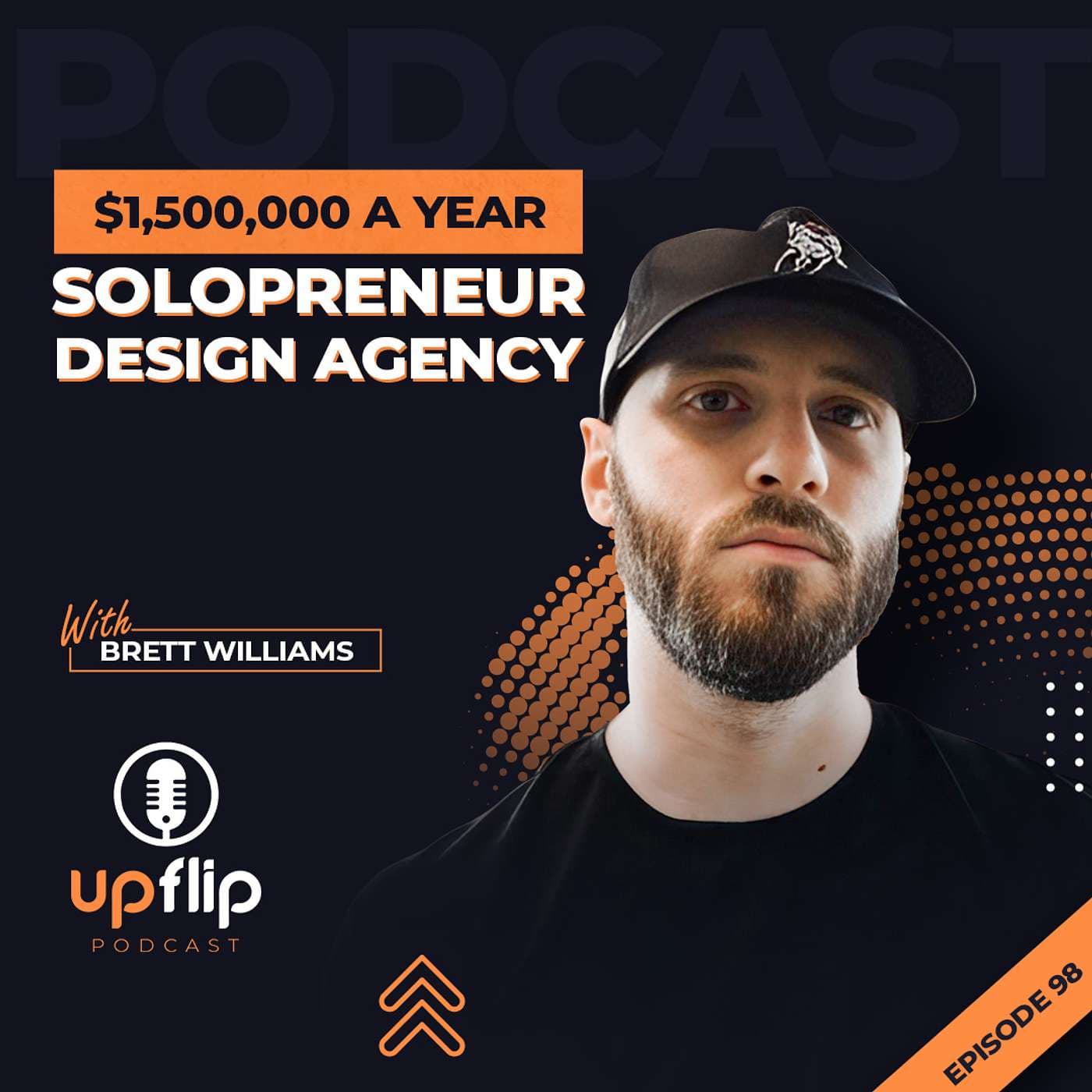
The UpFlip Podcast Episode 98: Side Hustle to $1M+ Solopreneur Business
Episode Overview
In this episode, host and guest Brett Williams discuss his journey from starting DesignJoy as a side hustle in 2017 to scaling it into a $1.5 million per year agency, all while operating as a solopreneur. Brett shares insights on how to effectively run and scale a design agency, the innovative strategies he implemented to reduce his workload, and the essential mistakes he learned from along the way.
Key Topics and Insights
Starting the Business
- Initial Launch:
- Brett launched DesignJoy quickly, with the idea struck on a Friday and a website live by Sunday.
- Focused on filling a market gap for high-quality, fast, and reliable design services that were otherwise expensive or unreliable.
Transitioning to Full-Time
- Realization of Potential:
- It took Brett two and a half years to transition from side hustle to a full-time business, driven by exponential growth and a gut feeling that it was the right time to make the leap.
- Financial Stability:
- Brett waited until he was financially comfortable before fully committing to the business.
Business Model and Pricing
- Subscription-Based Design:
- Created a subscription service to provide unlimited design requests for a fixed monthly fee, setting it apart from traditional freelancing or agency models.
- Demand-Based Pricing:
- Started with a low price of $449/month to attract clients, then gradually increased prices based on demand, currently ranging from $5,000 to $8,000/month.
- Client Retention:
- Existing clients maintained lower prices despite increases for new clients, fostering loyalty.
Challenges and Growth
- Workload Management:
- Initially worked 12-hour days but learned to scale the business effectively, cutting work hours down to around six per day while maintaining revenue.
- Client Selection:
- Focused on a selective client base, allowing Brett to work with clients that align with his strengths and manage demand more effectively.
Marketing and Customer Acquisition
- Product Hunt Launch:
- Utilized Product Hunt for initial visibility; leveraged social media (e.g., Twitter) for brand awareness and customer engagement.
- Organic Growth:
- Relied on word-of-mouth and organic strategies rather than paid advertising to grow the business.
Key Takeaways
- Innovative Business Models:
- Being flexible and innovative in the business approach can fill existing gaps in the market.
- Adjusting Strategies:
- Understanding when to pivot, particularly in pricing and client management, is essential for sustainable growth.
- Work-Life Balance:
- It’s crucial to manage workload and client expectations to avoid burnout.
- Community and Networking:
- Engaging with entrepreneurial communities on platforms like Twitter can provide valuable insights and support.
Tools and Resources
- Design Tools:
- Uses Figma, Webflow, Adobe products (Photoshop, Illustrator), and Shutterstock for design work.
- Course Release:
- Brett created a course, "Productize Yourself," to help others learn from his experiences and streamline their business processes.
Final Thoughts Brett emphasizes the importance of focusing on one's strengths, simplifying business processes, and adapting to market demands as key strategies for success as a solopreneur.
Additional Resources
- Designjoy Website: [designjoy.co](https://www.designjoy.co)
- UpFlip Podcast: [UpFlip YouTube Channel](https://www.youtube.com/@TheUpFlipPodcast/)
- Franchise Guide: [Unlock Proven Business Models](https://bit.ly/4aWuGvc)
Connect with UpFlip
- [UpFlip on Instagram](https://www.instagram.com/upflip/)
- [UpFlip on Facebook](https://www.facebook.com/upflipofficial)
- [UpFlip on Twitter](https://twitter.com/upflipofficial)
---
This episode is a rich resource for aspiring entrepreneurs, especially those interested in the design industry or solopreneurship. Brett’s real-life experiences and strategies provide practical insights into building a successful business from the ground up.
Written by AI. May contain mistakes. Listen to the episode to check what was said.
Transcript
Automatic transcript. May contain errors.0:00Starting a solo design business can be a grind. Brett Williams knows this firsthand. After three years of working 12-hour days, he pivoted to an innovative business model that cut his work time in half and scaled his revenue to$1.5 million per year. It closed the door to one type of client, opened the door to another, and now all of a sudden I'm a cheap option, which tends to be pretty popular. I have 50 other people in the pipeline, so I can be highly, highly selective with who I allow in. what I call demand-based pricing. So as demand increased, which it did very quickly for Design Joy, so did my prices.
0:34And that's where I land today at about$5 ,000 a month to$8 ,000 a month, depending on the plan. And that's what's fueled the growth at every stage. Wondering how Brett did it? Keep listening to learn the secret to scaling as a solopreneur without sacrificing your work-life balance. Brett, welcome to the show. Thanks for joining us. Hey, thanks so much for having me. It's a pleasure. So to kind of kick us off, when and how did you start DesignJoy? Yes, so I actually started it way back in the summer of 2017. The idea actually, funny enough, struck me on a Friday. By the next day, Saturday, I had a website stood up and launched the following Sunday.
1:10So it had all happened that quick. I love that. I love that. And so talk to me about the idea for subscription-based design. How did you kind of determine the viability of that as an idea? Yeah. So, I mean, you really today have three options. You can either hire an internal designer, which comes at a cost and risk. You can work with freelancers, which can sometimes be a little bit unreliable, or you can work with agencies that are notoriously expensive and slow. So yeah, the idea for this subscription-based design service was sort of born out of, I think, a gap in the market that existed for those that want really high quality design work done very quickly and very predictably and reliably.
1:47Yeah, that's where kind of design joy was born. And I want to go back to that. Had the idea, get the website up and suddenly you're off and running. I know that you started in this field as a side hustle. When did you realize it was time for it to be a full time business? It wasn't until running it for literally two and a half years. I say on the side, I would say it took up probably as much or if not more than my full time job. I oftentimes joke that I did most of my work for my full time job just during Zoom calls and the rest was devoted to Design Joy. So yeah, having done it for two and a half years, at some point, I had that feeling in my gut.
2:22It was mathematically, I should have made the jump a lot sooner, but I missed that sort of gut feeling that it was time. But looking back, things had just grown so exponentially, and it actually proved to be somewhat sustainable. That was what I was fearful of the whole time it all happened so fast, I thought it could also disappear just as quickly. So I wanted to give it due time, probably more than enough time to make sure that this was something that was going to stick around that the market actually needed long term and wasn't just some sort of trend that pops up. And so, yeah, I made the jump when I was making plenty of money, had plenty of money saved up and just sort of prove the business model thoroughly, I would say.
2:54And talk to me about the business model. You know, what you're doing at DesignJoy was not necessarily an everyday thing, an everyday occurrence. So what was the biggest challenge of kind of building out a new business model that hadn't fully yet been tested yet? Yeah, it was a ride. So yeah, most businesses being created today have somewhat of a blueprint to follow. You can look to individuals or companies and see what they've done in the past that's worked, look at their processes, look at their mistakes and learn from them. I unfortunately didn't really have that. No one had ever applied this model to web design and to branding and that sort of thing.
3:27And so I sort of had to just take a lot of shots in the dark and hope that I hit something. And luckily for me, I did. But that was definitely the hardest part. There was no one really talked to. The few people that I did run the idea by just really picked it apart, didn't think it could scale, didn't think it would last. And so I was faced with a lot of adversity from those that I would normally seek wisdom in. And so, yeah, I just went forward. I took as little risks as I possibly could. And it obviously worked out for me. We're definitely going to dive into kind of the way in which you've scaled the business.
3:55But I want to stay in the startup moment for just a couple more questions. One of them being, I guess, what were the startup costs to get the company off the ground? And what are the kind of the main expenses that somebody should be thinking about if they also want to go into kind of this design field? Yeah, so I'll reiterate, it is just me that runs this business. So the only expenses that I incur is really monetary expensive anyways, is tools that I use. So to get up and running, I mean, I basically use the free version of most tools. The only cost that I incurred was a$29 charge for Webflow, which Webflow is like Squarespace or Wix.
4:30If you've seen the commercials, that's basically a glorified version of it for more premium web designers. And so I just stood up a page there, only cost me 29 bucks to do. and that was all it took to actually launch the business. Wow, that is a nice low-cost point of entry. I love that. Are there any other particular things that people should keep in mind when setting up something that is subscription-based as opposed to just providing the service for a fee? The hardest part is really managing expectations when price isn't fixated to a particular single job and it's more this sort of unlimited model where you could get five requests or 10 requests done depending on the nature and scope of those requests.
5:07It's very difficult to manage everyone's expectations. But I always tell people probably the best thing to do is to figure out what you do today that you're very good at and also very fast at. It's not good enough to just be good at something and then sell it as a subscription. You also need to be fast at it, which might mean getting rid of the things that you're good at, but you can't do as quickly. And so you can't take on as many clients. You can't manage those expectations good enough. You know, it was difficult for me. I realized that I do have limitations, that there are things that I'm better at than others.
5:36But that's the winning recipe to a successful one is just sticking to the things that you're good and fast at. I want to hear a little bit more about kind of how you have gone about pricing the subscription. I'm sure you probably weren't perfect at it right away, but have learned some things along the way. So how did you go about doing that? Yeah, this was one of the, it's always the tricky thing. How do you price your services? For me, again, I had no roadmap, had nothing to reference. So I thought the best course of action in my main goal was really just to get clients, whatever that took, even if it meant underselling myself and devaluing my work.
6:08So I actually went to market with just a$449 a month price tag. I knew that with my senior level experience that would attract a lot of people. The most difficult part was actually just getting people to believe that it wasn't too good to be true. So I had no problem getting clients early on. And then what I did from there was basically just institute what I call demand-based pricing. So as demand increased, which it did very quickly for DesignJoy, so did my prices. And that's where I land today at about$5 ,000 a month to$8 ,000 a month, depending on the plan. So it was quite a jump. It was quite a journey to get to that point with several incremental increases along the way, just based on demand.
6:43But I think that early on low price point was what really kind of kickstarted the whole thing. Listeners, if you're looking for more advice on how to get started, check out the ultimate guide on how to start a business on the Upflip blog. The link is in the show notes. Brett, how did you go about handling those price increases with the clients who had come in at the lower price point? Did you raise the price on them? How did all that unfold as prices went up? I wouldn't consider this necessarily good business practice, but when I don't have to account for profitability because I'm the only one doing the work, I actually allowed you to keep your price.
7:17So I still today have clients that are paying a quarter or fraction of what clients that sign up now are. So anytime I increase my prices, that was really only applicable to those that were signing up in the future. It did not affect or never did affect existing clients. So that's the way that I chose to do it. That did create some very loyal clients for me. And, you know, to be honest, they're not too difficult to work with anyways. And if they were, then I would definitely entertain increasing that price or just getting rid of them altogether. But that's how I personally handled it. I was going to say, has that helped with both, I guess, retention and maybe getting a client that's like looking ahead and saying, oh, I probably don't need as much of these services in the next two months.
7:53But if I leave, I'm going to come in at a significantly higher price. Has that kind of helped smooth that out? It has. I haven't necessarily heard from the client's mouth that that's the case, but I have noticed several companies that really don't utilize DesignJoy at all, maybe one or two requests a month, but they're at, you know, let's say a$2 ,500 a month price point. They know that if they were to cancel their subscription, that would go away. So it's the convenience of having it there for so little of their budget. And then I will have future price increases as well. So it even keeps the clients that I have today kind of on point and sticking around in case they want to come back three months and it's an extra two grand more.
8:26It does help with retention. I'm assuming. I think it's a safe bet, but yeah. What were kind of those revenue numbers in the first year of business and how have those grown to where you're at today? Yeah. So the first year, again, keep in mind, I have a full-time job. This is never really intended to be a company. So it was really just a way to generate some side income for me. It was around$5 ,000 or$6 ,000 a month tops, honestly, for the first almost three years, which to me was really, really good side income. It was actually a little bit more than I was making in my full-time job. And then, yeah, that year three things just, lack of better words, absolutely exploded.
9:01Why do you think that was? I mean, obviously, part of it going actually full time as opposed to, you know, full time at one place, full time at another place. But what do you think kind of factored into that big growth for you? My theory is kind of a couple of things, but it did happen coincidentally around the time of COVID. So that March. And I think that people just kind of took a step back. A lot of people went home and had all kinds of time all of a sudden to live out their dreams of building businesses and things and on the side and whatnot. And DesignJoy was just sort of there. You didn't need any contracts.
9:30It was very affordable. And so I think it was a combination of the time had finally come. I think a lot of entrepreneurs, me included, I have a history of this, of creating businesses a little bit too early. And then hopefully if you stick around, then their time comes. I think that was part of it. The other part of it, that it did happen around the time that COVID hit the U.S. So I think a lot of people had a lot of extra time on their hands to work on some side projects. And that was the majority of what I worked on in the beginning was, you know, what you call indie hackers, just cranking things out on the side of their full time job.
9:57And DesignJoy kind of existed as that easy means of getting really good design work done. And so one thing led to another word of mouth spread that DesignJoy was out there, that this model existed. And it just sort of compounded over the next just few months. Revenue just went wild. Now, as you've grown, how have you grown the business while also cutting back maybe the amount of hours that you're working and not just suddenly adding in more hours upon hours of work? That's been the number one challenge with this business. The challenge is not getting leads, getting clients, which is really the biggest challenge of most agencies and freelancers.
10:33It's actually the opposite problem in that it's kind of curbing demand and handling all of the clients that want in the door. And so, yeah, I just basically raised prices incrementally. And funny enough, I thought that that would actually help to kind of lessen demand. But it funny enough had the opposite reaction a lot of times. But in doing so, in raising my prices, it equated in much better clients who were far less needy, way easier to work with. They were kind of aligned with my strengths. And so it was really kind of a gatekeeping my client list was what contributed to me going from working 12 hours a day to now about six hours a day.
11:04It's just a totally different client base altogether. together. Now, I'm interested in the not necessarily experiencing a demand drop at the higher price points. What do you attribute that to? You know, when I launched at$449 a month and got to, let's say,$2 ,000, I stayed at$2 ,000 a month for a long time. For someone that was just starting out, that was quite a bit of money to put down on a subscription when people were just paying it out of their personal bank accounts. But you think that you should charge more than you'll kind of rid yourself of those clients, which you do, but you open yourself up to a whole new host of clients.
11:35So now all of a sudden at 5k a month, someone could look and say that looks very, very expensive. But to a company who's used to paying, you know, senior level designers, let's say$120 ,000 a year. Now all of a sudden, you know,$60 ,000,$70 ,000 a year is on the cheap end. So even at 5k, I'm right at the floor of what I could be at, but I'm comfortable. So I don't need to tweak it just yet. But it closed the door to one type of client, opened the door to another. And now all of a sudden I'm a cheap option, which tends to be pretty popular. Now, how did you manage your stress levels when you were working those just exceedingly long days and keep yourself from getting burnt out?
12:13It was tough. I mean, I had never in my life, I mean, I had built businesses before, had stressful jobs, never experienced anything quite like that. You know, the saying drinking out of a fire hose could not have been more accurate. It was really tough. I mean, luckily I had my wife there. She would come in at night and make dinner and sit by me as I worked at my desk and just had a lot of support from her. And she just, you know, helped me out with organizing things and doing this and that. Other than that, it was just pure grit, like had my head down, hustled through it as fast as I possibly could.
12:43Woke up the next day, did it all over again until I just burnt out eventually. Do you ever consider growing a team to help out? That's sort of the number one question I get. I actually just consider myself a designer. I know I run a pretty popular big business, but at the end of the day, hey, I just like to do design work. I don't like to manage people. And I think a lot of people equate hiring employees with reducing stress. If you talk to many people who have a bunch of employees, it's not always that perfect. Sometimes they can actually increase stress and cause more issues. And so I just like to wake up in the morning and worry about myself.
13:16I like to be able to adjust things when I need to adjust things without having to run things by other people and figure out how it affects them. I've always just desired to run this thing myself. And in doing so for so long, I've just figured it out. the point where now I'm only working a few hours a day and I like what I do. So it's kind of pointless to even explore the idea of hiring. What would you describe as the biggest mistake you made while you were growing the business and what you learned from it? Absolutely. Yeah. Undoubtedly related to that last answer was not knowing when enough was enough.
13:44The subscriptions rolled in every day. It's hard when someone's waving several thousand dollars in your face all the time and you want to say yes to everybody and then you let them in and you look back and you think there's no way I can handle this. And it did cause me a lot of stress, a lot of pain for a good year and a half, two years. So now that I've learned how to approach this a little differently and not let sort of money drive all of my decisions, that's helped a lot. But yeah, it was really just not knowing when enough was enough and realizing that, you know, I'm only human. There's only so much I can do.
14:15This is going to bring us to a portion of the show that we call our fan blitz questions. These questions come from our YouTube community listeners. You You can go over to youtube.com slash upflip, join the community and post questions to future podcast guests. Right. I got about five questions here. We're going to try and get through in about 90 seconds. Are you ready? I'm ready. All right. First one here. What's the best part of being an entrepreneur? Definitely not having to answer to anyone. What's the worst part? I think for me, it's probably the pressure that comes along with self-reliance.
14:45If something happened to you, what happens to the business? We definitely probably sell the business. If you were to sell the business, what's the market price? That's hard to put a price on because I'm the sole employee, but I probably wouldn't let it go for any less than four or five million if I'm alive when that happens. In three words, what would you like to tell the naysayers now that you've made it this far? Told you so. Love it. Last one here. Given the power, what's one thing you would like to make illegal immediately? Probably driving in the left lane when you're not passing. Really random.
15:19I'm from Missouri. That's illegal. But out here in Arizona, it's not. And it annoys me. I love that. I love that. That's going to do it for our family questions. Listeners, if you're new to the show, hit that follow button in the podcast app that you are listening right now so that you can get new episodes of the Uplip podcast every Monday and discover how great businesses are built. Brett, how did it feel to hit the$1 million milestone as a solopreneur? It was cool for the day. Not nearly as cool as you think it's going to be when you start out and not even really thinking that that was a possibility.
15:51But I would say that that feeling lasted probably a few hours and then I got back to work. It still feels right now the same as when I made 10K a month, if not even worse, because it was actually more exciting back then to hit that mark than the million mark, I think. What has changed in the business since reaching that revenue level or in your life? Time management, for sure. Other than that, I mean, the business actually, if you were to look at it on paper and processes and tools that I use actually looks exactly the same as when I launched it. You know, the price is obviously increased, but the way that I manage my time and the focus that I have has definitely gotten better and gets better every day that I do this.
16:26But marginally, it's really quite the same as it was before. What are those tools that you're using to kind of manage the business? It's about four or five different tools. So obviously I have Figma, which is just a browser based design tool for digital designs, Webflow, which I mentioned earlier, which is basically just a no code website builder, Adobe products like Photoshop and Illustrator. And then my biggest expense is Shutterstock, which is just a stock photography site. But other than that, that's pretty much all I use. As you've scaled the business, what are some of the new challenges that have arrived to you as you've now are a solopreneur running a seven figure business?
17:00I mean, I do occasionally have to fire clients. That's always a challenge because I've built something that's really good and you have to protect it. And as agency owners know, kind of letting one bad client in can kind of contaminate the whole system. And so figuring out ways to navigate that and work with clients to adjust or let them go is always sort of a challenge. And I still deal with what I mentioned earlier about growth. You know, I'll have periods of time where there'll just be an influx of interest in DesignJoy and managing that, figuring out how to run a proper wait list and meet expectations is difficult.
17:30when you want to be there for everybody. But yeah, that's kind of the main thing. To be honest with you right now, I'm pretty smooth sailing without a lot of challenges just because I've been doing it for six years. How do you know when it's time to fire a client? It comes at different times. So fortunately for me, I don't require, but I do have a call with clients before they sign up. One of the unique things about DesignJoy is I don't have any meetings with clients, but if you're interested in signing up, you're probably going to want to talk to me before you drop$5 ,000 on a credit card. And so during those calls, I do screen clients quite heavily to figure out if they're a good fit.
18:00But occasionally, you do have clients who just out of the blue sign up without talking to you. Their very first request is sometimes evident that they're not going to be a fit for DesignJoy because maybe it's out of scope. It doesn't play to my strengths. They clearly can't communicate their needs properly, which is important to move fast. And so most of the time, it's their first request that I can identify and know that they're not the right fit. And even if they're maybe not the right fit, I have 50 other people in the pipeline so I can be highly, highly selective with who I allow. in. And sometimes I'm wrong.
18:30Sometimes I'm right, I'm sure. But usually it's that early gut feeling indication when they submit their first sort of design request. Do you have any advice for how to handle the conversation when you have to fire a client? And I want to say I'm cutthroat, but I'm just very upfront, right? It's like my conversation usually goes, hey, based on this request, I don't think that DesignJour is going to be the right partner for you. I oftentimes recommend them alternatives, whether it's in the subscription space. Sometimes it's evident they need someone internally. So I'm still helpful, but I don't beat around the bush whatsoever.
18:57I usually don't try to let them conform to my systems. It's usually kind of right away letting them go, but letting them go with helping them in whatever direction they need. Now, as you look back, what do you think was your smartest business move? Without question, charging more. It's not even close. I really haven't done anything else other than that. And that's what's fueled the growth at every stage. It's literally not close. I want to kind of shift things to the marketing side of things and kind of keeping customers in that pipeline. But I want to go back to that startup moment. How did you go about attracting those first customers to DesignJoy?
19:28Like I mentioned, I built it on Friday, or I had the idea on Friday, built it on Saturday and launched on Sunday. And by launch, what I did was I actually used a tool called Product Hunt. For those that don't know, it's essentially, if you're a digital product geek like me and you're into software and different business tools online, Product Hunt is basically a platform that you could submit your new company to and gather sort of upvotes, kind of like Reddit, the upvote system in there. You get friends and family. if you have a Twitter following, get there and upvote your product. If you make it to the top of the list onto the homepage, you often experience a lot of success, a lot of website visits, a lot of those convert.
20:03And so that's what I did with Design Joy. I just used literally my Facebook friends and family to get on there and give me some upvotes, made it to number four. And I got clients that very night and that never really slowed down from there. I rode that product hunt wave for the next three years, which is why revenue was sort of low, but sustainable. You have successfully built a very strong brand. So what are the key ingredients to an effective company brand? That's a good question. I mean, I'd say all of the cliche, normal things like aesthetics and messaging and how you're different than others and the personality.
20:36I think for me, what made my DesignJoy brand successful was not only those things, you know, people loved the brand, people love all the funky shapes on the site and the funny messaging, right? But there was a face to Design Joy and that face was me, which was very unique for an agency. It's usually, you know, you look at an agency and there's these kind of faceless team behind the scenes. But with Design Joy, it was sold as, you know, you're working directly with Brett. And I was the brand. I built a personal brand on Twitter and did a bunch of things around that. And that contributed highly to my success.
21:07So yeah, I'd say it's a combination of a lot of things. So you've got more than 56 ,000 followers over on Twitter or X. What's your secret to growing that audience on Twitter? Yeah, I mean, I got a helpful boost, so I didn't actually make my first tweet until last February. So I'm still fairly new at Twitter, still trying to kind of figure it out. But the boost was someone else shared DesignJoy's story on there that had a following. I immediately jumped on the opportunity, got on there, started sort of answering questions and whatnot. Got a few hundred followers that way and then actually just opened up the doors to DesignJoy.
Read the full transcript
21:36started sharing insights and behind the scenes, look at my Trello boards and all the sorts of tools and systems that I use to run and manage, you know, 20, 30 clients at a time, which, you know, is a very kind of elusive model and people can't really wrap their brain around it. So when I'm sharing things in public, people are interested. And so that's what I've done and haven't stopped doing since. And that's what's contributed to that. Do you use any other social media platforms for your marketing? Not necessarily. I mean, I guess you could consider indiehackers.com maybe a social platform. It's more of a form site, but that's what I wrote publicly on early on for the first four to five years of running DesignJoy when I didn't have Twitter.
22:09And basically there, I would do the very similar thing, but more in long form content. And that's the only other platform that I really used. What about paid advertising? Any paid as part of your strategy? Zero paid advertising at all. Have you ever run a paid campaign or has it all been organic? Not for DesignJoy, no. I've done them in the past for other businesses, but DesignJoy, like I said, I've actually had the opposite problem. So I haven't fortunately had to do that yet. So you also mentioned that sort of screening meeting, I guess, for lack of a better word, for potential new clients to design joy.
22:38What else are you doing to kind of follow up with leads and convert them into customers or I guess convert them away from customers as you have such high demand? This is going to sound kind of silly, but I really don't do any of the things that I'm supposed to be doing from a funnel perspective and following up. You know, occasionally when clients don't show up to a call that they have scheduled as like a demo, I'll oftentimes, you know, sometimes I guess follow up via email. But other than that, there's just such high demand that I can sort of neglect a lot of those things that other businesses typically have to do to get people to convert.
23:09So yeah, I mean, the short answer is I really don't do a whole lot, to be honest with you. I love that for you. And I love that for everyone who can do that. Every business owner has various strengths and weaknesses. How do you identify what your particular strengths and weaknesses are and make sure that you play to your strengths as a solopreneur? I don't get into anything that I'm not familiar with. So that's one reason why I haven't run paid ads because I'm just not familiar with it. So I've just gotten really comfortable with what my strengths are. And I've just honed in on those 100 ,000 % and don't even entertain anything that plays to my weaknesses.
23:44That may not be the appropriate response. I think sometimes you can work on your weaknesses and practice and get better with them. But with DesignJu, I really quite honestly don't have time to do those things. So I just let my strengths sort of ride, take me through and don't do anything or even entertain doing anything that plays to my weaknesses through Design Joy. Now, one reason a lot of entrepreneurs end up building at least a small team is because there are things that they either like really don't like to do or they're not particularly great at but have to happen. How do you fill those gaps without a team?
24:15Yeah, again, not the conventional answer, but I'll be the first to admit there are many things that I always say like I'm the worst million dollar business owner in history. Like I don't do anything like I don't do email campaigns. Normally you'd have someone do email campaigns. I don't do paid marketing. Normally you'd have that, right? Like you'd have lead gen flows out there and this and that. You'd have obviously design help. You'd have anyone in my position would probably have a project manager managing 20 or 30 projects at a time. I just get away without doing those things because I actually just cut out all of that.
24:49I don't think that you need all of those things to run a successful solo business. Sure, if I have a team, I'm going to need a lead gen funnel like ASAP to make sure that I constantly have revenue coming through and don't rely on just happenstance and word of mouth. But being just self-reliant without any employees, I just get away without doing those things. What do you do for support when you're looking for advice in the business, looking for a fresh set of ears on what you should do in any given situation? Where do you turn as there's nobody else in the C-suite with you? I mean, the primary place is Twitter, especially since joining, you know, and before that it was the IndiAcker community.
25:24But certainly Twitter nowadays has connected me with some just amazing entrepreneurs that I've gotten on Zoom and talked with extensively, several of them. And yeah, and people are never really shy to share their opinions and ideas on Twitter when I create a, or X, whatever you want to call it, when I tweet or post on there. And I've actually taken a lot of people up. That's partially why I've increased my prices a few times and changed some language on my site and whatnot. So I've learned a lot just by listening to people that are interested in what I'm doing and just so uprightly just share what their thoughts are.
25:54Other than that, yeah, I could probably definitely interact with and engage with other entrepreneurs more to gain a little bit more wisdom, but my head's so stuck in the business right now, just making it run that I did kind of neglect that a little bit. You also recently released a course, Productize Yourself. I want to give you a chance to talk about the course itself. But first, I have to ask you, how did you have the time to develop a course while being a solopreneur of a million dollar business? I put it off for several years, so I didn't really have the time. Yeah, it was actually just a meeting.
26:22I meet with my brother-in-law sometimes in the morning to talk about business, and he actually just pushed me to do it. I thought, OK, if I'm going to do it, I have to do it my way, right, because I don't have a lot of time. And it's going to be very contrary to how most people build courses out. And so I just went into my car with a microphone and just basically recorded casual conversations with myself regarding Design Joy and the ins and outs of running it and released it just on a whim. So it wasn't the production value that I wanted. It probably wasn't the thought and effort that I wanted to put into it.
26:48But it was sort of my true feelings on how I run things and the behind the scenes looks at things. And that's what I did. I did it my way so I could get it out. Otherwise, it would have never been released. And what was, I mean, obviously pushed by the brother-in-law to make it happen, but what was the sort of impetus to add it to the business to actually make it happen? I had been doing one-on-one calls. Obviously, again, DesignJoy is very elusive in the sense of how it actually works. And so a lot of people are interested and willing to pay money to speak with me. And every time I opened up one-on-one call opportunities, they always filled up really fast.
27:19And I found myself doing these two-hour sessions with individuals one-on-one. And, you know, I kind of want to move from like passion to purpose and actually helping people grow these things. And so this course was sort of the way to do that at scale, which is often course people say. But, yeah, it was the only way to reach the masses and reach thousands of people with that information and do it all in one whack. And so it was just a better use of my time getting things organized. And it was kind of a little bit of fun. And, yeah, it provided a lot of self-reflection on what I was doing, too. You really just to spread the awareness and sort of the knowledge of my business at scale.
27:52You know, they always say that the best way to actually understand a concept is to try and teach the concept. So I'm curious what in the course of creating the course, did you end up teaching yourself or realizing about the business that maybe you hadn't ever put into words? There's nothing that comes to mind necessarily during the process of recording those sessions. But I did, funny enough, learn quite a bit of things from the community that I built of people questioning why I was doing certain things. I have a way of just going, picking one direction and just going down it, not looking back or looking at other options.
28:21And so there were several things. One prime example was just the way I was using for payment processing. Like I was using this tool on top of Stripe, which had its own 2 % fee. So I was literally paying probably$40 ,000 or$50 ,000 a year in fees to this other service on top of all my Stripe fees. And they're like, why don't you just bypass that and use Stripe's checkout tool? And so I'm like, I don't know. Why don't I do that? So I like deleted that part of the course and recorded it and switched that. It saved me probably$40 ,000 or$50 ,000 a year just on that one comment in Discord. So there's a few things like that that have come up that luckily I read and noticed and acted on.
28:54I love that. What's the number one piece of advice that you would give to other solo entrepreneurs? I always tell people like everyone just always wants to overcomplicate things when creating a business. To create a business like this, I mean, I'm not going to speak on any other businesses. This is my area of expertise and probably not good at anything else. So yeah, I would say like, again, going back to what I said earlier in the podcast, like choose the thing that you're already doing today, that you're doing good, do it fast. quickly stand up a website, don't invest a lot of money or time into it, and then create your packages around some sort of Netflix style subscription around it and put it out there and see what happens.
29:25Brett, what's your favorite business book and why? I don't read a lot of business books, but the one I read probably about three years back when I was really kind of in a tough place was Company of One by Paul Jarvis. Love that. Brett, where can people connect with you and learn more about you and DesignJoy? Yeah, I mean, you can obviously check out designjoy.co.co or follow me on Twitter. I believe my handle is Brett from DJ. So yeah, you can follow me on there as well. That is going to do it for this episode of the Upflip podcast. Listeners, if you liked this episode, make sure to check out episode 76 featuring Chris Dew of the future in the show notes and learn how to make$4.8 million a year by doing what you love.
30:03Please leave us a rating on Apple Podcasts and Spotify to help other aspiring entrepreneurs discover the upflip podcast and we will see you next week brett williams of design joy thanks so much for joining us yeah thanks for having me it's been a blast
From the publisher
Designjoy started as a side hustle in 2017. Now, it’s a $1.5 million a year agency–and Brett Williams still runs it as a solopreneur. He’ll share how to start a design agency and scale it to 7 figures in this interview.
Brett’s life with Designjoy wasn’t smooth sailing from the outset. His workload was a big problem for his first three years, when he was working 12-hour days and earning less than he should. That was when he unlocked how to scale a business the right way, making an innovative shift that sliced his work time in half and skyrocketed his revenue.
A design agency can be among the best solopreneur business ideas–if you know how to run and scale it the right way. Brett will share the mistakes he made early on and how he adjusted to choose better clients, letting him cut down on his workload while increasing his revenue.
Resources:
- https://bit.ly/3YC5WUj Launch your business today
- Designjoy.co - Learn more about the business at their website
Ready to be your own boss without starting from scratch? Grab our FREE Franchise Guide and unlock the secrets of proven business models that have already created thousands of success stories.
Connect with UpFlip:
- On Youtube
- On Instagram
- On Facebook
- @UpFlipOfficial on Twitter
For more insights to start, build, or grow a business, check out the resources on UpFlip.com or head to the UpFlip YouTube channel to see more interviews with business owners and experts.
Thanks for listening!


