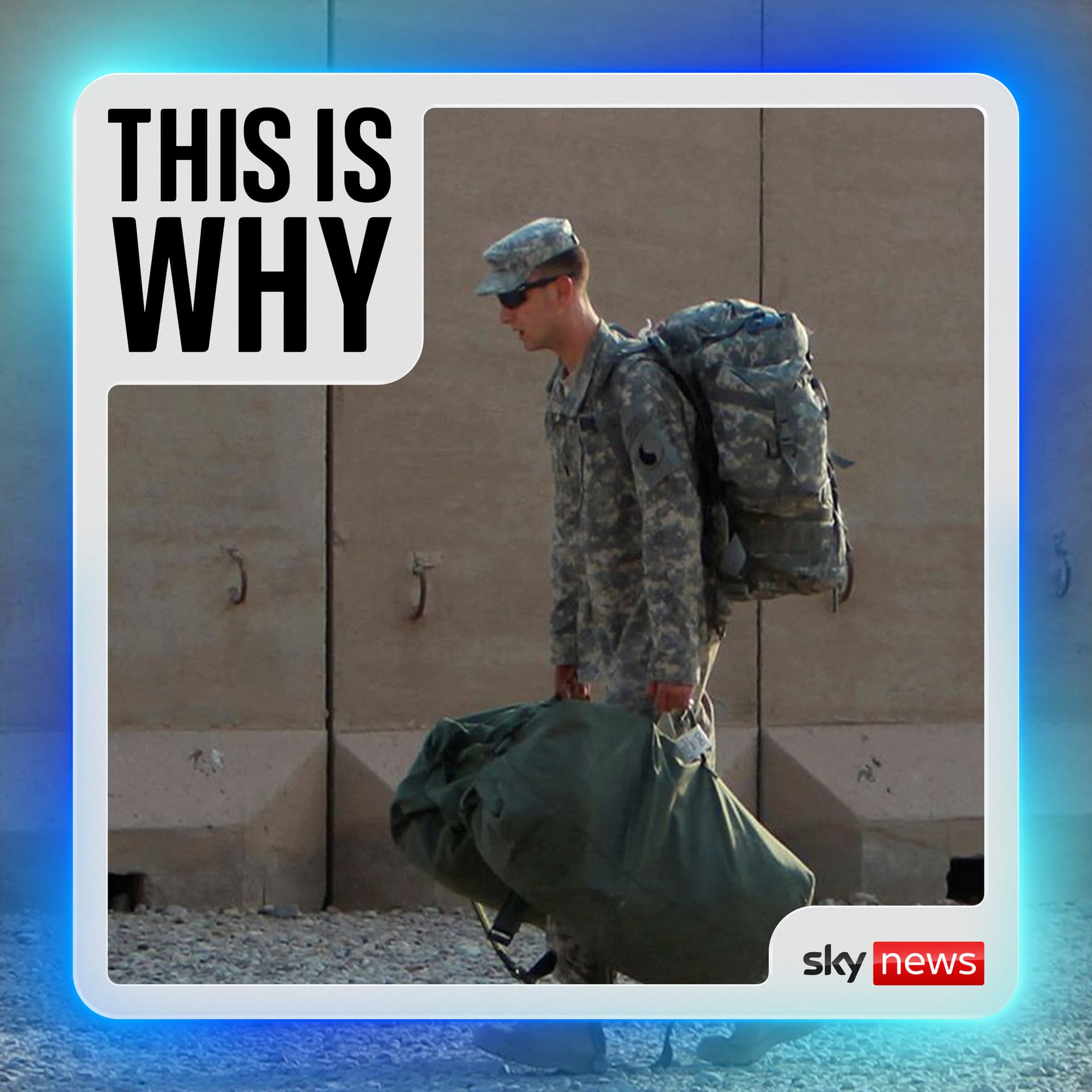
In short
Surging oil prices and a jet-fuel supply squeeze are forcing airlines to cancel or cut flights, potentially affecting summer holiday travel.
Guests
Paul Kelso, Sky News business correspondent (explains jet-fuel pricing/supply). Hosts also referenced: Sam Coates (Sky News) and Anne McElvoy (Politico), plus analyst Kepler (data) and mention of Ed Conway’s tanker research.
Key claims
Brent crude hit about $126; jet fuel/kerosene is ~99% higher than a year ago and has more than doubled. The Strait of Hormuz limits Gulf exports (~20% of normal oil supply), and China imposed a jet-fuel export ban. A ~600,000 barrels/day global gap is being covered by “jet fuel at sea” tankers, but reserves are low—UK has just over a month; NW Europe about 50 days, projected to fall to a week.
Notable examples
Lufthansa cut ~20,000 flights (~5% capacity). Airlines may reduce unprofitable short-haul routes (e.g., Heathrow–Newcastle frequency reductions). Advice: booked trips should be honored, but flights may be rearranged/cancelled.
Written by AI. May contain mistakes. Listen to the episode to check what was said.
Chapters
Tap a time to open that second in VOImpact of Surging Oil Prices on Summer Travel
0:54 to 1:58
Discussion on how rising oil prices affect jet fuel supply and summer holidays.
“and in the least surprising bit of breaking news ever, oil prices have once again surged.”
Understanding Jet Fuel and Supply Challenges
1:58 to 4:23
Explaining what jet fuel is and the current challenges in its supply.
“Paul Kelso, Eskai's business correspondent.”
Actual Shortages and Market Adjustments
4:23 to 8:30
Exploring the actual shortages of jet fuel and how the market is adjusting.
“there is still jet fuel either being produced in the places that can still get it out, sitting in tanks at airports and around the world that can be used.”
Future Prospects for Travelers
8:30 to 14:00
Advice for travelers amidst the uncertainty of flight availability and airline adjustments.
“I mean, the UK has among the lowest strategic reserves of any country in the developed world, lower than nearly all our European peers.”
Understanding Airline Responsibilities
14:00 to 14:46
Learn about airlines' obligations to adjust schedules and manage bookings.
“And the airline has an obligation to rearrange.”
Transcript
Automatic transcript. May contain errors.0:02Paul Kelso:Sky News, the full story first.
0:11Paul Kelso:Surging oil prices might just put the brakes on your summer holiday. And this is one.
0:21Paul Kelso:I'm Sam Coates from Sky News. And I'm Anne McElvoy from Politico. Downing Street drama, leadership battles and policy U-turns. We're on it before it breaks. We take you straight into the rooms where the real political conversations are happening. Smart Insight, clear analysis in your feeds by 7.45am. So you start your morning fully brief for the day ahead in British politics. Hit follow and listen to politics at Sam & Anne's wherever you get your podcasts.
0:53Paul Kelso:Hi everyone, Neil here. and in the least surprising bit of breaking news ever, oil prices have once again surged. The price of a barrel of Brent crude is, at the time of recording,$126. Now that's its highest price since the invasion of Ukraine four years ago. And whilst we're now all rather used to getting palpitations at the petrol pump, the next place you'll feel the effects of the Iran war is your summer holiday, thanks to jet fuel, or more accurately, a lack thereof. Global production at the moment, 5.7 million barrels. a day. Demand is 600 ,000 barrels a day, more than that. Airlines are already getting worried because a dwindling supply means, just like petrol, aviation fuel prices are also going doolally.
1:38Paul Kelso:Even more so, in fact. Volatility is almost an understatement. No oil-based product has gone up faster or further, relatively, than kerosene, than jet fuel. Not petrol, not diesel, not crude itself, but it's 99 % more expensive than it was a year ago. And as you're about to hear, we are already seeing the effects. So what will things look like by the time we're all ready to slap on the Factor 50? Paul Kelso, Eskai's business correspondent. Paul, right, basics here. When we say jet fuel, aviation fuel, what are we talking about? We are talking about kerosene. So it's a refined oil product. You make it from crude oil.
2:17in Britain. The statistics call it aviation turbine fuel. Jet fuel itself, which is largely made from kerosene, hasn't actually got an exact formula. You can use different constituents. It's judged effectively by its energy output, but it's the stuff that makes jet planes fly.
2:33Paul Kelso:I am assuming, given that it comes from crude, we might have seen a little bit of volatility in prices. Yeah, volatility is almost an understatement. No oil-based product has gone up faster or further relatively than kerosene, than jet fuel. Not petrol, not diesel, not crude itself. Prices more than doubled. They've exceeded the spikes that we saw when you'd expect. Familiar look at oil energy prices after the Ukraine war, after the financial crash back in 2007-8. It's effectively doubled in price at its peak. Last week's average price was$180 a barrel. That is It's slightly less, a couple of percent down on the week before and the month before, but it's 99 % more expensive than it was a year ago.
3:16Paul Kelso:And I'm assuming that this is in part due to reduced quantities of the stuff actually getting out. I mean, what are we talking in terms of the kind of consumption of ebullition? So the price of everything that's made from oil has gone up because of the supply shortage that has been caused by the blockage of the straightforward moves. 20 % of the world's normal oil supply, as we know, has come from there. But it's the first one to bump into genuine fears of a supply shortage. And that is because where refineries are, so there's a huge amount made in the Gulf, Kuwait, the UAE, Saudi Arabia is refined there and then shipped once it's made.
3:51Less refineries elsewhere means it's got to be made from the oil in the first place. So we're seeing that price increase in part because of the cost of crude, the raw material has gone up. But actually, there is this supply shortage that is genuinely starting to worry governments, airlines, and it's the first fuel product where there's a thought we might actually run out. So are we actually short of jet fuel, running out of jet fuel?
4:14Paul Kelso:Is there an actual shortfall? Or has it just got too expensive for airlines to buy? It is a combination of price and supply, but there is a genuine supply challenge. Right now, there is still jet fuel either being produced in the places that can still get it out, sitting in tanks at airports and around the world that can be used. So flights are still flying. I mean, you've got the European flights market. It's basically as it was, with some exceptions we can talk about. But there is an acute supply shortage caused by what's happening in the Gulf. There's an analyst called Kepler who provided these data to us.
4:48Global demand, if you exclude the Middle East and China, global production at the moment, 5.7 million barrels a day. Demand is 600 ,000 barrels a day, more than that. So the global market without the Middle East and China is short by about 600 ,000 barrels, about 10%. Why am I excluding the Middle East and China? Well, because the Middle East is effectively closed because of the Strait of Hormuz. So all that Gulf production isn't being exported. China is also out of those numbers because it's imposed an export ban on jet fuel to protect its domestic market. Now, in normal circumstances, together, the Gulf and Chinese exports more than fill that 600 ,000 barrels gap.
5:29But that tap has been turned off. Those taps are off. There is a gap which is putting pressure on the buffers, reserves that are held. And that is why it's being talked about by the European Union, by our own government at COBRA meetings and by airlines. big time airlines who are worrying where it's going to come from.
5:46Paul Kelso:So we can say with certainty there are regions that are going to be more desperately hit by all this. Yeah, and the Asian in common with the, Asia was the first part of the world to feel the impact of the closure of the Gulf. If you look at what airlines have done to cut capacity, which is the first thing you do, you try and get rid of the unprofitable flights, try and fly the same amount of passengers on fewer planes. Qatar Airlines, Etihad, which is the Abu Dhabi national carrier, down 20, 30 % in capacity cuts. But you look at the regional, the smaller airlines across Asia, they've all made, compared to normal times, they've made quite big cuts to capacity.
6:20But they're not alone. It is spreading to larger airlines and airlines in Europe and America as well in response to it. Because simply, there is this supply gap and there are buffers and there are things that have been done we can talk about. But it is not going away as long as China isn't exporting and the Gulf isn't exporting. Tell me more about these buffers. You know, we used to be talking about energy crisis, but this one is peeling more layers of the onion off. And one of them is, at the moment, it's been filled. And again, we're grateful to Kepler, who are trade analysts who've looked at this.
6:48The largest contributor to filling that gap, I said 600 ,000 barrels, nearly 500 ,000 barrels a day, certainly for the first seven, eight weeks of the war, has been filled by jet fuel at sea. It's literally jet fuel at sea. It is on vessels, it's on tankers, and it is either, and there's always a big quantity, tens of millions of barrels in normal times, floating about. It's either on its way to customers or it's perhaps hanging around. Our colleague Ed Conway did some work on this on one of the last tankers to make it out of the Gulf. You know, it's waiting around for a better price, which right now, if you've got a tanker full of jet fuel, you are in demand.
7:22So around nearly half a million barrels a day of that stock at sea has been drawn down to fill the buffer. But that stock at sea has, because it's not being replenished, vessels aren't coming out of the Gulf, it is dwindling. And if we did nothing in terms of imports and exports just based on what's being produced beyond China and the Middle East and consumed, that stock at sea is dwindling fast. And that's put pressure on that which is held on the land, strategic reserves and airports reserves and airlines reserves. So, you know, we're not short yet, but all the back pocket rainy day jet fuel, the down the back of the sofa, that is coming into play.
8:02And that is why this squeeze, which is worrying governments and airlines.
8:06Paul Kelso:Yeah, OK. But at some point, that's all going to run out. You know, if it's at sea, it will eventually get to land. So genuinely, and this is where we start to get a bit selfish in our line of questioning, are airports here in the United Kingdom at risk of running out of fuel? On the projections that you look at, if the market doesn't adjust, and we'll come on to this, markets adjust, right? That's what happens. Then reserves will dwindle. I mean, the UK has among the lowest strategic reserves of any country in the developed world, lower than nearly all our European peers. Take Japan, has 25 months of jet fuel in supply, more than two years worth.
8:44You know, that's a hell of a rainy day. They have got a lot. Europeans, typically three, four, five months. We've got just over a month's worth of supply. And again, that's it. Why is that? It's been either by deliberate policy choice or by omission. As we've discovered with so many things, we have low strategic reserves. Because there has been a bet, a couple of things have happened. We make much less than we used to. We used to have jet fuel refineries. Go back to 1998, the UK produced 80 % of our demand was refined in Britain. Today, it's about 25%. And it's a familiar story. Refineries have closed.
9:22Because COVID, there were lots of closures, lots of reasons for that, high energy costs, etc. So we have low strategic reserves and they are in time without a correction in the market going to come under pressure. And European stocks, there's one forecast, we've got about 50 days across northwestern Europe, which is our corner of the continent. That's standard at the moment. By September, if there isn't a correction and we'll come on to the correction, that'll be down to a week's worth. And that is not enough to maintain the equilibrium in the market and in prices. Okay, move on to and explain what you mean by correction.
9:55Paul Kelso:What is going to happen next? What happens when supply and demand are out of whack? Well, supply and demand change in this point. We haven't got enough supply. We expect demand to drop. How does demand drop? Price goes up, becomes too expensive to do. Well, at the moment, certainly in Europe, prices haven't gone crazy. That demand is still there. It's almost like the market isn't quite acting like it's going to have to. On the supply side, more is coming from elsewhere. So refineries in the US are doing well, as they are on all oil and gas products because they've got it and they're not blockaded.
10:27So more refineries, more from Nigeria. Refineries elsewhere in the world are going to switch up and try and make more. The problem is they are having to pay a great deal more for the crude oil. So that underwrites the prices. The other adjustment is quite technical in what airlines are doing. And it comes to how airlines run. They are essentially looking to rationalise and optimise their flight schedules. So we've already seen Lufthansa, second biggest carrier in Europe, cut 20 ,000 flights earlier this month. So to say it is, it's a big number, but it's actually, it's a big number, but it's only about 5 % of their capacity.
11:06And they're doing it simply because they're very explicit. Jet fuel's doubled in price, it saves 40 ,000 tonnes. But they say most of those flights, they're short haul European flights, and they're not profitable. I'll give you one. I mean, it's a personal example, and I can't speak to the exact economics of these flights. But I was looking at flying to the northeast, to Newcastle, in May half term. Need to go up there, one-way ticket. There are six flights a day from Heathrow to Newcastle. And I booked the cheapest, latest one, thinking this might be one of those flights that goes. because those flights I'm making, there's an educated guess here, they aren't full.
11:43They aren't all full. And probably the early one north on Monday morning and the late one south on Friday are really expensive and make money. But can you, again, I'm not speaking for British Airways here. I hope they don't cancel it. But can you turn six short-haul flights into three a day or four into two? And that is the sort of thing that will be done to make the fuel run longer and to make sure, essentially, again, you're trying to fly the same amount of passengers for less fuel.
12:09Paul Kelso:But here's the thing. You can get to Newcastle by other means, car, train, whatever. I'm wondering about those more remote parts of the United Kingdom, some of the Scottish islands where you certainly can't rely on the ferries, where flights are literally, almost literally, the only way of getting in and out. I mean, we're talking about some parts of the United Kingdom could be shut off to the rest. If we get to a point where jet fuel is in that short supply, But, you know, again, I've mentioned the government discussing this at Cobra meetings, that kind of strategic thinking you would hope is going on.
12:42And we saw this on some of the low cost airlines. We had that rash of closures a few years ago. That was the big worry, particularly the highlands and islands. So you would hope that would be looked after again. You know, lots of people care about their holidays, obviously. Short haul flights are where the pressure is. but airlines and holidays they have a huge amount at stake here in protecting what they have committed to and that's where this adjustment it it must come but there is a reason it's being discussed these are the reason that the energy commissioner of the european union has talked about and the head of the international energy actually six weeks supply and that is because that persistent gap in what's coming out of the gulf and china not exporting and how long it is
13:25Paul Kelso:taking to fill it okay paul time for you to whip out your crystal ball and tell me whether i will be whipping out the suntan lotion this summer i mean should people be actively considering whether or not to go abroad i hear scotland's very nice this time of year scotland's gorgeous at this time of year no midges yet as well getting there yeah yeah go book early to avoid um uh avoid disappointment uh all the advice is to continue as normal if you've booked you should expect your carrier and your holiday provider to honour that contract. What you can't rule out is that what you might have booked may be cancelled or rearranged.
14:05And the airline has an obligation to rearrange. So if the particular, we've talked about flights being optimised. If the one you're on, if they're turning, if they're thinning out schedules, they should move you on to another flight. And I think you have to proceed on the basis that the market will adjust. And you are going abroad until you absolutely know you're not. If you don't want any risk in your life and you want to enjoy the wonders of the United Kingdom, which plenty of people do, then go for it. But I think you could still, if an airline or holiday company is offering a flight and a holiday, you should take that in good faith and book it and hope this works through.
14:46Paul Kelso:And that's your lot for today. Do get in touch with your thoughts on today's episode and indeed any suggestions for future ones at why at sky.uk is the email. We're back tomorrow.
15:17Paul Kelso:where the real political conversations are happening. Smart Insight, clear analysis in your feeds by 7.45am. So you start your morning fully brief for the day ahead in British politics. Hit follow and listen to Politics at Sam & Anne's wherever you get your podcasts.
From the publisher
The war in Iran has led to fears of food shortages and fuelled forecourt price hikes – but is your summer holiday also in jeopardy?
The price of jet fuel has soared higher than any other oil product, including petrol, since the Middle East conflict led to the effective closure of the Strait of Hormuz.
It means major airlines – including Qatar, Etihad and Lufthansa – have started cancelling flights. So how worried should you be about your summer holiday abroad?
Niall Paterson is joined by Sky’s business correspondent Paul Kelso.
Have you got a question for Niall? Email the show – why@sky.uk