
In short
Debate over the UK state pension “triple lock” (uprating by highest of inflation, wage growth, or 2.5%) and whether Labour/PM plans to change it after the next election to fund social care.
Key claims
scrapping it would be politically damaging (“electoral suicide”); triple lock was introduced ~16 years ago to reduce pensioner poverty and gives retirement planning certainty; abolition would likely mean a replacement, not zero increases; costs are rising (e.g., 1% increase costs ~£1.2bn annually; by 2033 expected to be far more expensive than in 2011) due to more pensioners, longer lives, and longer benefit duration; raising state pension age (IFS suggests up to 74 by 2060s) could increase reliance on other benefits and hit people with shorter/less healthy life expectancy.
Notable examples
past triple lock rises (10.1% at one point; ~4.8% this year); state pension basics (~£241.30/week; full pension with 35 years contributions); pay-as-you-go funding.
Guest
Claire Moffat, pensions expert at Royal London (insurance and investment firm).
Written by AI. May contain mistakes. Listen to the episode to check what was said.
Chapters
Tap a time to open that second in VOUnderstanding the Triple Lock System
0:48 to 2:36
Explanation of the triple lock on state pensions and its implications.
“Hit follow and listen to Politics at Sam and Anne's wherever you get your podcasts.”
The History and Purpose of the Triple Lock
2:36 to 4:26
Discussion on the origins and intended temporary nature of the triple lock.
“When you reach state pension age, how much you get depends on how many years of contributions or national insurance credits you have.”
Cost and Sustainability of State Pensions
4:26 to 6:54
Analysis of the financial impact and sustainability of the state pension system.
“only ever meant to be a temporary measure.”
Concerns of Younger Generations
6:54 to 9:06
Insights into how pension changes affect younger people’s perceptions and concerns.
“Can we put a figure on roughly just how much the state pension is currently costing the country?”
The Challenge of Raising State Pension Age
9:06 to 12:02
Discussion on the implications of raising the state pension age for older workers.
“I think it can be quite easy to try and look at different countries, but sometimes it's a bit like apples and pears because they might have an element of a sort of private pension part of it.”
Public Sentiment Towards State Pension
12:02 to 14:01
Exploration of public perception and emotional ties to the state pension system.
“When you're looking at pensions in general, you're looking kind of into the future.”
Understanding the State Pension System
14:01 to 15:13
Learn about the emotional and financial aspects of the state pension system.
Engaging Listener Thoughts
15:13 to 15:35
The hosts invite listener feedback on the pension discussion and related topics.
“Claire, thanks very much for your expertise.”
Transcript
Automatic transcript. May contain errors.0:02Sky News. The full story first.
0:11The triple lock is to be reviewed. Your pension will never be the same again. And this is why.
0:23I'm Sam Coates. And I'm Anne McElvoy. Britain has a new Prime Minister and every day from 7.45am we'll help you make sense of the day ahead in just 20 minutes. That means taking you inside Westminster with our forensic insight, sharp analysis and the stories behind the headlines. From the battles in Parliament to the conversations shaping government. We'll set you up each morning for the day ahead in British politics. Hit follow and listen to Politics at Sam and Anne's wherever you get your podcasts.
0:55Imagine that every year you were guaranteed a pay rise, that your salary went up by whichever was highest, average wages, prices, or 2.5%. You'd probably be quite pleased. Certainly no I would. Well, that, in a nutshell, is what's known as the triple lock on state pensions. But like every other bit of government expenditure, it has to be paid for, and it keeps going up and up. Speaking at the Labour Party conference, the PM says he'll alter the pension promise after the next election in order to pay for social care. Conference, I won't pretend some of this won't be difficult. I accept I may pay a political price, but someone has to go through the pain barrier and rip the plaster off.
1:44Now you don't need to be Prime Minister to understand the obvious political appeal of protecting pensioners. They vote and they remember. But the state pension comes with a huge bill and the care system is crying out for money. Claire Moffat is a pensions expert for insurance and investment firm Royal London. Claire, I suspect for a lot of people some of the things that we will discuss on this podcast will be very much front of their mind but for many others it might be something that they've never perhaps even thought of. So let's go right back to basics on this. What exactly is the state pension?
2:19Who gets it? Where does the money come from? Okay, so state pension is what you will receive when you reach state pension age. Now, that is around 66 just now. It's increasing to 67 by 2028. So over the next two years, it starts to kind of gradually increase. When you reach state pension age, how much you get depends on how many years of contributions or national insurance credits you have. So if you have 35 years of national insurance contributions or credits, you will get the full new state pension. So that's currently about£241.30 a week, and that will be paid for the rest of your life. It's about£12 ,547 a year.
3:05So, you know, for many people, that might be the only income they have in retirement for others, it provides a really good base once they get to that state pension age. How it's funded by people who are working and paying national insurance today are funding pensioners who have retired. So that's how it works. It's kind of a pay-as-you-go system. So we've outlined the state pension. Let's have a think about the triple lock. What exactly is it? So the triple lock is this kind of guarantee. And that means that state pension increases in line with the highest of September's inflation figure. Seasily adjusted pay growth, and that's for the three months to July, or 2.5%.
3:43And, you know, we've seen in years of high inflation that this has been really invaluable for pensioners. At one point, it went up by 10.1%. This year, it went up by about 4.8%. That was based on average earnings. And next year, it will probably be going up with average earnings again. So, maybe be around the 4 % mark. But, you know, for pensioners who are receiving state pension is really important to them. It gives them that guarantee. It was introduced about 16 years ago and it was really to help pensioner poverty because there were a lot more pensioners in poverty. The idea was that it wasn't going to last forever.
4:18It was just to get pensioners to a certain point. I don't think then they would have expected it to still be around 16 years later. Okay, a 5 % pay rise every year I would take, a 4 % pay rise every year I would take, but this was only ever meant to be a temporary measure. Why, when we got to a point where pensioners were not being dramatically underpaid in the state pension, did we not just revert to the previous system? Well, you know, it was meant to be a temporary measure. It was meant to increase the level of basic retirement income. It wasn't meant to be permanent. Each government knows that it's been really important for pensioners.
4:54Having an annual debate on it is quite unhelpful for people trying to plan their retirement. And I think we're really starting with the wrong thing when we talk about ending the triple lock. What we need to really think, and I think what governments in general should be thinking about, is what do we want the triple lock to achieve? So it was, you know, all those years ago, it was about getting pensioners out of poverty. So is it still about a minimum safety net that will reduce poverty? Is it about giving a more comfortable standard of living? Is it about maintaining some kind of link with average earnings?
5:25And I think that's what's important is that we should be looking at what it's trying to achieve. And then from that point, when a decision is made on that, then we can look up what can we do to achieve that? What do we do? Because I think for people receiving the state pension, they are really concerned that it's just going to be abolished. Now, that isn't what would happen. What would happen is there would be some kind of replacement for it. It wouldn't just be you're never going to get an increase again. So we need a clear alternative because uncertainty is really worrying for people and again it can undermine retirement planning as well.
5:59There have been different solutions put out there. The Institute for Fiscal Studies and the Resolution Foundation have suggested alternatives to the state pension that might be linked to earnings but if there was times of high inflation then it could go up. So there are other alternatives and people won't just end up with no increases to their state pension. But whilst bearing in mind the fact that there is this very live debate as to what the triple lock is currently for, I mean, judge it on its original purpose. I mean, is the state pension now enough to live on? Well, maybe if you're someone who is only living on state pension, you know, it's quite difficult.
6:35You're certainly not living the high life, that's for sure. So I think it's about thinking about what do we want it to achieve? Is it about that kind of a level to try and avoid pensioner poverty and just making it at that level? Or is it about making it a little bit more comfortable for people? And that's the kind of decisions that every government has to look at. Can we put a figure on roughly just how much the state pension is currently costing the country? Well, yeah, it's interesting because, you know, even kind of putting a 1 % increase in the state pension will cost about£1.2 billion annually.
7:09So that's just putting an increase on it. And that's before you even think about kind of what is the actual cost of it. When all those years ago we had the triple lock introduced, well, it's expected that it's going to be by 2033 times more expensive than it was originally expected to in 2011. So we've got all of these kind of very big numbers. State pension is expensive. We've got a lot more pensioners. Now, you know, there's not as many working people. So it is expensive to maintain. But also, I think we have to look at the other end of the spectrum, because if you're younger, for example, you might be thinking, well, you know, am I ever going to get a state pension?
7:48Younger people are concerned about that. And younger people are seeing state pension age increase. So that's one of the other sort of things that can be done in relation to state pension age is that you can increase the age when state pension starts to be paid. So I think if you spoke to many younger people, they might think, well, I'm not going to receive it until I'm potentially, you know, who knows, 60, 69, 70. So that's, you know, a concern as well. I mean, why is the future cost of pensions so difficult to predict? I could understand if you're 20 % off, 30 % off, 300 % plus off. That's a fairly big disparity.
8:26And that makes the job of government that much more difficult. It is. And I think we've had such an, you know, there's an increase in the amount of people who are over state pension age now. We knew we kind of had the post-war kind of baby boom. So there's a lot more people have hit state pension age and above. People are living longer. So, you know, people are receiving their pension for longer. There's a lot more people reaching kind of over 100. So it's all of these different things that mean that state pension is just, you know, the cost of it is increasing. Compared with other comparable countries, you know, places in Europe, the United States, I mean, are British pensioners getting a poor deal when it comes to their state pension?
9:07I think it can be quite easy to try and look at different countries, but sometimes it's a bit like apples and pears because they might have an element of a sort of private pension part of it. there's more a kind of mandatory part. It might be based on something else. They could be paying more into the equivalent of national insurance than is paid here. So I don't think it's always helpful to look at other countries. Sometimes it's a good idea to look at what's an alternative to the triple lock, what might other countries do that can help with that. But I think looking at just an amount is different because some countries maybe have to be older or some, it might be younger, or they just work it out in a different way.
9:46Well, let's start thinking. about some of the options that may well be at the politician's disposal. I mean, when we hear people talking about scrapping the triple lock, as you've already said, it doesn't mean getting rid of all three of them, but it does sound like at least one of the three might be going. Which do you think? It's back to asking that right question. Do we want to get to a target level of state pension as a percentage of average earning? So we use the triple lock, we get to that point, and at that point we say, let's introduce something else, and perhaps it's based on average earnings and we agree a certain percentage of average earnings.
10:21So there would definitely be certainty for the public. It makes costs a little bit more predictable as well. And I think the Institute for Fiscal Studies, they've spoken about the fact that if we do keep the triple lock, then at some point it could mean increasing state pension age to 74 by the 2060s in order to manage costs. And that just means more and more people won't receive the state pension because they might die before they ever receive it. And we have to look at the fact, so the good news is life expectancy has increased, but healthy life expectancy has actually decreased. So people aren't as well in retirement, especially in certain parts of the country.
11:02If people can't receive their state pension until they're much older, then they're going to be sick and potentially another benefits before that point. But yeah, what we might see happen as state pension age increase. And that does have an impact on those who are poorer and have that shorter life expectancy. I was chatting to someone about raising the state pension age just the other night, in fact, Claire. You can tell I'm a bundle of fun at the weekends. But the point they were making was, look, you know, I get it. People are living longer. Therefore, why can't they work longer? And that to me seems a fairly straightforward point.
11:35But if you are an older person trying to get back into the workplace these days, you find it incredibly difficult. Employers are not looking across the board to be hiring people 55, 60, 65, and perhaps even older than that. So I just wonder if we are talking about reforming the state pension scheme, dealing with the triple lock and all the rest of it, fine, that's grand. But don't we need to look at some pretty fundamental changes elsewhere that government has its fingers on? Yeah, exactly. When you're looking at pensions in general, you're looking kind of into the future. And as you mentioned, there's lots of people who struggle to get jobs when they're older.
12:11We are seeing people work for longer. And one of the reasons for that is because the state pension age is increasing, but also some people really enjoy working and they want to carry on working. Also because actually for some people, they've got mortgages that last well into retirement. So, you know, maybe they had to take out a 40 year mortgage or it's got to carry on for longer. And we're going to see more and more of that as the years go on because younger people can't afford to have a mortgage until they're potentially in their 30s. I think the average age of a first mortgage now is about 34.
12:44So that has an impact. I think there have been some encouraging signs though where I saw recently some of the airlines were looking to recruit people over 55. People are kind of thinking, well, maybe they have some experience, some life experience that's really useful in certain careers. So it is about looking across the board and having this long-term view about pensions in general. Right at the beginning of this podcast, we made it very clear, look, there isn't some massive government pension fund out there that's investing to pay for your pensions in the future. You know, people who are paying taxes right now are in essence paying for the welfare system and indeed the pensions that are going out right now.
13:23I just wonder if perhaps the biggest issue that we have when it comes to reforming pensions is the fact that no one seems to get that. That frankly, every one of us feels that that state pension is money that I am owed. And if I don't get it when I reach retirement age, whenever that will be, I am going to be mightily annoyed about it. And I think that comes with feeling you've paid into something. So we hear about the National Insurance Fund and you think you've paid into that, so undo this. but actually most people's contributions will not have paid for the amount that they will get in state pension but it's a very we're all really attached to it especially you know as you get closer to state pension age I always laugh and see when I was younger none of my friends were interested in my job and now they're all coming and asking about pensions I think getting closer to that age but there's there is a real kind of tie to that you've seen it come out national insurance come out of your pay for a long time it's it's also worth remembering it's not just for state pension though that actually some of that goes to the NHS for example so you know it isn't just about that and remembering if someone has been ill for large periods of time they will still get a state pension and you know that's one of the good things about state pension is that it's not just about what you've paid in you might never have been able to pay and you might never have been physically able to work and you will still receive a state pension so it can feel there's this real kind of emotional tie to it and and I I've paid in for all of these years but for most people you won't have paid in the amount that it would give you to generate that amount of income but I do totally understand why people have that kind of feeling it feels like something they've seen on their payslips for 40 years potentially and so they can feel a real well that's my money and and I want to receive it and why do I have to wait or why can't I get an increase on it.
15:13Claire, thanks very much for your expertise. Really appreciate it. Thank you. That's your lot for today, but as always, we want to hear your thoughts. What do you make of the Prime Minister's plans? Would you be willing to work even longer? And doesn't Andy Burnham have a point about social care being desperately in need of proper funding? Let me know why at sky.uk is the email. We're back tomorrow.
15:39I'm Sam Coutts. And I'm Anne McElvoy. Britain has a new Prime Minister and every day from 7.45am we'll help you make sense of the day ahead in just 20 minutes. That means taking you inside Westminster with our forensic insight, sharp analysis and the stories behind the headlines. From the battles in Parliament to the conversations shaping government. We'll set you up each morning for the day ahead in British politics. Hit follow and listen to Politics at Sam and Anne's wherever you get your podcasts.
From the publisher
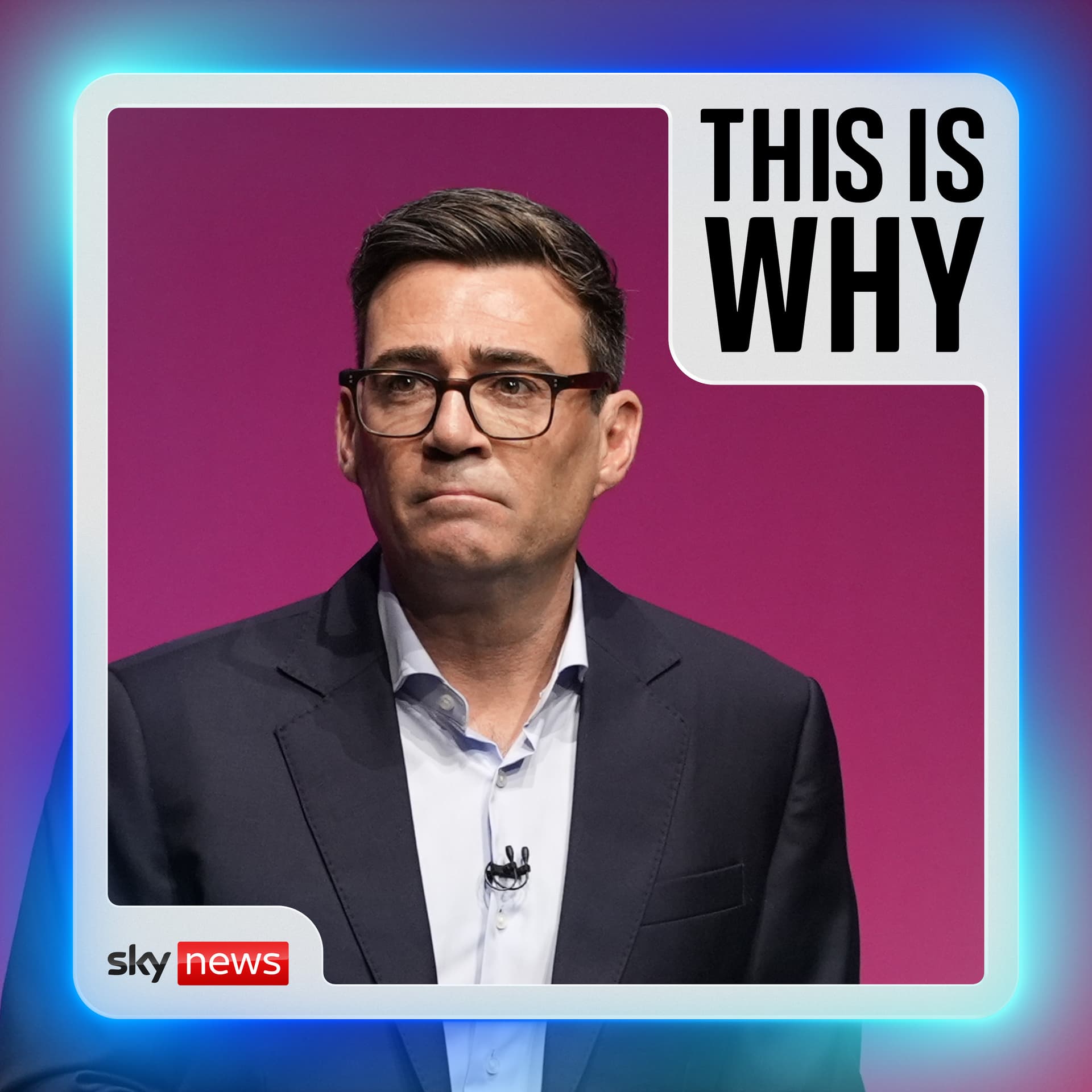
It’s long been seen as politically untouchable – but Andy Burnham has finally fired the starting gun on reforms to the state pension triple lock.
First brought in by David Cameron’s coalition government, the measure of increasing pension payments by the higher of inflation, average wage rises or 2.5% a year was introduced to offset years of underfunding.
But the new prime minister has used his first party conference speech as Labour leader to put the triple lock on the negotiating table – against the wishes of the unions, opposition parties and plenty of his own supporters.
So, how does the triple lock work and what could take its place? What is the cost to the country and is reforming the system as straightforward as it appears?
Niall Paterson is joined by Claire Moffat, a pension and tax expert at Royal London.
Have you got a question for Niall? Email us: why@sky.uk