
In short
Global oil shortage and Gulf/Strait of Hormuz disruption driving UK fuel prices toward a “cliff edge,” with limited government options and knock-on effects for inflation, inequality, and public finances.
Guests
Ed Cornway, Sky News economics editor. He argues the shortage is structural and geopolitically driven; Neil (host) provides consumer examples and policy questions.
Key claims
The world needs ~100m barrels/day; the Gulf supplies ~20m, and even after emergency measures there’s still ~8m/day missing. The UK imports most oil/diesel, so scarcity quickly raises pump prices. Fuel duty and VAT take a “majority” of the average litre’s cost. High petrol prices can destabilize governments via voter anger and wider interest-rate/debt costs.
Notable examples
petrol near 153p/litre; average family diesel fill over £100; rationing/closures in Sri Lanka, Philippines, Pakistan; UK diesel dependence after 2002 tax incentives and “Dieselgate,” with diesel sourced from the Gulf, US, and European/Indian refineries.
Written by AI. May contain mistakes. Listen to the episode to check what was said.
Chapters
Tap a time to open that second in VOThe Rising Fuel Prices Crisis
0:26 to 2:51
Discussion on the current state of fuel prices and their impact on the public.
“I've got data out today on just how much prices have been rising at the pumps.”
Global Oil Shortages and Economic Impacts
2:51 to 5:38
Exploration of the global oil shortage and its effects on the UK economy.
“And that is bigger than any other interruption in history, in history.”
The Consequences of Dependency on Imports
5:38 to 8:13
Analysis of the UK's reliance on oil imports and the implications for consumers.
“And I think that's the difficulty here is it kind of exacerbates inequality.”
Government Response and Economic Relief
8:13 to 12:54
Debate on the government's role in providing relief amid rising costs and economic challenges.
“In terms of the kind of fuel that we rely on here in the UK, petrol, diesel, kerosene, what's going on?”
Future Considerations and Planning Ahead
12:54 to 14:00
Discussion on long-term planning and potential future events similar to the current crisis.
“And even when they do improve, it will take weeks, maybe months to get back to, I don't know, whatever normal is in future.”
Geopolitics and Energy Supply
14:00 to 16:08
Explore how geopolitics influences global energy availability and economics.
“I don't think we should be given handouts for this.”
Transcript
Automatic transcript. May contain errors.0:01Sky News, the full story first.
0:11There is little, if anything, the government can do to protect us from rising fuel prices. And this is why.
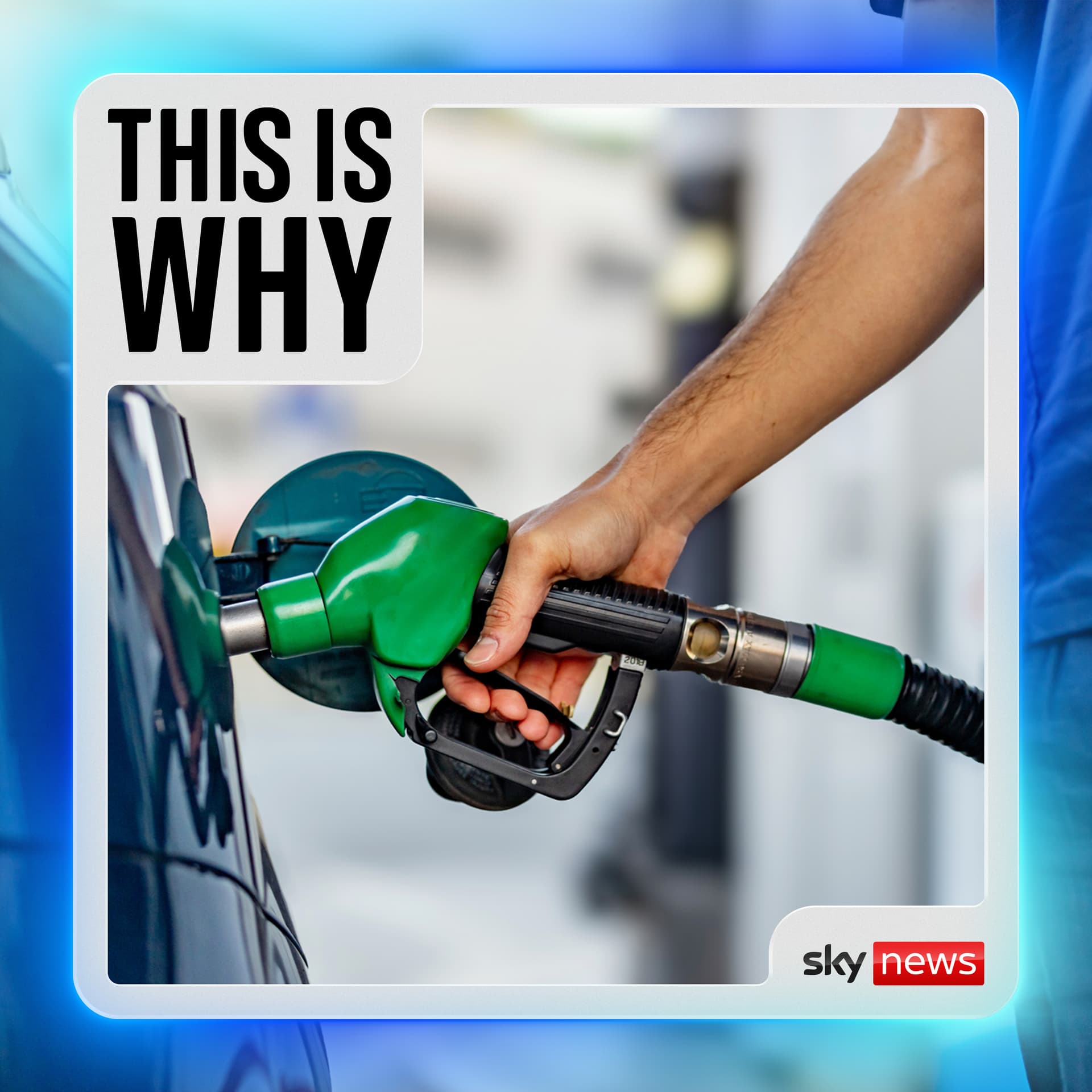
0:25Hi everyone, Neil here. I've got data out today on just how much prices have been rising at the pumps. Yeah, it's pretty grim, but you probably knew that already. It's a nightmare for me. I'm a self-employed cleaner, so top up£5 when I can. It keeps me going. But yeah, I can never fill up anymore. It's too expensive. According to the RAC, petrol is now on average close to 153 pence a litre. And if you happen to drive a diesel... ..well, the cost of filling up the average family car just broke through£100. This isn't just about what's happening here, of course. Donald Trump has given his clearest hint yet that he is ready to step back from events in the Gulf, telling countries like the UK to go get their own oil from the Strait of Hormuz.
1:14The ripple effects of the Iran war are already building and they're heading this way. When they arrive, there is precious little any government can do to stop them. The full gravity of all of that kind of quite toxic cocktail has yet to be fully felt in this country. Our economics editor is Ed Cornway. Ed, so often in our discussions, we arrive at a point where we say the government has to do something. But when it comes to the costs that we are all, well, those of us who drive, experiencing at the pumps, genuinely, what levers does this government have to pull? The depressing answer, like there's always some levers, but overshadowing all of this is this kind of enormous problem, a genuine quandary.
1:56Take the global view, first of all, but it's relevant to the UK. the world does not have as much energy as it needs right now. If you think about oil and gas, they're just literally fuel to enable us to do stuff. It might be getting somewhere in your car, it might be going on a plane, or it might be running some machinery. And the global economy expects about 100 million barrels of oil a day. Just keep the machine going. In due course, we should be reducing that and doing fewer fossil fuels. But right now, that's kind of where we are. And if you don't have as much oil to go around, And basically, Saudi Arabia, the Gulf as a whole, provided about 20 of those 100.
2:34So you're down from 100 to 80. It's kind of simple numbers, which is quite helpful that it turns out that it's 100 to 80. And that 20 is a massive gap. We have never in anyone's life have seen, outside of kind of World War, have seen as big a gap as that. And there have been various measures to try and bridge the gap. But even after you take all the emergency measures we've been talking about for the last few weeks, you know, stockpile releases, pipelines, all of this stuff, everything that can be done and assume that it's kind of done, you know, up to the max, we're still short of like 8 million barrels a day.
3:09And that is bigger than any other interruption in history, in history. And so we as the UK are an energy importer. So in every country around the world that is an energy importer, we're importing more gas than we produce. We're importing more oil than we produce and a similar thing for kind of all the different products and diesel. We can talk about diesel specifically if you want to. I've gone into the weeds on diesel recently. But the whole point is, if you are massively dependent on buying stuff from overseas, just to keep your lifestyle going, more or less where it is right now, and the price of that stuff goes up because there's not as much of it around.
3:43So it is literally just the scarcity or the lack of abundance. Yeah, it's a shortage. We have a shortage of oil around the world, and that is the lifeblood for economic activity. And And we in the UK feel that because we are dependent on imports. Okay, but the amount of money that I spend per litre at the pump, not all of that money is going to whoever owns that petrol station or the people who supplied it with the petrol and the diesel in the first place. A big old chunk of it is going to the government, isn't it? A really big chunk, yeah. Fuel duty. Why don't we just do something with that then?
4:12Fuel duty, VAT, these things, I think it's like the majority of the cost of the average litre of petrol and diesel ends up going one way or another to the government. And it is high in the UK. And it's similarly high, it's worth saying, in most European countries. So Europeans have quite high levels of petrol taxation in its various guises. And then America has much lower kind of levels of tax. And you kind of see that. And I mean, gosh, it's, yes, there's a lever that government theoretically could pull here, which is to - Other governments are doing it. Which is what other governments are doing around the world, including in Europe.
4:41The pernickety, economist-y answer to this. And remember that a lot of the policy in Westminster is decided by people who have economics degrees. And conventional economics would say, listen, you're in a situation here where you don't have enough of this stuff. By cutting the price, you're going to encourage people to get more of it. So why would you do that? And that would be the argument. So in Australia, they've cut some of the prices of the taxes on diesel. Australia is the most dependent country on diesel imports anywhere in the world. And so an economist, being like a pernickety economist, would look at this and go, that is just crazy because you want to be actually reducing demand so that people actually don't buy as much diesel and don't rush for the pumps.
5:21That's in the real world. It so happens that many people, particularly people driving diesel cars, particularly people who have to drive more, particularly people who don't enjoy public transport, aren't able to afford electric cars. They tend to be people that kind of lower income brackets and therefore are disproportionately affected when fuel prices go up. And I think that's the difficulty here is it kind of exacerbates inequality. Okay, just how bad might this get for people? That's what I find stressful and miserable about this period. As someone who looks at the economics, I can see the way this is going.
5:51I can see there are chain reactions happening right now. Choose your kind of metaphor. But oil is literally something that goes in kind of tankers and pipelines. You have flows of it coming in. You've got a machine. This is an economic machine that we're all part of here. the oil that we're currently burning, we've still got tankers coming in that left the Gulf just before this actually kicked off. That is about to stop. And in Asia, it's kind of stopped. So Asia has just gone off the cliff and they are not getting the deliveries that they would expect to be getting right now. Think of those 100 million barrels a day.
6:26That gap, that 20 million barrel gap. It's theoretical up until the point where suddenly it's real. And what we're experiencing right now, what we're living through right now at this very moment is it is becoming real. The theoretical cliff edge is something that people are starting to go over and it's grim. You're absolutely right. The global south does seem to be rather more affected right now by what has been taking place in and around Iran. We've seen petrol rationing in various countries. We've seen petrol stations closing in various countries. Why? Why are they much more exposed to it? If you're expecting a certain amount of oil and you don't get that much oil, then either you need to find some oil from somewhere, or you're going to pay more for that oil, or you're just going to start rationing it.
7:11And there aren't many alternatives. And if you're a country that doesn't have all that much money, if you don't have stocks and stockpiles, we do have some stocks and stockpiles, particularly in the rich world, then you are instantly exposed to that. And that's what we're seeing in Sri Lanka, where they've instituted a four-day week. It's what you're seeing in the Philippines, where they've got serious crisis right now. It's what you're seeing in Pakistan. You name the country, particularly in South Asia, Southeast Asia. And that's what I mean. That's why I find this a depressing period, because energy is the lifeblood, in particular oil, in particular gas.
7:48They are still the lifeblood of economic activity around the world. And when I say economic activity, that's just people having better lives. That's people running the heating or the air conditioning in their home or their school. It's allowing people to actually go into work. All that stuff is being stifled right now by the fact that we don't have enough of this stuff coming out. It is extraordinary economic damage that's happening. The longer this goes on, the longer the Straits of Hummers are closed, the greater that shortage is and the more people are going off that cliff edge. In terms of the kind of fuel that we rely on here in the UK, petrol, diesel, kerosene, what's going on?
8:22What's the situation? Kerosene, we in the UK are very dependent on imports of kerosene. So kerosene is jet fuel. But you know what? Kerosene, heating oil, when we talk about heating oil and people not having to pay lots for heating oil, it's the same stuff. And we in the UK are really dependent on imports of jet fuel. The interesting thing, so if you look at kind of what we produce and what we import, we still make loads of petrol in this country. Loads of petrol. We have more petrol than we know what to do with. But we became a net importer of diesel about like 10 or so years ago. And it all was partly a consequence of Gordon Brown.
8:57I was going to say, I remember him evangelizing for diesel fuel. So what happened is, you know, this is a really... The former Chancellor Gordon Brown, for those who don't remember. The former Chancellor Gordon Brown in 2002 basically said, well, all the advice that I'm getting is that diesel cars are better for the environment because they have lower carbon emissions than petrol cars. And so they introduced all these tax changes saying it's making it cheaper to buy diesel cars or making it more attractive than it was before. And lo and behold, everyone started buying diesel cars. And we went from a situation where actually we have very few diesel cars in this country to having loads and loads of them to the extent that by 2015, more diesel cars were being sold than petrol cars.
9:30And then comes Dieselgate, this revelation that it turns out they're not as clean as you thought they were. I mean, you couldn't make it up. But the long term consequence of that, Neil, is that we now live in a country where we have far more diesel cars on the road than we did before. Because of that decision 20 and a bit years ago, we have far more diesel cars on the road. And as a result, are dependent on diesel imports from overseas, most of which come from, well, most of them come from America. They used to come from Russia. We used to be totally dependent on Russia for our diesel. Even, you know, 2021, we were dependent on Russia.
10:03Then, of course, the invasion of Ukraine happens. And now, apart from America, basically all of our diesel comes either from the Gulf or it comes from European refineries that are getting oil from the Gulf or it comes from Indian refineries that are getting oil from Russia. That is the situation we're in right now. We are a much better place in this country than most nations because we have refineries, only four of them left, but we still have refineries and we still have some of our own oil. We still have some diesel production in this country. It's just it's not 100%. But even so, it's a very real situation.
10:34There's not enough oil out there in the global economy. and the longer this goes on, the more we are going to see shortages, not just kind of small shortages, but shortages across the piece. Do you think we're going to see more than that though? Do you think that these rising costs could destabilise governments, even maybe bring them down? I'll tell you the reason petrol really matters as an economic thing, and I only kind of realised this recently, it's one of the few prices that you're exposed to quite a lot. So when you go to the supermarket, you see prices and you pay attention to them to some extent, obviously, and you notice them going up kind of gradually.
11:08With petrol, you see that price even when you're not going and buying stuff. And so you see it on the fork, you see it on the big signs when you're going past the petrol station. And so it has this power, this inflationary power in people's minds more than anything else. And so I think, yeah, petrol prices being high is going to cause a massive unpopularity, not just for this government, by the way, also Donald Trump, you know, gasoline prices in the US, they call it gasoline, but you know, petrol, they are the highest they've been since Ukraine as well. And a lot of people will look back at that period and say, you know, kind of Joe Biden started to lose when gasoline prices went really high.
11:42But it's not just petrol prices, it's also interest rates, whether it's the Bank of England interest rates, or indeed just interest rates that the government is facing for its debt. They are going up and up and up in a way that has extraordinary kind of knock-on consequences for everything else, because the UK has a very high national debt. We've talked about this before, we have a really high national debt. And when those numbers go up to kind of 5%, suddenly debt interest costs are going up a lot. And that eats up all of your other spending. And the only way that you can balance your budget is higher taxes.
12:13But the government has just raised taxes to the highest level that we've ever seen before and raised them even further beyond that. And so its ability to do anything about this is extraordinarily kind of constrained. And put it all together, and again, this is why I find this moment quite kind of worrying because I think the full gravity economically for us, for consumers, for the government in terms of its public finances, for everyone else in terms of interest rates, not to mention the geopolitics, the full gravity of all of that kind of quite toxic cocktail has yet to be fully felt in this country.
12:46But in the coming weeks, we'll feel it and it's not going away until things improve in the Persian Gulf. And even when they do improve, it will take weeks, maybe months to get back to, I don't know, whatever normal is in future. When you worry, I panic, Ed, but let's have a little kind of thought experiment for a second. If you were down at the Treasury as Chancellor right now, what would be better? Temporary relief for voters now or kind of long term energy slash oil resistance later? I mean, do you think that we should be intervening to help people out right now or not. No, I think we should.
13:27I think we should be helping people who need help because this is going to be quite a grisly time. And happily, this is coming at a time when we're going into the spring and the summer. And so it's not a question of heating being incredibly expensive. But for people who are struggling, and a lot of those people happen to be kind of more exposed to higher kind of fuel prices. I think there are levers. I mean, you know, they're all kind of obvious levers, whether it's kind of help with bills or whether it's help in terms of kind of various kind of welfare measures. The thing I'm wary of, though, is I don't think better off people.
14:04I don't think we should be given handouts for this. I just don't think that's right. I think that surely should be part of the lesson from COVID that wealthy people shouldn't be subsidized by people who are less wealthy. Okay, can I turn that on its head then? And aside from those who are the worst off in society, should we all just get used to this? Should we start planning more? Should we start saving more? Should we start thinking about economies that we can live in our life? Because we are going to see another one of these one in a hundred year events coming. I don't know what next Tuesday.
14:35Well, it feels a bit that way, doesn't it? It does. It really does. But often what happens in these moments is you get the kind of famine and then you get the feast. And, you know, like if you look at places, you know, if you squint and imagine that there is a kind of positive resolution in the Gulf, which feels slightly unlikely at the moment, but you just never know, especially with Donald Trump, then suddenly you do have more oil coming through the Straits of Hummers. you have all these countries, whether it's kind of the US in particular, but also to some extent, Qatar have been building up their kind of liquefied natural gas facilities for a long time.
15:08Heaven knows what's going to happen with Russia and Ukraine, but there's a lot of kind of gas that Europe here or two got from Russia. If for some reason that kind of resolved, then you might have more gas coming through. So it's not like the world is short of gas and oil. There's plenty. It's not like we've run out. It's just that geopolitics is kind of creating these choke points that mean that we don't have enough of it. There could be this future where we have more energy abundance than we've ever had before. The problem is for years and years, our policymakers have not been thinking about physical resources and why they matter and why boring things like refineries matter and why it matters where your diesel is coming from.
15:46Yeah, but they probably also weren't imagining a president quite like Donald Trump, were they? No, that's true. And I think there's certain things you can plan for and certain things you can't really plan for. And I think we're in one of those moments where the geopolitics has become so enormous. We used to live in a world where economics decided geopolitics. Now we're living in a world where the geopolitics is defining the economics and that is a much more bumpy world but it's kind of where we are. Ed, thanks very much. Thank you. So do you share Ed's assessment? To me it certainly feels like things are going to get a lot worse before they get better.
16:18Get in touch, email me directly, why at sky dot uk. And if you're looking for more on the fallout for Iran just scroll back in your podcast feed. Yesterday's episode with Paul Kelso focused on the rising price of foods here in the United Kingdom. This is why it's back again tomorrow.
From the publisher
"Go get your own oil!" Donald Trump has served notice on his allies, telling them the US won't necessarily help to reopen the Strait of Hormuz.
And oil is important... for everything. The global economy needs 100 million barrels a day to function. The war in Iran means we're only producing 80 million.
Those missing barrels are having a huge impact on diesel and petrol prices – but that's just the start. Inflation, interest rates, food and utility bills are all set to rise.
What, if anything, can the UK government do to avoid the inevitable economic earthquake?
Niall asks Sky's economics and data editor Ed Conway why he's so worried about the financial effects of the crisis in the Middle East.
Do you have a question for the podcast? Email us: why@sky.uk