 Ask ChatGPT


In this episode, Danny and Katie discuss Nvidia's remarkable financial performance, including its $47 billion revenue in the second quarter—more than it made in all of 2023. The episode features an in-depth interview with Lisa Su, the CEO of AMD, focusing on the competitive landscape of the AI chip market, AMD's strategic direction, and insights into the future of technology.
Written by AI. May contain mistakes.

Get the gist, explore an idea or ask about something said.
 Claude
On Times Tech, what are the key points of this episode?
Searching your listeningAutomatic transcript. May contain errors.
0:02um is the reason that you're having to leave early today because you're going to an invidia party no no sadly not it's because it's for a glorious glorious glorious reason it's the first day of school oh you're so lucky summer summer is summer is over mercifully calm will descend yes exactly so we there's like all this kind of back to school there's this thing there's this orientation there's all this stuff on the first day they make a big to do out of it i just thought because you're in Silicon Valley, there might be like this big to do with everyone being like, NVIDIA. NVIDIA. NVIDIA. Hello and welcome to the Times Tech Podcast with me, Danny Fortson.
0:48And me, Katie Prescott. So that's Danny in the Valley. And Katie in the City, together in perfect harmony, as they say. I feel like you should sing that. Our big conversation this week is your interview, Danny, with Lisa Su, the CEO of AMD. Intel's great rival, but also one of the most important companies in the world right now and snapping at NVIDIA's heels, or she hopes. Yes, and we should really start before we get to that interview by talking about the biggest beast in the chip world, which is of course, NVIDIA. They just have their results. It's the moment so many people have been waiting for because whether you own NVIDIA or not, these results have just become a huge event.
1:29NVIDIA makes up 8 % of the S &P 500 So it can really, really, I know it's massive. It has been driving the rise in that index and the NASDAQ as well. But it's also what the numbers tell us about AI. Yes. And as usual, the numbers are pretty jaw-dropping. The company brought in nearly$47 billion in sales just in the last three months. So that's more than 50 % more than the same time last year. Mad, isn't it? And profits were huge as well. It made about$26 billion in net income. I mean, most companies would kill for that kind of growth. But, of course, everyone was watching. What would this do to the share price?
2:12And NVIDIA's shares dropped after the results came out. We were warned about this. Traders said that there could be a swing of about 6 % in either direction. So while we're recording this podcast on Thursday, the share price was down 1.45%. Yeah, and it's pretty brutal. you know, you report 50 % increase in sales. Your profits are almost like roughly more than 50 % of your actual total revenue. And everybody's like, meh, no, not very interesting. But of course, the reason is like, you know, the expectations are so high. Everyone on Wall Street was betting that NVIDIA would once again smash it out of the park, especially in data center chips, the brains of these AI models.
2:58And those sales were huge, but just a tiny, tiny bit below what investors had hoped. Of course, a lot of it is people are watching for any sign of a bubble, any sign that this growth just can't keep going exponentially as it has. Just to put it into context, though, that 1.45 % drop today, I mean, it's quite small, isn't it, in the context of what's happened over the past year when the share price is up more than 30%. And the company is now bigger than Microsoft, but also bigger than Apple, which used to feel totally untouchable yeah and they're not slowing down so for the next quarter nvidia says it expects to make around 54 billion dollars in sales which shows that for now at least demand for ai chips is still very very high and i just think it's worth pointing out just how dramatically the world has changed for nvidia so if you go back two years 2023 for the entire year of 2023 the company sold 26 billion dollars in chips so to put that in perspective for their whole year of 2023 they now do that in six weeks that's mad that's absolutely wild but not enough for wall street no exactly give us more the other big story everyone was watching of course was what this would tell us about china so sales in china make up about 13 percent of nvidia's revenue and it's had this weird moratorium on selling any chips there and said it didn't sell any ai chips in the in in the july quarter and it's of course had this very odd deal with the us recently if the green light finally happens because of course and we'll talk about it in the interview with lisa because it was nvidia and amd who struck this kind of strange profit sharing deal with the white house but if this all finally gets signed off because now Beijing has said, well, we don't want those chips anyway.
4:52You know, they're saying they could generate another two to five billion in revenue in the current quarter. Watch this space. We'll see what happens. But that's very much kind of in the balance. And overall, it just shows how NVIDIA is the beating heart of the AI boom. And so even if their numbers wobble just a little bit, it sends ripples further than across tech, but across the whole economy. People are talking about invidious results being as important as announcements from the federal reserve you know just the fact that they're doing so well and have kind of come from relatively nowhere to where they are now the largest company on the planet selling you know at the levels they're selling and they're like yeah we're going to sell 50 percent more than we did a year ago at some point the law of large numbers kicks in where you're like this can't keep growing like this but they are you think that every quarter well i think that every quarter and that's why this has become such an event exactly but i think it sets up really well for the conversation i had with lisa sue at amd which is of course the other big american player who is basically you know gunning for nvidia's top spot so you had this really extraordinary experience last week when you went out to interview the boss of amd yes right so one of the the world's biggest chip companies but also one of the ones that's at the heart of a political storm because they've done a deal with the trump government yes to pay 15 of their revenue they get from china in exchange for export licenses to china anyway i could go on but i'd just love to hear what was it like where did you go?
6:31Where did you meet her? So it's in Santa Clara, California, which I grew up in San Jose, which is right next door. Santa Clara, I'm just going to give a little personal riff, is where I had my first job at Great America theme park. I used to sell t-shirts and hats at Great America. So it took me right back, going back to Santa Clara. But it's like, you know, it's a classic big glass building. You walk in, there were two PR folks waiting for me in the foyer they knew i was coming and then on the main floor you walk past all these like different like generations of chips and these different type of chips that a and b makes there's like this whole like display zone and there was also this really strong man walking around which was her bodyguard oh i mean that's one of these things that like and he was like very kind of unobtrusive but he was definitely around did he pat you down no he did not he might have thought you were a tall scary man no no no he could have like broken me in half so yeah so it was at the amd headquarters and it was really interesting because amd growing up in silicon valley was a joke total joke it was intel intel inside intel was the world leader amd was always like the very very very distant second and she has like lisa sue who we're about to hear from she completely remade this company it went from 3 billion to 270 billion so 55 market value yes 55x as they say out here and she's left intel in the dust which is this thing that just like was impossible to conceive of if you're from the valley or knew anything about chips until you know the recent years so it was interesting just to sit down with her and obviously as you mentioned there's the trump stuff and this deal that she swung alongside jensen wang and nvidia to basically reopen the market to china by giving 15 of sales to the to the white house and they're just building these you know they've gone all in on ai they're slowly slowly slowly gaining on nvidia but they have like you know something like five percent of the market whereas nvidia has 90 plus it's like one of the most amazing corporate turnaround stories but also she's right in the middle of the ai boom absolutely obviously because we're all a bit obsessed with chip companies i was looking at the valuations this week and nvidia's got a four trillion valuation yeah yeah the next competitor is Broadcom yeah which is 1.4 trillion and AMD is next as you said worth 270 billion and Intel is at seventh with 107 billion although it's very interesting to watch Intel at the moment because of course the Trump administration took a 10 % stake it's been partially nationalized it's so what that does then to its position and what that backing means yeah it's it's kind of like how the mighty fall and it's really very much a tech story but one of the things that dr lisa sue said was you know just because you're good today doesn't mean you're going to be good tomorrow yep and just like how brutal you know if you make a few big wrong decisions especially in something like hardware that has the years long lead times you're screwed and intel made a bunch and so it's really interesting to see if they're going to turn around but they like intel has laid off 24 000 people they've been partially nationalized by donald trump like it's kind of unbelievable and you talk to people in the industry they're like intel has a lot more they need to figure out probably more layoffs more kind of closures all kinds of stuff yeah if you're good today doesn't mean you're going to be good tomorrow feels like a really good life lesson for all of us.
10:30Yeah. So the first question I asked her actually is about this very interesting, very kind of strange deal that she and NVIDIA did with Donald Trump. I think what we've seen is, you know, AI is the most important technology that has come out over the last, you know, I'd like to say 50 years. I mean, it is above the internet, above mobile. Above the internet. Absolutely. In terms of capability of what it can do for the world, for all of our lives. And then you come to where we are in the AI race. I actually do believe AI is a race and it's a race to intelligence. It's a race to capability. And so every country is now thinking about how do they have their own AI policy and AI plans.
11:25From the U.S. standpoint and from a technology standpoint, we are fortunate that we are very well positioned because the foundation of AMD is all about high-performance computing. How do we build the highest performing computers out there? And today, the biggest usage of that is for AI. So from that standpoint, look, our goal is to build great technology. That's kind of our mission in life is build the technology that changes the world. And to do that means that you want as many users of your technology as possible because actually technology gets better when it gets broad distribution and broad usage.
12:04So from that standpoint, I'm a big proponent of getting our AI capabilities around the ecosystem. And US is an important part of the ecosystem. Europe is an important part of the ecosystem. And of course, China is an important part of the ecosystem as well. And so there's been a lot of conversation with the administration of where do you draw the line? Where do you draw the line of what is national security versus what is just having more people in your ecosystem? And I think we found a right balance. Can you talk a little bit about, because I think it is important for people to understand, the chip that you're selling to China.
12:41It's the MI308, is that right? That's correct. Howard Lutnick, the commerce secretary, got a bit of flack and he's like, ah, we're not even selling our first best chips or our second best chips or our third best chips, We're still in our fourth best. And I think you might have been referring specifically to NVIDIA, but it was NVIDIA and you guys. So what is that chip? Is it kind of a rung below? And how much does that matter? We are pushing the envelope on computing like every year. Like every year, the new thing comes out. It's better. It's higher performance. It's more memory. It's more capable.
13:13And what we also have is because of some of these national security concerns, we do have some restrictions of what can be shipped to various regions. And so the MI308 does have different specs than our latest and greatest. So it is less compute and it is, you know, less memory. It's also a very capable chip for a lot of AI applications. And, you know, we think it's good to have these capabilities, you know, distributed throughout the world. And so were you having direct conversations with Trump about this? I'm not going to get into all of the back and forth. I think the main thing to say is we are a U.S.
13:53company. We are very focused on what's the right balance between national interests as well as our desire to sell our technologies as broadly as possible. I do think that we've found a good balance, and I think that balance will continue to be discussed as we go forward. The other thing that I'm struggling to get my head around, because I've heard this notion a lot of the AI race, but it's like a race that never ends, right? There's no finish line. It's not like, unless I'm wrong, it's not like you reach a point and therefore we have won. The other side has lost, right? I agree with you. It's not a race that has an end point necessarily, but think of it as if you have more computing capability and that computing is smarter.
14:42It's the difference between if you have 100 PhDs working on something or you have a million PhDs working on something, you can probably solve your problems faster or you can solve your business issue. And that's kind of the way we think about it. It's capability. So computing is equal to intelligence in this case. And the smarter that we can make each one of our AI agents, the more that we can do with it. And that's very, very attractive because the idea, and I know many people are like, well, what are you going to do with all that AI? And I think what we envision is AI can really solve problems across the entire spectrum of things that you are looking for.
15:25Like if you're a drug company, sort of the rate and pace of drug discovery. If you can take what would have taken you five years of research and shrink it down to like six months of research, I mean, that's incredible. or in chip design. If we can take what, you know, takes three years to design the next chip and do it in shorter time, that works. Even to things like, you know, customer service. If you have, you know, many, many more customer service agents that use AI versus necessarily people, there is a way to automate many of these tasks. And, you know, I think we're just at the very beginning of using AI for, you know, these types of applications.
16:04Do you have a stake in the ground in the Doomer versus it's all going to be wonderful debate around jobs slash the future of humanity? I'm probably much more of the optimist than most. Look, this is new technology. Obviously, we have to learn along the way. I think this debate about jobs, we shouldn't be afraid of the technology as it relates to jobs. I think we should recognize that the technology should make everyone more productive. and it might change jobs. So, you know, some of the, let's call it more repetitive jobs, if you can do with computing and, you know, just move everybody up the value chain, like that's what we do.
16:43I mean, we have, you know, lots and lots of software engineers, but if we can write parts of our code with AI and then use our engineers to do, let's call it, the more creative things, that's a good thing. So my view is we have to think differently about how we can use tech, but um you know this is not a a doomer scenario this is a how do we go much much faster scenario and and frankly you know productivity should equal you know economic prosperity as well obviously since you took over amd has been on an incredible run i think your market cap has gone up like 150 times but where we are today in 2025 a lot of talk of bubbles and i mentioned And before we started recording, I started my career actually in a dot-com, got fired after four months, right when the tide started going out and nobody could raise any more money.
17:33And then I covered that implosion. This feels similar in that I still think AI is going to change the world. It's a question of over what time frame and who's going to make money and lose money along the way, right? Right. And I'm just wondering how you view this moment, because it does feel a little bit crazy right now. I think it's fair to say the capital intensity is extreme. And we've seen the acceleration, right? When we've been looking at the market sizes, I started thinking, OK, maybe this is a couple hundred billion dollar market. And our last market forecast says this is over a$500 billion market over the next three or four years, which seems really, really large.
18:19But then you look at the capital intensity. You look at sort of the utility of the computing technology and the fact that not only is it a business imperative, it's a national imperative. And there's a lot of sovereign AI. So countries are thinking about their own computing ecosystems as well. and you say, hey, I certainly don't see a bubble. I certainly see that the demand curve is such that there's a thirst for intelligence. And if you can buy intelligence, and if you can buy computing, you're going to do so. And obviously, companies have to see the return on the other side, but we are starting to see that.
18:56And by the way, I think what makes AI so different this time, because AI has been around for like 10 plus years, it's not as if AI itself is new. I think what's new is, you know, with the real advent of large language models and training large language models, the interface has become much easier for everyone to use, right? The fact that you can talk to your AI, write to your AI, or your AI can generate images, or your AI can generate agents. I think the ability to utilize the technology has become much simpler, and you can do much more complex tasks with it that makes this wave different. And you guys have a partnership with Meta, is that right?
19:38Yes. So are you going to be providing the chips for, like, you know, Zuckerberg has these amazing names for his new big data centers, like Hyperion and various things, but like the Manhattan-size data centers. We're very excited about our partnership with Meta. It's a longstanding partnership on the CPU side and then now on the GPU AI side. And Yeah, we're powering a lot of their workloads going forward. Does it matter to you the open versus close, this idea? Meta famously said, no, we're going to open source. We are kindred spirits in this notion of open ecosystems. And the idea of open hardware platforms, open software platforms, Meta led with open models, with the Lama family.
20:28we're very happy to see that many people are now recognizing the power of open. And I think the main thing is the ability for more innovators to innovate when it's an open ecosystem. So you can get additive value, which is, you know, you have this group of smart people who comes up with something and then, you know, the next team can kind of pick up where they left off and innovate on top of it. And ultimately, you think this will prove to be a bigger thing for the world than the internet, for example? I do. I think we will, 10 years from now, think about AI as just part of our lives, right? Just like today, when you have a question, you go and you search something on the internet.
21:11You can do so much more with AI, and it'll just become part of how we live.
21:24Can we go all the way back to the very beginning? Okay. I've done a bit of reading. You came here from, is it Taiwan? That's right. That's right. I was born in Taiwan. My dad immigrated here to go to graduate school in New York at Columbia. And so our family moved to New York when I was really young, like three or so. Went to school in Boston. And after a few things, ended up in Texas about 20 years ago. But you went to MIT. I went to MIT. I studied electrical engineering. When I was growing up, my dad was always into math and science. Hey, you guys got to do the hard stuff. Yep. And so I went to MIT and studied electrical engineering.
22:09It was, again, it was the hard thing. So hardware, it was kind of fun putting together your first circuit boards. And frankly, freshman year in college, I was looking for a job. and the job that I got happened to be in a semiconductor lab and I was doing grunt work for graduate students, like taking little two-inch wafers and putting them in machines and having them do things. And I just thought it was the coolest thing on the face of the planet that you could build all of this intelligence into these little chips that were the size of a quarter. And the rest is history. I ended up doing my bachelor's, master's, and PhD in electrical engineering with a specialty in semiconductors.
22:54When was that roughly when you came out, when you finished your PhD? I finished my PhD in 1994. So right pre-internet, right. Yeah, it was the beginning of personal computing. The first project that I worked on, I was at IBM as a young researcher. In Texas. In New York. I was at the TJ Watson Research Lab, and we were working on technology for Macs, for PCs and things like that. So it was really just the beginning of what you can imagine computing being used for. So you were there, and then you went to Texas Instruments? I started at Texas Instruments, actually, and then I went to IBM. So I was at IBM for about 14 years.
23:40You know, IBM is a great, great company. Learned a ton, but it probably wasn't going to be a semiconductor company. Semiconductors was a very small piece of IBM's business at the time. And so I thought I needed to either change professions or go into a, let's call it a semiconductor company. And so I ended up going to Freescale Semiconductor, which was a spinoff of Motorola. That's what caused me to move to Texas, Austin. And I joined their CTO and I ran their networking and multimedia business. And then I joined AMD in 2012. Why did you join AMD? Because for those, this is for our British audience.
24:21I know AMD kind of vaguely because I grew up here. I grew up having a lot of people in my life who worked at Intel. And Intel was the company. It was the chip company. and AMD was almost like a punchline, like a little brother, always struggling way, like if there's a race that was like, you know, kind of tripping over itself way behind it, Intel. So why? Well, I don't know that I love that particular narrative. Those are my words. Those are my words. Those are your words. Look, my words are the following. Like I was a semiconductor person. I am a semiconductor person and I was looking to make a difference and make it, you know, join a company that really was working on technology that could make a difference.
25:06I grew up knowing about AMD. AMD was a company that had a lot of potential, so a lot of the right pieces, but hadn't executed as well as could be, and I thought I could help. And frankly, at the time, my thought process is, hey, I don't have to go to a company that everything is perfect. I need to go somewhere where I can make a difference. And so I joined AMD in 2012. And I think what I loved about the opportunity was the technology that we were working on, you know, sort of the highest performing processors was something that did in fact matter. And, you know, I knew that, you know, if you build great products and you really have the right long term vision and roadmap, we would be able to make a difference.
25:51But yes, a lot of people said to me when I joined AMD, how is it possible that, I mean, I think Intel was, I don't know, 10 times our size, something like that. And I'm like, well, you know, we have some good ideas. And I became CEO in 2014. That was a difficult time for the company because we were trying to decide what do we really want to be when we grow up. And at the time, the craze was mobile. Like everyone was like, hey, you need to be in application processors in smartphones because that's, you know, PCs are not going to be important. But the truth is we were strong believers in high performance computing.
26:32If you looked five plus years down the road would be the much more strategic technology. And that's what we could be uniquely good at. And just so people understand, when you say high performance computing, what do you mean? Building the largest computers in the world. So supercomputers, large cloud data centers, what you imagine in enterprise data centers. We do a lot of other computing as well. But those are, let's call it the flagship systems, the hardest things to build in the world. Very, very few companies can do that. And we felt that we could be one of those very few companies. And that would be sort of a foundation for what would be important going forward.
27:13What gave you the confidence you could actually pull that off? Because I think at the time, AMD was like, is this company going to survive? Is it going to get taken over? There's layoffs. It was kind of floundering. Maybe it's intrinsic belief that with the right roadmap and the right focus, you will be able to do that. Now, to be fair, AMD has always, like if you look back in history, has had some of the most innovative roadmaps, right? So good ideas was not a problem in this company. It was more how do you turn good ideas into great business that was a problem. So our view was, look, this industry is ripe for great ideas.
27:55Like it is not the notion of, and you can see it in history today, right? Just because you were good yesterday doesn't mean you're going to be good tomorrow. It's all about roadmap. It's all about technology, inflection points, and sort of making the right bets. I like to say that the bets that you make in technology, you won't know for three to five years whether you made the right bets. You kind of have to recognize that. We make bets. Every one of our products is hundreds of millions of dollars, if not billions of dollars in terms of research and development. We need to make sure at the end of it that it reaches its full potential.
28:31But, yeah, we fully believed that with the right roadmap, we could build the best technology in the world. and we were very thoughtful about how that would happen, right? We fundamentally believe that if you looked in the future, the best way to build chips was to build them in smaller pieces. We called them chiplets and the chiplets would come together and be a single big chip. Our biggest data center chips today are 150 billion plus transistors with something like 12, 13 chiplets that stack on top of each other and do all kinds of things. But fundamentally, the goal is how do we get more performance in a given amount of area?
29:13And that is what drives high-performance computing. For low cost, better energy consumption, all those things. Better energy consumption, better cost, and maximum performance. That's why I think it's so interesting about trying to make these big calls. As you say, you don't know if it's going to actually work out until five years from now. Do you have any sleepless nights or moments of doubt where you're like, I hope this works, but I'm not really sure. This is looking a little shaky. You certainly think about a lot of things. Back in 2014, 2015, we decided that we had to make a fundamental shift in our roadmap.
29:47And we actually predicted that it would take us five years to make that shift. And so, yes, you don't wait until the end and see if it works. You actually are looking at it along the way. So some of my most fun moments are when our, you know, we call it first silicon, when our new products come back from the manufacturing line, we turn it on. Does it work? Does it work like we expect it to work? It never works exactly as you expect it. It's like going from blueprint to the actual house. By the way, that's exactly what it is. We go from design to the actual chip. Then we have to test it out to Wazoo to make sure that it works in all kinds of variants.
30:28and then we probably have to make some adjustments. But at the end, when you think about the complexity of getting 150 billion plus transistors to work, all of them have to work. It's a lot. It's a lot. That's a lot of transistors. It's a lot of transistors. And just again, for people so they can visualize it, what does that look like? We can talk about 150 billion. It's about like this size. Size of a wallet. Not even a wallet. It's sort of a little. Bigger than a credit card. Actually, smaller than a credit card. Smaller than a credit card. Yeah. Right. Yeah. Right. We had Sam Altman on the podcast probably six months ago.
31:01And one of the interesting things that stuck with me that he said is that, yeah, Moore's law, which is double the amount of transistors on a chip every 18 months, roughly. And that has been the iron law of computing for, you know, half a century or more. And AI, the way he put it, is the cost per unit of intelligence is coming down tenfold every year. So like in two years, 100x. What does that mean for you as the maker of the brains that are processing that? It's incredible, the rate and pace of learning in AI. I think what it means for us is, and when you think about Moore's Law, it's a very hardware-centric law.
31:45It's kind of a very physical limits type of thing. But the way you get to things like 10x and 100x is you add on top of it software and algorithms and, you know, for us, new data types. And we're really pushing the envelope. You know, like I said, every year we're coming out with just tremendously more, you know, innovation and capability to enable the types of things that Sam is talking about. Your chips, are they all made by TSMC? Yes. Yes, TSMC is our manufacturing partner. So you designed them, but they're made at the gigantic TSMC fabs in Taiwan. That's right. Some of them are made in Arizona.
32:28Well, that's what I was going to ask, right? Because there's this huge push. We touched a little bit on earlier around the geopolitics. There's this huge push to kind of reshore. But obviously there's like TSMC are making these and look kind of nobody else because it's so hard. how do you where are we in that kind of reshoring push how realistic is it like how should we think about that because you know tsmc the maker of all the world's most advanced chips is suddenly like this it's almost like a political football right between china the u.s and because these things are so hard to make look i think the the best way to think about it is whenever you're doing anything like any type of manufacturing process or like you want to have resiliency in that supply chain so you know i i'm going to go back to the pandemic because that's when people really realize that holy cow like you you can't have everything in one place no matter what it's not just a political issue it's an economic issue it's so from that standpoint we've been really focused on enhancing geographic diversity for that reason.
33:38And it's important for us to enhance U.S. manufacturing. It has been a place where it hasn't been a focus. And so the fact that the last few years, and especially most recently with the new administration, there's a lot of focus on U.S. manufacturing. It makes perfect sense. We've been active working with TSMC and bringing up their Arizona factory and we're one of the first customers that have run product through there. It looks really good. So we're well on our way to do that. That's still being built? It's built, but it's being expanded. Right. So the initial modules are built, but there's a lot more building to go.
34:17This idea of working on supercomputers, the hardest stuff. Is there an analogy there to like Formula One or the space program where you kind of try the hardest stuff and along the way, you learn a bunch of things that you can then apply all the way down the chain. It's exactly that. I think when you think about supercomputers, like back in 2015, we were thinking, how is it possible to get one exaflop of computing in a computer? And that was like 10 years ago. It seemed really, really hard. And so you have to do all kinds of pathfinding to figure out how to do that. How do you build it? How do you cool it?
34:59How do you keep it reliable? You know, all of those things. And, you know, when you think about it now, you know, we're very fortunate to have worked on two of the largest supercomputers. The two largest supercomputers in the world today are AMD technology. One is at Lawrence Livermore National Labs. Not far from my house. Yes. It's called El Capitan. And number two is at Oak Ridge National Labs called Frontier. And to build those systems, we had to do tremendous innovation, like tremendous innovation on every level of chip design, packaging, cooling, working with our partner, HPE. There's a great ecosystem around building these things.
35:42But yeah, we learned a ton there. And now there are lots of smaller computers that are using all of those similar components to go forward. So, yes, building the biggest computers in the world require tremendous learning. and and then we use that to you know kind of get the next generations you know better and better when you're leading an organization like this you have to kind of basically turn this super tanker around how do you do that in terms of the people management aspect of it what is how do you think about that because it feels like if you're going from a place of my words again desperation or just like this company is not doing well and its future is uncertain too.
36:25$300 billion company doing very well. How do you get people kind of pointed in a different direction and kind of run through the many walls they're going to have to run through? Well, I think the basic foundation of our company is one, like people are here because they love technology. Like they really want to work on the latest breakthrough computing technologies. And that's really the foundation of how do you get people excited and motivated. My first day as CEO, I got up on stage and I said, look, we're going to focus on three things. We're going to focus on building great products because that's what tech companies do.
37:11We're going to focus on building very deep customer relationships because that's how we're going to learn together. And then we're going to simplify everything that we do. None of that sounds like a revolution. It is not a revolution. It is very clear what are we going to spend time on. And that's how we make decisions, right? We prioritize the technology. We prioritize how do we make good decisions on that, very strategic decisions in that area. How do we spend time with our customers and make sure that they understand what we're trying to do and that we understand what they're trying to do in the process?
37:52And I think if we make more good decisions than bad decisions, I think we do well. Now, I think we also chose right to spend time on. So we didn't choose to spend time on smartphones. We chose to spend time on high-performance computing. And now 10 years later, I think you would probably agree that high-performance computing is, if it's not the center of the universe, it's pretty important in the universe. It's getting there. It's getting there. Throwing it forward. When you think about chips, everybody's talking about NVIDIA, this famously founded at Denny's. I've been to that Denny's. I grew up going to that Denny's.
38:29Like, you know, moon's over my hammy, et cetera. um now they're a four trillion dollar company do you envision a world where you kind of catch up surpass i mean because you've already kind of done the one thing which is like little amd has surpassed intel and now you're here and now it's nvidia is the kind of the big kid on the block do you see a world where you actually can or a path where you can be like yeah we can be there. We can be this multi-trillion dollar behemoth that is leading the market. We certainly envision a world where the market size is like$500 billion plus three or four years out.
39:13The key is, do we believe that our technology is capable of leading? Absolutely. And look, this is an incredibly exciting market. I'm a big believer in there is no one size fits all for computing. You're going to need AI everywhere. So we're pretty optimistic about what we can do. We are in a place where this technology, once we fully get it up to fruition, and I mean, we're still learning at an incredible pace on hardware, on software, on models, on business models. So I still think we're very, very early in the AI cycle. But I think that, you know, 10-year vision is the right vision. The world, we will not recognize, you know, the world that we're living in today in terms of the capability that's out there.
40:08And I think that's a remarkable thing. And I think that that is what, for all of us who are living in this technology world today, I mean, that's what we live for, right? We live to build technology that can change the world. And this is uniquely that. I don't think this is incremental. This is not about chatbots. It's not about those things. It's about how do we really take the power of the technology and change the way we do things.
40:36Wow, what an amazing interview. What did you think? Yeah, it was really, really interesting. That answer that she gave about NVIDIA, I mean, it shows competition between the two of them. She's clearly got her sights absolutely on becoming the market leader. For sure. That's what's so interesting is that like, again, when she took over 11 years ago, you would have been laughed out of the room and be like, oh yeah, AMD in a decade is going to be, because I think it was in 2022 was the year they first passed Intel in terms of market value. And it was like, it was an absolute moment. And now they're almost three times as big.
41:10and intel is getting nationalized and slashing and burning but now it's nvidia who's kind of come out of nowhere in the past like whatever three years and now it's the biggest company on the planet but she's like yeah we can get there we can do that too like that's the next mountain we have to climb what's really interesting is like there absolutely is a bubble out here but in a way it matters to them less because it's kind of like the telecoms build out that happened with the dot-com boom it's like if you're the one selling the fiber people are putting it in the ground if you're the one selling the chips people are building the data centers it's not your problem if they then go unused for a while or they're too big or if they're later obsolete the demand as she said their projections are that over the next three or four years the market's 500 billion yeah and it's the companies that are selling the for the dot-com analogy the sort of don't forget my toothbrush.com businesses the exactly a companies this are building on top of ai yeah which are peripheral rather than the the shovels of the of the gold rush the slowdown will happen at some point but i think in a way it will hit hit them later because again some of the companies you've spoken about which are getting ridiculous amounts of money from basically writing an idea on a piece of paper correct and all of that money is either going is going to two things people and data centers it you know whenever the music stops i think it's going to be dramatic you know she's like nope there's not a bubble we see this you know the demand growing and growing and growing it's a kind of amazing story and she's you know she's quite an impressive leader just to like have gone from where they were to where they are and she's like very kind of like business like okay now we've done that we've done the first impossible thing now we're going to do the next impossible thing i thought your question about reshoring was really interesting as well because that's clearly key i mean tsmc are also nvidia's partner yeah i mean they are the chip makers of the world yeah but there is this enormous push to get things made in the u.s and the time that that's going to take and you wonder whether then policy may change yeah as presidents come and go what does china do when does china send the troops in and try to kind of nationalize tsmc or whatever yeah and there's that ever present threat as well so she's got clearly got an eye on that for sure and tsmc they have she referenced it they have built a huge kind of mega plant in arizona and that is like kind of still being developed and growing but that is one of the big investments that tsmc has made in america where they can kind of theoretically at some point build these super complex chips on u.s soil and it's really interesting because she brought out later in the interview she brought out one of their most advanced chips and it is about the size of a credit card and there's like there's 150 billion transistors on this thing the size of a credit card and you're just kind of like how is that even possible and she's like every one of them has to work you can't have 149 billion 999 you know like all of them have to work it's really quite extraordinary when you think because you when you see these things up close you're like it kind of brings into focus just how hard all of this stuff is but i do wonder whether that push for for reshoring is something that's going to benefit intel because they're building fabs in the u.s at the moment as well and with funding from government is that a way that they can keep up even if they're not necessarily developing the most high spec chips if they are the makers of it the american well the one thing she said is that you know it's really hard to do everything well to design the chips and build them at scale that is one of the one of the areas where intel has fallen down and so whether they will be able to turn that ship around is it's going to be really interesting i have let's call it some healthy skepticism that you know with the trump administration on the on the shareholder register all of a sudden they're going to be like all right now we know what we're doing i mean they do have a new ceo but isn't it the politics though isn't it the political there and the political support that that brings and it just feels like the whims of trump below in the wind at the moment and if he's like right i don't know the whole 50 billion dollars that we put in the chips act we're going to throw at intel i mean who who knows yeah yeah exciting to watch anyway but anyway fascinating times and I made it out of there I didn't run afoul of anything and get you know manhandled by the by the and she is kindred spirits with Mark Zuckerberg by the bodyguard with arms as I wrote in my piece this past weekend his arms are bigger than my thighs but I made it out alive you know I'm very very glad to see you on the other side of it long may it continue
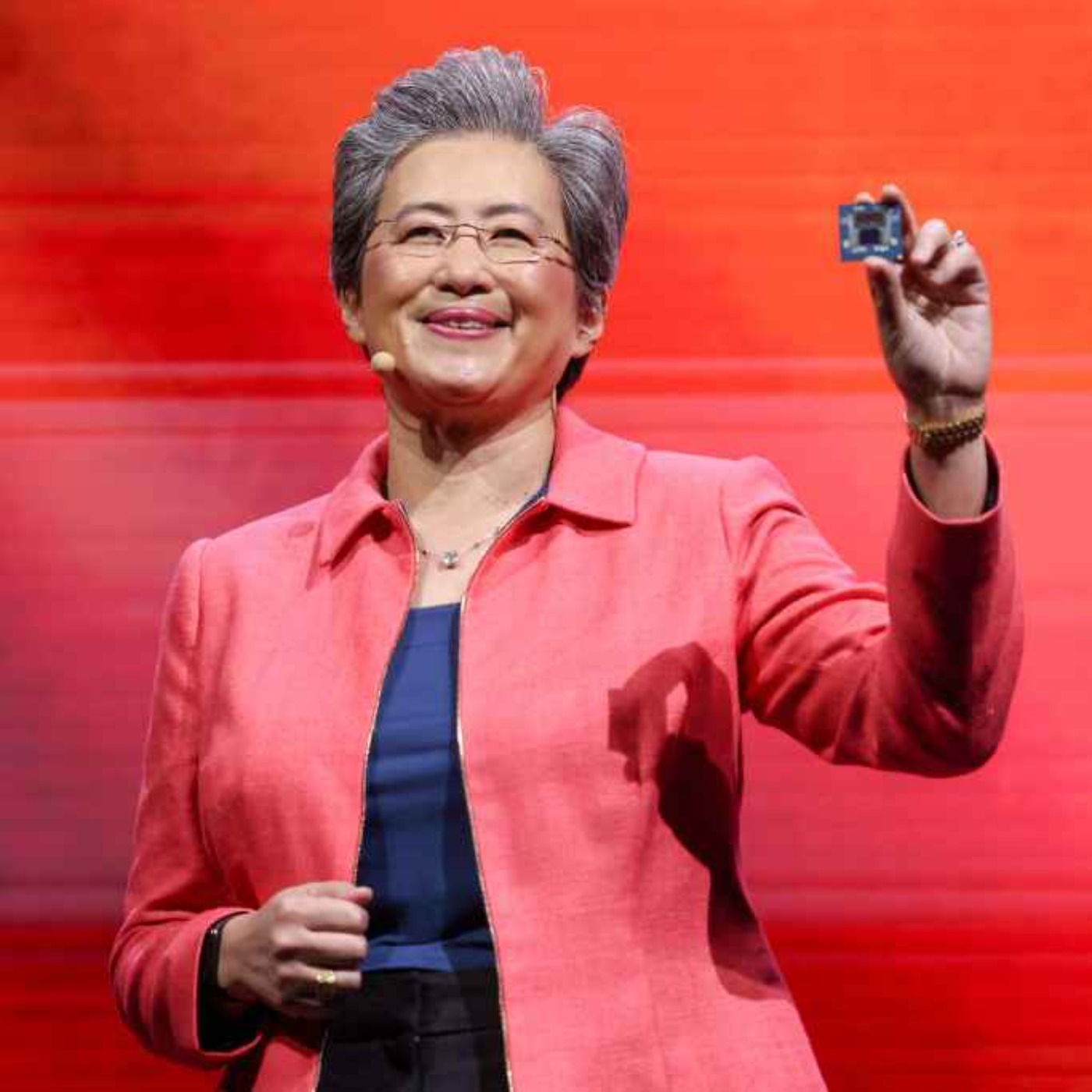
Katie and Danny unpack Nvidia's $47 billion second-quarter revenue – more than it made in all of 2023. But can anyone challenge its dominance? Danny interviews AMD’s Lisa Su, head of the American chipmaker that designs the processors powering everything from PCs to data centres, about the company’s turnaround, China, and whether Nvidia’s crown is within reach.
Image: Getty
Hosted on Acast. See acast.com/privacy for more information.