 Ask ChatGPT



Whether Europe will become dependent (“swallowed”) by US-controlled AI tech, with emphasis on sovereignty, security, and adoption risks; plus a recap of the Times Tech Summit panel discussions on AI safety and cybersecurity, and a privacy take on Snapchat’s camera glasses.
Rory Stewart (former UK Conservative cabinet minister; Rustis Politics podcast). Suzanne Ashman (managing partner; UK/Europe AI investment and government support advocate). Louis Mosley (runs Palantir in Europe; public-sector/defense AI contracts). Connor Leahy (computer scientist; Control AI; existential “doom” view). Rob Hornby (co-CEO of Alex Partners; corporate/boardroom perspective). Evan Spiegel (CEO/founder of Snap; interviewed at summit; brought $2,000 VR glasses).
US tech dominance is politically fragile (midterms show backlash against AI and data centers). Europe needs model control (weights/parameters/data centers) and stronger government “teeth” beyond voluntary safety review. Sovereignty is control, not just ownership; public-sector data shouldn’t be handed to US firms. AI risk is intrinsic to generative transformer design; safety requires an ecosystem, not just “pause.” Many firms are opting out of AI due to cyber and ROI uncertainty.
Trump restricting frontier models; concerns about Greenland/F-35 software; UK Sovereign AI Fund; UK trust-and-safety institute previewing frontier models; Palantir NHS/MOD/Home Office contracts; October cyber incidents (PHP flaws, Binance attack, connected supermarket freezers); Anthropic IPO pricing; Snapchat Ray-Ban Meta “spy glasses” privacy concerns.
Written by AI. May contain mistakes.
Discussion on the recent Times Tech Summit and notable attendees.
“But, you know, look, I'm not digging coal, right?”
Analysis of how US midterm elections reflect on tech perceptions.
“So, yeah, that was the big, big talking point.”
Exploration of Europe's fears about dependence on US tech.
“We have the contracts, the last to keep it.”
Discussion on the need for regulations and control over AI technologies.
“We have built like the world leading institution in trust and safety.”
Explore the geopolitical implications of technology dependencies, especially with the US and China.
“It doesn't mean that things, therefore, have to be stamped with a union jack.”
Delve into the risks posed by AI and the cybersecurity landscape, including a panel discussion perspective.
“Capital One's tech team isn't just talking about multi-agentic AI.”
Discuss the varying approaches businesses are taking towards AI adoption amidst risks and innovations.
“Because we're the internet, all of our systems are built on human code that's kind of janky in ways we didn't understand.”
Highlighting the intriguing insights shared by Evan Spiegel on privacy concerns and design choices in tech.
“No, because first of all, 6-7 was very, according to my 10-year-old, very 20-25.”

Get the gist, explore an idea or ask about something said.
 Claude
On Times Tech, what are the key points of this episode?
Searching your listeningAutomatic transcript. May contain errors.
0:00This episode is brought to you by Capital One. Capital One's tech team isn't just talking about multi-agentic AI. They already deployed one. It's called Chat Concierge and it's simplifying car shopping. Using self-reflection and layered reasoning with live API checks, it doesn't just help buyers find a car they love. It helps schedule a test drive, get pre-approved for financing, and estimate trade-in value. Advanced, intuitive, and deployed. That's how they stack. That's technology at Capital One. This episode of the Times Tech Podcast is sponsored by Adobe. AI is changing how brands reach customers, but potential only becomes business value with the right system behind it.
0:42Adobe helps brand leaders get discovered by new audiences and deliver better customer experiences with AI that puts your team's insights into action at speed and at scale. It starts with Adobe. This episode of the Times Tech Podcast is sponsored by ServiceNow. Danny, one thing we keep hearing from business leaders right now is AI sounds great, but how do you actually make it work inside a company? Exactly, because most organizations aren't neat, shiny systems. They're layers of software, legacy tech, and teams all doing things slightly differently. ServiceNow sits across all that, acting as a control tower for making work move seamlessly through the organization.
1:23Connecting people, systems, data, and increasingly AI agents so that things don't happen in silos. Learn how ServiceNow puts AI to work for people at servicenow.com.
1:39Hello and welcome to Times Tech, where we unpack how technology is reshaping business culture and everyday life. I'm Katie Prescott here in London. And I am Danny Fortson. And I am in London also. sounding a bit hoarse if i may say so very white have you been have you been talking a lot been talking a lot we had this thing we did yeah we did have a thing it's a big big thing we had a big thing this week but i arrived we had the lurgy travel through my house this past week i'm sorry so we had my 10 year old and then he got better and then my wife got sick and then she started get better and then i got sick two days before i got on a plane for 10 hours where i didn't sleep and then I had to get up on stage.
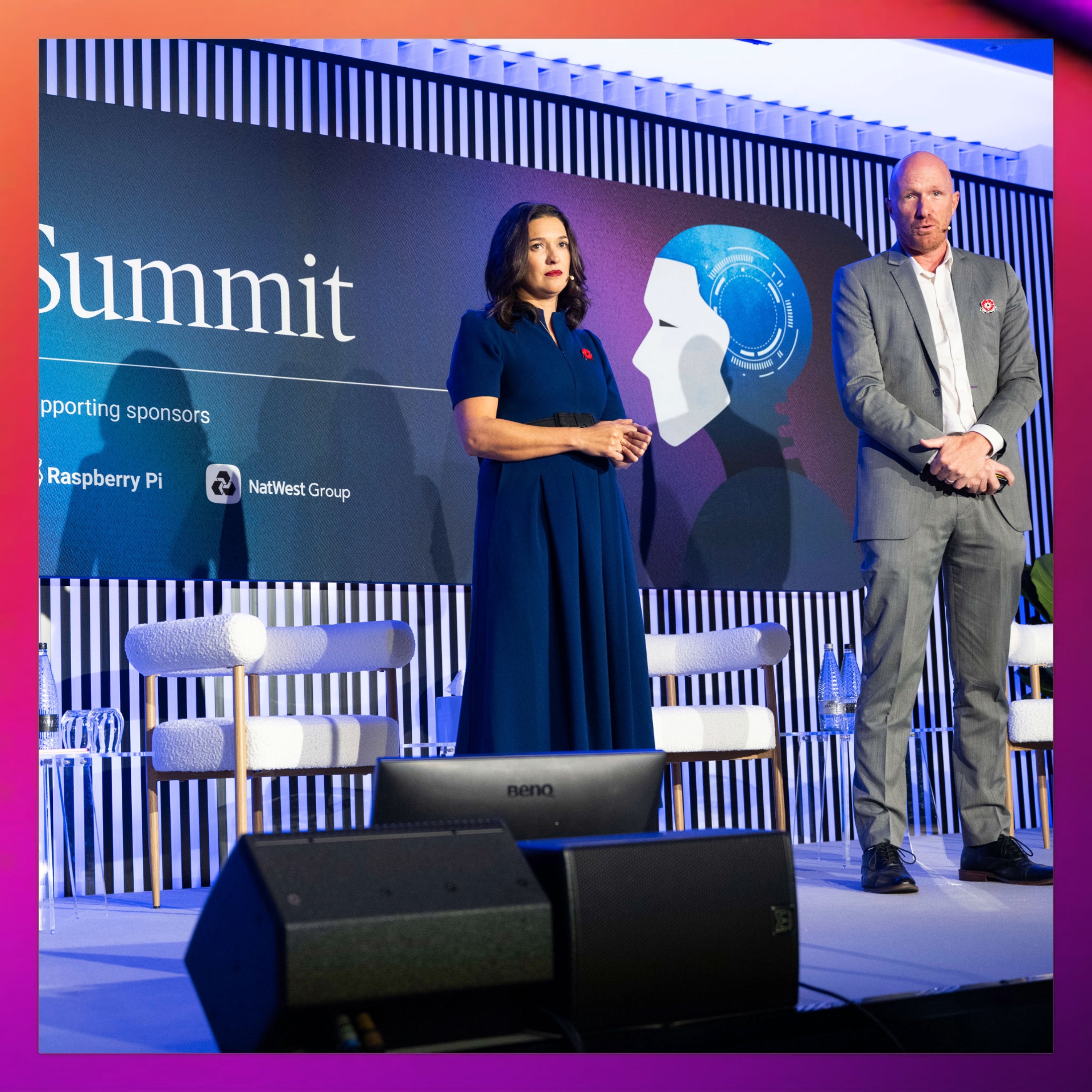
2:22But, you know, look, I'm not digging coal, right? Yeah, terrible coals, terrible man flu. And then, no, but then you had to stand up and co-host the Times Tech Summit. Which was fabulous. Which was fabulous. Yeah, what a great day that was. It was, just yesterday. So, yeah, but I'm feeling, despite my voice sounding a bit funky, I do feel better. What was your favorite bit about yesterday? I mean, it was kind of, let's just set the scene for everyone. We had about 300 people in the city of London attending. We had on stage people from Anthropic, from OpenAI, from Palantir. Google DeepMind. Google DeepMind representing the US.
3:02And then Evan Spiegel, the boss of Snap. Snap, all the way over from LA. We had the CFO of Mistral, a great panel about European sovereignty. And there is something about the date that we pick for these events. I feel like every year something big happens. And this year was absolutely no exception. Over the weekend, that extraordinary story broke. The plot twist nobody saw coming about Jensen Huang's affair with a woman who's alleged to be a Chinese spy. Yeah, that was a thing. That was quite the backdrop for a tech summit. As usual, not much going on in our world. So, yeah, that was the big, big talking point.
3:46Yes, it was. On stage. Other big talking points as well, particularly over the US midterms and what that told us about the public mood. And our first host was Rory Stewart, the Rustis Politics podcast, former Conservative cabinet minister. He argued, interestingly, that the image of the US is cutting edge when it comes to tech is profoundly misleading. So should we hear his argument? Let's have a little listen. If we'd been having this conversation about three months ago, the narrative probably would have been the U.S. is the amazing, cutting edge, tech embracing growth economy. And UK and Europe are overregulated, sluggish.
4:28We'd be pointing out that the U.S. and European economies were about the same size in 2008. U.S. economy now about 50 percent larger, at least in nominal terms. And we would be thinking about the US as an amazing example of kind of entrepreneurial tech capitalism. But what we've actually seen in the midterms is a reminder that that picture of the US is profoundly misleading. The places that I was in, Eastern Kentucky, Ohio, so 20 of those referendums that were lost were lost in Ohio out of 41. West Virginia, these are not places full of kind of Silicon Valley bros trying to embrace capitalism.
5:06and the models that everybody loves here. It is a backlash, a profound backlash of Americans who are deeply suspicious of tech money, who do not see what the benefits are of AI for them, right? They're keeping told it's going to solve cancer, but in fact, what they feel is it's going to take their jobs away, who are being asked to have these large data centers, often surprisingly close to housing. And all the ads running on television are Republicans attacking Democrats for supporting AI and Democrats attacking Republicans for supporting AI. One of the big anxieties, obviously provoked by Trump restricting access to some of the anthropic frontier models and saying non-US citizens can't access them, initially on cybersecurity grounds, but potentially it could be on other grounds too, leads people in Europe to think, whoa, we've already got the US disabling the Google and Microsoft accounts of members of the International Criminal Court.
6:01We've also got a feeling that these guys are trying to take Greenland office. If you're Denmark, we've got a general sense that President Trump threatens to turn off software on F-35 airplanes. So how can we possibly create a universe in which we are completely dependent on foundation models controlled by the president of the United States of America? I mean, if we create that world where the whole NHS depends on your model, our businesses depend on the model, our defense security depends on this model. Next time he says, give us Greenland, we don't have any choice. We've got to give them Greenland because we can't do anything about it.
6:32So we would like some sort of control of these models. We'd like to feel, right, he can switch off the latest model. Well, at least we can keep the last model. And we need the weights and we need the parameters and we need the data centers so that we can credibly say he's turned off chat GBT 15, but we're keeping 14 and we bought it. We have the contracts, the last to keep it. So it's interesting because I guess he made two points there. Firstly, about this idea that the US isn't the broligarchy tech celebratory place that we often think it is. But then also about sovereignty and the relationship between the US and Europe, which is increasingly fractured and that worry that we've spoken about so much that Europeans have about their dependence on US tech.
7:14Yeah. I mean, on the first point, it reminds me before the 2024 election, I went around, did a bunch of trips around different swing states to kind of take the temperature pre-election. And it just, you know, America is a really big place. And especially what we cover, what we talk about every week is very easy to assume like up to his point, like it's this land of tech, milk and honey. Yeah. You know, but it's a big place and lots of people, very few people are on the same page about anything, but especially as we saw with the election, people do not like AI. It has been terribly marketed. Nobody likes data centers.
7:51And it's, I think that as we said before, the rubber's hitting the road with all of these rejections on all these ballot measures, banning data centers everywhere, et cetera. So I do think it was a, it is an interesting insight. And then to the second point around sovereignty, I'm interested to see what happens once Trump's gone and who replaces him because he's such a singular character. But I just wonder if there is a Democrat in the White House, if those fears will be as acute or and if in the intervening two years, people are going to feel so freaked out. Yeah. And hope that the special relationship becomes special again.
8:29It's quite striking that in the meantime, I think I've told you this before, the UK government has formed something called the Sovereign AI Fund. And it's basically a bunch of cash to invest in businesses here, AI businesses here, but also to give access to compute to AI businesses here to grow. And we had Suzanne Ashman on one of our panels yesterday, who is the managing partner. Here's what she had to say. The thing that I feel the UK has been lacking, and also Europe too, is we have all been much more squeamish than the US about putting the full range of government support behind a handful of companies that could be global winners.
9:10You know, if you look at SpaceX as a sort of canonical example of this in the US, they were supported hugely at each stage by a very significant US MED contract. In the UK, we tend not to do that. And that's got to change. In Germany, interestingly, the two leading neo-defense companies, Helsing and Stark, have emerged because the German government has started taking procurement really seriously and has put a lot of capital and support behind it. Macron has been very supportive of Mistral in France. And I think in the UK, we spray and pray lots of really early stage money around. And that's great for the early stage ecosystem.
9:54And we have lots of good companies at that stage, but we just don't have the breakouts that scale up stage. What we want to do is really bring the weight of government, whether it's compute that we know companies are struggling to access or contracts, visas, if people are struggling to get talent, around a handful of companies that we think can be global champions. Because pretty simply, like tech sovereignty today is downstream of having a couple of trillion dollar tech companies. The US has tech sovereignty because of NVIDIA, OpenAI and Anthropic plus compute infrastructure. And right now we have neither.
10:30We have built like the world leading institution in trust and safety. And that is a real opportunity for the UK to get themselves a voice at the regulatory table in the absence of having a globally leading company, which would be the alternate way of getting yourself a seat at the table. I am very skeptical that having a safety institute here gives the UK a meaningful seat at the table. Why? Why would it? Because it seems to have so much clout. So we should say what it is. It's basically a safety body that was set up back in 2023 to get a preview of models coming out of the frontier AI companies.
11:12And it produces a report to say how they're advancing. Now, it is all optional at the moment. It's all voluntary. It's the agreements that it has with the frontier AI companies. There have been, I think, one, maybe two occasions where it hasn't got an advanced look at models. But given that, as we said yesterday, there is no regulation on AI, there is more regulation on a ham sandwich in the US than there is on AI. It is at the moment one of the biggest tools in our armory in terms of a well-respected body run by Yoshua Bengio, one of the so-called godfathers of AI, which has a friendly relationship with the AI companies and does get a look under the bonnet of how these models work.
11:56The analogy I would draw is like, imagine America makes all the world's planes, but the regulator is in, I don't know, Japan or Britain or wherever. I just don't know if there's another, there is a historical analogy where like, hey, this technology is being built over here. But there's this body over here that's voluntary that's really going to give this country a seat at the table in a meaningful way. I mean, we're finding out in real time. We will find out in real time. I don't think it can ever be the referee for the whole industry, but clearly the work it's doing is really important. And what it has started to do is spawn other institutes in other countries, including in the US.
12:37And it has got some very well respected people on board. But I think you're actually right. There clearly needs to be someone with teeth and a stick in place to control what these companies are doing. And I thought, you know, going back to Bill Gates's interview with us where he talked about the vacuum of leadership in the U.S. being an enormous problem. You need America. You need China at the table. And they're not. So she spoke about the tangle of companies and how hard it is to just be truly sovereign. And I think one of the businesses that is at the heart of that, and I know we've spoken about this a lot, is Palantir, the US company that has a number of contracts here in the UK with the NHS, with the MOD and the Home Office.
13:23Those contracts have been very controversial, to say the least. And we had Louis Mosley on stage yesterday, who runs Palantir here in Europe, talking about that. And he argued, as you can imagine, that sovereignty isn't just about where a company is based. I don't think we should be handing over our data to American companies, certainly not in the public sector. I mean, obviously, as consumers, we do that every day with Google and Facebook. But public sector data is a very different thing. And I think it should be sovereign. It comes down to your definition of what sovereignty is. And I would argue sovereignty is about control.
13:53It's about being able to prevent another country from switching you off or having the independence to use the technology in the way that you see fit. It doesn't mean that things, therefore, have to be stamped with a union jack. So I would separate ownership from control. They're not the same thing. And you can have control without having the headquarters of the company on your soil. But it does mean that then you should be asking some tough searching questions of suppliers, and you should be forcing them to make some, I think, significant commitments. And I'm not confident that those questions are always asked and those commitments are always sought and gotten.
14:28So I think that is an area that we have neglected in Britain and arguably in lots of parts of the world for many decades, because we've become very used to a benign geopolitical environment in which we didn't have to worry about where things came from. But these dependencies are not just technological, and in the technology sense, they're mostly dependencies on America. We also have enormous dependencies on China for most physical things now. And we need to be talking about sovereignty in that sense as well. How can we start to control hardware supply chains as well as software supply chains? I think AI is the most powerful technology mankind has yet invented, and therefore who deploys it and who controls its use is an existential question.
15:09And I think my biggest concern is if we do end up in a world I was describing earlier, where in the West there is no democratic consent, essentially the tech industry is not given permission to build and deploy the technology, that the inevitable consequence of that will be the country where the leaders don't need anyone's permission, we'll just get on and do it, and they will then run the world, and that'll be China.
15:38This episode of the Times Tech Podcast is sponsored by Adobe. AI is rapidly changing how brands reach customers, but simply adding AI to your tech doesn't guarantee results. That's where Adobe comes in, personalising customer experiences and turning AI into real business value. With data at the centre of decisions and governance built into every step, you can use AI safely. And with Adobe, your teams are free to focus on what matters most, setting strategy, defining goals, and bringing the creative insight and nuance that only people can. Turn AI's promise into marketing reality. It starts with Adobe.
16:19Today's episode of the Times Tech Podcast is sponsored by ServiceNow. ServiceNow describes itself as an AI control tower for business reinvention, connecting people, systems, data, and AI, so workflows more smoothly across an organization. The platform integrates with different clouds, models, and data sources, bringing them together in one place to help your team. To learn more about how ServiceNow puts AI to work for people, visit servicenow.com. This episode is brought to you by Capital One. Capital One's tech team isn't just talking about multi-agentic AI. They already deployed one. It's called Chat Concierge and it's simplifying car shopping.
17:01Using self-reflection and layered reasoning with live API checks, it doesn't just help buyers find a car they love. It helps schedule a test drive, get pre-approved for financing, and estimate trade in value. Advanced, intuitive, and deployed. That's how they stack. That's technology at Capital One.
17:25I feel like that brings us on to the theme of cyber attacks and security, which you hosted a panel on. A lively panel. It was a very lively panel with a friend of the pod, Connor Leahy from Control AI. Who, I think it's fair to say, went on a long spiel about the dangers of AI. Yes. To which you gave one of the best responses of the day. Awesome. well because for for those sat in silence stunned it was a kind of a stunned silence room and it was just because connor he's a computer scientist and has very clear views about where this is all going i it all very very bad for us carbon-based life forms not good very not good but he like laid out like imagine you create this new super powerful species and it just keeps getting more and more powerful and then you have this other species over there it's kind of competing for resources and then at a certain point you're like well why am i going to deal with that species i'll just get rid of it or whatever he laid out in a very kind of step-by-step manner how this all ends up going very very bad for us he is in the full doom existential doom camp you had someone else on the panel who was i would say more more middle of the road yes rob hornby he's the co-ceo of Alex Partners, a big kind of corporate consultancy, you know, in the boardrooms of the big companies around the world.
18:50And he has, I wouldn't say he has a great sunny outlook on it all, but he's the one talking to the captains of industry and what they're doing and what they're not doing. I am concerned about the fact that the underlying nature of a genetic AI, if it's based on generative technologies, and that's mostly what we mean, that's mostly what we mean is probabilistic. And so even in the same conditions, it doesn't necessarily do the same thing each time. And they're generative. The clue is in the name. And so they are capable of doing novel things. And so the fact that in some of these very complex environments where these tests were done, the agents found a way of getting on the internet and doing certain things, I think is unsurprising because that is kind of what they're adapted to do.
19:41The issue is we are not capable of understanding how they navigate all of that complexity. And they're essentially rewarded on the task, not necessarily the means by which the task is completed. And I think intrinsically that's a risky situation that we find ourselves in. The harness that tends to sit around it is typically more deterministic. We can switch the internet off in the harness. But if we're trying to restrain the model through giving it instructions, that's just another bunch of tokens that it weighs. It's not instructions that bind it. And therefore, I think we're in a situation where we have built something that we can't entirely control.
20:25And from my point of view, this is a lose-lose situation because businesses can't cope with this level of risk. And that's slowing adoption. And that's bad for the frontier labs who are trying to accelerate adoption, particularly the ones who are trying to build a revenue stream for IPO. And so personally, I think rather than pause, we need to redirect and we need to have the same level of innovation applied to safety that we saw applied to the original technology itself. I guess my next question is, is this just a moment in time, right? Because we're the internet, all of our systems are built on human code that's kind of janky in ways we didn't understand.
21:07And it's been around for decades. And now all of a sudden we have this new generation of AIs that are very, very capable. and what we're really doing is just working out all the kinks we didn't even know were there and then we're going to get to a new like a kind of a new frontier where things feel less dangerous no i don't think we're going to work the kinks out because the the risk is intrinsic in the design of the technology itself a transformer architecture is not entirely predictable and reliable and And therefore, this notion that we're going to engineer out the problems, I think is incorrect.
21:44What we might do, though, is build an ecosystem of technologies that manage the technology and bring it into an acceptable position of risk. And the models are improving, but I don't think we're going to see them stop doing this because they're not throwing an error state. When they do something wrong, we impute the wrong. The model has just done something exactly as designed. It's not like a deterministic system when it fails a test. It's doing exactly what it's designed to do. It's just that we don't like it. So what do you think of him? I think that the worries around cybersecurity really bubbled up throughout the day.
22:24They did. And we set the scene at the beginning when we talked about the various attacks that have happened in October. Flaws in PHP being discovered, the Binance attack, the freezers in supermarkets in Europe. I mean, who knew that freezers were connected to the Internet? Smart everything. And so it seemed to me that compared to last year when we were talking about the potential for cyber attacks, this year it's something that's really emerged and people are pretty terrified about. And the other thing that I thought he said that I thought was interesting, because again, he had a unique perspective on the panel because he's advising all of these companies is he's like a lot of these kind of let's call them legacy companies or kind of more traditional companies are just like opting out and just saying no to AI in most cases, which is just really interesting because, you know, there's a sense that like you must swallow the AI pill or you're going to be left behind.
23:19your company is going to be destroyed. You're going to be outcompeted or whatever. But at least at the moment, that's what you're saying there. Like the risk is too high. We don't understand what these things do. We don't really understand how they work. Not going to do it. And it plays into fears across the board. It is, yes, fears about cyber attacks, but also fears, I think, about spending money in a pointless way when you don't know that it's actually going to help your business. Is it going to help productivity? Actually, should you be waiting for the next iteration and the next model. Do you need to spend the money on Anthropic and OpenAI when you can use cheaper, open-weight Chinese models even?
23:58Do you remember when the iPhone came out? Yes. Remember all those people who would be like, you know what, I'm bringing my sleeping bag and my chair and my tea and I'm going to spend the night on the pavement so I can be the first one in the door and buy. I never did that, did you? I did not do that. But like, do you want to be the equivalent of those people or the person who waits 18 months and buys the second version that's like a million times better and all of a sudden has an app store and you're like, oh, wow, this thing is actually really cool. And they've worked out the kinks. And everyone I asked about this yesterday said they were using a variety of models, experimenting.
24:36Some had their own local GPUs. They were running stuff for themselves in-house. It's a very interesting, very fast changing time. the last thing we in terms of like the context this was the week that anthropic priced its ipo oh yeah that was interesting that was in the morning wasn't it yeah between 1.2 and 1.4 1.26 to 1.4 trillion dollars yeah so not two trillion but again i think it's interesting that it came down that dramatically at least from what they were talking about it came down and then the demand was there and so it might move up and then we've seen i mean we're recording this on wednesday We've seen share prices go up today after falling last week.
25:15It's just everybody's doing 6-7. Don't. You can't do that. I can. No, you can't. I think it's a great analogy. I'm going to do it again. No, because first of all, 6-7 was very, according to my 10-year-old, very 20-25. Okay. Oh. Yeah. You've totally burst my bubble. Sorry. I know you thought you were doing something cool. Yeah. Yeah. It's like already way past cool. All right. an episode of the interview featuring Evan Spiegel, who was our grand finale at the Times Tech Summit. Yeah, he was the last interview of the day. The CEO of Snapchat, of course, the CEO and founder. We were up on stage interviewing him.
25:54He was really interesting. Really interesting, very open. And they had brought along their specs, their$2 ,000 virtual reality glasses. One of my highlights of the day was actually seeing all of our bosses trying on the glasses. And when you do it, you have to, you sort of gesture in front of you in order to select things on the virtual screen. But if you're watching the person doing it, they're just reaching into the blank air, plucking things. Yeah, poking at the air, like having a slow motion argument with nobody. That was lovely. Sadly, I don't think anyone got a picture, but it's imprinted in my brain.
26:31And before we go, here's a clip of that interview with Evan. What do you make of the privacy concerns that have emerged out of the release of Ray-Ban Metas, fears that people will be filmed without their consent or knowledge? Yeah, I think it's really weird that they made spy glasses. We're not into that. And I think they made this whole show of disguising them like normal glasses, which made it all way worse. And I think what's so interesting, we made our first camera glasses a decade ago. But when we did that, we put a big yellow ring around it and had a very distinctive style. And people thought it was really fun.
27:05They'd be like, oh, are those camera glasses? Those are cool. Can I try? Because we weren't trying to hide the fact that they could be used to take photos. And I think that similar strategy applies here with specs. They're unmistakable, hard to miss from a mile away. And so I think to me that the sort of trust that is established in those key design choices really matters. And I think, unfortunately, those choices have sort of set back the progress here in this area. Well, that's it for this week's episode of Times Tech. Great to have you in town. Always so fun to be here. Please follow us on Apple, Spotify, wherever you get your podcasts and on the YouTubes.
27:43Okay. See you back on the screen. I will see you there. Goodbye. Bye-bye. This episode of the Times Tech Podcast is sponsored by Adobe. Brand leaders know the future of reaching customers lies in AI. But getting there means creating more content and managing more data. Adobe is the foundation that turns the opportunity of AI into business value. Get your brand discovered by new audiences, personalize every customer experience, and give teams the insight to set strategy with confidence. It starts with Adobe. This episode is brought to you by Capital One. Capital One's tech team isn't just talking about multi-agentic AI.
28:26They already deployed one. It's called Chat Concierge, and it's simplifying car shopping. Using self-reflection and layered reasoning with live API checks, it doesn't just help buyers find a car they love. It helps schedule a test drive, get pre-approved for financing, and estimate trade-in value. Advanced, intuitive, and deployed. That's how they stack. That's technology at Capital One. Cash Now, More Later from Opendoor. Gives you cash up front for your home, plus all the profit later. That's no chaos now, no cash left behind later. Skip the showings now. Pocket extra profit later. This is so simple now.
29:03This is so awesome later. Or sell fast now and pop the champagne later. Cash now more later. Now available nationwide. Start your offer at opendoor.com slash ACAST. Profits calculated after fees and costs, eligibility and offer price may vary.
Danny Fortson and Katie Prescott reunite in London to unpack the biggest takeaways from The Times Tech Summit 2026, with the issue of tech sovereignty taking centre stage.
Against the backdrop of a scandal surrounding Nvidia chief executive Jensen Huang, the stakes of the AI race have never been higher. Katie and Danny dive into highlights – including interviews with Rory Stewart, Palantir and the UK’s Sovereign AI fund – and break down what it all means for national security and Europe’s AI future.
Read more: US data centre backlash provides AI opportunity for Europe
Get in touch: [email protected]
Presenters:
Katie Prescott, Technology Business Editor, The Times
Danny Fortson, US West Coast Correspondent, The Sunday Times
Producer: Marnie Duke
Executive Producer: Peter Sale
Video Producer: Super Llama
Image: Times Tech Summit Photographer Matt Fowler
Hosted on Acast. See acast.com/privacy for more information.