Ask ChatGPT

 Times Tech
24 Oct 2026 · 33m · 13 chapters

Bear Robotics CEO Bren Pierce explains how AI foundation models (vision + language) are being used to “teach robots how to think,” why humanoid robots are still mostly in pilots, and what’s needed for real-world deployments (especially in warehouses/factories). He also discusses training data collection, robot hardware tradeoffs (wheels vs legs), and China’s dominance in robotics hardware supply chains.
Bren Pierce, founder and CEO of British humanoid robotics company Bear Robotics (previously did humanoid robotics research at Carnegie Mellon and TUM; founded Bear Robotics after academia; previously built delivery robots for restaurants). Interviewers: Danny Fortson and Katie Prescott (Times Tech Podcast).
Humanoid “brain” is improving via hyperscaler-trained models; manipulation reliability must reach ~99.99% for production. Home robots are “pie in the sky” and likely years away. China will dominate hardware due to subsidized supply chains and scale.
Bear Robotics’ restaurant delivery robots (about 16,000 shipped, mainly in Asia); Kinesi humanoid robots; robots crushing bottles at a prior summit; training via teleoperation/imitation learning (thousands of examples, potentially huge datasets for general tasks); bottle recycling sorting and warehouse picking pilots; five-finger hands cost ~£30,000 each; Bear uses a wheeled base with two arms.
Written by AI. May contain mistakes.
Bren Pearce discusses his passion for humanoid robots and early experiences.
“And today we are talking about Danny's favourite subject, robots.”
Discussion on the progress in humanoid robotics and AI integration.
“It's about, you know, kind of just getting excited about robots that can walk and talk.”
Bren explains the challenges and future of robotics in real-world applications.
“And at the same time, and they're my robotic - Are you talking about a Waymo?”
Bren shares the history of Bear Robotics and its advancements.
“let alone actually doing this task around people and being safe.”
Learn how AI is enabling robots to understand and perform tasks intelligently.
“With these two technologies, it actually unlocks the brain of the robot.”
Explore the considerations and challenges in designing humanoid robots.
“Ben, we will get some pictures of your robots for people watching this on YouTube.”
Discuss the realistic needs and challenges for deploying robots in workplaces.
“That is how much these expensive hands are, yes.”
Explore the challenges and realities of robotics manufacturing in China and beyond.
“And I was going to say, just on that 30 % point, that is 30 % cheaper if you are manufacturing in China yourself.”
Discusses the competitive landscape of AI development in different regions.
“Well, it's just interesting because when you think about, because we talk about AI, you know, every week, and this is another area where China is just dominating.”
Predictions on when home robots will become a common reality and their practicalities.
“So before we let you go, I'm going to ask you to make a prediction.”
Examines the practicality and societal need for humanoid robots in households.
“People want them because they look funny and you all watched Star Wars and thought CP3O was great.”
Concludes with reflections on the future landscape of robotics and the role of AI.
“And as he described it, it's so hard to challenge that Chinese government machine when it gets behind a sector.”
Concludes with reflections on the future landscape of robotics and the role of AI.
“Your heart can tell you a lot about your health.”

Get the gist, explore an idea or ask about something said.
 Claude
On Times Tech, what are the key points of this episode?
Searching your listeningAutomatic transcript. May contain errors.
0:00Your heart can tell you a lot about your health. Apple Watch Series 12 measures your heart rate every five seconds with the most advanced heart rate sensing in an Apple Watch. So your vitals app, now with heart rate variability, could tell you when something is off. And your readiness score can let you know when to rest and when to push. Hear the story in every heartbeat with Apple Watch Series 12. For general wellness purposes only, not intended for clinical use or to detect, diagnose, monitor or treat medical conditions. requires iPhone 11 or later. This episode is brought to you by Capital One.
0:33Capital One's tech team isn't just talking about multi-agentic AI. They already deployed one. It's called Chat Concierge and it's simplifying car shopping. Using self-reflection and layered reasoning with live API checks, it doesn't just help buyers find a car they love. It helps schedule a test drive, get pre-approved for financing and estimate trade in value. Advanced, intuitive and deployed. That's how they stack. That's technology at Capital One. This episode of the Times Tech Podcast is sponsored by ServiceNow. Danny, one thing we keep hearing from business leaders right now is AI sounds great, but how do you actually make it work inside a company?
1:14Exactly, because most organizations aren't neat, shiny systems. They're layers of software, legacy tech, and teams all doing things slightly differently. ServiceNow sits across all that, acting as a control tower for making work move seamlessly through the organization. Connecting people, systems, data, and increasingly AI agents so that things don't happen in silos. Learn how ServiceNow puts AI to work for people at servicenow.com. We've actually been able to, as an industry, piggyback on the work that's done by Google, Meta, these big hyperscalers. With these technologies, it actually unlocks the brain of the robot.
1:52So now the robot can finally know that a cup's there. You can say to it, where is the cup? And it can point to it. Getting a robot to actually know what it's doing. Before that, you would actually have 20 roboticists who would have to sit there for like three months and hard code every single line of code, like do this, do that, do this, do that. Now with a mixture of using like ChatGPT or Claude, you can just tell it like, this is what we want to do. Hello and welcome to the interview from Times Tech. I am Danny Fortson. And I'm Katie Prescott. And today we are talking about Danny's favourite subject, robots.
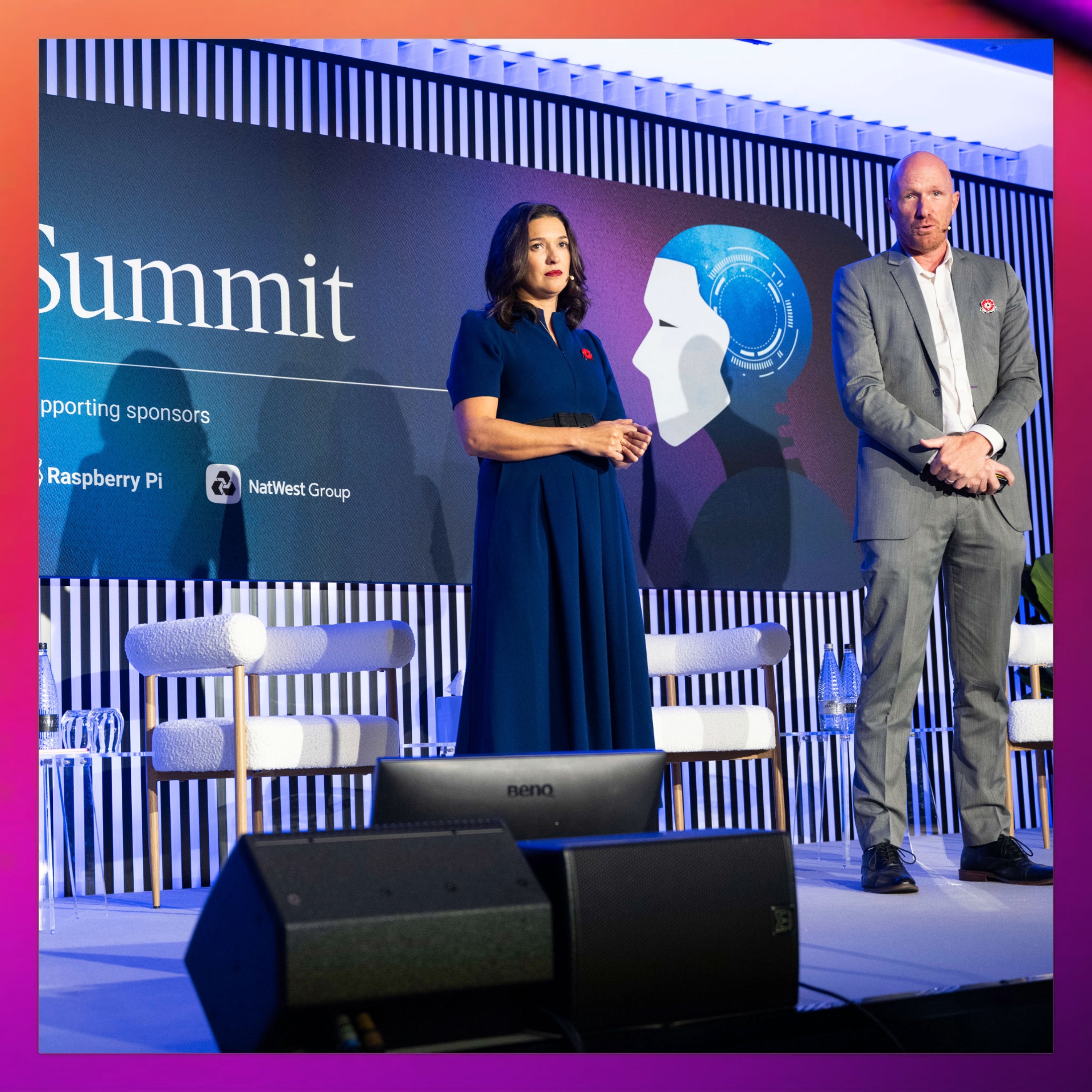
2:28And not just any robots either. Humanoid robots, little robots with two arms and two legs. And Danny, why? Because it's the future, Katie. It's the future. That's what they will tell us. So I'm very excited to hear from our guest today, who is Bren Pearce, the CEO of a British humanoid robots company called Bear Robotics. We first came across them, didn't we, at our tech summit last year in London. And I think we can tell this story now because there's enough distance from it. But it was it was very funny. The robots were there, Kinesi robots. to hand out. Which is like, Kinesi is now part of Bear Robotics, we should say.
3:12Correct. To hand out drinks to guests. But there was a bit of a problem. We had to stop the robot after a while. Yeah, because it was crushing the bottles and spilling water everywhere. It was too eager. Which is alarming, but also incredibly funny. It reminds me of like, growing up, we had a dog, Charlotte may she rest in peace and she would always you'd take a tennis ball and throw and she'd bring it back and then she's like she'd want you to throw it again but she wouldn't let go you know so you're trying to like yank this ball out of Charlotte's mouth so that was our experience last year but we I'm very excited very excited talk to Bren about all things robots how long it's going to take before we all have one in our house and I know you Katie you don't believe in them.
4:00People are going to be an early adopter. I just don't believe in them. I think anyway, I am very excited to hear maybe for different reasons. Right. Well, let's welcome Bren Pierce, founder and CEO of Bear Robotics and hear what he has to say. Look, is there something about humanoid robot? I mean, is this why you got into it? Let's go back to the beginning. Is this a sort of like little boy watching Hollywood movies, He's watching Star Wars. This is what I always say to Danny. It's about, you know, kind of just getting excited about robots that can walk and talk. Yes. That's what I want to do.
4:40I think fundamentally it is just something about it. Because I started as a software engineer and it was quite cool. You write, you know, your code and you hit some buttons or something pierced on the screen. And then one day I was watching TV and I saw a geek character on TV building like a 40 centimetre high humanoid robot. I'm like, that is epically good. I want to build one. So then I spent the next three hours Googling and thing and you're just like, all right. You know, two days later, I have like parcels turning up from Japan. And then 20 years later, I'm still doing it. Tell us about that little robot.
5:15Yeah. So it's interesting. Back in the day, they were like what was called like a robo one in Japan. And it was like 40-centre high fighting robots. And they were just made out of like servo motors you would find in a radio-controlled car. We'd have to like modify them, make them actually do what you want and write all the software, make them balance. And yeah, it was very, very cool and got me into it. And I spent, I think, about two years effectively on my own and forums building it in my house in Bristol. Two years later, my house is now looking like a robotic lab. And I wanted bigger and bigger equipment.
5:47and quite coincidentally at the same time bristol opened the first robotics lab bristol robotics lab and actually did a master i'm like all right i am going to sell my first sas company and i'm gonna go and spend a year building robots at bristol robotics lab and it was a great year i'd love to get your take on what's happening right now because we talk about it all the time on the pod i'm always like if ever there's a humanoid robot story or robot story i'm always like let's do that and katie always makes fun of me you have all of the hype and all of the youtube videos oh here's a humanoid making a bed here it is cracking an egg here it is running faster than usain bolt etc what is actually happening and how should we think about this moment especially when you have like nvidia jensen wong being like yeah we're putting a ton of money into robotics we're trying to create a universal robot brain so that we can really hit the accelerator on there it's like what is actually happening i think it's obviously the next wave in technology i was in silicon valley last week and i got an uber like 15 years ago i went in my first autonomous car you're like this is the future this is great my friend founded the company and you're in the back of the car driving around palo alto but it's taken 15 years to go from that very early startup up mentality to now I can order it with an app.
7:08And it's quite mind-blowing. And at the same time, and they're my robotic - Are you talking about a Waymo? Talking about Waymo, yes, exactly. And you're in the back of these cars going like 50 miles an hour with my other robotics friends. So how much do you trust the programmers in your life, basically, on this? But at the same time, it gets you to the destination. It is literally like living in the future. And I think that is the same analog I see now with this robotics, Humanoid robotics is AI and the foundational models. I think it's where we were in autonomous car like 10, 15 years ago, where it's like the technology's there.
7:42It's just very immature. So I think there is a lot of not really smoke and mirrors, but it's staged, really expensive stage videos. We like, right, this is like proper production. It's doing a backflip and it's really amazing. But then at the same time, where are the deployments? If you could actually make a bed and do what all these startups could do, then you'd be selling, as you said, like hundreds of thousands a year. I still think you're probably a couple of years away from really starting that ramp up where at the moment most companies are just in the pilot phase. Most of them, I think, including my company, Bear Robotics, is very much looking at the low hanging fruits.
8:22Can you just work in a warehouse, pick up a tote, drive around, put it down? No one could really do that at scale yet. And that's quite a lot simpler than can you come into a house and do all my laundry and fold the sheets and everything like that. So I think it's like this incrementalism. But at the same time, I think just with Moore's Law and the acceleration of everything, it's probably going to condense a lot of the timeline. So it's probably not 15 years like the autonomous car. It's probably more like five years until you start getting the early adopters, 10 years until it's like everywhere.
8:51But when you talk about early adopters, you literally mean somebody having a robot in their house, folding the sheet. Where are we on early adopters? What does that mean? Yeah, I think the home is pie in the sky. You know, I see a lot of these startups in Silicon Valley is like we're going to do home robotics. You can't even, you know, work in a kitchen and do dishes, you know, in like a Denny's or something like that, let alone actually in anyone's house. I think it's just like the incrementalism would be like working in a factory is very structured. Can you do subassembly? So go to a shelf, take the parts off, do the subassembly, put it in a box and very repeatable.
9:31This is where we're doing pilots at the moment because it takes a lot of time, like a couple of months to set this up. So it's actually working very reliably. We're getting up to like 98, 99 percent accuracy and repeatability. but that isn't what an actual factory worker or company wants. They want 99.99 upties. It's trying to get that percentage up so it's actually doing useful work. I think you've got to have to go into the factory, in the warehouse, these sorts of tasks before you can actually start going out into more real-world environments, let alone actually doing this task around people and being safe.
10:05So that sort of work is five years away, but still we have advanced so much from where you started out, getting those deliveries from Japan, building your little mini robot. Tell us about that journey and Bear Robotics and what you're doing now. How did you go from those mini robots to considering putting your robots in factories? Yeah, because when I finished my master in robotics, I looked out into the field, wanted the job, didn't want to stay in academia, but at the time it's just like factory arms. It was very boring. So I spent the next light, I think, eight years in academia at Carnegie Mellon, Technical University of Munich, really working on humanoid robots, getting them to just walk and, you know, balance.
10:46And some people even trying to get them just to stand on a skateboard was bleeding edge like 10 years ago. About 10 years ago, I looked at the field. I wanted to go back and do another startup. There was a lot of people I knew setting up like Fetch Robotics and a lot of these companies. I would have loved to do a humanoid robot, but back then it's very impractical. So I went to use a lot of my research in like navigation, slam, things like that, and actually founded Bear Robotics, which was doing delivery in restaurants. So that was just doing a very mundane, repeatable task. You take the food out of the kitchen, put it on the robot, it takes it to the table.
11:23We've been doing that now about nine years, shipped like 16 ,000 robots, and doing very well. Where? Is it a novelty thing? No. Yeah, where is it? Where is it? Where are the robots? Yeah, I think it's a very, going back to, I think it's a cultural thing. We sell them all in Asia. Right. I think that is where the big dominant, Japan, Korea, they love it. America, the uptief is a lot more. Europe, no one buys it. It's just a culture no one thinks about. We try to sell into here. A bunch of Luddites. Like talking to our waiting staff. It's a profession in most European countries. Yeah, we've been trying to get into Nando's for like four years, and it would be a perfect thing where you order at your table anyway on a QR code and your chicken turns up.
12:10But England, well, no one likes it. Apart from my parents are very happy, you know, randomly in Guildford, one of our robots there, and my parents had to go there to try it out. They'd tell all the wait staff that, you know, their son designed it. All of these robots always in the West get shipped to Japanese and Asian restaurants as well, Koreans. Fascinating. So can you just give like the two minute history of your company and what the last few years have been and and then again to kind of katie's point talk about like what is the environment now in terms of like you're running a robotics company you probably need to raise venture capital what does the world look like in this world in this kind of ai boom where everybody's getting excited about ai ai everything how does this fit and is it hard to raise money yeah so about three years ago going to some of the robotic conference, I was just blown away by the actual state of robotics.
13:04Well, AI to be precise. Finally, you could actually train the robot to do something. So I decided to set up another robot company, Kinesi, very much to follow my passion, which is humanoid robotics, and take these foundational models and actually make them a practical reality. So the last three years, we've built a very mature now hardware stack. And only just in the last, I say, year or six months as the software actually come mature enough that you could actually start using it. Just to translate out of techie speak a little bit, when you say the foundation of models, taking what is happening in AI digitally and bringing that into the real world.
13:39Exactly. So this is why robotics is now doing so well. So we've actually been able to, as an industry, piggyback on the work that's done by Google, Meta, these big hyperscalers, where they train these large language models and also with the vision backbone, which effectively, if you take a photo on your phone, it can tell you exactly what the objects are. With these two technologies, it actually unlocks the brain of the robot. So now the robot can finally know that a cup's there. You can say to it, where is the cup? And it can point to it. This was really missing. The control side, i.e. how to move the arm, how to control the robot and how to balance the stuff, That is done still primarily with classical control that's been just like incremental improvement over the last 20 years.
14:25But it's really been this understanding of the world and getting a robot to actually know what it's doing. Before that, you would actually have, you know, 20 roboticists who would have to sit there for like three months and hard code every single line of code, like do this, do that, do this, do that. Now, with a mixture of using like ChatGPT or Claude, you can just tell it like, this is what we want to do. It can write half the code. and the other half is what we call a foundational model. They're like these big hyperscalers like Google, NVIDIA. They train these models by collecting hundreds of thousands of hours of a robot actually doing a task.
15:00So you have a human in the background teleoperating the robot. So they'll wear gloves or there's different ways of teleoperating the robot. And someone will just pick up a glass 10 ,000 times and then use this massive amount of data to then teach the robot how to pick up a glass. And the idea is if you pick up enough glasses in the world, the robot then knows how to pick up a glass. That's really well explained. Thank you. And is this like, is it effectively like the Tin Man? Very rude. But like it finally has a brain, right? Like the Tin Man can go out into the world and actually start to do stuff.
15:35And the reason I ask is because Figure Robotics, speaking of very, very hyped humanoid robot companies, they announced something a few weeks ago where they're like, hey, who wants to sign up to wear like a camera on their forehead and just record themselves doing tasks around their house so that we can use that data to train our robots? Is that what has been happening kind of, but on a very large scale throughout the industry? Like, is that like, I'm just because it seems almost ridiculous, but I don't know if that's actually the way this has to develop. It's even more ridiculous than that. So for the last couple of years, you would literally have a room of three, four hundred people holding grippers and manipulating objects and collecting.
16:17That's how we've collected. Oh, you mean so you'd be like that, like you'd be holding them as a person. No, you'd literally have like a pair of grippers in your hand, mechanical grippers, and you just pick up objects. Or other ways people have been using it is literally like controllers. So you just control the robot like a puppet. Oh, right. And you're just puppeteering the robot and you might have like a hundred. I don't know how many Google has, but they probably have like a thousand people just. Real people. Real people, tying shoelaces, folding shirts, doing all these tasks. And it's basically called imitation learning.
16:52It takes about one to two thousand examples for the task to basically learn any task. but then to make it really general so going back to folding clothes it probably takes one or two thousand examples to fold your normal t-shirt but if you want to fold or do any laundry in any houses no one really knows like you might need a hundred thousand hours worth for someone doing laundry then you could generalize it we have covered this in us in a different capacity before when we looked at Wave driverless cars because they got footage from Ocado vans and Asda vans of people driving, essentially. And that's how they created their model.
17:34So it's quite similar. It's exactly the same. The advantage large language models had was they could scrape the internet. Another way that the AI used to be trained, if you used to go to websites and it would literally ask you, what is a bucket? And you had to click it. And that was you training an AI model. So that's how they could train the image classification, how they could learn language. For a robot, you basically have to get a robot to do the task. Historically, that is it. As you were saying before, FIGURE and some other companies claim that you could just wear a camera on your head. I don't know if that's been proven, but I think it's like all this mixture.
18:08You still need a lot of different data coming in because other things you need is like the contact forces of the grip. Like how much do you squash something if you're picking up like a bruise? Yeah, holding an egg. Or a grape. A grape, or you're picking up like sushi compared to like, I need to pick up a boat. So you need all of this, what we call multi-modalities. So you need forces, you need cameras, you need sound, you need all of these sensors to come into the robot. And you just need an incredible amount of data.
18:42Today's episode of the Times Tech Podcast is sponsored by ServiceNow. ServiceNow describes itself as an AI control tower for business reinvention, connecting people, systems, data, and AI, so work flows more smoothly across an organization. The platform integrates with different clouds, models, and data sources, bringing them together in one place to help your team. To learn more about how ServiceNow puts AI to work for people, visit servicenow.com.
19:12Your heart can tell you a lot about your health. Apple Watch Series 12 measures your heart rate every five seconds with the most advanced heart rate sensing in an Apple Watch. So your vitals app now with heart rate variability could tell you when something is off. And your readiness score can let you know when to rest and when to push. Hear the story in every heartbeat with Apple Watch Series 12. For general wellness purposes only, not intended for clinical use or to detect, diagnose, monitor or treat medical conditions. Requires iPhone 11 or later. This episode is brought to you by Capital One.
19:45Capital One's tech team isn't just talking about multi-agentic AI. They already deployed one. It's called Chat Concierge and it's simplifying car shopping. Using self-reflection and layered reasoning with live API checks, it doesn't just help buyers find a car they love. It helps schedule a test drive, get pre-approved for financing, and estimate trade in value. Advanced, intuitive, and deployed. That's how they stack. That's technology at Capital One.
20:18Ben, we will get some pictures of your robots for people watching this on YouTube. But for people listening, describe your robot and also explain to us how you came up with that design. Because something I've noticed about the humanoid robot world, which you two will be very familiar with, is they don't always look identical. They don't look like, you know, one might expect. Yeah, even though my passion is like humanoids with legs, one of the things I learned over the years is money matters when it comes to selling these so having like I think it's about 14 or 15 expensive motors to actually make a robot walk around is cool but in reality if you're just working in a warehouse or factories it's much easier just to have it on a wheeled base so it has like two arms I completely agree and the torso just goes up and up and down i've long thought the leg thing it's just completely ludicrous it is cool though it is cool to what end i don't know it's it it makes you do a lot of money in the vc industry it's not it's not the answer the idea that like we have built the built environment is for bipedal humans and if you're trying to drive mass adoption you need to just drop a robot into those environments where they can walk upstairs and walk downstairs as opposed to having to remake the built environment to accommodate this new army of droids who are going to pick up our stuff and crush our grapes.
21:45Yeah, that is actually a true argument. I do think there will be a need for a humanoid with legs. But then you also go, the environment's also built for people with wheelchairs that can get around quite happily. And it's much simpler. And it's also just, I think, from my experience... Especially if you're using them in factories. Yeah, exactly. It also just comes down to just me as a founder, what do you want to concentrate on? The hardest part is the manipulation. Can you pick up an object? Can you, you know, make a box? Can you do the task? Why overcomplicate it with the legs? So you've got arms.
22:17So yours doesn't have, you've got a wheel? We've got two wheels, yes. Two wheels. How high? It's about six foot 180 high. Almost Danny height, not quite, reaching the sky. But two arms. Two arms. With five fingers? No, that's another thing. It's like keep it safe. I would love to have a five finger hand if it's cheap, but they're about£30 ,000 each. For each hand? Per hand. Per hand, yes. That is how much these expensive hands are, yes. Whereas... So they have two fingers? Two fingers pinchers. Brilliant. Eventually I'd love five finger hands as well, but it also comes back to what you concentrate on.
22:56At the moment, if you just wanted to pick a lot of items up from a tote or do a lot of this manipulation. It's incredible what you can do with just two fingers. Yeah, amazing. Pick up cups, you can pick up... And a flexible arm. Oh, yeah, seven degrees of freedom. So it's basically... You've got an elbow. Yeah, it's the same articulation as a human arm. Okay. And then on the head? What does that look like? Very droid-y. It has eyes? No, well, it's all of eyes, yes. It has eyes. You've got to, you know, make it semi-look like a person. So getting back to like the actual use, right? If you talk to people out here who are in this world, they're like, look, we have, I can't remember the number, many hundreds of thousands or even millions of open factory jobs, like work in warehouses that they can't fill with actual humans.
23:46Is that the entree? Is that realistic? Is that where like we when you hear Elon must be like, oh, by 2031 or whatever, we're going to have a million or maybe a billion humanoid robots or whatever his crazy numbers are. Is that where we start? Is that there is a real need? And you do actually have companies who are like, yeah, yeah, give us all the droids. We actually need this. I think a lot of companies speak to a very interesting this because it's to start with, It's just boring, repetitive task. You know, one of our customers is doing beer bottle recycling where they're just like sorting beer bottles and wine bottles and no one really wants to stand there doing that all day.
24:25You also just get warehouse work where you're just picking up boxes, driving around, putting boxes down. You're starting to get into more automation. So some of our customers have a factory. They've looked at putting in like a proper, what you see is a classical robot with an arm and conveyor belt. and they're like, this is going to cost us half a million to automate this line. If we could just put two humanoids on it, then it's much easier. You don't have to run cables and it's just like self-sufficient. We just replace the people. But at the end of the day, you are replacing people generally.
24:59And what is stopping people adopting it at the moment? The technology isn't reliable. This is where you get to, you know, can you do the task 99.99 %? Because if you're working in a production line and you're, say, doing 100 tasks an hour, if you're only 99%, then once an hour, you can't do the task. So it is the tech. It's not that people are averse to having... No, they would love it. I think we're probably maybe a year away for these earlier tasks to get it completely nailed so you can actually start ramping up production. And in terms of the China piece, I was at an event last year with the CEO of Boston Dynamics.
25:39And he was like, if you look at the scale of what is happening in China and also like the state support and kind of requirement that has come from the government in Beijing, he's like, we are so far behind. Like they are just going to build way more robots for way cheaper. like can you give us a sense of what like the comparison between the kind of uk slash western state of the actual ability to make these things compared to what is happening in china and what that looks like going forward yeah so luckily i had first sound experience like a bear we sell a lot of robots and our two main rivals are actually chinese and this is where you see when it comes to just pure bill of materials you just can't compete with them because you get all the way from the button to the top Chinese sponsorship or subsidies so they will get free land they get free patents they get hands they get cheaper hands but it's the whole supply chain it goes from subsidized batteries to subsidized raw material to factories given to them to even the exporting they don't maybe they do what they don't but they probably don't pay as much export it's just like all of this ecosystem where they can build robots about 30 percent cheaper you know as a western company building in China, they could build it 30 % cheaper.
27:01And do you have any advantage over people wanting to buy British technology? No. We hear from other tech companies that, you know, because of the geopolitics at the moment, there are some people who try and avoid buying. It's funny, you hear a lot of companies will say, we'd rather buy Western because of security. And then you see six months later, they bought a Chinese robot because it's 30 % cheaper. yeah and then i think it also comes down to the government's decided robotics is very key to their whatever you call it it's a quarter their five-year plan yeah so you you get the state where we talked about all right you need like hundreds of thousands of people to collect data there's videos coming out of china where the chinese government's like great we're just going to build a massive warehouse and put 5 000 people in there collect data and just give it to the robotic companies and they have just an army of 5 000 people tying their shoes exactly and then you have in universities researching motors and you have a like a pipeline of very good robotics and ai people so they have this whole you know state yeah machine machine grinding away whereas you do get like silicon valley has a lot of money but it's a bit more fragmented where you have like obviously figure agility and these companies but you don't really have like a a European or an American government who's like, great, we're just going to hire 50 ,000 people to collect data and just make it open to our robotics companies.
28:30And I was going to say, just on that 30 % point, that is 30 % cheaper if you are manufacturing in China yourself. Yes, at the same factory. What about manufacturing outside of China? Good luck. Is that like just not a thing? Or is it like 10 times as much? We looked at it like four or five years ago. The problem you get is supply chain. So you even get to injection molding. So we went in America and went around a couple of injection molding companies. But when you chat to them, it's like, well, all your plastic comes from China. All your molds, the people that actually make all these crazy molds to make the injection molded parts, the knowledge to actually make the machine that makes the machine is actually a very complex part.
29:13And when we spoke to them, they're like, yeah, we outsource that to China. So it's like, great. So even if you make the plastic part in America, the machine is designed and built in China and shipped over. All the raw materials are made in China and shipped over. You pay a premium in America. You're like, why wouldn't I just get the injection molded part? Then you do that for all of the parts. You're like, all right, we need a motor. And you're like, you could probably buy the same motor in Europe, but it's 50 % more expensive. So you're like, well, if I'm going to buy the motor, I'll buy it from China.
29:42And if you do that, you're like, well, I might as well just build it in China. So end to end for you, you're manufacturing in China. Everything's coming from China. And it's 30 % more expensive for you because you're a foreign company. Yeah, we do some in Korea and Vietnam and other places like that. But primarily, a lot of the parts come from China. Right. So is it fair to say then that basically the robotics industry is in China? For hardware, probably yes. Yeah, interesting. If you want to compete with price. Yeah. I don't think any Western company is really manufacturing them anywhere. Right.
30:18Right. There we go. Well, it's just interesting because when you think about, because we talk about AI, you know, every week, and this is another area where China is just dominating. And if you believe that this is one of the kind of industries of the future, you would think that people would be concerned about that. I do think at the moment I could be biased, but, you know, America and Europe probably is ahead at the moment in terms of software, in terms of foundational models coming out of NVIDIA. There's also like companies like Pi Zero, Real World and some of these unskilled AI in America that are actually working on the AI models for the robots.
31:01And we do have really good universities in Europe, you know, Oxford, Cambridge, Technical University of Munich, Switzerland and things like that. So, you know. In that spirit, did you watch the recent Robot Olympics in China, or at least some of the stuff on YouTube? Oh, yes, of course. What was your favourite event? I still quite like running because that was a lot of my PhD work. Really? Making robots run. Well, back then we couldn't make them run. That was the point. So before we let you go, I'm going to ask you to make a prediction. how long the year is 20x before you have a robot in your house that can make your fried egg and make your bed and how long until they're doing the running olympics without having to have a fire hose sprayed at them and a crash mat i think for the home for early adopters i think 2035 2035 that's ridiculous 9 years hard things are hard Katie this is progress no I mean that's like not that far away I hope alive Rosie the robot in a decade whatever you do get the point though I think that a lot of people miss with the home humanoids I think it'd be like a couple of percentage population actually has them.
32:24If you look at the cost, you know, not many people have cleaners. And I think I pay like 200 a month for a cleaner. So is someone going to be willing to pay 1000 pounds a month if they're not going to pay 200 for a cleaner? I'm looking at Danny. But this is what we've been talking about a lot is like, you know, the Silicon Valley hype machine is in overdrive. And they're like, oh, everybody's gonna have one. And you're like, no, they're not. I know people that don't even have a dishwasher. Yeah, I mean, I barely have a car. I don't have a car. You don't really need one. Exactly. So do you really need a humanoid robot cleaner?
33:00Anyway, thank you very much for coming in. My pleasure. So, are you going to get yourself a robot? I think you both proved my point, right? Which is? People want them because they look funny and you all watched Star Wars and thought CP3O was great. and actually if you want to make a robot that does something practical a wheel is better than legs what unless you have stairs and cheaper i mean did you hear the cost of hands each one those are those are expensive hands that's that's crazy the thing that i thought that i just find so interesting is just the china piece of it and how he's just like to hear him tell it was like there is effectively no robotics industry outside of china of any size or has any hope of competing, which is just interesting, because if I take your skepticism, I hear it loud and clear.
33:55But if robotics does become a thing, and that is a big if, that's another thing that China just is set to dominate. It makes sense on the hardware side. I was very heartening to hear him say that from a software point of view, the brains, in inverted commas, are being developed in Europe and in the US. But it's the same with all hardware manufacturing, isn't it? Right. I mean, China has long been the world's factory. And though that's changing in some areas, and he mentioned manufacturing in Vietnam, really, that remains the case. And as he described it, it's so hard to challenge that Chinese government machine when it gets behind a sector.
34:36And maybe, you know, I laugh at the robotics Olympics and all of that silliness, but maybe they will get rid of the crush mart and it'll be a thing well there's the thing also when you think about the other framing around all things ai with the the kind of the geopolitical military angle of like what if these things actually do become capable and then you do have like a robot army and like and there's this notion of like a warehouse full of people tying their shoes and picking up shirts and folding laundry and all this stuff. It is kind of just like wild to visualize as we try to kind of like wade through all these difficulties to get to a point where these things are actually useful and a thing.
35:19But who knows? This could be, you know, 10 years away from being 10 years away like so many other technologies. It's quite a step away from the robot distributing chicken in Guildford. Exactly. Come on, Nandos. Yeah. He wants to sell you a robot. Be fun. people love it Nando's get on it anyway maybe we would have broken our first deal well exactly now I will be coming to that your fair isle next month and I'm gonna I'm gonna come to I do love a Nando's so maybe I'm gonna stop in my local Nando's and see what's happening there look for my robot go to Guildford and ferry my chicken to me sir or bee boo bop bee bee bop anyway um well that's it for this week's episode of the Times Tech Podcast.
36:09Please do follow us on YouTube or wherever you get your podcasts so you never miss an episode. Yeah, find out where to get served by a robot here. Sort of thing, sort of information we bring you. See you next week. Get your chicken. Bye-bye. Look forward to it. Bye-bye.
36:30Your heart can tell you a lot about your health. Apple Watch Series 12 measures your heart rate every 5 seconds with the most advanced heart rate sensing in an Apple Watch so your vitals app, now with heart rate variability could tell you when something is off and your readiness score can let you know when to rest and when to push hear the story in every heartbeat with Apple Watch Series 12 for general wellness purposes only not intended for clinical use or to detect, diagnose, monitor or treat medical conditions requires iPhone 11 or later At PwC, we optimize the systems that put your data to work, so you can scale your AI from proof of concept to competitive edge, and accelerate your tech evolution so you can redefine what's possible.
37:13From blueprint to breakthrough, we take you further with tech, so you can outthink, outpace, and outperform. PwC, so you can. PwC refers to the PwC network and or one or more of its member firms, each of which is a separate legal entity. This episode is brought to you by Capital One. Capital One's tech team isn't just talking about multi-agentic AI. They already deployed one. It's called Chat Concierge and it's simplifying car shopping. Using self-reflection and layered reasoning with live API checks, it doesn't just help buyers find a car they love. It helps schedule a test drive, get pre-approved for financing, and estimate trade-in value.
37:53advanced, intuitive, and deployed. That's how they stack. That's technology at Capital One.
Humanoid robots are all over social media: making beds, doing backflips, even outrunning Usain Bolt. But how much of it is real and how much is hype?
This week, Danny and Katie are joined by roboticist and co-founder of Bear Robotics Bren Pierce. He’s been building humanoid robots for more than twenty years.
They discuss how AI is finally giving robots ‘brains’ to understand the physical world, why China is winning the robot race and how long it will be until robots are folding laundry in our homes.
The Interview is our weekly conversation with the people shaping the future of technology.
Guest: Brennand Pierce, Co-founder and Chief Robotics Officer of Bear Robotics
Presenters:
Katie Prescott, Technology Business Editor, The Times
Danny Fortson, US West Coast Correspondent, The Sunday Times
Producer: Marnie Duke
Executive Producer: Priyanka Deladia
Image: Bear Robotics
Hosted on Acast. See acast.com/privacy for more information.