Ask ChatGPT


In this bonus episode of The Times Tech Podcast, the hosts discuss the implications and potential of quantum computing, featuring insights from James Palles-Dimmock, a leader in the field. The episode addresses how quantum computing could revolutionize various industries, including finance and pharmaceuticals, and explores the current state of research and development.
Written by AI. May contain mistakes.
Overview of quantum computing and its significance for various industries.
“And what will it mean for your business?”
A light-hearted joke about quantum particles highlights the confusion surrounding the topic.
“And of course, for business people who are thinking about this, what does quantum computing mean for them?”
James explains the principles of quantum computing and its potential advantages over traditional computing.
“So a quantum particle known as a qubit is lying on a therapist's couch.”
Discussion on the early use cases and expected timeline for impactful applications of quantum computing.
“Katie's going to ask you about how your company got started, but just staying with this idea of the development of quantum computing, for people listening, what will the first uses be?”
James shares the story behind the founding of Quantum Motion and its technological focus.
“How did the business start and what was its genesis?”
An in-depth explanation of qubits, how they function, and how they differ from classical bits.
“I mean, I told my terrible joke about it.”
James discusses his transition from academic research to leading a quantum computing startup.
“Where are you now with the company, sort of more than a decade on?”
Discussing the transition from theoretical studies to practical R&D in quantum technology.
“Is that what they do in quantum physics labs?”
Exploring how quantum computers could enhance AI capabilities and data generation.
“As we're seeing the huge acceleration in AI advances, massive investments in data centers needed to power AI.”
Examining the potential risks quantum computing poses to blockchain encryption.
“There has been some talk, apparently, that quantum computing will break the blockchain and destroy crypto as we know it.”
Understanding how quantum computing complements classical computing in various fields.
“And what businesses will want to use it?”
Investigating how quantum computing can optimize complex financial systems and risk management.
“Or is it actually doing something deeper than that?”
Discussing the competitive landscape of quantum computing technologies and market dynamics.
“So you're dealing in silicon and others are using other methods.”
Assessing the funding requirements and growth strategies needed for quantum companies.
“At that point, there were 50 ,000 person company.”
Analyzing the current investment trends in quantum computing compared to AI.
“And that lets us get up to a point where we've demonstrated all of the key features that you need for a large scale quantum computer.”
Evaluating the geopolitical race for quantum technology leadership among nations.
“I mean, is there a sense in the sector that there's a geopolitical race going on between Britain, America and China, for example?”
Discussing aspirations for building a leading quantum computing company in the UK.
“So it's like the most advanced technological ideas that they're investing in.”
Explore the dynamics of funding and independence in quantum computing.
“Jeff Bezos turns up and well maybe not him.”
Gain insights into the implications of quantum computing for industries.
“So Dom, do you feel any the wiser after that?”
Discuss the international landscape of quantum technology development.
“I mean, IonQ, the American business which recently bought Oxford Ionics, had to go through a massive process with the British government looking at, you know, it's a critical industry and they're our allies.”

Get the gist, explore an idea or ask about something said.
 Claude
On Times Tech, what are the key points of this episode?
Searching your listeningAutomatic transcript. May contain errors.
0:00Katie Prescott: This episode of the Times Tech Podcast is sponsored by Adobe Acrobat Studio.
0:04James Palles-Dimmock: A lot of us lead very busy lives, including the tech bosses you hear from on this podcast. We're dealing with more information than ever before, often across disconnected tools and working in hybrid teams.
0:16Katie Prescott: If this sounds familiar and you're someone whose life involves scrolling through contracts, reports or pitches with important data buried in long documents or different sources, then you'll know it can sometimes be a struggle to keep up.
0:27James Palles-Dimmock: Or at least to do so in a timely way.
0:30Katie Prescott: Adobe, the company that invented the PDF back in 1993, is changing that with Adobe Acrobat Studio. It's a modern workspace designed to help you work smarter and save time.
0:40James Palles-Dimmock: Acrobat Studio isn't just for essential PDF tasks like editing or signing documents. It's an AI-powered space built to help you use simple language prompts to get information quickly from multiple documents and sources, including PDFs, Office 365 files, and web pages.
0:56Katie Prescott: It's for people with busy, demanding jobs who want to spend less time on admin.
1:00James Palles-Dimmock: And more time on the work that really matters.
1:02Katie Prescott: Check out Adobe Acrobat Studio and its new features now.
1:06James Palles-Dimmock: This episode of the Times Tech Podcast is sponsored by PwC.
1:10Katie Prescott: How do you use AI in ways that drive real business value? It isn't just about the tech, it's a new way of thinking going further, faster. This is where PwC comes in, shaping AI to fit your business to help you innovate with impact, empower your people and accelerate growth. Working with you side by side, bringing deep industry know-how with expert change management to unlock real value and drive lasting impact.
1:36James Palles-Dimmock: PwC knows how your business works, so you can put AI to work for your business. Discover more at pwc.co.uk. Hello, it's Katie here. We wanted to share a bonus episode from one of the other podcasts here at The Times. Last week, I was standing in for my colleague Hannah Previtt on The Business, where we looked at quantum computing. It's a tech so many people think could be the next big revolution after AI, but one that many of us really struggle to fully understand. It's a fascinating conversation with James Pallas-Dimmock, who's the CEO of British company Quantum Motion. And we talk about how quantum could reshape industries from finance to pharmaceuticals.
2:19James Palles-Dimmock: And we thought tech listeners would enjoy it too. This week, quantum computing. It's billed as a revolutionary technology. But what is it?
2:29Katie Prescott: And what will it mean for your business? This is The Business, where we talk to insiders about markets, companies, and survival strategies to help you navigate the business world. I'm Dominic O 'Connell, Times columnist and business correspondent for Times Radio.
2:45James Palles-Dimmock: And I'm Katie Prescott, Technology Business Editor of The Times, standing in for Hannah Prevett this week.
2:55James Palles-Dimmock: Our business today is quantum computing. Don't be put off. We are going to try and explain it in human and in English. It's one of those things that's been billed as sort of the next big thing for almost as long as I can remember. But it does seem like it's coming down the track really quite quickly. I mean, we've seen HSBC recently do a trial with IBM about using quantum computing for algorithmic trading. The National Cyber Security Center, terrifyingly, has warned companies that they need to get ready for this because it's going to make it far easier to crack cryptography, so make hacking easier.
3:32Katie Prescott: Well, and also there are lots of competing technologies vying to win in this space. And I don't think anybody really knows which one's going to crack it. And of course, for business people who are thinking about this, what does quantum computing mean for them? What should they be doing to prepare for quantum computing?
3:48James Palles-Dimmock: It's not a subject that lends itself to levity. But Dom, I've got a quantum joke for you.
3:53Katie Prescott: Go ahead.
3:54James Palles-Dimmock: So a quantum particle known as a qubit is lying on a therapist's couch. And the therapist says, what's bothering you? And the qubit says, nobody understands me. And that's such a bad laugh. It's obviously not funny. Anyway, I think that is quantum's problem. Nobody understands it.
4:16Katie Prescott: Well, I think we're going to talk to someone who does, actually, because our guest today is James Palastimic, chief executive of Quantum Motion, a British company, a leader in this field. It's already raised£60 million.
4:34Katie Prescott: So, James, if you meet someone at a party and you say you work in quantum computing and you get a blank look back, rather like you're getting from the two of us in a minute, what do you say to give them a quick entree into it? I generally start with that we're making the most powerful computer the laws of physics allows us to make. If we then have to go a little bit deeper and explain why we can make a more powerful computer out of this, I'll tend to also ask them a question, which is, do you understand how a regular computer works? And then you can nuance that and then show how the laws of quantum mechanics allow a standard computer to become dramatically more powerful.
5:15Katie Prescott: So you're talking about traditional computing, and in traditional computing we talk about binary systems, noughts and ones. But quantum computing is a step past that, or a different type of step might be a better way of saying it. Yes, so rather than being somewhat constrained by just being on this axis of zero and one, quantum computing says, essentially, That's your classical analogue of a computer. But there is a certain richness where you can bring in things like superposition and entanglement, everything that we use to understand quantum mechanics and use that to expand the field of things that we can do with a computer.
5:55Katie Prescott: And so it's kind of the zenith of computing, if you like. Katie's going to ask you about how your company got started, but just staying with this idea of the development of quantum computing, for people listening, what will the first uses be? Where will it start to work and make a difference in people's lives? Yeah, so building on what we just said, quantum mechanics is a way for us to understand the world at the deepest possible level. Quantum computing, the earliest use cases, will be for those. It gives us the eye of God on what's going on at the subatomic level. We can model materials, new chemical reactions.
6:28Katie Prescott: These are the early areas that people have fantastic hope, and indeed a good degree of reason for that hope, to believe they will be transformative. When is it going to happen? When are we going to start seeing new drugs discovered using quantum computers? New drugs discovered? Maybe slightly longer, but certainly people are already investigating new kinds of materials. Really the issue is how large the quantum computer is. And I don't mean physically, I mean in terms of the number of qubits and what you can do and explore with that machine. So to do something useful, let's say in materials science, you're probably still looking at about sort of the five-year time horizon.
7:05Katie Prescott: because katie gave the example earlier of hsbc saying it had used a quantum computer from ibm to do some algorithmic trading is that a real quantum computer is that you think just a bit of pr i think it's useful for them to use that because they're building up the understanding of how they will use a quantum computer um to do that it's limited there that computer is still less powerful than the world's most powerful supercomputer but they're understanding how they can use that computer for that small subset problem, and then they can extend that. And so it's a very useful thing to do. But no, to say that it's something that's changing or giving them a return on their investment, I don't think anyone's made that claim.
7:45James Palles-Dimmock: But it does feel like more and more people sort of readying themselves for this quantum revolution. But let's go back to the beginning and the start of your company, Quantum Motion. How did the business start and what was its genesis? Tell us about its history.
7:58Katie Prescott: Yeah, so it was spun out of Oxford and UCL. so two professors Simon Benjamin and John Morton and myself essentially Simon and John had known each other since they were were in the same university so they were in Oxford Simon was a postdoc and he'd been fascinated by quantum computing since those early days but seen as I think everyone had that the early early ways of realizing small-scale quantum computers were things like, let's trap this thing with some lasers. Let's shine some light and get individual photons in a very, very large machine. And he and John and myself, we'd seen technologies like that go nowhere.
8:48Katie Prescott: And it's very, very difficult to imagine scaling up something to the millions of qubits that you need to make a difference to the world based on those particular technologies. But then what had happened just around about 2016, 2017, was that the experimentation on trapping electrons under individual transistors showed that you could use these as your qubits. There's some fantastic early work, and indeed early work down in Australia, not just in this country. So it's been a global effort. But seeing that work come together with what you could do at a theoretical level really gave us the impetus to say, let's not build a quantum computer that is the size of a data center based on these other technologies.
9:31Katie Prescott: Let's use what humanity has again and again shown itself to be incredible at, making transistors, miniaturizing them and putting billions of them onto a chip and turn that into a quantum computer. So all of those sort of pieces had started to come together. and that was the formation of the company in 2017.
9:51James Palles-Dimmock: Okay, so for the layman among us, could you just explain what a qubit is? I mean, I told my terrible joke about it.
9:57Katie Prescott: It's always good to hear terrible jokes. No, so a bit, essentially think of it like an arrow. It can point up, it can point down and that's your constraint on your bit. The way that we can broaden that and use all of the power of quantum mechanics to be able to manipulate that is that now instead of imagining your arrow as a line where it can only point up and down, it can now point anywhere on a sphere. So you can have all of these other states. You can only still measure a 1 and a 0 at the end of your computation. But all the while your computation is going on, you can have this arrow pointing absolutely anywhere and crucially being entangled, meaning that it has an impact on the operation of another arrow that's next to it.
10:40Katie Prescott: And these are representing your computational information. So that's what a qubit is, and that's how we can use them to expand and dramatically increase the amount of power we get from computers.
10:52James Palles-Dimmock: Would you just describe what one of your computers looks like? We even put one in the paper, actually, the other day, because they're really quite beautiful.
10:59Katie Prescott: Yes, I think we have the only Art Deco quantum computer available. So at the deepest level in there, though, there is just a single chip. So it's a single sort of square centimeter sized object. similar to you would find in your phone. Then what do you need to do to that to be able to sort of unveil these properties? You need to cool it down. And that's so that you can trap single electrons under these transistors. And we do that in what's called a dilution fridge. And that's what we've put inside this rack.
11:31James Palles-Dimmock: Which is sort of gold, almost like a gold chandelier.
11:34Katie Prescott: Gold chandeliers with different temperatures. It's using physics to cool it down. It's similar to your fridge at home. You just need to have an energy transfer between two fluids. And the only thing that stays fluid at these deep cryogenic temperatures is helium.
11:48James Palles-Dimmock: So that was the idea for the company in 2017, to try and do quantum computing smaller and cheaper, essentially. Where are you now with the company, sort of more than a decade on?
11:58Katie Prescott: Yeah, so we have demonstrated, we put the first demonstration out, showing that you can use a standard CMOS process to make a quantum computer. So the way that we make standard chips in your phones. Yes. So, yeah, metal oxide and semiconductors coming together and being patterned on substrates, which is the bedrock of the standard semiconductor industry and the way that we have the chips in our phones.
12:23James Palles-Dimmock: And have you got customers for that?
12:25Katie Prescott: Yes. So, yeah, the UK government bought one of these through the National Quantum Computing Centre. And, yeah, this was the first deployment anywhere where someone had shown that you can use this process to make a quantum computer. So, yeah, something we're pretty proud of. Can I just ask a really stupid question? Because you're using what looks like a conventional chip and cool it down and you trap an electron inside it or underneath it or, you know, somewhere nearby. Yeah, no, so, I mean, starting out from a description of how does a transistor work, a transistor has three electrodes on it. That's a way to get electrons in, a way to get electrons out, and a way to control them.
13:06Katie Prescott: Think of it like a switch. We call that a gate. So in a standard transistor, all of these are sat on top of your silicon and you will put a voltage on your gate that sucks up a couple of thousand electrons and allows a current to flow from your source to your drain. And that represents, whether there's a current flowing or not, a one or a zero in your standard computer. This is the way that computers work. The way that we turn that into a quantum computer is instead of having a higher voltage on your gate, we get a couple of thousand electrons under there, we essentially just turn down the voltage and you get a single electron under your gate.
13:41Katie Prescott: And then it's that spin, so not the charge, but the spin property of that single electron that forms our qubit. How has the journey from academia for you to business been? Did it come naturally to you or is it actually quite odd? You can't sit around smoking a pipe all day after all.
14:01James Palles-Dimmock: Is that what they do in quantum physics labs? Yeah. I'm on quantum physics labs.
14:06Katie Prescott: I saw that film, Oppenheimer, and that's what it's all about. Okay, so once I got past the smoking of pipes, yeah, no, so I actually started out relatively early. So I went straight from Cambridge into industrial R &D. So I worked for Sharp for over a decade, and that was very formative. So during my studies, it was very theoretical. I got a deep understanding of quantum mechanics and how the world should behave. But then when I went into this R &D lab and we transferred technology like new kinds of laser and new kinds of television or new kinds of solar cell and got those fabricated in Japan, I had to understand how to realize those things.
14:48Katie Prescott: It was a magnificent place.
14:49James Palles-Dimmock: Can I ask how quantum relates to AI? As we're seeing the huge acceleration in AI advances, massive investments in data centers needed to power AI. Is there some, I don't know, development in quantum that will change the AI revolution in some way, speed up the technology? I don't know. Is there a sort of overlap between the two?
15:12Katie Prescott: There's certainly ways that, well, both a quantum computer can improve AI and AI can improve quantum computing. But yeah, starting with your initial question, which is, yeah, how can a quantum computer improve AI? AI is very, very sensitive to the data that goes into it. And we've heard this about, you know, ChatGPT mining the entire data of the Internet and then other companies mining ChatGPT for their data. But we've got to a point where, you know, these companies have mined almost all of the data that's out there. And so using a quantum computer to generate data is one of the key ways that we can enhance it.
15:53Katie Prescott: So take, for example, materials modeling. If you want to generate new kinds of material using artificial intelligence, you need to have a large database that tells you how materials behave, what are the properties of them. We can generate that data using a quantum computer, essentially looking deeply, understanding material with the eye of God so that you know all of its properties, get that incredibly clean data, put it into an AI inference or LLM, and they will then generate new kinds of materials based on that very, very good data set that you've put in. So that's one example that people are looking very, very carefully at is how can we carry this out to accelerate AI materials generation.
16:38James Palles-Dimmock: There has been some talk, apparently, that quantum computing will break the blockchain and destroy crypto as we know it. Have you heard this? And is it true?
16:49Katie Prescott: So it's one possible extension of what a quantum computer can be used for. It's been demonstrated that you can factor large numbers, and this means that you can attack certain kinds of encryption. And the early encryption method that they used to secure Bitcoin, for example, would be amenable to this kind of attack. You would be able to break that particular code. There are ways to get around this. You can obviously replace the way that you encrypt these kinds of currencies. And indeed, this is what's been going on for the past 10 years inside our own government and elsewhere, is gradually replacing the kind of methods of encryption with ones that aren't amenable to quantum attack.
17:33James Palles-Dimmock: OK, so it's possible. It's possible. Right.
17:35Katie Prescott: From what you're saying, though, it sounds like quantum computing is not going to replace traditional computing. It's complementary to it, not a replacement for it. That's exactly correct. So what kind of jobs will it do that conventional computing can't do? And what businesses will want to use it? So, yes, I was talking about understanding materials at a deeper level. Why is it good at doing that? Precisely because the qubits have the same kind of properties that the subatomic particles that make up your materials have. And so it can model them in a much deeper way than our sort of surface level understanding the way we model them with classical computer scan.
18:17Katie Prescott: Now, there are other classes of problem that are analogous to that. Some in the financial markets, for example, you have these massively interacting systems that can be thought analogous to the massively interacting systems that we have in materials science. And if you can use where people have, you know, in derivatives pricing, for example, indeed, we've done an assessment of using a quantum computer to improve and speed up derivatives pricing for Goldman Sachs. So these are concrete areas, but all based on, you know, where do you have these very largely interacting systems or things? It doesn't have to be electrons or subatomic particles.
18:58Katie Prescott: Those are the kind of areas where quantum computers are very likely to have an outsized impact. So big chaotic systems with lots of inputs. But do you think of it, should I think of it like I would think of a normal computer? I've got this difficult derivatives trading book. I want to put in all the inputs that might influence it and my computer will work it out for me. Or is it actually doing something deeper than that? It's carrying out things in a very different way. so the way that a quantum computing algorithm works you know many people sort of come away with the notion that it's it's giving you all of the possibilities at the end somehow and that that's not not really the right way to to think about it it's more that you start out with the same sort of input data and again ideally with a quantum computer that's a smaller input data set of data as possible.
19:49Katie Prescott: And then during the computation, we're adjusting the probabilities of the output data. And so using this kind of interference that you get in quantum systems, we're reducing the probabilities associated with the kind of output data which we think that's definitely not the answer. And so rather than getting one single answer out saying, that's it, we've got it chaps. With a high probability, these are the kinds of output that we think are likely from this calculation. These ones are much less likely because during the calculation, as I say, you've interfered with these quantum particles such as to reduce the probabilities of those outputs dramatically.
20:32Katie Prescott: That's a better way to think about how a quantum computer is working. I'm nodding along.
20:39Katie Prescott: But for the Goldman Sachs trader, it might it may not make them a billion dollars at the end of the day but it might stop them losing two billion there are potentially no no so there are ways for them to understand um derivatives pricing better through through this as well um it's not just about uh risk mitigation but you're right in saying there are some examples where um managing risk has also been identified as a good way to use a quantum computer but just well on this there are lots of competing technologies and quantum computing, what will decide which one becomes the VHS rather than the Betamax?
21:14Katie Prescott: Yes, exactly right.
21:14James Palles-Dimmock: So you're dealing in silicon and others are using other methods.
21:18Katie Prescott: So yes, obviously I have my degree of prejudices, but I'm glad that you put that out of the way. It'll be economics as it is with it. I hate to say it, it will be that dull. Eventually, a quantum computer will be a commodity and people buy, you know, the commodity that has the best value for them. And that's precisely the reason why we're in this area. It's not that I don't think that a quantum computer made of any of these other approaches will work. Indeed, I think there's fantastic evidence that all of them can get to these million qubit machines. But in many cases, those become billion dollar machines that you put in a data center of their own.
22:01Katie Prescott: And that just has a very different sort of economic return compared to one which is, you know three smallish racks um which you can do for a fraction of the cost that's yeah where i
22:12James Palles-Dimmock: feel we have the advantage and as we're on the subject um of competition i'd love to hear your reflections about what it's like to be facing the challenge of big tech because there are some really really big players in this space right ibm microsoft google all who are announcing breakthroughs all the time um what's it like looking at that from from a startup in the uk
22:34Katie Prescott: I mean, I've had a background in big tech. So I had a decade working sharp. At that point, there were 50 ,000 person company. So I know how things work inside. And it's often siloed. R &D is sometimes harder. You still have to fight for the resources to get your individual projects done. And so that's, yes, they've got large budgets, but we have the ability to move incredibly quickly. Obviously, we're in a competitive market, but I don't. That's not the thing that keeps me up at night.
23:06James Palles-Dimmock: And do you think an exit for you inevitably means a sale to one of these companies? I mean, we saw Oxford Ionics being sold to IonQ, which is one of the few publicly listed quantum businesses, but based out in the States. I mean, is that the natural move?
23:22Katie Prescott: No, no, I don't want to be bought by another company. I want to be an enormous UK success story, in all honesty. We've grown this company since the very beginning, knowing that building a quantum computer and building a large company is what we wanted to do. And we're very fortunate that we've had very strong support from our investors along the way to do that. So I think, yes, you're right. There's examples where quantum computing companies have gone public, for better or worse. I think until you're doing substantial revenue, there's still a question as to whether you should stay private or public and i'm very happy that we're private still you've raised about 60 million pounds so far what kind of funding is needed what do you think the spend will be to realize that vision of a large quantum computing company well the the big benefit of the way that we're doing it is we're very capital efficient so we build we don't need to build our own foundries or you know have clean rooms indeed inside our offices we use the multi-trillion dollar semiconductor manufacturing industry, essentially the next stage for us is, you know, a hundred or so million.
24:32Katie Prescott: It's not into the billions. And that lets us get up to a point where we've demonstrated all of the key features that you need for a large scale quantum computer. Obviously, at that point, then you're scaling up like an integrated circuit company. And so there's a need for, you know, perhaps into the hundreds of millions of pounds. But you're not talking about needing funding of multiple tens of billions like you would if you wanted to put a rocket on the moon, for example.
24:55James Palles-Dimmock: But it has been an amazing week for British AI investment announcements? I mean, probably most notably$1.5 billion into Wave, the driverless car business. And we've seen recently the likes of 11 labs valued at$11 billion. Another AI company, Synthesia, valued around$4.5 billion. Another AI company. Do you find that quantum is in the shadow of AI at the moment? That it's the hot topic and that's where investors want to put their cash?
25:20Katie Prescott: There certainly has been a massive buzz. I don't think anyone can deny that around AI and with the mega IPOs coming later on in the year. That's likely. Yeah, I don't know anything about that. So I'm definitely not giving any advice there. No, so inevitably, that's where a lot of the capital has been pushed over the past couple of years. But I feel like quantum, you know, it's still well funded. It doesn't need as much funding. There aren't as many companies and there's a much higher bar to enter quantum computing than there is to enter AI. So I still feel like it's very well supported from private investors, from public investors.
25:59Katie Prescott: And you've probably seen that in the share prices of some of these public companies. There's still too much money for the amount of opportunities there are out there. So I think we're in a very good position.
26:09James Palles-Dimmock: And it is one of the industries that's considered sensitive by the UK government. I mean, is there a sense in the sector that there's a geopolitical race going on between Britain, America and China, for example?
26:20Katie Prescott: Yes. Yeah, I don't think that anyone could say otherwise. I mean, the UK government and the US government get on very well. Quantum was at the core of the partnerships that they put together recently. And indeed, we're in the DARPA program. And that's been very well supported by the UK government. So I wouldn't say that there's a sort of, yes, it's competitive, but kind of friendly competitive between UK and US. China's another matter, but they're equally making fantastic progress. And, you know, I do still wish that we could somehow get on better as a world, but I'm not going to be able to solve that.
26:57Katie Prescott: So, yeah, we just have to accept that it would be challenging for a Chinese company to operate in the UK or likewise a UK company to operate in China. That's just the world we live in. I quite like the ambition, though, the idea that you could be, you know, the UK. Well, I'm putting words into your mouth here, perhaps extrapolating a bit, that you could be the UK's tick titan that it never had, the UK's Google. Is that really part of the vision? Yes, absolutely. We are world leading. There's a reason why we're on the DARPA program. We were selected amongst hundreds of companies.
27:30James Palles-Dimmock: And that's the US Moonshot program. So it's like the most advanced technological ideas that they're investing in.
27:36Katie Prescott: Yes, it was. So I think this was important. The question that the DARPA program asks is not, can we build a quantum computer? It was, can we build a quantum computer that's worth building? and and it very much back to that to that point of can you actually get a return on investment that you're not just building something that's the the size of a of a factory and costs billions of dollars or if it does is there a billion dollars worth of return at least that you can have from such a machine um so it was a very important question yeah they've put a lot of funding into this because i i guess darpa's whole modus operandi is we do not want strategic surprise and what more strategically surprising than to find out that your competing countries have the most powerful computer the laws of physics allow you to make and DARPA was responsible for
28:24James Palles-Dimmock: the internet driver's car they've done a pretty good job of finding new technologies lots of
28:30Katie Prescott: interesting defense stuff as well um so perhaps just to finish it because you did say this didn't you so so you you make the breakthrough you become a tech titan bill gates turns up and offers you a check. I think he's persona non grata now. Jeff Bezos turns up and well maybe not him. You're struggling to find billionaires now. No not Elon Musk. $50 billion check. Can you really say actually we're going to be able to say no to that because we want to be independent? Because you have external investors now they'll have a view but the idea is you don't want to you want to be independent. Yes, and we can and have said no to people coming and offering.
29:09Katie Prescott: The number of times we've been offered to SPAC or something else is, you know, you probably get a couple of people a week writing to that. And so obviously, you think about that, you have to present it to the board, but the right option for us is to make sure we continue growing.
29:24James Palles-Dimmock: Thank you very much, James Palaston-Mick from Quantum Motion. It's been brilliant to have you on.
29:28Katie Prescott: Thank you. Let's pause there for a moment to talk about today's sponsor, Adobe Acrobat Studio.
29:33James Palles-Dimmock: Acrobat Studio helps documents work harder, organizing projects, extracting insights quickly, and creating professional content from the files you already have.
29:42Katie Prescott: It's designed for individuals, teams, and businesses who need AI-powered tools that are easy to deploy and use.
29:48James Palles-Dimmock: And Adobe says your data stays secure and isn't used to train its AI models.
29:54Katie Prescott: So if you want to rethink what PDFs can do, check out Adobe Acrobat Studio and its new features now.
30:00James Palles-Dimmock: This episode of the Times Tech Podcast is sponsored by PwC.
30:05Katie Prescott: Every leader is looking for that next opportunity for growth. But as technology and AI reshapes entire industries, the path forward isn't always clear. This is where PwC comes in, helping you put AI to use in ways that drive real business value. Working alongside you, bringing the deep tech expertise, AI capabilities, strategic insight, and industry knowledge you need. to innovate with impact, empower your people, and accelerate growth.
30:33James Palles-Dimmock: PwC knows how your business works, so you can put AI to work for your business. Discover more at pwc.co.uk.
30:46Katie Prescott: There's one place for the newest drops in wellness and performance, and the biggest sale of the year. It's The Drop by GNC, curating the best of what's new, handpicked by the pros who know what works. And right now, get it all, buy one, get one 50 % off during the semi-annual LiveWell sale. From crushing workouts to leveling up your nutrition and everything in between, get the best deals on the latest innovations. All the newness is all on sale right now during the LiveWell sale on The Drop by GNC.
31:22James Palles-Dimmock: So Dom, do you feel any the wiser after that? I mean, you feel like you go home and explain to your family, this is quantum computing.
31:28Katie Prescott: Well, I feel slightly like I've had the veil lifted on this magical world, which I was able to glimpse for a minute and not quite grasp. But in terms of the more sort of business side of things, I thought it was very interesting him saying that really they don't need too much money at this stage or at the minute. They're quite capital-like. They're not going to be making loads of stuff. so they're not in competition with the big tech titans and this rush of money into data centers because they don't really need all that they're doing something quite different and also this idea that quantum computing is not a replacement for traditional computing it's going to be doing something complementary and different so i think this idea that quantum computing is going to race
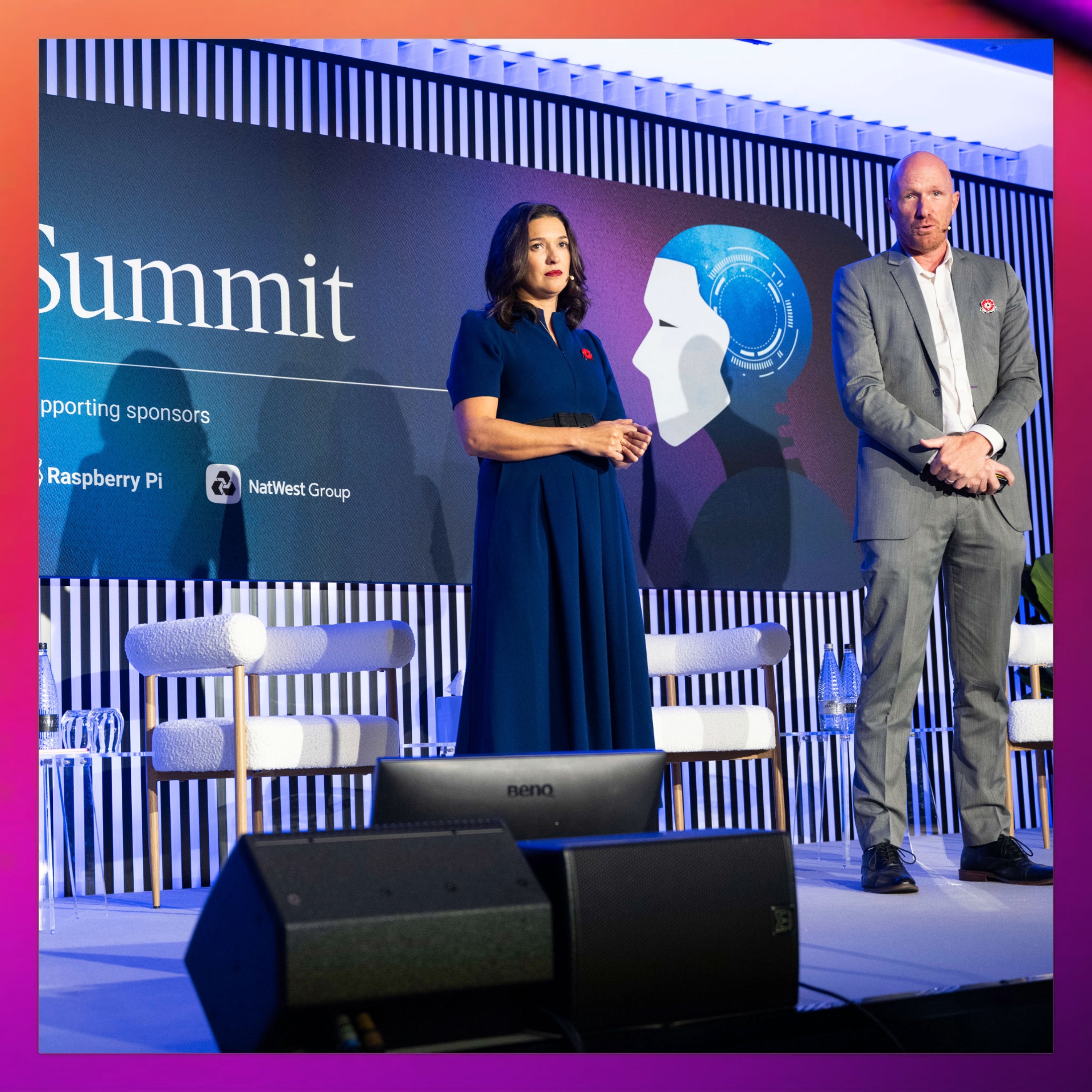
32:08James Palles-Dimmock: and swamp all these data it's that's not going to happen no complementary different but really really powerful and certainly I'm hearing lots of businesses at the moment worrying about it and thinking about it I mean at our recent tech summit we had the CIO of BT it's something they're looking at you know critical industries here as I said at the start have been warned by the National Cyber Security Center look you've got to get ready for this because it is going to mean that hackers can break your code almost instantly so it's just going to change things in a really revolutionary way and I think very very quickly the Cyber Security Center was saying companies need to be ready by the end of the decade.
32:43James Palles-Dimmock: You know, it's a few years away to wrap your arms around something that is extraordinarily complicated. I thought James did a brilliant job, by the way, of explaining it in human and English, which is not easy for a quantum physicist. But still, it does kind of blow your mind.
32:57Katie Prescott: Yes, and obviously it is nationally important. This is a question of sovereign capability. He talked about the Americans being in friendly competition with the UK, but also China as well. So clearly governments around the world are thinking about this very carefully and they don't want to be caught out.
33:12James Palles-Dimmock: No, absolutely. I mean, IonQ, the American business which recently bought Oxford Ionics, had to go through a massive process with the British government looking at, you know, it's a critical industry and they're our allies. So yes, it is extraordinarily sensitive and something that is coming down the track, I think, pretty quickly.
33:33Katie Prescott: I'm Dominic O 'Connell, columnist at The Times and business reporter on Times Radio.
33:38James Palles-Dimmock: And I'm Katie Prescott, technology business editor of The Times and host of The Times Tech Podcast. From The Times and The Sunday Times, this is The Business. And if you enjoyed this interview, you can subscribe to The Times Business channel on YouTube, and you can watch or listen to other episodes of The Business wherever you get your podcasts.
33:56Katie Prescott: We'll be back with you next week with all the analysis from the spring statement. Until then, goodbye.
34:10James Palles-Dimmock: podcast was sponsored by Adobe Acrobat Studio.
34:14Katie Prescott: Acrobat Studio is about more than just the PDF.
34:17James Palles-Dimmock: It's a collaborative workspace designed to make working with colleagues across teams and time zones faster and easier.
34:24Katie Prescott: One of the features is PDF Spaces, which brings PDFs, Microsoft 365 files and websites together in shared spaces.
34:32James Palles-Dimmock: It helps centralize notes and draft documents so you can see the full picture of a project all on a secure platform.
34:39Katie Prescott: There's also an AI assistant, which can summarize information, pull out key insights and help you understand what's in your files without reading everything manually.
34:48James Palles-Dimmock: Which helps if you're dealing with a lot of information, but a short on time.
34:52Katie Prescott: And with integration with Adobe Express, you can turn documents into presentations or branded content without switching tools.
34:59James Palles-Dimmock: So it's not about creating more paperwork. It's about making your paperwork work harder.
35:05Katie Prescott: Check out Adobe Acrobat Studio and its new features now.
35:09James Palles-Dimmock: This episode of the Times Tech Podcast is sponsored by PwC.
35:14Katie Prescott: AI that delivers. It isn't just about the tech. It's a new way of thinking and it's empowering your people to create value in new ways. This is where PwC helps you shape AI to fit your business, delivering real value. Working with you, combining strategy, industry insight, and deep tech expertise to help you innovate with impact, empower your people and accelerate growth.
35:39James Palles-Dimmock: PwC knows how your business works, so you can put AI to work for your business. Discover more at pwc.co.uk.
Quantum computing has been called the next big technological revolution, potentially as transformative as AI. Governments are investing billions, banks are already experimenting with the technology, and startups are racing to turn decades of research into real-world systems. In this episode, originally from The Business, another podcast from The Times, James Palles-Dimmock from UK startup Quantum Motion talks about the race to scale quantum computing, how close we are to a real breakthrough, and whether the technology could change industries from finance to drug discovery.
Presenters:
Katie Prescott, Technology Business Editor, The Times
Dominic O’Connell, columnist and business presenter, Times Radio
Guest:
James Palles-Dimmock, chief executive, Quantum Motion
Producer: Miriam Hall
Senior Producer: Julia Johnson
Executive Producer: Kate Ford
Photo credit: Getty
Get in touch: [email protected]
Hosted on Acast. See acast.com/privacy for more information.