Ask ChatGPT
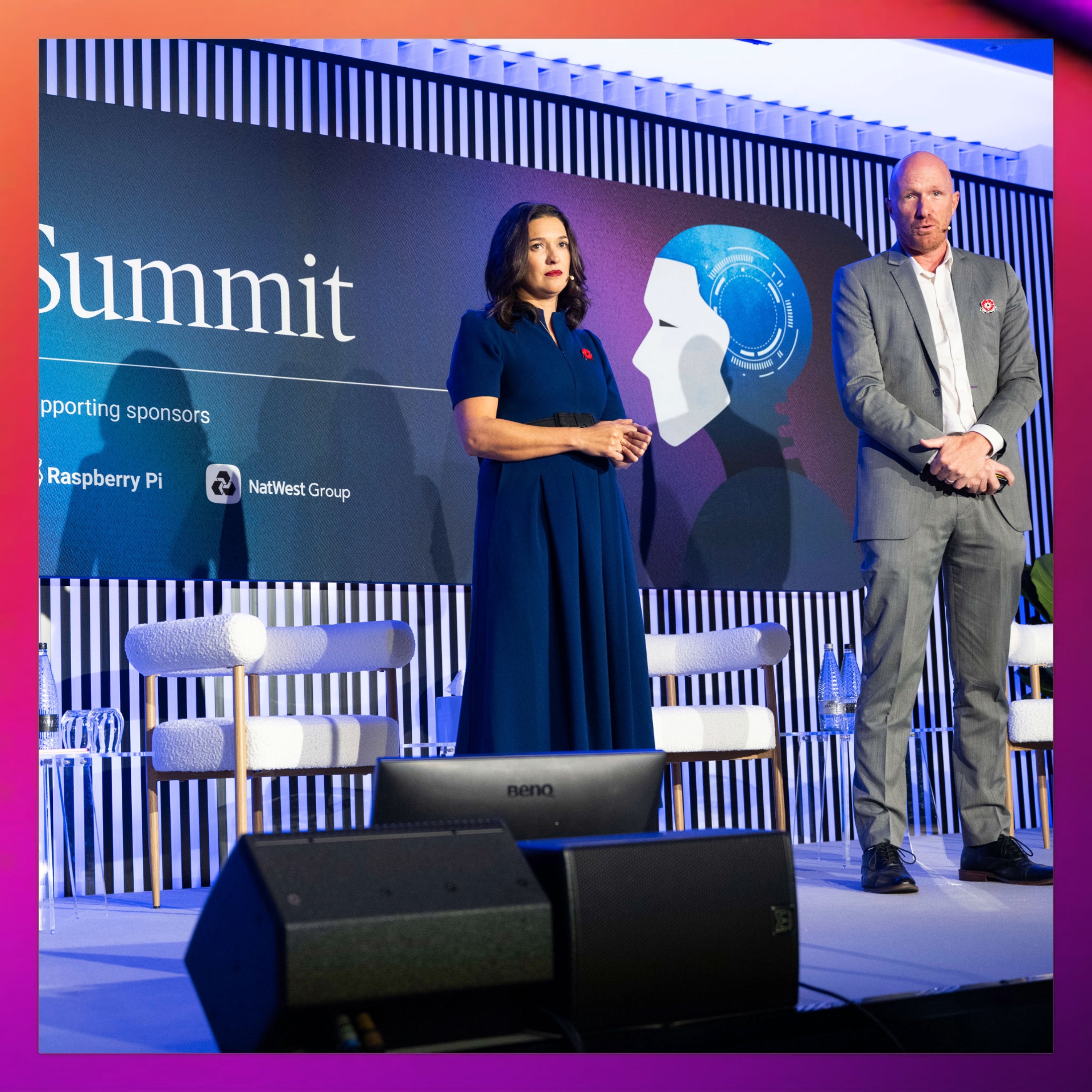


In this special holiday episode of _The Times Tech Podcast_, co-hosts Danny Fortson and Katie Prescott explore the past year's developments in AI, featuring insights from notable tech leaders. This episode is the first of a two-part series that aims to separate AI's potential from its realities amidst discussions of a possible tech bubble.
Written by AI. May contain mistakes.

Get the gist, explore an idea or ask about something said.
 Claude
On Times Tech, what are the key points of this episode?
Searching your listeningAutomatic transcript. May contain errors.
0:09Hello, and welcome to the Times Tech Podcast. I am Danny Fortson, Danny in the Valley. I'm Katie Prescott, Katie in the City, the City of London.
0:24So, everybody, welcome to this special edition of the Times Tech Pod, where we explain AI and everything else new in tech. And for the last year, we've been chronicling tech in all of its forms.
0:41and today we're going to look back on the year of the pod that was and in some ways try and separate if this is mixing metaphors the bubbles from the bathwater that's right so we're going to launch into a two-part i'm going to call it an extravaganza i don't think that's over the top um where we cover the biggest themes that have merged over this past year this week we're going to cover four areas they include first the great promise of ai what's this all about then we get on to uh one of the key ingredients data who owns it what it's worth third topic is the cost how are we going to pay for all of this who's footing the bill and lastly and very neatly the final question for today's episode the question of the ai bubble are we in one and should we be scared so that is you know the run of show as it were and we're going to do this by showcasing the best of who we call our friends of the podcast all the friends that we've made this year so many friends so many friends looking at everything really from data centers in space all the way through to the agi race all here in one place that was are you a poet and you know it that was yeah data centers in space race place i mean occasionally get a chance to show my creative yes that's right so strap in this is part one of the two-part times tech pod christmas special let's go
2:20so this week and next we're looking back at the world of tech that we've covered on the podcast in 2025. How big ideas about how AI would make the lives of humans completely different. It would solve problems we didn't even realize we had. Cure illnesses, save the planet, etc. You know, the guest list has at times looked like it should be on an invitation to a White House dinner, maybe. Or a European tech summit. No, not to toot our own horn. I mean, the only, you know, misses from that list are you and I. I have yet to go to the White House. Or to anything like that. Or a state dinner. Or a state dinner.
2:55which, you know, my spam filters must be set on high. But yeah, in no particular order, who we had over the last year. Sam Altman from OpenAI, AMD's Lisa Su, Klarna's CEO, Sebastian Schiempkowski, Matthew Prince of Cloudflare, a guy called Saty Nadella from Microsoft. I think I heard of him. Arthur Mensch, Mistral AI, Sir Demis Asabas of Google DeepMind, Mark Benioff from Salesforce, and Anthropics' Dario Amadei. So a whole smattering of billionaires with also a Nobel laureate mixed in. So what have they all told us about the AI rollout and what it means? That just sound like the biggest name drop.
3:39I know. You know what? It's been a long year. It's okay to, you know, pat ourselves on the back. Just a tiny, tiny, teensy, weensy bit. Well, let's start with a very, very big name drop then. Because if there was one person to choose out of all of those who's been arguably one of the most influential voices in AI, it would be the man that we're about to hear from, the CEO of the world's most valuable startup, of course, Sam Altman, the co-founder and CEO of OpenAI, who joined us here in London at the start of the year. And he set out his vision for the technology.
4:17people like a lot of people who are maybe they were even recent ai skeptics were saying things like i can now do things that would have taken me like many days or even weeks of work the ai can do like it in 20 minutes and it can do a bunch of them parallel and it's going to like change the way i do my job it's going to change the way my scientific field works this that the other thing and if you just project that same rate of change forward another two years and a quarter another another and you get all the way out 10 years yeah i think that's going to mean people can do incredible things like i'm not sure what i would ask the ai to do for me at that point you know i got 10 years to figure it out um but i sort of think that we will be quite literally limited by the questions we can come up with and we'll have ai to help with that too so that was sam altman speaking on the tech pod back in February.
5:10He and his now enemy, Elon Musk, founded OpenAI back in 2015 as a nonprofit research firm. And their goal was to develop AGI, which if you go back at the time, and even up to a few years ago, was just seen as a completely outlandish kind of ridiculous idea. You know, that we could actually build these systems that were smart as or smarter than humans. and their goal was to build these systems to quote unquote benefit humanity but what does it actually mean for all of us look like any technology uh i think there'll be a lot of good and a lot of bad my hope my genuine belief is that there'll be orders of magnitude more good than bad from this one but there will be real bad uh and i think you're seeing some of it now um i'm very optimist i'm not a believer that we just run out of things to do and we have this like miserable existence where we sit around and just sort of like do drugs and play video games but that doesn't mean the transition won't be messy in fact i expect it in some ways to be pretty painful um it's easy for politicians to sit around and talk about how we're going to reskill people this and you know i hear that a lot oh we're just going to upskill people it's going to be fine.
6:26And that feels a little facile. I agree with you. It seems to me like just having looked at history that kind of in two generations, we can, society can absorb any amount of technologically driven labor market change. The thing I remember most from this interview is that just after we did it, and you mentioned Elon Musk being Sam Altman's enemy, Elon Musk bid for open AI I forgot about that that feels like a billion years ago we had this chunk of time with Sam Altman and it must have been that evening that the bid went in that's right and it was one of those journalistic moments it was so frustrating because obviously we hadn't got to ask him about it so we had to kind of be like well when we interviewed Sam Altman etc etc but yeah it was like within a day of sitting down with him in London.
7:24I flew over for it. And then, yeah. It was that evening, wasn't it? Because we did ask about Elon Musk, his relationship with Elon Musk. We did. We did. But didn't guess the acquisition was coming that day. Anyway. Quite extraordinary. Quite extraordinary. Anyway, ChatGPT, it is still the market leader used by 900 million people a week. And it's got this massive$500 billion valuation. 35 times its value just three years ago. But one of the big themes of this year has been the intensifying competition around these frontier AI models. And particularly at the end of this year, we've just seen Google's Gemini, a new really top model there that has just been incredibly well-reviewed.
8:07And of course, what's happening out in China with DeepSeek. And then there's also, very much your friends with the pod, Anthropic. That's right. And what's extraordinary is like, you know, beginning of the year, it was ChatGPT, then everybody else. And all of a sudden it feels like, one, everybody's caught up. Now Sam Altman's calling a code red internally, basically being like down tools. Oh my goodness, we need to really focus on ChatGPT, making it better because everybody's catching up. And it just speaks to, you know, this is just a really chaotic, extremely competitive and very expensive race.
8:46And it's also just galloping ahead. And Sam talked about this kind of messy transition, which is another theme about which Dario Amadei, who of course used to work with Sam before leaving to launch Anthropic, also in San Francisco. And he's been really passionate about this idea, about the transition, about what this means. And when he set up Anthropic, they're like, look, this is going to be a quote unquote AI safety lab. We're going to take a different approach that's more thoughtful and, you know, theoretically safer. But of course, they have also just completely exploded in terms of their growth.
9:22They're now worth supposedly three, I think, I believe it's 350 billion now. And they're also growing very fast. But he's also deeply concerned about how fast this is developing and what it's going to all mean for society.
9:41You know, let's actually take this seriously, right? I'm someone who actually takes the potential for AI and where it could go very seriously. It's possible that I'm wrong about where AI is going to go and what's going to happen, but I think I'm not sure that the impacts are actually going to be very serious. And so let's think about how this can go well. What could AI actually do for humanity that, looking back a decade or two from now, people could say, wow, that really actually made our lives better. Well, I want to talk about that because I thought the way you put it is like, you know, powerful intelligence, not AGI, it was a different terminology you're using, could come as soon as 2026.
10:25And the way to think about it is that, you know, these data centers would be like a country of geniuses that you could then deploy to do any number of things. And then in terms of biology, there's a whole bunch of bullet points in here. I'll just go over a few of them and then we can talk about how you got there. Yeah. That this could lead to the reliable prevention or treatment of nearly all infectious disease, elimination of most cancer, effective prevention and cures for genetic disease, prevention of Alzheimer's, biological freedom. So you basically will be able to control our weight, physical appearance, reproduction, and other biological processes.
11:05And that we might double our lifespan to say 150 years old. this sounds crazy this is based on what why are you comfortable making some of these kind of yeah yeah predictions i think what has made me comfortable is the time that i've spent in biology it's it's taught me a couple things one is certainly it's it's taught me that the complexity of these problems has made solving them difficult and you know there's there's nothing about these problems that's beyond human's ability to understand. There's just more facts, right? You know, one thing I say is like, you know, there's this complicated, you know, like, you know, diagram of metabolism or something.
11:48Like, you know, it's not like, you know, string theory or general relativity or theory of everything where, you know, there's conceptually, it's very difficult to understand. It's just like, you know, it's just like a circuit board with a bunch of components. Yeah. And I think when I left for AI, while I didn't know everything that I know now about AI and didn't have as much of a picture, I did have this conviction that machines might be able to do a better job than humans of sorting through this complexity, that humans, it's hard for humans to store it in their brain. And the skills need to go across thousands of different humans.
12:24And then you run into human institutions and the difficulty of humans working together. and all of it felt when I was, you know, a very small part of it felt very inefficient. And so my reaction was, well, the humans need help. And I think, you know, that led me to work for many years in AI for, you know, it's been 10 years now. And maybe 2023, 2024 was the first year where I really felt that we'd gotten to the point where the AI systems felt like they were knocking on the door of really being able to help with these problems. Like it could happen very soon. If you literally extrapolate it, that's what you get.
13:01People should be ready for it and they should be willing to be optimistic. As this develops, at a certain point, the whole economy, the way we think about it, the way we think about value changes. And specifically for a company like you, if you are building something that is this base layer for the rest, for like a whole new economy effectively that propagates into every corner of what we do, the potential for wealth concentration. I mean, this could be a trillion dollar company in terms of revenue, not value. Do you see that? Do you aspire to that? How do you think about that? Yeah. I mean, I think these are going to be some really important questions, right?
13:50Where, You know, I think traditionally when new technologies are developed, you know, they lead to the overall pie getting bigger, but they lead to all kinds of disruptions. And they can lead to concentration of wealth in one place and disruption of what people were doing in another place, right? We saw this in the 19th century during the, you know, Industrial Revolution. You had your Rockefellers. You also had, you know, skilled craftsmen who used to do jobs that, you know, became disrupted in various ways by the Industrial Revolution. So I think that's going to happen again. And, you know, we need to have some humane and pro-humanity way of dealing with it.
14:34so another messy transition in ai to steal sam altman's words is a massive issue which we've looked at this year a lot and that is the challenge of copyright so the creative industries are up in arms about the idea that their data their music their books are being used to power tech companies AI models, frankly, without permission and without payment. And we've seen companies from Universal Music to Getty Images taking tech businesses to court saying, look, you've used our IP without consent and it's just not on. That's right. So what we're really talking, of course, is just, you know, the data question.
15:13Whose is it? How much is it worth? Tech companies say their models, you know, this is all quote unquote fair use, which is a legal doctrine, you know, in the US mainly that lets people use limited amounts of copyrighted material without permission. And so how do we decide what is fair use? You know, because their argument is like, well, if you're an artist, you're inspired by other artists. You look at people's stuff and then you make your own and they're arguing effectively. That's what they're doing here. But, you know, obviously lots of people disagree. And the line is, you know, what can be used without consent?
15:51Just to set out this view from the tech companies, I went to meet the chief exec and chairman of Microsoft, Satya Nadella, at the end of last year in London. And I think it's worth listening to what he had to say about this, because it really does present the tech side of this bitter dispute.
16:10Is their data, their output, what is the fair use of it? What is the copyright of it? And so that's, I think, the key, which is always in history, whenever there has been a transformative technology, a framework of law has been established on what fair use of transformation looks like, because otherwise there will be no new innovation. And that has to be deliberated. It can't be free rider. So you can't have copyright infringement. But if it's just transformative, it's just like, hey, I read a set of textbooks and I create new knowledge. having read it, is that fair use of having read it or not?
16:48Like that is the level at which you have to think about these LLMs, right? So they're not regurgitating. Regurgitation would be copyright infringement, right? So the key is to be able to understand what is real copyright infringement. So for example, if we are working with a news organization and we want to show citations, or we want to be able to ground an LLM with actual facts that are output, that's where the deals are. And then at some level, we have to also come up with, hey, if somebody is just using it to do transformation, then what are the bounds of fair use? And so I think that this is all where more than any given company, I think it ultimately, there needs to be a framework of law.
17:30And by the way, the interesting thing is different countries seem to be also taking a different view. I was very, quite frankly, delighted to see what Japan is doing. You know, I think that they're doing the calculus there seems to be that, OK, having perhaps gotten behind in software, they want to make sure they lead when it comes to this next phase. And so they have really said use of content as fair use to create new generation of models. So he loves what Japan's doing, which happens to jive with his view. I think manga artists love what's happening in Japan, by the way. But obviously, as ever with these type of issues, it's playing out in the courts in various companies, including Getty Images.
18:12You know, I think the largest photo agency in the world are taking tech to court. They're claiming that their IP has been used without their consent. And as it happens, we had their CEO, Craig Peters, on the pod earlier this year to talk about it. So Getty has filed a lawsuit here in London against Stability AI, an AI engine which generates images. also actually in the US as well, claiming that it unlawfully copied and processed millions of Getty's copyright protected images. Now, in this UK case, Getty actually ended up largely losing. So a chunk of the lawsuit actually fell away before it got to the final judgment.
18:51There was a very narrow instance of trademark infringement where they found that the watermark that says Getty Images, which you know is on the picture, was generated. but really this was seen as a bit of a loss a bit of a blow for the creative industries as this tussle keeps going on and on yeah and this will be the first of you know it's one of you know hundreds or probably eventually thousands of lawsuits in the states and across europe and in the meantime getty has entered a deal with ai giant nvidia to create ai tools trained on their copyright protected library of images. And they launched a service to provide AI text image generation of stock photos with an AI engine trained on their archive.
19:35So I think this may be a case, especially as they come out of this, this defeat in court of being like, if you can't beat them, join them. And it is join them, isn't it? I mean, more broadly, we're seeing so many of these deals being signed now between AI companies and the creative industries. And it's just going to be fascinating to see how that rolls out in the year ahead, particularly as these court cases start to actually get looked at, right? Because so many of them have been filed, but there haven't actually been that many verdicts yet. It's fascinating. And I think this is, again, going to be another area that just is going to be very, very, very active in 2026.
20:12You can hear how contentious it is, right? Just the view from Satya Nadella there saying, we need the opportunity to use this information you know fair use the opposite side yeah coming from the opposite it's hard to find the center of the venn diagram exactly exactly which leads us neatly into matthew prince the ceo of cloudflare and it's a company you may have never heard of but he came on he's really interesting about you know trying to kind of come up with a solution to this issue and cloudflare it's this 80 billion dollar cyber security giant and it's like basically does you know network infrastructure helps keep websites safe from bad actors and it it handles something like a fifth of the internet and his idea is to basically put up a kind of default wall for these crawlers that all these ai companies use and say you know so when these crawlers coming to kind of scrape the information to train their systems, they're blocked.
21:14And if that happens enough, then it might force the industry to the table, basically to strike a deal. So just remind us, Danny, so they're already in place, these barriers. And he's right at the thick of this now. Yes, exactly. So he handles about a fifth of the, you know, the kind of the internet traffic through the websites, through their client websites. And so basically they just turned that wall to default on. Companies can still turn it off, but that was the idea. So if I'm an AI crawler, I want to go on a website and use their information. I'll meet with this. You'll get knocked back. Yeah.
21:51Got it. And he came on the pod a few months ago to talk about, you know, how AI is feeding off of our data.
22:01You think about sci-fi movies. If you ask the helpful robot, hey, what's the temperature at which I should cook, you know, dinner tonight? It doesn't come back and say, well, here are 10 helpful links that you might go find. It just answers the question. So like the future is going to look like answer engines. But that then suggests the problem, which is that answer engines don't generate traffic to content creators. And so that then means either content creators just have to work without being paid, which is absurd, or we have to come up with some additional way to actually compensate the content creators for the work they're doing to provide the fuel that actually powers these answer engines.
22:42You think about like the history of YouTube, or Netflix, both of them have the same history. In the beginning, both of those companies or organizations were able to win early on, because they had a technical advantage, they could actually distribute content cheaper than anyone else. And they built the networks to do that and everything else that that they did. Over time, that technical advantage eroded. And so today, why YouTube, why Netflix wins is because they're actually having the access to original content that people want to get access to. I think AI is going to follow exactly the same trajectory.
23:16And we can see that where it seems like every single week, whoever the leading AI model is, is leapfrogging everyone else, which is just to me that the advantage isn't going to be in who has access the most GPUs. It's not going to be in who has access to the best researchers. Those two things are going to become commodities. GPUs are silicon and silicon becomes a commodity over time. Every single time, it's not gonna be different in this space. I think the thing that's going to differentiate the AI companies is going to be who has access to original, local, unique content that nobody else does.
23:47And I think that the creators that create that content will get compensated.
23:59So that's the data, one of the fuels that feeds AI models. But of course, to power AI, you also need compute to keep models running. And gosh, it feels like now for about the sixth year in a row, semiconductors were just another massive story this year. The story that really hasn't gone away, I think, since the pandemic shortages. That's right. And obviously, the 800-pound gorilla is NVIDIA, still leading the pack with something between 80 % and 90 % market share of GPOs, which are these super powerful specialized chips that these AI systems kind of need to be trained on and also to run. But they're making so much money.
24:44They have people nipping at their heels. And perhaps closest is AMD. and AMD we went there in August where I spoke to Lisa Su their CEO it's America's third biggest semiconductor company after Nvidia and Broadcom and they're doing deals and whatnot yeah I mean in August this year Nvidia along with AMD struck an export deal with the president that said they could send their chips to China some of their specialized chips in exchange for giving 15 % the US government. So in the way that the White House is doing business at the moment. So there was a national security ban on on semiconductors showing just how important they have become and how much of a weapon in the trade wars they are.
25:36And indeed, actually, already were, I would say, before President Trump even entered the White House. So yeah, a very, very interesting interview that you did with Lisa Su for lots of different reasons. Yeah, because she's basically building and quickly a credible competitor to nvidia actually just weeks after we spoke to her she unveiled this huge deal with open ai to provide them a bunch of their top chips the stock went soaring it was a very strange deal where open ai got the option to eventually buy up to 10 percent of amd it was very strange but yet one of many exactly it was one of these many kind of what they call circular deals where everybody's kind of you know people are basically funding each other to buy their own stuff in the spiral that goes ever upward in terms of you know the stock market response to the shares and if anyone's interested in that Morgan sorry to interrupt Morgan Stanley has done this amazing graphic where it's kind of listed out all of the big AI companies in Silicon Valley and who's doing deals with who which someone described as looking like a plate of spaghetti yeah it's all very incestuous no surprises that when you spoke to her like so many people that we speak to in the AI world.
26:47She's an absolute optimist about all of this and convinced that AI is in the process of fundamentally altering and improving everything.
27:01It's the difference between, you know, if you have 100 PhDs working on something or you have a million PhDs working on something, you can probably solve your problems faster or you can solve your business issue. And that's kind of the way we think about it. It's capability. So computing is equal to intelligence in this case. And the smarter that we can make each one of our AI agents, the more that we can do with it. And that's very, very attractive because the idea, and I know many people are like, well, what are you going to do with all that AI? And I think what we envision is AI can really solve problems across the entire spectrum of things that you are looking for.
27:45Like if you're a drug company, you know, sort of the rate and pace of drug discovery. If you can take what would have taken you five years of research and shrink it down to like six months of research, I mean, that's incredible. Or in chip design, if we can take what, you know, takes three years to design the next chip and do it in shorter time, that works. Even to things like, you know, customer service. If you have, you know, many, many more customer service agents that use AI versus necessarily people. There is a way to automate many of these tasks. And I think we're just at the very beginning of using AI for these types of applications.
28:28So in terms of jargon or big words from 2025, I think it's fair to say the one word, the B word has just been dominating. I mean, the world of tech, but also more than that. this fear that there is a bubble. Le boule. Le boule, as we call it, or le gluglu. Le gluglu. Yeah, it sort of makes it sound less sinister somehow. But just the amount of money that's being pumped into AI infrastructure, into data centers or sheds, as you called them earlier, the worry about whether we're going to end up with too many of them, and also how many of them are being built with debt as well. That's right. So I think everybody seems to agree that we're in a bubble.
29:11If everybody's like, are we in a bubble, in a bubble? I think everybody kind of agrees that we are. But it's a question of like, okay, so what happens when it pops? But before that worry really set in, showing just how quickly this world of tech moves, we had the boss of Equinix on the pod, which is the world's largest data center operator. They're a Fortune 500 company that hosts 90 % of the world's internet traffic. and they have, they had thoughts. Adair Fox Martin, who's the boss of Equinix, joined us on the pod in September. Whereas you say the worry then wasn't so widely about a bubble, but actually about energy and how we power all of these data centers that are being built so very quickly.
29:58I have to say, looking at the company's share price at the time, I was really surprised, I remember saying to you, just how it had dropped when it felt like the rest of the world's AI infrastructure companies were going up. It was down about 20 % at the time or year on year. It's now down about 25%. So I think investors at least were not very happy about how much the company was spending on infrastructure. That's right. And she talked about how the company is building two gigawatts worth of data centers, which is the equivalent of the total capacity it's brought over the last 27 years it's been operating.
30:28Just to give you a sense of kind of how quickly things are moving. Yeah. And why maybe investors are getting a little twitchy. So let's hear from her.
30:41So if we come to Equinix and the business model, I'd really like to understand more about how that works, because in essence, you're a real estate company. I think structured as a real estate investment trust. Or structured as a REIT, a real estate. But also a tech business. So it is an interesting dichotomy because there are two aspects to the business. the real estate side represents, if you like, the physicality of the business that we operate 272 data centers around the world. And in the vast majority of cases, we own the land that that data center operates on. That's part of the strategy of the company to take that position.
31:20But on the other hand, we also offer a range of technology services to our customers. So we straddle both worlds. And I guess I like to think of us as maybe the place where the physical meets the digital, right, where the two worlds come together. Are you essentially like landlords, like tech landlords? No, I wouldn't describe us like that. I think the best analogy that I would use for Equinix is to describe us almost as an international airport. So we offer data centres where companies can choose to place their technology into our infrastructure rather than build that infrastructure themselves.
32:00But in addition to that, we are also the place where companies connect with each other. So if I use the analogy of an international airport, a flight might come in to London Heathrow from KLM. You go through Heathrow, you connect, and then you go on to your next destination, which could be on a different airline. And behind the scenes, there's a whole series of things that have happened to make that transition for you as a passenger possible. We do exactly the same thing for data. So a data packet might come in from company A. We are the hub that connects, interconnects that data and sends it on its way to where it needs to be, which might be in company B.
32:46So think of us rather like the airport of the internet. And actually, 90 % of internet traffic comes through Equinix's facilities. But in terms of your clients, then, they will essentially rent space in one of your giant sheds. And then you might or might not provide the tech infrastructure with it. So essentially, our customers will rent space and power. And then, of course, we provide the energy. And then around that space, there's a whole range of things that happen around security and other facilities to render that space private, as secure and safe for our customers' data. I made a programme for the BBC many years ago about data centres that were being put in Arctic Norway.
33:29I mean, talking of energy, and we'll get on to the energy question shortly. We've also had someone on this podcast who is planning to put data centres in space, again, because of energy, because of it being cool. What's the sort of weirdest place that you've ever put a data center there? Are you exploring things like putting them under the ocean? Well, you know, we have 272 already. We're certainly open to... And there's 272 traditional sheds in normal inverted commas places. Well, this is the thing. You know, one or two have been, you know, as a result of acquisitions that we've made in different locations.
34:07And so there is actually a data center hidden behind, I wouldn't say exactly which city, but hidden behind the wall in a casino. Cool. And, you know, you're in red, red plush carpet, red and gold on the wall. And I feel there's a podcast moment where I can go, what's behind this door? And it's a data hall in one of our data centers. The original use of that building was different when the data center was built. And so the data center has remained and the casino's positioned around it. NVIDIA is one of your partners. Could you tell me a bit more about that relationship and how that works? It's a very important relationship to us.
34:46With NVIDIA, we offer a number of different services to our joint customers. So in our data halls, we have innovated on how you bring liquid cooling into an existing production data center. And even at your most simple level, we know that water and electricity do not mix and water and servers do not mix. And the team have worked to engineer the capabilities to bring into existing data centers the liquid cooling that is necessary to run the GPUs provided by NVIDIA. We're one of the first data centers to run the NVIDIA's new chips. We have that in our Silicon Valley facility. And so we host a lot of visits through to show that technology in action.
35:33We'll talk about what's happening in the UK with data centers shortly. But it's pretty obvious that across the board, with the advent of AI, the AI revolution, the demand for data centers is growing exponentially. I think it was in one of your recent earnings, you said you're struggling to meet demand and to get the capacity you need. What does that look like to you on the ground? So for us, you know, we really feel that this is quite a pivotal point. We're very fortunate to be a company that's, you know, at the center of such a pivotal moment. And where so many of the things that we offer are relevant to that technology landscape.
36:11We have adopted an element of our strategy that we refer to as Build Boulder. And this is really about understanding how we bring more capacity to the market. In the 27 years that Equinix has been a company, we have brought on two gigawatts of power through the 272 data centers. Now, that might, in the world of braggawatts, that might not sound like a lot. I don't know what a braggawatt is. There's a lot of statements in the market about, OK, we'll be bringing on five gigawatts, six gigawatts. In our 27 year history, we have been such a careful custodian of resources that we have brought on two gigawatts.
36:54And in two gigawatts of energy, we're servicing over 10 ,000 customers across that footprint. What's two gigawatts? And how do you bring that to life for someone listening to know what it is? Looking at it in terms of you have KVAs as the lowest level in electricity and then megawatts is the next level up and then gigawatts up. than that, almost like metric measures. 600 onshore wind turbines, the entire city of Paris. There you go. In the last 27, we brought on 2 gigawatts. So we're looking to double our footprint. In other words, add on our 2 gigawatts to our global footprint over the next five years.
37:39When Adair came on, she also gave us one of my favourite pieces of terminology of the year, which is Braggawatts. Everybody's, you know, bragging about how big their data center is, et cetera, et cetera. But it just kind of gets the point of just the absolute spending frenzy. Humongous. Yeah. Humongous company valuations. NVIDIA is valued at, you know,$5 trillion. And it begs the question, is this sustainable? So I was lucky enough to go and meet Jensen Huang very briefly at the end of this year. And of course, I had to ask him, I'm sure everyone else was asking him at the same time, about whether he thought there was a bubble.
38:24We're all in a bubble. The question is, where are you in that phase? And so I believe we're in the beginning of the build-out. It just happens to be very large numbers. But the way to think about AI is the ecosystem and the economy that it's going to impact is so large that these numbers in percentage pale by comparison. And so we're in the beginning of the build-out. We have decades of old computing infrastructure that's being modernized. And so we're trying to modernize it as quickly as we can so that we can bring AI to a lot more people. That's number one. Number two, AI has become profitable.
39:02It's effective and profitable, which is the reason why everybody's accelerating their build-out of artificial intelligence. When something is profitable, people want to make more of it. And this is applying to just every single technology company and every single computer company so that we can build into the AI era. This is just in the beginning. How do you feel about that power? I feel a great, great honor to be part of this important technology. This is probably the most impactful technology of all time. And the ability to manufacture intelligence is quite an extraordinary thing. The benefit to society is quite extraordinary.
39:40And it's a great privilege to be working in the company at the center of that. And, you know, it just causes us to work harder than ever. That, for me, is the jargon of the years. Don't say bubble, say build out. Exactly. Imagine some press officer saying, like, just a different B-word. But yeah, that is something to watch for in 2026, I think, when he talked about being in the company at the center of the build-outs. Do you think the music keeps playing? I think the music, I do actually, I just wrote my column about I think the music keeps playing for NVIDIA for lots of reasons. But for anyone at the moment, taking someone out who's got an 80 to 90 % market share, especially in infrastructure where it takes so much time for change to happen.
40:34And yes, there are lots of other companies like, for example, Google making their own chips and Amazon. But I think that might eat away at a little bit of NVIDIA's market share, but it's certainly not going to. So you don't think, because I guess as goes NVIDIA, as goes the market. So you don't think 2026 is the year that the bubble bursts? Oh, I think that's a slightly different thing. I was talking about the technological expertise. In terms of the bubble bursting, I just, I'm not sure I want to make it. Do you want to make a call on that? I don't. That's why I'm asking you. No, my friend, I'm sure you're better placed.
41:11No, no, no. But you have an outsider's perspective across the pond. You should make it. No. You're right in the mixer. I would have thought that something would have happened earlier this year. And actually, it's incredible. I was just writing a profile of Jensen Huang for our Christmas coverage. And they were worth$3.5 billion in June. And that was a big deal. Three and a half trillion. Three and a half trillion. Trillion. Sorry. so i mean just yes yes zeros but yeah and then four trillion and do you remember what a massive deal that was yeah and then five i know i mean i would have said to people at the start of the year if they asked me whether they should put money into nvidia no it's the top of the market totally totally so i i actually i i'm scared to make a call because this year's been so wildly unpredictable i will say i do think that i think the party continues for 2026 i do think a lot of these companies, I think a lot of the startups are going to start to blow up and melt down because, you know, we don't need 50 new kind of choose your category.
42:26You know, every company, every category you can possibly think of has a dozen or more competitors that have just kind of cropped up out of nowhere. So I think a lot of the startups will go away. But I do think you're starting to see some of the companies that we've talked to throughout to you and what to get to in next episode are actually starting to make real money to jensen wong's point and i think there's going to be a separation from you know the bubble and the bath water the wheat and the chaff whatever whatever analogy you want to use but i do think the kind of the boom continues it might kind of things might slow down a bit but i don't think it's going to be the violent implosion so there he goes i guess i just made a prediction prediction And now you're going to throw it back in my face at this time next year.
43:13I will. We'll cut it in March. Exactly. But NVIDIA is really stitched into the AI ecosystem in quite an alarming way now. They have used so much of their spare cash to make investments in AI startups like Wave and 11 Labs here in London, the driverless car business and the audio AI company. but then also some of those circular deals that you mentioned earlier whereby they make an investment in a business essentially in exchange for that company buying their stuff yeah and so if those companies those smaller businesses that they've made those investments in go bang yeah then you wonder sort of the repercussions on on the finances well what what a year it has been so that was actually quite a fun romp through kind of the promise of ai the data the cost the bubble fears but of course there's so much more to go through is there not there is yeah next week we're going to be moving away from the infrastructure stuff and looking at the impact that ai has been having in the real world in terms of things like jobs and productivity.
44:29So yeah, so more to come. Happy Christmas, everyone. Yes. Merry Christmas, everyone. And please keep your eye out for the next episode where it's part two. And I'm calling it again, I'm calling it an extravaganza because that's what it is. Part two of our extravaganza into kind of the year that was. and I think it'll give us some clues about the year that will be. All right. Happy Christmas to you. And Merry Christmas to you. Bye-bye.
In the biggest, most shameless holiday name-drop of the year, Katie and Danny bring you – in no particular order – insights from Sam Altman of OpenAI, AMD’s Lisa Su, Klarna CEO Sebastian Siemiatkowski, Satya Nadella from Microsoft, Matthew Prince of Cloudflare, Arthur Mensch of Mistral AI, Sir Demis Hassabis of Google DeepMind, Marc Benioff from Salesforce, and Anthropic’s Dario Amodei.
A whole smattering of billionaires, with a Nobel laureate mixed in too. So, what have they all told us about the AI rollout and what it really means? This is the first of a two-part Christmas extravaganza, where we look back at the world of AI covered on the pod with more than a year's worth of big-tech leaders returning to help us distinguish the potential of AI from the reality. (Just don’t mention the B-word!)
Hosted on Acast. See acast.com/privacy for more information.