
 Ask ChatGPT
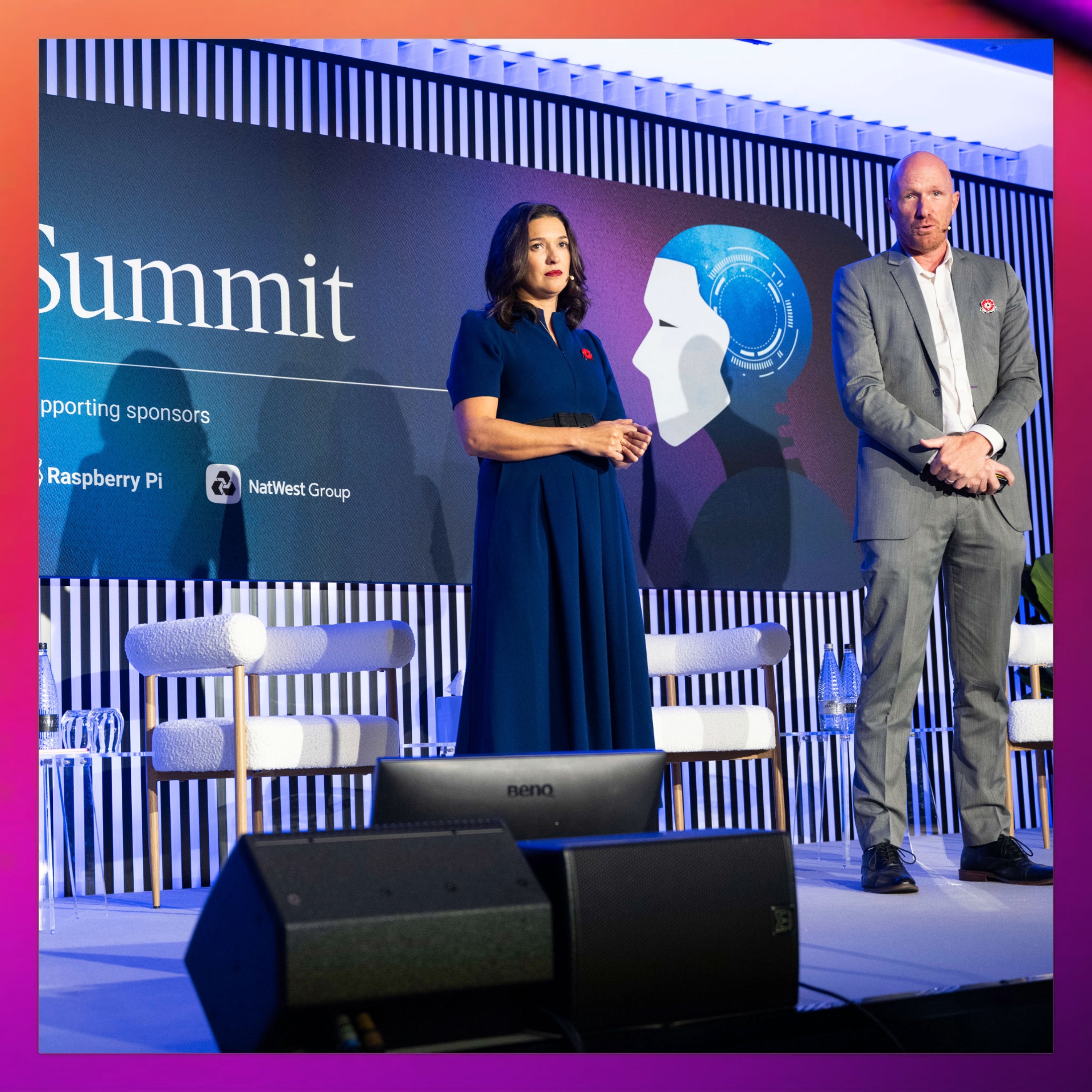


In this bonus episode, co-host Katie Prescott interviews Leon Butler, Chief Executive of IBM UK and Ireland, and Dr. Juan Bernabe Moreno, Director of IBM Research in Europe, to discuss the impact of Artificial Intelligence (AI) on productivity, growth, and innovation. The episode is produced in partnership with IBM and highlights the challenges and opportunities businesses face in the age of AI.
Written by AI. May contain mistakes.

Get the gist, explore an idea or ask about something said.
 Claude
On Times Tech, what are the key points of this episode?
Searching your listeningAutomatic transcript. May contain errors.
0:00I'm Katie Prescott. This bonus episode of the Times Tech Podcast is brought to you in partnership with IBM. IBM brings together technology, infrastructure, software and expertise and has consulting services for business across the world. It's got a long history of being at the forefront of tech and adapting AI tools and developing quantum computing. With the AI revolution at the moment, many business models around computer services are again in flux. So IBM's been putting together something of a roadshow to explain how it's adapting and looking at how AI may be changing what we see as productivity, asking what businesses need to do in the new age of AI and what's holding people back from joining in with this change.
0:50And to find out more about how IBM is meeting all these challenges, I sat down first with Leon Butler, who's their chief executive for IBM UK and Ireland, and then Dr Juan Bernabe Moreno, who's the director of IBM Research in Europe. So to Leon Butler first and his excitement about this new age of technology for businesses like his.
1:17AI really landed, I think, in the public consciousness, generative AI really landed in the public consciousness, it's fair to say, in November 2022, which is almost exactly three, well, which is exactly three years ago this month. And now it feels like it's everywhere. And I just wonder what your reflections are on this rather wild three-year period that we've seen and how things have changed for you and customers in that time. Yeah, it's accelerated incredibly quickly. The one thing I saw immediately were how many people dived into AI. A lot of pilots were kind of kicked off. But people, I think, can see very quickly productivity gains, which was great across the world.
2:00I think in the UK and Ireland, and certainly UK in particular, I mean, the government see it, right? I mean, they've got their AI opportunities plan, and they feel that it will generate 400 billion to the economic growth in the next, well, between now and 2030 as well. So there's huge amounts of potential there. And I think everyone really kind of graphs and sees it. I always got a joke, which is a lot of people used to come around the house and be quite bored. When I was talking about IT, suddenly everyone was to talk around AI. So I'd become a really popular person during dinner. But I think everyone intuitively has used it.
2:35The next piece is in delving into actually how do you scale it across enterprises? And hopefully we'll get into that. Yeah, because when people use ChatGPT for the first time, it allowed everybody to touch and feel and understand its capabilities, whether they were using it to write lyrics in the style of Bob Dylan or whatever it was. You say, I'm sure people coming to see you suddenly really understood what you did. But it feels to me that there has been a bit of a disconnect between seeing the opportunity in AI and seeing its power and actually implementing it. And I just wonder what your reflections are on that.
3:10Yeah, I think from a user interface perspective, that's what opened it up. suddenly everyone was using the technology and it became accessible everywhere. And I always say this a lot. I think we get into the point where people are intuitively using it, but it's great for maybe things like personal productivity. Not necessarily at the moment have people grappled with it when it comes to scaling it for enterprise and looking around that. So certainly when you look around things like domains around HR, procurement, supply chain, things that you can really get good productivity gains for is where I think it needs to kind of, I suppose, dovetail next.
3:44What are businesses adopting and what are you seeing working well? From a business adoption perspective, I would say, again, what we're seeing so far has been basic summarisation of minutes, as an example, extraction of documents. What we are seeing, though, are businesses now really grappling around. I mean, if we just take HR as an example, we have something called Ask HR, which is a series of agents that actually do a number of different things, whether it's around talent management, whether it's around recruiting, whether it's around tasks, simple tasks around maybe getting a P60 to moving an employee.
4:27We had an assistant quite some time ago, and we kind of launched Ask HR to be able to use natural language, natural interfaces to actually ask a question and get a process done. And that means that ultimately, you know, people would have spent a long time maybe trying to move an employee. Whereas now you can literally use natural language to say, I want to move this individual, this person, and it will tap into that backend system and do it. The key kind of aspect is making sure that you have a technology that actually goes into multiple applications. because what you start dealing with is a process that scans or goes across multiple applications, multiple environments, not necessarily an agent that just taps onto one particular technology.
5:11So by the time you and I talk around my talent management piece, if I want to talk to my team around talent management, that may be an email out to my team that says, let's look at the team. That kind of comes back. They have the ability to actually look at their team, say, this is what we want to do. It may cross over multiple applications, but it comes back into one place. To have that technology be able to do that can be complex on those particular processes. And we have something called Watson X orchestrates that actually orchestrates that layer. So connects to multiple applications, multiple environments, and actually allows you to kind of get an answer through what could be a really complex process.
5:50I'm sure lots and lots of businesses would love to roll this out. I should reference that very famous MIT survey that went viral recently that 95 % of projects in generative AI deliver zero returns. What's your assessment of what is holding companies back from implementing, say, the HR model that you just described? I'll put it into a couple of categories, actually, if that's okay. I think complexity is one of them, first of all. So complexity in the fact of the average enterprise has got about a thousand and applications. That's quite a lot of applications. Those applications will sit across multiple public clouds, private clouds, on-premise.
6:31We think over the next three years, there will be a billion AI applications that we generated, a billion AI applications. It's huge. It's quite terrifying for companies looking at that. Completely. It is complex. And again, then when you overlay it in the fact, it could be a private cloud, multiple public clouds or on-premise, that does become fairly complex. So having the ability to actually deal with those applications across those environments is going to be really, really important. And IBM's approach is very much around hybrid cloud, so giving the ability to, one, automate and orchestrate across those environments, so being able to connect multiple applications, multiple environments, as I said, between private and public and on-premise, that's going to be really important.
7:17automate the applications, the infrastructure, being able to have control of those environments, be able to put limits on it as well. So you can actually control where those applications are, but how they talk to each other as well. That's going to be really important. Data is another one. So we feel that about 1 % of enterprise data has made its way into a large language model or some form of description. Now, enterprise data is the crown jewels of any organization. If you look at that enterprise data, it's also unstructured, so it can be quite complex. So we need to kind of get into the ability to tap into that information.
7:56Again, information can be siloed across organizations and it can be across those environments that I mentioned. So private public clouds as an example. So again, having that ability to get that information, be able to track things like the metadata changes all the way through. So from the source all the way to the AI application is going to become very important. So by the time you make a loan decision or a hiring decision, you know it's on accurate information. And I will say it's around trust and transparency as well. And it is one of my analogies. I say quite a lot at the moment, there's a bit of an inflection point in the industry, closed versus open.
8:31So you can have models that maybe are trained that you don't know what it's trained on, as an example, and you can have open models, which are publicized as being clean and trained. And the analogy I do give, and you may have heard it, may have not, is the kind of the opaque test tube piece, which is you've got a test tube which is opaque so you can't see in it. There's some liquid in it. That may be the data that that particular model's on. Don't know what's quite in it. Pour some more liquid in it. That's your own data. Shake it up. You'd never drink that liquid. And it's the same with information and data.
9:04Mixing that information, you need to understand where the models have been trained on and you need to know how it's been mixed. So actually, by the time you make that decision, it's going to be clean and transparent and trusted. So I think that's going to be another piece on it. The third aspect is skills. If you look at skills at the moment, I think, by the way, I think UK government's made a great step around the AI training for seven and a half million people. We're part of that particular announcement as well. So we have something called IBM Skills Build. So it's free education that people can kind of learn around AI or quantum.
9:40So having that ability, and we're not the only vendor, there are other vendors and suppliers certainly do kind of have those kind of free skills out there. But that's going to be really important because we need to make sure that we have the right skills. And that could be around training and also apprentices actually, you know, really leaning into making sure we have the right talent coming through the organizations. But that's going to be really important, I think, as we go through. And then the last one is mostly trust and governance. You know, trust and governance, I think in particular, is something that we need to make sure, again, when you're making the right decisions, it's based on trusted and governed technology.
10:13And a lot of organizations, I think, certainly from the surveys that we saw, 85 % of businesses feel that they will tap into AI and trust and they think is really important. But really under half of those are actually making those steps towards actually having that real kind of governance around there. And about 27 % really feel that they're making any forms of great moves around dealing with bias, as an example, bias around making a decision. I think people sometimes are a bit worried about that and therefore may not lean into going from a pilot to production because they're wanting to make sure that they actually have those tools in place.
10:49And again, we have something called what's next.governance that allows you to be able to monitor those particular technologies as well. How much of a problem are legacy systems? And how much do people have to upgrade their IT infrastructure when they're looking at rolling out AI? I think the key thing is not starting from scratch. You know, people have invested in systems and legacy can mean a number of things as well. It could be just systems that maybe haven't been upgraded, that could be upgraded, as an example. So it doesn't have to be... Doesn't mean you have to kind of rip everything up.
11:21Completely. And again, that does come back to kind of the open technologies, technologies that are able to kind of connect to those applications and those infrastructures. And again, you know, when I talked around that what's next orchestrates that has the ability to connect to a Salesforce or an SAP or an Adobe, those different kind of backend systems. So you don't have to rip and replace. It's really important. You have the technologies that can orchestrate and span across those applications. The other risk around the open close piece, which is you, you know, we are ones that are open. So you do have other players out there that have closed technologies, and they have an agent that will connect or a technology to their own application, which is great maybe for that application.
12:05But again, if you talk, if you look at that set of complex processes I talked around, even around those HR processes that may span multiple applications, you need technology that can connect to those different applications, as well as across private and public clouds as well. So that will deal a lot with the complexity that is out there in the moon that customers are facing. You mentioned agents. Let's jump in and talk about agentic AI. So these are essentially bots which can go away and do end-to-end tasks for people and are coming down the track. Incredibly quickly, when do you think this will start to be part of an everyday life for businesses?
12:41I think the boss of sales was Mark Benioff said he's soon going to employ more agents than people. Is that right? so what's your assessment of agentic ai and its impact yeah it's um but firstly it's really exciting through our kind of consumer surveys about three quarters are pretty comfortable using ai powered assistants as an example now if we get onto the kind of the agentic piece on it as well um an agent is very much a machine learning type model that is able to kind of span multiple do a task across multiple multiple processes less of an assistant and more of an autonomous completely yeah so it will make decisions with human oversight which is really important i think human oversight is definitely an important kind of aspect on it as well but ultimately automate those processes will make the decisions across those complex processes as well really helpful for personal productivity and business productivity and you'll have multiple agents and you need multiple agents you won't have one agent that's going to do everything just like you won't have one large language model, a Swiss army knife to do everything, you're not going to have an agent to do everything as well.
13:46You have fit for purpose agents that will actually deal with a task. The risk is you get agent sprawl, as we call it, which are agents everywhere. And that's a bad thing? It's a bad thing when we talk around the complexity. Again, if you are an enterprise with multiple different agents doing multiple different things, you need to make sure again, that you've got the ability to orchestrate or control those particular agents. So if they are doing an HR task or if they're doing a sales task or a procurement task, that you can coordinate them. You can coordinate them, make sure that they're accessing the right information, that they're secure as well.
14:23Actually, they are making the right decisions, which is around the technology and human oversight. That's going to become really important. Otherwise, you could soon really get out of control. So having the ability to, again, orchestrate across those agents to coordinate it where those agents can tap into multiple applications is going to be very, very important rather than the kind of the locked in version of an agent maybe on one particular application. So what sort of things do you see agents doing? Just to explain to listeners what might an agent's task look like? Yeah, maybe just going back to that kind of HR example, that Ask HR, again, where, you know, you could use it for, as I said, you know, I would ask to move from my global job to my UK job.
15:11I had to transfer my team as an example. Historically, on a back-end HR system, that could take a fair amount of time to be able to do that. actually try find the person, try understand the process. Whereas I was able to use natural language to say, okay, I want to transfer that person. Is this person in their team? Are these other team members in your team? Yes. Would you like to transfer them? Who's the manager? Yes. And that process is then automated to be able to transfer those individuals to that person. That would have taken a huge amount of time. And an HR agent and assistant, our Ask HR assistant can do that.
15:45You know, we had a lot of people at one stage that were taking phone calls from managers trying to move employees, almost I call it the how-to type phone calls. That allowed us to kind of measure exactly how long people were taking to do those particular tasks. So you can then start putting time and dollars around it to actually say, or pounds as to how much time you're wasting doing those sort of processes. And I don't think any enterprise, any organization wants people to be spending huge amounts of time doing that. You can use that natural language to be able to do that. So that would be maybe one example versus maybe something that's dealing with talent acquisition or prospecting for a salesperson or procurement as well.
16:24So those domain-specific agents are going to be really important. So not necessarily tailored to an application, but actually doing some form of HR task or procurement task or sales task. And when do you think businesses more broadly are going to feel comfortable using agents in that way and letting them go off into the world and do those sorts of tasks? Yeah, so we're seeing it already. We are seeing it already. There's no doubt about it as well. So one of the examples we have, and it's a UK reference, is University Hospital of Warwickshire and Coventry, where they have something called People Assist.
17:01I think it is, but it's equivalent of an HR kind of assist agent that we have there as well. And that saves them about 2 ,000 days of effort per year already on it as well. So we are seeing both private sector and public sector. so so we're seeing that there and i suppose kind of going back to the other part i think you know genuine that consumer survey with almost three quarters of people feeling comfortable using ai powered assistance that ability is there i think it's then how do you deal with the complexity around that as well and actually making sure you're picking the right technologies that are open to connect to those applications you did this incredibly extensive survey of three and a half thousand business leaders um about their attitudes to ai i mean you mentioned sort of headline finding was there anything else that struck you from it particularly yeah so we did a couple of surveys uh one was the consumer survey the 2000 people the other one was what we call the race for return of investment or race for roi um which uh this is a boardroom saying eek we need to we need to implement ai how do we do it and what's the impact yeah yeah and and truthfully the return of investment in it as well so because that's ultimately if you don't get to a point of return investment um then quite rightly you're not going to scale across the enterprise because you you're going to want to see some form of productivity gain.
18:17So I, you know, from those particular surveys, and they were across Europe, Middle East and Africa, as well as UK and Ireland, there are about 500 businesses in UK and Ireland. And about 66 % of those enterprises felt that they were getting significant productivity gains. So that's a really good thing. 63 % of those leaders felt that they were getting operational efficiency. So again, it is, it is great from that perspective. but actually and another statistic for you about 62 percent of those enterprises felt that they hadn't tapped into its full potential for productivity gains on that one as well so this is where there is a lot more kind of gain that we can get out of those and that for us feels as if it's around those domains that i talked around so again having those agentic domains around hr supply chain procurement accounting so those domains that are not necessarily just for a specific task but for that entire domain on that one as well it does feel like there's a lot of FOMO around AI I feel like I speak to business leaders all the time who say we really want to be using it but frankly behind the scenes we're not quite sure how to implement it but we're sure other people are doing it better than we are yeah um and I just wonder what you think about that and and how you can advise people to cut through that hype and focus on productivity gains and where the successes are there.
19:41And were you hearing that FOMO? Yeah, well, I think it's there and it's real because you either have productivity gains and efficiency, so that can be around dealing with cost or it can be around generating revenue. So as a business, if you're competing, I think it's really important on that one. So I do see that. What I said, and certainly I saw it in the worldwide role I had, was that, again, these pilots that were good science experiments, but actually how do you get them into production? And I'd certainly say it's around picking the right business case and the right process and working backwards from there rather than just saying we're going to play around with technology.
20:21So if it is solving something around talent acquisition as an example or an HR kind of aspect or a procurement aspect or invoice to cash, actually saying, right, that's it. I'm going to deal with that particular process. understand how that is, that's dealt with, and then actually pick the right technology to be able to deal with that, that's going to be really important as we go through picking that outcome and working backwards, rather than just saying, I'm going to play with technology. So that I think that will be very well, it is very important, rather than those science experiments that we saw.
20:52You've been in the tech industry more than two decades? Yeah, I'm for you. Yes, yeah. Yeah, I can ask you to do some crystal ball gazing then. When do you think we will see AI implemented across businesses in a way that, you know, I guess the changes happened during the dot-com boom and bust, which is the comparison that a lot of people are drawing at the moment. As in kind of what's coming next? Yeah, well, no, I just mean when we are going to see it adopted more widely. We are only three years in. I think we're still in very, very early days. Yeah, look, I mean, definitely from those kind of those survey results, it is being adopted.
21:32There is no doubt about it as well. And I said it feels it's more around personal productivity than kind of enterprise on that one. I think as we're kind of looking forwards, I think we are going to have to kind of grapple with some of those technologies to make sure it's implemented. So that complexity that I talked around around public cloud, private clouds, on premise, we've seen a huge amount of investment in the UK, which is really exciting. that investment has been very much around infrastructure numbers of gpus some of the inhibitors around that as an example around you don't necessarily need a trillion parameter model to solve a query around hr as an example we have the ability as well as others we work with our models granite or granite is called as well as other trusted models that are smaller and more agile that take less numbers of gpus or lpus as an example um so that's going to be i think one of the one of the kind of the big i suppose accelerators which is you don't necessarily need football fields full of hardware and gpus to deal with it which can be an inhibitor i think the other piece is around as said open technologies i'm really passionate about making sure we have the right skills but also we start building up um businesses because ultimately the you We talked around the 400 billion that AI can contribute.
22:47That does mean making sure that businesses can actually create the applications and the jobs to be able to do that. That, again, is around open technology. Open technology means you can start utilizing codes and start applying it to your own solutions. When you have open technologies, that then starts allowing people to create applications. Those applications will then start connecting to those bits of infrastructure. the infrastructure is almost like a set of roads that we're building in the UK and Ireland at the moment it's great but how do you connect them all together it's time it takes time and but you can do that through making sure that people are trained in the right way using open technologies that then allows you as I said to create skills applications those billion applications I talked around you're not going to do that if you've got closed technologies if you've got open technologies that helps and you know we've had a number of kind of pieces I was in the invest summit in Birmingham recently as well.
23:41And there's some great resources across UK and Ireland, who are really keen to start generating new business. But again, it's making sure you have the technologies to be able to do that. Sounds like what you're saying, that we might be maybe a decade away from it being embedded in our everyday life. Oh, no, I think we're here now. Yeah, completely. I think this is now tapping into the next level of those gains that we need to get. But it is those gains across the business. And, you know, that is making sure that actually, as UK and Ireland, we are competitive as well. So, you know, building the economy as well as competing with other countries.
24:14What do you want to achieve from today's event? And what do you hope that people go away with? I think it is moving towards actually implementing AI at scale, not necessarily these small little projects now, but saying, okay, I understand the technologies that are out there. I understand the limitations and the benefits of them, but start leaning into actually those bigger enterprise-wide use cases and pilots turning into production. I think that's going to be really, really important because, again, we can see the benefits. I mean, IBM-wise, we saved, over the last couple of years, it was about$3.5 billion of productivity gains and it's something called client zero.
24:57So we use our own technologies at the moment. And this is why, again, I'm really on the fact that it can be done. You can quantify it. Those hard to do processes that I talked about can be automated and they can be automated across multiple different environments, as I said, whether it's private clouds, public clouds. being able to say, okay, I'm going to grapple that process because I want to get to an outcome and work backwards. The technologies are there to be able to do it, but we do need to lean in a little bit more onto that one to say, okay, right, I've maybe done one simple process. How do I now deal with it from an HR supply chain or a procurement process as well?
25:35Because that capability is there and we'll continue to do that as we go through. That three and a half billion dollars is measurable, is quantifiable, and other companies can do that. So I think that will be where we go next. The final question then I mean you're in such a unique position to answer this when you're speaking to people out there or businesses generally what is the biggest question that you get asked about the rollout of AI? Does everyone want to know? The biggest I think one of the biggest things I see and it's a cultural thing in companies at the moment which is again if you're going to make a kind of move to make sure that you've got an agent that is helping you automate processes across things like maybe HR or supply chain, you've really got to make sure that people trust to do it.
26:23Now, you could get to a point where you said, okay, I'll play with it a bit, but I'll keep those systems in there. You need to make sure you trust that technology to do it and then also lean in behind it to make sure that you actually do it. Otherwise, you end up having almost a shadow IT. You get to a point where you've got that AI kind of abilities to do it but you've still got the same processes there and going back to I think what I said earlier on which is we had lots of people phoning the HR help desk saying how do I move that person they were doing it because it was easy and you know they had their local person they could phone and say right how do I do that you need to make it easier to be able to do those automated processes but then you've also got to give people the ability to do it so we have something internally called the What's Next Challenge, which is our technology.
27:12And we actually ask all employees across the world to go use our technology to go solve problems across there. We vote on it, we get the best ones, then we go implement it. We make sure that generally all our employees utilize the technology and become very familiar with it as well, because that becomes really important. So as we go through, when I talk around skills and using the technology, that's going to be really important. Whereas I think sometimes people think actually, right, I'm going to put it in tomorrow and it's going to magically do it. You still need to make sure actually people are au fait with those technologies and can implement it as well and can use those technologies.
27:49Yeah. Thank you so much. Leon, I think we're gonna have to let you go. You're a busy man. It's a busy day.
27:57so leon butler went back to the ibm london event and now we turn to dr juan benarbe moreno who's ibm's europe director of research and as we heard ibm has a long history of research and innovation and this is itself now shaping ai use as well as the pursuit of quantum computing but first Let's take the view from space.
28:27Juan, could you just tell me a little bit about the partnerships with NASA and the European Space Agency? Well, we've been working with NASA for decades. We've been part of the Apollo missions. So we had a team of 4 ,000 IBM engineers in Huntsville, Alabama. and we've been a very integral part of helping NASA get demand to the moon. And now we are enjoying a very, very, very fruitful partnership in terms of advancing science with AI technologies and not only with NASA but also with the European Space Agency. And it's a very vibrant ecosystem at the moment. So tell us, for people who won't really know what those partnerships mean, what sort of applications are you seeing AI having on Earth, in oceans and space and in scientific research?
29:23Let me go back to 2023, right? The ChatGPT moment. Yes. We did have a moment as well, working with NASA. Oh, right. And it was along the lines of, look, we see how these wonderful transformers architectures can do with language. We see how ChatGPT has changed the way people interact with AI systems. Can't we apply this idea of this architecture to more interesting data? For example, the data we gather with our satellites orbiting Earth. And by doing that, we wanted to lower the entry barrier for the community to start working with Earth observation data. Because they are key if we want to solve the big problems that we have as humanity.
30:06For example, understanding this kind of flooding. We are partnering with the Kenya government to help them in their reforestation efforts. Working with this data has been a bit problematic because of the volumes of data. With AI, what we've done with NASA is we've created an AI representation, what we call a foundational model for this data. and we have also created the open source tools for everyone to work with this AI representation. As a result, we see a massive uptake by the open source community working on this type of data and creating their own applications for things like detecting illegal dumping places or understanding the effect of planting mangroves in terms of alleviating the problem of the formation of heat islands.
31:00in cities. I can go forever. Well, I think you've got one of the most interesting job titles of anyone I've met this year in terms of the things you're looking at from space, but also quantum. Tell us a little bit about IBM's role in quantum and where we are on the development of the technology. It's something that we always say as tech journalists feels like it's always five years away. Yeah. No, it's not fusion. Yeah. So we started looking into quantum like 40 years ago, right? It's not something that happened, you know, from one day to another, because it's complex. It's very, very complex.
31:44Say that again. Yeah. But we are very lucky at IBM to have a very strong legacy in terms of understanding hardware, building systems, doing great science. And if you want to make quantum computing a reality. You need all the elements. You cannot just be great at science, but not have a very powerful engineering approach or semiconductors approach. So we had all the package and it helped advance this idea of computing with atoms. That's what quantum is, right? And we've made some, to me, defining moves. For example, in 2016, we had the first with a few qubits quantum system, but we opened that by cloud to the community.
32:31So we started getting people, the scientists and physicists, to play with the first quantum system. And the role of the community has been vital for us to innovate and to drive our quantum mission further and further. That's one of the defining moments that we had. Another one is like we are from research and researchers, they have a certain allergy to commit to a roadmap. You mean you're not going to give us a date for... But in the case of quantum, we did. Oh, right. So in 2016, also we put together our quantum roadmap along the lines of improving the hardware, the technology, but also making sure that more and more we have a software layer, an application layer where it's very clear what you can do with quantum and we have the community to also contribute that.
33:24So we are creating a massive ecosystem. And we are very proud that we've met each and every milestone on this roadmap. For listeners who don't know what the roadmap is, what's the next milestone? And then maybe follow up. Like when is quantum going to be rolled out in the way that we're seeing AI? So we are in a very beautiful moment. And I feel very lucky to be part of this moment, right? As a computer scientist by training. So the moment we are in, in computing is very special. Why? Because we see all this AI taking the world by storm, but also we see a completely new paradigm in computing emerging, which is quantum becoming a reality, right?
34:07I remember when I was working in my previous job before joining IBM in 2020, we engaged with IBM. I was part of Eon. I was the chief data officer for Eon, the energy company. And we were exploring what quantum could do for energy. We were exploring what are the top use cases, how could quantum disrupt the energy industry. Right. But back at that time, we had a bit if question. It's like if quantum is going to ever come or become a reality. Right. Fast forwarding to 2025. Right. We have a date already on the calendar. It's not if, but when and we are making the right steps to hit in 2029, the first fault tolerant quantum computer.
34:58I don't know if fault tolerant rings a bell, But the problem with quantum has been very, very difficult to, you know, you can imagine we are computing in atoms to make sure that these atoms, they always compute in the same way. So there are no interferences and so on. And every vibration, every temperature change could impact that. So it's been very, very difficult to have something that works always in the same way. But we've introduced error correction, means that by 2029, we can, for the first time, trust that the quantum is going to execute as we program it. But before going to 2029, for 2026, we have a big ambition, which is we want to bring up the first examples of applications where we prove quantum advantage.
35:50Quantum advantage is a term, right? It's been there for a while. The definition is quite simple. is like by combining hybrid, by combining quantum and classic computing, you can solve a problem faster, cheaper, or better than just with classic computing, right? And you can prove it. And it cannot be more exciting as you can imagine. So two dates for you. You need to come back on the Times Tech Podcast in 2026 and 2029 when these milestones are reached. Thank you so much, Juan, for talking to me. Thank you. Well, that feels as good a place as any to end with a look to the future. My thanks to Leon Butler, the Chief Executive of IBM in the UK and Ireland, and Dr.
36:36Juan Bernabe Moreno, the Director of IBM Research in Europe. This bonus episode of the Times Tech Podcast was brought to you in partnership with IBM.
What does AI truly mean for productivity, growth, and innovation? Tech giants IBM are well placed to assess the impact of AI and what it takes for an organisation to transform to being AI-first. In this bonus episode - made in partnership with IBM - two of its leading strategists, Leon Butler, Chief Executive, IBM UK and Ireland, and Dr. Juan Bernabe Moreno, Director IBM Research in Europe, sat down with Katie to talk about what businesses are making of the opportunities and the challenges of AI.
This bonus episode of The Times Tech Podcast is made in partnership with IBM.
Hosted on Acast. See acast.com/privacy for more information.