 Ask ChatGPT

The episode argues that AI “lost the election” and that voters rejected both tech and data-center expansion. It cites midterm referendums: data centers/compute campuses appeared on 40+ ballots across 10 states, and all but one were voted down; Democrats such as Gina Inahosa (Texas) beat opponents including Gov. Greg Abbott. It also notes tech-stock drops after claims that Nvidia CEO Jensen Huang was allegedly “honeypotted” by a Chinese spy, plus divorce rumors.
Alex Boras, a New York state legislator and AI safety advocate (big-tech-backed defeat in his congressional run); and Chris Lehane, OpenAI’s Chief Global Affairs Officer, visiting Texas to support a SoftBank Energy compute-campus project.
require third-party audits and safety-incident disclosure; invest in chip-based verification; ban full recursive self-improvement (AI building AI without humans). Examples: New York’s RAISE Act; “speed limits” analogy; OpenAI’s “compute campus” rebrand.
Written by AI. May contain mistakes.
Learn how AI played a role in the recent midterm elections and the implications for big tech.
“The Republicans lost the midterms, the Iran war probably helped, but artificial intelligence was also a big old stinker on the ballot last week.”
Alex Boras discusses the urgency for Democrats to implement AI policies.
“So we called him to ask what Democrats in D.C.”
Explore the three buckets of actions Democrats can take regarding AI safety and regulation.
“The second bucket of things are investments that can be made that expand our policy options in the future, technology investments.”
Discuss the political consensus around banning recursive self-improvement in AI.
“OK, you gave us a lot of things that Democrats could do that Republicans could do.”
Understand the economic implications of AI regulations and their necessity for public safety.
“When you're talking about major reforms here, be they about, you know, critical safety or data centers or deepfakes or labor concerns, whatever it might be.”
Discuss the future of AI regulation and its importance in upcoming political campaigns.
“And if Congress doesn't act, I've spoken to a number of governors that have really exciting proposals coming in January.”
Discussing the rationale behind rebranding data centers and community engagement.
“Chris Lehane's official title at OpenAI is Chief Global Affairs Officer.”
Exploring the PR issues faced by AI and data centers post-election.
“70 percent of the country, maybe more than that, says that they're against data centers or compute campuses, as you're now calling them.”
Discussing the necessity of regulations for AI to ensure safety and control.
“Yeah, I mean, I think bifurcate a little bit here.”
Examining the significance of AI in upcoming elections and the social contract.
“Before you worked with companies like OpenAI or Coinbase or Airbnb, you worked in government and you worked specifically with a bunch of Democratic candidates, the Clinton White House.”

Get the gist, explore an idea or ask about something said.
 Claude
On Today, Explained, what are the key points of this episode?
Searching your listeningAutomatic transcript. May contain errors.
0:00The Republicans lost the midterms, the Iran war probably helped, but artificial intelligence was also a big old stinker on the ballot last week. Data centers and the policies surrounding them were on referendums over 40 times across 10 states and all but one of those initiatives were voted down. Democrats like Gina Inahosa in Texas, who opposed data center proponents like Governor Greg Abbott, won big. Tech stocks took a tumble. Then the world found out that Jensen Huang from Nvidia likely got honeypotted by a Chinese spy. Nvidia stocks took another tumble. Huang might be heading towards one of the most expensive divorces in history.
0:36What I'm trying to say is that it's been a bad week for AI. And all the fresh Democrats who've been promising to hold big tech accountable haven't even been sworn in yet. Enough is enough. We need to make sure that the pace of development isn't outpacing the pace of risk. On Today's Explain from Vox, we're going to hear from the guy those Democrats call for counsel on AI policy, and we're going to hear from OpenAI.
0:59Support for Today's Explain comes from ServiceNow. AI is moving fast, but without visibility, it's just chaos. Different tools, different models, different teams using AI in completely different ways. A mess. ServiceNow turns that mess into control. With the AI control tower, you see all your AI across the business in one place. Oh, what it's doing, what it's done, what it's about to do so you stay in control. To put AI to work for people, visit servicenow.com. Support for the show comes from Fetch Pet Insurance. If you have a dog or a cat, here's something you need to know. According to Forbes Advisor, one in three pets will need emergency treatment this year, and every six seconds, a pet parent gets hit with a vet bill over$1 ,000.
1:44Vet bills don't have to hit that hard. Fetch is pet insurance that covers accidents, illnesses, and emergency visits, and pays back up to 90 % of eligible vet bills. No wonder pet parents give Fetch an excellent rating on Trustpilot. Get a free quote in minutes at FetchPet.com slash save. That's FetchPet.com slash save. Hey, chat. Introduce Today Explained, the podcast. Of course. Today Explained is a daily news podcast from Vox. Each episode takes a single... No, just introduce it like you're introducing the show. Like, this is Today Explained. Ah, got it. This is Today Explained. Alex Boras is a New York state legislator, but he's also made a name for himself as one of the leading AI safety advocates in these United States.
2:33So much so that when he ran for Congress this year, big tech spent a ton of money to defeat him. He's one of the guys the big names call to talk about AI policy. So we called him to ask what Democrats in D.C. should do now that they'll have power. When you get power, you should actually use it. I think the biggest summary of what we saw on Tuesday was that the American people want results. And I think there's sometimes people will fall into, well, we're saying different things, so that's enough. What the polling shows, ours and others, is that neither party is trusted on AI. So yes, the Republicans were in control and the American people didn't like what was happening, so they were voted out.
3:14It's time for the Democrats to actually pass things, whether you're a governor and you have your budget proposal and you do things at the statehouse or you're a new congressman or senator. There's a number of common sense steps that could be taken. I would put three buckets of the things that Democrats should do. The first is common sense guardrails on this technology. The easiest is having third party auditors in all of the frontier companies with employee level access. This is something they all originally committed to in 2023 in the Biden White House. They committed to it again over the summer in a series of essays.
3:50And then just this fall in a lunch with Trump, we've had enough of the voluntary commitments. It's time for it to be actually required by law. I would add on to that requiring disclosure of safety incidents. The second bucket of things are investments that can be made that expand our policy options in the future, technology investments. So one of those is technology built onto chips that can either restrict the models they can run or can just tell whether they are being used for training a new model or for serving existing customers. A lot of the debate right now is about how companies verify whether each other slows down or how countries verify whether each side slows down.
4:38When we've had similar problems in the past, like with nuclear weapons, different countries have collaborated. We could have that analogous technology for chips. It's either here or pretty close. And I'd love to see the federal government making positive investments in pulling some of that technology forward so that we have more policy options in the future. Your third bucket. The third bucket is something that buys us more time to figure this out, right? There's actually a split in the AI safety community on whether you believe that we ever could make artificial superintelligence that is safe.
5:15I tend to be in the camp of, you know, we could keep researching and we should know for sure whether we could or not. But at the current pace and the current techniques we're using, we almost certainly will build something very dangerous. So how do we buy more time to do the safety research to understand if we can get all of the potential benefits of artificial superintelligence, but do it safely? OK, you gave us a lot of things that Democrats could do that Republicans could do. We know this is a do nothing Congress or has been for years. If they could do one thing, if you could push for one thing, what would it be?
5:51Uh, tough to choose, but I'm going to say the thing that I think could get done right now in the lame duck, even before the Democrats take office. And I think that's banning full recursive self-improvement. Ban the practice of letting AIs build the next AIs without any human in the loop. That means we are giving up control to the AIs. That idea is supported by some of the inventors of AI, like Yoshua Bengio, who is the most cited living scientist and computer scientist, one of the godfathers of AI, by whistleblowers that have left, but also by the whole spectrum of political support by Greg Cazar and Bernie Sanders and Open Markets Institute on the left and by Glenn Beck and Matt Walsh and Steve Bannon and Humans First on the right.
6:44And Ezra Klein has come out for it. It just feels like the sort of thing that politically there is large, large consensus and there is immediate urgency around it. And so my hope is if they're going to do anything in the lame duck, they do that. I couldn't help but notice you didn't say anything about data centers. Do you think about data centers, which is the one regulation we seem to see here and there in states where governors are saying no more data centers? Do you think data centers are just a red herring in this tech regulation, AI regulation conversation? No, not at all. I was saying the three things we need to do in the sub issue of AI safety of catastrophic risk.
7:28Fundamental to my perspective, to the perspective of who decides, is that we can and should do that all. that actually it's often an industry talking point that if you care about catastrophic risk, you can't care about near-term harms to children and what chatbots are doing. If you care about privacy, you can't care about labor concerns or environmental or they try to split us up. But actually what we find in our polling and talking to voters that Americans want solutions to all of these problems. They don't want to have to pick and choose. And the Democrats should be working on all of them. When you're talking about major reforms here, be they about, you know, critical safety or data centers or deepfakes or labor concerns, whatever it might be.
8:17How worried are you that our entire economy seems to be propped up by AI right now? So much of the economy is tied to AI, something like 40 percent of the stock market. And depending on how you measure it, maybe even more of the last year's GDP growth was tied to AI. Most of the regulation around AI doesn't actually threaten economic activity around it. I learned this when we passed the RAISE Act in New York, which at the time was the strongest AI safety bill in the country. And the industry lobbyists who have every incentive to portray it as onerous and just a crushing regulation. Their estimate for how much that bill would cost Facebook and Google and OpenAI, these massive trillion dollar companies, was that they would have to hire one full-time employee to comply with the laws.
9:06So like, yeah, if you were to say, you know, we are seizing all of these companies and letting people off, like, yeah, there's a huge economic impact. But I think most of what's being talked about, most of what would improve Americans' lives is equivalent to putting a seatbelt in a Lamborghini. Like the car is still going to go fast. The economy is going to be OK. We just need to do some things to actually protect people. There is an urgency that gives me hope. And if Congress doesn't act, I've spoken to a number of governors that have really exciting proposals coming in January. So if Congress doesn't act, expect some action at the states.
9:42But I'm optimistic on what Congress can do. Which governors can you say? I cannot, but all the ones that have good plans in January, the ones I spoke to and the ones that have plans you don't like where I wasn't connected with. So we'll work it through that. Are you talking to people in D.C. too? Yes. Have you been talking to any 2028 hopefuls? Who Decides? This past weekend hosted a convening of a number of leaders in early states and in civil society. And we had four of the 2028ers, potential 2028ers there. Rahm Emanuel, Cory Booker, J.B. Pritzker and Ro Khanna all came by. I've spoken to most of the names that are in the news about their AI policy.
10:29And this is, you know, they are taking this seriously as one of the premier issues that they need to be read up on, prepared on and maybe where they can differentiate. Do you see a way in which whatever happens in the next two years builds up to some campaign in 2028 where real more meaningful change happens, considering that this president has been an absolute obstructionist when it comes to regulating tech and AI? Yes, and. And I want to be very clear on that. I think it'll be a massive issue in 2028. Frankly, even industry agrees. Chris Lehane, the head lobbyist for OpenAI, put out a memo that said 2020 will be the AI election.
11:11So I think very much so it'll be a core part of that campaign. Also, the speed of developments means we can't just wait until 2029. Now, obviously, campaigns last two years and the ideas end up influencing what gets passed. But Congress really needs to act this term before the next president to if they're going to put any bit of a slowdown on recursive self-improvement. And so, yes, this president so far has been completely obstructionist. He's also probably been the president in American history that most frequently flips his positions. True. In response to public change and public opinion. So maybe between NVIDIA and Jensen and David Sachs losing some influence in the White House and growing anger and demand from voters all throughout the country, maybe there's a grand bargain to be had.
12:11Chris Lehane, the head lobbyist for OpenAI, coming up on Today Explained.
12:28So hopefully the show comes from Ramp. We all have had an expense report nightmare, whether it's waiting two months to get reimbursed for a$40 charge, losing a receipt somewhere between the rental car return and the terminal, or getting stuck in an endless email debate over whether a sandwich qualifies as a meal or an incidental. Oh man, mine was any time I've ever had to fill out an expense report. The point is, in the end, it's rarely just about the money. It's about the time wasted trying to get it back. The hours spent digging, screenshotting, and logging into an outdated portal from 2004 quickly adds up.
13:02Preach. Copy. enter ramp a finance platform where expenses submit themselves wow just text or email your receipt and ramp categorizes codes and submits it for you wow ramp is the only finance platform that employees and finance teams both rave about time is money save both with ramp new customers can get 250 off at ramp.com slash explain go to ramp.com slash explained ramp.com slash explained
13:36Support for Today Explained comes from ServiceNow. ServiceNow says AI was supposed to handle the parts of the job that you hate. Instead, it just describes them, suggests what to do about them, and then leaves you to do it. What? That's not help. That's homework. ServiceNow's AI specialists are different, they say. They're not a tool. Think of them as digital teammates who actually do the work from start to finish. Cases get resolved. Requests get processed. Loops get closed. And most importantly, they say no extra work for you, because when you can truly delegate to AI, you can get back to the work only you can do, the work that requires a person with ideas and judgment and, you know, a pulse.
14:11To learn how to put AI to work for people, visit servicenow.com.
14:19Support for the show comes from Fetch Pet Insurance. If you have a dog or a cat, here's something you need to know. According to Forbes Advisor, one in three pets will need emergency treatment this year and every six seconds a pet parent gets hit with a vet bill over$1 ,000. Vet bills don't have to hit that hard. Fetch is pet insurance that covers accidents, illnesses, and emergency visits and pays back up to 90 % of eligible vet bills. No wonder pet parents give Fetch an excellent rating on Trustpilot. Get a free quote in minutes at FetchPet.com slash save. That's FetchPet.com slash save.
15:03Everything computer. Chris Lehane's official title at OpenAI is Chief Global Affairs Officer. He's based in San Francisco, but last night we caught up with him in a newly blue state. I'm in Milam County, Texas. It's about approximately two hours sort of west of Austin. It's basically considered central Texas. It's actually northeast of Austin, but that's not the point. The point is why he's there. So I am here because along with our partner, SoftBank Energy, we are helping to develop and build out what folks have called a data center, what I think of as a compute campus. And I'm sure we can get into why it's called a compute campus.
15:53And I'm here really spending – I got here yesterday, spent the day here really talking with locals. I spent time at the local schools and with the local business community. You're listening and learning. Listening, learning, and being held accountable is what we're here for. And this is why we wanted to have you on the show today, because it feels like AI took a shellacking. It feels like it. Come on. Along with the Republicans. Do you want me to show you my bruises? I can take my shirt off and show you my bruises if you want. So you're out there. You guys at OpenAI, in the wake of this shellacking, put out this big document saying, you know, you're going to be listening, you're going to be learning, you're going to be empowering local people and bring in the jobs.
16:33But you're also in this document rebranding data centers to compute campuses, which when I say it, I have trouble not laughing because it sounds like a bit of a joke to meet everyone's concerns with a rebrand. But please tell us why you think this could work or why it's a good idea. Yeah. So, you know, we are very intentional in actually, you know, using that phrase. And let me unpack. And we did it with the full knowledge that people, hence you, would potentially be skeptical of it. But I do think there's an intent behind actually provoking this conversation. In fact, actually having the space to have the conversation sort of reflects and speaks to that.
17:15And so, you know, data centers have existed for 20 some odd years. And, you know, at some level, they're the proverbial, you know, empty box in a pasture. And they were called data centers, because that's, in fact, what they were, they were places where you would basically, you know, when people talked about the cloud, this is actually where the cloud was housed, where you would load up data, you know, if you're streaming a video, if you're ordering something from a delivery service, like the data was stored at these data centers, You know, these AI facilities are really fundamentally different.
17:51What is being generated at these facilities is something called compute, and compute is just a raw computing power that it takes to run, first of all, train AI systems and then run what's called inference running AI tools and products when you are using them. Second of all, they're different because the amount of jobs that do get created directly, both operational jobs, which are highly technical. This is not half a dozen people, you know, in that empty box. Like these are real jobs. These are six figure jobs. They are also huge opportunities for economic transformation. If a community approaches it in a really strategic way and companies like ours do our part to work with those communities, we're not just building in the communities, we're building with the communities.
18:35So you're out there in Texas because essentially data centers and artificial intelligence have a PR problem. 70 percent of the country, maybe more than that, says that they're against data centers or compute campuses, as you're now calling them. I believe 40 of 41 of them that were on referenda in this past midterm election got voted down. Why do you think it is that data centers, compute campuses have such a public relations issue in this country right now? Well, I think there's a variety of factors. But before even jumping into those, I do think, you know, worth noting and worth emphasizing that, you know, we have roughly six of these projects up and running in the country.
19:19They're in different stages of being built out and developed. But, you know, each and every one of them is moving forward. And each and every one of them is moving forward ultimately because I do think there is a right way to build these and perhaps a wrong way. And we can sort of get into that. But, you know, we have – Do you think that you guys were doing it the wrong way before? No, I mean I guess this goes to why I think we've actually been able to get approvals for, you know, each of the projects that we are doing. I think each of the individual projects themselves have been some version of a laboratory of democracy where you actually learn from each project and apply those learnings to the next project.
19:54But I do think we got the fundamental insight right at the beginning, which is, in fact, to actually go on the ground, listen, learn, hold yourself accountable and take the feedback and build your facility with the community and not sort of directing it or imposing itself on the community. One thing that seems clear from the election results is that there's just not a lot of trust. And now there's going to be a new Congress and various components of said Congress are pledging to do more to regulate AI and tech. Like, it wasn't so long ago that the head of your company, Sam Allman, was calling for Congress to get more involved.
20:27Does that call still stand now that it's a different Congress that might be more inclined to come down hard on AI? Yeah, I mean, I think bifurcate a little bit here. First of all, yes. When it comes to data centers, these are typically state or local issues. We envisioned that as state legislation that would actually make these requirements for folks who are building data centers to help give the public confidence that there's going to be a real material benefit for them. What Sam was talking about, I think what you're referring to, you know, was our call as OpenAI for there to be national level mandatory safety requirements for the frontier labs who are building AI.
21:07We thought about that and called for it before the election. We think it's more important than ever, you know, as we stand here today after the election. I think back in early September, you know, I had a blog post out there that talked about this idea that the policy window was opening up to create a real opportunity to pass those mandatory safety requirements. And the reason I talked about the policy window being opened up is you could clearly see where the politics were going, what was likely to happen with the election. and you're in Washington, D.C., you know, at some level you have to be a romanticist to believe that you can actually get legislation passed.
21:43But, you know, what is happening is the politics are coming into alignment with the polls. I actually think both parties do recognize the importance of having mandatory national safety standards that would be good for the country. It would also put us in a position to be able to create international standards, which we also think is very important. it's funny because we just had um new york assemblyman alex boris on the show he was trying to be a congressperson but um a super PAC partly funded by by open ai co-founders and and some other silicon valley tech types spent a lot of money millions to defeat him we asked him if if democrats in congress could do one thing to regulate ai what would it be and he said banning full recursive self-improvement ban the practice of letting AIs build the next AIs without any human in the loop yeah the version that we have talked about is some version of broadly defined speed limits so think about it and I'll use an analogy right as we were building out the automobile uh you know ultimately we built out speed limits now those speed limits changed over time.
22:55But the idea was to make sure that humans could actually have both hands on the wheel and be able to control the car and the car should not be able to go at a speed where a human would not be able to control it. Our North Star in everything when it comes to AI is that people should be in control of this technology. The technology itself is accelerating, the capabilities are becoming stronger. And so I think there is a world here where we do need to build out a framework, potentially a regulatory framework, you know, through legislation that effectively imposes some version of a speed limit. So if you think of speed limits being applied in the context of your question about RSI, which is what recursive self-improvement is, right?
23:38As you said, this is when the technology begins to actually be able to build and create itself. And that's a place where you could see the speed of the technology getting so strong that actually humans do lose control over it. And so, yeah, we would support some version of how could you actually build speed limits into this technology. I'm not sure it's quite as binary as saying you do or do not do RSI, because I think it's actually a lot more technical and complex than that. But I think, you know, spiritually, a similar concept, which is making sure that at the end of the day, we have a lot of confidence that humans are actually in control of this, able to monitor and able to make sure that it is not getting out of out of their control.
24:19Before you worked with companies like OpenAI or Coinbase or Airbnb, you worked in government and you worked specifically with a bunch of Democratic candidates, the Clinton White House. I had hair then. I wonder, you know, in the wake of this election, which people are calling the first big American AI election, and people are saying the next one's going to be even bigger, that AI is going to be an even bigger issue for the presidential election in 2028. What do you think companies like yours and all the other big frontier AI companies need to be doing to sort of flip the script in the United States, maybe around the world?
24:57Yeah, I think of 2026 maybe as the trailer to 2028. AI was an issue. It wasn't a top issue, but it was certainly an issue and an issue that was moving up the charts. as we got closer and closer to the election. I think there is a decent chance, maybe even a strong chance that AI is the issue in 2028. Is it the issue in terms of like, this is the, almost like it's on the ballot or is it an issue because it's just so significant that it's sort of a surround sound issue? Either way, it's gonna be a really big issue in 2028. And I think the way I think about it, I think the way we do think about it is something that we've talked about here.
25:40First and foremost, how do we make sure that people are actually in control of this technology? Who's actually putting out an idea and a vision and an approach to give people confidence that they're going to actually be able to control this? I think more broadly, and maybe you could tell me if I'm being overly aspirational or overly optimistic, but I do think the 2026 election now sets up 2028, frankly, for both parties to have a conversation that I just don't think we've had in this country for a long, long, long time. and that is what does this social contract look like? Who actually has a big idea about how we're going to make sure the social contract, the American dream actually exists in this country as part of that big idea of what is the role of AI going to be in that?
26:25And I think what you've seen over the last six, seven, eight cycles is that the party in power has effectively been repudiated by the public for not actually having fundamentally answered that question. And because I do think 2026 is almost like a portal, an electoral portal from maybe the last chapter of the last book into hopefully will be the first chapter of the next book in the American story. I do think that this is the time when those conversations are going to need to take place. I just don't think it's going to be good enough for a candidate from either party to emerge from their primary by simply being the person who's against things.
27:03I think they're actually going to have to have some real ideas of what they are for. And at the core of that is how are they going to address this anxiety that the American people have. And at the center of that anxiety is their ability to control their lives and make decisions about their lives.
27:19Chris Lehane, OpenAI. Earlier in the show, you heard from Assemblyman Alex Boris, New York District 73. Miles Bryan produced, Amin Alasadi edited, Gabriel Dunatov fact-checked Bridger Dunagan mixed with David Tatteshore. I'm Sean Ramos from, thanks to Maria Curie from Axios for her help with today's show. and today explain sends our love to Patsy and Loretta.
Newly elected Democrats are promising to hold big tech accountable, and some AI companies are taking note.
This episode was produced by Miles Bryan, edited by Amina Al-Sadi, fact-checked by Gabriel Dunatov, engineered by David Tatasciore and Bridger Dunnagan, and hosted by Sean Rameswaram.
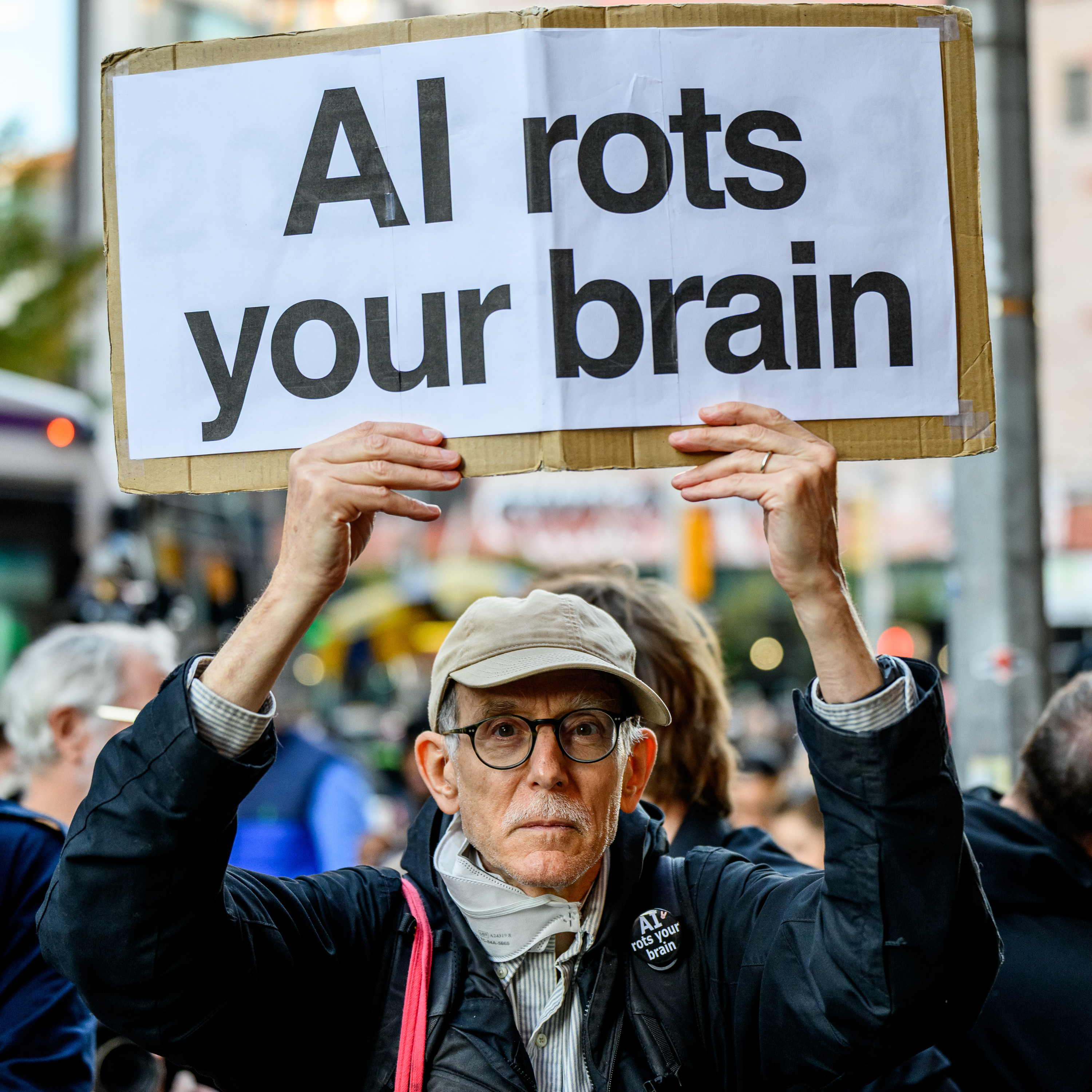
A protester holds a sign reading "AI Rots Your Brain" during the Nationwide Walkouts To Freeze AI - NYC on Oct. 20, 2026 in New York City. Photo by Roy Rochlin/Getty Images for Irreplaceable Action Fund.
Listen to Today, Explained ad-free by becoming a Vox Member: vox.com/members. New Vox members get $20 off their membership right now. Transcript at vox.com/today-explained-podcast.
Learn more about your ad choices. Visit podcastchoices.com/adchoices