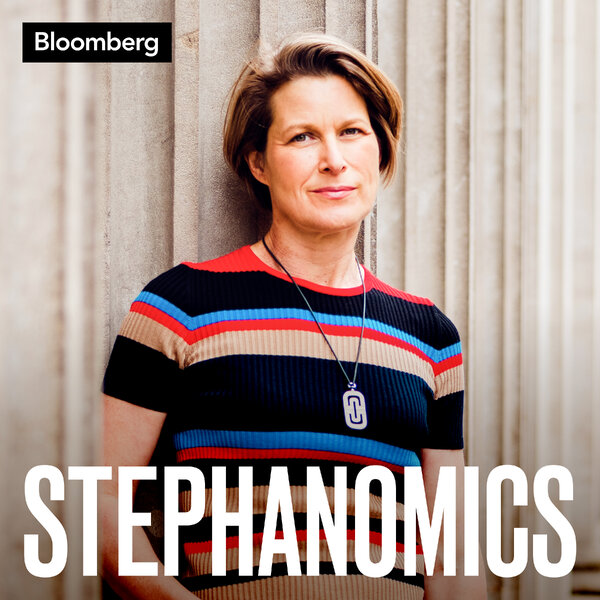
 Stephanomics
28 Jun 2025 · 24m

 Add vo to ChatGPT or Claude to ask about everything you hear
vo listened to this episode to put together the overview and transcript, so there may be the odd mistake.
A bonus Trumponomics discussion (Founders Forum, June 12) on whether Trump-era policies are shifting investor risk appetite, the dollar’s direction, and how innovation capital may rebalance from US mega-cap concentration toward other regions and sectors.
Cathy Wood, founder/CEO/CIO of ARK Invest; John Micklethwaite, Bloomberg editor-in-chief; Lizzie Burden, Bloomberg Television UK correspondent.
The “sell America” narrative is overstated; the dollar is down YTD but still within a long-term range, and returns on invested capital may improve. US Mag-6 concentration is unwinding as cash hoards turn into renewed capital spending and investors seek less “flight to safety.” Deregulation (especially healthcare) and tax changes could boost corporate risk-taking. Europe/UK have not matched US openness and investment urgency, though defense spending and some crypto regulation progress may spur innovation.
ARK holdings like Coinbase and Circle (digital assets); Tesla as “largest AI project” (humanoid robots); Tempest AI (healthcare information backbone); CRISPR Therapeutics revenue from sickle cell/beta thalassemia cures; stablecoins backed by Treasury securities; China’s AI/EV pace (e.g., DeepSeek) and open-source model dynamics.
0:00Cathie Wood: Some people treat ChatGPT like some kind of smart search engine, and some use it to get work done. ChatGPT Work is a new way of working in ChatGPT that can take action across your apps and files, stay with a project for hours if needed, and turn a goal into finished work. It's designed to help you move from a chaotic starting point to a reviewable first version. So all the source materials, briefs, and scattered information that you have to grind through to turn into something useful can just become something useful. Put ChatGPT to work on your most ambitious ideas and projects. Get started at ChatGPT.com by selecting Work Mode, available on Plus and Pro plans.
0:42This is Robert Smith from Business History. If you're listening to this, there's a good chance you're a small business owner. And like every small business owner, you started with a dream to do what you love and watch it grow. What you probably didn't dream about? Keeping up with cyber threats. That's where MasterCard can help with access to tools that help identify cyber threats to better protect your business. Building your dream business? Priceless. For cybersecurity in a changing world, there's MasterCard. Learn more at MasterCard.com slash small business. If you listen to financial news, you know a lot of time is spent thinking about what's next.
1:17The next opportunity. The next investment. The next move. But sometimes what matters most is being ready for what you never saw coming. For more than 75 years, Cincinnati Insurance has worked with independent agents to help protect businesses, homes, valuables, and more. Because planning for the future isn't only about knowing what's next. It's about making sure you're ready for what you can't predict. Let Cincinnati insurance make your bad day better. Find an independent agent at c-i-n-f-i-n dot com.
1:49Stephanie Flanders: It's me, Stephanie Flanders, host of Trumponomics, and we're bringing you a bonus episode this weekend. It's a conversation I had earlier this month on June 12th at the Founders Forum event held annually at the Soho Farmhouse in the English Cotswolds. The conversation features Cathy Wood of ARK Invest and the editor-in-chief of Bloomberg, John Micklethwaite, and Lizzie Burden, Bloomberg Television's UK correspondent. A lot has happened since we recorded the conversation, but we discussed wider themes around investing that I think are still timely and relevant. Cathy particularly shared her thoughts on China's competitiveness, the UK's missed opportunities, and whether we were looking at the end of US exceptionalism.
2:41Cathie Wood: I do think there is some rebalancing of portfolios, and it makes a lot of sense.
2:56Stephanie Flanders: I'm Stephanie Flanders, Head of Government and Economics at Bloomberg, and welcome to Trumponomics, the podcast that looks at the economic world of Donald Trump, how he's already shaped the global economy, and what on earth is going to happen next. And we're recording this episode from Britain's most high-end tech event, I like to think of it, Founders Forum. Some of the biggest names in European tech, even some Americans, have been cited here at Soho Farmhouse alongside politicians, former politicians, and pioneering investors. But I am always interested in how Trumponomics is not only changing the global economy, which we talk about a lot on this podcast, but changing the way the world looks to people who make money and manage money.
3:45Stephanie Flanders: That's going to be the focus today. There's been enormous focus on the trade war, headlines, massive volatility in the markets, definitely damaging for the global economy short term. But if you actually step back and think, you know, what else has happened in the world as a result of Donald Trump's economic policies since the start of the year, dollars gone down quite a lot. The rest of the world's assets have become, I would argue, more attractive relative to the US than they were. And if you'd asked a lot of people in the markets in the last few years, whether any of those things were good, they would say yes, they would say there actually would be healthy things that we quite wanted to see.
4:27Stephanie Flanders: We've been hugely dependent on the US for driving returns, for driving global economic growth. The dollar was pretty strong for all that time, was potentially having a distorting effect on many different trades.
4:43Stephanie Flanders: So I think you can sort of step back from the hysteria and some of the many things that people are worried about to say, OK, there's some good things here. And maybe this is a time where there is going to be more interest, more focus on other markets and particularly Europe and the UK. That's the question we had for this episode. You know, are we in a sell America world? And I guess related to that, you know, what would it take to buy Europe or, you know, heaven forbid, buy the UK? So to weigh in on this, we have Cathy Wood, founder, chief executive officer and chief Investment Officer of the investment management firm ARK Invest, and to be part of the back and forth, Lizzie Burden, anchor and UK correspondent for Bloomberg TV, and John Micklethwaite, Editor-in-Chief of Bloomberg.
5:33Stephanie Flanders: So, Cathy, we start with you, and you're well known for always having a strong view, not always the same as everyone else's. Should we be selling America? Well,
5:42Cathie Wood: Well, it's very interesting, and especially to be here for the last week, effectively, and watching Bloomberg, of course, and listening to how many people are asking and suggesting that American exceptionalism is done. And I don't know the answer to that, but here is what I will say. The way they validate the observation is the dollar is going down. And I understand that because the dollar is quite impactful as the world's reserve currency. So if you look at the long term of the dollar, yes, we're down 10 % year to date. But if you look at where we started after 08, 09, I think we bottomed at 70 on the trade weighted dollar DXY.
6:29Cathie Wood: And we're at 100. So we're still up 40%. And if you put it in the context of long-term history, we're at the middle to higher end of the range that has been in place for years. So that's the first thing. I don't agree that the dollar is telegraphing that America has lost its way. I do understand why there has been a correction for all the reasons you say. It seems like we're in utter chaos in the U.S. with trade wars and, you know, even closer to us, the Trump-Musk drama that we've been through. I do think there is some rebalancing of portfolios, and it makes a lot of sense. Our valuation levels in the United States are much higher than elsewhere in the world.
7:18Cathie Wood: But there is another phenomenon that I think, in saying that the U.S. was taking all of the oxygen out of the room, that did not take into account that really it was what we ended up calling the Mag-6. So take Tesla out. The Mag-6, we have never seen concentration like this before. So yes, there's a rebalancing away from the Mag-6. And why is that? It is because, you know, after building cash hoards because they weren't allowed to make any acquisitions under the last administration. So they didn't need to compete with one another to buy other companies. Now we're seeing a rush. And we've heard scale AI for meta platforms at a$10 billion valuation.
8:10Cathie Wood: And we are seeing massive capital spending out of these companies. The investor base in those companies, they were looking for safety. This doesn't feel as safe anymore. So I think there's a rebalancing, thank goodness, a rebalancing towards other exposures to innovation.
8:30Stephanie Flanders: Just to come back on that a bit, I guess a lot of people are surprised that you're talking about it as a sort of long overdue adjustment and correction, somewhat in terms of the balance between the US and the rest of the world, but also within the US market where you identify those massive concentration. A lot of people look at the US and say, look, there's a reason it's been doing so well all this time. It's had these underlying competitive advantages that you've seen even come through post-COVID in a way that a lot of other countries haven't seen, which are being undermined by Donald Trump's policies, whether it's the research infrastructure and the funding for basic research that we've seen slashed, the soft power associated with the centers of educational excellence, the openness to foreign talent.
9:19Stephanie Flanders: You're untroubled by any of that.
9:21Cathie Wood: So I think there are puts and takes. So again, back to the dollar. I actually think the dollar is going to continue to move up. And the reason I say that it's...
9:33Stephanie Flanders: You mean start to move up? Because it's been moving down.
9:35Cathie Wood: Well, I'm going to continue from that low, the 70, right, to 100, to 110, back to 100. And I think it is because there's a lot of controversy and argument on this point. So returns on invested capital, what will they do in the United States relative to the rest of the world? I think they're going to go up, but not 100 % sure, because I think other countries have massive opportunities now to capitalize on the biggest wave of innovation in history. Five innovation platforms, robotics, energy storage, artificial intelligence, blockchain technology, and then multi-omic sequencing in the life science space.
10:20Cathie Wood: And this is open for all. And I love to hear what I've heard here in the UK this week about a focus on getting into the game in a big way. Your educational institutions here are incredible. Your AI stripes, I mean, DeepMind came out of the UK, Arm and others. So what I love about this environment is the competition is open. Let's see who wins. But I do know in the United States, why might things get better for us? As I said, I don't think they've been that great over the last four or five years. And the reason is this concentration suggested to me flight to safety, cash, and okay, maybe they'll be involved in this AI thing.
11:09Cathie Wood: That's what that was. Now I think there's more risk-taking. Why is that? Number one, deregulation. We've been strangled by regulation. That is happening. And the most provocative deregulation that we're seeing right now is in healthcare, which is shocking. It's actually very exciting. And I think tax cuts, keeping the tax rates down and getting the corporate tax rate effectively down from 21 % to maybe 14 % by allowing full expensing of capital spending in year one, I think will also be very important. So I think that's good. I also think that competition is really good for America, from China, from the UK, and from Europe.
11:59Cathie Wood: So I think this will be a good thing. And we're at our best when we're competing. And I think the last thing is many of the cutbacks you're referring to are involved with the public sector. And deficit is a percent of GDP, six and a half percent. What they're trying to do is stop the crowding out of the private sector. So let's see what happens there. It seems to be basically, I think there's a lot of faith in those companies that aren't in the MAG-6 or MAG-7. And I just wondered, what kind of names are they? Because everyone's made so much money historically by being with Meta and whatever. Now suddenly, if you're right, and those are being sidelined a little, What are the sort of names that you would see in this new wave of American innovation?
12:51Cathie Wood: Yes, well, one of the things that happened during the last four years is we almost lost our crypto. And we should start saying digital assets a little bit more to make it a little more understandable, but to the rest of the world. And it's coming back now. So in the top 10 of our flagship ARKK, we have both Coinbase and Circle. So digital wallets, I think, are going to be a huge opportunity because this digital asset revolution has just started. So definitely crypto is a big wave. Our highest position is Tesla. We think Tesla is the largest AI project on Earth. And not just because of robotaxis, but because of humanoid robots.
13:42Cathie Wood: And then I would point to Tempest AI. We think this could become the healthcare information backbone of the United States. And then CRISPR Therapeutics, which actually technically is headquartered in Switzerland, is now deriving revenue. Many people think what I'm about to say is going to happen in five years. It's happening now. It is deriving revenue from curing sickle cell disease and beta thalassemia. Let's just let Lizzie come in. Where you were talking about crypto, I'm fascinated what your view is, because I wondered when the president is favoring crypto, is he hurting the dollar? I actually think that Bitcoin in particular will discipline our monetary authorities, a little bit like gold did during Chairman Volcker's and Chairman Greenspan's and maybe even Bernanke's time.
14:43Cathie Wood: But what's also interesting is if you look at stablecoins, which are really the gateway or the on-ramp into the decentralized finance world or the internet financial system, what are they backed by? They're backed 100 % by treasury securities in the case of Circle, largely by treasury securities at Tether as well. So that's a demand for dollar-based assets that most people didn't expect to be there. It's about$250 billion now, and it's just started.
15:22Stephanie Flanders: John, let's get on to the Europe side of this. Because, in fact, Cathy mentioned that there's a potential for some competition in some of these highly innovative fields and growing areas. Do you feel Europe or the UK has the potential to do that? I think what has been noticeable so far is you could see to some extent America from a kind of geoeconomic point of view, almost doing what you would not want to do, what it used to do to other countries, where you sanction countries like Iran by stopping them being able to import things, stopping people going there. America is now to some extent doing it to itself in the same way as Britain did with Brexit.
16:00If you sanction yourself normally long term, that's not a great thing. The interesting thing, I think, to me is the fact that Europe has not picked up that challenge. If you look at something like university graduates, for instance, you would imagine at the moment the cream of graduates, probably people in this audience, either them or their children. Everyone wants to go to American universities. Stephanie and I were in Qatar last week. Suddenly everything has changed. People are scared of that. And yet what's rather remarkable is if you look at the European countries, you look at Britain, there hasn't been a thing saying, for God's sake come here.
16:35Not in the same kind of public way that you might expect, slightly more from Canada. And I think that's true of various other things, especially within the European Union. You've still got a variety of people arguing about whether you have a banking union, which is most people would expect is the bare minimum. These are all things that kind of people have spent 15, 20 years arguing about within Europe. So I think people like me expected there to be a wake-up call to Europe. But it hasn't so far, outside military spending, it hasn't really come through.
17:06Stephanie Flanders: And Lizzie, you spend quite a lot of time as a UK correspondent. I see you often standing in 10 Downing Street. In the rain. And this week, you know, there's been these kind of two quite distinctive kind of big events. There's us hosting these trade talks that everyone was paying attention to between the US and China. And then the Chancellor having her big day yesterday with a spending review, this government would say they're starting to address long, festering structural problems, whether it's planning and other things. They're also saying quite a lot of, at least there's been lots of good mood music about investing in tech infrastructure and just energy capacity, probably not enough.
17:47Stephanie Flanders: Do you feel when you're sort of, does this feel like a country that's kind of getting its act together on some of these fronts? Yeah. Is it nice mood music or is it just nice noises? When you have the US-China deal, to go back to that, not deal, but it's not a decoupling, but they've made up for now. There's always the chance that they don't get on again and that this only lasts for a few weeks. So we put that to one side. Then we look at the UK. We had the prime minister on day one of London Tech Week announcing that billion pounds of spend on compute. Nick Clair-Goyle on this stage is saying to me, Microsoft spends$80 billion on the same thing in one fiscal year.
18:27It's kind of chicken feed. When you look at the ideas that are coming out from the government in terms of growth, yes, they're fiscally squeezed. But you've got a lot of people saying they spent 14 years in opposition. Could they not come up with anything more radical to boost the economy, to get that growth, to get that investment? So I think that there's a sense of disappointment, actually. But there is an effort to do the right thing. I mean, Keir Starmer, the globetrotting dealmaker, first in line, actually, at the White House to get this trade pact with Donald Trump. But is it meaningful?
19:04Stephanie Flanders: I mean, Cathy, yeah, you can see this. So we're very good at laying into the US, but then actually we're also quite, as some have said, we feel sort of excitement about our own failings as well. We're very happy to dwell on our bad weather and our bad failings, even as we point holes in the Trump policies. So what's your response to this sort of wave of negativity?
19:26Cathie Wood: Well, the first thing in terms of Europe, and then I'll do UK, But Europe passed, I don't know if you pronounce it, Mika or Micah here, in adding some clarity to crypto or digital assets regulation. So I thought that was a very interesting and important step in this world, which is going to transform the financial system. So that's good. and I also do believe that half of the solution is understanding the problem and as I go around Europe, which I think regulation is a problem there. Just to come back on that, people like Stephanie and me, this is much younger, have been wandering around seeing European prime ministers for 20 years.
20:19If you drew up a list of the problems over regulation, no integration, they've understood the problem for years. They've just been totally unable to work out a way to deal with it and get elected.
20:32Cathie Wood: And it is why a company like Palantir has said, we're pulling our employees out of Europe because the demand elsewhere is so great. And they're tied up in knots, you know, regulatory knots. And, you know, it's just not going to be productive. I do think, however, this move towards increased defense spending, which involves massive technology, is going to create a wave of innovation out of necessity. And I think that's a very good thing. And they're all united on that. And I think Germany agreeing to, what is it, 3 % of GDP, very important from a tech point of view, which is my lens. In terms of the UK, I must say I watched serendipitously the interview between Prime Minister Starmer and Jensen Wong.
21:28Cathie Wood: And I found it very interesting the way that your prime minister started with health care, which in the United States, you know, most VCs have found that a very difficult place. Here, you're opening it up in a very provocative way. And NHS is known for being progressive in terms of longitudinal data. And data is the name of the game in AI.
21:54Stephanie Flanders: So I am more optimistic. I did want to ask you, I just got back from Hong Kong. And I talked to quite a lot of investors and others. And it sort of strengthened something that I'd been thinking over the previous few months, which is when you ask people, and I did it, you ask people, what's the thing that's most surprised them in the last few months or the last six months? And actually, particularly there, it is not anything that Donald Trump has done. It's what's happened in China. It's the breakthroughs, whether it's Deep Seek and the things underpinning that and the things that have followed in the wake of Deep Seek.
22:28Stephanie Flanders: It's the breakthroughs in electric cars, the pace at which under the surface, Chinese key industries have developed. And it sort of feels like the subtext to almost everything, many columns and many pieces being written about China on any subject, the subtext is China's going to win.
22:47Cathie Wood: So it's interesting. We spend a lot of time. I think the open source movement in China, open source software movement, is very powerful. Now, examining it, though, not though, I think it's great for competition around the world. we are using some of the deep seat breakthroughs they distilled from our models. You know, we complemented them, very creative. So that's good. We can use those models and we're doing some open source models as well. In China, nobody wants to pay for anything. You know, I got a question from one of the LLM providers over there, the CEOs. He said, how is it that people are willing to pay$20 a month.
23:34Cathie Wood: And I said, because they want to be able to use it more instead of the limited time for free. So people won't pay here. And I'm thinking to myself, you know, the question for all of us is commoditization. Are they going to commoditize everything? Look at what's going on with EVs. Thank goodness Tesla is not an EV manufacturer. People say that. I just told you what I think it is. But I asked, I did a podcast there in Hong Kong just a couple of months ago, and I said, okay, you have to use some of these productivity gains. This was a co-CEO of APAC for a large bank. Actually, it was HSBC. I can say that here, right?
24:15Cathie Wood: And you've got to turn around that productivity, and so do we. What do you need to do with those productivity gains? You need to raise compensation because you need to drive your consumer economy. What do we need to do in the United States to compete more effectively against Japan? I mean, China is we need to use it to cut prices. That's why we think there's going to be a deflationary pull in the U.S. economy, more than people expect right now.
24:43Stephanie Flanders: All right. On that bombshell, we have covered a lot of ground. We haven't done justice to any of it, but I appreciate Kathy, Lizzie and John contributing. Thanks for listening to Trumponomics from Bloomberg. It was hosted by me, Stephanie Flanders. I was joined by ARK Invest CEO, Kathy Wood, Bloomberg TV UK correspondent, Lizzie Burden, and Bloomberg Editor-in-Chief, John McAvoy, with special thanks to the team at Founders Forum. Thank you. Thank you, Stephanie. Thank you, Stephanie. Thank you.
25:392 a.m. like it's 2 p.m. One partner powering how business gets done for companies around the globe. When you add it all up, no one does business like Comcast Business. Wise is the smart way to manage the currencies you need around the globe. When you send money abroad using your bank, you could get hit with hidden fees and exchange rate markups. There's a better way. Try Wise. Wise uses the exchange rate you'd usually find on Google with no unwelcome surprises. Plus, most transfers happen in under 20 seconds, which means your money arrives in less time than you've been listening to me. It's simple and free to sign up when you download the WISE app.
26:15Be smart. Get wise. T's and C's apply. If you're a business owner, you need a card that can keep up. With the Delta SkyMiles Reserve Business American Express card, everyday purchases transform into miles you can use towards future travel. So business as usual can lead to a well-deserved getaway. and for a limited time, card members can earn 200 ,000 bonus miles, the highest miles offered this year. Whether you're traveling for business or planning your next adventure, now's a great time to make every purchase go further. Apply today at www.delta.com slash podcast. Offer ends November 4th. Minimum spending requirements and terms apply.
Earlier this month host Stephanie Flanders sat down with Cathie Wood, the founder, CEO and chief investment officer of ARK Investment Management, at the Founders Forum Global conference in Oxford. They were joined by Bloomberg Editor-in-Chief John Micklethwait and Bloomberg TV UK Correspondent Lizzy Burden.
Wood gives her take on the 'great rotation' out of US stocks, why she believes investors rebalancing their portfolios, moving away from safe-haven tech stocks and towards riskier investments, and how that's shaping her outlook for the US dollar.
The conversation was recorded on June 12, 2025.
See omnystudio.com/listener for privacy information.
Scan the code with your iPhone camera
Listen in the app.