Ask ChatGPT
 UNTAPPED with Spencer Matthews
8 Oct 2026 · 42m · 12 chapters
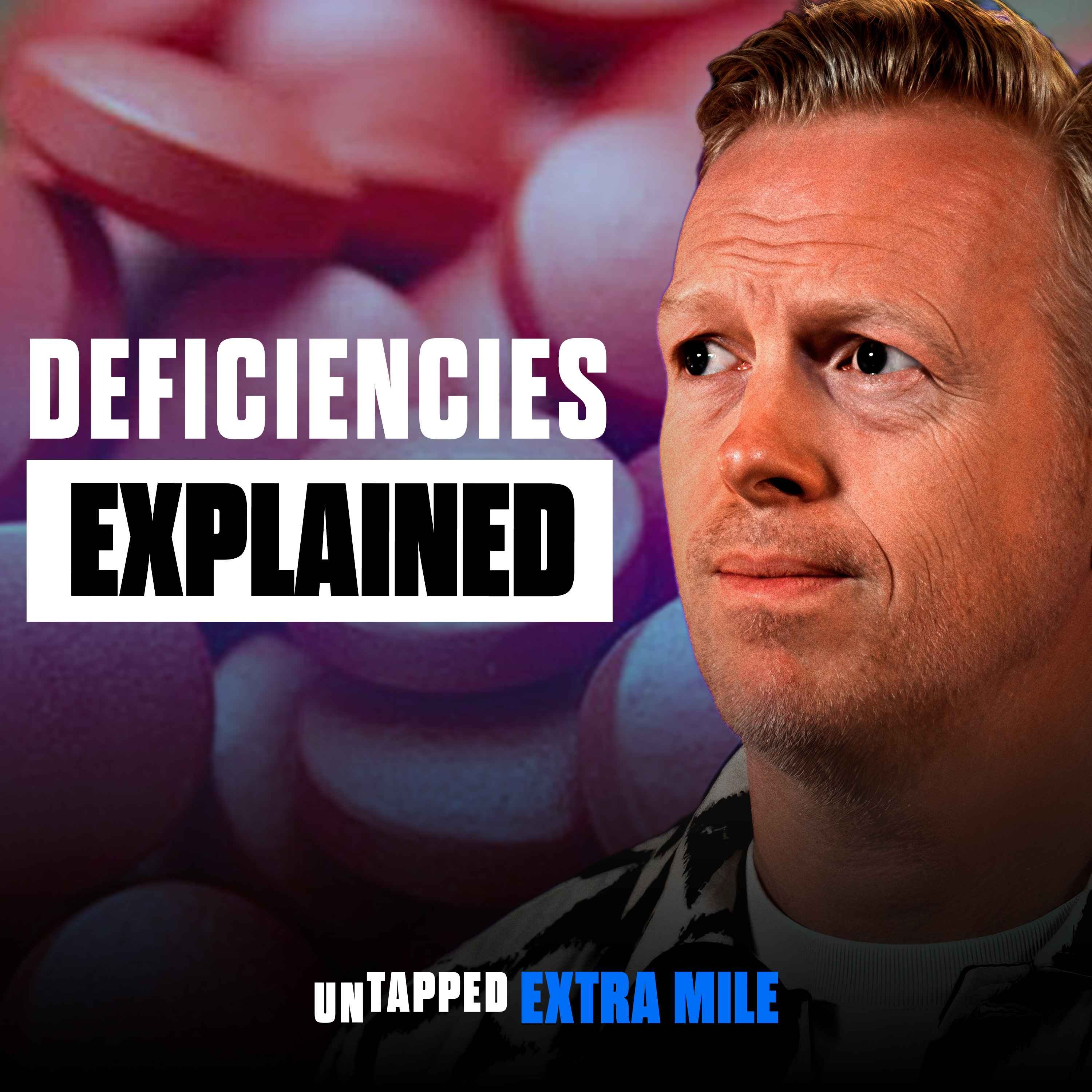
Three common nutrient deficiencies that can limit health and running performance—iron, vitamin D, and vitamin B12—how to recognize them, test for them, and correct them without over-supplementing.
Bella (co-host; recurring on the show). Oli Patrick (host; running/health focus). Mentions prior guest Dr. Hazel Wallace.
Fatigue/breathlessness can be anemia-related, but symptoms aren’t specific—blood tests are needed. Iron status is assessed via hemoglobin (oxygen-carrying) and ferritin (iron stores). Low vitamin D is linked to reduced sunlight; it affects immunity, bone, and brain. B12 is required for red blood cell production; vegans may need deliberate food choices or supplementation.
Tube ads for iron; runners noticing higher heart rate/breathing at the same pace; hemochromatosis as risk of excess iron; menstrual blood loss increasing iron needs; vitamin D and darker skin/pale skin differences; B12 injections improving low B12-related fatigue (not “more blood” for everyone).
Written by AI. May contain mistakes.
Exploration of iron deficiencies and their prevalence, particularly in women.
“But iron, how can I know if I'm deficient in iron?”
Discussion on how to test for iron deficiency and understand hemoglobin levels.
“the building block of the thing that carries oxygen in your blood.”
Examination of dietary sources of heme and non-heme iron and their absorption.
“And ferritin is really our stored ability to keep iron locked away in different aspects of the body.”
Guidance on supplementation for those who may not meet their iron needs through diet.
“inadequate hemoglobin, then we start to ask that question, do they then need a greater volume, or is there some kind of problem with absorption?”
Discussion on how women's iron needs change through menstruation and menopause.
“then of course we can lean in at that point to this idea of a supplement.”
Learn about how menstrual cycles impact women's iron levels and the importance of iron for physical health.
“So if you lose blood, then you will have a decrease in your natural, again, level of hemoglobin, and that could affect your body's ability to carry as much oxygen as you might wish.”
Explore the crucial role of vitamin D in health, immunity, and bone density, especially during winter months.
“And then the cells, the red blood cell contains within it hemoglobin and hemoglobin is what carries the oxygen.”
Explore the complexities of nutrient deficiencies and their impact on health.
“They're based on population distributions.”
Identify symptoms of deficiencies and discuss the factors contributing to their rise.
“That makes it a much easier decision and discussion for the physician looking after you to say, oh, it's not just because you've been sleeping terribly because you've got a new baby like Mr.”
Explore the impact of modern lifestyle on nutrient deficiencies and health.
“So my bones don't form properly and they bow.”
Learn about the importance of identifying deficiencies over quick fixes.
“identifying that deficiency and correcting it could be the roadmap forward.”
Reflect on the conversation and the importance of a balanced approach to health.
“often dive into the hyper personalization, the hyper optimization.”

Get the gist, explore an idea or ask about something said.
 Claude
On UNTAPPED with Spencer Matthews, what are the key points of this episode?
Searching your listeningAutomatic transcript. May contain errors.
0:00Welcome to Untap the Extra Mile with me, Oli Patrick, but no Spencer Matthews. Spencer once again, delivering on his dad duties, managing his brood, and he's left me here to tackle some of the questions that we know you've got from the running community and broader health and well-being. So we've got some great questions today, picking around the topics of deficiencies. Have you got them? If you've got them, what might they be? How would you test for them? What's the impact of those on health, well-being, running, performance, and more. And let's see if we cover some of the questions you might naturally have.
0:31So deficiencies. I've got Bella with me today. Hello. People are probably sick of me by now. They're far from sick of you. They're delighted to hear your voice again. I think I saw some nice comments about the quality of your voice. Oh, really? I need to check those out. Yeah, so I'd love to start by diving into one of the most sort of common deficiencies. I think it's one in five for women. But iron, how can I know if I'm deficient in iron? That's a great question. And that's a lot of people. One in five, 20 % for those mathematicians out there. And that's a nutritional deficiency. And that's interesting because we believe that iron has a critical role in producing hemoglobin in our blood.
1:09So iron and our body's ability to manufacture the actual base product of blood run hand in hand. If we think about one in five having inadequate iron in their diet, that doesn't guarantee that one in five would suffer from low hemoglobin, which is often colloquially called anemia. So this concept of anemia is I just don't have enough of the ability to carry oxygen through not having enough hemoglobin, which sits within my blood. And therefore, the theory would be people with low iron intake are more likely to have some degree of anemia. And that means that blood can't do what blood does, which is get oxygen everywhere.
1:44If I come into London, which I do frequently. I'm in London today. And I jump on the tube. There's always an advert for iron. You might've seen this as well, Bill. There's an advert for an iron supplement. And it says every time, are you tired? And that's, you know, everyone's like, oh, I must have iron deficiency anemia because fatigue is of course one of the main symptoms of anemia. And it's very easy to point at a potential iron deficiency as the reason someone's tired. We know in the UK that most people are tired a lot of the time. So we've got one in eight people classifying as tired all the time on a recent YouGov study.
2:22And then further to that, one in four people tired most of the time, which puts us over 30 % of people who are tired most of the time or more. And that's a pretty incredible statistic. So if I see an advert on the tube going, you may be tired because you have inadequate iron, which means we believe you don't have enough blood to carry oxygen, that narrative, of course makes sense. The reality is the only way to know this is to run a blood test. When we look in our blood, we call that hematology. And if you run a hematology blood test, you're going to find a couple of interesting things. The most notable one being hemoglobin.
2:55And hemoglobin would be the thing that your GP looks at to say, we believe you may not have enough iron to actually provide the building block of the thing that carries oxygen in your blood. And that then would lead them to an interesting discussion of was it that you were deficient in your nutritional intake or was it that your body isn't absorbing that iron particularly or is it because you're losing blood somewhere and that again as much as that's a slightly sinister connotation we're always interested that not having enough in the body doesn't mean I didn't take enough in it might be I didn't absorb it properly or even I'm losing it somewhere so those are the questions a GP would asked when they found a low hemoglobin level.
3:34From a performance point of view, when we see iron deficient anemia or any anemia, it often manifests as breathlessness. So that's quite an interesting sign of fatigue. Suddenly, I'm sort of over breathing for the same effort. And if you are a runner, and you're used to trotting out a sort of four and a half minute K pace, and your heart rate is generally you've sort of calibrated what that heart rate would look like and what zone you'd in and suddenly your breathing rate is a little bit increased, you know, a couple more breaths per minute or your heart rate is higher at the same exertion level, it's perfectly reasonable to think was that about a lack of hemoglobin and is that something I should check out with a GP.
4:13In the first instance, the easiest thing here to work out is did I take in enough iron? And iron is, again, prevalent in our diet mainly in two forms. If I go to animal products, particularly red meats, they will have heme iron. And what that means is the iron in there is pretty much ready to rock and roll. And so it's easily absorbed and easily turned into hemoglobin. We can get iron from non-animal food sources, so pulses, legumes, etc. And actually, it's one of those great arguments for fortified cereals. So when you look at the back of a cereal box, you'll often see fortified with iron. And so they literally wedge iron into the product.
4:52And the volumes you find in there often is quite contributory to good iron levels and good nutritional intake. So that is called non-heme iron, and it just takes a bit more effort to convert it. And one of the things that you need to convert it is vitamin C. And this is where we remember that the body is this amazing ecosystem of all these different things circulating together. So have I had enough iron, and let's imagine I'm a vegan, so I'm not getting any from beef or red meats in particular, then I've got to have enough vitamin C to help me turn that non-heme iron into something I can actually turn into a usable format in my blood.
5:28We also store iron. And there's another blood test that often run when people are interested in, is this excessive breathlessness? Is this fatigue being driven by my blood? And that's called ferritin. And ferritin, again, often spoken about, rarely explained, is just a protein in which we store iron. So ferritin is a bit like, have I got a bank of iron ready to deploy if my daily or regular intake was insufficient. So hemoglobin is going to reflect whether I've got enough, again, oxygen carrying capability in my blood. That's cool. And then second to that, I've got, again, was my iron intake sufficient, but is my ferritin levels, are they sufficient?
6:02And ferritin is really our stored ability to keep iron locked away in different aspects of the body. And then when the body calls on it, it releases that iron and it turns that iron into hemoglobin, which turns into me being able to move oxygen around my body. So when we look at this sort of practically, can I track whether my actual iron intake is inadequate? If it is, can I lean into foods that are higher in iron? There will be plenty of vegan and vegetable options for that, as well as the red meats, of course. Have I got adequate vitamin C? That's a great question. And if I've got good intake, but low blood markers, that's then for a physician, a GP in the UK to start thinking about, well, maybe you're not absorbing it properly.
6:40there's a condition called pernicious anemia where I just, if you like, the mechanisms through which I absorb iron is compromised. We call that an autoimmune disorder. So that can be checked out. Or is it that I'm using way too much? And that does start a little just back into the athletic community. We do use more. We, notice I've bundled myself in with the listeners, notice that. We use more because if I combust more energy, if I turn over more cellular activity, there is a slightly higher utilization. So there is that question again, whether I'm losing it or using too much of it, which might be nothing to do with how much I started off taking in in the first place.
7:13So I think it's get revved up about iron. You know, if you don't have enough oxygen, that is a real challenge for anyone involved in aerobic or cardiorespiratory exercise. And if it's one in five of us, we should really look at our diet as the first port of call. I have so many questions for you. All good. I'll take the second one and then the third. So when it comes to people who might have a vegetarian vegan diet, I'm aware that for some legumes, they can have a sort of something protective on them. But how can someone who might have a vegan vegetarian diet, make sure that they're getting enough iron?
7:46It's tough. And I think the first thing when anyone's interested is, is my diet adequate to give me the recommended daily intake of a particular nutrient? The only way we can truly establish that is a little bit of tracking. Got to be careful with food tracking. Some people don't like to formalize that relationship with food. And if people have had a difficult relationship with food. We certainly don't want them photographing and logging every meal obsessively. But if we are unsure whether A, my generalized intake of iron is sufficient to meet recommended daily intake, then I would always start with the only way we can prove that is probably a couple of weeks of logging food into a traditional search engine.
8:23Some of the apps that you can get, which are readily available, will then break down all the foods you put in. And some of them now use AI photography. So I take a photo of the food, and then it will log the different micronutrients. So remembering micronutrients are my vitamins and minerals. Macronutrients are my carbohydrate, my protein, my fats, the big building blocks of structure of food. But the micronutrients will then be qualified to say, you as a male weighing 85 kilograms, this was the volume that you ate, and is that inadequate over those two-week periods? It's really difficult because if we run a blood test, it doesn't tell us you didn't eat enough.
8:57It might tell us that, again, you didn't absorb enough or you used too much. So the first point when everyone's thinking about, how am I getting enough of that particular nutrient is to run a food log. If that is all coming from a vegan source, then we can still say if the iron meets that recommended daily intake, it's sufficient, but they're going to need that vitamin C to convert that more effectively. And the proof of the pudding, Bella, is in the eating, which is if that individual is eating an adequate perceived volume of iron through all the different legumes and pulses and foods that might contain iron, and they are running their bloods and they're saying, well, actually, I've still got inadequate hemoglobin, then we start to ask that question, do they then need a greater volume, or is there some kind of problem with absorption?
9:38So it's guesswork until it's tested, sadly. And that does put a layer of cost in. I think, again, if someone is focusing mostly on their intake being sufficient and their diet being diverse in sources and having sufficient vitamin C outside of people with that deliberate change in infatigability or breathlessness, it's unlikely that they're going to need some special care. But again, if you're eating enough and you're not getting enough hemoglobin, then it's to the GP for you.
10:09Therapy's biggest impact doesn't show up in some dramatic breakthrough. It shows up in the smallest moments. You bite your tongue instead of escalating. You put your phone down instead of firing off that text. You say what you actually mean instead of what would hurt someone else the most. Nobody applauds those moments. but they quietly change your life. That's what growing feels like. And that's exactly what Grow Therapy is here for. Grow is therapy that works, covered by insurance. Sessions average$21 with insurance, and some pay as little as$0, depending on their plan. There are no subscriptions, no long-term commitments.
10:46You just pay per session. Grow connects you with thousands of high-quality, licensed therapists across the U.S., offering both virtual and in-person sessions, nights and weekends. You can search by what matters, like insurance, specialty, identity, or availability. And you can book a therapy session in minutes and begin in as little as two days, not the national 48-day average. See if you could pay as little as$0 for therapy in seconds at growtherapy.com slash start now. That's growtherapy.com slash start now. growtherapy.com slash start now. Availability and coverage vary by state and insurance plan.
11:31For somebody who might not want to go to the GP and thinks, okay, I think I might be iron deficient, so I'll just pick up something from the supermarket that will do the job. Would it do the job? Potentially. Potentially. So if someone does feel that they can't be bothered to track diet or they can't get enough in, that is the logic of the word supplement. And we love the word supplement because it's to add to. my supplement on the the sunday times is in addition to the main newspaper so if i've hit my limit with my real diet and i say real diet because we can all live a sort of fanciful existence for two weeks where we're foraging in the back garden and dragging you know the perfect nutrient balance but if i'm not going to do it for three months it's probably not going to change my cellular structure so the the diet we've got to eat is the diet we can sustain that's always the starting point if i cannot get to a recommended daily allowance of iron through my diet alone then of course we can lean in at that point to this idea of a supplement.
12:26As with all things, more is not better. And we've said that a lot on Untapped Extra Mile. It's not about having tons of this stuff, it's having the right amount. And so there are a remarkable number of people who have a condition where they absorb too much iron. It's called hemochromatosis. And I found out about this when I was in the world of health screening, we found people with super high iron levels, super high ferritin levels. So they basically have a genetic condition where they store too much iron. and that can then start to have a real impact particularly on things like the liver where too much iron starts to store in the liver and they end up with challenges down the line and that's quite a strong genetic condition so the idea that i can just throw iron into my body and that won't come at a consequence makes some assumptions it makes some assumptions that it wasn't an absorption problem which is worth again could be something that might need a better review from a physician or solving but it also doesn't factor in the fact i might already have some particular challenge around the way I'm storing iron or managing it.
13:22So I think the idea of a sort of low-dose multivitamin always ratifies, and I think there's generally a good logic for that. But if someone consistently has low iron and they keep supplementing, then again, I would still send that person back to the GP, Bella. So we had the wonderful Dr. Hazel Wallace on a couple of weeks ago. Legend. Legend, absolute legend. And she touched slightly on iron deficiencies for women. Why is it that women need to be slightly more aware of it? Yeah, she raised the brilliant point, which is, you know, there is significant blood loss in the first stage of the menstrual cycle.
13:54So that blood loss may, again, we touched a bit on the volume, whether it's, you know, 70 mils or more, that volume of blood loss and the whole process of the menstrual cycle loses blood. So if you lose blood, then you will have a decrease in your natural, again, level of hemoglobin, and that could affect your body's ability to carry as much oxygen as you might wish. So a menstrual cycle in many ways is a monthly challenge to your body's ability to have sufficient blood, have sufficient red blood cells, have sufficient hemoglobin. And so there's just a very clear pattern with the increase in need for iron and the menstrual cycle.
14:30And it's always interesting when we look at iron guidelines that when biological females go through menopause, so at this point their menstrual cycle is stopped for a period of 12 months or more, their daily iron requirement then sort of matches that of biological males, which is something around, I think, 9 milligrams. And I can be fact-checked by Maria on whether that is true or not. But there is a clear need in the period of life where there is a menstrual cycle when an individual would have a greater need for iron to rebuild the hemoglobin that they're losing on a monthly part as part of that extraordinarily complex but wonderful cycle.
15:04Wonderful. Next one I'd love to tackle is a very common deficiency, especially here in the UK, vitamin D. Vitamin D. Oh, I love vitamin D. Vitamin D is probably the safest ground whenever you get people talking about which is the safest supplement. Vitamin D is one of the most researched supplement and it's totally valid. We are entering the period of autumn in the UK here, and that means the abundance of sunlight is depreciated. And we will increasingly see people have decreasing serum levels of vitamin D. And vitamin D is actually less of a vitamin and more like a hormone. So it does so many extraordinary things, particularly regulating my immune system, particularly regulating the quality of my bone mass.
15:48It has a huge role on the brain. And so to point vitamin D at just bones would be doing it a disservice. It is such a multifactorial vitamin that there's a strong argument it should be really classified as a hormone. Our biggest relationship with vitamin D is we can manufacture it, which is pretty extraordinary through exposure to natural light. So as natural light hits my tender skin, my body then manufactures vitamin d and that serves this immune protecting this bone building this brain supporting other other other purpose but if i meet no light then i make no vitamin d and that is a real challenge and we we start to look at where there are certain things that happen in again countries where we have a very clear seasonal pattern and decreased sunlight that there is um seasonal affected disorder people have probably heard about that which is a clinically definable change in mood state as we enter winter months.
16:36And then just below that is a sort of preclinical, almost self-diagnosis, winter blues that start to feel less well. Now, some of that is to do with mismanagement, what we call circadian rhythm, which is our 24-hour body clock where we want light in the morning, darkness in the evening. Some of it is change in social structures, less going outdoors, less exercising outdoors, less paddle, which is very disappointing. But some of it also might tie into changing levels of vitamin D. So what do I want really for good vitamin D is probably 10 minutes at least of quality sunlight exposure on my bare forearms a day to convert that.
17:08If I don't get that sunlight exposure because I didn't get out in the daylight at all, or I'm wearing long sleeve tops and heaven forbid I'm wearing winter sunglasses, then that whole thing doesn't get made. And then there's a strong justification for everybody taking a vitamin D supplement. And a bit like with hemine versus non-heme iron, vitamin D3 is sort of a derivative of vitamin D, which requires less conversion and is more biologically available. And again, if you go to like a biohacking longevity conference, everyone will be revved up about vitamin D for good reason, because it plays all these critical roles in the body, particularly in supporting the structure of bone density and bone mass.
17:45And that's something that naturally depreciates with age, unless we keep resistance training, keep vitamin D, and another cofactor called vitamin K2. All of that being said, you'll find quite high dosages of vitamin D out there. If someone's got a propensity for low bone density, a condition we call osteopenia, which can turn into a more pressing condition called osteoporosis, that's where the bones have become a bit more airy. So they're less dense. So the bone wants to be dense. It's like a honeycomb structure inside. And as we age, if there's not much strain on the bones or there's not enough vitamin D or there's just, again, some unfortunate genetics, that bone thins out and therefore it's much greater risk of the fracture or the break when I trip and fall.
18:24And that in the UK is the biggest cost into our healthcare system is frail bones breaking and then the huge loss of independence that comes with that. So tying all that together in the anti-aging community, they're like, well, then whack in loads of vitamin D and we get regularly a minimum dose of 1 ,000 international units and people taking 5 ,000 IUs, as it might be called. The case here again is this actually is quite a measurable parameter in blood. Why people tend to like iron is you can measure iron, free iron. You can measure transferrin, which travels iron. You can measure hemoglobin, ferritin.
18:56You've got living markers of where there's a potential challenge there. Vitamin D also quite a lot, again, travels in the bloodstream. So it's got a really nice marker to say, do I have sufficient in my diet over the last four or six weeks? And if I have, then those levels in my serum would be reflective of whether my body has what it needs. Lots of other nutrients aren't held in blood or serum or easily tracked. So I always think that iron and vitamin D are too, where investing in a blood test periodically is probably a worthwhile investment. Again, particularly from a runner's perspective and the role of bone strength in reducing injury risk, particularly small fractures that could be a significant risk from people pounding pavements with large repeated load over time.
19:38But also in the athletic community, the real pinch point seems to be immunity. Nothing worse if you're coming up to your marathon, you've been building for this block, and then you get that low-level virus or you, again, pick up that little bug that was a huge part of you having hopefully slept well, having a good gut microbiome, that's another topic for another day, and good levels of things like vitamin D. So I love vitamin D. People often ask me what it's like to be this pale, which is very kind of them, and maybe I shouldn't wear black and white because the whole thing here is now black and white.
20:08And I say, well, being pale has challenges in the summer, but it gives me a superpower in the winter. So when you see people with less melanin, I hope you're kind to them, less melanin, that sort of pigment in our skin that gives us that darker continental glow that I've got pretty much zero of, that again can actually inhibit my body's ability to turn sunlight into vitamin D. So as human beings migrated north, our skin lightened to allow us to convert more or less sunlight into more vitamin D. So it's a bit of a superpower for those of Celtic origin or Fitzpatrick type 1 and type 2 skin, as we are lovingly known online.
20:44And that conversion capability is really important. So who wouldn't benefit from that? People with darker skins, people whose family origin is, again, from Africa or the Caribbean. in. And so the need for vitamin D supplementation is likely to be greater. And again, there's nuances apply in individuals with darker skin who don't have those sort of Celtic roots. Would I still take vitamin D? I hedge my bets and I run my bloods because it's that crucial. I think it's a brilliantly, brilliant, important nutrient. It's found in lots of different foods. Found it in dairy, find it in some leafy vegetables, we find it in whole grains.
21:18It's sort of omnipresent in lots of different foods, eggs, another great source. But it's hard to get total amounts through diet without sunlight so we want a bit of sunlight we can get it winter exposure and consider government guidelines on supplementation amazing thanks so much you need to not be dissing the shirt though because it looks very good well that's many compliments well i've gone bold we're recording this on a friday so i thought i'd throw on the old the old magic maker so the next one we'd love to tackle is b12 deficiency b12 b12 that's that's that's popularized and I'll tell you what people like to do they like to have a b12 injection in their bum um or maybe that's just my close circle of friends uh b12 is a critical nutrient again through our diet but links us actually back into question marks around iron because b12 helps us make blood so b12 has a structural role in the manufacturing of blood itself so if you think of a red blood cell there's this again your blood is circulating through your body now the liquid is plasma, which is sort of a water-based fluid.
22:21And then the cells, the red blood cell contains within it hemoglobin and hemoglobin is what carries the oxygen. So if I want good blood, I need to have a enough blood that would draw me into things like hydration. Have I got enough blood plasma? Then I want again, sufficient red blood cells that would lead me into vitamin B12. And then inside my red blood cells, I would like enough hemoglobin. And again, here we see this wonderful orchestra of human physiology, that it's all these different nutrient parts playing a role in one outcome, which is my ability to take air from the environment, turn it into oxygen, get it to my cells and run this machine.
22:55So B12 is a nutrient actually we use in our bone marrow to actually manufacture a red blood cell. And that means if I have inadequate B12, I might find another challenge with having sufficient blood. So that blood test again might reflect in one of two ways. If I have a blood test for B12, which is a parameter that can still be pretty accurately measured in bloods. Then the question mark is, do I have enough B12? Second question is, was that B12 enough for me to have sufficient red blood cells? And that again, ties us into this area of hematology. B12 is again, particularly highlighted in vegan diets, because again, it's so associated with animal produce.
23:32So the thing with animals, of course, if animals have built these tissues, and we eat their tissues, we take the things that our tissues need. So it's a very clear sort of cycle of life. And there's always moral and ecological questions about that. But from a nutrient point of view, the meat itself, unfortunately, is extremely nutrient dense. So animal produce, we're stealing their conversion of B12. And that makes it easier for us. We can achieve adequate B12 through a vegan diet. But the foods again, some of those pulses and legumes, you got to work harder. And I have lots of great, wonderful friends who are vegans, and you just got to be more deliberate with food choices.
24:07And I think if someone's leading a vegan diet. The great danger is excessive consumption of traditional wheats and grains without all that nutrient diversity that is required to optimize both iron and vitamin B12. For several reasons, some people can have low levels of B12. There are some genetic components to that and some other health elements that are worth exploring. And if someone does have low B12, then sometimes it's given as intramuscular or IM. And IM is often a bum jab, which would increase your levels of vitamin b12 and enable the body then to have the raw nutrient it needs to make blood so to make the blood itself that is crucial and in that process we need b12 if we're making more blood and that might be the preserve of someone who's training hard and actually if someone's training at altitude or at altitude we know athletes tend to like that because the idea of being at altitude is i have a drop in my natural ability to move oxygen around the body and i might manufacture more blood and red blood cells in particular as a result of that and that's a process called EPO.
25:09So anyone familiar with cycling doping and the Tour de France scandals of, I think, probably the 90s, early 2000s with Lance Armstrong, EPO seemed to be the drug of choice, which was an ability to inject something your kidney would make naturally to manufacture more red blood cells. And then you need a high level of B12 and high level of iron to convert all of that into the structure of blood that should enable you to cycle up that hill harder, but with potential costs. And again, the body is this beautiful, you know, scales. It doesn't ever want anything to be too high. So if I have too much blood, then there's the risk of that blood getting cleggy and clotty.
25:42And that's a blood clot. And that blood clot could be a stroke or it could cause, again, an embolism which moves into my lungs and causes challenges. So I don't want loads and loads of blood. I don't want loads and loads of red blood cells. I don't want loads and loads of anything. And neither do you. We want the right amount. And in most cases, we've got to recognize the biggest opportunity in all things health, well-being, performance is correcting a deficiency, not pursuing heightened levels of markers that have got no evidence to them being enormously high. So will you inject yourself with a B12 suddenly make you have more blood and be a better athlete?
26:15No. If you have low B12 and you inject it, would you expect an uplift in how fatigued you feel, your athletic performance and general state of well-being? Absolutely. But the idea of all these nutrients isn't adding them isn't going to solve a problem unless there's an existing dietary or other reason for it being deliberately low. So we've just got to be cautious that I don't sell the dream of B12 makes more blood, you know, iron makes more hemoglobin, vitamin D makes stronger bones and immune system. These things do their jobs at the right levels. They don't do these jobs at a sort of more is better proponent.
26:49Deficiencies must be corrected. Excess should be treated with caution.
26:57Therapy's biggest impact doesn't show up in some dramatic breakthrough. It shows up in the smallest moments. You bite your tongue instead of escalating. You put your phone down instead of firing off that text. You say what you actually mean instead of what would hurt someone else the most. Nobody applauds those moments, but they quietly change your life. That's what growing feels like. And that's exactly what Grow Therapy is here for. Grow is therapy that works, covered by insurance. Sessions average$21 with insurance, and some pay as little as$0, depending on their plan. There are no subscriptions, no long-term commitments.
27:34You just pay per session. Grow connects you with thousands of high-quality, licensed therapists across the U.S., offering both virtual and in-person sessions, nights and weekends. You can search by what matters, like insurance, specialty, identity, or availability. and you can book a therapy session in minutes and begin in as little as two days, not the national 48-day average. See if you could pay as little as$0 for therapy in seconds at growtherapy.com slash start now. That's growtherapy.com slash start now. growtherapy.com slash start now. Availability and coverage vary by state and insurance plan.
28:15My name is Shannon Maldonado. I'm the founder of Yaoi, a gift shop from the lens of artists and handmade objects. I chose Shopify because when I was testing other platforms, it was definitely one of the most user-friendly. It was important to me to think about where we would be in the future. All of the tools for reading your sales, like planning inventory, they're just right there on your dashboard. For anyone starting a small business, the biggest thing I can tell you is it doesn't have to be perfect. Shopify can help you build upon it. Start your free trial on Shopify.com.
28:47obviously what's considered normal amount of iron that you should have in your body but there's also more optimal right so there's stuff that you would maybe be considered anemic if you didn't have it at that level but from my understanding you can actually start experiencing symptoms like hair loss and other things before you get to that point absolutely i mean normal ranges are really interesting and i would love a sort of biochemist followers or hematologist to potentially back me up or correct me on this, but often reference ranges aren't based on whether you would be symptomatic or not symptomatic.
29:18They're based on population distributions. So we have like take 100 people with iron levels, and then exclude the lowest 5 % and the highest 5%. And that becomes your normal range. And that means some people will be symptomatic within normal range. And some people will be totally fine outside of normal range. The question is always, again, how those different pieces tied together. So if someone has low iron, but has adequate ferritin and adequate hemoglobin, then what's the challenge of that low iron? They clearly have enough stored and they have the main role that's being performed by that iron and being capable and visible.
29:53So we've got to bear in mind, rarely does a result stand alone. And when you move into the clinical profession, they're trying to put two or three pieces of the jigsaw together and go, that makes sense. But one low result doesn't mean that individual will be symptomatic or challenged. And that creates a big issue with all blood testing, which is at what level is that enough for me? And at what level is that then toxic to me? And so we have these generic lab guidelines, but hormones are a great example of this. And I always use testosterone as an example from living in that world. You know, if my testosterone my whole life used to be 20, let's imagine the range is somewhere between 10 and 30, and then suddenly it's 10, the reference range might say that's normal, but it's half of what it used to be.
30:36so half the available amount of a particular hormone that drives so many biological functions so we've got the the third part of the question is what is my trend you know where's my result going to so that's why whenever I ask me which test is most interesting I say whatever test it is the second one is more interesting than the first because then we have established a baseline and a trend point but I think when we look at recommended intakes someone could be symptomatic with a perfectly normal level of many of the parameters I've talked about today including iron and someone could have you know significant high level functionality when they're below the recommended level so we can't take the reference level as gold standard of how that individual is going to feel and that's why i do always want this clinician layer added to these discussions because the great danger is i run a test and then without quality interpretation i over interpret what it means and there's nuance nuance nuance required for all these things i'm very aware that people struggle to stick to taking supplements regularly.
31:37But when it comes to being deficient, am I right in saying that it's actually you need to sometimes be on the supplements for quite a long time to see a difference? Yeah, it's one of the great challenges. Sometimes people will need to be on a supplement because they've got an absorption challenge or they've got a higher turnover need. And if your diet is never going to fix the intake problem, then there's no reason to think that supplement isn't going to be part of your daily existence for life. So, you know a dog is not just for christmas and a supplement might not just be for you know the three weeks that you remember to take it there is that huge challenge we have to reconcile that if there's no change in my nutrient intake and there's no obvious change in my nutrient demand then that supplement becomes part of my day-to-day existence ongoing and we're seeing of course with all this there's a behavioral science piece which is when do i take my supplements and how do i remember to buy them and we're seeing supplements of course moving into subscription models for that very basis that you're not going to run out of your you know iron and or your vitamin b12 and then you're going to forget to take it for four weeks then you start it again how do we remove the friction from this becoming a part of my daily existence and how do i just run basic behavioral science by creating a routine and structure that means my supplements are no different to me brushing my teeth and do i want people on products forever no and i think that again should be explored by whether they can solve the problem on the route in if there's no problem in the absorption or the utilization, there's always more diet that could be applied or more nutrient density.
33:03But the end result is your body doesn't care where it comes from. Your body doesn't care why it's low. If you have inadequate iron, you're probably gonna have inadequate hemoglobin. If you have inadequate B12, you're probably at some point gonna have inadequate blood. So your body just doesn't care about the reasons why. It just determines whether it's there or not. So I believe in strategic supplementation. but yeah it's probably it's for life better sadly. And how much can people trust the bloods that they get so if someone for example has issues with inflammation you mentioned autoimmune diseases yeah can that affect what they're seeing on their blood test results and does that mean for example when they're looking at ferritin that they know they're seeing an accurate result?
33:44Well that's a good question that's a good question because there can be variation yeah so in some of these results I think B12 and I think ferritin would both be sensitive to pockets of excessive inflammation. And we've got to bear in mind that blood is a changeable creature. Biochemistry, which is what's, if you like, traveling around in our blood, and hematology, the blood itself, are variable. If I've got a cold or an infection, if I did a massive training block, those bloods might be erratic. So we always have to say, was the condition in which the test was taken a fair representation of my baseline condition?
34:18If you did a huge exercise session, we look at markers of inflammation like C-reactive protein, that might be elevated. We've spoken previously about creatine, that lots of people got really panicked about creatine because their blood marker of creatine kinase, which can infer kidney damage, is super elevated. The result has to be contextualized. And I know there's a great desire to rush to, you know, an online blood result, and that means you need this supplement. There is nuance to all of these things. And I know there's a cost part to this. I know there's a hassle part, but if someone wants to know that all of their inputs are equally optimized outputs, it's probably a couple of blood tests separated by a decent block of time with consistent conditions pre and post the bloods, i .e.
35:01I'm not coming into one hungover, having just run a half marathon. Those two things also shouldn't go together. and then the next blood test it was after you know a five-day juicing retreat in Marbella so I've got to just find that balance that says that the data input is partly your responsibility because blood is is changeable part of physiology as all parts of physiology are so great question it's probably a good time to note that there's a great full-length episode on blood testing as well we did do a full-length episode of blood testing and again it ties back to similar thing is is we have to start with the exact question I'm asking and I think when we come back to iron and b12 uh probably more so than vitamin d it's like i've got higher levels of fatigue than i think i should i'm sleeping well i'm nourishing i think pretty well i'm you know managing my my social load i'm managing you know all of my my key demands and stresses as well as i can yet my fatigue doesn't seem to be tracking against those behaviors that's a really interesting point to interject with again a physician-led consultation ideally awesome direct consumer bloods and evaluate.
36:01What we don't want to do is run bloods and then link everything that we're feeling back to that away from, again, the potential lifestyle causes. So the danger is to start with the test or the product, not to start with the exact question that you are trying to determine. And I always believe in diving into the behaviors that we've spoken about before, quality sleep, quality nutrition, quality stress management, quality management of load. And we put all of that together and say, okay, I'm doing as best I can on all those things. And yet that things still persist. That makes it a much easier decision and discussion for the physician looking after you to say, oh, it's not just because you've been sleeping terribly because you've got a new baby like Mr.
36:38Spencer Matthews. So you mentioned people might be able to spot it from feeling tired or having like shortness of breath. What other symptoms might people have if they're deficient in iron? It's tricky because so many symptoms are potentially caused by a thousand different things. There's no singular symptom where you go, that is an iron deficiency, anemia or iron deficiency albeit there's sometimes a collection of these symptoms that might make a physician get to an easier decision hair loss can be a genuine challenge for lots of people we often see pallor, they get a little pale and it's quite a slightly different pale, they just look a bit washed out and actually if you touch their skin it can often be cool and again that's obvious when we think about the fact I haven't got enough blood which is what gives me my flushed face and the blood is what makes me warm.
37:26When we look at, again, fatigue, it's often that breathlessness that's sort of just constantly trying to catch the breath. That's a key trigger in. Because iron is also such a critical nutrient for a regulation of the cardiovascular system, we can see a more consistent irregular heartbeat, what we often call arrhythmia. So a nice rhythmic beat suddenly starts to have what we call either ectopic beats, extra beats, or missed beats. And that can often feel a bit like a fluttering or a sort of slightly strange, almost anxious feeling in the chest. and every one of those could be explained by four or five other things so we're just going to be cautious that we don't go oh it's a lack of iron therefore i'll go and follow the underground tube poster and go and buy more iron and that's where again we have to to let the real detectives do the detective work which is if there's key symptomology then we should be putting that through the care of a healthcare professional if you're on a journey of self-discovery say can i tweak performance or could i get that extra one or two percent i think that's perfectly fine for citizen science, which is you working out as you go.
38:24But when someone's genuinely losing hair, suddenly paler than they should be, irregular heartbeat, I don't think you should be listening to me on a podcast and solving that. I think you should be going to see a proper medical professional and starting there. And then if it's not that, they'll find out what the next best thing is. Very well said. So if someone's wondering if they might be deficient in vitamin D, what might they be experiencing? It's a challenge again, Bella, because the challenge of vitamin D, as mentioned it's so brilliant it does so many brilliant jobs that again if it was deficient it can show up in so many different ways we might get the little bags under the eyes but you might get those if you're absolutely knackered otherwise and we do see again a little bit of a brain impact could be difficulty concentrating might even spill into to dizziness and again for those three things alone i can think of four other potential causes and because bone turnover is slow it's not a good marker although those who are interested in bones getting a bone dentistometry done through a dexascan is particularly interesting.
39:21Again, following on from the episode with Dr. Hazel Wallace, we're so critical there's resistance training for perimenopausal and menopausal females because of the loss of estrogen and the role that has in bone. If you've got low estrogen and low vitamin D, your bones are going to need weight training 101. So having an actual scan, which is a low-dose x-ray called a DEXA scan, is something that may be a consideration for you in that population. Other things for vitamin D, again, it can also be hair loss, a little bit of that. It can be a compromised immune system. I would rarely say the first question I'd ask someone, if someone said to me any of the things I've mentioned, I'd rarely go, I'll get your vitamin D checked.
39:58I would just send them to a physician and say, let them work out because you know what they can do? They can run a vitamin D and your full blood count and maybe even another test at the same time. So if we try and do a very linear approach, that I'm going to take vitamin D for six weeks, see if that solves my problem. I'll take iron for six weeks, see if that solves my problem. Then we might be delaying a much quicker solution and actually a much better solution by actually going to a trusted health professional. B12, challenging again, because it's involved in blood production. If you haven't got as much as you might like, then everything that blood does could be compromised.
40:29So again, that's often going to be the fatigability. That could be the breathing pattern. There's quite a strong neurological component. So our nervous system, so that could be some impact on the muscles or muscle soreness has quite a large gastrointestinal impact. So it could be some gut-based symptoms. again everything that a b12 deficiency could be could turn up elsewhere it could be dry lips for someone could be a dry mouth there's a range of things and it goes to show how sort of multifactorial these things are it's not that that vitamin does that one job when you start to reconcile all the different outputs of these particular nutrients it does i hope lilt you back to god i want to eat a great diet i really do because you know this is where we say let food be thy medicine let medicine be thy food.
41:15And as much as I actually partially disagree with that statement, we have to reconcile these elements that we are taking through our diet have so many roles in our body that our body just can't do what it needs to do in their absence. So optimizing diet, I hope, is something that's coming out of this discussion. Because if you don't have sufficient blood or oxygen carrying capability or immune system, then it doesn't matter what you want to be, whether a runner or other, it's going to be inhibited by access to these particular biological processes. Are deficiencies becoming more common? And if so, why is that?
41:46It's a great question. I think there are things that have changed in our environment. We've seen one of the great challenges of ultra-processed food is stripping out lots of the nutrient value. So that is definitely making it harder to be nourished. We're seeing some early indications of conditions like rickets, which is systemically low vitamin D. So my bones don't form properly and they bow. We're seeing some scurvies, which is such low vitamin C that people connect to tissue, particularly gums, but also immunity. are compromised. That's odd when you consider how extraordinarily robust our healthcare systems are and our knowledge of how the body works.
42:19Vitamin D is certainly suffering from an indoor lifestyle, and we've gone from being an outdoor creature to an indoor creature, and we haven't evolved. So if I sort of wake up in 2026, suddenly I'm indoors all day, my food is delicious, but undernourishing. I've got, you know, physical inactivity at every turn. I've got, again, a range of biological processes like constant bombardment of stress, which would use some of these things a little bit more. I think you could probably find data that supports there are increased nutrient deficiencies. And I think you could probably find data that says that we're as nourished as we've ever been.
42:50I think certainly vitamin D is probably the most compromised of those by our sort of change in behavioral patterns and our complete abandonment of light and dark in their circadian biology. It's a good question, Bella. I think likely that we've all got to work a bit harder than our great grandparents had to work at optimizing these nutrients. I think all of these deficiencies pull us into this central theme, which is we don't want to pursue endless optimization. We want to find limiting factors. A limiting factor is if I'm not able to deliver that performance, what's the reason I'm being held back?
43:21And if you have deficiencies, then identifying that deficiency and correcting it could be the roadmap forward. But just starting with the product and then assuming that product will bring your benefit is where we just have to challenge both the messaging we're receiving on things like underground tubes, but also what we're seeing in the wellness and performance industry at large. There is no nutrient that's going to unlock the next version of you. What there is, is the key biological processes that we all undergo being enabled by our natural encountering of the right dose of the right ingredient.
43:53Blood is sexy because, you know, it's people want to have a blood test, they want to look in their blood and find the key that they can turn that suddenly turns them, you know, 10 years younger and unlocks performance. It's not as simple as that. And what we've got with vitamin D, with iron with vitamin b12 are genuinely structural things for the human machine but our place is not to start with the product to start with the question am i taking inadequate amounts through my diet if i am and i'm still symptomatic is there some blockade in me using them or am i using too much and the third question would i then potentially benefit from a supplement and that should be again carefully considered and measured and managed for me again we all too often dive into the hyper personalization, the hyper optimization.
44:36We just got to be kind to ourselves and say lots of our food system doesn't make these ingredients particularly abundant. Our change in how much time we spend outdoors makes it tougher vitamin D. All of the things around us make it more likely that these things are relevant to us. But I think, again, don't go straight to the product, go to the better question. And I hope some of the questions I've raised on this discussion with Bella will be useful to you in your pursuit of excellence or just being normal like me. Thank you so much for staying with this episode of Untapped Extra Mile. It's been a joy to be with you again.
45:08No diss comments on the jacket, please. Praying will have the magnificent Spencer Matthews back by my side for next week's episode. Hope this was useful and thanks for your support. See you soon.
Are you tired because life is busy… or could your body actually be missing something?
In this episode of Untapped Extra Mile, Oli Patrick tackles some of the most common nutrient deficiencies - iron, vitamin D and B12 - and explains how they could be affecting your energy, health and running performance.
Oli breaks down the warning signs to look out for, from unexplained fatigue and breathlessness to changes in performance, and explores when blood testing can actually be useful. He also explains why runners may need to pay particular attention to their nutrient levels, whether supplements are really necessary, and why simply taking more isn’t always the answer.
Plus, we look at why deficiencies may be becoming more common - and the simple questions you should ask before reaching for another supplement.
Because when it comes to performance, sometimes getting better isn’t about adding more. It’s about finding out what’s holding you back.
Heights 👉 Get 20% off your first month of any subscription at https://highpfrmc.com/UT_Heights_YT and use untappedpod at checkout
Robinhood 👉 Head to robinhood.com/untapped to get started and claim your free stock
Hosted on Acast. See acast.com/privacy for more information.