Ask ChatGPT
 UNTAPPED with Spencer Matthews
25 May 2026 · 50m · 20 chapters
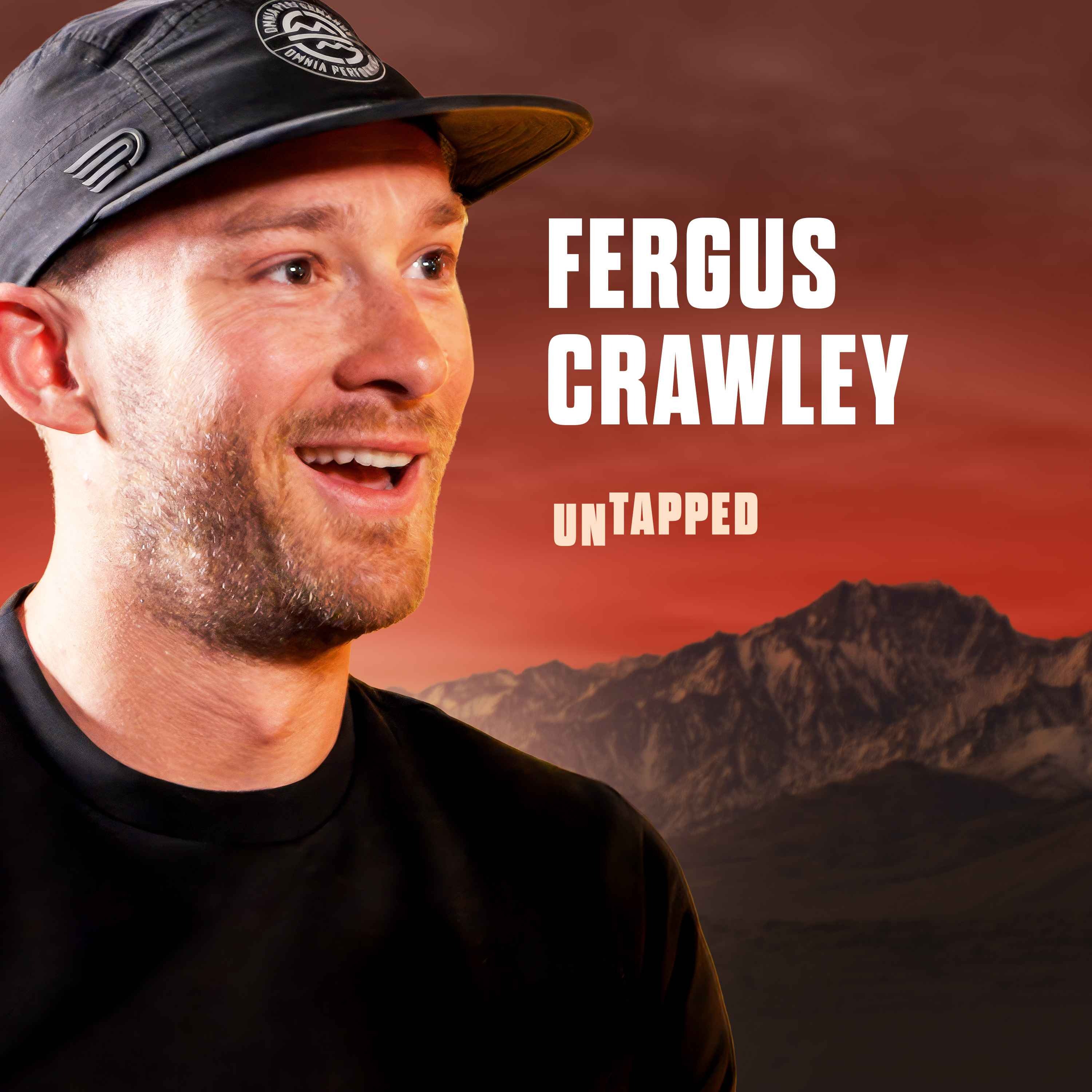
Hybrid training—how to progress in opposing disciplines (strength + endurance/speed) without “interference,” plus how to set goals, fuel, and schedule sessions.
Fergus Crawley, an Edinburgh-born British strength athlete turned endurance/challenge athlete. Background: competitive powerlifting after rugby (2013–2017), CrossFit Level 1 (2020), and endurance projects starting with a Movember charity squat-based effort (2018).
(1) Most common mistakes: under-eating when adding endurance, stacking two full programs without adjusting fatigue, adding sessions with no plan (too much total volume), and unrealistic “do everything at once” expectations. (2) Hybrid training works by “more with less” via clear parameters and prioritization. (3) Session order matters: ideal is lift AM + endurance PM with 6+ hours; otherwise endurance AM then strength PM; interference is linked to mTOR (strength) vs AMPK (endurance).
500-lb back squat + sub-5-minute mile in the same day (CrossFit “ideal”); his own “neat number” pairings (e.g., 505 squat with sub-5 mile; later 250/250-style challenges). He’s also preparing for 10 Ironman-distance triathlons in 10 cities (May 9, 2026 marks 10 years since his 2016 suicide attempt), using the project to highlight men’s mental wellbeing and suicide prevention.
Written by AI. May contain mistakes.
Discussion on the parameters for becoming a phenomenal hybrid athlete.
“Should someone be able to do that at all times?”
Exploration of the methodology behind combining strength and endurance training.
“one, Dave Castro said the ideal CrossFit athlete would be able to squat 500 pounds and run a five minute mile in the same day.”
Identifying four common mistakes people make when hybrid training.
“Ever hit a wall in the middle of the day and a third coffee just doesn't do it anymore?”
Learn how to set achievable goals as a hybrid athlete while managing multiple disciplines.
“And that cycle was repeated for a long time.”
Understand the interference effect that occurs when balancing strength and endurance training.
“additional time and that is the compromise.”
Discover strategies for structuring your workouts to maximize performance across disciplines.
“They believe that mTOR and AMPK were switches.”
Explore the importance of recovery and how to effectively incorporate it into training routines.
“Is like a light run an endurance session?”
Hear Fergus's personal story of overcoming mental health challenges and his upcoming athletic challenge.
“Loads of people can do certain things that other people can't or at least can't achieve quickly.”
Fergus Crawley shares his personal struggles with mental health and the guilt he felt despite a supportive background.
“reached out to me on Facebook Messenger at the time and just said, oh, it's really good that you're doing this, really appreciate it.”
Fergus reflects on the impact of sharing his suicide attempt story and his fundraising efforts for mental health.
Discussing the endurance challenges he undertook and the introspection that followed.
“where the focus has been a little bit more performance, content output, YouTube development, rather than that specific mental wellbeing narrative.”
Fergus recounts the details and feelings surrounding his suicide attempt, emphasizing the irrational mindset during that time.
“so a whole load of pills from local drug dealer in Newcastle at the time and alcohol that I kind of guessed a dose based on internet searching and the dose wasn't high enough.”
The importance of processing thoughts and the concern of fatigue affecting reflection during challenges.
“Because we want people to share their experiences and how suicides affected their lives, how men's mental well-being has affected them.”
Exploring how endurance sports can provide clarity and introspection, contrasting them with shorter races.
“And it's made me the person that I am now.”
Fergus and Spencer discuss the challenges of endurance training and the unique personal experiences it brings.
“Whereas in the marathon, it's grit your teeth and get your head down.”
Discussing the mindset of competing against oneself rather than others, and the personal satisfaction that comes from it.
“And even then, does she really care or is she just happy to see you having fun?”
Exploration of the journey and progression in marathon running, including setting and achieving personal goals.
“We have to just do things for ourselves, really.”
The challenges and strategies of balancing strength training with endurance running, including personal experiences and insights.
“It's kind of, you know, he ran his first proper marathon in 3.30, then, you know, 2.55, I think he said, then 2.51, then 2.40, then 2.29, And to him, it's just been this progression.”
A discussion on the pitfalls of being overly focused on metrics in training and the importance of enjoying the process.
“the funny thing for me is body weight relative to limb length as well because my squat's good because I've got short femurs, which means that my deadlift and my squat have always been quite similar.”
Conversations about the importance of standardizing training metrics in competitive settings and how to implement them.
“Chip time is the caveat for the marathon, isn't it?”

Get the gist, explore an idea or ask about something said.
 Claude
On UNTAPPED with Spencer Matthews, what are the key points of this episode?
Searching your listeningAutomatic transcript. May contain errors.
0:07Where are you from up north? Edinburgh. You're from Edinburgh? Yeah, hence the thick Scottish accent. Yes. Do you have a thick Scottish accent? That was sarcasm. Right. Yeah, yeah. So yeah, there we go. We've leveled out. I'm a British accent, you're an English accent. Yeah. I should have a Scottish accent or a Scouse accent, but here we are. But you don't. I don't, no. So I'm just one big disappointment. So let's continue that theme. No, you're very far from disappointing actually i've been looking forward to talking to you um because your name has been mentioned many times to us when discussing untapped athletes okay so i don't know how aware you are of this but a little while ago just for a bit of fun i kind of put out two parameters yep uh in order to to essentially be um you know a phenomenal hybrid athlete and i set the parameters just for fun at the time as a sub 250 marathon and 110 kilo for 10 bench and i put it out there and just said you know chat gpt thinks very few people can do this you know if you know anyone that can do this sing out and a lot of people were banging the fergus crawley drum okay okay can you do it not right now no because i'm currently training for something else but that's how training and fitness should operate, I believe.
1:23Should someone be able to do that at all times? Is that part of the parameters that you're working towards? No, no, just you would need to be able to do both things at the same time. So simple answer is I haven't been able to not bench 110 for 10 since 2015. So that's fine. That's covered. Can you bench 110 for 10? Sometimes. Not really. No, not at the moment. So I can do 135 for like one nice clean rep, maybe a scrappy second rep. And I can bench 100 for 10, easy. Okay. I could probably do 110 for eight, clean, easy, but sticks on like the last two, kind of depends. Like if I took my running volume down for one week and eight.
2:10Yeah. Like, you know, it's kind of, I'm there or thereabouts. Well, that's the beauty of the challenge. I mean, yeah, welcome to the party. You're six years late because I've been doing this for a long time. So 2020, 500-pound back squat and sub-five-minute mile in the same day for the exact same principles of far end of endurance, sorry, far end of strength balanced with far end of something opposing, which is essentially the premise of hybrid training in the first place. So Alex Viada wrote the book in 2014, if you've heard of it. The Hybrid Athlete, the book is called. Is it good? It's a very good book.
2:43So it's a methodology and it's sort of the whole reason that the phrase was coined as a methodology in the first place was to solve a very specific problem, which was how can you make progress in opposing athletic disciplines concurrently? So there's a lot of research and history on concurrent training, which is training for two disciplines at the same time for a specific outcome, i.e. strength and conditioning. So you're training strength in the gym to become a better rower. You are not in and of itself training strength to become a better powerlifter. you're doing it for a sport specific purpose whereas Alex tried to solve the problem with the methodology of I want to be a better rower and a better powerlifter and that's sort of where the idea came from so that always fascinated me when I was a powerlifter until I was sort of a competitive powerlifter after rugby from 2013 to 2017 and always liked the idea of trying to be strong and I'd always wanted to do a marathon growing up I don't know about you growing up I had friends whose dads had done marathons and I thought what this is mental so normalized now which is crazy to think on and I wonder what kids perceptions is on it now but I really liked the idea but I never had the confidence to give it a go and it was 2018 when I started training for a Movember charity project where I kind of accidentally started building my aerobic base keeping my strength training and then built it from there and then 2020 was in CrossFit level one, Dave Castro said the ideal CrossFit athlete would be able to squat 500 pounds and run a five minute mile in the same day.
4:14And me and a guy called Adam Klink over in Virginia inadvertently kind of got into this arms race by training for it at the same time. And he did it the weekend before I did, frustratingly. So he was the first person to do it. But the process of training for that opposing end of the spectrum strength outcome and opposing end of the spectrum speed outcome was what really sparked that enjoyment for me. And I've sort of followed that same model since. So I very much like and enjoy the concept that you've coined in the untapped game setting, because it is that, right, parameter here, parameter there.
4:49Go on your own journey to figure out how you achieve these things, because it plays massively to someone's strengths here, and it plays massively to someone's strengths there. How do you balance those two things together? So I've got a couple of questions for you on it. Okay. Which is, why did you choose those specific parameters?
5:08Selfish reasons, I suppose. I don't know. I was trying to find things that don't affect each other at all. So for me, like a fast mile and a back squat are both, in a way, leg exercises. They're very different, obviously. But when I train my legs, if I'm doing lots of back squatting like I used to do, my running would really suffer because my legs wouldn't be good to go as they are now, say. And also, at a very basic level, I was looking at it as we bench press when we go to the gym, right? Not everyone, but it's one of the main compounds. It's something that how much do you bench is a fairly regular question.
5:55It's like a normal blokey thing to do in the gym. It's lots of people's favorite exercise. And it really has no material impact on your running. Although it is very unusual to find somebody who's an incredibly, you know, good, fast runner who can also bench press a lot. It's something that there appears to be like very little crossover. It's kind of why I thought it was interesting. And also, as a kind of ratio to my size, I'm quite effective on the bench and I'm not a bad runner. So I like those two disciplines, basically. No, no, no, it makes sense.
6:49older and at average risk, it's time to scream for colon cancer. ColorWord Plus, make it simple. Es una prueba non-invasive, sin preparación, que puedes hacer en casa en unos 15 minutos. This is something you can do on your own time. Tu propio ritmo. Talk to your provider o pídelo en línea hoy mismo. Hablemos de lo que no se hable. Available by prescription only. Hey guys, it's Drew from the comment section. Some days my skin just needs a little coverage and other days I wanna go full glam. For those everyday moments like running errands or grabbing coffee, I've been loving the Merit Minimalist Stick because it's a foundation and concealer in one that gives me a really natural skin-like finish.
7:29But when I want more coverage, I'm reaching for the Hourglass Vanish Concealer every time. I know I'm not the only one who struggled to find the right foundation or concealer shade, which is why I always shop at Sephora. They have the best brands all in one place with so many shades, coverage options, and finishes, plus expert beauty advisors, free samples, and shade matching tools both online and in-store. So whether you're looking for barely there coverage or full glam, Sephora can help you find your match. Mod.com is changing the way people battle excessive fatigue. Ever hit a wall in the middle of the day and a third coffee just doesn't do it anymore?
8:07Here's what's actually happening. Coffee only briefly blocks adenosine, the chemical that tires you out. When it stops working, your system is flooded and you crash. Modafinil is a prescription treatment that works in a completely different way. Modafinil works by stimulating multiple receptors in the brain associated with wakefulness, including dopamine, serotonin, norepinephrine, histamine, glutamate, and orexin. It's a more complete solution that gives you 10 to 12 hours of steady focus and energy. To learn more, go to mod.com. fill out your intake form meet with a license provider and if approved mod alert ships straight to your door go to mod.com to get started that's mod.com there's a there's a few there's a few things that have been interesting to me since i've seen the concept because one i assumed it would have been kind of personal goals that you've then said okay who else is coming to the party on this one um but the exact concept of those specific sort of balance numbers is is a fun game i've always liked to play with the so it's 505 was the 500 pound back squat sub five minute mile one year later i did a 1200 pound power lifting total the same day as a sub 12 iron man so 1212 six months later 600 kilo power lifting total same day as a sub six hour 60 kilometer ultramarathon 660 and then I think I deadlifted 250 kilos the same day as a 250 kilometer single stage ultra so I've always liked that like that that neat number pairing so I very much got the concept of 250 so I'd like to 250 kilo deadlift just for one rep yeah that was on the Monday that was the same week that's pretty good going Jesus 250 kilos background and powerlifting which I think is important for this conversation because I think where somebody would perform best in the untapped game setting is where they don't need to dedicate much work if any to the bench press because that doesn't chew up adaptive energy it doesn't chew up training allocation it allows you to just focus on the adaption required for the marathon but then again that comes with muscle mass which comes with body weight which comes with the challenge which is why I love this concept and why I love this style of training.
10:28I'm looking forward to talking to you about the style of training. What do you think most people get wrong when they're trying to remain strong with high muscle mass, but also have endurance and be fast? So I think there's four key things, four mistakes people most often make. Number one is inadvertently under-eating, whereby you're probably similar to myself, we come from a recreational gym bro background where you had quite a good understanding of calorie intake, macronutrients, you knew what your maintenance was. I think bodybuilding, powerlifting has always been quite ahead of the curve in terms of understanding thermodynamics, those inputs, whereas endurance training is actually coming around to that a little bit more now.
11:10And what people often do is when they start adding in some endurance training on top of their strength training, they don't account for that gap in energy balance. So let's say someone's maintenance calories when they're lifting five days a week is 3 ,000, they then add in a run on a Tuesday and a Thursday and that's another 500 calories a day of additional expenditure that's another 1000 calories across the week that you need to add in to the sort of P &L otherwise you're going to be 1000 calories down at the end of the week Do you calorie count over the course of the week? No, just more to illustrate the sort of compounding effect of that if you don't account for those on a daily basis or you add up your weekly total and divide it by 7 so it would be 500 additional divided by 7 that would be too quick maths for me right now, but essentially people can inadvertently put themselves in a deficit when they're training hard, high intensity and start to feel fatigue set in, which makes them think, oh, I can't balance strength and endurance training.
12:06This is too hard. Whereas in fact, they're actually just under fueling or not fueling for the adaptation that they're looking for. So making sure that you're balancing the books is sort of the first thing to consider. Second thing to consider is arbitrarily taking 100 % of a strength training program and 100 % of an endurance training program and just putting them on top of each other. So example, Wendler's 5-3-1 and one of Daniel's marathon programs. Those were both very intelligently designed without accounting for the fatigue from either or. So as soon as they're spliced together, the programming principles that underpin both programs kind of become irrelevant because it's not in the context that it was designed for.
12:49So programming then has to be adjusted for the individual based on strength and weaknesses and accounting for that third thing is kind of just going am pm lift endurance lift run something like that without any clear intention so it makes sense because all you're doing is you've got a clear daily routine if i'm going to lift in the morning i'm going to run in the evening or vice versa and that means that your systemic fatigue is going to be increasing like this at a rate that you wouldn't achieve were you just training for a single discipline. Because if you add in five more sessions a week, that's a huge percentage increase in terms of the overall demand and volume required.
13:27So if you were building long runs per week, you'd typically not add any more than 10 % per week. If you want to get into hybrid training tomorrow from a strength background and you add in three runs Monday, Wednesday, Friday, five lifts Monday through Friday, that's suddenly whatever three more sessions above that is. It's a big, big spike. So what you're trying to do is make sustainable progress so that you can keep training and making progress before you hit a wall and go, oh, I can't do this. This isn't working. These two things conflict because that's what I think a lot of people did for a while was start doing cardio.
13:58Oh, cardio kills my gains. It's not possible. And that cycle was repeated for a long time. And the fourth thing I think is having realistic expectations. And that's becoming more and more the case now where people want to do everything all at once. And I think we probably contributes to that in a way but I think the the beauty of training this way I'm very enjoyment driven I'm not competitive really at all haven't been for a long time I kind of do this because I really like asking the question of can I do this and figuring it out and have I improved as a person along the way going on adventures different places all that sort of stuff but we have conversations with people that come to us and they ask oh I want to do this I want to do BJJ I want to do this I want to do that, I want to run a sub three, I want to bench 315.
14:43Okay, hang on, all of these things can be achieved over a long period of time. But you can't dedicate yourself, 100 % of yourself to three, four, five, six different disciplines all at once, you need to be prioritizing what you can actually achieve practically, but within a clear set of parameters. So I think it's really important to have clearly defined goals as a hybrid athlete. Otherwise, you can end up spending a lot of time just doing more when actually the secret source with a lot of the programming is utilizing more with less. Because if you've got 100 % to give, you've got to turn down certain dials, turn up certain dials to be able to actually make progress in opposing disciplines.
15:23That's the key they're opposing. They're not working concurrently. And that takes practice, it takes trial and error, it takes support, it takes lessons, it takes a few failures, and that's the key. And I think that's where most people go wrong. You give great advice. if somebody was looking to begin their journey as an athlete but they want both things exactly what you do best you keep your strength up and you build your endurance what would you advise they do? how should they plan their first week of training as a hybrid enthusiast? hybrid enthusiast better than hybrid rockstar is a statement that isn't it so number one set clear goals make them realistic Make them ambitious, but make them realistic.
16:07So if you've never ran a mile before, don't set 100 miles as a goal. Might be a 25-minute 5K. Clear, measurable goal. Not to go back to GCSEP, but smart goals, measurable, key component of them. Set a clearly defined strength or physique or body composition goal that is measurable as well. That is the key detail. So that you can then work backwards from where you currently are on those things to determine how you get there. so if you're training for a sub 25 minute 5k and you know that you're currently at 27 30 then you can either you can plan how to get there from a to b or you can have somebody help you do that from a strength training point of view same again if you're currently able to bench 100 kilos and you want to get 120 kilos give yourself a realistic timeline but what what would ordinarily happen is let's say you want to get from 100 to 120 in 12 weeks if the only thing you were doing is bench pressing.
17:05If you're also trying to improve your 5k simultaneously you need to allow for additional time and that is the compromise. You cannot just do more and expect more results because the human body can only adapt at a certain rate and I think that's where a lot of people are getting a bit carried away with the term these days where they think it's about doing everything all the time where it's actually doing the right amount of the right stuff at the right time. in your opinion just quickly is it better to lift and then run or run and then lift if you're going to stack sessions so i've got i've got a hierarchy for this which is i the hierarchy of idealness i've coined it's work entitled but essentially ideal world if you're lifting and running in the same day lift am endurance training pm with six hours or more between them next best option is endurance training am strength training pm with six hours or more between them next best option is strength training followed by endurance training.
17:55Next best option, if you have to do it for time constraints and to make it work but try not to make a habit out of it, is endurance training into strength training. Because what you're trying to manage there is, hybrid training is about managing the potential for interference. So the interference effect is essentially what we are trying to work against here. And breaking it down, if I've got time, essentially a key context on it. So there was a guy called Robert Hickson, who in the 1980 was trying to become a research professor at his university. And Professor Halosi was his research manager. Hickson was a powerlifter.
18:33Halosi was a runner. So by trying to cozy up to Halosi, he went on a couple of runs around the campus with him to, you know, schmooze. After six or seven weeks, he realized that his strength outputs in the gym were starting to dip a little bit. So he submitted a research paper on, I would like to explore this. so he had three groups strength only endurance only and both and he had them doing it was it was quite high intensity work so strength only was two sessions a week of heavy sets of five squats and then three sessions a week of heavy sets of five leg press with sets of 20 assistants on both days so six days a week of lifting the endurance only group was three days of hard effort running three days of hard effort cycling and the the both group was both of those things together What they saw was that all three groups were making progress up the way until week seven, where the strength output in the both groups started to drop.
19:23And in the research, that's where interference occurred, and that's where the interference effect was coined. So the mechanism at play there is mTOR is the energy pathway that allows for strength adaptation, AMPK is the energy pathway that allows for endurance adaptation. Up until recently, so 2000s, they looked at this in more detail. There's been a meta-analysis since. They believe that mTOR and AMPK were switches. So if mTOR was activated, AMPK could not be activated and vice versa. So therefore, the interference effect means that you cannot progress in strength and endurance concurrently. If you look back to the original study, six hard effort lower body sessions a week, six hard effort runs a week combined together is just terrible programming.
20:09So it created this concept of the interference effect, which effectively is cardio kills gains. But generally speaking, it's considered to be a poor focus group to get there. So then more recently, it's been discovered through more research that they're not on and off switches and that they're rather blunted. To what degree? It can't be measured in a percentage. but when you are lifting and mTOR is activated, then the response that you can get from an endurance adaptation is going to be reduced for a limited period of time because that is activated. So that's where trying to, where possible, separate these disciplines is the best way to adapt towards specific goals.
20:51So the best one is to lift in the morning and run in the evening? In general terms, but only if you need to be doing two sessions a day in the first place. And that's where working backwards from specific goals is key because most people don't need to be doing two sessions a day to be able to make the progress towards the goals that they've got. And what would you classify as an endurance session? Is like a light run an endurance session? Not really. So there's not much room. In terms of fatigue, not really, no. So that won't have much of an impact. But any quality output or high demand session, that's where if you're wanting to do hard effort squats and then hard effort turbo trainer intervals, then generally we actually program them in the same day to consolidate stresses into the same day so you've got one spike of high intensity work within the context of a week in your lower body which means that you're not then trying to recover from day one but then layering in endurance training day two to then think that you're recovered for more heavy lower body stuff day three because if you took traditional programming methodology where you go easy hard easy hard that doesn't work when you've got another discipline in there.
22:00So if somebody gets to the point where they need to do two training sessions a day, ideally lift first, endurance training second, but you're not going to undermine your performance too much in the long run if you do whatever's most practical for you is generally the advice. I would kind of ordinarily, if I'm lifting heavy, I'd only really do low heart rate, standard running. I wouldn't push myself really hard at the track. and lift really heavy same day, only because it throws such an imbalance into your calorific intake. You find yourself really hungry at 10 p.m. in bed and wanting snacks and chocolates and sugar because you just feel like you're completely off.
22:41I feel like I can feel quite exhausted. It's a big spot, yeah. I think the key there, though, is as somebody gets to a point where they're trying to really push the two opposing disciplines hard, almost to an elite within this context level, that's where you can actually start leveraging that fatigue and do your heavy lifting and your hard effort running in the same day so that you can become more competent. There's no one size fits all for people, which I think is the key, but the overarching principle is whatever is most practical for you is the best way to work towards those goals. Do you have a recovery habit that our listeners could take away that they could incorporate into their training immediately that might help?
23:20Don't do too much training in the first place is generally my recommendation. I think, and I'll quantify that rather than just sounding flippant, I think a lot of people have shiny object syndrome at the moment with their training where they want to accelerate their road to their first half marathon or the first 70.3 or whatever it might be. And the reason these events are intimidating and attractive is because of the delayed gratification mechanism. And doing more will not get you there faster necessarily unless you're a genetic phenom that can just take volume after volume. So respecting the distance and respecting the work required to get there and knowing that you cannot recovery, compression boot, or massage gun your way out of doing too much training in the first place, I think is the key.
24:03Focus on sleep, focus on nutrition, and try and make sure that your training in and of itself is not the thing that's forcing you to require additional recovery. I think it's important as well to understand that each person is different. Loads of people can do certain things that other people can't or at least can't achieve quickly. it's funny as well that you know all conversations here talking about performance come back always to kind of calorie intake and sleep and recovery do you suppose that being an excellent hybrid athlete becomes more complicated if you're also living a full life so have kids and have a full-time job you know outside of sport you know i suppose there's layering uh training on top of each other.
24:50Like, I suppose that's kind of fine. You've got a massive challenge coming up, which we're about to talk to you about. But you know, when I'm preparing for P7 or, you know, 30 marathons in 30 days, obviously the training load becomes slightly different. Like I wasn't doing much lifting in the lead up to 30 and 30 because I have absolutely no requirement for that additional muscle mass in the desert. I think, I don't know, I get a vibe from you that we're quite similar in the sense that we'll push ourselves and enjoy ourselves in the process and learn how to kind have achieved certain things almost on the job.
25:20I mean, you've clearly done a lot of Ironman, you've done a lot of interesting sporting activities. Why don't you tell us a bit about the challenge that you have coming up? So in eight days time, I'm about to attempt 10 Ironman distance triathlons in 10 days in 10 cities to highlight a specific date, which is May the 9th, 2026, which is exactly 10 years on from when I attempted suicide in May 2016. So it's a very full circle moment for me in many ways because I started posting on social media in August of 2018 as a way of fundraising for my first Movember event. And that was as a result of me just one day opening my laptop in a coffee shop whilst I was working down here in London.
26:03And I just got hit with this white noise that I recognized from previous experiences when I was feeling worse as a lack of fulfillment and sort of spiraling a bit towards depression. What was your life like then? So what were you doing and why do you think now that you felt that way? So there's actually quite a simple answer for it, which is I did Heineken's grad scheme in London and it was six, seven, eight months of nothing really changing where I was kind of going out to do a job that had no purpose day to day. And I've always been very purpose and fulfillment driven. and I tried to sort of just enjoy the process of trying to learn what I could but at the end of the day I was a driven young man without anything to sort of channel into other than my training I was still focused on powerlifting and a little bit of bodybuilding but very much strength output focused and yeah one day I just I just I just opened my laptop and thought this is not ticking the boxes for you at all and I was young so there was a part of me that thought you know what it's quite cool that maybe you don't have too much pressure from your job and you can explore London and all these things.
27:10But whatever it was that day, I said, you're not fulfilled. You've been here before. It nearly ended badly. This was 2018. And I decided, okay, I'm going to try and do something for charity. Movember, done some stuff for them with rugby in the past. What am I good at? I'm good at squatting. And then I committed to a squatting-based sort of challenge at that time and spoke to Movember on the phone, said, this is what I want to do. put it out to my personal Facebook at the time, just said, this is what I'm raising money for men's mental wellbeing and suicide prevention. That's what I said. I said, I'm doing this for that.
27:45And what really, really changed my perspective, and this is at the core of why I was in such a bad place in the first place, was that friends from primary school, my dad's friends, people I'd lost connection with from school, uni, playing rugby growing up, whatever it might have been, reached out to me on Facebook Messenger at the time and just said, oh, it's really good that you're doing this, really appreciate it. It's had an impact on my life or whatever it was. And there were enough people in there that gave me confidence that the reason I'd suppressed the fact that I was suffering with my mental health as a young man and that I'd attempted suicide in 2016, not something I'd shared with anyone at that point, it gave me the confidence to realize, oh, hang on, you are not the only person in the world that feels this way.
28:28There was a big part of guilt as well because I've had a great upbringing, parents still together, brother, friends, family that I got on with. there was a big, big element of guilt where I felt pathetic for having had that great upbringing and all of these wonderful things, roof over my head. People have got it much worse than me, but you feel this way.
28:49Early detection can change everything, but early-stage colon cancer often shows no symptoms at all. That's why screening matters and getting symptoms. If you are 45 or older and at average risk, it's time to screen for colon cancer. Colour World Plus makes it simple. It's a non-invasive test that you can do at home in about 15 minutes. This is something you can do on your own time, your own rhythm. Talk to your provider or ask it online today. Talk about what is not said. Available by prescription only. Losing weight can feel like a roller coaster, full of ups, downs, and being thrown for loops, like when someone brings donuts into the office, or your kids' dino nuggets start giving you that look again.
29:33That's why there's Noom. They combine GLP-1s to quiet the food noise with healthy habits that help you keep it quiet, even if you get off the meds. Their program is designed to make weight loss a smooth ride, helping you understand what drives you, so you can build better habits to not just lose weight, but keep it off. Noom. Lose for keeps. Get started at Noom.com. Not all customers will clinically qualify for medications. Individual results may vary. Who says Halloween only lasts one day? With Wayfair, one night of Halloween becomes a whole season at home. From larger-than-life yard decor and moody lighting to festive accents for every room in the house, Wayfair has what you need to make Halloween feel like magic all in one place.
30:16Because the best Halloween memories aren't made in just one night. They're made all season long. Shop Halloween decor now at Wayfair.com. Wayfair, every style, every home.
30:31and just having those messages from people when i first announced on social media gave me the confidence to actually share i am the survivor of a suicide attempt with the world and that's where 2018 2019 2020 three big endurance challenges for november raised over 100 000 pounds still working full-time until 2021 when i sort of the social media had grown as a result and we built from there. But that's how I got into this world. So it's quite nice to full circle eight years later, go back to a big charity, men's mental wellbeing and suicide prevention focused project that's built on all of the previous six, seven years of experience that have come along the way, where the focus has been a little bit more performance, content output, YouTube development, rather than that specific mental wellbeing narrative.
31:18It's always been a part of it. but what I'm really excited about with this project is every pool in each city is private other than in Liverpool we're in open water we've got private cycle circuits and we've got private athletics tracks so anyone and everyone can come along for one length one lap, whatever suits them at whatever pace and show up for the cause effectively because it's a big day 10 years, it's kind of surreal and I think what's funny is I think back now with a rational mind to then with an irrational mind and it's yeah I've been doing a lot of thought in the training been ruminating on it a lot over the past three months because I mean you'll know big endurance projects like this require a lot of time just doing the work in your own head and it's been a very positive experience for me personally but it has been challenging sort of trying to unpack how I want to have an impact on this and in simple terms I want this project to be something that if a 20-year-old version of me had seen, I would have engaged in and it would have had a positive impact.
32:22So that's how I'm trying to model the messaging, the narrative, and the presentation of it. Because when I was younger, for whatever reason, I'd never had my dad tell me this is what a man is or anything like that, but I had a very binary definition of success and what it meant to be a man, and feeling like I was failing those definitions nearly killed me. How did you try to take your life? so a whole load of pills from local drug dealer in Newcastle at the time and alcohol that I kind of guessed a dose based on internet searching and the dose wasn't high enough. So what's grim about that reality is when I came around, I was disconnected from body but connected with mind.
33:10I could think but I couldn't really move. and I was in a puddle of my own vomit and the first thought I had was that I was an idiot because I'd failed. Like the one initiative I'd taken to not feel this way hadn't worked, you idiot. That was how I felt at the time. And this is the stuff that scares me so much now because I didn't write a note or anything. I didn't think about the consequences really is I was slumped up against my bed and there were footsteps outside of the door afterwards and I was kind of there sort of limp. I wasn't completely incapacitated, but I wasn't moving well physically.
33:45I was kind of in and out a little bit. And the thoughts that I do remember then were, they were all self-destructive. It wasn't, you've made a mistake. It was, you've done this wrong. And it took a couple of days after that for me to start to see reality. And it actually took, so I was fortunate enough to be a part of a documentary with Roman Kemp in 2021 called Our Silent Emergency. and he was exploring why his friend Joe had died by suicide. And I was the segment in that documentary as the survivor. So he spoke to me about that and he wanted to, from my perspective, understand how I framed leaving people behind effectively.
34:26And when he asked me that question, I realized that I actually hadn't given it much thought. I knew that I hadn't written a note. I knew that that had felt like a disservice to my family. but what I'd done in an irrational state of mind is framed my suicide attempt as a way to achieve peace or just a bit of a break from this sort of chaos that I was experiencing in my own head. I managed to almost reframe it as not dying, which is scary because I knew what the outcome was deep down, but somehow I rationalized it as something else. And very, very pleased that obviously I was unsuccessful but the thing that does bother me still I'm very comfortable talking about it but the thing that does bother me is knowing that I was so insular and ashamed of how I felt about it as a young man this is what you should be doing this is how you should be presenting yourself whatever it is that I gave no consideration to what was being left behind and every moments like this what I'm about to take on everything I've achieved since wife dogs amazing experiences almost never would have happened if it hadn't been for surviving but one decision none of that stuff would have happened and I think that's where there's almost reflection embedded into every positive experience I have now because almost 10 years ago there was a decision that almost meant none of those experiences would have happened so Chris and I were talking the other day and his big concern for the project is actually when I'm in the depths of fatigue with this, is how am I going to process these thoughts?
36:01And that's my big concern as well. Because we want people to share their experiences and how suicides affected their lives, how men's mental well-being has affected them. And the more and more fatigued I get, the more and more I might reflect on it. And someone's personal story or family story or something, it might make me think about something that I perhaps haven't confronted. Because there's a blurry period. it was it was it was a pretty it was a pretty lonely negative period of my life but one that I made much worse for myself and that's a key part of the messaging is I didn't reach out to the support that was available for me I hid how I was feeling I lied about how I was doing and that was all because I didn't want to let down other people or be a burden or all of these if framed incorrectly traditionally masculine cliches I'd say but you are a different person now.
36:51Yeah. But it is a part of me. And it's made me the person that I am now. But I think that's probably a good thing, though. I agree. Yeah, I do. I think that when you're in the depths of fatigue and exhaustion on your challenge, this will serve as fuel and a positive reminder of who you've become. I think. I hope so. I do logically think it will. And that is the fuel. That's why I'm so excited about this and why actually it's the most connected to a training prep I've felt in a long time. Because even just selfishly, it's a forced reflective moment for me to look back on the past 10 years. And a lot's happened in the past 10 years.
37:34A lot of good, a lot of bad. So what's the next 10 years going to look like? And a lot of that journey has happened in training because of the time allocated to thinking and processing. but the way I always frame ultras and the reason I love endurance from a mental well-being development and character development point of view is because at some point along the way when you're dealing with that fatigue and you're working towards the end goal you are going to meet yourself and you're going to have to shake your hand you're going to have to ask yourself some questions and you're going to have to process who the person is that takes the next step and I think that's where my take on things is that ultra endurance is growing and growing because it's very black and white the world is very gray and what I think ultras give you or even triathlons give you or longer events give you that things like marathons or 5k's 10k's don't is that sort of forced introspection along the way where you hit a wall and you go all right okay this is miserable.
38:37How do I overcome this? Who am I? What can I achieve? Whereas in the marathon, it's grit your teeth and get your head down. But also you, you, I mean, you know this just as well as I do. You're, when you're in it, you're in it, right? Like the, the desire to give up is dwarfed almost immediately by the fact that you can't really, you know, it's kind of, you know, the times that I've really felt like giving up don't, don't actually feel like a reality. It's just hard. And you're expecting it to be hard. You want it to be hard, this whole point of it. It's kind of, you know, pulling the plug on it isn't going to happen.
39:14So you'll be fine. And I know you're not asking for my advice, but you'll be fine. I'm confident in it. And it's funny, I'm only shitting myself now, it's close. I wasn't worried until it was like, oh, it's 10 days away. Right, okay, this is happening now. So the travel between is the hardest bit. I mean, multiple Ironmans, multiple days is tough. Adding in travel in an RV and bad sleep and everything, stacking time after time after time is going to be tougher. But I asked for this. It was my idea. So I can't complain. It also feels like an extraordinary life experience. I think, you know, it's, it's, I mean, it would have been unique and I suppose our experiences are, are unique to us, but you will live forever after your challenge with the memory, the fond memory, most likely, of that time that you did that thing, you know, and it's something that only you will have, really, because it's kind of personal.
40:11We also did ours for James's Place, Suicide Prevention, and, you know, your story resonates with me quite a lot, because although I have no personal experience of suicide or an attempt on my own life, you know, the stats around suicide for men in particular, as you know, are alarmingly high in this country. I think, ironically, what I often think about is when I was struggling most at university, because I had powerlifting as such a big focus point, it allowed me to suffer for much longer. So the kind of the point of desperation that I hit, I got to slower because I had that anchor. So whilst it was good, it also allowed me to be miserable for longer.
40:49But it's just a throwaway point that training has always been a big anchor for me. And I think, like I said, that's because it's black and white. what is on the barbell today, does it move? Yes or no, that's a win. Whatever else has happened today, that's a gray area of life. And I think more and more people are yearning for a bit of black and white in their life so that they can measure a win. I have had a successful day because it can be quite chaotic. There's a lot of inputs these days. And I think that's why so many people are turning to recreational activity as a way of measuring themselves against themselves, which I think is great.
41:54Cologuard.com The Cologard is designed to detect the colorectal cancer in adults of 45 years or more with a average risk. Visit Cologard.com to get more information. Only with a medical recital. The Cologard is a love act for you and for your family.
42:27to restore the balance. That's where Liquid IV comes in. Its science-backed formula is clinically proven to hydrate faster than water alone. Whether you're exercising, playing outside, or simply surviving a summer heat wave, it's an easy way to stay hydrated. Shop now at liquidiv.com. Liquid IV, hydration that goes wherever life takes you. I'm Hannah. I've lost 75 pounds in 20 months with GLP-1s, plus diet and exercise. On Roe, I've gone from struggling to run a mile to running farther every day. You can access FDA-approved GLP-1s online. Get the support you need to reach your weight loss goals.
43:03Go to row.co.weight to see if you qualify. I'm a paid row partner. 20 % average weight loss in one year in non-diabetics with obesity or overweight with a weight-related medical condition versus 3.1 % in placebo arm. Rx only. To stay informed about serious side effects, go to row.co.safety.
43:21competing with yourself is almost always better than competing with others agreed especially as rubbish pros yeah i take the rubbish pro all day long mate i i like when he said that i was like i think i'm a shit amateur like you know like an amazing amateur or a rubbish pro i was like both of those sound good to me yeah i think uh my way of looking at things is if you're not winning or you're not a pro, no one cares other than maybe your mum. And even then, does she really care or is she just happy to see you having fun? Mate, it's unbelievable. I just had Hugo Fry in here and he runs a 217 marathon.
43:58Yeah, he's quick. When I ran 257 in Tokyo, I kind of felt like, oh my God, I've cracked sub three. All of this kind of might feel a bit different. No one really cares. And I don't even really care. Like literally, like a few days later, I was kind of like, okay, well, that's happened. You know, and even on a larger scale, you know, the 30 marathons changed my life. Yep. For sure. That was the beginning of a whole new life. Not in terms of like opportunity or how people perceive you. Just that was a real landmark, like flag in the sand moment of, okay, wow. Like I can dream big and go after big things and achieve it.
44:40Right. That was kind of the first time that happened. And I think you've obviously got examples of that as well, where you do do things that kind of feel like, you know, were our lives to be a business chart, you know, or we were forecasting our lives, you know, there'd be moments that you'd put in the spreadsheet, you know, these big things. We have to just do things for ourselves, really. You know, it's for us and our development and our mind. like the more you start to think it's you know obviously we're raising money for good causes and stuff but the more you start to think it's going to affect other people like it probably hopefully it'll inspire some people to go and do something or try something but like it's mostly us yeah and i think that's good i think it's easy to yeah i there's a couple of things i think one is when you ran your 257 in Tokyo I bet you can remember when doing that and that pace was as inconceivable then as 310s is to you now oh yeah yeah and that's what's amazing and I think that's what's great is if you're a wanted to do your first marathon and you're seeing 215 at London that's quite a big gap to bridge yeah but seeing the person that's going for 329 might be the thing that gets you to sub four and then there's tranches to this that's what that's one of the things I love the absolute most about the mind, the body, sport, other people, using people as inspiration.
46:08And it's like through consistency and pushing yourself and training and you gradually just get better. And Hugo and I spoke about that as well. It's kind of, you know, he ran his first proper marathon in 3.30, then, you know, 2.55, I think he said, then 2.51, then 2.40, then 2.29, And to him, it's just been this progression. He only just got a coach in January this year. He's just been doing it himself the whole time. It's unbelievable. But I think the key detail is, at one point, there was something that made him commit to taking one step forward that has now spiraled into potentially a 215 marathon.
46:50Are you a good runner? Reasonable for my body weight. Caveat. Caveat for my body weight. Which is? About 90. I hover around 92 to 95. Currently? About 92, yeah. Really? 92 and a half, yeah. I got down to 91 and then started eating for performance again and just got back to 92 and a half. That's where I sit most comfortably. Whenever I haven't had a break in events where I've committed to losing sort of five, six kilos for endurance-specific purposes because my final strength achievement I achieved in October last year, so I wanted to hold on the strength abilities to do that before transitioning into this endurance campaign, so to speak.
47:31But I've always been very top-end strength-focused, and because I built it, I fight very hard to keep it. Because, yeah, that's my main focus. And your marathon time? 3.09, but I, on paper, was good for 2.52 in May last year, but stress fracture three weeks out, which is frustrating. So last session was, brief was 20 to 25K at under 160 heart rate. So 5K warm-up, 20 to 25K, depending on how I'm feeling it, under 160 heart rate. I did 25K at 158 heart rate at 405 per K pace. Felt unbelievable. That's my Tokyo, basically. So I felt really, really good. Amazing. Could have done it that day. Genuinely felt phenomenal.
48:19Woke up the next day, couldn't lift my left leg. And that was my last session of peak week. So we just over-spilled it. but I was doing a lot of work in that prep on, the funny thing for me is body weight relative to limb length as well because my squat's good because I've got short femurs, which means that my deadlift and my squat have always been quite similar. So my best squat in sleeves is 240, my best squat in wraps is 260, which is a lot of weight, but my deadlift has always been roughly about 5 % higher. That's short femurs, but that means that my stride length is shorter, which means that the cumulative load over a marathon distance is higher, and that was something I was really trying to focus on with this last prep.
48:58But I was in good place to, the aim was to do a sub-three marathon and a three-plate bench in the same day. So 140 for one, and... Yeah, yeah. So I benched 150 on the Monday after this. So I did show up to the marathon, because we thought it was a tendinopathy, but it was a stress fracture that was lingering in the background, so it made it a lot worse in the marathon. so went out in 124 no 126 and then started hobbling from then the whole way home to I think 329 I think I came in at but because it was actually more convenient for me to walk it in than it was to come off the course and DNF and get home because it was an awkward part of Edinburgh so with hindsight I shouldn't have got to the start line but that's where I got a little bit lost in the source of the metric of the marathon and the weather was so tough on that day anyway that I think even if I was in 252 shape, I probably would have struggled to go sub three.
49:53So the mistake I made there personally is I began my training process trying to go sub three, but along the way somewhere, that switched into I want to go as fast as I possibly can. That happens. Yeah. But again, I don't make decisions like that or I don't get lost in that source. It's so funny. Unless it's metric driven. Literally with Tokyo, we were all kind of like, we've all had these big heads and gone for 255. Like in London last year, I went for 255, not three, right? And as a result of that, I blew up and like with 9K to go, it was really slow and missed the sub three even. So in Turkey, I was like, I'm just going to run a 259.
50:33Or just like, I'm just going to be on the nice side of three. Then all of a sudden, you feel great. It's like, let's go for 250. And then all the stuff starts happening in training. I think it's fair to say you and I both have all in mentality, Spencer. and could probably do ourselves some damage with those mentalities. So I think that's where, for me, marathons bring out the worst in me with that, which is why I found so much value from not being as metric-focused other than unless it's exciting to me personally. So obviously all of those sort of hybrid in the same day things I've listed are very metric-driven.
51:07I've just noticed your three-plate sub-three. Yeah, yeah, yeah. So that was the whole thing. How would you do, so 110 for 10, sub 250, make it rhyme well my this is why I was going to ask it's not a rhyme it's just a neat pairing of numbers make it a neat pairing of numbers yeah so probably sub 250 and I mean my argument would be a 250 kilo deadlift because it's much more opposed hybrid training is about balancing opposing disciplines and therefore training for bench and a marathon concurrently yeah you're basically just a bro that doesn't train legs yeah That's all you've done there. That's about to me.
51:49Yeah, yeah, yeah. Chip time is the caveat for the marathon, isn't it? Yeah. I would therefore argue that the bench press should be to powerlifting standards, calibrated plates, proper standardized powerlifting bench, start command, pause command, press command, et cetera. Does that mean that somebody tells you when to press each rep? It does, yeah. So do you hold it on your chest? So essentially you're on rack, and then it'll be start from the head judge, and then once the bar is static on your chest, they will say press, then you press, then you wait, and then they'll say rack. And that's one rep.
52:27So that's where doing... But you'd have to do that 10 times. You'd have to do that 10 times, but pausing it... Not racking it between each one. Not racking it between each one, no. But I think if you're going to have governing standards in the running as a former average power left, having those standards would be something I'd like to say. I have a question for you. Yes. if both your feet are on the ground and your back is flat to the bench can your arse be off the bench? no, arse has to be in contact with the bench at all times that was the other key detail because I've seen a few submissions to the 110 for 10 I'm assuming by the lick on Spencer's face your arse is touching the roof no mate it's not mine's not that bad my arse might come off the bench for like the last couple of reps which obviously wouldn't be allowed but I do the majority of my benching with my ass on the bench so my argument to simplify this and again would be one rep where you've got that controlled element of maximal output in a powerlifting setting so it is just a who owns the bench press powerlifting who owns the marathon running chip time one arm bench I like it controlled setting calibrated plates so that you know that someone in the gym at Pure Gym down the road isn't I mean, I have a squat record at a gym at Edinburgh that's 240.
53:45I know for a fact the 20 kilo plates I was using weighed 18.7 kilos each. So it was a very speedy 240. But with that information, I could gamify the untapped games if I wanted to. So I think calibrated plates, comp spec, judge commands, 1RM, and then that way it's standardized. 1RM means what? 1 rep max. So you want it to be higher, but just 1 rep max? That would be a way to standardize it in the channel that owns the bench press. Because I think my logic would be... So what would 110 for 10 be? Is that 140? You can become more conditioned to reps, but yeah, if you put it into a calculator, it'd probably be about 140, 142.5.
54:24Doesn't work as neatly with numbers, but I mean, what's 250 pounds? 250 pounds is about 120 kilos. That's not enough. That's not enough. But yeah, I think... You'd want it at 140 or 145. Three plates, but then again, it's US three plates is 143, UK three plates is 140. So it was just something I wanted to flag as a standardizing process because I love the concept. I love that it's going to bring out competitors to people in a really tough to balance setting. But plates can weigh different, bench heights can be different, arses shouldn't be coming up, feet contact points should be steady. and I think having that standardisation is a good way to respect the competitors would be my approach.
55:12I like it very much, Fergus. We need to do an arse check while I'm submitting to it. I think we must arse check everyone. We can't be having people with their arse in the air. If you're looking for volunteers, yes. We can't be having everyone with their arse in the air. So yeah, we must check.
55:35Thank you.
Fergus Crawley is a true hybrid athlete with a 500 pound squat, a 250 kilogram deadlift, a marathon under three hours ten and an Ironman under twelve hours.
In this episode, he breaks down the four biggest mistakes in hybrid training so you can avoid learning the hard way. He shares the core principle of balancing your total capacity, explaining how to organise strength and endurance in the same week, manage real-world double sessions, and why the belief that cardio destroys muscle is based on bad science.
Fergus also takes recovery back to basics with a focus on sleep, food and sensible planning instead of quick fix gadgets. He opens up on how training became a mental anchor in a noisy world and why clear, measurable physical progress is so powerful for mental health.
Fergus has now completed ten Ironman triathlons in ten United Kingdom cities across ten days, marking a decade since his suicide attempt and continuing his mission to raise money and awareness for mens mental health.
Project TENacity Donation Link 👉 https://givestar.io/gs/project-tenacity
Fergus' Training Plans 👉 https://www.omnia-performance.com/
Better Help 👉 Join Spencer in Saying It Louder with 10% off Betterhelp Therapy. Click here: https://highpfrmc.com/ut-betterhelp-yt
Postcode Lottery 👉 Discover how Postcode Lottery players are Powering Hope Together. Click here to find out more: https://highpfrmc.com/ut-postcode-yt
AG1 👉Head to http://drinkag1.com/untapped to save £20 on your first month, plus a free welcome kit, Vitamin D3 + K2 and five travel packs
Robinhood 👉 Head to robinhood.com/untapped to get started and claim your free stock.
Hosted on Acast. See acast.com/privacy for more information.