Ask ChatGPT
 UNTAPPED with Spencer Matthews
2 Jul 2026 · 31m · 15 chapters
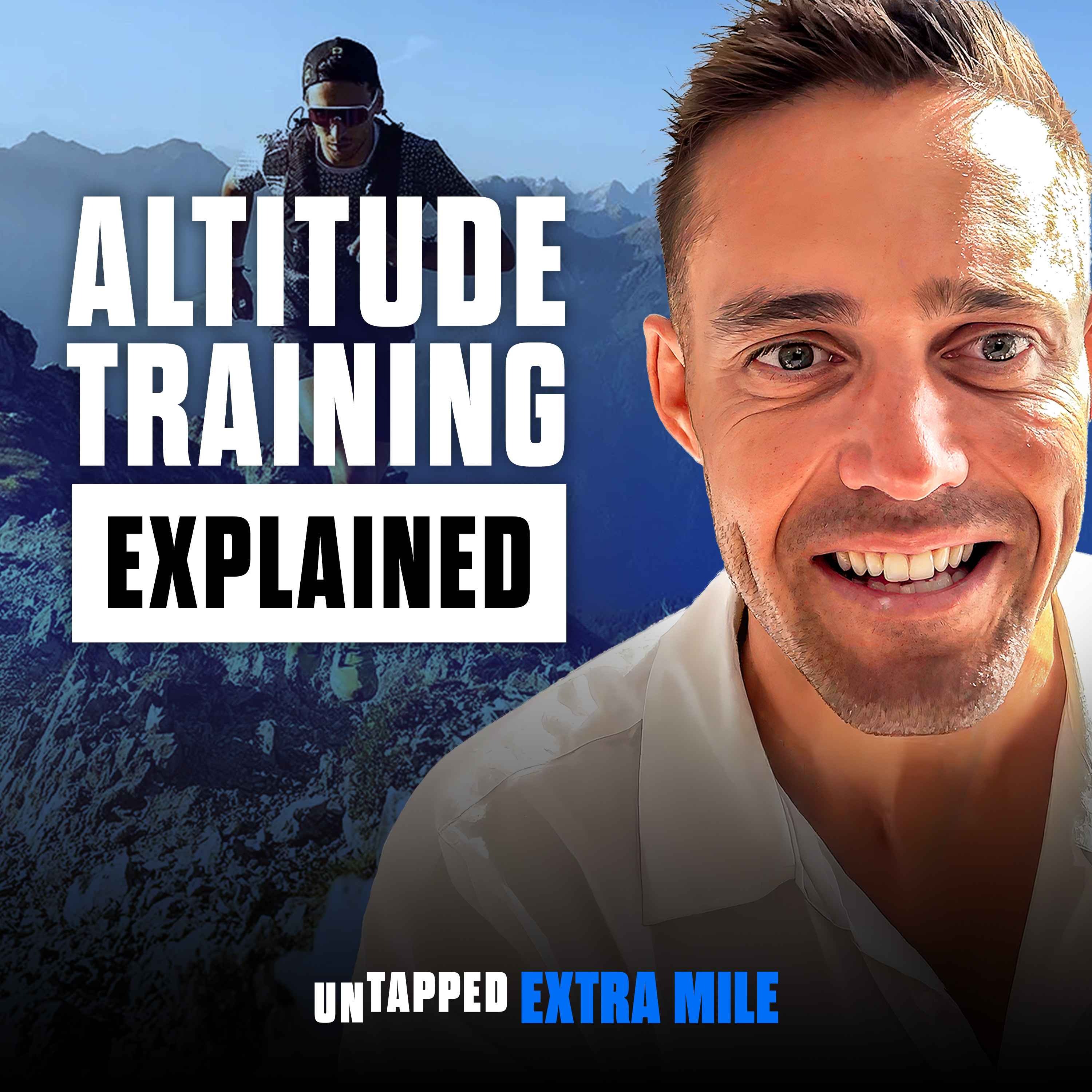
Altitude training for runners—how it works physiologically, whether it improves performance, and how to use it (including “train low, sleep high”); also compares altitude vs heat training and discusses risks like sleep disruption and clot risk.
Spencer Matthews and Olly Patrick (hosts). Spencer references Everest/base-camp experience (five weeks at base camp) and Kilian Jornet’s interest in altitude training; Olly discusses general training practice and questions the science.
Less oxygen is not the issue; oxygen amount stays the same, but reduced atmospheric pressure lowers partial pressure and oxygen delivery. Altitude triggers plasma volume loss, then increased red blood cells; VO2max drops during training at altitude (up to ~8% per 1000m over 1500m). Best approach: train at/near sea level but sleep in hypoxic conditions (“train low, recover high”) using tents/masks to mimic low oxygen. Altitude sickness differs from adaptation; acclimatization matters. Heat training can improve endurance via plasma-volume changes and sweating adaptations.
Everest helicopter performance; Kilimanjaro in ~10 days; altitude centers exposing athletes to progressively similar hypoxia; hematocrit/thrombus risk discussion; sauna as a heat-stress analogue.
Written by AI. May contain mistakes.
Discussion on the concept and benefits of altitude training for runners.
“Losing weight can feel like a roller coaster, full of ups, downs, and being thrown for loops, like when someone brings donuts into the office, or your kids' dino nuggets start giving you that look again.”
Discussion on the concept and benefits of altitude training for runners.
“I thought there was a delay on the line or something.”
Understanding how the body adapts to altitude and the impact on blood cells.
“I suppose because the air is thinner, there's less oxygen, which means it's harder to achieve the same results.”
Discussing the effectiveness of altitude training versus sea level training.
“The great debate though, when I got into this, was because we saw people going to altitude centers to train.”
Exploring how altitude tents and hypoxic environments work for training.
“Yeah, I was actually going to say that myself.”
Analyzing the benefits and common misconceptions regarding altitude training.
“I thought that there was less oxygen density in the air.”
Learn about how Modafinil works as a treatment for fatigue.
“Coffee only briefly blocks adenosine, the chemical that tires you out.”
Explore the benefits and approaches to altitude training for athletes.
“What is the kind of scientific general understanding of altitude training now, today?”
Understand the relationship between altitude training, blood adaptation, and health implications.
“to come back to Earth with more blood, more blood vessels, not blood vessels, blood cells, and be an absolute hero.”
Discuss the potential of the immune system in modern medicine and longevity.
“It's pretty, I just find the humor, but I mean, listen, we're just a couple of guys that like physiology, right?”
Dive into how DNA technology impacts crime-solving and societal behavior.
“Isn't it great that the legal system now takes DNA pretty seriously?”
Learn about the significance of pattern recognition in health and society.
A deep dive into the O.J. Simpson case and its implications on justice.
“Like, literally her blood is all over his bronco, which was badly parked as he rushed to the airport to catch a flight to Chicago with a fucking bloody hand with her blood all over his socks and floor in his house.”
Discover the differences and similarities between sauna training and altitude training.
Evaluate the effectiveness of altitude training for various athletes.
“I got a message on Strava the other day from a guy who just went Olly Patrick equals legend.”

Get the gist, explore an idea or ask about something said.
 Claude
On UNTAPPED with Spencer Matthews, what are the key points of this episode?
Searching your listeningAutomatic transcript. May contain errors.
0:00Losing weight can feel like a roller coaster, full of ups, downs, and being thrown for loops, like when someone brings donuts into the office, or your kids' dino nuggets start giving you that look again. That's why there's Noom. They combine GLP-1s to quiet the food noise with healthy habits that help you keep it quiet, even if you get off the meds. Their program is designed to make weight loss a smooth ride, helping you understand what drives you, so you can build better habits to not just lose weight, but keep it off. Noom. Lose for keeps. Get started at Noom.com. Not all customers will clinically qualify for medications.
0:37Individual results may vary. In a world where AI is changing every role in every industry, knowing who actually has deep expertise matters more than ever. Upwork connects you with the highly skilled freelance professionals with proven track records, so you can hire with confidence. Upwork gives your business fast access to highly skilled specialists with deep expertise, so you can fill critical skill gaps, launch projects faster, and scale support up or down without committing to full-time headcount. With Business Plus, you can access the top 1 % of talent on Upwork. AI-powered shortlisting delivers a curated shortlist of top freelancers matched to your goals in under six hours.
1:15No endless searching required. Thousands of growing businesses already trust Upwork to hire highly skilled freelance professionals for everything from one-off projects to ongoing support. It's free to sign up and posting a job is easy. Visit Upwork.com right now and post your job for free. That is Upwork.com to connect with top talent ready to help your business grow. That's U-P-W-O-R-K dot com. Upwork.com. Mod.com is changing the way people battle excessive fatigue. Ever hit a wall in the middle of the day and a third coffee just doesn't do it anymore? Here's what's actually happening. Coffee only briefly blocks adenosine, the chemical that tires you out.
1:57When it stops working, your system is flooded and you crash. Modafinil is a prescription treatment that works in a completely different way. Modafinil works by stimulating multiple receptors in the brain associated with wakefulness, including dopamine, serotonin, norepinephrine, histamine, glutamate, and orexin. It's a more complete solution that gives you 10 to 12 hours of steady focus and energy. To learn more, go to mod.com. Fill out your intake form, meet with a licensed provider, and if approved, Mod Alert ships straight to your door. Go to mod.com to get started. That's mod.com.
2:41Ladies and gentlemen, hello, wherever you are in the world. Good morning, good afternoon, good evening. And welcome to Untapped the Extra Mile with me, Spencer Matthews. And me, Olly Patrick. Fucking hell, Olly. Are you all right, mate? I thought there was a delay on the line or something. Olly and I unfortunately aren't getting to spend physical time together today, which is a real shame, actually. this already feels uh different in a bad way i don't think we should get used to this oh no i'm a little traumatized that was that was the delay my whole emotional my senses are on edge yeah i just because normally by this point you are physically touching me somehow and now if i'm to touch myself yes well it's always a shame when one has to do it themselves anyway today that's not the topic you'll be pleased to hear we are talking all things altitude training yes why do runners love it uh how does it change your physiology what are the advantages of altitude training and how can we get a peace for us mere mortals who live at sea level oh the the perils of sea level if only we were the mountain goat as is much as is much maligned um is this is does this pop up in your world much are many people talking about altitude training any of your peers or coaches doing this i don't hear a huge amount uh around battersea park about altitude training uh lots of runners lots of familiar faces lots of untapped guests but no mountain goats of yet.
4:27I have obviously had conversations about altitude training. I was pretty fascinated by altitude and thin air generally when I was on Everest for a while. I was up at base camp for like five weeks and you get a real sense of what it feels like to live at altitude. Kilian Jornay, of course, has been a guest on the show. He loves altitude training. Kenyan runners generally are said to have increased and improved physiology due to the fact that they train at altitude a lot. It's easy-ish to understand. I suppose because the air is thinner, there's less oxygen, which means it's harder to achieve the same results.
5:08Is that the case? So you're just training somewhere where essentially your body is undergoing more so that when you do come down to, you know, fruitful oxygen levels, things feel a bit easier. Is that correct? Or is it more complicated? One of the things people often say is there's less oxygen at altitude. There isn't. There's still the same amount of oxygen in the air. What you've got is a reduced pressure. So the partial pressure of oxygen is much reduced. So we've got an atmospheric pressure of oxygen. I think it's like some 760 millimetres of mercury at ground level. And that is down to sort of minus 500s.
5:41He's prepped for the show. First time I've prepped for a show. Because I'm like, what? I was about to say, how do you know what the general mercury levels are in the air? Where did you get that from? I think often people go, oh, there's less oxygen. The oxygen's the same. The partial pressure. So the actual ability for the pressure to push the oxygen into the alveoli in the lungs and get it into your bloodstream is much reduced. So effectively, the same amount of oxygen's there. you just can't access it as effectively. And what would happen if you and I went and lived at altitude? And again, looking at the sort of latest thinking, when we start to move up into the 2 ,000 meters, 2 ,700 meters, we're starting to say then that reduction in partial pressure of oxygen is so significant that our body is going to do a couple of things.
6:29The first thing it's going to do actually is lose plasma volume. That's quite interesting. So I know this when I've been to altitude, you get the urge to pee a lot. You might have noticed that when you're at Everest. So there is a diuretic effect of altitude, which means your body's going to try and excrete some of the extra fluid and that will lead to some of the plasma, which is the bulk of your blood, being, you know, again, being reduced in volume. And then concurrently, your body basically says, I've got to make more blood vessels, more blood cells, red blood cells, so I can capture every little bit of oxygen more efficiently.
7:01so your density of red blood cells goes up because the fluid they travel in goes down and the volume of them goes up and that makes you a more efficient machine at carrying oxygen Isn't it insane that your body can just do that? You head up some mountain and your body begins to create more red blood vessels It's insane It's that thing again where it doesn't know you're up there for a charity climb with your pals. It doesn't know that you've set yourself some outrageous fundraising target. It just knows this is my new normal. And if I do not adapt to this, then this world will be too stressful for me.
7:43So it's always trying to decrease the stress it's undergoing by creating physiological adaptations that reduce that stress. What's the kind of timeframe of creating more red blood cells? So I'm assuming if you just popped up to the metaphorical shop at the top of the mountain and came back down your body's probably not gonna uh do much you know you might feel some discomfort like do you need to exist in that kind of turmoil for a period of time or that's a beautiful beautiful concept yeah absolutely so it seems to be you might lay down an extra like one percent uh you know increasing in red blood cells per week so those are relatively marginal and here again we end up with are you a three-hour marathon runner because you only train two and a half times a week or are you someone who's looking for that that one percent differential which is going to separate you from elite to you know world class and i think that's a pretty small gain so after four weeks we might see four five percent we can see a significant change in blood plasma over that time as well decreasing so we could see quite a significant uptick in your body's ability to to take oxygen out of that reduced pressure environment turn it into energy in your cells and combust performance at a higher level.
8:58The great debate though, when I got into this, was because we saw people going to altitude centers to train. And what's interesting is when you go to altitude to train, then what you've got to bear in mind is that reduced partial pressure of oxygen will mean you have a decreased aerobic performance. So for every 1 ,000 meters, over 1 ,500 meters, you'll see up to an 8 % decrease in VO2 max. so if you're at you know two and a half thousand meters you'll be eight percent less than if you're at 1500 if you are at 3500 meters you'll be 16 percent less you know there's some variance within there but that became really interesting when people were going to altitude and basically the quality of their training sessions wasn't that they weren't fit enough it was that they didn't have enough enough oxygen to do it right so they didn't get progressive overload because they weren't physiologically fit enough they just ran out of energy because they couldn't get enough oxygen in and that raises the very principle why am i exercising i'm exercising to overwhelm a system of biology that then goes do you know what spencer i'm going to make you bigger or better for next time and what we basically found is people weren't getting much progression when they trained at altitude because their body wasn't the limiting factor you didn't you didn't exhaust your capability the environment was the reason you fatigued and then you might have heard this new phrase which was train low sleep high or train low recover high and basically what people started to do was they would do their training as close to sea level or you know whatever they could as possible but then they would sleep in a tent that created a sort of hypoxic environment that mirrored so hypoxic meaning low oxygen environment that mirrored altitude so they'd get all those adaptations over the night when they were sleeping but their training quality would be good because they're doing it at sea level isn't that genius that's that's uh beyond my pay grade that's clever that's why that's right in your pay grade no no but it is amazing isn't it what people will do for an edge yeah and you're massive and it's different right if you're if you're training to do a mountain expedition you know our mutual friend sean stafford didn't he do the everest marathon yeah i mean it's uh yeah so it's from base camp down to uh that airport i always forget the name of the airport and i should really remember it because i well firstly i've been there twice is it kutsko no it's not that's over in what is it come on somebody's in peru yeah i've been there as well just got the airports confused um uh what is it someone's gonna let us know are you looking for luckler i am there he is there he is never far never far with a fact yeah here he is simon lucla airfield and the helicopter's up there super sketchy you're like flying around normally and then the thing will literally feel like it's just falling out the air for a little while yeah it's it's quite full on also then you know we just need to reflect that helicopter is struggling to fly for the same reason you're struggling to breathe there's less atmospheric pressure so you know that that creates really challenging conditions for a helicopter that relies on such things.
12:09Yeah, I was actually going to say that myself. Yeah. You know, but I was surprised to learn actually that there wasn't less oxygen. I thought that there was less oxygen density in the air. Yeah, well, you can mirror it. So when people are at ground level and they want to mimic the conditions of altitude, you create a hypoxic environment. So if we think again, if you wear an oxygen saturation monitor, then we're looking at the percentage of your red blood cells that are well perfused with oxygen. and that might be 97 98 at sea level that might be down to you know 92 94 at altitude um and so if you wanted to mirror what the adaptation is at altitude you could give someone a low oxygen environment to so their oxygen saturation drops and that will trigger a similar physiological response so when you go to an altitude tent um or you put one over your bed it's not actually going to mimic the the low atmospheric pressure is my understanding it will mimic the low oxygen that triggers the same adaptation but and so and so when people explore altitude training and they go to you know an altitude center and they strap on a mask and it starves them of oxygen essentially whilst trying to uh you know be physical and you know anyone who sat on a bike or jumped on a treadmill with this device on your face will tell you you get really tired really quickly it's not not dissimilar to a vo2 max test actually in feeling It feels quite similar with far less exertion.
13:38What are the benefits of altitude training, if any? I was interested to hear you say that people didn't actually think that it benefited you to train at altitude. It was better to recover at altitude.
13:53Mod.com is changing the way people battle excessive fatigue. Ever hit a wall in the middle of the day and a third coffee just doesn't do it anymore? Here's what's actually happening. Coffee only briefly blocks adenosine, the chemical that tires you out. When it stops working, your system is flooded and you crash. Modafinil is a prescription treatment that works in a completely different way. Modafinil works by stimulating multiple receptors in the brain associated with wakefulness, including dopamine, serotonin, norepinephrine, histamine, glutamate, and orexin. It's a more complete solution that gives you 10 to 12 hours of steady focus and energy.
14:35To learn more, go to mod.com. Fill out your intake form, meet with a licensed provider, and if approved, Mod Alert ships straight to your door. Go to mod.com to get started. That's M-O-D dot com. This message is brought to you by today's sponsor, Walden University. Set a course for change. Now is the time to make a real change in your life, career, and community. At Walden University, we give you the support and flexibility to get the W. Walden's online programs are designed for working professionals like you. You'll gain hands-on skills to take on real-world challenges and succeed. Your future is waiting, and Walden is here to help you achieve it.
15:19Take the first step to make your impact. Visit waldenu.edu. Walden University. Set a course for change. certified to operate by Shev. In a world where AI is changing every role in every industry, knowing who actually has deep expertise matters more than ever. Upwork connects you with the highly skilled freelance professionals with proven track records, so you can hire with confidence. Upwork gives your business fast access to highly skilled specialists with deep expertise, so you can fill critical skill gaps, launch projects faster, and scale support up or down without committing to full-time headcount.
15:54With Business Plus, you can access the top 1 % of talent on Upwork. AI-powered shortlisting delivers a curated shortlist of top freelancers matched to your goals in under six hours. No endless searching required. Thousands of growing businesses already trust Upwork to hire highly skilled freelance professionals for everything from one-off projects to ongoing support. It's free to sign up, and posting a job is easy. Visit Upwork.com right now and post your job for free. That is Upwork.com to connect with top talent ready to help your business grow. That's upwork.com. Upwork.com.
16:32What is the kind of scientific general understanding of altitude training now, today? I suppose it would, and coming back to the Sean Everest thing, if your event is at altitude, you've got to build tolerance to that environment. So your great debate, let's imagine I'm wanting to be the legend of Battersea Park, you know, and then for me, I would train at Battersea Park and then recover at altitude if I wanted that sneaky advantage, you know, that suddenly why am I an absolute legend and also why am I sneaking off to my bedroom and sounds like someone's, you know, turning on an air turbine in my bedroom.
17:11I am sucking the air out of my bedroom so I can beat you in Battersea Park. So that would be sort of, you know, the train low, recover high type mentality and sorry just just how would one go about doing that um so you would get a a you would work with a sensor that provides you a hypoxic sleeping environment so you'd get a tent effect literally have a tent over your bed and you would go into that bedroom environment and as you go to bed you'd read you decrease the the concentration of oxygen in that environment to a control level to trigger the benefits of um yeah the benefits that you get at altitude so And this stuff happens?
17:52Absolutely, yeah. So what? So people, you know, perhaps when you do notice, you know, a bit of a legend in Battersea Park, there's a chance that they are sleeping in a tent like that. There's a chance. Highly unlikely. Because, you know, such a marginal gain. But, you know, if you are regularly exposed to it. But I know you think it's a marginal gain. I distinctly remember going for a run when I got off Everest when I'd been up there for a while I'm like you're flying literally flying when you came back yeah so when you come back so when you were up there you'd have lost the blood the blood plasma and you'd have increased the density of the red blood cell plus a few other things you know you've really triggered your body to make a multitude of new adaptations then you come back down to sea level and then your body remakes the plasma so you end up with more blood volume and more blood cells so in that environment then you are at your sort of rock star peak um and that that is you know then you should be flying you know what we've got is this slightly contradictory thing where we want more blood plasma because that increases what's called stroke volume which is how much blood your heart pumps per pump but you won't get that initially when you're at altitude you'll get that when you return to sea level so yeah theoretically the idea again would be you do your hard work when your body is most able to overwhelm itself which would be sea level and then if you want the physiological adaptations of more red blood cells and change in plasma volume you would recover or spend time in a hypoxic slash low oxygen availability environment now so for the best result then you really need both environments all the time you flick between the two but you need to spend enough time in altitude to trigger that response because as you said it doesn't happen when you go to the shops that's why sleep what you've got to flick on there again is what happens if i go into that hypoxic environment and it disrupts my deep sleep cycle because i'm waking more frequently so people who have the health condition sleep apnea which is where they they can't get enough oxygen into their body so apnea this period without oxygen so lots of people with a really heavy neck or snore a lot they occlude their airways and they sort of you might hear they sort of gasp themselves gasp themselves awake and they don't notice they've done that but they have all these little micro wakes in the night which which interferes with their sleep structure in the real restorative deep sleep um so if the low oxygen environment is triggering your body to stay awake you might get a cardiovascular adaptation but a but a neurological deterioration because sleep is the rock star of resetting our nervous systems and we you know rebuilding connective tissue and repairing our immune system so everything is is a everything is a seesaw and the minute you try and manipulate the system you may find that something you're thinking is a benefit is actually a cost elsewhere um now if you were doing your event at altitude you've got to get used to that environment so you go to again we used to use a clinic in london called the altitude center and they would expose you to increasingly similar environments to the one you're going to end up you know either climbing in or competing in or you're doing an expedition in and that means your body has built a resilience to that environment has started to take on some of the physiological adaptation and i think the question is if my event is at altitude then i would use an altitude environment to acclimatise to that.
21:06If my event's at sea level, I can manipulate time at altitude to come back to Earth with more blood, more blood vessels, not blood vessels, blood cells, and be an absolute hero. And if you do all of this quickly, so say you went up Kilimanjaro in a day, will you feel the effects of the altitude if you're travelling fast enough or not? So I've heard that if you climb a mountain quickly, essentially, that you may not feel altitude sickness because your body hasn't quite fully adapted to the change. You know, it's as you kind of stop and wait that your body adapts to the varying levels. Is that bollocks or is that real?
21:53Yeah, I think, again, altitude sickness is sometimes a different beast to altitude adaptation. and because there are some people who get altitude sickness despite having done an awful lot of prep. So there is something additional to that, which I think is about how the brain reacts to that environment to trigger a nausea. And some people do all the right things and still there is that unknown of whether they might get altitude sickness. That's also just life, isn't it? Some people prepare for stuff, you know, loads and still fail. Exactly right. And others wing it and succeed. It's beautiful. And that is life, you know.
22:27I like that element of life. You can only control what you can control. You have to accept what you can't. And I think there is a piece within altitude that until you've been up there and exposed yourself to those altitudes, you don't know how you're going to feel and operate in that environment. But if you stay up there long enough, you'll come back with thicker blood. And that's a win for everyone. Thick blood is delightful, isn't it? Is it the kind of blood where, like, if you cut yourself, it'll clot quickly? What is that? You know that happens, that's when you're very dehydrated, right? Yeah, so that's when you've got less plasma volume.
22:57So if you're thinking about thrombotic risks, so the risk of a thrombus, which is where platelets aggregate and form a blood clot, clearly having low plasma volume and a load more red blood cells is not necessarily a progressive step in that regard. So here you would say, and again, I'd need a cardiologist to come in and weigh in on this, but being significantly lower plasma volume with significantly greater red blood cells, we'd take a blood marker in a clinic called hematocrit, it that would be much higher um and you'd start to say if that person's got a history of of forming clots or or stroke risk or thrombus then they'd probably want to be cautious and that person might then be led into things maybe even in medical scenarios like uh blood thinning drugs or a sort of relatively high respective dose of omega-3 and it's one way where often the sports performance world separates from the health world and what what enables performance doesn't necessarily enable a longer disease-free life.
23:56So I personally wouldn't want someone walking around with an absolute shit ton of red blood cells and very low blood volume because that may enable you to be an extraordinary athlete in the short term. But as with everything, it'll come at some cost at some point. It's pretty, I just find the humor, but I mean, listen, we're just a couple of guys that like physiology, right? But like I do find it just absolutely mind-bogglingly fascinating and absolutely nothing to do with altitude here. but like isn't it isn't isn't kind of just blood and the general reparation of the body just fascinating even just the the sheer thought of cutting yourself bleeding scabbing over scab comes off skin has healed it's crazy it is isn't it like we we are built to just fix ourselves aren't we unbelievable stuff it's like a slow version of the wolverine yeah like we are basically wolverine It's just, it takes a little longer for us because we're not a superhero, but like, it's kind of, you know.
24:55We're not dissimilar. We're not dissimilar. That ability to repair. And, you know, and what you've got to bear in mind in every cell of your body is the code for all of you. You know, so that, you know, your DNA, the same DNA is in your skin cells, is in your liver cells, in your blood cells. Yet each of those knew which part of the code to read to become a skin cell or a liver cell. and so the turning the body's ability to heal itself is of course the next big frontier of medicine and you know what you've got i remember years ago when someone accidentally thought i was a high net worth individual i might my job was looking after high net worth individuals but they they've confused me and so i turned up in my sort of h &m tracks and there was there was a bit of you know he's playing it cool and i basically got pitched for about four hours on this new you know immune modifying cancer therapy which is of course the new direction which says if we want to kill a cancer which is one of the most challenging things in modern health care our immune systems are best hope not killing our immune system but targeting our immune system to target those cells and once we learn how to harness immunity and and not you know have it overreacting or underreacting that then unlocks the next frontier of longevity which is i know your least favorite word but it allows real quality health span if we can get our immune system working as a strategic beast.
26:15Untapped extra mile, curing cancer. That's what we're up to anyway. People are trying, I promise you. People are trying. Isn't it great that the legal system now takes DNA pretty seriously? Yeah. OJ Simpson was lucky. Jesus. I mean, Windows. I can't imagine the mindset of a modern criminal. Impossible. You can't do it. Literally, I was sat in bed the other day thinking, like, being a murderer nowadays would be absolutely impossible. Think about it. Think about trying to get away with murder in central London. Good luck. No chance. CCTV everywhere. Witnesses everywhere. Like, the whole thing, very difficult to dispose of the body as well.
27:06Like if like from within the house or the flat, like how are you getting rid of the body without being seen or heard? Forget it. You need to be a la Ed Gein, Wisconsin, middle of nowhere, you know, before DNA, just out in the woods with a chainsaw. Like that's the only way, right? All right, up in the highlands of Scotland with a hammer, you know, and you're somehow there with the person, but that person's told nobody. Because even if they've told a single person where they're going, you're kind of fucked. Like, you know, they know. I find it greatly reassuring that you can identify so much from so little.
27:50You know, it's not, I probably don't think about it as much as you do, but you've triggered me to consider it. i like the fact you know everyone's very anti you know the the sort of the state observing behaviors but you know if you're buying volumes of liquids or buying bins or you know it's what we've got now is pattern recognition we're looking at it in health i want the pattern recognition to spot a disease before it occurs you're you know we're drifting closer to minority report which is patterns of behavior it's not some you know some some supernatural being patterns of behavior will predict future events and that predictolytic capability is hugely the frontier of medicine but i think also in some ways potentially the frontier of society as well so yeah it's um it's quite reassuring actually we've managed to murder a podcast about altitude training pretty soon but i do i do i do think it's i do just think it's extraordinary yeah and by the way just that that oj simpson case nothing will ever be wilder than that like just just like we should do an episode maybe on on we were talking about blood loosely simon so that that's you know this does kind of sort of make sense we because we were talking about blood oj's blood at the scene her blood all over him in his house and car what who the fuck else could it be no genuinely who the fuck else could it be well we know who it was but you know i just don't i like i watched that again recently and I was just like, this is an absolute, this is preposterous.
29:22Like, literally her blood is all over his bronco, which was badly parked as he rushed to the airport to catch a flight to Chicago with a fucking bloody hand with her blood all over his socks and floor in his house. Yeah. You'll get no pushback here. But also just like, why even have a jewellery? Like, surely a judge can just look at that case and go yep guilty like what's the point in even having in the case there's a there's a justice system i don't like it there's a lot of people who are on the wrong side of those bars because that system was too loose so you can you can spin that both ways extra extra mile really on really on the button with what people are talking about
30:11um let's get let's move on let's move on to our sauna training now you you you teased me saying you were going to connect the two issues okay right well some people claim that you can get similar benefits from heat training than you can at altitude what's why would why would that be i'm assuming is there greater blood flow when you're in a sauna what's your body trying to do it's trying to cool down isn't it so it's sweating profusely to try and keep you cool cool body temperature lower yeah yeah so there'll be there'll be there'll be a correlation in that i think with with heat stress um the longer term adaptations clearly heat stress has been proven to also be a benefit to endurance performance partly because obviously during an endurance event your core temperature is rising so your body's ability to manage that rise in temperature a good example would be if you regularly expose yourself to heat you'll become better at sweating sweating is a physiological process that improves as people get more adapted to heat so that person who starts sweating a little earlier their sweat will probably be a little bit more dilute interestingly if you measure the um sort of sodium concentration of of people's sweat the more heat adapted person will have less sodium in it the big correlation with altitude um is that when you go to altitude you get a reduction in blood plasma volume because of that diuretic effect and um also the air is ridiculously dry you'll know if you're going to altitude the air is really dry so you have to humidify that air on every inhaled breath so you'll know how much fluid you lose when you look at your breath in on a sort of cold winter's day you see all that water being lost in respiration that the level of water lost at altitude is significant through respiration but also then through that diuretic effect the need to pee more so your plasma volume drops in a sauna here's the kicker over time your plasma volume increases so your body says okay if this is going to be my new normal i will increase the volume of blood plasma so they actually are often spoken about interchangeably but they work on almost the exact opposite principles one will decrease plasma and increase hematocrit and the other will increase plasma and increase stroke stroke volume so coming back to that point earlier if you're regularly whacking into the sauna you will build more blood effectively which means your heart can pump more blood per pump which means there's more available oxygen throughout the body through that increased efficiency of the heart amongst other things like i can tolerate heat better i sweat more effectively and i'll have better ability centrally to withstand the sensation of heat so heat is an endurance performance tool for sure is it the same as altitude you get if let's imagine i went to altitude and came back down i'd get a rise in blood volume that would be equivocal between the two but it's more of a foil so it's an and rather than an oar probably.
33:02I think you're fascinating.
33:06Just great. I got a message on Strava the other day from a guy who just went Olly Patrick equals legend. And I replied to him and I said correct. That was on one of my workouts mate. So look at that. Well that's very nice. A we love him and we're grateful for every listener keeping me in the hot seat may these plaudits continue to land because it's so much fun uh where else would you discuss sitting on a dead body the oj simpson trial and blood plasma all within space of about three minutes of each other so it's thrilling delightful so as we conclude our conversation about altitude training and other exciting and interesting points um what do we what do we think what is the general takeaway is altitude training a bit niche like is it going to help your 5k time if you're an average runner or is it more reserved for you know elite top tier kenyan marathoners or is it a question of where you live perhaps you know should we be chasing altitude training for results a simple yes or no ollie there's no simple yes or no's with me i think you know if you've optimized every other facet of your training it's to be explored it's that classic thing isn't it should i buy you know an ultra carbon bike well not if you cycle twice a week and you weigh 150 kilograms you know you probably want to focus on training three times a week and losing five kgs you know if you want to be an elite athlete so you're looking at again altitude benefits maybe less will be less than five percent overall that could be massive if If you're pursuing to be a world elite, heat benefits might be slightly less than that, you know, a couple of percent, three, four percent.
34:55So if you're adding those into already, you know, optimized training, optimized sleep, optimized nutrition, optimized psychology, they might be a performance edge. If you're thinking they're going to be a shortcut to performance outside of all the basics and foundations we talk about, then I think you'll be grossly disappointed. The caveat being, if you're going to go and do something at altitude, take structured advice, don't turn up cold. you know i do like centers that allow you to be exposed to that high altitude environment in a deliberate fashion and even if that's a relatively short time away some of those um benefits of adaptation to a higher climate can take place quite quickly so if you've suddenly decided to go and do kilimanjaro you know and you've got 10 days to do it i still see validity in going to explore some altitude centric sessions so if you're training at altitude you need to be exposed to that environment.
35:42If you're a ground level 5K battersea athlete, I think you can focus on the basics first quite comfortably. And I'm not including you in that, by the way, mate. You're elite. I didn't think you were. Thank you. Thanks for the clarification. And we'll catch you next week for a brand new episode of Untapped and Untapped Extra Month.
36:13Waiting for your sign? Here it is. Shop Labor Day appliance deals at Lowe's before they're gone. Get up to 45 % off select major appliances. Plus, get free delivery, haul-away, installation and parts, and a two-year Lowe's protection plan on purchases of$999 or more. Labor Day deals are on now at Lowe's. In-store and online. Valid through 916, while supplies last. Selection varies by location. See Lowe's.com for more details. I'm Jake Stouck, co-founder and CEO of Serval. We built Serval to automate the IT work that slows companies down. Onboarding, password resets, access to applications, my laptop stopped working.
36:55While employees wait for help, their real work is put on hold. IT desperately wants to automate this work, and that's why they need Serval. You just tell Serval what you want to automate in plain English, and it's built. No drag-and-drop workflows, no expensive consultants. Employees get unblocked and IT teams go from drowning in tickets to building what actually matters. With Serval, IT becomes the AI engine powering the entire company. This is a new way to run IT. We guarantee you'll automate 50 % of all tickets and we'll prove it to you in a free four-week pilot. Go to serval.com slash tickets.
37:33That's S-E-R-V-A-L dot com slash tickets.
37:42Hello, I'm Monica Reinagle, host of the Nutrition Diva podcast. Summer is here and with it, the hot and sticky weather. A morning working in the garden, or maybe on the golf course, can leave you more depleted than you realize. And plain water isn't always the most efficient way to restore the balance. That's where liquid IV comes in. Its science-backed formula is clinically proven to hydrate faster than water alone. Whether you're exercising, playing outside, or simply surviving a summer heat wave, it's an easy way to stay hydrated. Shop now at liquidiv.com. Liquid IV, hydration that goes wherever life takes you.
Does altitude training actually make you a better runner, or is it just for elites? Spencer and Ollie explore what really happens to your body at altitude, why "train low, sleep high" became the gold standard, and whether the benefits are worth chasing if you're an everyday runner.
Do Health 👉 For your long-term health. Head to https://highpfrmc.com/dohealth-ut-au to sign up now.
Better Help 👉 Join Spencer in Saying It Louder with 10% off Betterhelp Therapy. Click here: https://highpfrmc.com/ut-betterhelp-au
Postcode Lottery 👉 Discover how Postcode Lottery players are Powering Hope Together. Click here to find out more: https://highpfrmc.com/ut-postcode-au
Robinhood 👉 Head to robinhood.com/untapped to get started and claim your free stock.
Hosted on Acast. See acast.com/privacy for more information.