Ask ChatGPT
 UNTAPPED with Spencer Matthews
16 Apr 2026 · 34m · 15 chapters
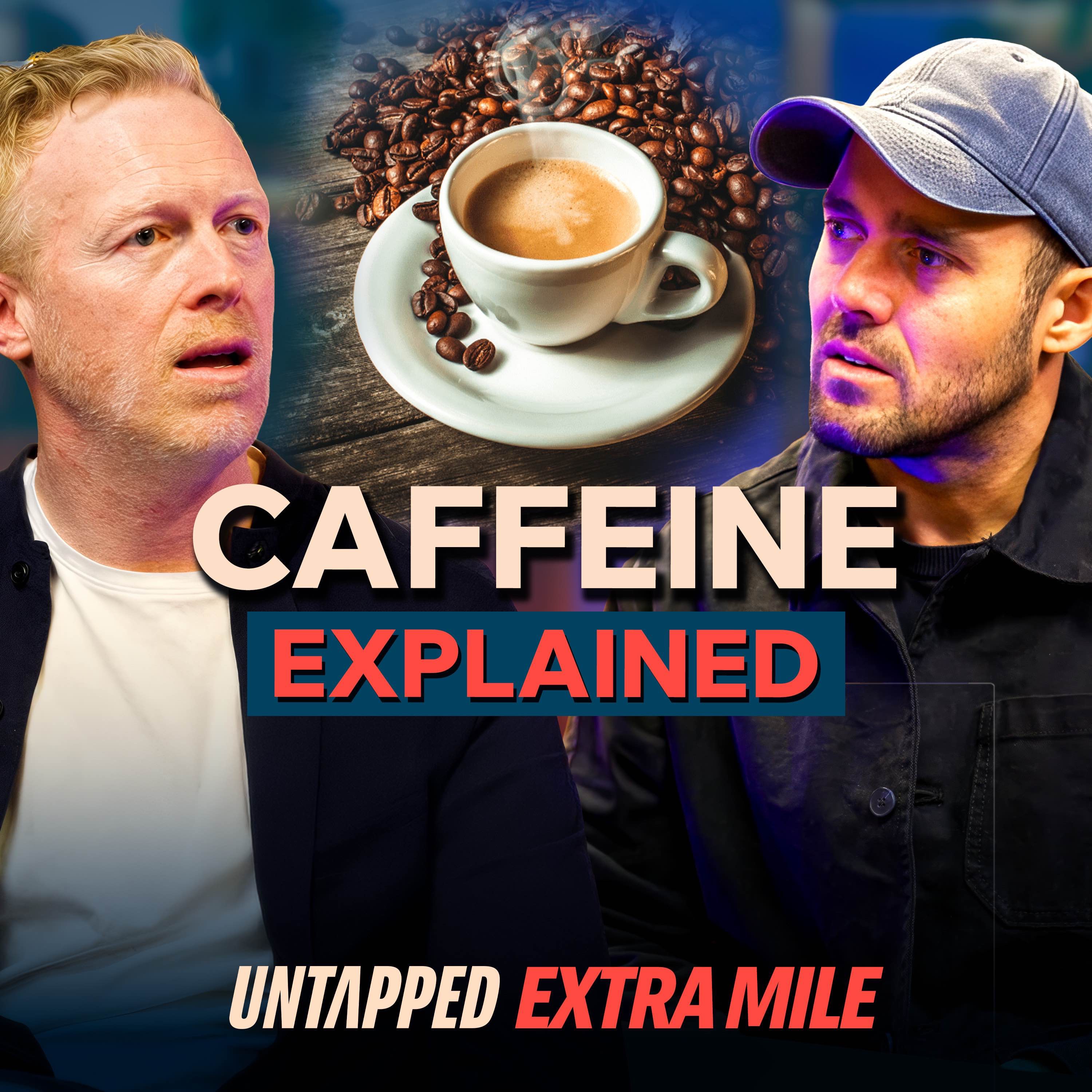
The episode explains what caffeine actually does in the body (adenosine receptor blocking that masks fatigue), reviews common myths (e.g., delaying caffeine 90 minutes after waking), and discusses benefits for performance and cognition versus risks (sleep disruption, cardiovascular strain, anxiety in sensitive people). It also covers timing strategies like caffeine power naps and how individual factors (body size, genetics, tolerance, caffeine half-life) change effects.
No specific guests appear in the transcript. The hosts are Spencer Matthews and Olly Patrick (The Extra Mile with Untapped).
Caffeine doesn’t create energy; it hides sleep pressure by competing with adenosine. Performance benefits are “unequivocal” for endurance and cognitive tasks. Coffee/tea can be protective due to antioxidants, but energy drinks are riskier due to added stimulants/glucose. Sleep quality matters because sleep enables brain “debris” clearance via the glymphatic system.
Caffeine power nap (espresso + 16–24 min nap for 4–5 hours productivity). Cultural examples of late-day espresso in Italy/France and heavy espresso intake in the Middle East without obvious sleep issues. A personal anecdote about using multiple espressos to function while hung over. Mention of L-theanine to reduce jitters.
Written by AI. May contain mistakes.
Discussing common myths surrounding caffeine consumption.
“wondering what's happening to your body ends now.”
Discussing common myths surrounding caffeine consumption.
“The great myth that went around, which was that you needed to delay caffeine for 90 minutes.”
Explaining how caffeine interacts with our brain and fatigue.
“Sometimes you have a caffeine discussion.”
Caffeine as an ergogenic aid and its effects on endurance.
“And you can tell me if they're true or not.”
Examining how caffeine affects cognitive performance and clarity.
“So from the minute we're awake, we're building adenosine levels, which are being picked up in our brain.”
Describing the technique of caffeine naps for productivity.
“Caffeine, in a similar way, would blunt some of that response.”
Discussing the impact of caffeine on sleep and individual responses.
“I think when we're seeing the rise now of caffeine gums, my understanding of those is they had their sort of roots in military where they were trying to get sharper minds quicker.”
Exploring how personal factors influence caffeine sensitivity and tolerance.
“that obviously don't have a coffee before going to sleep, you won't be able to sleep.”
Explore how caffeine affects sleep and the variability of individual responses to it.
“which means 10 hours later, some of it's still in my system.”
Discuss the potential health risks of caffeine abuse and its impact on well-being.
“If you've got 20 hours a day, you should find 40 minutes for us.”
Examine how caffeine interacts with stress levels and anxiety, and discuss strategies for management.
“On Iyanla, The Inside Fix, a podcast from OWN, Iyanla Vanzan revisits the stories, teachings, and insights that made her show Fix My Life a must-watch for millions.”
Explore how caffeine impacts dopamine release and its tolerance in the body.
“caffeine's buying them an excuse to keep going as it brought you the ability to keep performing without having to address the central cause of that behavior, which are things that were really challenging your physiology.”
Discusses the impact of watching screens before bed on sleep quality.
“It's that sense of a reward from me earning my coffee or whatever it is.”
Examines how different people react to light exposure and content watched before sleep.
“yeah yeah something with a bit of grit to it something ghastly yeah yeah something ghastly exactly and then literally I'll fold the iPad put it on the floor and just go to sleep is that a shocker?”
Analyzes how caffeine affects performance, fatigue, and individual health.
“and you're taking quite heavy material in.”

Get the gist, explore an idea or ask about something said.
 Claude
On UNTAPPED with Spencer Matthews, what are the key points of this episode?
Searching your listeningAutomatic transcript. May contain errors.
0:00Hey, it's Tony from Tony Told Me. On Iyanla, The Inside Fix, a podcast from OWN, Iyanla Vanzan revisits the stories, teachings, and insights that made her show, Fix My Life, a must-watch for millions. With fresh eyes, she re-examines those lessons with greater clarity and shares new wisdom for the challenges we face today. Personal growth evolves over time, and there's always room to find new meaning in old lessons. Listen to Iyanla, The Inside Fix, wherever you get your podcasts. Hello, I'm Monica Reinagle, host of the Nutrition Diva podcast. Summer is here, and with it, the hot and sticky weather.
0:39A morning working in the garden, or maybe on the golf course, can leave you more depleted than you realize. And plain water isn't always the most efficient way to restore the balance. That's where Liquid IV comes in. Its science-backed formula is clinically proven to hydrate faster than water alone. Whether you're exercising, playing outside, or simply surviving a summer heat wave, it's an easy way to stay hydrated. Shop now at liquidiv.com. Liquid IV, hydration that goes wherever life takes you. 75 % of women who seek menopause care don't receive it. The lying awake at 3 a.m. wondering what's happening to your body ends now.
1:15Midi is virtual care built for women in perimenopause and menopause with clinicians who specialize in women's health. Plus, it's covered by most major insurances. Getting started is easy. You can book your first visit with a clinician right away. Midlife needs Midi. Visit joinmidi.com to book your first visit today. That's joinmidi.com. Insurance coverage varies. Check with your plan for coverage. The great myth that went around, which was that you needed to delay caffeine for 90 minutes. Is that a myth? It's a myth. Oh, yes! I've been doing it! Oh, I wish we were recording then. We were. Were we?
1:57Yeah. Oh, thank God. Okay, fuck. I'm going straight back to having my coffee in the morning.
2:08Hello, ladies and gentlemen. Welcome to this week's episode of The Extra Mile with Untapped. My name is Spencer Matthews. I'm Olly Patrick. And today we are here to talk about caffeine. God's gift to humanity. Caffeine. People love it. People love it. It's one of those things that has been deemed a miracle. I've heard bad things about it as well. You can't be having too much caffeine. You need to delay caffeine by 90 minutes in the morning. Let's talk about caffeine myths, the legends of caffeine itself. And should we use it? And if so, how much of it should we have? These are all great topics.
2:54We've got to separate. Caffeine isn't only in coffee. Sometimes you have a caffeine discussion. People think you're just talking about coffee. But coffee is probably our main vehicle for caffeine consumption. It's my main culprit. And I love, I mean, I literally, there should be a disclaimer. I love, I love coffee. What is, did the machine make you a flat white that is palatable? It is palatable. Is it? Yeah. Or are you just saying that because we're recording? No, I feel no social requirement to it. Like to extraordinary levels. It's not an artisanal. No! It's perfectly acceptable. I love it.
3:26Is it good for us? It's probably the most, you know, widely used psychoactive compound on the planet because it is really effective. Good for us is always that impossible question, you know. Is it good for, you know, enormously, a terrible sleeping, high cardiovascular risk individual who's using too much of it in the evening? Absolutely not. Is it good for an endurance athlete, guest on Untapped to, you know, increase cognitive and physical performance and achieve their goals? Unequivocally, yes. So the question is always context, which is boring, but true. I'm just going to fling a bunch of caffeine-related questions at you.
4:02Let's go. And you can tell me if they're true or not. I need to delay my morning coffee by 90 minutes. The current empirical evidence would say that is not true, but it trended an awful lot. It mechanistically makes some sense. We've got to probably go one step back to all these truths, which is just to remind ourselves, what is caffeine doing? What is caffeine doing? So caffeine is this, again, the psychoactive compound. It's genius because it binds to these receptors in our brain that sort of detect our baseline levels of fatigue. So one of the great misunderstandings with caffeine is not that it gives you energy, but it actually hides fatigue.
4:43So adenosine is like the waste product of us being, you know, cognitively engaged now and physically active. Our hearts are beating, our muscles are working. And remember the phrase adenosine triphosphate, which is our ATP, so the molecule of energy. Do I remember that phrase? No. From our first date? Yeah, from our first date. Oh yeah, no, no, I remember that. Of course. Adenosine triphosphate, yes. How could I forget?
5:13Adenosine triphosphate, ATP, is the unit of energy. So adenosine is the molecule of energy. As humans combust energy over the course of the day, adenosine levels basically build up like an exhaust feed, right? So from the minute we're awake, we're building adenosine levels, which are being picked up in our brain. So our brain's got these receptors for adenosine. And that's why after 16 hours of being awake, being physically active, being cognitively engaged, I build up what's called sleep pressure. And that's one of the reasons I'll want to fall asleep, where I down-regulate all my physiological processes and I allow adenosine to drain out of my brain to refill all the various cells of my body.
5:51And I get ready to cook again the following day. That's humanity. So adenosine in the brain is a big marker of fatigue. And what caffeine does, it doesn't give you energy. It hides those adenosine levels because it competes with adenosine on the receptors in the brain. So it basically masks fatigue. So hang on, just to be clear, like a strong shot of double espresso in the middle of the day won't make you more energetic. You will just think you feel less tired. Obviously, most fatigue is psychological. So if we, and again, there's great debates on this. We take the work of Professor Tim Noakes and central governor theory says that as I'm getting more tired as I'm exercising, I'm not fatiguing in my periphery.
6:33I love Tim Noakes. You know, and he's, again, drifted into sort of more of the carnivore, you know, ketogenic world. But in his original sports science days, the central governor theory, which is there to be picked apart, was that when I run out of gas, it's because my body was protecting me from damage. So my brain is listening to those symptoms of fatigue and shutting me down effectively. Caffeine, in a similar way, would blunt some of that response. So it's a well-known ergogenic aid. So for endurance sport, whether it's working locally on the muscle, and there is a discussion about, again, caffeine would help increase fat oxidation.
7:04So me using more fat as a predominance of my fuel. Caffeine will mask some of the fatigue in terms of giving my brain that reduced feedback mechanism of adenosine building up in the brain. Unequivocally, it is a performance enhancer. And I think at certain levels in certain sports, it's banned. So there's a tipping point of when it is allowed. What, is caffeine? Yeah, I think so. What? I'd need a doping professional. But I think there is a caffeine limit in certain sports. Yeah. We need to fact check that. I've not heard of that. I'm fact checking as we speak. Fact check that as we speak. It fundamentally has this massive role of blocking fatigue, which will manifest as more energy.
7:40It's just not doing it in the way most people think it's doing it. Wow. Okay, so more caffeine related questions. Will I feel sharper? Or better still, will I be sharper if I drink caffeine? Or if I consume caffeine? Probably. So it's often called a nootropics, this new world of nootropics, these sort of active ingredients that increase our cognitive clarity and sharpness. From an attention point of view, there's good evidence on it. I think when we're seeing the rise now of caffeine gums, my understanding of those is they had their sort of roots in military where they were trying to get sharper minds quicker.
8:21Because if I absorb caffeine in my mouth, rather than waiting for it to go through my digestive system, I can have a quicker response on the brain. because there is a lag on caffeine. It could be 20 to 60 minutes before this ends up eliciting all the sort of key physiological benefits. It's so funny that, isn't it? Like, you almost immediately feel energized and more awake when you have your coffee. But like, it hasn't kicked in. No. So that's placebo. You're anticipating it and loving it. But isn't it funny? That to me is hilarious. I've done tasks that don't take half an hour, but needed the coffee to do the task.
9:03And you're probably only going to get high from the coffee after the task. So it's completely pointless. I've had a double espresso and gone straight into the thing. I'm caffeinated now, you know, when you're not. And it can have a change on blood glucose levels. There can be things, it could be that some things start earlier. But one of the sort of well-used techniques is the caffeine power nap. which is people have a shot of espresso. Then they do a traditional nap, which is somewhere between 16 and sort of 24 minutes, but, you know, 20-minute nap. And in that state where they don't fall asleep, they're in that sort of non-sleep deep rest.
9:34They arise from, again, this clearing a bit of adenosine naturally, plus the caffeine sort of kicking in, and they go into sort of turbo mode for the next four or five hours. And the caffeine nap is quite well used in sort of business settings for people who want to be a really productive, rich, cognitively, you know, enabled mid-afternoon session. Crikey. I mean, the ability to be able to just nap at will is remarkable. It is. I am a fervent napper. A fervent napper. And every time, I've talked about the science of napping in lots of different guises, in lots of different places. And every time I go for a nap, my wife will still say to me, off for your nap, are you?
10:12Like with a clear derogatory tone, like it's a lazy move. I'm like, babe, if culturally you can't get on board with a nap, how are workplaces and the modern corporate athlete ever going to get on the bus? Yeah, it's an easy thing to poke laziness at, to be honest, isn't it? It is. But, you know, these are performance-based naps. These are not lazy naps. You're speaking to her right now. Yeah, I am. Lara, you're listening. Lara, yeah. No, your husband is elite, right? and in order to operate at a completely elite level, you must nap. Napping is a really interesting part. Caffeine nap. Caffeine naps have become a meaningful thing.
10:55But again, that dip in performance people get after lunch can often be associated with what we call circadian biology and this building of adenosine throughout the course of the day. So a little nap, which reduces that adenosine also, and caffeine kicking at the same time is brilliant. It's why adenosine is the reason if your kid falls asleep in the car just before you get home. they then stay awake for another four hours. Because as adenosine drops in those rapid naps, you've lost sleep pressure. And sleep pressure is part of that urge to fall asleep. So the person who falls asleep in front of the sofa, the person who has a nap on the train traveling home, they really run the risk of disrupting their quality sleep by the same mechanisms for which caffeine works, which is we need adenosine building up in our brain over the course of the day.
11:38Okay, what about caffeine before bed? So it sounds obvious, right? that obviously don't have a coffee before going to sleep, you won't be able to sleep. That's not true of lots of cultures, right? Like I'd have a Cortado or a double espresso after dinner in Italy or France even. Don't really do it here for some reason, although sometimes it's just not really a thing. In the Middle East, I shot a documentary a few years ago, we were drinking, we must have had 15, 20 double espressos a day. Like, you know, it's just a standard, normal cultural thing, right? You may as well carry around your own little coffee cup, right?
12:21Because somebody's going to top it up, like just somewhere. And I slept like a baby. You know, so is it a myth? Like do people get in their own heads with it? Oh, I had a coffee at 5 p.m. today. That's why I can't sleep. You know, because a lot of sleep I think is your mind playing tricks on you, right? What would you believe? I, just this last year, have had my first ever problems with sleep. And I know for a fact it's all in my head. Yeah. You know? Yeah. And very real. And I think that question comes down to a few things. There's no way we could say you and I respond to caffeine in the same way, right?
12:58So first thing is mass. And if we look at whatever a guideline might be, 300, 400 milligrams of caffeine over the course of a day. And we might, in this cup, there might be 70 to 100 milligrams. So theoretically, three or four caffeinated drinks a day might be reasonable. But again, that's different if you're a 50 kilogram individual versus a 100 kilogram individual. Then there is a genetic component to how well we break caffeine down. Same with all drugs. So there are pathways of enzymes, particularly in your liver, of how rapidly you break this product down. The more rapid you break it down, the less it stays in your system.
13:31If you're crap at breaking it down, it will stay in your system for longer. So this is true of all substances the body has to metabolize. Am I a good metabolizer or am I a slow metabolizer? Slow metabolizers will be more sensitive probably. I've got then, of course, how much I've used. You know, that makes a big difference. And I've got how much I've built a tolerance to over time. So I've built some degree of caffeine tolerance. So all this plays into the fact, the great challenge is, you know, for most people, caffeine has got a half-life somewhere between three and seven hours. And as people say five to seven hours, which means 10 hours later, some of it's still in my system.
14:04Now, that means if I think theoretically of having something after lunch at two o 'clock, it's still biologically active in my body. at, you know, towards 11, 12, midnight, whatever it might be. It's at a de minimis dosage, you know, so it's probably not that much kicking around in my system. And I may sleep brilliantly, I may not sleep well at all. And here we have to lean into hyper-personalization and say, if you fall asleep with ease, you have good sleep latency, you know, with 15 minutes of getting into bed, you're falling asleep 20 minutes. And, you know, you're tracking, you're fortunate to track your sleep as you and I both would.
14:37And there's adequate deep, there's adequate REM. and more importantly, you wake up and within half an hour of waking up, you feel refreshed, then you can't let a rule tell you how you respond to caffeine. And I've met people who do have, you know, early evening, late evening, espressos, double espressos. They've got good sleep architecture, good energy levels, fantastic. It doesn't meet the scientific logic, but that's the reality. I've met other people who are hypersensitive to caffeine, have one drop, you know, whiff past their nostrils at midday and they're lying in bed awake. How much is that, you know, because of their perception?
15:08how much is true physiology, always impossible to tell. But the general rule is, you know, most people logically should be cautious with caffeine after lunch because it could and should still be in your system as you enter the sleep staging. And it should be delaying sleep pressure, which should potentially impact on sleep staging and quality of rest. But I know Italians too, and they seem to be doing all right. It's unbelievable the difference in people, isn't it? Madness. That is crazy. One of my highest performing friends, hyper successful, sleeps for like four hours a night, maybe less, and drinks wine a day, plus beer and stuff every single day.
15:56and I've never seen them drunk, tired, angry, just hyper-focused, hyper on it. Super successful. You can't imagine. And it's literally like, if I have a bottle of wine, you fucking write me off. Ruined. Ruined. Not drunk or anything, but just certainly not training, not doing a great job looking after my kids, not doing the work I should be doing in the evening, not up early in the morning, bright and bushy-tailed, not in a great mood, you know, when the three kids are running around disobeying us in the morning. You know, like, he's just different. It's unbelievable. I just think, you know, he's jealous.
16:38I'm jealous, but also caveat, being functional is not the same as being healthy. Oh, I never said he was healthy. No, but you can, the danger there is, of course, a symptom is a really useful thing, right? So if you and I wake up on a slight hangover and we're terrible parents and we're, you know, we're unable to perform our basic tasks of daily living. That's a feedback loop to say, maybe don't do that again. Caffeine nap. Caffeine naps on the horizon, mid-afternoon, double espresso, sleep for an hour and a half. So the challenge you've got is, of course, lots of people don't get that symptom and they don't get the feedback that this thing is, on some level, an underlying health risk.
17:15And of course, my great concern from that friend of yours would be their neurocognitive health with particular risk of early Alzheimer's and dementia. because the brain clears itself in those hours of sleep. And there's 10 biological processes that will go on during sleep that will not take place in the day, from immune regulation to growth hormone release to, again, clearing debris of my brain. There's a whole biological system called the glymphatic system, which only works at night. Now, you wake up the next day and you can keep working. You're not incentivized to change those patterns of behavior.
17:46But I would want that individual to change those patterns of behavior, not because they need them to perform, but because they're playing, you know, the game of I want to protect the 20, 30 year version of myself. So it's a public service announcement to them. You hear all, well, yeah, they won't listen to this. They're too busy killing it. I've got loads of extra time. If you've got 20 hours a day, you should find 40 minutes for us. Yeah, exactly. You hear a lot of people also just saying, you know, I'm avoiding caffeine for the time being, or I'm not drinking caffeine, or I don't drink caffeine.
18:19What would you say to them? not to kind of try to persuade them to drink caffeine. But, you know, obviously some people may not like the feeling of drinking caffeine. But I think a lot of people don't drink caffeine because they think it's unhealthy. Yeah. So is this unhealthy in any way? Is abusing it unhealthy? Yeah. Like the abuse of anything really feels unhealthy, right? Abusing working out feels unhealthy. Abusing, you know, drugs and alcohol is obviously unhealthy. Is having a lot of caffeine an assault on your body? Is it unhealthy or not really? It's a tough question. Again, I think the biggest challenge would be it can impact the cardiovascular system.
18:57So someone, you know, biggest killer in the world is heart attacks and strokes, what we call cardiovascular disease. And we'll see increased blood pressure, increased heart rate, potentially higher levels of circulating glucose.
19:19Midi is a virtual care platform built for women by women and offers specialized hormone care from trained clinicians. Plus, it's covered by most major insurances. Getting started is easy. You can book your first visit with a clinician right away. It's not you. It's your hormones. Visit joinmidi.com to book your first visit. That's joinmidi.com. Insurance coverage varies. Check with your plan for coverage. Hey, it's Toni from Toni Told Me. On Iyanla, The Inside Fix, a podcast from OWN, Iyanla Vanzan revisits the stories, teachings, and insights that made her show Fix My Life a must-watch for millions.
19:56With fresh eyes, she re-examines those lessons with greater clarity and shares new wisdom for the challenges we face today. Personal growth evolves over time, and there's always room to find new meaning in old lessons. Listen to Iyanla, The Inside Fix, wherever you get your podcasts. Hi, it's Mark Bittman from the podcast Food with Mark Bittman and the website The Bittman Project. One of the things that makes Whole Foods Market different is their commitment to quality standards. More than 500-degree insert bands store-wide to give us peace of mind whether we're browsing through the store or shopping online.
20:32And it's been this way since 1980. Their selectivity makes your shopping easier. Shop Whole Foods Market in-store or online. Thank you.
20:47If you had a high propensity for cardiovascular risk, as in you might be managing a metabolic disease, type 2 diabetes, you're a smoker, you're carrying too much weight, too much of that weight is around your middle, then adding in something that worsens that state or challenges the body wouldn't be entirely logical. If it's challenging your sleep, then it's not healthy at all because sleep is our greatest opportunity to restore and rebuild. Itself isn't inherently unhealthy. Actually, the vehicle of coffee and tea, these are powerful antioxidants, and seemingly at every turn being proven to have some protective benefit over the heart and protective benefit over the brain.
21:19So we're sometimes killing the idea that, again, we're blending the two things together, but coffee and tea seem to be healthy for us. The challenge then is separating that from something like an energy drink, which is laced with other stimulants and additives and glucose and is a totally unknown element for human physiology and catastrophically sold into children. So that's a big challenge. I think the big worry with caffeine is what is it masking, right? So if I need four, five, six caffeinated drinks a day, then I'm masking a level of fatigue that potentially was sending me a signal. So if I'm so knackered because I have got five hours sleep, caffeine buys me the performance edge to keep going.
21:57If I'm so knackered that I never take any downtime or regulate myself, caffeine gives me the opportunity to keep going. And where will those things bite me in the ass in five years, 10 years time? And we've just got to remember that fatigue is a feedback loop to the body to say you've given me inadequate rest in one way or another. And this is masking that feedback loop. So is it the caffeine itself? No, unless I've got strong cardiovascular risk. Or I suffer, you know, again, I can suffer from psychological distress. I can get anxiety from too much coffee for sure. But principally, my concern with caffeine is what is it hiding me from that I needed to learn earlier in my life?
22:35And there you have it. do you feel any because a lot of people feel slightly anxious when they go past a certain dosage have you got a a volume where you start to get the jitters or the twitches no I don't feel anxious at all no I can feel stressed if I'm if I'm how can I feel stressed I can feel stressed if I'm under a lot of pressure you know with Klinko you know and a lot of people are relying on me to get something right or, you know, whatever that might be. So I, but you know, again, I'll put that stress in a box straight away and just try and problem solve it. So I'll just say, you know, the way out of this or the way to best, most efficiently deal with this is to do this, that, and that.
23:25And if I need help doing this, that, and that, I'll ask this person to help me with that and this person to help me with that. And we'll just work towards a goal. It's very rare that I would worry about something that hasn't happened, right? So anxiety is, although I understand it quite well, my wife has anxiety and I've been married to her for nine years. So, you know, I get it. I don't have it at all. Would you, in those periods of high stress, would you change your relationship with caffeine at all? It'd be interesting to see whether Vogue does as well. The periods of high stress, as I said, are solvable.
24:02Yeah. so it's like this has happened that approach in itself is just gold this has happened shit I wish it hadn't how do we fix it right and like who has to do what that's about the only thing I care about right is what's the next plan and how do you door A door A has blown up yeah cool let's all grab our shit and get into door B you know like you know let's not sit around and worry about door A that ship sailed so that this makes you a modern day monk you know this because does it God, I love monks. I just genuinely love monks. But that's, you know, so often, you know, it was Winston Churchill who said, I know the story of a man who had a stressful life where it not for all the things that never happened to him.
24:41You know, and so many people are living in the stresses of future events that haven't happened or ruminating excessively on the events that took place previously. And stress control is saying, I'll do what I can in the moment where I'm at, which is you. The events that took place previously are occasionally useful reminders for, you know, how to pave a future, dwelling in them is ludicrous, as far as I'm concerned. As far as I'm concerned. I, you know, if something happened this morning that I was, that I hated, I would forget about it by now. You know, it's kind of like... That's the methodology.
25:20And that, you know, we've spoken previously about seven out of 10 people in the UK feeling excessively stressed. But most of those stresses aren't real. And what you're describing there is much easier said than done. and you'll have had that through a whole series of what you learned as a child, skills you developed as an adult. It's quite a complicated series of events that led you to be that present. Obviously, we're supposed to be talking about caffeine, but I lost my brother at a young age, all kinds of stuff. So I think from a young age, you start to think, well, this is what terrible feels like.
25:52This is probably not that bad type thing. So my whole life, I've felt fairly relaxed about lots of stuff. It's really, really powerful. And a lot of people get taken out of that state by caffeine. And interestingly, because caffeine elicits this central nervous system, for a lot of people, does create their first real impression of what anxiety feels like, this sort of trepidation. My body is heightened, waiting for something to happen. It doesn't know what, so it's looking for everything that could be going on. And actually, so it's brilliant you don't have that. And where people do suffer potentially more from anxiety, they've got to be a bit more cautious with caffeine.
26:27And if you look at caffeinated products now, they'll start leaning into a product called L-theanine, which is an amino acid, which seems to give some of the performance benefits of caffeine, but negate some of the jitteriness. And so if I'd had 100 milligrams of caffeine, people are now dosing up 200 milligrams of L-theanine, so two to one ratio, because I want the fat burning and the nootropic benefit, but I don't like that sense that something terrible is going to happen. And they haven't built the skills to mitigate that. And so, or, you know, it's a pure genetic thing. So that's become an interesting development.
26:57Back when I used to be hung over a lot. So when I worked in the city, I'd be hung over every single day. You know, I'd sleep for two, three hours every night and, you know, come into work, you know, just thinking of booze on no sleep at all for, you know, years. Yes. I would use caffeine to break into my day. Yeah. You know, so I'd get to the office and have, you know, two triple, you know, espressos just before I do anything. Absolutely. and then probably have a couple more, like 10 minutes later. I'd flood my system full of caffeine in order to try to break free from the wreckage of the previous evening.
27:36But that's the example. So that caffeine enabled you to keep that pattern of behavior longer than you should have done. I knew that caffeine was my issue. In that cycle of things. But it's a great example. How many people aren't as clearly burning the candle as you were, but their version is poor relationship with bedtimes or screens in bed or whatever it might be, caffeine's buying them an excuse to keep going as it brought you the ability to keep performing without having to address the central cause of that behavior, which are things that were really challenging your physiology. Does caffeine give you a dopamine release?
28:13It does in terms of anything that you get a reward pathway from would release dopamine, but that would be less and less as your body fundamentally gets more tolerant of it. so anything you seek that gives you reward will create a dopamine response what's interesting with caffeine why it doesn't fit with some of the other patterns of maybe addictive behaviors is you don't generally see people's caffeine intake rising so if you go to someone how many coffees do you have a day it's probably been their number for years which is quite an interesting thing when you compare to other behaviors where the dosage needs to be greater and greater to elicit the same benefit.
28:51So it sort of sits in this weird bracket between. But anything that gives you reward, so if you look forward to it and you feel like you've earned it, which might be another piece of why, you know, in the placebo benefit you're getting, you feel good with your caffeine. But it's not directly targeting dopamine receptors. It's that sense of a reward from me earning my coffee or whatever it is. And it's probably a question for another day, but I know you often talk about screens in bed as like something that you should absolutely avoid. Every single night, I'll watch something, you know, potentially quite violent, like a Narcos or something like that, in bed, like laying down on my iPad with my headphones in, Vogue's like next to me, and I'll watch an episode until about 9.30.
29:41I'll get into bed at like 8.30. I'm so boring at night, like genuinely. I'm in bed at 8.30, fantastic. Sometimes even earlier, great, right? I like to be asleep at 9.30 if I can, be wonderful. I will have a screen a couple of feet from my face every single night and I'll watch a good hour at least of some Netflix series or some serial killer or something like that something hearty yeah yeah something with a bit of grit to it something ghastly yeah yeah something ghastly exactly and then literally I'll fold the iPad put it on the floor and just go to sleep is that a shocker? no because here again we can't determine that a rule will react the same to two different people so the old theory was, of course, having blue light, which mirrors, if you like, sunlight.
30:23So the light from devices would delay our body's onset of melatonin production. Can I just put something on my screen? You can put a blue light blocking on. Really? You can. You can wear blue light blocking glasses, which some people feel has made a huge impact on their sleep. Others would feel no benefit whatsoever. You can put a screen guard on, depending on what type of screen you've got. The debate is there's a de minimis reduction in melatonin, which created a huge Ferrari that said, actually. Melatonin is a huge anti-cancer molecule. It doesn't just regulate sleep. It's a really important part of growth hormone and all this other stuff.
30:54And light in the evening is suppressing its production. Because the human body was designed for light in the morning, darkness in the evening. And we just haven't in any way rationalized the new world. Designed by who? Well, that's a question. Designed, evolved, whatever you want. When are we going to call this place the church? This is our sanctuary. This is the church. We're worshipping at the altar of human physiology. This is, yeah, we are. We are. We are. And it's miraculous. We're just a couple of guys that love human physiology. We love it. But your example is, you then get the light, and you're taking quite heavy material in.
31:29If you run that across 100 people, most of them would struggle to sleep because they're sensitive to the light, and they're also going to ruminate and over-extrapolate the episode of a drug baron being killed in Mexico, in Narcos, whatever it is. Colombia. Again, Mexico's the next series. So the reality is, it's so good. The reality is you live in the present and you have an incredibly robust physiology. So for you, it's not a problem. Would your, you know, when you wake up, are you as refreshed as you could be if you didn't do that? Only you can test that. But if I did 100 people with your, you know, watching a graphic violent thing in their bed, it would impact their sleep negatively across more than it didn't.
32:09I struggled a little bit with the, um, ah, Ed Gein one. because he's quite like the necrophilia was a lot you know I just was watching that thinking like this is on Netflix I was just thinking like honestly like this was imagine filming this what do you think his caffeine intake I'd say I'd say caffeine made him do all that Ed Gein without coffee would have been just a great bloke yeah Ed Gein I'd say well because Ed Gein by the way Ed Gein was a Ed Gein was a schizophrenic so he actually didn't realise he was doing a lot to stuff that he was doing. Yeah. So actually, you kind of, of all of them, you feel slightly sorry for Ed because genuinely, why are you pulling a face?
32:55Well, I wouldn't tell you. I have great empathy for extreme mental illness. Well, I don't have empathy, actually. I don't know why I said that. I feel sorry for the victims. Right. I feel sorry for the victims. And obviously, again, this has nothing to do with what we're supposed to be talking about, which is, of course, caffeine. You're reaching out to Ed Gein's victims. Yeah, yeah. But Ed Gein, you know, It does sound a bit like caffeine, Ed Gein. Ed Gein, yeah. Yeah, caffeine, Ed Gein. Yeah, caffeine. In the title. He did a lot of dark stuff that inspired an awful load of those early serial killers that you'd see in the series Mindhunter.
33:32Yeah, maybe. So all of those, like the Kempers and all that lot were inspired greatly by Ed Gein. But Ed often didn't know what he was doing. He thought he'd killed loads of people that he hadn't killed. He, of course, did kill loads of people that he... That he did. He did kill you.
33:50And he's... So it's been a wash, really. But your ability... It's all a bit of a wash. Your ability to sleep. Also, like, it's great. Coffee's great. Everyone should drink caffeine. Well, there is a... Have you been listening to one? There's a hat. This is hot off the press. That caffeine was banned and then taken off the ban. That's in 2004. So it's good to know I'm completely up to date on the WADA guidelines. Just 22 years ago. but I think that goes to show that it was so performance enhancing but they obviously realised they couldn't run an accurate test for it it was out the box I would imagine as it is so you can't ban something that you can't test and trace I was thinking when you said it it's a pretty difficult thing to you know given that it's in tea and stuff everything yeah and chocolate and you know chocolate all over the place and lots of people again it doesn't really matter where you get it from but certain vehicles a la coffee a la tea are going to be healthier versions.
34:46I've got one for you. Go on. Are levels of caffeine in tea and coffee comparable? Yeah. Yeah, in many cases. Thank God. Yeah. I knew I was right. Yeah. And, you know, it all depends. I mean, you can have, I remember years ago, someone ran a study, didn't they, between the different mainstream coffee retailers, how much caffeine was in their drinks and some had three times the caffeine. I was having an argument with one of Vogue's aunties the other day because I was like, would you like coffee? She goes, ah, no, I'll have a tea. I wouldn't be having all that caffeine now. And I was like, tea's full of caffeine.
35:18And she's Jamaican. She does sound a bit Jamaican. And again, it depends how long you brew the tea for. So people who dunk the tea bag once or twice, there's going to be very little caffeine in there compared to a really effectively created espresso. So these things, rules don't work. What I think is vital, and again, is that individuality. You track your sleep. You track your performance. you are aware of caffeine. Caffeine is an ergogenic aid. It's going to help with, again, fat mobilization, brain concentration. It is a wonderful performance asset. It really is. It's used in shift pattern work.
35:53It's used to alleviate fatigue around the world. The question is, why is that fatigue there? And am I masking something that's going to kick my butt down the line? Is it inhibiting my sleep at my kick my butt? Is it inhibiting my sleep against my patterns, against my needs unknown? And have I got the cardiovascular capacity to absorb this, all that offset against does it make me feel anxious more so than I would do naturally? And if, you know, depending on how I answer those questions, should be where someone nets out with their volume and pattern of caffeine intake for me. That just about sums up our episode on caffeine.
36:27Thanks, Oli Patrick. We'll catch you next week for a brand new episode of Untapped, The Extra Mile. We're just a couple of lads that love human physiology.
36:49Hey, it's Tony from Tony Told Me. On Iyanla, The Inside Fix, a podcast from OWN, Iyanla Vanzan revisits the stories, teachings, and insights that made her show Fix My Life a must-watch for millions. With fresh eyes, she re-examines those lessons with greater clarity and shares new wisdom for the challenges we face today. Personal growth evolves over time and there's always room to find new meaning in old lessons. Listen to Iyanla, The Inside Fix, wherever you get your podcasts. Hey guys, it's Drew from the comment section. Some days my skin just needs a little coverage and other days I want to go full glam.
37:30For those everyday moments like running errands or grabbing coffee, I've been loving the Merit Minimalist Stick because it's a foundation and concealer in one that gives me a really natural skin-like finish. But when I want more coverage, I'm reaching for the Hourglass Vanish Concealer every time. I know I'm not the only one who struggled to find the right foundation or concealer shade, which is why I always shop at Sephora. They have the best brands all in one place with so many shades, coverage options, and finishes, plus expert beauty advisors, free samples, and shade matching tools both online and in-store.
38:02So whether you're looking for barely there coverage or full glam, Sephora can help you find your match. Hi, it's Brooke DeVard, host of Naked Beauty, and I wanna talk about how I upgrade my hosting experience. There's a moment just before guests arrive when my home stops feeling like a series of rooms and it becomes an atmosphere. The light settles, the air shifts, and then the beautiful scent of jasmine, rose, and fig fill the air. It feels warm and considered. That's what Pura does. It turns fragrance into environment. A collection of beautiful, clean fragrances, all controlled from your phone.
38:31Choose your sense of place at pura.com.
Does your 9:00AM coffee habit actually work, or are you just falling for a well-marketed myth?
This episode strips away the influencer trends to reveal the biological reality of caffeine. Oli Patrick and Spencer Matthews challenge the popular "90-minute delay" rule and explain the surprising science behind why your immediate post-espresso "buzz" might be an illusion. From its history as a substance once banned in professional sports to a counter-intuitive productivity hack, they explore how to transform a daily ritual into a legitimate performance tool.
This isn’t just a talk on the benefits; it’s a guide to understanding what your caffeine intake might be masking and how to optimise it for focus without sabotaging your long-term health.
Heights 👉 Stay sharp like Spencer. 20% off Heights with code UT20: https://highpfrmc.com/ut-vitals-au2
WHOOP 👉 Join Spencer in untapping your own potential with 1 month free here: https://highpfrmc.com/UT-WHOOP-au3
Randox Health 👉 Take care of your health today and into the future. Save 20% on all health checks now with the code untapped at: https://highpfrmc.com/UT-Randox-AU2
Hosted on Acast. See acast.com/privacy for more information.