Ask ChatGPT
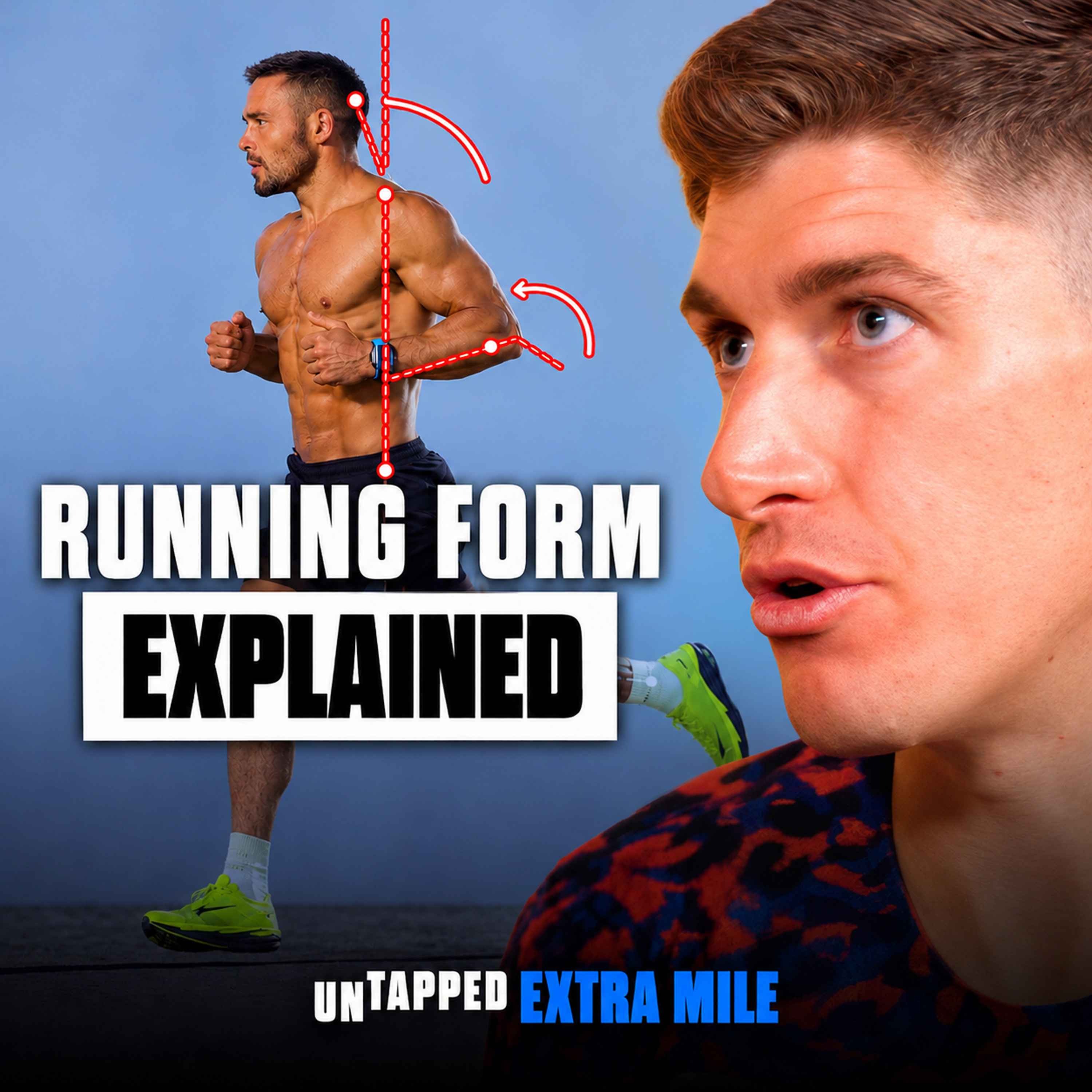

 UNTAPPED with Spencer Matthews
18 Jun 2026 · 36m · 12 chapters
How runners should think about carbohydrates—carb loading, glycogen depletion, and when gels help—plus how “zone 2” fat-burning relates to weight loss and performance.
No external guests; the hosts Spencer Matthews and Oli Patrick discuss with references to elite endurance athletes and sports science (e.g., keto/ketosis triathlete, “Stephen Scullion” and “Alistair Brown” as examples).
Carbs are foundational macronutrients; endurance intensity increasingly requires glucose from glycogen (stored as carbohydrate in muscle/liver). “Bonking” is linked to glycogen depletion (and also central governor/dehydration). Carb loading fills glycogen (roughly 4–600 g stored; ~600 g discussed as a “full tank”). Refined carbs can spike blood glucose; gut training and gradual carb increases matter. Mid-race fueling (gels) helps prevent depletion and can reduce perceived fatigue via “carb mouth” effects. Gels often combine glucose+fructose to use different gut transporters.
A host’s past “bonk” during tempo-like 5K sets after low-carb eating; marathon “hitting the wall” around 30–35 km; carb loading with pasta vs pizza (pizza led to feeling “horrendous”); example fueling math (e.g., 1 g/kg/hour post-event).
Written by AI. May contain mistakes.
Exploring the role of carbohydrates in running and their demonization in diet culture.
“into more complicated structures, forming carbohydrate.”
Discussing how glycogen affects athletic performance and the impact of diet on energy systems.
“Interesting to hear that you can live without carbs.”
Debating the effectiveness of a ketogenic diet for endurance athletes and its implications.
“It's interesting that the example of the ketosis and the fat burning is an elite triathlete.”
Personal anecdote on the experience of 'bonking' and its relation to carbohydrate intake.
“that I could potentially pinpoint as to why that happened was because of a lack of carbs.”
Personal anecdote on the experience of 'bonking' and its relation to carbohydrate intake.
“Hey, it's Paige DeSorbo from Giggly Squad.”
Discussing how carbohydrate intake relates to running performance and weight loss mechanics.
“and noticed a dip in performance almost immediately, you know, and it wasn't a case of, oh, wow, I feel slow or I can't quite get the pace.”
Learn how heart rate zones affect fat and carbohydrate usage during different training intensities.
“So you were still, what was your zone two?”
Learn how heart rate zones affect fat and carbohydrate usage during different training intensities.
“75 % of women who seek menopause care don't receive it.”
Explore the concept of carb loading and its impact on glycogen levels during marathons.
“That hitting the wall is essentially, as I understand it, and please feel free to correct me, that your body has ran out of glycogen.”
Learn about the optimal strategies for carb loading before races and the impact of carbohydrate types on performance.
“And that, again, will be all the training you're doing now is increasing how much you can use fat at higher intensities of workload to allow you to run a two-hour 45 with, yes, carbohydrate, but some contribution of fat.”
Discover how to train your gut for optimal carbohydrate absorption and the importance of post-exercise refueling.
“We used to think with carb loading, you had to completely deplete your carbs and stop training.”
Explore how different sugars are absorbed in the gut and the role of gels in enhancing athletic performance.
“So we're just going to be careful that we're not giving ourselves dodgy tummies by misjudging which carbs.”

Get the gist, explore an idea or ask about something said.
 Claude
On UNTAPPED with Spencer Matthews, what are the key points of this episode?
Searching your listeningAutomatic transcript. May contain errors.
0:00Hello everyone and welcome to Untap the Extra Mile with me Spencer Matthews and me Oli Patrick. Today we're talking carbs. Carbs. I love carbs. So do I, thank God. So listen we've all heard the term carb loading. What are carbs actually doing when we run and how does your body use them? We, the carbs got demonized didn't they? Carbs fell foul of diet culture and people were like no carbs before marbs, which I believe was no carbohydrate before my holiday in Marbella. Marbella? Marbella, even. Marbella. Marbella, that's my Versace moment. So, principally, carbohydrate is one of our foundational macronutrients.
0:44So, it is little molecules of glucose bound together into more complicated structures, forming carbohydrate. And carbohydrate, protein, and fats, these form macros. Why carbs are interesting is they're the only real macro that you and I can live without. So we do need protein, protein, the building block of the human machine. We make proteins, but we need protein for growth and repair, obviously. Protein sources, of course, your animal meats, your dairies, your things that could be made from soy, so tofu, and various other vegan options. And then we've got fats, which are also an essential nutrient, you of our cells, membranes are made from fats.
1:22Our brains, as we sit here, remain made pretty much from fat. So fat is a critical nutrient for cells, for immunity, for general health. But carbs, this sort of molecule of sugar bound together, we can live without because we can make carbohydrate from fats and proteins. Isn't it strange that diet culture has changed so much over the years, but also the advice has just varied, you know, enormously, drastically, you know, people, eating no fat and, you know, less fat in certain products. And, you know, as you say, completely cutting out carbs and all these different diets. We needn't single out individual diets and go into that perhaps as a conversation for another day.
2:06But today, just focusing on carbs. Interesting to hear that you can live without carbs. I didn't know that. Could you be a great and fast runner without carbs? That is a great question. And the general theory would be across a population, probably not. Because when we've spoken previously on this podcast about energy systems, you know, when we're burning fuel at low intensities, if you and I sit here now, you know, in a relatively fasted state, neither of us have had a big brekkie as far as I'm aware, and you know, we're deeper into the day, we're probably creating the energy to sit and talk using fat smashed together with oxygen, that's our energy.
2:47If we went out for a run, and we increasingly demanded more energy in our legs to power us and, you know, more energy into my heart and my lungs, you know, the whole system is going up. As that intensity rises, I can't just do that using fat and oxygen alone. I'll bring in the magical glucose molecule in its stored form, glycogen. So I store carbohydrate in my body as glycogen. When exercise intensity goes above a certain threshold, which the fitter I am, the deeper that threshold will be. But as I increase intensity, I'll need carbohydrate stored in my body releasing glucose, and that will fuel our athletic performance.
3:26So historically, the answer to that was no, but there was a big trend towards keto. Have you heard of keto? Of course, yeah, ketosis and, you know, primarily kind of existing off proteins and fats. Spot on. And I think there was a pretty significant triathlete who managed to do quite high level competition in a state of ketosis, which would fly in the face of traditional science. Now there is going to be again, genetic variability to that ketone bodies are interesting because they're this thing that you can manufacture again out of protein and carbohydrate, which are a really rich energy source, but often come with some cost.
4:01And many people can't either get into a state of ketosis or produce energy in there. But the old blanket, I would have said probably 10 years ago, no, any endurance athlete is predominantly going to need a significant volume of glycogen stores. And to do that, they're going to need a significant dietary intake of carbohydrate. But the science is moving as all things are. And maybe there'll be some people who can do without, but not the majority. It's interesting that the example of the ketosis and the fat burning is an elite triathlete. Because I suspect they're not kind of at threshold heart rate for the entirety of their race, particularly if we're talking about, say, an Ironman.
4:42Yeah. You know, the old adage, you know, I've got a certain amount of stored glycogen. When that runs out, I can't sustain energy at those high intensities. And lots of people would know that in running terms as bonking. Yeah. And so bonking really, amongst the concept of dehydration, is generally seemed to be this point when your stored volume of carbohydrate depletes and therefore you can no longer sustain, A, the exercise intensity you're working at, but also basic sort of brain function and you know you go your brain is the most glucose sensitive organ so your brain goes wobbly as much as your legs go wobbly i've only ever bonked say twice like when running uh never in an in a long kind of endurance setting only ever in a kind of tempo session you know in in the park like a training session bonked really early in in one session i I bonked towards the end of the first 5K set.
5:35I was setting out to do four sets of 5K at about three-hour marathon pace. It's like something that I could do pretty easily now, you know. And the only logical reason that I could potentially pinpoint as to why that happened was because of a lack of carbs. And I don't think I had eaten carbs for a few days even. you know, leading up to it. Maybe not even like on purpose. I was eating less. I was in a calorie deficit. I was looking to drop some weight. Carbs kind of, you know, took the hit. But again, it wasn't for any particular reason. I was just eating, you know, steak and eggs and stuff, you know, and probably getting carbs from somewhere.
6:18There'll be a little bit here and there, but no real complex carbs. But no, I kind of was avoiding large, stodgy pastas and big, you know, bowls of rice. And, you know, just because I was looking to drop, I can't even remember why. I think it may have been men's health cover or something like that. Whatever. I was just looking to kind of shred up. Hey, it's Paige DeSorbo from Giggly Squad. And this episode is supported by Rothy's, the brand famous for chic, comfortable flats. My listeners know I love to start an outfit with the shoes. And there's nothing better than a great flat in the fall. They're timeless.
6:49They make everything look more polished. And Rothy's iconic pointed flat, The Point, has been reimagined to be better than ever. It now has a cushioned bouncy insole with much more arch support, so it's comfortable enough to wear all day, and the point comes in so many gorgeous colors, patterns, and textures. Discover the point at rothys.com. That's R-O-T-H-Y-S dot com. If you felt stuck trying to lose weight, you're not alone. Enter Weight Loss by HERS. It's designed to support you in reaching your goals. And HERS now offers access to an affordable range of FDA-approved GLP-1 medications, including the WeGovi pill and the WeGovi pen.
7:27Even better, with a range of affordable GLP-1 options, HERS makes it simple to find an approach that fits your needs and your budget. If eligible, you'll get a treatment plan personalized to you and unlimited dosage changes as needed. It's weight loss designed to work with your life. Ready to reach your goals? Visit forhers.com slash eligible to get personalized, affordable care that gets you. That's F-O-R-H-E-R-S dot com slash eligible. Forhers.com slash eligible. Weight loss by HERS is not available in all 50 states. Wegovi is the registered trademark of Novo Nordisk AS. To get started and learn more, including important safety information, Wegovi clinical study information, and restrictions, visit forhers.com.
8:11I'm Jake Stouck, co-founder and CEO of Serval. We built Serval to automate the IT work that slows companies down. Onboarding, password resets, access to applications, my laptop stopped working. While employees wait for help, their real work is put on hold. IT desperately wants to automate this work and that's why they need Serval. You just tell Serval what you want to automate in plain English and it's built. No drag and drop workflows, no expensive consultants. Employees get unblocked and IT teams go from drowning in tickets to building what actually matters. With Serval, IT becomes the AI engine powering the entire company.
8:50This is a new way to run IT. We guarantee you'll automate 50 % of all tickets and we'll prove it to you in a free four-week pilot. Go to serval.com slash tickets. That's S-E-R-V-A-L dot com slash tickets.
9:15and noticed a dip in performance almost immediately, you know, and it wasn't a case of, oh, wow, I feel slow or I can't quite get the pace. It was like, I have to stop running. Yep. Like, like body just stopped. It was almost felt like a kind of I may pass out if I continue pushing. and yeah, so that was kind of a foreign feeling to me it's the first time I thought, oh wow because I used to run on an empty stomach all the time in the morning and used to quite enjoy a fasted run but I think if you're really looking to push your performance wherever that might be having glycogen stores I think can only be helpful the way I understand it and I've got a few specific questions about carb loading and glycogen depletion and reserves generally.
10:10I think having hosted Untappd now for a while and spoken to many elite athletes about glycogen and how carb loading works, my understanding of it is when you're in your zone two, you're burning fat. You're not touching your carbs or your glycogen per se. Your body is operating on energy that is not your glycogen, right? So if you are running with a heart rate of, say, in my case, you know, 145, even all the way up to 149, you know, whether you have carb loaded or not is completely irrelevant, right? You're kind of cruising and you're burning fat. anything past that, so into your zone 3 and tempo and threshold and beyond, into speed, you are depleting your glycogen levels and will require gels, carbs if you sustain that over long periods of time, say a marathon, or a half marathon or even a 10k, whatever, depending on how you're doing it.
11:17Well, they will look at gels separately because you will start to move into carbohydrate usage for sure. The question I wanted to ask you was people see and i know this to be true like zone two running and the burning of fat as an interesting place for weight loss yeah right so they they go i'm gonna run long and slow and that's gonna burn fats yeah you know and i can do that without carb loading so it's a great place to lose weight surely if you if you did say if you did the opposite and you only ran in you only ran tempo just for argument's sake yeah right with heart rate of you know 150 to 175 you know like and beyond yep surely you're still gonna lose weight if you don't replace the calorie how does it how does it work and why like you know i think it was julian huell the guy the guy who created who said to me, you know, if you're looking to burn fat, keep your heart rate below 150.
12:20And if you're looking to, you know, lose weight, that's just where you should operate. But, you know, you look at runners who are really skinny, who obviously run in kind of, you know, far beyond those heart rates. And Stephen Scullion and Alistair Brown, you know, they're all constantly pushing speed work and they're thin as rakes, right? So kind of like, and, you know, Elite marathoners are notoriously thin, light people. So they're not losing weight because they're running slowly. Agreed. So how does it work? And this isn't, by the way, a weight loss thing, and we will come back to carb loading.
13:00I'm just interested because a lot of people run to lose weight. So I think it's interesting for them to understand how that works. The mechanics. I think there's lots in there. And the first bit, you know, you cutting for a men's health cover. Of course, one of the great challenges with when we store carbohydrates, glycogen, is it stores three grams of water for every gram of carbohydrates stored. So if I deplete my muscle and liver glycogen stores, I lose both the weight of the carbohydrate stores and I lose the weight from the water. And that water would have a big impact on my aesthetic appearance.
13:36So if I go without carbs for a period of time and I carb deplete, I will probably look slimmer I'll probably weigh less but it's not necessarily a functional state to be in so put that there when we're at low end it's spot on and again not everyone's zone 2 is true fat burning so the more conditioned you are the deeper into your heart rate you can go the higher the heart rate the higher the workload and you remain in a true zone 2 we know you're zone 2 because you've done a gas analysis where we measured the volume of carbon dioxide you're breathing out and oxygen you're breathing in and we could see that you went into zone 2 much higher than your age-related predicted range is because you're well-conditioned.
14:12So you were still, what was your zone two? You got the range, do you remember? Pace range. No, heart rate range. I think my zone two ends at 150 beats per minute. Which if we did the sort of traditional, you know, 60 to 70 % of your max heart rate is going to be 15, 20 beats lower than that. So your zone two is much higher because of the volume of training you've done. So we've just got to be a bit of nuance. If we just use a heart rate zone, some people will be higher than zone two and therefore they'll be using some carbohydrate to manufacture their energy. And of course, the beauty of you and I is we've got loads of fat to clarify, to actually classify zone two.
14:45All that taken aside, in zone two, I am predominantly using fat as my fuel. So in that case, obviously it's harder to burn as many calories because if you're doing, say, speed work, you can't sustain it ordinarily for as long as you could sustain a zone two run. So you go to the track and you can run for, your session could be say 40 minutes of really intense speed work but you perhaps won't burn anywhere near as many calories if you go for a light jog for an hour and a half great example so let's imagine let's imagine they'll need replacing is what i'm saying and it depends on how you replace them totally and i think just on a pure calorie point of view let's imagine i did a zone two run i burnt 300 calories and 100 that came from fat so i burnt 300 calories of fat calories, fat is nine calories per gram.
15:33So without doing the maths on that wildly, let's imagine I've burned 30 grams. I'm gonna assume it's 10 calories per gram. I've burned 30 grams of fat. Let's imagine in that same training, the next day, I do a high intensity interval training session, I actually burn 600 calories. And of that 60 % was fat. So it's a lower percentage, but it's a higher absolute amount. So now I've burned 400 calories for fat, I put 40 grams of fat. So I've done a harder session with a lower percentage contribution from fat, but a higher absolute amount of fat burn. I know that's people again, just go, no, I'm off.
16:08I'm going home. What I'm saying is your body doesn't care about percentages. It never has. It cares about absolutes. So it's better to burn 50 % fat from a harder session than 100 % fat from a lighter session in the sense of when it comes to weight management, my body cares about absolutes not about principles so the the challenge you've got with that is if i do the high intensity interval session i might be hungrier than if i did the the zone two workout so we've got to also look at the way different sessions elicit a post-exercise return of fueling and i've also again got to just look at what the impact that training is on whether i am more sedentary that day whether i get my active steps in all these things matter you know and what we get with high intensity work is we get a bigger um post-exercise oxygen consumption we've heard EPOC?
16:52Yes. Yeah. So EPOC is really what is the sort of biological cost of the training session in its repair stage. So after we finish a really heavy hit session, I've got to rebuild the tissues that have been broken down. I've got to clear out all the metabolic byproducts of that session. That has an oxygen cost to it as well. So when you do high intensity work, you get a bigger EPOC. And that might mean more calories burnt as a totality over the next 24 hours compared to the zone two workout, which felt easier, but didn't burn me as many calories. So from a weight management point of view, we're interested in whatever you can do on a regular basis and match that against your dietary impact more than a carbohydrate discussion per se.
17:3475 % of women who seek menopause care don't receive it. The lying awake at 3am wondering what's happening to your body ends now. Midi is virtual care built for women in perimenopause and menopause with clinicians who specialize in women's health. Plus, it's covered by most major insurances. Getting started is easy. You can book your first visit with a clinician right away. Midlife needs MIDI. Visit JoinMIDI.com to book your first visit today. That's JoinMIDI.com. Insurance coverage varies. Check with your plan for coverage. In a world where AI is changing every role in every industry, knowing who actually has deep expertise matters more than ever.
18:11Upwork connects you with the highly skilled freelance professionals with proven track records, so you can hire with confidence. Upwork gives your business fast access to highly skilled specialists with deep expertise, so you can fill critical skill gaps, launch projects faster, and scale support up or down without committing to full-time headcount. With Business Plus, you can access the top 1 % of talent on Upwork. AI-powered shortlisting delivers a curated shortlist of top freelancers matched to your goals in under six hours. No endless searching required. Thousands of growing businesses already trust Upwork to hire highly skilled freelance professionals for everything from one-off projects to ongoing support.
18:49It's free to sign up and posting a job is easy. Visit Upwork.com right now and post your job for free. That is Upwork.com to connect with top talent ready to help your business grow. That's U-P-W-O-R-K dot com. Upwork.com. Who says Halloween only lasts one day? With Wayfair, one night of Halloween becomes a whole season at home. from larger than life yard decor and moody lighting to festive accents for every room in the house wayfair has what you need to make halloween feel like magic all in one place because the best halloween memories aren't made in just one night they're made all season long shop halloween decor now at wayfair.com that's w-a-y-f-a-i-r dot com wayfair every style every home
20:00Let's talk about carb loading specifically. so at a very basic level i think most people listening to this have heard of hitting the wall you hear about people hitting the wall at you know various stages of a marathon uh it's very common around the 30 kilometer mark yeah um 30 to 35k the theory behind that is that if you if you went into the race with adequate glycogen levels that that probably wouldn't happen if you are loading up well throughout the race. That hitting the wall is essentially, as I understand it, and please feel free to correct me, that your body has ran out of glycogen. If your glycogen levels are adequate, you should feel the energy to persist at kind of tempo pace, threshold pace, even, although hopefully not too much threshold on marathon day.
20:54But when that runs out, say you're not carb loading you're not gelling your body would then try to burn other energy sources and that kind of tacking over from burning this source to that source would result in you being essentially out of action during that period you know you would have to slow down stop you know if your body to to to manage that different combustion love it you're rubbing off on me i think that's a very fair take. I think the wall itself is a more complicated as you said, it's a bit of psychological self-talk, it's central governor theory, it's dehydration, it's wear and tears, all those things.
21:34If we're looking at glycogen depletion, that's very real around that period of time. So we will eat carbohydrates and we will then be able to store at Grasso. We'll wolf down, you know, mama's meatballs at Grasso and lovely protein in the meatballs, but lots of, again, quality carbohydrate in the pasta. And then we will store that. We'll turn that into muscle glycogen and liver glycogen. So we've got two main places where we can store carbohydrate, like a little hamster tucking away its food in its cheeks. And we've probably... In fact, the more muscle I have, the more glycogen I can store. So people with better muscle mass would be able to store more carbohydrate than someone who's not.
22:13That's another, again, incentive for having lots and lots of good quality tissue. That's interesting, isn't it? But also that would make you heavier, right? So that works against your running economy. Spot on. So there's always a sweet spot between too little, too much. And that's true of almost all things physiological. There's a sweet spot, nothing too much, nothing too little, just right. We're just a couple of guys that like physiology. We're just a couple of guys who like physiology. So here we are with muscle determinants. I'm consuming my carbohydrate. How much glycogen can I store will depend on many things, biological sex, size, muscle mass, but somewhere between sort of four and 600 grams of carb is what I can probably store as glycogen.
22:52So 600 grams of muscle glycogen with about four-fifths of that being in my muscle and then about a fifth of that being in my liver. Shall we just in theory discuss what the perfect carb load might look like? So 600 grams feels really light to me. Well, that's how much you've stored. So again, you can consume. To get your stores to be full, you might need it to have eaten a significant amount because not every bit that you eat is going to translate to muscle glycogen. So you're spot on. There'll be days where you loaded north of 600 grams of carbohydrate, or you'd certainly be working hard to pile it all in.
23:25That's a big old day. It's a big day. But there can be big, big days of loading. What you can store is going to be down to that storage. Now let's play out again. Sorry, so 600 grams is a full tank? That's a pretty full tank. And again, some might be bigger, some might be less. But let's take 600 is not going to be, I don't think anyone, and there'll be better sports nutritionists than I. How much is, say, just a large bowl of delicious vodka sauce pasta? Traditionally, if you're doing pasta, a sort of home portion would be somewhere between 100 grams of pasta. But that would be a relatively meager.
24:01If you think of most people would buy a packet of pasta and there'd be 500 grams in there. In the full pack. In the full pack. So if you're the sort of person who that takes two meals, you're doing 250 grams. If you're the sort of person who divides that between a family of four, you're doing 125 grams each, you know, so that gives a bit of a sense. And again, you got to look at what you consume over the course of the day, not in the meal. But you've got 600 grams of carbs stored, each gram of carbohydrate can generate four calories of energy, right? So what you've effectively got is 600 times four, you've got 2400 calories of carbohydrate available, stored.
24:35Think of a workout. So a good workout, there was the insanity workout, remember that a few years ago, which was, can I burn a thousand calories in an hour? And that became a bit of a yardstick in the hybrid training routine because I want to do a thousand calorie workout. And people might work that out by what the machine says or what their heart rate monitor says. But if I'm combusting at a pretty high intensity rate, it's not unfeasible. I could be towards a thousand calories an hour. Yeah. I mean, that's, that's, that's fairly standard. It's fairly standard. So if you're running at high intensity, what are you seeing in terms of estimated calorie burn per hour?
25:08Sometimes not enough. I ran like a steady 12K yesterday that was like relatively fast and I burnt 900 odd calories in 51 minutes. Perfect. Okay, great example. So let's say a thousand calories in an hour. So here you said people sent a bonk about 30 kilometers in. If I'm using predominantly carbohydrate because I'm running in a heart rate zone that isn't using much fat but is predominantly using glycogen, then I'm going to run out of that 600 grams, which is a pretty optimistic dosage based on good muscle mass, good carb loading, at around two hours 35 in, which for some people is going to be 30k, for other people it's going to be 20k in, whatever it might be.
25:53But if I'm running on carbs, I haven't got a finite store of that. If I'm running on fat, I've got kilograms of that stuff kicking about, mostly around my ass, according to a recent MRI. So I've got an ass full of fat, you know, on top of my glutes rather than internally, as I should say. I've got a fat butt. I've got a little bit of extra timber around my midriff. That is calorie dense, right? So every gram of that gives me nine calories, and I've got billions of it. Every gram of carbohydrate, you know, I've got four calories, and I've only got 600 grams. So this is about running economy. It's about all these things.
26:32But this is where you go, I want to enter my event with stores of glycogen that are appropriate for the demands of my event. If I'm running a 5K, I'm not going to go through those glycogen stores. If I'm doing an event, probably, and we used to think... So you're really not burning any fat when you run a marathon then, because, you know, it's not like you're... I mean, you may warm up briefly before it and jog a K or two or something. So, you know, whatever, sure, you'll burn some fat then. I mean, like, from crossing the start line, you're broadly speaking going to push yourself to... well, you'll be at your race pace immediately, right?
27:03So kind of for most people who are racing, you will be in zone three, and that will creep up probably to zone four. You know, you shouldn't be in zone five really at all. And some people do manage to go in there. And again, I would defer to Stephen on things like this in terms of where you should be for your optimized marathon performance. Anything less, by the way. sorry to interject, you know, 5k, you're, you know, max heart rate, max heart rate, zone five, you know, whatever. 10k, probably about zone four, you're probably not max heart rating in that. I wouldn't have thought, well, I mean, obviously some people will, but you know, essentially the longer the distance, the less borrowed time you want to be on.
27:52Spot on. But that's the point. So the longer the time, the more I need to depend on fat, because my carbs won't get me there. And therefore, I've got to find an ability to use fat oxidation. And that, again, will be all the training you're doing now is increasing how much you can use fat at higher intensities of workload to allow you to run a two-hour 45 with, yes, carbohydrate, but some contribution of fat. So it's never, again, pure. If I'm raw zone 5 sprinting, it's just anaerobic glycogen. If I'm walking, it's probably predominantly fat, but in between, it's a blend. What about... So we're looking at carbs just as a food source.
28:34What about different kinds of carbs? Or roughly speaking, are they kind of all the same? So if I'm looking at the ideal way of carb loading for a marathon, say you've got the marathon on the Sunday, you may start carb loading properly on, say, Thursday, Wednesday, Thursday, Friday. You start to build into it. maybe with like a really heavy carb day on the Friday, maybe less so on the Saturday, just so that you don't feel, you know, big and bloated morning of your race. You know, I've had a few people in here who suggest that just, you know, boring old bowls of white rice are the way forward. You know, I carb loaded for Berlin on pizzas.
29:21I won't do that again. No, not bad. I probably had seven pizzas in the kind of four days leading up to the Berlin Marathon. And I have to say, I felt just horrendous. We don't need our sports nutritionist friends dialing in to say, it matters what's the quality of the car. It does matter. If I have a pizza, I'm aware, by the way, obviously, that the pizza has tomatoes and sauce and whatever else on it. And, you know, possibly some protein. I'm not talking about that. So the pizza dough and a bowl of white rice versus a big bowl of, you know, carb-dense vegetable. Like, does your body know the difference between those things?
30:06Yeah, it will do. Between pizza dough and pasta? It depends on how refined the carbohydrate is. So let's imagine we had 100 grams of carbohydrate from something that was very sort of white flour-based and something that was more whole food-based. So something made with a brown pasta versus white pasta just to be nice and straightforward. The brown is brown because it's got more fiber left in it, which means it will have a lower glycemic index, which is what people used to talk about in the early 90s as a major sort of dietary modality. But glycemic index is how quickly will the food turn into sugar in my bloodstream.
30:39And table sugar was always the yardstick of that. Table sugar had a glycemic index of 100, which means I basically put it in my mouth, and then it goes, because there's nothing to break down, it sort of immediately enters my bloodstream so it's a rapid turn from mouth to blood fab though fab if you are having just worked or just about to work not fab if i create a huge influx of glucose when my body is sitting doing nothing because that creates a metabolic challenge and this is where you get into the science of blood glucose spikes and that became a great demonized trait in the weight loss industry that i don't want these glucose spikes take that side what i don't want to do is create a huge surge of blood glucose outside of the context of physically active behavior so i should have either just trained i'm just about to train because what i don't want is your blood glucose going to some crazy high number let's imagine i want it normally somewhere between four and six i don't want it up at 12 or 13 or your body's going to rush to get rid of it and move it into different places now hopefully there's space in your muscle and your liver to pack it in.
31:42And here's the challenge. Let's imagine you and I both had 100 grams of a white bread or a white pasta, and you've just trained, you've got more muscle mass, you're training later, you've got a completely different environment for where that glucose is going to be stored, where it'll be packed back into your muscle, packed into your liver, whereas I've done nothing. So my glucose rises up and it knocks on the door, it goes, right you fat bum twat you know I'll come in can I get in there? and he goes no because I'm full already and then it might convert that glucose to fat tissue and it has that process to store because it can store more energy in fat because it's a higher energy molecule for example what we basically move into is how refined the carbidrin will affect how quickly it enters into your system and that could create a metabolic challenge when it shouldn't do and again it's also complicated isn't it?
32:32but it isn't Just eat whole foods. And ultimately, what you'll see is your elite athletes will be eating lots of sweet potato and lots of... And they'll be eating food... Hummus? Hummus is, again, a good source of protein more than anything else. But hummus with flatbreads. Oils and fat. Oils and fat. Lovely carbs. So what they're going to do is slow down how quickly the glucose goes in. So if we both have white pasta, but on my white pasta we put something that's got a protein-based source and it's got some fat in it, the same glucose will enter my bloodstream slower because those different macros get in the way of the glucose process.
33:08It's going to boil down to two things. You don't want to do anything your gut isn't ready for. So what you don't want to do is go from eating white breads to suddenly having brown pasta. You don't want to go from eating, you know, 100 grams of carbohydrate to eating 400 grams because the gut, its ability to take that food and turn it into glucose is trainable. It's that's the thing that most people get wrong, that they suddenly whack in either a massive new dose of a different carbohydrate, and then they shit themselves in the marathon. Because that's their body's like, well, what the hell? What the hell are you doing?
33:40What am I supposed to do? Well, what the hell? What the hell? What the hell? And that piece does matter. So gut training, and that plays into the fact that let's imagine you ate whole foods in a consistent fashion, you increase the dosage of those in the three days before. We used to think with carb loading, you had to completely deplete your carbs and stop training. And the general science, as I understand it, is that that's no longer the case. You haven't got to fast yourself and then feast yourself. You just increase the carbohydrate volume. And then the question being, let's imagine you stored 600 grams of carbs and your race is going to last three hours.
34:13You probably are going to need to take some carbohydrate in during the event to offset the chance of that depletion happening. And that's led to the new science of mid-race fueling, which seems to have two benefits. The first is when your carbs, you may not run out of 600 grams of glycogen, but if your body spots it going low, it can have an impact on your perception of fatigue. And equally, when we put carbohydrate into our mouth, your brain realizes more glucose is coming and actually delays fatigue irrespective of your blood glucose levels. Isn't that amazing? It's like carbohydrate mouth washing, something like that.
34:47So the gels themselves work on two facets. They stop you depleting to the point where your body would go, hang on a minute, Spencer, slow down. and they send a message to your brain going, sugar is here, keep burning the candle. Clever old machine, isn't it? It's a wonderful beast. It is though, isn't it? I love it. It's genius. Like, one thing I have to say is it's just astounding. Isn't it? Isn't it the most amazing thing? You're the living, so you're feeling all these things out and others, you know, you're right in the zone where this is relevant to you. Do I need a carb loading strategy for someone who's already eating most of their meals out of carbohydrate, isn't depleting glycogen stores on a regular basis and is going to run a park run at the weekend?
35:28No, I don't, right? And so I think we've just got to be really aware that most people, if we're looking at most people's nutritional challenges, most people will over-consume the wrong type of carbohydrate, refined carbohydrates in ultra-processed food. That's a big metabolic and performance challenge. But carb loading is, you are the guy, right? Who's going to be trying to stay on the red line to achieve a particular sports performance target. So you eating an increasing volume of carbohydrate, you fueling carbs as you're training, you training your gut, this is deeply relevant to you and anyone out there who's leading a life similar to yours.
36:02So we've been quite specific about, you know, somebody who has a very clear, you know, goal and is really looking to understand this stuff. For your kind of, you know, everyday person who works, you know, full-time job, who perhaps runs a couple of times a week, who isn't training for some big goal, but enjoys a bit of running, what kind of things could they be looking out for to better their relationship with carbs? I think they probably don't need to worry too much about them, truth be told. I think there's actually a bit of a difference here between biological sex that we've seen in studies that lots of biological females undercarb, and historically carbs and females haven't been best friends.
36:48So we've seen that there is an underfueling of the female population when it comes to carbohydrate. And I think that's something they could look at addressing, making sure their carb intake in the days before an event is sufficient to store, again, sufficient glycogen. I think the average person, if I'm working in the red zones, if I'm zones three, four, and five, if I'm feeling that burn, I've probably got enough carbohydrates to do it, unless it's sort of a half marathon marathon. But I would certainly want to refuel afterwards. And that post-training refueling. So, you know, we look at any after an event, we're looking at rest, we're looking at rehydration, and we're looking at refueling.
37:23And I might want to take as much as four grams of carbohydrate per kilogram of my body weight over the course of the duration after the event. Now, that would be a struggle for most people, but you'd look at one gram per kilogram of body weight per hour. So if I were 100 kilograms, I'm doing 100 grams of carbs, first hour, 100 grams, second hour, 100 grams, third hour, 400 grams in total, that would be a refueling strategy. that someone might then be back to full glycogen, you know, liver and muscle, ready to rock and roll the next day. If they don't want to go and do some endurance event, which requires, you know, good stores of glycogen, then they don't need to do that.
37:59But if I'm you, you're re... Again, we're going to come back to you. You are the perfect person to talk about this carb loading because your sessions are going to deplete them. Your post-exercise refueling, rehydration and rest has to be on point. So when you come back to the next session Stephen's devised for you, you are not bonking when he's asking you to stay in those difficult zones for durations of time. But the average person shouldn't fear the carb. They probably don't need to carb load for the basic sessions. If it's below 45 minutes to an hour, they may not need a gel. But if they do need a gel, it's probably for the psychological benefit of the mouth washing and the perception.
38:31And they should, again, consume carbohydrate post-event if they've burnt it during the event and carbs for the win. And within carbs, we've got fiber. So we're just going to be careful that we're not giving ourselves dodgy tummies by misjudging which carbs. And that's a learned personalized response I think people need to trial and error with themselves, but not on race week, for God's sake. Or that could lead to all kinds of issues. All kinds of issues. And again, there's many reasons for gastrointestinal distress. And interestingly, you'll look in your carbs, and the gels are a mixture of often glucose and fructose.
39:06And the reason for that is the gut can only absorb as much carbohydrate as it's got the transporter to move the sugar through the gut. So when I take glucose, which might be a simple sugar, I've got one transporter that moves that into my body. And then fructose has got a different transporter. So I can basically take 60 grams of carbohydrate, I think over the course of an hour. But if I do fructose and glucose, I can do 120 grams. So the new gels are generally these combinations of different sugars because they use different transporters in your gut to move the glucose from your gut into the tissues.
39:41and that's why you'll see different gels made of different constituent parts each claiming that they're the best but it's the one that works for you is the one that works. That's a nice idea that I can double up on a bit of fructose. Yeah, yeah. If you need it. Oh, we need it. Oh, we need it. We need it. And so does the listener. Get yourself some fructose. All right, guys and girls and anyone else listening. Lots of love. We deeply appreciate you guys listening to this. We'll catch you next Thursday with a brand spanking new fresh episode of Untapped the Extra Mile.
40:39If you're a MyLowe's Rewards or MyLowe's Pro Rewards member, you get free same-day delivery. Honestly, Lowe's will make the run for you, making it that much easier to get what you need. Just place your order and Lowe's handles the rest. It seriously makes life so much easier, especially when you've already got a million things going on. Members get more at Lowe's. $25 minimum and loyalty membership required. Order eligible items by 2 p.m. subject to weight and size restrictions and availability. Terms at lowes.com slash shipping terms. Colon cancer is on the rise. It's the second deadliest cancer and the number one cancer killer of people under 50 in the U.S.
41:20Yet it remains one of the most preventable cancers. If you're 45 or older and at average risk, it's time to talk about screening. Cologuard Plus is a non-invasive at-home collection kit that requires no prep, can be completed in about 15 minutes, and is 95 % effective. If you've been putting it off, you're not alone, but timely screening matters. Let's talk about what isn't talked about. Talk to your provider or request Cologuard Plus online, Rx only. Hello, I'm Monica Reinagle, host of the Nutrition Diva podcast. Summer is here and with it, the hot and sticky weather. A morning working in the garden or maybe on the golf course can leave you more depleted than you realize.
41:59And plain water isn't always the most efficient way to restore the balance. That's where liquid IV comes in. Its science-backed formula is clinically proven to hydrate faster than water alone. Whether you're exercising, playing outside, or simply surviving a summer heat wave, it's an easy way to stay hydrated. Shop now at liquidiv.com. Liquid IV, hydration that goes wherever life takes you.
Spencer and Oli break down the truth about carbs for runners: what carb loading actually does, why runners hit the wall, how glycogen fuels performance, and when gels really matter. They also explore zone two running, weight loss, gut training, and how everyday runners can build a healthier relationship with carbohydrates.
Better Help 👉 Join Spencer in Saying It Louder with 10% off Betterhelp Therapy. Click here: https://highpfrmc.com/ut-betterhelp-au
Do Health 👉 For your long-term health. Head to https://highpfrmc.com/dohealth-ut-au to sign up now.
Postcode Lottery 👉 Discover how Postcode Lottery players are Powering Hope Together. Click here to find out more: https://highpfrmc.com/ut-postcode-au
Robinhood 👉 Head to robinhood.com/untapped to get started and claim your free stock.
Hosted on Acast. See acast.com/privacy for more information.