 Ask ChatGPT

Whether dietary supplements are necessary or just a fad; how to choose supplements based on actual nutrient gaps, correct dosing, absorption, and individual differences; risks of high-dose “mega” supplementation and placebo effects; safest evidence-based options.
Spencer Matthews and Oli Patrick (hosts). No other guests mentioned.
You can be nourished without supplements but it requires rigorous, individualized diet; most people don’t meet nutrient needs due to diet quality, food processing, soil nutrient decline, and gut/microbiome factors. “One person’s medicine is another person’s poison,” so supplements can help some while being unnecessary or harmful for others. Multivitamins may help broadly due to widespread micronutrient inadequacy. Avoid starting with products; start by tracking diet and identifying what you’re missing.
Creatine monohydrate (performance/brain energy; dosage may vary by body size and training). Vitamin D for people with low sun exposure. Omega-3 (EPA/DHA) for those not eating cold-water fish; caution against over-supplementing. Beta-carotene and vitamin E high-dose studies linked to increased cancer risk in smokers/at-risk groups. Creatine gummies lacking creatine discussed as an efficacy/labeling issue. Probiotics framed as potentially relevant after C-section vs vaginal delivery.
Written by AI. May contain mistakes.
Discussion on whether supplementation is necessary for optimal health and the complexities involved.
“What does the human body actually require in order to function at a high level.”
Identifying the three most beneficial supplements and their importance for health.
“It's also even more complicated than that, because we're all different.”
Spencer shares his personal supplement regimen and discusses its effects.
“But, you know, this industry is wild, right?”
Exploring the importance of personalized supplement dosages and genetic factors.
“I think let's unpick some of the ones you're on.”
Learn about the factors affecting the effectiveness of supplements based on individual needs and conditions.
“So dosages, when we think of a supplement, first thing is how big am I compared to the dosages that were evidenced in trial?”
Examine the challenges of maintaining proper nutrition and the implications of relying on supplements.
“you know, where can we find just great, clean stuff that works?”
Learn about the challenges of measuring nutritional deficiencies and the importance of vitamins.
“the financial ability to construct them, but also the literacy to know what good versus bad is.”
Explore the logic behind supplement use based on individual dietary needs.
“That food that I'm adding in, be it an omega-3, well, what if I eat three portions of mackerel a week?”

Get the gist, explore an idea or ask about something said.
 Claude
On UNTAPPED with Spencer Matthews, what are the key points of this episode?
Searching your listeningAutomatic transcript. May contain errors.
0:05Welcome to this week's episode of Untapped The Extra Mile with me Spencer Matthews. And me Oli Patrick. I will never guess. I love it. I just love it. Oli Patrick, what a legend. I just genuinely, I love spending time with you. You are like a human version of ChatGPT. And I just think it's awesome. It is a joy to be with you. I love talking about this stuff. We would talk about this stuff, whether there's microphones or cameras here or not. And I think there's more and more people who want to talk about the stuff that we love. So I'm thrilled to have the opportunity to discuss with you and everyone out there.
0:43And this week, we're going to be talking about supplements. Supplementation, do we need it? Is it a fad? Is it a phase? What does the human body actually require in order to function at a high level. Just to build on your previous point, whenever I'm in a black cab, which is quite often, I have an urge to call you and talk about like weird health stuff. And we do quite regularly. And we say, save it for the studio. Save it. Save it. Let's not have this discussion today. Let's wait until we're in the studio. Supplementation. What do you think about it? Do we need it? How useful is it? Do we need it?
1:19The word itself, you get your Sunday newspaper, you get the supplement. By definition, it is in addition to. So I think the great challenge is the word itself doesn't mean anything, right? It's in addition to. And of course, what we're looking at here is the human machine does require nutrients for our existence. You and I, we are operating a very complicated machine. And some of the activities that go on require elements from our diet. I require certain amino acids from the proteins I eat. I require, again, sunlight to help me make vitamin D. And the great question is, can I get all those nutrients that my body needs to work effectively through diet alone?
1:58And you've got to start with that first hypothesis. Can a human be nourished before we conceive of a supplement, an additional product or pill that's going to top up some of those nutrients? And I think my personal journey on that is, I think that the science is you can be nourished without a supplement, but you would have to work bloody hard. You would have to be so diligent with your intake of the different food groups at the right dosages without overcooking them, making sure your gut health was in great nick to absorb them all, making sure that you weren't burning through too many. And I think basically what we've got the sort of, you and I live in the real world, can you theoretically eat a diet that nourishes all the requirements of the body, from all the essential nutrients that we need to work.
2:41Yes. Does anyone do that? Not in my clinical experience. It's also even more complicated than that, because we're all different. This is the killer. So it's not like there's a blueprint that says, we all need this much magnesium, this much vitamin C, this much vitamin D, you know, this much protein, this many carbs, you know, like some people, some people operate better on fats than carbs. Some people need more of this than that. The old adage, one person's medicine is another person's poison is relevant here. What does that individual need? And anyone speaking about this will be going, maybe, and this could lead to, and this if we, you know, under certain conditions might.
3:19Anyone who goes, everybody needs vitamin D, as convincing as we, it says they probably haven't recognised that that will be wrong to some people. What is the new science of longevity supplements? So let's strip it back to just bare kind of essentials, if you will, as we've already said, probably not essential to everyone. But, you know, what are the three most commonly used scientifically proven beneficial supplements that people should take? Good question. And we sometimes have to separate nutrients or essential, you know, vitamins and minerals that are critical to our existence from from athletic supplements.
3:57So you and I live in a world where creatine will be part of every conversation electrolytes you know potential other elements so i think if we think of just where is the safest ground it's probably probably in creatine which is the most sort of researched supplement in the world vitamin d for people who don't live on the sort of aquatic um equator aquatic what's the what's the right word for equator well equator is is just the line that goes around the center that's what i mean you don't live on the equator basically Anyone who isn't getting bombarded with natural light, vitamin D is well-researched and probably critically important for most people.
4:35And then probably omega-3 would be propping that up. Fish oils. Fish oils, absolutely. So that omega-3 EPA, DHA, that you'd find in your cold water fish predominantly. You would say, look, the research is pretty compelling for folic acid and avoiding some development challenges in pregnant females. else. So, you know, when developing a child, there's a certain increased nutrient need. There's going to be certain nutrients for certain health conditions that have been proven to alleviate symptoms, etc. But your safest ground is probably creatine monohydrate, you know, omega-3, vitamin D, and even all three of those at inappropriate dosages in the wrong person could be counterintuitive.
5:13It's a killer, isn't it? It's just a killer. In a world where AI is changing every role in every industry, knowing who actually has deep expertise matters more than ever. Upwork connects you with the highly skilled freelance professionals with proven track records, so you can hire with confidence. Upwork gives your business fast access to highly skilled specialists with deep expertise, so you can fill critical skill gaps, launch projects faster, and scale support up or down without committing to full-time headcount. With Business Plus, you can access the top 1 % of talent on Upwork. AI-powered shortlisting delivers a curated short list of top freelancers matched to your goals in under six hours.
5:54No endless searching required. Thousands of growing businesses already trust Upwork to hire highly skilled freelance professionals for everything from one-off projects to ongoing support. It's free to sign up and posting a job is easy. Visit Upwork.com right now and post your job for free. That is Upwork.com to connect with top talent ready to help your business grow. That's U-P-W-O-R-K.com. Upwork.com. Waiting for your sign? Here it is. Shop Labor Day appliance deals at Lowe's before they're gone. Get up to 45 % off select major appliances. Plus, get free delivery, haul-away, installation and parts, and a two-year Lowe's protection plan on purchases of$999 or more.
6:38Labor Day deals are on now at Lowe's. In-store and online. Valid through 916, while supplies last. Selection varies by location. See Lowe's.com for more details. Losing weight can feel like a roller coaster, full of ups, downs, and being thrown for loops, like when someone brings donuts into the office, or your kids' dino nuggets start giving you that look again. That's why there's Noom. They combine GLP-1s to quiet the food noise with healthy habits that help you keep it quiet, even if you get off the meds. Their program is designed to make weight loss a smooth ride, helping you understand what drives you, so you can build better habits to not just lose weight, but keep it off.
7:18Noom. Lose for keeps. Get started at noom.com. Not all customers will clinically qualify for medications. Individual results may vary. But, you know, this industry is wild, right? So, you know, you take supplements. Yeah. I take supplements. I mean, I don't know anybody who doesn't take supplements. I think in the UK, we're at 40 % of people take supplements I think in America it's 70 % wow isn't that amazing it is and I'm pulling that from from a again a relatively trustworthy source that's crazy but you know this is the most interesting discussion when I talk about my background in physiological testing and I say well if I could test anything on you what would you want tested people say vitamins they say I want to know exactly which vitamins I need so I know whether that supplement is right or wrong when we look at your DNA we could say there are certain jobs in your body you're going to be crap at and certain jobs you'll be amazing at and the jobs you'll crap at might be supported by a particular nutrient so we might find you're really bad at a process called methylation and you need more of a particular form of vitamin B9 and B12 than someone else yada yada but that still doesn't know how much you eat it still doesn't know how big you are it still doesn't know how much you absorb and it still doesn't know how much you use honestly it's like I was really excited about this conversation i actually i'm i've i think it's it's it's all so complicated but let's break it down genuinely because i look i take creatine yeah good i take uh collagen interesting yeah i take my heights every morning so heights are really the vitals that's the multivitamin so it's a very high caliber multivitamin i take magnesium in the evening yeah that's about it i sometimes supplement with kind of additional protein, like protein powder, whey protein powder, whey isolate protein powder.
9:14Nothing like branded and flavored, just like, you know, just like kind of raw whey. Clean, try to be as clean as possible. Does any of it make me feel great? Yes. But is it a little bit placebo-y? Maybe. Like, it's interesting to me, right? I take it because I think it's good for me. Spot on. And when I scoop collagen into my water every morning, which, you know, doesn't mix particularly well and is a bit thready and doesn't taste great, I knock it back because I think this is good for my skin. It's good for my hair. I'm 37 years old. It's good for my nails. You know, this is generally good for me.
9:59When I look in the mirror, you know, having taken collagen for a week and I see a slight glow, I go, there's the collagen. Is it? Is it? And do people do this to feel better about themselves or is it scientifically proven to help? I think let's unpick some of the ones you're on. Creatine, again, most of your listeners will be aware of creatine and it moved from people who were jacked and heavy lifting to now perimenopausal, menopausal females. It's moved into the brain space. And we're just realizing that this nutrient, it's effectively something we take a little bit through our diet, through red meat particularly but actually the stores of creatine you have in your body directly contribute to energy in the brain that seems to have some role in mopping up damage and it is unequivocally proven as a performance and ergogenic aid so if something helps you be a better runner or a athlete be called an ergogenic aid and then someone's got to work out is it something that should be banned based on how much it increases performance but if you're lifting heavy running fast training want good brain health interested in retaining muscle mass and bone mass as you age.
11:02Creatine is - Which everyone should be. Which everyone should be. So it's a no-brainer. And that's why creatine in all its forms has become mass market for good reason, right? As we said, most researched of everything, pretty much. And I've looked at products that say you should have five grams of creatine. I've looked at stuff that says you should have 10 grams of creatine. I've even heard people saying that they're trying 20 grams of creatine a day. Do you have an idea of dosage? And does it depend on how big you are? You know, like all of this stuff to me is exciting and interesting because we're all looking to be, well, sorry, we're not all looking to be healthier and, you know, live better lives.
11:33But I think the majority of our listeners are interested in that, at least. It's kind of what the show is about. It's exciting and interesting, but there's just so much varying, you know, opinions. And it's hard to understand what to spend your money on nowadays, and what to buy and what to have and how much to have of it and i'm just hoping that you can shed some light on a kind of good mix of credible things that people should do you know that won't break the bank potentially as well i'm on it we're going to do that you know and again christen your point there again is let's imagine i was with someone last week who weighs 175 kilograms what those is he a powerlifter yeah he's very much in that world yeah so strong man oh wow of course yeah right yeah and again but what does alarmingly heavy how tall is he uh six foot eight yeah fucking hell yeah incredible six eight and 175 kilos yeah yeah it's incredible yeah can you imagine i can imagine i was there i know but i mean like imagine being the guy yeah well you know the guy is a is a globally renowned strongman so someone that you and i both know actually so it's a yeah it's it's tom stoltman oh okay but I mean that's it and again it was sort of well documented as up with him and his brother in Scotland can he like run on a treadmill or not like would he break the treadmill I mean he's an extraordinary athlete he really is but if you think about what dosage of a supplement it's a good example right if you've got someone who weighs twice of what you weigh the guidelines aren't the dosage per kilogram they're just the dosage so most people take five grams of creatine of course if you weigh twice as much it might be twice that dosage I think before we get into any of this if people want hyper-personalised guidance seek out a quality registered clinical nutritionist and for me that's just a no-brainer I'm going to come back to things I think are safe bets and logical but if you're going to be taking supplements for the next 40 years isn't a consultation with a professional probably worth it?
13:35and I just think it is because there are nuances when we move into what's called either mega doses or therapeutic dosages of supplements why would you do that without knowing where you're starting from and what you need. And that's a real challenge that I'll walk into a main, you know, mainstream health and, you know, health food store, and there'll be a thousand supplements, all at extraordinary high dosages without me ever working out what it is I need, not which label suggests it talks most closely to the problem I walked in with. I'll caveat that. So dosages, when we think of a supplement, first thing is how big am I compared to the dosages that were evidenced in trial?
14:12Then I've got the next question, if I take it in, how much of the actual ingredient was in there right there's a great debate it was it was triggered enormously by james smith um the broadcaster who went to town on creatine gummies because there was no creatine in the gummies he was buying so we got this question about efficacy which is a what's the recommended dosage b how should that be for my size c was there any of the active ingredient in that product right if there isn't five grams in the gummy then the whole thing's a mute process anyway then i've got d how much did i absorb right if i've got a dodgy gut it doesn't get in So if I don't absorb it properly, if I just crap it all out or pee it all out, it doesn't work.
14:49Then I've got E, which is what was my genetic requirement for it. I might be a genetic beast. I might be a genetic flower. Newt or beast. So I've got a component that says some people need more than others. Then I've got F, how much did I use? So I need more creatine if I'm doing reps and sets of training or if I'm sitting in bed all day. So here's the variables that goes, right, I'm not going to go out and go, you need 13 grams of creatine because the variables in play are so multifactorial. Who doesn't care about this? Supplement companies, because they'll go, our product is going to solve your problem without recognizing the nuance into this scenario.
15:25And all of those things won't be as effective, unfortunately, as actual food, because my body was never designed to encounter these nutrients in isolated forms. We have something called the food matrix, which means if I eat vitamin C, it's in a format that my body recognizing goes, I know vitamin C, i'll go and put it over there if i take ascorbic acid my body's like what's this i've never met ascorbic acid in in nature how do i know what to do with it where to store it so we we have yeah and we're going to try and rattle through this in a meaningful way the principle here again is we have to start it's just like it's it's like honestly it's a headache no no it's like i'm gonna lift this up i'm not saying that you are boring i'm saying that that it's it's it's almost impossible, right?
16:09It's just like, I'm a supplement guy.
16:37and scale support up or down without committing to full-time headcount. With Business Plus, you can access the top 1 % of talent on Upwork. AI-powered shortlisting delivers a curated shortlist of top freelancers matched to your goals in under six hours. No endless searching required. Thousands of growing businesses already trust Upwork to hire highly skilled freelance professionals for everything from one-off projects to ongoing support. It's free to sign up, and posting a job is easy. Visit Upwork.com right now and post your job for free. That is Upwork.com to connect with top talent ready to help your business grow.
17:11That's U-P-W-O-R-K dot com. Upwork.com. Most women have been there. Something feels off. You don't feel like yourself. Yet your doctor says everything looks fine. Spoiler, it's your hormones. Midi is a virtual care platform built for women by women and offers specialized hormone care from trained clinicians. Plus, it's covered by most major insurances. Getting started is easy. You can book your first visit with a clinician right away. It's not you. It's your hormones. Visit joinmidi.com to book your first visit. That's joinmidi.com. Insurance coverage varies. Check with your plan for coverage.
17:46Losing weight can feel like a roller coaster, full of ups, downs, and being thrown for loops, like when someone brings donuts into the office or your kid's dino nuggets start giving you that look again. That's why there's Noom. They combine GLP-1s to quiet the food noise with healthy habits that help you keep it quiet, even if you get off the meds. Their program is designed to make weight loss a smooth ride, helping you understand what drives you, so you can build better habits to not just lose weight, but keep it off. Noom. Lose for keeps. Get started at Noom.com. Not all customers will clinically qualify for medications.
18:23Individual results may vary.
18:28Because, we're about to talk about it, it's like, where do you draw the line between just commerce and a brand, a big shiny brand, like stuff that you'd buy in Holland and Barrett, right? That says, this is great for you and you should trust us for this reason, right? And it costs this. And we've been around for 50 years. And the thing doesn't even kind of get to your gut in the end, right? Or like it's a pill that, you know, the casing isn't right. So it decomposes quickly in your gut and it doesn't get the whole way to your colon. That's how Heights was created. Our friend Dan, who made Heights, realized that all of the many supplements he was buying because he was an insomniac and wanted to get proper nutrition, proper supplementation, couldn't because the pills that he was paying 220 quid a month for in Holland and Barrett didn't work at all.
19:18And it's to your point, the supplementation point, you know, where can we find just great, clean stuff that works? And I'm not looking for an answer from a company perspective, but just it is i i do i do find it frustrating yeah right because like we we get we get sent stuff i buy stuff yeah and you look at it and it's kind of it's almost like uh the problem with uh ultra processed food right it's like you know you you know that if it's a big shiny glistening brand that it's just gone through hell to get there right that it's not that it's not clean like organic stuff and i don't know supplementation i see as being potentially quite dangerous if people get it wrong well that that was people thought it might just be an expensive piss you know in terms of what's the worst case scenario waste of money and then a few studies that were quite important came out that showed actually there's one with beta carotene which is a form of antioxidants you get it in orange and and sort of bright red uh foods so carrots got loads of it in and red peppers be in there and and it it's an antioxidant that's quite involved in going to the skin and protecting from sun damage so people supplemented it but found that actually people who are smoking and supplemented it had a higher risk of cancer than those who didn't supplement with it.
20:31We found a similar thing with vitamin E that certain populations, when they took these vitamins, and some vitamins are what we call fat-soluble, which means they can, in excess, be stored in human tissues. Others are water-soluble, which means you're likely to pee them out if there's too much of them. And what we had is a few studies, you know, well over a decade ago that showed, actually, this isn't just a risk of an expensive pee. If you put a super high dose of a nutrient in, without considering where you started and where you're ending up, you could harm yourself. And I don't think that was as widely understood or popularized as it should have been.
21:01And it certainly hasn't put a dent in the scale of the supplement industry globally. And, you know, it rises and rises. But you can make a case for every supplement. You can say, oh, L-arginine, that helps make nitric oxide, which dilates your blood vessels. So avoid blood pressure. Oh, I'll take that. Or rhodiola could be good for depression and mood. I'll have a bit of that. Or beta-carotene means that really pale people like me might get a tan. I'll have as much of that as I can get. you know you can go into a shop and there's an argument for every single thing the question is a what am i missing in my current diet that's so absent someone goes to me ollie which supplement should i take i say first and foremost yeah have you considered seeing an actual nutritional professional if not you know that's first step if you don't want to do that then why don't you track your diet right and go of the essential nutrients that we know have a biological role in the body which ones don't you consume I don't I hate mushrooms I hate them I love mushrooms I know everyone does it's like being a Tottenham supporter and eating mushrooms means I've got a very small social circle I never get invited anywhere even my seven year old son hates Tottenham what have they done wrong I don't know probably and mushrooms you guys would get along great apart from the football yeah no he's got a real distaste for Tottenham he hates them He's only seven.
22:20He probably couldn't name them all. He doesn't know anything about them. He just doesn't like them. The one thing he does know is that he just doesn't like them. It's inbuilt. But the principle being, if there's a food group you don't eat, if you never eat any citrus fruits, you might need vitamin C. If you literally live on tropical fruits, you might not. Most people aren't starting with the problem. They start with the product, which is a vital point. But again, isn't it interesting that in order to have a really balanced diet, you'd have to put so much thought into that. Oh, my God. So I currently am taking these food from a company called Callow.
22:54And this is not an ad, by the way. No, no, no. It's just a great company, right? And they prepare my full four meals every night and drop it off at the house. Yes. And this is a service that anyone can buy into, can use on the Callow app. And that's all calorie counted, macro specific. I know exactly how many carbs I'm getting, exactly how many calories, exactly how much protein, exactly how much fat I'm getting on a daily basis. That's like organized by this company. When I'm eating this food, I notice, right, that it's quite balanced. Yes. There's different kinds of proteins, different kinds of carbs.
23:31There's different... And I look at it all in the morning and I think to myself, I would never eat like this. No. If I wasn't. You'd have to work. It'd be like a full-time job to eat like that. Yeah, yeah, genuinely. So to me, it's really interesting. Even when you're at your absolute healthiest, right, When I'm being, you know, what my wife would describe as a freak, you know, and like, yeah, well, you know, there's different kinds of freaks, but we'll actually, we'll keep it in health, right? So the purpose of today, a health freak we're talking about. I think that, you know, you're being as healthy as you can, right?
24:07So I'm having like plenty of eggs, plenty of nice single ingredient meat, you know, meat like steak, chicken, fish. you know i'm very fortunate to be able to to to to buy like this kind of organic lovely food that i can eat whenever i want which is which is great i realize not everybody can but like even when i'm being mental like that cooking vegetables and blah blah i'm probably missing half of what i need right at the very at the very least i would say some there's two parts to that one is the diversity required so we've got the macros which is your you know proteins your fats your carbohydrates, then you've got your, if you like, micronutrients, your vitamins and minerals.
24:44That's why you see a lot of companies promoting diversity, because you need so many different types of plant-based foods to get all the different families of nutrients at the required level. There's a big challenge, but even if you get this food right, there's less nutrients in the food now than there has been historically, because we're turning over crops so quickly, there's less nutrients in the soil. And actually, remember, you're feeding two people when you eat. you're feeding you, but you're also feeding your family of trillions of bacteria that live in and around you that are a huge part of our body's, you know, effective ecosystem.
25:15So all these beneficial bacteria are often collectively called our microbiome. So like, so honestly, this is an honest question. A huge portion of the population will grab like a sandwich and a pack of crisps and a chocolate bar from, you know, the local supermarket or corner shop for lunch and, you know, whatever, kind of every day. Safe to say that none of that food has any of the things that you're talking about really, right? Highly ill, you know, de minimis amounts. So how many of us are living in a complete, like, supplemental deficit? Like, like, like... Almost, I would literally, and bear in mind, you know, when I was involved in a high-end health assessment clinic would measure every marker of nutrition you could in people who were very fortunate to be able to afford that service.
26:05So they're pretty health literate, pretty well off. And I didn't find a single well nourished person in the 12 years of that clinic, and probably not in the sort of 13 years of clinical practice before that. That's heartbreaking, right? So I was very anti supplements on a personal basis, like do it through food alone. And anyone who doesn't start with food should be locked up, right? You start with food, you start with food, because when we look at diet, you know food is still our best opportunity to be nourished it really is and yes there are barriers to it in terms of the ingredient quality and and the literacy around cooking the right types of foods but we should still try because food itself is is you know a wonderful opportunity to to build wellness in so many different ways but you could eat a pretty good diet and there's not enough nutrients in those foods i think it goes without saying if you're going to cook some beautiful salad with chicken you've roasted yourself with fresh vegetables obviously that's the best option.
26:58But I reckon if you were to poll that and say what is better for you as a human being, like this chicken salad from the corner shop or this bottle of fuel, I reckon everyone's going for the chicken salad. Chicken salad's a bad example, maybe. It's a terrible example. It's a terrible example. The ham and cheese Sambo, you know, in the packet of what's-its. And again, the chicken salad's probably got... Chicken salad's also full of crap. The chicken's... almost little to no nutrients in the lettuce. God knows what spread it is. What conditions has that chicken been under? But we end up here. When was the last time that chicken was a chicken?
27:36Was it ever a chicken? We're getting philosophical. We're blowing everyone's mind. But that sandwich could be£1.50 and a hew could be£5. And you can't have a supplement discussion and a nourishment discussion without the socioeconomics of this, which is there is a poverty play to this. And the reality is that's both in the time that's required to make these foods, the financial ability to construct them, but also the literacy to know what good versus bad is. And we weren't taught enough of this stuff. This is a challenge we haven't got. If you aren't doing exercise, I can measure your low VO2 max.
28:14If you're not doing strength, I can measure low muscle mass. How do I measure suboptimal nutrition before it's malnourishment? If you don't eat any vitamin C, your teeth fall out, you get scurvy. If you don't get any vitamin D, your bones don't form, you get rickets. If you don't potentially have any omega-3, you might see some disturbance of your skin, depending on your genes and your environment. But the body doesn't really reveal a lack of nourishment in the same way as other behaviors would reveal themselves until they're grossly malnourished. And so what we've got is undernourished people.
28:43Undernourished people, but it's not one nutrient, it's all of them. And that's actually coming back to your stack. You're a very logical play for creatine, right? You do an awful lot of work in that, in what we call the phosphogen system, where you're using phosphocreatine, which is what you turn creatine into, to manufacture energy, plus the brain play, plus the data. Brilliant, box it off. Multivitamins. That's the most commonly asked question I would get, which is, should I take a multivitamin? And historically, the data sat on the fence on that, and increasing the data is suggesting yes. Because of this broad-scale, inadequate perfusion of vitamins and minerals, because the food system's changed, and we're more stressed than we've ever been in our guts, arguably through relentless antibiotic use and a slightly over-sterile environment.
29:27My gut isn't the rock star it was 50 years ago. Not my gut, but I'm not. I was just wondering when your gut was a rock star. It's always had aspirations of making its West End debut. We take all that in fame. We go, look, a multivitamin could be great. When you move outside of a multivitamin in creatine, the first question you've got to look at is,
29:51waiting for your sign here it is shop labor day appliance deals at lowe's before they're gone get up to 45 off select major appliances plus get free delivery haul away installation and parts and a two-year lowe's protection plan on purchases of 999 or more labor day deals are on now at lowe's In-store and online. Valid through 916, while supplies last. Selection varies by location. See Lowe's.com for more details. I'm Hannah. I've lost 75 pounds in 20 months with GLP-1s, plus diet and exercise. On Rowe, I've gone from struggling to run a mile to running farther every day. You can access FDA-approved GLP-1s online.
30:33Get the support you need to reach your weight loss goals. Go to row.co.weight to see if you qualify. I'm a paid Rowe partner. 20 % average weight loss in one year in non-diabetics with obesity or overweight with a weight-related medical condition versus 3.1 % in placebo-armed. Rx only. To stay informed about serious side effects, go to roe.co. Hello, I'm Monica Reinagle, host of the Nutrition Diva podcast. Summer is here, and with it, the hot and sticky weather. A morning working in the garden, or maybe on the golf course, can leave you more depleted than you realize. And plain water isn't always the most efficient way to restore the balance.
31:06That's where Liquid IV comes in. Its science-backed formula is clinically proven to hydrate faster than water alone. Whether you're exercising, playing outside, or simply surviving a summer heat wave, it's an easy way to stay hydrated. Shop now at liquidiv.com. Liquid IV, hydration that goes wherever life takes you. That food that I'm adding in, be it an omega-3, well, what if I eat three portions of mackerel a week? You know, I will have the requisite grams of omega-3. What if I never eat any cold water fish or any, you know, sort of potential plant-based sources of omega-3? Then that's a very logical supplement.
31:47And you can't, you have those two people sat next to each other. One person who literally lives on mackerel and sardines and anchovies. And the person next to them, you know, hasn't, you know, lives in the middle of England, hasn't seen the sea in 20 years, doesn't know what a fish looks like. Then those two people have a different need for omega-3. Right? I'm from the Midlands and I love anchovies. So I'm insulted twice. Well, good. Good, yeah. As you should be. You do look like you could use some omega-3. Oh, I need some supplements. Here's what's going to happen, though. You'll get the first person, right?
32:20You say two of them might suffer from a condition, and we see some benefit potentially of omega-3 to the brain because the brain is just a big ball of fat, or cardiovascular health. So the person who lives in the Midlands, who eats anchovies... this person in the Midlands could be a great person this person in the Midlands who's got a big bowl of fat hair so what's that the fat brain Midlander is out there is his name Todger Todger the fat brain Midlander is out there he goes I've assigned him a gender he goes I think I'll start taking Omega 3 because I'm having a bit of trouble with dry skin and I don't eat mackerel he's got dry skin he's not listen he's living alone he's a suboptimal person we've come to the conclusion that he needs a bit of help Todger is is clinging on for what I say next.
33:06It's on a lifeline. So he's got dry skin, maybe some potential inflammatory condition, like it might even be a psoriasis or an eczema. Bloody hell. He takes his omega-3, he takes his omega-3, some kind of reasonable dosage, a gram of EPA a day, and he suddenly feels like his skin is cleared up, he gets a whole range of cognitive benefits, and he goes on a social media platform and goes, oh my God, all this time, I was deficient in omega-3. Then Barbara, who lives on the mackerel fishing capsule of the world, wherever that is, and is eating 18 mackerel a day, goes, oh, I've got challenging skin.
33:45And she then takes a totally unnecessary dose for a problem she never had. And what we get is people, when you find your limiting factor, you'll be evangelical about it. But one person's medicine is another person's poison. And this is the challenge of supplements. And what we don't want to do from a supplement point of view is target one thing without recognizing we're this integrated holistic being. And another supplement that's risen enormously is, of course, probiotics. So capsules that contain the live bacteria that I don't get because I'm no longer vaginally delivered. So if I go through the vaginal canal, which people might have fond memories of, you nail down a whole load of bacteria and you populate your microbiome early doors.
34:25then you're crawling around in the dirt eating turd off the floor and suddenly you've got trillions of bacteria and you are a rock star or you come out through C-section you're locked into the cleanest room in history you haven't eaten bacteria by the time you're 13 then you need a probiotic the challenge again is what is my deficiency to know what is my solution that's the challenge and it's a killer you're one of the smartest people I know and it's just like there's too much I can't leave you feeling like that So I would go, look, the first principle is, you know, in this country, vitamin D, absolutely logical, you know, in winter months, you know, that's robust.
35:00Government guidelines on that, check the NHS website. You know, creatine. Do they know what they're talking about? They play the safest line. No one goes to the government guidelines, but I've got to say it, haven't I? I've got to say it. Do we, though? I'm the kind of person that would look at the government guidelines and go, I'm going to do the opposite of that. Do you know what I mean? Your candor. No, but genuinely, I would look at the Minister of Health and go, you are unhealthy. What do you know about health? There's no place to go. And again, this is why trusted voices, right? So go to a trusted voice who looks at that.
35:31That's us, by the way. We are that. We are that. In the world of nutritional science, there's lots of people I like. Rhiannon Lambert, she's extremely robust, from my opinion. When I say us, I mean you. But principally, there's good sources, right? But vitamin D is a no-brainer. Creatine, safe, taken at recommended doses. is omega-3 there's a strong case for it everything else should be based on if it is my problem so have i looked at my diet analytically using a free tracking tool what am i not consuming on a two weekly basis that's where my supplementation would start then in that supplement is it tested to be what's in there is what should be in there are they the effective dosages yes or no and has it got any evidence of impact that it turns up in my cells or my tissues and i think that bit of due diligence.
36:16Don't start with when you walk into the supplement shop, what this says it does is the problem I've got. I'm tired, so I need that. Or my hair's falling out, I need that. It's really challenging. Start with the nutrient you're deficient in, but do that by working out what you're not consuming through your diet and what you might need more of. That's where I would try and leave a note of positivity. It feels negative. Oli Patrick, listen, I love talking to you.
36:45I We don't have the time and we're going to need to call it on our supplement episode. Do send us some messages, send us some DMs. If you are finding these clips on Instagram, please get in touch. Let us know what you would like us to discuss on the Extra Mile. Also worth mentioning that we referenced a few brands in this episode. We, Oli, or I are not directly financially benefiting from releasing this episode with positive information or negative information about the brands. these are just our own opinions thank you very much drop us five stars in a review it helps other people find us we will catch you next week
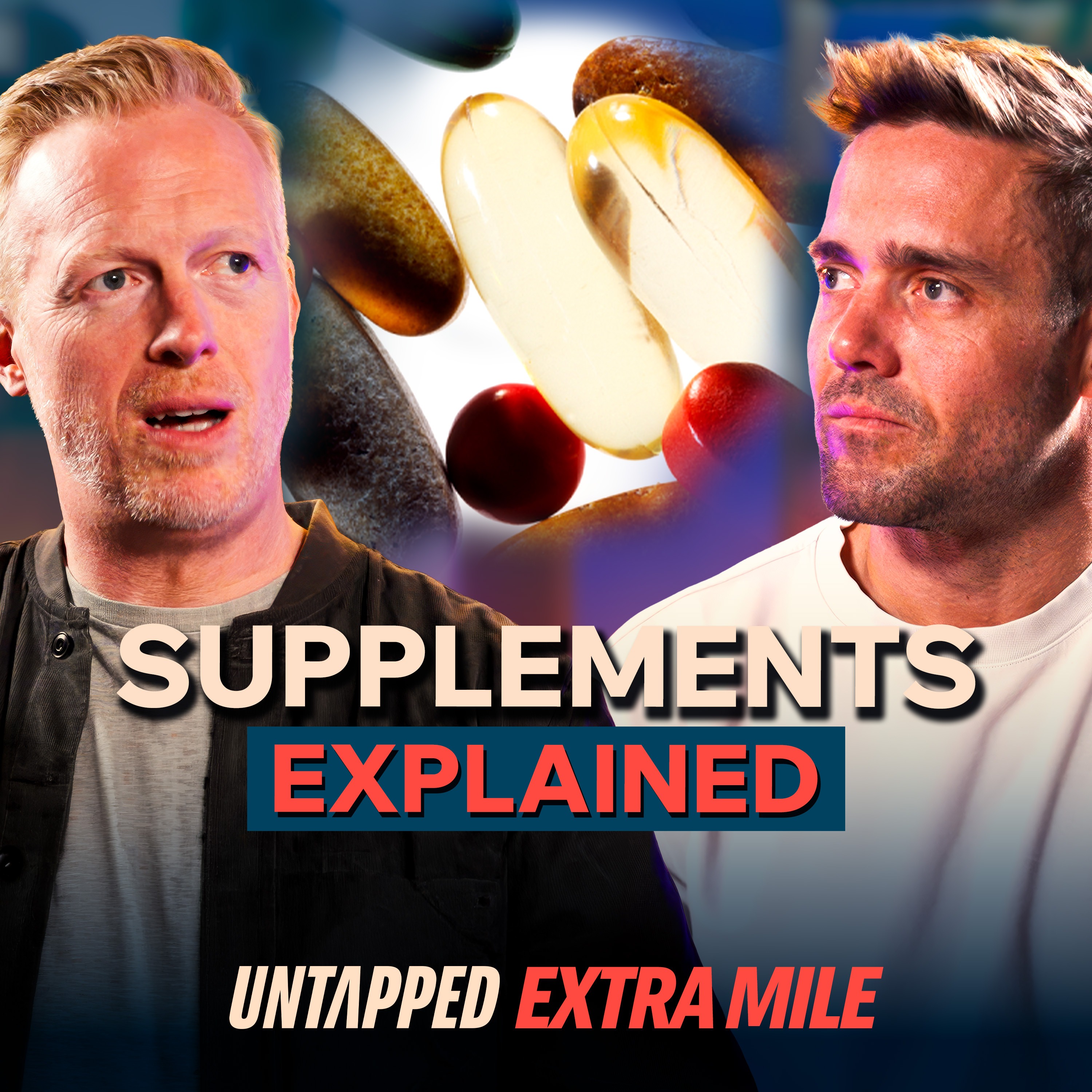
Spencer and Oli unpack the confusing world of supplements. Do we really need them, or can we get everything from food?
Oli explains the science behind some of the most talked-about supplements, including creatine, vitamin D, omega-3, multivitamins, protein and probiotics, while cutting through the myths, marketing and guesswork.
They also explore why modern diets may leave many of us undernourished, how to think about personalisation, and why the best supplement routine starts with understanding what your body actually needs.
Heights 👉 Stay sharp like Spencer. 20% off Heights with code UT20: https://highpfrmc.com/ut-vitals-au2
WHOOP 👉 Join Spencer in untapping your own potential with 1 month free here: https://highpfrmc.com/UT_WHOOP_au
Hosted on Acast. See acast.com/privacy for more information.