Ask ChatGPT
 UNTAPPED with Spencer Matthews
21 Jul 2025 · 49m · 19 chapters
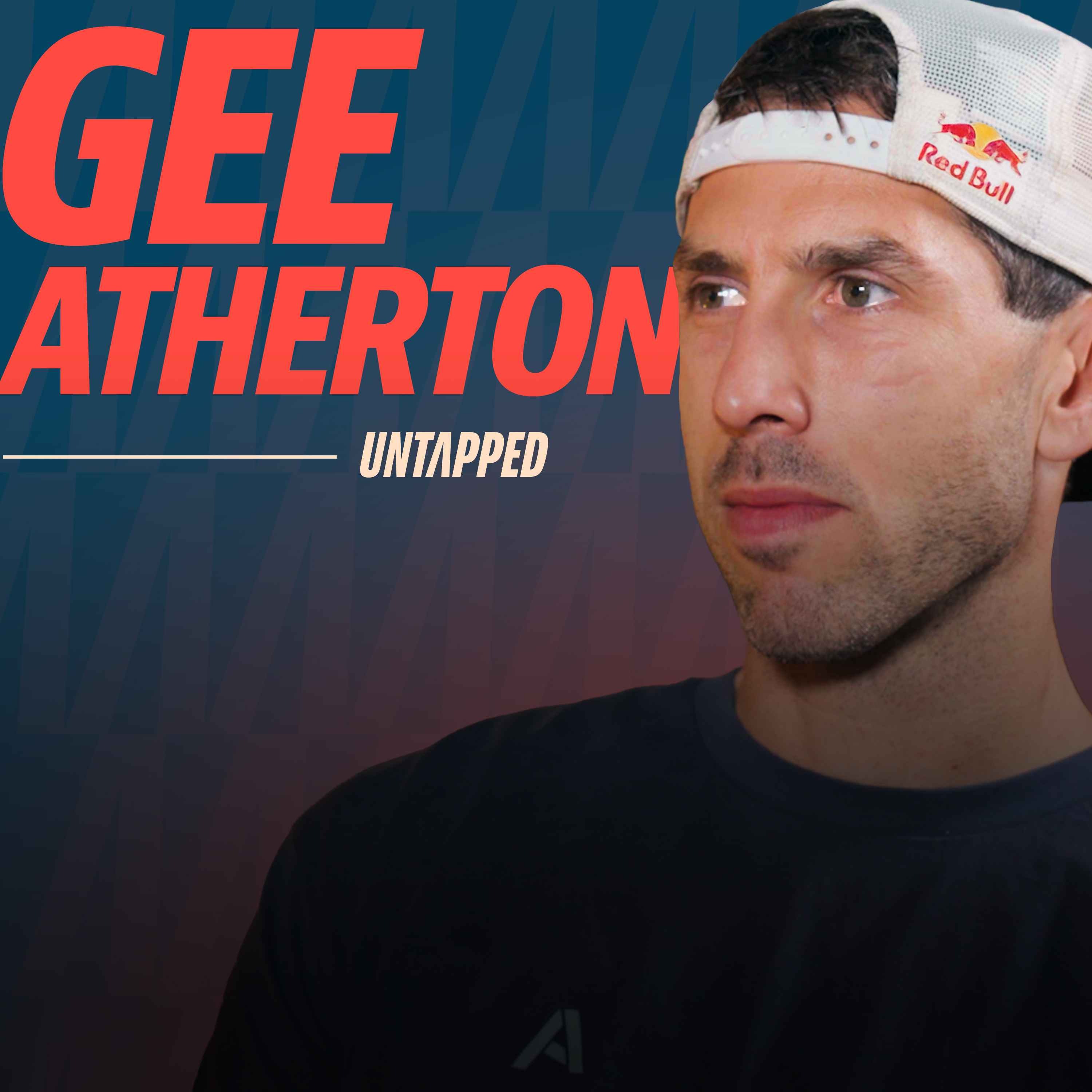
Gee Atherton, multiple-time downhill mountain bike world champion, discusses racing and Red Bull filming projects, his relationship with fear, resilience after near-fatal crashes, and how to push through nerves by being calculated and detail-focused.
Gee Atherton is a top downhill rider and big-mountain filmmaker; he rides extreme, exposed backcountry lines and races at elite level. He grew up with supportive parents and siblings who also raced: younger sister Rach and older brother Dan. Dan strongly shaped his mental resilience.
Fear evolves from excitement to something you must manage after repeated injuries. You need a personal “safety stop” where you pull back when risk becomes unacceptable. Pain during trauma is often forgotten, but training discomfort can be processed and overcome. Recovery depends on fitness and injury-prevention training (about 50% performance, 50% avoiding injury).
A “knife-edge” Welsh mountain crash—tumbling over 70 feet, shattering femur, rib cage, puncturing a lung, open radius fracture, eye socket and nose injuries; team kept him alive for 40 minutes. Later, a Utah Red Bull Rampage crash after a 70-foot drop led to occipital condyle injury and vertebrae damage, treated with a halo for three months. He also describes Kazakhstan Ridgeline filming where lines were too steep/loose to stop once dropped in.
Written by AI. May contain mistakes.
Gee Atherton discusses the nature of downhill mountain biking and its obstacles.
“I'm only grinning ear to ear because whenever I come across clips of you doing this or, you know, your peers doing this, you literally can't take your eyes off it because it's just so extraordinarily dangerous, it seems.”
Gee shares his complex relationship with fear and how it drives him in racing.
“Did you push each other as kids to go harder and further?”
Gee reflects on the importance of knowing limits and managing risk in biking.
“To start with, you have to be willing to put yourself on that line and willing to take those risks.”
Gee recounts his near-fatal crash, detailing the injuries and the aftermath.
“And I had injuries to the level where I wasn't okay with it.”
Gee recounts his near-fatal crash, detailing the injuries and the aftermath.
“And the plan was to build this line down through the rocks, down through the cliffs, but there was huge drops on one side and steep rocky shoots off to the other.”
Gee discusses the nature of pain and its implications for overcoming fear in challenges.
“and I'm just lay there on the side of this mountain, you know, struggling to breathe, losing a lot of blood.”
Explore how pain is remembered and how it affects motivation during challenges.
“until until we can get evacuated out of there you mentioned that the actual feeling of pain is forgotten, that you can't remember pain.”
Learn how physical fitness contributes to injury prevention and recovery.
“so athletic and in such good physical condition.”
Understand the importance of resilience and bouncing back from failure.
“You know, what do you think kept you in the saddle?”
Understand the importance of resilience and bouncing back from failure.
“Hey guys, it's Drew from the comment section.”
Discover the role of family support and early influences in a competitive career.
“And also it just occurred to me that you must have had quite supportive parents to have all three of you like competitively riding.”
Gee Atherton recounts his traumatic 70-foot drop accident and its aftermath.
“You know, I didn't know what, but I knew I'd damaged this area.”
Gee discusses the mental challenges of recovering from injuries and the relationship with fear.
“Just no movement from the waist upwards.”
Exploring the current state and future potential of mountain biking talent.
“You're still competing at the highest level.”
Explore the emergence of young, talented downhill mountain bikers and their unique approach to the sport.
“Is there a middle ground or which one is the most beneficial in this sport?”
Learn how athletes prepare mentally and physically for demanding stunts and competitions.
“in sport, but the same in everyday life.”
Discover the intricacies and excitement surrounding the Red Bull Hardline mountain bike event.
“Well, we have some filming projects coming up that we're kind of working our way towards.”
Gain insights on pushing personal limits and the importance of having clear goals.
“Do you have any advice for kind of our listeners, on how they can potentially untap more of their potential?”
Gain insights on pushing personal limits and the importance of having clear goals.
“Hey guys, it's Drew from the comment section.”

Get the gist, explore an idea or ask about something said.
 Claude
On UNTAPPED with Spencer Matthews, what are the key points of this episode?
Searching your listeningAutomatic transcript. May contain errors.
0:00Welcome to Untapped with me, Spencer Matthews, where we learn how to untap our potential from people who've achieved and overcome extraordinary things. Gee Atherton is a multiple-time world downhill mountain bike champion whose viral films for Red Bull push the limits of what's possible on two wheels. After surviving a completely brutal, near-fatal crash during filming, tumbling down over 70 feet over jagged rock, he fought through the pain, rebuilt his body and returned to the sport that he loves. Today, we'll learn about fear, resilience, and how to open your mind and push boundaries to achieve your goals If you haven't already, please take a moment to subscribe to the show wherever you are Your support and joining our Untappd community helps the show grow And you'll be the first to hear about the incredible guests that we have lined up Let's get Untappd with G Atherton You're considered by many to be the greatest downhill mountain biker there is you hurtle down impossible routes at crazy speeds take us through just just what it is that you do well yeah downhill mountain biking you've you've summed it up well there basically hurtling down a mountain you start at the top there's a marked out course and it's fastest man to the bottom fastest man wins and there's jumps and drops you know tree routes and through forests and wet, slippery, dark, muddy, every obstacle you could think of designed to be put in your way to try and trip you up and try and upset you, you know?
1:28And then that's the racing side. And then aside from that, I do these filming projects, kind of big mountain projects, I guess you'd call them, where it's me and a couple of boys kind of heading into the back country somewhere, into the wilderness and finding the most exposed mountains we can to film on. I'm only grinning ear to ear because whenever I come across clips of you doing this or, you know, your peers doing this, you literally can't take your eyes off it because it's just so extraordinarily dangerous, it seems. Obviously, you know, we've had athletes who also have interesting relationships with fear on this show.
2:08And, you know, they have taken me through trying to understand that obviously, when you practice something your entire life, it becomes more and more comfortable. But, you know, to somebody who just looks at what you do, it just feels so raw and, well, quite frankly, life-threatening. You know, what is your relationship with the bike like? You had siblings. Did you push each other as kids to go harder and further? Yeah, massively. My youngest sister, Rach, and my older brother, Dan, both ride and both race, you know, very successful themselves. ourselves but the sport we're doing is it is you know inherently very dangerous and there's multiple times where you know I almost kind of stop and step back and think this is quite ridiculous this is almost designed to to hurt us at this point you know so the sport is very dangerous it is a difficult sport but it's something we've done all of our lives so I think because we've been so close to it and so focused on that fear and that danger, you know, you go into such detail with it.
3:16Sometimes you don't notice that danger as much, you know, because you're so close to it and you're so used to it and it seems so natural. How fast are you going? Oh, it depends. Some of the tracks, you know, 75, 80 kilometers an hour. We did a snow race, an ice race once. The speed trap on it was 120k, just drifting along this fast, hard packed ice. It's just wild. Yeah. Like, what would you say your relationship was like with fear? So does fear drive you at all? Do you love it? Does it grip you in ways that kind of keeps you coming back? Or, you know, is it that being close to death that you find interesting?
4:00Well, you know, let's dig into that. Well, it's a strange relationship. I think when I was younger, that drew me to the sport, you know, That adventure, that danger, that risk, that kind of sucked me in. And I enjoyed that element, riding my bike and thinking, wow, that was close. And again, that little buzz and that little heart rate. And that drew us into the sport. That's probably why we did it at that stage, me and my brother Dan. And we would push ourselves more and more and we loved that danger. But over time, I think it gradually, as the danger built, what we were doing got more and more extreme.
4:36it almost spun around like suddenly we were into this sport that was you know very dangerous suddenly you realize you need to find ways to minimize it and you know avoid those enormous injuries because what was fun as a kid and just bouncing around as it as it kind of escalated and got worse and worse and the injuries became you know bigger and bigger suddenly you realized right we need to find ways to minimize this and deal with this as well how do you find the line So like you're hammering down a very tricky course. You're right on the edge. You're one of the most competitive athletes in this space.
5:18So you like to win. You're not doing things at 80%, 90%. You're giving it everything you've got. The margin for error is tiny, I'm assuming. If you get the line slightly wrong or you go into a corner slightly fast, it's going to be not only are you going to lose the race, but you could potentially lose your life. or at least break a few limbs. At what point do you know you're riding the line correctly? And where does the extra edge come from? What makes you the best at this? To start with, you have to be willing to put yourself on that line and willing to take those risks. You often think you're kind of on the edge of what you can do, and often you're still very far away from it.
6:06You have to be willing to push yourself further and further and further to find where that edge really is and find where that line really is. Multiple times I felt, right, this is too much and this is too dangerous. When you put your head down and push yourself a little bit more, you find you can go further. Do you have a level of risk that you are willing to accept? Chatting to you is making me, for whatever reason, think about Nicky Lauder. and his relationship with James Hunt. And that those moments where they would race, but Nicky famously would only ever have a certain level of risk. And if it became any more than that, you know, wouldn't feel comfortable and wouldn't want to race, which I suppose is very, very sensible.
6:56And of course, he was the most incredible racing driver as well. And his appetite for risk is probably far supersedes the average person. And I'm just wondering whether you have anything in you that kind of, where you won't go for that particular corner, or you won't allow the bike to travel at a certain pace, or are you willing to die in pursuit of being, you know, the greatest? No, absolutely. You have to have that limit. You have to have something in you, you know, that safety stop where you say, right, you know, we are going too far with this. And I perhaps didn't have that to start with, and was just in this mindset of the more risk you take, the better, and just pushing myself as far as I possibly could.
7:39And inevitably, you come unstuck at some point. You're not invincible. And I had to learn that. I had big crashes. I had big injuries. And I had injuries to the level where I wasn't okay with it. It wasn't an acceptable amount of damage that I'd done to myself. So you have to have that, right, we've gone too far. oh, this is too risky. And sometimes I do pull myself back or the team that I'm with will say, this is too much, this is too dangerous. This isn't a project that's worth dying for. We need to reel it in. And that's difficult, because when you're in that moment, sometimes you do just want to keep pushing and chasing something that's always just out of reach.
8:23But you have to be able to pull yourself in and you have to say no sometimes. Otherwise, you know, you're dead. What went wrong in the knife edge crash?
8:58every time. I know I'm not the only one who struggled to find the right foundation or concealer shade, which is why I always shop at Sephora. They have the best brands all in one place with so many shades, coverage options and finishes, plus expert beauty advisors, free samples, and shade matching tools both online and in-store. So whether you're looking for barely there coverage or full glam, Sephora can help you find your match. Most women have been there. Something feels off. You don't feel like yourself, Yet your doctor says everything looks fine. Spoiler, it's your hormones. Midi is a virtual care platform built for women by women and offers specialized hormone care from trained clinicians.
9:36Plus, it's covered by most major insurances. Getting started is easy. You can book your first visit with a clinician right away. It's not you, it's your hormones. Visit joinmidi.com to book your first visit. That's joinmidi.com. Insurance coverage varies. Check with your plan for coverage. Hi, this is Monica Reinagle of Nutrition Diva. Today's show is sponsored by Nature Raised Farms. Grocery shopping can be a little overwhelming, especially if you're reading labels. And in my opinion, chicken shouldn't be complicated. Which is why I appreciate Nature Raised Farms. It's chicken that's just chicken.
10:11And their lightly breaded chicken nuggets are free from gluten, dairy, and soy. Look for Nature Raised Farms on your next grocery trip and feel more confident about your choices.
10:25So, you know, it's... Would you say that's probably your most famous crash and, you know, the closest you've come to things going wrong? Yeah, that was very close. I mean, things obviously went wrong. Yeah, it went wrong, but it was, you know, I just mentioned there an unacceptable amount of damage, you know. So the knife edge, we're filming this project on this exposed, gnarly, just a dragon's back of rock down the side of this Welsh mountain. And the plan was to build this line down through the rocks, down through the cliffs, but there was huge drops on one side and steep rocky shoots off to the other.
11:04So there was no way you could make a mistake or there was nowhere to make a mistake and recover from. And we started this filming project and we were chipping away at it bit by bit, working my way down this line, but it was awkward and it wasn't a smooth filming project. And the last day, as I dropped into the final kind of section of this mountain, of this chute, I just landed slightly offline and got kicked off the bike. And I get thrown. I just ragdoll down the side of this mountain. And every time I strike the ground, there's just sharp rock and broken slate and bedrock that's just cutting into my body.
11:47And it just chops me to pieces. Every time I hit the ground, another broken bone. Eventually, I come to a standstill and I've shattered my left femur, several pieces. It's kind of blown through all the muscle on the side of my leg there. I've shattered my left rib cage, all the ribs on the left, punctured my lung. I've blown my left radius through the skin. You can see the scar there where it came through. That's like an open fracture. Shattered my eye socket, broke my nose, knocked myself out. and I'm just lay there on the side of this mountain, you know, struggling to breathe, losing a lot of blood.
12:26And I remember as I was coming around, like looking at my body and thinking, right, this is a bit of a mess. We're in a tricky spot here. The team that I was with, luckily, were, you know, were pretty good. They were there, ready to help me and basically kept me alive on the mountain for 40 minutes until the helis managed to get to me. Did you feel much pain at the time or had adrenaline kind of taken over or when you were lying there clearly noticing the state that you were in, how did you feel? I definitely felt pain, but it's hard to say. You forget pain. That's something I've learned in my career.
13:05You don't remember pain as the way you do in the moment. But I remember being quite, I was quite practical about the situation. I remember thinking, right, you know, I'm in trouble here. I don't want to die. What can we do to minimize the chances of that? You know, things like my left hand was like swelling up because the trauma in the wrist, I was losing so much blood, it kind of restricted what blood could get through to my hand. So the guys had to like cut my elbow pad off and then drag it over the like broken bone on my wrist there and where they were holding me on the hill trying to stop me rolling was like they were they said they could feel my ribs like pushing into my lung after a while it's like guys I can't really breathe you have to move how you're holding me you know so it was always very practical we were just like right what can we do in this moment to to try and keep me in the best shape possible until until we can get evacuated out of there you mentioned that the actual feeling of pain is forgotten, that you can't remember pain.
14:12Is there a lesson in that for people to be perhaps less fearful of pain? You know, when we're taking on challenges or, you know, our listeners have that mountain they want to climb or that marathon they want to do, should they be less fearful of pain generally, given that, in your opinion, we can't remember it? that's a tricky one because you do forget pain. You know, I remember lying on a mountain. I remember looking at, you know, bones coming out of my skin. Obviously, I remember that being unpleasant, but I don't remember the pain from that moment. You know, I don't remember how much it hurt.
14:49So I don't think you can say, you know, don't worry about pain because you'll just forget it because that's not enough of a motivation to injure yourself, of course. There's no reason to, you know, nobody wants to be hurt whether you remember it or not. But I do think it's a good example of how well your body can cope with traumatic experiences. And I'm not talking about injuries as such. I'm talking about when you're training or doing an event and you're having to push yourself and you're uncomfortable, you're hurting, whether it's running or cycling or swimming or anything, your body will cope with that difficult environment that you're putting in.
15:30your body will be able to process that difficulty that you're feeling, that pain or that discomfort of training hard. You'll cope with it, you'll deal with it, and you'll move on from it. If you can trust that that will happen, it almost makes you more, it makes you okay to push yourself into those environments, I think. That's exactly what I was thinking. It just means that it's a safe environment really in which to push yourself. Yeah, absolutely. You know, I'm not talking about injuries because you, you know, you never want to be injured. That's, you know, same as for me as for anyone else.
16:09But when you're training or putting yourself into a, you know, you're burying yourself in a training session, those, you know, that pain that you feel in those moments will soon go. I don't mean to obsess over this idea that you could die doing what you're doing, because we've mentioned it so many times. But did you feel like this could have been life-threatening? And in that moment, what were you thinking about? Obviously, trying to safely get off the ridge, but did any people come into your mind at the time? No, it wasn't. I didn't have that kind of, or I don't remember at least, I didn't have that kind of emotional, you know, there was no fear.
16:53There was very little emotion. It was all just doing what we could to minimize the damage. And I think probably because looking back, you know, I didn't realize how bad it was at the time. You know, I looked and saw the state of my body and I knew it was bad. But at the same time, you're used to being injured and you just go into this. I guess it's like a mindset where you just begin a process like, right, we need to, you know, what's next? What can I do to get me off the mountain? Rather than the kind of the emotional or the fear side. And that definitely came, but it came much, much later. It was said at the time that you were able to recover as well as you did because you are so athletic and in such good physical condition.
17:41What do you do just generally to keep yourself fit? Well, I think that played a big part in a good recovery. I think it also played a good part in my injuries. Whilst they were bad, it kept me alive perhaps. As I was bouncing down this mountain, I think the better shape you can be in, the less damage is going to happen to you. And I'd say 50 % of our training is geared towards performance and being able to ride better and faster. 50 % is geared towards avoiding injury. So when those crashes do come, you're not getting injured every couple of weeks. Inevitably, you're bouncing off trees or rocks or just hitting the ground hard.
18:21You have to be strong and you have to be able to keep your body together in the best way possible. So do you lift weights? Yeah, a lot of weights. It's a tricky sport to train for because you need to be as strong as possible, but you can't be bulky. You can't be carrying huge amounts of timber. you know so I guess that's why I could never be perfect yeah oh so so you lift weights what do you do for cardio or do you count your or do you is is it a big cardiovascular workout to to do what you do yeah well the racing you're you're pretty much you know it's sprinting for three four five minutes so it's very intense but we do a lot of a lot of road riding a bit of running a lot of time on the mountain bike, you know.
19:10But as well as that, a lot of time in the gym. You know, you need to be strong. You need to be flexible. You need to be able to move quite quickly. You need to be quite explosive. You know, you need that strength, but you have to be able to access it straight away, you know, as soon as you need it. So you need that kind of explosive power and those fast twitch muscles. Who would you say inspired you to be strong and resilient in the ways that you are? Well, that mental side is hugely important. And I think I've built up that resilience over time and kind of created this, you know, certain ways and certain tricks how to be mentally a bit more, a bit stronger.
19:55And I'd say it's probably come from my older brother. You know, he has always been the one that's taught me to push myself, taught me how to deal with failure or injury or things not going your way. He's always taught me how to be confident enough to put myself into environments where the only way I'm going to get through is if I perform at my very best. He's always kind of, almost without realizing he was doing it, just kind of guided me through that. And when we were younger, he was the one that probably instilled that kind of that thought in my mind that you need to be very resilient to be in a sport like this.
20:36And, and he was the one that kind of gave me those tools to create that mental resilience, I think. Or because he was also mentally resilient? I think so. Yeah, I think that was, that was part of it. But also, I think he was just aware of how important it was. You know, it was, it was more clear to him quite early on that, you know, the sport was very physical and very physically demanding but also you know a lot of it was mental and a lot of the kind of the physical side would only work if you could access that that that resilience that that strong mental side if you could be in control of your mind and and steer it and direct it exactly how you need to it's quite a disciplined um well approach to to sports of course what you've just said, but also in this particular case, there must be so much failure in inverted commas, you know, in the early days, you know, when anybody is learning to do anything fast, dangerous, you know, whether it be downhill skiing, park skiing, boarding, surfing, there's so much falling off the horse, as it were.
21:45You know, what do you think kept you in the saddle? Yeah, a huge amount of falling off the horse, you know, it's the only way to learn. And I I think, you know, I mentioned it before, pushing yourself to that line of where failure is. Inevitably, you push yourself too far, you know, and come unstuck and things go wrong. And that's not always, you know, a life-threatening injury. It can be just failing in a race, you know, having a poor result, not feeling like yourself because you've messed something up. You have to be able to kind of bounce back, dust yourself off and carry on, which is hugely, you know, that's hard that is hard you have to be able to to pick yourself up say right that was my fault I've made a mistake there I failed but I'm going to learn from it and and push on because failure doesn't it doesn't make you feel like that you know it crushes you and and I was I you know just losing a race when I was younger would would be devastating to me it was you know I was probably so competitive more through that fear of feeling that kind of failure feeling rather than that, you know, hunger to win.
22:57I just hated feeling like I'd messed up and lost a race. So you have to be able to, you know, do that and pick yourself up, hold your chest high and crack on, which is hard to do. Hey guys, it's Drew from the comment section. Some days my skin just needs a little coverage and other days I want to go full glam. For those everyday moments like running errands or grabbing coffee, I've been loving the Merit Minimalist Stick because it's a foundation and concealer in one that gives me a really natural skin-like finish. But when I want more coverage, I'm reaching for the Hourglass Vanish Concealer every time.
23:34I know I'm not the only one who struggled to find the right foundation or concealer shade, which is why I always shop at Sephora. They have the best brands all in one place with so many shades, coverage options, and finishes, plus expert beauty advisors, free samples, and shade matching tools, both online and in-store. So whether you're looking for barely there coverage or full glam, Sephora can help you find your match. This is Nick and Jack from The Best One Yet, and we are excited to tell you about Walmart Business. Staying ahead of business trends means moving fast and adapting quickly. Walmart Business helps you simplify operations so you can focus on building the next big thing.
24:10Find exactly what your organization needs with their ever-expanding business assortment and everyday low prices. Keep your momentum going fast with reliable shipping and fulfillment. Eligible organizations can take advantage of tax-free shopping, both in-store and online, saving you more while getting you everything you need. It's Walmart built for your business. Sign up for a free Walmart business account today at business.walmart.com. 75 % of women who seek menopause care don't receive it. The lying awake at 3 a.m. wondering what's happening to your body ends now. Midi is virtual care built for women in perimenopause and menopause with clinicians who specialize in women's health.
24:47Plus, it's covered by most major insurances. Getting started is easy. You can book your first visit with a clinician right away. Midlife needs Midi. Visit joinmidi.com to book your first visit today. That's joinmidi.com. Insurance coverage varies. Check with your plan for coverage.
25:06Where did this all start for you? Where did you grow up? Where did you first start riding? And also it just occurred to me that you must have had quite supportive parents to have all three of you like competitively riding. And, you know, what was your relationship like with your family when you were young? And where did this all begin? Very patient parents, I'd say. They were quite, very supportive, you know. My brother got us into riding and just the general cycling and we would always be on bikes. But then once we started racing, you know, it was my dad that had to, well, my mom and dad that had to take us around all these races all around the country and then eventually all around the world.
25:44But I think the hardest part for them, and as I get older, I realized how hard it must have been, you know, was seeing us breaking ourselves and crashing. And there was always one of us, because there was three of us doing it, there was always one of us injured, you know, always one of us either just recovering or just getting another injury. and it must have been very hard for them. But I think they saw the potential in doing an interesting sport and it wasn't necessarily that they could see a great career for us, but they could see that it was a good thing for us to be doing. Whilst there was risk overall, it was quite a healthy sport to be doing and an interesting thing to do as a kid.
26:25Certainly very cool to be good at. Yeah, yeah, definitely. yeah the look on people's faces when you tell them you do downhill mountain biking you know they're surprised it's even a sport I think yeah how many bones have you broken in your life do you know countless no I've no idea probably the majority of them really yeah and some you know all the normal ones and the usual ones but you know sometimes I've had a crash and gone to hospital and the doctor's like you've broken this and then you know I think I didn't even know I had one of those didn't even know where that was or that was a thing. Perfect.
27:00I don't even need that. I don't know what it is. Yeah. Yeah. I crashed in Utah at an event called Red Bull Rampage a couple of years ago. I had a huge crash off this drop. I landed. The drop was about 70 foot. This was after... 70? 70 foot. And this was kind of the first event back after that knife-edge crash that I was just mentioning. So I got fit. I got strong from that. Managed to get back to riding. Got back into a good space. And we headed out to Utah to this event. And we're building this line. The line, you know, you have to hand build this line because it's a kind of a free ride event.
27:35It's all judged on the scale of your line, really. And as I come off this, I'm testing this drop I've built. As I land this 70 foot drop, I've basically gone too far down the landing. As I land, I get kicked off the bike and spun around in the air and I whip into the floor backwards and just slam my head backwards into the ground. and, you know, I was knocked out, but I realized I'd done something. You know, I didn't know what, but I knew I'd damaged this area. It just sounds like hell. Like, genuinely, 70-foot drop. Yeah, in the desert, you know, it's 35, 40 degrees, hot, dusty. You know, you've built this entire line from hand over 12 days, which is absolutely grueling, you know.
28:24And eventually, you have to test it. you're there, helmet on, goggles on. The heat is just incredible and the nerves for testing these kinds of lines are terrifying. And as I drop in, yeah, I get kicked off the bike, flung backwards, slam into the ground and they helen me off to hospital again. And the doctor tells me I've broken my occipital condyle, which is at the back of your skull. It's where the vertebrae attaches onto your skull to kind of steer your head and stop your head movement. I basically just ripped that off. Which was brutal. Basically just ripped that off. I'd broken some vertebrae in the middle of my back.
29:06I smashed this occipital condyle at the back there. Occipital condyle. And this is the part of the spine that essentially holds your skull onto your body. Well, it anchors off your top of your vertebrae. Well, this is my understanding is probably people listening who are, you know, screaming that I'm wrong. You probably understand it better than most. Well, I hope so. You know, it anchors the top of your vertebrae onto your skull. So your head fell off, essentially. It was close. I mean, it's an area of your body you don't want to injure. And, you know, I knew that when I went to the hospital in the US, you know, they put me in a soft neck collar and I flew home.
29:44So I get back to London in a neck brace and go to the hospital. and that's when they started to panic. My skull had basically moved seven millimeters from where it should be on top of my vertebrae. And they said, this is bad. This is an area you don't want movement in and we need to do something straight away to stop that movement and to try and straighten things up, which was quite terrifying to hear really. The option here, well, there is no option. We're going to have to fuse the whole thing. we're going to have to fuse your skull to the top two or three vertebrae. You're going to have about 10 degrees of movement, you know, left and right, up and down.
30:24And you'll never be able to ride a bike again because, you know, there's no way of riding a bike with that kind of metal in your neck. And I was devastated, you know, I'm sat there thinking, God, I've really messed this up again. So we go home for a day, try and, you know, think through my options. And my physio gets in touch and says, you know, let's get a second opinion because I know some great spinal specialists that may be able to help here. So we go to another hospital and the surgeon says, we'll put you in something called a halo. And a halo, I don't know if you know, it's like a plastic cage around your chest and then you have…
30:56I thought it was… No, well, it is. You have bars coming up the front and then a metal halo around your skull that screws in four places. Oh, yeah, yeah, and I've seen this. Yeah, it screws into the bone in your skull. It just locks you. It just locks you in place for three months to let everything heal up, basically. So they strapped me into this thing. That was me just locked in place for three months. Just no movement from the waist upwards. And that fixed it? Yeah. But when they put me in, he said, it might work, it might not. So you might spend three months in this thing. You know, you can't move, you can't sleep, you can't really do anything in it.
31:35And we could get to the end and it's not worked and we have to still do the operation to add the metal. But luckily it worked. brother I think the fact that you're still riding is uh it's pretty uh it's pretty awesome I enjoy it I love it you know we spoke about having that that reason to to come back from injuries or to push yourself and you know my reason is that I love what I do I enjoy the sport I love that kind of feeling of adventure and pushing to places that that people haven't really been before and you know that's what drives me on and keeps pulling me back it's pretty insane to me that you would have the knife edge crash which you know could have been life threatening you recover from that you come back to this 70 foot drop break your what's it called?
32:25Ocipital condyle yeah yeah apparently we've all got one it's almost strange how old are you? 40 now you're 40 years old? yeah he looks good for 40 doesn't he look good for 40? doesn't he? stop fucking hell so yeah Yeah, basically, it's kind of, you know, you come back, you hurt yourself again. At any point, are you lying on the ground this time thinking, you know what, I'm just going to, I'm just, you know, I'm good. Every time. So you do consider giving up? Oh, every time. So you are a normal person as well? I think when you're injured and you lay on the floor and you're, you know, you're very badly injured again, you tell yourself, I'll never ride again, I'm going to stop now.
33:10because you have to, you know, it's a coping mechanism. If you were lay on the floor injured, knowing you had months of, you know, physio, rehab, that whole process that you've done so many times, but you knew that you were going to do it again and again after that, you wouldn't be able to cope with it. You wouldn't be able to deal with it. It would be too much. So, you know, when you lay there in hospital, I always think, right, that's enough. No more. No more of this. How many hours did you say you've spent in hospital? So many. So, so many. Yeah. That's really interesting to me. And let's just quickly pivot back into that relationship with fear.
33:47Because obviously, when you continue to hurt yourself in the way that you have, is there a buildup of fear? So say, for example, you know, obviously you have extraordinary ability on a bike and you know exactly what you're doing. You're incredibly experienced. You do make mistakes. You do have accidents. When you're next at the top of one of these drops, are you in a winning mentality where you go right I've got this or is there a part of you that goes fucking hell you know I remember what happened last time no you you remember you know I remember every crash I remember every injury and every time you you have another crash and you have another injury you know you store it and and you keep it and it you know it it kind of shapes who you are and there's no way of not having that fear in you, you know.
34:43Does it make you a worse rider? It can do. And I think that is where the, you know, you have to have an ability to process it. You know, I tried that, you know, just ignoring it or pretending it wasn't there early on. And you can only do that so many times, you know, it doesn't, it doesn't work. There must be a part of you every time that you ride that goes, I really don't want to end up in hospital again. Yeah, absolutely. And that becomes harder and harder. The more crashes you have, the more injuries, the more times you fail. You're remembering all this trauma that you've been through. And the worse the crash, the more you store that kind of fear and that trauma.
35:28And when I started riding again after these crashes, you just get hit with these enormous waves of fear. You'll be stood at the top of a mountain about to drop in and all you can think about is all of these crashes, all of these times you've failed and you have to have a process, you have to have a way of dealing with that. You can't just ignore it or pretend it doesn't happen because it's too strong for that. You have to be able to take it head on, cope with it, say, right, I know that happened, I know what went wrong. I know that that is a real risk of that happening again, but I'm okay with that.
36:08And, you know, and this is the reason why. And you have to have, you have to be able to process it rather than just ignore it. Has your reason for dropping in when you're feeling that way ever been the kind of wrong reason? So cameras are rolling, people are watching, but like, I don't really want to be doing this type thing. Or are you, there's still a huge appetite, I'm sure, for you to compete. You're still competing at the highest level. So it's kind of like, is there an element of, I wish I wasn't doing this? Well, I've always tried to be as calculated with it as possible. And I found that helps a lot.
36:42That helps me deal with those nerves. It helps me deal with that fear. I'll try and break it down as much as possible. So if you're scared or nervous or looking at a line and that fear kind of washes over you. I think the only way to deal with it is to dive into the detail, you know, and I start looking at, you know, why the line is difficult or what the risks are, you know, what can I do to minimize that? And like you said, you know, am I doing it for any of the wrong reasons here? You know, I try not to feel any pressure to do something or, you know, do it for any other reason than something that, you know, that I want to do.
37:22And I think the more detail you can dive into, the more you can kind of look into it and process it. It helps you deal with those nerves, you know. It's really refreshing, by the way, to hear you be so honest with the fear and the nerves, you know, it'd be very easy for you to just say, you know, I'm Jetherson, I love it, you know, it's kind of, I eat it up and, you know, it's great. And, you know, I, you know, I've been doing this my whole life and I love it and I get a kick. So the fact that, you know, people in your position do feel this nervousness and fear, I think is really relatable for the rest of us because uh you know somebody like me that loves watching stuff that you do you know i'll i'll look at it and i'll just go like well they're just different to me you know whereas actually understanding that you have this you know baseline normal human um you know emotion i suppose running through you is interesting to me and i know it sounds stupid because of course we're all human but it's like it's nice to know that you know you're not just and i'm sure that Is anybody in your space, the way I'm describing it, just like gung-ho, you know, full of enthusiasm and beans and whatever else and just like hammers down these things in a kind of almost careless way, but obviously matched with lots of skill?
38:35Yeah, but generally the careers are quite short.
38:42Generally, you know, you don't have a long career in a sport like this. if you have that gung-ho mentality like you say you know you don't last you have to be able to really dive into the detail and I know it probably doesn't look like I do but you know I'm very calculated and I'm I try and minimize the risk as as much as possible you know I still come unstuck of course and and still get it wrong but I think the I think the the riders that have had those longer careers and have had more success in the sport, they take out as much danger as possible. And like you said earlier, you know, you have a line and you try not to go beyond that.
39:22Is there a stage during the ride where you couldn't slow it down even if you wanted to? So like, do you know what I mean? Like I was just thinking there when I was talking to you about risk and, you know, with most things, you know, Formula One, for example, or, you know, let's say formula one 50 years ago where you know there was a good you know 25 chance you're going to die every time you get in the car type very different nowadays um if you're going too fast and you want to slow down you just slow down you know obviously it's a flat track most of the time um with you is there a point in the run where you couldn't stop it even if you wanted to or can you broadly speaking stop whenever well i think a lot of the tracks you know the race tracks generally you can be quite calculated with them and ride them in quite a controlled manner, you know, going as fast as you want to go.
40:18Okay. But the filming projects, we did a project last year out in Kazakhstan. And where we kind of found for this project was this amazing landscape, you know, quite desert, quite exposed, quite big ridges. Is this the Ridgeline project? Yeah, that's the Ridgeline project. The most recent one. And there were sections in it where we would hike up the mountain, look at this line and kind of see the line where you would drop in and see where you would ride and come out the bottom. But it was steep and rocky and loose. And a lot of the lines, once you dropped in, you were just trying to control the bike.
40:59There was no stopping because it was so steep and loose. There was no kind of changing direction. And there was no practicing it really. So you had to kind of walk the line and look at it and plan it as best you could. But then at a certain point, you had to just drop in and the speed would just rip you down the mountain. And there was no way of, you know, you just had to make sure you got to the bottom. It's like when you're learning how to ski and you're not good yet and you go down something that's too steep and you lose that control when you're trying to turn and you just get flung down. It's pretty scary.
41:32Yeah, that's what it felt like. It was like this loose, dusty powder and you were just ripping through it and there was no way of controlling it really. You were just steering to the bottom. Do you think that we're at the limit of what's possible on mountain bikes? Or is there more to give? Who's your eye on at the moment as somebody who is 40 years old? are there any young lads or young women coming through the sport at the moment where you look at them and just go I've not seen talent like that potentially ever with the racing I think there's a huge pool of these youngsters coming through they're like a new generation of downhill mountain biking they've grown up in the sport since they were 4 or 5 years old and they've just spent their lives on bikes riding and then moving into the downhill racing and just incredibly talented you know really really incredible riders and that kind of wave of youngsters coming through is is quite cool to see you know they ride with such commitment and you know they have that fire in them where they just they're just throwing themselves down the mountain and they're still calculating and still knowing exactly what they're doing but you can just see they're hungry for that kind of that raw speed which is very cool to see.
42:57Where do you suppose the best balance is between that kind of youthful, not naivety, because obviously they know what they're doing, but I think you know what I mean, that youthful, energetic, kind of I'm going to fling myself into this and the more experienced, seasoned person who's spent months in hospital, I'm assuming. Is there a middle ground or which one is the most beneficial in this sport? Well, it's fascinating with the youngsters. I often see them, you know, you see them come through on this incredible trajectory, you know, just getting faster and faster and faster. Inevitably, that first big injury comes, and then the speed at which they return back to the sport after that injury, that kind of gives you an idea of how successful they're going to be in their career.
43:44And some, you know, come back after a big injury up here, you know, still charging and they've dealt with it well. and some it affects more and they come back a lot more controlled, a lot more contained and struggle to find that speed again. And it's really interesting to see who can deal with those injuries and that fear and that recovery process. And if you're going to have a career in downhill mountain biking, that's something you have to be able to do. Some people do it better than others. So you do notice a drop off in speed after large accidents? Yes, very often, yeah. And it comes back to what I was saying, nobody can just have a big crash, have a big injury, have that failure and just ignore it.
44:29Everyone has to deal with it, has to process it. They have to accept that it's happened to them. And I think that's the same in down and mountain biking, in sport, but the same in everyday life. People have to be able to process failure and process things going wrong. and the better you can deal with that kind of stuff, the more you can move forward afterwards. Would you call yourself a spiritual person? No, not at all. Not at all? No. So no religion? No, strangely. Perhaps I should be. I'd say something's helping you along the way, is it? Or you reckon it's all just… Perhaps, yeah. Someone's keeping me safe.
45:12I think I've learned that you have to have a lot of respect for this kind of stuff. You know, you can do everything in your powers to try and take out the risk and be as detailed as possible. But at the end of the day, you know, if something goes wrong, a lot of the time it is out of your hands. And whilst you've done everything to make it go as smoothly as possible, often it doesn't. What's a typical day like for you? So when you're training for something or getting ready for one of these large Red Bull projects. You know, Red Bull constantly are creating big, daring, creative stunts that haven't been done before.
45:57You know, what's your relationship like with alcohol, for example? Do you do periods of abstinence to be as clean and focused as you can be? Or how do you prepare for something that you know hasn't been achieved before and could potentially be a beautiful risk, should we call it? I like that, a beautiful risk. Well, I think they're the periods I enjoy the most when I have something on the horizon where I know I have to be performing at my very best for. Often I'll have a conversation with the guys at Red Bull. You know, we'll say, I've got this idea. What do you guys think? You know, I want to go here and do this.
46:35And, you know, it's not been done before or no one's done it this way before. And they say, you know, great, we love it. Let's do it. And, you know, you set a date, you get the team together and then you've just got this kind of couple of months period, however long it is, where you know something quite incredible is coming. You know, you're in for a difficult time. You know, one of these big mountain projects is kind of looming, creeping towards you and you know it's going to be really physical. You're going to be in somewhere quite bleak. You know, you're going to be in for a tough few weeks and you just have to do everything you can to get yourself as well prepared as possible.
47:13And I think if you're just trying to be well prepared and stay fit and stay healthy, you know, those things feel like a sacrifice. But when you've got this, you know, this daunting, this looming project kind of on the horizon, you know, eating well, you know, not going out, looking after your body, training, not drinking, like you say, you know, those things don't feel like a sacrifice when you've got this, when something big coming up because you think, well, I just want to do everything I can to be ready for it. You know, I'll happily sacrifice, you know, whatever it takes just to be as strong as I need to be for this, you know, to survive this kind of project.
47:52Yeah, it feels kind of purpose driven. Exactly, yeah. And when there's something, you know, riding on as important as your physical safety, you know, you don't mind eating well for a few months or training hard or getting up early or pushing yourself a bit harder because you know it's going to make the difference between being okay or not. Do you have anything on the horizon that's really exciting for you? And could you share what that is or not? Yeah, absolutely. Well, we have some filming projects coming up that we're kind of working our way towards. Red Bull Hardline, though, is another event that's coming up.
48:28That's one of the tougher events of the season. So that's on the horizon now and creeping towards us. What is Hardline? Can you take me through exactly what it is? Why is it such a difficult thing and why are you so excited about it? Well, Red Bull Hardline is an event that me and my brother came up with over 10 years ago now. And the idea is to create the hardest downhill mountain bike track in the world. So we wanted to take a normal racetrack and supersize it. You start at the top of the mountain, you drop in, and it's fastest mountain to the bottom still. but the features in this track are enormous.
49:10You know, the drops are huge. The road gaps are enormous. The jumps are bigger than anything we've hit before. You know, it's the hardest downhill mountain bike race in the world. And we have 30 guys and girls from all over the world coming to race. You know, 30 of the best riders in the world. And it's basically just this incredible stack of features, one after the other, all the way down the course. And the fastest man to the bottom wins. Where is it? Well, there's two events this year. We had the first one in Tasmania and Australia at the start of the year. And then end of July is the next round, and that's in Wales.
49:45And you can watch it live, Red Bull TV, 26th, 27th of July. Probably one of the most impressive, most incredible downhill mountain bike races in the world. I'm genuinely really looking forward to that. I'm terrified. But that's a good thing. Yes, absolutely. Do you have any advice for kind of our listeners, on how they can potentially untap more of their potential? Well, I think the thing I've learned over time is what an incredible machine your body is. And, you know, that's every single person, not just athletes or certain people. You know, your body is incredible. You know, it works so well.
50:28When you give it a good opportunity and the chance to do well, it's incredible how far and how hard you can push yourself. Your mind as well. I've learned that you can always push a bit harder than you think, push yourself a bit further. So I guess my advice would be to trust that you can push hard physically and mentally and your body and your mind will be able to deal with it. I also think having a reason to do that is very important. you know it's hard to just kind of push yourself along without without a focus or a goal i think if you've got something specific that you're you know something big you know something is the first thing you think about when you wake up in the morning you know you wake up in the night thinking about it if you've got something like that to to drive you along you know it's going to make yourself work harder and push yourself and i've i've learned that that's very important to have have a clear purpose set big goals push yourself as hard as you can or further at least and set big goals as well trust that your body and your mind will be able to reach for it and take yourself out of your comfort zone I think that's key if others can do it, so can you exactly I wouldn't want to be doing what you're doing I'm probably not a good example for that yeah, exactly well listen mate, thanks so much for taking the time to come in.
51:56It's been a real pleasure. I found that really interesting. I'm sure there's so much that people can take away from that conversation. So again, thanks for your time. My pleasure. Thanks for having me. Thanks so much for listening. We hope you enjoyed that episode. And if you want to hear more incredible conversations with extraordinary people to help unlock the potential within all of us, then please subscribe, follow and review the show wherever you're listening or watching. Thanks again. And we'll catch you next week right here on Untappd.
52:31Hey guys, it's Drew from the comment section. Some days my skin just needs a little coverage and other days I wanna go full glam. For those everyday moments like running errands or grabbing coffee, I've been loving the Merit Minimalist Stick because it's a foundation and concealer in one that gives me a really natural skin-like finish. But when I want more coverage, I'm reaching for the Hourglass Vanish Concealer every time. I know I'm not the only one who struggled to find the right foundation or concealer shade, which is why I always shop at Sephora. They have the best brands all in one place with so many shades, coverage options and finishes, plus expert beauty advisors, free samples and shade matching tools both online and in store.
53:11So whether you're looking for barely there coverage or full glam, Sephora can help you find your match. Hello, I'm Monica Reinagle, host of the Nutrition Diva podcast. Summer is here and with it, the hot and sticky weather. A morning working in the garden or maybe on the golf course can leave you more depleted than you realize. And plain water isn't always the most efficient way to restore the balance. That's where Liquid IV comes in. Its science-backed formula is clinically proven to hydrate faster than water alone. Whether you're exercising, playing outside, or simply surviving a summer heat wave, it's an easy way to stay hydrated.
53:46Shop now at liquidiv.com. Liquid IV, hydration that goes wherever life takes you. Hi, this is Monica Reinagle of Nutrition Diva. Today's show is sponsored by Nature Raised Farms. Grocery shopping can be a little overwhelming, especially if you're reading labels. And in my opinion, chicken shouldn't be complicated, which is why I appreciate Nature Raised Farms. It's chicken that's just chicken. And their lightly breaded chicken nuggets are free from gluten, dairy, and soy. Look for nature-raised farms on your next grocery trip and feel more confident about your choices.
Mountain biker Gee Atherton takes us deep into the mindset of extreme riding; the fear, the focus, and the sheer force of what it takes to keep going after devastating setbacks.
Does he ever doubt the pursuit? Gee talks about facing injury, fear, and the harsh unpredictability of the mountains, and why he keeps coming back. He shares the intense physical and mental preparation behind every ride, the drive to push beyond limits, and the quiet resilience it takes to rebuild after things go wrong.
This episode is about precision under pressure, the mental toughness to rise after a fall, and the relentless pursuit of progress, even when the cost is high.
Gee is speaking ahead of Red Bull Hardline which is taking place on 26th and 27th July - you can watch Red Bull Hardline live on Sunday 27th on Red Bull TV
WHOOP 👉 With 3 new memberships, there is a WHOOP for everyone. Join Spencer in untapping your own potential:
Audio link: https://highpfrmc.com/Whoop-au
Heights 👉 Get 20% off your subscription by using Code: UT20 here:
Audio Link: https://highpfrmc.com/20
Hosted on Acast. See acast.com/privacy for more information.