Ask ChatGPT
 UNTAPPED with Spencer Matthews
4 Aug 2025 · 36m · 16 chapters
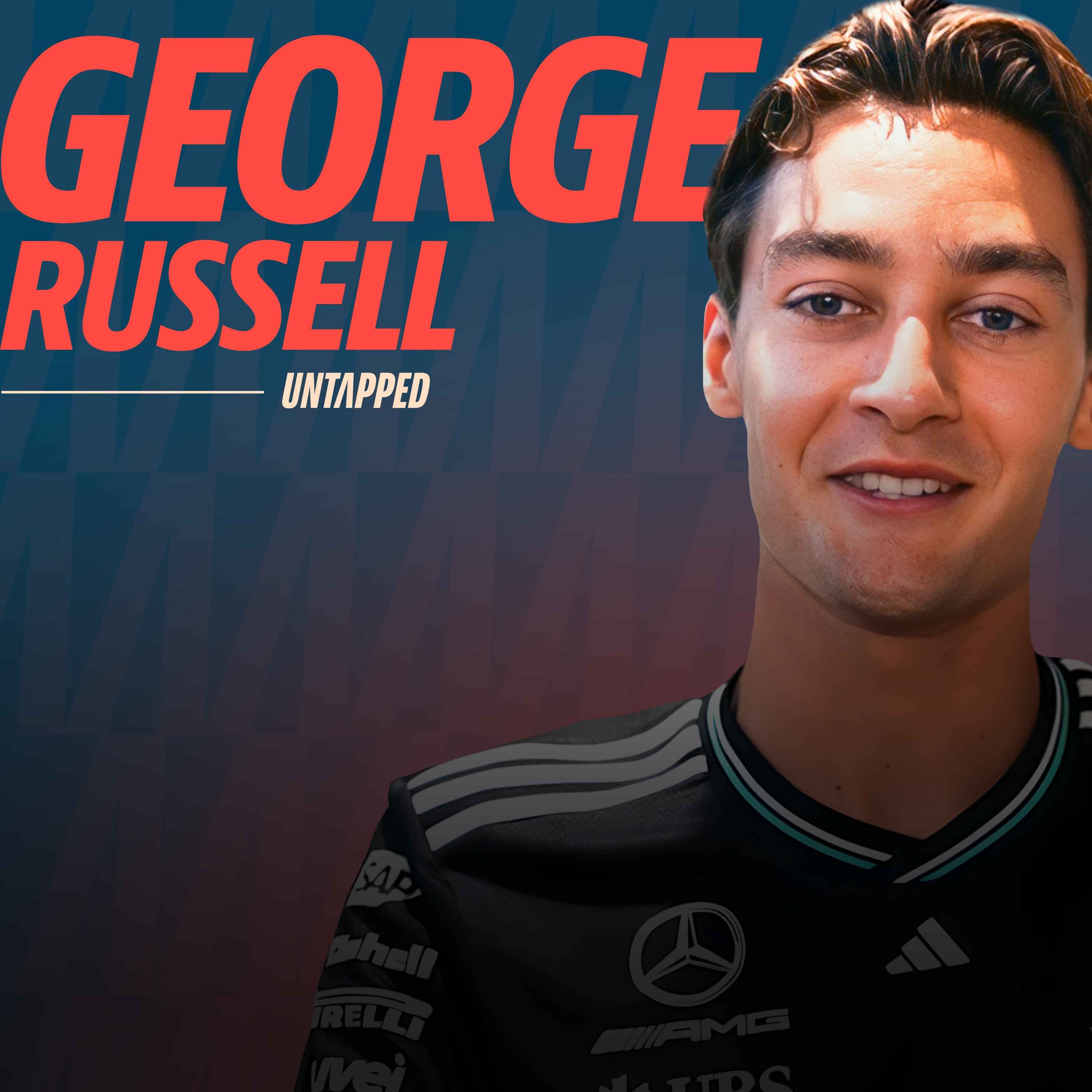
George Russell discusses fulfilling his childhood dream of Formula One, the psychological pressure of joining Mercedes and racing Lewis Hamilton, and how his father’s tough coaching shaped him. He also talks about patience in F1, learning from “small victories” when results don’t match potential, staying mentally sharp, and training basics (sleep, nutrition, psychology). He explains why he believes in an eventual world championship, and gives performance advice: stay off late-night phone use, wear blue blockers, and don’t be afraid to fail.
George Russell is a Formula One driver who started karting at age seven and later signed with Mercedes at 17, becoming Hamilton’s teammate.
His father manipulated practice lap timing to keep confidence grounded; beating Hamilton is a season-long goal, not guaranteed. F1 is less “level” than karting; risk is not a conscious factor for top drivers. Neck training targets ~5–6G in corners and up to ~50G in crashes.
Silverstone’s Copse corner (~186 mph) and Hamilton/Verstappen’s 2021 crash; “emotional hangover” after races; freediving and sea swimming as mental reset.
Written by AI. May contain mistakes.
George shares his journey from karting to Formula One and the challenges faced.
“Without further ado, let's get Untappd with George Russell.”
Exploring George's relationship with his father and the impact of expectations.
“But then suddenly things changed again, and the dream was back on.”
George discusses his transition to Mercedes and the pressures of joining a top team.
“He'd be left before I woke up to go to school.”
George reflects on the psychological challenges of competing alongside a champion.
“he almost looks like handing the baton over.”
George discusses the need for patience and setting realistic goals in racing.
“I think so, because it was, for me, I had to...”
Explore the psychological strategies racers use to handle expectations and performance pressure.
“Because we're just not in that position right now.”
Learn about the foundational practices George Russell employs to maintain his performance.
“What steps do you take to keep your performance at its highest?”
Understand how George Russell balances intense racing life with activities that help him reset mentally.
“They're the two things I do that helps me disconnect for a couple of hours, resets my mind, and then I can come back and think clearer.”
Understand how George Russell balances intense racing life with activities that help him reset mentally.
“Hi, it's Mark Bittman from the podcast Food with Mark Bittman and the website The Bittman Project.”
Delve into the competitive dynamics of Formula 1 and how politics influence racing.
“Hey guys, it's Drew from the comment section.”
Learn how elite drivers perceive and manage risk on the track.
“So I don't think it will be a massive impact.”
Discover the physical challenges drivers face due to G-forces in racing.
“You've kind of taken them over the course of 20 odd years.”
Explore George Russell's mindset on achieving his goal of becoming a champion.
“big braking zone so let's say we're braking from 210 miles an hour down to 60 you'll be getting about five and a half to six G on the back of your neck.”
Hear practical advice from George Russell to enhance personal performance.
“but I had a really good conversation with Novak Djokovic about human performance and what he's doing currently, but what he was doing in his 20s.”
Discuss the impact of parental expectations on athletes' careers and decisions.
“And I would, I preferred to be at 95 % of my own capability and know that I could not make a mistake, but I'm not going to my limit.”
Discuss the impact of parental expectations on athletes' careers and decisions.
“The Night Pack helps you wind down and supports a calm, relaxed state.”

Get the gist, explore an idea or ask about something said.
 Claude
On UNTAPPED with Spencer Matthews, what are the key points of this episode?
Searching your listeningAutomatic transcript. May contain errors.
0:00Welcome to Untappd with me, Spencer Matthews. Today's guest is none other than legendary George Russell, Formula One racing driver, tireless competitor, and a voice that is increasingly unafraid to speak up. We talk about setbacks, his relationship with his father, and the relentless speculation about his future in the sport. Without further ado, let's get Untappd with George Russell. George Russell, welcome to Untappd. Thank you so much. Good to be here. how does it feel to fulfill your childhood dream and be a formula one racing driver i mean i only really sort of pinch myself and recognize the position i i'm in when you know you make a statement like that because for me you're kind of like climbing this ladder and you go through starting as a young kid at your local go-kart track and winning your first race is like a step on the ladder winning your first championship is the next step progressing to the next age category so on and so forth and suddenly you become you get closer and closer to your dream it's not like overnight i've just been dropped in to my dream like if there was a there were a couple of years on my journey when i thought maybe formula one is not going to be possible.
1:20But then suddenly things changed again, and the dream was back on. So, you know, I do recognize how fortunate I am because, you know, I'm driving the fastest cars around the best places in the world. And that's all I ever wanted to do. You started karting when you were seven. Did you know very quickly that you had a gift? I didn't know any different, to be honest, because I jumped in and when I was winning races and I was fast, I probably didn't know because my father was so hard on me. You know, I always felt that I wasn't good enough for my father. He used to, when I used to do go-karting at the time, there was no real data analysis.
2:06We didn't even have lap times on practice days. It was literally my father with a stopwatch. And I learned after about five years that he would always time me late. So my lap times looked slower than reality. So he would tell me the lap times of the other drivers on practice days. And I always thought I was slow. And then I got to the races and I was qualifying on pole and I was winning races. And I was so confused as a kid. I'm like, I'm always slow on these practice days, but then I get to the races and I win. You know, why is that? And I realized over time that he would always do that just to, you know, that I didn't get too full of myself or too overly confident.
2:46And that was such an amazing, important lesson for me. Do you appreciate it now? Yeah, 100%. At the time, I hated it because, you know, my father worked every day. He'd be left before I woke up to go to school. He wouldn't be back until eight or nine o 'clock in the evening, and I'd already be in bed. And so I wouldn't see my father during the week. we'd then jump in the van on a Friday night we go up and down the country and if the race weekend wasn't good you know he'd be screaming and shouting and I'm really pushing me hard and as a young kid I'm thinking like I've never seen my I don't see my father then when I do see him he's upset with me and I feel like I'm letting him down that was really tough but it's only when I was about 17 years old I recognize not you know the financial investment is one thing but it's the investment and time that he put into me.
3:42He had to work his ass off to give me that opportunity. And then whenever he had a spare moment, he's taken me here, there and everywhere. And I can only imagine the pressure and stress he must have been under himself. And he ultimately, those years, I think, from the age of seven to 13, shapes me as a person. And I have him to thank for that. Would you mind me asking what your relationship with him is like now? Yeah, much better. It's much better. And he's there as a father, as opposed to at the time he was a mentor. He was a mechanic. He was, you know, the driver up and down the country. He was the investor.
4:28So he was everything. And of course, he is sort of watching me grow as a kid or as a teenager. and he's wanting to give me this. He's given everything. He's put everything on the line for it and given me this opportunity. And it was only when I signed with Mercedes at 17, he almost looks like handing the baton over. And we had a really great chat when this happened, and I sort of told him my views that I wanted him to be there as my father and not really anything further. you know and that's why when they come to the races they're not standing there in front of the television they're keeping themselves to themselves they don't want to take any sort of spotlight or presence or interviews or they just want to be there as my parents I think it's it's really interesting firstly I remember you signing for Mercedes we had breakfast I think you know not long before that because you used to race with with Williams so you know my my family and I remember talking to you about the pressure of, you know, joining a much faster, should we say, team currently.
5:40It always interested me, you know, and I was really excited about that jump for you, you know, incredibly talented driver in a slower car, moving into Mercedes, Lewis Hamilton as your teammate. What was the pressure like for you at that time? Because I suppose you're already in Formula One. You're already, you know, top 20 drivers in the world. But making the shift, you know, within the sport, was that a huge day for you signing for Mercedes? It was a huge day because it felt like, as I spoke about before, like this climbing the ladder, this didn't feel like one step up. It felt like I took three steps in one go.
6:23And over those come in months before I started the season with Mercedes, I was thinking like, I believe in myself, I believe I can be anybody. But the truth is, you don't know until you go up against the best ever. And I'm stepping into his team where he's been for 10 years. Everything's built around him. I'm coming in, I feel fast, I feel young, I feel healthy, I'm ready to take the fight. but you just don't know so I was thinking about how I'm going to deal with this psychologically until sort of one day I had a really good conversation with my psychologist about it like how I should deal with the pressure of being his teammate and concluded that when I walk into the garage I'm jumping into my race car I'm putting my helmet on I'm putting my visor down it should not matter if my teammate on the garage next door is a seven-time world champion or if he's a rookie or if there's nobody there because I'm in control of my own destiny and that's the approach that I had it's like I'm now this is on me to perform and finally taken acceptance that if I were to finish ahead of Lewis in a season, I think my stats against previous teammates were I finished ahead of them like 95 % of the time.
7:56I concluded, well, if I beat Lewis in a season, that's going to be an amazing achievement, but I'm not going to beat him 95 % of the time. So if I beat him 55 % of the time over a year, that's amazing. But you've got to accept 45 % of the time, you're going to be behind him. And that's totally understandable because you cannot go up against the goat and expect to wipe the floor with him. And so that was probably the biggest psychology shift I had is like accepting that my goal is to beat him over a season, but there will be times that I will be behind him.
8:39Hello, I'm Monica Reinagle, host of the Nutrition Diva podcast. Summer is here and with it, the hot and sticky weather. A morning working in the garden or maybe on the golf course can leave you more depleted than you realize. And plain water isn't always the most efficient way to restore the balance. That's where liquid IV comes in. Its science-backed formula is clinically proven to hydrate faster than water alone. Whether you're exercising, playing outside, or simply surviving a summer heat wave, it's an easy way to stay hydrated. Shop now at liquidiv.com. Liquid IV, hydration that goes wherever life takes you.
9:15Hi, it's Mark Bittman from the podcast Food with Mark Bittman and the website The Bittman Project. One of the things that makes Whole Foods Market different is their commitment to quality standards. More than 500-degree insert bands store-wide to give us peace of mind whether we're browsing through the store or shopping online. And it's been this way since 1980. Their selectivity makes your shopping easier. Shop Whole Foods Market in-store or online. Thank you. Most women have been there. Something feels off. You don't feel like yourself. Yet your doctor says everything looks fine. Spoiler, it's your hormones.
9:53Midi is a virtual care platform built for women by women and offers specialized hormone care from trained clinicians. Plus, it's covered by most major insurances. Getting started is easy. You can book your first visit with a clinician right away. It's not you. It's your hormones. Visit joinmidi.com to book your first visit. That's joinmidi.com. Insurance coverage varies. Check with your plan for coverage.
10:19So it was very much, in your mind, a competition with him over, say, the world championship in your first season? I think so, because it was, for me, I had to... prove to Mercedes, but not just Mercedes, but, you know, the 2 ,000 people working for the team that I can hold my own and show what I'm capable of. Of course, I thought in my head, if I finish ahead of Lewis Hamilton, I would be a world champion because any teammate who beat him in the years gone by, they were a world champion, you know? So it was, of course, the goal was to beat Lewis, but it wasn't that it. That was my sole goal. Like, of course, my goal was to be world champion.
11:08But the two in my head at the time were intertwined. So much of your career specifically, but also the careers of many other great drivers is built on patience, you know, waiting for the right team, the right car. Do you still trust the process? Or do you find a kind of growing urgency to take control of your own situation? Yeah, I mean, Formula 1's a frustrating sport because you have over 20 best drivers in the world, yet in one season you may only have four different drivers actually win a race and maybe a maximum of two drivers fighting for the World Championship. So you've got 15, 16 other drivers who don't even taste that victory.
12:04If you compare that to, let's take football, the team who finishes last in the Premier League, in a year, they would still win one, two, three, four games in a season if you're the worst team in the league. so they get that sense of success more times than the number five to number 20 best driver in the world if that makes sense or a tennis player if you don't if you're not one of the top five players in the world you can go and play in the tournament below or you might win matches throughout the tournament and you still get that sense of victory but in formula one It's just so few people get to experience it.
12:53But I still absolutely believe my time will come. I don't know when my time will come, but I'm making sure every single day I'm ready for that. Whether it's next year, two years time, five years time, 10 years time, I'm making sure I'll be ready for it. You've certainly got age on your side. I mean, this season's been a tricky one, hasn't it? Because it's seen you perform really well, but the results haven't been perhaps where you might hope they would be. What has it taught you about yourself as a driver, a competitor, a leader, you know, kind of giving your all to a sport, waiting patiently, pushing as hard as you can go, but not quite getting the result that perhaps you feel you deserve?
13:34I think you learn that you have to take those small victories. You've got to adjust your goals to what is a realistic goal for this given weekend. What is the realistic goal for this given season? To win the championship this year is not a realistic goal. So if we're, of course, we're working towards that. But if we don't achieve that goal, we shouldn't be, you know, kicking ourselves. Because we're just not in that position right now. And that's when we go into every single race weekend thinking, right, we think we've got an opportunity to fight for the podium here. If I finish in fourth place, I won't be happy.
14:18If I finish in second, I will be. Or on the flip side, if we believe we can win this weekend, but we only come home in third, that might be a better result than all the other races, but you've underachieved compared to the potential. You have to teach yourself to take those small victories. Otherwise, you're going to get in a sort of a negative spiral of psychological struggle. And that's only going to impact your performance later down the line. So, you know, you're not doing this just so you're staying happy. You're doing this to continue performing at your 100%. What steps do you take to keep your performance at its highest?
15:02Obviously, this podcast is called Untapped. It's all about human performance, the steps that we can take to draw more out of our human potential and our performance. I would love on a personal level to hear some tips from you, how you stay at the top of your game, how you keep a clear mind, how you ignore noise, how you operate so well under pressure. I think you're a fantastic example of somebody who sticks through incredibly difficult positions well. You know, I think that there is so much noise around you and what's happening next year and where you might be, whether you're staying at Mercedes, what's happening with Max and your rivalry with Max, where's Max going to drive?
15:48you know it must be so interesting and exciting being you at times but also very difficult not to just be able to speak your mind sometimes how do you keep a cool head big question I mean I over the years I'm always trying to look for like what's next in terms of my own human performance I always say to my coach, like, what is going to be the norm in 10 years time? And how can we be ahead of that curve? And if you rewind, you know, 30 years, fitness wasn't really a focal point for athletes or racing drivers. Then nutrition came into it maybe 10 years later. Then another 10 years later, it was psychology.
16:38then you know in 10 years time there's going to be something else on the table but what's very important for me while striving to look for that next opportunity to take advantage of in 10 years what it's going to be in 10 years time and be ahead of the curve you can't forget the basics of the points that have already been mentioned so I always first and foremost focus on the basics which number one for me is sleeping well. So I always ensure that everywhere I go, I travel with my own pillow. So I have that consistency. I travel with my own duvet. I make sure the room is pitch black. 18 degrees is how I like to sleep.
17:22So, you know, nice and nippy, you know. So that works for me. Then nutrition. I always, even when I travel around the world, I eat the same foods. so we send the the recipes off to the chefs in the hotels we're reaching out to all the hotels because of course I'd love to go and try you know the local Japanese sushi or some Singaporean street food or the Mexican tacos but when you're doing that 24 times a year that doesn't sit well in your stomach and weight is a bit of an issue for me being six foot two so I'm always ensuring that I'm eating the right meals at the right times, focusing on nutrition.
18:06So again, that's for us such a basic now, but there's a lot of work goes into that when you're trying to do it in 24 different locations over the course of a year. And then psychology is something I've worked a lot on. And I've found huge benefits in talking with a professional, helping me deal with successes, helping me deal with the tough races, the failures, what I need after a race weekend. And we call it, on a Monday, we call it the emotional hangover. So even if you've won the race on Sunday, you're going through such a buzz on the Sunday, and it's such a high, Monday is a bit of a slap back to reality.
18:58And on the flip side, if you've had a bit of a failure that weekend and you've struggled, that Monday, you're constantly thinking about it and you're going a bit crazy. So I find ways to disconnect from everything to reset my mind. And for me, that's playing paddle. That's going diving. I do free diving. They're the two things I do that helps me disconnect for a couple of hours, resets my mind, and then I can come back and think clearer. They're the sort of fundamentals for me. So is it the breathing that you like about the free diving? Do you go through breathing exercises? Obviously, you need to hold your breath for freediving.
19:40Do you have somebody that takes you through that process or are you comfortable on your own now? No, I always go with a professional. I'm comfortable if I'm, let's say, out on the water to dive down 10 to 15 meters. But if I go any deeper, I'm always with a professional. But something like freediving, you have to focus on the job at hand. And, you know, it's a pretty extreme sport. But I just feel like when my head's in the water, you find a nice place where you can sort of see some fish or coral. You know, you're just sort of taking in the world beneath you. And you actually realize it's such a beautiful place.
20:22And you just focused on, right, I'm going to dive now. I need to breathe properly. I need to stay relaxed, not that my heart rate go up. and I can spend four hours there and not even, you know, think about anything else in the world. It's pretty awesome swimming as well. The sea, obviously, we're talking about specifically at the moment. I've just incorporated some sea swimming into my routine because I've got a challenge that's going to see me do a fair amount of swimming in a few months time. And I've never swam before. Like I've just not ever been attracted to it really as a sport and um flown and bought a wetsuit because it's kind of the water's 11 degrees here 10 degrees so when you're in it for an hour hour and a half it's pretty cold um and uh it's exactly as you describe it it's just like it's an off switch no music obviously no nothing like you can really just attach uh and glide through the water and it's it's pretty i i kind of get it now like i would i you know you hear of so many people who go for these long sea swims and i just i just envisaged it being incredibly boring training.
21:31I love lifting weights and playing paddle and running and, you know, more dynamic stuff, I suppose. But no, I'm a big fan of the swim at the moment. It's pretty great. It's the sea is like, I was scared of the sea growing up. I was born in the countryside in the middle of nowhere. So the sea is a bit of a sort of murky brown. So it's not really appealing to go in the water. So, you know, we, I was always too busy racing. We never did holidays and if we did it was never to you'd never be in the water so I only sort of explored jumping in the water in in a sea or an ocean when I was like 23 and I was crapping myself by the first time I went down like I don't know what's going to be under there I'm going to get eaten by a shark or whatever but as soon as I started this free diving I would dive down and I was like so happy to see thousands of fish or whatever it was down there and this this whole different dimension of life that I've never appreciated before and that's why it's like been such an exploration for me that I'm just so sort of focused in on that and it and then as I said it really helps me when I come back to reality and then I'm thinking about my job and how to improve I'm thinking clearer.
22:52And those couple of hours, you need to disconnect. You need to find that balance to be more creative. And if you're just tunnel vision 24-7, never leaving that channel, you're never going to be able to grow from my experience.
23:15Hi, it's Mark Bittman from the podcast Food with Mark Bittman and the website The Bittman Project. One of the things that makes Whole Foods Market different is their commitment to quality standards. More than 500 ingredients are banned store-wide to give us peace of mind whether we're browsing through the store or shopping online. And it's been this way since 1980. Their selectivity makes your shopping easier. Shop Whole Foods Market in-store or online. Thank you. 75 % of women who seek menopause care don't receive it. The lying awake at 3 a.m. wondering what's happening to your body ends now.
23:53Midi is virtual care built for women in perimenopause and menopause with clinicians who specialize in women's health. Plus, it's covered by most major insurances. Getting started is easy. You can book your first visit with a clinician right away. Midlife needs Midi. Visit joinmidi.com to book your first visit today. That's joinmidi.com. Insurance coverage varies. Check with your plan for coverage. Hey guys, it's Drew from the comment section. Some days my skin just needs a little coverage and other days I wanna go full glam. For those everyday moments like running errands or grabbing coffee, I've been loving the Merit Minimalist Stick because it's a foundation and concealer in one that gives me a really natural skin-like finish.
24:33But when I want more coverage, I'm reaching for the Hourglass Vanish Concealer every time. I know I'm not the only one who struggled to find the right foundation or concealer shade, which is why I always shop at Sephora. They have the best brands all in one place with so many shades, coverage options, and finishes, plus expert beauty advisors, free samples, and shade matching tools both online and in-store. So whether you're looking for barely there coverage or full glam, Sephora can help you find your match.
25:03Coming back to F1, it's no secret that it's a pretty political sport. Obviously, some teams have more money than others. And ordinarily, those are faster than the teams that do not have the support that they have. Is there ever a time where you get out the car and just wish that it could be more of an even playing field, like in the good old karting days? I think it might have been Senna who said that, you know, he enjoyed karting the most because it's just a level playing field. And you know that you're getting in at an equal level on equal terms and you know it's the purest form of racing i think he called it would you agree with him i absolutely would agree with him you know karting is it's the purest form of racing um it's far more evenly balanced of performance between the best and the worst go-kart versus you know formula one the best and the worst car i think all drivers wish that would be the case, that we'd all have an even playing field that we can sort of showcase what we can do.
26:12And ultimately, that's what the junior formulas like Formula 2, Formula 3 and Formula 4 is. You know, it's the same race car. You've all got the same opportunity to get out there and show what you can do. So that's why, you know, Formula 1 is so unique. If everyone was in the same cars and you didn't have brands like Mercedes or Ferrari, Aston Martin, McLaren around, maybe it wouldn't be as attractive. So, you know, that's the balance. But drivers are pretty selfish and we just want to show what we can do and we don't really care about much else. But you obviously appreciate how this sport works and it's as big as it is because of the brands that are here.
26:59I noticed you left Red Bull off the list. Is Christian Horner's departure going to make a big difference to Red Bull as a team in terms of a destination, do you suppose, for the top end drivers? I left Red Bull off because I was mainly referring to car brattons because it's sort of a motorsport as opposed to, you know, Red Bull who have done an incredible job since they have entered. so you can't fault them whatsoever. Yeah, obviously, with Horner's departure, is things going to change a lot? It's not really my place to sort of comment, or it doesn't really concern me, to be honest, because I'm focused on my own job.
27:49But the bloke who's coming in, who's replacing him, is very well respected, got a lot of experience in the sport. And, you know, things evolve and things change. So I don't think it will be a massive impact. And yeah, there's a doubt. Do you think that the best drivers have a greater appetite for risk? Or do you think that their talent work balance is just different to others? I don't think the appetite for risk is greater in those drivers who are the best because I sometimes see drivers who I don't rate as highly taking enormous risk. But I would define that as being as stupidity as opposed to ballsy, if that makes sense.
28:44You know, if you're a great driver, you know the risk that is required. you're not you know i don't drive a lap thinking this is risky if that makes sense i'm to make the perfect formula one lap it's like you need to be on a roller coaster and your your machine is in those tracks and you're pushing it to the limit but it's not it's not a major risk there are certain places like monaco where the risk is suddenly taken to a whole new level because if If you make a mistake of five centimeters, that's game over. But nine times out of 10, you don't approach a corner thinking, I can take more risk. I'm trying to drive just as fast as possible, if that makes sense.
29:32And I guess I know the risk that is involved, but it's not even a consideration. That word risk doesn't even cross my mind. You're reminding me of the great Alex Honnold, who I had the pleasure of interviewing, he climbed El Capitan in a free solo effort. You know, there was that incredible film, Free Solo, about him. And I asked him, you know, about risk in a similar way. And he kind of, he said the same thing, that, you know, he's not just being slapped on the mountain just in the same way as you're not being slapped in a Formula One car. You've kind of taken them over the course of 20 odd years.
30:10You guys have mastered your craft to the point where it probably feels normal to you to be flying around corners at 170 kilometers an hour? Miles an hour sometimes as well. 170 miles an hour around a corner? Yeah, I mean, the fastest corner on the track that's a real corner is probably Copse at Silverstone, which was the old first corner, which we go through at about 186 miles an hour. That's just wild. Honestly, it's hard to believe. That's the corner where Lewis and Verstappen had that famous crash at Silverstone in 2021. I think it's when you see the video from the grandstand of the car crashing into the barriers, that's when you appreciate the speed.
30:58Do you have to train a specific strength program as well for, you know, your neck, for the G-force you take? You know, what is the maximum G-force you might take in a day or, you know, in that particular corner, say? the yeah i mean the neck is a big my neck doesn't look massive because my head is so big but you've got drivers like daniel ricardo with a peanut head and his neck looks quite big so it's you know it's a bit of perception in there but you know through a corner maximum when we do a big braking zone so let's say we're braking from 210 miles an hour down to 60 you'll be getting about five and a half to six G on the back of your neck.
31:40If you go around the corner at 180, you'll be getting about five G again on the neck. So that's, you know, when you include the weight of your head and the weight of the helmet, you're talking about 55 kilos of force being pushed through it. So I always, I question it with my, my girlfriend who's in her 40, she weighs in her 40 kilograms that's actually about 45 kilos I'm like I reckon I could hold you on the side of my uh on the side of my head so it's a pretty unique um unique exercise but your whole body is like scrunching through the corner and I when I first drove in Formula One I was having different muscle groups were becoming really sore because I just never experienced those forces before my eyes were bloodshot the first time I ever drove because you know the blood rush into my head I hadn't experienced that before and as I said my legs were like moving in the cockpit so my my glutes were getting really sore just to try and hold my legs upright and my shoulders were hurting because if I was turning around the right hand corner my my my arms were trying to go left my neck was trying to go left and everything's just so you're trying to hang on so it's um but you also need to train the neck a lot in the event of a crash you know if you have a big crash you can experience up to 50 g and obviously your neck is you know exceptionally important in terms of the strength you need for helping with a concussion you know into preventing a concussion or injuries you may face during one of those crashes.
33:28So we train a lot, like sort of movements in all different directions. So my neck, in the event of a crash, is sort of as best prepared possible. Do you think we'll see you as world champion in the next few years? For sure. For sure. I believe that too, by the way. I don't know when it's going to come. I don't know when it's going to come, but I had a really good conversation with Novak Djokovic about human performance and what he's doing currently, but what he was doing in his 20s. And he said to me, when he was in his 20s, he felt that he could comfortably miss a day in the gym or a day here or a day there, and it wouldn't affect him.
34:10But he didn't, and he's so grateful for that now because he thinks the work he put in during those years is allowing him to continue to play at such a high level into his late 30s. And, you know, Formula One isn't as brutal on the body as, let's say, tennis. It's different because you don't have that constant impact on your legs. But, you know, I want to be here one into my 40s and when I see what Alonso's doing, you know, that gives me inspiration that I can do that. And, you know, someone told me this morning, Schumacher won his first title at Ferrari when he was 32 years old. you know i'm 27 so you you think of schumacher and ferrari as just domination but his first championship with ferrari was in his in his 30s so yeah it's quite quite interesting that's amazing i hadn't thought of it like that either that's what i tell myself to keep motivated stay motivated you know that's um and telling myself you know it it will come at some point it we're not the fastest car today but it might be next year but it might be in five years time it might be in four years time it might be in 10 years time but my dream is to be a world champion and I'm working every day to make sure I'm ready because I just don't know when that time will come.
35:33Lastly George because I think you're nearly up on time if you could give our listeners some advice for them to untap their own potential what would be just off the top of your head things that people can put into practice today listening to this what what positive changes can people make to their life to live a fuller better life in terms of ability and performance focusing on the basics stay fit eat well sleep well secondly trying to stay off your phone late at night you know if that has such a negative impact on your sleep and especially when you're looking at bright lights just on a sort of human performance level, that was, I always wear my blue blockers.
36:21Every single night, sort of in front of a TV, my blue blocker glasses on. But in terms of like a philosophy that I stand by, and I wish I stood by this earlier in my career, was don't be afraid to fail. Don't be afraid to push yourself beyond your limit and fail because it's always those failures that make you stronger as an individual, stronger whether it's as a professional or an athlete or whatever it is you're doing. And, you know, I never wanted to fail because I never wanted to let my father down when I was younger. And I would, I preferred to be at 95 % of my own capability and know that I could not make a mistake, but I'm not going to my limit.
37:16And I realized it was actually when I became teammates with Lewis, I realized that I've got untapped potential here. I'm not digging into. And I've made more mistakes than ever in these last three years, but I've been driving at a greater level than ever in these last three years. So, you know, that's something that I really stand by. Don't be afraid to fail. I think the stuff around your father as well is just so interesting because, you know, you see it quite a lot with elite athletes at the top of their game that they had a parent or both parents that would push them beyond what felt reasonable at the time.
37:56You know, as a father of three children myself, you do tread that line sometimes when they want to give up on things that they liked before. And, you know, you don't know quite how hard to push them because you don't want them to engage in things that they perhaps don't love or enjoy. And it might feel like they're doing it for your benefit at times as the father. But it's so interesting. I wonder how many athletes or indeed Formula One racing drivers had that style of relationship with their parents. I would have thought quite a few. Yeah, I think so. But at least in Formula One, from the stories and experiences, I know.
38:34At the end of the day, I don't think there is a right or wrong way of bringing up a kid. But I know I wouldn't be here today if it wasn't for my father. but maybe I'd be happy as a pig in shit if I was doing something else and he didn't push me to be an F1 driver you know so um you know it's it goes it goes both ways I've achieved my dream could I be happier doing something else nobody knows but all I ever wanted was to be a Formula One driver and him being so hard on me and pushing me beyond what I thought was reasonable at such a young age is what has made me today and is who I'm going to carry through for the rest of my life.
39:21George, it's really kind of you to join me today. You're our first Formula One racing driver on Untapped. Hopefully not the last. And I really appreciate your time, mate. It's a pleasure to watch you flourish and very much looking forward to that day that you're crowned world champion, my friend. I'm sure it will happen. Cheers, Spencer. Cheers, guys. Cheers. Thank you.
40:13The Night Pack helps you wind down and supports a calm, relaxed state. Less time managing your supplements, more support for your day and night. Shop Total Human now at onnit.com. Hey guys, it's Drew from the comment section. Some days my skin just needs a little coverage and other days I want to go full glam. For those everyday moments like running errands or grabbing coffee, I've been loving the Merit Minimalist Stick because it's a foundation and concealer in one that gives me a really natural skin-like finish. But when I want more coverage, I'm reaching for the Hourglass Vanish Concealer every time.
40:48I know I'm not the only one who struggled to find the right foundation or concealer shade, which is why I always shop at Sephora. They have the best brands all in one place with so many shades, coverage options, and finishes, plus expert beauty advisors, free samples, and shade matching tools both online and in-store. So whether you're looking for barely there coverage or full glam, Sephora can help you find your match. Hi, this is Monica Reinagle of Nutrition Diva. Today's show is sponsored by Nature Raised Farms. Grocery shopping can be a little overwhelming, especially if you're reading labels.
41:21And in my opinion, chicken shouldn't be complicated, which is why I appreciate Nature Raised Farms. It's chicken that's just chicken. And their lightly breaded chicken nuggets are free from gluten, dairy, and soy. Look for Nature Raised Farms on your next grocery trip and feel more confident about your choices.
Formula 1 star George Russell offers a rare look behind the visor, into the mindset, habits, and personal growth that drive his journey at the highest level of motorsport.
George opens up about the psychological challenges of stepping into one of F1’s most high-profile seats alongside Lewis Hamilton, and the mindset shift required to perform when perfection still might not be enough.
Reflecting on his upbringing, George credits his father’s demanding standards for instilling the grit and discipline that now define his career. He speaks to the value of patience in F1, why trusting the long game is just as important as raw speed.
Whether it’s resetting through freediving or learning from every race, George’s story is one of quiet intensity, constant learning, and a deep belief in doing the basics right.
WHOOP 👉 With 3 new memberships, there is a WHOOP for everyone.
Audio link: https://highpfrmc.com/Whoop-au
Heights 👉 Stay sharp like Spencer. 20% off Heights with code UT20
Audio Link: https://highpfrmc.com/20"
Hosted on Acast. See acast.com/privacy for more information.