Ask ChatGPT
 UNTAPPED with Spencer Matthews
30 Jul 2026 · 32m · 14 chapters
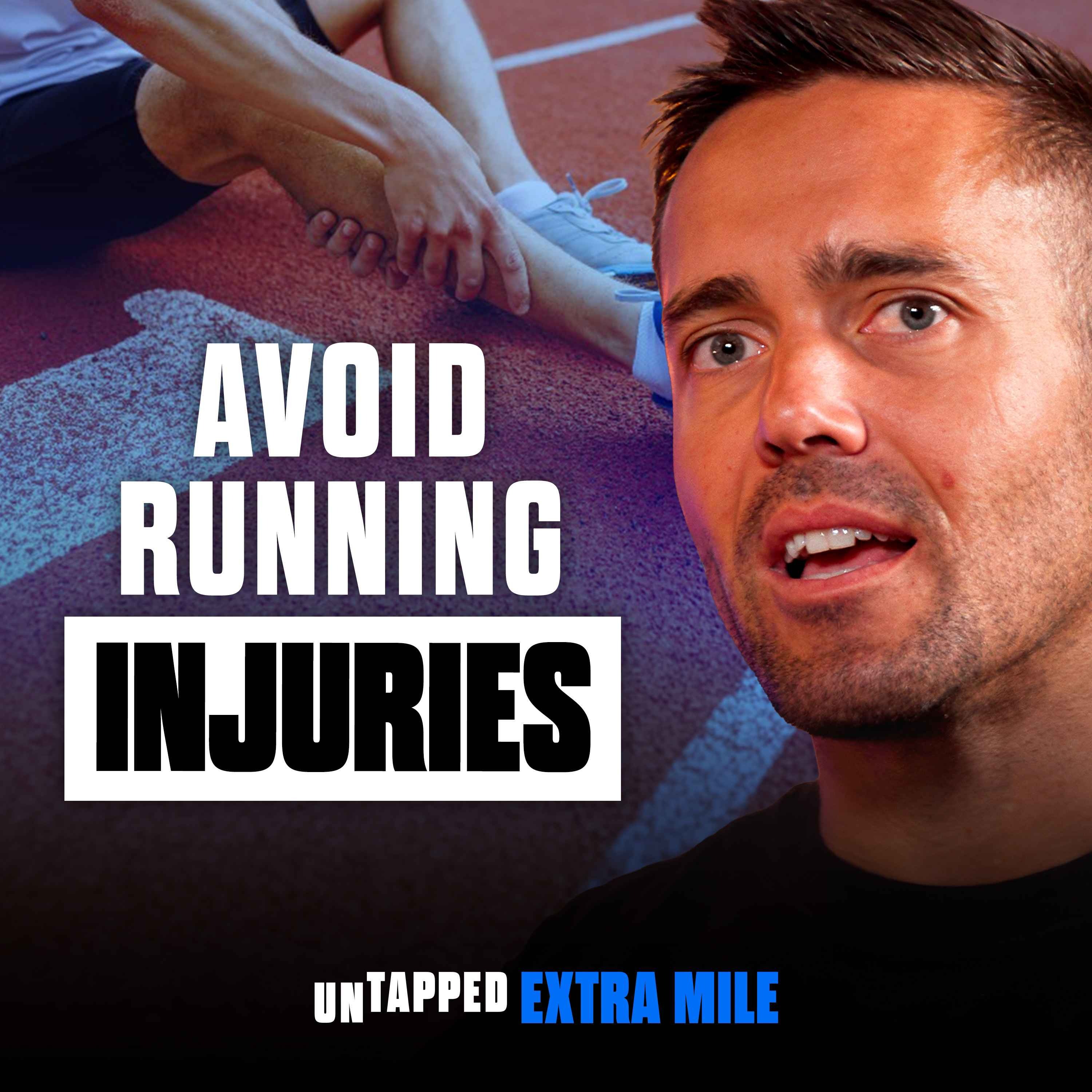
How to prevent running injuries by understanding injury types (anatomical vs functional), common runner problems, and the main drivers of pain (often inflammation from poor load management and strength/mobility deficits).
Spencer Matthews and Olly Patrick (hosts). Backgrounds mentioned: both discuss their own injury histories and training/physio experiences; Olly has had meniscus surgery and other sports-related injuries; Spencer describes working with professionals/learning biomechanics basics.
most running injuries are functional/physiological rather than purely anatomical; pain is frequently inflammation; injury risk rises with sudden load increases (intensity/terrain/hills) and body weight; prevention is strength + mobility + symmetry, especially hip abductor strength (glute med) and calf strengthening.
patellofemoral syndrome (“runner’s knee”), plantar fasciitis, Achilles tendonitis, Achilles tendon’s energy return, IT band syndrome treated with PRP, and meniscus flare-ups requiring surgery.
Written by AI. May contain mistakes.
Discussion on common running injuries and injury prevention techniques.
“In a world where AI is changing every role in every industry, knowing who actually has deep expertise matters more than ever.”
Discussion on common running injuries and injury prevention techniques.
“More kind of niggles than injuries, I suppose.”
Exploration of anatomical vs functional injuries in runners.
“It creates quite a lot of inflammation, which is something we've spoken about previously.”
Detailed discussion on specific injuries like runner's knee and Achilles tendonitis.
“It does raise an interesting question on your injury because that injury, we often bracket them into two different types.”
Discussion on the origins of the term 'Achilles heel' and its relevance to injuries.
“You might have shin splints in there as well.”
Discussion about personal experiences with injuries, particularly the achilles tendon and its impact on running.
“And that's because that tendon carries an unbelievable amount of energy within it.”
An exploration of different inflammation-related conditions, including epididymitis, and their implications.
Sharing personal narratives surrounding significant injuries and their recovery processes.
“But I'll go to whichever one I feel like at the time.”
A detailed explanation of runner's knee, its underlying causes, and prevention techniques.
“it can be taken out of structure by trauma, but then the strength and the caliber of the muscularity will determine future risk of injury.”
Learn about the biomechanical factors contributing to runner's knee and injury risks.
“But from a runner's knee point of view, that's the muscle that stops your leg collapsing in when you stride.”
Hear a personal story about dealing with iliotibial band syndrome and its treatment.
“It wasn't terrible, to be honest, but I could sort of feel it.”
Explore how regenerative medicine techniques like PRP are used for recovery.
“A good sports medicine doctor would do that.”
Discover the importance of strength and mobility work to avoid injuries.
“than gyms, supplements, longevity clinics, preventative medicine, wearables, etc.”
Understand how to manage training loads to prevent injuries effectively.
“So it'll be a combination of strength, some degree of symmetry, so not having one massive right leg and a tiny left leg, or being really imbalanced from one side of the body to the other.”

Get the gist, explore an idea or ask about something said.
 Claude
On UNTAPPED with Spencer Matthews, what are the key points of this episode?
Searching your listeningAutomatic transcript. May contain errors.
0:00Hi, this is Becca Moore from For The Girls and this podcast is sponsored by Aerie, where you can find the right bra in 59 sizes, soft fabrics and good fits. If your bra strap is digging into your shoulder right now, it's the wrong bra. We get so used to being in pain as girls that we forget it doesn't have to be this way. Your clothes should not hurt. I got to the point where I stopped wearing bras altogether and now my life has changed, you guys. The only bras I have in my dresser right now are Aerie and I'm not kidding. Aerie's on a mission to make you feel good and that starts with your bra.
0:27Your bra should hold you in, not back. Visit Aerie.com to find the right bra for you. Think of a toilet as just an everyday object. Your entire perspective shifts the moment you experience a Kohler smart toilet. Design changes everything, transforming a basic routine into something extraordinary. With standout aesthetics and intuitive controls, these are functional works of art. Stunning design that never sacrifices performance. Enjoy customizable features for elevated comfort and convenience. It's more than a fixture. It's a cleaner routine and a more refined space. Experience the difference of Kohler smart toilets.
1:04Find more at Kohler.com. In a world where AI is changing every role in every industry, knowing who actually has deep expertise matters more than ever. Upwork connects you with the highly skilled freelance professionals with proven track records, so you can hire with confidence. Upwork gives your business fast access to highly skilled specialists with deep expertise, so you can fill critical skill gaps, launch projects faster, and scale support up or down without committing to full-time headcount. With Business Plus, you can access the top 1 % of talent on Upwork. AI-powered shortlisting delivers a curated shortlist of top freelancers matched to your goals in under six hours.
1:43No endless searching required. Thousands of growing businesses already trust Upwork to hire highly skilled freelance professionals for everything from one-off projects to ongoing support. It's free to sign up and posting a job is easy. Visit Upwork.com right now and post your job for free. That is Upwork.com to connect with top talent ready to help your business grow. That's U-P-W-O-R-K.com. Upwork.com. Ladies and gentlemen, boys and girls, hello and welcome to Untap the Extra Mile with me, Spencer Matthews. And me, Olly Patrick. Today, we're going to be talking about injuries and how we can prevent them.
2:22Not us, obviously. We cannot prevent your injuries. I think we can. Oh, okay. Fine. Well, we can certainly advise on methods to stay healthier when running. When running in particular. Yeah. Yeah. It is an injury fest is old running. You've been remarkably injury free? Uh, had the odd injury. More kind of niggles than injuries, I suppose. Ever diagnosed, seen a doctor, seen a physiotherapist, sports medicine? Yeah, yeah. No, I have some physio sometimes. It needs to be really quite bad for me to bother with physio, but I think with this training plan that I'm currently in, it's a very good idea to have regular physio.
3:07I agree. I had an issue with my meniscus. I needed that tidying up. Oh, did you have a little op? I had an op. Oh, very good. Cheeky bit of keyhole? I mean, that operation 20 years ago. was a hatchet job, and now beautiful. They just pop in, clean it up, job done. Pretty good. I walked home from the operation. I was then told that I should not have done that, but it was relatively close to home. It was a couple of K, maybe. Okay. So I walked it. It's all good stuff, that. You know when you've got an issue with your meniscus, it's quite a specific kind of pain. like I couldn't run a K basically without it flaring up and just being like really quite painful and achy really interesting yeah and then no listen some bloke just snipped it up and good to go you're kind of like you're lying there just as you're about to black out from whatever it is they give you what is it?
4:06oxygen how do they knock you out? I don't know what would be within the anaesthetic but that would be the preserve of an anaesthetist always a word difficult to say I did know what it was at one point, but I don't know what they put in. But that person's got... Something abuse anyway. It's something that literally... Actually, it's quite challenging physiologically, anesthetics. So if you are frail, you can't go under a general anesthetic because you may not emerge the other side. Just another thing. And increasingly, people are trying to avoid going under general anesthetics for the toxicity of it.
4:35It creates quite a lot of inflammation, which is something we've spoken about previously. Yes. But if you need it, you need it. Oh, my goodness. Don't not do the thing. it's just if there was a chance to not do the thing. I think I've only ever been put under once and it might have been then. Well, it certainly was then. But I'm just trying to think if there were any other times. I've never gone under. It is a strange feeling. Quite nice though, actually. Because being me, I kind of tried to fight it for a bit. Good luck, mate. No chance. No one fights. It's literally like, whoo, bash. It's the type of thing you wish you could have actually just every night.
5:09I know it's probably not really good for you, But it's if you get into bed, watch, you know, a quick blast of Breaking Bad or, you know, something that you love, then just whack that on. Was it gas versus IV? Yeah, it was gas. Okay, interesting. Yeah, I think they'll probably do it IV now. The reality, the reality is, and just for those listening, you shouldn't be watching TV in bed. and you should be so tired and so under caffeinated and so free of alcohol and so beautifully aligned with your circadian rhythm that you feel like you're being anesthetized as you're sucked into deep sleep. Who are that?
5:51That sounds wonderful. Check your sleep latency. If it's under a minute, you're basically under anesthetic. Well, that sounds great. It does raise an interesting question on your injury because that injury, we often bracket them into two different types. It could be anatomical or it could be functional. So in an anatomical injury, you've got literally a bit of tissue or a bone spur or a break where it is clearly an anatomical thing. Of course, everything is this mix of anatomy, the structure of my body and physiology or function, how it works. But that's quite a clean one where, again, that wasn't driven by poor movement patterns, perhaps.
6:29Therefore, it's not going to be solved without surgery. But most of the injuries that we see in the running world are not as clearly anatomical. They're more of a functional issue, more physiological. And I can probably run through some of the injuries that I've seen most commonly in runners, if that's of interest to you. And I've had a few of them myself, Ashley Spencer.
6:51Hi, this is Becca Moore from For The Girls. And this podcast is sponsored by Aerie, where you can find the right bra in 59 sizes, soft fabrics, and good fits. If your bra strap is digging into your shoulder right now, it's the wrong bra. We get so used to being in pain as girls that we forget it doesn't have to be this way. Your clothes should not hurt. I got to the point where I stopped wearing bras altogether and now my life has changed, you guys. The only bras I have in my dresser right now are Aerie and I'm not kidding. Aerie's on a mission to make you feel good and that starts with your bra.
7:18Your bra should hold you in, not back. Visit aerie.com to find the right bra for you. Most women have been there. Something feels off. You don't feel like yourself. Yet your doctor says everything looks fine. Spoiler, it's your hormones. Midi is a virtual care platform built for women by women and offers specialized hormone care from trained clinicians. Plus, it's covered by most major insurances. Getting started is easy. You can book your first visit with a clinician right away. It's not you. It's your hormones. Visit joinmidi.com to book your first visit. That's joinmidi.com. Insurance coverage varies.
7:52Check with your plan for coverage. Losing weight can feel like a roller coaster, full of ups, downs, and being thrown for loops, like when someone brings donuts into the office. or your kids' dino nuggets start giving you that look again. That's why there's Noom. They combine GLP-1s to quiet the food noise with healthy habits that help you keep it quiet, even if you get off the meds. Their program is designed to make weight loss a smooth ride, helping you understand what drives you, so you can build better habits to not just lose weight, but keep it off. Noom. Lose for keeps. Get started at Noom.com.
8:27Not all customers will clinically qualify for medications. Individual results may vary.
8:36Okay, so what are the most common injuries that runners face? I would say someone will do a statistical analysis, but I know the number one is runner's knee, which we would have heard of. In the top... Is that a similar kind of thing to tennis elbow? It is linked. So it's called patellofemoral syndrome, and it's an inflammatory condition. Tennis elbow, also an inflammatory condition. And I'll come to that as a different challenge, but similar, just a different joint. Slightly different in the fact that it's really driven by the kneecap, which is your patella, and how it sits over the knee. Plantar fasciitis, you've probably heard of that before, plantar fascia, which is the sort of connective tissue that keeps or helps preserve the dome of your foot, the arch.
9:22You've got Achilles tendonitis. That would be up in the top. Melting pot, so your Achilles tendon. That was the downfall of the... Just thinking about him. Yeah, I love that film. What a legend. Brad. We love Brad. I love everything about Brad. We're a couple of guys that love physiology, of course, but we also like Brad Pitt. Enormously. Yeah. Enormously. Not so much, you know, some of the things that are rumoured in his personal life. I think we're talking more about his portrayal of the character Achilles. Achilles, indeed. and the origin of this being the weak spot in the body. And those are probably the big three.
10:01You might have shin splints in there as well. We must just draw attention just quickly before we move on from Achilles. Of course, legend has it that he was shot with a bow and arrow by Paris in the Achilles. But I did notice when watching the film, Troy, he was also nailed seven or eight times in the chest which I think could have been the cause of death in the film and if you haven't watched it this is a spoiler he then pulls all of the arrows out and they find him dead with only one arrow remaining which is in his Achilles hence the origin of a legend but he was killed of course by the arrow that hit him in a major blood vessel somewhere as would be the general logic to a trauma, a traumatic wound.
10:58But essentially, and of course, this is relevant because Achilles injuries are injuries that we are talking about. But it's all bollocks, the Achilles heel thing. I am no historian. I've mentioned this off camera. I'm so poor on Greek mythology and Roman history fabulous stuff I don't know if they completely fictionised that for the film or whether that was born from the writings but in the film that was the first time I'd ever understood why Achilles was called Achilles and why the Achilles tendon was called the Achilles tendon the myth is that his mother held him by his ankle and dipped him in the fountain of life oh so that was the only bit of him that didn't get submerged oh that's outstanding that's the weak spot that's why it's no like that that is very good Simon Simon with no notes at times we're very glad to have you here that's a good point we like that a transient lift we like that that's a great fact okay that would all tie in so maybe it was the one that hit Achilles again though you know he was buggered by several arrows to the chest agreed I think the more likely tale to be told quite an unlikely injury for runners though so should we but should he not be impervious to those given that he was dipped in the yes it would have been the one that hit Achilles that killed him yeah but it didn't though that's silly I think we nobody would die from that you can shoot me if you like with the crossbow through the Achilles it will hurt it certainly won't kill me it's a very again we have found what I believe is a loophole I can't close this off it's a shame it's not a documentary no but it's also just like I love it all I like it but things just need to like make a little bit of sense here agreed you know he was not killed well that's a very good point maybe perhaps those two stories are incongruent with each other that's the bottom line is there even a major blood vessel in the Achilles not to my knowledge so not even can't bleed out from there I would have thought so no you would find yourself in Chelsea and Westminster though oh for sure and you would need the whole thing with an arrow to Achilles yeah it's not a minor injuries units thing how funny would it be to be carried into Chelsea and Westminster with like a with an arrow coming out of your Achilles and you just only speak in kind of you know Trojan dialect do you think they'd get it?
13:23I don't think they'd find that funny at all no I think anyone would find it funny it'd be a shame I was playing tennis with my dad in fact just after I beat my dad for the first time at tennis which is a great seminal moment were you seven? don't diss my dad he was quite a good tennis player I was about 14 and it is a massive change in the guard so anyone who plays sport with their parents or has young children the moment you're beaten by your kid my son beat me in a park run actually not that long ago I know wrong story to tell the wrong person he is 13 but he beat me when he was 12 really disappointing I had an off day and he went and we technically it's a win I mean good for him good for him but not but also you feel you suddenly feel horrible you're proud and grossly disappointed as was my father when I beat him at tennis and I could feel it and then we played literally like maybe a week later he was obviously coming for vengeance but we played doubles I went to go and get a smash last minute went yours and then we and then basically we sound like a gun went off so we're all like this oh my god you know hands above our heads and he's lying on the floor and he goes ollie you've hit me i was like i haven't hit you i'm in front of you because you've hit me on the back of the leg i was like but i haven't hit you and then we looked down his foot sort of flopping like this well i think your achilles tendon's gone and it snapped clean but the sound was, and if anyone's had this, it is as loud as, you know, hitting the ground.
14:49It's like a gun. Like Hector's whip. It was like Hector's whip. And that's because that tendon carries an unbelievable amount of energy within it. It's an extraordinary, it is literally the spring of your entire body. That just, it just sounds awful. Like the way you described it as well, it's just horrible. Pain-wise, he managed it really, really well, because it was such a clean snap, but it does reflect what an extraordinary part of running biomechanics it is even in a level pe we did quite a lot on the energetic return of the achilles tendon and it's like this thing is a compressor you know every time you land and your heel goes down it takes all that energy and then it returns it back up into your stride and actually when i you know do my sort of middle-aged man warm-up in things like paddle i'm really i do ankle mobility and i do a lot of leg swings and i've got in mind what a challenge it was to rehabilitate from that injury for him he must have been a male in his 50s at that point the loss of muscle to his gastrocnemius the calf muscle the soleus which sits in there as well and then that that was something that was very hard and you know back in in that era very poor understanding of the role of strength training post sort of post rehabilitation so it was it was an unbelievable thing but it tells you again we are fragile beasts and we must play with caution with this incredible machine that we've been gifted um but achilles body's an amazing thing amazing and achilles tendonitis you might have heard of that before do you know you know itis means inflammation you familiar with that it's quite a good pub fact so every single condition that's got itis in of course we know that but you know just this is this shows for the listener others may not so a pancreatitis is an inflamed pancreas a dermatitis is inflamed skin if you've got a epididymitis an inflamed ball bag exactly right if you can i tell you something honestly this is um well it is a joke in the context that i'm telling it but but it but it didn't feel very funny at the time i woke up one morning oh god and i got in the shower and things just felt a little bit off and i was i was i had a meeting that i was supposed to get to yeah and uh and i had like a third ball i've like a mate i i've never been more frightened straight away you just go cancer yeah of course yeah yeah I'm gonna lose my balls right like Bertie you know like Bertie's our bulldog yeah right and I literally immediately you just you just go straight to nightmare my life could end you know and it wasn't there yesterday so why is it here now which just for those at home is a good sign when it comes to serious stuff like cancers big big like big lump on my ball and anyway called called a friend who knew a doctor.
17:36Why don't you just call the doctor? Because I don't have a, like, I think I know who my GP is. I'm not quite sure. I don't really have one. I kind of rotate between these two doctors that I like. But I'll go to whichever one I feel like at the time. And I'll, as for who is my GP, I don't know. You know, one of these two. So, and you know, depends on the day, right? But I go to these two different doctors. They don't even know each other. Why should they? Yeah, no, exactly. Why should they? Indeed, why would they? And they don't know of each other is what I mean. I think they both think that they're my GP.
18:14Yeah, good. And yeah, so anyway, I went to the doctor who then referred me to Harley Street and straight away the bloke just said, it's epididymitis. It's an inflamed testicle. Yeah. I said, what from? And it's from like whatever. It could be a little bacterial infection. It's whatever, yeah. Or a viral infection. I think it was sports at the time. I was playing a lot of sports, doing like a lot of weird stuff. Yeah. It's sports. It's like basically you become a mini doctor when you understand itis is an inflamed part of whatever the first word was. I also found it strange. One of my favorite films is The Big Short.
18:52Yeah. And like one of the characters is introduced by talking about epididymitis, which when I watched it, I thought, that's weird. I know what that is. Whereas I reckon most people probably don't know what epididymitis is.
19:06interestingly achilles tendonitis so a tendon of course connects a muscle to a bone i'm sure our listeners would know that but it's always worth recapping so ligament connects bone to bone tendon connects muscle to bone fascia is sort of the the scaffolding of human physiology and i put that because you know people might not remember doing that in in school in biology or whatever it was 20 30 years ago or 10 years ago some fresh out of school just five years ago But the principle being that is relevant stuff. So tendon, the Achilles tendon, is connecting your gastrocnemius, your calf muscle, to your heel, and it basically is going to drive plantar flexion, which is where you go up on your toes.
19:45That is what it does. So it is an enormously important part of propulsion. What about ACLs? So anterior cruciate ligaments. So they are the ligaments. The knee, again, is that fascinating structure that it's two flat bones on top of each other, where the structure and strength of those ligaments defines its range of motion. So your knee doesn't bend both ways, it bends one way. And that's because of the tensile strength of your anterior, posterior cruciate ligaments. And they are involved in stopping the knee from basically shifting, the bones shifting on top of each other. If someone has an ACL injury, normally if you've got the bones set on top of each other, if you're not watching on YouTube with my fists are on top of each other, the knee can now, the bones can now go off each other.
20:26and of course it's an absolute monster in terms of professional sport and often when the knee lands and the force of the top of the leg going forward snaps that ligament and you know challenging and usually ligaments don't have huge pain receptors so it's not it's not always as uncomfortable as other injuries like a shoulder sublux you know sublux shoulder shoulder dislocation which would be famously as close as as males can get sort of childbirth in terms of how uncomfortable that is Surely childbirth is worse than a dislocated shoulder. Biological males will only be able to have one side of that experience, so hard to tell.
21:03But yeah, I would say childbirth is the most pain-inducing activity known to mankind. I have dislocated both of my shoulders at the same time before. And what was that like? That was rough. Yeah, that's horrible. Didn't feel good. But also, I didn't actually feel that pain until a bit later. like I thought that I was going to die basically. We were in a powerboat, a speedboat. Oh my God. Which flipped. Oh, and you're doing your hands out to brace. I think we were going slightly over 100 kilometers an hour, not miles an hour, of course. Wearing a helmet, neck brace, quite heavy boots, racing. And my friend, I won't even name him because he sounds so posh, he's a professional powerboat racer.
21:47And he had asked if I would fill in for whatever they're called, the number two in some random race that he was doing on the freezing cold as well by the way it was horrendous and we're going we're going he was trying to pass the he's trying to gain first place and went a little bit too aggressive and the boat flipped and you're not even um strapped into these boats in case they flip yeah right so so it's not like a formula one style thing it's a few levels down from that great fun uh but flipped and tom was thrown out of the boat because the boat flipped left and i was on the left so i got sucked in under the boat and he got he got flung out the boat and my when i hit the water my shoulders kind of snapped my arms around the back of the boat not the back of the boat sorry the back of the seat both arms out couldn't really swim and like couldn't move my arms oh god i thought i was dead mate thought i was toast that is an incredible injury yeah and then i got eventually got to the surface but couldn't really see anything wearing a big helmet with the visor down and everything underwater with a helmet you know it's like it was awful what noise did you make that i was like you know trying to you know kicking but i've got big heavy boots on so it kind of felt like i was going nowhere life vest life vest but obviously i was kind of 80 something kilos i was only going up very slowly so winded as well so i was kind of like thinking yeah good chance i don't get out of this to be honest and then i was kind of yanked onto this boat and then and only then did i realize you know i don't have the use of either arm you couldn't really see anything both sides were kind of completely snapped back and they snapped them back into place on the boat or when you're back in hospital uh on the boat oh my god someone's bold yeah and then uh and then i had i had half a bottle of jack daniels which made me feel great actually painkiller yeah yeah painkiller and you know i was i quite enjoyed a jack at the time anyway but you know so this one was slightly premature and you know worth having if there's ever a reason to nail a bottle of jack you know this was quite a good excuse incredible um and then yeah off to hospital and i had to wear this kind of like belt around my upper body for a while like to keep my shoulders in yeah but like for ages anything that i would do above shoulders they just slide out again so they're really loose yeah um but yeah that kind of sucked i didn't like that and then they would dislocate all the time for a while after that, but now they're solid.
24:10And that's, that's, A is a sort of, you know, unbelievable, horrific, and so pleased, and more to recover. But not once did I think, you know, this could be worse than childbirth. No, it depends on, again, no, it wouldn't be your first thought while you're, you know, under the boat. Can you imagine had I been, like, a father and married to vote, I could have gone home and said, hey, you know what? I know what it feels like. But I didn't, and I haven't. Anyone who's conceiving that idea. It's just notoriously painful. But that gives a good example that lots of joints are the preserve of, it can be taken out of structure by trauma, but then the strength and the caliber of the muscularity will determine future risk of injury.
24:53So clearly you don't have such lax shoulders now. It lacks that loose joint where it could move in and out of the ball and socket because you have increased your strength and musculature of your shoulder. and so often we see that synergy between injury risk and strength because that'll be the big determinant of it. If you look at, of all of the injuries, so I think the most common one, most people, again, runner's knee is called runner's knee because it's so frequent in that group. Patello-femoral syndrome. Patello is your kneecap. The femoral, you know, we're looking at the sort of femur, the upper part of the leg.
25:26Effectively, the kneecap, not tracking nicely over the knee is going to create, again, recurrent irritation which will create inflammation. That pain will often feel like it's behind the kneecap or just on top of the kneecap, very specific there. That is very, very much associated with a lack of strength in the pelvis. So what we often call the sort of ability to abduct the leg or adduct, but particularly abduct, which the muscles that if I have my knees together, pull my legs apart, that's again, away from my body's midline is abduction. If I pull my legs together so my knees are touching, that's adduction.
25:59How do you know all this shit? Honestly, you're just a fascinating character. Honestly, like you sat here every week with no notes. You just know so much. I suppose. Is it a burden being as clever as you are? Like when you're walking around, do you feel burdened by genius? I certainly do not feel clever. Everything I've got here is I've had a blessing of experience. So every injury we're talking about, I've either worked with people who've got that injury or I've had it myself. And I'm interested in the process. So, but as we've spoken about frequently off camera, I'm so incapable in so many other areas.
26:37It's just in this area. Sunbathing is a real, it's my Achilles, you know, it's the old sunbathing. But principally, all these things are born from the fact that I've worked with professionals who know more than me and have taught me enough for me to understand the basics. And when it comes to runner's knee, the strength of your, particularly your abduction muscles, which the most famous one would be the glute med, the gluteus medius, has a huge determining role. If you get someone to squat and their knees bend in, that's often called a valgus. So it's a sort of technical name that I should be able to have my legs track fairly straight.
27:12So if I gave you a basic single leg squat or double leg squat and you're looking in the mirror, it's why mirrors were originally designed for gyms before people started, you know, taking photos themselves. The principle there is as I'm doing a squat, my legs should track to the top of my leg and lower part of my leg are pretty even. If my knees collapse in, that's called a valgus. And the muscle that would stop that doing that most would be the glute med, which you've done much yoga, pilates, you've done the clam. You must have done the clam. The clam? The clam. The clam exercise. When you sort of roll on your side and then you literally open your legs.
27:42Oh, yeah, yeah, lovely. Yeah, drink. And you can do it in Pilates. And sometimes you'd be lying just over the side of a bed or a couch with your knees tipped towards the floor. And then you'd separate your legs. So again, open your legs up like a clam. That's quite good for preventative injury, no? That's like the goat. The clam. You can make an argument for everything. But from a runner's knee point of view, that's the muscle that stops your leg collapsing in when you stride. And that then would be the biomechanical action most associated with runner's knee. And there'll be physiotherapists and sports medicine doctors probably going, he's simplifying it too much.
28:14But in principle, your ability to control how your knee responds to impact will be a determining feature of what quality of strain goes through your kneecap and the tendons that hold your kneecap in place. And if that's shearing inside every time you hit the ground, then there's an increased likelihood that you're going to get irritation. And that irritation becomes the inflammation that you feel. And most of the pain is inflammation driven. That's the reality. So that would be like runner's knee, is going to be a combination of two things. All of these injuries will have an increased risk depending on your sudden increase in load, your likelihood of doing events like hill running.
28:55So suddenly if you start doing hill running, that's quite a big biomechanical change. So we get people struggling with that. And equally, your weight. Heavier individuals are putting increased volumes of force through these joints and tendons. And so managing change in load, change in intensity more than change in frequency, and you know changing sort of the the terrain into suddenly doing hill sprints etc is quite associated with these increased risk but if you were saying i don't want to ever get injured this is why you'd fundamentally have that person doing pilates or yoga or deliberate sort of you know mobility specific strength work because we've spoken about strength before and people is that's yeah of course deadlifts of course it's bench pressing actually it's it's that sort of innate strength to stop my body moving in different directions when i want it to travel in one that's the key piece so that would be runner's knee I've had a bit of that I've got a bit of that and another version of that would be iliotibial band syndrome have you heard of that one so ITB yeah I had a problem with my ITB I tore it oh did you yeah okay that's a bugger yeah so that's yeah the doctor this was kind of just before the 30 marathons in 30 days oh wow not just before a few weeks before it one day I realised this was all kind of swollen on the right yeah I noticed it in the mirror I couldn't really feel it out on your hip yeah yeah and then when I would run I could sort of feel some discomfort.
30:11It wasn't terrible, to be honest, but I could sort of feel it. And he told me I had a partial tear in my ITB. And they injected it with my own plasma. Oh, yeah. Which was lovely. So they took blood and then spun the blood violently until the plasma was separated from the blood and then just re-injected my plasma all around the area several times. Did that three times. Very cool. And then, yeah, broadly speaking, I think that did it. That's sort of an advanced form of regenerative medicine. More used now frequently. A good sports medicine doctor would do that. So they take your blood, separate the, I think it's the protein-rich plasma.
30:52And so they basically spin out the red blood cells, leave the plasma, and that then has a big anti-inflammatory role. So it's similar to a corticosteroid injection, but without the repercussions of that steroid leaching into lots of different tissues like cortisone would do. and you can't have unlimited cortisone. But at the moment, we're pretty happy that people have quite a lot of PRP. So that's being used in lots of different areas and people do vampire facials and things that uses a similar sort of principle where they take their own blood and then inject it back in as part of the body's ability to regenerate and heal itself.
31:22Yeah, it's interesting. What's that? Don't tell my wife about that. She'll be all over it. She would have been offered it. I don't know whether they still do it because they basically started doing things like the dermal rollers and they try and create these micro pockets of inflammation that the body would repair itself to a higher level. Is there a salmon sperm facial? There is a salmon sperm facial. Honestly, are they having just a bit of a laugh with it all? Is it sort of like, you know, we know that these people are just going to buy whatever? Yeah, well, they're going to buy it if someone famous has done it.
31:53And there'll be... Salmon, like pumping salmon sperm into your face surely isn't necessary. It will be a college in play. Someone will have found a link that you'll get increased texture, firmness, appearance. And if you get 50 people who have an improved appearance of skin, less wrinkling, you can roll that product out. So, you know, the skin industry is a phenom. And it's still the biggest spend. So if you look at the global wellness economy, which will be$10 trillion annually by 2030, the biggest single spending category is beauty and aesthetics. And the biggest single spend within that is beauty creams.
32:29So beauty creams is a far bigger contributor to the global wellness economy than gyms, supplements, longevity clinics, preventative medicine, wearables, etc. Bonkers. Because we want to rub something on our skin and look amazing. The best way of preventing all of the injuries that you have so eloquently given us today is certain mobility and strength work in the gym, is it not? Pretty much, yeah. And it may not need to be in a gym. Lots of this is body weight stuff. So plantar fasciitis, again, would be generally that the load onto the foot has been too great for too long a period of time. That's probably, again, more affected by calf strength.
33:09So suddenly the return of the calf raise machine, you've seen calf raise machines back in gyms? Yeah. They disappeared. They're back. And that's, again, the role of the calf raise. Or if you're at home just doing single leg calf raises, I don't know anyone who's been to see a physio with any knee, ankle, foot injury that hasn't been given a calf strengthening routine and then hasn't tried to ignore that until they get injured again. And, you know, physios I have empathy for. Everyone wants a physio to rub you better. You know, that's the service they may offer. But, you know, principally, you know, a physiotherapist is going to, you know, potentially do some treatment and manipulation.
33:42But more importantly, they're going to understand the biomechanical or strength weakness that you had that got you there in the first place. And that will require effort. And everyone's got sheets or apps or, you know, prescriptive exercises from physios they've seen. If you do those, they genuinely work to reduce your risk of injury. So it'll be a combination of strength, some degree of symmetry, so not having one massive right leg and a tiny left leg, or being really imbalanced from one side of the body to the other. It'll be that ability to have mobility, but more importantly, sort of equality that I'm as equally flexible in flexion and extension, so the sort of two opposite sides of each movement.
34:22And critically, from an injury point of view, it's generally about how quickly people increase load. So if I went from being deconditioned now and suddenly said, I want to beat my 5K trial and I'm going to run every day or every other day, that change from barely anything to suddenly daily or every other day training volume is just a super challenge to your fascia, this connective tissue. It's a challenge to your tendons. It's a challenge to any biomechanical weakness. And a bit like a shuttle going up into space, it can't have a nail, you know, slightly out, because at that extreme heights and forces, that will rip the fuselage apart.
34:58And so the more you train, the more precise your fuselage has to be. You need equality, you need strength, you need mobility, or at some point, you're likely going to find yourself in the reactive part of a physiotherapist's office rather than, again, the proactive approach of being strong, being mobile, and increasing load accordingly. A fine summary. thanks again for joining Untapped the Extra Mile this week we welcome your viewership don't we just yes we do and we appreciate it it is welcome and appreciated we'll catch you next week for another episode of Untapped with a stunning guest make sure not to miss it and we will also be back for a brand new episode of the Extra Mile with myself and Professor Patrick not a professor
35:56Hi, this is Becca Moore from For The Girls, and this podcast is sponsored by Aerie, where you can find the right bra in 59 sizes, soft fabrics, and good fits. If your bra strap is digging into your shoulder right now, it's the wrong bra. We get so used to being in pain as girls that we forget it doesn't have to be this way. Your clothes should not hurt. I got to the point where I stopped wearing bras altogether, and now my life has changed, you guys. The only bras I have in my dresser right now are Aerie, and I'm not kidding. Aerie's on a mission to make you feel good, and that starts with your bra.
36:23Your bra should hold you in, not back. Visit Aerie.com to find the right bra for you. Think of a toilet as just an everyday object. Your entire perspective shifts the moment you experience a Kohler smart toilet. Design changes everything, transforming a basic routine into something extraordinary. With standout aesthetics and intuitive controls, these are functional works of art. stunning design that never sacrifices performance. Enjoy customizable features for elevated comfort and convenience. It's more than a fixture. It's a cleaner routine and a more refined space. Experience the difference of Kohler smart toilets.
37:01Find more at Kohler.com. Hello, I'm Monica Reinagle, host of the Nutrition Diva podcast. Summer is here and with it, the hot and sticky weather. A morning working in the garden or maybe on the golf course can leave you more depleted than you realize. And plain water isn't always the most efficient way to restore the balance. That's where Liquid IV comes in. Its science-backed formula is clinically proven to hydrate faster than water alone. Whether you're exercising, playing outside, or simply surviving a summer heat wave, it's an easy way to stay hydrated. Shop now at liquidiv.com. Liquid IV, hydration that goes wherever life takes you.
What are the most common injuries runners get? How can you prevent and treat them?
Spencer and Oli break it all down on this week's episode of Extra Mile.
Hosted on Acast. See acast.com/privacy for more information.