Ask ChatGPT
 UNTAPPED with Spencer Matthews
16 Jul 2026 · 39m · 12 chapters
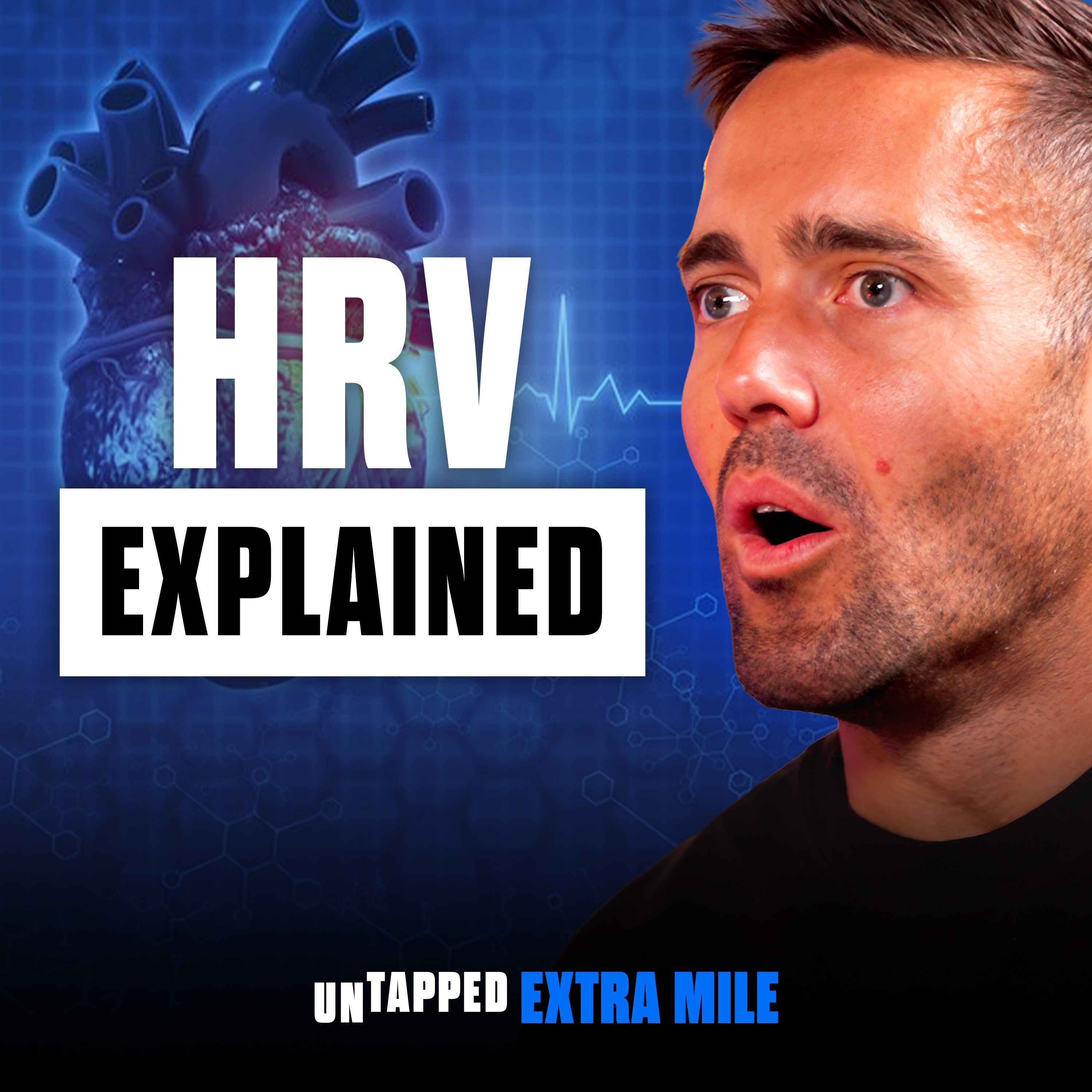
Heart rate variability (HRV)—what it measures, why it changes, how it reflects the autonomic nervous system balance (stress/threat vs recovery/rest), and how alcohol/social life affects HRV and wearable “recovery” scores.
Spencer Matthews and Olly Patrick host. Steven Bartlett is referenced via a viral clip about “three glasses of wine ruining his week.” Bartlett is not interviewed in the transcript.
HRV (often measured via MSSD in milliseconds) is beat-to-beat variability, not a fixed “good/bad” number. Lower HRV can indicate sympathetic (stress-ready) dominance and inadequate recovery; higher HRV can indicate parasympathetic (rest/digest) dominance. Wearables differ because each uses its own baseline-calibration algorithm; the key is change vs personal baseline. Alcohol suppresses HRV and fragments sleep, reducing parasympathetic recovery.
Olly describes a 6-day stretch of moderate drinking (3–4 glasses/wine/beer) with “red” wearable recoveries despite feeling fine and training successfully (e.g., 17k run at ~4:10 pace). They argue Bartlett’s “three glasses” claim is about mindset/data-ownership rather than inevitable performance collapse.
Written by AI. May contain mistakes.
The hosts discuss heart rate variability (HRV) and its significance.
“Ever hit a wall in the middle of the day and a third coffee just doesn't do it anymore?”
The hosts discuss heart rate variability (HRV) and its significance.
“Nobody knows what HRV is, I don't think.”
Exploration of how alcohol consumption affects HRV scores.
“I don't think either of us actually are experts in that particular field.”
A deep dive into HRV, its measurement, and its implications for health.
“So like, okay, if I, I'd like to talk to you about drinking as well, actually.”
Learn how heart rate variability reflects your body's stress and recovery levels.
Learn how heart rate variability reflects your body's stress and recovery levels.
“In a world where AI is changing every role in every industry, knowing who actually has deep expertise matters more than ever.”
Explore the effects of alcohol consumption on heart rate variability and recovery.
“Everyone's so busy and social at this particular time of year.”
Discuss the importance of balance between health optimization and social enjoyment.
“It's nice to do things that feel like a little bit naughty.”
Exploring the trade-offs between enjoyment and health metrics in life choices.
“I'd say to myself, right, you know, I wish I hadn't done that yesterday.”
Discussing heart rate variability (HRV) and its implications on health and performance.
“Liquid IV hydration that goes wherever life takes you.”
Learn about the significance of Heart Rate Variability in maintaining health and performance.
“So I would never message Stephen, for example, and say, and this is Stephen Scullion now, not Stephen Butler.”
HRV serves as a crucial indicator of overall well-being and future health risks.
“What you'll find is lots of people going to doctors around the world with conditions that are effectively their body is slightly too ready for threat all the time.”

Get the gist, explore an idea or ask about something said.
 Claude
On UNTAPPED with Spencer Matthews, what are the key points of this episode?
Searching your listeningAutomatic transcript. May contain errors.
0:00Who says Halloween only lasts one day? With Wayfair, one night of Halloween becomes a whole season at home. From larger-than-life yard decor and moody lighting, to festive accents for every room in the house, Wayfair has what you need to make Halloween feel like magic all in one place. Because the best Halloween memories aren't made in just one night. They're made all season long. Shop Halloween decor now at Wayfair.com. That's W-A-Y-F-A-I-R dot com. Wayfair, every style, every home. Mod.com is changing the way people battle excessive fatigue. Ever hit a wall in the middle of the day and a third coffee just doesn't do it anymore?
0:40Here's what's actually happening. Coffee only briefly blocks adenosine, the chemical that tires you out. When it stops working, your system is flooded and you crash. Modafinil is a prescription treatment that works in a completely different way. Modafino works by stimulating multiple receptors in the brain associated with wakefulness, including dopamine, serotonin, norepinephrine, histamine, glutamate, and orexin. It's a more complete solution that gives you 10 to 12 hours of steady focus and energy. To learn more, go to mod.com. Fill out your intake form, meet with a licensed provider, and if approved, ModAlert ships straight to your door.
1:23Go to mod.com to get started. That's M-O-D dot com.
1:55you feel something is a car that stops short of amazing. Experience amazing at your Lexus dealer. Ladies and gentlemen, boys and girls, hello, and welcome to Untap the Extra Mile with me, Spencer Matthews. And me, Olly Patrick. Today's conversation is about HRV. Nobody knows what HRV is, I don't think. And I'm somebody that almost cares about my HRV score. I'll track it. I'll pay attention to it. I've actually once tried to understand it, but I don't know what it is. I don't think anyone knows what it is. It's just a number. And it's strange because some people have an HIV of 120 and some people have an HIV of 10.
2:42And so I know some quite healthy people who have quite low HIVs and, you know, Sean Stafford HIV is miserable. It's like 28, 30, Which for me, I'd get an HIV of 30 if I drank a relatively considerable amount of alcohol the day before. I think alcohol is HIV's great nemesis. That's a brilliant description. Okay. Can you tell us what HIV is? And I know that you will naturally sound beautifully learned and scientific, but can you try and explain it as if you were talking to a little kid? I can, because it is, I think you framed it there, it's probably the most misunderstood parameter. And the challenge with it is the number doesn't mean much.
3:33And that's so hard to get your head around. We've talked about VO2max before, and I love VO2max. Life number, gone up to 64. Oh my God. Yeah, it's slowly creeping up. No kidding. as you move towards the ability to combust oxygen for two hours 45 and get over 26.2 miles. So that is great. Now, VOT makes intuitive sense. The higher the number, the better. That's the only parameter in physiology where there is no upper limit. So the higher, the better at all ages and stages. Amazing. And that's nice and crisp and clean. HRV is not the same. You and I could both have the same heart rate variability number.
4:05So it stands for heart rate variability, HRV. And one could be healthy, one could be unhealthy. Not to be mistaken with HIV. which of course is not the same thing. It's not the same thing and should be separated early into this discussion. We're not going to do half an hour on HIV. Unless of course that's what the listener would like. If they want it, I can work on it. Not my area of expertise. I don't think either of us actually are experts in that particular field. I would concur. Heart rate variability, however, I've used and loved actually since probably 2002. And for me... 2002? Yeah. 24 years ago.
4:4324 years in bed with HIV. No, no, no, no, no. Yeah. Ollie, come on. 2002. I do ask that we tell the truth in here. Yeah, I can only speak the truth. I said this to, I had the pleasure of doing some fine dining with Will Ahmed, the founder of Whoop. And I so appreciate what he did because I loved HIV and he really was the first to democratize a 24-hour wearable. And in clinical practice, we were like, wouldn't it be amazing if someone could make this test, but you had it capturing data all the time. So probably 10 years before he came up with Whoop, I should have come up with Whoop, but didn't have the capability, the knowledge, the entrepreneurialism.
5:25So, you know, it's a parameter I've been in love with for a long time. And I think it might be A, the most useful performance parameter, but it also might be, yeah, it might also be the most important health parameter. What, HRV? HRV. But why is it so yo-yo-y? So like, okay, if I, I'd like to talk to you about drinking as well, actually. Well, let me frame what it is first, because. Just exactly, say exactly what HRV is. Yeah. But you know, what I was about to say is, if I went to sleep at 8pm tonight, completely alcohol free, having had a good day of training, and I slept for 10 hours, my HRV tomorrow would be 90 or 100, something like that.
6:06If I finished the day here and it's 5 p.m. and I have three pints of lager with a friend and watch a football match and go to bed at 11 p.m. and wake up at 6 or 7, my HRV would probably be 30. So how can it vary so much? So it's not fixed like VO2, which won't change from week to week and week to week. You're a bit more stubborn. It's a dynamic physiological parameter. Heart rate variability, let's capture it. So heart rate, that's how many times my heart beats per minute. So if you and I beat at, or we've both got a heart rate of 60 beats per minute, then the idea then there's one beat per second.
6:44That would not be the case, right? So the gap between heartbeats will change. So it might be that my heart beats, then it's 1.2 seconds, then it's 0.8 seconds, then it's 1.4 seconds. Is this throughout the day? This is throughout every minute of your life. your heart rate is varying but not over the course of the minute over the course of beat to beat so it's beat to beat variations in your heart rate I'll get to explain all this and then people will realise actually it's not relevant later down the line but it's worth framing so if we both are beating at 60 beats per minute if we're both at heart if our heart rates are at a very steady cadence of 60 beats per minute but your heartbeat is going metronomically once every second boom boom boom mine is more erratic it's going boom boom boom boom i would have more variance in my beat to beat variation so i would have a higher heart rate variability what the maths is we take something it's called the root mean square of successive differences now i only say that because everyone will see your thank god someone said it.
7:51Maybe we should do HIV. Thank God we finally got there. Well, our MSSD is the measurement unit and it's then in milliseconds. So milliseconds of, if you like, average differences. So if I've got loads of differences between my heartbeats, I would have a higher heart rate variability. If you have less... Hang on a second. Just broadly speaking, is having a high HIV better? That's a great question. Neither better nor worse. Now, again, everyone wants it to be this result is good this result is bad so who cares about this shit then if like no one cares what the number is because it's a shop window right HRV is the ability to look not at heart rate variability but at the balance of the nervous system that's running the inside of you sorry can I ask you of course you can yeah so when my HRV is lower yeah my heart rate is more stable when your HRV is lower it would be your heart rate would be more stable beat to beat not minute to minute but beat to beat.
8:48Is that not a good thing? That's a really logical thing that a more stable heartbeat sounds good because we hear about arrhythmias and, you know, an irregular heartbeat. Irregular heartbeat is a different animal. That's where the heart's rhythm is now being lost through an electrophysiological signal mishap. So my heart is not firing as it should do. This is different. HRV being dynamic is a good thing for a very important reason. Your heart rate and your heart rate variability has been controlled by two nervous systems. One that could speed your heart rate up and one that could slow your heart rate down.
9:19And your heart rate can change rapidly, right? So if we suddenly decide to stand up, our heart rate goes up. If we lay down and we have our feet, you know, rubbed and massaged, our heart rate will go down. I would love, honestly, I'd love that. I need it so badly. Well, I'm not offering it. Well, oh. But my legs are just like, my legs honestly may as well be cinder blocks. Like this morning, I went for a really slow, ploddy 8K. and it just sucked. Oh, interesting. Terrible. Shocker. Well, that's my dream kind of run. That's why whenever you say anything, sort of zone one, zone two, my eyes light up when you do your hard sessions.
9:55I much preferred the faster stuff yesterday. We are the polar opposites in that regard. So let's think again. There is a nervous system. We're going to have to do a bit of physiology because if people want to be stuck not knowing what HRV is, then they can end this podcast now and they're done. But HRV is irrelevant. What it's doing is trying to make an assumption about the balance of something called your autonomic nervous system. An autonomic nervous system is the unsexy, uncool nervous system that runs all of the internal processes going on in you that you're not under conscious control of, right?
10:24So as we sit here now, I'm controlling my arms and my legs and my mouth. That's part of my motor nervous system. What I'm not controlling is whether my heart rate goes up or down, but it will. Whether my temperature goes up or down, but it will. Whether I produce some lovely digestive enzymes to engorge and break down the avocado toast that you and I have just inhaled. Fabulous. That's great. Whether I produce a bit more, you know, of blood to my surface because I want to cool down, whether my pupils dilate, my physiology is changing all the time without my conscious control. And it's changing to maintain a process that is relevant to everyone on this podcast, which is homeostasis, which is the regulation of my internal environment despite a changeable outside world.
11:06If it's hot in here, we sweat. If it's cold in here, we shiver. If food comes in, we salivate. If Simon attacks us with, again, a hammer of some description, we will panic and run or take him down. We bash him. I think there'll be a good chance that two-on-one we could take him. So principally, or one-on-one and I'll watch, principally, we have an incredibly dynamic physiology that is changing all the time, right? So the inside of you is changing second to second to second. Why is it changing? It's changing so the inside matches the outside demand. If it's hot, I've got to sweat. If it's cold, I've got to shiver.
11:35If it's food, I've got to digest. That's being run by this autonomic nervous system, which in simple terms has got one branch that accelerates your physiology, gets it ready for what people often misappropriate is fight or flight, right? But think it's more dynamic. It's exertional activities. So my heart rate goes up, blood pressure goes up, temperature goes up, glucose in my bloodstream. I'm able to do physical dynamic stuff. I've got another branch of that nervous system that slows all those processes down, gets me out of being ready for dynamic activity, gets me ready for resting and digesting.
12:05So I've got a nervous system, basically, you have, everyone listening has, that responds to the outside world and gets me ready for chill, energy, recovery, and is often really a recovery biological system. I've got another branch of that system that gets me ready for threat, for dynamic activity, for being switched on and alert. Now what's interesting is we can use heart rate variability to see which nervous system is the dominant force within that individual. So I can look at your heart rate variability, and through understanding how those two nervous systems affect heart rate, I can work out which one's in charge.
12:35For example, if the nervous system that gets you ready for threat and stress and all these exciting bits, the branch is called the sympathetic nervous system. If that is more dominant, I will see less variability in beat to beat heartbeats because that nervous system communicates through hormones and therefore its changes on heart rate are more slow. That's a bit of extra science. If I see that your heartbeat over those 60 beats per minute is bouncing around all over the place, then that's more akin to the parasympathetic calming branch of that nervous system, which means your body internally is ready for resting, digesting, energy recuperation.
13:08So the basic principle of heart rate variability is the number itself is not important. What we see is when we see more variability, that looks like a physiology that is restoring energy, recovering, digesting. When we see less variability, sounds counterintuitive, but a lower number, we see a physiology that's ready to take on threat, take on load, is physiologically switched on. And so what you've basically got is a living glimpse into the inside of you to say, is Spencer anticipating threat or is Spencer anticipating recovery? And therefore, it's been hugely sort of pioneered into sports performance where it became an early indicator of overtraining.
13:48And that's its lifeblood, right? Because if I'm overtraining, I've inadequately recovered so i would see less heart rate variability what we've seen then with the likes of whoop and and sort of these permanent wearables is we realized that overtraining is the same physiology as being overtly stressed and being over under pressure if all day today i'm thinking about things that i've got to solve problems i've got to manage i'm i'm living in future events that always my body thinks oh you better be ready for threat in those scenarios my body will be slightly ready for threat all the time my heart rate variability will drop and that will come at the cost, critically, if I probably haven't spent enough time restoring energy and recharging my battery.
14:26So in very simple terms, the heart rate variability is a glimpse into your autonomic nervous system to see whether you, Spencer, are spending enough time in your body's repair, recovery, energy restoration mode and too much time ready for stress, ready for threat, etc. That's the basic principle. The answer to that is no at the moment. Well, that's interesting.
14:53In a world where AI is changing every role in every industry, knowing who actually has deep expertise matters more than ever. Upwork connects you with the highly skilled freelance professionals with proven track records, so you can hire with confidence. Upwork gives your business fast access to highly skilled specialists with deep expertise, so you can fill critical skill gaps, launch projects faster, and scale support up or down without committing to full-time headcount. With Business Plus, you can access the top 1 % of talent on Upwork. AI-powered shortlisting delivers a curated shortlist of top freelancers matched to your goals in under six hours.
15:29No endless searching required. Thousands of growing businesses already trust Upwork to hire highly skilled freelance professionals for everything from one-off projects to ongoing support. It's free to sign up, and posting a job is easy. Visit Upwork.com right now and post your job for free. That is Upwork.com to connect with top talent ready to help your business grow. That's U-P-W-O-R-K dot com. Upwork dot com. Mod.com is changing the way people battle excessive fatigue. Ever hit a wall in the middle of the day and a third coffee just doesn't do it anymore? Here's what's actually happening. Coffee only briefly blocks adenosine, the chemical that tires you out.
16:11When it stops working, your system is flooded and you crash. Modafinil is a prescription treatment that works in a completely different way. Modafinil works by stimulating multiple receptors in the brain associated with wakefulness, including dopamine, serotonin, norepinephrine, histamine, glutamate, and orexin. It's a more complete solution that gives you 10 to 12 hours of steady focus and energy. To learn more, go to mod.com. Fill out your intake form, meet with a licensed provider, and if approved, ModAlert ships straight to your door. Go to mod.com to get started. That's M-O-D dot com.
16:55Waiting for your sign? Here it is. Shop Labor Day appliance deals at Lowe's before they're gone. Get up to 45 % off select major appliances. Plus, get free delivery, haul-away, installation and parts, and a two-year Lowe's protection plan on purchases of$999 or more. Labor Day deals are on now at Lowe's. In-store and online. Valid through 916, while supplies last. Selection varies by location. See lowes.com for more details.
17:27Everyone's so busy and social at this particular time of year. And that's a great point. It's crazy. Like, I think, generally, I think alcohol consumption is rife right at the moment. I'm not talking about just me. yeah you also just i mean if we take it as an example so i want to ask you about hrv but also let's just go through some actual whoop data so so first thing on the data so why every company's got a different algorithm is let's imagine we've both got an hrv of 80 right so you mentioned sean's was lower yours can be higher all of your devices that you wear will try and do one thing they'll try and calibrate you for a three, four, five, seven day period, right?
18:14Because what they're not asking with your HRV is an 80 or a 20. They're trying to work out what your normal HRV is. And when you therefore are higher, more recovery, lower, more stress, I'm gonna be more generic than that, but or that's slightly inaccurate through its through its simplification. But principally, every individual has got their own baseline. So the question is not what is your HRV? the question is what is your hrv doing compared to its baseline so if i'm normally 40 and my hrv's 60 i'm getting more recovery if i'm normally 40 and my hrv's 20 i'm getting less recovery so every technology company's built its own algorithm to determine what it has decided your baseline is and therefore what it defers as being inadequate recovery yeah those eyes are telling me a story I find it interesting.
19:07I think that the times of living a perfect life and doing everything perfectly and well and optimizing everything is almost suffering a bit. I agree. You know, I think, well, you know, we all saw the Stephen Bartlett clip where he said, you know, three or two glasses of wine or something ruined his whole week. Yeah. Which was, you know, just a bizarre thing to say, obviously. I understand what he means. Like, if I'm living an optimal life, which I do do a lot of the time, where you're eating very healthily and training really well and not drinking any alcohol and not staying out late. And, you know, I've done lots of that.
19:55if you suddenly chuck alcohol into the mix, of course you feel slightly different. Does it affect your ability to function properly? No, not really. Will it affect your HIV? Yes. And it affects your WHOOP data. As an example, I've gone from drinking hardly ever to the last six days I've consumed alcohol every day. right at some form of event so like it was the football then it was silverstone then it's wimbledon then it's gigi's birthday then it's you know why am you took me out for dinner you know just at this particular time of year just before everyone breaks for the summer holiday i find it very heavy on the social fronts you know i don't normally go out but at the moment i'm finding myself at something every day yeah right um and i'm not talking about like getting pissed like you know hammered drunk i'm talking about having you know call it three to four you know glass a couple of beers couple of glasses of wine something like that you know yeah um so drinking yeah definitely drinking but not but not you know going overboard drinking drinking but drinking you're not you know not drunk yep going to bed at you know 10 whatever like you're not you're not out late you know nothing's really suffering i've got five red recoveries here yes on the bounce every day has been red because of the alcohol spot on every day my strain has been between 17 and 18 and a half which is so like so not not stop me training yeah lifting weights running well not failing any sessions sticking to the plan running 90 kilometers a week so just really if anything you know maybe you feel a touch dusty just till you have your first coffee type thing in the morning but other than that no real difference but the whoop data um is basically you know declaring me dead yep here whereas where we're actually i feel very much alive and well it's a great example and i'm just look alive and well i feel fantastic well you're training well and actually the the folks who don't have the whoop the maximum load is 21 isn't it so it's a sort of scale up index but days of 17 18 are pretty high intensity or high volume days but You know, like if you take yesterday as an example, I ran 17k at a 4.10 average pace in the park with a pal.
22:25It was 30 degrees. I'd had, you know, four or five pints the night before.
22:32And generally just didn't feel like affected at all. Like these last few days haven't really affected me. I think if I were to suddenly decide, right, I'm going to do this every day. then I would eventually begin to feel some form of slight suffering, you know, because it wouldn't quite be what I'm used to, which is living a lovely, clean, healthy life. You know, I'm looking forward to not drinking today, for example, you know, just having a lovely nice night's sleep and a sauna and, you know, all the stuff that I've come to love. But actually, there's been a really, you know, relieving feeling of, actually, it's quite nice just to have, you know, a few drinks with your mates in the sun, particularly when, you know, Britain is as beautiful as it is now.
23:17And, you know, I said to myself, because my brother was like, oh, you know, he wasn't used to seeing me drinking at dinner, right? And I had a few glasses of red wine with him. It was my mum's birthday. It was one of the five. and I just said it's not getting in the way of my training you know I was just like I'm on track with my 245 we're ahead of time not failing any sessions Stephen's happy getting everything done I said you know I'm not drifting back into day drinking irresponsibly but just this little period before we go away for the summer holiday has felt really great you know and it's good it's pretty fun like I kind of like I really I've enjoyed it Yeah.
24:00Like I like it. I like that you like it. I like it too. It's nice to do things that feel like a little bit naughty. I think that's the backlash to the Stephen Bartlett piece, which is a life lived under strict, you know, governed rules by third party technologies is maybe not a life at all. And I think, you know, there is that great challenge that two pieces, alcohol smashes apart heart rate variability and it really compromises many of the body's natural recovery modalities. It fragments sleep. We've touched on that before. It suppresses the body's ability to move into true parasympathetic tone and quality recovery.
24:35So alcohol will do that to everyone's data. And actually, I think that the rise of WHOOP and other wearables has led to a significant drop off in people consuming alcohol for that exact correlatory reason. what you're proving which is important is your body's ability to manufacture energy and to be a high performance individual is much more than the balance of your autonomic nervous system right so over these six days your balance of that internal nervous system is a bit out of kilter there's not as much in layman's terms over 24 hours you've not spent as much time in true physiological recovery as you would do normally and here's the big answer to that so what right Right, so what?
25:13And the so what is relevant because this is where you need nuance, which is you're observing performance, so you're tracking clearly with Stephen, you know, all of your training metrics, you're tracking and training for a 245. You are not your data. And this is a really important piece. The person who wakes up and checks whether they slept well has already potentially lost the balance of power. The person who wakes up and goes, I've slept pretty well, I don't need to check because I know I've got the energy I need to go through today. And the minute, and I love Whoop, I love all wearable data.
25:45The minute it's telling you how you feel, you're a goner. The minute you're asking it to confirm what you should do that day, you've got a real ally in that data. And that's where I think it's an opportunity. Can I pose this as a question, just on the Stephen Bartlett stuff? Essentially, it's the question we're trying to get at, like, what's the point in living a highly optimized long life if it's boring and you've got no friends and it's a bit lame. Yep. Do you want me to answer that? Yeah, I think that's the question, isn't it? I think there have to be times... This is why complete teetotalism doesn't sit well with me.
26:23You know, I love being sober, and I love drinking no alcohol, and I love, you know, living quite an optimal life, even at the expense of a full social life. But you've got to have both, I think, from time to time you know it gives you stuff to look forward to gives you you know nights to look forward to events moments to look forward to i think it would actually be quite easy i think to just shut the door on anything fun in adverted commas get nine hours of sleep every night train perfectly do an ice bath every day never drink any alcohol never have a cigarette on holiday You know, like that's, I don't think that's difficult.
27:09It's just, why would you want that? It's like saying, say the masochists love being slapped about, but they wouldn't want to just get beaten up randomly in the street. I've actually never heard that before. I can't see that direct link. No, no. Let's leave it in the episode. Because I like it. It's like a suicide at the same point. Am I being beaten up? Do I like being beaten up? I think there's a flip side to it. That made sense in my head as a metaphor. There's a flip side to it, in my opinion. And look, booze is a slippery slope for me. I have an addictive nature. You know, I've had big problems with booze in the past.
27:46I think, for me, this 245 training block is kind of very much a parameter that I care about that's keeping me in check. I think if I woke up, like, violently hungover with a headache and my session went really badly, I'd say to myself, right, you know, I wish I hadn't done that yesterday. Let's, you know, get back into the thing that is giving me joy, which is this, you know, chipping away at this goal, this gradual progress. Honestly, the last five days where I've drank every single day, haven't had any negative knock-on effect in my work, in my training, in my marriage. so it's not an excuse to suddenly go great this is my new life i'm going to do this every day but it is a nice reminder that you can exist a little bit more like a human being oh like it's a boiling hot day i've done my session i feel like having a pint with my mate i'm going to have a pint then i'm going to go home and deal with the kids and yeah you know that's just that's normal human behavior of course i'm an advocate as well for sobriety and for for not drinking any alcohol and of course i think we all know that alcohol is bad for you that we know that right in the same way that eating a fried chicken sandwich every day isn't great for you but if you feel like a fried chicken sandwich eat it who cares you know like whatever it's the dosage that determines the poison we say that in all things i think there is energy from other sources you know we can the The hyper-optimization movement is getting a backlash for good reason, because people are too fine-tuned into the signals, they're too dictated to by the data.
29:27And I think the Stephen Bartlett episode was a really good example of getting people to push back, but I don't want this life of rigid, data-led fragility. What I want is to seize life for all its value. And again, if Stephen has got the fullest life, I don't know how he feels and whether his life is dynamic and exciting, it certainly has lots of positives to it. But I know the social value of those drinks would outweigh the physiological decrease in recovery. I know that the freedom of making a choice based on impulse would outweigh a perfect night's sleep. However, that is an exchange that tips fairly quickly out of balance.
30:06And what you're in an interesting period here is you've had a six-day run where your decreased physiological recovery has been captured and noted. Your performance has been sustained. That will lag at some point. And therefore, it's what signal are you going to determine that that is starting to occur? And really what you've got with wearables is a canary in the mine in the old days. You know, that ability to spot a problem just before you'd spot a problem. Heart rate's up by five beats per minute. HRV's down by, you know, six milliseconds three days in a row. maybe I should pull a cord on this before I get that little bug that goes around the office that I wouldn't have got previously or before I, you know, get an injury while running because I didn't get all the cellular repair I should have got overnight.
30:47And we never know what that day is going to be. So all these devices are trying to do this predictive pattern. They're trying to go, Spencer, if you do this for another five days, you won't be able to do that on the sixth day. But that's why they're learning about you as they're sharing with you actually real time. it's nice for the mind as well to not always be completely obsessed with driving, you know, hopeful perfection because at the end of the day it can be a little bit boring it feels nice because you're getting all your work done and your training's perfect and stuff but, you know, it is at the expense perhaps of a really full life unless of course you go and fill your life with extraordinarily exciting things but most people don't right it's tough to say i mean and i think there's that bit again where i see a lot of people who feel like they've optimized too much you know if i go to a wellness conference people can't believe i'll have a glass of wine or that i'll eat you know the bread at lunch you know we are not defined by a singular act we're defined by our aggregate acts over time offset against our genes and environment and in simple terms we can get away with this stuff yeah until we can't and And your job is to seize the day, enjoy your life, while watching and observing signals of change that might stop a problem before it starts.
32:05But HIV is good for that. But also, I do believe not to continue banging on the Stephen Bartlett door, but the idea that three glasses of wine would ruin your week is categorically wrong, right? That doesn't work or make sense. That is waking up, seeing the low HIV, seeing the red recovery, allowing that to dominate your mindset, not reacting to it with any kind of action and just essentially being owned by the data, right? And I think that happens to people for sure. And it happened to Stephen. There's no, like if he had decided to wake up and go, I feel a bit dusty. I'm going to have two double shots of espresso instead of one.
32:50And I'm going to go to the gym and I'm going to sweat this out. and then I'm just going to screw my head on and get on with my podcasting, then he would have had a normal day. But he chose to say the actually very weak thing of, you know, this has chucked a spanner in my works, which at the end of the day is lame. I think it's a struggle. I think, not to defend Stephen, I think in his corner, two things. we were both at the formula one at the weekend if you put um a sort of five glugs of really low quality oil into that car you would notice it much more than if you put five you know lugs of low quality oil into my car on the basis that the cleaner the engine the more you would notice things that distract from that elite level performance so if you are overtly clean you will notice that suppressed sleep you will notice that change in in mood state i think he's he's being led by the data but he's also very um he's observing his state of being so closely that he's noticed things that others might might bully through and caffeine you know we spoke about previously it doesn't give you energy it masks fatigue if you're looking for fatigue you'll find it if you're looking for discomfort you'll find it so i think there's a perfect storm there of overt clean living mixed with data leading the witness plus excessive self-observation um and i think in there there's there's three lessons we can learn the data doesn't tell you how you feel you know we can get away with with blocks of time where we don't get it entirely right and sometimes just cracking on with the thing you want to do will have a greater value than being you know restricted by all these rules that actually in reality don't really exist i think everyone past a certain age understands what they're doing and how it might affect them you know we all understand well i don't i don't think people do with i think they do i know that if i if If I go to Silverstone, right, and I decide, right, I'm going to drink Don Julio margaritas all day.
34:52Yeah. I know that that is going to fuck me up, right? Like, obviously. So I'm going to come home. My sleep is going to be fragmented. I'm going to feel like shit. I'll probably smoke a couple of cigarettes. You know, everything about the day is going to begin to go downhill because I've made a conscious decision to go in too hard. Totally. Sounds great. That's on you, right? It's 100%. No, no, but that's on you, right? And of course your data is going to be shit the following day. Everything is going to be red. Whoop is going to say, you're a piece of shit. You know, you may as well be dead today.
35:25But you could also, you could just get on with your life. Can we also ask one question, actually, just on this point? Why do we assume that everyone who talks and obsesses over elite performance metrics is performing at elite level? Why has he been so affected by a very minimal amount of wine? He's also not a performance athlete. Listen, we're in the high performance studios. He's doing the best you can with what you've got where you're at. So it's not athletic performance. Cognitive performance would equally be valid. Cognitive performance, social performance. So we can't judge everything by your ability to combust in an athletic sport.
35:59There is a pretty clear cause and effect that if you drink alcohol, it suppresses recovery at potentially some physical, psychological cost. But... Who says Halloween only lasts one day? With Wayfair, one night of Halloween becomes a whole season at home. From larger-than-life yard decor and moody lighting to festive accents for every room in the house, Wayfair has what you need to make Halloween feel like magic all in one place. Because the best Halloween memories aren't made in just one night. They're made all season long. Shop Halloween decor now at Wayfair.com. That's W-A-Y-F-A-I-R dot com.
36:38Wayfair, every style, every home. Hi, I'm Jack Cravici, Kramer host of The Best One Yet. At T-Boy, we're always talking about small decisions that can have an outsized impact. One of the simplest is staying hydrated. Whether I'm traveling, getting a workout in, or heading into a busy day, I keep Liquid IV on hand. It's clinically demonstrated to hydrate faster than water alone and contains three times the electrolytes of the leading sports drink, plus eight vitamins and nutrients. It's an easy addition to your daily routine and helps support hydration when you need it most. Shop now at liquidiv.com.
37:09Liquid IV hydration that goes wherever life takes you.
37:39or request Cologuard Plus online, Rx only. The clear piece here is the freedom to make that choice and the ability to get energy from other sources might outweigh it. I think that box is off. The danger here is that we restrict HRV to alcohol and that's the cleanest relationship that exists. And because if you drink, it doesn't care who you are, you'll have less heart rate variability, you'll get less recovery. That will have a ramification, short-term, medium-term, long-term. Stephen feels the short-term, you don't. It's the three glasses that did it. Had he said, I had three bottles of wine and a couple of grams of cocaine last night and it's ruined my week, I'd go, yeah, fair enough.
38:21And I think everyone would go, yeah, sucks to be you. Because there's a very good reason, actually, that that would get in the way of your podcasting. I'd argue be a much better podcast. No, no, well, you know, there's pros and cons for everything I find myself in this Stephen Bartlett sandwich I'm not even by the way can I just say I'm a Stephen Bartlett fan I like Stephen Bartlett and I like what he stands for I'm jealous of him in many ways but I genuinely think that what he said was it's just a real shame actually it raised a good debate which is what he does like to do which is there are people now being led by data not enabled by data there are people who are too introspective on their feeling when they should be more focused on the outside world.
39:08I still don't know what HIV is, by the way. Well, I'm going to come back to HIV. I also find that impossible. You're going to have to listen back to the first 10 minutes of gold where I've laid out a very clear scientific framework. So heart rate variability is a living... So we're actually going to redo the stuff we've got? No, no, no. Heart rate is a living battery monitor that takes your baseline and says, Spencer, do I think some of your behaviours, including or excluding alcohol, have led to suppressed physiological time in recovery? Or do I think your HIV is representing you spent too much time ready for threat and stress and you then have to make a decision on how you would then attenuate or reduce training load?
39:47Whether, again, if I've got recurrent low recovery, whether I cancel going to that friend's dinner tonight because I just cannot do another night, whether I go to bed earlier, whether I engage in activities that increase recovery like meditation, breath work, cold exposure, infrared sauna, other. what you've got is a barometer and on a very simple basis forget the number you're going to need to put HRV into an engine that tells you are you under recovered and potentially excessively stressed if that is true what next best action will you take to get that balance back that's the principle so that's interesting so I think I get it now so is low HRV your batteries low and high HRV is you're good to go that is close enough to being true the challenge there is some people with excessive hrv that's also a bad sign so let's imagine i'm getting unwell my body might be stuck in recovery mode because it's so if my hrv is super high that could also be a problem if my hrv is low and i'm ready for threat that could also be really important if i am being attacked or i'm in a war zone or i'm on the front i might take hrv off off my dashboard no it's the master parameter i think it's it's it's worth like that it's worth listening to this podcast again and going if i get this even though you're talking to you i'm not talking to the listeners i'm talking to you listen to the first one if you understand how to use hrv it is a lifelong ally a lifelong ally on your management of pressure stress recovery and sleep and if you understand how your actions and behaviors influence your ability to go between stress and pressure and rest and recovery, then you have control of your well-being.
41:30But I don't give myself any option. So if I decide to go out with my friends in the evening and watch England at one in the morning, and I decide to have five or six pints of beer, and I go to sleep at three or four in the morning, and I have to get up at 6.30 with the kids, of course I'm going to feel a bit like shit. But I'm still going to run my session because I have to. I would never allow my behaviour from the previous night to get in the way of my blog. So I would never message Stephen, for example, and say, and this is Stephen Scullion now, not Stephen Butler. I would never message Stephen Scullion and say, oh, hey, mate, I feel a bit shit from last night, so do you mind if I just don't do today's...
42:14That's not in my makeup. So I'll go and run the session anyway. I'll probably run it extra specially hard just to kind of give myself a good kick up the arse from the behaviour the night before. or I'll complete the session probably quite well. And then I'll think, there we go. Perfect. Job done. Tick. You're young physiologically. You're driven. You've got good psychological fitness. You've got good social structure for accountability. No one thing determines all things, right? So HIV is part of an orchestra of factors that would determine your ability to get up and perform in that event the following day.
42:46Other people haven't got that same orchestra. They haven't got the same drive. They haven't got the same psychological fitness. They haven't got someone who's waiting for them to turn up and do it. but they haven't got someone who expects them to complete it down the line. You've built an ecosystem of things that means you can have one of those balls dropped, which might be physiological recovery. If the only ball I've got is my physiological recovery, and I drop it, I'm going to feel terrible. And that is the core reality, that we are not determined by one thing. We're many things. But HRV and the balance of this nervous system, the autonomic nervous system, is a central facet of how energized most people will feel day in, day out.
43:19We've got one in eight people in the UK tired all the time. one in four people tired most of the time. My strong hypothesis is that is driven by mostly people being out of balance on their autonomic nervous system with too many signals telling me to be internally slightly ready for threat and too little, too few things that tell me I can go into true physiological recovery. That's why the boom of the recovery industry through wellness is so multifaceted and it's had a commercial avalanche because most people are physiologically under-recovered because the world has shifted the natural balance of our autonomic nervous system and hrv is the canary in the mind and and the cold reality if you understand this parameter on a personal basis you have control over your dosage of training intensity your likelihood of injury risk your likelihood of compromised immunity your decisions around sleep your late stop on caffeine your use of alcohol your use of social networking if you get this parameter you get the rules of how your body interfaces with its entire world and therefore i suggest people listen to this podcast again i'm telling you now it's the number if i you know go back to time spent in advanced clinical practice if your hrv is low or lower than its baseline so it's not about low lower than its baseline then what we'll find probably high blood pressure because it controls blood pressure we'll find high glucose because it controls glucose we'll find poor stomach digestion because it controls digestion we'll find low mood state because it affects sleep rest and recovery we'll find poor inflammation.
44:46What you'll find is lots of people going to doctors around the world with conditions that are effectively their body is slightly too ready for threat all the time. And HRV would have told them that two years before they started getting meaningful symptoms. So if you don't get it, your body doesn't care if you get it or not. It matters. So take the time to understand it because it's a rock star. And there you have it, ladies and gents. HRV. we'll catch you next week with not a main ep but another ep of Untapped with a guest don't know who that'll be because I don't know what all of this is going out in and then we will be back with Untapped the Extra Mile providing I pay Ollie and he comes back I've always come back okay good
What does your HRV score actually mean—and can three glasses of wine really ruin your entire week? Spencer and Oli unpack Steven Bartlett’s viral comments, debate whether wearable data is making us healthier or more fragile, and explain what HRV really reveals about stress, recovery, sleep and performance - and how you should use it.
Do Health 👉 For your long-term health. Head to https://highpfrmc.com/dohealth-ut-au to sign up now.
Postcode Lottery 👉 Discover how Postcode Lottery players are Powering Hope Together. Click here to find out more: https://highpfrmc.com/ut-postcode-au
Robinhood 👉 Head to robinhood.com/untapped to get started and claim your free stock.
Hosted on Acast. See acast.com/privacy for more information.