Ask ChatGPT
 UNTAPPED with Spencer Matthews
1 Oct 2026 · 32m · 16 chapters
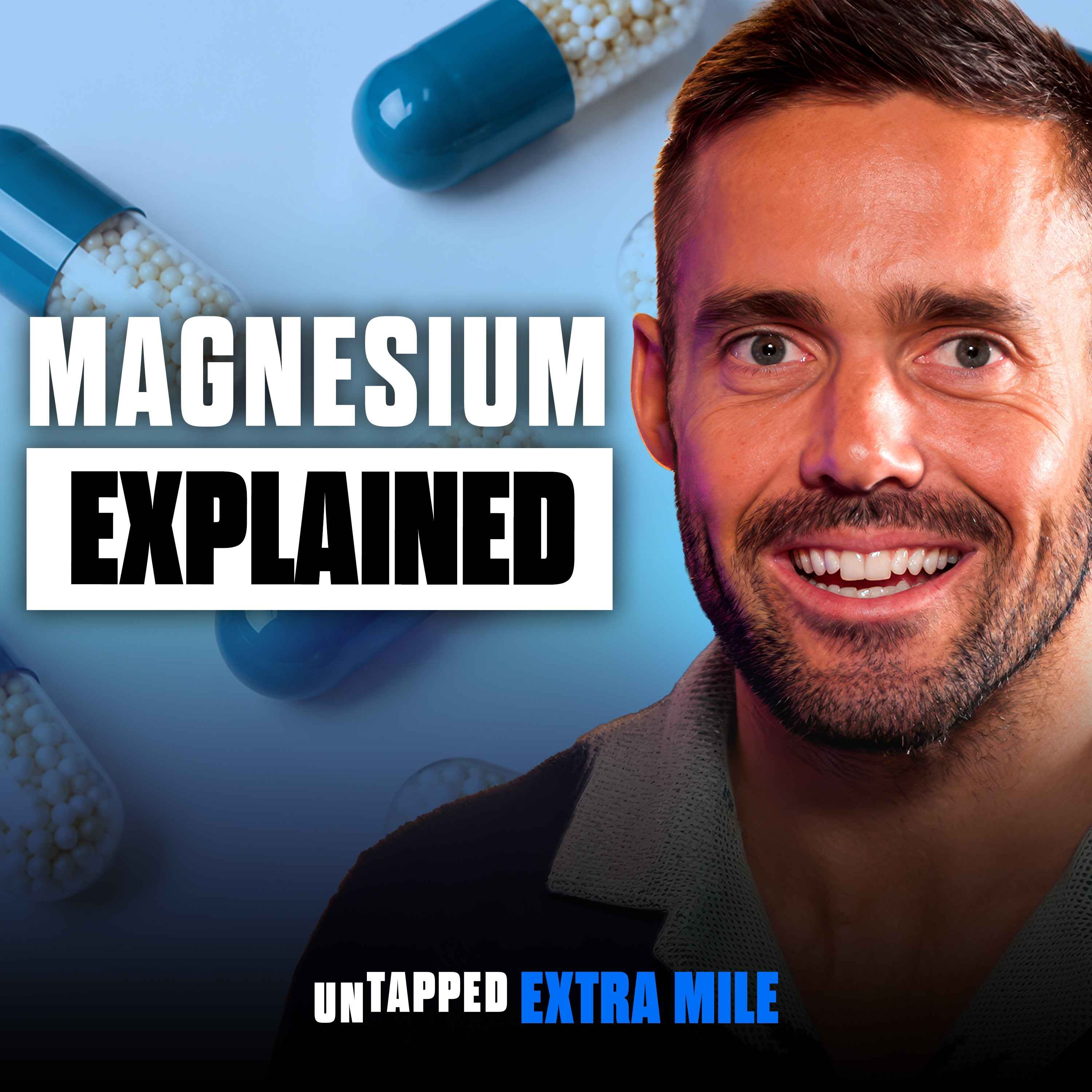
Whether magnesium supplements are worth taking for runners, and when they help (sleep onset/quality, muscle relaxation, cramps) versus when they’re unnecessary if dietary intake is adequate.
Blood tests don’t reflect total body magnesium stores well; benefits are most logical in people with low intake or deficiencies. Too much magnesium can be an issue (kidney strain; toxicity not common). Magnesium may work via GABA-related calming and calcium-magnesium roles in muscle contraction; placebo and belief may contribute.
magnesium-rich foods (dates, avocados, bananas, leafy greens, legumes like baked beans); Epsom salt baths; magnesium forms discussed (glycinate/biglycinate for sleep, threonate for brain).
Dan Murray, CEO/founder of Heights (insomniac who created a magnesium product; co-author on scientific papers). No other named guests.
Written by AI. May contain mistakes.
Discussing the significance of magnesium and its popularity in supplements.
“This is Dan Murray, the CEO and founder of Heights.”
Oli shares the story behind Heights and their magnesium supplement.
“In fact, I'm listed as a co-author on two scientific papers that they've put out because they try and prove the efficacy of their products, which is great.”
Exploring how magnesium affects sleep and dietary intake.
“It's not, I don't think we've seen huge amounts of toxicity from it because it's not stored in the way some of the other nutrients would be.”
Discussing food sources of magnesium and their health benefits.
“And magnesium is found in dates, avocados.”
Debating the necessity of magnesium supplements for those with a balanced diet.
“I think giving someone fruit is a lovely thing.”
Highlighting the nutritional benefits of legumes in relation to magnesium.
“Availability and coverage vary by state and insurance plan.”
Examining how magnesium impacts muscle relaxation and sleep.
“this bread, there's not much magnesium there.”
Explore how magnesium influences neurotransmitters like GABA and its calming effects.
“who are stuck with unlocking sleep and have turned to magnesium and found salvation.”
Learn about magnesium's impact on muscle contraction and relaxation, including Epsom salts.
“You say what you actually mean instead of what would hurt someone else the most.”
Discuss the potential for wearable technology to monitor mineral levels in real time.
“Availability and coverage vary by state and insurance plan.”
Differentiate between magnesium types and their specific benefits for sleep and brain health.
“after consistent sleep and wait time, after no caffeine, after light in the morning, dark in the evening, yada, yada.”
Hear personal anecdotes discussing the subjective effects of magnesium on sleep quality.
Discover why runners may need more magnesium and its role in energy production.
“No, no, genuinely, because I'm like, what else did you want me to do?”
Learn about magnesium's benefits for recovery, cramping, and overall running performance.
“Magnesium, you know, we probably could have started.”
Explore the botanical differences between fruits and vegetables with a focus on magnesium-rich foods.
“and do you know how to determine what a fruit is oh seeds is that right yes tomatoes are a fruit because they're full of seeds.”
Final thoughts on magnesium's benefits and the hosts' camaraderie.
“I think that magnesium from heights will be of benefit to me.”

Get the gist, explore an idea or ask about something said.
 Claude
On UNTAPPED with Spencer Matthews, what are the key points of this episode?
Searching your listeningAutomatic transcript. May contain errors.
0:00Hello and welcome to Untapped, the Extra Mile with me, Spencer Matthews. And me, Oli Patrick. Today, we're going to be talking about a bit of a phenomenal supplement. Can be found in food as well, of course, like all good supplements. Well played. We're going to be talking about magnesium. Mag-nesium. It burns bright. Oh yes, it does. Remember burning it in school? Is it a Bunsen burner thing that goes a bit wild? Is that what you put into the Bunsen burner? That's one of the things that goes off. It has gone off in the supplement marketplace. Yes, it has. Probably the most popular. It's funny.
0:34To be honest, I broadly speaking just take what I'm told. Who told you? Heights released magnesium, didn't they? They released a good one. To be honest, I just trust Dan. I like Dan. This is Dan Murray, the CEO and founder of Heights. He'll be delighted to leave this in, Bella. No, but he will be. I like the founder story. I like the fact that the supplements were created to fix a problem in his own life. He was an insomniac that, you know, he went and spent hundreds of pounds every single month in Holland and Barrett. None of the stuff actually reached his colon. So he developed a certain type of casing for the pill to feed his brain and his gut.
1:11And they released magnesium. So I thought, yep, I'm in. I said, I don't need to know anything about it until today. So today we're going to find out all about the thing that I eat every night. There's an argument for it. And Dan and Heitz are legendary. In fact, I'm listed as a co-author on two scientific papers that they've put out because they try and prove the efficacy of their products, which is great. Aren't you the chief something there as well? Chief energy officer, which is basically a chief well-being officer role, but it's supporting their research team, which are brilliant because it comes back to that question, does the supplement work?
1:48And it's interesting you started with a supplement versus diet. You corrected yourself because you're overtly self-aware. but you know principally most people think of magnesium the supplement not magnesium the the the mineral the elements you know the the nutrient in our diet and it has become just an absolute you know monster in the supplement world it's a beast and and the great danger with it is people go will magnesium help me with x and the great horror of that conversation and most people probably would say sleep right will magnesium help me sleep and the question is do you have inadequate dietary magnesium.
2:27And over time, has that inadequate dietary magnesium led to an inadequate body store of magnesium? And if so, supplementing with magnesium might be logical. Can you have too much magnesium in that case? You can have too much magnesium. You'd pass it through. So there'll be a load. Kidneys would face some potential strain. It's not, I don't think we've seen huge amounts of toxicity from it because it's not stored in the way some of the other nutrients would be. Kidney delicious. to eat obviously i'm not i'm not talking about human kidneys but a bit strong that's kind of you know my my palate genes territory now i'm talking more about um kidney that you might find in the steak and kidney part anyway those i'm assuming weren't under duress from magnesium no and the human kidney um does does a lot of our filtering for us and gets rid of what is what is extra it's tricky because one of the things in physiology it's hard to manage what you can't measure, right?
3:22So magnesium isn't massively visible on a test. So you can go get a blood test and we look at your magnesium, but that's not really that indicative of how much magnesium you've got stored in your bones and in your muscle mass where it does its job. So if you and I both go and get a blood test for magnesium, it doesn't actually massively tell us if we have adequate or inadequate magnesium. That's problem number one. Problem number two is, you know, if I look at my dietary intake, I still don't exactly know whether that's enough or not enough. And where we see most of the benefits for magnesium just as a starting point is in people who have massively or significantly inadequate amounts in their diet.
3:58So as logic would be with any supplement, the word itself gives us a clue. If you can't adequately take this vital nutrient into your diet, you could consider supplementing it, adding to. But if we both have enough magnesium in our diet and enough in our cells and tissues, and we take magnesium, it isn't going to unlock some magical health benefit according to the science we understand at present. And magnesium is found in dates, avocados. I love a date. Dates are delicious. Straight to fruit. Well, you haven't gone for the whole grain or the green leafy vegetables or legumes. As you know, fruit is indeed more fascinating than legumes, in my opinion.
4:42It's untapped extra mile bingo. My humble opinion, fruit is not only beautiful, but nutritious and interesting. I think were I a single man courting and I were to be offered fruit instead of flowers, I'd be bang up for that. I just honestly, I think if you're going to send someone flowers. It's offering you flowers. Or even you need to be single or courting. If you're buying flowers for your wife or your husband or trying to do something nice, consider some beautiful dates instead. I think that's actually... Some ripe avocados, beautiful dates, some golden kiwis. All of this is good shit. All right, like genuinely.
5:26I agree. Nutritious, beautiful, nutrient-dense fruit from the bosom of the earth. I agree. Honestly, it's unreal. Flowers, they look nice, they smell all right, but then they perish. I think giving someone fruit is a lovely thing. Wonderful. I'm not talking Granny Smith apples or something. No, for real. I'm talking about like actual... Magnesium rich dates, avocados, bananas, mostly. Imagine being able to say to your wife when it comes to the evening and she's looking to head into slumber and young Remy is fed, changed, unwrapped, lying in the snooze. We're at your house. Yeah, we're at mine now.
6:08We're at mine. And young Remy Valentine Matthews is going to sleep once more because he's been sleeping most of the day. Yeah, he's always tired. Yeah, he's growing. Yes, he is. And Vogue says, can you just pass me a couple of magnesium tablets? And I said, darling, you don't need those today because I made you smashed avocado on toast with some dates and you've actually had your fill. So anything you have tonight will be superfluous to necessity. Agree. And that vision of your future and maybe your current is quite extraordinary. It's very visceral. I think you could replace the supplement with food.
6:52People like the supplement. And the general theme would be, can I get a benefit from the supplement? And the supplement industry has pitched it mostly as sleep. So largely because there have been some studies where people who added magnesium, not through fruit, not through good sources, be whole grain carbohydrate, legumes, your beans, your pulses. We love those guys. They're great for you. And leafy green vegetables, your kales, spinaches. There's a great amount in there.
7:23Therapy's biggest impact doesn't show up in some dramatic breakthrough. It shows up in the smallest moments. You bite your tongue instead of escalating. You put your phone down instead of firing off that text. You say what you actually mean instead of what would hurt someone else the most. Nobody applauds those moments, but they quietly change your life. That's what growing feels like. And that's exactly what Grow Therapy is here for. Grow is therapy that works, covered by insurance. Sessions average$21 with insurance and some pay as little as$0 depending on their plan. There are no subscriptions, no long-term commitments.
8:00You just pay per session. Grow connects you with thousands of high-quality licensed therapists across the U.S. offering both virtual and in-person sessions nights and weekends. You can search by what matters. like insurance, specialty, identity, or availability. And you can book a therapy session in minutes and begin in as little as two days, not the national 48-day average. See if you could pay as little as$0 for therapy in seconds at growtherapy.com slash start now. That's growtherapy.com slash start now. growtherapy.com slash start now. Availability and coverage vary by state and insurance plan.
8:44What else can be found in a delicious legume? Oh, fiber is your gut, and protein. So legumes are unequivocally like the goat of most diets, apart from like the carnivore diet, where people don't want any meaningful... Nothing green. Nothing but meat. And again, we discussed that on a recent Q &A show, and there's an argument for it for some benefits, But the legume is protein, fiber, lots of, you know, of phytonutrients, so little antioxidants. They're unbelievable. And if you take like baked beans, for example, again, quite a lot of sugar added, but that's a great source of magnesium. And, you know, and you might find if someone's had some brown rice, some baked beans, you know, some banana in there and they're, you know, potentially a fortified cereal in the morning.
9:36you might find that they've absolutely topped off 250-300 milligrams of magnesium by lunchtime. And so why am I banging in a supplement for the nutrient that I've already perfused my tissues with? And that is always the question. Most supplements aren't tested for people with normative values of these things. They're tested for people with deficiencies. So is it fair to say then, and I'm not looking to shoot our dear friend Dan in the foot, because as mentioned, we love him. But if you have a good, balanced diet, should you really be supplementing full stop? I think there is an argument that you should, but that would be challengeable on every level.
10:17I think on the first basis, for you to be optimally nourished, you have to have a really strong whole food diet with quite a large volume of food. Because one of the great arguments for magnesium, which we're tying to all nutrients, is maybe there's not as much in our food as there used to be. So lots of nutrients, obviously all the nutrients in your food have come from somewhere. They don't just magically appear. So the nutrients from the soil will transpose up into the plant. And then we harvest the plant and we get the nutrients from there. And then we have a poo that goes back into the earth.
10:46And the circle of life is completed. And that's great. But what if we didn't poo and the fields weren't riddled with fantastic nourishment and fertilizer? And we rapidly farmed foods with low soil quality. and we accelerated crops, then there might be less magnesium in the food than there was previously. And that has been, again, broadly proven to be true. And then the foods that contain magnesium are being now ultra processed, which in high heat or high refining, the magnesium disappears. So let's take my whole grain, you know, a lovely bit of wheat has spawned in the fields behind my house, you know, but it came from soil, which had less magnesium and then it's heated and stripped down and turned into white flour and put into a loaf of ultra processed.
11:31this bread, there's not much magnesium there. And that might mean that people aren't getting 300 milligrams by lunchtime, unless they're going super send on like targeting really good quality locally sourced seasonal food. So we have to live in a pragmatic universe where most people don't eat the way that we know we should eat. And therefore the supplement is logical. And I think of the logical supplements, magnesium sits there. You'll also get, you know, you go to Dan's website or Heights website, you'll get thousands, tens of thousands of people who have experientially taken this supplement and seen an improvement in X.
12:05And probably the three groups of people who would be sort of hankering after magnesium would be the poor sleepers. So there's some data that supplementing with magnesium can improve the onset of sleep and potentially the quality of sleep. There'll be people who potentially in our world of runners, and I'm calling it our world now because... We're in the same world. Clinging to the coattails in your world, you might get cramps through a potential inadequacy of magnesium. That would be a very realistic thing. I'm just going to say, I've never had a cramp. That's not ever. In running. Wow. I've had a cramp where you're lying in bed and you stretch massively and then, you know, some muscle cramps.
12:48Yeah. But I've never, ever cramped in a session or a race. Touch wood. I can see it happening in Valencia now. I shouldn't have said that. But I've not. I've not. That's amazing. Never. Not pushing yourself hard enough. Well, you know, you can always debate that. It's definitely not that. Cramp in itself is something that's not brilliantly understood. I eat loads of salt. That might be why. I love salt so much. Salt is, anyway, we're talking about magnesium. Not entirely. And actually, salt and magnesium, they get put into the same bracket because these all are involved in electrolyte balance.
13:22If you take an electrolyte supplement, which has got your sodium and potassium, it'll often have magnesium as well because you do lose some in in salt sorry in sweating and interestingly magnesium is is thirdly involved in sort of muscle relaxation right so some people get almost a meditative sedative effect from magnesium and there's great debates about why that might be but you've got three fairly passionate advocacy groups where you go you'll go online and i hope in our comments we'll have someone who says i took magnesium didn't change anything else I went from not being able to sleep to being able to sleep.
13:54Now, I don't care what the double-blind trial says, that is their truth. And there's so many people like that, that I think it has spawned a significant industry of people who are stuck with unlocking sleep and have turned to magnesium and found salvation. Could that be a bit of placebo, the effect of just believing it's going to work? Very likely. It could be the magnesium they took created a sense of increased physiological calm. And we see some magnesium changing the relationship of a brain neurotransmitter called GABA. GABA, very cool. GABA is like a wet blanket of your brain. It calms things down.
14:28It's an inhibitory neurotransmitter. So if the world's going, get ready for a fight, GABA is like, nah, you know, I think it's probably not going to happen. No. No. No. No. That's GABA. That's GABA. GABA is, you know, leave it, leave it. No. I love that. GABA. GABA. Gabba's that. Gabba. It's like Gabba the Hut. Gabba the... No. Gabba's that. Okay. So magnesium might increase the levels of Gabba. Interestingly, I love Gabba. Gabba's a beast, isn't he? Well, Gabba, you get that first kick from booze when you have your first pint. A lot of people get Gabba. That gives you that sense of chill. Few things feel better than that first glass of chilled Pouligny Montrachet or even just a lager.
15:27Even just a lager. It's so funny, isn't it? I do this dance in my head all the time of, you know, do I love drinking? Should I just drink or should I be sober? I'm not comfortable with either, to be honest. I think you found the happy medium. Which I believe in. I don't know. Professor David Nutt has his new drink brand. I love David Nutt. And the whole point of it is it's giving you the same effect in terms of enhancing GABA and the neurotransmitters. GABA! So this is interesting. It's always interesting from Bella. But, you know, because the idea now is can I reproduce the sensation from alcohol from non-alcoholic?
16:05So L-theanine is often used, which is, again, an amino acid that can contribute to those neurotransmitters. So can I create that sense of calm and relaxation? And if you gave me a drink which didn't have alcohol but had L-theanine and magnesium, you might be able to elicit that. My shoulders have dropped and I'm ready to tell you the sort of dirty joke version of myself that would emerge. I sound like I'm literally from the 1950s. Dirty joke. You've got a dirty joke. You either sound very old or seedy. Yes. Seedy is a terrible word. Or both. Could be both. So neurotransmitter, GABA, you might get that.
16:46Also, if you have stiff muscles, that can be the relationship between calcium and magnesium. So a contraction of muscle is actually driven by calcium intramuscularly. Do you look at someone and go, he's got a calcium-magnesium influx? No. No? No. I'm very able to just look at them. Just leave them. I see the person, not the physiology. But principally, lots of this stuff is... is sort of the foundation of how we work. So if you've got calcium driving a muscle contraction, the relationship between calcium and magnesium would say whether that muscle stays locked in or locked off. And so magnesium has been used, and you see people doing Epsom salts baths.
17:29Have you ever done an Epsom salts bath? Or magnesium flakes? Yeah, they've got, like, the kids have bath bombs. No? Is that Epsom salt? Nah. There might be some of them. Oh, I've had some Epsom salts. You pour it in the bath, yeah? Yeah. And it just feels nice. So the idea there, which again, I don't think topical has been shown to have any bath. Do you bathe? The house I bought a year ago has got a roll top bath. A roll what? Like a standalone bath. Like not one that's built into the, there's a bath in our bathroom. Yeah. And I've had more baths. Where else would the bath be? Well, normally it's like a shower bath.
17:59Oh, I see. It's a freestanding bath. Okay. So I've had a few baths. Of course. So magnesium bath. Why are we talking about magnesium? Because some people take magnesium through topical. So topical is when something goes in through my skin versus oral where I take the supplement. So I've got a hot bath, magnesium flakes in there. That was used to create muscular relaxation. Like a sponge. We're like a sponge. Yeah, we've got very porous skin. I remember someone the other day going, well, because there was a theory when you had a sauna, particularly an infrared sauna, that you would release more environmental toxins through the sweat from an infrared than you would from a finish.
18:31But then you've got to, after the sauna, wipe that off. Otherwise, it's going to be reabsorbed back into your skin. Jesus, listen, I know we signed up for this, but there's a lot to remember. The key bit to remember here is that people use magnesium for muscle relaxation, and there is some logic to that. They use it for brain calm. There's some logic to that. They use it to help sleep onset, sleep staging, and sleep quality, and there is some logic for that. Is there empirical evidence that if you and I ate enough magnesium between now and lunch, we took any magnesium and we got any of those benefits no are you saying that there's no evidence to support that magnesium is helpful that is not what i'm saying so what did you just say you just said stuff to load a magnesium into us it might not help yeah unless we've got low magnesium therapy's biggest impact doesn't show up in some dramatic breakthrough it shows up in the smallest moments you bite your tongue instead of escalating you put your phone down instead of firing off that text.
19:35You say what you actually mean instead of what would hurt someone else the most. Nobody applauds those moments, but they quietly change your life. That's what growing feels like, and that's exactly what Grow Therapy is here for. Grow is therapy that works, covered by insurance. Sessions average$21 with insurance, and some pay as little as$0 depending on their plan. There are no subscriptions, no long-term commitments. You just pay per session. Grow connects you with thousands of high-quality licensed therapists across the U.S., offering both virtual and in-person sessions, nights and weekends.
20:11You can search by what matters, like insurance, specialty, identity, or availability. And you can book a therapy session in minutes and begin in as little as two days, not the national 48-day average. See if you could pay as little as$0 for therapy in seconds at growtherapy.com slash start now. That's growtherapy.com slash start now. growtherapy.com slash start now. Availability and coverage vary by state and insurance plan.
20:45How far away are we from creating a device that can tell us where like our levels are straight away? That's a great question. Because I'd love that. You know, imagine just wearing a bracelet. Yes. and you're eating all day and it it shows you levels of potassium good magnesium good you know like it would just be nice to know totally i have no idea right like how much protein i've eaten today how many carbs i've eaten today how much sugar i've had it's too passive there's a obviously people did that with glucose by having continuous glucose monitors where they repurposed a technology that was built for people with type 1 and type 2 diabetes so i can see whether my carbohydrate intake is potentially appropriate against my level of activity and glycogen storage.
21:26There was a grain of sand scheme where they basically have a circulating microcomputer that would observe blood markers in real time. We are a million miles away. You would have it injected into your bloodstream, so IV. It then travels around. Have you seen Inner Space with the old 80s film where they shrink a spaceship down and travel around the inside of the body? Great. For a guy loves physiology who's in that you are going to love it he was an OG oh Dennis Quaid Dennis Quaid I love Dennis Quaid this is like an 80s phenomenon Dennis Quaid pretty much only plays like football coaches now yeah like American football coaches exactly or like the dad you know this was Pete Quaid handsome leading man but he took a little spaceship travelling around the body trying to solve a problem almost like a crime brilliant film but they created that and I don't think it might have been Phillips or someone they said will put a tiny microcomputer that is measuring stuff all the time and then saying oh actually your prostate specific antigen has gone up 32 percent go and get checked out for prostate cancer it's called the grain of sand because your challenge there is what happens if you get stuck somewhere creates a blood clot yada yada so injectable like live biofeedback monitoring will happen it's in muscle and bone it can't just be blood that you're using to base your opinion on and that's really challenging and what you've got with these studies is how can they control for all the stored magnesium, the oral magnesium, the absorption of magnesium.
22:53But again, why products like the one we both take exist is because there's enough data to show magnesium in some different forms, which is worth touching on, can improve sleep. And there's enough confidence in that to say, without making huge, you know, obnoxious claims, if you're not sleeping great, here might be something to consider after, and there's that old phrase, don't step over pounds to pick up pennies, after consistent sleep and wait time, after no caffeine, after light in the morning, dark in the evening, yada, yada. You know, you don't start with a supplement. You end up with a supplement.
23:25And for me, I think that's a logic. And I like placebo. I think this is going to help me sleep. If I think something's going to help me sleep, it will definitely help me sleep. I love a placebo. It's good. If Puma, right, were to send me a couple of cinder blocks and they said, these are the fastest shoes in the world by miles, I reckon I could PB a 5k in them that's strange these are a bit uncomfortable but Puma said so I'd be out there caning it it's interesting yeah if you believe you can or believe you can't you're probably right and our belief over the efficacy of products has a huge impact on whether they work I always used to feel guilty because I was like the placebo killer because someone said I take this magnesium I'm sleeping like a dream I'm like well the data says and they're like bollocks so you're telling me it doesn't work I'm like no I'm telling you we don't know if it works and they're like, well, now I don't believe in it anymore.
24:16And like all great childhood dreams, the minute you're told it's not entirely true, it takes the magic out of Christmas. What form of magnesium should people consider were they to give this a go? There'll be forums after forums, and most companies will sort of back, probably depending on what benefit they're pitching out. If you're pitching out sleep, most companies probably do magnesium glycinate or biglycinate. you'll get magnesium malate magnesium magnesium oxide what's the magnesium you use in the Bunsen burner that's a good question, don't know surely you can't just be swallowing that no no, they'll bind it to something to make sure the body can recognise it and absorb it I think it's called a collating agent so they've got different things attached what is interesting about that is sometimes the thing it's bound to might have the benefit that magnesium is selling so one of the arguments with magnesium glycinate is it's the glycine that has a role on Gabba.
25:11Piggybacking. Piggybacking. So it's literally just like it's stealing really. Maybe. And what you've got is taking credit. Some magnesiums will increase a laxative effect. So what you don't want to do is take the laxative when you want the sleep benefit or take the sleep benefit when you want the laxative and just be asleep on the loo or heaven forbid just caked and turd in your own bed. But the principle being there is a I've fallen asleep in a loo before. Not an ounce of that surprises me. Yeah. It was in Val d 'Ezir. Anyway. So what became interesting a while ago, I'm just ignoring that story entirely, is the brain, which is often talked about, doesn't seem to absorb all magnesiums, but magnesium three on eight is a form that seems to cross the blood-brain barrier.
25:57So if you're, and here it does get confusing, and if you're sitting at home, you're like, oh, I'm going to give up on all of this. Magnesium, when it gets to where it gets to, is the same thing. Really, the thing it's bound to may offer an additional benefit or may get it through tissues without more GI discomfort. I think broadly, if people are selling a brain product, it's probably magnesium threonate. If they're looking at more of a sleep-centric product, it's probably magnesium glycinate or biglycinate, pretty much the same thing. And the truth is, you know, they're all much of a muchness.
26:25It's an incredibly strong marketing weapon. We've got the perfect, you know, formula of magnesium where the data isn't great. In fact, lots of data on sleep wasn't glycinate or biglycinate, but a recent study which wasn't using polysemography which is the only way you can really measure sleep found that there was an improvement in sleep with biglycinate I'm boring myself with that No, no, you're not boring me I'm just thinking I'm going to do a company where I just do the best quality of supplements Like heights Better The journey from this episode Much better than Dan It's going to be exciting and interesting I think of everything we've spoken about creatine is up there creatine's a goody magnesium i put you know collagen we both love a bit of collagen collagen just makes you feel like you're getting some kind of like implant you know collagen don't make me take the placebo away from you okay i won't but so i would say i don't take collagen i do take creatine i do take magnesium and i take it in the evening and i see here's an interesting piece again we're both you know quantified selfers we've got our whoop data and we got you know eight sleep mattresses telling us how we did i have better sleep when i take magnesium so so i can turn around and go right the data doesn't support it but what we've got to be careful is that's that's now being referred to as anic data or that you know it's my n equals one experience what you can't do then is go is magnesium is good for sleep magnesium in the context of my life for whatever reason does improve my you know my volume of deep and rem a little bit compared to when i don't take it that's a science experiment i need it I need it and also I can't bear waking up in the amber can't bear it it's not it drives me mad if I go to bed nice and early and I don't drink alcohol and I have my magnesium and I drink lots of water and I don't eat before bed and I don't really do screen time and I get into bed and I put my sleep mask on and I fall asleep before 10pm and I wake up around 7 had a good monster sleep and I turn on whoop and it gives me like some 48 % yellow recovery, I think.
28:42How disappointing. No, no, genuinely, because I'm like, what else did you want me to do? Whoop. But it's a defending whoop. It's a signal. So it's not whoop's fault that you had less heart rate variability. But that is a very... 86 or something. It's a very clear, very clear. And again, it's not whether it's 86. If it's less than your baseline, then they'll be interested. But I don't like that. So if you just have a monster baseline, they should reward you with being a green king. Yep, you'll get rewarded on load and biological age. What it's telling you is your session has been monstrous and you haven't fully adequately recovered from your session.
29:18That's not true, though, is it? That's debatable. How's it supposed to know? Because that's literally what it does. Yeah, but like... It's a lens. It's based off other people's variable data. It doesn't know whose wrist it's on. It knows it's you. Not really. Yeah, because it's basing you against you. Nah. So when we did our episode on creatine, we discovered that for some runners, you know, with certain goals, it could be beneficial. If we're looking at runners generally, should we be taking magnesium? Runners probably use more magnesium. Magnesium, you know, we probably could have started. It's involved in over 300 biological processes.
29:58One of the critical things it's involved in is some of the enzymes involved in energy production. So if I make more energy, I spin more mitochondrial processes, I would have a higher need for magnesium than the person who sat doing nothing all day. So there's a higher utilization in people who are fit, sweating, exerting, running. So there's an argument immediately that whatever might be the recommended daily allowance, they normally buffer for more, would be greater for someone who's got higher muscle volume, a higher you know exertion rate that's fair enough they also want to avoid cramping and they also might be sweating and losing some minerals through that and they also might be needing you know deep restorative sleep you can make 20 arguments that says it's probable that everyone listening to this podcast who runs has a greater need for magnesium that they may not meet through their diet what we haven't got is a study that says runners who took magnesium did better and that's always the hindrance and we don't want to fib and lie about that.
30:54But I think I can't see why as a runner you wouldn't be taking magnesium to hedge the bet that you've got enough of this molecule that does 300 things in your body. Almost all of them contribute to how good a runner you are and how fresh you feel after the run. So, you know, we can't, you know, we're not going to flog a magnesium supplement. But I take it because of all the things it does, heaven forbid I wouldn't have enough and I can't be bothered to be continually chasing kale, brown rice you know avocado is not such a burden but you know i don't want to be every day hunting my magnesium sauces avocado is delicious amazing food amazing food and as well just for the record fruit i was going to say some may think that avocado is a vegetable it isn't it's a fruit and do you know how to determine what a fruit is oh seeds is that right yes tomatoes are a fruit because they're full of seeds.
31:49All fruit has seeds. Vegetables do not. I'm desperately trying to think of a vegetable with a seed. I'm sure there's probably a vegetable with a seed that may be an outlier. Generally speaking, fruit has seeds and vegetables do not. Pepper. What about it? A red pepper is botanically a fruit. Seeds. That's actually brilliant. Yeah, I know. Told you. I would not have said a red pepper. I find the fact that I knew something that you didn't to be alarming. That shouldn't alarm anyone, although it's a blind spot. That's great. Blind spot. But actually, it's very easy now to live by that. Yeah. You know, avocado, fruit, and name anything with a seed in it.
32:32Well, I'll be doing that in my own mind. But red pepper is a goodie. Fruit. That's a goodie. Peppers. One would think it was a vegetable. Yeah. Well, guess what? It's not. After learning what I've learned today, I can comfortably say that I'm going to continue taking magnesium to hedge my bets because it performs 300 things in my body that I can use because I'm a runner. So why not? Hedging bets is good. Why not? Have the hedge. That is a stance. Totally valid. I think that magnesium from heights will be of benefit to me. So I'm going to eat it. no notes i agree and that just about brings our magnesium episode to a conclusion thank you very much for listening we we do value your your listenership ollie and i we enjoy spending time together an extraordinary amount um should it be worrying to the wives i don't know i think lovely to have a friend like you more people need a friend like you well that's very kind i feel very lucky to have you in my life.
33:41Did you see my Instagram post about you? I did. I got like 600 new followers. Did you? Yeah. I was like, literally, for a minute there I was popping off. Is that it? 600? Alright, thanks a lot. Yeah, you donated 600 from the million. Thanks for the... 1.1 nearly. Yeah, thanks for the follow. Knowing that you can't see the 78 ,000 in addition to the million, it's just a million until it's 1.1. Oh, is that right? We'll catch you next week for more Untap the extra mile where I believe we're digging into well I don't know what order this is going to be in so find out next week so good
If magnesium is so good for you, why doesn't everyone need it? Spencer Matthews and Oli Patrick get into one of the wellness world's most popular supplements and separate the genuine benefits from the hype.
They look at what magnesium could mean for sleep, recovery and running, why your diet might matter more than your supplement cupboard, and whether different forms really make a difference.
This episode is a closer look at whether magnesium is something every runner should be taking, or simply another supplement we’ve been told we need.
Heights 👉 Get 20% off your first month of any subscription at https://highpfrmc.com/UT_Heights_YT and use untappedpod at checkout
Robinhood 👉 Head to robinhood.com/untapped to get started and claim your free stock
Hosted on Acast. See acast.com/privacy for more information.