Ask ChatGPT
 UNTAPPED with Spencer Matthews
10 Sep 2026 · 46m · 18 chapters
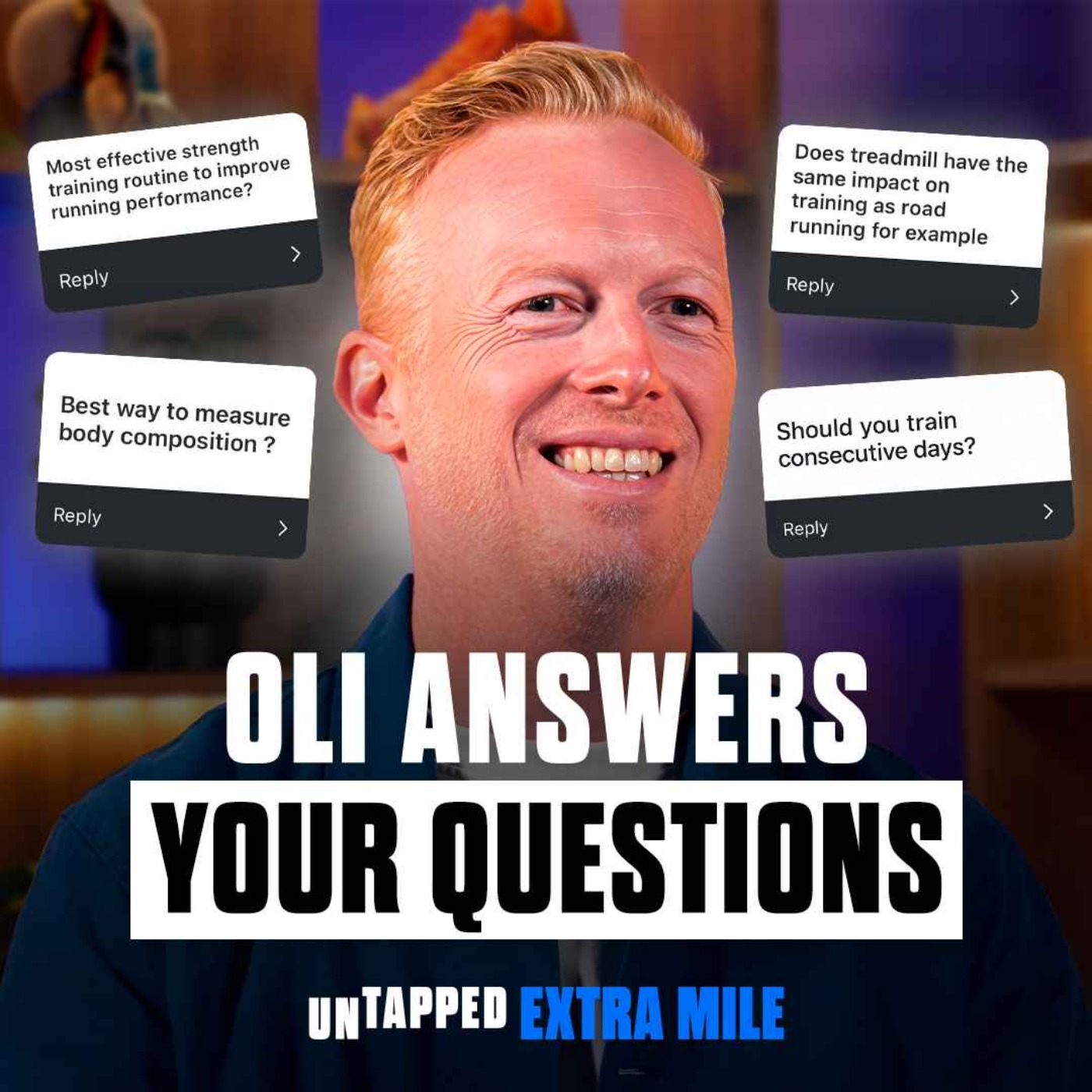
“Any Question Answered” health & fitness Q&A with Oli Patrick (Spencer Matthews absent).
none featured as named guests; questions come from listeners (usernames like Dead by a Thousand Cuts, Peter Everett, Monica Reinagle of Nutrition Diva appears only in an ad read, plus others like Robobobo 45, Endurance Sport 81, Shoreline Kelly, Delwin Andrews 8719, JMF Electrical 8225, Philin, Lottie PT, Darren Hunter, Jim Gregory 92, Archie Young).
HRV is a recovery/autonomic nervous system marker—use trends, not single readings; improve HRV via sleep, nature, journaling/meditation/breathing, and light zone 0–1 “dynamic rest.” Dietary fat storage depends on total calorie balance. Ultra-processed/junk foods may raise inflammation indirectly via fiber/protein loss and glucose spikes; body fat drives inflammation. Carnivore/keto: mixed evidence; may help blood glucose/weight but may harm gut health and can impair higher-intensity performance. MCT oil may raise ketones; performance benefits likely limited, possible brain/cognition relevance. Sauna benefits are well-studied in males; female data lacking but likely similar. Creatine monohydrate is standardized; premium brands mainly differ in micronization/purity. Collagen: mostly “maybe”; mainly protein, possible skin/gut effects but marketing ahead of evidence. Electrolytes: use when visibly sweating (long runs >50–60 min, sauna). Shift-work sleep: prioritize light/dark cues, consistency, low-intensity recovery, reduce caffeine/alcohol; cortisol reduction is secondary to fixing rhythm.
Spencer’s fourth child mentioned; “40% lower all-cause mortality” sauna study (male-based); GLP-1 meds referenced; Alzheimer’s/dementia cognition studies for MCT mentioned; visible sweat marks as electrolyte rule.
Written by AI. May contain mistakes.
Oli discusses heart rate variability (HRV) and its implications for recovery and performance.
“A fantastic Dead by a Thousand Cuts, outstanding username.”
Discussion on how dietary fats affect body fat storage and overall health.
“from something healthy, like an avocado, does that 20 grams simply get stored as body fat?”
Discussion on how dietary fats affect body fat storage and overall health.
“Hi, this is Monica Reinagle of Nutrition Diva.”
Oli explores the relationship between junk food consumption and inflammation in runners.
“too much sugar in chocolate, fizzy drinks, sweets, cake?”
Discussion on the carnivore diet's effects on athletic performance and gut health.
“And if that is the case, then how would I power my body without glucose, the main molecule used for energy?”
Explore the relationship between carbohydrate intake and athletic performance.
“has a higher intensity component if you remember we've got the gears of human physiology at low level now I'm probably using fat and oxygen to burn fuel.”
Understand the benefits and applications of MCT oil in fitness and cognitive health.
“Next up, we have Endurance Sport 81, very on brand.”
Discuss the lack of research on sauna benefits for females and the implications.
“against again one of the more sinister and high incidence diseases we face this one's from Shoreline Kelly.”
Learn about the differences in creatine supplements and their impact on performance.
“So it's not gleamed from animal products, which is of course, where we would get it through our diet.”
Strategies to improve sleep quality and align circadian rhythms.
“I have extremely poor sleep and my circadian rhythm is all over the place, causing me to take overly long daytime or early evening sleeps when I'm not working.”
Explore the role of peptides in health and the caution needed in their use.
“It's going, normally your body produces this molecule to get rid of inflammation.”
Unpack the efficacy of collagen and its role in skin and gut health.
“Exception to that, as I do think, as I've spoken about before, the rise of the GLP-1 and GLP-1-like medications will become a really fascinating part of mainstream living.”
Discuss the convenience and effectiveness of single-use supplement sachets.
“This is a slightly selfish question off the back of that liquid sachets.”
Learn when and why to use electrolytes during and after exercise.
“it's potentially then a gut-centric delivery mechanism that they've got some early data or proven data means you end up with more in your cells and less in your wee or your poo.”
Strategies for better sleep and cortisol management for firefighters and shift workers.
“If we have people shifting between day and night, that is classed by the World Health Organization as a carcinogen, which means that is unfortunately a greater risk of developing cancers and a shorter life expectancy.”
Learn strategies to optimize sleep and manage cortisol levels effectively.
“And whenever anyone's got a heightened level of suspected cortisol, we want to optimize sleep and sleep consistency against the challenges of their demand as quickly as possible because that's our best opportunity.”
Discover which supplements might enhance performance leading up to a race.
“And we haven't covered beetroot on the pod, but maybe if you're keen, tell us and we can do a deeper dive on that.”
Explore the importance of humility and experience in the field of health.
“So Liam, you're on the Christmas card list, but I feel like everyone else because I am like everyone else.”

Get the gist, explore an idea or ask about something said.
 Claude
On UNTAPPED with Spencer Matthews, what are the key points of this episode?
Searching your listeningAutomatic transcript. May contain errors.
0:00Welcome to Untap the Extra Mile with me, Oli Patrick, but no Spencer Matthews. And that's for a very good reason. Spencer is a very fertile young man and he has produced his fourth child with a magnificent Vogue and he is at home celebrating that occasion. So big love to Spencer. And that has left me in the chair. And we are going to do something a little bit different, a little bit special, because we've got an incredible audience on Untap the Extra Mile who are extraordinarily bright and constantly asking us questions. So we are going to do an Any Question Answered special. So you have been sending in your questions even before we asked in their droves, but we've chosen some questions that we think might have great relevance to our broader audience, and I'm going to try and do them justice over the coming episode.
0:44So no, Spencer, but your questions, my answers, and we hope you enjoy this episode. So let's get into it. This is from Dead by a Thousand Cuts. A fantastic Dead by a Thousand Cuts, outstanding username. My HRV has been very low in the past month, mostly redstone. I noticed on the graph that I stress a lot more than I thought, and even when I sleep. I wonder how much does it impact my HRV score and running form? It's such a great question. HRV, we've spoken about, it's become a real powerful parameter of performance. Why? Because HRV, heart rate variability, is a marker of the autonomic nervous system.
1:20I think the first and most important part with HRV is, is it lower than normal rather than is it low? because we don't actually know what a good score is. Your score might be 50, mine might be 40, yours might be bad, mine might be good. The trend of HRV is much more important because what HRV is trying to gauge is whether your body's undergone sufficient recovery. So it is a recovery metric. Most wearables will be using it as part of a recovery score. If your HRV is substantially lower than it normally is, and that's indicating as red, it means your body's parasympathetic nervous system has been less engaged than historical.
1:55And that might mean you're under-recovered. Now, you may or may not feel that. And what we've got to be careful of is the human body doesn't have to balance its books every day or even over short periods of time. I don't have to be optimally recovered today to be able to train hard tomorrow. Spencer Matthews himself will be under-recovered over these coming weeks as he adjusts to life with a fourth baby. So his HRV will be down, but he'll still be very capable of delivering quality training because training and exercise is more than just, did I get sufficient recovery in the last 48, 72 hours, etc.
2:30I think what we've got to bear in mind is, why would your HRV be down? And what it normally indicates is somewhere along the line, the balance between pressures on you and your ability to manage those pressures has got a little out of kilter. And looking at where those pressures are coming from, how kind you're being to yourself, and whether you're building enough space for quality sleep, our best opportunity to improve HRV, or quality, again, dynamic rest, like low-level cardiovascular exercise. Think zone zero, zone one, really light stuff. Time in nature, reading, journaling, meditating, breathing.
3:02These are the tools that can increase our body's ability to recover and by proxy, increase your HRV. In the short term, I wouldn't use it too much as a signal to avoid or change your training structure. But if you're feeling like there's less energy, if you're feeling less vibrant and less energized, then it's a really good indicator to say, okay maybe I take my foot off the accelerator pedal somehow push a little bit onto the brake using some of those techniques I mentioned and then hopefully over a period of two to three days you'll see that number rise and your athletic and running performance will follow that's my hope don't use it to tell you how you feel but if you are feeling a little less energized than previously foot off the pedal calm down a little bit drive a bit of recovery and let's see what happens so this is a slight paraphrasing from a question from Peter Everett so if I eat 20 grams of fat from something healthy, like an avocado, does that 20 grams simply get stored as body fat?
3:55Great question, Peter. No. And it's a really important question to pick up. Fundamentally, whether you store tissue or not will still come down to total energy balance. So that will be the principle. If I have my combination of fats, proteins, carbohydrates, and I consume in total 2 ,500 calories, and over the course of that day and aggregate over that week, I burn 2 ,400 calories, I'm in a 100 calorie surplus, I will gain weight. If I'm in a calorie surplus, so I'm eating more calories than I'm burning, then if I've overeaten with calories from fat, there is a slightly higher percentage chance that some of that fat will store as fat.
4:34Largely because if I, again, consume dietary fat, I break it down potentially into something called triglycerides, and that's very easily stored as fat. So you mechanistically make it easy for your body to turn that extra calorie into fat tissue, slightly separate if I over consume carbohydrate or over consumed protein. So if you're overeating calories and some of those calories or too many of those calories are coming from a fat source, yes, you may then lay down extra body fat, which we often call adipose tissue. But if you are taking that 20 grams of fat within a calorie controlled diet, then you will not store that tissue.
5:08And most likely that fat will contribute to cell membranes, to structures, to the development of hormones, a whole range of incredible biological processes, which means fat is vital, vital, vital for our diet. So I think you sound like the sort of character, Peter, who's not over-consuming calories. So I think that 20 grams of fat is probably net positive for you. Wonderful. And next up we have NADK 9VM. Catchy. Very catchy. I think we might have met.
5:36Hi, this is Monica Reinagle of Nutrition Diva. Today's show is sponsored by Nature Raised Farms. Grocery shopping can be a little overwhelming, especially if you're reading labels. And in my opinion, chicken shouldn't be complicated, which is why I appreciate Nature Raised Farms. It's chicken that's just chicken. And their lightly breaded chicken nuggets are free from gluten, dairy, and soy. Look for Nature Raised Farms on your next grocery trip and feel more confident about your choices. You know that feeling. Too many updates, too many meetings, too many things falling through the cracks. Monday.com was built for that gap.
6:15The AI work platform designed from the ground up for people and agents to work side by side and deliver more together. Drafting the brief, flagging risks, running a competitive scan. Your agent can do it all. And the best part, anyone can build one. Even you. Try it. Create your first Monday agent today at Monday.com. Mod.com is changing the way people battle excessive fatigue. Ever hit a wall in the middle of the day and a third coffee just doesn't do it anymore? Here's what's actually happening. Coffee only briefly blocks adenosine, the chemical that tires you out. When it stops working, your system is flooded and you crash.
6:59Modafinil is a prescription treatment that works in a completely different way. Modafinil works by stimulating multiple receptors in the brain associated with wakefulness, including dopamine, serotonin, norepinephrine, histamine, glutamate, and orexin. It's a more complete solution that gives you 10 to 12 hours of steady focus and energy. To learn more, go to mod.com. Fill out your intake form, meet with a licensed provider, and if approved, Mod Alert ships straight to your door. Go to mod.com to get started. That's mod.com.
7:41Does junk food cause inflammation which affects running, e.g. too much sugar in chocolate, fizzy drinks, sweets, cake? That is a great question. And probably because the narrative at the moment is junk food causes inflammation. Again, what would that look like from a running perspective we can spill into? The data would be mixed on this. With junk food, we'd probably be clearer to define it. We're probably talking about ultra-processed food. and there we're talking about food with five or more ingredients that has been mostly designed for pleasure and taste not for nourishment and when we look at ultra processed food or junk food there's always two challenges to it there's what's in it and there's also what's not in it what's in it of course is a slightly higher percentage of potentially saturated fat or refined glucose but also things like emulsifiers binders things my body isn't brilliantly adapted to engage with what isn't in it is probably not massively full of omega-3 which is great for anti-inflammatory It's probably not great and rich in fiber, which is incredibly important for the fibers to feed your gut, which is where we stop inflammation, our gut health, an absolute linchpin of this.
8:44I think that the big argument with junk or ultra processed foods and inflammation would be around the idea that they're probably, because they're low in fiber, often quite low in protein, prone to raising blood glucose quite aggressively. And the glucose spike, so how quickly the sugar in my stream goes from normal to raised is one of these if you like straw man theories of why we're all developing more disease and and struggling with weight and struggling again with with multiple things in fact we have the carbohydrate insulin model of obesity for those who want to read about that and it's not proven it's greatly discussed and the idea here would be i eat that refined chocolate bar let's take something that's a sort of fairly obvious confectionary junk food product and it rapidly goes through my stomach rapidly enters my bloodstream the sugar surges into my body.
9:28And my reaction to that is to produce insulin, get rid of it. And in human trials, we see that creates what we call oxidative stress, which is my body doesn't like that particularly, my blood vessels get a little more rigid as a result of that. But what we haven't seen is that over time calling what we call chronic systemic inflammation, which is my body's a little bit inflamed all the time to the detriment of future health. I think that the logic is there that if you have a diet which is rich in ultra processed and junk food, you're less likely to be vibrant, high energy, high cognition, high immune functionality.
10:01But we couldn't very clearly claim that outside of the fact that most, again, problems associated with ultra processed food are of course a rise in calories, a rise in body fat, and that body fat itself becomes the cause of inflammation. So when you have too much body fat, particularly in your abdominal region, it actually creates inflammation. And so it's often difficult to separate, was it the food that caused the body fat, which caused the inflammation, or was it the food that directly cause the inflammation. Certainly if the diet is rich in fibers, omega-3s, good quality whole foods, and we're not having these big glucose spikes from eating refined food too quickly without movement, we're setting ourselves up in a great space.
10:38I think logically you want as low levels of unnecessary inflammation as possible. So a whole food diet, limited ultra processed food for special occasions, birthdays, bar mitzvahs, weddings, that sort of thing. But other than that, try and keep a whole food approach if you want low inflammation levels. I wish I had your brain. right so this one's from robobobo 45 wonderful name can you talk about the carnival keto diet and the benefits using fats for fuel instead of sugar or glucose and is it possible to sustain a high level athlete on fats instead of carbs that's a great question i do hope robobobo is your christened name carnival diet raised you know got people pretty excited on the idea that if i don't consume carbohydrate which is one of the main features of that diet then my body will run out of stored carbohydrate and glycogen.
11:24And if that is the case, then how would I power my body without glucose, the main molecule used for energy? And I'll turn to fats, potentially proteins, but mostly fats. I'll break those fats down into ketone bodies and I'll run on ketones rather than glucose. And that sounds good from everyone's perspective, because then I haven't got some of those challenges around fluctuating glucose levels. And ketones are a beautiful fuel that generate really good energy and particularly brain energy. And I might come back to that in a minute. The general science of the carnivore diet is mixed. In principle, here's the sort of way we look at the world is through which lens would I determine success?
12:02If I was looking to improve your blood glucose levels, as in what's your average level of sugar in your bloodstream and what's your average level of glucose in your body over a three-month period, if you didn't eat much carbohydrate or any carbs at all certainly to get into ketosis you probably need less than 50 grams of carbohydrate each day which is a pretty de minimis amount if that was to be your lifestyle i'd probably see or a physician who's testing your bloods would probably see better blood glucose and because you've certainly been calorie restricted or being restricted on your food choices you'd probably see a change in weight and body composition so amazing what a great diet until someone ran a stool test on you hopefully with your consent and they looked in your stool and they said, well, where have all the bacteria gone?
12:44Because those bacteria that live in your colon, in your large intestine, throughout your body, they feed on fibers predominantly. And fibers, part of that, if you like, carbohydrate family have been woefully neglected. So if I was looking at gut health and the immune benefit and the performance benefit of gut, we'd probably see a diminished contribution through carnivore diet. If I'm looking at blood glucose markers, I probably see an improved composition. So here is that great challenge that I can find success depending on which lens I look at you through. And what we've broadly seen with the carnivore diet is we much prefer, of course, Mediterranean style diet, diversity.
13:17We love pulses, legumes. We love the benefits they bring from a multitude of reasons. And at a sustainability point of view, we haven't seen the data suggesting that's a really good long-term diet modality. Ketones and athletic performance, really interesting. And we touched on this in one of the episodes. And there are some, I think there's a very high level triathlete who's running on a sort of ketogenic diet so there's almost no carbohydrate at all and the the position on this is just shifting to say maybe maybe you can be a good endurance athlete without carbohydrate and maybe is always a disappointing word but an important one because there are some people who can do this but historically of course carbohydrates stored as muscle glycogen is one of the major fuels for endurance but more importantly when that endurance has a higher intensity component if you remember we've got the gears of human physiology at low level now I'm probably using fat and oxygen to burn fuel.
14:09So it wouldn't matter if I've been on a ketogenic diet for months. But if I started to run and then run faster, I'd need to contribute to my body's energy production using carbohydrate. And if it isn't there, what does that mean for my athletic performance? What does that mean for my fatigue levels? And again, some people have managed to do that, but one swallow doesn't make a summer. So isolated examples of elite athletes doing this isn't the same as it being something we can recommend for a broad population. I think on a very simple basis that if someone has got a difficult relationship with carbohydrate or they're looking to change body composition, blood glucose control or weight, then drifting into a lower carb existence might be worthwhile exploring, ideally under the care of a quality nutritionist or dietitian.
14:48And you may see a downturn in performance depending on how much of your event requires carbohydrate to contribute to it. If it's anything above really low, sort of zone two, easy, very slow paced exercise, I suspect you'll notice a deficiency in performance when that carbohydrate is no longer there. But it's a brilliant question. And if you do do it and you succeed with it, I'd love to hear the success story. Wonderful. Next up, we have Endurance Sport 81, very on brand. Oh, yes. Any opinions on MCT oil? MCT oil. So MCT, medium chain triglycerides. So these, again, are slightly shorter versions of the traditional fat molecule that generated quite a lot of excitement because actually it ties really back to Robbo Bobbo's question.
15:34I won't stop saying that. The fact that the theory with MCTs is because they're rapidly broken down and processed by the liver, they cause an upsurge in ketones or ketone bodies. And if ketones are a contributory fuel to all endurance performance, wouldn't it be great to have more of them? And there is some logic to that. And I think it's another one of these things that's very logical mechanistically. is and if we draw that on a sciency graph it's going to make sense have we seen great uplift in performance or mass adoption not necessarily probably a couple of reasons for that mct is is again it's pure fat so it's quite highly calorific and when you add in something like an mct oil there can sometimes be again that inevitable gastrointestinal discomfort because the gut doesn't really like finding itself dealing with sort of high doses of individual nutrients that it wouldn't have met at any point in its evolved past mcts again can be found in in things like avocados i think a little bit in there coconut is is a good source and where it became really interesting is because this ketone benefit and the role that ketones can play in brain energy is it's actually been predominantly used in cognition and potentially in the role of of of supporting a dementia or alzheimer's uh prognosis and that is a highly controversial area and i i tread cautiously here knowing how emotive that is um but some of the benefit of mct might be i rapidly raise, I don't rapidly, I do clinically proven to increase my levels of available ketones, that might provide a fuel to the brain.
17:04And in some smallish studies, that has slowed the deterioration of brain function in people with Alzheimer's and dementia. Not very running E, I know, but probably relevant. And therefore, we see quite a few people with a history of cognitive decline using that as a sort of Hail Mary, why not? Why wouldn't I? so I think from an athletic performance the addition of the some ketones may contribute but again that would most likely be in that sort of zone one zone two lower intensity fat and ketone bodies unlikely to support great benefit in interval runs or the like but potentially a growing understanding of MCT oils as a benefit to brain health future brain health and protecting against again one of the more sinister and high incidence diseases we face this one's from Shoreline Kelly.
17:46So are there any studies on impacts of sauna on females? Are the benefits the same? Shoreline, the names, the names alone. I need to up my tag game. Good question. I mean, biological females are just woefully neglected by the literature. Again, if you haven't noticed that, of course, most studies when it comes to health, well-being, performance have been conducted on males. And that was just because when universities were putting their their studies together they just thought it was really difficult to have biological females because of the menstrual cycle which would mean fluctuating levels of energy fluctuating levels of of performance metrics and so it was easier to run studies on males we live in the new world now where that's not good enough and now what we're seeing is a fantastic upsurge in in studies on on biological females which will you know drip feed into our sort of mainstream understanding over the years that's a long-winded way of saying we haven't got great data and actually the real big Finnish sauna study, which is where we got these stats like the sort of 40 % reduction in all causes of dying, a 50 % reduction in cardiovascular disease for people who are saunering for 20 minutes, four times a week.
18:53They are based on males and we haven't got the equivalent for biological females, which is disappointing. Then we know now, again, through the great work of many sort of female pioneering physicians and sports physiologists like Stacey Sims and Dr. Vonda right that females are not small males. I think that's a phrase that we should increasingly get used to. So we can't always assume that the same adaptations will take place between biological males and biological females. I think that the growing understanding is, of course, mechanistically, it should be the same thing. Heat shock proteins will be produced by females.
19:24The brain-derived nootropic factor from sauna, which protects the brain, will be produced by females. The detoxification benefit of sweating, the rise in heart rate. If you think about all the things sauna does, there'd be no reason to conceive why the benefits wouldn't transpose across to a biological female. Caveat being heat acclimation, which is how quickly I get used to the sauna, is quite apparently different between the biological sexes. And that's something where we often see that if you go into a sauna with, again, if you're a female or if you go into a sauna with a female, there's sometimes a latent sweat response.
19:56So males might start sweating earlier. These things are nuanced at the moment. We're not sure what they mean. but ultimately there is a difference between males and females that's quite significant as you've probably noticed and we just don't know my gut feel based on both the growing data but also huge anecdotal experience is it's going to be the same benefit and it might even be a greater benefit and i lean into sauna in every sort of aspect of my life and hopefully shoreline shelly you lean into the sauna too next up we've got delwin andrews 8719 are all creatine supplements basically be the same or does the quality vary between brands is it worth paying more for a premium creatine or will a cheaper one give you the same results as long as it's the right type that's a great question i won't i won't butcher a welsh accent but delwin i love how many numbers you've put on the end of your names i just wonder how many delwin andrews there are out there for you to have to end up at 18 17 it's a great question creatine the market is booming we obviously did an episode on creatine which generated a lot of feedback and interest and i think it's an outstanding health well-being and performance supplement do the do the different formulations matter uh potentially not as much as the marketeers would have you believe so the the two big things you'll see with creatine is you might see um a micronized creatine versus a non-micronized and that's more about your user experience than is about the efficacy of the creatine monohydrate which is pretty standardized wherever you go and buy it creatine monohydrate is is synthetically manufactured.
21:23So it's not gleamed from animal products, which is of course, where we would get it through our diet. It's synthetically manufactured. And the difference between your sort of low level cost and your mid level, if it's micronized, it's basically a finer powder. So you're not gulping down those big sort of chalky chunks that might put you off. And if you don't take creatine, because you find the user experience prohibitive, then micronized would be a brilliant reason for a slightly increased spend. There is a brand of creatine, which is often used by the higher products called crea pure and that was manufactured by a german laboratory and that gets an awful lot of press and is bolted into most of your high-end products um because they are basically saying it's pure and in that in that what they're really saying is there's no other stuff in there that might be proven or disproven to be you know negative to human health so crea pure is a way of saying i know that that is 99 percent creatine monohydrate and there's no weird stuff from the factory or someone's thrown in a bit of baking powder or there's you know god knows what in there it's almost a highly lab tested you know molecule i think most of the lab testing is their own in truth but principally if you're buying an expensive creatine it's probably using crea pure micronized if you're not it will end up in your tissues is pretty much the same thing with reduced confidence that it's not contaminated and reduced again potential user experience but yeah you don't need to spend big to get potentially the world's most evident supplement And this is probably a good time to plug a main episode if you want to go and have a listen.
22:46Spencer and Ollie speaking about creatine and length. I think it's always a great time to plug a main episode. And that episode, again, caused a lot of feedback into myself because people felt from some of the clips that we weren't promoting creatine. What was interesting about that episode is we spent a lot of time talking about the benefit of creatine specific to Spencer's 2-hour 45 marathon attempt. So when it comes to the brain, when it comes to health, I think we're really, really strong advocates for creatine. but creatine may not be the performance enhancing benefit people think it is until they contextualize what they want from it.
23:40are free from gluten, dairy, and soy. Look for nature-raised farms on your next grocery trip and feel more confident about your choices. You know that feeling when too many things fall through the cracks? Monday.com was built for that gap. The AI work platform where people and agents work side by side to deliver more together. Create your first Monday agent today at Monday.com. Who says Halloween only lasts one day? With Wayfair, one night of Halloween becomes a whole season at home. From larger-than-life yard decor and moody lighting to festive accents for every room in the house, Wayfair has what you need to make Halloween feel like magic all in one place.
24:21Because the best Halloween memories aren't made in just one night. They're made all season long. Shop Halloween decor now at Wayfair.com. That's W-A-Y-F-A-I-R dot com. Wayfair, every style, every home.
24:39This is from JMF Electrical 8225. I have extremely poor sleep and my circadian rhythm is all over the place, causing me to take overly long daytime or early evening sleeps when I'm not working. The sleep inertia is so great, I believe it's called sleep coma. How can this be tackled to bring me back to decent sleep at night? Super tough. I think we're probably, if it's been a real problem going on over three months, I do always like to bring a physician in. I think there are some very intelligent strategies to improve sleep. And sometimes, you know, we're sort of told that I can biohack my sleep back into rhythm, and it might not be as simple as that.
25:13You know, actually, the NHS has really strong relationships with CBTI, which is cognitive behavioral therapy for insomnia, which is a pretty clear pathway of changing our relationship with sleep through really strong evidence based pathways. And you'd be surprised how advanced that provision is from a healthcare service that often people think is is moving behind the times In sleep, I think it's actually doing some really, really exciting stuff. So my first point of call there would be not to always try and solve things ourselves. I know in sort of citizen science, we can democratize everything.
25:42And there's people like me saying, you know, this is how you live your life. But I do think sometimes it's worth sitting with an absolute clinical professional and just saying, let me just run through all of the things you've just shared on that question and see whether there's an obvious intervention point. I think you raise a really valid point that lots of people are struggling with circadian rhythm alignment. circadian meaning my 24 hour rhythm this idea that my body should be waking with the light falling asleep with the dark and the cool and and i run like a purring sort of porsche engine or rs6 as a spencer would once slipped in hopefully he's at home listening and enjoying that bit but principally you know the the idea that we've got this perfectly aligned circadian rhythm is is a challenge for most people because the world is sort of fighting against that i think if someone's completely out of kilter with a circadian rhythm of course in an ideal world we have a consistent wake time that's often much more easy to manipulate than a consistent sleep time because as you've noted if you're having naps and sort of breaks in in you know in sleep in the day that will lose some of your sleep pressure which is the build-up of the desire to sleep over the course of the day and that makes falling asleep more difficult so having a rigid sleep time can actually often be a pressure some people don't need but a consistent morning wake time with an abundance of blue light ideally getting out and we've still got in the uk a bit of time left where we can get light in the morning.
26:59But I'd say the first step in regulating your circadian rhythm and getting it back on track would be to have a consistent morning wake time and get that first morning light. And then you've alluded to another thing that we should all be cautious of is if I nap too late, I do kill that ability to fall asleep later in the day. So I've got to build enough exertion, cognitive and physical, to be tired enough to fall asleep. You know, I always say I run my children like dogs because if they haven't exerted, then why would their body want to fall asleep later that night? So can I get my 10 ,000 steps or steps equivalent if I can't do them?
27:31Can I get some load into my physiology? Can I have no caffeine after lunch? Can I not have a late night nap? And in there will be some of the basics, assuming it's not drifting into a more clinical issue. But I think that'll be the first place to exclude with a really, really sensible visit to the GP. this question is from philin do peptides affect heart health and what benefits are there for them chance to plug an episode here this sort of feels like the marketing team have sent these questions um peptides aren't a thing i know that's that's really tricky we're hearing about peptides all the time remember peptides are short-chain amino acids in the same way as mct oil is a medium chain triglycerides we're all being turned into sort of chemists without our consent um a peptide is is a molecule length which doesn't tell us whether it's a hormone so insulin which is injected by people managing type 1 diabetes is a peptide glp glucagon like peptide 1 the sort of main molecule sitting behind your zen picks and wagovi is a peptide and we're hearing about peptides like bpc157 which might accelerate my body's ability to recover from inflammation the way of the sort sort of lay of the land at the moment is peptides are trying to do biological jobs that my body might do naturally, but they're trying to enhance them.
28:43It's going, normally your body produces this molecule to get rid of inflammation. Why don't I just inject it in abundance? And then that job will get done at a higher level. And one of the great challenges we face with this is logically that makes perfect sense. Hence, there's a peptide being manufactured for almost every single thing that our body does, but we want done better. A lot of this is untested. Most of the peptide studies are of course on rats and mice and unless you've got a tail and you're running between the floorboards that's probably not relevant to you at this moment in time so you just got to be cautious that there are unknown unknowns from injecting high levels of elements that work in our body without our body naturally producing them and naturally governing them and we know even we touched on it loosely in the episode when we talked about testosterone more is not better the body isn't something that more universally is good i don't want unlimited anything.
29:35I want the right balance of everything. And peptides aren't taking, if you like, blood work and biofeedback to say, well, how much did I need? And have I gone too far? Have I gone not quite far enough? I think in the next 10 years, all of our lives will be affected by peptides in a most likely enormously positive way. But the rush to commercialize them and use them ahead of behavior is illogical. Do they hurt heart health? No. We haven't got 10 years of people using them who are studied in randomized control trials or longitudinal studies or even observational studies, some of the key things we need to know if something's good or bad.
30:08And I think unless you've got a very clear clinical reason and being supervised by a very advanced longevity or again, rejuvenative physician, I would stay clear of ungoverned peptides until the science catches up with what we hope they're going to do. Exception to that, as I do think, as I've spoken about before, the rise of the GLP-1 and GLP-1-like medications will become a really fascinating part of mainstream living. And we should understand those at this juncture because I think they'll influence all of our lives in a much shorter timeframe than the 10 years I mentioned earlier. Amazing. Next up, we have Lottie PT.
30:42Is collagen good or a waste of time? Lottie, what a question. I think collagen, I was writing something about this the other day. I think it's a$10 billion global industry. So if I don't turn up for the next record, you know what's happened to me. I've been lopped off. Is it good? It's a source of protein. So interestingly, the reason I have to inject most peptides is I break peptides down into amino acids, the building block, which are the same thing as protein. It's just a shorter version of a protein. The challenge we've got with collagen is it's a form of protein. And so, of course, it in my digestive process will be broken down into amino acids.
31:19So did it matter that it was a whey protein coming in or did it matter that it was collagen protein when they're both going to be broken down into the alphabet? It's a bit like, did I swallow the word elephant or did I swallow the word pineapple? They're both going to end up as letters by the time they enter through my digestive system. There is some data that collagen can support some skin elasticity. A lot of that data is questionable, but there is data. And of course, you know, the beauty and anti-aging community have sort of almost rebranded as the longevity community are really ratcheted on the idea that this can have some potential impact through mechanisms that aren't all entirely explained on aesthetics my appearance how bouncy my skin is um again if we refer to spencer's magnificent new baby its skin will be literally like a trampoline like absolutely fantastic all of that collagen all of that you know stem cells and opportunity is why the cheeks of a baby are just quite an extraordinary thing my cheeks less so these cheeks before anyone gets too rude yeah this has lost some of the collagen it's lost some of the structure which means i just don't look like i did 10 years ago and in 10 years i won't look like I look now.
32:22So it's a lovely idea that I could just eat collagen that whops itself back up into my face and I look 30 again. But the science is lagging. I think what we're looking at more importantly is collagen could be a source of protein, so totally valid. Collagen, again, used to have a theory, which is still a working theory that might improve the functionality of my gut. So it can protect my digestive system and stop it from certain markers of inflammation. Again, that's used a lot in functional medicine. I'm not sure how the empirical evidence sits on that i need to double check it um but the broader idea is we're looking at treatments now that stimulate your body's natural production of collagen of which probably the most exciting and most interesting would be um red light so red light's whole theory is that it will boom into your skin target the little batteries below your skin the mitochondria trigger more production of collagen so you make more rather than ingest it and break it down to amino acids so here again lottie the question is what to what benefit am i after is there a benefit to ligaments and tendons there is some thinking that there may be a benefit there.
33:19So it could be structurally involved in repair, but nowhere near perhaps things like PRP or quality, again, sports medicine led interventions. Is it a thing for the gut? Maybe. Is it a thing for the skin? Maybe. A lot of that is sort of way ahead in the marketing than it is in the literature. And we're seeing a sort of bit of a backlash over the fact, you know, if it's collagen, it's probably from animal bones that may or may not have been treated brilliantly in the process of boiling them down. If you want to make collagen stick a chicken uh carcass into boiling hot water and all that oil you'll sit on top will be again those collagen proteins uh dissolving so bone broths etc are rich sources of collagen so we can make it if we're we're not in you know desiring to buy it i think it's one where the marketing's two years ahead of the the actual claims it's a maybe maybe maybe um but good quality protein red light might be a better way of optimizing um some of the benefits people are after.
34:11This is a slightly selfish question off the back of that liquid sachets. And is that just marketing? Because so many different supplements now are given out and sachets and monthly subscriptions and they're quite costly. Yes. What's your view on that? I think when sachets, there's two parts to it that if you can remove friction, so I'm always keen, I will do a sachet of creatine because I just, it's easier for me. I can stick it in my pocket. If I haven't managed to do my creatine before I leave the house, I rip it and drop it into a water bottle on my way to work so the first part of sachets is that they those single servings seem to have anecdotally i think this one proved it a slightly higher compliance level and actually the only products of work are the ones you stick with you know human physiology doesn't flick flack between a wednesday and a thursday it changes to the aggregate exposure of things over six weeks 12 weeks so if i can't adhere to a behavior there's very little point in me potentially starting it there's not many things that have huge benefit for you know i would say a juicing weekend in Marbella is not going to change anyone's health and well-being.
35:09It might break the circuit that I've been on the booze cruise too much and I'm just time to get back at it in terms of self-care, but we can't change our physiology dramatically in short windows of time. So individual sachets are part of compliance. If there's liquid, we might find things that have got a sort of liposomal delivery mechanism. So sometimes one of the great challenges, again, same with peptides, same with collagen, is my stomach acid is a brutal environment. Like stomach acidity is pretty pretty potent stuff and to get through the stomach in a way that is meaningfully going to get them to my tissues often requires a delivery mechanism that almost bubble wraps them so it's sort of sealing up the particular nutrient we're after allows it to move through so one or two stages of digestion and then ends up where it needs to get to there's a really clever supplement that's been designed that actually doesn't break down to get to the last two inches of your colon where it targets l cells to produce the feeling of being full so what we're seeing with some of the developments in science is products that basically try to get to the tissue layer versus i took them and hope that as a hail mary they ended up doing the job they do so single use sachets be that liquid be that again sort of even powders are often partly because the consumer wants a more frictionless way of complying with that behavior over time if they are liposomal or if they are it's potentially then a gut-centric delivery mechanism that they've got some early data or proven data means you end up with more in your cells and less in your wee or your poo.
36:37Very good. Thank you very much. Should I take electrolytes after long runs? That's from Darren Hunter. Darren, that's a great question. And it sort of depends. So clearly within electrolytes, so we're generally talking about sodium, potassium, magnesium. These are, again, elements that we need for cellular function, but they're also hugely important in hydration. And the general idea is the presence of those electrolytes would move more extracellular water intracellularly or get the water or hydrating fluid into my tissues where it's actually going to be used for energy production, other, other, other.
37:10The broad thing is it sort of depends how much salt you eat. So if you are nibbling away on the old nuts and, you know, cranking in crisps at lunch and then you have a ultra processed, you know, burger or you do something wild or just eat general, you know, supermarket bread, you might be at five, six grams of salt. so banging in another gram of sodium may not be ideal and we always have to offset that performance isn't always the same as health so you know when we have too much sodium of course that causes my body to keep fluid in its system and that would over time increase the blood volume i have which raises blood pressure so that the flip side of a high sodium diet is of course the risk of high blood pressure and that has an impact on both risk of stroke risk of heart attack and just general cardiovascular health so we can't be just whacking in salt without some context of how much salt has been over here and when i say salt i mean sodium before the loughborough crew who've been in my comments call me out for that one i know you're out there so the principle being uh the sodium content would need to be offset against total salt and sodium intake that's valid the general rule of thumb which keeps things sort of fair is if i've seen so if i if i sweat sufficiently that I can see sweat marks on my top, then an electrolyte is broadly justified.
38:22Every time I do a sauna, I would do an electrolyte. Every time I would do a run lasting over 50 minutes to an hour, I would do an electrolyte, even if that was in relatively ambient conditions or not particularly hot. The idea that I need an electrolyte today to hydrate myself, to come into the high-performance offices, record this, and then wander home to my family is probably not entirely fact-driven. We're starting to see some companies produce lower sodium content electrolytes for everyday use. And that idea then is water plus electrolytes will be slightly more effective at getting into the right tissue places.
38:58And I think that's a really judicious and clever idea. Judicious meaning I think that's well considered and fair against what we're trying to achieve. But I think the general theme would be I would consider for myself, which is the only person I can truly advise, taking electrolyte when I've seen visible sweat or visibly sweated and on days I haven't I wouldn't see a pressing need for that so the next one again slightly selfish for me because I've seen this one and I'd love an answer for this my partner is a firefighter and is actually struggling with sleep so I love this question and I can confirm this is not from my partner it's from Jim Gregory 92 okay I'm a firefighter looking to better my sleep around night shifts and lower cortisol what would you advise that is a great question and a tough job you know there's a there's an emotive nature to firefighting that any body i think has got a sort of reverence rightly so they're absolute legends um tough shift working is super tough um shift working where you may be called to a situation of life and death an extra tough variable and and probably needs its own podcast on anticipating threat and and vicarious trauma and a whole load of other things that will be bolted into a really, really meaningful but difficult job.
40:08Shift work is extremely tough. If we have people shifting between day and night, that is classed by the World Health Organization as a carcinogen, which means that is unfortunately a greater risk of developing cancers and a shorter life expectancy. Because it disrupts that circadian rhythm so much, when we spoke about the challenge earlier, the body loves to have a really metronomic clock, meeting light in the morning, darkness in the evening, 24 hours. it knows what it's doing because against that metronomic clock it produces cortisol with a known frequency and routine it produces melatonin with a known frequency and and routine and those two hormones have a huge role in our virility in the day and then our quality of sleep in the evening if my morning is suddenly my evening and my evening suddenly my morning melatonin and cortisol don't know what to do and what we might find as a result of that is the body feels like it's in some kind of perpetual threat zone.
41:00And if it gets inadequate restoration or recovery or disrupted sleep over time, we might find, and again, lots of this is hypothetical language, we might find elevated cortisol, which is better to be tested than hypothesized, because the body is using cortisol as almost like an energy buffer. If I've underspent on my current account for weeks, months, months, then my body's going to start pulling on its savings account. And that's what cortisol is. So we start to see cortisol at heightened levels, again, more from anecdata than empirical science when individuals have been under a chronic stress scenario so too many pressures overwhelming their ability to cope for months and and potentially even years no quick fix because that's an environmental challenge i think there we've got to go to the very advanced science of how do we shift biological rhythm and so how do i use light to get onto my night shift as effectively as possible so if i'm doing a night shift i've still got to wake up into my morning and I've still got to go to sleep into my night.
41:53So how do I use light and dark cues, stimulus and sensory cues to get my body into its correct rhythm as quickly as possible? And whenever anyone's got a heightened level of suspected cortisol, we want to optimize sleep and sleep consistency against the challenges of their demand as quickly as possible because that's our best opportunity. Generally, when we see people with high cortisol or what they might call hypervigilant state or again, a dysregulated autonomic nervous system. We hear lots of mainstream language about different versions of this. We lean into the calm and we lean into low intensity cardiovascular exercise.
42:29We lean into biophilia, which is time spent in nature. So a walk in nature, doing a light walk. We minimize unnecessary disruptors to the body, caffeine and alcohol, and we're diligent with light and dark. And I think no matter where the sort of environmental circumstances are coming from, If the body's got really clear signals on morning light, evening dark, it spent time in nature, low level exertion, wasn't hyper caffeinated later in the day, didn't encounter alcohol. Then before we move into some of the more nuanced behaviors, those would be the sort of foundational starting points. There will be supplements saying they reduce cortisol.
43:03There'll be a whole range of products. I think rather than reduce cortisol, you have to think about why the cortisol is elevated in the first place. change that behavior rather than change the symptom of that behavior which is actually probably propping you up in a really challenging time i wish there was a quick answer an easy answer to that and maybe we do a deeper dive on an episode about stress hormones and whatnot but it's um but you know without individuals doing those roles society doesn't exist and i think we've also got to recognize that when you have a challenging role like you have you will also have huge social awareness you'll also very likely have huge purposefulness and you'll also have you know great learning and development and you'll also have great you know multitude of if you like psychological and other sources of energy and restoration that definitely feed in to overall energy and health and so we can't reduce human physiology to did i sleep did i recover we are much more complicated and multifactorial than that so i think some of the things that you lose in that work and work pattern you'll find there's also many things that you gain that we can't as easily measure or talk about but certainly from lived experience are if not more critical equally critical thank you brilliant brilliant answer last running question so what supplements should i take in days building up to race day this one's from archie young archie young you sound like a racer archie young sounds fast i want to know what you're running and how fast it's actually what you're running does matter a bit there actually you might have listened into our bicarbonate episode which again every time we talk about anything there's three opinions on you know so they're great so we're just trying to find a line of best fits so if you're running an event that lasts less than 10 minutes you know between one and 10 minutes bicarbonate would be a really logical supplement to explore assuming again lots of the youtube commenters did have problems with the old runs and and digestive discomfort but that would be relevant if it's a long event um that you know is going to require you to lose a certain amount of fluid volume then of course optimizing electrolyte status would be absolutely valid if you have had a good relationship with something like beetroot juice, that would be a potential performance enhancing.
45:07And we haven't covered beetroot on the pod, but maybe if you're keen, tell us and we can do a deeper dive on that. But beetroot has, I think it's L-arginine, which is an amino acid that correlates with increased nitric oxide production, which is something that makes your blood vessels a bit more dilated. So theoretically, more oxygen to tissues, and we see some good benefit from that. From a performance supplement point of view, of course, again, creatine is a really relevant one, but am I doing, again, that more explosive dynamic end of the spectrum, not as useful, we don't think, in the marathon, long, long-term endurance end of the portfolio.
45:39And probably the easiest, cleanest one would, of course, be caffeine. You know, caffeine is sort of well-recognized ergogenic aid, can enhance performance, cognitive clarity, might increase your propensity to lean into fat tissue. So that's a bit of a belter. So you might be doing, I mean, there's exogenous ketone bodies, that's becoming an interesting area of exploration. but you know by the time you've done a bicarbonate a beetroot juice your creatine you've done your electrolytes you've whacked in um you know some caffeine uh the question then is what does that cocktail look like for a tummy and of course everything here is about my ability to absorb it use it get it through my gastrointestinal system and the crux of all of this is if you are going to try something then you load them in in training you expose yourself to them gradually and if you feel a performance benefit i also don't care if that's placebo or factual it's real so if you're running a bit faster on some of these things that's great i always again like an advocate for multivitamin because lots of the nutrients within those multivitamins particularly the b vitamin family and magnesium are deeply involved in energy production in the cells and i wouldn't want to be undernourished before i even go into if you like the sports specific or active supplement range so those would be some of the ones to consider um i again think if you're doing sports performance supplements i always prefer people do it with a sports nutritionist because they can iterate and none of these things normally work at the perfect dosage out the box for the perfect result um so look up a great professional and that might be really money well spent and last question which i think everyone's probably wondering right now this is from liam w12 which is how does it feel to be the smartest man in the world uh liam uh no answer you know smart is interesting because you know i i'm so unskilled in so many other areas and uh i suppose i don't feel smart so it's a very it's a very kind question i'm aware that i do know a lot but i i've i've probably answered all of these questions to a real person not that you're not a real person liam in a real clinical environment and i think you know we live in a funny well-being world at the moment where information is is ever present but experience not as much so and you know when you work with real people and try and solve their problems you generally have to know what you're talking about and also be flexible to change what you think and i think those are two things that I have got so I wouldn't say I'm smart I would say I am experienced and I'm also humble enough to know when I'm wrong like when the Loughborough graduates in my YouTube comments said I should have been referring to as lactate not lactic acid where they were painfully correct so I'm acutely aware that there'll always be a better expert than me in everything I talk about but I do feel that space of knowing a bit about everything is potentially quite useful for people who feel a little bit confused by everything.
48:19So that's what we're trying to do. So Liam, you're on the Christmas card list, but I feel like everyone else because I am like everyone else. Always so humble. Love it. That brings this special episode to a close. We are blown away by the questions. If you do an Ask Any Question episode, there's always a risk. No one sends a question in and we have to make them up ourselves. We didn't have to get close to that because there were so many questions and we didn't answer so many that you did send in. So we've fielded those and hoarded them. And if you'd like another episode like this, do let us know in the comments because it's been great fun to do it.
48:50I'm not sure Spencer's planning on having a fifth child anytime soon. So hopefully he'll be back in the Untappd studio and we'll get the partnership back together again. It's been a real privilege to do this solo episode today. I love to Spencer and Vogue and the family at home because that's a wonderful new addition. Thanks to you for listening to the show and supporting it. It feels hugely supportive and your brilliant audience with brilliant minds. So hopefully we can continue this journey together and we'll see you next time on Untappd Extra Mile.
49:27Hi, this is Monica Reinagle of Nutrition Diva. Today's show is sponsored by Nature Raised Farms. Grocery shopping can be a little overwhelming, especially if you're reading labels. And in my opinion, chicken shouldn't be complicated, which is why I appreciate Nature Raised Farms. It's chicken that's just chicken. And their lightly breaded chicken nuggets are free from gluten, dairy, and soy. Look for nature-raised farms on your next grocery trip and feel more confident about your choices. Hey guys, it's Drew from the comment section. Some days my skin just needs a little coverage and other days I want to go full glam.
50:05For those everyday moments like running errands or grabbing coffee, I've been loving the Merit Minimalist Stick because it's a foundation and concealer in one that gives me a really natural skin-like finish. But when I want more coverage, I'm reaching for the Hourglass Vanish Concealer every time. I know I'm not the only one who struggled to find the right foundation or concealer shade, which is why I always shop at Sephora. They have the best brands all in one place with so many shades, coverage options, and finishes, plus expert beauty advisors, free samples, and shade matching tools both online and in-store.
50:37So whether you're looking for barely there coverage or full glam, Sephora can help you find your match. Who says Halloween only lasts one day? With Wayfair, one night of Halloween becomes a whole season at home. From larger-than-life yard decor and moody lighting to festive accents for every room in the house, Wayfair has what you need to make Halloween feel like magic all in one place. Because the best Halloween memories aren't made in just one night. They're made all season long. Shop Halloween decor now at Wayfair.com. That's W-A-Y-F-A-I-R dot com. Wayfair, every style, every home.
From HRV and recovery to creatine, keto and race-day supplements, Oli Patrick answers your biggest health and performance questions.
Oli cuts through the noise around what your recovery data really means, whether dietary fat makes you fat, how ultra-processed food drives inflammation, and why the best diet depends on what you're trying to achieve.
He also tackles sauna use for women, supplements worth spending money on, shift-work recovery and race-day nutrition, sharing practical advice to help you make smarter decisions without letting trends or data take over.
Heights 👉 Get 20% off your first month of any subscription at https://highpfrmc.com/UT_Heights_AU and use untappedpod at checkout
GQ Box 👉 Treat yourself or someone else and use code UNTAPPED20 for an extra 20% off at: https://highpfrmc.com/GQ_AU
Hosted on Acast. See acast.com/privacy for more information.