Ask ChatGPT
 UNTAPPED with Spencer Matthews
3 Sep 2026 · 35m · 15 chapters
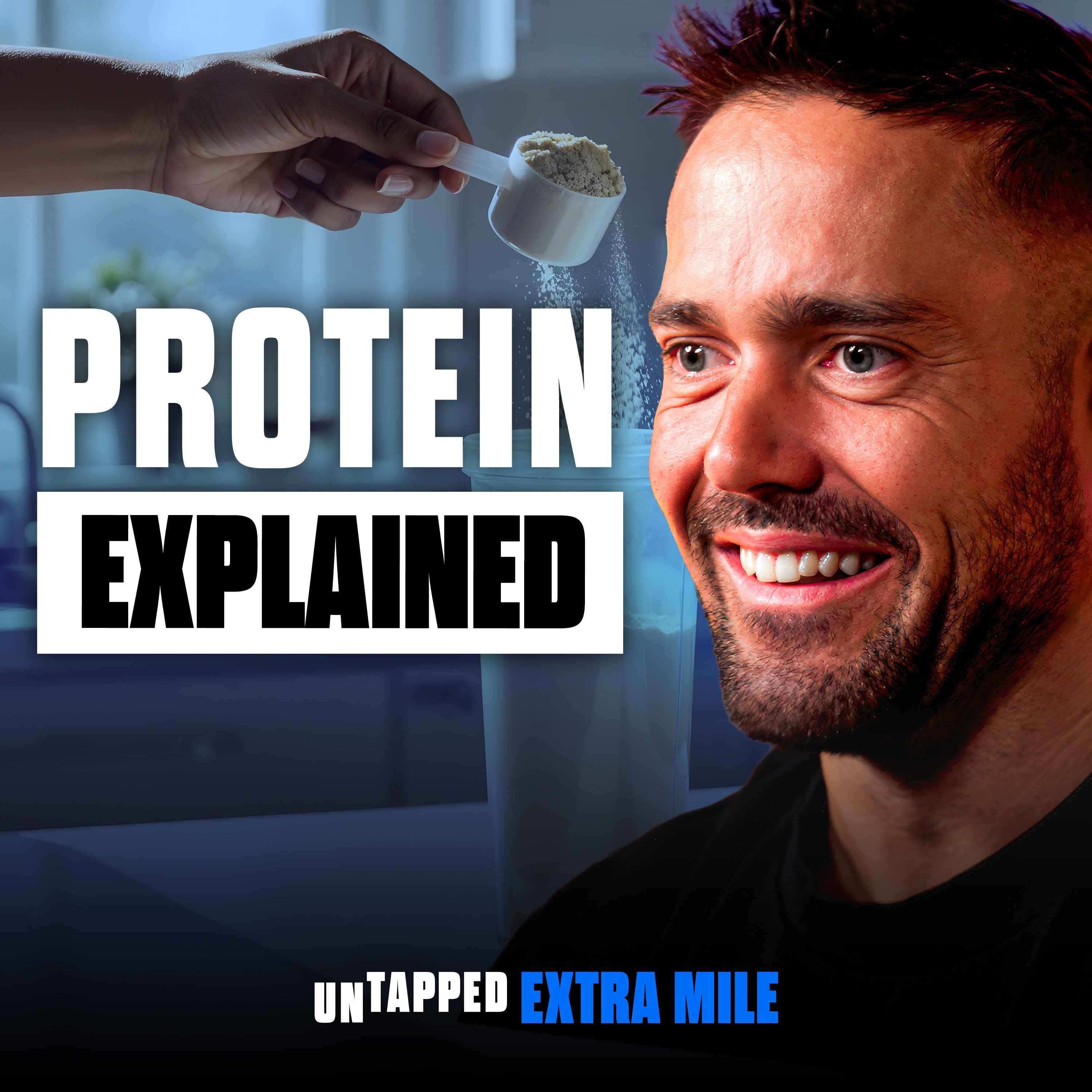
Protein for runners—what “good” protein is, whether shakes equal food, how much to eat (RDA vs active needs), timing, and how protein affects satiety and recovery; plus protein-per-100g comparisons (e.g., parmesan vs chicken).
No episode guests named; only hosts Spencer Matthews and Oli Patrick. (Transcript includes unrelated ad voices.)
Protein is broken into amino acids; the body doesn’t “care” whether amino acids came from whey, chicken, beans, or a protein bar. Essential amino acids must come from diet; non-essentials can be made. Protein needs rise with training: ~0.8 g/kg is RDA, but active people may need ~1.6–1.8 g/kg (up to ~2 g/kg for heavy resistance). Endurance athletes should prioritize protein for growth/repair, not as a fuel. Muscle protein synthesis appears to cap around ~25–30 g per sitting; spread protein across meals.
Parmesan ~38 g protein/100 g vs chicken breast ~31 g; pumpkin seeds ~30 g/100 g; peanuts > salmon; oats ~17 g/100 g; dry lentils vs cooked lentils; guava has ~5 g protein/100 g (impractical to rely on).
Written by AI. May contain mistakes.
The hosts outline today's focus on protein, its importance, and related questions.
“But actually, if you boil it down, everything is physiology.”
Discussion on the rise of protein in public interest and its economic implications.
“Where should we be getting our protein from?”
Explanation of amino acids, their types, and their role in protein synthesis.
“But protein is everywhere and probably the most hyped of the macronutrients.”
Comparison of protein from shakes versus whole foods and their nutritional value.
“individual compounds that when you glue them together, they make protein.”
Exploring recommended daily allowances for protein and individual needs based on activity.
“Is it embedded with too much saturated fat?”
Discussion on the balance of protein consumption and its impact on longevity and health.
“Fats and carbohydrate, we can think of much more as fuels.”
Learn about the complexities of protein intake and its effects on aging.
“But there are some suspicions that having too much protein could contribute to pathways that accelerate aging.”
Understand the critical role of protein in survival and bodily functions.
“What would happen to you if you suddenly just stopped eating protein?”
Explore how protein influences feelings of fullness and weight management.
“The question is, is, well, how much do you already take through your diet?”
Discover how protein supports recovery and repair for endurance athletes.
“and if you aren't doing loads of exercise on top of that there's probably not a compelling case to take more in truth be told if you're the kind of athlete where muscle mass is uh a hindrance say a long distance runner.”
Evaluate the role of protein in muscle mass gain for strength athletes.
“kilogram more weight I lay on could be more kilograms that I have to provide oxygen to.”
Learn how protein absorption affects muscle growth and the importance of dosage.
“That's a good question, actually, where the white blood cells are.”
Discover why it's better to distribute protein intake across meals rather than consuming it all at once.
“through the course of the day rather than saying, do you know what, I'm going to do a naked carbohydrate breakfast, just some cereal and some fruit without huge protein.”
Explore various food sources of protein, including fruits and legumes, and their contributions to a vegan diet.
“need higher volumes and higher diversity.”
Wrap up of the discussion on protein and its significance for dietary health.
“Olly Patrick, you're a gorgeous man and a wealth of knowledge.”

Get the gist, explore an idea or ask about something said.
 Claude
On UNTAPPED with Spencer Matthews, what are the key points of this episode?
Searching your listeningAutomatic transcript. May contain errors.
0:00Hello and welcome to The Extra Mile with me, Spencer Matthews. And me, Oli Patrick. The greatest show in all the land. I mean, are we allowed to... We probably shouldn't say that it's the greatest show, but in my unbiased opinion, this is the best podcast that one could listen to. It's certainly, in our opinion, one of one. Well, of course, the main show is well worth a listen. I don't think we should even call it that anymore. No, we shouldn't. The extra mile is where it's at. This is, we bring you the vibes through a bit of science and physiology. We're just a couple of lads that like physiology, you know, at the end of the day.
0:41I think increasingly we're seeing other people love to chat about physiology too, because it's so interesting. But actually, if you boil it down, everything is physiology. Me speaking to you now is physiology. You hearing and understanding me is physiology. Our latent love for each other is born from, neurochemical balances. So physiology is life. That's the reality. Genuinely, I could discuss any of these topics all day with you, my friend. And we've not even began. It's a pleasure. What shall we discuss today? Well, today's topic is something that every single listener will be familiar with, and that is protein.
1:23But I'm keen to really dig into protein. I want to understand what is good protein. Is there good and bad protein? How much protein should we be eating? Where should we be getting our protein from? And does that matter? Right? We need to be thinking about these things in our pursuit of greatness. Isn't that right, Oli? It is a bombastic topic. Probably. would have been a good time. What's that? Is that a shaggy reference? What does bombastic... Bombastic's not a word, surely. Is that a real word? Bombastic would need to be checked. It might be shaggy. It's Mr. Bombastic. Shaggy fantastic. It would be Mr.
2:03Bombastic. Yeah. Yeah, yeah. Protein has had a bombastic rise into the public's mind. Probably would have been a good time to invest in creatine, electrolytes, and protein back in the day because if you put protein in anything now, it's probably going to sell. There is a fervent hunger for protein, which does not quite meet the exact science, nor does it meet our current and existing understanding of protein. But protein is everywhere and probably the most hyped of the macronutrients. So fat, carbohydrate, protein, the macronutrients, the building block of food, the foundations of our diet. I think protein is probably the goat in terms of public interest and desired consumption.
2:58Interestingly, a lot of people, one of the great challenges of protein is before we get to volumes, is it's slightly more dear historically. You can, of course, get protein from fruits and vegetables but there's a cost to protein don't get me started on fruit well listen we can start and finish on fruit but ultra processed food you may not have as much protein as whole foods because naked carbs you know still getting products born out of you know wheat and flour and sugars and and you know basically sort of cheaper products are of of everly abundant. And you know, protein is a slightly harder nutrient, both socio economically, and from a culinary point of view to put together.
3:40So a lot of people don't have protein at every meal, and won't have as much protein in their diet, as we might like. But on the flip side, there's also a lot of people who are so obsessed with protein that they've completely forgotten the science and have started to wander into into the streets, just just putting protein in their water without any idea of its value or any potential sense of its repercussion. Am I right in thinking that protein from protein shakes is less effective than protein from food? That's a good question. And no. So protein from a protein shake will still be as valuable.
4:15Ultimately, protein in whichever format you take it in, will then break down into its component parts, these wonderful building blocks called amino acids. So amino acids are effectively these individual compounds that when you glue them together, they make protein. And there's 20 amino acids, there's nine essential amino acids and 11 non-essentials. So of these 20 amino acids, what an essential amino acid would mean is those are things that my body cannot manufacture. So it's essential that I eat them. That's quite interesting. The 11 non-essential are ones that I can make from other stuff in my body.
4:59So my body, in the same way as it can manufacture glucose from proteins and fats, it can build amino acids out of other stuff, which is genius. So if I don't eat them, I can still make them to do the jobs they do in my body. But what we've got is of those essential amino acids, I have to get them through my diet. But if it's a protein shake, or I've had some chicken, or I've had some beans and legumes, I basically will break that protein down into amino acids in my digestive system. Did you say legumes? And then add those amino acids into my body. They won't know whether it came from a protein shake, a chicken, or a soybean.
5:36It will just end up as the building block. I honestly didn't know that. So protein from a chocolate protein bar is exactly the same as a chicken breast? Well, obviously the chocolate bar comes with other nutritional downfalls, but the protein element is the same. If it's a whole source of protein, so whey protein, which is whey that's extracted from the dairy process, so wouldn't be suitable for those sort of leading a vegan lifestyle. But fundamentally in a whey protein, which would be the predominant protein used for the products, you will have a full spectrum of the amino acids. And by the time it breaks down through your gut, it didn't know that it came from you know an ultra processed bar um because the protein will do the job the great challenge as you rightly notice to what other elements is that protein bound was it something that um entered my body too quickly was it something that that carries lots of emulsifiers and disturbances that disrupt my gut was it if it's protein coming from um the bovine you know the cow family?
6:43Is it embedded with too much saturated fat? And what's that doing from a calorie point of view? What's that doing from an impact on blood lipids and cholesterol point of view? So it's really important that we say that when we consume a whole spectrum protein, it will break down to amino acids, and then the body will do with it what it wants to do. But in principle, that doesn't make all proteins equal, but it's mostly what they're bound to versus the protein itself. When you eat, this is you, not anyone, I'm asking you a question. When you eat food, does this go through your mind?
7:20This is Hannah Burner from Giggly Squad. O-Pill is the first over-the-counter daily birth control pill available in the U.S. Let's be real. Getting a birth control prescription is not always easy, and it's so much admin. In fact, about a third of women face barriers to access prescription birth control between scheduling appointments, missing work, class, or just trying to exist. It's a lot. But now Opil is putting birth control in our control. Opil is a daily birth control that's FDA approved, full prescription strength, and estrogen free, and 98 % effective when used as directed. Grab it online or at most major retailers, no prescription or doctor's appointment needed.
7:59So if you're thinking about birth control, check out Opil to see if it's right for you. Use code GIGLY for 25 % off your first month of Opil at O-P-I-L-L. opill.com. That's code Giggly at O-P-I-L-L.com. Birth control in your control. We love to see it. Hi, it's Brooke DeVard, host of Naked Beauty, and I want to talk about how I upgrade my hosting experience. There's a moment just before guests arrive when my home stops feeling like a series of rooms and it becomes an atmosphere. The light settles, the air shifts, and then the beautiful scent of jasmine, rose, and fig fill the air. It feels warm and considered.
8:31That's what Pura does. It turns fragrance into environment, a collection of beautiful, clean fragrances, all controlled from your phone. Choose your sense of place at Pura.com. Hi, this is Becca Moore from For the Girls, and this podcast is sponsored by Aerie, where you can find the right bra in 59 sizes, soft fabrics, and good fits. If your bra strap is digging into your shoulder right now, it's the wrong bra. We get so used to being in pain as girls that we forget it doesn't have to be this way. Your clothes should not hurt. I got to the point where I stopped wearing bras altogether, and now my life has changed.
9:17So I'm curious as to how your brain works. So like if you were sat at Bleeker Burger in Victoria, my goodness, they know what they're doing. I genuinely can't think of a better burger. So we're sat in Bleeker, right? and you crush down your burger and you put it in your mouth. Do you think these protein amino acids are going through my stomach wall and that's triggering all kinds of... Are you ever just human? I am embracing the flavours. I am very comfortable being in the moment I'm in. What I will do is, from meals, I will play the game of aggregate. So if I'm having a bleaker burger, I will revel in the volume of saturated fat and the sheer calorie density of it and the low quality impact it will have on my gut.
10:09And I will just know that I'll be trading for that tomorrow in improved choices and decreased functionality. But hang on a sec. Hang on a sec. The bleaker burger is good food. So your general thing that would play out, so there won't be, in every meal you're looking today, as broadly as possible, and it comes back to protein. I would look for most meals, say, where's my protein component? That should be the hero of my meal because it's quite difficult to get the volume of protein I need if there isn't protein in one of two or three meals. And I historically don't have breakfast during the week.
10:47So that means I've got two meals to get all my protein in. I then have got to get, so in my mind I'm thinking, when I've got to get circa 120 grams of protein a day. That's sort of, you know, that might be what I'm after. And we can work back. Why? How did you arrive at that number? Just in terms of what I can do. So the general, if we take your average listener, listen to this government guidelines would be 0.8 grams of protein per kilogram body weight. That's your RDA, recommended daily allowance. And that, and again, we're going to need to get my nutritional colleagues to keep sense checking me.
11:20but that is sort of the level that was decided. Below that, you might suffer from some challenges to retaining muscle mass or some of the structural roles because protein as a macronutrient is growth and repair. And of course, you and I, as we sit here now, we are made of protein, right? So from a tissue point of view, we get protein from animals, of course, because they're made of protein, but we are made of protein. Protein is us. We are structurally made of protein. Fats and carbohydrate, we can think of much more as fuels. carbohydrate is of course a fuel it's not structural fat does have a role in the cell structure but it's predominantly a fuel so all tissue be that a hormone an enzyme a you know a ligament a muscle is broadly made of protein there's nuance that the brain is quite fatty and there's other tissue but think of the protein is us so i need to keep a volume of that as a central part of my strategy and below 0.8 some of those structures and functions might be compromised if you go to the literature then then you'll find that this has been a sort of a good debated warring ground and you know where people generally net out is for your active community because of the role of exercise and and it's it's role in damaging tissue to rebuild tissue i need a higher protein volume because i am creating more growth and more repair so if we think of what protein does growth and repair, you and I this week will do, I believe, more exercise than the average individual in the UK.
12:51So we will have a heightened, you certainly, I'm taking the two of us and averaging us together, which is really clever strategy. So the two of us combined are doing better than average. And that means we would then have more growth, more repairs, that 0.8 figure starts to become irrelevant to us, because we have an increased need for repair and protein synthesis, which is built out of the amino acids that I've consumed and broken down into my body. And that might take us up to something like 1.6 grams per kilogram, or 1.8. And if you go to some advanced, you know, real heavy resistance training, bodybuilding, there might be an argument for even two grams or above.
13:32So my number comes from there. So it's not so much a question then of body weight as it is how active you are. So if you train a huge amount and you're extraordinarily active, you should be consuming more protein than average. That's spot on. And that's probably the recent debate because you know that I love and live in the longevity world, which you rally against viciously. And we shan't enter into a debate about the quality of living longer and extending life. But there are some suspicions that having too much protein could contribute to pathways that accelerate aging. And a study years ago showed that individuals above the age of 65 who had higher protein levels had worse health outcomes.
14:17And that was like, well, hang on. I was always told protein was good for you. More protein is better. And truly, there's so much nuance to this that whichever way you lean at it, you could argue against. But if I'm having loads and loads of protein with no growth and repair, then some of the pathways that activate could be deleterious slash negative to the whole aging and living longer experience. So we've got to not just look at body weight and go, well, that's a mandated volume of protein. We've got to look at body weight. And then critically, is this individual creating tissue damage through not just aerobic exercise, but particularly the value of resistance training to take that protein, turn it into muscle and protein synthesis, and keep me skeletally muscly, dynamic, active.
15:04And, you know, you'll get lots of people arguing that muscle mass is the organ of longevity. That's going to pull from Dr. Gabriella Lyons, who uses that phrase directly quite frequently. The reality is there's a greater need for protein for people who have a greater need for protein. And so to put one number out for our audience above and beyond the RDA would potentially be risky. Well, I'm glad we cleared that up. That's what I'm here to do. What would happen to you if you suddenly just stopped eating protein? Aside from the obvious, you're going to lose muscle mass. I'm talking over an extended period of time.
15:40Say if for 30 days I didn't consume a single gram of protein, but I ate, you know, lots of carbs and fats and drank lots of water. And, you know, what would happen to me? I couldn't say, actually. I know over time you would die because it's not... You need protein to survive. Yeah. So the only nutrient you can live without forever is carbohydrate. And then you'd still struggle, I would say live forever. But you can manufacture glucose from fat and from protein. You can create some, again, we've got the non-essential amino acids I can construct from other materials. but the jobs done by those essential amino acids will not get done and that is structurally and functionally critical to my existence so um what would 30 days look like compared to 60 days compared to to nine months i'm not entirely sure but if you were to look at why someone would would pass away from malnutrition yeah an absence of protein would would certainly contribute to that um and it might be for someone it's a hormone change for someone it's a disturbance in immune you know building an immune cell for someone else it's recovering from wound healing you know it is it shouldn't be underestimated that we are protein so without protein we are not very poignant we are not we are not we are we are with and protein but that yeah that comes up if i come back to the tracking point the great thing lots of people go i'm going to put protein in this it's like well in the same ways people go ollie should i take a supplement for uh magnesium or should i take a supplement for B vitamins.
17:25The question is, is, well, how much do you already take through your diet? And to a certain extent, are you deficient in this nutrient before we determined there was a need for a surplus? And what's fascinating with protein is sort of being positioned as a panacea for a couple of things. One, for retention of muscle mass and muscle growth, and, you know, two, for recovery, so both the athletic population. Three, there is a role when you eat protein, and you'll know this, that it has a greater impact on satiety, that feeling of being full. And satiety is, if I had protein per gram is effectively four calories, but so is carbohydrate.
18:03So if I had 10 grams of protein, it's 40 calories, 10 grams of carbohydrate, 40 calories, the protein would have a bigger impact on sending signals that I'm feeling a bit full, and I don't want to eat too much more. So I had a couple of pieces of chicken breast, versus if I had some pure cereals or rice, the mechanism of those foods is one would tell me I'm a bit more full than the other. And in many ways, actually, it draws back to that glucagon-like-1 peptide debate, your asmpics. Proteins and fibers trigger my body's natural release of these things, whereas carbohydrate, in its simplest form, doesn't.
18:37So protein is good for the recovery. It's good for muscle growth, but it's also good for suppressing appetite. And so people who are just eating those naked carbs might be prone to overeat. And that puts protein in the weight management debate as well. So if I've got a protein-rich diet, I'm probably less likely, again, there'll be bariatric surgeons and weight management consultants tearing their hair out. But principally, a protein-rich diet can support a whole food diet, which would support healthy weight management. But I always ask someone, have you tracked it? Assuming you've got a healthy relationship with food and you're not going to be thrown off by that process, have you tracked how much protein you eat are you miles away from the 0.81 grams per kilogram and if you aren't doing loads of exercise on top of that there's probably not a compelling case to take more in truth be told if you're the kind of athlete where muscle mass is uh a hindrance say a long distance runner.
19:38You know, you're a elite marathoner who weighs 55 kilos, 58 kilos, you know, super light, slight build. How essential a part is protein in their diet? Obviously, having, you know, very high glycogen levels being carb loaded, you know, for the, I don't know, 220k that they run every single week is of the utmost importance. How important is protein in their diet? Critical, but not critical as a fuel. So you can break down protein for a fuel, to use as a fuel. And of course, if you did an unbelievable endurance event, over time, you'd see the muscles wasted and the ligaments have wasted and tendons have wasted because the individual's physically taken the protein from those tissues turned it into energy to complete the combustion of the event.
20:38But it's a minor part, you know, your body will go stored glycogen, stored fat, and then there's a tiny contribution from protein. So it's a fuel source, not valuable. As that body is put under relentless strain and needs to repair itself, of course, every day that person's running, they're creating microtissue challenges and ligament damage and tendon damage and cardiovascular strain to the heart, all of the repair of that would require adequate protein. The management of weights, if they weigh 55, 60 kilograms, that comes down to total calorie intake, of which protein should meet that minimum requirement.
21:17And again, they're probably at an athletic basis. And I always bow to my sports nutrition colleagues, but you're probably there would still need to be at the 1.6, 1.8 grams per kilogram so that they didn't lose the critical tissue that's powering them the next day and the day and the day after so i think your endurance athletes have got to view protein not as a performance fuel but as something that they will use to facilitate growth and repair but they wouldn't want to over consume calories irrespective of protein because their event is weight centric and we know vo2 max that objective marker of aerobic performance is per kilogram so every kilogram more weight I lay on could be more kilograms that I have to provide oxygen to.
21:57And that could decrease my overall performance and endurance, potentially. So let's flip it now into I want to be as big and strong as possible. I want to, you know, stack on as much muscle mass as possible. Let's take the Stoltman brothers as an example, you know yeah or ollie patrick obviously uh friends of the show um my only goal in life is i want to be able to shoulder press 150 kilos you know whatever how do is is is there ever uh can there be too much protein can that have a negative effect you know i recall chatting to the Stoltmans, who I believe, you know, they eat several kilos of protein a day.
22:46You know, but they're, you know, they're six foot nine and weigh 180 kilos. You know, were they to grace Bleeker Burger Victorious, you know, with us, there would be, you know, one would hope that they had enough food to fuel these brothers. it's bedlam i mean they'll do yeah 10 000 calories plus and i i've had great fortune of spending quite a lot of time with luke and tom and uh and they're just eating all the time so you've got to eat all the time so from a from a protein synthesis point of view there's this sort of debate comes in around can the body use much more than than two grams per kilogram um so if you weighed you know if you weighed let me round tom stopman up to 200 kilograms to help my maths you know if you're at two grams per kilogram, that's 400 grams of protein a day.
23:38You know, that, that's, if we take that alone, that's certainly 1600 calories. I was about to say, I'm assuming that he's doing way more than that. Like I've had 400 grams of protein in a day on many occasions. They would, they would. And the great debate is, you know, A, there's not huge studies of people who weigh 180 kilograms eating that volume but you know you've got similar to you know what we've spoken about for what's that protein bound to it's going to be bound in almost all cases some form of saturated fat it's going to be bound to a huge amount of carbohydrate metabolically so my body's ability to keep blood glucose stable and regulate my bloods it's a huge challenge to take in that volume of of any nutrient but it's it's you know it is that's 400 grams you know cooked you know so not the raw weight so that's going to be a huge volume of um of eggs of chicken of of dairy products and we come to some of the challenges around fruit and veg providing that protein all that being said there's there's two interesting parts of the literature which is how much protein will turn into what's called muscle protein synthesis and you might remember from back in the early days of resistance training we were told there was this window post weight training that I had to nail my protein.
24:56So I had to get it in within this sort of 30 minute window. So you had everyone finish, you know, drop the barbell, shake up the whey protein, you know, juice pouring down the chin in the gym, you know, going to be absolutely stacked tomorrow. And that data sort of broadly gone out the window that there isn't this deliberate window of urgency that post exercise, we must replenish protein, we need to replenish liquid and carbohydrate there is a definite definitive value to that but protein less so but the sort of debate is is i can't take an unlimited protein in one window and have that convert into muscle protein synthesis so i think again probably should completely check this i'm sure bella has has got the fact check for me but 25 to 30 grams is the most amount of protein that in one sitting will convert to muscle protein synthesis the let's imagine i took 60 grams of protein post-meal that doesn't mean the other 30 grams is wasted it just won't convert to immediate development of muscle tissue so in in your average person so we spoke about so so so hang on sorry so
26:06this is hannah burner from giggly squad opil is the first over-the-counter daily birth control Opil available in the US. Let's be real, getting a birth control prescription is not always easy and it's so much admin. In fact, about a third of women face barriers to access prescription birth control. Between scheduling appointments, missing work, class, or just trying to exist, it's a lot. But now Opil is putting birth control in our control. Opil is a daily birth control that's FDA approved, full prescription strength, and estrogen free, and 98 % effective when used as directed grab it online or at most major retailers no prescription or doctor's appointment needed so if you're thinking about birth control check out opill to see if it's right for you use code giggly for 25 off your first month of opill at opill.com that's code giggly at opill.com birth control in your control we love to see it hi this is becca moore from for the girls and this podcast is sponsored by airy where you can find the right bra in 59 sizes soft fabrics and good fits.
27:08If your bra strap is digging into your shoulder right now, it's the wrong bra. We get so used to being in pain as girls that we forget it doesn't have to be this way. Your clothes should not hurt. I got to the point where I stopped wearing bras altogether and now my life has changed, you guys. The only bras I have in my dresser right now are Aerie and I'm not kidding. Aerie's on a mission to make you feel good and that starts with your bra. Your bra should hold you in, not back. Visit aerie.com to find the right bra for you. Who says Halloween only lasts It's one day. With Wayfair, one night of Halloween becomes a whole season at home.
27:39From larger-than-life yard decor and moody lighting to festive accents for every room in the house, Wayfair has what you need to make Halloween feel like magic all in one place. Because the best Halloween memories aren't made in just one night. They're made all season long. Shop Halloween decor now at Wayfair.com. Wayfair, every style, every home.
28:03say you make a kind of tremendous protein shake which i enjoy doing after a big workout or a big run i'm the kind of person that kind of puts double everything in you know that you're supposed to so i'll i'll do kind of four big heaped scoops so you know it's kind of like 100 grams of no it's bit more isn't it 25 grams of proteins in the powder but let's imagine so yeah so you might be might be 20 30 grams per potentially but 15 grams per scoop might be reasonable okay so so so am i so past 30 grams it's not really doing much it's just excess calories it's not excess calories let's imagine it's somewhere in that 25 grams bracket you will you will absorb and use the other protein but you won't use it specifically for muscle protein synthesis so it won't turn to gains but it might turn up as you know as a beneficial hormone or a white blood cell or other tissue but in terms of the muscle protein synthesis impact there seems to be in and around you know a bit north of that 25 grams that's where it caps out what do you think it might turn up as a white blood cell like what are you talking about be over the moon you're you know remember But structure is not just, you know, hair, skin, organs.
29:26It's also circulating hormones. It's circulating enzymes. It's white blood cells. That is all protein. Well, white blood cells. That's a good question, actually, where the white blood cells are. Red blood cells aren't. But principally, you know, where is that protein in every tissue of the body? It's everything. So again, if you think of something in your body, it's protein probably, or protein has contributed to it. So it not turning into muscle doesn't mean it was wasted. But what that does mean is you're better off spacing your protein through the course of the day rather than saying, do you know what, I'm going to do a naked carbohydrate breakfast, just some cereal and some fruit without huge protein.
30:08And in the evening, I'm going to have a big bowl of pasta with a little bit of pesto or an arrabbiato sauce. Big carbohydrate-rich meals. and some nutrients in there. And at lunchtime, I'm going to do all my chicken, all my eggs. You're much better off having protein in every meal. So you get that 25 grams of muscle protein synthesis spread out through the course of the day. And that's harder if you fast. So people who miss breakfast because they want to control blood glucose or appetite or gut health, whatever reason someone's got for doing it, they've got to then, if you like, run the risk that they're not going to get optimized muscle protein synthesis by just having two windows to eat in.
30:48challenging. Does any fruit have protein in it? Please don't get me started on fruit, Ollie. You know that, were I a painter, I would paint fruit. It's just all day long. It would be my, I am, I am obsessed. I think, you know, the listeners of this show are aware that I love fruit. But I may end up loving fruit even more were I to learn that it's packed full of protein. but I was I would be surprised which fruit has protein in it well packed would be the wrong word but there is the presence and our love of fruit fruit is again predominantly not protein but you will find some protein in low levels in fruit more in vegetables and of course if we get to legumes beans and pulses we've got a really valid source but you you know a guava I had to look this because I knew you were going to ask me.
31:43A guava. I think a guava would have five grams of protein per 100 grams. So, you know, that's a lot of guava. So in order to get all of your protein from guava, you'd need to be absolutely hammering the guava. You probably then would move into a point where the glucose would be overwhelming and you would be A, suffering from a calorie surplus and B, gastrointestinal discomfort and C, you know, if you eat 100 of anything, you're probably not going to be doing particularly well. You know, no food in abundance is as good as diversity over the course of the week. So, but yeah, this raises the debate.
32:24If you're a vegan, because lots of vegans are told they can't get their protein intake, you can. So when we look at the essential amino acids, the problem you've got with plants, so fruit, vegetables, nuts, seeds, is none of them contain the full spectrum of those essential amino acids. but across different fruits, vegetables, nuts and seeds, you can get them all. So you can be totally adequately perfused with protein on a vegan diet without animal produce, but you just need higher volumes and higher diversity. So it just needs a bit more deliberate focus. And I find when vegans historically been after sort of optimized protein levels against training volume, they've used something like a pea protein or, you know, or some form of a vegan protein that allows them to get that additional 30 grams or 40 grams over the day that took the burden off eating loads of tofu, loads of soy, and loads of guavas.
33:18Guava delicious. I've had guava in yonks. What a delightful fruit is the guava. Here's a good one. Another fruit that's good for some protein, but more fat, avocado. Avocado delicious. Avocado. Avocado. What a hero is the avocado. So after our guava and avocado reveals, I've got a couple of things I'm going to throw at you and see whether you believe there is more protein in food A or food B. Are you ready for this? Yes, I am. This is, as one might say, a test of sorts. So the first one is, more protein, again, assuming the same weight, in parmesan or chicken breast? I mean, the answer is seemingly so obviously chicken breast that I'm going to go with Parmesan.
34:08And you would be correct. Really? Yeah, isn't that bonkers? I love Parmesan as well. So that's even more of a reason to love it. Again, in the same way as you've got to be careful what it carries with. I think it's quite a lot of saturated fat in Parmesan. So what, mate? I run 100k a week. Yeah.
34:27So I've got a stat here. 38 grams per 100 grams for Parmesan. What? 38 grams versus 31 grams for chicken. It's pretty cool. Parmesan is 38 % protein. That's phenomenal. That was new to me. That's ludicrous. I'm going to have a wheel of Parmesan for lunch. Pumpkin seeds versus steak. Bear in mind, we're thinking of per 100 grams. Well, like, it kind of, what, again, I mean, pumpkin seeds. Surely not, though. It is, yeah. Pumpkin seeds. You probably wouldn't do 100 grams of pumpkin seeds, but yeah, you get 30 grams. And a cooked steak could be up to 30 grams, probably 25 to 30 grams. So we often find vegans, again, throwing pumpkin seeds into everything.
35:17They are, and not just vegans, pumpkin seeds are open to all, but they are a really, really good source of some of the critical amino acids for protein synthesis. So that's pretty cool. Peanuts or the old salmon? I'm just going to go with the least likely every time. So peanuts. And that is correct. Yeah. There seems to be a trend here. There's a trend here. The vegans will be like, yes, I told you. But again, you've got to eat sufficient volume. Peanuts are a very compact source of energy. Of course, salmon are lower content due to its fluid volume. So often people weigh things without realizing that there's a lot of water in there.
35:53That would be true of chicken. That would be true of things like salmon. So you may not get as much protein as you think for the pre-weight before it's cooked. That's always a good point to note. What about dry oats versus the protein goat eggs? There's actually surprisingly little protein in eggs. I was really shocked. Yeah. I was really shocked. They're a great way. So it is oats, just a little bit. Maybe 17 grams per hundred. I can't believe there's 17 % protein in oats. This is great news. Most food is in this food matrix where it's got, you know, the different macros all smashed together.
36:31The challenge is, you know, if you're doing 100 grams of peanuts, 100 grams of oats, 100, you know, you're going to be doing a significant calorie volume and you're going to be taking an awful lot of glucose and, you know, potentially above and beyond your glycogen needs. So it is that nuance that's required. But there is, you know, the foods that we lean to, I think it's 13 grams of protein per 100 grams of eggs. So that's not wild. Here's another one. Dry lentils versus steak. Surely we've got to let steak have its day, but it's going to get nailed by the lentils, isn't it? See, the crucial piece here is dry lentils would win, but when you cook them, their protein content drops.
37:11So steak would beat a cooked lentil, but not a dry lentil. But who's eating a dried lentil? So as foods, again, absorb water, they might find that their percentage of, if you like, of protein would diminish. So steak is still a wonderful source. But with steak, again, you've got the cost. Before we even talk about any sort of environmental, ecological components of things like avocados and steak, which increasingly are relevant. Well, they're relevant always, but more relevant to some than others. And I think, in principle, there is protein in lots of places you wouldn't expect to find it. And you may not need to go and purchase something with a spurious 15 grams of protein wedged into a smorgasbord of emulsifiers and additives.
37:53and unhealthy collaborators when your oats, your lentils, your nuts, your guavas and your avocados might have filled that gap through whole foods eaten slowly and appropriately to your personal training volume. Olly Patrick, you're a gorgeous man and a wealth of knowledge. And I learned so much from you and I love recording this show with you. Thank you for your time. I hope you all enjoyed this week's Extra Mile episode all about protein. We'll catch you next week. lots of love if you love us uh i don't know drop us five stars in a review uh if you think it's uh shit don't bother lots of love
38:41hi this is becca moore from for the girls and this podcast is sponsored by airy where you can find the right bra in 59 sizes soft fabrics and good fits if your bra strap is digging into your shoulder right now it's the wrong bra we get so used to being in pain as girls that we forget it doesn't have to be this way your clothes should not hurt i got to the point where i stopped wearing bras altogether and now my life has changed you guys the only bras i have in my dresser right now are ari and i'm not kidding ari's on a mission to make you feel good and that starts with your bra your bra should hold you in not back visit ari.com to find the right bra for you this is hannah burner from giggly squad o-pill is the first over-the-counter daily birth control pill available in the u.s let's be real getting a birth control prescription is not always easy and it's so much admin in fact about a third of women face barriers to access prescription birth control between scheduling appointments missing work class or just trying to exist it's a lot but now opill is putting birth control in our control opill is a daily birth control that's fda approved full prescription strength and estrogen free and 98 effective when used as directed grab it online or at most major retailers, no prescription or doctor's appointment needed.
39:51So if you're thinking about birth control, check out Opill to see if it's right for you. Use code Giggly for 25 % off your first month of Opill at O-P-I-L-L.com. That's code Giggly at O-P-I-L-L.com. Birth control in your control. We love to see it. Hi, it's Brooke DeVard, host of Naked Beauty, and I want to talk about how I upgrade my hosting experience. There's a moment just before guests arrive when my home stops feeling like a series of rooms and it becomes an atmosphere. The light settles, the air shifts, and then the beautiful scent of jasmine, rose, and fig fill the air. It feels warm and considered.
40:24That's what Pura does. It turns fragrance into environment. A collection of beautiful, clean fragrances, all controlled from your phone. Choose your sense of place at Pura.com.
You probably know you need protein. But how much do you actually need and does it matter where you get it from?
Spencer Matthews and Oli Patrick break down how much protein you really need, whether protein shakes are as effective as food, and what happens when you eat too much.
From chicken and steak to eggs, lentils, fruit and even a few very ambitious protein shakes, they separate the genuinely useful from the fitness industry noise — with a few unexpected protein sources along the way.
GQ Box 👉 Treat yourself or someone else and use code UNTAPPED20 for an extra 20% off at: https://highpfrmc.com/GQ_AU
Do Health 👉 For your long-term health. Head to https://highpfrmc.com/dohealth-ut-au to sign up now.
Robinhood 👉 Head to robinhood.com/untapped to get started and claim your free stock.
Heights 👉 Get 20% off your first month of any subscription at https://highpfrmc.com/UT_Heights_AU and use untappedpod at checkout
Hosted on Acast. See acast.com/privacy for more information.