Ask ChatGPT
 UNTAPPED with Spencer Matthews
9 Apr 2026 · 34m · 16 chapters
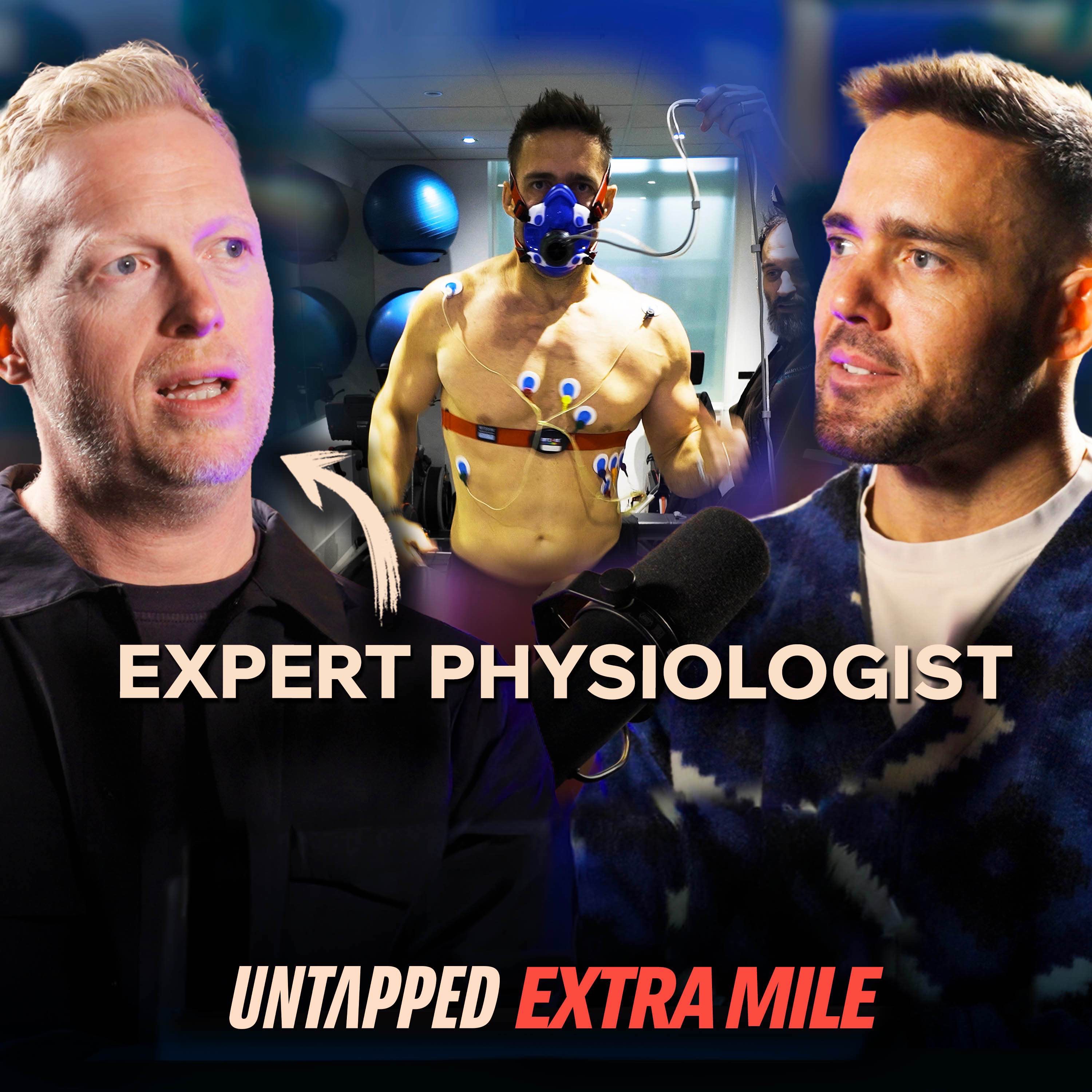
VO2 max (“the life number”)—what it measures, why it matters for health and longevity, how it’s limited mainly by heart/stroke volume rather than lungs, and how to improve it with training (including hard intervals like the “Norwegian protocol”) plus weight management.
Oliver Patrick (co-host; endurance/health-wellness listener). Physiologist Jim Pate (runs gold-standard VO2 max testing; “thousands” of tests). Spencer/Mike Murray (the episode’s tested athlete; VO2 max retested after 7 years; Mike Murray is a 58-year-old athlete with VO2 max 58).
VO2 max predicts life expectancy; one cited study suggests ~45-day life extension per 1 ml/kg/min increase. VO2 max rises ~10% per decade decline after 30–40. No pill can build it—cardiorespiratory exercise and recovery do. High VO2 max supports immune/cardiovascular resilience.
Spencer’s measured VO2 max increased from 49.5 to 62. Anthony Joshua described as mid-level due to anaerobic-heavy training; endurance athletes/cross-country skiers cited as highest.
Written by AI. May contain mistakes.
Explaining the significance of VO2 max as a fitness marker.
“like when someone brings donuts into the office, or your kids' dino nuggets start giving you that look again.”
Explaining the significance of VO2 max as a fitness marker.
“I just think you're such a fascinating person.”
Discussing how VO2 max relates to cardiovascular health and physical performance.
“So as human machines, we use oxygen to generate energy.”
Exploring the relationship between breathing and VO2 max in athletic performance.
“its flowers because I've loved it for years.”
Analyzing how VO2 max varies among different types of athletes and sports.
“So if VO2max isn't the defining feature of your sport, so Anthony Joshua would do three minutes of extraordinary high-intensity work with a minute's recovery.”
Discussing personal experiences of measuring VO2 max over time.
“divide that by my weight in kilograms so if i can consume five liters of oxygen in my last minute of exertion, but then I'm 100 kilograms, my VO2 max would end up as 50 millilitres per kilogram in that minute.”
Details of the VO2 max test process and its implications for athletic performance.
“can impact your ability to be a better athlete even in later life.”
Learn about the process of measuring VO2 max and its significance.
“how it does this process of just keeping you going.”
Discover how ZocDoc simplifies finding and booking healthcare appointments.
“On Iyanla, The Inside Fix, a podcast from OWN, Iyanla Vanzan revisits the stories, teachings, and insights that made her show Fix My Life a must-watch for millions.”
Hear the reactions and thoughts following the VO2 max test.
“Have you been putting off a doctor's appointment or need a dentist and don't know where to start?”
Explore the factors that contribute to fitness changes over time.
“And it's not a, like, can you run until you physically fall off the treadmill?”
Learn about the physiological changes from training and how they impact performance.
“You have done the training, you know, and you have trained to build what will be a more effective heart.”
Learn how the body reacts to stress and the importance of recovery.
“So it doesn't know what exercise is, it just knows when it's meeting a problem it can't solve, it finds a way to solve that problem.”
Discover the critical balance between stress and recovery for optimal training.
“I mean, what I was saying, I kind of, you know, sort of went without saying that, like, you know, don't injure yourself.”
Explore why VO2 max is vital for overall health and longevity.
“And what are the benefits of trying to improve it?”
Learn why VO2 max should be seen as a fundamental measure of health.
“Let's have a think about this life number.”

Get the gist, explore an idea or ask about something said.
 Claude
On UNTAPPED with Spencer Matthews, what are the key points of this episode?
Searching your listeningAutomatic transcript. May contain errors.
0:00Hey, it's Tony from Tony Told Me. On Iyanla, The Inside Fix, a podcast from OWN, Iyanla Vanzan revisits the stories, teachings, and insights that made her show, Fix My Life, a must-watch for millions. With fresh eyes, she re-examines those lessons with greater clarity and shares new wisdom for the challenges we face today. Personal growth evolves over time, and there's always room to find new meaning in old lessons. Listen to Iyanla, The Inside Fix, wherever you get your podcasts. Losing weight can feel like a roller coaster, full of ups, downs, and being thrown for loops, like when someone brings donuts into the office, or your kids' dino nuggets start giving you that look again.
0:44That's why there's Noom. They combine GLP-1s to quiet the food noise, with healthy habits that help you keep it quiet, even if you get off the meds. Their program is designed to make weight loss a smooth ride, helping you understand what drives you, so you can build better habits to not just lose weight, but keep it off. Noom. Lose for keeps. Get started at Noom.com. Not all customers will clinically qualify for medications. Individual results may vary. This episode is sponsored by ZocDoc. Have you been putting off a doctor's appointment or need a dentist and don't know where to start? We've definitely been there, and that's why we use ZocDoc.
1:22Actually, over the holidays, Michael had a dental emergency, and seemingly every office was closed. But we hopped onto ZocDoc, found an in-network dentist, had great reviews, saw real-time appointments available, which was key. It was on New Year's Day, and booked an appointment in just minutes. It took so much of the stress out of the already stressful situation. ZocDoc makes it easy to search and compare over 250 ,000 local in-network providers across more than 200 specialties. So you can find the right doctor or dentist and book instantly. Ready to be seen? Download the ZocDoc app today and book that appointment on your to-do list.
2:03That's Z-O-C-D-O-C, ZocDoc.
2:09Welcome to Untapped, the extra mile. We had an idea not long ago, didn't we, Ollie, about bringing more data-driven facts to the show. So the things I love listening to and how I envisaged this podcast being when we first launched it was somewhere where people could go to hear inspiring journeys and stories, you know, often of extreme athleticism. But also I was hoping to balance that with facts, data, science. Unfortunately, that was never my strong point, but it is what I love listening to. You know, I listen to Huberman and other leaders in that field, and it's where I get lots of my information from, you know, around health and wellness.
2:59Not throwing any shade at Dr. Huberman, because I'm a big fan, but, you know, the episodes are incredibly long. They can be three hours long. So often, you know, it's an incredible bank of information, but it's quite difficult to get to the things that you want to get to in a bite-sized, concise way. And that is what we're aiming to do. My co-host for the series is Oliver Patrick. I just thought you'd be the most incredible addition to this show. So without further ado, Oliver Patrick. Oh, Spencer, what an intro. What a delight. It's such a pleasure. I love spending time with you. I just think you're such a fascinating person.
3:40I'd love to kick stuff off by talking about VO2max. Yes. You hear it all the time. Yep. It is the marker, right, for fitness. If you were to compare your fitness with somebody, your VO2max number should be enough in theory. Yep. I think that lots of people have access to a VO2max number, you know, through devices like Whoop and Coros, but the algorithms are slightly different. Very few people get tested. you know, in the perfect scenario to find their true VO2 max. But just before we dig into data, what is it? It's a great question. And now you've set the tone of don't be Huberman. Don't go too deep.
4:20I think... Well, I mean, if we were, you know, as successful as Huberman, I think we'd probably be okay. We'd be fine with it. And we both love him. We like him. We like him. But, you know, we would like to answer questions straight away. Yes. So you consume oxygen, as do I. So as human machines, we use oxygen to generate energy. And VOTmax is the marker of how much oxygen your body could consume in one minute when it was working at its maximum. And why that's interesting is your body's ability to consume oxygen is a marker of how effective your cardiovascular system is. So we first heard about VOTmax because endurance athletes like yourself, you know, like to compare how high is this number.
4:58And that might indicate whether I'm a better triathlete or marathon runner than you. But VO2max is as interesting at the bottom end of the spectrum that if your body can't consume much oxygen, you probably wouldn't survive complex surgery. And increasingly, and this is why it's got super sexy, a big study has showed it's probably the best predictor of life expectancy. So human beings breathe air. As we're breathing in the air now, it's got 21 % oxygen. It comes out with less, 17 % oxygen, because I physically consumed it. And the version of you or I who could consume more oxygen would be able to generate more energy, and perform more work.
5:33So fitness sort of grabbed this parameter and said, we're going to own it, and we're going to use it on performance athletes to see, were they lazy during the closed season? Are they fit enough to begin the new football season, etc. But actually, it's increasingly understood as the sort of the life number, that this number of how many milliliters of oxygen you could consume in one minute per kilogram of your body weight is the defining feature, potentially, of your existence as a human being. And so it's a big number. I love that it's getting its flowers because I've loved it for years. I've had a personal love affair with it for years.
6:05And I think the fact we've democratized how you can capture it so it's less invasive, you don't have to do the original way of doing it. Now, as you said, wearables can bring it, you can test it in different ways at home, and we can touch on those. It's finally become a sort of mass market number, still broadly misunderstood, but for me, probably the most singularly important number for health and performance. Having a high VO2 max correlates better fitness, better quality of life. how does breathing come into it? You know, is breathwork a factor in having a high VO2 max? Should athletes be spending time on their breathing?
6:41Or is it purely a function of cardiovascular activity and load? Interestingly, your respiratory systems, your lungs, your airways tend to not be the first limiting factor. So if you haven't got a high VO2 max, it's not because your lungs aren't as effective as they should be, or your breathing, it'll most commonly come down to the biggest variable of how much oxygen you and i can deliver to our body which is the strength of our heart so a stronger heart so if i if i do something that increases the strength of my heart and let's think traditional cardiovascular or endurance exercise i will actually improve how much blood my heart can pump out per pump this thing we call stroke volume so if your average person pumps out 70 milliliters of blood every time their heart beats a monster like you will probably churn out maybe 100 mils.
7:29So for every beat, you are putting out an extra 30 mils, nearly a shot of a non-alcoholic drink that you could consume. So in principle, you get a stronger heart. You also then get some of the many adaptations that happen when your body's put under regular strain. You get anatomical changes, which is you will grow more blood vessels. You will actually grow more blood. You will grow more batteries in the cells of your body that convert oxygen. So you get this anatomical change that you basically create a stronger infrastructure to get oxygen into your blood and from your blood to your tissues and from your tissues back out to your airways.
8:05And what's the biggest factor? They all change sort of fairly equivocally, but rarely is it lungs. It's more often heart and stroke volume or the power of the heart. And just for the layman, it just means that you can perform without feeling tired. And that's a vital point, right? So when you see someone doing an extraordinary thing, from an effort point of view, if you see a chip choggy running a two-hour marathon, his level of discomfort will still be equivocal to me trotting out a very average part-run 5K because exertion is sort of uniform, but what his body can achieve at that same level of exertion is extraordinary because of a multitude of things of which VO2 max is one.
8:46Are there any elite athletes in the world that have a low VO2 max? Yes. sprinters potentially and strength athletes because of weight so the really important piece is your endurance athletes which is the world that you know you are very much inhabiting will normally have a really high VO2 max and certain degrees of exercise efficiency but if you take a strong man who might weigh 170 kilograms and is able to lift extraordinary weights they'll have a very low ability to consume oxygen per kilogram which actually means they probably are suffering a little bit from long term health and longevity at the expense of elite performance in the strongman world.
9:22And so take like an Anthony Joshua. Yeah, great question. And he would have a mid-level. So if VO2max isn't the defining feature of your sport, so Anthony Joshua would do three minutes of extraordinary high-intensity work with a minute's recovery. So he will be working what we call predominantly anaerobic pathways. And that means his training would be bursts of energy with quick recovery. If he was more of an endurance athlete, he would have a higher VO2max. But he does need a VO2max because he needs that oxygen to clear down the waste products of the exertion in between the rounds. So he'd be mid level, probably less than your elite level footballer or other endurance athletes.
9:57But the big challenge there is, you know, and I don't know what his current weight is, what do you reckon, 100 kgs, 90? Anthony Joshua? Yeah. I'd say he's heavier than that. Okay, well, he's, if you've got 100 kilograms of tissue, you've got to deliver oxygen to 100 mouths. So Anthony Joshua, if I weighed 50 kilograms, he'd need to be twice as fit as me to generate the same amount of work. and so what we see with big human beings is because this is a per kilogram metric big people can't win at vo2 max and that's why your elite endurance athletes weigh 60 you know 55 kilograms because it's it's an efficiency play you can't have a big engine in a giant chassis you need a big engine in a small chassis so super high-end vo2 max is kind of you know elite tour de france cyclists it's elite marathoners and it's um ultra endurance athletes who like kylian jornay for example who just have you know an incredible engine who are light who can go all day exactly right and you know and interestingly cross-country skiers we're not a million miles away from the winter olympics so nordic skiing is generally recorded some of the highest ever vo2 maxes and and these numbers are thrown around a little bit and we had two figures for vo2 max you get your how much oxygen i could consume in a minute which might be five liters but then what you do is divide that by my weight in kilograms so if i can consume five liters of oxygen in my last minute of exertion, but then I'm 100 kilograms, my VO2 max would end up as 50 millilitres per kilogram in that minute.
11:22And that's where these numbers start getting thrown around and people don't know what they mean. Right. Well, seven years ago, I had my VO2 max tested for the first and only time. And it was 49.5, which I think at the time I was told was, you know, 20 to 30 % better than average, you know, for my age and weight and, you know, gender, whatever. Yeah, yeah. Today, we have gone to the same place and visited the same man and had the same test. And I guess we wanted to understand whether or not big lifestyle changes, albeit seven years, you know, later, can have a very big positive effect on becoming a better athlete, even if it's later in your life.
12:13I think everyone would assume that potentially you're going to be fitter and stronger when you're 30 than 37. Agreed. Obviously, in my life, you know, there's been a lot of change, right, in that time. So we've gone back to the same guy. We've done a VO2 test just to see whether or not a lot of positive change in your life can impact your ability to be a better athlete even in later life. so we are strapping you into a mask we're going to see your oxygen consumption we're then going to see that total amount divided by weight in kilograms and let's be clear 49.5 was a really good result to say like nearly 125 of what is predicted for a male of your age at 30 we lose vo2 max somewhere in our 30s 40s at 10 per decade 15 after 50 so if you had the same vo2 max that would be quite you know quite high credit but you've had this extraordinary relationship with endurance exercise i cannot wait to see how you do on this test let's go so let's bring in the man who can jim jim pate who is a hero of this physiologist jim how many tests have you done do you reckon all right thousands so many so many you are the man so you're gonna look after the test you you are the master of getting clean data yeah well it means we'll do the best we can i mean look this equipment is designed more or less to test like everybody from elite athletes all the way down to hospital patients so um you know and the main thing we try to do is make sure everything is safe first of all elite athlete under the spot but yeah purpose of the test is not to see how well expensive you can run but we're we're using like running as a way of applying stress to your system to see how well it copes with it and then this is going to give us insight more or less into like how it does this process of just keeping you going.
14:03In order to gather the information that we want during this test, I've got to connect you up to some monitoring equipment, which you may remember from the last time. The first thing I'm going to put on you is actually this heart rate monitor. Sorry if there's a little chilly, Spencer. Sorry, no worries.
14:19And then take a big breath in and out, and just make sure it's okay. I'm also going to put an ECG on you, too, so I'll put a few of these stickers on several places around your torso. These have a little bit of gel on the back of them as well, too, so they might be a lot chilly also. It's like that moment before a marathon where you feel like you can't run. So, of course, lots of devices will give an estimated VO2 max. So, we've got a measured VO2 max of seven years ago of just shy of 50, 49.5. Then we've got an estimated VO2 max, which will be based on things like resting heart rate, heart rate variability, heart rate at load of 58.
14:53So, somewhere we're seeing a potential as this result moved from 50 seven years ago to closer to 60 today this is an estimate a good estimate but now we're going to get an objective accurate measurement which is where this becomes extremely exciting
15:18come on you got this there's more there's more well done Come on! Great job. Great job. Thank you. I saw it again. Absolutely brilliant. Stay balanced. Superb. Oh, you're going to be happy. When the pain goes, you're going to be happy. So good. Just hop back on, okay? Just go, just walk nice and easy, okay? My friend, what are the results? It's a great question. So Jim's just making sure. What are you? It's not the only question. He's clearing it up. It is the only question. You'll be pleased. Let's go back to the studio and have a look at those results. And then I shall reveal whether you have beasted your version from seven years ago.
16:03Okay. The signs are good. I respect the system. The signs are good.
16:10Hey, it's Tony from Tony Told Me. On Iyanla, The Inside Fix, a podcast from OWN, Iyanla Vanzan revisits the stories, teachings, and insights that made her show Fix My Life a must-watch for millions. With fresh eyes, she re-examines those lessons with greater clarity and shares new wisdom for the challenges we face today. Personal growth evolves over time, and there's always room to find new meaning in old lessons. Listen to Iyanla, The Inside Fix, wherever you get your podcasts. This episode is sponsored by ZocDoc. Have you been putting off a doctor's appointment or need a dentist and don't know where to start?
16:50You've definitely been there and that's why we use ZocDoc. Actually, over the holidays, Michael had a dental emergency and seemingly every office was closed. But we hopped onto ZocDoc, found an in-network dentist, had great reviews, saw real-time appointments available, which was key. It was on New Year's Day and booked an appointment in just minutes. It took so much of the stress out of the already stressful situation. ZocDoc makes it easy to search and compare over 250 ,000 local in-network providers across more than 200 specialties. So you can find the right doctor or dentist and book instantly.
17:27Ready to be seen? Download the ZocDoc app today and book that appointment on your to-do list. That's Z-O-C-D-O-C. ZocDoc. Hello, I'm Monica Reinagle, host of the Nutrition Diva podcast. Summer is here, and with it, the hot and sticky weather. A morning working in the garden, or maybe on the golf course, can leave you more depleted than you realize. And plain water isn't always the most efficient way to restore the balance. That's where Liquid IV comes in. Its science-backed formula is clinically proven to hydrate faster than water alone. Whether you're exercising, playing outside, or simply surviving a summer heat wave, it's an easy way to stay hydrated shop now at liquidiv.com liquid iv hydration that goes wherever life takes you
18:17right we're back in the studio oh it's an annoying test yeah because you feel like there's a lot more to give like i feel like i gave up too early but in reality that's just not the case because you're not exhausted. Yeah. And it's not a, like, can you run until you physically fall off the treadmill? Sure. But like, was that only five seconds away? Maybe. Like, you don't really know because everything feels a bit weird and it happens really quickly. It's like, comfortable, comfortable, comfortable, comfortable, comfortable, comfortable, comfortable, comfortable, not comfortable, like not comfortable at all.
18:54Finished. You know? And it's kind of like, it happens fast. It does. What's my score? Put me out of my misery. Go on. A, that's completely normal. B, what did you want? My friend Mike Murray is a tremendous athlete, lovely man. He's 58. He's not 58 years old. He's similar age to me. He's a 58 VO2 max. And my old school... You were 49.5. God. Seven years ago. Yeah, God, nearly 10 whole points behind Mike. Yeah. And again, let's remind... I was aiming for 60. I would love a 60. 60 is when you start to feel special. Again, that's 60 milliliters per kilogram per minute. You were 62. .04. Really? Scrap the 0.04.
19:45Just 62. 60. Could be, you know, brilliant. I mean, absolutely brilliant. That's great. I'm really happy with that. You should be over the moon with that. I'm really proud of that. That's good. It's going to be quite an important message. See you later, Mike. You fucking loser. keep the more broader pride at this moment sorry Mike that is 20 % increase in cardiorespiratory fitness over 7 years as you're 7 years older and that really is a phenomenal increase and what's really interesting there is you weigh a little bit more now than you weighed then so you could get a 10 15 % increase in VATMAX if you lost 10kg because it's weight dependent for you to have built an engine that has got 20 % more capacity for the same physical structure, give or take, is honestly remarkable.
20:34And this is the gold standard test against the same lab, same fantastic team at Marlboro Bone Health, same fantastic physiologist, Jim Pate. That's gold. Marlboro Bone Health, legends. They've done a superb job. They're good people. Well, principally, you know, there's a lot that goes into running these kits because you need to calibrate them against oxygen, air temperature. You know, there's an awful lot of actual clinician interpretation. it doesn't just spew out a result. So going somewhere you can trust does make a big difference. And I think, again, the only thing we have to be cautious of is you previously tested on a bike, and now you're tested on a treadmill.
21:09But actually, when we look at the data sets against each other, we're super happy that there's a great comparison. And honestly, yes, we can look at elite level, you know, we've spoken a lot about elite level athletes who could be in their 90s, rarely. You know, your top, top endurance athletes are probably mid to high 70s or in their 80s. And that goes to show, again, performance isn't just defined by VOT Max you and Mike Murray might have a really tight race and he might beat you because he's able to use fat for longer or endure grit a bit more or wear the pain cave a little more effectively so we can't define who's going to win a race by who's got the highest VOT Max but when you're into the 60s you are a supremely good athlete this is a beautiful result and really impressive it was great to watch thank you I'm really happy with it it kind of makes you it's strange isn't it like the things that you thought you would make you proud like before like i honestly if you said to me 10 years ago like are you interested in having a higher vo2 max i would have said like i know like not at all i've never heard of it couldn't care less uh but no it's pretty it's pretty interesting that to me is is a nice indicator of hard work paying off agreed you know that's and that again similar similarly to whoop and koros and garment that's just a that's just nice like that's a nice positive upward trend you know for me now i'm thinking you know how do you get into the 70s type thing but it's but it's interesting i i i'm i'm happy to be honest it's exactly the kind of thing that if you went in there and you were like oh you used to be 48 and now you're a 49 i would have gone what yeah well as would have i but and And here's the bit that we love when the science matches the story.
22:50You have done the training, you know, and you have trained to build what will be a more effective heart. So your heart will pump more blood per pump. That is an absolute reality. Your maximum heart rate will potentially be higher. You've got more blood. You've got more mitochondria, the batteries in every cellular body that manufacture energy. You have built an infrastructure of anatomy and physiology that means you can now perform more work. And the real benefit of that is all those benefits will also transfer to things like your immune system. And they'll transfer to your ability to withstand cardiovascular disease.
23:25So you get a real health and longevity benefit. But also, this is hard work only. We were talking with Jim in the place. There's no pill that will do this for you. There's no passive way of building VO2max. That is, on the screen, did this guy put in the hours of work to transform his anatomy into something that could deliver more work? And, you know, you should be proud because it's a beautiful result and a beautiful testament to what you've done. When does the hockey stick begin to kind of slow down? So if you come from like an average, like healthy background like I had, or even like, say you come from an unhealthy background like I had, you know, abusing alcohol and eating shit food and sleeping badly.
24:04and all of a sudden you become a bit healthier. To take that first reading of VO2 max is probably when I was kind of averagely healthy. I'm just going to be honest, 49.5 is still a really good result. So you were already on the upward trajectory, without a doubt. Most people would be aiming to get towards 50. So that was 127 % of what would be a predicted value for a male age 30. What I was going to say, obviously between these two times there's been an awful loss of miles covered, like a lot of training done. but surely it doesn't just continue to rise. So when you get to a certain kind of level, if your sole goal was to have a high VO2 max, what would you be training?
24:49You'd be training that kind of pain chamber, those vomiting sessions, like those real hellish kind of like, how can I teach my body to keep going through hell bits so that you could add that, you know, 45 seconds, 60 seconds at the end of the session today? Is that what you'd be focused on? Probably. Your big thing, first of all, the great joy of fitness is the biggest gains of the people who have been sedentary. So, you know, your biggest change in VOT max will be those early years of suddenly, you know, cleaning up the diet, more steps, more movement, you know, and so everyone can accelerate their VOT max quite quickly in the first instance when does it plateau when does that level out hard to say your biggest challenge now if you wanted a really high vo2 max you would have to seriously consider whether you can do that with a body weight north of 80 kilograms and and the reality is if you look at your elite guys that you'd be comparing in the 60s and 70s let's take your exact vo2 max that you took today and you know and and so all we have to do is take 60 and times it by 81 and and that will be your total amount of oxygen you consumed then we take that number and we now divide it by your new weight of 70 and suddenly your VOT max has moved into the mid-60s.
25:57So 10 kilograms less, yeah. But do you want to be 10 kilograms less? What does that mean for your strength? What does that mean for your aesthetics? What does it mean for your performance? So your next step would be two things. Do I want to manage body composition down to get the frame and physique of an elite endurance athlete? Secondly, time, as you mentioned, in that pain cave, which is when we do work at sort of near to maximum capacity over a three, four-minute window, that is when we get absolute VO2 max gains and the protocol that's most spoken about is something called the Norwegian protocol which is you do four minutes so if you're using running you run at the speed that you can only run at for four minutes so you not the speed that you you know it's not trying to break your mile record you're basically running your mile record you know and trying to get as a constant speed so you're not increasing or decreasing your speed so the first minute and a half isn't too bad flat out but four minutes then you rest for three minutes and you do four sets of that and that's the type of session yeah Yeah.
26:51That's type of session. Honestly, it sounds a ghastly session. It is a ghastly session because you're creating such a stress into your physiology that it goes, oh, I didn't enjoy that. And what I'll do then is I'll build a structure that when I meet that thing again, it hurts me less. So you're creating such a level of, you know, hormetic stress or this physiological load. Your body goes, I need a bigger heart. I need a stronger, you know, delivery of oxygen. Isn't it insane? Blah, blah, blah. Isn't the body such a wild... Genius! Isn't it so weird? That you push your body into a corner, right, where we hurt it, and it goes, I need a bigger heart.
27:27And it'll give you one. Isn't it insane? A French philosopher. It's fucking crazy. Geoffrey D 'Offre, who said, the human body is... Geoffrey, do you mean? Geoffrey. Geoffrey D 'Offre. I don't know what it is. Autre? Either way, I think he's dead. I think he's dead. Oh, well, in that case, who cares? The human being is the only machine that winds its own springs. Right. You load more apps onto your phone, it slows down. you load more load onto the body, it increases capacity and it is extraordinary. And bear in mind, your body's only interested in survival and it goes, what it thinks you're doing with the VOT max session is this is your new requirement to go and get water from the well and so if you need to get water from the well that's all these horrible four minute bursts away, I'll build you the structure to go and get it because I want you to stay on this planet.
28:10So it doesn't know what exercise is, it just knows when it's meeting a problem it can't solve, it finds a way to solve that problem. And yeah, you can eulogize it all day because it's genius. It's like Flubber? I can't be accurate on my recollection of Flubber. Can you not? Flubber can basically do anything. It's amazing. It's like this little green thing. I don't recall it too much. I don't even know why Flubber popped into my mind there but I'm pretty sure it can just turn itself into whatever it wants which is essentially what we're saying. I think it's mainly bouncy. Okay. There's a Pokemon then that does just change into all of them.
28:46Could be. It's like a kind of anyway it's Ditto Ditto no but there's there's like a super strong one are you talking about Mew I think yeah there's Mew and Mewtwo there's another one that has like a long ponytail thing and it can just be anything right whereas I think Ditto can be like I can also be a Pikachu which obviously no one cares about it's an extraordinary collective knowledge of Pokemon in a room full of grown men well actually I don't think we've got very far
29:22which pokemon most reflects v8 max isn't it funny just as a super just obvious thing to say but worth saying isn't it funny that the more strain and stress you put your body under the more it will react to reward you in the way that you're trying to be rewarded by doing the thing in the first place like it's amazing you want to be you want to be bigger and stronger lift heavy things right and your body will adapt it's unbelievable until those stressors overwhelm your ability to cope so this is the sweet spot of science I want more than I can handle but not too much more because you know if you put too much load in you break down and get injured if you go too fast too far too quickly you know you'll get a musculoskeletal injury or you'll get marked signs of overtraining so the dosage of this overwhelm is the strategic critical piece that's where coaches live that's why you're all the training programs you've been on you would want to go full send more often than they would be encouraging you to because you can't put that stress in too frequently without what is absolutely critical, which is volumes of recovery.
30:21You didn't get fitter from the strain. I mean, what I was saying, I kind of, you know, sort of went without saying that, like, you know, don't injure yourself. That might slow you down. Yeah, I agree. But there is a point where the body can't take unlimited strain. It can take a bit more. I'm not suggesting you suddenly jump under like a back squat rack with 300 kilos on it if you can't lift, you know, 100 kilos. I'm saying that you should put your body under suitable levels of strain and push yourself. I'm being litigious and making sure no one goes and runs. Litigious. Even if somebody were to go to the gym I was listening to this and hurt this.
30:55It's not our fault, right? Like, listen, we're not there. It's more my fault than yours. I think the reality is, you know, you wouldn't run the Norwegian protocol if you don't get 2 ,000 steps and you haven't played PE since school. And here again, the body wants just a bit more, just a bit more than it can currently do. but you must be watching signs of when that doesn't turn into a benefit that's an early sign of overtraining and this is why the new science of recovery has actually enabled people to double your VO2 max in 7 years because you've actually let's be fair lent into recovery as much as you've lent into quality training I think you should shock your body into submission basically and then you'll learn a few lessons you'll learn how far you can go and what you can carry and all kinds of stuff and like I think those those dark times that come with not quite knowing if you can do the thing there's something in there as well I agree but then we're into grit and then we're into psychological strategies and I couldn't agree more but I will caveat this by saying I don't entirely agree with you okay so let's pull the conversation back towards people listening wherever you may be why is vo2 max ultimately important and why should people have it on their radar?
32:08And what are the benefits of trying to improve it? I think that the great thing about this number is it's not just for people interested in athletic performance. It is the number that keeps all of us on this planet, right? So if your VO2 max is too low, then you won't be able to survive complex surgery. If your VO2 max is too low, you won't be able to leave the house to go and do your shopping. And, you know, what we're really looking at, why this has become so popularized is that the data is showing this number seems to have the greatest correlation to length of life. Maybe a better correlation than things like blood pressure and cholesterol and whether you smoke and stuff that people would naturally think, well, that's what would determine how long I live.
32:43But VOTMAX seems to sit there. So we're viewing it more as a life number. And that's because, again, the things that will have improved since your VOTMAX was raised is, you know, more batteries in your body. Well, that's also part of your immune system and a heart that can deliver more blood per pump. Well, that's also then strengthening it against the heart attack and cardiovascular disease. So what we're really interest of VOTmax is does someone have virility and energy do they have immunity do they have good future disease resistance and that's why I get excited about this number and you know a big study out of sort of out of Norway I think it was not Norway Denmark showed that for every milliliter increase in VOTmax in a man we saw a 45-day extension of their life expectancy and that was a big big data set and quite a compelling piece of information and so we could say that for just the improvement in vo2 max that you've had over the last seven years you have extended your lifespan your lifespan by 450 days now that's before we look at the impact of that training on your resting glucose levels and your blood pressure and your sleep quality and your others and and really at the heart of this is we need people to be engaged with regular cardio respiratory exercise you know government guidelines 150 minutes of moderate cardio 75 minutes of intense cardio either or people don't hit those straps and they think it's something to do with how i look and whether i play paddle at the weekend and it isn't and i do and you do it isn't that it's about have i got the underlying capability to stay me on this planet capable and agile and i think vot max needs a rebrand it sounds too technical it sounds overly medical and i don't know what the rebrand is but what do we think it is i think it's the life number.
34:29I really do. Guys, listen, you heard it here first. The life number. Has anyone else called it that? Not to my knowledge, no. Let's trademark that. The life number. That's a belter. We must get on to whoop and other... Let's have a think about this life number. Let's take that offline. It's a lot better than VO2max. I keep calling it VO5max because of the old tomato juice. Yeah, but also when people do a lot... Shampoo, isn't it? No, remember VO5? Shampoo. What is that? Is it shampoo? Yeah. VO. What am I thinking about? V5. Not J2O. Don't say J2O. There was a tomato. There was like a tomato juice thing.
35:07Called? V5, I think. V5. See? Validated. Validated. Not shampoo. But also, people, when you go to a medical, people get a forced vital capacity, which is how large your lungs are. And so people turn around and go for a VO2 max of six liters. You're like, I don't think you have. We must simplify this. Because even if you're talking to someone like my wife, for example, and you would say, what's your VO2 max? And can I just be honest? Even if you asked me right now to describe VO2 max, having just listened to you, no, but seriously, I know I can feel and know what it is, and I understand it, but I would explain it badly.
35:54Yeah. Like the litres of oxygen per kilo. Like what the hell is that? I know, I know. It's a lot. It's a lot. I don't think anyone gets it. No, I agree. And I think to get it down to that one simple concept, it's I run on oxygen. You and I are using oxygen now, everyone is. And some people can consume more oxygen than others. And that is a good thing. And that is a great thing. So the more oxygen I can consume when exercising, the fitter I am, basically. And also, here's an idea. If we've both got high VO2max and someone next to it, our identical twin equivalents are sat next to us with lower VO2 max.
36:29Everything in the day takes more out of them. Less oxygen. Yeah, but they have a reduced capacity. So something that's 50 % to me is 60 % to them. Every five steps of effort I take, they've taken seven steps of effort. So you're making life easier when you are a more efficient engine at consuming the fuel that drives energy. So let's simplify it. The life number. I love that. The life number. I'm only ever going to call it that. And I'm going to say, basically, if it's high, you're good. If it's low, watch out. I think that's fair. It's actually fair. You know, you start to classify health risks at low.
37:05And the American Heart Association said VOT Max should be taken as a part of every medical consultation. It isn't because it's hard to explain. It's hard to capture. And the only true therapeutic intervention is cardiorespiratory exercise and weight management. And there's not a drug for those things. Well, there is for one. When I've had a couple of glasses of wine at Christmas, this is all I'm going to talk about. Genuinely. And I hope that this side of the podcast can be that for people. Like the type of thing that I love listening to is the kind of thing that you can learn from and regurgitate.
37:36Obviously, you're the genius, right? I'm just here to learn from you. But like so are the listeners, right? So I'm delighted personally that we can tap into you for your wealth of knowledge on all kinds of stuff that, to be honest, most of us don't even dare to try and understand because it's just too much. So now we've got life number, high, good, low, crap. Good luck.
37:59That was great. So good. So good.
38:13Hey, it's Tony from Tony Told Me. On Iyanla, The Inside Fix, a podcast from OWN, Iyanla Vanzan revisits the stories, teachings and insights that made her show Fix My Life a must watch for millions. With fresh eyes, she re-examines those lessons with greater clarity and shares new wisdom for the challenges we face today. Personal growth evolves over time and there's always room to find new meaning in old lessons. Listen to Iyanla, The Inside Fix, wherever you get your podcasts. Hello, I'm Monica Reinagle, host of the Nutrition Diva podcast. Summer is here and with it, the hot and sticky weather.
38:52A morning working in the garden or maybe on the golf course can leave you more depleted than you realize. And plain water isn't always the most efficient way to restore the balance. That's where liquid IV comes in. Its science-backed formula is clinically proven to hydrate faster than water alone. Whether you're exercising, playing outside, or simply surviving a summer heat wave, it's an easy way to stay hydrated. Shop now at liquidiv.com. Liquid IV, hydration that goes wherever life takes you. That sound could mean a lot of things. And when something's going wrong at home, the hardest part can be figuring out what the problem actually is.
39:33At Thumbtack, you can upload a voice message or a photo, and our AI-powered search will help diagnose your project. Plus, the pros we know have over 14 million five-star reviews, so you can hire with confidence. Bum Tech. We know homes. Hire the right pro today.
Spencer and expert physiologist Oli Patrick break down the science behind the health and fitness trends shaping your feed, unveiling the truth and busting myths so you can train smarter.
Real experience, meets real science — unpacking what actually improves performance.
This episode explores VO2 Max, the objective measure of oxygen consumption and the leading predictor of human longevity.
Oli Patrick explains why this "Life Number" is more predictive of lifespan than blood pressure or whether you smoke or not. Data shows that every 1ml/kg increase in VO2 Max adds approximately 45 days to life expectancy.
Spencer also visits a VO2 Max testing centre for the first time in 7 years to see the improvements he's made. Together, they reveal the most effective way to increase VO2 Max; from high-intensity intervals to building a more efficient engine, proving this isn’t just a fitness metric, it’s a measure of how much life you have in the tank.
Eight Sleep 👉 If you’re ready to upgrade your nights and unlock more energy in your days, start with Eight Sleep. Use code UNTAPPED for £350 off the Pod 5 Ultra here: https://highpfrmc.com/UT-EightSleep-AU
Heights 👉 Stay sharp like Spencer. 20% off Heights with code UT20: https://highpfrmc.com/ut-vitals-au2
WHOOP 👉 Join Spencer in untapping your own potential with 1 month free here: https://highpfrmc.com/UT-WHOOP-au3
Hosted on Acast. See acast.com/privacy for more information.