 Ask ChatGPT


Explains running heart-rate “zones” (zone 1–5) and why “zone 2” training is emphasized for building aerobic fitness and managing stress, while higher zones (3–5) carry more injury/tissue-damage risk and require more recovery and fueling.
Spencer Matthews and Oli Patrick host. Main expert guest is Stephen Scullion (noted as a highly knowledgeable running “alien” with 209 marathons). They also reference elite runners like Mo Farah and Josh Rose, plus Stephen’s prior appearance on the main show.
Zones differ by person; zone 2 is “below the anaerobic threshold” and feels light but builds “scaffolding” (mitochondria, capillaries, blood volume). Polarized training: ~80% volume in zone 2/below, ~20% in harder zones. Carbs are performance fuel; fasting/low-carb can cause early “bonk.” Heart-rate formulas like 220-age are flawed; test max HR to set zones.
Comparing zone 2 speeds (e.g., Stephen’s zone 2 pace is much faster than the hosts’). Mo Farah’s flat-out 5K vs others’ exertion. A host’s failed interval session in a calorie deficit. Discussion of Norwegian-style 4-min VO2 max repeats.
Written by AI. May contain mistakes.
Exploration of what running zones are and their significance in training.
“Hello everyone, welcome to this week's episode of The Extra Mile with me, Spencer Matthews.”
Discussion on the body's energy systems during different intensity levels.
“Yeah, so running zones historically have been a way of trying to gauge which energy system I'm using to perform the task.”
Announcement of the episode's sponsor.
“So like if you're past, if you're higher than a certain heart rate, you will move into the next zone.”
Debate on the effectiveness of different training intensities and strategies.
“Guessing is for game shows, not your business.”
Exploration of perceived exertion in training and its implications for athletes.
“And it therefore increases my injury risk and requires a much greater strategic recovery.”
Learn about the different training zones and their physiological impacts.
“if you're looking to run hard and fast marathons than running slow five times a week.”
Understand how proper fueling impacts performance in running.
“I learned a really big lesson the other day.”
Explore how different training zones affect stress and performance.
“I have respect for fellow businessmen but bloody hell.”
The hosts discuss the challenges and variances of shoe sizing across brands and how it affects performance.
Insights on how to run sessions based on heart rate and perceived exertion for improved performance.
“these race wheels out today for the first time I'm not going to go berserk with four sets of five.”
An explanation of zone training, focusing on VO2 max and its role in athletic performance.
Discussing the benefits of Zone 2 training for both performance and mental health.
“So what's our key takeaway from zone 2 today?”
The importance of accurate heart rate testing and understanding individual training zones for optimal performance.
“elixir for 72 % of the UK feel that they're excessively stressed.”

Get the gist, explore an idea or ask about something said.
 Claude
On UNTAPPED with Spencer Matthews, what are the key points of this episode?
Searching your listeningAutomatic transcript. May contain errors.
0:00I'm seeing the Staff Master General after this. Procession? Yeah. Is that where he goes to Victoria? Yeah. Is that London City Athletic? Yeah, City Athletic. Is it good? Yeah. Gonna lift some weights with the staff man. And then, what are you laughing at? He's such a good bloke. He is a good human being. Can you eat too much protein? Nah. Can you remember when I sent you that? I asked I thought because Sean used to do the equivalent of the extra mile so I sent Ollie a message saying can you eat too much is it possible to eat too much protein and I sent it to Sean as well just to see if there was a difference and Ollie sent me this like really scientific breakdown of like yes of course you can but like it's quite hard to do so and blah blah blah and Sean just went nah
0:50have you told him that story no
0:58Hello everyone, welcome to this week's episode of The Extra Mile with me, Spencer Matthews. And me, Oli Patrick. And today we're going to be talking about zones, running zones. What are they? Why do we care about them? You know, we had Stephen Scullion on the main show. I'm going to stop calling it the main show. I think it is the main show. You know what? I love Extra Mile, right? And I look forward to Extra Mart. I love Untapped, the main show. But I'm not going to call it that. What should we call the regular episode? No. Guest. The guest episode. Lovely. He is knowledgeable. He reminds me a bit of you in the sense that you just know things, right?
1:38There's people who just run because they like running. There's people who run because they want to get fast. And then there's people like him who like, you know, he's like an alien, I think, of the running world. Yeah. 209 marathons. Outrageous. Pre-super shoot. Gosh. I know. I can't imagine. It's such an incredible physical feat. It really is. It's just so wild. It's extraordinary. Anyone who runs will look at someone who puts out a 209 and just there's reverence in every word because it's so hardcore on so many levels. One of the most interesting parts of the conversation that we had that I loved was when we were talking about this obsession with Zone 2 training.
2:18Before we go into that, Will you tell us just so that the listener fully understands just what we mean when we're talking about different zones? What are running zones? Yeah, so running zones historically have been a way of trying to gauge which energy system I'm using to perform the task. So human beings are much like an electric car, which I could potentially use the Prius as our early example, that at relatively low combustion rates, so when your Prius is pulling out of the car park, it's probably silent. and then as it speeds down the A430, it would move from being a silent vehicle to a petrol-powered vehicle because as it requires that higher speed, it requires a different fuel mix and humans are the same.
2:59So as we're running at low intensity, we can use a really efficient fuel, which is fat and oxygen to combust the energy that we are using now. So as you and I sit here now, you'd like to think, unless we've had some crazy glucose drink or some wild energy drink, we will be performing these energetic tasks of communicating and having a lovely time using fat and oxygen to generate fuel. If we then started walking and then running faster and running faster, we get to a point where our body can't deliver that energy using that same fuel source. So it starts to subsidize the fat with a bit of carbohydrate and it starts to lose some of the availability of oxygen.
3:33And as our body moves from a really clean fuel without consequence, so we could sit here all day, it moves to, if you like, a dirtier fuel mix, which comes with consequence, most notably the byproduct of fatigue, which could be a change in the acidity of the muscles, this rise of lactic acid, which is often misappropriated as the cause of fatigue, but certainly correlates with fatigue. And the faster and harder the body works, the more I change the fuel mix and my ability to do that for a certain period of time. And so I'm basically stratified these into five zones, which theoretically correlate with my body moving from using aerobic and fat metabolism to carbohydrate anaerobic metabolism.
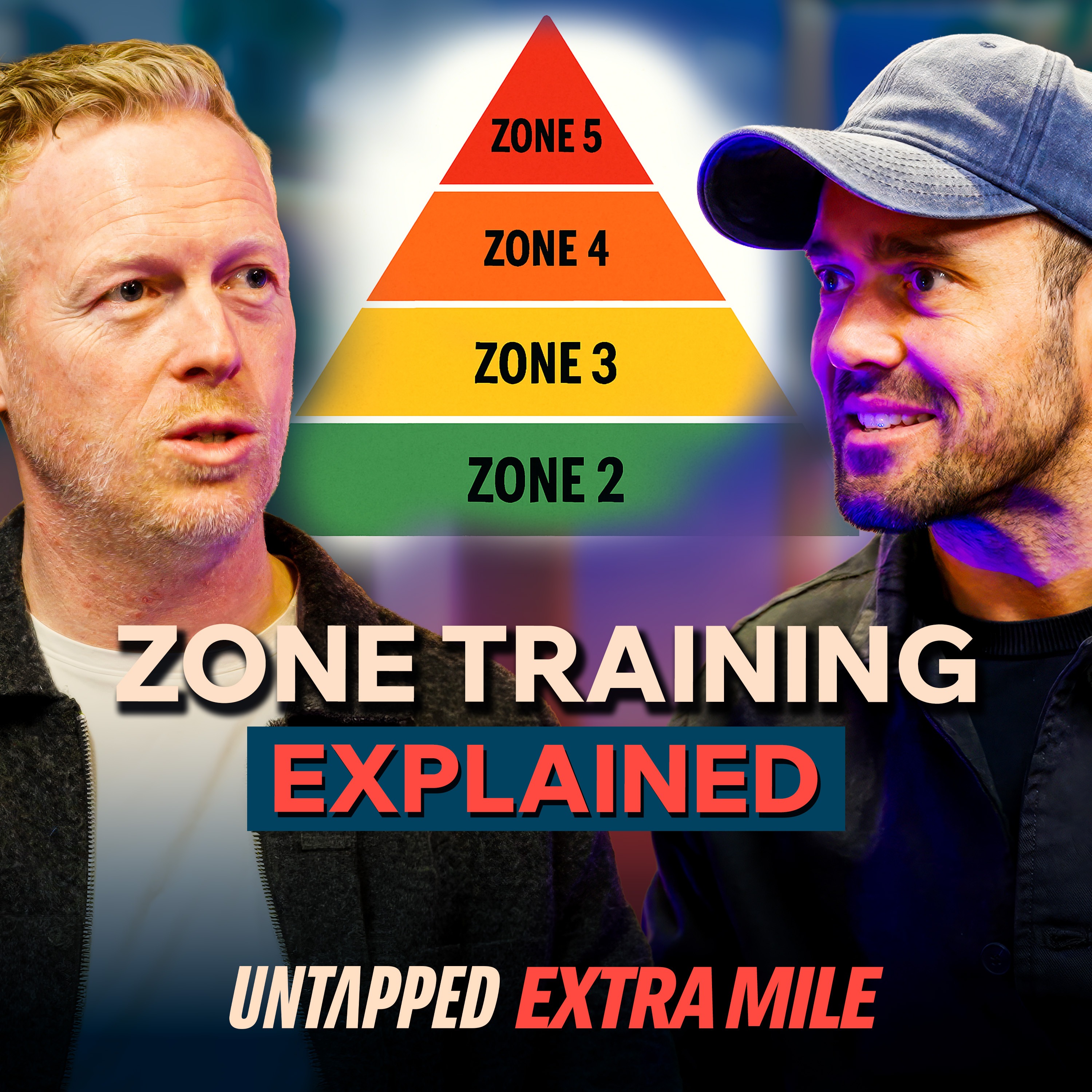
4:11I am working with sugar and no oxygen, having started with fat and oxygen. And the zones are sort of, you know, 50 to 60 % of my maximum heart rate, which in itself is a debate, is zone one. 60 to 70 % is this magical zone two. 70 to 80, zone three, often called the gray zone. 80 to 90 would be zone four, and 90 to 100 is zone five. So they're basically built there to try and help people theoretically work out which fuel source they're using against the objective of their training? That's quite the answer. I was expecting you to say something like, it's the heart rate at which you run at. I probably could have done.
4:52Forgive me. This is, again, why I don't get invited out much. Because there's a quicker answer. It's an incredible answer. I think if you're someone who wears a wearable, like a Garmin or a Coros, it will tell you what zone you're in based on what heart rate you're putting out. Yeah. Right. So like if you're past, if you're higher than a certain heart rate, you will move into the next zone. Exactly right. As it were. Yeah. Stephen made the really important and interesting point that zones are different for everyone. This message is brought to you by today's sponsor, Walden University. Set a course for change.
5:32Now is the time to make a real change in your life, career, and community. At Walden University, we give you the support and flexibility to get the W. Walden's online programs are designed for working professionals like you. You'll gain hands-on skills to take on real-world challenges and succeed. Your future is waiting, and Walden is here to help you achieve it. Take the first step to make your impact. Visit waldenu.edu. Walden University. Set a course for change. Certified to operate by Shev. Guessing is for game shows, not your business. Workday is the enterprise AI platform for HR, finance, and IT.
6:11With AI grounded in your context to get work done and done right. It's a new Workday. Los Deportes bring families together. Maybe it's watching el partido or cheering from the stands. While you are taking care of everyone else, don't forget to take care of yourself. If you are 45 or older and at average risk, it's time to screen for colon cancer. ColorWord Plus is non-invasive, requires no prep, and can be used at home in about 15 minutes. Hable con tu médico o request ColorWord Plus test online. Hablemos de lo que nos de habla. Available by prescription only. They are. And this is where, and of course that's obvious, but he made it really obvious by comparing myself to him, right?
6:56So he was like, you know, you may be able to comfortably run in zone two at, you know, five minute Ks or five minute 30 Ks. He's like, my zone two is three minute 40 Ks, which for you is really fast. For me, it's really slow and comfortable. So he was like, one of us is doing actual exercise and the other isn't really, you know, my zone two is. But he just made the point that if I were to suddenly start running in his zone two, I would be in zone five or whatever it might be. It's a really good point. So he then went on to say, which I thought was fantastic. He then said, in my case, taking me as an example, if I want to run a fast marathon, is running five minutes, 30 kilometers for 80 % of my week worthwhile while if I'm looking to run significantly faster than that on the day for three hours or two hours and 50 minutes.
7:56Yeah, really interesting. And he said, you know, probably not. He was like, I should be working at speed. He said when he was a kid, he used to run, you know, five miles a day or seven miles a day. I can't quite remember what he said, but he said he used to run it hard and fast. And over time he became fit and fast. And he kind of made the simple point that had he ran that five miles, you know, really slowly every day, if it ever came to running a really fast five miles, then, you know, I don't think he'll be better off for having ran it slowly. You know, obviously this raises the question of, can you run fast all week long and not get injured and recover properly?
8:37And, you know, and fuel all of that perfectly. You know, Stephen was a professional athlete. So I reckon he probably approached his training differently to how we all approach our training. But I did find it interesting. It does make sense, right? And by the way, I don't know if anyone listening feels the same way. I can't run in zone two, really. Like I will drift into zone three for at least half of a two hour effort, even if I'm trying to keep my heart rate really low. Like I have some friends who are really fit, who, Josh Rose, for example, who we ran Tokyo together. He ran the whole Tokyo marathon in 255 or something, which is really slow for him.
9:19He runs a 229. Outrageous. In zone three. Yep. Could have been a bit of both. I think it's zone two that he ran it in. Zone two, sorry. He kept his heart rate at 130, I think, for the whole marathon. Just because he was pacing me. So, you know, it's kind of... It's a bit of fun for some people, isn't it? It is, but you can't compare exertion. So, you know, one person running at a certain speed. The only way you can really think about zones is how it feels. So zone two, by its very definition, is staying below what is often called the sort of anaerobic threshold when your body basically is going to be on borrowed time.
9:56So in zone two, you're theoretically mostly, and when we look at these energy systems, there's never that you completely use fat and oxygen, you completely use sugar and no oxygen. So these systems are always blended. But if you and I are using fat and oxygen to run, we can run for a long time. Me more than you because I've got more fat than you. right i've definitely got more fat you know so my ability to combust energy is is basically you know nearly not unlimited i'll you know i'll dehydrate i'll have some some central elements of fatigue creeping in but if i can do something in zone two i can do it for a long long time now what i can do in zone two depends on on how conditioned i am so your zone two what you can achieve and again comparing you to me you running in zone two would be significantly faster than me running in zone two, but we would probably feel the same.
10:43And that's the thing, when people see extraordinary tasks, when people see Tour de France cyclists cycling at 40 kilometers an hour, you know, oh my God, I can't imagine that. Because when you're at 40 kilometers an hour, you're in zone five. So they don't feel like you feel for two and a half hours, three hours, five hours. They feel like you feel when you're barely trotting. Well, we had Mo Farah in this studio who made the point that him running a flat out 5K and you or I running a flat out 5K is exactly the same in terms of exertion, right? It'll take us a few minutes more. Yeah. It's worse.
11:15It's harder. But yeah, exactly. We're out there for longer. Yeah. Yeah, yeah. I'm in zone four or five for, you know, let's say around 20 minutes, definitely north of 20 minutes at the moment. You know, so he's doing that in, you know, what was he, 13? I can't remember. I can't remember his PB, but yeah, it's fast. So he's seven minutes less in the same degree of pain. And, you know, he'll have built much better tolerances to that pain. So, you know, theoretically, the average person, and I want to give them their flowers. We are feeling pain at a greater level than some of these elite endurance athletes because we don't have great tolerance of it, and we're enduring it for longer durations.
11:49I always think the person running a 209 marathon is going through half the pain I am, clocking in a four-hour 15. And again, there's, of course, nuance to that. But I think perceived exertion becomes a really important thing. And there's this well-known rating of perceived exertion of which there's a 1 to 10 scale. There's an even better one, which is 6 to 20, called the Borg rating of perceived exertion. And really, if you look at how hard it feels to someone, that's a much better marker of which zone they're going to be in compared to what level of performance they're delivering. But on your run, you're going back to this sort of central idea of polarized training, right?
12:23Which was the traditional sports science, and there's always debates and good debates on this, is that when training for an event, 80 % of your training volume would be in that sort of zone two and below, and only 20 % would be in that higher echelon. And I think there you've hit the nail on the head with one of the key reasons for that is that high, that zone four or five when I'm using, again, anaerobic metabolism and carbohydrates, so depleting muscle glycogen, is where the injury risk occurs, but also where the significant volume of tissue damage occurs. And it therefore increases my injury risk and requires a much greater strategic recovery.
13:00And so if I'm looking at a volume play, there is a sweet spot of you run the risk when you're in that zone for a number of reasons. Yeah, I kind of, like when you're making an effort to keep your heart rate as low as possible and therefore not putting yourself under a huge amount of physical strain, to use your words, you could do it all day type thing. You don't get that great sense of achievement from the session, I feel, unless you go and run 30K or something, but obviously it's time consuming. We have kids and jobs. and that's a once a week thing if you're really lucky. So it's kind of, I love to feel like I'm exercising when I exercise.
13:43If you're lifting weights, I like to lift heavy. If I'm running, I like to run hard. So I love chatting to Stephen because it was similar to that. Stephen was just like, well, then run hard. And if you can put up with it. His point was, running five times a week hard will be better for you if you're looking to run hard and fast marathons than running slow five times a week. He was like, obviously, your body will adapt and become faster. But not necessarily the same way. And he, you know, let me not, you know, contradict a 209 marathon runner because he's an elite athlete. So his lived experience is absolutely true.
14:27and there are some anatomical differences in what would happen to me in zones one and two where I'm using what we call oxygen pathways versus in zones four and five where I'm training hard where I'm using potentially anaerobic pathways. And the reason we like a blend of both and he will do some in both is not just the injury risk, not just the greater recovery need is that in zones one and two, I sort of build the scaffolding of my physiology. So we hear about mitochondrial biogenesis is a really fancy word. Not heard of that. No, nor should you have done. You know, who wants to hear about that?
15:04But you know, batteries. You know, mitochondria are the batteries in human cells that combust energy. We physically manufacture energy in these mitochondria. And you will make more of them in that zones one and two, where there's a requirement to use oxygen as your predominant fuel. You'll increase blood volume. You'll increase the number of blood vessels like capillaries, these little tiny blood vessels that perfuse, you know, oxygen and remove carbon dioxide from the muscle layer. You get anatomical benefits that is the scaffolding, he may already have them and he might be getting enough of an aerobic benefit in the training he's doing.
15:33But your traditional person is basically doing zone one and two to build the scaffolding in which they can paint the house in zones four and five. It does make sense. I think both things make sense. It kind of depends on what kind of rig you're sporting. I don't mean how you look. It depends on how strong you are, how conditioned you are, how often you've been running. How much can your body tolerate? I think all of these things matter. To our friend's point earlier, whose legs hurt because he's just started running, that's because he doesn't run. Exactly right. And he's probably not strong enough.
16:14Early detection can change everything, but early-stage colon cancer often shows no symptoms at all. That's why screening matters and getting symptoms. If you are 45 or older and at average risk, it's time to screen for colon cancer. ColorWord Plus. Make it simple. Es una prueba non-invasive, sin preparación, que puedes hacer en casa en unos 15 minutos. This is something you can do on your own time. Tu propio ritmo. Talk to your provider o pídelo en línea hoy mismo. Hablemos de lo que no se habla. Available by prescription only. Guessing is for game shows, not your business. Workday is the enterprise AI platform for HR, finance, and IT, with AI grounded in your context to get work done and done right.
16:59It's a new Workday. Who says Halloween only lasts one day? With Wayfair, one night of Halloween becomes a whole season at home. From larger-than-life yard decor and moody lighting to festive accents for every room in the house, Wayfair has what you need to make Halloween feel like magic all in one place. because the best Halloween memories aren't made in just one night. They're made all season long. Shop Halloween decor now at Wayfair.com. Wayfair, every style, every home.
17:32I learned a really big lesson the other day. That fuel is just so important to performance-based running. If you want to run and you want to push yourself and you're not fueled properly, you simply can't do it, right? I'm someone that kind of wings stuff, and I used to go for quite big runs fasted, but when I wasn't fasting, I'd be eating quite a lot. So the fasting kind of didn't really make too much difference because I probably was overloaded with calories in the window that I was fasting. In this calorie deficit, I literally laced up the other day, speed shoes on, fresh plate, first big session from Tokyo.
18:10I wanted to do four sets of five at sub-four-minute pace. So proper run. you know proper run went into Hyde Park for a change and everything like you know just really mixing it up lovely beautiful day failed in the first set really early on so like did a 2k warm up and then set off I was this is my third day of being in a calorie deficit I had gelled and then and literally kind of set off at 350s for about a K and a half and then just similar to what your car might do if it ran out of oil yeah type thing it just just like super light haired body stopped working like it wasn't a case of like oh this is going to be difficult it's like I can't do this so which is like I never fail a session really like you know a session might be a bit slower than I thought it would be I might pull the plug a couple of K early but like I've never gone out to do 20K at fours and done one and a half you know like that's never happened in my life and I stopped stopped the watches like sat down had a coffee had a water and then just kind of jogged 8k you know and just kind of flushed out my system but it was pretty it was a strange I'm just going to put that down to the calorie deficit right to like the not having the carbs in your system to sustain but should it be kicking in in a k and a half like that glycogen deficiency like deficiency I'm not really that glycogen depletion I'm not really sure it should be.
19:46So I don't really know what happened there. I think somewhere in there is the answer in terms of the calorie deficit. Clearly, when we consume carbohydrate, we store any excess carbohydrate in muscle and liver glycogen. So it's like we have the sugar in our bloodstream, but we always want to make sure we've got enough glucose or sugar in our bloodstream. So we store it. So as our body drops levels, it can release it from liver, release it from glycogen. When you're in a calorie deficit, you're probably also in a low carb state and you've continued training. What this brings back to is that really interesting point around different energy systems and different heart rate zones having a different fuel mix.
20:20So when we go up into zones three and above, we're starting to use a significant volume of blood glucose and significant stores of muscle and liver glycogen. And you wouldn't have needed that if you were running it. And again, I've got your heart rate zones, interestingly, but let's say you're running at whatever pace, kept you at 120 beats per minute and you're using fat and oxygen, you'd have been fine. because of the intensity, the running speed was moving you into probably, you know, upper zone three, probably zone four. Your predominant fuel was carbohydrate and you ran out. Now, should you run out that quickly, you've definitely been in then a decent calorie deficit for quite a period of time, but that it would be most closely associated with people using the word bonk.
20:59When you, you know, in the marathon, people sort of drift into higher heart rate zones, start pulling on glycogen, run out of stores, and they experience that feeling where it's not I'm knackered it's I can't move I can't do it it was completely bizarre yeah suddenly started slowing down and I was like why am I slowing down yeah and I was really looking forward to the session as well and I was like why can't I move my legs and then also all of a sudden I was like I'm walking yeah I was just like this is bizarre I think everyone should bonk at least once I've never bonked before and on Project 7 Chris Taylor kept talking to me about bonking and he's like at some point you're going to bonk yeah you're going to you're going to come off the bike and not fall off necessarily, but you're going to bonk on the bike at some point.
21:43I didn't in the end because we're careful, right? Yeah, but that's also brilliant fueling. That's use of gels. But it was, that experience of bonking was bizarre. And also like, I wouldn't have minded if it'd come in like the third rep. It is odd to me. Right at the very beginning. Could still be a bit of fatigue in there and you haven't replenished glycogen stores from some of the big bursts of exertion you've put in recently, but a combination of a big sporting event straight into a calorie deficit is probably not your ideal one after the other. And then returning to relatively high-intensity work within these fairly narrow windows.
22:21I'm going for a nice sesh today, anyway. I'll report that. A kind sesh. So the great debate was, should I be doing my runs then in fat-burning zones in one and two, and should I do it fasted? And of course, fasting doesn't make such a difference if you are truly staying in zones one and two, but where people historically, want to drift into zone three and zone four where there is a carbohydrate complete element, what we often see with faster training is the quality of the session is less. And of course, the body's adapting to the quality of the session, not the intention of the session. So better to be fueled.
22:51And lots of people, and carbs got demonized, right? So particularly, we find this massively prevalent in women's sport, that carbohydrate became so synonymous with weight gain and managing carbs without realizing this is the fuel of performance. if you are doing anything that's taking you into those upper limits, if you're a high rocks or anything of an hour, you know, 20 minute burst, 30 minute burst, you need carbohydrates. And carbohydrate being avoided in the build up to events is, it might help you look a little more, you know, chiseled on the beach, but it will be a detriment to performance for sure.
23:26But, you know, maybe. I think because muscle glyphogen stores water. I don't know why you're looking at me. Because you've already had your top off twice since I got here. I was showing you that there's children that burnt me. I won't name them. I have respect for fellow businessmen but bloody hell. It's happened to me a few times. I put it on. I don't know why I just don't chuck it out. I will. Yeah, I think, again, the key learning for this morning is if something irritates you, not necessarily a person, but if a product just irritates you. If anything irritates you, chuck it in the bin. So your zone 2s are a great example of when someone does an awful lot of conditioning, they actually move the numbers.
24:02So your zone two would be predicted to be something about, you know, up to 128 beats per minute. But your zone two is somewhere between 136 and 146 beats per minute. So that's way higher. Yeah, but like 128 beats per minute? I can't run at 128 beats per minute. No. Well, and again, you could if you run. Hardly anyone can. If you walk and run. So where people really fail with zone two and why they call zone three the gray zone is people naturally go in there because it feels a bit more like exercise. Zone two does feel bizarrely light. And people, you mentioned earlier, you don't get the same buzz from it.
24:39And because you're not creating as much muscle damage, you don't create as many painkillers, which are the endorphins, which sit around after the session and make you feel like you're an absolute rockstar. So you don't get the same runner's high when you do not create as much damage. So I won't feel as buzzed afterwards. I won't feel like I've slaughtered myself. But actually, I think one of the reasons more people are leaning into zone two is they haven't got the capacity to take on that additional load. So when we start to go up through these elements, we also start to activate more of the body's sympathetic nervous system, the nervous system that gets us ready for fighting and escaping danger.
25:13And you can almost look at zone one and two as stress mitigating, as in they're going to make you feel calmer and manage stress down. And zones three, four, and five as stress sort of accelerating. They're another form of stress. And if you and I had a horrible day today, you know, and you've been on edge all day wired. Interestingly, physiologically, you may, you may look as if that is the day you're having, you know, we may not be best off going and slaughtering a high intensity interval session. We're better off cruising at walking pace in nature. And that would be more restorative than blasting stress into a stress system.
25:49And I think, and again, maybe not for you, but for most people, why they're leaning into zone two is they are feeling sort of hyper-stimulated, overwhelmed, and they're noticing a connection with this type of exercise, a increasing performance, not to the level of an elite marathon runner maybe, but they're seeing an increase in performance. But more importantly, they're feeling reduced stress. And that makes a big difference. Early detection can change everything, but early stage colon cancer often shows no symptoms at all. That's why screening matters, aunque te sintas bien. If you are 45 or older and at average risk, it's time to screen for colon cancer.
26:25ColorWord Plus, make it simple. Es una prueba non-invasive, sin preparación, que puedes hacer en casa en unos 15 minutos. This is something you can do on your own time. Tu propio ritmo. Talk to your provider o pídelo en línea hoy mismo. Hablemos de lo que no se habla. Available by prescription only. Hi, I'm Jack Gravici, Kramer host of The Best One Yet. At T-Boy, we're always talking about small decisions that can have an outsized impact. One of the simplest is staying hydrated. Whether I'm traveling, getting a workout in, or heading into a busy day, I keep Liquid IV on hand. It's clinically demonstrated to hydrate faster than water alone and contains three times the electrolytes of the leading sports drink, plus eight vitamins and nutrients.
27:06It's an easy addition to your daily routine and helps support hydration when you need it most. Shop now at liquidiv.com. Liquid IV hydration that goes wherever life takes you. Hi, this is Brooke DeVard from Naked Beauty. I am always looking for ways to elevate our daily rituals, and the Kohler Smart Toilet is proof that design changes everything. It's this stunning sculptural piece that feels like quiet luxury for your bathroom. It totally transforms your daily ritual into something elevated with customizable cleansing and touchscreen controls. It's functional art that makes your space feel cleaner and more intentional.
27:42A modern home deserves a modern toilet. Experience the difference of Kohler Smart Toilets. Find more at Kohler.com.
27:56Stephen mentions that there is one super shoe that is better than all other super shoes and that is the Sockony Endorphin Elite Pro 2 Good God I have a box fresh You do not at home Yes I do in the correct size this time because I bought them and they were too small can we create like something that tells you where you size with other brands I'm like a 9 in Nike I'm a 10 in Adidas I'm an 11 with Sorkin E I'm all kinds of stuff I'm not a 9 in anything a lot of people stay with the brand I'm a 9 in the Nike Vermeer O Plus I'm a 10 in the Prime X3 I'm an 11 in the Sorkin E like come on so interesting come on like can't we all just yeah well you could do that we could do we could make an app that goes like this is my shoe size like where do I size if you buy it through a shoe store they normally go true to fit smaller so there is there's a bit of guidance why can't it just all be true to fit everything should be true to fit I've got no argument it should be true to fit I've got no counter okay so anyway so I'm going to take these these race wheels out today for the first time I'm not going to go berserk with four sets of five.
29:22I'm going to do some over and unders with a K. Now, the key here is if you are running your session based on your timings, then you would... Ideally, you're running the session based on heart rate and perceived exertion. And if you run it on that, the time should be faster. If you run it on timings, then the exertion level would be lower, if that makes sense. So principally, the shoe, it becomes a performance age, but it doesn't change which zone you're in. you're just able to deliver a faster running performance for the same perceived exertion. What I'm going to try and do is I'm going to just warm up and then hit go.
30:00And I'm going to blast a fast K to the point where it's sort of uncomfortable, but I'm not going to look at what the pace is, to your point. I'm just going to get into a super fast rhythm in the new shoe, not really knowing how I'm traveling. and then when I'm a good like minute into the K I'll have a cheeky glance a little glimmer and can you imagine if you look down it was like three tenths you'd be so happy wouldn't you imagine oh my god well I can't see a three tenths I can't even imagine I think there again but these sessions so you're running you'd be mad these are these are sort of zone four five sessions oh yeah threshold they'll increase VO2 max so threshold is generally linked to zone four zone 4 when you are still able to continue performance zone 5 theoretically zone 5 if we take that whether it's 95 to 100 % or 90 to 100 % you know you could be there for 5 minutes as an elite athlete there's sort of theoretical people could be there for 10 minutes 12 minutes but principally you're in 4 minute bursts which is why when people do lots of the training that you're doing they sort of pull on work that's probably best summarized as the Norwegian protocol which is 4 minutes as hard as you can go three minutes recovery repeat that four times and that was born out of a protocol that basically was the best way to increase VO2 max or an evidence based way four minutes as hard as you can go yeah but the key with the four minutes is you don't taper so you would start at the pace that you finish at but the last minute and a half you're in a dogfight from hell like you really are yeah you're just going for it yeah yeah so you're not sprinting and then tapering no no no so the speed is the same four minutes of your four minute pace yeah all in as hard as you can three minutes active recovery so again zone one just clearing out and four sets of that and that's a VO2 max pill that's the one which is not so similar to what you're doing that's the sesh mate that's the sesh that's what I'm going to do yeah just the four sets just the four sets but literally like and it's four minutes of running you're not looking at distance nope it's four minutes of running and it's like about as hard as you can go as hard as you can go for four minutes yeah that and that again is the idea that then if I go into that zone 5, well, you should still have enough glycogen to run that session, but the reality is you'll have to see how you get home.
32:23So what's our key takeaway from zone 2 today? Well, you've had guests on this podcast that have been great advocates. Alistair Brownlee was a great advocate for it, easy for me to say. Stephen Scullion, less so. I think elite athletes are closely monitoring the impact of their training. They're watching what works for them. They've got advanced recovery protocols, advanced fueling protocols. You know, what works for one may not work for their direct competitor. I think that the literature on Zone 2 is that it's a solid way of building the scaffolding of human physiology. And what's exciting about that scaffolding is that that translates not just to performance benefit, but also health benefit.
33:00And I think in the modern world where we're seeing people sort of extra wired, burnout on the rise, people super stressed, 72 % of the UK thinks they're excessively stressed. I think Zone 2 is a real elixir. elixir for 72 % of the UK feel that they're excessively stressed. Yeah. What? Yeah. Yeah. It's, you know, if you go into a room, a hundred people say, put your hands up to feel like you're a bit overwhelmed. Yeah. Seven out of 10 hands will go up, you know, maybe more. So using zone two, we must do an episode on stress. We absolutely should. You know, using zone two as a way of building strong physiology that enables performance, calms the stress response, creates the anatomy for, for, for progress is great.
33:39The challenge most people have is the same challenge you have, is it feels lighter than they might wish. But that is what it is. And unless you've gone and got your zones tested, using a heart rate formula, and ideally people doing a full test to work out what their maximum heart rate is. So running a mile and checking what their heart rate was in the last 30 seconds of that mile is a really good test. So not relying on 220 minus my age, which will be a flawed formula for most people. But if you get a true maximum heart rate for any of the methods to get that, work out your zones. Zone two may feel lighter than you would like it to feel, but it may be the thing that really propels you from a health, well-being and performance perspective.
34:17Beautiful. Thanks so much for listening to our Extra Mile episode here at Untapped on Zone Training. We will catch you next week with a brand new episode of The Extra Mile.
34:38It was an afternoon that envories her
Spencer and Oli break down what heart rate zones really mean, how they are often misunderstood and how you can train better using them.
Postcode Lottery 👉 Discover how Postcode Lottery players are Powering Hope Together. Click here to find out more: https://highpfrmc.com/ut-postcode-au
WHOOP 👉 Join Spencer in untapping your own potential with 1 month free here: https://highpfrmc.com/UT-WHOOP-au3
Robinhood 👉 Head to robinhood.com/untapped to get started and claim your free stock.
Stride 👉 find your edge and unlock a special offer at getstride.com/untapped
Hosted on Acast. See acast.com/privacy for more information.