Ask ChatGPT
 UNTAPPED with Spencer Matthews
21 May 2026 · 29m · 12 chapters
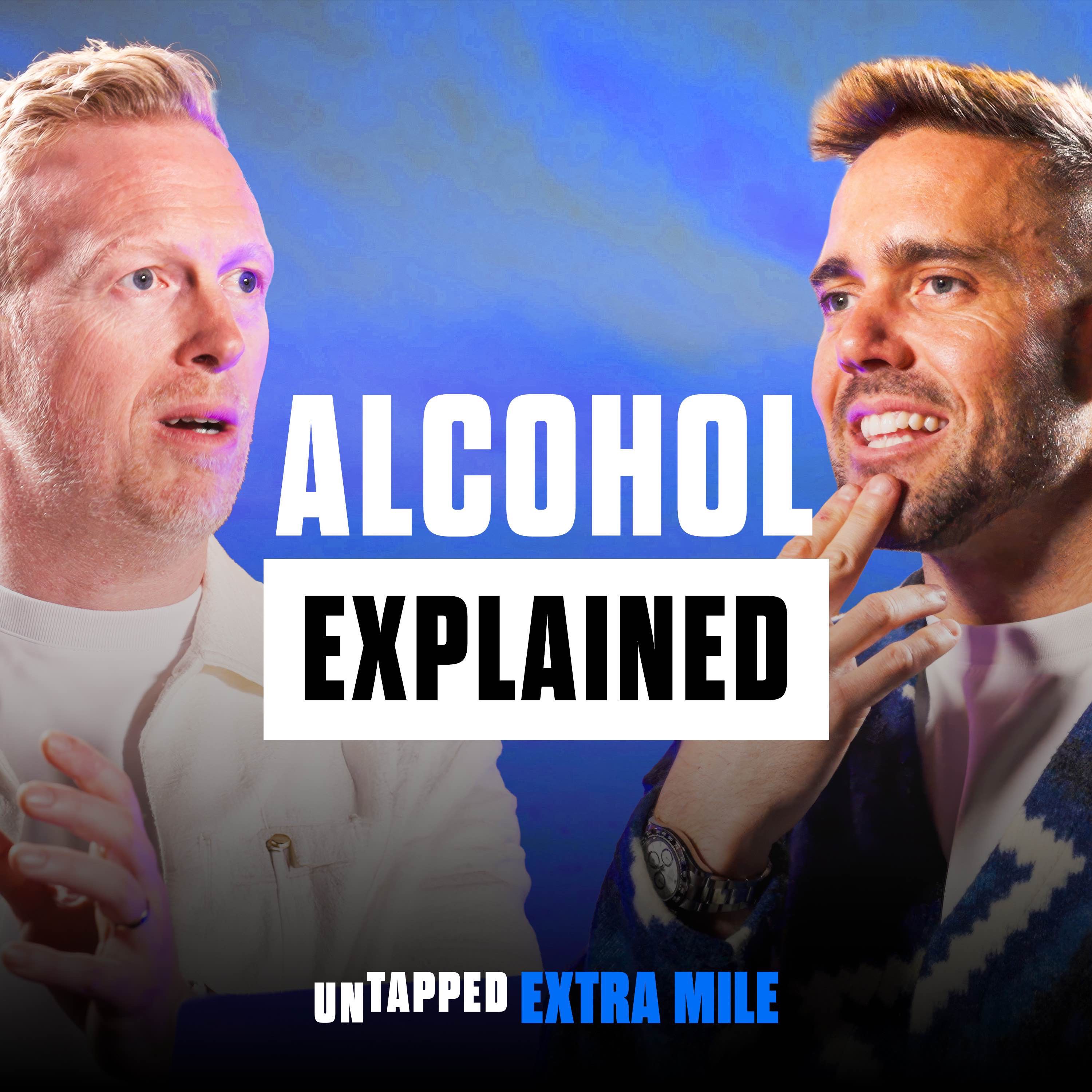
Alcohol’s effects on the brain and body, why it feels good, what causes hangovers, how heavy drinking damages multiple systems (sleep, brain inflammation, gut microbiome, liver, cardiovascular health), and why people keep drinking despite harm; also discusses addiction as habit and the social role of alcohol.
No named guests. The hosts are Spencer Matthews and Oli Patrick.
Alcohol is “effectively poisonous” and disrupts sleep quality; it enters the brain quickly (water- and fat-soluble) and alters neurotransmitters (early GABA rise, later dopamine/endorphin reward loop). Hangovers involve poor sleep and brain inflammation. Excess alcohol kills gut bacteria, contributes to fatty liver (via acetate/energy overload and impaired fat oxidation), raises liver enzymes (gamma GT), increases oxidative stress, and can shrink/inflame the brain.
“Pub sports” where short-term tremor reduction may help (darts/snooker); alcohol’s mismatch between belief and execution leading to injuries; foie gras as an analogy for fatty-liver mechanisms.
Written by AI. May contain mistakes.
Discussion on how alcohol affects the body, particularly highlighting hangover effects.
“And before people think that we're just going to drone on about how bad alcohol is.”
Exploration of why alcohol feels good, discussing its impact on neurotransmitters.
“It's interesting, you know, the history of alcohol is it's been intertwined with sort of human connection for thousands and thousands of years.”
A conversation about whether one drink can be beneficial and its social implications.
“So is there an argument for saying that just one drink is good then?”
Discussion on the role of alcohol in social interactions and the effects of its absence.
“This is the challenge and everyone involved in this space can be absolutely puritan and go, right, alcohol at all dosages is physiologically damaging, yet I intrinsically feel good to it.”
Exploring the feelings of shame and control related to alcohol consumption.
“It's like you don't, you almost, because you're, you know, in my case, losing control and, you know, a really slippery slope with alcohol, which obviously, you know, is a toxic and addictive substance.”
Discussing the nature of addiction and the complexity behind habits.
“Not all customers will clinically qualify for medications.”
Debating whether alcohol can enhance performance in certain activities.
“in far more complicated things than willpower.”
Examining the cultural acceptance of alcohol and its role in society.
“Because say for example I'm just having a bit of fun here Yeah, so like your fear may diminish.”
Discussing the human need for social interaction and alternatives to alcohol.
“The prohibition era failed because alcohol, the lure of it was so great that the whole alcohol industry went underground.”
Explaining how alcohol affects various bodily systems and overall health.
“of social behaviors and historically evolved physiology and modern day marketing.”
Learn about how alcohol affects liver function, fat metabolism, and overall health.
“And if my body can't get rid of that effectively, it inhibits its ability to oxidize fat.”
Explore societal views on alcohol and its implications for long-term health.
“for my GABA response, my frontal lobe, you know, depreciation and habitual behavior with my wife.”

Get the gist, explore an idea or ask about something said.
 Claude
On UNTAPPED with Spencer Matthews, what are the key points of this episode?
Searching your listeningAutomatic transcript. May contain errors.
0:05Welcome to Untap the Extra Mile. I'm Spencer Matthews. I'm Oli Patrick. Indeed. Indeed you are. And today's topic is alcohol. It's one that people are increasingly aware of. I think, you know, with the rise of more easily accessible information and data, I think people are already making better decisions around alcohol. I mean, Gen Z, you know, just drink an awful lot less than certainly millennials and older people. You know, this is not really a trend. It's a movement now away from alcohol. And before people think that we're just going to drone on about how bad alcohol is. You know, we both enjoy a drink from time to time.
0:55and we're by no means anti-alcohol, but thought it would be interesting to dig into alcohol and the effects that it has on the brain and body. I think at a surface level, we're all aware that drinking alcohol to excess is bad. You know, it feels bad. Yes. And, you know, everyone, or at least most people listening, know what it feels like to be hungover and, you know, abusing anything, to be honest. is not to be recommended. But I was wondering if you might be able to break down... Well, firstly, what is a hangover? What's happening to your body? Like when you wake up feeling hungover, what has happened to your body and what is your body processing?
1:42It's processing a poisonous toxin, really. You know, we've got to start with the bad news and we'll end up with some hope, you know, and some sense of where alcohol sits in a healthy ecosystem. But it is effectively poisonous. It's a toxin to the body. And it's got such a range of difficult things that challenge our physiology. I think a hangover, which is still a great debatable piece, sits fairly confidently in at least two places. One is through the role that alcohol has in suppressing sleep quality in terms of the cycling of sleep, but also the duration of sleep is compromised through alcohol, despite it helping you fall asleep faster.
2:21So it drives quicker sleep, but it's not quality sleep and it's disruptive. And then the hangover seems to have some relation with the fact that alcohol is creating inflammation of the brain. So, you know, it's the byproduct of all the neurotransmitter disruption of all the sort of the byproducts of toxicity seem to create an inflamed brain. It is a very physiological entity to which there is no magnificent cure other than not consuming more alcohol than your body can process. Why does it feel good? It's always felt good. It's interesting, you know, the history of alcohol is it's been intertwined with sort of human connection for thousands and thousands of years.
3:00You know, so alcohol is sort of biblical. Alcohol is, you know, far beyond that in terms of people used to make mead, which was, you know, fermented honey. And fermented fruits have been a sort of staple part of animals and humans for forever. But certainly it's been a big part of our bonding. And it feels good because it does a range of things that do make us feel good. So alcohol on the brain in particular, and alcohol is quite special because it's water and fat soluble. And that basically means it can get everywhere. So as water soluble is more likely to travel in my blood, fat soluble means it can enter cells because the walls to my cells are made of fat.
3:35So it's basically, it proliferates pretty much all the tissues of the body, but particularly the brain. And the brain is protected by this thing called the blood-brain barrier, which basically stops any nonsense going up into this most valuable of organs. But alcohol gets in there and gets in there rapido. and when it's in there it creates a change in neurotransmitters neurotransmitters are this chemical element that make the neurons of the brain talk to each other and communicate signaling of the brain and people might have heard of GABA which is a neurotransmitter that makes us feel calm and there's an almost instantaneous rise in GABA when we have our first drink and the first drink actually which was always something that I had lots of friends when I was younger who liked one drink and then they'd stop and I was like okay and I wasn't that I would drink through and push through.
4:20But our first drink, when you get that sort of soothing, calming impact on the brain, is a really, you know, potentially positive experience for lots of people. So that's pretty powerful. That's really interesting to know what that is. So GABA, that's what that is. So is there an argument for saying that just one drink is good then? Because I can directly relate to what you're saying in the sense that if something goes wrong with your business or you are experiencing heightened levels of stress, Having a beer will diminish those feelings of stress, whether that be good for you.
5:18Visit JoinMidi.com to book your first visit today. That's JoinMidi.com. Insurance coverage varies. Check with your plan for coverage. Waiting for your sign? Here it is. Shop Labor Day appliance deals at Lowe's before they're gone. Get up to 45 % off select major appliances. Plus, get free delivery, haul-away, installation and parts, and a two-year Lowe's protection plan on purchases of$999 or more. Labor Day deals are on now at Lowe's.
5:55In a world where AI is changing every role in every industry, knowing who actually has deep expertise matters more than ever. Upwork connects you with the highly skilled freelance professionals with proven track records, so you can hire with confidence. Upwork gives your business fast access to highly skilled specialists with deep expertise, so you can fill critical skill gaps, launch projects faster, and scale support up or down without committing to full-time headcount. With Business Plus, you can access the top 1 % of talent on Upwork. AI-powered shortlisting delivers a curated shortlist of top freelancers matched to your goals in under six hours.
6:32No endless searching required. Thousands of growing businesses already trust Upwork to hire highly skilled freelance professionals for everything from one-off projects to ongoing support. It's free to sign up, and posting a job is easy. Visit Upwork.com right now and post your job for free. That is Upwork.com to connect with top talent ready to help your business grow. That's U-P-W-O-R-K dot com. Upwork.com. This is the challenge and everyone involved in this space can be absolutely puritan and go, right, alcohol at all dosages is physiologically damaging, yet I intrinsically feel good to it. I'm aligned with it culturally.
7:10And I sit with the simple challenge that we are losing a social structure that was the fabric of humanity and we didn't replace it before we dropped it. And how many of my great friendships, relationships were built in the presence of alcohol? Did I need alcohol? Hard to determine, but certainly it was a facilitator of social wellness, which seems to be the missing piece from Gen Z and potentially into other generations. If you take the social element out of it, Is there a scientific reason why when you have that first beer or that first glass of wine, you almost instinctively want another one?
7:45Yeah, and it will vary again. So everything has to have nuance and everything needs a bit of context. But yeah, historically, that first, again, role of GABA, we also see a sort of down regulation of our inhibitory part of our brain, the prefrontal cortex, which is my sort of overtly protective part of my brain that goes, don't say that to Spencer. He might take offense to that and he won't want to come around to your house for a barbecue next week. and so I'm inhibiting. We're on. We're on. So, you know, principally, I don't do it because of the potential repercussions and of course, what most people lose under the presence of some alcohol is that inhibitory break and they are their true other selves and again, you go, I don't need alcohol to be my true self.
8:23Some people do and some people like, you know, letting the sort of rascal version of themselves, the slightly funnier, the slightly less risk-averse version out of the box. So that plays into, you know, how we behave and some people don't like that version of themselves, some people do. But in the neurotransmitter game, again, we see then a rise of dopamine, which you've spoken about frequently on the pod, the reward neurotransmitter, which means I start to feel, again, pleasure from the benefit of alcohol. It's targeting those sort of pleasure and reward centers. And then we see endorphins. And those endorphins are my feel-good neurotransmitter and are also pain relief.
8:57Let's remember the history of alcohol was that, you know, if I'm of bottles of mead into you and you feel it less no doubt you felt it a lot but you feel it less so alcohol has this sort of extraordinary cascade of neurological impacts where it's it's calming my brain initially reducing my you know activity in my frontal lobe eliciting feelings of pleasure and and joyfulness in endorphins and that can create a feedback loop that encourages me to pursue it again despite the fact the following day i woke up with an inflamed brain poor quality sleep and a sense of latent anxiety in some cases. And that, you know, propensity to feel the impact of those neurotransmitters and those, you know, who are more sensitive to it, less sensitive, there's so much individuality in people.
9:47But there are things about alcohol that certainly correlate with pleasure and a returning desire to engage with it again. That's very physiological. Is it Anna Lemke's seesaw effect in the brain? You know, firstly, what is your view on that so basically you know you get these large dopamine releases from drinking lots of alcohol and then you essentially you know the seesaw dips back down to neutral but then dips into pain so you must pay for the dopamine that you have borrowed essentially from drinking alcohol. The view of some is that quick easy dopamine release must be paid for you know so whether that be smoking, gambling porn, alcohol sex you know you're giving yourself this clean dopamine hit from toxicity essentially and when that dopamine level drops it doesn't just stay level at neutral it seesaws and you know you pay for it with pain anxiety you know in some cases depression bad sleep is it that balancing of the seesaw if that's the case that makes people keep jumping in you know and I have experience of this myself where you're in a really kind of toxic relationship with alcohol for many years I drank to excess incredibly regularly and that image of the snake eating its own tail almost springs to mind you know where you I'm just wondering now that you know I've been clear minded for a while it is are you just trying to skew the seesaw in your favor by just getting back on it I also know some people who regrettably you know day drink quite a lot not regrettably I guess people should do whatever they like right like I've been there before I'm happier now that's my own personal view but you know is it that drinking again and again and again, just to try and chase the normal level?
11:58Or is that a completely different question? Or what would be your view on why people continue to do things that they know to be harmful? That's a deep question. Actually, there I would normally defer to colleagues in psychotherapy, because there you're looking at what is the pattern of addiction and the cause of addiction behaviors, and who is more predisposed to addictive behaviors. And actually, there's some really exciting science in that space, which I'm waiting to stand on the shoulders of in understanding. Certainly, dopamine should be earned is a very good phrase. Dopamine that's given cheaply will come at this theoretical cost, which will be a sort of malaise or a low mood state that is compensatory for this cheap thrill of dopamine.
12:42and you probably know the work of TJ Power who created the dose effect talking about how we can really reinvigorate our dopamine pathways through reduction of these sort of cheap thrills and very rapid access. I think in many ways the brain is calibrating as we've spoken about before. If it's regularly encountering this high level of dopamine, these high levels of endorphins and then that is taken away and there's a sort of concurrent lull, the natural predisposition of humanity would be to pursue the original behavior that got you there in the first place. How you break that cycle, who's more susceptible to staying in it and those other elements are probably nuances that we've got to then look at the addictive sort of pathways and dive into that, which I'd be remiss to give expertise on, pal, because I'm on thin ice in that area and there's some brilliant experts.
13:34It is interesting though, isn't it? Because I recently read a book called Addiction is a Choice, which is pretty controversial for obvious reasons. I mean, the title itself is very controversial. Provocative. Indeed. And, you know, I've been there where you feel like you don't really have a choice. It's a strange feeling. Like you feel like the first drink of the day is just baked into what's going to happen. It's like you don't, you almost, because you're, you know, in my case, losing control and, you know, a really slippery slope with alcohol, which obviously, you know, is a toxic and addictive substance.
14:16It's odd to feel that way when like, you know, a certain time of day comes around and it's almost like you just, it feels normal to just walk into, exactly, to just walk into a pub or a bar, have a quick beer, bam, out. And it's obviously, for me, that kind of behavior carried a lot of shame.
15:0315 minutes and is 95 % effective. If you've been putting it off, you're not alone, but timely screening matters. Let's talk about what isn't talked about. Talk to your provider or request ColoGuard Plus online, Rx only. Waiting for your sign? Here it is. Shop Labor Day appliance deals at Lowe's before they're gone. Get up to 45 % off select major appliances. Plus, get free delivery, haul-away, installation and parts, and a two-year Lowe's protection plan on purchases of$999 or more. Labor Day deals are on now at Lowe's. In-store and online. Valid through 916, while supplies last. Selection varies by location.
15:43See Lowe's.com for more details. Losing weight can feel like a roller coaster, full of ups, downs, and being thrown for loops, like when someone brings donuts into the office or your kid's dino nuggets start giving you that look again. That's why there's Noom. They combine GLP-1s to quiet the food noise with healthy habits that help you keep it quiet, even if you get off the meds. Their program is designed to make weight loss a smooth ride, helping you understand what drives you, so you can build better habits to not just lose weight, but keep it off. Noom. Lose for keeps. Get started at Noom.com.
16:20Not all customers will clinically qualify for medications. Individual results may vary. because you kind of know well god i shouldn't really feel the necessity or need to do this but you know you're kind of doing it anyway so you know and then i read this book which essentially is saying that first drink yeah is is is completely your choice like nobody is holding a gun to your head the second and third and fourth drink once you've had the first you may be beyond your tipping point you may have no control past that point but human beings essentially have control of their behavior to some degree at least.
16:58And I just found it pretty interesting. I don't really have a view on it. I feel like I've been on both sides of it. Obviously now I feel like I can walk past the bar and make a decision whether or not I feel like having a drink or not. And that obviously feels normal to most people, I think. But I certainly went through a phase where I felt like I had less choice than perhaps I would have been comfortable with. And I just find it interesting. I know you're not an expert on addiction, but But, you know, when you take, you know, drugs, alcohol, when does addiction come into it? Do you know from a scientific perspective?
17:31Like, must you abuse a substance or a product for an extended period of time for it to become a problem? Or are some people just predisposed to, well, I've had this drink on a Friday, now I'm just going to do that all the time type of thing? It's a good question. I don't know. I think that I know one of the foundations of addiction is it's become a habit. And therefore, to get out of that cycle of addiction, we're into some pretty complicated science of habit breaking. And getting out of a habit requires more than this sort of concept of willpower. It will require new... And of course, there are extraordinary medications that can help people get out of these patterns of addiction.
18:06And I believe it should be done firmly under the care of a healthcare professional. and those people who are wondering whether they're addicted or not and whether they can get out of that pattern should be curated in their journey. And this, again, if they're listening to this podcast, then this might be the instigation to check it out.
18:26But ultimately, the pattern of behavior has become ingrained. And then we look at the neuroplasticity of breaking that habit, which requires concerted and deliberate effort and is far greater than I've just got the willpower to quit. and a lot of people beat themselves up about willpower. But willpower doesn't get you a habit and willpower doesn't necessarily get you out of a habit. And addiction has its roots in far more complicated things than willpower. Is it a myth that a couple of drinks will make you better at something? Do you know what I mean? No, it's not. Like it may be that you feel that a couple of pints will make you a better darts player or it may even be that a couple of drinks might make you feel like you're a better lover.
19:11You know, what, what, what, what, is there any truth to that? Or is that just freeing your mind a bit, you know, and taking on the alcohol, being a little less nervous in the moment and essentially tapping into some potential higher performance? Or is that just not relevant to... I think it's good. In certain sports, it could be performance enhancing. I'm not calling sex a sport, but I would say sex needs its own little caveat I think there you get an awful lot of my prefrontal cortex is going oh god what am I going to look like naked and oh god I hope I'm an absolute stallion and you have a couple of drinks I don't care about any of that stuff I'm going in so I think that there is validity to that that we hold ourselves back what's the stallion's name?
19:56Samson Samson I was going to say Shergar Shergar Samson Samson doesn't care about any of that nor should he so Samson aside people have some level of reservation. Interestingly, we used to have Bob Werbenek, who was a snooker player, who would regularly smash through eight pints Canadian while playing snooker. What you've got with pub sports is they're sports that you tend to get slightly better at because alcohol reduces muscle tremor. My muscle's always shaking slightly, and with alcohol I reduce it. Fine motor skills may benefit in the short term before the pathways of my so we have this other glutamate neurotransmitter which gets dysregulated by alcohol and then I start to become sluggish and slow but my self-belief goes up, my stillness might go up and there might be a sort of apex point where darts, snooker, other enhance slightly, but it was deemed a performance enhancing sport in those sports Balance?
21:00Awful No but are you sure though? Because say for example I'm just having a bit of fun here Yeah, so like your fear may diminish. Yeah. So say you had to walk, you know, between like two skyscrapers on, you know, a plank of wood. Yes. You would believe you could do it, but you would fail at it. You know, this is the great challenge of alcohol. There's a mismatch between belief and execution, which genuinely leads to lots of people severely injuring themselves because they're like, you know, I can make that jump. And it's, you know, that's why you have a prefrontal cortex that goes, if you don't make that jump you might break your leg and you've got to go to work tomorrow morning whereas the in you know the inhibited version you would go i've got that jump all day long you know and i'm living in the moment and i'm a rock star and so and all that aside it can make for you know terrible decisions that that override a really evolved part of our brain that that protects us and so we've got to distinguish between pleasure in terms of these transitory rises in neurotransmitters that elicit a sense of pleasure versus really happiness and joy, which are often not necessarily intertwined with pleasure in the same way.
22:07Yeah, you said something interesting earlier that you've recently read that if alcohol were discovered today, you know, there would be, the dosage would be minute per year, you know, a couple of shots a year or something. You know, we use that in our clean codex that, you know, if alcohol were a new product today, like Falco didn't exist and you took it to market today and you had a meeting with the Tesco's buyer, they'd think you were literally insane, right? Like they would look at you like you're an alien and they would laugh profusely at you and make you feel like a total idiot before chucking you out.
22:48Because, you know, obviously there's literally no benefit to it. Big toxin, you know, very calorific, awful for your health, you know, gives you all kinds of stuff and, you know, by all accounts will kill you. Perfect. so why would you stock it? It's interesting though, isn't it, that it plays such a kind of pivotal role in society and shows some sign of slowing down. But why is it you think that people don't have stronger views on alcohol? I think because it's been woven into, from birth, we've understood it. It's at celebrations, it's at commiserations, it's at parties. It is a part of the fabric of society.
23:26It's hard to remove. And people have historically tried to ban alcohol at different periods. The prohibition era failed because alcohol, the lure of it was so great that the whole alcohol industry went underground. And that tells us a little bit again that this is something that is fairly hardwired into our way of connecting and being with other people. The challenge of what we are social creatures... Could you not say the same as drugs? I know we've moved off piste a bit though, but for example, it also has a stigma attached to it, right? If somebody were to say, hey, mate, I'm giving up cocaine, you'd say, that's a very good decision.
24:00I wholeheartedly agree with your decision to give up cocaine. Whereas most people, when they say, I'm giving up alcohol, people go, oh, why? When? But they're not worried. They're worried about your interaction with them. So I want to spend time with you, and I want that time to be of even keel. And it's a social wellness play. And humans are tribal creatures. We're looking increasingly at who lives longest and who lives most well. It's those who move in tribes and have strong connections with others. And we shouldn't need alcohol, but we haven't easily got the replacement for the social wellness that it provided.
24:34And people are looking for that. Social wellness as a concept, which might be getting groups of people together away from the presence of alcohol, but in the presence of low and no options and hot and cold. So communal bathing is having a resurgence not seen since the Roman times. Suddenly there are 100-person saunas and cold water plungers with adaptogenic bars popping up in every major city in the world. Why? Because this group of people who want to be with other people but don't want the deleterious effect of alcohol are coming up with new ways of doing it. So I think it is a fascinating time where we know we need, I want to hang out with you, how do we do it?
25:15And alcohol has been a great vehicle for us both, losing that bit of inhibition, bringing us together, taking us to a third place. Not my home, not my place of work, a third space, which humans have historically needed. Now that third space is gone, and maybe even the second place is gone because I work from home. So where do I meet people? Where do I connect with others? Where do I not go where everyone agrees with me, an echo chamber? And in the absence of an alternative, we still potentially lean back to alcohol. And I'm a big believer in finding new ways of creating real social engagement without needing alcohol.
25:47but they're lagging behind the demand, which is I demand connection and I haven't yet found my perfect vehicle to establish it with my peer group. So I think it's an absolutely fascinating blend of social behaviors and historically evolved physiology and modern day marketing. And we're right in the middle of it. And your point earlier is people, there's no right or wrong. Government guidelines are pretty clear. If you do more than 14 units, you'll be struggling and that will be neurological. We see, sadly, a shrinking of the brain, which is quite a significant anatomical challenge. We see a lot of people with liver damage, alcohol as a toxin, as all toxins are, will be eradicated through activity in the liver.
26:31And we're finding a lot of people, of course, as always have been, a sort of heptologist's remit is people inducing liver damage, rising to significant liver disease and a shortening of life. So in the case of excessive of alcohol consumption, what is actually taking place? So, you know, you go out, you have a couple of drinks, you feel fantastic, you know, having the time of your life, you have a couple more drinks, you know, then, you know, a few cigarettes and things start to go a little bit wonky and then perhaps you have, you know, four or five more drinks, you know, who knows, whatever. Then all of a sudden, you're having problems with memory, you're having problems with balance, you feel sick, you, you know, what is happening?
27:09Like, the more alcohol you put into your system, how is it, How is the demise of the system taking place? It's sort of almost every system. You have to go system by system. So if you think of the first thing, if you go and have an injection at your GP, they will use an alcohol swab to kill the bacteria on your skin. So I always love it that we've suddenly understood the role of the human microbiome, these bacteria that live on us, but mostly in us, that are synergistic with my body, with these trillions of bacteria, digesting the fibers in my diet, working to produce my immune system, manage my mood stability.
27:41but of course what don't they want is alcohol right because alcohol kills it's an antibacterial so i rub up my skin to kill things i use it to sterilize goods and then i drink it in excess and expect to have a perfectly balanced gut microbiome and we're seeing that as a as a challenge so my gut microbiome will be challenged liver is challenged because it reaches a point where the volume of of alcohol is overwhelming its ability to deal with the byproduct of energy it's an energetic molecule there's i think seven calories per gram in alcohol which is second only to fat, but it's breaking down through various component parts to a molecule of energy or acetate.
28:17And if my body can't get rid of that effectively, it inhibits its ability to oxidize fat. So the mechanics of alcohol is in the liver, it starts to inhibit my body's ability to break fat down. So fat accumulates in my liver. And we find, you know, alcohol induced fatty liver disease and human, the liver is such a genius organ, you know, this thing that's filtering all the toxins and medications and elements in my body. It's absolutely delicious. Not human liver. No, no, no. It's delicious because it's genius. Now, and interestingly, you know, there's a highly controversial food which is foie gras, which is again banned in the UK and I think increasingly in EU where you force feed geese and those geese are force fed grain and all that extra calories goes to their liver and their liver fills up with fat and they get fatty liver disease.
29:06And that fatty liver is a sort of a cuisine gastronomique in France and around the world. But humans are doing similar and we're creating fatty liver disease with alcohol and actually increasingly by just having too much body fat and too much body fat in that intra-abdominal region. But so it's overwhelming my body's detoxification pathways, which ultimately causes fatty liver, but also causes a rise in the enzymes that break alcohol down, which is a sort of canary in the mind that the liver is inducing damage. When I first started in multidisciplinary medical clinics and we were screening people, they would always be like, oh, I need my liver function done because I want to work out how hard I'm boozing.
29:43And there's a blood marker called gamma GT, which sort of directly correlates to how much alcohol you're breaking down. And it's the early sign that you are overwhelming your liver alongside three or four other enzymes that would normally break down alcohol, but now they're working too hard. So the liver gets overwhelmed, it might get fatty. My gut becomes, again, I lose the balance. We might call it dysbiosis. I interrupt the bacterial picture. We see a direct impact on blood pressure. So again, one of the biggest contributors to cardiovascular disease. We also have to bear in mind, alcohol is going to create increased levels of inflammation, particularly in the brain, but also in the body.
30:21And it's a source of oxidative stress, which is oxidative stress is not the same stress as you and I would have if we're having a Barney. oxidative stress is the cellular mechanisms through which I change the structure of cells and make them less effective. And in simple terms, if you and I have got something I call LDL cholesterol traveling through our bloodstream, the one who's drinking more alcohol is more likely for that LDL cholesterol to deposit in the wall of their artery and contribute to traditional cardiovascular disease. So my brain is shrinking and inflamed, my neurotransmitters are off balance, my gut my source of immunity is dysregulated my liver is again inflamed fatty dysfunctional my cardiovascular system tip to toe is is challenged and all this at you know a relatively innocuous dosage yes i feel good occasionally but you know that then before we move into the societal challenges the mood stability we just have to take that step back and go we forgot it was a toxin because everyone drank it.
31:17We forgot it damaging to almost every biological system in the body because everyone did it. I can still make a strong argument that I enjoy it on a Friday night for my GABA response, my frontal lobe, you know, depreciation and habitual behavior with my wife. But it is impossible to make an argument for it for someone who says they want to live long and live long well, sadly. Sounds great. Thanks for that. I was about to say but other than that is that right other than that it's pretty awesome right you know it depends how much you love darts that's great perfect thanks a lot I mean there's there's lots I think that we could continue to talk about alcohol perhaps we'll do a second part but thanks so much for listening to Untap the Extra Mile I'm loving these episodes I hope you are as well drop us five stars in a review if you are also enjoying them it really helps us grow the podcast We'd love to keep doing more.
32:14Lots of love. See you next week.
32:25It's time to set your sights on higher peaks to scale, deeper rivers to cross, and greater dreams to pursue. It's time to embrace the impossible with Defender. Built with legendary capability and tested on some of the most difficult terrain, Defender defines tough luxury. From the sleek two-door Defender 90 to the purposeful Defender 110 to the Defender 130 with seating for up to eight, there's endless potential ahead. Explore the full Defender lineup at LandRoverUSA.com. Hey, it's Paige from Giggly Squad. You know when you finally get started on a project around the house and then five minutes in you realize you're missing one thing?
33:06Somehow it's always that one thing that sends you back to the store. That's why I love this from Lowe's. If you're a My Lowe's Rewards or My Lowe's Pro Rewards member, you get free same-day delivery. Honestly, Lowe's will make the run for you, making it that much easier to get what you need. Just place your order and Lowe's handles the rest. It seriously makes life so much easier, especially when you've already got a million things going on. Members get more at Lowe's. $25 minimum and loyalty membership required. Order eligible items by 2 p.m., subject to weight and size restrictions and availability.
33:42Terms at lowes.com slash shipping terms. Colon cancer is on the rise. It's the second deadliest cancer and the number one cancer killer of people under 50 in the U.S., yet it remains one of the most preventable cancers. If you're 45 or older and at average risk, it's time to talk about screening. Cologuard Plus is a non-invasive at-home collection kit that requires no prep, can be completed in about 15 minutes and is 95 % effective. If you've been putting it off, you're not alone, but timely screening matters. Let's talk about what isn't talked about. Talk to your provider or request Cologuard Plus online, Rx only.
Spencer and Oli break down what alcohol really does to the brain and body.
They explore what actually causes a hangover, how alcohol affects sleep, anxiety, confidence, performance and long-term health.
A clear, honest conversation about the science of drinking, social connection, and whether alcohol still has a place in a healthy life.
Better Help 👉 Join Spencer in Saying It Louder with 10% off Betterhelp Therapy. Click here: https://highpfrmc.com/ut-betterhelp-au
Postcode Lottery 👉 Discover how Postcode Lottery players are Powering Hope Together. Click here to find out more: https://highpfrmc.com/ut-postcode-au
WHOOP 👉 Join Spencer in untapping your own potential with 1 month free here: https://highpfrmc.com/UT-WHOOP-au3
Robinhood 👉 Head to robinhood.com/untapped to get started and claim your free stock.
Hosted on Acast. See acast.com/privacy for more information.