Ask ChatGPT
 UNTAPPED with Spencer Matthews
15 Oct 2026 · 33m · 12 chapters
Whether GLP-1 weight-loss drugs (e.g., Wegovy/semaglutide, Mounjaro/tirzepatide, plus mention of Zepbound/retatrutide) improve or harm running performance, and how weight loss affects lean tissue, muscle, VO2 max, and training.
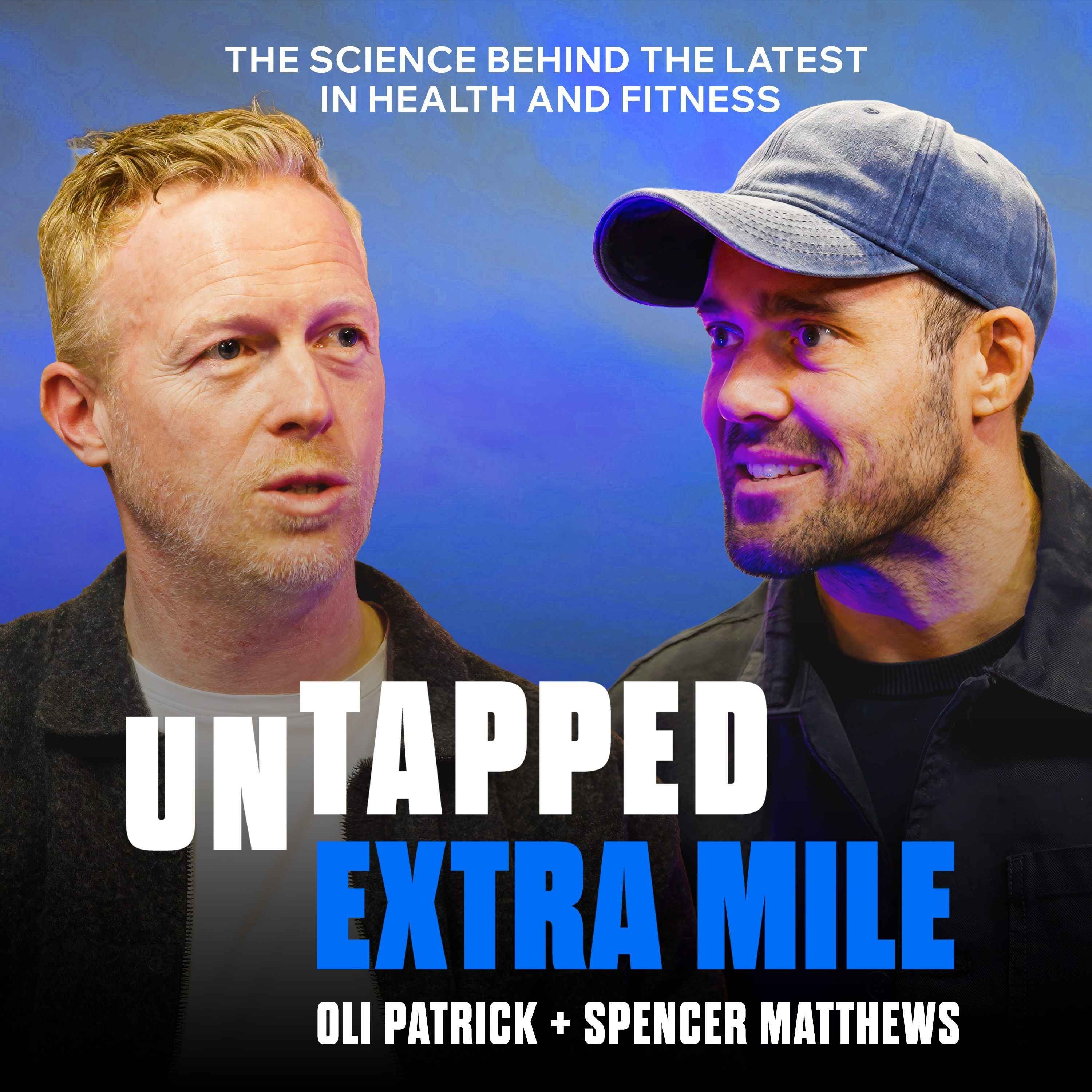
No named guests in the transcript. Hosts are Spencer Matthews and Oli Patrick.
“Lighter” isn’t automatically “faster”; performance depends on what tissue is lost (fat vs muscle/functional lean tissue). GLP-1s don’t “melt fat” directly; they reduce appetite/food noise via slower gut emptying, brain craving effects, and improved glucose handling, making calorie deficits more likely. Inadequate fueling and insufficient resistance training during deficits can increase lean-tissue loss and weaken training adaptations, especially over age ~35. For runners, chasing weight loss while trying to get faster is a mismatch; better to prioritize training/nourishment and let weight change follow.
Elite marathoners are typically lean (ectomorph-like), while mesomorphs may struggle to become marathon-elite due to needing to lose more “unnecessary” mass. The hosts discuss a personal example of losing ~5 kg (shoulders/arms) and feeling able to sustain faster paces longer. They also cite “reds”/RED-S energy deficiency concerns (menstrual disruption, bone/fracture risk) from aggressive calorie restriction.
Written by AI. May contain mistakes.
Discussing the perception that being lighter leads to faster running.
“means faster if you look at the kind of elite running pen in any marathon you'll notice that almost all, well, actually, not almost all, you'll notice that all runners are really light, really skinny, really lean.”
Analyzing the impact of GLP-1 drugs on weight loss and running performance.
“I think, you know, in general terms, that's not necessarily true.”
Exploring how weight loss affects muscle and performance in runners.
“there's an old story about the kid who carried the bull out to the garage.”
Examining the evolutionary challenges of weight loss and metabolic rates.
“What is going to take it from like things that you need?”
Explore how GLP-1 medications affect hunger and weight loss.
“It is a medication that was for people with type 2 diabetes.”
Discuss the impact of calorie deficits on weight loss and muscle retention.
“So like a nice steep calorie deficit, say you're having 1500 calories a day, 1800 calories a day, say.”
Analyze the relationship between weight management and running performance.
“I was about to say, let's bring it into running with some specific examples, which we can do together.”
Learn how calorie deficits affect running performance and muscle recovery.
“It then becomes quite difficult to adequately load for the strain that you need to put yourself under in your sessions to get faster.”
Understand the risks of relative energy deficiency in athletes and its consequences.
“like, and I think you don't really need to interfere too much with it, is the way I feel.”
Discuss the challenges of losing weight while trying to enhance athletic performance.
“And they're in such calorie deficiency that their body shuts down the menstrual cycle.”
Explore the implications of fasting on athletic performance and calorie intake.
“I'm out today you're in you are I'll wear the doctor's hat today alright well I'm not a doctor I'll be the doctor not a doctor I don't think people need to be told that I'm not a doctor I think they might know that.”
Acknowledge listener support and provide a closing note for the episode.
“People don't start to forget food is such a joyful, wonderful, social, grasso.”

Get the gist, explore an idea or ask about something said.
 Claude
On UNTAPPED with Spencer Matthews, what are the key points of this episode?
Searching your listeningAutomatic transcript. May contain errors.
0:00Therapy's biggest impact doesn't show up in some dramatic breakthrough. It shows up in the smallest moments. You bite your tongue instead of escalating. You put your phone down instead of firing off that text. You say what you actually mean instead of what would hurt someone else the most. Nobody applauds those moments, but they quietly change your life. That's what growing feels like. And that's exactly what Grow Therapy is here for. Grow is therapy that works, covered by insurance. Sessions average$21 with insurance, and some pay as little as$0, depending on their plan. There are no subscriptions, no long-term commitments.
0:37You just pay per session. Grow connects you with thousands of high-quality, licensed therapists across the U.S., offering both virtual and in-person sessions, nights and weekends. You can search by what matters, like insurance, specialty, identity, or availability. and you can book a therapy session in minutes and begin in as little as two days, not the national 48-day average. See if you could pay as little as$0 for therapy in seconds at growtherapy.com slash start now. That's growtherapy.com slash start now. growtherapy.com slash start now. Availability and coverage vary by state and insurance plan.
1:18If you felt stuck trying to lose weight, you're not alone. Enter Weight Loss by HERS. It's designed to support you in reaching your goals. And HERS now offers access to an affordable range of FDA-approved GLP-1 medications, including the WeGovi pill and the WeGovi pen. Even better, with a range of affordable GLP-1 options, HERS makes it simple to find an approach that fits your needs and your budget. If eligible, you'll get a treatment plan personalized to you and unlimited dosage changes as needed. It's weight loss designed to work with your life. Ready to reach your goals? Visit 4hers.com slash eligible to get personalized, affordable care that gets you.
1:56That's F-O-R-H-E-R-S dot com slash eligible. 4hers.com slash eligible. Weight loss by HERS is not available in all 50 states. Wegovi is the registered trademark of Novo Nordisk AS. To get started and learn more, including important safety information, Wegovi clinical study information, and restrictions, visit 4hers.com. Hello and welcome to Untap the Extra Mile with me Spencer Matthews and me Oli Patrick and today we're going to be talking about weight loss but specifically for runners whether or not lighter means faster if you look at the kind of elite running pen in any marathon you'll notice that almost all, well, actually, not almost all, you'll notice that all runners are really light, really skinny, really lean.
2:49So it's easy to understand how one might think, well, in order to be a fast runner, I need to be really lean and the lightest I can possibly be. I know that the general view certainly used to be that. Like my brother, who used to be quite a serious runner, and all his friends would say, you know, you need to be as light as you possibly can to be a fast marathoner. I think, you know, in general terms, that's not necessarily true. But with the rise of GLP-1 drugs, like Azenpec, Monjaro, Wigovi, Retitrutide, the question's even more relevant, I suppose. And I guess to kick stuff off, you know, if I were to just shed five kilos, and not have any impact on my fitness at all, would I run a faster 5k?
3:32It depends what we cut off you for five kilos. Is it a foot? We took off the old gammy foot. It depends what weight you lost and how you achieve that weight loss would probably be a more important question. One of the great challenges around any weight loss discussion is weight is a sort of amorphous concept. Someone says I lost five kilos. It's like, of what? So if you lost five kilograms... Call it fat. Well, in which case then, I would expect you to have a potentially higher athletic performance at five kilos lighter. In the same way as if I just put a five kilo backpack on you, I'd expect a decreased athletic performance.
4:13Well, that, like, I hate that argument. I don't hate that you've made the argument. I just, when people say, okay, I'm 90 kilos and I'm 80 kilos. So if you put on a 10 kilo pack and we race, then that will be fair. That's so stupid, right? Because nobody gains 10 kilos in a second. And so the rest of your body isn't tailored to taking on the weight. Obviously, if you gain 10 kilos over time, your entire body is used to packing on those additional kilos. And so it shouldn't have a vastly material impact on your running, although you probably would be slower, but not as slow as if you put on a 10 kilo vest.
4:54100%. And the body will adapt. there's an old story about the kid who carried the bull out to the garage. Remember this one? It's an old Greek fable. I can't say that I do. Basically, the kid carried the bull out to the shed to get fed. Carried him. Carried him. A baby bull. And then as the bull grew, so did the boy grow. And so suddenly you've got a man who can carry a bull. And that sort of general idea of incremental gains, progressive overload sort of ties into this. If I build any structure over time, I adapt to it. That's pretty interesting, actually. It's a lovely analogy. But you can't just pick up a bull.
5:28But I may buy Theodore a calf. Yes. And then just have him carry it every day. Because then one day, imagine just walking around carrying a cow. Yeah, it'd be incredible. Everyone would go, you're amazing. And if you could genuinely... Make a career of it. Build it alongside. There'd be a tipping point when you reach human capacity. But he would be an enormously strong young adolescent male. Yeah, so quite exciting. He'd be extraordinarily strong. He'd be a strapping 13-year-old. No, but imagine that, honestly. You would be extraordinarily strong. Far more so than any other 13-year-old. You could do it by just giving him a weight that got slightly heavier.
5:58It doesn't have to be an actual livestock. Just FYI. It just, that analogy from Greek mythology exists. But they're no best. Greeks were pretty good. All that being said, weight isn't a thing, right? So composition is a thing. And when we look at anybody's weight, we've got to say, they are made up of lean tissue and non-lean tissue, which is predominantly fat. So the question would always be, have they lost functional tissue? in which case you might expect a decrease in performance. But when we say lean tissue, that's also your organs, right? So your liver and your kidneys and it's also your connective tissue, fascia.
6:33Fascia is like the scaffolding that connects the human body, gives some of it its structural shape. It's got ligaments and tendons and you've got… No one's losing weight from their ligaments and fascia and stuff. What are you talking about? It could be. Obviously, like… No, you would do. You would lose. if you lost, if we took 10 kilograms, you mentioned in the intro, GLP-1 medications. So if we're seeing people losing 10 kilograms traditionally on a GLP-1 medication, of which Wagovia and Maljara are probably the two most used in the UK, both injectable. We've got oral versions now. It's quite interesting and exciting.
7:08So there is a pill. Going away from that, 25 % on average is lean tissue, right? And that's one of the great arguments about these drugs is that people are losing 2.5 kilograms for every 10 kilograms. And actually, that could be up to four kilograms. So maybe four kilograms of the 10 kilograms was lean tissue. And a portion of that would be skeletal muscle mass, not all of it, but a portion. And that might have been the bit of muscle that stored carbohydrate that I needed, or that might be the bit of muscle that protected my bone, or it might be the bit of muscle that stopped me tripping over when I hit my toe on the curb.
7:40It's like that tissue is such high value that to lose it means I'm probably, there's a great argument, am I less or more well, 10 kilograms lighter, but with two and a half or four kilograms less muscle? That is a great debate. Is the weight not just going to come from like your guts and your love handles? No. What is going to take it from like things that you need? It'll take it from things you need because fat is an extraordinarily important issue. Why weight loss is so difficult is it's against sort of every evolutionary logic. Rarely in human history was there a period of abundance where you could just eat until you literally can't stop eating.
8:17I mean, the Romans had vomitoriums. Well, those are. So that they could continue to eat. They were a niche pocket in history. I think if you go back to your Neanderthals, they would probably say that they couldn't have imagined that we'd become so decadent that we'd eat until we kept yakking and then keep going and then have an orgy. I mean, absolutely mad. And then watch people eat my lions. I mean, that Roman period was, of course, a lot of fun. it does sound like you know we could have had like a good time there at least good time but what you got then then you suddenly started to get diseases of excess um and that that was a new thing like obesity like obesity which is classified as a disease for many good reasons and principally the idea is historically we would have periods where there wasn't an abundance of nutrients so in periods if i put you into a calorie deficit be that through using a medication or through um changing dietary habits or movement habits your body is going to fight that because it thinks I've just dropped you off on a desert island and there's no food coming and it wants you to stay alive until I circle back around and pick you up in three months time how long do you think you could stay alive on a desert island do you think you would be efficient me as a but utterly 24 hours I'll be dead I reckon well that's not possible like a trying to kill yourself I'd eat like a stonefish or something there's no I've got nothing in the in the capability tank I've I can't change a plug I can't I've struggled with light bulbs you wouldn't have any I watched I I didn't have a light bulb or a plug on a desert island.
9:41But now I've been looking for them. That's the problem. Bella, who do you think lasts longer on a desert island? I'll tell you. It's 50-50, Bella. I'm going to put my foot in either way. I feel like Ollie will make really bright decisions about survival. Will he, though? He just said he'd swallow a stonefish. I think you overestimate me, Bella. The only advantage I've got over Spencer is I've got a higher body fat percentage. So if we were not to eat, you may last longer. But Spencer might try and eat you. I would that's the higher likelihood I think he would become a predator but quickly into the experience it was a terrible last moment for me and so body fat probably percentage is the advantage because for every we'd be eating like kings just so you know because I'd go out and hunt yeah but let's imagine we are unable to get resources fat tissue of course we talk about the calories in fat nine calories per gram that's also the energy I can dream from it so every nine you know every pound of fat I've got is is so dense this is a TV show by the way so we do need to pitch this people just fast forward to the end yeah yeah oh Ollie's gone I think but that principle so the body will preserve fat because it's its richest capability to stay alive so it will then waste if you think the reason we're burning calories now let's imagine we both burn 3000 calories and that's what often people call our metabolic rate so the rate of energy consumption and it's built from how much muscle I've got predominantly because muscle is what we call active tissue So if a kilogram of muscle might burn 50 to 70 calories, just sat there because it vibrates.
11:12It's like it's got muscle tremor. And so the more kilos of muscle I've got, the more I vibrate, the more energy I use at rest. And your basal metabolic rate is the calories you need to just to lie in bed all day effectively, to keep your organs functioning, your brain working, your blood circulating. Then you add on top of that, like twitching and nervous energy, and you add a sort of, you know, non-movement-based calorie burning, and then you add movement-based calorie burning, and that's your 3 ,000. if your body's going well i've basically got no food so you're only eating 300 calories you're finding some berries and nuts and seeds it's got to get your 3 000 calories down or you're going to eat it too quickly so it will waste the tissue that burns you calories of course it will so if i take a kilogram of muscle that basal metabolic rate suddenly drops down by 50 calories a day and now i'm only burning 2950 calories the next day so you've got to eat yourself effectively to save yourself.
12:06And so in periods of starvation, the body is going to try and decrease its metabolic rates, which is why there's always been this great challenge that people end up in cyclical dieting, that they go into a calorie deficit, they do not then increase physical activity, and they certainly don't try, and again, this is broad speaking, they don't do enough resistance training to disable the body's ability to take muscle tissue as its primary fuel. And that's why we're seeing this sort of really confused backlash over glp1 medications weight loss to lose weight in the absence of resistance training makes it really challenging certainly over the age of 35 when these systems are a bit more fragile to for your body to to end up more well for the weight loss so your waist muscle tissue because it's the reason you're going to ultimately pass away is the calories it's demanding so you get rid of the hungry mouths first effectively interesting
12:58Therapy's biggest impact doesn't show up in some dramatic breakthrough. It shows up in the smallest moments. You bite your tongue instead of escalating. You put your phone down instead of firing off that text. You say what you actually mean instead of what would hurt someone else the most. Nobody applauds those moments, but they quietly change your life. That's what growing feels like. And that's exactly what Grow Therapy is here for. Grow is therapy that works, covered by insurance. Sessions average$21 with insurance and some pay as little as$0 depending on their plan. There are no subscriptions, no long-term commitments.
13:36You just pay per session. Grow connects you with thousands of high-quality licensed therapists across the U.S. offering both virtual and in-person sessions, nights and weekends. You can search by what matters, like insurance, specialty, identity, or availability. And you can book a therapy session in minutes and begin in as little as two days, not the national 48-day average. See if you could pay as little as$0 for therapy in seconds at growtherapy.com slash start now. That's growtherapy.com slash start now. growtherapy.com slash start now. Availability and coverage vary by state and insurance plan.
14:17If you felt stuck trying to lose weight, you're not alone. Enter Weight Loss by HERS. It's designed to support you in reaching your goals. And HERS now offers access to an affordable range of FDA-approved GLP-1 medications, including the WeGovi pill and the WeGovi pen. Even better, with a range of affordable GLP-1 options, HERS makes it simple to find an approach that fits your needs and your budget. If eligible, you'll get a treatment plan personalized to you and unlimited dosage changes as needed. It's weight loss designed to work with your life. Ready to reach your goals? Visit 4hers.com slash eligible to get personalized, affordable care that gets you.
14:54That's F-O-R-H-E-R-S dot com slash eligible. 4hers.com slash eligible. Weight loss by HERS is not available in all 50 states. Wegovi is the registered trademark of Novo Nordisk AS. To get started and learn more, including important safety information, Wegovi clinical study information, and restrictions, visit 4hers.com.
15:21but were you able to take glp1 and strength train and ensure that you're getting the calories that you should have whilst remaining in a slight deficit then you would lose weight effectively would you not theoretically and then then you're being the question of again is there adequate protein so then but but sorry to interrupt but sorry it's essentially these things curb your your desire to eat to excess, really. So the GLP-1 doesn't lose you weight. It is a medication that was for people with type 2 diabetes. It suppresses or it produces or mimics a hormone your gut produces that stops you feeling full.
16:02So it makes you feel full. For example, as I understand it, if it's the middle of the afternoon, maybe I fancy a snack, and I open the fridge, and all of a sudden, that snack turns into a thousand calories, right? Because I have like a tub of hummus and a thing of ham and a thing of chocolate. And all of a sudden I've had like, what feels like a snack is actually a meal. And you do that on top of breakfast, lunch and dinner. And maybe you do that twice a day. So all of a sudden you're like, if you don't use me as an example, because obviously I train a lot as well. But like, if you're the kind of person that sits in an office all day and you have those behaviors around food and you're a little bit overweight and you are eating in that way where you're not really tracking calories and you're in a calorie surplus, so you are above your desired body weight perhaps, if you were to take a GLP-1, you would have less desire to have those snacks and potentially even eat at all, as I understand it.
16:59I know quite a few people who take retitutide and bits and bobs and they sometimes have to remind themselves to eat. 100%. It's working on three mechanisms. One is that the actual hormone in the gut will slow how quickly food moves through your digestive tract. So that is a huge part of you feeling full for longer. It then also targets a part of the brain that craves food. We often call it food noise, this sort of constant underlying desire to go and eat when you're not really physiologically hungry. And that's got many triggers and many causes and is a really complicated thing to manage. I eat all the time when I'm not even hungry.
17:36Like I'll have a meal when I'm not that hungry. Yeah, and that food noise for some people who, again, aren't able to be as active or have got other challenges is a disaster. So it targets that directly in the brain. And then the third thing is it increases your cell's sensitivity to glucose, which can stabilize how much sugar is in your bloodstream. And that level being nice and stable can also stop you craving the wrong foods or making, I suppose, impulsive food decisions. So all of that points to that you are probably on these foods going to enter a calorie deficit. so they don't the drugs don't melt away fat or melt away you know weight they just make it more likely that from previously eating 3 000 calories a day you're now going to eat it might be 2 500 it might be 2 000 and we're always trying to make sure that gap isn't so big probably less or maybe less but but again challenge it depends on the dosage and that that's down to the prescribing you know team to get that right what that what you will lose then will depend on many many factors so if I'm in a calorie deficit, I will lose weight.
18:32That's the science of human physiology. And as much as people want to think that weight has a hormonal trigger or weight has emotional components, all of these play into it. It's one of the most complicated maps you'll ever see is the science of obesity. There's more factors that go into weight than almost any other thing in human health. But if you're 1000 calories down in terms of you eat 2000 calories and you burn 3000, thousand you will lose weight that's unequivocal just whether where it comes from which way is how active you are and how many how many weights you lift can you keep muscle mass by just using your body weight so like say you were in a controlled calorie deficit take glp1s out of the equation for a second just say yeah you know it's the good old days where if you look you're looking to lose weight you have to do it yourself yeah you you can't have any assistance for your own mental resilience when it comes to i'm hungry i'm not going to eat right so you have to do it all yourself say you are in a calorie deficit of call it a thousand calories a day.
19:31So like a nice steep calorie deficit, say you're having 1500 calories a day, 1800 calories a day, say. You're going to lose a lot of weight if you sustain that for call it two weeks, you're going to lose a lot of weight. If you were to do lots of press-ups, say just as like a, as a simple way of kind of remaining active and maintaining muscle mass, would your muscles waste away if they were active in that way? Or do you need to be doing reps in a gym? Do you need to be strength training? Or can you keep most of it with, call it like 200 push-ups a day, a lot of push-ups, like putting your body under relatively significant strain for a normal person?
20:19Yeah, I think the first point would be the steeper the calorie deficit, the less likely you are to be able to hang on to that tissue because your body has got to get its metabolic rate down. So historically, people won't want much more than a 500, 300 calorie deficit because A, that's unlikely to be sustainable. B, it's such a dramatic shock to the body that it's going to really struggle to access that whole calorie deficit just from fat tissue alone. So there's this sort of, if you want to lose loads of weight rapidly, it's almost impossible that you won't lose some lean tissue in that bracket.
20:49second question would be how old is this individual so if that's a 22 year old or a 52 year old that that muscle tissue can be much harder to keep after you know we move into um less testosterone less growth hormone you know a slightly aged physiology the the question then would be we're all over resourced right so if i'm going to cling on if i'm not going to lose a kilogram of muscle and let's imagine i've got 41 kilograms of skeletal muscle mass which is not is pretty much what i have got so if i do a body composition analysis and it breaks me down into lean tissue and non lean tissue, I can then take the lean tissue and work out skeletal muscle mass, I've got 41 kilograms of skeletal muscle mass.
21:25The question would be, if I do those push ups, did I use 41 kilograms of skeletal muscle mass? Or did I use 38? If you use 38, I can't complain if I lose a kilogram, if I use 35. So if you don't utilize the full capacity of the machine, you can't argue when someone skims off the top. If you said, you know, I've got to make some people redundant, I've got 100 people in this team, 100 people in this team. And they're like, well, we can't possibly touch this team. 90 of them are really busy. You're like, well, can we get rid of 10 of them then? And that is the way the body operates. It's like, and so it would be protein quality, age, there'd be, again, some genetic components to that, there'd be how stressed that individual is.
22:02So when we're in a higher stress environment, the body can go into more of a catabolic state, which we call where we would be more prone to breaking down the wrong tissues and keeping fat. So if stress hormone's high, I'm going to lean more into muscle tissue. So it's a great question, but I would say if you were a runner... I was about to say, let's bring it into running with some specific examples, which we can do together. Yeah, and I think if you said, I want to lose some weight, and of course, you're right. So your first point here today was on the start line of an elite race, the somatotype or morphology, you can sort of look at these different technical words of saying the shape of people looks pretty similar.
22:41They're probably at the lower end of a body mass index scale. If we take biological males and start with them, they're probably going to be single digit body fat. So the body fats might be in that range, you know, sort of 8%, you know, 6 to 8%. They won't be carrying tons of excessive musculature. So when we look at somatotype, that's sort of almost the different shapes of someone. And you have a mesomorph, which you're an interesting one because you're quite mesomorphic, broad shoulders, lats, good muscle mass. Someone who's very skinny would be an ectomorph and was sort of, you know, it hasn't got that big latissimus dorsi.
23:17They haven't got the triangle shape. And then you've got... Well, I think that only comes from, like, that's, you could argue that it's genetic, but it's not really. If you look at other people in my family, like, I have, I suppose, broader shoulders than other people in my family because I've lifted weights three times a week for 13 years, right? So, like, my... So, you've built it. It's not genetic. I've kind of, like, my brother's not built like me. Neither is my dad. You know, it's kind of, you look at some families like the Stoltman brothers. you guys are beasts and I'm not suggesting that I'm in any way carrying as much muscle load as they are but I'm noticing changes with my running obviously as I approach like a fast goal at the end of the year I've actively stopped lifting weights basically, I no longer go to the gym I might go once or twice a week maybe, but it's like 45 minutes 50 minutes here or there it's not these big lifts that I was doing before, it's like vanity shit you know it's just to hold on to the odd thing so that i don't look like a squid on holiday you know yeah yeah and um and it's sort of it's kind of uh i i've lost a lot of upper body muscle and strength in exchange for becoming a faster better runner which is exactly what i wanted to do so i'm not like suggesting that that people, I'm sure there's many runners out there who have tremendous upper body strength who are much faster than me.
24:44I'm just saying for me, I could feel that my upper body, the volume of muscle in my upper body and my upper body strength was mechanically slowing me down, not necessarily the weight of it. Just I could feel in long sessions that my back would feel the strain of, you know muscles moving around because yeah i'd gone a fast-ish long run and i'd have aches in my back and i'm not carrying a backpack or anything and again i'm not suggesting i've got you know a massive bag but you're carrying you're carrying a lot of excess weight right i'm probably five kilos lighter than i was in tokyo a lot of that is my shoulders arms like i'm a lot i'm quite a lot skinnier i'm not like much lighter because my legs for example are the same as they were because it's lots of running, lots of volume.
25:39So I don't know. It's kind of... But that's relevant. I think it does make sense to not necessarily lose fat. I don't feel any skinnier than I was in Tokyo. I was probably actually arguably in a physiologically better shape. Like I was more tonally ripped in Tokyo at five kilos heavier. But it's much easier for me to sustain faster paces for longer now that I'm not carrying this extra five keys of muscle. 100%. And that's such a great example because that's unnecessary tissue to the task you're trying to perform. We've raved about one of our favorite parameters in physiology, VO2 max before. Delightful.
26:19We love it. We love your value. We love physiology full stop. Yeah. This is like the cherry on the physiology cake. So VO2 max is milliliters of oxygen per kilogram per minute. So of course, if you lose four or five kilograms of skeletal muscle mass lean tissue, that is more available blood and oxygen for the remaining tissue. So there is a clear logic to weight management for those involved in aerobic sport. And we come back to the Stoltman brothers, you know, Tom weighs 180 kilograms. And so he can't be an aerobic athlete and therefore he can't be an elite level runner. And so there's a genetic component that some of us are born with this mesomorphic shoulder frame, which puts you into power sports or big lifting.
27:04Some are born with a more ectomorph physique. And we can even look at the propensity to having more slow twitch muscle fibers and more fast twitch muscle fibers, these different types of muscle that combust energy at different rates. Your guys at the start line of an elite marathon will have had probably the born somatotype of being skinny or ectomorphs. They will then have lent into that with, I suppose they've tilted their training towards that. But it's going to be very difficult for a mesomorph to lose their weight to the point where they are on the start line of a marathon with a chance to win it.
27:37It doesn't mean they can't be a 250 marathon runner. What I find interesting, and just again to bring it back to running, is runners that try to lose weight to get faster fail usually, right? So it's quite difficult. And I've been there before. It's quite difficult to, when you focus on the weight loss, you put yourself in a calorie deficit, however you want to do that, whether you use GLP-1s or not. It then becomes quite difficult to adequately load for the strain that you need to put yourself under in your sessions to get faster. So you inherently, when you're in a calorie deficit, feel weak or weaker, shall I say.
28:17I mean, I'm sure it's possible to go about your daily life in a calorie deficit. I've done that many times. When I was in a big calorie deficit, I tried to run a pretty straightforward session. I think it was 4K at four minute Ks, which I just held for a marathon, right? It was four singular Ks with floats in between. And I bonked in the end of the first or the second K. I couldn't do 2K at a pace that I can hold for a full marathon, right? So it's kind of, that was like a real eye-opener of, okay, I'm just going to ditch this losing weight thing. I'm just going to stick to like loading up on food and running lots and building, you know, tons of miles in the legs and focusing on the sessions.
28:56Because actually, I don't think that these three kilos are holding me up much trying to lose them is, you know, I think I think that's the best summary. Because, you know, we spoke on that carbohydrate lesson that you might need 10 grams of carbs per kilogram body weight to achieve these tasks. Well, if that's 70 kilograms, you know, in terms of your weight, that's 700 grams of carbs, that's two and a half thousand calories before you move to the two grams of protein per kilogram to optimize your because you're doing resistance training to avoid the injury and then you've got to have the fats for so so you know what who's in a calorie deficit at three and a half thousand four thousand calories and you'll go to any good quality sports nutritionist and they'll be much more interested that you are fueled and nourished than you are losing that extra two kilograms of weight but i I also think that if your body will be dictated by your goals and your behavior, like, and I think you don't really need to interfere too much with it, is the way I feel.
29:55I totally love that. It's sort of like my friends who are elite marathoners are all really skinny, but they also run 160K a week, right? And they eat a lot, but their body has chucked off a lot of their muscle and has responded to the fact that this guy doesn't lift weights. He only runs. So I probably don't need big shoulders. And it just handles it all itself. I think that the focus on weight loss to get faster, in my opinion, doesn't really stand. Like, I'm sure that if you did it in the perfect way, then great. But it's way more complicated than it looks. And I think that if you want, you know, if it happens to be that chasing a really fast, If you're chasing a 230 marathon, a 220 marathon, you're going to get skinny.
30:44Because you are not going to be able to do the training and lift heavy weights and be in a deficit. Your body will respond to the training you need to do to hit the time. So I just wouldn't bother overthinking it at all. When we started, the idea of carrying a calf every day, your body changes to the environment it finds itself operating in. If you are combusting energy over an hour, hour and a half on a regular basis, your somatotype will adjust to that and the great danger is pursuing weight loss when your body needs to be nourished and i think we had dr hazel wallace on here not that long ago talking about the female menstrual cycle she mentioned a phrase which is reds which is relative energy deficiency syndrome where we're seeing a lot of biological females carbohydrate restricting you know really trying to cut weight and that might be also driven by the by the hybrid boom where you've got to be strong so you'll be doing the strength training and you're doing the endurance and trying to have an aesthetic that is very lean.
31:41And they're in such calorie deficiency that their body shuts down the menstrual cycle. They then have huge challenges, as would males in similar situations with bone structure and avoiding fractures. And the body is fragile in an energy deficit. Rarely does someone go, I feel amazing on this 500, 600 calorie deficit and my bones feel strong and my muscles feel strong, it can be a means to an end. I think your point there again is you focus on the nourishment for the event and you do the training and the nourishment to get you there. In many cases, that will lead to a natural weight loss as a derivative.
32:18But if weight loss is the target while trying to increase performance, those two things are really difficult bedfellows. Well, they're both a challenge. Both a challenge. So it's kind of you're chasing two challenges all of a sudden. You're on fire today with these. no but it's true it's like they're both a challenge if you want to lose weight and you want to get faster good luck you know one is a very difficult thing to do on its own and so is the other thing so for one thing you need the fuel for the other you don't so immediately you've got a big mismatch one has to go I'm out today you're in you are I'll wear the doctor's hat today alright well I'm not a doctor I'll be the doctor not a doctor I don't think people need to be told that I'm not a doctor I think they might know that.
33:01They need to know I'm not a doctor. Come in. I'm a doctor. I'm a physiologist. But you have stepped in. I am nothing. You are everything. Your perspective today is 100 % spot on, as it always is. It's not always, actually. Usually I sit and listen to you, but I'm quite happy to be able to contribute today. I think that's... But the lived experience is right. And you accepting the loss of muscle mass in pursuit of the goal is also a really valid piece. It's going to be really difficult to be over-resourced with muscle when you simply do not need it. A possible exception to this could be a degree of fasting as long as you're getting your calories.
33:39So fasting is just another mechanism of changing calorie intake. In my experience, though, if you do limit your eating window, again, it's difficult to perform at the highest level because you can't always plan your sessions. So if your session happens to be at a time when you're at your hungriest, it's probably not going to be helpful. if you're the kind of person that really can plan everything in advance having a smaller eating window so being fasted and you know lifting your weights and training around a certain time and potentially you know running you know two hours after you've eaten or like in that perfect window and then you know you you you reload on that last meal and then give yourself more fasting there's a chance your energy could remain like high there's a chance you could lose the weight there's a chance you could perform i i just think that becomes that's in my opinion from a physiological perspective, possible, but very hard?
34:30I think fasting, if I'm on a GLPY, if I'm on Wagovi, Same thing, really. I'm reducing my calorie intake. Fasting, as much as we want to believe, there are some magical components to it. And I think there's some interesting stuff about fasting. If I'm a rat, I'm all into fasting because, you know, I'm going to live forever if I'm a rat. Humans aren't rats. And so we don't know. It's good to know. It's great to know. So hang on a sec. Rats literally - Humans aren't rats. We're not. Okay. So we have a different DNA. But people often assume if it works in a rat, it'll work in a human. And the truth of that is it's not entirely true.
35:03So fasting is another mechanism of reducing total calorie intake as the same way a GLP-1 or one of these GLP-1 or when medicated weight losses would, as is better eating slightly more vegetables in a meal and reducing my refined carbohydrate. The difference being, though, when you're fasting properly, you are hungry. So that's the difference. and you can snack in the window. You'd be hungry. And again, that's a trainable response. But the great challenge with fasting is, you know, I will enter my event glycogen with potentially lower blood glucose. And the theory, of course, with fasted running, which we've touched on before, is that I would burn a higher percentage of fat, assuming I'm running zone two, you know, below zone three, because I don't want to be using carbohydrate when I haven't eaten.
35:49So it works potentially well with your easy recovery run and you'll burn a slightly higher percentage of fat maybe. But principally, what we find is it doesn't make a huge effect that there's any statistical impact on overall weight loss from training fasted versus training fed. And if I was looking after someone, I'd want them trained fed and I'd want them with a really lovely relationship with feeding. And just in all of this, you've got to be so careful. People don't start to forget food is such a joyful, wonderful, social, grasso. Oh, grassy. I'm going to grassy on Friday. Mozzarella sticks for the wife's birthday.
36:27Possibly a margarita or two in there as well. And I don't mean the pizza. Right. You heard it here first. If your goal is to try to lose weight on purpose to achieve a time or a running goal, our advice would be to just focus on the running goal and the weight loss will potentially follow. It may not even, but like, I think it doesn't, it doesn't, it could would materially negatively impact your running, whereas remaining at the weight that you are and becoming a better runner will probably do the opposite. So special shout out to the taxi driver who pulled over in central London, wound down the window and said he loves, loves our podcast.
37:06Thank you. We love you. With no regard to the laws of the road. You had someone in the back of the car, so whoever's in the back of the car, hopefully they're a listener too. Yes, please. And if not, hopefully you converted them. Whilst we're patting ourselves on the back. We had a tremendous amount of support from the good people at the Berlin Marathon. I can't tell you how many people from all over the world. I genuinely mean this. Toronto, Singapore, Japan, Italy, Spain, Berlin, of course, like Brits, all just saying how much they enjoy the show. So to you guys and to everyone, in fact, who ran the Berlin Marathon, good luck, God bless, and we'll catch you next week.
37:51a a
If you lose 5kg, does that make you a better runner?
Not necessarily. Spencer Matthews and Oli Patrick unpack why what you lose matters more than how much, and why dropping body weight doesn't automatically translate into better performance.
For runners, trying to get lighter while trying to get faster can mean chasing two competing goals. From losing muscle and under-fuelling to the rise of GLP-1 drugs, this episode asks a more important question: are you losing weight, or are you losing what you need to run well?
Hosted on Acast. See acast.com/privacy for more information.