Ask ChatGPT
 UNTAPPED with Spencer Matthews
23 Apr 2026 · 27m · 13 chapters
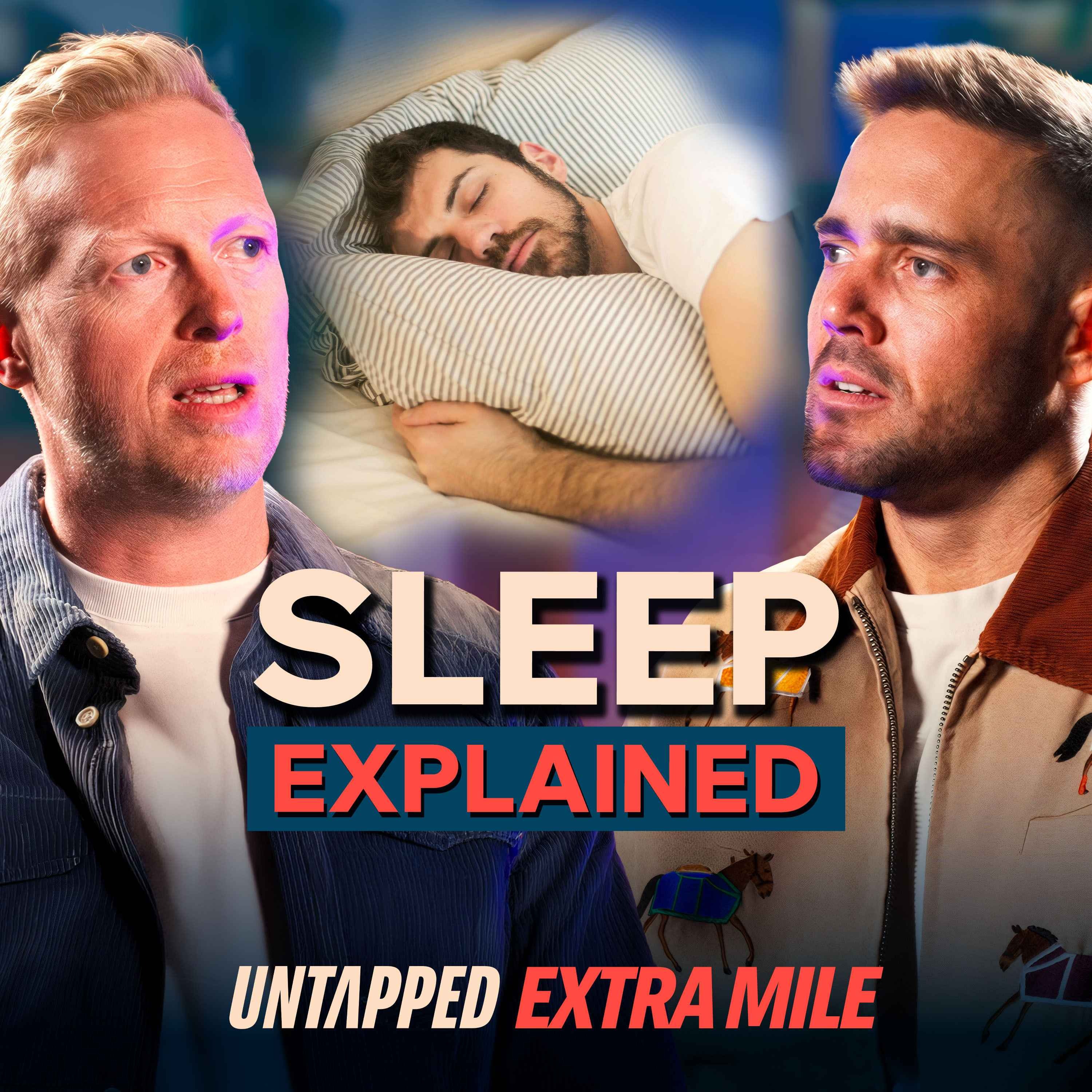
Sleep and recovery—what biologically happens during sleep, why it’s essential for brain health and performance, how much sleep to aim for, and how to improve sleep using tech and supplements.
Spencer Matthews and Oli Patrick (hosts). No other guest is interviewed in the provided transcript; they reference prior guest Lucy Charles Barkley (female world champion Ironman-distance triathlete, data-driven, sleep-obsessed, uses wearables).
Sleep is an active biological process (glymphatic clearance of brain “debris” like adenosine byproducts), supports immune regulation, growth hormone, and memory consolidation. Less than ~6 hours sharply increases risk for dementia/Alzheimer’s. Aim for 7–9 hours (often 7 hours). Sleep cycles (90–120 minutes) include non-REM stages 1–4 (deep/slow-wave) and REM (emotional processing; “mini trauma therapy” theory).
Mark Wahlberg’s 2–4am training schedule as “counterintuitive”; alcohol fragments sleep and reduces REM/deep; cooling mattresses (e.g., Eight Sleep) claim 40–50 minutes more deep sleep; magnesium glycinate “yay,” melatonin “yay” mainly for travel/time-shifting; morning light boxes/10,000 lux for seasonal mood issues.
Written by AI. May contain mistakes.
Discussion about Lucy Charles Barkley and her data-driven approach to training and sleep.
“She trains like something you can barely imagine, right?”
Exploration of sleep's critical role in health and productivity.
“And that's partly because we understand it a bit more.”
Detailed look into what happens in the body and brain during sleep.
“that can't take place when we're awake, right?”
Understanding how adenosine builds up and influences sleep pressure.
“It's part of our bodies having this natural circadian rhythm.”
Advice on how much sleep individuals should aim for each night.
“I don't know if I can clear the hydrogen ions, and I can slowly feel my glycogen stores depleting.”
Overview of different types of sleep and their physiological benefits.
“But I'll also fall asleep for a different mechanism that I've got this 24-hour circadian rhythm, which is basically my connection with light and dark driven by two hormones, cortisol and melatonin.”
Learn about different sleep stages and their importance.
“I think everybody is aware of the certain brackets of sleep, right?”
Explore the significance of each sleep stage and their functions.
“So we've got non-REM sleep, which can transition between stage one, where I'm lying asleep, and you next to me whisper in my ear, Ollie, are you awake?”
Understand how to assess sleep quality beyond wearable metrics.
“And really, one of the theories with REM sleep is we are doing sort of mini versions of trauma therapy, because I detach the replayed behavior from the emotion I felt while it took place.”
Examine the negative effects of alcohol on sleep patterns.
“So we're just going to be careful that we don't measure sleep before we fix the reason someone's sleeping well.”
Discover how technology can aid in improving sleep quality.
“So for good quality sleep for you and I tonight, we need to drop our core temperature, the temperature inside of us by about a degree.”
Learn effective lifestyle changes to enhance sleep quality.
“What about these light boxes that I'm hearing about?”
Learn practical tips for improving sleep quality, including lifestyle changes.
“And I find that most individuals using those sense a better appreciation of daytime energy than those who start in the dark and finish in the dark, which is not something we're designed to do.”

Get the gist, explore an idea or ask about something said.
 Claude
On UNTAPPED with Spencer Matthews, what are the key points of this episode?
Searching your listeningAutomatic transcript. May contain errors.
0:00Your daily supplement routine doesn't need to be managing a handful of different bottles. Onnit's Total Human brings key research-based vitamins, minerals, herbs, and amino acids together in convenient day and night packs, one all-in-one product designed to make supplementation easier. The day pack supports cognition, focus, and cellular energy production. At night, the night pack helps you wind down and supports a calm, relaxed state. Less time managing your supplements, more support for your day and night. Shop Total Human now at onnit.com. Thumbtack presents Uncertainty Strikes. I was surrounded.
0:39The aisle and the options were closing in. There were paint rollers, satin and matte finish, angle brushes, and natural bristles. There were too many choices. What if I never got my living room painted? What if I couldn't figure out what type of paint to use? What if I just used Thumbtack? I can hire a top-rated pro that knows everything about interior paint. Easily compare prices and read reviews. Thumbtack knows homes. Download the app today. Quick question. When was the last time a display ad changed your mind? Now think about the last time a friend told you about something they loved. Different feeling, right?
1:14That's how podcast advertising works. A host who's built real trust with their audience talks about your brand in their own words, in their own voice. It doesn't interrupt the experience. It's part of it. With Acast, you can access the world's largest podcast marketplace. Choose the right shows, the right audiences, the right format. Then watch the data tell you it worked. You're not buying impressions. You're buying influence. Learn more by visiting acast.com slash advertise.
1:50Hello and welcome to Untapped, the extra mile with me, Spencer Matthews. And me, Oli Patrick. Hi, it'll never get old. I love it. I love it. I love it. I love these. It's great. We recently had Lucy Charles Barkley on the show. She is an athlete of biblical proportions. She's the female world champion Ironman distance triathlete. She trains like something you can barely imagine, right? It's just an incredibly full-on training schedule that she loves. She is incredibly data-driven. She loves her data. She loves her wearables. Sleep-obsessed, as most of the extraordinary athletes that we host in here are.
2:38Which brings us on to the topic of sleep. I think it would be interesting to really dive into sleep and recovery. But what really happens when you sleep? What is actually happening to your body? yeah nowadays i don't know anyone who's not really sleep obsessed and i actually think i'm gonna throw it out there right like being good at sleep is cool oh like i don't care if you're listening to this and you think it's lame like you're lame all right sleep sleep is cool okay i can't wait to show you my sleep scores i i've got a sense of them i think you might have shown me at some point have i already shown you they're belters not today but i love it i mean your your The point there again is sleep's become trendy.
3:21And that's partly because we understand it a bit more. It's always been a pretty critical thing in the fact that if you have average life expectancy with, I think, average sleep duration, you're sleeping for 26 years of your life. 26 years? 26 years. Imagine everything we could do with 26 years. And that's where your average CEO about 10 years ago was like, sleeping's for the week. Sleep when you're dead. And interestingly, there was a real sort of cannibalization of sleep that became popular. It was trendier to go, I'm in the 4am club or the 3am. You know, you had Mark Wahlberg and the gang getting up at 2am to do weights and burgers.
3:56Yeah, you've caught me in a bit of a... Again, I like Mark Wahlberg, right? I'm a fan of his acting. I like him as a person. Great watch collection, you know, or that cool guy, right? I like him. That schedule that he put out is bollocks. It's counterintuitive. Well, no, I'm saying it probably isn't real. well like i mean you know well like thinking about the look of how is he golfing at four in the morning like like what is he doing right i i i think the whole thing is like why there's a bigger like people ask me why about a lot of stuff why are you getting up at that time yeah everything is dark nobody's around like i'm sure that's great like if you if you were to say i wake up at three in the morning to have breakfast and you know lower my cortisol and like get in the zone and do a bit of red light therapy and read a book and lift some weights that's that's one thing yeah He's like leaving his gaff and going to the driving range and stuff.
4:48I know. Are they open? I can't speak for the LA opening hours of driving ranges, but I can tell you it's odd, right? And I'll tell you why it's odd. The reason we sleep is it's not rest. It's like a whole range of complicated biological processes that can't take place when we're awake, right? So the idea of sleep being just that time to recharge the batteries has been broadly sort of squashed because we can now look at the brain. We can, you know, look at brain imaging. We can look at neurotransmitter balance and all these things we couldn't do 50 years ago. And we thought, well, sleep is basically how I avoid being knackered.
5:24If you love sleeping, if you love staying in bed, then, you know, all of this sleep is excellent. It's good news, right? Whereas before it was kind of like, if you wake up late, you know, you're a loser. You should be working, right? That was kind of what I grew up with. Like, you know, early bird catches the worm. You know, all this stuff, which, you know, probably is true. I'm sure the early bird does catch the worm. You know, that's great. Tell me about these complicated things that happen when you sleep. It's vital. So one of the clearest things we know is if you don't sleep, your brain suffers maybe more than anything else.
5:53Alzheimer's, dementia. Really? Because one of the, yeah, massive, as in probably low sleep being the sort of, you know, right up there with excessive weight or low cardiovascular fitness. So every hour, less than six hours, there's a sort of sharp increase in risk of, yeah, suffering from, unfortunately, the probably most scary disease of all. And that's because your brain clears the debris and junk. There's a whole biological system called the glymphatic system. So it's basically all the debris that accrues in your brain during the day when it's active and solving problems. It all sort of gets rid of that debris.
6:24It's like a clearance system. So what debris accrues? Is it accrues? Is that what you said? Yeah, accrues. Actually, the most interesting debris. What are you laughing at, Simon? That was just a funny way of asking what accrues meant. Well, no, I know what it means, actually. I wasn't sure about it, that's all. I don't think you could see me laughing at the way you said that, but it was just quite funny. I know what accrues mean, actually. Okay. Thank you. You refer to debris. Debris sounds very full on. You know, I think debris. I think war zone. I think all kinds of stuff, right? So your brain produces what during the day that needs clearing?
6:57Most notably, something called adenosine. It's the buildup of the byproduct of energy expenditure. So as you and I expend energy through the course of the day, we actually use ATP, which you might have heard of, which is adenosine triphosphate. So this is the molecule of energy. and interestingly humans we've got enough stored energy for two seconds of activity and then everything that creates energy is how we glue that the energy that provided those two seconds back together so energy is like a little christmas cracker and you snap it in every cell of your body and then all the way in which we use oxygen glycogen all these things is gluing that the sort of end of the cracker back on and cracking it again how often does it crack oh i mean like billions of times a second but you've got you've got enough stores for two seconds of energy before you need to glue the ATP back together.
7:39So it snaps. It's part of our bodies having this natural circadian rhythm. Circadian meaning about a day in Latin. So people think it'd be something far more impressive than that. It is not. So Latin, all these Latin will be, ah, drive yourself to a better future. It means about a day circadian. About a day. And we've got an about a day clock in every cell of the body governed by a central part of the brain, the suprachiasmatic nucleus, the SCN. And that's watching light and dark and running a 24-hour clock. I'll get into that in a minute. But principally, when your body builds, the byproduct of being awake for like 16 hours, this adenosine fills up in your brain.
8:13It detects there's a volume of adenosine. That drives what's called sleep pressure, i.e. I feel a bit sleepy. And then as I sleep, I drain that adenosine levels back down, and I wake up in the morning, theoretically ready to cook again. How are you able to sleep with all of this in your head? Yeah, I mean, weirdly. No, I mean you. Me. Yeah, like when you know all of this. Yeah. do you not think about it sometimes? So when you're in bed, for example, and you're about to go to sleep, but I sometimes am like, I feel like I have a lot going on. So I can't sometimes switch off and just go to bed. And I just think, oh, I'm busy.
8:54You're going like, oh, I've got extraordinary levels of adenosine. How do I get rid of the adenosine? And I'm assuming that just creates It's this strange knock-on effect of scientific protocol that would drive me mad. I think it does a lot of people. I think I'm a simpler beast than many in terms of I don't over-ruminate on almost anything. I'll tell you where it is a problem. When you're exercising, you're like, oh, God, I've just moved into anaerobic combustion. I don't know if I can clear the hydrogen ions, and I can slowly feel my glycogen stores depleting. And the bloke next to you runs past you in flip-flops.
9:31He's like, oh, I can't wait to eat my KFC tonight. and you're like, I'd love to be free from the shackles of the knowledge of things that might be happening. That aside, the mind drives the body and the body also drives the mind. And from a sleep point of view, just come back to the things it does. So there would be, you know, eight, nine, ten biological processes like the glymphatic system clearing out, you know, some of the waste products of the day, like growth. You're not going to grow today, you'll grow tonight. You're not going to, you know, if you go to the gym and, you know, you've done some weights this morning, that will turn into gains tonight.
10:03Your immune system is going to regulate itself tonight when you are unconscious. Your memory, if you remember it in a week, is because you consolidate it tonight during your sleep. Really? Yeah. That's cool. Sleep is a really active process. Because my body is effectively under a sort of enforced state of paralysis, which is critical, right? So I don't act out my dreams. And because I'm unconscious, we assume it's a dormant process. What we now know is it's a very active process, and it's a whole load of things that just won't get done if I don't give it the space to get them done. And what is the space?
10:34So what is the ideal level of sleep required? I'm sure it probably is varied and different for different people. But like, what should our listeners be aiming for every single night sleep wise? Seven. Seven hours. The range is seven to nine. That's sort of the World Health Organization. And the principle there, you know, so someone averaged out eight, which gave a lot of people sleep guilt. I'm never get eight. But you know, it's actually seven to nine. Most people don't sleep because they don't give it enough time. They don't give it the seven hours that it needs. In fact, average sleep in the UK, I think, is like 628 or something like that, which means most people are sleeping less than they need.
11:13Are you saying that they don't prioritize it enough and therefore just don't do it? If you take an elite athlete, you've met and spoken to so many, and you yourself are training in an elite way, whether you like it or not, you are. And the reality is there is no one in that space who doesn't prioritize sleep, who doesn't see it as absolutely equal, if not greater, to nutritional choices and movement choices. because they've understood all of the effort I put in in the day will only manifest if I get it right tonight. So if you did a brilliant weight training session today and you decided to stay up late for no reason, doom scrolling, and you again had had a glass of alcohol, which you wouldn't, but again, these things all take place, and you cannibalize tonight's sleep, the gains from that session are broadly gone.
11:55It's so interesting to hear it that way, and I think that's such a good takeaway for the listener because I think ordinarily people will see the gains and the progress taking place in the gym, right? So they'll think, I've done my weights today. I've done my run. I'm going to enjoy a bottle of wine with my wife tonight and we might stay up and watch Sky and whatever else. To people who sleep badly, what could they be doing better to sleep better? I go, well, we're going to fall asleep for two reasons tonight. The first one is if I'm awake for 16 hours, that adenosine will build up in my brain and that will create a sense of my body's going to try and shut me down so it can drain the adenosine levels out.
12:31We call that sleep pressure. But I'll also fall asleep for a different mechanism that I've got this 24-hour circadian rhythm, which is basically my connection with light and dark driven by two hormones, cortisol and melatonin. So what time did you wake up this morning? 6.30. Beautiful. So if your body knows that it generally wakes up at 6.30, two and a half, three hours before that, your body will go, well, Spencer's going to wake up in two and a half, three hours. I'll start producing cortisol because cortisol is going to help wake him up. Stress hormone. Yeah. good for you. Good for you. Yeah, the worst rebrand ever.
13:03Imagine being so good for humanity and someone calls you the stress hormone. Cortisol and dopamine sort of go hand in hand, don't they? Do they not? Like where there's dopamine, there is cortisol or is that not necessarily true? I know that if you're drinking alcohol and smoking cigarettes and doing things that would be considered bad, there will be cortisol. If you're doing ice bathing, there won't be cortisol. I think that's the whole point, isn't it, of putting your body through a big, big dopamine release without the kind of stress hormone attaching to it when ice bathing. Is that correct?
13:34Partly correct. They're often found in the same scenarios. So scenarios that induce excessive physiological stress would also potentially induce dopamine as part of that pleasure. Cortisol, we hypothesize that about a lot. Its main job is to regulate your biological rhythm. You woke up at 6.30 this morning partly because as, you know, from 4am, your body was making more cortisol, then you woke up, then hopefully you saw some natural sunlight and cortisol continue to rise. I think everybody is aware of the certain brackets of sleep, right? So we all have, you know, people who wear wearables are aware of deep sleep, rapid eye movement sleep, you know, REM sleep, deep sleep, awake time, light sleep, you know, what are the different, firstly, kind of chapters, if you will, of sleep?
14:25When do they usually occur? how much of each do you need and what are the benefits of each? Yeah, so there's generally two types of sleep. So as soon as I fall asleep, I've got non-REM and REM.
14:56theanine, and Hooperzine A to support focus and memory, and it's caffeine-free. So when you're deep in the work, AlphaBrain helps support enhanced productivity and tune-out distractions. Get focused on what matters. Shop AlphaBrain now at onnit.com. That sound could mean a lot of things. And when something's going wrong at home, the hardest part can be figuring out what the problem actually is. at thumbtack you can upload a voice message or a photo and our ai powered search will help diagnose your project plus the pros we know have over 14 million five-star reviews so you can hire with confidence thumbtack we know homes hire the right pro today with the american express platinum card i can unlock experiences like no other since i'm always booking my next trip I love that I can earn points on travel.
15:51Plus, I get a resi benefit, so you know I'm hitting the restaurants everyone's talking about. And you can find out your welcome offer after you apply, which could be as high as 175 ,000 points. For experiences like no other, there's nothing like platinum. Learn more at americanexpress.com slash explore dash platinum. Terms apply.
16:15so every non-REM will be classed by how slow my brain waves become and the slower my brain waves is classified as stage one stage two stage three or stage four and the stage threes and fours and they're sort of debated are slow wave sleep which are colloquially called deep sleep so deep sleep and slow wave sleep that's like the place is burning down you've got no idea type thing yeah which is which is super super important you say that you're sort of you're you're disconnected from the world in deep sleep. So we've got non-REM sleep, which can transition between stage one, where I'm lying asleep, and you next to me whisper in my ear, Ollie, are you awake?
16:48And I go, yes. But I wasn't, actually, Spencer. What I could say is, no, I was actually in non-REM stage one. Thanks for ruining it for me. All I can think about is being in bed with you. I was planted the seed. Yeah. Let's see whether the harvest is reaped. Oh, yeah. You say, Ollie, are you awake? Yes, I am. Oh, I didn't actually realize you were here, Oli, but yeah, okay, good, good. I'm glad. I snuck in. So, non-REM stage one, two, I like sleep. And then as the brain slows itself down, you go into stage three and four, deep sleep. And that is really the process where all the biological repair takes place.
17:25That's where the toolkit comes out. That's where the memory consolidation comes out. It's where the immune regulation comes out. It's where your body has got highest levels of melatonin, theoretically, which is the hormone that helps transition you into sleep. and it's where growth hormone gets produced. It's the good stuff. And fundamentally, we never stay in one stage. We go through these sleep cycles, which can be sort of, you know, 90 to 120 minutes long. It sort of varies. And we'll get a bit of all of them in. So we'll get a bit of light sleep. We'll get a bit of deep. We'll get a bit of REM.
17:52And then we'll wake up briefly to sort of change posture and position and go back through another. But what we historically see is we see more, you know, deep sleep in the early stages of sleep and then increasing volumes of REM sleep, rapid eye movement in the later stage and REM sleep is different in the fact that I will see rapid eye movements if you look to my eyelids they're all darting around the place as my brain is extremely active and effectively it's doing an awful lot of emotional processing so in REM sleep I'm going had a lovely day with Spencer today we joked about sleeping together but you know I'm not sure if I really want to pursue that and so I will be I'll be consolidating why not just playing out the dream so I'll be dreaming and I'll be playing in what I what I emotionally accept and what I don't.
18:36And really, one of the theories with REM sleep is we are doing sort of mini versions of trauma therapy, because I detach the replayed behavior from the emotion I felt while it took place. So I slowly feel less uncomfortable about talking to you about having sleeping together. And so you know, if something really terrible happens, we see a big compromise in people's REM sleep associated with post traumatic stress disorder, for example. I think that the general principle is, I need seven hours. And if I get seven hours of quality sleep, we don't know exactly what volume of deep or REM you and I both need because the ability to measure it was never in the big studies.
19:10So all of the studies that look at sleep and risk of heart attacks or sleep and risk of Alzheimer's were sleep volume because it's only a recent phenomenon that we could mimic what we call polysomography, which is the cap you wore when you slept in the special sleep clinic through heart rate variability, respiratory rate and resting heart rate and other things that are plugged into our wearables. So we're guessing a bit, but the general theme is somewhere like 20-25 % of our seven hours would want to be in both of these stages. So let's think 90 minutes deep, 90 minutes REM, and the rest would be sort of transition stages between the two.
19:41But the single biggest marker is not what my watch says, it's whether I feel refreshed upon waking, capable to absorb, you know, enigmatically version of myself, and I fall asleep nice and clean the following night. So we're just gonna be careful the numbers don't dictate the feeling, that the feeling aligns with the numbers and allows me to calibrate behavior against outcome for people who are looking to pay more attention to their sleep and understand it a bit more and take it more seriously even perhaps yeah what what good tech exists out there what you know we both whoop obviously we do um i love my whoop i love my whoop i genuinely love my whoop i love yeah no i do like my whoop i do like my whoop um what other wearable tech is there out there if you're not a whooper uh you know what what are you aware of other brands um and we can talk about whoop as well but other brands that um that will do a good job of helping you kind of monitor and regulate your sleep i think monitoring is different to regulating so the great challenge with wearables is if you have a massive sleep disorder and you're extremely anxious about your sleep and you bang on a monitor that confirms you're sleeping four hours and none of it's deep and none of it's REM then that psychologically and behaviorally doesn't really work for you.
20:52So we're just going to be careful that we don't measure sleep before we fix the reason someone's sleeping well. And if you're only giving yourself five hours to sleep, what do you expect to see on the measurement? Like, what are you showing your mates the next day? You know, hey guys, in my five hours, I got 12 minutes of deep sleep. You know, A, you're not at the cool kids party anymore because sleeping is trendy. But B, what do you expect to see? So measuring sleep, I'm a big believer in when you're trying to work out when's the last time I could have an alcoholic drink. And did I, you Did I sleep sufficiently well to take on a heavy training load today?
21:23Or what's my hard stop on caffeine? Is it 2 o 'clock for me or is it 12 p.m. for me? So I can hyper-personalize my behaviors that traditionally either support or reduce sleep to work out what dosage works for Ollie Patrick versus spent the masses. We will have different relationships with caffeine, alcohol, light, temperature, training load. So a wearable device helps you work out the causative effect of behaviors on your sleep and its quality of sleep. So I think there's validity to that. We're going to do a whole separate episode on alcohol and the effects on the brain. And I know that alcohol is detrimental to sleep.
22:00I'm not here to bang the anti-alcohol drum. I understand that most of us enjoy a drink every so often. I certainly do. But my relationship with alcohol, thankfully, is much better than it ever has been, which is great. But can alcohol play any positive role in sleep? No. it depends if you aren't monitoring sleep cycling you will notice alcohol helps you fall asleep faster but but alcohol sort of fairly unequivocally fragments sleep which will actually reduce its total duration and historically cannibalizes REM sleep which is again that emotional processing it also many people depreciates deep sleep as well so it's a it's it is the antithesis of good sleep and that's really tough and actually i think when i first got into you know the world of health assessments and screening, everyone was worried about liver toxicity and liver damage from alcohol.
22:50And then the rise of the wearable basically moved it from a liver and a calorie and even a brain health issue to a sleep issue where it sort of firmly remained. So it's not a good news story from sleep at any volume, sadly. And for every rule, there's an outlier who'll be screaming at the podcast. You know, I get more deep sleep and more REM sleep when I have two glasses of alcohol. That's an anomaly for the majority. It's a huge problem. From a tech point of view, again, we're seeing the rise of, we've spoken before about intelligent mattress toppers and this ability to use thermal regulation.
23:23So for good quality sleep for you and I tonight, we need to drop our core temperature, the temperature inside of us by about a degree. So that's why if I eat late, that generates heat. If I train late, it generates heat. Some of those things inhibit sleep onset. Could late saunas be a problem? Let's imagine a hot bath or hot shower. If you then cool after that, your body can cool itself to a lower degree. So a sauna could be a really good part of a sleep routine, but it couldn't be too close. And that's where the wearable, right? You do, let's say you do a sauna 90 minutes before bed, you track your onset of sleep, how quickly you fall asleep, sleep latency, and then how much deep sleep you get.
23:56And then the next night you do it two hours before, you check it, then one hour before, and you go, actually, I need it one hour 45 before bed. That's the Spencer Matthews prescription. Whoop doesn't do latency. It won't, but you'll be able to identify how quickly you fall asleep. Now, other devices, other devices, so mattress toppers now what's interesting is they've taken that cooling out of your hands so we now have a new wave like Eight Sleep where Eight Sleep are effectively going to say Spencer I know for you to go to deep sleep I'm going to cool you down so your mattress will become cold it will chill you down until you fall into the right stage of sleep and then it will move the temperature to move you between deep sleep which is colder and REM sleep which is warmer and it does it automatically so the mattress topper itself the intelligence into the sheet is measuring you and changing temperature automatically and they're showing that they get something like 40 and 50 minutes more deep sleep for the same hours in bed okay so i'm going to quick fire you with some kind of techie and supplemental tips that i know people use to get a better quality of sleep or fall asleep faster i want you to tell me what you think of them and whether or not they are yay or nay excellent magnesium a lot of people get a huge benefit magnesium glycinate or biglycinate proven to potentially induce sleep.
25:12It mimics the neurotransmitter GABA, which can help calm the brain down, produces muscle relaxation. And for some people, it's been the key to getting better sleep. But if you've already got high magnesium, adding it isn't going to solve it. So most of us don't eat enough or consume enough magnesium. So I'm actually a big fan of a magnesium supplement and try it and see whether it works. Melatonin. Melatonin. Interestingly, people think of it as a sleep aid. It's not legally available here as a supplement. It normally needs to be prescribed. It's the hormone we produce in anticipation of sleep.
25:41And we would think of it as a circadian rhythm modulator. So I would say, yay, if you are traveling east on a long haul flight, you need to bring your sleep cycle forward. Tokyo. Tokyo. Tokyo. Could be a dream. That's so good. Using... Melatonin. Yeah. And an app like Time Shifter, which is something that would help you work out when you should eat and align your sleep and eating to a local destination time. Melatonin could play a key part of that but i prefer people to produce more natural melatonin by going to bed in pitch black and cool with a good day's physical activity rather than taking it exogenously as we would say blue light shutters blue light shutters well blue light blocking everything so you got blue light screen blockers blue light glasses maybe are they called blue light blockers blue light blockers not shutters it depends if they are physically shutters but yeah blue light blockers things that block blue lights of which eyelids seem to be one of the main things you know maybe one of the great debate is someone showed blue light does suppress melatonin production which we've seen is important to regulate sleep and therefore it's the you know if you block that light you get you get a benefit the question is if I went from blue light blocking glasses but I'm still watching a horror film in bed on my laptop then it's a hard no if blue light is part of me reducing all digital stimulus and getting into a proper wind down routine then it's a probably yes.
27:04What about these light boxes that I'm hearing about? These boxes that mimic kind of natural light waking you up? Yeah, if you are in Scotland, recently Aberdeen had 18 days without any sun whatsoever. And people get seasonal affected disorder, which is a clinical condition where you're getting so little sunlight, you're not producing enough cortisol and your rhythms are out. And then there's a version of that we all get, which is winter blues, which is not clinical, but I just feel a bit, ah, during this period. I love the winter. I love the winter, but you are up and out and a lot of people are in and not.
27:36And I think light boxes basically mimic that we need about 10 ,000 lux of natural light in the morning to cascade this sort of biological benefit of waking up. And most people aren't getting that yet your working day starts at the same time. You're expected to be a high rev version of yourself. I think they're actually really good in clinical use for individuals managing seasonal lack of mood. But actually increasingly there's a device called AO wearable. They're glasses that pipe the light into your eyeball while you're moving around and doing stuff. And I find that most individuals using those sense a better appreciation of daytime energy than those who start in the dark and finish in the dark, which is not something we're designed to do.
28:12And other things, you know, little things without tech that people can be doing to get a better night's sleep. I mean, I know that, you know, having a huge meal just before bed is not great. Obviously, caffeine late in the day isn't ideal. You know, alcohol and late nights obviously are not beneficial to a good night's sleep. anything else that we should be avoiding in order to give ourselves the best chance of a good night's sleep big ones just sleep consistency so similar wake time similar sleep time within an hour on both morning being more important but you know but that flexibility on evening if i'm not retired at all don't go to bed and lie in there stewing but sleep consistency um build enough pressure by being physically active in the day uh it's exposure to light in the morning darkness in the evening it's caffeine again none after lunch alcohol only in social situations and in that evening we spoke a little bit about busy mind you need to find a way of going to bed believing that you're safe from the world and you know deep sleep you mentioned is when you're out you're lost you know the house could be burning down most people are won't go to deep sleep because they think the house is going to burn down is it true you can't smell or sense anything when you're in deep sleep yeah basically just says that while you technically can still smell something during deep sleep you're much less likely to consciously detect or react to smells yeah that's a good question.
29:27Perception rather than you haven't shut down your nasal, you've shut down the brain that detects the nasal. So, yeah. Grand. Thanks for listening everyone. That was another episode of Untap the Extra Mile with my dear friend, Oliver Patrick. Ollie Patrick. Ollie Patrick. And Spencer Matthews. Lots of luck. See you later.
30:00Some days, getting the work done isn't the problem. Staying locked in is. AlphaBrain is Onnit's daily nootropic formula for cognitive support, designed to support memory, focus, attention, and mental clarity. Its formula with science-driven ingredients include theanine and huperzine A to support focus and memory, and it's caffeine-free. So when you're deep in the work, AlphaBrain helps support enhanced productivity and tune-out distractions. Get focused on what matters. Shop AlphaBrain now at onnit.com. At QVC, shopping is more than just checking out. It's discovering something new every day. Start with today's special value.
30:43Then explore exciting finds across the brands and categories you love. From beauty and fashion to home, culinary, and outdoor living. Shop now at QVC.com.
31:02Thumbtack presents Uncertainty Strikes. I was surrounded. The aisle and the options were closing in. There were paint rollers, satin and matte finish, angle brushes, and natural bristles. There were too many choices. What if I never got my living room painted? What if I couldn't figure out what type of paint to use? What if I just used Thumbtack? I can hire a top-rated pro that knows everything about interior paint, easily compare prices, and read reviews. Thumbtack knows homes. Download the app today.
Sleep isn’t just rest… it’s where everything happens. In this episode of Untapped: Extra Mile, Spencer Matthews and Oli Patrick break down the biggest myths around sleep — and what’s actually going on inside your body when your head hits the pillow.
From why 8 hours doesn’t guarantee you’ll feel rested, to how your brain literally cleans itself overnight, this is a deep dive into the science of recovery, performance, and why sleep might be the most important tool you’re ignoring.
Heights 👉 Stay sharp like Spencer. 20% off Heights with code UT20: https://highpfrmc.com/ut-vitals-au2
WHOOP 👉 Join Spencer in untapping your own potential with 1 month free here: https://highpfrmc.com/UT-WHOOP-au3
Randox Health 👉 Take care of your health today and into the future. Save 20% on all health checks now with the code untapped at: https://highpfrmc.com/UT-Randox-AU2
Hosted on Acast. See acast.com/privacy for more information.