Ask ChatGPT
 A Bit Personal with Jodi Shelton
8 Oct 2026 · 1h 18m · 32 chapters
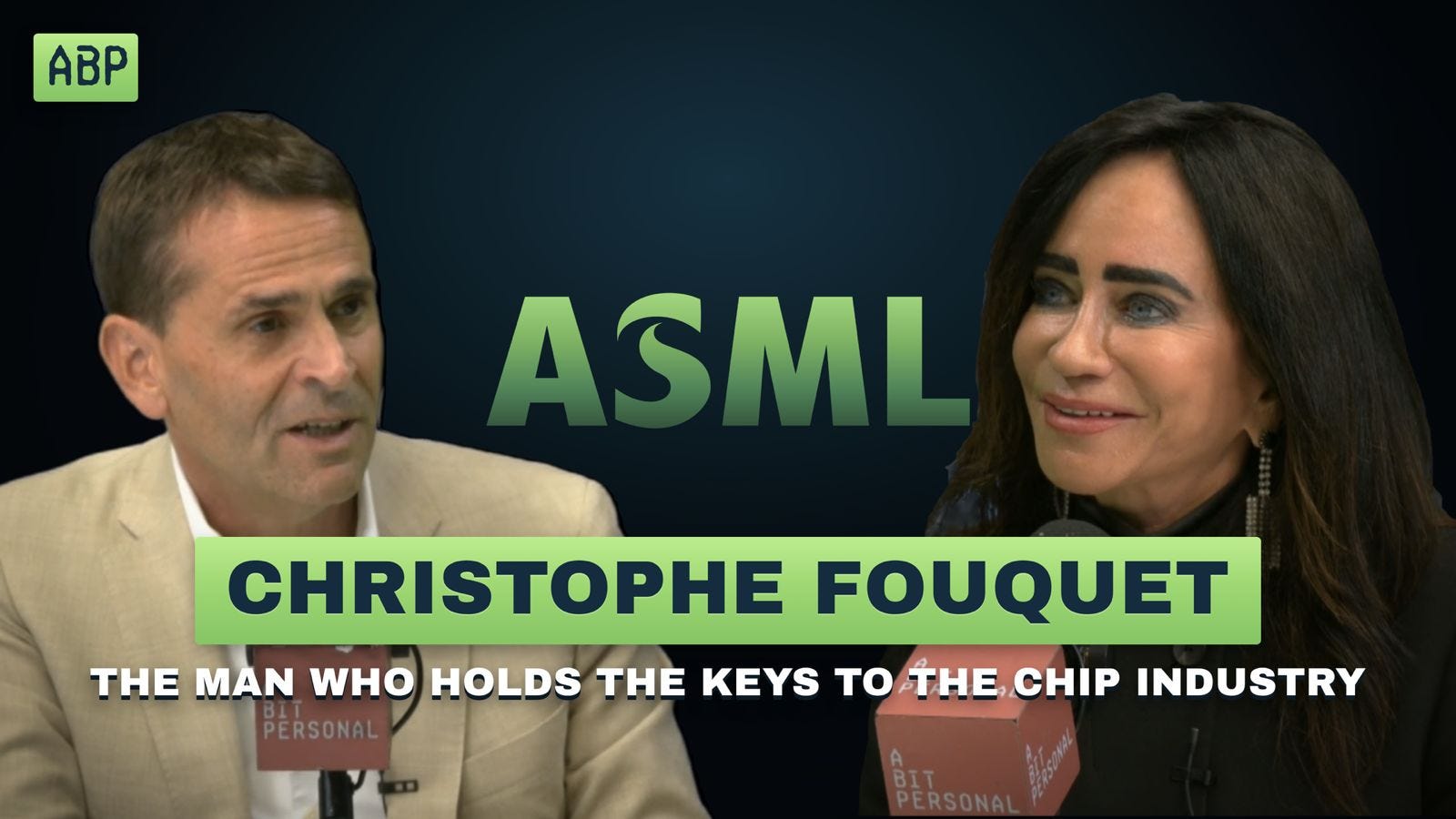
ASML’s role in modern computing and AI, explained through lithography machines (DUV/EUV) and the geopolitical/national-security stakes of being the sole EUV equipment provider.
Christophe Fouquet is a French physicist from Grenoble. He worked for decades across the semiconductor equipment industry at Applied Materials and KLA Tencor, joined ASML in 2008, and became CEO/president in 2024. He credits supportive education, family, and mentors (including ASML CTO Martin van den Brink) for his progression.
ASML is “one of the most important” companies because advanced chips powering AI depend on its DUV/EUV machines; EUV is what made ASML strategically indispensable. EUV took 20–30 years and is difficult for any second company to replicate. Fouquet spends about 10–20% of his time on geopolitics, driven by interactions with the U.S., China, Korea, and Taiwan. He argues Europe must improve capital access, reduce regulation, and increase flexibility to attract ecosystem players.
ASML’s EUV “plan A” required scaling EUV light generation (hitting a droplet with a laser tens of thousands of times per second for years/decades); he describes seeing ASML’s first EUV prototype in Albany and sending his resume the next day. He also frames ASML as a “system integrator” (e.g., Zeiss optics, Trumpf lasers, ASML integrating suppliers’ expertise).
Written by AI. May contain mistakes.
Discover why ASML is considered one of the most important companies globally and its impact on AI.
“It's really lovely to be here in the Netherlands with you and to have this conversation.”
Explore how EUV technology transformed ASML and its significance in the semiconductor industry.
“Because it's not just that you're making equipment for AI.”
Understand the geopolitical pressures ASML faces and how it affects the company's operations.
“and now you're suddenly a strategic asset?”
Learn how Christophe manages pressure and maintains work-life balance as a CEO.
“Well, you know, these are skills I think you develop over time because things change so rapidly.”
Learn how creating mental space is crucial for leadership and innovation.
“Okay, and you wake up in the morning refresh also explain people they sometimes don't believe it but you know when I go to Home and I crossed the door of my home.”
Explore Christophe's modest upbringing and the supportive environment that shaped him.
“You know, one of the most fun parts of this podcast has been learning about how people were brought up and how that the values and ideals came often from their upbringing.”
Discover how family values promote unlocking potential in individuals.
“I never thought when I started to work, you know, in this industry that will be a CEO.”
Understand how a focus on happiness and simplicity defines success for Christophe.
“I would say it was a pretty normal family, very happy family.”
Learn about the importance of curiosity and embracing change in personal growth.
“So some of the values they taught, hard work, curiosity, anything else that I'm missing?”
Examine how education shapes career opportunities in science and technology.
“Are you having a good time with your friends?”
Discover the key people who influenced Christophe's career and personal development.
“Yeah, so this also goes back to education.”
Learn how childhood experiences shape leadership values and company culture.
“Of course, in your career, but I would say in your life more generally.”
Explore Christophe's views on the role of relationships in successful companies.
“So, you know, I talked about simplicity.”
Christophe shares highlights and lowlights of various business cultures he's encountered.
“So it sounds like if I was sitting with the 12-year-old Christophe that I would definitely recognize many things in that kid to the man today.”
Discussion on the traits of effective leaders and the importance of simplicity.
“But I think the diversity of all of this, which our industry brings together quite uniquely, I think is mostly one of the reasons this industry is so successful.”
Christophe emphasizes the importance of staying true to one's core values in leadership.
“So during this time of working with these different cultures, what part of your identity didn't change?”
Christophe discusses the challenges European leaders face in the global market.
“Do you think that people misinterpret European leaders?”
Discussion on essential changes needed for economic progress.
“What are the two or three things that need to happen to make that a reality?”
Reflecting on the shift from expertise to leadership in career.
“Kind of that being the definition of when someone becomes a leader.”
Exploring the importance of taking risks for innovation success.
“If you have a good idea instead of saying, hey, it's my idea, let's make sure no one finds out.”
Narrative about joining ASML and witnessing innovation firsthand.
“and then one day it just becomes a reality.”
Discussion on separating ego from decision-making in leadership.
“So how do you separate ego from conviction?”
Insights on how to cope with failure and use it as a learning tool.
“that's how you have to pick people and don't pick people that Flatter you they're useless.”
Offering guidance to young individuals navigating their careers in tech.
“Not necessarily about the leadership portion, but you have such mixed messages to young people right now.”
Examining ASML's role as a system integrator and its impact on innovation.
“I'm going to be part of it, and I'm going to be rather someone benefiting from it rather than someone just crying on the good old days, then you move.”
Discover how ASML leverages collaboration with top experts to innovate effectively.
“And again, look, every year in the last 100 years, you have the same challenge for young people.”
Learn about Christophe's simple life and family-oriented Sundays.
“because you have developed a complete independent ecosystem.”
Learn about Christophe's simple and peaceful Sunday morning routine.
“You know, I live in a small village close to SML countryside.”
Explore how Christophe's family provides support and purpose in his life.
“Sitting in a garden with a nice glass of wine is a very nice and peaceful moment for sure.”
Understand the sacrifices required in Christophe's role as CEO, including time and exposure.
“So any kind of success, especially becoming the CEO of a company, there's a lot of sacrifices that have to be made.”
Delve into how Christophe's family perceives his work and their involvement with ASML.
“Usually one way to manage that is maybe time become Less But the quality has to improve, okay, right?”
Discover how advancements in technology affect perspectives on life and humanity.
“But the interest in there, the curiosity, the pride, of course, you know, they also realize a bit the privilege it is to have their dad, for example, to be the CEO of SML.”

Get the gist, explore an idea or ask about something said.
 Claude
On A Bit Personal with Jodi Shelton, what are the key points of this episode?
Searching your listeningAutomatic transcript. May contain errors.
0:00Jodi Shelton: There's a company that's almost completely unfamiliar to people outside of tech. Unlike Google, Apple, NVIDIA, Microsoft, this one has spent decades flying under the radar. You're almost certainly watching this on a device that only exists because of what they make. The chip inside your phone, the chip that trained the AI model you used this morning, none of it happens without this one company. That company is ASML. What they build are called lithography machines. And if you want a simple way to picture it, think of a super precise printing brush. ASML uses optics, either lenses or mirrors depending on the type of machine, to control light.
0:41Jodi Shelton: The machine uses optics to direct this light to burn the desired circuit pattern onto a silicon wafer so small you could fit thousands of them across the width of a single human hair. Each of these machines has over 100 ,000 parts and costs more than$150 million. And every advanced chip powering the AI revolution, every GPU in every data center requires the use of DUV and EUV machines. And because every single advanced chip that powers the AI revolution was made possible by an ASML machine, they naturally sit at the crossroads of technology, economics, national security, and geopolitics. My guest today is Christophe Fouquet, the president and CEO of ASML, one of the most consequential leaders in global technology.
1:31Jodi Shelton: He's a French physicist who grew up in Grenoble, spent decades moving across the semiconductor world at Applied Materials, KLA Tincor, before joining ASML in 2008 and becoming the person responsible for the one machine the world cannot do without. But what I'm most interested in today isn't the machine, it's the man. Because you don't end up running the most strategically important technology company on earth by accident. I want to know what that journey actually looked like from the inside.
2:06Jodi Shelton: Christophe, welcome to A Bit Personal. It's really lovely to be here in the Netherlands with you and to have this conversation. I know I've been looking forward to it. Thank you very much. It's a great pleasure to be with you today. So there are some people who literally say that ASML is the or one of the most important companies in the world and defined by if there was ever a disruption at ASML, it would affect the global economy and it would certainly affect the trajectory of AI. So is that an exaggeration to say that ASML is one of the most important companies in the world? Well, I think first I like that you say one of the most important, not the most important.
2:45Because when you look at what has been happening with AI with sub-conductor in the last few years, I think it's become obvious to everyone how important this is for the future of our society, the future of our economy. AI is really today at the center of everything we do. We see huge investment, we see huge potential, and therefore people see AI and everything that is related to AI as extremely strategic, extremely important. And of course, ISML is one of the key players in AI. As you know, we are making machines that enable our customer who make chips to basically make their chips. And yes, without those chips, the whole AI ecosystem is at risk.
3:35So I think we do fully understand today that we are indeed one of the most important companies. We understand the impact of what we do can have on our society. And therefore, we make, I would say, attention. We pay a lot of attention to make sure that we are not being disrupted. Because a lot of people, of course, rely on ISML product today.
3:57Jodi Shelton: Okay, so when you wake up in the morning, do you think to yourself the kind of significance of your role? Because it's not just that you're making equipment for AI. You are actually the sole provider of EUV equipment for what enables the most advanced AI chips. So do you wake up in the morning thinking about this? No, I don't think you feel the burden every day because I think the good news is, you know, SML has been existing for 40 years. And for 40 years, we've been really working in developing those machines. And I think those machines were always important, important for our customer. For many, many years, they already depend on us to be able to create their chips.
4:44So I think this is not really new. The burden is not really new. I think it's what is really new is The realization of the entire world of how important it is so I think we have been Very important for many many years, but maybe no one knew about it And nowadays I think we are very important as I say pretty much everyone is aware of that
5:06Jodi Shelton: Okay, so obviously at some point in time ASML became so much more than an equipment company so Presidents and prime ministers and policymakers all over the world started paying attention So does that surprise you that people think that ASML is so important from a geopolitical perspective? I mean, does it surprise you? Well, I think it does surprise us a bit. At the same time, you know, it's interesting because we did work very hard, maybe like any other company, to come to that point. I think that in some way when you work on advanced technology, your dream is that one day you have this killer application that become indispensable to the rest of the world so we did work very hard to come to this point we did invest heavily we took a lot of risk on a technology called EUV which I think in many way is maybe the technology that has brought us to that point today but we're still a bit surprised of the level of attention that we are getting nowadays.
6:13And, you know, in many ways, sometimes we miss the time where we didn't get this attention, where we could focus only on technology.
6:20Jodi Shelton: Yeah, it's be careful what you wish for. Be careful what you wish for and what comes with it, yes. So do you remember when that shift happened, when, you know, you were a deep tech company and now you're suddenly a strategic asset? Well, I think that EUV is most probably, you know, in short, the reason why this happened. I think that ISML before and after EUV are two different companies. Not again in terms of culture or focus on technology. This was always there. But in terms of the impact it has, I think today EUV is really one technology that only ISML can deliver. For everything we have done before, I think there were always some alternative.
7:03I think for EUV, I think there is a clear understanding that, well, we are the company that can create this technology. And also an understanding that to have a second company trying to do the same is quite a lot of work because EUV took us 20, maybe 30 years to realize. Couldn't be realized without all the knowledge we had of previous technologies, previous product. So the bar basically to get, I would say, second player in this world is very difficult. So I think EUV in many ways has brought us to where we are today.
7:39Jodi Shelton: So when you took the role as CEO, in what year was that? It was a couple of years ago, 2024. Did you have any idea that so much of your job would be on geopolitics? Well, I had the fear that this would be the case, I think, because it started, to be honest, maybe four or five years ago, where we saw a lot more attention given to geopolitics. And for me, this was also a bit of a risk because when you are a CEO, you need to focus on your company. You need to focus on your customer, on your product, on your people. And geopolitics is a lot of work. It's not something that had a lot of value to your company.
8:22It's something that you have to deal with because you cannot ignore it. So this was a bit of a fear. And I think that, like I said, you know, in general, we all hope as business leaders for geopolitics to be as quiet, as smooth as possible so that we can focus on running our business.
8:41Jodi Shelton: So what percentage of your time do you spend on it? Today, I would say maybe 10, 20 percent. Right. And where do those skills come from? Well, you know, these are skills I think you develop over time because things change so rapidly. And if you look at geopolitics, you have many, many different interests, many, many different cultures you have to deal with. We are based in Europe, of course. We are interacting with the U.S., with China, with Korea, with Taiwan. Very different countries, very different angle to the geopolitical situation. So you have to develop those skills a bit on the go. There's no school that teach you how to manage a very, very changing environment.
9:33And geopolitics is changing all the time.
9:36Jodi Shelton: You think you're good at it? Well, I hope that I am good enough at least to drive the company through the turbulent time. We have been always very, very focused on people, our customer. And, you know, with geopolitics, you also deal with people. You meet with very smart leaders. They have an agenda. They have a certain logic. You have your own logic. And it goes down to exchange view, try to understand each other, and potentially have discussion that lead to the right decision. So in that sense, maybe it's not too different from business. It's still about people. It's still about explaining, educating, sharing views, and trying to come to a consensus or compromise.
10:28So that part, I think, is very similar to what we have done for many years with our customers, for example.
10:36Jodi Shelton: So how do you handle the pressure sort of personally? I mean, do you have some sort of mechanism, some sort of habit, some sort of daily ritual that you go through that helps you manage the pressure? Well, first, I think, you know, I try to remember every day how big of a privilege it is to run a company like ASMR, right? I think it's something that is extraordinary. The opportunity it brings in terms of what you do, who you meet, the activity you have every day is just great. So when you start from that, it takes away a lot of the potential, maybe complaint you could have about the job. That's number one.
11:15Number two, I think the industry is really great. And, you know, I know this industry for many, many years, the people, the players. I know the company. And this means that I'm very comfortable with a lot of that. So people ask this question about pressure quite a lot. I usually say that I don't really get stressed to be honest.
11:40Jodi Shelton: Okay. Yes, you can have stressful situation. I'm a bit of an engineer by education. Stressful situation can be translated into here is a problem. And if you're a good engineer, when you are given a problem, you start to work on the solution. And most engineers will find this fun. In fact, that's what you look for. So pressure is not something that I feel. Okay. I don't feel a burden running the company. I feel also very blessed to be surrounded by so many excellent people who can help you every day to take a large part of whatever problem can come your way. So I don't think that pressure is something that is with me.
12:28I also believe, by the way, if you do this job and you feel a lot of pressure, This must be complete hell, to be honest.
12:36Jodi Shelton: Right. So a lot of, also I think the CEO I meet, especially in this industry, typically also say, well, we don't really feel the pressure. They also say we don't really walk, which is also something I feel, you know, it's not a task. It's more of an opportunity you have every day to, of course, lead a company, but also to go through so many great experiences. So that takes away also a lot of the potential pressure. So I enjoy it very much. And as a resource, I think there's not too much pressure that I feel. So how do you start your day? I mean, how do you set yourself up for success every day?
13:14Yeah, so this is a very American question. So, you know, I'm a European CEO, so we are very down to hearse on that. I think having a very balanced life, having strong purpose is very important. So it's not something you do every morning. I don't have a routine. Some people sometimes talk about a routine. I think it's something far more profound. I love my job. I also have a pretty big family, which I also love. And for me in my entire career the balance between the two has always been very very important So when I go home in the evening when I see you know my family This is a way for me to get this rebalancing act Okay, and you wake up in the morning refresh also explain people they sometimes don't believe it but you know when I go to Home and I crossed the door of my home.
14:13I don't think about as a man anymore which is a way also to reset your mind, to free your mind. And it's very healthy because having space in your mind, I think, is very critical when you lead, when you want to innovate, when you want to do new things, when you may have to face the day after a new difficult problem, et cetera, et cetera. So I think this balance is very, very fundamental for me. So it's not about the routine. It's more about a very structural balance between what I do every day in ASML and, I will say, what I do of my life in a much broader term. Okay.
14:53Jodi Shelton: Okay. Well, let's go back. You know, one of the most fun parts of this podcast has been learning about how people were brought up and how that the values and ideals came often from their upbringing. So I want to shift and talk a little bit about that and talk about Christophe before the title. Maybe the title is son or brother or student. So let's start by just telling me what it was like to grow up in Grenoble. What was your childhood like? What kind of kid were you? Well, I think that I grew up in France. and I grew up in a modest family. I think that I was most probably the first one in my family to reach the end of high school and go to university.
15:46And I could do all of that because of a very supportive system. Family, of course, friends, but education itself gives a lot of space, a lot of chance to people who have a certain ability to go on. And I have experienced that pretty much my entire life. It starts very early on when, you know, you are capable to do things, maybe a bit gifted at school, but then the school system allows you to go to the next step and challenge you more and more and more. And nothing stops you. In fact, everything encourages you, if you can, to develop more. and for me it was pretty obvious but you know looking later on around the world I realized this is not I think this this is a really strong opportunity when a kid is given the ability to go as far as he can and what has been interesting is that this really continues also for my career you know there's no way when I grew up as a kid I ever thought I would be a CEO I didn't even know what it was.
16:56I never thought when I started to work, you know, in this industry that will be a CEO. When I joined SML, I didn't think about that as well. But there's been a succession of progression, positive experiences, a lot of supports across the way. You find people for some reason that help you, that support you, and allow you to go to the next step. and, well, one day you're the CEO. But this is a bit of a succession of very positive experiences along the way. Nothing ever stopped me. Everything encouraged me to go further. And I think creating such an environment for children, for students, and for later on employees, I think is extremely powerful because that allows you basically to really unlock the potential of anyone.
17:53So unlocking potential of people is one of the value we have in ISML. I think it's a very important one because if you focus on making sure that everyone in the company can go as far as his or her abilities allow him or her to go, I think you're going to end up with a great set of people and most probably many candidates to become the next CEO of ISML.
18:18Jodi Shelton: So what was your family like? Did you have brothers and sisters? Was it a chaotic household? What was it like growing up? Well, I had two sisters. My parents were walking. I would say it was a pretty normal family, very happy family. It was a lot of activity, a lot of well energy I think energy is the right word loving family we did a lot of things together we used to like to travel we were very curious I think my parents were extremely supportive for us to learn to study to do new things which I think are things that I'm thankful even today because having the people you really care about the people who you love to tell you it's okay do it maybe we don't even understand at some point what the hell you are doing but we are with you we want you to to be successful I think is very powerful I would use the word simple or so you know people underestimate the value of simplicity I say sometimes people look for very complex life very fancy life I think simplicity is a is a way to get your core value right you know knowing very early on what is important, what is essential and what is not, I think goes a long way.
19:46And I think when you come from a more modest family, you learn that faster. You learn that working hard is important. You learn that if you want to be successful, you've got to work for it. You have to deserve it. It won't come by default. You learn that you need to have friends. You need to have people that you are going to interact with positively in order to be able to achieve great things. So simplicity, I think, is a very important thing. And it's something that I still like today. We've talked about complexity of the world we're living in, and that's true. But I think when it comes to value, when it comes to what is essential, I think this has to remain extremely simple.
20:34Okay.
20:35Jodi Shelton: So some of the values they taught, hard work, curiosity, anything else that I'm missing? Hard work, respect, dream. Be able to dream, be able to believe that what you have today, what you know today, doesn't have to be what you see tomorrow. Don't be afraid to change. One of the things I did as a kid was to move to many different places because my father will have to move to go to the next opportunity. Don't be afraid to change. Don't be afraid to meet with new people, to make new friends. Be open, curious. Very early on, you know, I wanted to travel. I took, I think, my first flight, I was 25, right?
21:20So this is a bit late nowadays. But I was very curious about what's happening elsewhere. You know, I did start to work in Israel, then I went to the U.S., then I came to the Netherlands. I'm French, as you know. I worked in France for only one year. So very early on, I was very curious about what the rest of the world can bring. I think curiosity is a huge quality. I think it's something that I always invite people to be curious. And if you're curious, you will learn and you will want to change. You always need to want to change. I could say improve. right but change is a good thing and still it's usually a thing that scare a
22:08Jodi Shelton: lot of people so how did your family define success for you I mean what would you know they must be so impressed with what you're doing now but how would they have defined success when you were growing up well most probably happiness was most really the most obvious sign of success right this was not related to material things. Are you happy? Did you have a good day? Are you having a good time with your friends? Do you have a good environment? Happiness, I think, was most probably the best definition of success. This is maybe the question that will come up the most. Even when it will come to studying, the question was more are you happy with your results than are you the first or second or third in the class.
23:01Okay. Right.
23:05I guess it's a pretty sound definition of success, in fact.
23:08Jodi Shelton: Right. I agree. So, are you successful today? I'm very successful today. If you define it by happiness, good. Yes, I'm very successful today. So, who first told you or introduced you to science as being a possible track for you? Yeah, so this also goes back to education. So France has an education system which is based mostly on math and science. So historically, for good or bad reason, to be very successful in France when you study, you had to be good in math and in science. And if you were then you would go basically for a cursus Sometime a bit editist that will bring you to the best school and therefore the best job I was good in math.
24:00I was good in science I was also good in literature and maybe I liked literature better than I did like science and math But my practical side side made me try to understand very quickly that if I wanted to be successful then math science was the path and for a long time in France you do really math science without really understanding what it means for the future so the connection for example to technology to engineering to some other very practical things that I do today happen pretty late most really when you are past 20 even 22 okay so then you start to open yourself to what I would call the the world of the industry but it takes quite a while and as you do that I mean it's it's a very complex world and I still believe that me hanging up in this world in semiconductor was because I did like physics so I'm a physicist but it's also by chance to be honest okay and the first company I worked for when I left university was applied materials is also equipment company as you know and I signed a contract without knowing at whole what the hell applied material was about but you know they had office in Israel they had office in the United States so that sounded pretty cool but But there is an element of chance also in all of that.
25:35And chance comes together with capability and then you start to learn. But to be honest, even in this industry, the semiconductor industry, it took me a good 10 years to really understand what it meant for the rest of the world. Because that's not something I did learn at school at all. So there is this also, again, continuous learning that came on the way.
25:57Jodi Shelton: Was there any person, place, or event that sort of changed the trajectory of your life? Well, there have been many, of course. And it started, of course, with parents, with my sisters. They had a huge influence in a very indirect way. I had a chance during my study to meet a few teachers that really helped me explain me what direction I could take. and they mostly don't even know that, but I'm very, very thankful for them doing that because they did spend that little moment to explain maybe that based on what they knew about me, what they had seen, maybe this would make more sense than something else.
26:43And that's extremely valuable. And I had the chance to have that, of course, also for my career. And I won't give you the whole story, But even in SML, someone like Martin Van Brink, who used to be our CTO, one of the two presidents before 2024, had a huge impact on what I was doing and what I decided to do. And having those people around you, I think, is a real blessing because you need that at some point of time. And I think having those people versus not having them is making a huge difference in your life. Of course, in your career, but I would say in your life more generally.
27:30Jodi Shelton: Okay. How about experiences that you had growing up that you can directly relate back to what kind of leader you are today because this happened to me or that happened to me? Yeah, so I believe that, you know, I talked a lot about change, but when it comes to core value, when it comes to core culture, to your core personality, I truly believe you don't change too much over time. I think if you do, most of you lose something. So, you know, I talked about simplicity. I talked about happiness. I described a bit maybe the way I used to live. and I think this is still with me today. And when I walk with the people around me, when we do things together, the way we interact, the way we discuss, the way we want to do things together, that model I think is still very similar to some of the models I described before.
28:33And I always see ISML as a family. Of course, it has become a big company. But when you look at the board of management, if you look at the senior executive team, that's still only a few people. With you, you can really develop a very, I would say, authentic, very valuable and very meaningful relationship. And for me, that's very important. You know, people when it comes to company, they talk a lot about the CEO. I think the CEO is the least important person in the company. The only role maybe of the CEO is to really bring together that kind of team, that kind of environment, so that the company can really strive, right?
29:20The idea that one man can do it all is an absolute nonsense, because one man, doesn't matter how smart he is, has a certain bandwidth. And if you can multiply this bandwidth by a factor of 10 or 100, then you end up with a company that will be able to take on a lot more things. and I think this what I tell you today is most really things that came to me very early on and I'm not deviating I would say from from those fundamentals today it doesn't matter how big the company will become it doesn't matter how much attention we may get what really matter is that every morning you come you have a group of people with who you work that you care about that you respect and that you truly believe that, you know, if you are together, we can do great things.
30:14Jodi Shelton: So it sounds like if I was sitting with the 12-year-old Christophe that I would definitely recognize many things in that kid to the man today. Yeah, I think a lot of people mostly will tell you that. Okay. You're very similar. Very similar, yes. So you've had the opportunity to be involved in the business cultures, Dutch, French, American, Israeli, Asia. So give me some of the lowlights and highlights of each of those cultures and maybe how, you know, what you think that they bring uniquely and maybe some things that each of them can work on. Yeah, it's a great question. And it's also a difficult question because you really have that.
31:04I think every culture really brings good things and things that are less good. If I start with, you know, I could start even with the Netherlands because the Dutch are very proud to be direct. But the New Yorkers are also very proud to be direct, I found out. But that's a quality for sure. I think being direct, going to the point, being able to debate is for sure one of the reasons why ASML, but the Netherlands in general are very successful. I come from France. Maybe France tends to be a bit more structured in terms of organization, in terms of decision making. this is also giving a lot of efficiency in what you do.
31:55You know, thinking, deciding, acting. That's something maybe, maybe not, but I feel that French people know how to do pretty well. If you go to the U.S., I've learned a lot about processes, meaning not only about being structured, but bringing that to an entire organization. When I spend time in California, I say most probably this is where I learned the most about how to develop systematically product, organization, etc., etc. So a very strong corporate culture. If you go to Asia, more flexibility, more opportunism. We work a lot with Taiwan, of course.
32:37Jodi Shelton: Taiwan is still a country where anything can happen, which maybe we don't have anymore in Europe or in the U.S. It's still possible in Taiwan. You go to Korea, you see an unbelievable talent for execution. There's nothing big enough that cannot be executed. If you go to China, there are, again, a lot of creativity, a lot of people that, you know, want to do something because, you know, they are still in this phase of the development of the country where there is a need for that. And you see I stress mostly the positive because it's a bit one of the privilege I described before when you work with all those countries, with all those leaders, when you meet the CEO of Intel, Samsung, TSMC, Micron, you see all of that.
33:30You see this very, very rich environment where everyone brings slightly different culture and it works very well for some reason. because I think at the end of the day, we all learn a little bit from the other one. The Americans are still asking me, why do you take two weeks holiday in the summer? And then I say that this is one of the best ways to create the space in your mind to really think about new things rather than just have the need to read every single email every day and just keep going on what you do. But that's, for example, a divide that I think may take another 200 years to solve.
34:17Both are okay, by the way. I lived in the US where I did not have that. I live here where I have it. And you realize also that there is no right or wrong. There is just a bit of a combination of words. But I think the diversity of all of this, which our industry brings together quite uniquely, I think is mostly one of the reasons this industry is so successful. There's a lot of respect also, I think, for the different culture. You met a lot of my colleagues, right? I don't think anyone will ever point to one model as being potentially weaker than the other. Everyone appreciates a bit the diversity of culture, but also even personality.
35:02Jodi Shelton: So, with that said, I'll ask you a question that may be difficult to answer, but who are some of the two or three top leaders that you've worked with in the last few years that you think are maybe some of the smartest leaders that you've worked with? There are a lot of them, so it's always a risk. And of course, I mentioned Martin Van den Brink, who was our president and CTO, has been a major figure for ASML, so it's an obvious one. Of course, I work with CC Wei, I work with YH June, GY Lee in Samsung, with Dr. Kwak in Escanics, with Sanjay in Micron. I'm going to forget some of them. I have, you know, I could say respect, but it's extremely enjoyable to work with them.
35:48They are extremely smart and extremely nice people. and the relationship we have is I would say exceptional because it doesn't matter again how big our company when we're going to meet together like you know we do today we just have a conversation a conversation for the good first of the industry for the good of our respective company, etc, etc. So, what you see with all those leaders is that I also find them fairly simple and inspiring at the same time. It's possible with any of them to sit and solve anything. It doesn't matter how big they have become, how long they have been in history, how big is the perception about their own power, I would say.
36:44They are extremely down to earth, right? So that's an element. That's why I stressed simplicity before. A lot of them are still extremely simple and down to earth, which is the reason why when we meet every few months for a few hours, we're capable together to do great things.
37:04Jodi Shelton: So during this time of working with these different cultures, what part of your identity didn't change? I mean, do you think of yourself as a French leader? Well, I don't really know what is a French leader, but I think that most people would be comfortable to say I'm a European leader. Okay. Because I see there's some commonality. I think there is a difference of style, culture, with, of course, our colleagues in the U.S. or in Asia. But that's just out of the culture we were educated with. And, like I said, those things stick with you. I think it's one essential element of leadership is to not compromise on your core value right you have to be yourself to lead right right I used to believe that you can lead and be yourself but I think it's stronger than that you have to be yourself to lead if not I think it's too complicated sometimes you see people who who try to please everyone or try to say the right thing who try to make sure that what they say will not make someone upset, this doesn't work.
38:16Because when you do the kind of job we do as CEO, you don't have time. Right.
38:21Jodi Shelton: You don't have time to go like this. You just have to say what you think and think what you say. And I think that's essential. And it doesn't mean that, you know, your values are better than others, but it means that this is just who you are and how you know how to operate. And I think that's very important to stick to that. So you don't change your fundamentals. I think if you do, most probably there's something not totally right. Semiconductors power so much of modern life. And building a stronger, more resilient supply chain in America takes more than technology. It takes the right infrastructure, the right locations, and the right partners.
39:09Jodi Shelton: Kaiser works alongside the semiconductor and technology companies as they establish and expand operations in the U.S., helping them navigate the complex real estate decisions that make growth possible. Kaiser, a commercial real estate with a bigger purpose. Learn more at Kaiser.com. Do you think that people misinterpret European leaders? Do you think that they misunderstand them? I don't know. I don't, you know, I think sometimes there's some comparison. So there's always a risk if you look at someone with your own reference that you may not understand why that other person is different. There is also a certain view of Europe, and there I will say most of the time the European CEO will be the first to agree to it.
40:00You know, if we compare Europe to the US in terms of agility, in terms of regulation, I think the European CEO will be the first one to say, well, this is a problem. So we are not like that. We are, in fact, asking for that to change. Business is creating, I think, common characteristics. Because if you're going to run a company, if you're going to want the company to be successful, You need to have customers, you need to have a good product, you need to be innovative. These are fundamentals that I think any successful company across the world share. You have a very successful company in the US or in Europe, and you have a company that will fail on both sides of the ocean, for example.
40:47Jodi Shelton: So Europe gave us ASML, so we know what the capabilities are. Why don't you think that Europe has been more successful in building out the entire ecosystem, or does it really even matter? It does matter for sure because, you know, this ecosystem, as we discussed, is strategic. If you look at AI, AI is going to secure the prosperity of any country in the future. It's going to secure the sovereignty. It's going to secure national security. So not having access to the ecosystem is, of course, a risk. Everyone today understands that. And to have access to the entire ecosystem, you have to create conditions where people who play in this ecosystem want to be here.
41:37So, yes, I think that Europe has to improve that dramatically. I think the US, China today are doing a much better job, being attractive, providing capital to invest. I think it's important for Europe that SML is not an exception. Right. And these are some of the discussions we're having with all our political leader friends so that we change a bit.
42:04Jodi Shelton: What are the two or three things that need to happen to make that a reality? You need to have easier access to capital. You need to have a lot less regulation. And I think the last thing is more flexibility. I described Asia. Asia is flexible. They can do anything. Right. They have this mindset, we can do anything. We don't have that mindset anymore. Okay. You think it'll happen? I think that sometime, well, when you come close to danger, you're forced to change. I see a bit of that in Europe for all kinds of reasons. COVID was one example. Ukraine was another example. So, sometimes you're forced to change because you see the risk becoming too high.
42:54Now, I wish that we change even without too many freight. That would be better. Will it happen? I think it will because, you know, the alternative is not very exciting.
43:08Jodi Shelton: So do you remember a time in your career that there was actually a shift from people looking to you for your expertise to looking for your judgment? Kind of that being the definition of when someone becomes a leader. Do you remember when that happened for you? Yeah, I think I remember that vividly because I think you're also the first one maybe to notice this change. And I've said a few times, there is a part in your career where you have this need to prove yourself, that you're competent, that you can deliver. And then you do that usually with expertise by being very good. And by the way, education cannot teach you to be very good.
43:54Most education systems drive you to be the first in the class, have great notes, etc. So you keep that for quite a while. But there's a point of time where you realize that as you do that, you're very limited, because the only variable is yourself. And you can become very good, but okay, you can only do what you can do. And there's a part of time where you realize that instead of spending time demonstrating that you could maybe spend more time trying to share some of the method, some of the thought. If you have a good idea instead of saying, hey, it's my idea, let's make sure no one finds out.
44:33If you gather a team together to work on your idea and you're okay if maybe it become a bigger group idea, then suddenly you exponentially enable innovations, wealth, success. And that for me happened most probably in my mid-30s, late 30s. And then you look back and say, well, I've been wasting quite some time. I should put my energy to to create bandwidth rather than You know focusing on my very narrow myself and I think that moment Is when you become a leader not a manager right the leader and after that It goes back to the opportunity you have to exercise that How many mistakes you make I think it's very important to make mistake people underestimate the need to screw up a few times to learn.
45:33Because if you don't make a mistake, it just means you don't take enough risk. You're just too safe. And you get comfortable with that over time. But it takes a while.
45:44Jodi Shelton: So were you always naturally a risk taker? Because in this industry, when you're investing years and years ahead of ever seeing the fruition of that, I often think of Jensen's story that 10 years he's out preaching about AI and no one's really listening. and then one day it just becomes a reality. I always believed that to be successful, you have to make some big moves. And I'll give you the story also. The reason why I joined ISML, for example, which is 18 years ago, I was in semiconductor industry for a while, and one day I was in Albany. Albany is this place in New York State where you have an R &D center for semiconductor.
46:27They have a clean room. and they have a window pass in the clean room, meaning you can walk and you can see everything that's happened in a clean room. And I was having the tour, as many people do, and you walk by and you see a lot of tours, but they all look the same. They look like big boxes with some interface. And at some point of time, we were walking and I stopped because I saw this huge, huge machine with cables everywhere. It looks like a spaceship. And I asked my host, what is this thing? And they told me this is the first ASML EUV prototype machine, which I never heard of because I was not a lethal person.
47:14And the day after I sent my resume to ASML. Because it was clear looking at this entire display that without me knowing it, I didn't know ASML very much, I was in the US back then, this was for sure a different company. Because when you look at the whole thing, you know that someone was taking quite some risk and was going through quite some innovation, creativity, to get these things to work. Now, the machine I saw, it took another 20 years before EU was successful. So this confirmed the fact that the company was taking risk. But this is, I think, what innovation is about. You need to try to come with bold ideas.
48:00By the way, it's always a sort of challenge as a CEO because you always look for the next one, right? And when you have such a great one like you, it's maybe difficult to find the next one. But I think this has to be a perpetual quest, right? Because this is really what can make a company great, is to come up with products that are unique, indispensable, that's required to take risk. EUV has been a major risk for the company. This has been a product that for many years almost got us bankrupted because we were putting all our profits in the development of this tool. But people were strong enough to to keep going for almost probably 10, 20 years until it worked.
48:51Jodi Shelton: So how do you separate ego from conviction? And when do you know when maybe, okay, it's time to reverse course? Well, I think that ego is a very dangerous thing. Our guns are very dangerous things. These are the two things that you have to, you know, to push away as much as possible. You always need to listen, right? So you could get stubborn indeed on a technology, but what is good, again, when you work on technology, when you're an engineer, is you get data. Data will always tell you what is right, what is right. It doesn't matter what you believe. You could believe that this design is really the greatest things humankind have ever thought about.
49:36Then you test it, because there's always a lot of time where you have to test it, you get data, and it will tell you if you're right, if you're wrong. And if you're wrong and you keep going, then it's ego or stubbornness or arrogance and you will fail. So ego has almost no place in success. Ego is mostly the first sign that success will stop. That's true for an individual. That's true for an entire company. That's also why you have to listen to your customers. You know, I spend so much time going to see our customers and listen to what they don't like rather than what they like so that you can improve.
50:22You need to listen to your people. Same thing. What is it that they don't like versus rather than what they like. So you need to have this ability to question yourself, to look for improvement, no matter how successful you have become. Success is your always biggest threat.
50:42Jodi Shelton: Right. Because success can bring ego, can make you believe that you're super smart, and make you forget that no, success was not the resource of you being super smart. It was the resource of a lot of hard work, a lot of mistakes, a lot of risk. And to continue to be successful, you have to continue to do that, not start to believe that, you know, it's because of you. I think it's very, very important. And any successful company has to be extremely paranoid about ego and arrogance. So you have people who tell you the truth people tell me the truth that's how you have to pick people and don't pick people that Flatter you they're useless.
51:20They have to tell you the truth. I have no problem with that in ICML I can promise you it's also a bit of a cultural element and we tell each other the truth It's very important.
51:29Jodi Shelton: So how do you personally deal with with failure? You said that it's very important to take risks makes mistakes. So how do you deal with it? I mean, how do you get up the next morning and soldier on? Yeah, so failure is always a bit of a pinching disappointment, right? And you have to still take the time for that disappointment because that will be part of the learning. But then you have to believe the day after, maybe, when you wake up and you come back, that there will be a solution for it. Okay. And that's also fun. In some way, failure can be more fun than success because then you still have something to invent, something to create.
52:11So you have to make it a philosophy that this is okay to fail as long as failure is learning. You try something that doesn't work. Call it a failure or call it learning. And then you go to the next one. There's big failure that are more painful than others that you can avoid, I think, if you have this philosophy on the smaller one. So only ego will lead to very big failure. If you're not too stubborn, and if you really listen to what data, people, customer, whatever will tell you, then you will change course early enough. Okay.
52:51Jodi Shelton: So what is your advice to young people? Not necessarily about the leadership portion, but you have such mixed messages to young people right now. right because some people who say oh this is the greatest time to be alive to start companies to do business and then you have young people that are graduating from university not finding the job of their dreams maybe not even finding a job and almost a backlash at university right now about AI so what is your advice to young people that are starting out their careers well first I would say that I had the exact same challenge you know when I left university same thing this was the best time ever.
53:30But we also had major challenges because, I don't know, the internet came, because they were computer, because maybe they were less job because of technology. This has always been the case. This will always be the case. But technology always has allowed us to do greater things. So any job any young people take today, thanks to AI, will be a lot less boring than the first job I took. when I left university. So they should not fear technology. They should just make it the tool of their success. And I think AI is going to be a great tool to allow people to be a lot more innovative. Because instead of spending time doing things completely useless, they will put all their energy to creativity.
54:24When I studied, I had to remember by heart the value of every scientific constant. This was a nightmare for me because it is something my brain was not good at. And one day, I didn't have to do that anymore. And it freed maybe 20, 30 % of my mind. AI would do the same. So this is by far the best time. They'll get new tools, tools that allow them more and more to do very, very interesting things. I find that AI is not fast enough. I still have to do so many stupid things in my life, in my career at work, but also at home. I'd like AI to go faster so that I have more time to do the important stuff.
55:06I think that's what AI will do. AI will be a companion for people who are creative, to be a tool, and we should not fear it. People will have feared technology for as long as it appeared.
55:20Jodi Shelton: Right. It seems, though, that young people have always been pretty accepting of technology, and now it seems like, again, there's just sort of this backlash, this nostalgia about another period of time. Yes, but this is the thing, you know, that's what I told you about change. Change is always a bit scary because you feel sometimes more safe with what you knew. But if you pass the fear, if you embrace it and say, I'm not going to be scared, that's what it is, it's happening, I'm going to be part of it, and I'm going to be rather someone benefiting from it rather than someone just crying on the good old days, then you move.
56:01And again, look, every year in the last 100 years, you have the same challenge for young people.
56:11Jodi Shelton: Right. Okay. So I had the opportunity to go back and reread some of Chip Ward's, Chris Miller's book about our industry. And ASML plays a big part in that book. And, of course, everybody thinks of ASML as building these incredibly complex, very expensive machines that, once again, that the world can't do without. But it seems to me, after reading that, that the biggest innovation at ASML has been the ability to sort of orchestrate all of these innovators and all of these scientists to focus on this one problem. Yeah. You think that that's true? I think it's a great analysis on your side indeed.
56:54ASML made the choice many, many years ago to be what we call a system integrator. So we knew that to create those very complex, very advanced machines, we needed to be good at many, many, many, many things. And instead of trying to do that all by ourselves through vertical integration of everything, We just picked the best people at everything. Zeiss for the optic, Trump when it comes to drive laser, a lot of other suppliers, Bistrad today for AI. And we worked with them, brought their competence, let them innovate on their competence, and bring it together as a system. And I think that has given us a lot of flexibility, a lot of speed.
57:45and it allowed us for every single competence that was critical to our system to work with the very best engineers. That's another thing the idea that you can be the very best at everything, it's pretty close to ego by the way, is not possible. So a collaborative model works and I think this industry is exactly that. You know, NVIDIA rely on TSMC to do the chips, TSMC rely on us to do the machines they will never break that because you know the day you start to want to do everything then you have less time to spend on what you're really good at and you spend a lot of time on stuff you're not very good at so you're going to slow down dramatically so this has been a very very successful model which we still entertain today we want to walk with I would say the very best people on every single part of our tools.
58:42Jodi Shelton: Okay, so the other part of that book that I found fascinating was the chapter No Plan B. So when you're talking about EUV, there was a lot of people who, you know, really doubted that it could ever be done. Yeah. So if I can say this correctly, it's the idea of hitting a droplet of 10 with a laser 60 ,000 times a second, every second for every year for 30 years. Explain to us what that means. Well, we were looking at a way to create EUV light, and there were not too many ways because EUV light is very difficult to extract. And this was really the most critical problem on EUV. We looked at a few options.
59:25So there were a plan B and a plan C. We looked even at options that are being looked at again today, like free electron source. But we came to the conclusion that only one could scale on the long term. So we didn't only want to have a solution for let's say 2018, we wanted to have a solution that we could scale for another maybe 20-25 years. And very quickly this narrowed to one solution, the way that CIMER was developing that's why we acquired CIMER and that's why we put a lot of energy to make that option work and that became plan A and plan A was already very expensive so it's very difficult to have you know many other planes on the side but this were also very intelligent decision it's not like we didn't look at anything and we went blindly for one option we did look at a few with certain amount of investment but came very quickly to the conclusion that only one solution could really provide what our customer needed for the long term okay technology doesn't stand still
1:00:41Jodi Shelton: neither do the company shaping what comes next jp morgan's technology investment banking team works alongside technology leaders at every stage of growth bringing deep industry expertise global perspective and the full capabilities of JPMorgan to their most important strategic decisions. From raising capital and navigating M &A to understanding the forces reshaping the technology landscape, JPMorgan combines sector expertise with insights drawn from across market industries and the global economy, helping clients turn ambition into what's next. Learn more at jpmorgan.com backslash tech IB. Now let's get back to the episode.
1:01:28Jodi Shelton: So you've talked a little bit about, or in the past, you've talked about that decoupling, which is the separation of the U.S. from China, creating their own ecosystems, was prohibitively expensive. Yeah. So a couple of questions there. First of all, why did you believe that and do you still believe it today? And haven't they already decoupled to a large extent? Well, you know, it's very expensive because you have to do things many times, right? So if you look at the R &D we spend to develop a new machine, if you look at the R &D, TSMC, or Intel or Samsung spend to get the next generation of chips, could extend that to NVIDIA for, you know, for the product around AI.
1:02:15If you decouple, you have to do that twice. And this industry, what we have seen is, even for us, some of our suppliers are unique. Because the cost of having a different one was too high. So if you're going to do several times the same thing, it becomes very expensive. Did the world decouple? I think that, you know, of course, there is a bit of a no-choice type of attitude in some cases. If you're not going to have access to a technology and you don't accept to fall behind in your own progress, then you try to do it. If you have no choice, you're going to try to do it. But then things will slow down, of course, as we see it potentially happening in China.
1:03:12And in the long term, the whole world will slow down. So there will be some attempts, and I think it's very, very difficult. And what you see today, as again, chips demand is very high, you hear that some U.S. company would like to buy chips from China. Right. And China still wants to buy our equipment. And of course, China, if left no choice, they would do everything they can to have our own equipment. And we've also been explaining that to governments. I think restrictions give the strongest possible incentive to people to develop an alternative. I think Jensen have said the same thing many times.
1:03:55That's true. So what's the balance there? You know, you create a world that is a lot more expensive. You create a lot of incentive for people to compete with you. And maybe the day they compete with you, they can also sell their product to your own country. So, you know, it could maybe sometime make you feel good that you keep people behind. But on the big picture, on the long term, this is a very, very difficult model to understand. How this is going to work? Yeah, you can do something. Next to three years, you slow down. But what's happened in five years? What's happened in 10 years? What's happened in 20 years?
1:04:37Sometimes the resource is exactly the opposite of what you were looking for in the first place because you have developed a complete independent ecosystem. And yours has become very expensive.
1:04:49Jodi Shelton: Unintended consequences. Yes. So do you think that the U.S. restrictions, especially on ASML's equipment, Is there a reason why they have made progress today in China? I think it's one of the reasons, of course. Like I say, if you have no choice but to develop your own product, you will do that. And if you feel that you cannot trust one party to get access to technology, you have to do it yourself. You see that also with NVIDIA products, which are allowed in China. but China is even hesitating to buy them because they don't know if they're going to be allowed in two or three years from now. So this is a dynamic that I think people have to really look at in those kind of decisions.
1:05:37Jodi Shelton: So, of course, a couple of weeks ago, and, of course, now it's going to be a couple of months by the time that this airs, but a couple of months ago there was an announcement in China that they had made progress on DUV, which is not EUV. It's the technology that's used for more mature, older technologies. But still, you know, three or four years ago, we would have never guessed that China would have that capability this early on. Did it surprise you? Well, I think China has been working on lithography for more than 30 years, more than 30 years. And the progress has been extremely small. and in the article you have seen two weeks ago, there's no fact.
1:06:24And what surprised me the most is how easy nowadays it is to write down anything without any fact. And then you enter speculation. That's also why we typically don't comment on those articles because there is no fact whatsoever on the ground that this is happening and still it makes news. Okay. What is for sure happening is a strong intention from China to have those tools. Why? Because if we cannot provide them those tools, they will want to have theirs. Because are they going to accept to not make, you know, chips? I don't think so. So that's really the dilemma. So you get a lot of news, a lot of noise.
1:07:13And I think the noise is just the proof on how important this technology has become for everyone There's also by the way noise coming out of the US on our technology.
1:07:23Jodi Shelton: Okay But this is just because everyone back to your very first question I understand you need lithography for any progress on major application product moving forward And therefore, if you tell a country you're not going to have access to something that gives you the path to prosperity, it's going to be a very tough thing to accept. Okay. So do you... explain to the audience why it isn't just as simple as replicating an EUV machine. Well, I think it's... you touched on that before. We didn't do that alone. We did it with many different partners. To make an EUV machine, you need to have a source, you need to have an optic, you need to have something to move the weather, to move the reticle, you need to have many, many other things, very complex, which have been developed not only by SML, but by thousands of people beyond SML over the last 30 years.
1:08:30and we would not have been successful without the knowledge we had of previous product. So what people say is that what took us 30 years, what required so many different expertise of different companies who also needed 30 years, for example, Zeiss, to create the EU Optik, can be done in five years. That's what used to be printed last year. EUV would be available in China by the end of the decade. You know, this is, I don't know. I don't know as a rational person, as an engineer, I don't know you do that.
1:09:11Jodi Shelton: But you said they had been working on it also for 30 years. Yes, but they have been working on it without coming with product. Okay. So they have not been practicing it. Okay. You need also to be able to practice the technology to improve it. Last week, to give you an idea, I got a report in XML that we have exposed across our install base of system one billion wafer. One billion wafer on our machines. Wow. So we have one billion wafer learning across on our tools that we can use to develop the next system. How many of those people have exposed? Most probably a few thousands. Okay. That's the challenge.
1:09:53Jodi Shelton: Okay. Okay, we're going to switch gears here a little bit and come to our last section, which is really the part that is a bit personal. So tell us who Christophe is on Sunday morning. Yes. You know, I live in a small village close to SML countryside. So what I like on Sunday morning, Saturday morning is to wake up slowly, get to the garden, get some fresh air because you don't get a lot of fresh air when you, you know, the CEO of ASML. Go to the bakery, you know, buy the bread. Very French. Very French. Try to find some croissant. Do the simple things. Very simple. You know, prepare the coffee, get breakfast with the family, play outside.
1:10:43I have a lot of children. I have six children, so they keep me busy. My life on Sunday mornings is extremely simple. Do a bit of sport, get going, let her meet some friends, family if possible. That's it.
1:11:00Jodi Shelton: So is that where you're most peaceful? Is it home? In the garden? Sitting in a garden with a nice glass of wine is a very nice and peaceful moment for sure. Okay. So tell me a little bit about your family and what role that they play in your success. I think they've been there all the time. They're still here with me today. They have been a rock, a support that was always there. And that's true for my parents, my sister. That's true for my children today, for my wife, of course. Everyone is there. and this feels extremely safe. I think when you have this feeling that you have people around you that love you, support you, it gives you a lot of strength.
1:11:50Of course, it doesn't go without bumps, how private life is. But still, if I step back, this emotional support is extremely strong. and I would say most probably this is also giving you the purpose right there's always a question of why you do all of that but why and I think that that also surrounding is mostly a big part of that so that's a purpose that's a support that's the safety and that gives you a lot of smiles you know when you have a lot of children this is a lot of ages are they they're a pretty large range should start at the oldest 27, the youngest is three.
1:12:33Jodi Shelton: OK, wow. So I'm still busy. So any kind of success, especially becoming the CEO of a company, there's a lot of sacrifices that have to be made. So who makes most of those sacrifices? And do you think your family feels that? Are they accepting of what they might see as sacrifice? I think time is a bigger sacrifice. and, you know, sometimes a bit exposure, of course. I think these are the two key things you really think about before you become a CEO because, of course, you don't have much time for yourself anymore. There's a lot of moments where you have to be the CEO of ASML and it takes away a bit of your personal time, which I think is a very important thing because it doesn't matter what you do.
1:13:25I truly believe you need time for yourself and I think that's you know as you become so busy as it is important things to To do so I think time is the most important thing And I think that's something you have to discuss of course with your family your family has to be okay with it and Usually one way to manage that is maybe time become Less But the quality has to improve, okay, right? So when we are together It's good and maybe yes over time this is less but you know there's already a reason for that sometimes also the children will leave the house so this is also happening anyway but the time i think at least i have with my family is very important right because as i explained this is providing a lot of a lot of balance a lot of happiness the other thing is exposure so you know you know we talked about how important this industry has become, the amount of articles in the press.
1:14:28Yeah, it's not always the most enjoyable part, to be honest, but that's also something you have to accept and, like I say, you have to do your best to still bring the best possible image of the company. And when things are a bit too negative, especially if incorrect, then you also have to help.
1:14:47Jodi Shelton: Right. And do they understand what you do? I mean, are they a part of, you know, a part of ASML in a way? Oh, they are, you know, they for sure are part of ASML. You know, it's a big thing for them. They try to understand more and more, of course. They don't understand 10 % of what I'm doing. It's good for them. But the interest in there, the curiosity, the pride, of course, you know, they also realize a bit the privilege it is to have their dad, for example, to be the CEO of SML. They see that, I think. Okay. Okay, so you've spent sort of your entire career looking at teaching humanity how to look at things smaller, right?
1:15:38Jodi Shelton: So from nanometers to transistors to atoms. Has that changed the way you see the big picture of life? the purpose of life, humanity, again, the really important things in life. I don't think so because, you know, one thing we didn't touch on maybe is also back to purpose. You know, when we did think smaller, faster, when we create those chips, when we create AI, I still believe that those applications will really bring good to the society. And I've seen that in many ways in the last few years. I mean, I always take the example of, you know, the iPhone, for example, the mobile phone in general.
1:16:24The way it brought us together, the way we can communicate nowadays, the way we can learn, I think this is a major improvement. I was comparing before, you know, what I saw when I left university versus what, you know, my kids are seeing when they left university. I will in no way exchange what they see with what I saw. I think they are in a better place. Okay. For sure. And I think that the opportunity they have in front of them are enormous. They can do almost anything. They can learn about anything. They can ask any question. They get the answer right away. So their curiosity, their opportunity can be fulfilled a lot more than we could.
1:17:05And I think that is the resource of getting things smaller and smaller and smaller. So I feel pretty good about, you know, the resource of that. And yes, we also have to make sure that some of those things are controlled because it can always go wrong. We all know that. But I would say the overall, you know, contribution, I think, is highly positive. Okay.
1:17:35Jodi Shelton: Well, I think that we've run out of time. I'm definitely wearing out my welcome here. But it's been wonderful. I mean, I think that so many of the themes that we've touched upon, including seeking happiness and curiosity and risk-taking, are all things that I believe our audience will relate to. So it was wonderful to sit down with you. Thank you. Thank you so much. Thank you. Thank you.
Christophe Fouquet runs the company that builds the only machines able to print the most advanced AI chips, and when I asked how he handles the pressure, he told me he mostly does not feel it.
I sat down with the ASML CEO in the Netherlands for A Bit Personal, and our conversation kept coming back to a few plain ideas: stay curious, take real risks, tell each other the truth, and go home at night. Here is what stayed with me, followed by some reading if you want to go further.
If you’re curious about the process of building these chips, I like this video from CNBC that takes you through exactly how it works.
This episode is proudly sponsored by J.P. Morgan and Keyser
A spaceship behind glass
Eighteen years ago, Christophe was working in the US semiconductor industry and took a tour of a research center in Albany, New York. A window runs along the clean room there, and as he walked past rows of tools that all looked like big boxes, he stopped at one enormous machine with cables everywhere. It looked like a spaceship. His host told him it was the first ASML EUV prototype. He sent his résumé to ASML the next day.
What he saw in that machine was risk. Someone, he told me, had clearly taken a big bet to make it work, and the bet took another 20 years to pay off. For much of that time EUV nearly bankrupted the company, because ASML kept putting its profits into the tool. Christophe credits the people who stayed with it for 10 or 20 years until it worked.
From being good to being useful
For the first part of a career, Christophe said, you prove yourself through expertise, and school trains you for it by rewarding the person who is first in the class. Then you hit a ceiling, because the only variable is you. In his mid to late 30s he started spending his energy on sharing methods and ideas instead of defending ownership of them, and he got comfortable when an idea he started became the group’s idea. Looking back, he said, he felt he had wasted some time before that. For him, that shift is the moment you become a leader and not just a manager.
It is also why he calls the CEO the least important person in a company. One person has a fixed amount of bandwidth, and the job is to build a team that multiplies it by 10 or 100.
Ego, truth and failure
When I asked how he separates conviction from ego, Christophe pointed to data. An engineer can believe a design is the best thing humankind ever thought of, then test it, and the result says whether that is true. If you keep going after the data says you are wrong, that is ego, stubbornness or arrogance, and you will fail. He called success the biggest threat of all, because it can convince you that you are very smart and make you forget it came from hard work, mistakes and risk.
The same thinking shaped how ASML is built. The company chose to be a system integrator, working with the best partner for each critical component, Zeiss for the optics among them, instead of trying to do everything itself. The idea that you can be the very best at everything, he said, is pretty close to ego. It also shapes who he keeps around: people who tell him the truth, because flatterers are useless.
On failure, he allows himself the disappointment, since it is part of the learning, and then treats the problem as something left to invent. In some ways, he told me, failure can be more fun than success.
Doing everything twice
We also talked about what it would mean to split the US and Chinese chip ecosystems. His point is a practical one: you would have to do the work twice. The R&D for a new ASML machine, for the next generation of chips at TSMC, Intel or Samsung, and for NVIDIA’s AI products would all be duplicated. He added that restrictions give the strongest possible incentive for someone to build an alternative, which can leave a country with a complete, independent and very expensive ecosystem.
He is also skeptical that EUV can be copied quickly. It took ASML and its partners about 30 years, and a report he received the week we spoke said ASML systems around the world have now exposed one billion wafers. That is a body of learning feeding the next machine, and he said those trying to catch up have nowhere near it.
Leaving ASML at the front door
Christophe grew up in Grenoble in a modest family and was the first in it to finish high school and go to university. His parents measured success by happiness, he told me. The question at home was whether he was happy with his results, never whether he was first or second or third in the class. He took his first flight at 25, signed his first job offer at Applied Materials without knowing much about the company (it had offices in Israel and the United States, which sounded good), and has since worked in Israel, the US and the Netherlands.
Today he has six children, the oldest 27 and the youngest 3, and he lives in a small village in the countryside near ASML. A Sunday morning for him means a slow start, some time in the garden, a trip to the bakery for bread and croissants, and breakfast with the family. He does not keep a morning routine. What he keeps is a boundary: when he crosses the door of his home, he stops thinking about ASML, and he says that empty space in his mind is what makes room for new ideas the next day. He takes two weeks of holiday every summer for the same reason, and American colleagues still ask him why.
Try this week
Christophe’s rule for staying honest is to surround yourself with people who tell you the truth. This week, ask the person most likely to do that where you are wrong about something you care about, and listen to the answer without defending yourself.
Keep reading
* Chip War by Chris Miller. I reread parts of it before the interview, and the chapter called “No Plan B” covers the EUV bet Christophe and I talked about.
* How ASML Got EUV by Brian Potter. American institutions funded much of the early EUV research, yet ASML ended up the only company to bring it to market. Potter explains why having a working technology and winning in the marketplace are two different problems.
* The Costs of U.S.-China Semiconductor Decoupling from CSIS. A look at what it takes to separate the two ecosystems, which pairs with Christophe’s point about doing the work twice.
* Europe’s irreplaceable innovator: ASML’s CEO on powering the digital future. A November 2025 interview with Christophe by IMD professor Jean-François Manzoni, for a more traditional business view of the same leader.
Listen
The full conversation with Christophe Fouquet is on A Bit Personal with Jodi Shelton, anywhere you get your podcasts.