Ask ChatGPT
 A Bit Personal with Jodi Shelton
29 Oct 2026 · 58m · 20 chapters
Jeetu Patel’s life story and leadership philosophy, with a focus on AI’s impact and Cisco’s role as “AI infrastructure” (networking, security, observability, silicon/compute/optics) for agentic AI workloads.
Jeetu Patel is President and Chief Product Officer of Cisco. He grew up in Bombay, moved to the U.S. at 19, studied computer science in Chicago (community college to a four-year school), and worked his way up through roles including EMC, Box, and then Cisco (about six years). He credits mentors, especially a professor and a banker who enabled an early investment.
Talent is widespread, but opportunity isn’t. AI should be used to learn—not to outsource learning. Leaders must show a steady hand: responsive but not reactive, paranoid but not panicked. Cisco can’t stop AI; it must make AI outcomes better by networking and security “picks and shovels” infrastructure.
Borrowed $250,000 as an intern to buy out an investor; ran the business for 17 years and repaid 10% interest. Cisco’s AI orders grew from $0 to $9.3B in hyperscaler AI-based workloads (FY26).
Written by AI. May contain mistakes.
Discover Jeetu's unique path from India to becoming a tech leader.
“We're getting to know each other in public.”
Explore Jeetu's thoughts on opportunity, personal growth, and resilience.
“I don't think like you have a, I think when people plan out their careers very meticulously, it almost always never works out the way that you have landed.”
Jeetu shares insights into his family background and evolving roles.
“I've tried to not get cynical as I've gotten older with experience, and I try to unlearn as much as I've learned.”
Understand the complexities of Jeetu's relationship with his father.
“And tell me about what your home life was like.”
Jeetu recounts his deep bond with his mother and her impact on his life.
“So how old were you when you were realizing all of this?”
Jeetu recalls the emotional goodbye with his mother and the lessons learned.
“You know, Cisco had some event that I was speaking.”
Exploring the expectations his mother had for him and his struggles in school.
“I couldn't afford going back at the time.”
Jeetu describes his transition to America and his initial feelings of loneliness.
“Because my mom was so far away, my friends were all there, I was, I wasn't really sure if I was going to be able to make it here in a good way.”
Jeetu shares his unexpected journey into computer science and teaching.
“stuttering went away because something flipped in the brain that said you have to entertain people and be more extroverted than what you are naturally and so.”
Learn how mentorship and capitalism can drive personal and societal growth.
“But if you're afforded a platform and you don't make the most of it, I mean, shame on you.”
Explore the importance of personal fulfillment and leadership in professional success.
“without whom, you would not be where you are.”
Understand the value of hard work and the learning process in career development.
“What would be your advice to young people who want you know okay when I'm you know 50 years old I want to love coming to work.”
Discuss the role of AI in learning and how it complements personal growth.
“So I'm going to talk about AI in a few moments, but since you brought up sort of the tedium of work that AI sort of promises to get rid of.”
Discover how AI can enhance learning and the importance of personal initiative.
“Like for example, I would have never been able to get my job done.”
Explore the need for a balanced perspective on the risks and benefits of AI.
“And I actually find it unfortunate that we're getting cynical about AI when we have nothing but to stay excited about it while keeping in mind that there are risks with it.”
Learn the essential traits of leadership in times of technological change.
“Yeah, I just think it's hard for the average American to know how they're now supposed to manage that risk.”
Understand Cisco's strategic transformation and its role in the AI infrastructure.
“I think it's a very insightful question.”
Hear about Cisco's ambitious goals in the AI market and their impressive results.
“and got thought very carefully about which particular parts of the ecosystem we wanted to participate in.”
Explore personal reflections on achieving daily satisfaction and growth.
“Honestly, I want to talk for about another hour, but I will just end on a quick question here.”
Explore the importance of craftsmanship and attention to detail in products.
“I feel like that's a perfect day because it shows me the pride of craftsmanship of someone else.”

Get the gist, explore an idea or ask about something said.
 Claude
On A Bit Personal with Jodi Shelton, what are the key points of this episode?
Searching your listeningAutomatic transcript. May contain errors.
0:00Jodi Shelton: Today my guest is Jeetu Patel, President and Chief Product Officer of Cisco. If you listen to him speak, you know he has a lot to say about AI, and he says it with conviction. He believes that we're at the beginning of a fundamental transformation in how humans interact with technology. And at Cisco, he's responsible for the product strategy behind an enormous portfolio spanning networking, security, computing, silicon, optics, and much more. So there's plenty to talk about in terms of technology. But the story behind his success is even more interesting than his resume. He grew up in Bombay and came to America at 19.
0:37Jodi Shelton: He didn't arrive with some perfectly constructed plan to become one of Silicon Valley's most influential technology executives. His path included difficult circumstances, people who gave him opportunities at moments when he desperately needed them. And there's an idea that runs through his life that really stayed with me. Talent may be everywhere, but opportunity isn't. He knows firsthand what can happen when someone sees potential in you and gives you a platform. And today he's in a position to give that opportunity to other people. So yes, we talk about Cisco and AI, the enormous infrastructure required to support it.
1:15Jodi Shelton: But what I really wanted to understand was his story. His story of leaving India, the relationship with his mother, the professor who changed the trajectory of his life, and the man and the leader he became. So let's get a little personal.
1:36okay G2 welcome to a bit personal it's great to be here I'm very excited I this this podcast is
1:44Jodi Shelton: going to be a little bit different for me because most of the people that I've had on so far I've known for many years sometimes decades and we're new friends so I get just we just met that's right So I get to see all of who you are unravel in real time. We're getting to know each other in public. That's right. Fully exposed. Kind of scary. Anyway, so when you look at your story, it's, I mean, it's actually a beautiful American success story, right? Immigrant comes to the U.S. after kind of fleeing difficult circumstances, struggles financially through university, Gets a job as an intern, becomes a president, and now ends up as the president and chief product officer of one of the most important technology companies in the world.
2:29Jodi Shelton: Amazing. America is a great country. So when you look at a career like that, most of the time from the outside it looks intentional. So was it intentional? Did you have this big grandiose strategic plan or was it more serendipitous? I don't think the exact path is predictable in these things. I don't think like you have a, I think when people plan out their careers very meticulously, it almost always never works out the way that you have landed. But what I was very obsessed about was I wanted to do something that was purposeful and meaningful with my time. I wanted to make sure that it had commercial relevance because I feel like commercial relevance actually creates a level of lift and impact to society that it's just very easy to measure.
3:27And I wanted to make sure that the way that that happened took advantage of skills that I had and that and I was having fun doing it those are the things that I kind of I would say that if I look back you know 35 years or so now those are the things that I had said that I wanted to do over time and I think you learn a lot about yourself as you're going through the journey not every single day is hunky-dory and great and you know rainbows and roses I think there's there's a lot of hard days um and I think the suffering you know Jensen says this like I want you to suffer I think I've had my share of suffering um and um and I feel like that yeah there was no different on this one I I don't think if you would have asked me 35 years ago project what 35 years later was going to look like my wildest imaginations I would have not felt like I would have had the opportunities that people gave me zero chance that I would have felt like one that I was deserving of them and two that people were given to me but you know as you learn stuff you figure out oh this is I can learn this as well and it's not that hard
4:54Jodi Shelton: So what part of the 19-year-old that came from India to America, what part of that is sitting across from me today? What would I recognize? Most of the 19-year-old. I don't think... I've tried to be... I've tried to not get cynical as I've gotten older with experience, and I try to unlearn as much as I've learned.
5:22And, you know, there was a level of hunger and hope that I had that I would do big things when I was 19 and I still feel like I'm on day zero and there's still so much more to do and we're just getting warmed up so I do feel that I feel a level of kind of I have a 15 year old daughter and so that by back then I had a mother I was taking care of at 19 now I have a daughter and I feel responsible for her So even that is similar. I always felt like there was someone else I had to look out. I'm not living my life just for myself. I have someone else that I have to look out for. And I feel like I have a family, a great partner, and an amazing daughter who in some ways is like 5, and in some ways is like 40.
6:27Jodi Shelton: I know how that goes. Yeah. Yes. Yeah. Okay. So I want to go back to the young G2. Yes. And you were born and raised in Bombay. Born and raised in Bombay. And tell me about what your home life was like. So, you know, my, my, my dad was, um, um, he was never, it was unfortunate, but he never really was able to go speak the truth. He was a perpetual liar on things. And one of the reasons I'm very direct, and sometimes I can be direct to the point that it's jarring to people like, oh my God, why is he saying that to me? It's because I never want to be accused of just being straight straight with people because I so actively have tried to not be like not have that characteristic of it but he was he was a good father but he was a bad husband and I could never tell the difference back then and he was a high-stakes con man he was like Bernie Madoff swindled a lot of people for money I never really wanted I never really felt comfortable with that that part of it and so he was you know like promiscuous with my mom he had a mistress mistress over to our home and she had said she's gonna live with us and then she eventually ended up taking her life and it was just like there was a lot of drama in the younger years.
8:19Jodi Shelton: So how old were you when you were realizing all of this? So I first time he was in prison I was like seven years old or something. Okay. And and so I knew that side of him that just got more and more revealed to me the older I I got the more I was able to be aware of it but none of that actually he loved me very much and so I was very lucky about that but because of his relationship that was not respectful with my mother I never really felt I felt a lot of anger towards him and I was growing up but back in 2004 he got really sick so I had left in 1991. Hadn't really seen him much since then. One of my buddies called me and said, hey, your dad's really sick in the hospital.
9:16And my first reaction was, is he actually telling the truth or is he really sick? I said, no, no, no, he's telling the truth. He's sick. You should come see him. So I went to go see him. And I told him how disappointed I was in what he had done. and he you know to his credit I don't think I've shared this you know publicly in any forum not because it's secret anything I just haven't done it to his credit he listened to all of it and then I came back two days later he called my mom after all those years and he thanked her for raising a good son and they made peace six months later he passed away but he had taken like money from people in really embarrassing ways and you know like it was it was very awkward for me that he had taken money from all these people so I happen to go back again in 2017 2004 to 2017 I hadn't gone back 2017 I go and I see one of these people that used to be my next-door neighbor that he had taken money from.
10:36So I went up to him and I said, Hey, I just wanted to let you know I'm so-and-so's son and I'm really sorry that my dad did this. And he said, Oh, no, no, son, sit down. And he's like, Let me tell you a story. And the story was that back in 2004 in August, I had gone to visit him in July. I said in August, your dad came to me and returned my money.
11:08Jodi Shelton: Oh my gosh. So you really made an impact, that conversation. That conversation must have made an impact. And he went and returned his money. And he's like, I was actually, people that told me take legal action, get like all kinds of people to go threaten him, all of that. He's like, I didn't want to do any of that. But all of a sudden, out of nowhere, years later, he came in 2004 and he returned my money. And so I just want you to know to not feel bad because that's happened. I'm like, this is great. Clearly he didn't return everyone's money that he had taken, I'm sure. But this one was an example that I had cited.
11:45This was really disappointing that you did this. And so from that perspective, I think everyone has goodness in their heart they just get sometimes fall in the wrong path and so I think
11:57Jodi Shelton: forgiveness is a really important thing so both your mother and you forgave him absolutely no I have I'm grateful to him that he gave me the life that he did I'm grateful that he was a good father I'm grateful that because of the experiences I had with him both good and bad I am the person who I am today. So you must have been almost like the peacemaker in the home. Did you feel like you had to protect your mother? I felt like I had to protect my mother. And there was, you know, there were some episodes where he had hit my mom and then I had intercepted and then we had had some physical encounters and it was just a very uncomfortable situation in general.
12:47And so, but I was, my job at the time was to protect my mom. My mom was my best friend and she lived here with me until three years ago when she passed away.
12:58Jodi Shelton: Wow. She never lived with us. She wanted to live in a home. She had her, she said, what I want to do is I want to make sure that I'm living with my independence in my home. I need to have a kitchen. I need to have an address. I need to be able to have my own key that I can go in and out of and you're the only one that can have a key and so for the longest time we did that and Then she was getting older and I'm like mom. We have a big backyard I'll build a home for you there. We'll give you a new address We will make sure that you have a key. It will have its own kitchen and washer dryer Can you come move in with us and she finally agreed to do that we built a home and She moved in for two weeks before she passed away Wow.
13:44But, I mean, she was the best mother on the planet. She made up for all the shortcomings that my dad had. And in the last eight weeks, I lived with her in the hospital. Wow. And she was, you know, we called every single person that touched our lives to say goodbye. I had to go to some event. You know, Cisco had some event that I was speaking. Cisco Live at Mia, which is our big user conference in Europe. I'm like, Mom, I'm going to go to Amsterdam for two days. I'll be back. She's like, absolutely not. And I'm like, Mom, I have to go. I'm working. And she's like, I cannot let you go. Because if something goes wrong with me, I don't want you to live with regret.
14:35Jodi Shelton: Wow. And so she didn't let me go. I decided to stay back. Chuck, who's our CEO, texted me, said, she's your only priority in all caps, you know. And, I mean, it was, we gave her a good send-off. She said, I want to die in your arms. She ended up dying in my arms. One of the best ladies ever to have been around. And I've got great memories with her. and she left nothing unsaid by the time she was gone, which was amazing. And one of my good friends, anyone watching the show, if you have parents or you're lucky enough to have parents right now, take a lot of videos because you might take a lot of pictures.
15:20What ends up happening is over time you forget how they sound. And one of my trainers, my fitness trainer, Kim, she had said to me, she had just lost her mother a while ago. she said, Gitu, make sure you take a lot of videos. This is while my mom was in the hospital, so I took a lot of videos. And I can tell you, even to this day, there are times when I'll just sit down in her, the place that she used to live in, we have still kept it exactly the way it was. And so I'll go there from time to time, and I'll watch her videos. And it's just, I'm so glad, because I still remember, I feel like she's with me.
15:58Jodi Shelton: What were her expectations of you when you were a kid? What dreams did she have for you? As a kid, she just wanted me to get through school. I was a terrible student back in India. I had a lot of disciplinary issues and all of that. She was just like, please, can you just get through school? She would tell me sometimes, she's like, your dad doesn't have a business that you can just go out and inherit, which is what a lot of people in India do. You're going to have to make it on your own, and you need to just be responsible in school. And I would always be like, nah, I don't know. And it was, frankly, it was very overwhelming professionally in what to do because I had no idea what to do back then.
16:43When I came here, we hadn't seen each other for a very long period of time when I came here because she couldn't get a visa to come here. I was already here. I was going through school. I couldn't afford going back at the time. And then she came after seven years. So I didn't see my mom for seven years, and she's my best friend. And I would have to literally save up money because it used to cost like$3 a minute to talk to people on the phone. So I had to save up money to talk to her. And when she came here for the first time, that was completely a magical time because she saw me in my element.
17:26I had started a business in Chicago. I used to stutter when I was a kid. I was not a very confident kid. And then she was just marveled every single time she saw me. And I could tell that she felt that way when I was around her. She'd be like, oh, my God, you're so eloquent in how you speak, and you're talking to people, and you're so confident. And part of me actually felt really good that my mom was proud that I was doing that. And she was, you know, she never knew what I did, I think, until the day she died. I tried to explain to her a couple times, but I don't think she did. But anyway, it was, but she gave me a lot of good advice.
18:06Like, for example, I was running my own business. It was a consultancy in Chicago. And then I moved to EMC, to the Valley. And I was contemplating whether to take the job or not. And I asked her, I'm like, Mom, this is this new job. We have to all move to California. Should I take it? She's like, which one scares you more? I'm like, oh, definitely the new job, the old job. I can't do it in my sleep. She's like, then take the new job. And it was such sage advice for someone who didn't know anything about what I was going to do. She's like, just overcome your fears. And that's how we did that.
18:43Jodi Shelton: That's amazing. Yeah. So when you came to America for the first time, I mean, you know, I think that people, again, back in the day when you did it, I mean, you couldn't find out a lot of information about where you were coming. You just kind of came. No, you just came. I had been to America once before in third grade, and then once again in ninth grade. So my uncle and aunt lived here, and I was very close to one of my cousins, who coincidentally is coming to visit me this weekend. But, you know, so I was, you know, when I first came here, there was some familiar territory. But, I mean, it's, America, for me, initially, for the first year or so, was a lonely place.
19:32Because my mom was so far away, my friends were all there, I was, I wasn't really sure if I was going to be able to make it here in a good way. I wasn't academically the most bright kid, but it turned out that in America I became a straight-A student. I think necessity is the mother of invention, and you just figure out different ways to do things. I had a very clear goal in mind, which is I had to make sure I made enough money to take care of me and my mom. And so for all the Silicon Valley talk on don't chase money and everything is okay and do what you love, when I started at the workforce, my objective was I need to do what I love to make enough money so that we can survive.
20:14And that was, when I came here, initially it was hard, but I think there were so many people that helped along the way, and I made so many good friends. Every decade of my life I've been very blessed. We have made new friends that have become very dear friends. I continue to be amazed at the number of friends. We do this annual Diwali party at my home. Now it's got to be like about 300 people come to it. These are all close friends that might not even know each other, but they come and they meet once a year, and it's a very gratifying feeling. I was the only child, and so I felt like friends are like family.
21:00Jodi Shelton: So are some of these friends the ones that you met in Chicago? or they met in Chicago met met at work the industry people that I met in you know random kind of events in life you know one of my best friends she and I had spoken at an event together and then we you know we met like six years ago seven years ago she's one of my best friends is my best friend and so like I feel like there's a lot of these people that just come into your lives in different ways that you never thought would be possible so we have to be a very welcoming and open person to allow people into I think you have to allow people and you have to forward invest because you can't I think human relationships can't be transactional and I think a lot of times people make the mistake of saying what do I need from this person I don't need to go out and sometimes you just I just need to make sure that I get exposed to another person because every human is unique and learning from everyone that's composed slightly differently than you is an enriching experience in and of itself so when you first came to America what surprised you most maybe surprised you on the upside as well as the disappointment maybe I don't think America has disappointed me yet.
22:26I think this is, for me, this became home very quickly because it took me in with open arms and afforded me all the opportunities that, like if someone said to me, what is the country you would fight for, it would be America. I love this country with all my heart.
22:46Jodi Shelton: When did it feel like home? Oh, I think because it was so traumatic when I came here, from where I came, just touching ground in America, I'm like, wow, this is great. So then you go to university. Was it your plan to go to university from the beginning? No, so when I came here, I had no idea what I was going to do if I was going to stay. You know, I came here, I'm like, okay, let's see if we, I'll explore and look at what might be possible, and if not, I'll go back home. But I didn't want to go back home because I wanted to see if there was something possible, and I actually decided to go to school, or to explore school.
23:28I got in to a community college in Chicago, and then I applied for a student visa. I said, oh, okay, I'm in a community college, maybe I'll do my undergrad.
23:44and the field that I decided to do my undergrad in was also very serendipitous because we had a bunch of people from the family that were invited over one night when I the night I first came in to your uncle's house my uncle's house one of my other uncles asked me so what are you going to study I don't know business because I wasn't very good at school and he said nah don't do business. Study computers. You'll make more money." I'm like, alright. And next day I enrolled at Harper College in Chicago to, not next day, but like a few days later, to a computer science course. And I loved it and I became a lab assistant over there and I would teach people and that became very cool and one thing led to the other.
24:34And then I actually transferred from a two-year community college to a four-year college and I was like really hand to mouth at the time, didn't have enough money and then one of my professors said I'm going to give you a teaching assistantship as an undergrad for undergrads which had never happened. It's usually petitioned to the vice chancellor and I got that and I became a teaching assistant and so I was teaching everyone and I loved teaching and that gave me a lot of kind of confidence and I used to wait on tables and that gave me a lot of confidence because I used to stutter and so waiting on tables all of a sudden my stuttering went away because something flipped in the brain that said you have to entertain people and be more extroverted than what you are naturally and so.
25:18Jodi Shelton: So you really did reinvent yourself when you came down there. Completely different from that perspective than what I used to do. And the fact that you found your calling in computer science which obviously is very difficult and you were never very studious. I was never very studious. That's why I say it's a stroke of luck when people say, oh my goodness, you worked so hard. I'm like, you can't be arrogant about success because any turn during those initial formative years could have completely changed my life. and it was just pure luck that I happened to be at the right place at the right time.
25:53So yes, I took advantage of the opportunity, but there's a lot of people I know that work very hard, but very few that actually are afforded the opportunity. I'll give you an example. When I went back in 2017, I took my daughter with me. She was like five or six years old, and I took her to the Taj Mahal, three of us went to the Taj Mahal. my better half, my daughter and me. And the tour guide there, his name was Raj, he was like a really good tour guide. He knew everything about the Taj Mahal, and I don't know if he was making this stuff up, or he was actually genuine about it, but he sounded really good.
26:36And then when we were walking back from the Taj Mahal to the main entrance, all these people would come by, and he would start speaking to them and bust out in different languages. and at some point I'm like dude how many languages do you speak and he said oh I speak like 12 or 14 or some really high number and he's like I learn a new language every day sir every week no I'm sorry not every week I learn a new language every year and I'm like that's that's a lot why do you why do you do that he's like because I don't want to be presumptuous about people that come into my country that they're going to speak my language and so I want to honor them by speaking their language.
27:16I'm thinking to myself, like, this guy is categorically smarter than anyone in my leadership team that I work with. Probably just as smart as any salesperson. He's probably making$10 a day, and I am sitting over here doing extremely well and comfortable financially, and the only difference between the two of us, other than he might be smarter than me, is that I have a platform and he doesn't. I had the platform of America. I had the platform of education. I had the platform of tech, I had the platform at the time of Box. He didn't have that. And so I've always felt like, you know, if you're not afforded the opportunity and you don't succeed, that is not on you.
27:58You have to try, but at some point in time, very smart, capable people that are hardworking don't get afforded the opportunity. But if you're afforded a platform and you don't make the most of it, I mean, shame on you.
28:10Jodi Shelton: So you have a great sense of social justice, it sounds like. I feel like I've been given opportunities way above my capability and should try to see if I can make the most of it and make sure that my contribution creates improved lives, but not necessarily in a charitable way, but more so in a way of, I think capitalism is actually a great way to create impact in the world, because if you innovate something and you can actually get it to a broad level of diffusion where there's billions of people that can benefit from the work that you've done, I think you actually uplift society quite a bit. And so I found it to be very gratifying being in the tech field, because you can have bold ambitions and you're able to go out and meet them.
29:09Jodi Shelton: So the professor who gave you the break at university, does she know what you're doing now or he? Is it, it was a she? Oh, so no, it was a she. She, I just spoke to her four months ago. Okay. Four or five months ago. I called her out of the blue and she had just recovered from cancer. And one of the things we talked about is she's going to come visit me here when she feels better. I mean she was an angel. She you know and that was on the schooling side and then when I started as an intern in this company one of the stories that was really interesting was that internship I started as an intern and then the two co-founders they were from Xerox one of them came to me and said hey we're gonna have the original investor in our business he's gonna want to sell his shares so we're gonna buy we're gonna buy him out and I'm like I want in I want to buy him out too mind you I was making like minimum wage at the time or something like ridiculously low he said yeah we are each putting in a quarter million dollars why don't you put in a quarter million dollars and then you can you can be part of this and I I knew someone that was actually a customer of ours that happened to also be a banker and I went to him and I'm like hey I want to borrow a quarter million dollars and he had always looked at me as like a kid that he mentored I said why do you need a quarter million dollars I'm like oh I need to borrow it to buy this business what are you gonna do when you buy the business gonna run it and you're an intern yeah and he was like 30 seconds of silence and he said okay son come by tomorrow pick it up I'm going to charge you interest, it's going to be 10 % interest.
31:01Come by and pick it up tomorrow and then you can have it. And I borrowed the money. I ran that business for 17 years. I paid him back. He was an amazing human being that passed away a few years ago. And I feel like you have these angels that come into your life that, without whom, you would not be where you are. Right.
31:21Jodi Shelton: Do you feel like you've been that person to others? I hope so. I've tried. probably more that I could do as well but I've tried with many people to make sure that they I don't get that much satisfaction by doing broad scale charity I'll do my share of donation and all of that but what I actually really find fulfilling is finding in retail mode people that I can help and then going out and helping those individuals One life at a time. Yeah, one life at a time. I find that more fulfilling for myself than just doing everything at scale. I do business at scale, but I feel like those things tend to be very, very, you know, kind of gratifying.
32:07So I've had a few people that have taken on as active. When people have very high potential and they have an extreme amount of hunger, I tend to gravitate to those kind of people. I need to make sure I help this person out. And I do that. But the thing that I've learned is you've got to teach them how to fish rather than giving them the fish. So, yeah, I hope I can do more of it.
32:38Jodi Shelton: So when was it that you discovered that you also had this leadership skill? I mean, was that at DocuLabs? It was a doculab because we started an internship and then we started running our business. And what I found was there was this tremendous ability to be able to take something as a project and finish it off and put in your heart and soul into it. And I always found that those were very satisfying and fulfilling projects to do. right I didn't think I'd be able to do it I put my heart and soul into it and before you knew it like great things came out of it and what became even more exciting is when other people participated and I was able to help steer the ship where all of them would also find joy and fulfillment out of things and we have this kind of thing that we do with have you heard of the table group no there's a guy named Patrick Lancione has a table group.
33:46He talks about the five dysfunctions of a team. And what they do is they'll bring people in a room and they'll actually ask them, what is the most, other than the current job, what's the most satisfying job you've had, a fulfilling job that you've had, and why? and typically you'll go around and you know and then the second question they ask is like and I can't remember the exact phrasing of the questions but the second question they'll ask is tell us tell this team something about yourself that you don't that no one else knows about you and then they'll start with the leader and so I've usually brought these people in for my teams and I'll start with my story and then everyone goes in and before you know it you realize that everyone has a story.
34:32And once you go through that entire circle, you find that the most rewarding experiences people have had are not the ones that made them the most money, not the ones that accumulated the most fame. They were the ones where they felt like they had a goal that was almost impossible to achieve. There was a group of people that went through collective hardship and came out the other side and actually achieved that goal. Those were the most memorable moments. I've done this exercise now like eight or nine times in every leadership team meeting that I've formed.
35:11Jodi Shelton: And what was yours? I think if I think about my experiences I had at EMC, like if I think about other than my current job, every job that I've had, we have taken on very audacious goals that we never thought we'd be able to get done. And the team coming together and actually accomplishing that has been superbly fulfilling. And so I had that at EMC, I had that at Box, I had multiple instances of that at Cisco. And so I feel like people enjoy, that's why they climb Mount Everest, you know, even though there's a pretty high likelihood that you might die. Like people like the challenge. It's just innate in humans to want to go out and do something that's not been done before.
36:01Jodi Shelton: Right. And I feel like that's an important dynamic to keep in mind. And so from a leadership standpoint, to answer your question, I found those kind of aspects of pointing to a true north, working with a team, rolling up the sleeves and saying, let's go achieve this together, to be a very, very gratifying experience in business. which is why I don't think of work as work. I feel like work is my escape, and I find it to be very gratifying. I love work. I love coming into work. Yeah, that's great. Yeah. I'm very lucky. It's everybody's dream, right? It's everyone's dream, and I think it's... There are times, by the way, that I've hated going into work because times are different.
36:49Something's not working well at work, and the politics is too high. but you have to figure out a way to get calibrated back again and say what can you be doing and how much of that is being driven by your own ego and can you take a step back and I try to do that from time to time.
37:05Jodi Shelton: What would be your advice to young people who want you know okay when I'm you know 50 years old I want to love coming to work. I'd say that you know like Kobe Bryant had this great thing that he wrote recently that captured it so perfectly, which is when he has to do something, we all get so focused on the outcome of success that we forget that the hard work is in the process of getting there. But if you learn to do the boring work and follow the process of doing the boring work and enjoy and find joy in the in the mundane and really perfect through practice what you want to actually become. The outcome is nowhere near as rewarding as the process of getting there.
38:05And so my advice to people that are just coming in it would be don't get overly fixated on, you know, I posted something like this recently, a 25 year old that tells me I need to become a billionaire by the time I'm 30. You're kind of looking at the wrong metric. By the way, that doesn't mean that I wouldn't love a billion dollars, but I'm not sure if that'll actually get you fulfilled. But if you take, if you do something, the billion dollars can be taken away from you at some point in time, but what you learn can't be taken away from you. So actually build something a little bit more durable and the money will accumulate and I think the money is really important and I think it gives you freedom and money is a vehicle for freedom in my mind.
38:53It's very important to have. But don't have your entire life be dictated by that. Have your life be dictated by going out and having the joy and the fulfillment from the learning and accomplishing and having an impact and doing all of those things. And I feel like that this generation has missed out because of the speed at which we're moving, that sometimes it takes 10 ,000 hours to perfect something.
39:15Jodi Shelton: Right. And, I mean, I don't know how long you've been doing this, but my guess is that you've had your reps, and you get better with the reps. Your first interview that you might have done might not be as good as the last one that you did. just because you've gotten better at it over time. And I feel like I don't think that the value of the reps is as clear to the people that are coming into the workforce right now. And I feel like we owe it to them to understand that not everything comes in quick and easy. And sometimes you failing a little bit is a good thing. And there's a lot of gravity in what Jensen says, I wish you suffering, because that's what makes you better.
40:01That's what builds character.
40:02Jodi Shelton: Technology doesn't stand still, neither do the companies shaping what comes next. JPMorgan's technology investment banking team works alongside technology leaders at every stage of growth, bringing deep industry expertise, global perspective, and the full capabilities of JPMorgan to their most important strategic decisions. From raising capital and navigating M &A, to understanding the forces reshaping the technology landscape. JP Bankers combines sector expertise with insights drawn from across market industries and the global economy, helping clients turn ambition into what's next. Learn more at jpmorgan.com backslash techib.
40:48Jodi Shelton: Now let's get back to the episode. So I'm going to talk about AI in a few moments, but since you brought up sort of the tedium of work that AI sort of promises to get rid of. If that's the case that it does, how do those people get to where you are in terms of like kind of that you have to build upon these sort of boring days? I don't think like the tedium gets rid of with AI. The mundane repetitive work might get rid of with AI. But the process of learning and the process of internalizing, I don't think AI takes that away from you. You know, in In fact, I feel like that's one of the big mistakes people make is they fully delegate something to AI without actually feeling the responsibility to learn it.
41:37It's like, no, you want to learn. The joy comes from learning. And so if you use AI to learn, it's going to stimulate and excite you. If you use AI to not learn and avoid learning, man, at some point in time, you're actually he's really making a mistake because this is a great set of technologies and tools to allow you the ability to learn in discontinuous ways that you could not do before. Like for example, I would have never been able to get my job done. Two years ago when I was given this job, there was no rationale for giving me the job because there was a bunch of areas that I had no idea about.
42:15And Chuck placed a bet. Luckily it worked out well, but it could have gone the other way. But in that bet that he placed, he said, okay, you're going to run all products. I'm like, but Chuck, I know nothing about networking, and we are a networking company. He actually asked me that, and I said, yeah, but I'd never known anything about a bunch of other areas, and I learned it over time, and so I'll just figure out a way to learn it. I would not have been able to learn those areas as fast as I did if it weren't for AI. But if I had outsourced my learning completely and said, I don't need to build an instinct for it.
42:50I'm just going to go ask someone to do it in AI. I don't think that, I'm not even sure that's how we want to live life. We don't need to go live without AI. Like, AI is a great tool that we have. We should actually use that and build on top of that so you can stand on the shoulder of AI to go out and accomplish more than what you could have accomplished otherwise. And I actually find it unfortunate that we're getting cynical about AI when we have nothing but to stay excited about it while keeping in mind that there are risks with it.
43:24Jodi Shelton: Well, I mean, part of the reason is that some of the major leaders put it in our lap for us to worry about. I think it's one thing to have exposed the risks. It's another thing to wholesale be negative about the tech. And I feel like we just have to change that narrative. I just don't think it's helpful for humanity. And it's not helpful for our country because our country is the leader in something that we have all of a sudden started to think is not a good thing. And the thing is, is that thing that we are a leader in is going to determine economic success and national security for a country moving forward.
44:16So we should internalize that in a positive light rather than a negative light, but not be delusional about the risks that we don't think exist when they actually do exist. And we should just mitigate those risks.
44:28Jodi Shelton: Yeah, I just think it's hard for the average American to know how they're now supposed to manage that risk. I mean, it seems like it's the responsibility of the leaders. I think so. I think so. I think we have to do a much better job of educating without getting everyone freaked out. You know, like if you think about leadership, one of the things that is a core trait of leadership is in times of adversity and in times of real challenge, it's really important that the leaders show a steady hand. And you learn this all the time. The people that you have to be paranoid but not panicked. You have to be responsive but not reactive.
45:20And I feel like that's an important characteristic in leadership. I think that's an important characteristic that we should exude right now during the shift that's going on. Because the shift can be very anxiety-provoking for people. And part of the reason it's so anxiety-provoking is because we have made it very scary. And we should actually evenly show the upside and the risks. Because for every time that we say this thing could kill us, I wish we also talked about the fact that this thing could allow us to live an infinite life where we could actually have perpetual extension of life because of this and we could cure all diseases and we could go out and do the things that we needed to do to end poverty and we could make sure that education gets disseminated so that everyone has an equal opportunity to participate in an economy regardless of where they are.
46:14All of those things now are possible because of AI as well. but we actually have fixated on a single narrative, and I don't think that's helpful. I think we should make sure that we... But I don't think it's okay to be delusional about the risks either. I think the risks are real. We should keep those in mind, but we should not make sure that we make it such a binary...
46:38Jodi Shelton: So you ended up at Cisco at how many years? Six years now. Six years ago. Best career decision I've made. Okay. Okay. And it's amazing to watch Cisco, okay, because Cisco was sort of the poster child for the... Internet era. Internet era, and at one point in time lost 89 % of its value. It was once the most valuable company in the world. And then you guys, you didn't just survive or evolve. You're now thriving and now part, a major player in the AI infrastructure build. So how does it, you know, what's advice to companies that, I mean, people think that determining the future is hard, but it's actually sometimes letting go of the past.
47:23I think it's a very insightful question. The way I see it is you can never fight a megatrend. You have to use it as a tailwind. Because, you know, Victor Hugo had this saying that, you know, you can't stop something whose time has come. AI is going to happen with or without Cisco. It's just a matter of can Cisco make it better. And it's not even about can Cisco benefit. Can Cisco make it better? Can Cisco make the outcome from AI better than what it would have been without Cisco? Can we bring a unique enough perspective that is only something that Cisco can do that can actually help this movement become a net positive for society?
48:11And if you are able to do that, the commercial success actually follows. And it turns out that in this particular case, look, we missed the cloud wave. We didn't do as well in the cloud wave. And one of the lessons we learned from that was you have to make sure that you understand the tectonic shifts that are happening in the industry. And you have to understand the disruption that could happen from it. and you also have to understand the role that you're going to play in it. And the role became very clear for us that if you believe that agents are going to be everywhere and AI is going to help everyone do things that they had never dreamt of doing before, and if you believe that that is going to require a fair amount of compute infrastructure, it became pretty clear to us that if that compute does not get networked, you won't really have a durable infrastructure that will benefit AI.
49:17And we happen to be the world's best networking company in the world. We happen to be one of the finest security companies in the world. We happen to be one of the world's best observability companies. Why can't we use those capabilities and make them part of that movement so that we become the picks and shovels company during the gold rush? We don't have to be known as an AI company. We have to be known as an AI infrastructure company for the AI era that can allow AI to go out and progress at its fullest potential. And we decided to do that and then had durability in our business model and got thought very carefully about which particular parts of the ecosystem we wanted to participate in.
50:06and then built out the moat, some of it during the past two years, and some of it we were lucky enough that we had made a decision way before my time, for example, to build out our own silicon for the networking switches and routers and all of that. And had we not had the silicon, we would have had zero revenue from hyperscalers. But because we had the silicon and the market needed choice in silicon providers, because there's only a handful of them that build it. They said if Cisco could actually provide it, that would be a great thing. And so we then became a very viable provider and supplier of the network apparatus and the infrastructure that was needed.
50:52And now, so we decided two years ago, we said, let's go provide a number to the market. We'll do a billion dollars in orders in the first year, just so that we can get everyone oriented saying, because no one was taking us seriously when we said we were part of AI three years ago. Like, yeah, let's go. It's interesting, but I don't think that's gonna be the case. So we said, let's put a number down, and let's hold ourselves accountable. We didn't have all certainty that we'd be able to make that number. We said, let's have a billion dollars, something that was meaningful and material. We ended up the first year at 2.3 instead of a billion.
51:30So the second year we said, let's do$5 billion, double it. We ended up in fiscal year 26 at$9.3 billion. So we went from$0 to$9.3 billion in AI-based workloads in these hyperscalers. And that made the market realize, oh, wow, this is not just a company waving their hands in an empty way. this is a company that's actually demonstrating success and has durable technology that can actually help in this movement. And I think we have many such plays that are left that we will be able to do.
52:12Jodi Shelton: Well, you know what? Honestly, I want to talk for about another hour, but I will just end on a quick question here. So you probably have lines of people out your door. Everybody wants something from you, whether it's your employees, investors, board, children, your daughter, what though is then the perfect day? No one needs you. What is the perfect day? That's such a great question. What is the perfect day? I'd say it is me feeling like I learned something and got 1.27 % better today than I was yesterday because I have this rule which is if you're 1.27 % better every day in a year you're 100x better and so the only person you should be competing with is yourself can you get to be a percent and a quarter better from yesterday to today so a perfect day would be you learned and you got better perfect day would be you know I I have a teenage daughter.
53:21There are days when she wants to engage and talk to me really well. There are days when she wants to not.
53:33I should know better because they're going through a lot during their development process that I shouldn't take it personally. But man, can I tell you, it's amazing when they do talk to you well and they spend some time and the days that my daughter says, hey dad, you want to take me to ice cream? It's great. So that would be a great part of a perfect day.
53:58I think another piece of a perfect day is when you feel like you've made someone else better. And once again, it's not about being nice to them or making sure that it's a popularity contest where you've just given them, you've placated them with false compliments, you genuinely progressed their development as a result of your participation in their growth. That's one. I think the other one is Cisco. I find it very gratifying when a customer comes and says, we used your products and And our team is loving it. And we're doing so much more than we could have done than we had done before. Or, hey, I'm sorry I haven't talked to you much, but we haven't had any issues.
54:53Everything's working just fine. All of those are kind of great parts of a perfect day. The other thing that I've actually not done as much, I'm trying very hard right now, is fitness in the regime of day-to-day work. So like working out, work out at 6 in the morning or work out at night, but whatever you do, just get some kind of physical activity. And then a large part of the perfect day is like you have some friends that you share some laughs with, you share some laughs with your family. I think about my mom. Those are all kind of, they make for a great day. And I've had many, many more perfect days than I've had not in my life.
55:44So no complaints in that front. I've been very lucky. And then I'm also like superbly materialistic. I love things that are well designed. And so if I get exposed to a thing that's really well designed, I feel like that's a perfect day because it shows me the pride of craftsmanship of someone else.
56:08Jodi Shelton: You're a car person? I'm an everything person. I can tell by the way you dress, the jacket, the watch. The reason for that is because I find like there's an attention to detail that gets sweated on by someone. That is the ultimate form of respect you can give to your customer saying, we cared about this so much that we sweated the details, even on the things that you don't see. Like one of the most admired companies in my life is Apple. Because there are things that Apple does sometimes that you don't even see, but they have sweated the detail. Like if you open up the phone, the way that they've laid out the phone is very meticulously laid out, even though no one's going to ever see it.
56:51When you open a box from Apple, if you notice there's suction, it takes a while to open it up. The reason they do that is so that it creates anticipation for what you're going to see when you open the box. and there's a surprise element to it. And I feel like those attention elements of detail show a tremendous amount of gratitude towards your customer and show a tremendous amount of respect and honor your customer for saying, we care about you so much that we actually wanted to put a smile on your face and move you emotionally. That's why I like well-designed things so much, and I feel like I owe them money if they've designed something well.
57:30I have to buy it. My family doesn't like it, because they're like, you're buying too much crap. Like, stop buying stuff.
57:36Jodi Shelton: I love it. Well, here's to wishing you a perfect day. Thank you so much. Thanks for having me on the show. It was really fun.
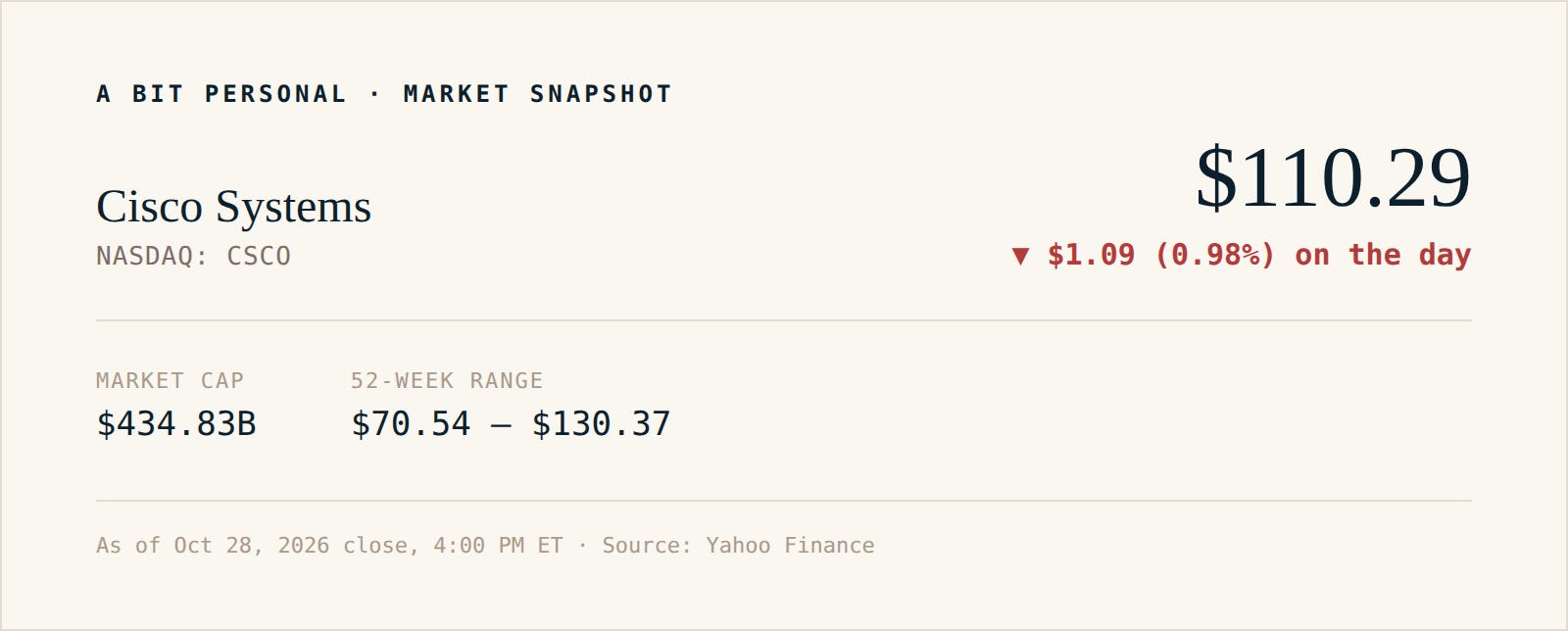
Cisco just closed its fiscal year with $63.3 billion in revenue, up 12%, according to its own results. The man running its products started with a very different kind of number: as an intern, he borrowed a quarter million dollars to buy into the company he worked for.
Jeetu Patel is Cisco’s President and Chief Product Officer. This week’s episode is about the people who bet on him early, and what he does with that now.
Know someone early in their career? Share this with them, and subscribe so you do not miss the next one. Below are my notes, but you can listen to the full episode wherever you get your podcasts.
This episode is proudly sponsored by JPMorgan!
The question his mother asked
Jeetu was weighing a move from Chicago to the Valley, a new job at EMC that meant relocating the whole family. He called his mother and asked if he should take it.
Her answer was one question: “Which one scares you more?”
The new job, he told her. He could not do it in his sleep. “Then take the new job,” she said. She never really understood what he did for a living, he says, but he calls it sage advice all the same.
Think about the decision you are putting off. Which option scares you more? That is probably the one worth taking seriously.
Thirty seconds of silence
Jeetu started as an intern, earning close to minimum wage. Then one of the co-founders told him the original investor wanted out, and the founders were each putting in a quarter million dollars to buy him out. Why didn’t Jeetu put in a quarter million too?
He went to a customer who had mentored him, a banker, and asked to borrow the money. The banker asked what he would do once he owned the business. “I’m going to run it.” You’re an intern, the banker said.
Then, in Jeetu’s telling, came 30 seconds of silence. “Okay, son, come by tomorrow, pick it up.” The rate was 10% interest.
Jeetu ran that business for 17 years and paid the banker back. The banker, who has since passed away, was one of the angels that come into your life, he says, “without whom you would not be where you are.”
What Raj did not have
In 2017, Jeetu took his wife and young daughter to the Taj Mahal. Their guide was a man named Raj, and on the walk back to the entrance Jeetu noticed he could switch languages for every group of visitors he met.
Jeetu’s thought was blunt. This man is smarter than anyone on my leadership team. Raj was probably making ten dollars a day.
The only difference between them, Jeetu decided, was a platform: America, education, tech, Box. Raj never had one.
His conclusion is the part I keep thinking about. If you are not given a platform and you do not succeed, that is not on you. But if you are given one and do not make the most of it, “shame on you.”
Paranoid, but not panicked
On AI, Jeetu does not take either camp. He thinks the risks are real, and he calls a headline like “10% chance everyone’s going to die” false precision. “Paranoid but not panicked,” he says. “Responsive but not reactive.”
His plan for Cisco was to skip the race to be the famous AI company and become the picks and shovels company of the gold rush: the infrastructure, security and observability that AI needs to run.
The results are public. In fiscal 2026, Cisco reported $9.3 billion in AI infrastructure orders from hyperscalers, including $4 billion in the fourth quarter alone, according to its earnings release.
Questions I’m still asking
* Who was your banker, the person who said yes when you had no business asking?
* What platform have you been handed that you are not fully using?
* Jeetu’s idea of a perfect day is getting 1.27% better than yesterday. What would that look like for you this week?
Try this week
Write down the last person who took a chance on you, and send them a two-line note this week. Say what their yes made possible. Jeetu still talks about his banker years later, and a note like that can mean a lot to the person who gets it.
Keep reading:
* Talent is everywhere, opportunity is not, Max Roser, Our World in Data. On why talented kids from poor backgrounds so rarely become innovators. Read it after the Raj story.
* Why “lost Einsteins” are hurting our economy, Marketplace. Economist Raj Chetty’s research on who gets the chance to invent, and how mentorship changes it.
* Mentorship strongly predicts protégé success in the sciences, Chemistry World. A large study finds mentees of eventual prize winners are two to four times more likely to have superstar careers. A data-backed look at the banker’s role.
* This coach improved every tiny thing by 1 percent, James Clear. The British Cycling story behind the idea of getting a little better every day.
This episode is brought to you by JP Morgan. Visit jpmorgan.com/techib