
In short
Podcast Summary: A Book with Legs - Episode with Amar Bhide
Podcast Overview Title: A Book with Legs Host: Smead Capital Management Description: The podcast focuses on value investing, featuring discussions with authors whose works have influenced the investing strategies and thoughts of the Smead team. The aim is to provide insights into the investment world for listeners of all backgrounds.
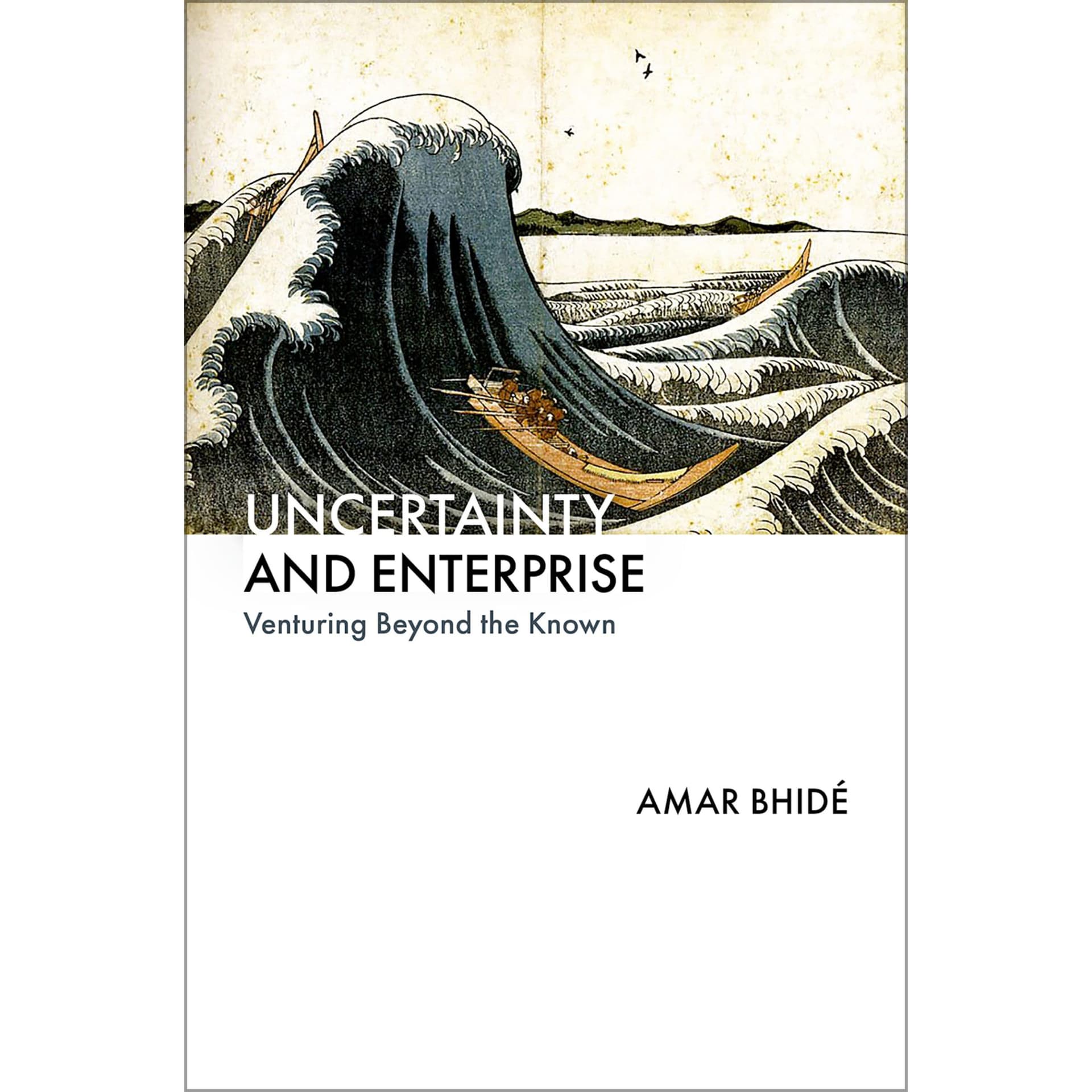
Episode Details Episode Title: Amar Bhide - Uncertainty and Enterprise: Venturing Beyond the Known Description: Amar Bhide, an author and professor, discusses his book "Uncertainty and Enterprise," exploring the relationship between profit and uncertainty in investing, contrasting old and new schools of economic thought, and considering the implications of artificial intelligence in these discussions.
Key Discussion Points
- Introduction to Amar Bhide
- Background on Amar Bhide:
- Member of the Council on Foreign Relations.
- Founding member of the Center on Capitalism Society at Columbia.
- Holds degrees from Harvard Business School and the Indian Institute of Technology, Bombay.
- Concept of Uncertainty
- Bhide's focus on uncertainty as a central theme in his work:
- Distinction from risk; risk is quantifiable and measurable, while uncertainty is not.
- Referencing Frank Knight’s ideas on uncertainty, Bhide emphasizes the importance of understanding human behavior, which often involves unquantifiable risks.
- Old vs. New Chicago School of Economics
- Knight's contributions to the Chicago School:
- Old Chicago emphasizes the value of unquantifiable risks and uncertainties.
- New Chicago suggests a more quantitative approach to risk, often dismissing the implications of uncertainty.
- True Profit vs. Competitive Returns
- Bhide on true profit:
- True profit arises from taking responsibility for genuine uncertainty, rather than simply returns on capital invested in a competitive market.
- Use of real-world examples (like board responsibilities and entrepreneurial decisions) to illustrate principles.
- Implications for Investment Strategies
- Discussion on existing investment paradigms:
- The focus on reducing volatility in investment often leads to overlooking genuine opportunities that arise from embracing uncertainty.
- The need for investors to recognize that uncertainty can spur innovation and new ventures.
- Investment Behavior and Human Nature
- Human tendency to oscillate between confidence and fear in investments:
- The impact of uncertainty on decision-making and how it can lead to poor judgments.
- Importance of narrative and storytelling in conveying investment rationale and decision-making processes.
Key Takeaways
- Understanding Uncertainty: Embracing uncertainty is crucial in investing; it can lead to better decision-making and innovative opportunities.
- Different Investment Strategies: Investors should appreciate the differences between various types of capital (angel, VC, public) and how they relate to uncertainty and risk.
- Importance of Narrative: The ability to frame investments through storytelling is essential for conveying value and understanding the broader implications of decisions.
Conclusion
- The episode concludes with an emphasis on the importance of imaginative discourse in navigating uncertainty, suggesting that understanding the human element in economics and investing is vital for long-term success.
Follow-up Actions
- Listeners are encouraged to buy Amar Bhide's book, "Uncertainty and Enterprise," and reflect on the insights shared during the podcast.
Additional Notes
- This episode highlights the importance of revisiting classical economic theories to better understand contemporary challenges in investing, especially in the context of rapid technological advancements like AI.
- Bhide’s arguments encourage a deeper exploration of how uncertainty is perceived and managed within the modern investment landscape.
---
This summary encapsulates the key discussions and insights from the podcast episode, allowing readers to grasp the essential concepts presented by Amar Bhide without needing to listen to the entire episode.
Written by AI. May contain mistakes. Listen to the episode to check what was said.
Transcript
Automatic transcript. May contain errors.0:02You're listening to A Book With Legs, a podcast presented by Smeed Capital Management. At Smead Capital Management, we advise investors who fear stock market failure. You can learn more at SmeadCap.com or by calling your financial advisor.
0:21Welcome to a Book With Legs podcast. I'm Cole Smead, CEO and Portfolio Manager here at Smead Capital Management. At our firm, we are readers and we believe in the power of books to help shape informed investors. In this podcast, we speak to great authors about their writings. The late, great Charlie Munger prescribed using multiple mental models and analysis. We analyze their work through the lens of business, markets, and people. In this episode, we're going to talk about risk, true profit, and the unknown future. We will also go deep into the bowels of thinking from the Chicago School of Economic Thought.
0:57Amar Bide is joining us to discuss his work, Uncertainty and Enterprise, Venturing Beyond the Known. A little bit of background on Amar. He is a member of the Council of Foreign Relations. He is a founding member of the Center on Capitalism Society at Columbia. He has written four other books. Mr. Biden has also taught at Tufts University, Harvard Business School, and like I mentioned a second ago, the University of Chicago's Booth School of Business. He has a doctorate and master's in business administration from Harvard Business School and a bachelor of technology degree from the Indian Institute of Technology in Bombay.
1:33Amar, thanks for joining me today. Pleasure to be here. Thank you for inviting me. We are going to have a lot of fun. I'm kind of, as I was going back to my notes and preparing things today, I was just kind of like juicing. And full disclosure, in very central to our discussion, I was actually at Chicago University earlier this week at the Gleacher Center there in Chicago. And so I got to speak there at the Booth School. And so it's kind of fun to be able to go into Frank Knight and discuss a lot of his core thoughts with you today. I've taught at the Glitcher School. Okay, there we go. I'd never been there before, so I feel like this is fortuitous that we did this today.
2:16Just to start out, you've written other books around this. So I kind of want to open it up by just asking this book that today that you wrote and published recently, why did you want to bring this out? What do you think this really exposed that was new in your writing and how you think about – like the book is titled Uncertainty and Enterprise. So uncertainty has been front and center in my mind since 1990 or thereabouts. Okay. and I have tried to insert it into practically everything that I've written. Sometimes with success, usually not. And either people say, what's the stuff? Get it out of there.
3:01Or it would be there and then they'd ignore it. And then finally I decided I should make uncertainty the central character in a big book so that at least it can't be ignored if anybody reads it. So whereas uncertainty was an important platform which I used, this is now my stage. And the uncertainty that I have in mind is something which was constructed in 1921, so that's now 103 years ago, by this guy called Frank Knight, who later on went on to become what is called the father of the old Chicago School of Economics. And there's a distinction between the old Chicago School of Economics and the modern Chicago School of Economics.
3:54Sure. And he made an incredibly perceptive distinction between risk, which is measurable, and more or less reliably calculable, either by definition. So if you toss a coin four times, what are the odds that you'd get four heads in a row? That's pure calculation. Sure. Or risk which comes from some stable distribution, which allows you to say, well, if it happened in the past, pretty much the same thing is going to happen again. Sure. And what Knight said is that, first of all, these two kinds of risk are the exception rather than the rule. In the actual world involving human conduct, they may be true of the natural world.
4:44So if you toss through a ball, it will land the same way. if the sun will turn in its orbit in more or less the same direction. But humans are constantly changing. And they're changing in ways which they themselves have no idea what they will do next. Sure. And he said this construct which he called unquantifiable and unmeasurable risk, he called this uncertainty. and he used this to explain the nature of what he called true profit. He said if you can model something statistically, whatever return you get for it cannot be true profit. Sure. That's simply a return on the capital that you invested.
5:33Correct. Determined in a competitive market. But true profit is what you get for taking responsibility for genuine uncertainty. It doesn't mean stuff where you know absolutely nothing, where you have partial knowledge. And I have cottoned on to this construct and I have used it in a variety of ways. So I've used it to explain, for example, why it is important for board of directors to have skin in the game. Not because they will catch the CEO from lying or cheating. Sometimes they do that too. but because the CEO himself or herself doesn't exactly know what is going to happen in the future. Yeah.
6:16That person is making a judgment and therefore that person's judgment needs to be second-guessed or at least verified. Sure. So I use this to explain the importance of what I call venturesome consumption, which is the idea that when we buy something, we have no idea what benefit we'll actually get from it. Sometimes after the fact, we don't know. Sure. I use this to explain the specialization of entrepreneurial enterprise. What's the difference between a bootstrapped entrepreneur, a venture capital-backed entrepreneur, and angel. And so I said, let me put all this in one place. Because the new Chicago absolutely dismisses any value to this idea.
7:02Sure. And to kind of make sure our listeners understand, and we'll talk about this later, but the new school simply is a highly quantitative and highly quantitative amount of risk is viewed to be central. Is that fair? Well, they basically say there's no difference whatsoever in measurable risk and unmeasurable risk. Sure. Because they say, unmeasurable risk, so what? I can construct in my mind a probability distribution. And then I can multiply the payoffs with the probabilities. And what do I care whether it was quantifiable or not? Sure. And that is not how the world works. We care a lot.
7:49I have a story in my book, which you may or may not. It's a legal case. It's called the Blue Bus Company. And it's a real case. It was tried in the Supreme Court of the state of Massachusetts in 1947 or 48. And the idea was something along the following lines. A guy is driving at night in a car, gets hit by a bus. The bus drives off without stopping. He suffers some harm and damage. The facts clearly indicate that it was negligence on the bus driver's part. so he sues this company called the blue bus company because it operates 70 percent of the buses that are that run in the area and he said well if they run 70 percent of the buses then there must be a 70 percent probability that it was one of that was a blue bus that hit me and civil suits say preponderance of evidence you know all that means it has to be a probability greater than 50%.
8:49And that's complete rubbish. And the judge said it was rubbish. And the Supreme Court of Massachusetts upheld the claim. So there are so many instances where we care about the quality of the information that we have. And that becomes one of the bases for how we construct what I call and imagine future because we cannot see the future, we imagine it. Well, and to your point, like in that case, they were saying it's a probability weight and it was actually a binomial event, it was zero or one. And therefore the probability didn't matter. Well, I don't think even using the language of binomial event, etc.
9:35It is what you feel in your bones. I mean, we frequently use quite loosely language like, oh, it's 50-50. What does that really mean? It really means we don't... Yeah. So since you mentioned Frank Knight, I want to quote, you have a quote from Knight in your book that I want to read because I think you're touching at exactly what Knight got at. So you said in your book, the, quote, ultimate logic or psychology of these deliberations is obscure, a part of the scientifically unfathomable mystery of life and mind. We must simply fall back upon a capacity in the intelligent animal to form more or less correct judgments about things an intuitive sense of values end quote isn't that what you're getting at we try to quantify something that it just sits in our mind and there's nothing quantifiable well the further wrinkle to it which I spend quite a bit of time on in this book is that if we could act unilaterally, if every man or every woman was an island and we were Robinson Crusoe's and we could do whatever we pleased on our little island, then we could simply rely on our individual judgment.
10:55The problem in human conduct... But we don't and we can't. And so we have to somehow convince each other that our judgments are reasonable. Sure. And there is where I say that the art of narrative becomes absolutely crucial. Because we cannot prove as in a geometry theorem that what I'm saying is correct. I cannot even show you statistics which tell you what I think is correct. I am forming my judgment through some combination of the evidence at hand plus imagination. And then how do I communicate my imagination to you? I can communicate my facts to you. But how do I communicate my imagination?
11:47And that's where we speak to each other in English. We are not talking to each other in math. and even though math is much more precise. And we use metaphor. We use analogies. We tell stories. And these things are an absolutely crucial aspect of what makes the world go round, or at least what makes the practical world go round. I agree. And none of this shows up in economics, I might add. Well, I agree. And so here's, you know, again, my, and we'll go into more of this, but just your goal in your book isn't to reduce uncertainty because we can't, to your point. Your goal is to better manage human affairs around uncertainty.
12:36And because like I work in the investment business. I mean, this is the craziest thing in my mind. Our industry spends all of its time trying to reduce volatility, which is predicted primarily by one-off uncertainties. That cannot be known, explained, or understood in advance. And yet, yet, they spend all their time trying to reduce those uncertainties. And my question is like, is that a good strategy? Well, I think it is not unreasonable to diversify, for example. And Neitzat said in his book as well, that diversification is one way of managing uncertainty. Gotcha. It's not unreasonable. In fact, it is prudent to get as much information as you can so that you are less likely to be surprised and more likely to be surprised.
13:38Sure. Well, and now that being against, obviously, you get paid the going rate for taking the going risk. And in today's world, the going risk is, to your point, it's a highly diversified risk, right? Right? Yes. So that your primary occupation is, well, what's going to be the going rate? In some eras, that's good. In some eras, that's bad. I would argue, I'll use beta for lack of a better term on the going risk. I think it's going to be pretty poor. So you're diversified, but the going return on risk is low. Yes. But most people, I don't think they understand that they're just taking the going risk.
14:19Isn't that fair? Yeah. The two things they don't understand. Okay. And I wrote an article about this once in 1994. I told you this thing has been on my mind for decades and decades. Sure. And the argument I made over there is that if you actually look at the numbers and you say, how do stock returns compare to bond returns? Right. Yep. The prevailing belief is that stocks always outperform bonds over a long period. Correct. That's a long-run bias, if you will. That's the long-run story. But I said, if you do two things, if you leverage up your bond portfolio so that it becomes as juicy as it were as your stock portfolio, and then compare returns over 10-year periods, stocks versus juiced up bonds.
15:19First of all, you find no difference in the returns. Sure. And this speaks to where we are, where we're in right now. What has happened in the last 10 years is a very poor predictor of what will happen in the next 10 years. Agree. So we assume that stocks are following, on average, a stable pattern. I mean, it's random noise plus, quote unquote, a stable rate of return for taking measurable risk. Yep. But even that is not true. And so what I said is, one way or the other, you have to make judgments. If I say, I'm just going to invest in the S &P, well, you're making a judgment that the composition of the S &P is in fact a reasonable proxy for the market rate.
16:13Sure. You're making a judgment that you wouldn't be better off having a juiced up bond portfolio. Or just a 10-year treasury without being used. Or just a 10-year treasury. You're making a judgment that you couldn't get better returns outside the U.S. And all these things may be true, but these are judgments that you're making. And people simply don't want to come to terms with that. They want to do something mechanical and then throw away the key and say… Well, that's the scientific approach. In other words, this is just what you do. It's like an algorithm. It runs itself. You don't have to touch it.
16:54And to your point, they usually make those assumptions when that, in the shorter term, I'll call it five or 10 years, that has worked. And so then, I guess, as Jim Grant once said, humans eat, sleep, and they extrapolate. And what we extrapolate on is nothing more than what we've recently seen, right? So let me pivot a little bit, because I think this is a really important idea that, again, I think about, I like that you write about, can you contrast simply for our listeners, the difference between risk and uncertainty? Because I think we kind of like, we went over that, but I just want to make sure to kind of touch on it from a Knight perspective and how you view that too.
17:30According to Knight, risk is quantifiable. Uncertainty is not quantifiable or measurable. And you'd have to add in the word reasonably quantifiable by a reasonable person or unquantifiable by a reasonable person. And that's where you'd get to my definition of uncertainty. Although in my definition, I think of uncertainty as a mental state, the state of doubt. It so happens that it's synonymous with the external condition of one-offs where you should not reasonably extrapolate. So anything where you should not reasonably extrapolate, let's call it uncertainty. Anything where you may reasonably extrapolate from what has happened in the past, let's call that risk.
18:27Most of the natural world is risk. Very, very little, if anything, of the human world is risk. Almost everything in the human world is uncertainty. Okay. So let me jump on that because, you know, you mentioned this idea in the mind. I always think of uncertainty. And again, I do think uncertainty like you. I always tell people it's that feeling that you get in the back of your head when things are going awry, right? In other words, like, for example, there's a high correlation between uncertainty and losses. You know, we go to, when we talk about Kahneman and Tversky, we can prove that, right?
19:06That people make poor decisions when uncertainty is higher due to loss, right? But I also, as I, and we'll come to this later, but when you're going return needed to be commensurate, AKA, let's just say the 10 years at seven, right? Your uncertainty is higher because what you have to do to get the going return. So I see some crossover between loss and cost of capital and uncertainty. But to your point, uncertainty is in the mind and it's in the back of your head and it's in your fears. And sometimes in your hopes. Okay. Since we're talking about current circumstances, which are very trying to say the least for many people.
19:48And since we are talking about people who'd rather not lose their money, we think of uncertainty as a negative thing. Yeah. And sure it is in certain circumstances. But in other certain circumstances, it's a spur. It's the positive thing that makes us human. Correct. So you don't want to go to a sports event where you know who's going to win. You don't want somebody to give you a spoiler to the movie that you're going to see. Yeah. Right. And equally, uncertainty or doubt can be something, hmm, what would happen if I did that instead of this, which everybody's doing? So it can be a spur to enterprise.
20:44So it's both a hindrance to enterprise. it is a it's an encouragement it kind of helps you if you are the kind of person who's willing to take it on that other people are deterred by it Hi, I'm Cole Smead CEO and Portfolio Manager here at Smead Capital Management and host of this podcast If you enjoy this podcast I'd like to invite you to check out SmeadCap.com At our firm, we are stock market investors We advise investors who fear stock market failure with a discipline that has proven success over long periods of time. Learn more about our funds at SmeadCap.com. Past performance is not indicative of future results.
21:30Investing involves risks, including loss of principle. Please refer to the prospectus for more information about the investment company, including objectives, risks, charges, and expenses. Read and consider it carefully before investing. Smead Funds Distributed by Smead Funds Distributors, LLC, not affiliated. So let me ask you one more thing, because I love the uncertainty being in the mind, but you pointed out something, and I got to touch on this because you were right at the tipping point of something. I feel like, to your point in economics, nobody wants to go near this. So you mentioned an absence of confidence, and then compare that to the spectrum of faith in God versus agnosticism.
22:10Okay. And I found that interesting because I would argue that humans are physical, they're emotional, they're relational, but they're also spiritual. Okay. And so have you ever, I mean, again, I'm not saying you have, or you have to, but I've also thought about how does the spiritual element of the human also play into the idea of the uncertainty, which again, like you point out is good in some cases and negative and other to the mind, but is purely human. So, because the future is not foreordained, at least for mortal human beings, whatever we do involves a leap of faith. even if it's a completely material decision that we're making.
22:59We're making a leap of faith that the way we are drawing on past evidence to imagine the future is more or less correct. And that in some sense can be compared to a religious feeling. Sure. and one of the people who reviewed my book in the Wall Street Journal he is a fairly devout Greek Orthodox scholar that was for the Heritage Foundation I read the review and we were talking before he wrote this and he said what you're saying is relevant to music and it's relevant to religion and I mean there's the famous Pascal wager which you may have heard of which uh which I think is is not right I agree with you by the way he came to the wrong conclusion and people traded it as though he got to the right conclusion because ultimately he said I might as well do it because again, the odds are, is what effectively made the case.
24:14But the truth is, but if you're not 100%, that means you don't have faith. Yes. Yeah. And there are people who have 100 % belief that there is no God. But there too, it's 100%. And uncertainty is the case of the agnostic, where you are completely, I don't know.
24:46That is, I think, in human conduct, possibly the most extreme kind of uncertainty. You're on your deathbed and you have absolutely, if you have faith, you're fine because you have a belief as to where you will end up. Well, and to your point, in times like these, We tend to watch people go from being the faithful to the agnostics pretty quickly on a myriad of subjects. Right. Indeed. Although in the markets, you see them oscillate with equal confidence that the world is going to be absolutely great to the opposite confidence that it's going to be just absolutely terrible. I agree. I mean, like I've joked around with people that in the last six weeks, we've gone from being, gosh, look how strong the economy is and we have American exceptionalism and look how great we are.
25:41Now it's like, man, the economy is going to be terrible in the future. It's like that was like six, eight weeks. So here's another example where being uncertain serves you well. Okay. Where if you are certain in either direction, you are liable to exercise bad judgment. Sure. Whereas if you say, hmm, I could be wrong. I'm not certain. That then allows you to make decisions which are more reasonable. Sure. Yeah, because you're not overconfident in the uncertainty and you're not underconfident in the uncertainty. I mean, if you're an investor, of course you need to act. You cannot stay in all cash all the time, which is what...
26:30So you need to have a certain amount of, let's say, positive confidence. Sure. But you also need to have that doubt at the back of your mind, which says, hmm, what if I'm wrong? I could possibly be wrong, and what signs should I be looking for? Sure. Well, let me – because again, in thinking about this, the other thing that I like you brought up, in – so the US Supreme Court Justice Oliver Wendell Holmes said in his famous 1919 dissenting opinion from the US Supreme Court, he argued how important the market was. And so in thinking about like risk and uncertainty, he talks about this idea of letting the market decide.
27:18how do you frame the market in the idea of uncertainty, risk, profit, etc.? So if we are thinking about the same quote, and I think we are, you said, let the marketplace for ideas decide. Yep. Right. And my answer to that is, if only. I mean, because the metaphor of a market is tens of thousands of people making independent decisions. Yep. And then collectively they decide what the quote unquote right price for something is. Sure. And, yeah, so that's one instance where the market is actually deciding. Sure. Or you say whether, you know, there's Android versus iPhone. Sure. And let the market decide which is the better operating system.
28:28There the metaphor begins to break down. because why do we have only two operating systems? And that's all we have. And both these people are not simply, quote-unquote, letting the market passively decide. They're trying to persuade people that Android is better than iPhone or vice versa. And then if you ask yourself, all those features in Android or iPhone, How did they get decided? Was there an auction which said we'll have a three-lens camera with an Apple or we'll have a four-lens camera? No, it's people arguing with each other, perhaps sometimes consulting beta users. So there's a whole matrix of conversations and dialogue which does not take place in an anonymous market.
29:31And that, or likewise, there's the famous quote from, who was the other guy, who said, states are the laboratories of democracy. Yeah. What is his name? I'm having a senior moment.
29:56And that is partially true. So you have a diversity of laws which are passed in various state legislatures. But if you dig into these things, each state is having a discussion in its legislature about which laws we will pass. So even the candidate laws are the result of discussion. Sure. And there's a lot of backroom negotiation as to what laws are voted on and what laws aren't. So I think Holmes is being a little, I think his point was exactly right, that one should not suppress dissenting opinions. I mean, that is just absolutely correct. I think his point that people who have, as he called them, fighting opinions and are ready to kill other people for their fighting opinions often turn out to be wrong.
30:57So all that is true. Sure. So Munger says to invert, it was one of his always mental exercises. Explain why when uncertainty is low, profit is low. For example, applicably, we just came off an era in the US stock market where the uncertainty was very low. In other words, people said, I'm going to buy an index. I'm going to make money. That's what you do. Or like if I came to you and said, Amar, don't you know that this AI revolution is coming? Don't we all know that? There's high certainty around that. And the only problem is you don't profit off of certainty. You profit off of uncertainty. It's things that were not well understood that profited.
31:46Yes. And things where you happen to be the person who had a different opinion from the crowd. Because if the crowd is confident, they will do the same thing. And then they will bid up the price of whatever it is that they're doing. Yep. To the point where there is no potential for profit. Yeah. And it is only when, again, your favorite person, buy when people are fearful. Yep. You know, it's sort of Buffett, you know. And so genuine investing profit can only be realized under circumstances, I believe, when you're doing something where you are just a tad more confident than everybody else who thinks this is a really bad thing to do.
Read the full transcript
32:45Sure. So why did Keynes, and again, I think, why I think you inserted Keynes, I think I know. I'm a big Keynes fan. Obviously, most people don't think of Keynes as an investor, but he picked stocks for the chess fund. And he was one of the greatest concentrated stock pickers of his era. Most people don't know that. But Kane's thought of logic, not statistical measures of this, like you pointed out, he would not be a new Chicago school person. He would be in the old Chicago school, though, as I think you noted in his book, him and Frank Knight weren't buddies. Hated each other. Yeah, they didn't like each other.
33:26but he thought of this as a logic exercise, not a mathematical exercise. Can you explain a little bit of Keynes' view on this? So there is to my mind, for my purposes, the useful Keynes and the distracting Keynes. And so the useful Keynes is in his 1921 book called A Treatise and probability. And the more distracting Keynes is the Keynes from 1935, which is the general theory of equilibrium. So let's stay away from the distracting Keynes and stick to the good Keynes. And what basically the good Keynes said was that if one thinks about probability in its broadest sense. One should include things which are not, or logic in its broadest sense.
34:29One should include under its purview things which cannot be mathematically deduced, but which, where there's some likelihood of this, there's some likelihood of that. and it was a valiant effort, much deeper in some senses than Knight's, to say what does one do when one wants to behave logically but where one cannot behave deductively or where one cannot behave statistically. And so where Knight threw up his hands and wrote the quote which you read earlier in the program. Yep. Keynes tried very hard to say, well, what can we do besides throwing up our hands? Sure. And that was the treatise on probability.
35:26It turns out that it didn't work. But it was an incredible intellectual ambition. Okay, so I'm going to step us forward a little bit. because you used one of my favorite examples of what you called uncertainty-free economics, okay? And again, I think this is so important to think about the idea of uncertainty and particularly the idea of uncertainty in a group, okay? So you mentioned when Bernanke, and I'll quote your book, quote, crowed at a 2005 conference in Boston that monetary policy had become a science. When money warrants tightening or loosening, experts will know it and act, end quote.
36:14Okay, I love this. Okay, so just so you know, Amar, I got in the investment business in 2006. And I think often about the idea at the time was that, listen, we had not had big imbalances in the economy. So therefore it's become down to a science. and we all claimed that and we said listen housing's a science monetary policy's a science and then what happened was obviously the world changed the uncertainty was far higher so i say that because again if i was going to use more of a current example that at the pandemic low ultimately the science was the fed knows how to manage problems and will always aptly be able to provide liquidity to those problems.
37:02Not the same kind of science, but just the idea that there will always be liquidity. More recently, it was that our dollar is so strong and our way of life in America is so exceptional that that will never change. That paradigm is here forever. And why I find those two arguments coinciding with the last couple of years really interesting, as we watched the 10-year treasury move a few nights ago in a very odd way. And the dollar. And the dollar. What we're learning is that what they thought was certain is becoming less certain by the day. And it's in many cases, it is the people, or I'll call it the market participants' confidence in what they consider low uncertainty.
37:54So there are two sets of players in this There's one set of people who are relying on past patterns So the past pattern is that there's a dollar smile Which is that when things are really going haywire People will buy the dollar because it is the currency of last resort And the other side of the smile are people who say, when things are going really well, that's when people will buy the dollar because America is a country of growth and so forth.
38:30And the fact is, this has been roughly historically true. But the key point is that it has only been roughly historically true. Correct. Right. And so it's like the blue bus company that I told you about. 70 % of the time it may be right. But is that a bet in all circumstances worth taking? Well, and also I think to your point on those two smile ideas, there is a difference in duration to the bet, if you will. So for example, the dollar was king in 2002. Six years later, the dollar was dead. Okay. And then the more recent past, the dollar became king again. And, you know, as I've discussed with a friend of mine who runs, who's involved with a global macro hedge fund, we are outcome dependent, right?
39:23That's our job. We're outcome dependent investors. So therefore, if the dollar is going to do really poorly, that is an outcome in the future. And therefore, you want to plan accordingly. versus someone on the path might say, hey, if in the next three months, some tumult picks up, the dollar could appreciate in the near term, which to your point might be a kind of like near term risk off trade. But again, there's like this also dispersion of durations in those two ideas you're mentioning. Yeah, no, absolutely true. And again, there's a difference between trading as a fiduciary or investing as a fiduciary.
40:06and trading on your own account. Sure. And I used to have a sub-hedge fund, and I used to be a prop trader once. And eventually I gave that up because I have an iron stomach when it comes to my own trades. When I'm responsible for other people's money, that requires a certain amount of, let's call it, moral fortitude, which I don't have. And you sort of have to know yourself. And I admire people like you who have it. Full disclosure, just so you know, I don't, I mean, my PA is what we do for investors. So to your point, I think of them, they're symbiotically the same. Yeah. But it's, it is still different even if you every single penny is is in your own fund as it should be uh the fact that you are responsible for other people's at least it wore me down and i i was on i was on the board of this uh this investment trust for three years called Scottish Mortgage Investment Trust.
41:30And they invest neither in Mortgages nor in Scotland. They were the largest investors in Tesla. They were early and large investors in modern. Yeah, part of Bailey Gifford? Part of Bailey Gifford, exactly. Yep. I got thrown out of that because I spoke my mind. That can happen on boards, by the way. Not very often on investment trust boards. So I ended up in the Financial Times as being sort of the guy who, British boards are not supposed to speak your mind under any circumstances. Yeah, you're supposed to only do it behind closed doors there. It's bizarre. Yeah. And what I found, what attracted me to that board, why I joined in the first place, was I wanted, I love this.
42:21I mean, I like technology. I like entrepreneurship and so forth. And so I was, I mean, that was part of the conflict, which is I knew more about the business than everybody else on the board. And everybody else on the board knew basically nothing. And so they were unwilling or unable to play the role of, I mean, they're unwilling to have a discussion even. Sure. When I asked for it. Be that as it may. What I was really interested in is what is the mindset of someone who can buy a Tesla at a very high price? Because I couldn't. What is the mindset of someone who can buy a Moderna? And these are different people.
43:11And Bailey Gifford, I have enormous admiration for them. They're a very professional firm. I mean, my conflict was not with Bailey Gifford. It was with the board. And to this day, I think the guy who's the investment manager was a genius. But it was more than he was just a genius. It was his instincts, his courage. which is, I hope you don't mind me saying this, because you're a value manager, correct? Correct. And I wrote in, where did it get published? I published it somewhere else. It is in some sense easier emotionally to be a value manager than to be a speculative growth manager. My biggest criticism, and I think this will probably touch on what you're getting at.
44:14My biggest criticism of other people, and again, I think Buffett deals with this uniquely, in my opinion. But my biggest criticism of other people that, say, come from a like-minded approach, as we may, is they are actually pessimists on the future but still want to make money, if that makes sense. Yes. Okay? Yeah. In other words, all the world could go to hell and I still make a profit. And I think what I've learned, and to your point, is that the arc of humanity is so bright and therefore the air of not only investors at certain junctures but people that like buying things attractively priced at other junctures are that they tend to not think highly enough of the future or not hold as owners.
45:05long enough in that future? So I think one of the bravest things intellectually that Warren Buffett did, which he did, I believe at the behest of Charlie Munger, was to give up buying cigarette butts on pavements. Sure. And to go from being someone who would only buy stuff which was dirt cheap where the cash value is higher than the price, et cetera. Yeah. To saying the value lies in what this company will do in the future. Correct. That was an act of enormous courage and enormous imagination as well. Yeah. Yeah. And because you can take the absolute, you know, Benjamin. So Buffett is not a Graham and Dodd guy in the pure sense by a long shot.
46:11The idea of buying great companies at good prices and being willing to pay up, pay good prices for great companies, means that you are making, there's an act of faith, there's an act of imagination. Yep, I agree. And to your point, there's a hope and a willingness to dream is how I think about it. Yes, that Coca-Cola will continue on its trajectory. The moat is deep enough that that I'm willing to pay more than whoever sold me the stock. Well, so let me, let me, let me, because, okay, so I'm going to tie this into my next question. So Vernon Smith's work is in your book, okay? He said, quote, all traders might well be rational, but if this rationality is not common knowledge, traders might speculate in the pursuit of capital gains and bubbles might arise, end quote, okay?
47:10okay so like my question i was going to ask was how can rationality not be common knowledge but in the context that you're explaining it there let me go one step further and and i'd love you to kind of use smith's idea with this i agree with everything you're saying one of my problems is so does everyone else okay in other words the idea that you go out and buy great businesses in the long run. And so the market adapts because markets do adapt. They're complex, but they're adaptive systems. They adapt. And I think the amount of uncertainty they're ascribing to that idea is higher than they predicted.
47:55And therefore, what we're going to find out is that because the uncertainty was higher for what they were doing under that rationality, is that the outcome is worse than they thought. And I'll use Coca-Cola as an example. Buffett bought it, I think, and he bought it in 87 originally. And at the time, what he was watching was the returns on capital to business. And I think the return on equity of Coke went from like 25 % within a couple years. It was at like 50%. He bought more. Because again, he was saying, gosh, for the returns on capital to business doing in the bright future, people don't understand this.
48:30So then in 98, he called Coke and Gillette the inevitables. And obviously Gillette today is part of Kraft and Coke is still a standalone business. And what coincided with him saying that was obviously the late 1990s. And it ended up being that Coca-Cola was part of that bubble. It was part of this idea that in the long run, you buy common stocks and Coke's a long-term winner. And let's just overpay for great American businesses like we tend to do at Manias. And Buffett, a couple of years after that said, hey, here's a deal. I should have been selling the stock because when I said that, it was ultimately his lack of uncertainty that he was exposing.
49:12But the truth is the uncertainty was far higher. Now, again, Amar, I, you know, under this framework that you're saying, because again, how can rationality not be common knowledge? I have walked forward. We have looked and said, okay, let's just say that when Buffett said that in 98, he had sold the stock. how would he have done to today? And the answer is Coca-Cola has underperformed the S &P 500 for 27 years, okay? And so again, to your point, I tend to think that when people talk about Coke is kind of like that good example. And I'm sitting there like, that's a terrible example. That's a terrible example.
49:52Because again, in many respects, like no one uses American Express for that, but American Express was a better example of like, Like, you know, again, having faith that the returns on capital and the brand and the future of the business is far greater. And so the reason why I say that is because watching people crowd into stocks like that today with these uncertainties, like, wait, they're buying the 27-year bad story at what I would argue are expensive prices. And even though there's good attributes of that business and there's good returns on capital, it still might be a 27-year bad story. Yes.
50:24And so you have to be always cognizant of two things, but you can't be too cognizant of them, which is that in human affairs, you're always making a judgment. Correct. All judgments are fallible and all judgments are transient. They're not necessarily transient from one moment to the next. Correct. But things change. that is, so what is a great business today may not be a great business five years from now. I agree, but we like heuristic things, right? As you talk about your book. So we like, well, you know, that old rule of thumb, you know, like, oh, just follow your heart. Well, that might be a terrible idea in certain situations, but we use it all the time.
51:08Let me, I wanna show a chart here because I wanna show this because obviously it's from your book and I, you know, thinking about some of these paradigms we're talking about. So I use your chart, again, and thinking about uncertainty on the Y-axis and investment and complexity on the X-axis, okay? You know, thinking about this across the investment sphere. So, you know, you talk about like a true, like bootstrap company, you have your angel backed, you have your VC funded, and you have your public company prospects. Can you talk about as, you know, you go out, particularly on the X-axis, I think a lot more about the X-axis on this than anything, because a company that's public is less likely to fail because it's got funding and ability to access funding, which is obviously different than the bootstrap company.
51:57But can you kind of talk about this paradigm that we have here up in graph form? So lurking behind this graph is the source of capital. So if you are a bootstrapper and you're starting a business entirely with your own money, then you can do what you want. And therefore, you can get into businesses where there's very little evidence about what the prospects are, the genuine prospects for making a profit are. So that is one extreme. But unless you happen to be Charlie Ellison's child, you typically don't have a whole lot of money to put to work. Correct. So the size of your enterprise is going to be small.
52:51And typically in small enterprises tend to not be very complex. Sure. At the other extreme, you have, let's say, Microsoft in its current time or a Coca-Cola or an American Express. Where by this time you are a fiduciary for quite a large number of diffuse stockholders with whom you have no contact. And so they would hope that you are a reasonable manager, but they can't really know this. So what they are betting on at the bottom is that you have a good management process in place to not have you go crazy. And so this combination basically does several things. One is that it means you have a ton of public investor dough.
53:51And so you can undertake projects which are ginormous. Ginormous projects also tend to be complex. They have tons of moving parts. I mean, think of the supply chains, think of all the people working in a variety of functions, and then your managerial process helps coordinate that. But then, equally, the managerial process is fairly demanding of evidence. And to the degree that it demands evidence, you will not do the crazy stuff which the individual entrepreneur can do. This does not mean, if you put up that out again, you'll see that it's not zero on the y-axis. It would be, it is still above, it's still a non-zero uncertainty on the y-axis.
54:50Yeah. But it is simply less. And so the challenge for the public companies to allow for a certain amount of uncertainty, to allow for a certain amount of judgment, but yet put in enough checks and balances that people feel confident that you're going to do a good job. sometimes this means that you will be late. I mean, the interesting thing to me, example of this is actually Apple. Apple is never on the bleeding edge of technology or has not been on the bleeding edge of technology since, let's say, the early 80s. Sure. It always waits until things have shaken down and then it comes in in full force where everything is buttoned.
55:46And what I find today is that the chart that you displayed has broken down. And the world, I'm not just now talking about the financial markets in which you invest. Okay. I'm talking about what companies are doing inside them. Sure. has gone completely haywire because everybody has told them
56:14AI is the future. Yeah. And there's absolute confidence that if you don't invest in AI, you're toast. And in my personal experience of having tried to use AI or actually large language models for ever since they came out, But if there's one of those few things which I feel confident about is that a very large proportion of the investments that these companies are making are going to go up in smoke. Hey, I want to give a big shout out to everyone who's been working so hard on this show. You know, we recently hit the top 10 in investing podcasts on Apple Podcasts and even number one in the business category in several countries.
57:00As you may know, this show is brought to you by Smead Capital Management. Smead Capital Management understands how frustrating and illogical the stock market can be. If you're searching for funds with a proven track record, give the Smead funds a look. Or better yet, reach out at SmeadCap.com. And don't forget to mention, you're a fan of the podcast. Past performance is not indicative of future results. Investing involves risks, including loss of principal. Please refer to the prospectus for important information about the investment company, including objectives, risks, charges, and expenses.
57:33Read and consider it carefully before investing. Smead funds distributed by Smead Funds Distributors, LLC, not affiliated. You're hitting at a topic, and we didn't talk about this before the show, just so our listeners know, but you're hitting on a topic that I've been running around talking about in a presentation, okay? And how I term this idea, I talk about the hyperscalers, right? Which are the companies like Microsoft and Amazon and Google and Meta who are producing all this CapEx in this subject of AI. And here's, you know, again, the uncertainty is considered to be very low in this, which I'm always naturally skeptical of because low uncertainty means low profit.
58:17Okay. And so what I find really interesting is if you parse back and say, okay, you know, when I take out all the CapEx and I take out all the stock-based comp, what are these businesses actually making in cash returns? And the answer is they're very low today, like sub-20 % returns on capital for many of these businesses once you take out all the costs. Now, here's my problem with that. Are these technology businesses? Yes. So they produce all things equal, higher returns on capital than other businesses that would attempt that. But in every situation in America where we have found someone who uses the word revolution for describing what goes on in an industry like the shale revolution, it has always done one thing, put massive amounts of capital spending on an industry and massively diluted the returns on capital and thus the valuations people will pay in the future over time.
59:17Full stop. So I have a friend who's an old line, very successful oil and gas guy. Okay. And for years, he's been saying that shale has terrible economics. I don't know enough about the industry to have an opinion. But he said these things just sort of eat up cash. Correct. But this is going to be the answer. This is going to be the clean energy stuff. I mean, it is true that the core businesses, Microsoft, for better or for worse, Microsoft, Amazon, Google, have virtually impregnable, very deep moats for what their basic functionality. but they are taking the profit that these moats are producing and throwing it like drunken sailors.
1:00:23I mean, Microsoft is an odd one. They kind of, in some sense, remind me of what IBM used to be like, which was where IBM, you have to buy from us, What choice do you have? Enormous profit margins, et cetera, et cetera. And they got arrogant. They pissed off their customers and people bought because you had to buy IBM. What choice did you have? Microsoft and these other guys are also, pardon the French, but there's a term called entertification.
1:01:04and they're really taking their franchises and virtually willfully destroying them. And I don't know when the comeuppance will be or what form this comeuppance will take. But this is not a sustainable game. And again, how I think about it, And to your point, if the returns – I know the history of stocks are that when returns on capital are good, investors will naturally – if you can consistently produce high and sustainable returns on capital, investors will pay more for your business because A, the consistency and B, the size of returns on capital, right? Right. And what I don't get, and again, this is not for me to decide because I don't own them, but it's again, it's the opportunity cost, if you will, is that when businesses naturally take their returns on capital to much lower levels at time and time again, the market always pays less for that.
1:02:04It takes a while for them to figure it out. But again, oil and gas businesses went from being a small G God in the 2010s to in the, at the 2020 low, nobody want to touch them. And, And we're still kind of seeing like this is like the second wind of like nobody wants to touch them. But I say that because in many cases, the ideas in those manias are right. They're just poorly priced. So in this particular case, I'm not convinced even the idea is right. So the railroads are a case where there's a mania where the idea was right. Yep. The internet was the same way. Like the internet was right, but it was poorly priced.
1:02:42Yes. But this thing, I don't even think, I'm not at all convinced that the underlying product has the value that it is claimed to have. But don't those companies get the valuation today based on the idea that they're right? Well, they're getting it based on the idea that everybody believes that they are making great investments with their cash flow. Mm-hmm. More than others. Yeah. So the distinction is that the railroads in railroad manias were madly building railroads. Yep. And what was wrong over there was that everybody was building a railroad and the capacity, at least in the short run, could not justify everybody investing in a railroad.
1:03:38But at least those railroad are moving and people from point A to point B. It is not clear what the hell this stuff does. Well, and also what usually coincides after malinvestment takes place, as we know from an accounting perspective, someone comes in and says, hey, we built this asset. It's not worth anything. So we've got to write it off and that's effectively a write-off and the book value comes back in line. But from a pure accounting, like again, we're thinking about this conceptually for logic and all that kind of stuff. But I think about the accounting where it's like, yes, at a later date, the returns on capital of the business will go back after it takes a balance sheet impairment on an asset that was of little value.
1:04:18Yes. We've poured money down the drain and we wrote it off. Correct, correct. Yeah, but at least we admitted our wrongs. So let me – I want to show one other thing because I want to show my other chart because I love this. And you touched on this just a second ago. So, but you discuss in your book how often highly successful people or businesses or stories, they don't create anything new. So here's the other picture of this, okay? And I love this because, I mean, admittedly, I'm biased. Amar, I sit in an industry that's not new by nature. and that doesn't mean that something can't be done that's unique and incredible and highly productive for society and has the ability to grow and compete even though it's like call it old line.
1:05:10And even if you talk about new line stuff, it progresses possibly very quickly, but it progresses in little steps rather than great leaps forward. and frequently the people who are successful were not the ones who took the first step or took an original step at all. I mean, Microsoft is a classic example. I mean, its monopoly is based on an operating system. It was not the first. It was not even their own operating system. They were behind Apple in graphical user interfaces. They just more or less bullied their way up. They did not invent spreadsheets. They did not invent word processors. They didn't invent PowerPoint.
1:06:09Microsoft Teams is a follower after Zoom, and Zoom is probably a follower after who knows what. Sure. So the whole history of, let's say, new line businesses as opposed to just old line businesses is a history of people passing the baton and who then crosses the finish line and gets the winner's cup. Sure. Maybe very many people removed from the person who sort of got off the starting blocks. Sure. So let me turn to another thing that you had in this, and I loved this because you get into the conversation like bootstrap businesses versus VC investors and kind of the criteria or how you go about that for those different types of investors.
1:07:00So let me ask you the question, why can't VC investors just focus on the defects of a founder-led business or the founder themselves? Why is that not a winning strategy? Because that wouldn't be enough I mean, because everybody and his uncle and his dog shows up at the VC's door They are all in some way, shape or form defective Nobody shows up with a perfect business idea
1:07:38And so part of what a good VC does is to co-develop it with whoever came looking for money. Now, frequently the VCs exaggerate their contribution to the co-development. Sure. But their job is much more than sort of saying, well, you know, like being, let's say, a tennis coach. It says, I see this wrong in yourself, and I see that wrong in yourself, and if only you fixed that, you'd become a Federer. No, you probably wouldn't. Yeah. And you have to have some capacity to spot the 14 or 15-year-old who not only has the physical talent to become a Federer, but who will mature into the sort of person who will be capable of winning Grand Slam tournaments.
1:08:37Sure. Sure. And at that point, you're getting a raw, unformed person in front of you, just in the same way that a VC is getting a raw, unformed person asking for money. Sure. So I'm going to ask you in the next question, because it kind of plays on this idea. Can you explain the difference between an angel investor and a VC investor, how they profile and how they view their investment opportunities? I think you you use the example of Andy Bechtelsheim, who obviously is of Sun Microsystems fame. We got to interview Scott McNeely here on the podcast. So I'm kind of, I loved your example because, you know, I love the Sun history.
1:09:16But Andy in passing after meeting the gentleman at Google, like in a quick meeting cuts them$100 ,000 check, like almost sight unseen. Yes. And that's a vastly different investor as an angel for Andy than what a VC investor would do. Exactly. And I think the difference has widened over time. Okay. Because in the early days of VC, it was a very informal business. And the amounts were relatively small. And people like Arthur Rock, who invested in Apple, et cetera, were not that very different from Andy's writing a$100 ,000 check for Google. Yep. Now it has become much more institutionalized. Now we're talking about VCs raising huge sums of huge funds in the billions.
1:10:12And they're not raising these funds from wealthy families or wealthy individuals. They're raising them from institutions. So these institutions have a fiduciary responsibility to, quote unquote, vet the VC. So that means writing out a 30-page questionnaire about what your investment style is and what your investment process is and who all you have on your team, et cetera. And inevitably, unless you're going to flat out lie about it, you're going to develop an investment process that suits what the institution they're looking for, which is a systematic process. Or put it another way, it's a strategy in search of a customer.
1:11:03Yes. So they have become, in some sense, much more like the large Microsoft or the large IBM, which is that because IBM and Microsoft are beholden to diffused investors, they have a responsibility to have a management process that is more prudent. shall we say. Or like the stock pickers would be accounted for in a prior era. They had to have a process they could show and develop and show as repeatable. Exactly. So let me ask you, because again, I've been thinking back to your graph paradigm, the angel and the bootstrap at the top left. And as you go out to the right and down the uncertainty curve, you're going down to the public company.
1:11:52The one thing I thought about though, is like, that's the natural progression. That's how it slopes. That's why it's sloped that way along those axis.
1:12:02ultimately, this is outcome-based investing. VCs are outcome-based investing. Ten-year lockups are very normal, as you point out in your book. But ultimately, those lockups require something at the end. And so I guess my question is, what if the public markets are poor to raise capital, or let's say it's a poor return era, doesn't that also feed back up the uncertainty curve where if the public markets can't provide liquidity, doesn't that ham up the business model of the venture capital firm? Because who's the buyer when the investors are done? Well, that's the negative side of it. The positive side of it is that it flushes out a whole bunch of people who should not have been VCs in the first place.
1:12:49Sure. Who cannot raise their funds. And therefore, starting a VC fund when markets are poor, If you can raise the money, it becomes extremely difficult to raise the money, is not such a bad thing. Sure. And that's capitalism for you. You know, we go through periods, lean periods, we go to rich periods, and one frequently leads to the other and vice versa. And then there comes a time when very few people get into VC, very few people can raise a fund. And these funds, because they don't have much competition, they end up investing in some great businesses. Then everybody says, oh, VC is where we should be in.
1:13:39And all the institutions crowd into VC as they have. Yeah. Well, you point out in your book that obviously they have access to information that sits in private markets. So obviously there's not as much work done on that. And therefore this access to information provides value. they also involve themselves on as you know i'll call it management organizations to their portfolio companies to really be on the board you know they're having far more oversight of the organizational structure the board comp composition things like that obviously that does not go on the public markets though obviously institutional investors do have some say i'll call some, not a lot.
1:14:18But I guess, you know, as I think about that, is the information and the ability to organize these companies, is that where their alpha is? Or is it really just a newer part of the public markets? In other words, because again, you're kind of like in the small cap realm, like we used to think in public markets. No, I think investing in private companies preceded investing in public companies. Sure. So JP Morgan and General Electric and all that, these were essentially private investors. Public markets for public stocks really did not become a respectable thing till the 1920s. In a great many parts of the world, my father's business was funded by an angel.
1:15:11You know, so I think the American system of raising capital through public markets is pretty much the exception rather than the rule. And even there, it used to be the case that a company like Hewlett Packard started out in a garage with the founder's own funds. Yep. And they built it to a sizable enterprise. And long after they had built it to a sizable enterprise, that they went public. Yep. And that was the norm. I mean, the New York Stock Exchange had rules about how many years you had to have had a profit.
1:16:06And NASDAQ upset the apple cart. And particularly in the 2020 and 2018 mania, you got people buying into private markets. without any real knowledge of what they were doing. And this was the argument that I had with Bailey Gifford and with Scottish Mortgage. I said, you have a tremendous talent for investing in public markets and at the bleeding edge of public markets. It requires a completely different set of skills. to be an effective manager in private markets. I'm not saying that one is easier or one is harder. It's different. It's like being, you know, running a model to make credit card debt versus being a frontline bank officer, you know, lending to a small business.
1:17:18So you can't have the same people following the same process doing both things. And we have had, we've gone through this period, which I hope we are unwinding now, of people just throwing money at pre-public companies. I mean, we see this with open AI. I mean, God knows what its profits are. It has a valuation of what, like$300 billion or something like that? Well, I was going to say, God knows, but no one cares. No one cares, right. Yeah. Yeah. And companies of the sort like Microsoft are writing them checks at these enormous valuations. And really? What happened to your fiduciary responsibility to your stockholders?
1:18:14Well, so I want to come back to one last thing with you, but I'll just throw this out to our listeners. this section where you talk about Galbraith and DuPont and GM. And I'm trying to think of the other things I had here in my notes that I just, I totally ate up. You mentioned Shumpeter in that part and Alfred Chandler. I would say our listeners have got to go listen to that because I love that discourse of what American business was thought to be in the enterprising fashion of it, which in some respects is like the big cap tech companies today, but not exactly. but I want to come to another part because I think this is like this is maybe the seminal part of your book and I loved it your chapter on imaginative discourse okay you are ultimately meeting the need of uncertainty through humanity and can you explain the why can I deviate a bit and talk about AI because it's not unrelated okay These large language models appear to talk to you.
1:19:21Yep. Right? And they appear to have a human-like conversation with you. Yep. But if you look underneath the hood, all there is, is a statistical model. They have no sense of meaning. They're literally not making sense. They're making statistical predictions about which word or which set of words follows what came before. And therefore the writing tends to be pedestrian. I have tried to use it frequently. The human capacity for conversation, for discourse, which is so vital to our day-to-day lives and how we work together as a species, relies on this capacity to communicate our imagined futures and to share our imagined futures.
1:20:28and that's where we are in the realm of literature rather than math. Sure. In the realm of history rather than neurology, for example. Well, let me ask you, because when you said that, the thought that came to my mind was, what you're saying is these models are path dependent, right? In other words, they're statistically trying to make decisions based on the path, right? Versus we're outcome people, right? Like I want to get married. And you said, how did you get to the path of that? It's very random at times. It might not be as path dependent. I don't think it's so much path dependent as it is dependent, variable dependent.
1:21:17Okay. And the assumption is that if you throw in some of these models of Bill and variables into the pot, it will correctly predict what the next word should be. Okay. And there is no attempt at thinking about context, meaning the emotion you want to communicate. Sure. It is literally computers. is following the metaphor of the mind as a computer. Herbert Simon considered the father of artificial intelligence. That's literally how he thought about the mind. Sure. There's another character in my book called Jerome Bruner who took the opposite approach. He said the mind is a meaning constructor in a way in which the computer is not.
1:22:14The mind constructs meaning from its past experiences, from culture, from looking into other people's eyes, from trying to understand, from having empathy. And hopefully that is what is the basis of our speech, not a statistical prediction. Gotcha. I love that. When also, to your point, we've all now come to this conclusion with these large-language models today. Now, to your point, these theories and ideas have been out here for decades. They're not brand new. No. But we all seem to agree at this point, at this juncture, as though it's eternal and it might be ephemeral. Yes. I mean, the reality is that artificial intelligence in one way, shape or form is deeply woven into our lives, but has been for the last 25 years.
1:23:17Correct. So we are using the conversation we're having, realizing statistical sampling. Yep. Because otherwise video would not transmit. And in this particular use case, sort of sampling, say, every third bit or whatever is fine. Because that transmission does not require any meaning making. But the fact that we're having the conversation requires meaning making. So where the use cases are appropriate and where the use cases are not, where the statistical process is good enough. For example, in autocomplete on your phone, I mean, yeah, it occasionally gets stuff wrong, so what? If you had a legal contract written up with autocomplete without having checked what was actually produced, God bless you.
1:24:19And we cannot predict in advance which uses will work and which uses won't work. It's a gradual process. Well, and to your point, I mean, it's better predicting my next word when I'm typing things because there's more logic involved versus if I say something, it's way worse at predicting it because there's something more human about that. Well, it is and it isn't. So I find the autocomplete when I'm trying to write something intelligent and serious, which doesn't happen all the time, but I try. The autocomplete is terrible. If it is trying to autocomplete a simple message, somebody inviting me for dinner and say, yeah, sure.
1:25:08Yeah, a text message, for example. Yeah. So in that particular case, it's statistical prediction that you should have one or the other response and that's all you should have is good enough. if I want to persuade somebody that this is really the restaurant you should go to, and here's why, and I compare it to blah, blah, blah, blah, blah, it could not autocomplete. If I wanted to say, hey, remember the restaurant we went to? It's exactly like that. Sure. Unless that autocompleter is a mind reader, it does not know that we went to this restaurant together. way back when and had a great time. Or we went to this other restaurant and had a terrible time.
1:25:57That was a human experience, which is in our memory and which I can invoke, because I think it's appropriate. And I would not invoke it if you were the person or I had suggested going to this place where we had a terrible experience. And I understand this is probably a bad thing to remind you of. Well, and to your point, it gets back to the idea that the human is, you know, it will provide uncertainty. And by nature, these models are providing certainty. Or they're relying on numerical risks. So they know the probability distribution of this word following that word is such and such. And they have a set of rules that say, pick the third most likely, it's some crazy algorithm.
1:26:49But it is something like that. Well, yeah, what you're getting at then is if I go out and say, I want to find a totally unknown, great Italian spot in, I don't know, Chicago, for example, it's just going to go out and give me what people generally think are good Italian restaurants, statistically speaking. But it might not find the diamond in the rough because ultimately that would be where I truly profit relative to everyone else. and it can't by nature do that. So that's a really good example. So there are two problems with using other people's recommendations for Italian restaurants in Chicago.
1:27:30One is after a while, the restauranteurs figure out that they need to game the system and they start putting up fake reviews. Yep. But so the information value of those reviews sort of goes down over time. This is what I was saying earlier, which is that you need a stable process. And the fact that humans are involved in this means that they will game it so that the reliability of these reviews yesterday will not be the same as the reliability of the reviews tomorrow. borrow. Secondly, I don't just want to look at the stars. So for example, when I go to Amazon to look at reviews, first of all, I look at the three-star reviews, not the five-star reviews, not the one-star reviews, because the one-star reviews could have been put up by someone who's trying to badmouth you deliberately.
1:28:25The five-star reviews may have been paid for. Then having looked at the three-star reviews, I actually read them. And I try to see whether the good things they say are important to me. If they're not, then it's irrelevant. Or if the bad things that they say about it are... So I am making meaning for myself through reading the reviews, which unless there was somehow this AI system had an implant in my brain and had access to all my feelings about why I would want a shoe of this sort or what purpose I might want it for, what I'd be willing to pay for it, what kinds of trade-offs I'd be willing to make, it's not going to do that.
1:29:21But on the other hand, if you're buying something like baking soda and then you find someone who has five-star reviews, you don't care. Baking soda is baking soda is baking soda. You know what I mean? Yeah, it's not a high touch, as you said in your book. So here's why I like it. When I do go get a good restaurant in your neck of the woods, I am going to call you because I feel like you have a massive information edge compared to how I go about doing that. Amar, I was going to ask you, where can our listeners follow you going forward? Obviously beyond your book, are you on social media? I am on social media.
1:30:02I'm on LinkedIn and I'm on Facebook. But I also have my own website, which tends to lag a little bit. But practically everything that I write about ends up on – So hopefully I should be having an article in Barron soon next week or the week after on what has gone wrong with universities. And hopefully your listeners, at least some of your listeners are going to go head straight off to Amazon and buy my book. Yeah, I agree. Yeah, I appreciate your time. And I will make that pitch here too. Your book, Amar, I believe gives investors a paradigm for thinking across the spectrum of investment opportunities.
1:30:44You do a great job of explaining the work that an angel may or may not do, to your point, versus a VC investor might do, versus a public investor and the amount of investment needed for that. My favorite part of the book is how discourse, prose, and addressing the underlying person may be the best and I would say the only way of dealing with uncertainty that obviously, as we talked about today, always arises. We can see this today in 2025 and we'll see it forever. To your point, go buy a copy of Uncertainty and Enterprise to read and also put this in your library. If you enjoyed this podcast, go to Apple, Spotify, YouTube, wherever you listen to a book with legs.
1:31:25Give us a review. Tell others about the books and great authors like Amar Bide that we have the opportunity to understand and study the world with and through. For our tribe, if you have a great book that you'd like to recommend, email podcast at smeedcap.com. That's podcast at SmeadCap.com. You can also send your suggestions to us on X. Our handle is at SmeadCap. Thank you for joining us for A Book With Legs podcast. We look forward to the next episode. Thank you for listening to A Book With Legs, a podcast brought to you by Smead Capital Management. The material provided in this podcast is for informational use only and should not be construed as investment advice.
1:32:06You can learn more about Smead Capital Management and its products at SmeetCap.com or by calling your financial advisor.
From the publisher
In this episode, author, professor, and Council on Foreign Relations member Amar Bhide, joins Cole Smead to discuss his book, “Uncertainty and Enterprise: Venturing Beyond the Known.” Their conversation explores the relationship between profit and uncertainty when investing, the old and new schools of thought emerging from the Chicago School of Economics, artificial intelligence, and more.


