
In short
Podcast Summary: A Book with Legs - Ekaterina Pravilova - The Ruble
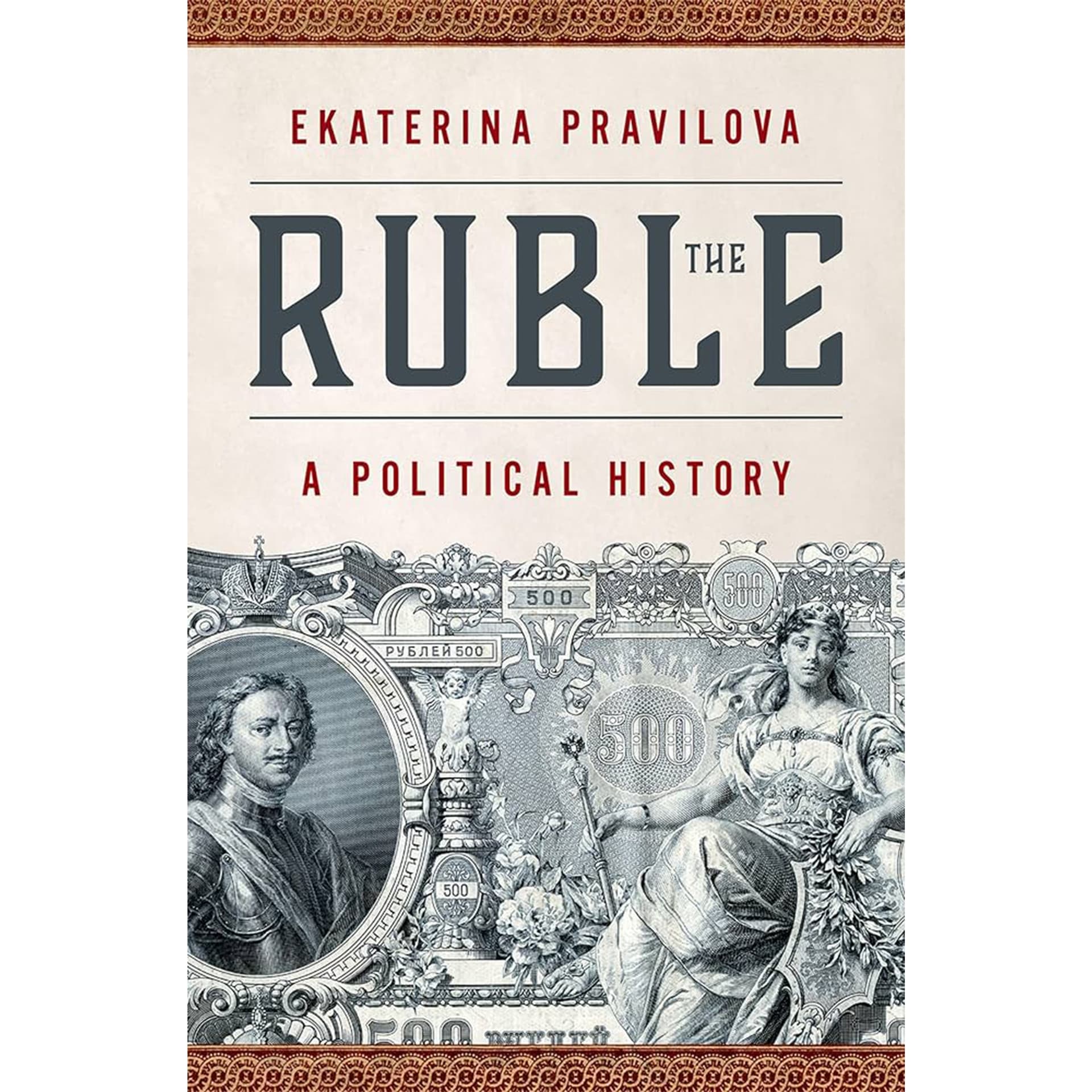
Overview In this episode of *A Book with Legs*, host Cole Smead interviews Ekaterina Pravilova, a professor and author of *The Ruble: A Political History*. The discussion revolves around the historical evolution of the Russian currency, the ruble, over 200 years, focusing on the interplay among politics, culture, and power.
Key Participants
- Cole Smead: Host, CEO, and Portfolio Manager at Smead Capital Management
- Ekaterina Pravilova: Author, Rosengarten Professor of Modern and Contemporary History, Director of the Russian Program at Princeton University
Key Themes and Discussions
Introduction to the Ruble
- Background: Pravilova's interest in the ruble originated from her research on counterfeiting in the 1960s, revealing a fundamental issue of public trust in the government and its currency.
- Political Lens: The ruble's history is explored through a political lens, highlighting how financial systems are often reflections of governmental structures and public trust.
Historical Context
- Catherine the Great's Reforms:
- Initial issuance of *assignats* (paper money) aimed to replace cumbersome coins and raise state revenue, especially during military campaigns.
- The initial perception of *assignats* versus actual money, emphasizing the lack of public trust.
- Catherine's Perspective on Debt:
- Differentiation between state debt and public perception; the monarchy viewed debt as a right of governance, while the populace viewed it skeptically.
Distinction in Currency Systems
- Assignats vs. Traditional Currency:
- Initial *assignats* were seen as temporary and not fully backed by gold or silver.
- The state often overspent on wars, leading to inflation and public skepticism about the currency's value.
Economic Transformation
- Nikolai I and Bullion Reserves:
- The establishment of the Bullion Reserve in the Peter and Paul Fortress aimed to restore trust in currency.
- Introduction of credit rubles as a means of stabilizing the economy post-war, but often leading to inflation and public discontent.
Impact of War on Currency
- World War I: The war caused Russia to suspend the gold standard, leading to inflation and economic instability. The lack of leadership exacerbated the situation, with significant human cost and hardship.
The Bolshevik Era
- Post-Revolution Monetary Policy:
- The Bolsheviks struggled with designating a new monetary system due to a lack of established economic principles from Marx.
- Lenin's idea of using labor as currency ultimately resembled traditional currency concepts, emphasizing labor value but failing to eliminate currency altogether.
Contemporary Relevance
- Comparison to Modern Russia:
- The discussion draws parallels between 19th-century autocratic principles and modern-day policies under Putin.
- The episode concludes with reflections on how historical trends in Russian governance and economics continue to resonate today, particularly in the context of war and public trust.
Key Takeaways
- Trust in Currency: The evolution of the ruble highlights the critical role of public trust in currency and how its value is often tethered to political authority.
- Historical Cycles: The cyclical nature of autocracy and economic policies in Russia demonstrates the enduring impacts of historical governance on contemporary society.
- Current Events and Historical Parallels: The ongoing conflict and economic strategies under current leadership reflect historical patterns seen during imperial periods.
Conclusion Ekaterina Pravilova's insights into the ruble's history provide a nuanced understanding of how politics and economics are interwoven in shaping public perception and trust in currency. The discussion serves as a lens through which to view both historical and modern Russian governance.
Further Information Listeners interested in following Ekaterina Pravilova's work can find her on social media platforms and through the Princeton Program in Russian History. The episode encourages continued exploration of the themes discussed, particularly in understanding the legacy of Russian autocracy and its implications today.
Written by AI. May contain mistakes. Listen to the episode to check what was said.
Transcript
Automatic transcript. May contain errors.0:02You're listening to A Book With Legs, a podcast presented by Smeed Capital Management. At Smead Capital Management, we advise investors who fear stock market failure. You can learn more at SmeadCap.com or by calling your financial advisor.
0:21Welcome to a Book with Legs podcast. I'm Cole Smead, CEO and Portfolio Manager here at Smead Capital Management. At our firm, we are readers and we believe in the power of books to help shape informed investors. In this podcast, we speak to great authors about their writings. The late, great Charlie Munger prescribed using multiple mental models and analysis. We analyze their work through the lens of business, markets, and people. Thank you to our audience for joining us today. We are going to look back at really the history of a country. We're going to think about its currency. We're going to think about its politics.
0:54And we're going to think about what transformation means. Joining us today is Ekaterina Pravalova with her book, The Ruble, A Political History. A little bit about Ekaterina. She is the Rosengarten Professor of Modern and Contemporary History and the Director of the Russian Program in Russia, Eastern Europe, and Eurasian Studies at Princeton University. She is the author of award-winning A Public Empire, Property, and the Quest for Common Good in Imperial Russia, as well as Legality and Individual Rights, Administrative Justice in Russia, and Finances of Empire, Money, and Power in Russian Policy in the Imperial Borderlands, published in Russian.
1:29She is a native of St. Petersburg, Russia. She has also received her PhD from the Russian Academy of Sciences. She was a research scholar at the Academy of Sciences and taught history at the European University at St. Petersburg from 2002 to 2006. So we're going to get an insider's look at this up close. E. Katrina, thank you for joining me today. Thank you for inviting me. So you've obviously done a lot of writing on Russia. You're from there originally. I think this is just an intriguing discussion. I remember when I came across your book, I thought, wow, what a time to talk about the ruble and what a timely work you had.
2:05But I want to ask you, what made you use this lens of the currency and the ruble as a way to look at really the pre-communist Russian history? Well, initially, I didn't want to write this book. It was almost accidental. I was working on something else. I worked on, actually it was a very narrow episode, a history of counterfeiting in Russia in the 1960s. And when I was researching this Russian government trying to foil the plots of counterfeiters, I realized that there was one fundamental problem behind it. because this rise, this counterfeiting, originated from the lack of trust, of people's trust in the government and Russian currency.
2:53So sometimes we think that the historians, how they write the books, they start from point A and go to point B from Peter I and Nicholas II, or, I don't know, from Lenin to Gorbachev. But often it doesn't happen this way. So it started from the mid-19th century, And then I just realized that I do want to write the history of Russian currency to explain this lack of trust in the financial problems of Russian economy through the lens of politics. Because I realized that this is the fundamental issue in the history of the ruble. So let's start with Catherine the Great. She obviously was a dominating authority in this idea of autocracy in the monarchy.
3:38Can you teach our listeners what a signet's were? And what did they allow the holder to do? Oh, you're asking about the so-called, in Russian, they're called assignatsy, right? Okay. The first Russian paper money, or assignia, we can pronounce in the French manner, assignia. So the assignatsy, or the assignia, as we introduced, introduced in 1768, well, 1669, was the idea to just replace very inconvenient and heavy coins. Because the Russian system was based on the circulation of copper, silver, and gold. And of course, most people used copper coins. The most popular coin was the five-copics coin, and it was pretty heavy.
4:26Princeton University Library has a numismatic collection and went there just to hold this coin in my hand. And it actually weighed almost like a, you know, you will fill it in your pocket. It's like a half of the weight of your iPhone, maybe. Sure. Maybe just a little bit. So transporting these sums of money was just terribly inconvenient for the purposes of trade, commerce, but also for the purposes of the state, how to collect taxes, and also how to transport money to pay for war expenses. So the beginning of the issuance of paper money, this Assyria, coincided with Russia's entrance of Katrin the Great's first war against Turkey, the Ottoman Empire.
5:11And so this reform or the appearance of paper money pursued two goals. One, to make this money circulation much more convenient and easy and lighter. And the second goal was, of course, compensate for the lack of resources for the state. So when you ask what are the purpose or what are the circumstances and what the people could do, we should separate between these two agents or the actors, the state and the people. And of course, for people, it was just inconvenience. But simple folk, peasants, continue to use coins. It's only the assignats were mostly the money of the rich and the state. And for the state, of course, it was a very convenient method of raising income, but also simplifying tax collection and trade.
6:10So, but the assignats, they would still get discounted, wouldn't they, by the people that tried to use them? Oh, yeah, absolutely. This is a very important point about the initial idea of Asinias. They were not even called real money. The government legislation and people talk about them as representative of real money. So it's like something that's in place of the coin. So it's not real. It's just like an image of the coin. But people could definitely come to the bank. And there are two banks established. And there are more later, the Aseniat Bank, a signatory bank in St. Petersburg, then Moscow.
6:58And in the first years, they could freely exchange Aseniat at any point for copper and silver. And then the states started running out of silver and only copper became the exchange species for the assignats. But exactly in the very first years, there was non-stoppable exchange of assignats for coins. So just to hit on it, can you just mention the two banking structures? You mentioned their location, but did they play a different function to each other for the assignats? No, the banks were, we call them the banks then, and they were called the banks. But essentially, these first banks, they function just as cashiers, just the exchange offices, like the big exchange offices established by the state, and then the huge, with a huge storage for these coins that were kept there in leather bags.
7:58And the only function of these SNS banks were just to exchange the SNS for coins. and collect coins and collect the Asinias. So I think a really interesting distinction early in the book was Catherine the Great's view of foreign loans. Okay. She looked at foreign loans and credit. You know, she looked at one was assigned to effectively the people and one was assigned to the monarchy. Can you kind of talk about that? Because that becomes a pretty common theme across the book is how the monarchy looks at debt versus how the public or the markets look at debt? Yeah, so these first Asinias, initially they were perceived as a state's debt, right, states that in relation to people, as if they stay poured from the people by replacing coins with paper.
8:53And essentially the Asinias, they even look like promissory notes or vexil. They're so simple in design. There were no even, no state symbolism, no two-headed eagle or any other symbols of the state or the monarchy or the dynasty. So they're very, very plain and without any, like very few ornaments. Therefore, they were perceived as like a promise you're not given by the state. but later this idea started losing popularity in the government and bureaucracy because what came instead was the idea that in fact the state cannot borrow anything from the people and should not borrow because the state has the power it has the power of take whatever we want at any point so this idea of balancing the interest of the people and the monarchy kind of disappeared from this financial sphere.
9:57And of course, the relationship between Russia and the foreign creditors were based on totally different model because Russia, during catch-and-grew great times, for the first time, starts borrowing in Europe. So these things had not happened before. And of course, it connected. These two financial innovations happening almost at the same time, the introduction of paper money, and Russia's opening the doors, like the foreign market capital. And Russia was perceived like no one in this European market. Nobody knew Russia is a good trader or someone who would, a country that would pay all debts back.
10:47And therefore, Katrin was very, very happy and at the same time very cautious in dealing with foreign creditors. And until the very end, until the fall of the Russian Empire in 1917, the government always prioritized the repayment of foreign debts, overall domestic obligations. A theme that also comes up throughout the book, you have some wonderful data, just so our audience is aware, on the rubles outstanding, and how that grows over different eras, were there limits on Catherine's assignats? And if those were raised, what ultimately backed the assignat when they raised those caps? Yes. Initially, there was a limit established at 100 ,000 rubles.
11:39And Catherine pledged not to exceed this amount. But very soon, of course, they breached the limit. And if before, and of course when the domain was breached, the banks had difficulties exchanging Asinias for coins and the Asinias rate began to fall. Therefore, if initially the Asinias were seen as being backed up by this metal reserve, this coin is kept in the storages of the Aseniaz banks. Later, this idea kind of lost its ground. And another idea was introduced, and the idea that the value of money in an auto-equatic country rests not on any metal reserve, but on the power and the promise of the ruler, of the empress.
12:36A Catherine pledged several times for the exchangeability, the convergibility of Asinias or for not exceeding this certain amount. But of course it didn't help. But this idea kind of persisted throughout, again, 18th and 19th century, that in autocratic country, the relationship between money, the throne, any people, this relationship are based on totally different principles than anywhere else. This next question I'm going to ask you couldn't be more appropriate as we think about the world we're in today. My question is, why did Catherine's government overspend on war? And then you do a good job of pointing out like what the local critiques were and kind of the I'll call it the local conspiracy theories of why, say, the ruble would would do poorly and not have would be devalued.
13:29They just began to make rubles supply, you know, meet the government needs. ultimately, they oversupplied the market with money. Why did they not recognize at that time, even that the money supply did change, as you pointed out just a second ago, the idea of trust? Yeah, the thing is that, of course, in the 18th century, the glory of empire rested not on economic wealth, but on military abilities. So and of course, the Russian empire was becoming or trying to become a great power competing with or against other membering empires. And therefore, of course, from the point of view of this prestige of the monarchy, conquering lands and conquering people and spending on war or fighting against the enemies of Russia and enemies of orthodoxy was always a priority.
14:26Therefore, the costs and like even discussing the costs of a war was kind of inappropriate sometimes. And, of course, there were critiques of Ketchum's policy who were pointing out that the government undermines by spending so much and increasing the amount, overprinting Assyrians, it undermines people's trust. And this idea, I think it appeared in this financial sphere very, very early. So this is 1780s, so the time before the French Revolution, the French Revolution that brought the idea of popular sovereignty when the idea that economy and wealth produced by labor belongs to the people. This idea before the French Revolution was not yet in the air, especially in Russia.
15:22And therefore, these people who criticize sketching policy voice for the first time this concept of popular sovereignty in the financial spheres that the state has obligations because the wealth, the national economy belongs to the people. Yeah. So I think there is a pretty radical, very radical and liberal idea for the time. This show is brought to you by Sneak Capital Management. We hope you're enjoying the podcast. You know, we work hard putting together this show, but we work even harder for our investors at Smead Capital Management. At Smead, we believe in disciplined investing, which is why the Smead funds have a proven track record of long-term outperformance.
16:03If you're an investor who fears stock market failure and want to invest in wonderful companies to build wealth, we invite you to visit SmeadCap.com. Past performance is not indicative of future results. Investing involves risk, including loss of principal. Please refer to the prospectus for important information about the investment company, including objectives, risks, charges, and expenses. Read and consider it carefully before investing. Smeet funds distributed by UMB Distribution Services, LLC, not affiliated. Another area that you explained, they were kind of more radical currency use going on in the Russian empire.
16:37You discussed what happened in the early to mid-19th century in Russia's Alaska. They obviously had a different form of currency there. Can you explain the currency that was present in Alaska, why it was created? Yeah, so Alaska was governed by a Russian-American company. So essentially, the money that circulated there, the so-called marks, this we can describe as a form of private money, because these marks were issued by the Russian-American company. At the same time, the Russian American company belonged to the state or was a representative of the state. And so the idea of introducing the marks belonged to the company and the government itself.
17:30And the marks were printed on the pieces of skin or leather, therefore kind of emphasizing maybe the purposes of the whole Russia's acquisition of Alaska as being a colony supplying skins and furs to the Russian state and selling. So therefore, these marks were very interesting and very peculiar form of currency because they only circulated within the stores of the company and mostly used by indigenous people who were employed by the Russian American company. I'm saying employed, and of course you can imagine it was not normal or free employment. They were essentially enslaved by the company because there was no free market for them.
18:30They had to use these marks only to purchase goods available in the company's stores. So it's a very cruel form of exploitation through financial means, through the introduction of this specific colonial currency. When you pointed out how that even, you know, that would be discounted because no one other than the store would take the marks and therefore things like skins and other things were more readily exchangeable because people could go out and barter those into other goods. Yeah. Yeah. I mean, of course there was another kind of, there was barter in Alaska in the Russian settlements and there were all the valuable things such as alcohol or of course, order skins.
19:17But again, for the indigenous people employed by the company, it was very, very limited possibilities of using coins. And of course, there were no assenials there because they were not delivered there. Russian Empire was extremely vast and in the early 19th century the ruble was not the only currency circulating across the old imperial space at that point in the early 19th century if I start just naming all kinds of currencies the money that existed it would be a very long list because there was a special currency in the Caucasus and it was in Poland In Alaska was this Russian Marx and elsewhere.
20:05So the rubble was just becoming the national imperial currency very, very slowly. Alexander I was educated, as you wrote, quote, in the best tradition of the European Enlightenment, end quote. How does the liberalism that was floating around Europe at that time affect Russia's monarchy and shape the forward view from Alexander I on with the role of money? Yes, Alexander was very well educated in the book because Catherine, who was his key teacher, and therefore she was an avid reader of Enlightenment literature and thinkers, and she befriended some of them and corresponded to some of them. So, Alexandre, her grandson, received a brilliant education.
21:00And he, as well as many other aristocrats of this era, were very well versed in all contemporary economic, liberal, political ideas. So they read in French was the language of conversation. And of course, they read everything. And all books published at that time on political economy in French as well as in English and in German. So Russian literature is very cosmopolitan. And in the first decades of the 90th century, censorship was relaxed. And these books could be delivered to Russia and read, translated. So we shouldn't think about Russia as being behind this iron wall as during the Cold War.
21:48Of course, it belonged to the market of ideas, and ideas circulated at least in the first decades of the 19th century freely. Later, the Nikolaus I will introduce more strict control over the circulation of Western harmful ideas. But in the early 19th century, that was not yet the case. People were still hopeful is what you're saying. Let's see. Let's go to Nikolai Mordanov. He made the point that, quote, all kinds of money derive their validity from the productive force of the national economy, end quote. This is assumed in today's world, obviously. How was the view of money deriving its validity prior?
22:32Was it just the monarchy or was it bullion? well Mardvinov in this quote what he wanted to say that the government cannot do whatever it wants with the money with national currency this was his idea of course he hinted that there should be an institution like a bank with a bullion reserve that will regulate the issuance of paper But the next point in this kind of line or logical connections will be people's labor, because even money represents labor. In between that, the bullion, even coins, the gold, there are also points of representation of value. But the value is produced by people who work.
23:27And this economic formula, labor coming from the products produced by people that could be exchanged on the basis of this representative, either gold and then the second will be, another point will be paper. And this economic formula had a parallel in political sphere. Therefore, we call it economic and political liberalism because he thought this economic control translates into political control. That means that people should be able to control the activity of the government. We also see that money is also the seed to fight autocracy in your book. Is it fair to say that every attempt at currency reform actually attempted to limit the monarchy's role slowly over time?
24:26Yes, that is correct And we mentioned, just mentioned liberalism And of course, liberalism was born in Europe As well as in Russia In reaction to French Revolution So it was an alternative to radical change But as soon as these liberal ideas appeared We also can see the emergence of political reaction This conservatism and nationalism That appeared just at the same time in Russia and elsewhere. And the conservative position in relation to money was totally just mirroring or opposing the liberal concept. It was based on the idea that Russia, first of all, Russia is different. There are no universal rules or laws of the political economy.
25:13It makes no sense. Every country has its own nature. And therefore, you cannot use Adam Smith, apply it to the Russian case. It's just, it's not going to work. Because Adam Smith, this is only applicable to Britain. And they said, no, Russia is different. And in Russia, the value of money is based not on labor, not on bullion reserve, but on the power of the autocrat. On the trust, people, people's trust in the love and the figure of the czar. So everything emanates from the czar. And all of this, you know, the gold reserve, the silver reserve, or all other explanations that are totally inapplicable to the Russian case.
25:58So this idea appeared in the early 19th century, and it continued to, these two trends, liberal and conservative, continued to coexist in the 19th century. Therefore, every time when the liberals would say, we need to fix the currency system, we need to create an independent central bank, these ideas were immediately read or perceived as a threat to autocracy. It's something that really is going to shake this autocratic model, introduce constitution, something alien to Russian political models and model and ideas. So can you explain the relationship between the state banks, the treasury, and the monarchy in the 1820s and 1830s?
26:44Who answered to who? And I guess my second question would be, was there any accountability between any of them? Everything was just Belonged to the Tsar's government So there was no balance of power No separation of power of any sort Treasury Was about In Russia Belonged to the government So it was governed by Bureaucrats appointed by the Tsar As well as the Ministry of Finance There were the Asenia banks that I mentioned before and they're totally controlled also by the Ministry of Finance that was created in the early 19th century. That was the only innovation of creating the government as opposed to just the rulers' advisors.
27:34Things were bureaucratized. This is the main change that occurred in the early 19th century, institutionalized. But everything was put in one pocket, on one box, and this is the executive power. So whereas in England, for instance, there was a Bank of England that stood independently without private funds. In Russia, the banks, these Asenia banks, they totally belonged to the government, were totally controlled by the government. So they're actually the unit of the government, not separate from it in any possible way. And this power of spending and power of issuing money, it was like the two hands of the same person.
28:17So what caused the Asignat to go away ultimately, and what political reform brought that about? Well, we should mention that because of the wars, and there was, we mentioned previously, there were Russo-Turkish wars, several of them in the 18th century, then the late 18th century, late 19th century Antinopoulin campaign, and of course, what we call the patriotic war against Napoleon. So the consequence of all this continuous warfare was, of course, that the Russian finance totally ruined. And the value of Asenia fell by 75%. So the one ruble Asenia cost 25 silver copex, right? So just a quarter of its original value.
29:10And the government tried different means to somehow a little bit raise the value of the Asinitean work. And so the reform that was originated in the late 1830s and complete in 1843, finished in 1843, it aimed at exempting the Asinite. It was totally hopeless. There was no way of doing anything with them. And the situation on Naive with this reform was very bizarre and annoying for the government because what happened is that the market started regulating these fluctuating rates between different kinds of coins and money circulation. The government didn't like it. And it just withdrew the Asenia as an exchange and introduced a new kind of money, Russian state credit rubles.
30:07Sure. So Nikolai I invented the Treasury Bullion Reserve that was held in the Peter and Paul Fortress. If trust was important, like you mentioned, that's a theme that your book hits on so many times no matter what structure we talk about. Was the idea behind the Bullion Reserve to just show physical gold or make people believe that there was physical gold in hope that that would cause trust? Yes, you described it very well. Exactly. That was the idea behind this reform. So Nicholas was a very staunch nationalist. He also thought that he was a good economist. And he was probably aware of different ideas, including the ideas of the gold standard.
30:51He probably read something about the Bank of England and how currency functioned in other countries. And he designed a model that looked like a European model, looked a little bit like an even British model, but it was totally different from the political point of view. So he set up this, the government set up this booting reserve, put it in the Peter Polenpo fortress next to the cathedral, which is also a burial place for all czars of the Romanov dynasty. And the idea was, yes, to demonstrate the new state credit rules were all backed up by this reserve. But at the same time, what happened, this is a very important thing, that I mentioned that there were these Asenia banks, which belonged to the government, but still these were separate institutions.
31:50So Nikos decided, so we don't need the banks. If the government makes money, why do we need the banks? It's just these banks were totally just abolished. And it was this treasury that started, the government started issuing the new banknotes on its own behalf. So you mentioned credit rubles had been created. How were credit rubles different than assignats or rubles themselves? So the credit rubles were essentially the same assignats of 1769. in principle. The principle was that there was a reserve, there was a bull in reserve, and silver, a little bit of gold, also state applications. And the ruble initially, the state rubles were initially exchangeable.
Read the full transcript
32:46So people could actually come, as well as the Asenias in the first years, they could come in exchange. and there are now other mechanisms for instance that involves the as i mentioned in the book the term credit was in the misnomer there is no connection to the credit operation because the government is is not the bank right if the government issues money it's not engaging in credit transactions so it was just a kind of paper money that trusted on this bull in reserve and the government authority. So let's see, to come back to another idea, we also see the other central theme, you touched on it just real quickly, but I do want to use an example in your book.
33:35You talked about the other systems that were on the edges of the Russian empire. So we talked about Alaska, but let's use the other Western front. Let's talk about Poland. What was going on in the 1840s and 1850s in Poland? Why was Russia so interested in their effect on the Polish monetary system at that time? Yes, just a little bit of background. Poland became a part of the Russian Empire in the 18th century. So Katrin the Great, along with Prussia in Russia, along with Prussia in the Habsburg Empire, partitioned Poland. Sure. And then the partition, the elimination of the Polish state was complete in 1815.
34:19when the Kingdom of Poland was formed within the Russian Empire with some political and financial autonomy. And Alexander I, he was very benevolent, and he granted not only constitution to the Kingdom of Poland, but also the right to have its own currency, Polish Zloty. And this Polish financial organization from the very beginning was different from the Russian financial organization. Zlotys were not connected to the rubles, and Poland economically was more oriented toward the West. Also, in 1836, the Polish government established a Bank Polski, the Bank of Poland, that functioned as a very, not totally independent, but resembled central banks as we think about them, the independent central banks.
35:17And the Bank of Poland was issuing paper banknotes that were exchangeable, convertible, and circulated freely as also worked as means of credit. But what happened is in 1830 was a rebellion or the revolution in Poland. And there was a revolution against Russian autocracy. And Nicholas I, he was a ruler at that time. He was furious. And the consequence of this rebellion was the gradual elimination of political autonomy. So, Poland, Kingdom of Poland lost the constitution, but monetary system is also a projection of political rights. So, the next step will be gradual restriction on the autonomy of Poland to have its own money.
36:11And it first started with just introducing bilingual coins and changing the denomination of the coins so they would be easily convertible into roubles. And in the 1940s, when there was another revolution in Europe, Russia just flooded. Russia participated in the anti-revolution campaign in Europe. Russia just flooded Poland with its paper credit roubles. And the result was just the demise of Polish monetary system that became complete in the 1860s after the second Polish rebellion when the slottage was just abolished. And a few years later, the Bank of Poland was also totally eliminated. So at this time during, let's see, to get my notes correct here, during, I think it was Alexander I reign, you have liberalism floating around calling for a constitution.
37:09This is Russia, as we've been talking about. So again, we're still dealing with this autocracy, whether it wants to accept the idea of kind of a liberal constitution. To use Peter Volouv as an example, he really argued, to quote your book, he suggested that only a constitution could strengthen financial credibility, and the czar's sovereign power did not extend into the sphere of finance. So liberalism was calling for finance to be really a standalone part of the economy, outside the sphere of the monarchy? And the question would be, even though Alexander I was a more enlightened king or monarch, why wouldn't he allow this?
37:53Well, interestingly, the Tsars can have, the Russians, some of them have had their liberal education, they entertained liberal ideas, but none of them ever wanted to restrict their own authority. So we can read Rousseau, maybe even like Adam Smith, but when it comes to one's personal power, nobody wants to say, no, I want to get rid of my power to control financial state finance or to control legislative process. None of them ever done this. And this is, by the way, also a good example to explain this Valuyev quote that he mentioned, when Valuyev said or wrote to Alexander II that only political constitution can save or improve financial standing of the ruble.
38:53What was the meaning of this quote? Válov was not a liberal. He was a technocrat. And this is a new time, 1860s, and the new generation of Russian bureaucrats who were also very well-versed in liberal ideas, but were not liberals in the soul. But practically, they knew that Europe is almost totally constitutional, or the political principles of European creditors are totally different and Russia is seen as a very barbaric corner of Europe where there is autocracy when the Zara can do whatever he wants what Voluiv was suggesting that if we want to get loans in Europe if we want our currency to have good exchange rate we should do something with a political responsibility.
39:50Why? Because other countries and the creditors are not valuing Russian national currency because of this lack of anyone's responsibility and this unlimited nature of this authority. I want to give a big shout out to everyone who's listening to this show. You know, we recently hit the top 10 in investing podcasts on Apple Podcasts and even number one in the business category in several countries. As you may know, this show is brought to you by Smead Capital Management. Smead understands how frustrating and illogical the stock market can be. If you're searching for funds with a proven track record, give the Smead funds a look.
40:26Or better yet, reach out at SmeadCap.com. And don't forget to mention you're a fan of the podcast. Past performance is not indicative of future results. Investing involves risk, including loss of principle. Please refer to the prospectus for important information about the investment company, including objectives, risks, charges, and expenses. Read and consider it carefully before investing. to meet funds distributed by UMB Distribution Services, LLC, not affiliated. So Malstav was a very interesting character in your book. He was an exceptional person as a businessman, but had a unique situation with the currency.
41:06It had kind of touches of the Alaska situation, but can you teach our audience who he was and why he was such an interesting story inside of Russia? Yeah, Malzoff. Yes, so he was a businessman who created a network of factories and essentially was almost a republic within, not republic, a separate state within Russia. And Malzoff introduced its own currency in response to a very ubiquitous problem familiar not to Russia but also to all other states. What we call the big problem of small change, just the deficit of coins and small change. And Malzav introduced in several provinces where his factories were located, it's just a separate private kind of money.
42:14And interestingly, I mentioned Assad Republic, which is perhaps not a good term to describe it because Malzav's state was just mirroring the Russian state. He was like a monarch in the territory of the factories and villages around the factories that he administered. Therefore, this money was just a projection of the Russian autocratic financial system. So another example that reminds me of the bullion in the Peter and Paul fortress, but I wanted to ask it. When they started to burn assignats and credit rubles, was that just to kind of show the people, see, we're not printing money, we're actually getting rid of it?
43:06Just to kind of promulgate this idea of trust that obviously might not be true, but it's just the effect it's trying to have on the psychology? Exactly. you rightly pointed out this connection between this splendor of the gold reserve and all these rituals and ceremonies of for instance moving the gold reserve from the banks to this beautiful fortress it was not just you know they put it on the on the on the on transport and and quietly move no everything was done with a lot of this you know celebration and and and symbolism just to show the existence of this reserve and the power of the state.
43:52And the situation with the burning of this Assyrians and the credit rubles that were withdrawn from circulation is very similar. To show people, but most importantly foreigners who were in the capital, that the government really cares about the in control of the circulation of paper notes. Therefore, the burning of the ruble was always a public ceremony. People were invited as if it was like a theatrical performance. The tickets sold and invitations distributed to come and watch how the old money is burning. So stock exchanges were another interesting dialogue at parts of your book, especially in the latter part.
44:44They were obviously influential, but they were influential, what I deemed to be from a money market perspective. Is that what was primarily traded there? Was money markets or were there actually businesses being traded on markets? Businesses as well, of course. after the 1860s, Russia changed a lot in the mid-1900 century. What was new was the liberation of economic regime that allowed for the creation of joint stock companies and a lot of new businesses appeared in a matter of a few decades. And of course, also new private banks. It was a very, very new thing that hadn't existed before. And Russia was, we should keep it in mind, It was a capitalist country.
45:33So it was, of course, the Russian capitalism was different from other kinds of capitalism. It developed in a slightly different manner, but still there was a free market. And therefore, the stock exchange, there were very important financial institutions for the money market, but also for companies. And they had significant influence over local financial policies, but also the government had to consult the representative of stock exchange communities while making very important decisions. So the next person that becomes a very unique character in the view of monetary policy, and I say interesting because he couldn't make up his mind, depending on what part of his life he was in, was Sergey Witt.
46:27What was his role? And can you teach us about his movement back and forth of his monetary views? Of course. So Sergei Vita, he was a very, very interesting and very strong and important figure in Russian political and economic history. Unlike all other ministers of finance, he later became a minister of finance. He had a totally different background. He was a businessman, an engineer by education. He worked in private railroads. So he knew how private businesses operated, not from textbooks, but from experience. Later, he worked in the Ministry of Communication, public transportation. But there was another feature of his early career and development.
47:17He was exposed to influence from nationalist and conservative press and circles. His uncle was a very prominent nationalist. So when he came to office as a minister of finance in the early 1890s, he was a committed nationalist. He had ideas of Russia's exceptionality, how Russia is different from the West. He loved the ideas of Friedrich List, the German economist, who tried to combine nationalism with economic development. So the consequences were the introduction of protections tariffs. So the government had to help local businesses and attention to agriculture. But when it came to money, Witte, at first, he penned this project of very inflationist project of developing Russian railroad system through the issues of just additional special kind of paper money, railroad assenias, railroad money.
48:28And this idea was totally bizarre. And of course, there is very little economic rationality. but the most amazing thing from my point of view about Vito was he was very flexible and he could make a u-turn in a matter of few maybe months or weeks if not days or minutes and it's when people convince him that this is irrational this is going to lead it nowhere and this is just just But after a while, he changed his opinion just to the opposite. He made this U-turn, and instead of creating new kinds of inflationist currency, he took the path toward Russia's transition to the gold standard. So can you explain the bear squeeze that he pulled off while he had this role?
49:25Yeah, well, the first steps in his policy of maintaining Russian ruble, forming Russian ruble, was to do something with the fluctuation of ruble's rate. Because the rate of the ruble was extremely volatile. It was back and forth, back and forth, and ups and downs, but mostly downs, of course. The reason was that because of the fluctuation, ruble was very attractive kind of assets for all kinds of speculation on stock exchanges, especially in Germany. So Witte decided that the best way to do it is just to play the same roles as these speculators. So the government acted as a speculative by making a pledge for this future contract and then using private agents exempting all Russian rubles from circulation that available, purchasing all rubles in circulation in Europe at the time when this obligation matured.
50:43And people who made these future promises were desperate to get Russian credit rubles and couldn't find them anywhere. So Witsa just told them that this is it. The speculation has to end. And the techniques was later, I think that people say, like economists say that he invented these techniques that the Vesk was in the first time practice in the situation with the Russian state credit rubles. When he also created the imperial ruble, and why was, I guess maybe the question shouldn't be why was it needed, but how was the imperial ruble different than what had been prior? so the main reform that Vita managed to accomplish was putting the rubble on the gold standard and of course he just finished the reform, the long process that some of his predecessors had done before him because Russia had been accumulated gold, buying gold for several years by selling grain on the western market and just getting more and more gold into the coffins of the state bank.
52:02So what Wietze did is the reform consisted of developing the ruble by a third and putting on the gold standard. So that was the main innovation. And the reform was, of course, there are many steps in this process, but it was complete by 1897. And the new gold-based ruble was, the main rationale for introducing the gold-based ruble or for Russia switching to the gold standard was to attract foreign investment. Sure. Because Russia was not considered a good place to invest money because exactly because of the ruble's fluctuating qualities. The Westerners were very cautious because you can invest in using your francs or marks and then the ruble falls and you lose a significant part of your investment.
53:05So for Witte, that concern, the lack of capital and the lack of foreign investment was the main goal that he wanted to achieve by this gold standard reforms. And we can say that he achieved this goal because after the stabilization of rubles rate on the basis of gold, we can – Russia witnessed a surge of foreign investment. So from this point of view, the reform was successful. So to your point, it increased foreign investment, but these imperial rubles could be exchanged for silver and gold, but that affects people in society differently. Who was affected by that changeover? well in Russia people who paid always the cost of all reforms are of course peasants the last protected Russia the people who were bearing the cost of taxation the most significant part and of course every financial reforms of that kind inevitably allowed to the rise of prices So peasants, peasantry was affected in two ways.
54:26First of all, in the most mundane level because of the growth of prices for all goods. Second is that I mentioned that to maintain the gold standard, to maintain this gold reserve, Russia had the largest, at some point, the largest in Europe gold reserve. Russia had to export grain in huge quantities, huge quantities. And Vitor's predecessor, Vyshningradsky, the minister of finance, Vyshningradsky, even formulated this principle as, we better starve but export. So this priority was to export grain, even if it's at the cost of peasant's derivation. And it indeed happened when there was a huge famine in the early 1890s.
55:18So the cost for the peasantry that Russia had to export a lot of grain and who is the producer of grain, of course, agrarian sector and peasantry. And there was another, like a third maybe aspect of the reform that Vita, the way he imagined the gold standard is like everyone is going to use gold coins. Indeed, gold coins were introduced, including peasants. But the gold coins were very, let me put it that way, well, they were very expensive. And I think you also mentioned how heavy they were to carry and transport. Exactly. they were heavy, they were very uncomfortable. And then you can imagine that, for instance, I told the story of people complaining that someone is buying products on peasant's market, just going from one village to another and transporting all of these bags of coins, instead of paper rubles, as was before the reform, because Vita ordered to withdraw from circulation all rubles of small denomination.
56:39Why? Because these papers, these banknotes competed with the gold and silver coins. So people were very much affected by it. They hated this reform. And it looked also kind of coming back to the Middle Ages when, you know, instead of we think that paper money is a more modern way of monetary, a more modern financial instrument. But in Russia, the movement was just in the opposite direction towards the return to the coins and the metal-based economy. So people didn't like it. So another question I want to ask is looking at World War I, how did war change the currency? Obviously, as you talked about, numerous countries, they suspended the gold standard.
57:34You could not exchange their currency for gold or bullion. And how did that affect countries like Russia and their ability to stay on this imperial ruble or what we'll call the gold standard? Russia was very much affected by that by the war it had to suspend the exchange of course but the war revealed one major shortcoming of the Vita system call it the Vita system because of course the money question was just of one element in the totality of the system Vita paid too much attention to finance and very little attention to sustainability of economy. That was the biggest mistake of the government before World War I.
58:25Because when World War I started, it turned out that Russia had to buy almost everything on the Western market. And of course, to pay for these products, like chemical, everything that, the chemical industry products, for ammunition, etc., etc., to pay for this product in gold. So the gold reserve that was supposed to back up paper rubles was just spent on the purchases of these items. And, of course, Russia also had to contribute to the Allies' efforts. And therefore, of course, there was a huge blow and a huge shock for Russian finance. And I think you point out really well that not only was there a lack of leadership and thought on the finance side, like you just mentioned, but you also pointed out that there was also just a lack of leadership from obviously the czar at that moment because it wasn't just costly in the payments and trying to get the money to fight a war.
59:33It was also costly in lives. Can you talk about the underinvestment in capital, but I'll really say armament compared to other countries and therefore how humans were the actual sacrifice in World War I for Russia? Yes, if we compare the performance of different countries during World War I in Russia's financial contribution and Russia's contribution in terms of the lives of people, soldiers and also civilians, we'll see that financially Russia did not contribute as much as other allies. but the human cost was just enormous and the human cost in terms of the lives of soldiers who perished on the battlefield but also in terms of the hardship like famine and people just deprived of the basic food and basic items of consumption so Russia was very, very hard And taking into account that in general, the level of wealth in Russia was very low comparing to like France or Britain.
1:00:52You can imagine to what degree of poverty and what degree of poverty people find themselves in after two years of war. Sure. And also you get the sense that like to our discussion earlier, if you think about trust, There was not only a lack of trust in the currency or the monetary system, but then you add a lack of trust for human life during World War I, and you could kind of understand how the vacuum of power got bigger and bigger. So obviously the czar abdicates, I think it was what, 1917. The provincial government comes in, which is a weak government at best. And then the Bolsheviks come in to take that vacuum that was present.
1:01:34But even they really couldn't decide what they wanted in a monetary system. Can you just explain what was their debate? What were the primary two options they debated? with the bolsheviks i wouldn't even use this term debate because when the revolution happened before the revolution nobody really thought about financial system because marx didn't give an advice of of how money will function under socialism there is no recipe ready for the socialist economy. So the only solution was formulated in the beginning by Vladimir Lenin, who, naïve with the revolution, wrote a long, long article on the state revolution, where he explains that although we think that under communism in the future there will be no state, there will be no money, there will be no banks, In the first years after the revolution, the proletarian state will have to use the same institutions as existed under the capitalist regime.
1:02:46Kind of a transition system in a way. Yes, exactly. The transition system, but everything was owned and run by the proletarian state. So you can imagine that all of this, I mentioned there are a lot of private banks. So all of these banks were nationalized. Then 1918 is a wave of nationalization of private businesses and factories. And even before, the state was only managing a limited state sector as well as, of course, the monetary system. Now, the state had to take care of everything, like all banks, all factories, everything in the state. So now the state had to run this immense, the gigantic machine that included the old credit system apparatus as well as all nationalist enterprises.
1:03:44And the Bolshevks had to use also, ironically, the old czarist money. So the banknotes with all the symbols of the old regime continued to circulate and the Bolsheviks even continued printing them using the old templates because they had no capacity of producing enough new banknotes, the Soviet banknotes, just to satisfy the demand of this economy in the situation of insane inflation. And I think in your writing, you explain so well that, if I understand it perfectly, in effect, they were trying to keep like a general ledger system that would account for everything in society, you know, what we know truly as a quote unquote planned economy.
1:04:37They wanted to ultimately get rid of the currency. But I think it even pointed out that they still ranked people by their job, which if you're ranking people by their job, you de facto have a currency system because you're valuing the individuals differently. And, you know, the system kept trying to keep old vestiges, if you will. Is that a fair way of thinking about it? Yes, that is actually perfect because you describe the inability of the Bolshevich to design a totally different system of currency. There are some ideas, for instance, the idea of labor money. The idea is that there will be no currency as such based on gold or silver or anything material.
1:05:25But the money, the new currency, the new banknotes were backed up by labor. So everyone, by products and by labor of the proletariat, of workers. So the idea was exactly as you described, that the money will be denominated in hours or labor days and days, not hours because nobody had watches or anything. So the labor days will be used as a unit of currency. But essentially, if you think about it, this is the same idea as the gold standard or any other idea of money that exists at that time. You just keep the gold element going back to labor. So there is still the same equation between currency and something that backs it up.
1:06:23The idea that you just mentioned, I don't want to gloss over this, but if you're going to go out and tell people it's your hours or like you said, it's your days you spend and all these peasants have no watches, how can you have a sense of time if no one has a concept of time? And it just shows you how kind of these were all kind of circular arguments that could ultimately go nowhere for even the individuals. So let me take one other step because I mean, as I'm reading through this, the themes of Russia are still the themes of Russia. The idea of absolute power or control or this idea of autocracy is still very present.
1:07:01the idea of the movement of the value of the ruble and how that affects society. Ultimately, if the government doesn't care, the government doesn't care, even today, I would argue. And then we have this idea of war, war being a very important concept in the scheme of the empire, if you will. And I think of all these, you know, what someone could say are 18th or 19th century ideas. And isn't this very analogous to the 21st century Russia that we see with what's going on with Putin? In other words, we saw a war, the value of the currency went way down initially in that war. And then to your point, we've seen assets be nationalized.
1:07:43Either if you're on Putin's side, you're fine to operate, right? You're there aligning with the state, let's call it. But if you're not, the assets have gone away. Isn't that really the autocracy of the 18th and 19th century more so? Absolutely. And of course, political scientists called Putin's regime an autocratic regime for a good reason. And it's not only in the sphere of finance, but also, of course, in a way the nature of his power. But you're right that there is such a strange and even eerie, I would say weird, resemblance between Putin's ideas and ideas of 19th century monarchists and conservatives.
1:08:34Sometimes I think that when I listen to him talking about economic matters that he probably read some of this, maybe Sharapov or somebody else, some of those conservative thinkers who were saying that Russia is different. Russia is not like the Western countries. We don't care about the standards. We don't care about the rate of exchange because Russia can survive by its own. It's self-sustainable. And it is even improper to think about the financial costs of war because this is a war for Russia's dignity, Russia's honor, or for like a higher truth of, you know, you can now think about everything that Putin says about their, sorry, I have to quote his like false brotherhood of Ukrainian Russian peoples.
1:09:29So all this rhetoric is so similar to the rhetoric of 19th century nationalists. It sometimes is very surprising. As I read through your book and think about two differences compared to then, is that back then, Russia was still a growing population. In other words, Russians had a lot of kids, even though there was strife and there was problems in society. You know, it was a growing population ultimately. Today, Russia is a shrinking population. which is a difference compared to then. And I know your book didn't touch on that, but I just know that data to be true. But I think the difference, the other difference that your book, someone could draw that's very different than Putin's world is if Russia was seeking to enforce itself on another land, you would have a direct war, right?
1:10:18In other words, they're gonna go fight the Ottoman Empire. They're directly fighting the Ottoman Empire. And the world that Putin is having direct conflict with is actually a Western world that likes fighting proxy wars, right? Which is not something that the monarchs of Europe would do. They fought direct wars and campaigns. How do you see, and I'll give you my answer, but I'd love to hear your take, because obviously you're Russian, you've lived in Russia. I look at Ukraine as the war's actually over because Putin is willing to do whatever it takes, much like other autocrats in your book would do whatever it takes to have their will be seen, whether or not the autocracy would survive.
1:11:03Do you look at Putin the same way versus these Western powers that will fight proxy wars, but will never come in direct contact with Putin? Yeah, Putin is a person of the 19th century, I sometimes think, because he, I know despite the difference that you just outlined concerns the population, he probably doesn't even understand that the world is not the same, right? That there is this international community and it's impossible to fight wars in isolation. But at the same time, he has a very bizarre mixture of rationality that supports irrational ideas so the idea of getting Ukraine back into the Soviet Union into the Slavic fold is totally irrational it's very bizarre and there is no rationality in fighting the war which may destroy can destroy your own power and empire at the end.
1:12:15But at the same time, everything that he builds around so far has been rational. So, you know, we're not going to go into details about the sanctions regimes, but we see that the Western powers are losing. And maybe it's just their fault, their miscalculation of how to check Russia's financial resources or limit Russian financial sources. Or maybe it's a good calculation on the Russian side that the sanctions are not going to affect so significantly the Russian economy. And as you mentioned, in the beginning of the war, ruble collapsed, but then it grew back. And the Russian budget is suffering.
1:13:00Of course, it's under NABO because Russia spends a huge amount of money on that. But at the same time, russia cells uh cells oils and there are so many loopholes on on how to avoid sanctions so so far this the 19th century mind with 21st century techniques of avoiding international pressures um somehow survived this you know oxymoronic combination uh while the western powers uh i think that they do not yet understand this uh uh peculiar combination and this mixture of ideas And they're so stuck in this, I know, textbook principles of how to deal with an aggressor. Now that you said that, I think the only other thing I can think of as a difference is obviously after the Romanovs and Nicholas II abdicated, if you were a duke or you were a princess, you could just go off to Paris.
1:13:58I don't think Putin and his allies might have the same ability. I don't think they'll be accepted in Paris like they were back then. And Katrina, this has just been such a wonderful thing. I'm going through my notes here. There's quite a few things we didn't talk about from your book that I had questions on. I'll just mention a few for our readers because I think it's such a wonderful story and thinking about, you know, over 200 years of Russian history through the lens of, you know, the currency system. But, you know, we didn't talk a whole lot about the idea of a central bank in Russia, for example.
1:14:32I'm looking elsewhere here in my notes. We didn't talk about the Bukarian economy and how that was also different. We didn't talk about Finland as another example that. But I want to ask you, you know, where can our listeners follow you going forward? If they're sitting here saying, well, if she's saying Putin's like the autocratic world of the 19th century, I find that terribly true. And I find that terribly interesting. You know, where can they find you out on social media or what's the best way for them to follow your writing going forward? I am on social media, X or whatever it's called now, Twitter, Facebook, although I write, of course, a lot in Russian about politics, about history.
1:15:15And also I invite to visit the webpage of Princeton Program in Russian History and Eurasian Studies. I have a lot of interesting things there. I was just going to ask you, what's your handle on X? uh i i'm i used to i know actually subscribed only when the war began because okay we all had this you know deficit information sure uh and uh i've wrote and i read a lot but uh recently and it's it russia is constantly there are the ways of crisis right and i usually start using it again when something happens like Navalny's death. And we all got back because of it's also collective therapy so you just say when you connect and see pictures coming from Russia.
1:16:10But I'm not a super active user. I must confess. E. Katrina, this has been very educational. For our readers, the ruble is a wonderful picture of the legacy of Russia in the interplay between politics, money, and ultimately, as we just discussed, power. For those of you that think autocracy today is new, through Ms. Pravalova's work, you'll learn that this may be normal. If you enjoyed the podcast, go to Apple, Spotify, YouTube, or wherever you listen to a book with legs. Give us a review. Tell others about the books and great authors like E. Katrina Pravalova that we have the opportunity to understand and study the world with and through.
1:16:49For our tribe, if you have a great book that you'd like to recommend, email podcast at smeedcap.com. That's podcast at smeedcap.com. You can also send your suggestions to us on X. Our handle is at smeedcap. Thank you for joining us for a Book With Legs podcast. We look forward to the next episode. Thank you for listening to A Book With Legs, a podcast brought to you by Smeed Capital Management. The material provided in this podcast is for informational use only and should not be construed as investment advice. You can learn more about Smeet Capital Management and its products at SmeetCap.com or by calling your financial advisor.
From the publisher
In this episode, author and Professor Ekaterina Pravilova joins Cole Smead to discuss her book, “The Ruble: A Political History.” Ekaterina’s book explores the evolution of the Russian currency over a 200-year time period through the interplay between politics, culture, and ultimately, power. Their conversation covers financial turmoil, currency reforms, and an extensive discussion of Ruble’s story.


