
In short
Podcast Notes: A Book with Legs - Episode featuring George Gilder
Podcast Overview
- Title: A Book with Legs
- Host: Smead Capital Management
- Theme: Exploration of value investing through literature
- Target Audience: Investors, business people, and curious minds seeking worldly wisdom.
Episode Details
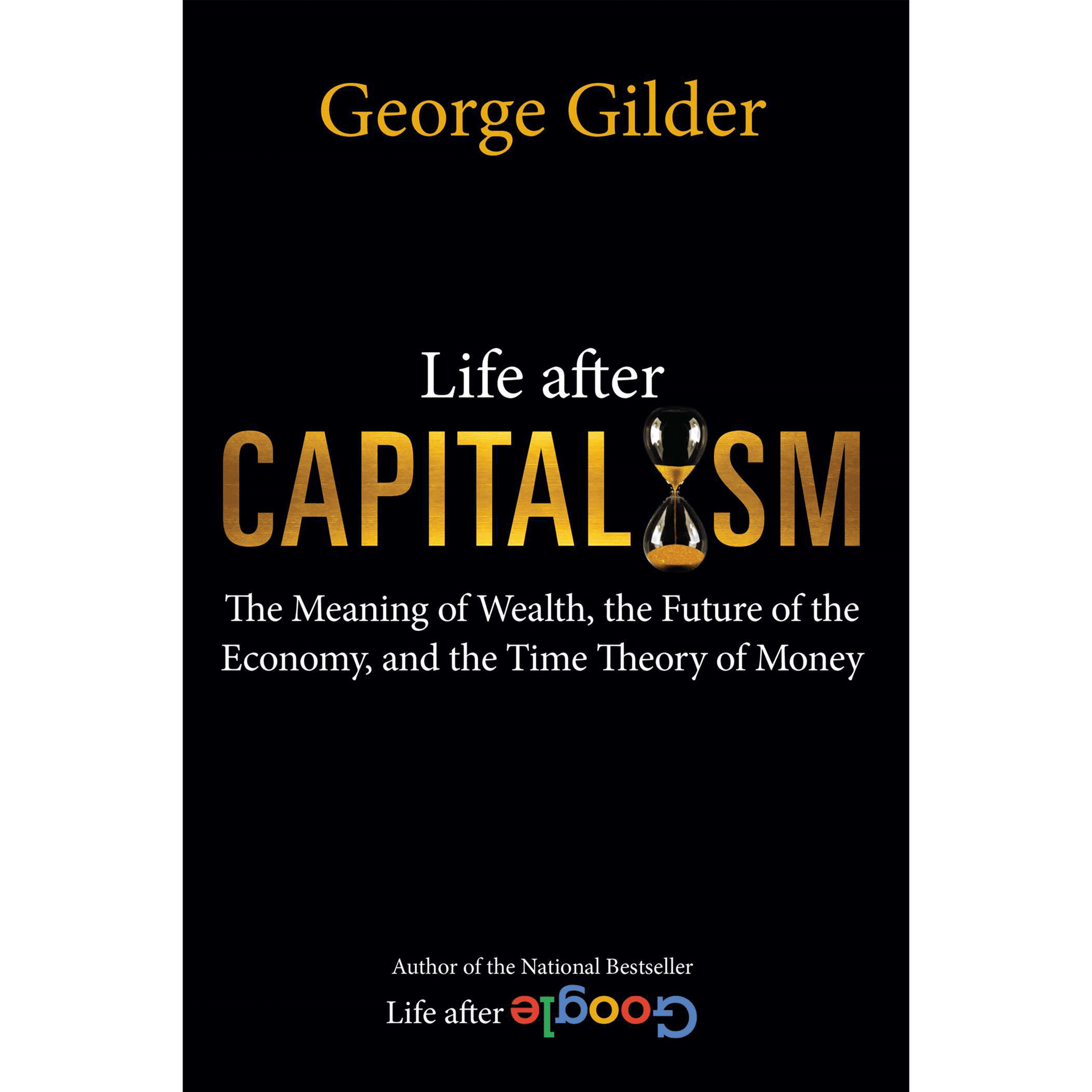
- Episode Title: George Gilder - Life After Capitalism
- Description: Discussion with venture capitalist George Gilder about his book "Life After Capitalism," redefining capitalism as a knowledge-based system amid technological disruptions.
Key Participants
- Cole Smead: CEO and Portfolio Manager at Smead Capital Management
- Bill Smead: Chairman and Chief Investment Officer at Smead Capital Management
- George Gilder: Venture capitalist and author
---
Highlights of the Discussion
Introduction
- The episode takes place live at the 2024 Smead Investor Oasis in Phoenix.
- George Gilder's background includes notable works like *Life After Google* and *Wealth and Poverty*.
Gilder’s Vision
- Gilder's motivation for writing Life After Capitalism stems from observing a shift in capitalism towards knowledge and creativity rather than wealth accumulation.
- He argues that:
- Traditional systems are becoming obsolete due to technological advancements.
- The future lies in distributed intelligence across human minds.
Economics and Knowledge
- Gilder introduces the information theory of economics:
- Economics should be viewed as an information system rather than solely an incentive system driven by greed.
- Creativity is essential for economic growth and is often unexpected ("surprisal").
Sustainability and Scarcity
- Gilder critiques the misconception that sustainability in the West is parallel to China's concept of common prosperity.
- He suggests:
- Economic resources are not limited; rather, human creativity is the true scarce resource.
- Innovations drive abundance, contradicting Malthusian views of scarcity.
Measuring Economic Progress
- Discussion on Nordhaus’ time price measure, illustrating historical growth in technologies like lighting, which significantly outpaced economists' expectations.
- Gilder argues traditional measures like GDP do not capture the true nature of economic progress in the private sector.
Critique of Materialism
- Gilder dismisses the deterministic materialism of figures like Malthus and Paul Ehrlich, stating:
- Historical evidence shows that human creativity outpaces predictions of resource depletion.
- Advances in knowledge and technology continuously reshape our understanding of resource availability.
Government Influence on Economy
- Gilder argues that excessive government intervention stifles creativity and economic growth.
- He highlights the detrimental effects of guarantees and regulations that discourage entrepreneurial spirit.
The Role of Ideas
- The podcast examines the relationship between knowledge and capital:
- Knowledge-generating entities can create wealth without the need for heavy capital investment.
- Gilder emphasizes that incentives can exist in all systems, but true growth stems from the pursuit of knowledge.
The Future of Capitalism
- Gilder proposes that understanding the dynamics of creativity and knowledge will redefine future economic landscapes.
- He calls for a recognition of the spiritual dimension of capitalism that aligns with the pursuit of truth and knowledge.
Closing Thoughts
- Gilder encourages listeners to embrace the unknown and the surprises it brings as essential to progress.
- He notes that innovations, like graphene, hold potential for revolutionizing industries, signifying an era of superabundance.
Conclusion
- The discussion encapsulates a vision of capitalism that prioritizes creativity and knowledge, challenging traditional views on economics and resource scarcity.
- George Gilder’s insights provide a provocative look at how a shift in mindset can redefine future economic possibilities.
---
Key Takeaways
- Capitalism Reimagined: Focus on knowledge-based systems rather than wealth accumulation.
- Human Creativity: The core driver of economic abundance, countering fears of scarcity.
- Critique of Metrics: Traditional economic metrics fail to capture real progress in innovation.
- Role of Government: Excessive regulation hampers the potential for innovation and growth.
- Future Outlook: Embrace creativity and adaptability for a prosperous economic future.
---
Additional Resources
- George Gilder’s Book: *Life After Capitalism* - A must-read for understanding the evolving narrative of capitalism.
- Follow Gilder’s Work: Available through his newsletters and upcoming publications related to technology and economics.
---
This markdown document serves as a comprehensive summary of the podcast episode, encapsulating the main themes, discussions, and insights shared by the participants.
Written by AI. May contain mistakes. Listen to the episode to check what was said.
Transcript
Automatic transcript. May contain errors.0:02You're listening to A Book With Legs, a podcast presented by Smeed Capital Management. At Smead Capital Management, we advise investors who fear stock market failure. You can learn more at SmeadCap.com or by calling your financial advisor. Welcome to A Book With Legs podcast. I'm Cole Smead, CEO and Portfolio Manager here at Smead Capital Management. At our firm, we are readers and we believe in the power of books to help shape informed investors. In this podcast, we speak to great authors about their writing. The late, great Charlie Munger prescribed using multiple mental models and analysis.
0:39We analyzed their work through the lens of business, markets, and people. Thank you to our listeners for joining us for this episode of the podcast. Hosting this along with me is our chairman and chief investment officer, Bill Smead. I usually refer to him as Dad. Dad, thanks for joining me. Great to be here and really excited to visit with George. So normally we visit with podcast guests from our small studio in our office and it's dinky. But this is a special discussion. We are coming live from the 2024 Speed Investor Oasis. We have the blessing of looking out over a large studio audience today.
1:19This means that Bill and I would like to also give a very proud welcome to all the investors joining us this year at the Oasis. Let's get a huge round of applause for everybody.
1:33All right. This will be quite a fun. We're going to talk, as we always do with today's guest, about the order of the world and the philosophy of how we all subdue the earth and have dominion, I would say. George Gilder is joining us to talk about his latest book, Life After Capitalism. To give you a little background on George, George has written numerous other books that include Life After Google, Life After Television, Microcosm, and his 1981 classic, Wealth and Poverty. George has followers all across the technology world, including Peter Thiel, Eric Schmidt, Ray Kurzweil. He also founded the Discovery Institute with Bruce Chapman in 1990, of which I'm blessed to be on the board and very fun.
2:17Thank you. I also want to mention to our audience that if you have not heard George speak publicly, he is one of a kind. And that's like a full stop. You're in for a real treat. George, it's great to have you here in Phoenix for the 2024 Summit Investor Oasis. Thanks for joining us. I'm delighted. Well, let's get started. First of all, what what caused you and motivated you to write the book Life After Google and what moved you to write Life After Capitalism? Well, life after Google expresses my vision that this world of gigantic, increasingly centralized data centers that with refrigeration towers that dominate their architecture and models of AI that entail 175 billion parameters for just chat GPT.
3:19All this is a climactic phase of the Silicon era and that we're moving into a new era where intelligence will continue as it always is to be distributed as widely as human minds. are distributed. Life after capitalism just expresses this crazy world we're in at the moment where the governments declare emergencies and then assume new powers, and as if socialism can suddenly be made into a workable system by declaring an emergency. Well, by the way, we didn't pay George to say that. I just want to let everybody know here. He's not a paid shill. You say early in the book on the subject of humans, we are the bane of the earth.
4:10We're the plague on the planet. Aren't we looking at this here? Look who we've done to Phoenix.
4:24It'll be like this for 45 minutes. We're going to have quite a bit of fun, everybody. You say that computer chips, the computer chip business has nothing to do with the material that compose it. Or the money that we use to make it. Quote, it has everything to do with knowledge. End quote. Explain this to the audience. Well, I'm introducing the information theory of economics. I don't think economics is chiefly an incentive system that arrives at its goals through mobilizing greed. I believe economics is essentially an information system. And Claude Shannon, who was really in some ways the founder of our information age, defined information as surprisal, as unexpected bits.
5:20And as Albert Hirschman of Princeton put it, creativity is the key to all economic growth and progress. And creativity always comes as a surprise to us. If it didn't, we wouldn't need it. And government planning would work. And we'll talk more about that because obviously we all deal in a stock market where the future is unknown. So we'll come back to that because I think it's a really important principle. Love that concept. So, George, I mean, there's just I feel like you like picking fights. So I want to get in some of the fights you pick in this book because it's fun. You liken sustainability in the Western world to the principle of common prosperity in China.
6:13How are those the same? You kind of touched on it with the government, but can you explain that more? Well, it just assumes that we live in a world of limited resources and that somehow we can collectively tap and redistribute these resources.
6:38Elon Musk has a good image. He says, we imagine the economy is kind of a horn of plenty and and everybody's fighting to command different flows of wealth from this horn of plenty. But it's a it's it's a magical concept of economics and economic growth. You point out, George, there's one scarce resource. What is that? That's human minds. The scarce resource is human minds. And what has really been a great discovery for me in the last four or five years, I've encountered Gail Pooley of, he's at Brigham Young, actually, and Brigham Young, Hawaii, and his collaborator, Marion Tupi from St. Andrews in England, wrote a book called Super Abundance.
7:42And what they have really demonstrated is the bankruptcy of all the economic measuring systems that agglomerate in Washington with these gigantic bureaucracies full of economists pouring over consumer price indices, GDP deflators, and all these purchasing power parodies, all these kind of measures of economic progress, and utterly missing the revolutionary, massive increases of abundance around the world, which correspond to the growth of human populations. The bigger the population, the more resources there are. In other words, human minds create resources. We do not consume resources. And we'll come back to that because we'll talk about the lottery tickets of humanity is how I think about that idea.
8:49Discuss the problem in measuring Nordhaus' 94 essay titled Do Real Income and Real Wage Measure Capture Reality? The history of lighting suggests not. This is Nordhaus, the Nobel laureate professor from Yale. Everybody gets your Nobel for your worst idea, you know. And so Nordhaus got his Nobel for carbon taxes. But before that, he made a genuine Nobel laureate worthy discovery of time prices. In other words, this is a universal measure that applies to any economy at any moment in history, in any place in the universe. And it measures value by the number of hours and minutes and days that you have to spend to accumulate the money to purchase goods and services.
9:57And this allows you to compare different eras. And Nordhaus did a massive study of the history of lighting, illuminating a room. How much did it cost in hours of human labor to illuminate a room? And he discovered that over human history, this technology of lighting had advanced thousands of times faster than economists had estimated. that the history of lighting was absent from economic histories that focused on the dismal science of scarcity or dark satanic mills. And while I wrote about dark satanic mills, a lighting revolution was underway and people could read on into the night and expand their days And it was really a complete transformation of human life that was utterly missing from economic data.
11:17And today, measures of GDP are really ridiculous. They assume all government spending done by printing money or whatever is worth what it costs. Or is easy to pay. While private sector accomplishments are drastically undervalued, they have no estimate of the massive consumer surpluses that people like Nordhaus and Pooley and Tupi dramatize in their books. Super abundance. We really live in an era of super abundance. Yeah, we totally agree, George. So I feel like we're beating around the bush a little bit here. And I don't know, maybe it's because, you know, some people might be chagrined that we're not burning whale fat anymore to get our lighting versus, you know, just turning on a light switch and saving all the whales out there.
12:15But that's another subject for another day. Let's hit the nail on the head, though. OK, we're not talking about Thomas Malthus. OK, so why was Malthus so wrong? And is there any evidence? I mean, you're talking about super abundance and the data for time prices, which is wonderful work. But is there any evidence that he or Paul Ehrlich of population bomb fame have ever been proven right? No. I mean, that's the point of superabundance is that humans create resources. We don't consume them is the essence of it. But this is, you know, Carl Sagan used to like to give people a sense of the size of the universe, you know, and how human beings were mere specks in this vastness that surrounds us.
13:12and he'd say that there are more stars in our universe than there are grains of sand in all the world's beaches. Well, a physicist at Stony Brook called Jennifer Cano, who I like, points out that there are more electrons in a single grain of sand than there are all the stars in the universe. And these electrons create a new quantum universe that has been opened through the nanocosm, which I'm writing about, to create all sorts of new opportunities. Essentially, the Neanderthal in this cave, as Thomas Sowell wrote in 1971 in Knowledge and Decisions, had all the natural resources we have today. The difference between our age and the Stone Age is completely the growth of knowledge.
14:20Now they want to create a new Stone Age. You know, Wired had a there's a company called Climeworks that was a cover story in Wired magazine, a great breakthrough. They can convert CO2 in the atmosphere into stones for trillions of dollars. That sounds like a deal, right? Isn't that a speed company? George, you might pick a fight at some point here. We'll probably have a presidential official or, you know, maybe someone that's got some subsidies. So let's pivot, though, because on top of that idea of Malthus and Paul Ehrlich, who I agree. I'm always blown away, George, where I run into these technology optimists where they think the world's their oyster and they can conquer the world.
15:07And then you ask them about, you know, where we're going in the world. And they have this super dour view. Oh, we're going to ruin this earth. And it's like, wow, in your business, you seem pretty optimistic. But in your view on life, it's very negative. So one of the outcomes of bad thinking, I'll call it, or the lack of knowledge is scarcity. Bad thinking or the lack of knowledge is scarcity. Price caps cause a scarcity of labor, as an example. We've taught the West to not have children. Polluters. They're polluters. Kids are polluters. You're the bane of the earth. Your kids are going to be worse, as you can tell from me.
15:41I obviously was. should we be shocked that we are starting to find a scarcity of productive and ready workers? Should we complain about young people or repent from the lie that children are bad for wealth and thus society? Yeah, I mean, it's it's nihilism and it's really a dreadful fruit of this materialist superstition that afflicts much of our philosophy, the idea that we're in a determinist material universe and we kind of represent some sort of random fluctuation. I always like to quote C.S. Lewis's great essay, Transposition, which is, imagine that you are a 2D citizen of a flatland. You're creeping across the surface of a landscape painting, a 2D landscape painting.
16:43Could you believe in a 3D world of which this 2D painting is the merest shallow reflection? and if all you know is explicable in terms of this 2D vocabulary, you've measured all the effects of the light and the patterns of the oil, you know all the material details of this 2D painting, and people ask you, well, what about the 3D universe out there of which this painting is a mere reflection. And the modern materialism says, I have no need for that hypothesis. I can explain everything in terms of these 2D relationships that I experience. And this is a hierarchical universe, and you can't reduce the higher levels to the lower levels.
17:54We'll come back to that. We'll touch on some of the, what I'll call the other dimensions that go unaddressed that I think your book made me think of.
18:24companies to build wealth. We invite you to visit smeedcap.com. Past performance is not indicative of future results. Investing involves risk, including loss of principle. Please refer to the prospectus for important information about the investment company, including objectives, risks, charges, and expenses. Read and consider it carefully before investing. Smeed funds distributed by UMB Distribution Services, LLC, not affiliated. George, you tug at our heartstring when you said this in the book, quote, quote, under capitalism, capital migrates not to those who spend it best, but those who can expand it best.
18:55That's why my wife and me are a really good team. We have both sides covered. To expand wealth, to enrich many lives, depend on knowledge and learning, not on mere incentives, unquote. It's not the financial benefits that cause people to create, it's the seeking of truth. Explain what seems to be this paradoxical reality. Paradoxical in that, you know, it's the creation of an idea that drives people, but yet there's incentives that can also fuel. It seems paradoxical. I think incentives are universal. There are incentives under socialism. They might be perverse, but they're incentives to blandish government officials and bureaucrats and make deals with the authorities and take what you can get in what's assumed to be a zero-sum world, mainly.
19:51Those are incentives. Incentives apply everywhere. And everywhere, greed is a distortion and a loss of its information and creativity that always comes as a surprise to us that fuels all economic growth and progress. This part of your book, I got really going because you said something that seems so simple, and yet I think it's missed. So I'll have to laugh when I say this. You call the Darwinian idea that survival of the fittest is tautological, okay? And when you said it, I was like, well, the other term I thought of was like, well, that's prima facie, right? right? Survival of the fittest is just true on its face.
20:40Can you explain what you meant by this? Because we assume it's like some eternal truth, and it's a truth that's just self-fulfilling. There's no truth about it. Yeah, I mean, what survives is fittest, and what is fittest survives. It's a self-referential circle that doesn't advance the argument very far. And it, that Darwin imagined that the cell, and he said various things like this, that the cell was an amorphous lump of protoplasm. That was what he assumed the cell in a human body was. And what we discover today is each cell in a human body is a massively complex and almost ineffably intricate device containing all this information systems of DNA and programming systems of RNA and the whole energy system with ATP and adenine triphosphate, you know, phosphate, all these incredibly complex operations that both Newton and Darwin, Newton thought that Adam was just undifferentiated lump.
22:15And Darwin thought the cell was undifferentiated lump. Instead, we have this fabulous universe in a single grain of sand. I mean, this is the whole world is fabulously more complex and fabulously more resourceful than these materialist models imagine. What you advocate to the book is, I love your C.S. Lewis quote, because what you're advocating is a 3D model in a 2D view to most people. In other words, you're saying, hey, there's a third dimension. There are infinite dimensions. I agree, but let's touch it because you get to another, we always talk about this. What is physically and economically true is also spiritually true, I would argue.
23:09And that's part of what C.S. Lewis is getting at that third dimension or fourth dimension. You wrote in your book, the Gospel of John says in the beginning was the word. You were a secular intellectual earlier in your life, as you commented in the book. This idea of in the beginning was the word. Isn't this the same as the entrepreneur? In the beginning was the word or what I'll call their idea, their unscripted, unknown idea. Yeah, the idea. Yeah, the word has manifested in all sorts of different words in our vocabulary of ideation. You know, we got cubits now, we got bits and bytes, we got logos, we got logic, we got...
24:02But it's all different manifestations of the word. And the substrate doesn't matter. You can inscribe words in sand and gallium arsenide and, you know, graphene. Let me tell you about graphene. This is a running theme. But the material substrate does not determine the content. Conduit does not determine content. The content comes first. In the beginning was the word. And that represents great wisdom that is a practical agenda for investors. and the understanding that now all information is ultimately surprise and surprises of human creativity and the image of their creator is the fundamental expression of our predicament.
25:11George is kidding, by the way. We know what stocks are going to go up. It's a joke. Yeah. Mind can generate and lend meaning to words, but words in themselves cannot generate mind or intelligence. What does this say for generative AI? Ka-ching, ka-ching, ka-ching. That's a little Matthew McConaughey. I'll get to that later. You know, I've been writing about AI for 50 years now. It's not new? It's not brand new? Well, I mean, all the AI claims and expectations were expounded by McCarthy in the great Stanford conference in 1956, I believe. And they thought it would take a couple of years or maybe even all the scientists went back home from that conference with the mandate to fulfill this.
26:10embodiment of the human mind and a machine during the course of the summer. And it's not that the AI systems that are currently being introduced are a new computer platform and they're very impressive and exciting. They're probably less dramatic than PC revolution, but maybe, you know, in the course of time, they'll, they're going to outstrip the PC revolution to the extent that they really do distribute computer power more widely as an instrument of human creativity. But this idea that it is somehow apocalyptic or a threat, or it's, It's just delusional. And it's a delusion, however, that has a propagandistic purpose, which is to induce regulation.
27:10Sam Altman is the great leader of OpenAI, which Microsoft bought. And it did chat GP3 and 4 and 4 Turbo and all this. And it's exciting. but he says we need to have government regulation and guidance. This is an entrepreneur who has lost his way. And, you know, it's just really a bizarre manifestation of the materialist superstition that they think they can end the world with a computer. It's just, it's stupid. And a lot of people, a lot of Silicon Valley now is seeking government regulation. That tells me it's the end of the line for Silicon Valley. Bring in graphene and this great new material that's utterly transformative, that's a thousand times more conductive than copper.
28:21Silicon Valley is approaching a heat crisis in all these gigantic data centers with their refrigerator towers. They're really giant refrigerators is what they are. And graphene is the most heat transmissive material ever discovered by far. It's the strongest material. It's the thinnest material. It's the, it's, it's just, I've, I've got a new book coming on graphene, but life after capitalism has a chapter on graphene. With Jim Tuer and, and, and he's done some wonderful work. You, you get into another spiritual truth. If you haven't picked up on all the spiritual truth that he's already thrown at you.
29:05How is confession learning? How is what? Confession learning. When you confess, as a person learning, what does that give you? Well, it just means crucial to learning is falsifiability. I mean, if anything that's guaranteed suppresses learning and information and surprise and the expansion of knowledge and economic growth guarantees. So you've got to be open to failure. You've got to be open to refutation. You've got to be open to falsification. And that's critical to the learning process and all economic growth. That's why government guarantees destroy companies and destroy growth. If you've got a company with a government guarantee, it's probably going to fail.
30:02So you use this wonderful analogy in your book. I find it very interesting that, you know, the wealth is bad, but you did use one of the most expensive cars in the world to explain this analogy, which I found intriguing. You explain the analogy of the Bugatti Veyron, okay? And you point out, and I was thinking, like, it's kind of like someone could say, I'm just a mass of cells. Like, mouthless might say, coal is just a mass of cells and maybe not a very good mass to boot. But I say that because it's my design. That's what gives me value, right? And hence, there's an oracle outside of me that somehow designed me.
30:39In the case of the Bugatti, you mentioned if you took that Bugatti and you ran it into a wall, it would go from like a$2.6 million car to something worth far less. It's not the components that comprise it. It's what has been designed. Yeah. The value of the Bugatti is entirely in the design. You crash it against, and all the material atoms and molecules remain, but they completely lose their value. The value wasn't in the material, it was in the knowledge embodied in the Bugatti. Yeah. George, you wrote, quote, paradoxically, just as all human experience teaches us that there is a path, it teaches us the next step is always unknown.
31:30It is always concealed by the opaque curtain of time. The next step is always an experiment to be validated or falsified, unquote. As you say, knowledge is surprised because the future is unknown. Why then do thinkers and investors treat a shared belief in a known future as knowledge? By the way, at the heart and soul of almost everything we do here. Well, the essence of it is it takes surprise is measured by Shannon as entropy, as information entropy, as unexpected bits, surprisal. But in order to transmit surprising ideas, you need a low entropy carrier. That is, you need predictable structure of laws and expectations and beliefs and moral codes and family values and all these things provide a low entropy carrier for high entropy creations.
32:41And you need both. You need the low entropy carrier, the predictable channel, and you need to accommodate the surprises of human creativity. But if you begin manipulating the carrier, government intervening everywhere and changing everything and imposing woke nonsense and just generally undermining the predictable carrier, you can thwart the unexpected boons of creativity. They've become swamped by noise in an information system. Well, in other words, not everyone can be high entropy either, necessarily, because there's got to be a low entropy system that it goes through. Yeah. You wrote that, quote, Chinese-backed venture funds have failed to spur a mainland microchip industry strong enough to compete with Taiwan's global mastery, unquote.
33:47So you call their way of doing this, quote, this randomness operating on large numbers, unquote, and shows why they're captive to the materialist superstition. Couldn't this same criticism scald the passive investor in the U.S.? In other words, it's the law of large numbers. You just passively do whatever you want. But it's not working for the Chinese and venture capital. How can that work for everybody? Is that a surprise? Yeah. Well, I mean, there's an illusion that the surprises of human creativity can be simulated by a random number generator. I mean, this is in AI systems gain their surprisal, gain their ability to simulate human intelligence through injecting levels of randomness into the system.
34:49And, you know, they have a temperature. One is complete, reliable reproduction of the most probable outcomes from the AI system. And zero, I might have this opposite, but zero may be the most random outcomes. And it turns out the people prefer outcomes that include a certain amount of randomness, which means that the outcomes are error prone. And this is a fundamental contradiction in the AI scheme. It assumes that randomness is the same as human creativity. But you can't simulate human creativity by a random number generator. So let's touch on that human creativity because you tell, I mean, again, this is a wonderful idea.
Read the full transcript
35:51You talk about McLean's creation of the cargo container. So we look out at these intermodal containers on ships, on trains, and we take that for granted. But even that was human creativity. Explain how that revolutionized global trade and what it was prior. Yeah, well, this was crucial. You know, before, you couldn't have global trade and the intricate and fragile and diverse components of a smartphone. what I've been calling a teleputer since I predicted it way back in life after capitalism. But I mean, life after something or other, life after television. I've forgotten about television, although Apple wants me to sign up for Apple TV every time I open my iPhone.
36:47I don't know what they. Along with 40 ,000 other things that Apple wants you to do. iPhone in order to return to the TV age. I don't know what they've got on their minds. But anyway, cargo container is a low entropy carrier for the world economy. Everything can be put into uniform. It digitizes trade as bits and bytes allow information to be transmitted readily through all the systems of information age. The containerization of trade is like the bits and bytes of international commerce. It's a low entropy carrier, packetized transmission of goods and services around the globe. As a ship pilot, my dad made a lot of money from those containers.
37:43George, why do you think health care and education don't follow the time price path of all the other goods we produce? Because they're dominated by government. These seem to not... They're governed by authority rather than by creativity. Yeah, yeah, yeah. Okay. It sounds like that's done. I rarely catch George on short words, but that was full stop there. I want to give a big shout out to everyone who's listening to this show. You know, we recently hit the top 10 in investing podcasts on Apple Podcasts, and even number one in the business category in several countries. As you may know, this show is brought to you by Smead Capital Management.
38:22Smead understands how frustrating and illogical the stock market can be. If you're searching for funds with a proven track record, give the Smead funds a look. Or better yet, reach out at SmeadCap.com. And don't forget to mention you're a fan of the podcast. Past performance is not indicative of future results. Investing involves risk, including loss of principal. Please refer to the prospectus for important information about the investment company, including objectives, risks, charges, and expenses. Read and consider it carefully before investing. Smead funds distributed by UMB Distribution Services, LLC, not affiliated.
38:55You quote one of my dad's favorite lines. I don't know if you chuckled when you read this part of the book. Every year, my dad will go sit down around Thanksgiving, watch It's a Wonderful Life. And you sure enough, quote his favorite line of the movie, where he explains to them how a bank runs and that the money isn't sitting in the safe, it's in his property, in his property. So we love that scene. The best investments to fund are the ones that create their own capital immediately. That's the ideal world. To your point, the knowledge is so great, and it's so profitable to society that it starts feeding out cash and grows itself.
39:32Now, not all investments are like that, though. As we know, some of these investments require, I mean, I think like the internet age, it took billions of dollars of infrastructure to be built in creating what I'll call a low entropy carrier, ultimately, to produce all the information we share today on the internet and our phones, you know, globally. So how do you look at the illiquidity gap is what I think about it, right? That where banks have to provide long-term investment, and yet they're doing that to effectively arbitrage the price of money where someone's eating capital day one versus the business that creates capital day one.
40:11Well, I think the fundamental law of investment is you can only keep what you give away. This is originally the Midas paradox. You know, King Midas turned everything to gold and died of starvation. You can only keep what you give away. If you try to hoard and keep stuff, you undermine the creative process of altruistic enterprise that ultimately produces all growth and progress. Yeah. You say that, quote, fiat currency is obviously oracular, unquote. Oracular. Oracular. Oracular. Because it's based on faith. You go on to point out that God's creation of time is better. We find it funny to believe that inflation is bagged with the government, is loaded with low entropy investment opportunities, and massive debts to begin with.
41:13We believe there's only way out, like all governments for the last 100 years, is to inflate. Would you agree? I think the key point is to understand what money is. Money is what remains scarce when everything else grows abundant. We live in a world of superabundance. And money is ultimately time. It's tokenized time. It's the way the scarcity of time is incorporated in the management of abundance and creativity. And time is the scarce resource, and money is essentially time. Wealth is knowledge. Growth is learning. Information is surprise. and money is time and that tokenized time. And so it's a real thing.
42:17And it was simulated by gold, which over the millennia, because as we mined ever deeper for more gold, it neutralized the effect of technological advance. You got the miner with a sieve and the gold rush in California could, or the guy with a sieve and a river could mine gold as fast as a gigantic factory of mining complex in South Africa. So gold neutralized time. And that's why gold was and has been the most intrinsic money. I believe that the crypto revolution is going to increase, is going to produce a new global money and retrieves the economy for capitalists from these now nationalized banks.
43:28I mean, the politicians have used nationalization of banks and the ability to just print money, essentially, to circumvent all political processes and democratic controls and constitutional restrictions. They just print more money and issue a mandate and a subsidy, and they think they've guaranteed the future. And what they do is destroy the future by that process. Guarantee failures. Guarantee failures. And to prove your point, George, about the money is time, I think the easiest way to think about this is how do you live longer here on Earth? Well, the number one statistic is how much money do you have?
44:18Because with money, you have better health care. So it's interesting to see that there's a direct correlation between the amount of money you have and how long you're able to sustain yourself on Earth. It is the closest thing to capturing time or in the information theory, it would be the accrued knowledge you provided to society that saved them time inversely. Well, I think that's right, except, you know, our lifespans across the developed world are now, for the first time, longevity is diminishing. And this is kind of an alarming development. And I think it's a result of the socialization of health care.
45:00Health care is no longer entrepreneurial. It's entirely government mandated and with Operation Warp Speeds and similar ideas, where essentially government mandates and subsidizes the future and thus produces reduced longevity, despite the miraculous expansion of knowledge, which renders biotech and one of the great frontiers of opportunity in the world economy. It's amazing how the socialization of health care, how quickly it's brought to a screeching halt the growth and longevity that has been the great triumph of human endeavor in the last several hundred years. So I want to get to the most important thing that I think blockchain will bring to us in society.
45:59So, Bill, you want to tee up our... As a baby boomer, I hate passwords. Do you really believe the blockchain's tokenization process will get me away for ever having to remember any of my passwords in Web 3.0? Well, yeah, I mean, the password is really something to stick on you, the user of the technology, the responsibility for security that the producer of the technology actually should incur, but is allowed to avoid under monopoly rules. You know, FTC keeps in business these security scams like Norton and all these security mumbo-jumbo companies that are really, and then collecting all your passwords and usernames and demanding them as you proceed through the program.
47:06I mean, it's a complete clutter of nonsense where they stick on the customer the blame for the incredibly gross security fiasco of millions and millions of usernames and passwords being stolen every month. You know, every, you know, they're constant big catastrophes. And still they blame you for, and slow you down every day with this password nonsense. sense. So I'm the only non-jaded person on the stage right now, I think. I think bio ID is reasonable. So you can prove that you're you, that's reasonable. Fingerprints. But to make you memorize hundreds of passwords. George, there's a lot we didn't get to, admittedly.
48:07We didn't. It's a great book. It's a wonderful book. We didn't get to graphene, which by the way, George, if you want to learn about a wonderful technology that, again, it's purely based on knowledge. And just so we're all on the same page, it's carbon based, that really dangerous, scary, scary thing. We didn't get to page 76 where he literally uses the best scientists to blow up the whole global warming climate change debacle. So there's a lot we didn't get to. but I wanted to ask you, George, and I think the question I want to finish on is I don't think I did it early in my notes, but we start out with this very dark view of the world and I think somewhere in my notes here, you point out how bleak the future is in a quote-unquote sustainable world, okay?
49:01And you kind of lay out the worst case scenario and I think the reason why you did that early in the book is because we hear about that all the time, how bleak it is. So I guess, you know, can you give us the opposite case? In other words, you know, can you give us kind of a blue sky picture of what this world looks like compared to what we hear more regularly? Well, I wrote the introduction to superabundance. And this book, Life After Capitalism, summarizes superabundance and has a couple chapters written by Gail Pooley, who is the master of all the data that proves that all these GDP numbers and CPIs and GDP deflators and purchasing power are all just futile and misleading.
49:53And that's interesting. There are contrary things. It may not be that we have any inflation. This whole idea of inflation as the natural condition of economies is a function of money debauchery, but measured by time, which is the real measure of value. We've had no inflation. We had incredible increases. All the inflation is in government. Everything else is massively cheaper. according to the learning curve. And I just came from Georgia Tech. I've spent two days with Walt DeHere, who really deserved the Nobel Prize for discovering graphene. But DeHere has, over 20 years, has developed a way to create perfect layers, sheets of graphene for wafer scale integrated computation grown on silicon carbide.
51:11So you sublimate out the silicon in the top layer of silicon carbide, and you gas out the silicon under high temperature, and you get a perfect layer of 2D graphene on the surface, which can be manipulated, which is the strongest. I've given you the superlatives, but they're all real. I mean, while the silicon industry is reaching a sort of baroque phase where they got thin fats and 3D structures on top of the devices and heat crises, And meanwhile, Tor and Dahir and other great figures are moving back to 2D graphene. And they're going to transform electronics. Wafer scale integration of electronics on silicon carbide is a real practical agenda.
52:26And I think the silicon carbide companies better get on the stick or they're going to, you know, China, one of the problems with the here at Georgia Tech, you can say it's a problem, but it's probably a solution to tell the truth. I mean, the idea that we can gain anything by war with China is one of the most idiotic ideas I know. And Tahir's students, half of them are Chinese. His leading student has got a big company now emerging to do graphene on silicon carbide in Tianjin, China. And meanwhile, they here can't get any money from all the American VCs. And even companies like Intel are all preoccupied with the CHIP Act, which is a kind of waste money on the mature and obsolete phase of the silicon industry.
53:32Well, Huawei has got a graphene transistor patent. I mean, this whole, I mean, somehow China is more capitalist now than we are. And this sounds like a preposterous idea, but really we're going over to China to tell them to adopt emergency socialism. him. That's what Newcomb or whatever the name of the goofball governor of. I promise in California. He went and told Xi that he wasn't communist enough, that he's got to really take over the economy and suppress his energy production. So, George, you probably offended maybe 30, 40 percent of the people in the room because that billions of government waste will go directly into our housing prices here.
54:21So So we feel very blessed with this. George, let's see. Well, Chandler, I mean, I'm for Intel, but I think Intel's got to do graphene and got to do the new generations of electronics rather than create a Baroque cathedral of the old era for the government. So I'm going to throw a shameless plug in here. Like I mentioned earlier, I'm on the board of Discovery Institute, which George helped found. If you've enjoyed yourself, you can do this for like two or three days every year in November. George, he created Cosm, so I want to throw that out to the audience. I know some people here have been to that before.
54:56Outside of Cosm, George, where else can people follow you going forward? If they look and say, gosh, George is a little screwy, but I love that. Well, I mean, if you can fight through the somewhat embarrassing marketing, the future is surprising. But I do have four newsletters and a great Moonshots publication, which is mostly written by John Schroeder, who has 20 semiconductor patents and who I met at Caltech with Carver Mead, who is the prime figure at Cosm. And I'm out there. I'm writing a new book on graphene now. And by the way, Bill, he's actually on Twitter or what we now know as Axe. So George is, I mean, he's killing it.
55:51I'm not on Twitter much. Not much. I've noticed that. You're known. George, thank you for your time. For our audience today and the listeners of this podcast, we believe George's book, Life After Capitalism, describes true knowledge like Christ did. In the beginning was the word, and that word can't be created or solved by government, but by an oracle from the outside of the system. Our audience today at the Smead Investor Oasis has received a copy of George's book, Life After Capitalism, should be on your seat. Our listeners should go to their favorite bookstore or website, buy a copy today of George's book.
56:27If you enjoyed this podcast, go to Apple, Spotify, YouTube, or wherever you listen to a book with legs. give us a review, tell others about the books and great authors like George Gilder that we have the opportunity to understand and study the world with and through. For our tribe, which we can look out to you today, if you have a great book that you'd like to recommend, email podcast at smeedcap.com. That's podcast at smeedcap.com. You can also send your suggestions to us on X. Our handle is at smeedcap. Thank you for joining us for a Book With Legs podcast. We look forward to the next episode.
56:58Thank you, everybody. Thank you. Thank you for listening to A Book with Legs, a podcast brought to you by Smead Capital Management. The material provided in this podcast is for informational use only and should not be construed as investment advice. You can learn more about Smead Capital Management and its products at SmeadCap.com or by calling your financial advisor.
57:28Transcription by CastingWords
From the publisher
Live from the 2024 Smead Investor Oasis, venture capitalist George Gilder joins Bill and Cole Smead to discuss his latest work, "Life after Capitalism," in which he redefines capitalism as a knowledge-based system. Gilder presents a vision of the future in which technological advances disrupt traditional capitalist structures, emphasizing innovation and knowledge over wealth accumulation.


