
In short
A Book with Legs Podcast - Episode Summary: Harold James - Seven Crashes
Podcast Title: A Book with Legs Episode Title: Harold James - Seven Crashes Host: Cole Smead Guest: Harold James
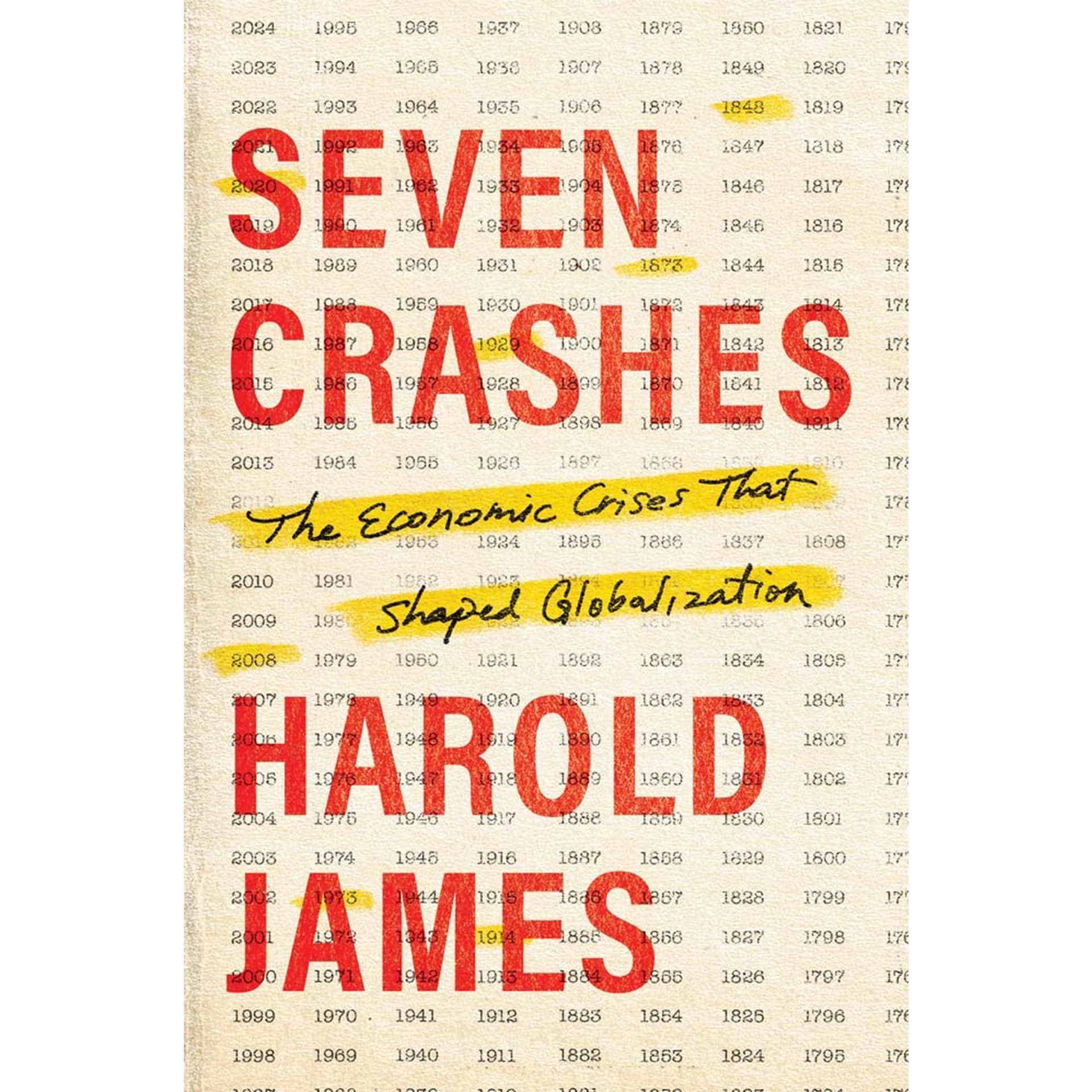
Podcast Overview In this episode, Cole Smead interviews historian and author Harold James about his book, "Seven Crashes: The Economic Crises That Shaped Globalization." The discussion explores significant economic downturns throughout history, their causes, impacts, and the reforms that emerged in their wake.
Key Themes
- Globalization and Economic Crises: Analyzing the relationship between historical economic crises and the evolution of globalization.
- Role of Government: Examining how government actions can facilitate or obstruct technological dissemination and economic recovery.
- Historical Perspectives: Insights into how historical events inform contemporary economic conditions and policies.
Key Points from the Discussion
Author Background
- Harold James: Claude and Laura Kelly Professor of European Studies at Princeton University, official historian of the International Monetary Fund, and author of several influential books on economics and history.
Globalization and Economic Crises
- Skepticism Toward Globalization: Following the financial crisis of 2008 and subsequent geopolitical events, Harold argues against the notion that globalization is in irreversible decline, suggesting that crises often catalyze innovation.
Government's Role
- Influencing Technology and Markets:
- Governments can both aid and hinder technological advancement.
- Historical examples include the regulation of railroads and the development of container shipping.
- Heuristics of Government Action: Harold discusses how government needs to recognize the necessity of innovation during crises, contrasting successful government interventions (like the internet and vaccines) with restrictive policies that stifle progress.
Historical Contexts of Economic Downturns
- The 1840s Crisis:
- The famine in Ireland (potato blight) exemplified how a government’s failure to manage crises can lead to widespread political upheaval.
- This crisis prompted greater investment in infrastructure like railroads, fostering a more interconnected global market.
- The Role of Notable Figures in History:
- Discussion of great men theory and how influential figures catalyze change during economic turmoil.
- The contrast between influential reformers and the faceless nature of broader economic changes.
The Gold Standard and Market Movements
- 1870s Economic Context:
- Transition towards the gold standard and implications on global trade and economic stability.
- Examination of U.S. market resilience in the face of crises compared to global counterparts.
The Great Depression
- Bank Failures and Economic Collapse:
- The Great Depression was exacerbated by bank failures, not merely stock market crashes.
- Highlighting the profound impact of financial systems on broader economic health.
Modern Economic Reflections
- Current Policies and Economic Predictions:
- Critique of contemporary fiscal policies and their sustainability.
- Discussing how economic recovery needs a careful balance between demand stimulation and market stability.
Innovation as a Solution
- Adapting to Tomorrow's Challenges:
- Harold emphasizes the need for innovation in response to economic challenges, advocating for localized solutions to manage economic disparities.
Conclusion Harold James provides a comprehensive historical lens through which to view economic crises and globalization. His insights serve as a reminder of the importance of learning from history to navigate contemporary challenges effectively.
Key Takeaways
- Economic crises often prompt significant reforms and innovations.
- Government intervention can play a critical role in either facilitating or hindering economic recovery.
- Understanding historical economic patterns aids in the formulation of effective modern policies.
Further Reading and Resources
- Book: "Seven Crashes: The Economic Crises That Shaped Globalization" by Harold James
- Follow Harold James: Monthly columns for Project Syndicate and other academic contributions.
Closing Remarks Listeners are encouraged to explore the themes discussed in this episode and consider the implications of past economic crises on current and future global economic landscapes. The discussion underscores the necessity of recognizing patterns to foster resilience in our modern economy.
Written by AI. May contain mistakes. Listen to the episode to check what was said.
Transcript
Automatic transcript. May contain errors.0:02You're listening to A Book With Legs, a podcast presented by Smeed Capital Management. At Smead Capital Management, we advise investors who fear stock market failure. You can learn more at SmeadCap.com or by calling your financial advisor.
0:20Welcome to A Book With Legs podcast. I'm Cole Smead, CEO and Portfolio Manager at Smead Capital Management. At our firm, we are readers, and we believe in the power of books to help shape informed investors. In this podcast, we speak to great authors about their writings. The late, great Charlie Munger prescribed using multiple mental models and analysis. We analyzed their work through the lens of business, markets, and people. Today, we're going to review and discuss multiple periods of economic history to think about the circumstances, the policy decisions, and the aftermaths they brought. Harold James is joining us to discuss his book, Seven Crashes, The Economic Crises That Shaped Globalization.
0:59A little background on Harold. He is the Claude and Laura Kelly Professor of European Studies at Princeton University, a professor of history and international affairs at the Woodrow Wilson School, and associate at the Benheim Center of Finance. His prior books include The German Slump, A German Identity, International Monetary Cooperation Since Bretton Woods, and The End of Globalization. He is the official historian of the International Monetary Fund. He was awarded the Helmut Schmidt Prize for Economic History in 2004 and the Ludwig Erhard Prize in 2005, first writing about economics. You're a much more esteemed man than me, Harold, but I really appreciate you joining me today.
1:38Well, it's great to be with you, Carl. So you've written obviously a lot in your lifetime. I've mentioned some of the books you've authored. You've co-authored quite a few books as well that I didn't mention. What inspired you to write this, you know, really series of economic circumstances to argue for really what I would argue is the ultimate upheaval and cause to lead to globalization more often recurringly? Well, I've been thinking about globalization for a long time. In the early 2000s, just after the turn of the millennium, I did a book on the end of globalization, which was not a kind of attack on globalization, but it was a reflection on the experience of the interwar period and a reflection on how globalization was reversed at that moment with really devastating consequences.
2:29And at that time, everybody was really gung-ho about globalization and they just thought that it was inevitable and it would go on forever and ever. And I wanted to introduce a bit of skepticism. Then the great financial crisis happened in 2008. Then the turbulence of the 2010s, the politics, the Brexit votes in the UK, the Trump election in the United States. And then it became almost a commonplace that globalization was going into reverse. And it became more and more of a theme after 2020, after the outbreak of COVID. And then last year or the year before, February 22, the Russian attack on Ukraine.
3:13And that really cemented the view that globalization was breaking apart. And I thought, no, no, this just isn't right. There have been moments like this. And it's actually at those high moments of tension that you get a sense of what's possible, what's necessary, what technologies are available. And there's a lot of innovation at those moments of great upheaval. There's a lot of great quotes in your book, and I'm going to pull out one to start because this comes out in your introduction. And I think it's a great way to think about all these periods. And I'm glad you wrote this early. Quote, it is thus wrong to simply assume that the dissemination of technology is a steady, even paced process.
3:55It is distinctly shaped by government priorities, choices as to why certain products matter, railroads, steamships, aircrafts, vaccines, and so on. End quote. Let's call this the development and distribution of information. That's how I think about it. The government can assist this process. Isn't that one of the inherent problems at times? As you look across these periods, we need the governments to do some things right. I think about the internet. I think about the vaccine as an example. How do you look at the government's ability to help or hurt that process? Yeah, I mean, you're absolutely right.
4:29I mean, government is very, very often obstructive of that. But the early history that you just mentioned is a good example of that with the railroads. There were lots and lots of limitations on railroads at the beginning. And it's only in the middle of a hunger crisis in the middle of the 19th century that people see that railroads are good not just in connecting two places, and they're often a relatively small distance in the Pennsylvania coalfields or in Yorkshire between Stockton and Darlington. So railways can be networked and you can really expand the range of markets through that. But it's only when you thought that something has really gone wrong that governments are pushed to change.
5:12And that was the case in the middle of the 19th century. It was the case in the 1970s. And I think it's the case at the moment in today's multiple crises. It's also interesting, and I didn't have this in my notes, but it's interesting to think about the technology that thrived without a lot of government push. versus the ones that need it. I mean, you know, as an example, the vaccine needed a lot of government thrust to be done so quickly. You know, I would say the armament of World War II would be another example of where the government thrust caused a hastened pace. But then you look at like automobiles and automobiles didn't need a lot of government incentive.
5:49It was really a consumer driven thing in the end. Have you come up with any, you know, heuristically simple rule to use as a framework for thinking about, you know, how the government pushes this information off to the society? Well, I mean, it's often that there are big barriers to the adoption of new technologies because people are worried about their effects. They think they're disruptive. And often the government sides with that kind of view. And at the beginning, that was also the view on the automobile. Remember, this is the UK rather than the United States, but in the UK, the automobile was allowed, but in order to make sure that it was completely safe, it was instructed that somebody had to walk in front of the automobile carrying a red flag.
6:41And that's exactly the kind of obstruction that you get. That was early in the history of railroads. You know, the example that I like in the late 20th century is the container ship. The container ship was a pretty obvious idea to have. And there was a proto-container ship built in the 1930s. And from the 1950s, there was regular container traffic between Florida and the port of New York. But you know, you need to build ports that can work with containers. And in one city after another, one port city after another, unions are really obviously very hostile to containers because they will eliminate all the longshoremen.
7:25City governments, state governments listen to that. And it's only when you've got a big, big problem and you decide really you need to get transportation more cheaply. That kind of objection is then overruled and you can move on with it. process of innovation. In your introduction, you bring up a historical argument, which I'm an economics history double major, and I'd never heard until I was in college. Can you teach our listeners what the idea of great men theory is in the historical debates? Right. So particularly in the 19th century, in the weight of Napoleon, everybody was really obsessed with the idea that Napoleon had fundamentally changed history, and German philosopher Hegel had talked about Napoleon as the world spirit on horseback.
8:23But that view of things applied elsewhere, and in some ways it's linked to a topic that we were discussing just now. How do you break through ossified political systems or ossified social systems? You need somebody with a kind of charisma to stand up and say, you can do things differently. And so I think you can find plenty of entrepreneurs and you can go backwards from Elon Musk and Bill Gates. But this was also part of the story of the classic industrial revolution. But it's also the question of economic policy. So there's still a club in London called the Reform Club, which celebrates the reformers in the middle of the 19th century who reformed Parliament, but also got rid of the high level of protective tariffs.
9:19And so this is Richard Cobden, John Brighton. They have big, big statues there in the reform clubs. There would still have been protective tariffs and Britain wouldn't have modernized so efficiently and so quickly and so on. So, you know, I think mostly economists and most economic historians really push back quite heavily against that. And for instance, I sometimes teach a big outline course. And when I talk about the Industrial Revolution, I tend not to talk about individuals at all. So it's all about coal and coal replacing human and animal power. But it's a kind of rather faceless history.
10:05And I think, you know, what I try to do in the book is also give some kind of due to these people who stand up at particular moments and say, things are going wrong. We've got to do things in a different way. Sure. Sure. Well, yeah, and I think what you do a good job in this book is you really explain the backdrop and the circumstances that brought to this point what was going on environmentally and the politics. And then to your point, if there was a truly unique individual, you explain why they were unique in such a wonderful way. So let's talk about the crisis of the 1840s. Can you just give our listeners some of the backdrop of what was the buildup to that crisis?
10:46Yeah. Famine was a standard story in the pre-industrial world. There were regular famines and catastrophes. And the great political economists of the 18th century make famine a part of their regular analysis. There were also big famines in the 19th century. So in the 1870s in India and northern China, big famines. But the famine that hit Europe in the middle of the 19th century in the 1840s, and I think we probably remember it most as the Irish potato blight, the failure of the Irish potato crop because of a fungal infection. But this was a failure all over Northern Europe. There were just one summer after another with no sunshine, lots of rain, and so crops rot.
11:42Food prices go up, and it turns into a catastrophe for the British government. The British government, first of all, starts with the right kind of reflection that people are starving in Ireland, they need to be fed, so they provide public soup kitchens. But then they hit a financial crisis, a fiscal crisis. They need to spend more money on these soup kitchens. They need to import the food. There's a deterioration of the balance of payments. In consequence, they put the interest rates up. The government debt becomes more difficult to manage. So they stop the soup kitchens, and the famine gets much, much worse.
12:21And people emigrate from Ireland. So this was not just in Britain, but every European country. It was a failure of government. And at the end of the decade, in 1848, there are political revolutions and the old governments are swept away. And particularly in continental Europe, you get governments that really think now, we need to build the railroads, we need to make sure that our people get said, that they have access to foreign markets, that the grain, if it doesn't get produced, if it doesn't get grown in Europe, it can come from the Russian Empire or North Africa, a lot of Egyptian grain, or across the Atlantic more and more because there are now steamships that are going across the Atlantic.
13:05And so the world gets integrated. And that really is the sense in which these great free traders that we were talking about before, they stand up and they say, this is exactly the direction that the world is going to move in. And one European politician after another goes on exactly that course. okay so you point out and i think of other people's writing we were talking before the podcast about neil fergus and his book doom touches on the same thing but you you quote francis milton troll up in this chapter you quoted when he said quote but thought i do not believe in exhibitions of god's anger i do believe in exhibitions of his mercy end quote so the idea being you know he here he's writing about these circumstances that are playing out and people are looking around and spiritually saying, well, this is God's wrath or his anger pouring down on us.
13:56But, you know, he takes a different tact, which is that it's really God's mercy, because to your point, these don't go on forever. We solve these. To quote, you know, the original mandate, it was be fruitful, multiply, subdue the earth, have dominion. It isn't what you're studying in these crises, really just the latter two parts of that, subdue the earth and have dominion and getting through these are part of us, you know, subduing the earth. I think that's right. But we also have experiences where those famines or catastrophes or epidemics, pandemics, are treated as some kind of divine retribution.
14:36Correct. So, you know, particularly in Ireland, the Protestant clergyman, the Church of Ireland, the established church, many of them took that line. After 2020, some people said that the COVID pandemic was a penalty for globalization, that it was the price that was being paid because people had opened up too much and they made themselves dependent on foreign goods. And if you didn't have globalization, you wouldn't have so many people traveling and so on. You know, I think that isn't the right way of thinking about it. And there's another view that says, no, no, we've got possibilities. We've got potential.
15:22We just need to utilize that potential. Correct. And I think you really get into the, later we'll talk about some of the flexibility and adaptive thinking that some of the bigger personalities in your book that you do talk about. Also in the chapter, you talk about the belief that is still floating around even since the 19th century. You mentioned Thomas Piketty. He recognized that returns on capital outpaces economic growth in the long run, producing, in his view, inequality. Put another way, more risk taken by, say, an investor over government bonds produce more returns, is how I think about it.
15:55Why does Marx and Piketty tire themselves out over a concept that most individuals would easily understand and agree with, even though we might not always individually love the outcomes of that agreement? Well, Marx, I think, stands at the beginning of a kind of interpretation of these shock events as a catastrophe. So many people are thinking in the middle of all this upheaval that the system is going to be completely destroyed. It's going to collapse. And they try to evolve a long-term picture of why that is the case. And Marx, I think, is kind of interesting in that regard, in that he's in a way self-critical.
16:43And you can see it because he's expecting immediately after the crisis of the 1840s and the political revolution that there will be just another event like that. And then he sees how in the late 1850s, there's another crisis. In 1866, there's another crisis. And they didn't produce the end of the system. So he thinks he actually needs to adapt his view. And he sits there and it's a wonderful thought of him sitting there day after day in the library of the British Museum. And he's writing columns of figures from the London Times or the Economist. He writes out these columns of figures and stares at them and tries to work out some kind of linkages and interdependence.
17:29And at the same time, exactly the same time as he's working on that, in the same reading room, Stanley Jevons, the son of a businessman who failed in the crisis of the 1840s, is sitting there and actually working out what the relationship of prices to decisions about trading are. And he works out that things happen at the margin. So he pushes this great revolution of marginalism in economics with a mathematical capacity that Karl Marx didn't have. So, you know, I'm afraid to say, I think it's, you know, Marx recognized that himself, that he had limitations. He couldn't see quite how to analyze the data in the right way.
18:09So Stanley Jevons, in your writing, is one of these true big men, you know, from a discussion perspective that you have. You know, you mentioned a little bit of his background. I don't think you actually touched on this book, but my favorite Stanley Jevons idea is the Jevons paradox, which I think is still vastly misunderstood, not necessarily in academia, but just in practical real world terms. Can you teach us, you know, what the Jevons paradox is and why that was so interesting at the time in coal, for example? Well, yes, I mean, it's exactly right that he was writing on the theory of pricing at the margins.
18:48And he felt people weren't really interested in that. But then he wrote about the way in which Britain was running out of coal. And that attracted everybody's attention because here was Britain really in a position of absolute dominance in the middle of the 19th century, but dependent on coal. And you could work out that there was more coal in other areas of the world. There was more coal in Germany. There was more coal in Pennsylvania. There was more coal. People were beginning to realize that in China. And so Jevons is then saying, we need to work out what we're going to do when this great resource is exhausted.
19:31This show is brought to you by Smead Capital Management. We hope you're enjoying the podcast. You know, we work hard putting together this show, but we work even harder for our investors at Smead Capital Management. At Smead, we believe in disciplined investing, which is why the Smead funds have a proven track record of long-term outperformance. If you're an investor who fears stock market failure and want to invest in wonderful companies to build wealth, we invite you to visit smeadcap.com. Past performance is not indicative of future results. Investing involves risk, including loss of principal.
20:00Please refer to the prospectus for important information about the investment company, including objectives, risks, charges, and expenses. Read and consider it carefully before investing. Smead funds distributed by UMB Distribution Services, LLC, not affiliated. So the 1870s, as you put it, was a crock. But this period was very much a deflationary era, as you lay the case out, because of the technology and the technology being what we had in, for example, coal-fired production. Do you think about the 1870s deflation due to technology, you know, similarly to what we've seen looking back, say, for much of the last 20 years, as we think about what the Internet's done in the revolution of business and therefore the price of goods?
20:44I think there are bad deflations and dangerous deflations. And that was the experience in the late 1920s and in the early 1920s. But there were also good deflations when deflation is driven by innovation pushing down prices. So things like the most obvious example is if you think of the vast increase in computing capacity, You think also of the way in which automobiles are so substantially improved in the course of this, and the price increases that you see don't reflect the degree to which the automobiles got better. better. So the 1870s is a good episode of that. The early 2000s and in many, many countries, people worried about deflation then.
21:40But fundamentally, this was driven by the vast opening of the world and by really very, very large numbers of people in the big emerging markets coming in, producing things, and driving down prices of the common consumer goods, t-shirts, sport equipment, as well as the high-tech goods that are benefiting from the technical improvements. And that's very, very different to the declations that come in the aftermath of big financial collapses. And we've got the Great Depression, but also the global financial crisis, so-called global financial crisis after 2008 had a bit of that element of a financial collapse, the collapse demand.
22:34So also in this chapter, looking at the 1870s, you also get into the conversation of the gold standard. This is where you kind of get into what is the monetary standard, at that time. Obviously, gold wasn't necessarily the main standard. Bimetallism was very prevalent at this time. What was the debate among the countries on what was the most acceptable currency standard? I mean, indeed, as you go into the 1870s, gold isn't that common. The modern metallic standard isn't that common. It's in Britain. It's in Portugal, which everybody will tell you it's Britain's oldest trading partner. But the United States had suspended convertibility in the Civil War.
23:19France, which is really the big economic rival of Britain at this point, has a bimetallic standard. China, Mexico are on a silver standard. And it's fundamentally a kind of tipping point argument that what happens is that one new country, Germany, decides to go on to gold because they think Britain is the most advanced country. And if Britain has got it, we better do it. And the United States at the same time goes back on to gold. And at that moment also, there's a big, big fall in the silver price because France is paying a lot of its reparation bill after the Franco-Prussian war, after the Franco-German war in silver.
24:10They try to diminish the possibility of disruption in the European market by selling the silver in Asia. but they obviously see very quickly that it's one world and that if the silver price collapses in China, it's going to collapse in Europe as well. And so you can't separate the markets like that. That's when people are really very, very conscious very quickly of the way in which the global market is connected. And selling something in China is not going to stop it affecting Europeans. And, you know, from that moment on, really everybody goes on to gold with just one or two exceptions that Mexico and China stay on the silver standard from until the interwar period.
24:57So in 1873, you talk about how Jay Cook failed. Obviously, Jay Cook was the financial backer to the Great Northern Railroad, which, you know, ran through Duluth, Minnesota, all the way out to the Pacific Northwest. And I found this really interesting because I think a lot about this today. you pointed out how U.S. markets were directly affected. The stock market had quite a bit of trouble. Companies weren't as bothered by this in comparison. I think you mentioned the Pennsylvania Railroad continued to chug out profits, pay dividends repeatedly through that period. Other markets were unaffected by this issue.
25:30So thinking about this at that time in 1873, the U.S. is the deepest capital market in the world. I think most people assume that because of globalization, if the US markets have an issue, let's just call it a bear market, not a credit crisis, but a readjustment of stock market prices, that this is going to be a global problem. In a panic, I would agree, tied to banking, but outside of a banking issue, do you also agree that this is a falsehood? In other words, that it's the only, it's the tail that wags the dog, if you will? Right, that moment in the 1870s looked as if it was a global panic in that there were stock markets that behaved in a more or less synchronized way, that there was an Austrian branch of that.
26:21I mean, indeed, it was highly covered in the American press. The Americans were fascinated by the Austrian stock market collapse in May of 73, months before the U.S. collapse. And they actually got the word kreisch from the way in which the Austrians used the German word kreisch to describe what they're doing, what they're going through. But yes, I mean, ultimately, you're completely right that this is not something that reversed globalization in the 1870s. It continued to go on, but it called for a greater control of the movements. And so one country after another starts to apply some kind of level of protective tariff.
27:07And the continental Europeans do that. The United States does that in the end with the McKinley tariff. And you're moving away from this completely opened up world that had existed in the middle of the 19th century. Sure. Yeah. Because I also try to use that analogously to ask, you know, when Japan fell apart as a market, which was both a banking problem there as well as a stock market problem from the late 1980s, did the U.S. and the rest of the world's trajectory end? And the answer is no. It continued to globalize, just like the dot-com bubble busted. And it didn't cause the same problem that a credit crisis of 08-09 did.
27:49So I think you always point out that economists fight the last war and they tend to fight the last war that we just went through. And that becomes their anchoring bias and their recency bias. And so I'm always trying to ask the question, what is the bias today? And therefore, what is not likely to happen? Right. You know, in a go forward nature. You did an excellent job in this book explaining why the Weimar experience is so overstated. When I say overstated, it's not the only example we have, but it's the most talked about. I'm going to quote from your book, quote, the Weimar experience became the principal historical showcase argument in favor of fiscal orthodoxy or what is now often called dismissively austerity, end quote.
28:32You know, it's not the only period, but it's the most talked about. Why did that end up becoming the default versus the other examples you cite in the book? That's right. I mean, I think because the political outcome of that experience was so tragic. So the collapse of the economy in the early 1930s is also the collapse of the political system. It's the collapse of democracy. And in the aftermath of that collapse of democracy, this is the dictatorship of the head of Hitler and the Nazis. So the really horrendous experience of the 1930s, murderous, genocidal experience, comes in a way as a legacy of the Depression and the failure of the economy, the failure of democracy to deal with that economic collapse.
Read the full transcript
29:31I think that's undoubtedly why, because other countries had hyperinflations, other countries had terrible depressions, but this was uniquely murderous in its outcome. So you do a wonderful job of talking about scarcities and any readers of your book will walk away thinking governments create scarcities is how I think about it. But, you know, I think of a lot about the lockdowns as, you know, being someone that had to live through that. You think about, well, what do government decisions do? Can you teach our listeners what stock markets and even other markets that were traded did with the outbreak of war in 1914?
30:14Right. So 1914 is obviously going to produce scarcities, but nobody knows how long it will go on. And there are many, many people who think, well, it's such a costly business fighting this war that it really can't go on forever. so just the fiscal constraints will lead to the end of the war. But actually it kind of feeds on itself because the more you've sunk into fighting the war, the more important it is that you finish it and you win the war because the only way that you can pay for the war is by winning it because you're going to impose the cost of the war on the loser. And so you mustn't under any circumstance lose.
31:00And so it becomes really harder and harder to negotiate a peace without the complete collapse of a society. And that's really what happened at the end, that first Russia collapses in 1917. And then in late 1918, the central powers, Austria and Germany collapse. When I think you mentioned that I think the New York Stock Exchange closed for five months, I think Britain closed their markets for the stock market for four months. Was the central idea that, oh, here's wealth, we better trap it in place so it can't leave the country? Yes. I mean, it's in part also trying to build in a break so that the market doesn't get overwhelmed by panic.
31:47But it's kind of interesting, for instance, that you would expect in August 1914, when the war breaks out, with Britain in the war but the United States not in the war, that the United States would see money flowing into it and the dollar would rise against the pound. Exactly the opposite happened because the Americans saw that the submarine warfare was going to interrupt the cotton exports. So Britain wasn't going to buy so much in the way of American goods. And so you could see that affecting the balance of payments. And the dollar tanks very quickly after that. And that's one of the reasons.
32:31I mean, it actually is a kind of striking one because the United States had just a few years before that gone through a wrenching financial catastrophe. The outcome of that was that they wanted to create a federal reserve system, a central bank, for the first time. But the central bank isn't operating yet. And so they do the emergency currency issue under the terms of the act that had been put in immediately after the 1970s panic. So the Fed can't do anything to stabilize the crisis because it isn't working yet. so you talk a lot about the cost of war in this chapter and i think this is just a great discussion there's some other books that we've touched on um that you know where we think about like prior sieges and how kings would deal with that so there's a lot of historical precedence for what you say in this but doesn't war provide really good cover for higher taxes on wealthy people ultimately?
33:33Well, that's exactly the debate that you have, because, you know, should you put taxes up or should you borrow because you may be able to recover the cost of the war or you think that you may be able to grow in the future? And so, you know, on the whole, there's a kind of gradient from west to east, that the United States and the UK taxed more. Germany and France taxed less, and Russia was completely unable to tax at all. And so the Russians borrowed. And they get a much worse inflation more quickly than the Germans do. The Germans get a worse inflation than the French do. And the United States and the UK have an inflation during the war.
34:25But then a really quite abrupt deflation after the war uniquely, and they go in a different direction. But the simple story, I think, is that, you know, countries that tried to avoid the costs of war and the increasing the tax burden, what they found was that they, in the end, descended into social and political chaos and disaster. So I think the other really good example of this idea of taxation was the story you tell of the Czechs. To your point in your book, the Czechs had no problem with the war. How did they deal with this problem of taxation so differently than other countries? Well, I mean, the finance minister in post-war Czechoslovakia was more courageous than many other finance ministers.
35:16He put the taxes up and then he was assassinated as a result to that. But it was also slightly easier in the sense that one of the things that the Czechs did, the old Habsburg Empire was now broken up, and they expropriated the big landlords. And that was relatively popular because the big landlords were mostly foreigners. They were German speakers, Austrians. And so there was a considerable kind of nationalization sentiment that you were Czechifying the economy by putting up taxes on big landlords. And elsewhere, it was more difficult to do that. Germany didn't look levered, as you pointed out, when you look at their, I'll call it their overall government borrowing.
36:10But you talked about even then, And there was really shadow banking going on in the German economy that you wouldn't see on its face. Yes, they've got a much lower debt because they've wiped out their domestic debt because of the high level of inflation and of hyperinflation. But the capital market is completely destroyed by that experience. So effectively, they can't borrow. And going back to your earlier discussion of why Germany did the austerity in the early 30s, they really had very little other alternative except to do that because the domestic market was so weak and the international market had collapsed.
36:53And so, you know, saying that they should have done something different, they should have had a more expansionary policy. We just like saying that a country that today is in this kind of near collapse, so Argentina with high levels of inflation, that they have an easy way of spending out of their problems. They don't. And they need really radically and really painful reform. One of the most searing lines in your book, and I just have never thought about like this, and I just love your writing here. quote, the government spending capacity is infinite. All that is limited are the productive resources of the economy, end quote.
37:39This is the paradox, is it not, when we think about fiscal spending? Yeah, that's absolutely right. And this is, I think, the heart of the story that I wanted to tell, that in these moments of scarcity, you can't do everything with government spending, because what you really need is some kind of very specific good. So in the case of the Federal War, it's very obvious what you need. You need munitions. You need to put the munitions at the front. I mean, it's what you need in Ukraine at the moment. You need to equip the Ukrainian army. But if you think of the pandemic, it's very, very similar in that sense that you need specific kinds of medical equipment.
38:24You need, at first, you need the face masks and the protective clothing for the hospital workers, and then you need the vaccines and so on and so on. But, you know, just spending money splurging on anything actually makes it difficult to address the particular problem. And so you need to cut down the consumption of ordinary civilian goods in a wartime. And having people spending on household goods and fun equipment in COVID is not going to solve the actual question of COVID. So when you talk about the Great Depression, you point out that stock markets crashed in 1929. But just the market movements don't account for the collapse in demand.
39:11You really argue it was the collapse in banks. Can you explain this to our listeners? Yes. I mean, this is an old debate and it's odd that it's still conducted, but it goes back to what you were saying earlier in the discussion that there are some moments, the collapse of the dot-com boom or the collapse of the Japanese stock market. Or, you know, I remember very well October 1987, you know, a really massive stock market collapse in the U.S. with the same kind of percentage fall as in October 1929. It did really have almost no macroeconomic impact. And what really went wrong in the Great Depression was the collapse of banks in the United States in waves from 1930 until 1933.
40:00And it's that that turns the Great Depression into the really Great Depression. Otherwise, it would have been a little business cycle blip. But, you know, it's a famous point that Milton Friedman and Anna Schwartz made in the monetary history of the United States in the early 1960s. And absolutely correct. What Friedman and Schwartz didn't do was to think about the way in which bank collapses in other countries had an impact on the United States. So the U.S. collapses get much worse after the summer of 1931.
41:04forget to mention you're a fan of the podcast. Past performance is not indicative of future results. Investing involves risk, including loss of principle. Please refer to the prospectus for important information about the investment company, including objectives, risks, charges, and expenses. Read and consider it carefully before investing. Smead funds distributed by UMB Distribution Services, LLC, not affiliated. I think a lot about this point too. I mean, we just watched American banks collapse about a year ago. And, you know, I, like I tell people, are we watching any European bank collapses?
41:37And there are structural reasons for why, and also how those loans are priced, things of that nature. But, you know, these can be on a two-year delay. You know, some of the things that might affect a bank at one point might affect the banks at other points. The other, the other really important economic lesson, I think that you pointed out, and I'd never heard this, but I'm probably just not as not very well studied on this, but you pointed out that when the Kredenstalt failed, you could see a direct correlation between where bank failures were happening and where the rise of Nazism, in other words, the economic problem becomes a physical problem.
42:10And as we all know from the outcomes of World War II and it becoming what I would argue is a spiritual problem. You know, how close was that connection between economic failure and really political problems? Yeah, we'd say it's absolutely there. And it's the reason that people are really terrified about the prospect of bank collapses on a big scale. And it doesn't really matter whether it's one big bank collapsing or lots and lots of little bank collapsing. They're going to have the same kind of effect. And so thinking that you can avoid the problem by having a lot of little banks. And the United States and the Great Depression had no really big systemic banks, but it had lots and lots of little banks.
42:57And the effect of that was also really devastating. In the next part of your book, you talk about how particularly interesting Keynes is as a policymaker, as a person, as a thinker. Is there any particular story that comes to mind for you? Or can you explain to our audience, you know, why he was so unique in the setting and scene he was in? Yeah, he's a wonderful, wonderful, mesmerizing figure. And he has so many critical points to make. Very early as a young man, he's part of the peace conference in Paris in 1919. He's there through the 1930s. he's the major figure or one of the major figures in making the post-war monetary settlement his key figure in the Breffin Woods Conference in 1944.
43:53So I think of him in very, very different settings and he's doing different things on each occasion. And what he learns to do actually is to bite his tongue in some circumstances, because in 1919, he was a big critic of the peace conference. He was a big critic of the United States government. And then he comes up with a scheme with some other Europeans and American bankers of how you might have structured finance in order to get Europe out of the post-war mess. But it's impossible because he's associated himself with this brilliant and witty book in 1919, The Economic Consequences of the Peace, with a devastating pen portrait of Woodrow Wilson.
44:40And Woodrow Wilson is really the only person who could possibly have realized that. And, you know, I think you have, you know, again and again, brilliant economists who write to a wide audience. But you know, sometimes they're making fun of people who could actually produce the solution. And I think Keynes learned not to do that and to be more of a behind the scenes person in the Second World War. And he's critical in managing the Second World War. And actually, for instance, making sure that Britain doesn't get a big inflation in the second world war and putting on taxes in order to reduce civilian demand you know all those really good remedies that we in part talked about weren't done in the first world war and then he's he's the big designer of the um of the international monetary system after after the after the war i was trying to remind myself what the there was a really good line you had in the book that was um from i think one of wilson's gentlemen you know commenting on that book that I can't remember offhand, but I was one of those incredible, you know, one of a kind lines that you'd had throughout your book.
45:58If it comes to mind, the other thing I was going to mention in my mind, John Maynard Keynes looks like Muhammad El-Aryan. He talks like the intelligence of Charlie Munger, the late, great Charlie Munger. And he has the policy prescriptions of Larry Summers today. Is that a fair amalgamation to build up a Keynes-like personality? I think that's pretty good. I mean, I think in some ways, if I were thinking of the living embodiment of Keynes today, I would think of Larry Summers. The quote that I really love from Keynes, I don't know whether this is what you were thinking of, was, you know, in this very, very gloomy moment in 1919, he says, all this makes it increasingly probable that things will have to get worse before they can get better.
46:48And I just love that they will have to get worse, but they can get better. And so there's always a hopeful element there. And so that's really important because when people just preach doom, it's terrible. It demoralizes people. It makes them incapable of being innovative. It creates a mood of defeatism, pessimism. You just want to sit at home and do nothing. You need to realize that it can get better and you can do things. Agree. And I think the other, you know, you point out he had this, you know, kind of like mysterious, magical nature to him because he was he knew personally that the British civilization or the empire was in decline.
47:35And he recognized that his hope was ultimately that America would lead, which is why he had such disappointment with Woodrow Wilson, I think, was, you know, as I thought about that. So, you know, he was real, but yet he was optimistic. The other line that I love, and this is kind of my personification of Charlie Munger, and this is describing Keynes on a quote from your book, quote, Quote, Keynes was always ready with his beautifully polished sentences. He detected any inconsistency in the opposition, even in the most obtruse matter, with lightning celerity and pointed it out with seeming gentleness in barbed and sometimes offensive sentences.
48:10End quote. I mean, I think I just think of Charlie Munger telling you that you're wrong, but with a better accent and a more polished way. And someone looking across the table thinking, how dare you tell me that? Which is what Wilson had. So you just talked about the you cannot be negative. You by addressing it in such a dour view, you can affect the circumstances and people. You put a really good contrast in your book. I think most people that are, you know, entrepreneurs and are free market people tend to look at Shumpeter and say, oh, you know, creative destruction. What a great thing. But you also point out how creative destruction has a very dour view.
48:50There is a fatalist and a defeatism that can come with that view. And most libertarians love to espouse that ideal, I would argue. How does Keynes contrast with Schumpeter's creative destruction and kind of the defeatism that can come with that? Well, yes, Schumpeter, you know, he was wracked by a series of personal catastrophes. His first wife, who he absolutely adored, died very, very quickly. And he basically never recovered from that. and it becomes gloomier and gloomier through the 1930s. And the last books, the Capitalism, Socialism, and Democracy, he basically thinks that capitalism has failed completely.
49:39It's a book of despair that he writes in the 1940s. And Keynes has got an energy, and he also has a sense of personal liberty. So, notoriously, he stands at the opposite end of many of the debates with Friedrich Hayek, but he absolutely admires the liberalism of Hayek and the defense of personal liberty. so i never heard this story from the 1970s you tell some beautiful stories to help understand why not all inflationary policies in 1970s were alike okay and to play at this idea of governments create scarcities whether it be through too much fiscal largesse or through bad policies on the supply side you talk about how we saw gas lines here in the united states of america so for example when my dad turned 16, he got gas depending on which day of the week based on your birthday, if you were an odd day or an even day.
50:41And we saw gas lines here. But you point out that in Germany, there were no gas lines. Why? Well, that's a fascinating thing. I mean, some Europeans, by the way, tried exactly that, but they tended to allocate gas according to the number on your registration plate. And so rich people just bought two cars. So they would have one car with an odd number and one with an even number. But the, no, I mean, it's one of the moments, I think, really decisive where Germany and Japan go in one direction and the United States and the UK go in a different direction that the United States, for political reasons, wants to hold the gas price down.
51:25Obviously, gas is politically sensitive. People in the interior have to drive very long distances. People in New York and California don't, and in New York City and San Francisco and Berkeley don't. So you're affecting things if you let the gas price rise. But what the rise in the gas price did in Germany and Japan was, first of all, it pushes drivers not to drive so much, but then it also pushes them to buy fuel-efficient cars. And the automobile producers see that, and they produce the fuel-efficient cars. In the United States, they don't really do that until the second oil price shock, the one that follows in 1979 after the Iranian revolution and the flight of the Shah.
52:16And so the United States is stuck with an automobile industry that takes a long, long time to react to the Japanese challenge. As I'm going to quote from your book here, as Eichenbaum put it, quote, there is now widespread agreement that countercyclical discretionary fiscal policy is neither desirable nor politically feasible, end quote. That could be said of the 1970s, whether we were talking about LBJ or Nixon, it's the old guns and butter debate, if you will. Can't the exact same thing be said currently in at least in the U.S. political environment? Oh, I think you're absolutely right. But, you know, what I think why we got to this is that we thought that or many people thought that 2020 and COVID was just a replay of the 2008 problem.
53:09And 2008, it was right that there was a deficiency of demand, the banks had collapsed, it was monetary collapse. This was a demand shock. What happened in 2020 was a supply shock. And fundamentally, that's the heart of the message of the book, that you need a typology of crises and you shouldn't treat supply shocks as if they're demand shocks because you will actually augment the scarcities and you will make things worse and worse and worse because everybody is going to look for new bottlenecks and they're going to jump on those new bottlenecks and you're going to wrestle endlessly with scarcity as a result.
53:53I agree with you. And I think the other thing that you write about in this book, and I, again, I highly recommend all of our listeners to really understand what you mean by this, but you, you are one of the few authors who has said, listen, COVID was a war. It was a war because the policies used. It was a war, I would argue, if you look at the amount of spending on a federal basis, it was a war. We restricted countries, depending on their status in the world, like a war. There was rationing like a war. And yet, no one says the government just fought one of the largest world wars, if not the, on a fiscal spending basis we've ever seen.
54:34And what's happening in response is war-like reactions. Why has that not been said by most people in the economics realm? You're absolutely right. I mean, you go back to Keynes in the Second World War, and Keynes says, we're fighting this war. We can't have the degree of consumer demand that we would have because we need, we would like to have, because we need to supply the troops with the uniforms and with the ammunition and so on. And that point could and should have been made. And obviously there are many people who are immediately badly affected by the closures in COVID. But people are very reluctant in the political sphere to do targeted interventions to help them.
55:29they want because it's much easier to do across the board spending. And that's what gets you then into these difficulties. You know, that's where I think there are voices who said that very quickly. Larry Summers was very critical of both the Trump and the Biden fiscal packages, and he was right on that. So you also point out a piece of debate and speech that I've been coming back to repeatedly because I think it is so important for understanding, to your point, the bias, to your point, what policy prescription people are using to think about the COVID scenario versus 08 or 09. You talk about Bernanke's speech, the great moderation that he gave in 2004.
56:25And I think you mentioned a couple of times in your writing. I went back and revisited that a couple of weeks ago and wrote about it. But I would argue that Ben Bernanke is really the father of modern central bank policy in the 21st century. He has created it. He has crafted it. He has honed it in so many respects. But the great moderation was very helpful for 2008, 2009 to quote, I think you tell a story of the Fed governor's debate around QE. One of them said, you know, this could become kudzu for market operators, which is an invasive plant in the south. It can ruin vegetation. It can ruin habitats.
57:01Aren't we at the point where Bernanke's great moderation has become the kudzu for market operators? Their bias is that rates will always be simple and easy. And is there a danger that this bias by policymakers and market operators can actually cause what we've actually got, which is the great conflagration, the road where great fiscal spending meets great monetary ease over time? Yep. And you clearly get into a trap. The more you go on with this, the larger the deficit and the debt level is, the more sensitive the government spending will be to interest rate changes. And so looking at that, you get a degree of pressure on central banks not to increase rates because it will make life for the government impossible.
58:01And you add on to that, when people think of some kind of really big challenge, it can be the challenge of managing the transition to carbon neutral energy. It can be the military mobilization that you need in a world that is becoming more insecure. But people are going to give both those arguments. And we've got an element of what economists call fiscal dominance in this moment. So speaking of Larry Summers, I agree with you that I think he is the voice of reason. He is being the adult in the room on the left. He's making Democrats mad because he sounds logical and they don't like that on the right.
58:45He sounds like a globalist, which he thinks is beneficial. And the right doesn't like that either here in the United States. So I agree with you. He's really providing policy prescription that fits the matter at hand, which is why many people are frustrated with him. And full disclosure, after the release of this podcast episode, he'll be out here in Arizona for an event on what will be March 7th, 2024, called Lift AZ. And we're going to talk about this. We're going to call it Fed watching. What do you think Larry really has right about this debate, you know, in a few big ideas? I think fundamentally the vision is right that the fiscal side of responding to COVID was overdone and that it's helped to get the United States into a problem.
59:30So that I think is right. I mean, what I wanted to say right at the end of the book was also that, you know, these moments of thinking about how to restructure critical moments, it's very, very important to think of microeconomic adjustment measures. And so, in some ways, thinking about the global aggregates is an immensely helpful topic when you're thinking about demand collapses and when you're thinking about managing wars. But it's not going to give you the heart of the innovation impulse. And if you really want to think about social reform programs, I think, you know, we've got a lot of material now that comes with specific localization of where educational programs are not going right, where there are inequalities.
1:00:26You know, that has to be managed in a very, very local way. And across the board, management of that brings more problems than it brings real gains in tackling the problem. agree and i think a lot about the politics i mean the political debate just blows my mind um if anyone ever thinks economists are crazy they should just get into politics watching people debate two billion dollars to ukraine out of the federal budget here in the united states when we're spending money on medicare and medicaid and social security like we have money you know infinitely as we pointed out earlier those are two different worlds and they don't if you use simple math and accounting those are completely different conversations so So the other thing, Harold, and I think this is something I'll leave our listeners with.
1:01:09You point out that, again, Bernanke being the father of modern central bank policy, his bias is to clean problems after the fact, not lean into problems as they build. And I think most investors, the market operators, like was pointed out, don't understand that. They think that the Fed is like a benevolent ship captain. And I think what we've already seen in the bond market in the last two years is that they might be benevolent, but they're not here to clean you up. They're here to clean up the economy and the society. But many people can be taken out on a stretcher in the process of them cleaning.
1:01:48Would you agree with that? Yes. I mean, I think also if you're just looking at the landscape of the world to come, what we experienced in the UK in September 2022 with this very, very brief-lived government under Liz Truss with Kwasi Kwarteng as the Chancellor of the Exchequer, the finance minister, is in a way a warning of a situation that can emerge elsewhere, including in the United States. I mean, I think that was why the US Treasury got so upset about September 2022. Why Janet Yellen got so upset about it was that it looked like a warning, that there's some kind of tipping point where the markets think that you're incredible, incredible, and you look for alternatives at that moment.
1:02:37You know, if people don't think that the central bank doesn't have to be political at times as we move forward, I think it's going to become more political to your point about this this this issue of where you have these big debts and yet the government has to finance it, which is a central bank problem in the long run. Watching our former Fed governor and chairman, Janet Yellen, tell everyone that all is well while inflation is running rampant is probably the oddest thing I'll ever see in my life in central bank policy. Harold, I could go on for hours. There's so many things we didn't talk about.
1:03:09We didn't talk much about Nixon. And we skipped along some of the things about like capitalism and how malleable it is. We touched on that. We didn't talk about Carl Menger. There's just so much of this. But one of the things, because I'm a huge fan of your thinking on a global basis and, you know, the repercussions across different continents, particularly, how can our listeners follow you going forward? Where can they find your writing and pay attention to what you're working on here forward? Well, that's so kind of you, Colin. It's really been great talking to you. I do a monthly column for Project Syndicate, and so it goes across in newspapers across the world.
1:03:45And that's probably the most updated version of it. But I think if you read Seven Crashes, you will see, if you're listening to this, you will see where I'm going on really translating a note of optimism into a world that has become very, very gloomy. And we ended with a rather gloomy discussion of the fiscal situation. What will help, the only thing that can help is innovation. In order to innovate, you need to be flexible, but you also need to have a relatively good sense of what you might do in the future. If you think that everything is completely gloomy, you're out, you've failed. I completely agree.
1:04:33And I agree with you that pragmatism, you know, coated with optimism is a very scarce thing. I also need to mention, I just, I need to come out and have you come up to New York sometime and host a dinner party. Because like I said, this discussion is like a three, four hour fun over a nice glass of wine. And I could go on forever. I want to say to our audience, Harold's book builds a picture of how we arrived at today's policies based on the past mistakes in crises. It tips the hand of a rational policymaker for the unknown future where policy works and investors must deal with the policies that work.
1:05:10This should be required reading, I would argue, in economics and history departments all across the United States and the world. Go out and get your copy today. If you enjoyed this podcast, go to Apple, Spotify, YouTube, or wherever you listen to a book with legs. Give us a review. Tell others about the books and great authors, like Harold James, that we have the opportunity to understand and study the world with and through. For our tribe, if you have a great book you'd like to recommend, email podcast at smeedcap.com. That's podcast at smeedcap.com. You can also send your suggestions to us on Twitter.
1:05:42Our handle is at smeedcap. Thank you for joining us for a Book With Legs podcast. We look forward to the next episode. Thank you for listening to A Book With Legs, a podcast brought to you by Smeed Capital Management. The material provided in this podcast is for informational use only and should not be construed as investment advice. You can learn more about Smeet Capital Management and its products at SmeetCap.com or by calling your financial advisor.
From the publisher
In this episode, author and historian Harold James joins Cole Smead to discuss his book, “Seven Crashes: The Economic Crises That Shaped Globalization.” Their discussion delves into major economic downturns throughout history, offering insights into their causes, impacts, and reforms to prevent future crises.


