
In short
A Book with Legs Podcast Episode Summary
Episode Title
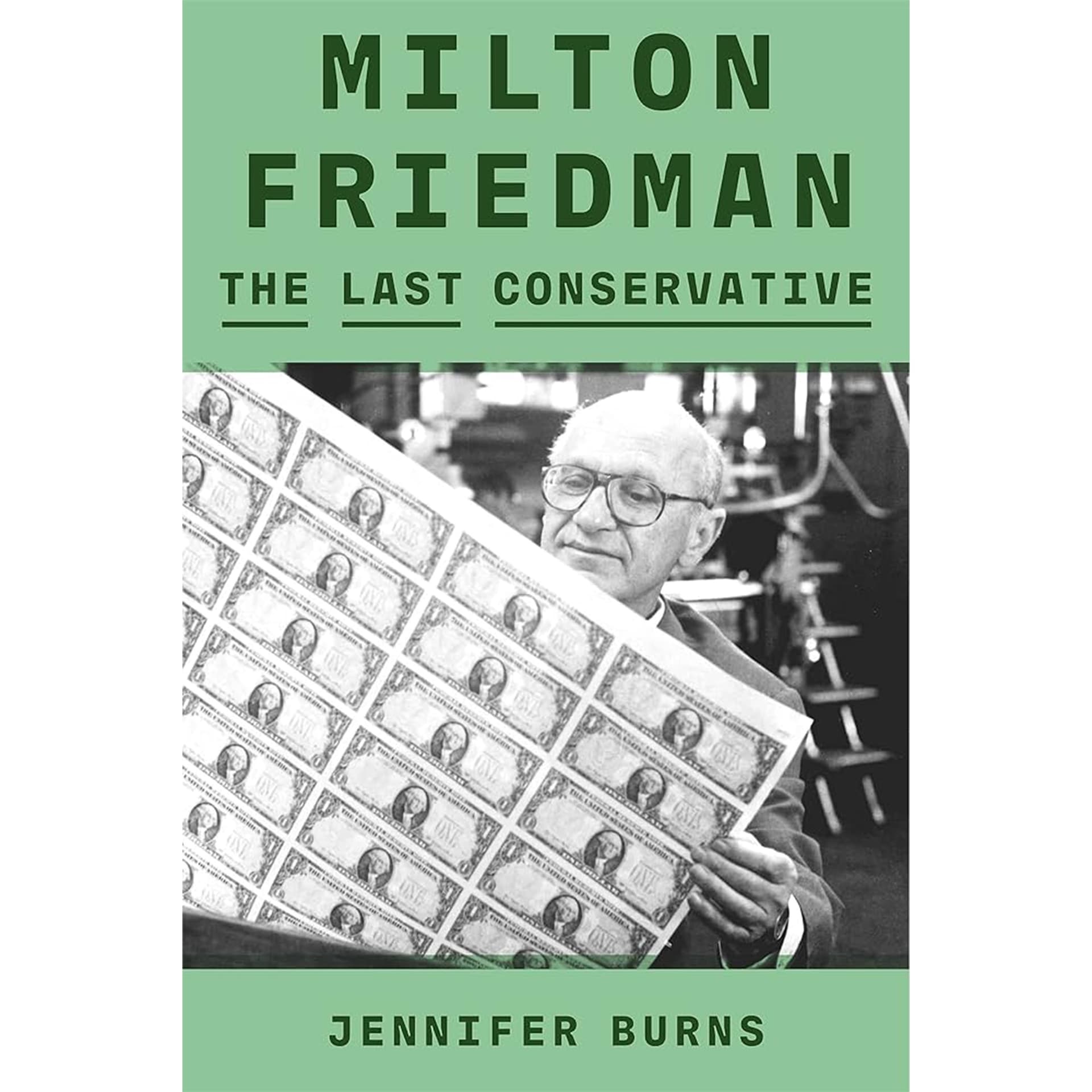
Jennifer Burns - Milton Friedman: The Last Conservative
Host
Cole Smead, CEO and Portfolio Manager at Smead Capital Management
Guest
Jennifer Burns, historian and author of "Milton Friedman: The Last Conservative"
---
Podcast Overview In this episode, historian Jennifer Burns discusses her book, "Milton Friedman: The Last Conservative," exploring the life and economic theories of the influential economist Milton Friedman. The conversation delves into Friedman's upbringing, his key relationships, the evolution of his economic philosophy, and the impact of his ideas on contemporary conservative thought.
---
Key Topics Discussed
- Inspiration for the Book
- Jennifer Burns shares her motivation for writing about Milton Friedman, highlighting her desire to fill a gap in understanding the Chicago School of economics and Friedman's role within it.
- Milton Friedman's Upbringing
- Friedman was born to Jewish immigrant parents in New Jersey and had a suburban childhood that differed from many of his contemporaries.
- His father's early death was a significant event that shaped his future aspirations.
- Educational Influences
- At Rutgers, Friedman met Arthur Burns, who became a mentor and inspired him to pursue economics, especially during the Great Depression.
- Economic Theories
- Discussion of Friedman's critique of the prevailing economic ideas of his time, particularly regarding competition and profit.
- Explanation of Frank Knight's views on uncertainty and the role of entrepreneurship.
- Debate on Central Planning vs. Price Theory
- Historical context around the popularity of central planning during the New Deal and the arguments favoring price theory and competition.
- Friedman’s belief that competition is essential for economic success, countering the narratives of the time.
- The Quantity Theory of Money
- Explanation of Friedman's contributions to monetary economics, emphasizing his modern formulation of the Quantity Theory and its implications during the Great Depression.
- Friedman’s Critique of Licensing
- Examination of Friedman's dissertation on the medical profession, which criticized the American Medical Association for creating barriers to entry and maintaining higher wages through cartel-like practices.
- The Chicago School and Room 7 Gang
- The formation of a strong intellectual community at the University of Chicago, where Friedman and his contemporaries collaborated and influenced each other.
- Friedman’s Political Engagement
- Discussion of Friedman's support for various political figures, including Barry Goldwater and Ronald Reagan, and how he navigated the complexities of political economy.
- The Legacy of Friedman
- Reflections on Friedman's evolving ideas about government spending and taxation, especially in the context of contemporary economic challenges.
- The realization that political and economic freedoms do not always align, as evidenced by examples from Singapore and China.
---
Key Takeaways
- Friedman's Pragmatism: His ability to adapt and refine his ideas over time, reflecting a deep understanding of both economics and human behavior.
- The Impact of Economic Freedom: The ongoing relevance of Friedman's ideas about economic freedom and its relationship with social and political structures.
- Critique of Socialism: Friedman's concerns about government expansion and spending, and the paradox of politicians needing to promise spending to get elected.
- Modern Implications: The conversation draws parallels between Friedman's theories and current economic and political trends, highlighting the importance of choice and competition in economic systems.
---
Conclusion The episode provides a comprehensive overview of Milton Friedman’s life and thought, emphasizing his lasting impact on economics and conservative ideology. Jennifer Burns offers valuable insights into how Friedman's ideas resonate in today's economic landscape.
For more information about this episode, visit [Smead Capital Management](https://smeadcap.com) or search for A Book with Legs on your favorite podcast platform.
Written by AI. May contain mistakes. Listen to the episode to check what was said.
Transcript
Automatic transcript. May contain errors.0:02You're listening to A Book With Legs, a podcast presented by Smeed Capital Management. At Smead Capital Management, we advise investors who fear stock market failure. You can learn more at SmeadCap.com or by calling your financial advisor.
0:21Welcome to A Book of the Legs podcast. I'm Cole Smead, CEO and Portfolio Manager here at Smead Capital Management. At our firm, we are readers and we believe in the power of books to help shape informed investors. In this podcast, we speak to great authors about their writings. The late, great Charlie Munger prescribed using multiple mental models and analysis. We analyze their work through the lens of business, markets, and people. Hello to our audience today. We're going to discuss one of the most pragmatic minds of the 20th century who taught the world the power of market-based forces and the quantity theory of money.
0:53Joining the podcast is Jennifer Byrne to discuss her new book, Milton Friedman, The Last Conservative. A little bit about Jennifer. She is the associate professor of history at Stanford University and a research fellow at Stanford's Hoover Institution on War, Revolution, and Peace. She also authored Goddess of the Market, Ayn Rand and the American Right that was published in 2009. An expert on this history of conservative ideas and politics, she has written for the New York Times, the Financial Times, Bloomberg, and Dissident, and has discussed her work on The Daily Show, The Colbert Report, and elsewhere.
1:25She received her bachelor's degree in history from Harvard, her master's in history from the University of California, and her PhD in history also from the University of California. Jennifer, thanks for joining me today. Thanks so much for having me and that nice introduction. Well, this is an easy book to kind of smile, as you can tell I'm doing here. Outside of the fact that you obviously centered a lot of your work on conservative thought, let's just call it, what inspired you to write about Milton particularly? You know, it came to it in a couple different ways. One was being interested in writing a more comprehensive history of conservative ideas and politics in the 20th century.
2:01And so, you know, as I started to look into that project, I kind of bumped into Friedman and the Chicago School. And I was thinking that I had this base of knowledge from my book on Rand that was really the kind of grassroots set of ideas. You know, nobody was assigning Rand on a college syllabus. She was really an outsider. But nonetheless, people found her work and discovered it and loved it. And so I thought, well, you know, here the Chicago School is really different. It's an organized educational institution. And so as I was kind of getting oriented, I realized there wasn't really a good foundational book for me to understand the Chicago School and for me to understand Milton Friedman.
2:35And so I started thinking, you know, like maybe I should write that book. And I wasn't sure I wanted to write another biography of a major figure. But I realized Friedman was a way into all these bigger questions. and I also had really good access to his archive, which is professionally curated, very vast. It's held at the Hoover Institution at Stanford. And so these different kinds of forces came together. I have to say, I started interested in Friedman, the kind of pundit. Sure. Friedman, the public intellectual. And then along the way, I became fascinated by Friedman, the economist. And so that really became the process of discovery for me that was so exciting.
3:12Yeah, and as you know, He obviously ended up late in his career at Stanford and hence why so much of his archives would be there. So can you just kind of teach – and you don't have to spend a lot of time on this, but I would say just kind of teach us about Milton's upbringing, who his parents were and kind of where he grew up initially. Yeah, so his parents were Jewish immigrants from Eastern Europe and they were part of several waves of migration that came in the late 19th and early 20th century. They came in the early years of the 20th century. What was unusual about them was that most of these immigrants would end up staying in New York or Chicago and had a very collective urban experience.
3:49And his family, by contrast, moved to suburban New Jersey to a town called Raway. There were about 10 Jewish families in the town. And so Milton Friedman had this kind of prototypical American boyhood of living in small-town America, walking to school. His parents had a variety of small businesses that he worked in. And it really was a very idyllic life and very removed from the kind of stresses and really deep poverty of the urban immigrant settlements. The big loss in his life was that his father died when he was about 16, very suddenly, of a heart attack. So that was right at the kind of moment he was considering his future.
4:25He was an excellent student, and he received a scholarship to Rutgers in New Jersey near his home. So that's ultimately where he chose to go for college. And at Rutgers, he runs into Burns, and that becomes a big relationship and really kind of a, you know, I think you point out it's a father figure as he goes through life and really an awestruck moment for him as a young learner. Right. So Friedman arrives at college. He's lost his father. He doesn't have really any guide to what his future might look like in the United States. And he meets Arthur Burns, who is only a few years older than him, who's also from a Jewish immigrant family, who's now a professional economist and teaching at Rutgers.
5:04And he's just, yeah, he's in awe of Burns. They get along very well, and Friedman sort of sees in him a model of his future, that I could become an economist. And so that really is what sets him on the path. At the same time, he graduates from Rutgers in 1932. And so he's living through the first years of the Great Depression. And so that's really bringing a lot of questions front and center about why is there poverty among plenty? How is our society organized? What's gone wrong? Why is this happening? And economics seems like the field that will give him some answers to these questions. And so the kind of the combination of the mentorship with Burns, the unfolding of the Great Depression, and then the fact that he has this really strong quantitative and mathematical aptitude all seems to kind of suggest economics is a good path forward.
5:52When it's interesting that he had those strong mathematical aptitudes, and yet he fights most of his career against the mathematical or statistical analysis, which I think is very interesting. Early in the book, you point out really what the going convention was in beliefs about the market. So, for example, at the time, the going convention believed that in pure competition, profit was impossible. Knight, in comparison, believed that it didn't account for really uncertainty. Can you explain that idea? Yeah. So, I mean, Frank Knight is a really big figure for Friedman. And what's important about Frank Knight is that he represents the kind of he represents neoclassical economics, we would say today, as opposed to the institutional school of economics.
6:36So the institutional school of economics is looking at politics, social structures and seeing different economic landscapes happening at different times and different routes to success, depending on your social structures. And Frank Knight is doing the more traditional analysis that's kind of supply and demand curves and ideas of perfect competition. And economic forces are timeless. They're kind of scientific, timeless forces that operate in any different condition. And so what makes Knight famous, though, is he both believes this idea of microeconomics, but he also realizes it's a model. It doesn't exactly map to the real world.
7:14And he says, you know, if it mapped to the real world, there wouldn't be any opportunity for profit. So where does profit come from? And he ends up, he writes this book, Risk, Uncertainty, and Profit. It's still a classic. It's still something your listeners might want to pick up. And he basically says it's the entrepreneur's willingness to take risk and to act in the face of uncertainty, which can never be calculated and can never be known. That is like the margin of profit. And so he's kind of the first theorist of entrepreneurship. ownership and what's interesting about that is he's injecting kind of individual initiative into this timeless play of sort of physical forces supply and demand he's also injecting an element of irrationality or unknowability we could also think of knight as kind of making the first black swan analysis and that he says you know the future can never be known you can have probabilities but You can never really know it.
8:06And you have to act nonetheless in that, you know, in the face of uncertainty. And that, to him, was why profits were deserved, because of the reward for action. And then he kind of used that to say, this is a counterpoint to more socialist organization, which will never work because you'll never be able to accurately predict what is going to happen. And so Knight made a name for himself as someone who was committed to individualism, committed to free market capitalism, yet not in a dogmatic way. He was interested in history, psychology. He was very widely read. And he became this, probably the most influential intellectual figure in Milton Friedman's early years because he was one of the dominant forces at Chicago when Friedman arrived there.
8:51What I love, I love just, there's some breadcrumbs throughout this book. I mean, here we sit, if I haven't mentioned this before, Jennifer, we pick stocks for a living. So like what you're saying about Knight, I love because then it would make you ask the question, well, how much uncertainty is prevalent or is uncertainty going up? And therefore to Knight's point, could profit above and beyond a market force be, call it higher than in the past. So I, we'll come back to that idea because there, I think, I think Friedman also touches on that later when he thinks about the market, but let's, Let's go to Milton's wife or wife-to-be, I should say, Rose.
9:27I mean, she lived in Portland, Oregon growing up. That was way out west back in that time. Yeah. So she has, I mean, her family story is somewhat similar to Friedman's in that her parents are also Jewish immigrants. They are much less acculturated than Friedman's family in that they don't learn English very well. And they end up in a community, a Jewish community that's big enough that they can sort of make their living without having to really acculturate. But they want something different for their daughter. And so what's really interesting is, first of all, they send her to secular education.
9:59Then they send her to Hebrew school as a girl. She's the only girl there. And then the interesting thing is her mom, you know, takes care of all of the household labor, but she refuses to teach her daughters how to do it. She's, I will not teach you how to bake bread. I will not teach you how to do these things. I want something else for you. And so that's really interesting. It was in some ways a more traditional family that was closer to its Jewish European roots. And in some ways it was more progressive in how they handled their daughter's education. So, you know, Rose was really a free thinker.
10:32She, despite her religious upbringing, sort of moved away from religion. And she was able to attend Reed College, which was close to her hometown. And then probably the big formative influence on her was her older brother, Aaron, who was fully 10 years older than her. And he had already gone on to the University of Chicago. So she and Aaron worked together to convince her parents that she should be permitted to leave home and finish her college education at Chicago. And so Chicago, again, unusual in admitting women and taking them on equal terms. And then she had kind of her brother as a forerunner.
11:08So it was a really, really interesting upbringing. I would say one more thing is that Rose experienced much more anti-Semitism because there was a bigger Jewish community and the discrimination against them was much more overt where Friedman didn't recall episodes like that. And it was – so it was a different social dynamic in that way. Sure. When also it's funny to even think about that one of the, and I'll use Rose as one of the true, I'll call it believers in free market economics and what I'll call conservative thought with her and her husband could come out of a place like Reed College. I mean, it's almost laughable today that shows you that truth is always stranger than fiction.
11:46But so let's at the University of Chicago, there wasn't just the controversy of maybe dropping college football at the time. There was this also big debate between central planning versus the price theory. I would argue and I don't know if you'd agree with this, Jennifer, but this is still the key political problem. Even today, I would say between left and right. It's this idea of does the market inform or does can the government act better? Explain why planning was so popular at that time. Yeah. So, you know, I do agree this is a perennial tension. It comes out in different ways. So the planning that most people were that was the strongest heading into the New Deal was related to the progressive movement.
12:28And so this came out of the late 19th century, the rapid development of industrial capitalism, often with labor that, you know, immigrant labor that was paid very low wages and had very unsafe working conditions. So one arm of progressivism just focused on those problems. You know, let's have limited working hours. Let's have factory inspections. Let's make sure that the like the meat is not tainted. And also the working conditions are safe. Let's get the children out of the factory. So that was that whole piece. Then there was another more abstract piece that said all of these problems show us that capitalism itself has problems and it needs to be better managed by experts, be they economists or be they government officials, who can not only make sure working conditions are safe, but can work to kind of balance out capitalist development so that it's more beneficial.
13:19And so the word that they used at the time was social control, that society should control the pace and direction of economic development. Now, the other piece that's happening that does make it different than today is that you also have socialist movements, full-blown classic socialist movements in Europe that are claiming for ownership of the means of production, ownership of major industries that the state should own and operate that. So it's a much more developed form of planning because it doesn't have a track record yet and people think it could really work. And so, you know, Knight is one of the economists who's most suspicious of the type of economic analysis that leads you to believe planning is better than competition.
14:02And I would say really competition is his lodestar. He believes competition keeps people honest. And he also believes that the threats to competition don't just come from the state. They also come from businesses that want to collude, you know, bigger entrants want to collude and shut off market entry to smaller ones. And so the other person that really shares these sentiments with him is another teacher of Friedman's, Henry Simons. And so in order to preserve competition, in some ways, Simons will call for state action, like for if he thinks, for instance, like certain utilities, those should be state run because there's no way to have enough competition in that type of system.
14:41And then you would end up with a monopoly. And so there's a lot of different ideas and thinking around, but I would say both Simon the Knight believe in what Simon's called the heart of the contract. The heart of the contract is free play of price and supply and demand. So free play of prices. And so they really think that that is the best way to allocate society's resources. They think of it as an allocation problem. We have scarce resources, and these are best allocated through prices where people let you know how much they want these resources. And that's opposed to a vision where you would set prices or you would try to distribute more a top-down.
15:20So, you know, this is out there. It's really supercharged by the Great Depression because it's taken by many to be this sort of ultimate failure of the price system. And so, therefore, the alternative starts to look better. And there's a really vociferous debate around it. At the same time, you have fascism on the right, You have communism on the left, completely different systems in which the state plays a huge role. So all of these debates that have been simmering and I think are perpetual really sharpened and become more intense in the 1930s. This show is brought to you by Smead Capital Management.
15:54We hope you're enjoying the podcast. You know, we work hard putting together this show, but we work even harder for our investors at Smead Capital Management. At Smead, we believe in disciplined investing, which is why the Smead funds have a proven track record of long-term outperformance. If you're an investor who fears stock market failure and want to invest in wonderful companies to build wealth, we invite you to visit smeadcap.com. Past performance is not indicative of future results. Investing involves risk, including loss of principle. Please refer to the prospectus for important information about the investment company, including objectives, risks, charges, and expenses.
16:26Read and consider it carefully before investing. Smead funds distributed by UMB Distribution Services, LLC, not affiliated. it. The other book that I think of when I think of your touch on this idea of too much control or that, you know, I'll call it the planned economy that was going on at the time is Amity Shillet's book, The Forgotten Man, where I think she tells the chicken little story. And it's like where there was like all these rules for how a chicken farmer could cut up their chicken and were allowed to do it. And that was kind of like where the planned economy had gone so awry that you knew there were better alternatives.
16:57Hence, you know, these ideas in price theory. Let's use this time. Out of the price theory is really where the quantity theory begins to come about. Because if planned is not the result, can you kind of teach us what was the early ideas on quantity theory at this time? Yeah. So I tend to think of Chicago economics kind of on two tracks. And one is what we're talking about, price theory, neoclassical economics, protecting the heart of the contract, protecting free prices. Then there's another Chicago tradition, which is monetary economics, which is looking really closely at the banking system, at the flow of money in the economy.
17:31And the quantity theory is started, is put in its modern formulation by Irving Fisher, who's not a Chicago professor, but he's actually was very progressive. Yes. And he was also very progressive, like an early vegetarian and, you know, very quirky guy. And so he basically put, you know, the quantity theory into a very simplified equation, which talks about the price level is related to the amount of money you have circulating. And so this was pretty much, you know, it was a pretty basic analysis. It was pretty uncontroversial. It loses favor in the Great Depression because many people interpret the Great Depression as a broader failure of capitalism.
18:13And they believe that the Federal Reserve didn't do anything to help. It was powerless to help. It didn't have the ability to, you know, restore economic health. What was really needed was federal government spending. So what happens with Friedman is he gets a dose of Chicago monetary economics educated in the quantity theory before the intellectual and economic consensus has shifted away from it. And so he'll move out into his career. And even men just three to four years older than or sorry, younger than him will never get that training because it will have dropped out. And you can look at I put some of these statistics in the book like, you know, they look at textbooks and where they used to talk a lot about money.
18:54banking, the interest rate, that suddenly drops and you see a lot more about the budget and taxation and these other terms become more important. Gotcha. To kind of control the school of thought. So off of this, one of the, I think the really important part of the quantity theory is obviously what happened in banking during the Great Depression, because the quantity theory really was seen through the disappearance of banks and therefore I'll call it money supply or the availability of credit. Can you explain why that was like that? Yeah. So I could jump ahead a bit and talk about Friedman's research in this area.
19:28I would say that when he got to Chicago, he found a real focus on bank reform as the first thing that needed to happen in addressing the Great Depression. And a lot of Chicago's ideas were adopted in the 1935 Banking Act. One that was not was Henry Simon's idea, what he called 100 % money. And this was basically the elimination of fractional reserve banking. because then money wouldn't be destroyed. If you only lent what you had, you couldn't get over leveraged and you couldn't basically have a thing. Here's my question though, as I was reading this, I was trying to ask myself the question, would this work?
20:04Is this a plausible theory? Because I can't see, you'd have to greatly contract the economy to get there because obviously you're contracting the supply of available credit and therefore supply of money. Is that fair? I think it's interesting. Friedman actually hung onto this idea until like the early - Forever. Yeah, he really did. He really did. Part of the idea called for institutional change so that it would separate the lending and deposit function from the speculative investment function. So that's kind of how you have to see it as you would have, it would almost be like a postal savings bank.
20:37It would be something different than a bank. Yeah. And it really just comes out of the knowledge that people have put their savings in a bank and it's gone. You know, that's just a violation of the sort of, the social contract. And so Simons was thinking of any way around it. I think that FDIC insurance kind of created a version of 100 % money that's a lot more functional. Well, and on that really quick. So we were, I was having a conversation with the CFO of Western Alliance Bank, Dale Gibbons on this. And he pointed out that using FDIC, for example, you can't insure above the FDIC limits. It's not allowed.
21:14And so I think a lot of, to your point, FDIC took over some of that, but if we want to secure the system in kind of a Friedman-esque kind of a way, you would go out and build an insurance market for lenders above the FDIC limits because it actually creates more safety, like you would, say, a FEMA backstop, just to give it some federal policy prescription, and yet you can't find that today. So even though we don't do 100 % lending on assets, the safety isn't necessarily there either. Yeah, especially because those limits are pretty small. I mean, they haven't been inflation adjusted, right? At all.
21:50Yeah, there's a lot of wealthy people out there. Yeah, yeah. As we've seen last spring or a year ago, I should say. Yeah, I mean, I think that, you know, it's interesting in the Great Depression years, there's so much less regulation than we have now. You can think boldly, you can have it. I mean, banking is so highly regulated now. I'm not surprised that, you know, people are like, well, this would be such a challenging industry to get into. Maybe I just will go do something else, you know? Yeah. Well, I appreciate that because that means the brightest minds in America aren't going to do it and therefore you can make a lot of money because there's less competition.
22:19Back to the uncertainty, our point earlier. Let's pivot to the room seven gang because this is kind of like the intellectual curiosity of young, bright intellectuals. And they're just booming off of Simons and Knight and all these incredible theories that can't be disproven yet and yet could be potentially right. Yeah. So Room 7, it was a storeroom that they took over in the basement of the Chicago Economics Department. And it was just like their jam session. You know, they would be in there amongst like the dusty old portraits, just gabbing and gabbing. And so what's fascinating is these bonds became for Friedman absolutely lifelong.
23:02There was Aaron Director, who became his brother-in-law, George Stigler, who was pretty much his best friend. You know, Henry Simons, we know they were very close. A couple of other folks who sort of would turn up in his life again and again. And so this became this really thick student culture that really bonded them together. And I think it became a network that really persisted. And they were united in feeling there was a different way to do economics than was kind of being publicized. United in really their love for Frank Knight or their admiration for Frank Knight. And, you know, when you go – so that's in the – it comes together in the 1930s.
23:44If you fast forward to 1965, all those men are back on the faculty of the University of Chicago and they're working hand in glove yet again. So I really wanted to focus on that to show how important that 30s moment was, how formative and how lasting those bonds really were. So by focusing on the labor price, if you will, Friedman makes this attack on the American Medical Association. And I love this because he's just comparing like learned groups of people, which was the dentist versus the American Medical Association. What was his primary argument in that debate? Yeah. So this was his dissertation.
24:20And he looked at the differential between the incomes of doctors and the incomes of dentists. And he said, you know, accounting for different factors, it probably should be about a 17 percent price differential. But actually, it's 32 percent. Doctors make on average 32 percent more. And he said this is because there's a cartel that restricts entry into this market. The cartel is the American Medical Association. And his superiors were like, no, you can't say that. I mean, they really freaked out. And it took him years to get this dissertation published because that was seen as being too political.
Read the full transcript
24:51Well, it's interesting. The Justice Department, right after his dissertation came out, actually sued the AMA for being a cartel. And by definition, it was a cartel. Now, I think in some ways he pushed it a little far. Like one can say, like, there's a reason to have medical doctors licensed. But this critique of licensure is fundamentally a way that, you know, bigger entrants in the market crowd out the ability of smaller to enter. I mean, this is perennial. This is still with us. It's interesting there's now like a left critique of licensure. You need a license to do nails. You know, you need a license to do all types of things that might be the person's first step onto the ladder of economic independence or self-sufficiency, except the licensing keeps them out.
25:38So that is really an evergreen analysis. Now, he got in a lot of trouble for it because there are many simplifications involved. You know, doctors and dentists are different professions. They're learned, but they're also quite different. But it's a mark of his ability to look at all this data on incomes and to pull out some really bigger principles that are really important. And there's one more piece of this that's really relevant is that when he was writing, the American Medical Association had just passed a regulation saying that all doctors had to pass an English test to practice in the United States.
26:15Now, why would they be doing this in the late 1930s? Well, there had just been a huge influx of German-speaking doctors, refugees from Hitler's Germany. And the American Medical Association was protecting its members from competition from these doctors. And so Friedman saw that and he was doubly outraged by that. And that also became kind of part of the rationale for the project. Well, because you touch on some of the anti-Semitism at the time, you know, using that. And at the same time, in the Roosevelt administration, if you looked at the courts, you looked at a lot of parts of the Roosevelt administration, there were Jewish people everywhere.
26:50So it was interesting to see a very pro-Jewish force in the presidential administration versus, to your point just a second ago, what was going on in these policies of, say, the American Medical Association. So let's say I'm going to quote out of your book here, and Friedman rebutted this. Quote, once wants are satisfied, new wants are going to be formed. The process of want formation is part of the basic drive, end quote. how should a person use a lens that Friedman laid out that for the government spending, you know, using like today, right? And there was the idea that, you know, they're going to satisfy the wants, but is that the last stop, right?
27:26Because again, it's like muscle memory in a way. It just, you continue to find a way to create a response. And I guess my other question is, I think of like, you know, what are new government policies that have been, you know, really radical in some respects compared to what we've seen looking back 30 years. And I always think of like the subsidy to climate change, just as an example, it's a very new thing in the, you know, looking back 30 years. At the same time, the idea that we're going to solve that and it ends, I think Friedman would argue directly against that idea because once they solve that, again, they're going to find something else inevitably.
27:59Is that a fair critique of a, you know, thinking about policies and subsidies like that? Yeah, I think he's starting to articulate that and he's writing that particular quote is before there's really been, it's amid a significant expansion of the federal government. Yeah. He's really thinking about the the depression era idea that like the we've reached a mature economy and it's just kind of going to settle out. And he's sort of like, no, people always want more. And so you don't have to worry. We're not going to read satiety. That's like a simple that's not it's a nonstarter. But I do think that over time he does come to apply that to the responsibilities of the federal government.
28:36If they continually grow, there's a dynamic of government growth that continues that maybe is the collective wanting that is always extended. And so he comes towards the end of his life to favor reform, sort of constitutional designs, like say at the state level that you have to have a balanced budget or you have to have a super majority to increase taxes. And he thinks without those really strong checks, you will have that dynamic of like taking on new tasks and constantly growing. And I mean, that is something that we are seeing, that there's the state has gotten bigger and bigger and has gotten past the point of governability.
29:10I think that's not just the American state. I think many institutions have grown past the point of governability at this historical moment. But that's maybe another podcast question. But so Milton goes off to Wisconsin. At the time, Wisconsin was a well-thought-of economics department, and that was a leading place of thought. What other schools beyond Chicago and Wisconsin filled that role? So Harvard was really very strong. Harvard would get stronger with the Keynesian analysis. I mean, there's lots of other ones, like University of Iowa was very strong for agricultural economics. Berkeley was very strong.
29:45Hopkins. These were kind of the handful of really good programs. Yale. So, but Chicago was up there in the top four, top five. Wisconsin had been known for its institutionalist economics and had really been part of the progressive movement and was kind of down on its heels when Friedman got there. And he only spent a year there because as I talk about, he got the politics all wrong. And I mean, the kind of interdepartmental politics. The personal politics. Yeah, he really, he didn't play it right at all. He was hired to teach statistics, and he managed to alienate everybody who had anything to do with statistics by sort of being the whiz kid who was smarter than everyone else.
30:25And he rubbed everyone the wrong way, and he was out in a year. How that really becomes significant is he ends up working for the federal government during World War II because he's lost this job. It's a very difficult moment, and he ends up working for the Treasury Department for, I think, about two years. And so later in his career when he talks about the federal government, he's worked for the government. He's seen some of the biggest agencies from the inside, and I think that really informs his critique of them. Well, and especially with the strategic research group who is purely mathematical-based in many ways.
30:56And it's funny. He gets done with that and thinks to himself, that's worthless, broadly speaking, in many respects. Let me pivot because I can't remember if I've read you said this somewhere, but I think one of the unique aspects of your book is these incredible women that are in his life. So at this time, you talk about Dorothy Brady and Rose Friedman's work together at the Bureau of Home Economics, which it's almost like a laughable bureau in today's world. But at the same time, they were doing some novel research in consumption economics. Could you kind of just explain that? Yeah. So, you know, consumption economics was considered a good place for women to work because it was about buying and selling and it was thought that was a good thing for them to do.
31:37And so most male economists completely and totally ignored this field. And they were doing traditional methods of data gathering and analysis. And the field was becoming more abstract and more interested in kind of top-down models, general equilibrium models, not interested in this kind of fine-grained data. So Friedman remained really interested in the work they were doing, and he ended up collaborating with these women on a book called A Theory of the Consumption Function that was a very important critique of the Keynesian consumption function, which was one of these equations in all of these big models.
32:11And he said, let's test this against all this data from the real world and said, it doesn't work that great. Here's some alternate ways we could think about it. And this led to the idea of the permanent income hypothesis. And these are still ideas that economists work with today. This was very, very foundational work. And so in tracing out that story, you know, that would not have happened without these women. They were central to the generation of the idea. And that Friedman took them seriously and was interested in them and their ideas really paid huge benefits to his career. And that was the most obscure episode that I really sort of dug out of the archives.
32:47There's the more obvious episodes, which is, you know, his partnership with his wife on his bestselling books and TV show. And then his partnership with Anna Schwartz on A Monetary History, which, you know, is the great analysis of the great contraction. Depression is a monetary phenomenon. So every major episode in his career, there is a woman collaborator or co-author. And I think that really is like one of the secrets of his success because in some ways he wasn't just one person. He was the kind of collective genius of many different minds. Yeah. But he also, he sold sizzle well. The old saying is like, you can't sell the steak, you got to sell the sizzle.
33:24And I think that's what Friedman did. He took other great ideas and he was able to kind of package and transform the idea to be kind of not bigger than it was, but more exciting than it might have been to other people. So Pearl Harbor takes place. And at the time, the Treasury thought it could fight a war and prevent inflation at the same time. My question to you is, how do you do that? Well, the answer they came up with was mass taxation. And so this is the moment where the income tax goes, or one scholar says, the income tax shed its morning coat, you know, fancy dress clothes, and put on overalls.
34:04It became a mass phenomenon. And Friedman was one of the technicians that was charged with, like, how do we make this happen? And so he was on a team that came up with the idea of withholding its source. So the money would be pulled out of your, the way it is today. If you have a salaried position, the money's pulled out right away, as opposed to you reporting and later. And that had kind of two functions. One, it made it possible to erect mass taxation and get the money that the war machine needed. Secondly, it was believed to help with inflation. And now this is wartime inflation. So you have the government spending a lot and also telling, you know, factories that they have to stop producing, say, refrigerators and start making tanks.
34:44And so and then you have lots of people making really good defense industry salaries at this work, whether it's the, you know, white collar or blue collar line assembly line work. So you have the classic scenario, too much money, too few goods. Yeah. And you have too few goods because nobody can respond to this new dynamic economy because the government has or they're they're they're building things to tanks and machines to go fight, you know, Nazis or Japan. plan. So it's a mistake to think this is a general analysis of how to stop inflation. But in the wartime economy, one way to do it is to pull the money out through taxation.
35:22The other alternative that Friedman really opposes is price controls. And he thinks that's just totally the wrong idea. It's not going to get to the base of it. And so when you think of him as an advocate of taxation, you have to really think like, what are all the other options there? And he's sort of choosing the best option out of, you know, many that aren't great. And also he's very committed to the war effort. So he's thinking differently. One thing I noticed about Freeman is he could have like, these are the ways you should respond in an economic crisis. Now that the crisis is over, you should go back to like the basics.
35:56Here's how you should respond in a war, but it doesn't mean that we have a new way of doing things for peace. You know, so he was very much saw, he had the flexibility of like, you could change in one situation, but he's always very careful. Let's make sure the changes you implemented for the emergency don't just get crystallized and made solid without us really thinking if that's a good idea or not. Well, I think that's the ultimate pragmatic. Those are his pragmatic moments where he says, well, this applied then, but that's unfair to use now. Also, when I was thinking about this part of your book, it made sense without the quantity theory being the dominant and kind of in a monetarist age, if you will, The idea of aggregate demand going up because too much government spending and then taxing that to effectively control the supply of money via the fiscal side made practical sense because that was the tool available.
36:42So let me ask you one other thing. So we are in the monetarist, or I'll call it maybe like a post-monitorist age, okay? We had Harold James on to talk about his book, Seven Crashes, which I think he really appropriately in that book advocates that COVID was a war, right? Think of we took these factories and made them make masks and needles and all these physical supplies for medical purposes. And yet, like the Treasury in World War II, we had our Treasury Secretary Janet Yellen say, but this is not going to be inflationary. This is not a problem. And in reality, it was. Do you find it bizarre that we see these same massive mistakes happening from the idea that the fiscal can be easily managed?
37:24Yeah, I mean, I think that what I think people have really short memories. So one thing I'm trying to do in the book is to expand our collective memory, which you do an excellent job of, I want to add. And so I think, you know, there's a complacency when you haven't had a crisis, you haven't had a crash. I think you just forget how to operate in it. And we haven't had a serious inflationary episode since the 1970s. And everyone feels like, oh, central bankers have learned their lesson. We've tamed inflation. That's something in the past. I mean, you had people saying, like, that's something we had to worry about a long time ago.
37:58We don't have to worry about it anymore. And so I think it depends on what is your long time. Like, what is your time frame, right? And if you take the Friedman timeframe of like what happens after wars and sure, I like that idea that COVID is a war. You can see it's very hard. The most natural thing is that there will be inflation. And so you have to be alert to it. And I think people just have short memories. You know, there's also these dynamics around inflation. It's become extremely politicized. This is the real problem where it's somehow become that people believe, you know, if they're progressive or in favor of more equality or on the side of the little guy, they can't be an inflation hawk.
38:36And I think that's just wrong because rising prices deeply affect the people who have the least money. And I think there's been an overlearning of like the Volcker shock that like to fight inflation, we need a 25 % unemployment rate and a huge recession. That's what you need if you don't mind a store. It's not what you need if you pay attention. And so, yeah, just I think there was a reluctance to say inflation is a problem because saying inflation is a problem has been coded as one sort of politics. And If you don't share those politics, you can't say that. You can't see it. You've kind of blinded yourself.
39:08I think that's really unfortunate. Inflation is not partisan. It's like a dynamic that's going to emerge under certain conditions. Agreed. And I'm going to touch on that later because you brought something to mind that I've been thinking a lot about. And again, I look at this as I have my thoughts and, you know, quote Keynes, when the facts change, I change my mind. What do you do, sir, is what he said. And I think, again, you know, to highlight Friedman, that was what he was good at. The Cowles Commission was really the deep base of institutionalism at the time and kind of this idea of using mathematical models to decide what's going on in the economy.
39:42Friedman kind of despised that so much so that he pushed the Cowles Commission. I think it would have ended up at Yale, I think is what you discussed. Why did he just see that as so fanciful, the idea that people could sit down with a simple – what we'd call an algorithm today to figure out what was going on in the economy? Yeah, I think he was raised in a different tradition. So he just believed that you had to gather data and test your hypotheses against data. So there was kind of an epistemological, like, how do you know what you know? You know by testing against data. And he felt like they were not doing that and were not interested in doing that.
40:15In the beginning, they weren't. Eventually, the models would incorporate more of a Friedman-style critique. Secondly, he understood all of the math, so it wasn't mystification to him. And, you know, I talk about the incident where he tries to use math to design a new type of metal. to be used in wartime. And he finds out that although theoretically it's supposed to work, it's actually very, doesn't work at all. And so that is very formative for him as kind of suspicion. And then the other thing is, I think it's the Kohl's commission after the guy who founded it, but the Kohl's commission is, it's stocked with leftists and the idea of planning and the idea of using a general equilibrium model get really married.
40:53And so you're using the model to develop a plan. And so, and it's not, it's quite to the left. They have actual socialists, actual communists. They have some of their members. One faculty member goes back and sort of runs the plans for the Polish communist party. So it's very, very different. And so he sees the methodology is wrong. Like their theory of knowledge is wrong and their politics is wrong. There's literally nothing for him to like. And he really makes their life hell. And so that was another thing I discovered that like, you do not want to be on the wrong side of Milton Friedman. And he would just show up in their seminars and just relentlessly destroy them with questions.
41:31I mean, he literally drove some of them mad. So anyhow, high drama in the economics seminar room. And he does succeed in running them out of Chicago. And so then he's able to kind of rebuild the Chicago school that he experienced as a student now that he's a faculty member. So we're going to come back. We talked about Knight earlier with his idea of uncertainty. So here's another quote. When I hear Friedman say this, this is just night running through Friedman's soul. Quote, the ultimate test of a theory, speaking about Friedman, argued was not conformity to the canons of formal logic, but the ability to deduce facts that have not yet been observed that are capable of being contradicted by observation and that subsequent observation does not contradict.
42:13end quote. In a way, it's like saying you're saying something you can't prove yet, but in an unknown future ends up being correct or true. It holds in what you put it against. That's what I'll call real information, right? That's what real information is. But he's saying it in an unpredicted way. Why is that? I mean, it seems like that kind of question and answer or that idea is so antithetical to a lot of academia. He's just saying, listen, there are new theories that could work far better than we have now. And people are looking and saying, I built my entire career on this theory. How dare you destroy it?
42:49Is that a fair way of thinking about this? You know, I mean, it comes out of, it's similar to the falsifiability idea in science. Like how do you know something's true is that it can be falsified and it's not falsified. And so he wants to say that economics should be scientific and we should be able to prove it wrong. And the way we should point towards the future, basically with our theories. So I think that's one piece of it. The other piece of this, this is a very famous essay he wrote on methodology. The other piece he's trying to get across is that when you design a theory, it's okay to have a certain level of unrealism in its assumptions.
43:27And so it's a statistical idea. Like you act as if. So for instance, you act as if all businesses are trying to maximize their profit because when you're looking at many of them and designing a theory, that's the cleanest way. And of course, maybe there's noise along the way, but as if you act as if people are trying to maximize their utility or corporations are trying to maximize their profit. So in some ways, it's a defense of neoclassical economics because one of the main critiques of that is that's not how people are. That's not how the world works. And he's saying, well, it doesn't really matter how natural that model is if when you take it all together and it can point towards what actually does happen in the future.
44:08Sure. So it's a defense of kind of simplicity in economics, but it's also asking economists to really use data to test their theories and to be always testing them. He felt the Kohl's Commission wasn't doing that, that they got too wrapped up in the beauty of their construction and the elegance of their mathematics and didn't stop to ask, like, do we see this pattern in history? Do we see this pattern in the future? I want to give a big shout out to everyone who's listening to this show. You know, we recently hit the top 10 in investing podcasts on Apple Podcasts and even number one in the business category in several countries.
44:44As you may know, this show is brought to you by Smead Capital Management. Smead understands how frustrating and illogical the stock market can be. If you are searching for funds with a proven track record, give the Smead funds a look. Or better yet, reach out at SmeadCap.com. And don't forget to mention you're a fan of the podcast. Past performance is not indicative of future results. Investing involves risk, including loss of principle. Please refer to the prospectus for important information about the investment company, including objectives, risks, charges, and expenses. Read and consider it carefully before investing.
45:15Smead funds distributed by UMB Distribution Services, LLC, not affiliated. Klein from the Kohl's Commission predicted kind of a recurrence of the Great Depression in the 1950s, which obviously didn't end up becoming true. So again, we're back to the, well, the people that plan the economy aren't doing such a good job of planning or predicting for that matter. And then on the flip side, the critique of Friedman is that he's not out writing statistical models and testing those. He's out reading history books and trying to ask new theories and come to new conclusions, which was – from what you write, was very different for the time of an academic and an economics role.
45:52Yeah, I mean it's interesting. There's a – I was looking at some critique that he and James Tobin, who's a famous – Tobin Q is what James Tobin would also be famous for. said something like, you know, what what what what used to these extreme cases have for us? Like what what this means nothing, you know, like going to history and finding these extreme cases, it means nothing, you know. And it's like it just was such an interesting mentality that, you know, so I found that very interesting that Friedman used history in a different way than a historian would. But he he had a way of saying, like, you know, he he used it as natural experiments.
46:27And these are like natural experiments are all the vogue again right now in economics. But at his time, the idea of using history as a natural experiment was pretty innovative and it allowed him to really see. Again, he's looking at, say, all episodes of wartime inflation and seeing when do they have price controls, when do they have not. This helps us test the efficacy of price controls or this helps us understand the dynamics of inflation. So I think because of his education, he just – I mean I call him a political economist as much as an economist. Like he had a more capacious framework. Well, I would argue the great part about history is it's blunt and it's very liberal.
47:03In other words, you have to learn a lot about a lot when you study history versus a lot of these people around him. You know, they're kind of the classic academic trap, which is they know a lot about very little. And when you read history books, you kind of got to learn about everything going on, societal problems, social problems. Even like, you know, you talk about gender problems. You're going to read about those in history. And that's just different than a lot of the models might tell you X person does X and they get Y. So can you talk about Hayek's effect on Friedman at this time? Because Hayek's kind of coming into the picture.
47:36He's getting associated with the Chicago school. And he's kind of touching at a lot of these freedoms and ideas that Friedman has, to your point, witnessed, understood, believed to be true, but yet haven't really been espoused in society to direct the thought of what people thought was coming. Yeah. So, I mean, Friedman first meets Hayek at the 1947 Mont Pelerin meeting. And I would say Hayek continues kind of what Knight started in terms of thinking of economics more capaciously and thinking about the sort of fate of the individual and the fate of market society, you know, amid the kind of rise of socialism and communism now as we head into the Second World War, post-war era.
48:18And then Hayek ends up with kind of helping inspire a project called the Free Market Study at the University of Chicago. And then in 1950, he ends up on the faculty of the University of Chicago. Now, what's interesting is Friedman doesn't want him to be in the economics department, and he discourages that. The appointment never happens. And it's because Hayek, you know, does not do the type of economics Friedman wants. He doesn't do empirical economics. It's much more kind of abstract, axiom-driven. But they are connected in many different social worlds and many different political worlds. And I think Hayek really helps further crystallize Friedman's thinking about institutions, about law, and about the kind of structural setup you need in a free society.
48:59And he can take all that from Hayek without endorsing Hayek's economic ideas. And he disagreed quite a bit on monetary economics in particular. But you see things like the framework for competition, the competitive order, these very Hayekian phrases start to come through Friedman's writing. So I think the influence is quite considerable. So I want to come to another thing that I think is really playing into today. I think this is – there's an article out today talking about how Joe Biden is finding friends among what they call the conservatives. In other words, like Lena Kahn, conservatives that agree with Lena Kahn.
49:32So Aaron Director argued, Rose's brother argued, that there is no natural monopoly in his law and economics view. How would you compare no natural monopoly to anti-competitive practices? Because I think those things get really distorted quickly. And I think Director, from my reading of what you wrote, would say there can be anti-competitive practices, but there is still no natural monopoly. Can you kind of provide that distinction? Yeah, I mean I think so. So Director and Friedman end up converging pretty closely on the Hayekian position. They do believe there are some natural monopolies, but they're very, very few and far in between.
50:15Natural being something that the government doesn't create on their own. Right. Or that there's only one source that makes sense. Sure. Like for water for a municipality. You need one set of pipes. Sure. Sure. But they end up feeling that really what creates monopolies is a government intervention in one form or the other. Sure. That there's a kind of perpetual churn of capitalism that will always subvert. If it's let free, it will dissolve kind of market. It will dissolve market. Anyone who has a competitive edge needs to actually keep that edge. And if they don't have it, they'll be outcompeted by somebody else.
50:50So that's where they converge onto. They do think there could be anti-competitive practices, but they don't believe they will be sustained if they involve the firm running losses. So, director's basic analysis is to say, look, if, say, a company is suppressing, artificially holding down its prices, that's not going to work because eventually they're not going to be able to turn a profit. They're going to have to raise their prices. Sure. And so basically, as long as there's free entry, you don't really have to worry about monopoly is kind of the top line takeaway. Sure. And that's a shift because the earlier generation, director and Henry Simons before Henry Simons died, they were really looking also at the social consequences of monopoly and really thinking about the kind of late 19th century world in which, you know, the railroads and the big industrial companies use their power to kind of restrict entry and to really throw their weight around politically.
51:52And so they almost had a philosophical objection to bigness in a way that you had to protect the small producer by breaking up these bigger conglomerations of power. And Friedman and director think that market forces will break those conglomerations of power up, right? So Kodak is the big dominant company. Let 20 years go by and they're going to fall apart. Well, so I think a lot – because I mean they're using price theory to really argue this. I think he points out that if you produce at a loss for long enough, you'll eventually have to raise prices because you can't run at a loss, and therefore competition will be present at that higher price.
52:26But I think a lot about, say, Section 230, if you're a hosting business, where you have no legal liability. And that can create an unnatural monopoly is one way I could look at that. And so I asked the question, well, if the government's going to create an unnatural monopoly, wouldn't they have to de facto regulate the pricing of that unnatural monopoly on the flip side? So you're giving someone a benefit, you give them the stick and the carrot, if you will. And then I also think about where, for example, most people probably know this, but Google pays Apple to be the de facto search on an iPhone, for example.
53:02And I always ask myself, does price matter? Does the price matter? Yeah, they're the highest payer, but is that because no one else actually has the capital to make that kind of payment and produce those kind of economics. And so I was trying to use Aaron Director's framework and Friedman's framework to ask, are there aspects that the price theory doesn't meet this, but are other social constructs that are problematic for us? In other words, kind of testing a theory of, does that really fit what we have in place today? Because in this complex, and what I would argue adaptive world we live in, things adapt to what we believed in the past to try to get to the next goal.
53:46Yeah, I mean, it's a good point. They were, when this analysis came out, it was completely fresh because people hadn't been thinking through questions of antitrust in terms of economic incentives or economic outcomes. It just blew everyone's mind because it was totally new. But it did push aside these other ways that, so, I mean, the law that you're mentioning, Telecommunications Act, that's like defined the terms in a certain way. And if those terms are defined differently, you'll have different markets. So I think in some modes, Friedman, Director and Hayek were very attuned to how the state structures markets.
54:22And they felt that was a legitimate way that the state should try to set up the competitive order and in a logical way. They were not laissez-faire. But on the other hand, they tended to push away like, oh, like price will automatically attract an entrant. Well, like what if it doesn't? Could that be bad? So they had a kind of mechanistic, it was a simplified way. They moved away from Knight's kind of complex view of the world in some ways. So I think it's right to have a pushback. And I think you're also right that now that the economic logic is so pervasive, like people have kind of built that into their approach.
54:54Yeah, because I always think like what if we just took like say like a Google and did a mob bell, broke it up into say five regions and said, okay, for the next three years, you know, disaggregate yourself, organize yourself. And in three years, you're going to go compete head to head. And I think to the point about competition, I think price would change because now you have actors and actresses going out to compete in a more, I want the marginal business, I want to grow. And that might produce different outcomes to your point. Let's see, I'm going to skip through some stuff. I will mention it because there's so much good stuff here.
55:28I'm going to skip John Birch. I'm going to skip Barry Goldwater, even though I'm in the state of Arizona. One quick thing I do want to touch on, because I'm in Arizona, you might be aware that we are kind of the pinnacle of school choice in America today with charter schools and vouchers. I think one of the interesting things I never knew is that vouchers were really kind of something that grew out of segregation. Can you teach our listeners why segregationists looked and said, well, let's do vouchers? Yeah, I mean, that's a really kind of a dark part of the story. So Freeman came up with the idea from vouchers, probably from John Stuart mill, like kind of very theoretical, like, you know, let's give parents money and let them spend it themselves.
56:08And we can understand this as the application of price theory to social problems. And this is a move Friedman did over and over again. So instead of building a public school bureaucracy, let's give that money to parents who then as individual actors in an economic marketplace make a choice. So it's very much in keeping with all of his thinking and it in his mind. And when he formulated it, it had nothing to do with segregation. He published it in 1953. In 1955 comes Brown versus Board of Education. And many Southerners do not want to integrate their schools. And they feel they're being forced to.
56:42And so then they say, well, wait a second. We've created a public school system that's subject to this law. What if instead we just gave parents money and they can choose to spend it however they want, whether it's an all-white school or an integrated school or something like that? So there's an enormous burst of enthusiasm for vouchers among Southern segregationists, and many rewrite their state constitutions and pass laws in order to create funding streams for what are called segregation academies. So that's one really big boost. There is another actually almost opposite thing that happens. There's also a movement in the African-American community and some left communities to take school vouchers because they want to get their schools out of the hands of what they see as a racist school system.
57:27And again, that's also played out into the current moment when you see lots of these kind of inner city charter schools that are trying to do something different for those populations. I mean, I puzzle over this in a book because Friedman decided he was fine with segregation as supporting his idea. And I found that troubling because I felt like this is an idea that ostensibly is in the framework of promoting individual liberty, but is being used to support this incredible oppressive system of state-sanctioned discrimination and violence. It's like, how could Freeman be on board with that? So I discuss that also in the context of his support for Barry Goldwater, not just his support for him as an economic advisor, but he becomes almost more vocal than Goldwater himself against the 1964 Civil Rights Act.
58:12Yeah, and that was a really tough tussle for Goldwater where I think you lay out wonderfully how personally he was a desegregationist, what he did in his personal life versus he had to kind of thread the needle of part of the Republican Party was very segregationist and part of the moderate Republicans or kind of a neoliberal Republican thought it was a terrible thing in many respects. Yeah, and in some ways, Goldwater was more anguished about it than Friedman. And I think you do a good job of writing, though, on Friedman. It was kind of like he wants the market. He wants choice. If that's one of the de facto things that comes legging along with it, you know, such as life.
58:53But it's kind of like we're talking about a racial issue. Such as life will never look good. Yeah. And he just didn't have much knowledge of what segregation was like. He really he just he didn't he didn't see it. He didn't grasp it. But so, yeah, I think that that was an area that, yeah, it's hard to read that and to and to sort of understand where he's coming from and think he landed at the right place. So and we won't I won't come back to the kind of the Chile Pinochet kind of example, because it touches kind of some of those tensions where in the long run, it was right for Chile to get, you know, their arms around the problems they had from a socialist government.
59:31but from point A to point B was not pretty, was not fun for Friedman. Both him and Hayek, I think when we did Hayek's book with Vikas Yadav, he talked about how this was damaging to Hayek because Hayek did trips to there as well. So it was like the kind of Chicago school, the Friedman, the Hayek world really got thrown over the coals with that. In some cases, good purposes, people died in those situations. But for Friedman, And his accelerationist theory was is still very interesting. I mean, I would say I think you can apply the accelerationist theory right now, Jennifer. And I think people are being fooled by the idea that things can't speed up from here.
1:00:15But obviously for him, that greatly affected his relationship with Burns. Yeah. So the accelerationist theory was Friedman's idea that inflation kind of has a logic of its own. They it's been is what we talk about with inflation expectations. fluctuations. And so among the many things Friedman did, there's the reinterpretation of the Great Depression as a monetary event. There's a new theory of inflation, which basically says there's many dimensions to it. But one of them is how does inflation work? It's because people are trying to get ahead of the inflationary curve. And the more they try to get ahead of it, the more they try to get ahead of it, the more it kind of builds.
1:00:50And so that's why he worried way more about inflation than his contemporaries because a little inflation is fine. He said, no, there's a dynamic of acceleration that is part of the problem. The other thing that he said, which was very counterintuitive to his contemporaries, was like, hey, look, high interest rates can reflect high inflation. High interest rates don't necessarily mean you are getting ahead of inflation. And in the time when he was making these arguments, the Federal Reserve did not distinguish between nominal and real interest rates. They didn't adjust for inflation because there hadn't been any significant inflation.
1:01:23And so, you know, Friedman was always writing these columns. Like, is 10 % inflation high? Well, it depends. So 10 % interest rate, is that high? Not if you've got 11 % inflation, that's a negative interest rate. So, you know, he was able to kind of think through these things again, because he has that like 150-year lens, not a five-year lens that most of his contemporaries did. So yeah, I mean, where we are today, that's a difficult question. But that is the reason why you want to be so careful with inflation in the Friedman analysis is that it takes its own, it has its own momentum. And that's why you hear so much discussion of our inflation expectations anchored, or are they unanchored?
1:02:00And that was like, the idea of expectations was like three sentences in this, you know, speech he gave to the American Economic Association, and then like an entire school of thought, rational expectations grew out of that aside. So yeah, he was an incredibly fertile thinker. Yeah. And I think, I mean, I just think about, let's say you could sit down with Friedman right now for five minutes, I would ask him, you know, Friedman, you know, you were an advocate of the market for two plus years. The market in, I'll call it, you know, inflation expectations has been wrong because the market itself, like if you go look at the futures market that, you know, tries to predict this, they've been utterly wrong.
1:02:38And so I would love to ask him, what do you think the implications are for that in the acceleration, you know, theory or for trying to understand where we're at in inflation because, again, you go through this period where people have just been flatly wrong. Are the old models really bad? Could be the question. Yeah. I mean, I think you have to distinguish between his belief in markets as general organizing forces in society and allocated forces and the market in terms of herd psychology. Totally. He totally knew that people can get it so wrong and are making decisions based on other people making decisions and there can be, there can be no, they're there.
1:03:14So, you know, I wouldn't say like be too much to say he was like a value investor, but I think he would be skeptical of, you know, where people could go. Yeah. He, I look at him and he was an irascible contrarian in many facets. I mean, he had no telling problem telling you, listen, your theory is terrible. And let me tell you why he'd finish and walk off and you'd be thinking, I've never been so offended in my life. and I love that. I mean, if I could just be that, I would be happy with myself. I'd be all by myself, but it would be very enjoyable to your point. So I have another, so it's kind of like, I thought about the chronology of him as a political economist.
1:03:49So he runs into Goldwater and he's like, this is the guy, this is the vessel and that doesn't work. And then he runs into Nixon and he's like, no, no, no, this is the vessel. This is the person that can actually do this. Maybe someone could have said, maybe it was Ike before just to get rid of McCarthyism, But really, Ronald Reagan and you argue that Thatcher were really the vessels for pushing what we know as I'll call it Friedman economics today. Would that be a fair assessment? Yeah, I think so. I mean, and in both cases, you know, so I'll take the Thatcher first. What's interesting about Thatcher is, you know, this idea of privatization that we associate with Friedman.
1:04:30So instead of having a program, let's let market forces work or let's elevate the private sector over the public sector, that really played out so differently in Britain because Britain had a full-blown private sector. I mean, they had British Airways, British Telecom, British Rail. They had the full-dress socialism of the mid-20th century, and they unwound all that. And so in some ways, that was Friedman's dream come true. And it could never happen in the United States because the United States has always had like a hybridized public-private model. We didn't have state industries to privatize in the same way.
1:05:04And so in terms of he believed deeply in Ronald Reagan. He believed in his ideas. He was influential in helping supporting Reagan in staying off of Paul Volcker's case when Volcker jacked up interest rates and created the depression or the recession that took us out of the inflation of the 1970s. And so he was really telling Reagan the whole time that you have to do this now. It's going to hurt and then it's going to get better. And so Reagan took enormous inspiration from that. Over the course of the Reagan administration, Friedman became more comfortable with budget deficits and spending. And he sort of wasn't comfortable in the beginning.
1:05:44And he made his peace with that, as did kind of the Republican Party as a whole. And so I think in some ways he kind of closed his eyes to what was happening there or decided it wasn't as bad as he thought it would be. But he felt that the kind of shift in tone of deregulating where it was possible to and kind of shifting the focus of economic growth and prosperity away from what can the government do to how can the government get out of the way of the spirits of the sort of individual private initiative and the private sector. I think philosophically he felt very aligned with Reagan for doing that.
1:06:21And, you know, at the end of his life, he was somewhat regretful and somewhat stymied. Like he felt like we won the battle of ideas. Everyone agrees our ideas are right, but the government has still gotten bigger. Like how did this happen? You know, and so Reagan was part of that dynamic, which he never quite admitted because he wanted that vessel, right? He wanted someone to carry his ideas forward. You're getting at my next question. So you have a quote in here from Friedman. I think this is the tip of the iceberg in where I'll call it political thought should be really housed around. So this is right out of your book.
1:06:59Quote, increasingly, Friedman observed that capitalism and freedom did not always go together, although he believed they should. He hoped that China's economic liberalization would bring political freedom. But the experience of Hong Kong and Singapore, he told the Fraser Institute, convinced him there was really three kinds of freedom at stake, economic freedom, social or civil freedom, and political freedom, end quote. Yeah, end quote of that. Unfortunately, it appeared that political freedom could be sacrificed without endangering the other two, end quote, to that entire part of your book. Systems adapt over time, right?
1:07:33You know, they sit down and say, well, here's what we've dealt with. How do we adapt? I look at Singapore, a one-party country that's had a lot of economic success and social success and yet has never had political freedom. So in other words, I'll call it control or a controlled economy by a particular government has adapted. It took capitalism and used it for its own good. On the flip side, could it be said that what Friedman's frustration was with the size of government is actually the fact that socialism recognized it can't sell itself? It's better off selling itself via democracy, hence why Bernie Sanders can push his ideas via an elected – a voted election because ultimately he knows if he says let's become a socialist country, it would never sell in politics.
1:08:21It's interesting. I mean I think Friedman worried – so he did understand – I mean he didn't start to grasp at the end of his life that economic and political freedom are not necessarily like – They might be like peanut butter and jelly, go together great, but doesn't mean they're always going to. But Hayek would argue that those should go together naturally. It's kind of like the natural law. It's not that it went together naturally. And I think he starts to think that they don't. I think what you're pointing to, and he did start to worry about that to get elected, politicians would promise more spending.
1:08:51Yeah. And that there would be never any reason to do anything other than promise spending. What he started to see was starting to happen in his lifetime is what some people call the two Santa Clauses model of politics, you know, where one side offers new social spending and the other side offers tax cuts. And both have decided there's no consequence for spending. And that's kind of where there will be a consequence. We don't know when it will come, but there probably will be. And so, yeah, I think that was something that Friedman worried about. And he worried about how do you argue against the first line of argumentation against socialism was it doesn't work because the government is terrible at running companies.
1:09:31And that sort of proved itself out. The second line is about redistribution. How do you argue against redistribution in a way that's not really mean-spirited and nasty and says, like, you don't deserve what we're giving you? Because he didn't ever want to make that type of argument. He was a very genial person in that way. And so the way he kind of dealt with it was focus on the bureaucracy that's created in order to do the redistribution. but he recognized that arguing against redistribution was much harder than our org arguing against you know the seizure of the means of production so i don't know that he ever worked out the right strategy on that so you're i don't know if you've read the book the myth of american inequality by phil graham and a couple other authors but they talk a lot about you know to your point you know this two parent system or two santa claus system that we have they talk about how there's unaccounted for transfers in our system for example if you look at at the income bans, you wouldn't see transfers because federal transfers are not counted as income, which is an ironic thing.
1:10:34It's a benefit. But yet we also don't include taxes in that either, which is an irony because it reduces spending, obviously, naturally. And this was the kind of thing that Ludwig von Meises complained about was the idea in a socialist system, you know, there's no price mechanism because it's just a transfer. So therefore, no one made a choice. It was kind of pushed in effect. Do you see that a lot of what I'll call the socialist forms of what we see in our country, is that one of the inherent issues is that the price isn't necessarily set? I think of like healthcare, for example. No one sets the price.
1:11:10The government decided the price already, and the question is that the true price? Yeah. No, I think that there is a movement away from prices. I mean, incidentally, Friedman himself was concerned about how income statistics were used. He always preferred consumption statistics rather than income statistics to show kind of what people were able to – Correct, which would account – to my point earlier, would account for taxes and any transfers because that's total spending by the household in effect. Yeah. I mean that is the classic critique. If you lose sight of the prices and the price mechanism, your allocation is off because you don't really know what you're trading off against.
1:11:45So, I mean Friedman's – and we didn't touch on this yet, but I'll say what he really favored in terms of social policy. He was a big advocate of what today we talk about as universal basic income. And he talked about as a negative income tax. And his belief was that that would be kind of cleaner and more transparent than transfer programs that say are in kind, right? Like how do you value the food stamps or the medical care? And instead, if you paid people a certain amount of money, they would have the choice on how to spend it. He had a great faith they would spend it right. And then also it takes away a lot of the overhead.
1:12:20if you just, especially in today's world, would be out to people's cell phones or something like that. And he saw that could be run through the tax system much more efficiently. So he was interested in a social minimum, philosophically and morally, and for practical reasons. He just wanted the social minimum to be provided in the most efficient way possible. And I think there has been some interest in this idea. There's a lot of progressive interest in the universal basic income, but it also has come into the way we structure a lot of programs. The fact that coronavirus relief was structured as these direct grants, right, as opposed to we didn't create an institution or the child tax credit.
1:12:58Things like this are, it's subsidies kind of the wrong word, but more of a grant. And he really wanted it to be a grant that the recipient chose how to spend. And he also believed the recipient needed to be chosen based on a number, like an income number. He didn't want it because you're a farmer, because you're a member of this group, because you're a member of that group. He thought that was really socially divisive. And the cleanest and fairest was just to say, if you need the money, you get it. And the need is based on numbers. Sure. And I think a lot about as we're debating, like, you know, what kind of credit do we give to a family for having children and things like that in this world where we're having fewer children?
1:13:36It's one of the few places you can go to everybody and say, hey, if you have a child. Here's your direct benefit. And even though, I mean, I think of watching, I think of watching, you know, the meme Reddit movie that I watched just recently, the positive to the stimmy checks, as they call them, is they didn't tell you what to do. They just handed it to you and said, let the invisible hand decide with what you do with it. And the great part is there was no bureaucrat they had to pay to decide who got it and who didn't. Because think of how much slippage there is in most programs to, you know, raise the cost that you were touching at earlier.
1:14:10So let me ask you one other question because I'd love to just get your straight take on this. Do you think any politician can run today without saying that they're going to spend money? Or maybe a better question would be saying that they will cut spending. Do you think anyone can get elected saying they'll cut spending? I think cut spending is still tricky. I do think there's a lot of frustration with how government services work and are provided. And I think especially if you look on a state level, I could imagine a governor running successfully to reform the types of state agencies that people really have to touch their lives on a daily basis that people know aren't working.
1:14:52I don't know if cut spending, I think people are still worried about that. They see like the level of benefit going down. I think you'd have to package that and like doing it better, you know, or bringing it into the internet age or something like that. I mean, all of our bureaucracies were designed so long ago and they're not keeping up with the experience people have in the private sector of like ordering a sandwich online or something, right? That's easy. Everything else you do with the government is really collugy and really hard. Or I think of, I mean, to your point about where we are today versus where we were using owner equivalent rent and CPI calculation when we have all these market-based numbers in housing costs, like the Shiller Index or the data that Zillow has.
1:15:32I think to myself, can't we just adapt a little bit in bureaucracy? To your point, I think one of the real legacies of Friedman, again, I use the state that I'm in. But just so you know, Jennifer, my kids go to a government-funded classical charter school. I think about 90 % of the money is government provided and the rest comes from private people who just provide charitable gifts. And I look at – I think what we're going to find out, and I think this is really because of the likes of people like Friedman. But we're going to find out that everybody should have access to great schools. The question of what will that great school be, that's for the market to decide.
1:16:10Will it be a public school? Will it be a public charter school? Will it be a private school where someone collects a voucher and goes and does that? I think that is very, and Friedman would be like excited in the grave over that idea. And we have it here. I know other states like Texas are trying to ask the question, you know, can they pass that? And that's showed up in places like Iowa already as well. So I think that's a real legacy of his that we will be talking about in 10 or 20 years because it seems like the wave of that is only picking up. Yeah, I think so. And even in some dilutions, like I've heard of some within trying to put competition within a public school district so that you can choose a school within the district.
1:16:50And even that really changes people's calculation and what they care about. And, yeah, I definitely have – I'll have students at Stanford who will say I'm here because Friedman because I went to a charter school or I went – I had public choice and, you know, my neighborhood school would not have gotten me here. So I do still see that legacy continuing for sure. Yeah, unequivocally. It's also very interesting to see at a public charter school where kids are showing up in uniforms and in a Friedman way, you can't tell where they're from. You can't tell whether mom and dad have money because they all look alike.
1:17:22It's really, it's where the individual expression shines in a true Friedman kind of way. I have a lot of stuff that we skipped over. We didn't talk, you mentioned the Volcker shock. We didn't talk about it. We didn't talk about how Volcker agreed with his quantity theory up to a point, but then obviously, you know, didn't follow that in an ideological way like Friedman did more so. We didn't talk about how numerous conservative thinkers like Nixon or Heath in the UK, you know, took and used price freezes as a way to fix a problem. So there's a lot of things we didn't touch. Is there anything else that we didn't touch that you do think needs to be mentioned?
1:18:03gosh um i mean there's i i want to tell everyone to read the book well where they will see it all and but maybe i better rely on you to say that um yeah i mean i just might i think that i'm trying to take readers on a journey you know from the great depression through to the very the very you know modern era and i think what uh there are many things to like about friedman there's lots to dislike um what i really ended up thinking was he was it was a very agile mind up to the end of his life. And he was willing to consider himself wrong and willing to rethink his major ideas. And so in that way, I found it inspiring.
1:18:37Let's see. For people following you going forward, where can they find your stuff? I know you have your own website. It's jenniferburns.org. Is that correct? That's right. I try to post major media stuff there. I'm on Twitter at Prof Burns. I really pretty much just post what I'm doing. I don't do a lot of hot takes. But yeah, I'm out there. And yeah, I don't have a second book I'm ready to announce yet or a third book. Oh, my goodness. But yes, those are places I would talk about it when I'm ready. And out on your website, you have like your unadulterated lectures out there. I think you even have a note in there saying like these are unedited, so there can be errors.
1:19:12And so I think that's another resource that people love your thinking and your writing to follow. Jennifer, this has been an incredible discussion. One other note I'll mention, I agree with you. I think Friedman would have been a value investor, all things equal. His discuss for Fama's belief in like the efficient market hypothesis and passive investing. I think Deutsche Bank a few years ago had a report saying that passive investing is communism. And I personally believe that it actually raises uncertainty in kind of a night idea. And it also limits the abilities, the person's ability to be a free thinker thus might damage the market more than we think.
1:19:50But again, like Friedman would say, we can test that theory and find out if it's truth or not. For our audience, Jennifer's book is the anthology of the history of economic thought, in my opinion, in the 20th century. You must read it to understand the power of markets and unique answers to current and future problems in areas like politics, social problems, and also economic choices. If you enjoyed this podcast, go to Apple, Spotify, or wherever you listen to a book with legs. Give us a review. Tell others about the books and great authors like Jennifer Burns that we have the opportunity to understand and study the world with and through.
1:20:25For our tribe, if you have a great book that you'd like to recommend, email podcast at smeedcap.com. That's podcast at smeedcap.com. You can also send your suggestions to us on X. Our handle is at smeedcap. Thank you for joining us for a Book With Legs podcast. We look forward to the next episode. Thank you for listening to A Book With Legs, a podcast brought to you by Smeed Capital Management. The material provided in this podcast is for informational use only and should not be construed as investment advice. You can learn more about Smeet Capital Management and its products at SmeetCap.com or by calling your financial advisor.
From the publisher
In this episode, historian Jennifer Burns joins Cole Smead to discuss her book "Milton Friedman: The Last Conservative," which provides an in-depth analysis of Friedman's economic theories and their lasting impact on conservative ideology. The book chronicles key moments in the life of one of the most influential economists of our time, and how his pragmatic way of thinking significantly shaped contemporary economic discourse.


