In short
A Book with Legs Podcast Summary
Episode Title
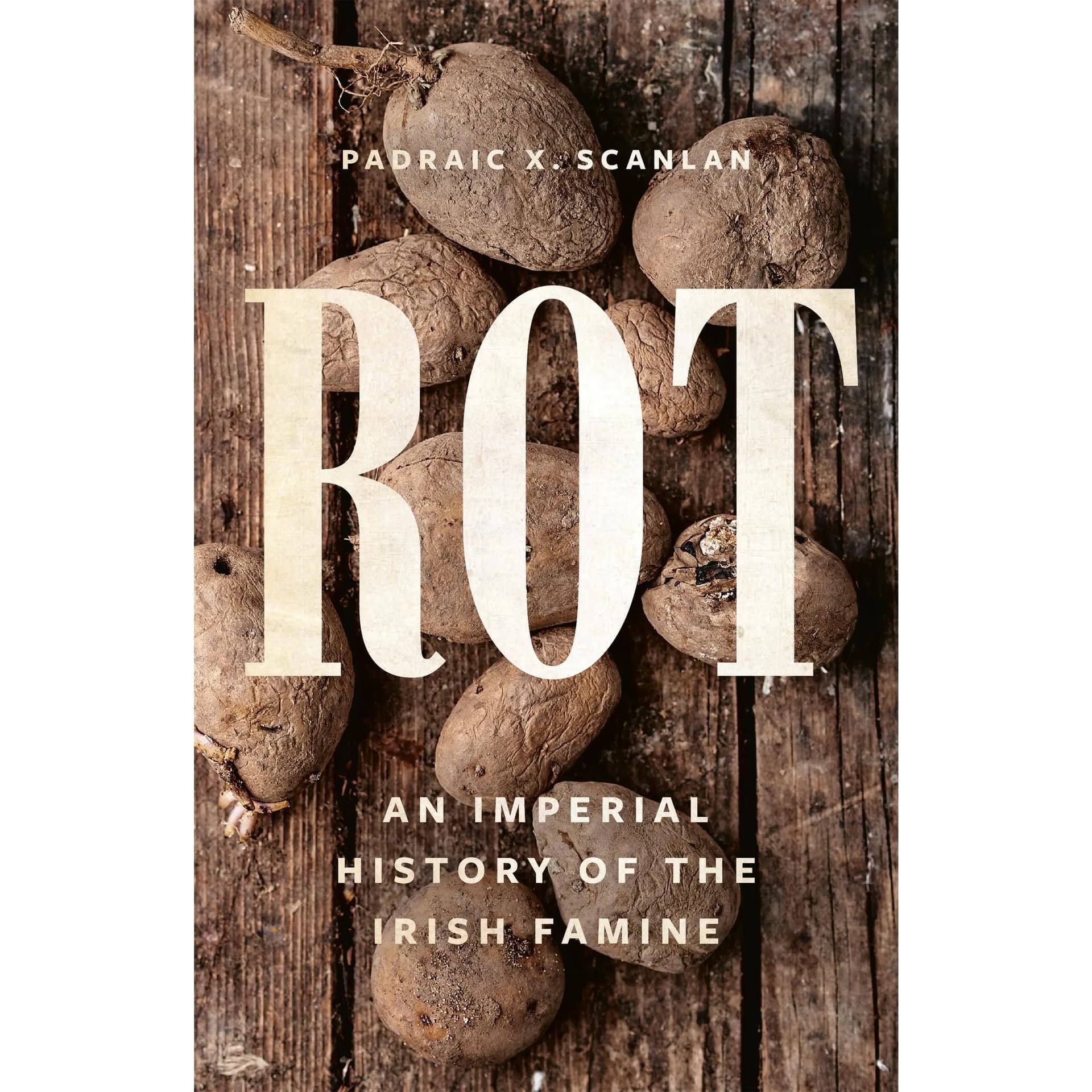
Padraic Scanlan - Rot: An Imperial History of the Irish Famine
Podcast Overview
- Host: Cole Smead and Conor O’Callaghan
- Guest: Padraic Scanlan, Author and Educator
- Book Discussed: "Rot: An Imperial History of the Irish Famine"
- Focus: The historical context of the Great Famine in Ireland, its causes, and its implications for the relationship between Ireland and Britain.
Key Points Discussed
Background on Padraic Scanlan
- Associate Professor at the University of Toronto.
- Background in labor history within the British Empire.
- Previous works include *Slave Empire* and *Freedoms, Debtors*.
- Personal connection to Irish history leading to his current book.
Context of the Irish Famine
- The Great Famine (1845-1852) was heavily influenced by Ireland's position within the British Empire.
- Ireland's agricultural dependence on the potato made it particularly vulnerable to famines.
- The interplay of economic policy and market failures led to widespread starvation.
Historical Relationship with Britain
- Ireland has been under English rule since the Norman invasions in the 11th century.
- The 18th-century relationship involved significant economic exploitation and political subjugation.
- The Act of Union in 1801 brought Ireland into a constitutional union with Britain but did not improve its economic conditions.
Economic Framework
- The Irish economy was largely agricultural with a significant portion of the population working as tenant farmers.
- A unique rental system (soil-only tenancy) meant that improvements made by tenants would lead to increased rents.
- The middlemen in the land rental system exacerbated the economic exploitation of the Irish poor.
Social Dynamics During the Famine
- The public works program was introduced as a response to the famine but was poorly executed and often a facade for systematic exploitation.
- The Irish poor often preferred public works jobs over private labor due to the latter being seen as a direct support of the aristocracy.
- Public works projects did not effectively address the needs of the starving population.
Cultural Aspects
- The potato was not only a dietary staple but also a cultural symbol, representing both sustenance and vulnerability.
- Generosity among the impoverished was common, exemplified by sharing food with beggars despite their own scarcity.
Misunderstandings and Myths
- The myth of extreme potato consumption (12-14 pounds daily) was critiqued for its unrealistic representation of the Irish diet.
- The conversation touched on the complexities of poverty, including the potential for cannibalism during extreme starvation, although historical evidence is limited.
Contemporary Connections
- The discussion connected historical events to modern-day issues, such as resource allocation and socioeconomic disparities.
- The conversation concluded with reflections on human resilience and the potential for future prosperity despite historical hardships.
Conclusion
- The episode emphasized the complex interplay of economic, social, and cultural factors in understanding the Irish Famine.
- The discussion highlighted how history informs contemporary issues, making it crucial to learn from past mistakes.
Key Takeaways
- Understanding Context: Historical context is essential to grasp the nuances of the Great Famine and its implications.
- Economic Structures Matter: Economic exploitation led to dire outcomes for the Irish population, illustrating the consequences of poor policy decisions.
- Cultural Resilience: The ability of communities to support one another in times of hardship is a testament to human resilience.
Further Reading
- Book: *Rot: An Imperial History of the Irish Famine* by Padraic Scanlan
- Related Topics: Irish history, economic policy, cultural studies, agricultural dynamics, and the impact of colonialism.
Listen to the Podcast
- Available on Apple Podcasts, Spotify, YouTube, and other platforms where podcasts are hosted.
Written by AI. May contain mistakes. Listen to the episode to check what was said.
Transcript
Automatic transcript. May contain errors.0:02You're listening to A Book With Legs, a podcast presented by Smeed Capital Management. At Smead Capital Management, we advise investors who play the long game. You can learn more at SmeadCap.com or by calling your financial advisor.
0:22Welcome to A Book With Legs podcast. I'm Cole Smead, CEO and Portfolio Manager here at Smead Capital Management. At our firm, we are readers and we believe in the power of books to help shape informed investors. In this podcast, we speak to great authors about their writings. The late, great Charlie Munger prescribed using multiple mental models and analysis. We analyze their work through the lens of business, markets, and people. Hosting this episode with me is our resident Irish citizen, our chief operating officer, Conor O 'Callaghan. Conor, thanks for being here. Great to be here, Cole. I'm very excited.
0:58We have a very special guest here with Patrick Scallon. So in this episode, we will discuss economic policy, the failure of markets, public welfare, and just about every unenjoyable, unimaginable thing that you can think of that happens in the roughest economic and civil moments in a population. Podrick Scanlon is joining us to discuss his new book, Rot, an Imperial History of the Irish Famine. Podrick is an associate professor at the Center for Diaspora and Transnational Studies and the Center for Industrial Relations and Human Resources at the University of Toronto. He is also a research associate at the Center for History and Economics at the University of Cambridge and Harvard University.
1:40He has authored two other titles, Slave Empire in 2020 and Freedoms, Debtors in 2017. He received his bachelor's degree in history at McGill University in Canada and his PhD in history from Princeton University. Quite the resume. Yeah, quite the resume. Patrick, thanks for joining us today. So you're joining us from Toronto, but you're obviously Irish, as we can tell from your name being an Irish name. Yeah, I mean, I'm from Montreal. Um, my, my dad's side of the family are, are from the Irish Catholic diaspora. My mom is, or was, uh, French Canadian. Uh, yeah. So a real, in, in, in many ways, like a real Montreal or a real Anglo Montreal kind of background.
2:27Nice. But yeah, thank you very much for having me. Yeah. So, so, you know, um, in your past titles, you know, you, you've dealt in certain particular histories and I guess like, you know, other than obviously your heritage, you know, what initially drew you to this story? You know, it was this family members telling stories, or was this just something that you'd heard in the past and you thought, I really want to know more about this history? So, I mean, I think in some ways I had kind of avoided Irish stuff for a long time. You know, I studied British history. My expertise as an historian is in the history of labor in the British Empire.
3:07And I kind of avoided Ireland in part because I have this kind of outrageously Irish name, like Padraic Scanlon. But I didn't necessarily feel any particular Irishness. I think that was definitely, I think in some ways it was sort of the last gen, I think my dad's generation. And before that felt a lot more, felt a lot closer to that identity. And, you know, so my like my dad grew up in an ethnic enclave, basically, in Montreal, Point St. Charles, which was more or less exactly or rather his family grew up in Point St. Charles, which is basically all Irish Catholics. But then so I wrote a couple of books and I spent the first part of my career working on the history of the abolition of slavery and the transition from enslaved to free labor in the British Empire.
3:58And one of the big points of comparison for not for enslaved laborers in the British Caribbean colonies, but for emancipated formerly enslaved laborers was to the Irish poor. So in the decade right after the abolition of slavery in the British colonies and Britain's Caribbean colonies in the 1830s, abolition came into effect in 1834. You know, there were a lot of comparisons between recently emancipated laborers and Irish laborers, not to make a kind of comparison between the Irish as enslaved because they weren't, but the Irish as being sort of on the on the or the Irish poor, especially the Irish agricultural poor, being on the kind of bottom step of a ladder of civilization and work ethics.
4:41So that was one kind of pathway toward this book, those constant comparisons. And then, you know, you know, in the past, again, 2019 and then in 2021, my parents died and my brother started doing a lot of genealogical research, which is unlike him. and you know I think we both kind of were sort of thinking about so you know I suddenly had a kind of like personal impetus to think a little bit about my own relationship to Irishness and my own relationship to the British Empire and Ireland's relationship to the British Empire so those were really the the the two kind of things that got the project percolating and then as we were talking about before we started recording, right, then the COVID sort of brought the famine into the picture, right?
5:30Because it was this sort of unbelievably complex, difficult to solve, multidimensional omni-crisis that seemed like it was going to last for a season, but ended up lasting for years. And so I had intended to write a book about Ireland before the famine and about labor in Ireland before the famine, sort of drawing on these comparisons with formerly enslaved laborers. But then with COVID, the famine kind of entered the picture and it became a book about Ireland before and through the famine and sort of following the relationship of Ireland to the United Kingdom and to the British Empire from the Act of Union, the acts of union in 1800 through to roughly the end of the famine in the early 1850s.
6:19Sure. Yeah. Because when you mentioned the abolition of slavery, I think of the book Wilberforce, which was a big figure in the abolition in the UK. To your point, bringing us up to speed kind of the context politically prior to this, you discuss what Ireland's relationship was to England from, say, the 16th to the 18th century. Can you kind of teach us of what that was like. Yeah, I'll do it really, really quickly because there's a lot of details that are probably not worth burdening your listeners with. But so effectively, Ireland has been under some form of, or Ireland had been under some form of English rule since shortly after the Norman invasions in the 11th century.
7:07So, you know, English, the new Anglo-Norman aristocracy after the conquest of England by the Normans in the 11th century, that aristocracy invaded Ireland in the Middle Ages. So if you meet people whose surnames are Fitzwilliam or something like that, that's straight from Norman French, right? It's Fis, it's son. So Fitzwilliam is son of William in a kind of Irishized version of the French, Fitz, like son. So, you know, Ireland had always been in some kind of had been under nominal English rule for centuries. But that the degree to which, you know, a medieval king could actually assert power over Ireland really waxed and waned depending on the ambitions of the king and the relative power of the Irish aristocracy.
8:01But then in the 17th century, shortly after, during the English Civil Wars of the 1640s, Oliver Cromwell's new model army invaded Ireland for the first time and set about a project of really intensive, I mean, I think it's maybe a bit anachronistic to describe it this way, but a kind of ethnic cleansing of Irish Catholics, pushing Irish Catholics out of three of the provinces of Ireland and into primarily to Conant. So the phrase then was like, where should the Irish go? To hell or Conant. And that wasn't completed. That was really more of Cromwell's army's ambition rather than what it succeeded in doing.
8:46But that was its plan. And then shortly thereafter, in the early 1690s, after the glorious revolution in England, which is again probably not worth going into but the overthrow of the Stuart monarchy in England the new king of England William III formerly William of Orange the stadtholder of the Netherlands who was married to the deposed Stuart King's daughter Mary so William of William and Mary right fame invaded Ireland again in the 1690s and completed in a sense the conquest that Cromwell's forces had begun in the 1650s. And then after that, for the duration of the 18th century, throughout the 1700s, Ireland was not officially a British colony insofar as it was never, it was nominally an independent kingdom with its own parliament.
9:40It just had the same monarch as England and Scotland and Wales. But it was effectively a colony. Its parliament had to submit its parliamentary agenda to Westminster for approval, laws that the Irish Parliament passed could always be vetoed in London. And throughout the 18th century, Ireland's economy became more and more oriented towards exporting agricultural products to England. And so that's really the story of the Irish economy in the 18th century is conquest and the dispossession of the former Irish Catholic aristocracy. So you get an almost entirely new landlord class in the course of the 18th century.
10:21So who owns Ireland changes pretty dramatically. And then you have, you know, increasing pressure on land, in part driven by a pan-European increase in population, right? Across Europe, the population explodes in the 18th century, and it's no different in Ireland. But in Ireland, there's no kind of concomitant increase in capital. So Ireland has very little capital and a growing population. And so the new landlord class don't enter into the kind of farming arrangements that English landlords would enter into. They enter, which would have been generally an English farmer would be somebody with a fair amount of capital who would be able to kind of enter into a partnership with an aristocrat and rent for a very long time, a very large amount of land, like in the range of thousands of acres.
11:07And that's not what happens in Ireland. Farmers rent, you know, 50 acres or 25 acres. And that's not enough land to produce enough food to pay the rent. And so you end up with a system of land ownership in Ireland that is increasingly subdivided, where more and more people, you know, if I'm a farmer, I have enough capital to rent 50 acres from a landlord, I don't have enough money to pay my rent on that land. And so I subdivide my land into smaller and smaller chunks, and effectively collect both the proceeds of what I'm growing, which I sell, but also the rent that kind of flows upward toward me.
11:45So it's not, it's a kind of like a pyramid. One of the phrases that's used about Ireland in the 18th century is that it's a nation of landlords. Because even like the smallest, a farmer having 50 acres might have five tenants each holding five acres. And those five acre tenants might also have subtenants holding a quarter acre. And so you have this kind of pyramidal structure. without capital. So I was just going to ask you, because Ireland enters the Union in 1801. Okay. Yes. And I think what you said in your book is it takes them from a puppet country to a junior country. Can you explain why entering the Union really did not better them off in England?
12:25Yeah. And I don't want to put words in your mouth, but you almost imply, you know, as you said correctly, Ireland was never a colony of Britain, but in some ways, Because, you know, again, I'm not putting words in your mouth, but it was almost worse off not being a colony. It was really kind of in no man's land to a certain degree. Yeah, I think that's – so I think it's not clear to say that absent the Union, the same process wouldn't have taken place. But I think – so basically at the end of the 18th century, in the midst of the Napoleonic Wars, which was, as the historian David Bell calls it in his book, the first total war, right?
13:03So this is a war where the British state starts to borrow huge amounts of money, unprecedented amounts of money for a European state in order to finance the war effort against France. And in the midst of that war, a rebellion, a serious rebellion in Ireland led by a group called the United Irishmen breaks out in 1798 and is suppressed. And one of the reasons why the Union starts to appear as a solution is that the leaders of that rebellion are not dispossessed Catholics. their Protestants. So Theobald Wolftone is a very famous figure in the history of the Irish nation, and Wolftone was a Protestant.
13:42And so the Protestants, the Anglo-Irish ascendancy, as they're called, are supposed to be the managers, and they're supposed to be responsible for kind of husbanding Ireland within the Union. They're supposed to be the representatives of British power. So if you start to have your ostensible kind of ruling class turning against England, you need a solution. And the solution that appears congenial to both kind of Irish merchants and British politicians is union. And so after in 1800, Parliament in England votes to include Ireland in the union, and the Irish Parliament votes to dissolve itself. And so 100 Irish MPs then sit in the House of Commons, a bunch of Irish lords sit in the House of Lords, the Irish Anglican bishops and the bishops.
14:30So Ireland becomes politically integrated into the United Kingdom. But as we say, it's integrated as a kind of, it's on paper, it's a, on paper, it's an equal partner, right? By the 1820s, there are no more laws against Catholic participation in civil rights, in civil life, rather. So Catholic civil rights are fully restored in 1829. The new United Kingdom has a single currency, it has no internal barriers to trade, it has no internal barriers to migration. But all of the structures that were built in Ireland in the 18th century aren't taken apart by the Union. They persist. And if anything, they get worse, because now Ireland is in a situation where, you know, as the UK, the new UK begins to gain momentum economically, especially after the end of the Napoleonic Wars, Ireland doesn't have any of the kind of industrial base that is developing in England.
15:28It doesn't have the reserves of money that are held in the city of London. It is still a kind of capital poor, labor intensive, agricultural producer of mostly grain and livestock for British markets. And that doesn't change with the union. And so consequently, all of the things that were making Ireland poorer in the 18th century are not erased by the union. They're accelerated. So, yeah, I think that's more or less what happens. You can see it, you know, in the first decades of the 19th century. Ireland starts to have serious subsistence crises even before the Great Famine itself. Hi, I'm Cole Smead, CEO and Portfolio Manager here at Smead Capital Management and host of this podcast.
16:15If you enjoy this podcast, I'd like to invite you to check out smeedcap.com. At our firm, we are stock market investors. We advise investors who play the long game with a discipline that has proven success over long periods of time. Learn more about our funds at smeedcap.com. Past performance is not indicative of future results. Investing involves risks, including loss of principle. Please refer to the prospectus for important information about the investment company, including objectives, risks, charges, and expenses. Read and consider it carefully before investing. Smead Funds Distributed by Smead Funds Distributors, LLC, not affiliated.
16:53So I want to touch on a couple of things. You mentioned the Napoleonic Wars. And so Irish people, you know, from Ireland were fighting in the British military, to my understanding from your book. You know, how well represented were the Irish in the military? And then also you touched a little bit on the Catholic Relief Act from 1829. and obviously the religious aspects of that in terms of restoring rights to Catholics, but also if you could get into how that sort of changed the game for the worse from a land perspective in Ireland. Oh, yeah, yeah. Yes, yeah. So, yeah, so really, really briefly, just a bit of context, right?
17:33One of the consequences of the conquest of Ireland in the late 17th century was the introduction of a series of laws that are usually called the penal laws that were designed to restrict Catholic belief in practice, I guess, in Ireland, but especially to restrict and further squeeze the Catholic landholding class, right? So there are rules, for example, that forbid priests saying mass in Ireland, but in practice, those were very indifferently enforced, although they were sometimes enforced. So people – it's not as though Catholicism – it's very hard. Like this is not – like 18th century Britain is in many ways a rapacious, exploitative state, but it's not a totalitarian state.
18:18It's impossible to enforce those kinds of laws. Well, it's why they flip out kings over the issue because it's like you can't enforce them. So like we're just off with their head and you go from Cromwell being the Protestant to the stewards showing back up with Catholicism. The same tension the monarchy is going on in society. Exactly, yeah. Yeah. And the Stuarts, right? Like you can't, and you can't, you can't uproot Catholicism basically from, from Ireland, but you can dispossess the Catholic landholding class. So those laws are really carefully enforced. And then, you know, one of the initially, right, all Catholics, in fact, all Irish period, including Protestants are banned from the, what would have then been the English military, right?
19:01Because it's only in 1707 that Great Britain comes into existence with the Union of Scotland and England and Wales, which has its own kind of rocky history in those first few decades. So after 1707, the British military. But then, you know, as the 18th century wears on, those regulations are relaxed because Ireland has always exported people, right? Even before the famine, Irish mercenaries served in all kinds of European armies. And, you know, in a way, an Irish soldier serving in the British military was one fewer Irish soldier who could hire themselves out to serve in the French or the Spanish military, which were the other common places where the where Irish mercenaries served.
19:44So, you know, yeah, like Ireland, in some ways, like the relationship between Ireland and England and Ireland and Britain is really, it's not as, it's tense and it's often really internally contradictory and painful, but it's never fully estranged, right? Like one of the great war hero of the Napoleonic Wars, Arthur Wellesley, the Duke of Wellington, he's Irish. Like he's an Anglo – he's a member of the Anglo-Irish aristocracy, becomes the prime minister. So it's not as though Ireland is fully – and he's the most celebrated military – most celebrated land-based military hero of the first half of the 19th century in the United Kingdom.
20:27So there's this complex relationship between the Irish upper classes, including after 1829, which is the Catholic Relief Act, and the British upper classes. But one of the things that the Catholic Relief – to return to your original question – one of the things that the Catholic Relief Act does is it restructures how the electoral franchise works in Ireland's writings. And it introduces something called the 40 shilling freehold. which effectively means that the barrier for voting in Ireland had previously been, you know, pretty, like it had been relatively low. And so a lot of Irish MPs were elected by their tenants who held a certain amount of land, either as rented land or in freehold.
21:17And after the Catholic Relief Act, that franchise is dramatically reduced. So it's kind of a clever bit of work done by the two main parliamentary architects of Catholic Relief, who were Robert Peel, who I imagine we'll talk about later, and the Duke of Wellington, who was the leader of the Tories in the Lords, right? Because in this era of British government, every government has effectively two leaders. They have a leader in the House of Commons and a leader in the Lords. And it doesn't always, you know, I think usually conventionally the leader in the Commons is treated as the prime minister, but not always.
21:50So under Catholic relief, the Duke of Wellington is in the House of Lords and he's the prime minister. And Robert Peel is the leader of the party in the commons. And so they together make this kind of clever bargain where they get rid of an extremely unpopular and very outdated law. No one really believes in 1829 that Catholics represent a fifth column in British society who are going to overthrow the king, except for a very small number of what are called ultra Tories. But it's really a minority of a minority that believes that Catholics still pose a real political threat to the stability of the United Kingdom.
22:25So they get rid of an unpopular kind of outdated law and at the same time smuggle in an electoral reform that guarantees that the representatives of Ireland in the House of Commons will be representatives whose constituencies are wealthier tenants. Right. So it's kind of a clever bit of political maneuvering by Peel and by the Duke of Wellington to transform Catholic emancipation into secure votes for the Conservative Party and the Conservative Party's policies in Westminster. Well, that's a perfect segue. So you talk about the aristocrats. Early in the book, you talk about Shirley Castle, and it sort of paints a picture of the landed gentry of Ireland.
23:08So could you touch on the Shirley family, how they got their land, how the estate was run with tenants? And do you think that that's sort of a good representative picture of why Ireland is really a nation of landowners slash landlords? So the Shirley's get their land as descendants of the Earl of Essex, who is one of the leaders of, and in a way they're even earlier Anglo-Irish inheritors, because the Earl of Essex kind of earns his land serving in Ulster. for the first Ulster plantation. Well, there's so much, like the history is so complicated and so entangled. One of the projects of kind of anglicizing Ireland before the invasions were what are called the plantations.
23:58So the reason why Ulster has a substantial, it's no longer majority Protestant now, the north of Ireland, but the reason why there is a substantial Presbyterian minority in and previously majority in the north of Ireland is because of the Ulster Plantation, this early 17th century project to install mostly Scots, Presbyterian settlers in what are now the six counties of Northern Ireland, the polity of Northern Ireland. And so the Shirley's, one of the leaders of that campaign is the Earl of Essex and the Earl of Essex descendants are the Shirley's who own this big estate. and their estate is in many ways this testament.
24:44I try to build it up in the book and actually I think their estate's a hotel now. I'm not sure. I think it's become, it may even still be in the family, but I think it's now used for, it still stands, right? Shirley Castle still stands and they build this estate in the early, just like just before the famine and the idea is to build it to look as old as possible, right? To kind of capture what the aristocracy in Ireland who really like, because some aristocrats who own Irish land never go to Ireland. They just collect their money as an annuity and they don't care. They just, they just, they outsource, they just hire manager, professional managers who manage their land for them.
25:22And they just collect the proceeds and they make decisions at a distance. But the Shirley's live there and they build this, this kind of, this very old fashioned looking Tudor style castle. The intention, and they fill it with beautiful artworks. They have all these, they both kind of, they have Spanish old masters, they have Dutch old masters, they have really fine kind of Celtic woodworking and stonework that's done. But so they're trying to present themselves as almost like feudal lords from an era before capitalism, before the Union, like a throwback to the Middle Ages. But meanwhile, they own all this land.
26:01And outside of the walls of Shirley Castle, they have tenants, they have professional managers who manage their tenants, and they are ruthless in the way that they deal with their tenants. Although they personally, the Shirley's themselves, are not making these decisions. But, you know, they have a very unsentimental, they have a very sentimental attitude to the Irish past and to the aesthetics of their home. But they have an extraordinarily unsentimental attitude to the Irish poor, which is that if you can't pay the rent, emigrate. And if you are being in arrears in your rent, we'll pursue you in court.
26:35And so, you know, one of the chapters of the book begins with the scene of this contrast between the kind of self-consciously old-fashioned aesthetic of Shirley Castle. And in fact, the lands around it are rustic looking too. They're old-fashioned looking too. But the very kind of modern market for land and really modern landscape of litigation over unpaid rent that happens just outside of the walls of the castle. And the Shirleys aren't like, I don't single them out because they're especially bad, right? I don't, I'm not trying to like cast aspersion on the Shirley's or on their descendants. There's just a lot of records on the Shirley's, which made it easier.
27:20And they happened to build this castle in a very deliberately old timey kind of Tudor style right before the famine. Right, so you describe this sort of, like you said, modern system, real estate system, landlord tenant system, but it's not just as simple as these wealthy barons that were given this land and then they kind of rent it out. It's really a complex ecosystem. So can you kind of walk us through the middlemen that were involved in this land business also, and then some of the challenges that come with that? One thing that Cole and I found very striking in the book is outside of Ulster, if a tenant improved their land at all, they'd get charged more rent.
28:02So you have a great antidote in there about a farmer who wouldn't even paint his house because he thought if he painted his house, you know, he, he had, you know, reasonable belief that his landlord would charge him more. Yeah. Yeah. Yeah. I mean, I, I don't know exactly where this system comes from, although I imagine it, it has its, you know, I think it sort of develops in the course of the 18th century, but it's called land. It's called a ground only, if I remember correctly, right. Or soil only. Soil only. Right. Yeah. So, so, so soil only, um, tenancy. The idea being that you are like, so the big contrast is with England, because in England, that's the world of what are called improving landlords, right?
Read the full transcript
28:41And improving farmers. And, you know, an Irish farmer is not, as we've already discussed, is not necessarily someone who is, I mean, an Irish farmer is definitely wealthier than an Irish laborer. But an English farmer is somebody who has money to invest and often will enter into a partnership with their landlord to say, you know, lease land for what Often they're leased for 30 years or royal lives, they're often called, like a kind of imaginary length of a monarch's reign or even longer. So you'll rent this land for 30 years and each party to the agreement will agree to invest a certain amount of money in like irrigation or experimentation with new crops or crop rotation or commercial fertilizers are becoming available for the first time in the 19th century.
29:31So a lot of improving farmers and landlords are very interested in new techniques for soil chemistry and for improving yields. And that is not the case in Ireland. In Ireland, improving land, with the exception of Ulster, which has a system called Tenant Right, which basically allows tenants to kind of sell the value of improvements they made to their land in order to either offset, sell them to other tenants in order to realize a profit or sell them to their landlord to reduce their rent, right? It's this asset. Like in Ulster, you have a situation where if you build an irrigation system on your land and you're the tenant, the value of that irrigation system or some of the value of that irrigation system accrues to you as something that you can dispose of, either to offset your own obligations or to realize some kind of profit for yourself.
30:24That's not the case in the rest of Ireland. In the rest of Ireland, it's that you rent the land that you have soil only. And if you make any improvements, that increases the value of the land and consequently you can be charged more rent on it. Like Ireland in many ways has a very modern real estate market in a way that even Britain doesn't really have yet in the 18th century. And who were all these bit players? So you had agents. You had drivers. You had people who would sort of subdivide the land, cottiers. Can you kind of just give us a little primer on what that looked like? Yeah, sure. So you have – I'll try to start from the top.
31:08So you have the aristocratic landlord at the top who owns the land, either resident in Ireland or not. Then you have their own agents. Land agents are people who are usually pretty highly trained. They're usually lawyers, legally trained, and they rent out larger chunks of land to farmers. It's pretty rare for a landlord to do their own business, right? You have an agent who represents you, which is pretty, you know, in that sense. Then the farmers have their own tenants who are often called cotters or cottiers. And they rent cottages with small amounts of land with them. And they tend to be, they rent their land year round.
31:49and between the farmers and the cottiers are middlemen who act basically as freelance land agents for the rental of farming land from farmers to the next layer down. And then you have another layer down are people who are called con acre farmers. And con acre is a specific, as far as I know, a specifically Irish form of land tenure that is short for corn acre, because the idea is it's about an acre of land, sometimes less, and you rent it not for a full year but for a growing season. So it's usually a 10 - or 11-month lease. And the idea is that you rent that land and you're able to – it's like a rented land that also includes a plot of land for subsistence farming.
32:36And so that's where the potatoes in Ireland are often grown. They're grown on con-acre land, or a lot of potatoes are grown on con-acre land. And so, you know, people in between, you know, the cottiers and the conacre farmers, there are middlemen there too. And then there are also a subgroup of middlemen who are called Gombeen men, who are kind of the sort of loan sharks of the Irish countryside. Yeah. Yeah. Yeah. I mean, I mean, I mean, the Gambian men are basically trying to find advantage wherever it's possible to find advantage. Right. So, you know, one of the things that you need to, you know, if you need a plow, hardly anyone in Ireland owns a plow.
33:17It's almost always rented. And so the people who rent plows can turn a pretty substantial, they can definitely charge rates of rental that would be extortionate in England because of the kind of dearth of technology in Irish farming. Or if you need seed, if you're growing oatmeal, Gombe and Men will provide you seed on credit. Right. So they're kind of like the all-purpose lenders for the poor, either of goods but also of cash. And so you have the situation where every layer, between every layer of the pyramid, there is a kind of thin layer of middlemen who are either acting on behalf of the people above them or acting on their own behalf trying to find some opportunity for arbitrage, basically, between the two layers of the Irish economy.
34:13And obviously that would work when things were good, but as soon as revenue goes down, everyone wants their pound of flesh and therefore there's, call it, too much economic rent being extracted from too little revenues. And so someone's got to get squeezed. Someone's got to lose a leg because that gone bean is going to want their money. Let me pivot a little bit. So – because I think this is just a whole other thing. So you got all this economic rent being collected by all these people up and down that scheme, if you will. but then there's also the separate issue which is that only the king can create money he can only mint and so how prevalent was you know pounds and shillings floating around ireland i know we've done other books on the podcast like we did easy money which talked about the colonies issue with money you know the u.s colonies what we now know is america but this same issue was prevalent in ireland and so in lieu of say currency your pig might be a better capture of wealth to trade and barter and sell?
35:10Yeah, yeah, there's very little circulating money in Ireland. That isn't to say a lot of people don't. So if you're somebody working on the, let's say you're a con acre farmer, you are constantly making financial transactions of different kinds, but they're almost always just in a ledger, right? They're not, it's, there's very few occasions during the year when you have either a coin or paper money of any kind that you're then exchanging, right? So you might, You know, you'll buy your seed potatoes on credit. You'll buy your piglet on credit. You'll pay your rent on credit. And then at harvest time, you're making like farmers make a series of complicated decisions about whether or not they're going to, you know, sell their like sell their pig, sell their crop, eat their crop.
36:01You know, there's a lot of different options for somebody at the bottom of this pyramid for how they're going to repay their debts at the end of the season. But very rarely are they handling cash because there just isn't that much circulating cash in Ireland. And there isn't that much circulating cash in Britain either. And the problem is kind of exacerbated in the 1820s because after the inflation, like very strong inflation of the Napoleonic era when the Bank of England was pumping money into the system, in the 1820s, the Bank of England tried to slow down inflation by dramatically decreasing the money supply.
36:40So not only is there less circulating actual paper money or coin in Ireland, physical objects that are being used as a medium of exchange, there's just less money on the Bank of England's books. right? It just, there's just much money on their balance sheet. Yeah. There's there, they, they, they dramatically shrink their balance sheet, um, in the, in the 1820s in part to try to regain some control over inflation and to just kind of restrict the amount of money that the British government is spending, uh, servicing its debts, um, which are really substantial after the Napoleonic Wars. We hope you're enjoying the podcast.
37:19You know, we work hard putting together this show, But we work even harder for our investors at Smead Capital Management. At Smead, we believe in disciplined investing, which is why the Smead funds have a proven track record of long-term outperformance. If you're an investor who plays the long game and want to invest in wonderful companies to build wealth, we invite you to visit SmeadCap.com. Past performance is not indicative of future results. Investing involves risks, including loss of principal. Please refer to the prospectus for important information about the investment company, including objectives, risks, charges, and expenses.
37:53Read and consider it carefully before investing. Smead Funds Distributed by Smead Funds Distributors, LLC, not affiliated. So in Ireland, right, there's very, like people are, you know, if you have a pig, as you mentioned, right, one of the things I try to bring out in the book is that, you know, people, potatoes don't have a lot of value. They are, except as subsistence crops, like people do sell their potatoes, but there aren't big time potato wholesalers in Ireland. Potatoes are hard to transport. Even now, right, the fact that you can buy potatoes in a supermarket is in some ways a miracle of the modern cold chain, right?
38:32Because potatoes, usually if you transport them under conditions that a lot of other produce is transported in, they start to sprout or they rot. So potatoes are really, like the fact that you can buy potatoes that are imported from somewhere else is, like takes a lot more technology than you think. even in comparison to other produce. And so potatoes don't travel very far. And so you can't really sell them, although you accept locally. And so people fatten pigs and almost every, there's a ready market for pork, both live pigs and also for pork products in the rest of the United Kingdom. And so people basically at the bottom of this, of the socioeconomic hierarchy, not at the absolute bottom, but kind of con acre farmers almost always have a pig and they fatten the pig on potatoes.
39:20And in that way, they're kind of able to - Store their value. Yeah, store value. Exactly. And because they hardly ever eat their pigs, right? Especially not at that level, right? If you have 50 acres, you're definitely eating pig, at least at holidays, right? You have enough then to slaughter and eat yourself, but the lower you get, the more you sell. Um, yeah. And so, you know, you presented other risks. I mean, pigs can pass pathogens. Um, pigs could kill children. I mean, I just like, um, total another, uh, discourse that I'm not going to go into, but when I thought of like them putting a ring in the snout so that they don't root, I was like, yeah, we did that on bulls.
40:05I think the, the, the bulldog in that same 19th century came out of that whole idea of the snout. And I was like, just to think that women put that in their nose today is just absolutely insane to me. That's what we used to do to pigs. So I'm through it. I mean, humans don't root, right? It's more. No, I agree. I agree. But why don't we put no rings in their noses? So let me, let me pivot. So Thomas Malthus is obviously a popular person at the time. Okay. And I want to ask you this because I have a kind of fall on question this, but he said in your book, you quote him, a civilized and well-governed society, Malthus argued, would not choose to feed the poor since with the check of hunger, the poor would not work, but would reproduce, making a subsistence crisis inevitable.
40:44So here's Malthus, like, listen, if we give them food, they're just going to end up reproducing, kind of like they're almost, he's treating them like they're rats. Like if we give them food, they're just going to reproduce, which by the way, he's speaking of the Irish, right? And so it's, I mean, he has this idea that it's like a very negative context. More humans are bad, but obviously that's against the culture of like, I'll call it, you know, Irish Catholicism, which is that like the family and children are a blessing. And these are coming to head at the same time. Well, that was your wealth.
41:19Your family was your wealth because quite clearly you paint the picture that there wasn't a lot of other wealth. So your wealth in quotes was your children. Yep. Yeah, I mean, I think there's a couple of dimensions there. So one word that I haven't brought up, but that's important to understanding the British empire period in the 19th century is civilization, right? And civilization is this very inchoate, undefinable characteristic that in practice means all kinds of things, right? It can mean wearing European clothes. It can mean like using European eating utensils. It can mean participating in markets.
41:58And so it means all kinds of different things to the British, but it's extraordinarily important, but very hard to define. And one of the things I try to emphasize in Rot is the sort of – the best way to describe this kind of optical illusion of the Irish countryside, which looks – the same optical illusion that was at play in Shirley Castle, which we talked about a few minutes ago. Something that looks ancient, but that is in fact very modern. And so one of Adam Smith's theories of civilization in Wealth of Nations and in other works is that there's a kind of civilizational hierarchy that is visible in people's relationship to the market.
42:41And so Smith imagines a kind of imaginary barter economy that then evolves into an economy that uses just precious metals that are undifferentiated to an economy that uses beads or shells that are denominations that are meant to represent wealth to an economy that uses coins to an economy that uses paper money, which represents gold or silver reserves. And that final economy with all of its credit instruments and all of its exchanges and all of its kind of fluidity, that is the most civilized possible market. So when the Irish don't have money circulating in the countryside, even though they do have very complicated relationships of credit and production and labor, it's a very complex economy.
43:27But from the perspective of somebody interested in looking for markers of civilization, it doesn't look sophisticated. And for Malthus, Malthus' view, and Malthus is a classic kind of like sociology or political science 101 figure in his essay on the principle of population. Malthus' argument is that absent civilization, which he also doesn't define, but I think for Malthus, the best way to describe civilization is a kind of like sexual restraint is probably the best way to characterize it. Very Freudian of him too, by the way. Yeah, I mean, yeah, exactly. Yeah. So it's kind of like, you know, absent civilization, like people who are civilized recognize the reality of the absence that that population will grow faster than the food supply.
44:18I thought, but population will increase exponentially and food supply won't. And so to Malthus, right, to be civilized, like British people are civilized because they are able to, when times are tough, Malthus's big metric is marriage, right? There's plenty of children born both in Ireland and Britain outside of marriage, but it's a pretty good, it's used relatively usefully at that time as a metric for the birth rate, right? So if people are getting married later, they have fewer children, and that's pretty consistent across the 18th and 19th century. And so for Malthus, the fact that at times – like that people like the Irish don't stop marrying early in times of subsistence crisis is evidence of a lack of civilization.
45:04And so you have – and Malthus doesn't actually write that much specifically about Ireland in some ways. But he's saying that from a British context too. So it's like a guy looking at Ireland in many ways looking his nose down, isn't he? Well, I think it's more he's trying to say – I mean what he's really looking at I think are the British poor, people who would be called paupers, right? And there's a widespread moral panic in early 19th century Britain about paupers who are distinguished. So the poor are people – even what poverty means is in flux at this time. There's no clear definition, right?
45:38So often there's the kind of poor who are, or even the invention of the term like working class, right, that is intended to distinguish, right, because they might be economically have fewer resources, but they are the working class or the laboring class or the productive class. Those are the terms that are often used for the working class. I mean, we still use working class, but those were the terms that were in use then, and they were definitely morally charged, right? These are people who work for their living, even if they don't have much to speak of in terms of material wealth. Whereas paupers are people who depend on the state.
46:10And what Malthus is arguing in Essay on the Principle of Population, that it is fruitless to try to preserve the – that investing too much in preserving the lives of paupers or preserving their ability to live without – on state assistance, basically, will eventually lead to a population crisis. So what Malthus is saying is that it is fruitless to try to stop people from starving to death using state assistance because using that state assistance will encourage people to depend on the state and increase the problem, right? So he's making an early argument for what we would call – what people in the 19th century called like laissez-faire social policy, right?
46:54It's not worth trying to intervene to feed people because if you feed people, you will create dependence among those people. And if you create dependence among those people, then they will only seek more assistance. And then eventually the resources of the state will be overwhelmed by demand. And then the state will be sucked into the collapse of the – like the pauper population will kind of drag the rest of the state down. So Malthus is really, I think Malthus is, like in some ways Malthus is now like, you know, it's easy to, like people was controversial in his time, although I think a lot of people were Malthusians.
47:29But Malthus wasn't like he didn't have a kind of he personally wasn't particularly spiked like he was by all accounts like a pretty amiable affable person who a lot of people liked, you know, even though he had this this social theory that was a very useful pretext for a lot of very callous and and and kind of cruel social policy in the 19th century. But Malthus himself was sort of seeing this dispassionately, right? More in sorrow than in anger. He's not saying the paupers are going to annihilate the state. And therefore, he's just saying this is natural, right? He's trying to describe a natural law of economic life.
48:09And in doing that, he's very much of a piece with a lot of the people who are in rot, right? A lot of the people are interested in and believe very deeply in the idea that there are natural laws to human economic life that are as inviolable as something like the laws of physics, right? And then if you can only discover those laws and build a government with regulations that will act as the kind of barest guardrails over those laws, then people will start to behave in a way they'll be impelled to behave naturally. And until you can find those guardrails, until you can find those structures, right, that's what the purpose of social policy should be.
48:48It should be to find the rules that govern human economies and then design a system accordingly. And that's one of the things that happens in the famine itself. Right. But yeah, Malthus Malthus is in the background. Malthus is somebody who I'm not sure who the best kind of modern analog would be, but he's somebody who everybody in 19th century Britain claims to have read. But very few people seem to act. Very few people seem actually to have read. Smith is like that, too. Like a lot of people will invoke Dr. Smith or Reverend Malthus. Right. And in their speeches in front of Parliament, it's not at all clear that they've actually read any work by them.
49:21They have a kind of folk Smith, you know, and I think actually Smith still has that kind of effect now, right? I think there's a lot of people who invoke ideas like the invisible hand of the market without actually having any firsthand appreciation for what Smith was trying to do in, in, um, in creative, the wealth of nations. I think of mouth as like Paul Ehrlich more recently, like in the 1970s, right. Which sort of like population bomb. Yeah. Population bomb. Yeah. Where like nobody's read it, but they all refer to the idea of it. And so I agree with you there. Yeah. And, but I mean, unlike, unlike Ehrlich, right?
49:57Ehrlich is an entomologist, right? And, and Malthus was, yeah. Here's the funny thing. Like, I don't think Malthus could have known what's happened, you know, since then. Obviously we have hindsight to know that, you know, starvation was not going to become more common with the more people that were on the earth. Paul Ehrlich knew that and he still said it. Yeah. No, I think you're right. Yeah. Yeah. You're, you're, you're, you're exactly right. Like this is not post-Green Revolution. This is like Malthus was writing right when commercial fertilizers were first becoming available. And industrialization was going to begin to take off and it hadn't yet, obviously.
50:29Yeah. Well, let's shift gears a little bit and talk about the main character in your book, the potato. So talk to us a little bit about potatoes, where they fit in in the Irish diet, what other things Irish people at the time were eating. and then also tell us a little bit about the lumper. Oh, yeah. Okay, sure. So the potato is kind of indelibly associated with Ireland, but it's not, I mean, not just with Ireland, but probably most strongly with Ireland, but it's from the Americas. It's native to Central and Northern South America. You know, it's still grown. You know, the organism that caused the potato famine probably originated in the kind of volcanic valleys outside of Mexico City where potatoes grow wild and they're also cultivated.
51:21And it arrived in Ireland as it arrived in much of Western Europe after what historians call the Colombian exchange, the kind of exchange of pathogens and foodstuffs and people that took place after the Spanish and Portuguese conquistadors' arrival in South America. So the potato came back to Europe. It was widely adopted by European farmers, especially in the 17th century. I think the 17th century was a horrible time to be alive in Europe, a century of climactic catastrophe with a little ice age basically causing successive harvest failures. The Thirty Years' War devastating much of Central Europe and especially Germany and what's now the Czech Republic and Slovakia.
52:11you know these are like the the potato was a backstop crop that people adopted because it kept it was something that could be kept in the ground until you ate it and it kept kind of marauding armies it was hardy so it could survive worse climactic conditions and marauding armies couldn't get it but in the course of the 18th century you know Irish farmers used it for the same reason that German farmers that French farmers that Belgian farmers that Swedish farmers used it But then in the course of the 18th century, the pressure that we've already discussed on the Irish economy and on the poorest people in the Irish economy made the potato not just a staple, but a kind of hyper staple.
52:49And so by the end of the 18th century, there was a pretty substantial subset of the Irish population who subsisted only on potatoes or virtually only on potatoes, usually served like potatoes and water or potatoes and milk if you had a cow, usually just boiled. And so the potato fit into the overall structures of exploitation or extraction in Ireland because it allowed people who were being paid some of the lowest cash wages, which, of course, as we already discussed, they very rarely would have been paid actually physically in cash. Their wages would be written on a ledger or they would be paid their wages very indifferently or very occasionally.
53:32It allowed people who weren't earning a lot of cash to survive from season to season. And speaking of the sort of idea of children as a resource for the Irish poor, the potato in Ireland had this perverse, and this is something I dwell on a lot in the book, had this kind of contradictory paradoxical effect where it both increased the exposure of the Irish poor to the market because it was essential to the system of low capital, low technology, high labor inputs, export farming that prevailed in Ireland, but it also, at least in good years, could produce really gigantic yields. So you had a situation where people who are among the, on paper, the poorest people in the United Kingdom, and by some measures, some of the poorest people in the British Empire.
54:23Before I worked on Ireland, I wrote a book about colonial Sierra Leone in the 1790s, freedom setters. And, you know, the wages in Ireland were lower than a lot of the wages that were being paid in colonial Freetown. So Ireland was very poor within the standards of the union, but they had the potato. So you could have people who could marry early, which seemed uncivilized to the British, right, because it was improvident. People could marry early and could have more children. And they could have more children because they could feed them. and they could feed them because of the potato. And so the potato was both, both abetted the exploitation of the Irish poor, but also made possible the elements of, especially like Irish Catholic cultural life that sustained the millions of people who subsisted only on a potato.
55:14So it was a gift and a curse, is what you're saying. Exactly, yeah. Yeah, and it was something that people could not get away from, both out of culture. And it was this double, right? One of the things that happened in the famine itself is that it was kind of impossible to, right? So we can talk more about the famine, I'm sure later, but in the third wave of the, speaking of the relationship with this book to COVID, right? In the third wave of the blight, so that would have, the first wave would have been the autumn of 45. Second wave would have been the autumn of 46. Then 47, there were fewer potatoes in the ground, but there was also less blight.
55:54And then people kept planting, right? There was no, so, you know, the potato blight returned in 1848 and in 1849 quite intensely, but nobody was really able to shift to growing another crop. And that was partly because they couldn't afford seed, right? So there were economic barriers to it. They couldn't afford seed to grow oatmeal or wheat or anything like that. But also, they had a kind of cultural attachment to the, they had both an economic dependence and a cultural attachment to the potato. Hey, I want to give a big shout out to everyone who's been working so hard on this show. You know, we recently hit the top 10 in investing podcasts on Apple Podcasts and even number one in the business category in several countries.
56:38As you may know, this show is brought to you by Smead Capital Management. Smead Capital Management understands how frustrating and illogical the stock market can be. If you're searching for funds with a proven track record, give the Smead funds a look. Or better yet, reach out at SmeadCap.com. And don't forget to mention, you're a fan of the podcast. Past performance is not indicative of future results. Investing involves risks, including loss of principal. Please refer to the prospectus for important information about the investment company, including objectives, risks, charges, and expenses.
57:10Read and consider it carefully before investing. Smead funds distributed by Smead Funds Distributors, LLC, not affiliated. Something that Cole and I found fascinating, obviously Catholics, you know, stereotypically are quite charitable. You know, they're sort of known for that. The Smead family is also known for being very charitable, and charity is important to us here as a firm. So the poorest of the poor in Ireland, you know, these people that were surviving off potatoes, they used some of their potatoes to give to others. Can you touch on that a little bit? Yeah, you call it open-handedness, which is an interesting term to use.
57:47Yeah, I mean, the idea is like, so this is not year round, but in the harvest, right, especially in a good year, there is, you know, if you are somebody who's even got a con-acre amount of potatoes, right, there are beggars who are even poorer than you who kind of walk around from farm to farm asking for potatoes. And it's considered, I mean, somewhere like in your, it seems to have been considered at least almost kind of sinful not to give. Right. And certainly, even if you didn't consider it to be sinful not to give, it was certainly a really spectacular loss of face. Right. It was seen as extraordinarily gauche if you were, you know, counting out the potatoes that you gave to people who asked for them in harvest time.
58:30Right. It was just an expectation that people would come with sacks and you would give them potatoes. and there was almost like a kind of standard, it was like two big handfuls was the standard amount that you would give to somebody who was begging. And a lot of people were begging who were at the kind of on the even lower on the people utterly landless who would have just been laborers. And so, but at the same time, right, there are definitely references in the archives to people stealing those potatoes back under cover of darkness, right? So it's not like, it's both a real commitment to charity, but also it's, it's associated with like, it's a cultural expectation, right?
59:10And it's not, but it's also a cultural expectation that if somebody takes back their potatoes at night, that you're not going to confront them about it, right? It's just, you know, there's a kind of doubledness to it where you're doing one thing. You're, you know, there's a, that's like almost like a doubled, like a doubled mentality where you're both, you, you have this thing, you have to give it. But at the same time, if you take it back, no one will fault you for taking it back. Um, and that's sort of how it works, uh, in terms of, of giving. Right. And that's definitely, that's, that's rooted in, like, I would say, you know, it's interesting.
59:44Like, I think, um, I think. it's hard to say whether that flows from Catholicism. Maybe it does, maybe it doesn't. It's certainly unique to, I don't know if it's even actually unique to Ireland, but it's like an economy of abundance, right, in the midst of scarcity. And you can see that in other kinds of crops. So one of the things that a piece that I found really, really like a generative for me in writing this book is the botanist and anthropologist Robin Wall Kimmerer has a book called The Service Berry about the, which is also called Saskatchewan, right? It's a tree. We actually, since the book has come out, we have one growing on our front lawn.
1:00:29It's native to Ontario. So you can kind of like the city of Toronto will plant. So we have a service berry and it grows. it produces huge quantities of berries. And the idea is like when the service berries are in bloom, you have abundance, right? And so it suddenly becomes kind of obscene to have so much of something and count it, right? If you have so much of potatoes or you have so many service berries, if somebody asks you for them, it borders on obscenity to say, well, will I have enough for later? You just give it, right? And so it's more that kind of economy of abundance. And the Catholicism in Ireland before the famine is a really interesting thing.
1:01:08And I think one of the things that happens post-famine is the increasing assertion of doctrinal uniformity by the Catholic Church on Irish Catholics. because like that century of the penal laws doesn't snuff out Catholicism in Ireland, but it does snuff out sort of Episcopal control over Catholic priests in Ireland. So like Irish folk Catholicism is a totally different thing. British domination because you effectively, I mean, you don't make this absolutely, but you build the seeds of Irish independence in your book is one thing you kind of build on. The other thing I want to pivot because you mentioned this just a second ago, but I want to come back to it.
1:01:54Blight came back from 1846 to 1847. And then so as I'm reading this, I'm like, oh, it's everywhere. Everyone's affected. And then the reports, you report on all the divisions. And it was like there were divisions that didn't have crop loss. It was like I think the average was 30 percent, but there were certain divisions that just didn't show crop loss. Was that because the potato had already ruined a lot of crops to where they were so low? Or why was the loss? I think it was luck, right? Like it was just luck, right? That they, you know, it depended from season to season, right? Like they're eventually, right?
1:02:29Every single county in Ireland would have blight. But it was more or less severe depending on the, you know, I think I have theories, right? I can't prove them. But there are, you know, one of the things that is associated with poverty in Ireland is more intensive potato cropping. And so, you know, in a poor and generally the poorest counties in Ireland are in the southwest. Those are the kind of poorest, poorest parts of the country and the west generally of Ireland. So in the west of Ireland, you have more potato fields that are right next to each other. So there's no kind of fire break. because the actual organism, we haven't talked about it yet, but the actual organism that causes the disease that led to the collapse of the potato, which led to the potato famine, or to the Great Famine, was an organism called Phythoptera infestans, or P-infestans.
1:03:26I'm glad you're saying it. Yeah, I might not actually have pronounced it correctly. When we were doing the audiobook for Rot, I had to look up how it was pronounced. So I may actually have just kind of fallen back. It might be anyway, P. infestans, let's say. And it's like a fungus. So it sporulates, right? So if you have a field, if there's prevailing winds, if you have two potato fields next to each other, it'll spread really quickly. So I guess one theory for why some parts of the country that were – why generally the crop loss was less severe in places that were relatively wealthier. So there was plenty of blight in, for example, in the counties in Ulster.
1:04:02But Ulster never really had quite as severe a potato – had quite as severe a subsistence crisis as much of the rest of the South, especially the Southwest. And so that was in part because in Ulster, some people still grew oatmeal for subsistence, right? There's a part of Northern Ulster that's called the Oatmeal Belt. And so in those places, then you have fields where maybe if a field is afflicted by blight, it spreads quickly. And that potato field, that potato field is ruined. But there's no way for the spores to spread to other fields. And so, you know, in general, like the more intense, like that's one of the kind of especially like in some ways the blight was like struck a place that could not be more vulnerable to complete social collapse because of its like this was a place where the poorer you were, the more potatoes you ate.
1:04:54The more potatoes you ate, the closer your fields were to each other, the more vulnerable the whole world, your whole social and economic world was to an organism that could devastate potatoes. And especially in Europe, right? Because this is an organism that had lived in like as an endemic illness of potatoes in the much drier, much higher altitude highlands outside of Mexico City. But here you're having a situation like you have a climate that is extremely congenial to the reproduction of this organism. And you have endless fields of potatoes right next to each other. Yeah. And people keep planting them even after because for all the reasons that we've already talked about, like even though it's obvious.
1:05:41Also, nobody thought it would come back. Right. There had been there had been diseases, fungal diseases, viral diseases of potatoes that had struck previous potato crops. Actually, to return back to the lumper, right, the Irish lumper. So I have a chapter in the book. It's my favorite chapter in the book. It's called The People's Potato. And one of the things that I think I uncovered in it. And I don't like novelty is not necessarily the best commendation for it. But I'm pretty sure I'm the first person to write about this as far as I know who isn't a plant geneticist. But, you know, like the lumper is just so it sounds so perfect.
1:06:19Right. The Irish poor who ate their lumpers. Right. But then the lumper has all of these kind of legends about it. Legends that are repeated in one of the sources that I use very extensively for the book, which are Irish folklore records. something called the schools collection, which was the Irish free state in the 1930s, basically asked school kids to interview their grandparents and other elders and write down all kinds of folk stories as a kind of like works progress, sort of depression era. Social history. Yep. Yeah. So I use that pretty extensively. And there's all of these kinds of accounts of the potato collapsing and the potatoes, the spread of the potato famine.
1:07:01It's truly, and of the lumper itself, this iconic potato that is so, it's so easy to say the Irish are lumpers, they eat lumper potatoes. But one of the things I found in the research was that there's a kind of cycle of potatoes. If you want to grow potatoes, you can get a bag of potatoes from the supermarket, cut the eyes off with a chunk of the tuber and bury them in the ground. That's how potatoes are generally cultivated. It's called set cultivation. And the potatoes that grow will be clones of that original potato. And that can yield gigantic yields very quickly. Any kind of set called garlic is the same.
1:07:38Anything where you can set cultivate something or onions, where you can just kind of plant the bulb and clone the original plant, you can get really big yields very quickly, but those plants are also very susceptible to pathogens, especially to viruses and fungi and bacteria. Because they're just growing the pathogen in effect. Yeah, and they're a monoculture, right? They're all identical, so they're all equally vulnerable to new pathogens. And so you have this rise and fall in the Irish potato crop where, so you have different crops that are associated that are basically the people's crop. They're considered by the Irish poor to be the highest yield, best value kind of potato.
1:08:22And you can see that, so there's a potato called the apple. That is, and whatever the people's potato is, people say it's gross, basically. So they're like, ah, the apple tastes bad. But then by the time the potato famine rolls around, the apple is a variety of potato that is grown more by people for the middle-class market. Because everyone in Ireland loves potatoes. It's not just the poor, but just the middle class have a kind of more, they're like potato connoisseurs, right? So there's a certain sense, like, I would like an apple. I would like a, like a, they have great names. I put a bunch of them in the book, but there's even more of these lists of great names of potato cultivars.
1:08:59And so the, the lumper is just one of these same kind of cultivars. And it, it, it is reaching the end of its natural life when the blight happens. but for historians and for commentators at the time, it's been irresistible to kind of repeat the name of the potato and let the illusions that kind of flow from it kind of hang in the air, right? Ah, the lumper, you know, and there's this other legend that the Irish eat 10 to 14 pounds of potatoes. Yeah. We had that in our notes. I was like, yeah. Like ludicrous. Like 12 pounds of potatoes. You did a good job of getting into it that it's like basically medically impossible, you know, these, these numbers are being thrown out.
1:09:39You can't do it. Right. And you'll see it, right. If you feel like there's a challenge though, like if you could eat 12 pounds of potatoes, I'll pay you a thousand dollars. You could do it. Like if, if, if you want to do it, you could do it. It's, it's not physically impossible to eat 10 to 14 pounds of potatoes in a day. It's just not something that you would do every day. Like it's, it's not beyond human capacities, but it's, it's just, and then people use that, that historians, you know, have been incautious, I think, because it seems so juicy, right? It's one of those sort of facts that you see it, and you see it in the primary sources, right?
1:10:13It's not something that was invented post facto by historians commenting on the famine, it's something in the records. And I understand, right, you see it, and you think, ah, this has got to be like, what a juicy fact this is. And then people have, you know, one of the big questions about the potato for some historians is the Irish seem, at least by some record reckoning, to be slightly taller and heavier on average than the English. And so one of the big questions or in some strains of historical scholarship is why is that? And so from the 12 to 14 pound of potato estimate, some historians have said, well, that's 3 ,600 calories a day.
1:10:51So no wonder the Irish were bigger. But it's like, that's not, that can't be true, right? Well, it's all just hearsay. It's like a total guess. It's like an urban legend. Yeah, it's like an urban legend turns into somehow like, well, we mythologized based on the science. And it's like asking for the stars to line up. Yeah, so one of the things that was cut, I cut from the book, like I actually chased it down to try to find where it began. That stuff all ended up kind of on the cutting room floor of the book because my editors correctly, I think, judged that it was pretty boring. Yeah. Right? Like to actually follow this like.
1:11:23But it seems to be something that people, that somebody in a couple of parliamentary inquiries, some Irish farmer said, how many potatoes do you eat a day? Oh, about four pounds a meal is enough for a laborer, right? And that could have been mistaken, right? It's not as though people who are Irish laborers, they might have meant four potatoes, four individual potatoes. How much does one potato weigh about a pound? You know what I mean? They might have just been guessing. They might have been thinking that they were being offered food, right? And that if they lowballed the estimate, because there was a parliamentary inquiry.
1:11:57You know, there's lots of reasons why somebody might say that and just be wrong. But there's one very clear reason why British officials and then historians latched onto it, which is because it seemed to signal really strongly the Irish depend on potatoes, right? Like that's - Well, that's why the old saying is like a rumor can get around the world faster than the truth and get its pants on. I mean, that's the reality to it. Well, so I want to pivot here to some of the social stuff. But I was thinking, though, with all the lumpers and the apples and the different types of potatoes, I think something that we should do is, you know, like you have oysters and you have like four different types of oysters and you try each one.
1:12:34Like I want to see a potato flight where it's like here's four different types of potatoes. Also, since you're in Toronto, the other thing I was thinking about, and I like this, I think of poutine as like one of the greater Irish leftovers from Canada, right? Which is like putting French fries down with gravy, which I think it was like a very like – Yeah, yeah. And cheese curds, which is like a very British or Irish kind of dish. I think of like – I could eat it in London and it wouldn't be that different than a lot of the fare in London. And I think that's like my favorite dish every time I go to Canada.
1:13:05And I don't think it would be there unless it was for the Irish. There you go. Yeah. I mean, it's also like the potatoes, right? It's, it's, it's, I mean, look as, as, as, as Quebec, as a Quebecois, I have to say it's a Quebecois invention, right? It's a, it comes from the, the, but like, look, potatoes are, are poor, are food for the poor everywhere. Right. And one of the things about the potato, like if I were a better, more serious, like if I were a real historian, you know, like a real one, as opposed to I would have learned like four or five European languages in addition to I already have like I have French, but you know what I mean?
1:13:39I would have learned Dutch. The PhD from Princeton wasn't enough to make you a real historian? No, I mean, look, I mean, I will say having been to Princeton for grad school, there was that is a history program that places a lot of emphasis on multi multilingualism. So I'm bilingual and maybe like have some German and some Latin, but like not very much just like Jesuit level Latin. And anyway, but the point is, is that like the potato famine was a was a transatlantic event. And the fact that it was most catastrophic in Ireland is is can only be explained, in my view, at least by Ireland's relationship to the rest of the United Kingdom and to the British Empire.
1:14:20because the potato blight started in Mexico, maybe, certainly struck Peruvian farms before, arrived in Pennsylvania and in Quebec and in Ontario where people were growing potatoes and those potato fields were struck by the blight too. And then the blight crossed the Atlantic in 1844 or 1845, hit Belgium, spread outward from Belgium to the Netherlands, to Prussia, eventually going as far north as Scandinavia and as far south as the Basque country in Spain, people's potato fields were dying, right? So this was a pandemic of at PN Festands when it kind of, it had previously been restricted to sort of native growing potatoes in a specific climactic condition in central Mexico.
1:15:06And then it suddenly was through the engines, through the mechanisms of the steamship and through the expansion and globalization of, like really, truly like globalization of potato agriculture, it suddenly spread all around the world or everywhere potatoes were grown. And it's still a huge problem, right? Like Met Arran, right? The Irish Meteorological Service, yeah, has blight forecasts based on the overall humidity in the air and the wind direction. It still costs billions of dollars a year to control this organism. It's endemic everywhere the potatoes are grown. So for me, the big question is like, you know, it's why is this – like you can understand a lot about how the British Empire worked and about Ireland's place in it by understanding why something that was devastating everywhere it struck became apocalyptic in this one specific place.
1:15:59And it is – yeah. And so that's one of the things that I was trying to unpick in writing this book. Well, something I think you did a great job of is demonstrating, obviously, the aristocrats, the wealthy British people's apathy at best and probably hostility more accurately towards the Irish poor. But that seemed to cut in both ways a little bit because they tried several different things. We don't have enough time to get into all of them, but to try to help the situation, one of which was public works, which was better than the workhouses, which came later. But during the public works era, you know, the public works didn't pay as well as private farming.
1:16:40Yet a lot of Irish people seem to prefer taking lower paying public works jobs rather than working, you know, on the farmland, which seemed to be a repudiation of the sort of the aristocracy. It's like, why am I helping make these people more rich? And I was wondering if that was sort of what was driving that. Yeah, we thought that ourselves. Like, was it a social issue that caused a labor issue? Yeah. I mean, I can briefly, let me just briefly sketch the pandemic relief cheese. Let me just briefly sketch the famine relief policies. So as we've discussed already, right, as Ireland was struck, like the potato was vulnerable, the Irish economy was precarious and had a lot of vulnerabilities.
1:17:23and the failure of potatoes was one of them to the point where there had been potato failures nowhere near as complete, nowhere near as long lasting as the ones that caused the great famine. But there had been, you know, there had a poor season like bad weather in 1817, in the 1820s, in 1831, right? There were localized subsistence crises in Ireland and the British government had, they were so common that the British government had a kind of playbook for dealing with an Irish subsistence crisis, which was all premised on something else that we've talked about a lot, which is this idea of civilization, right?
1:17:54The idea that the Irish are uniquely, are in danger of sliding out of civilization unless they are disciplined by the market, right? If they are like, and so the two plans are to, you never give food away because if you give food away, you risk creating dependence. Well, you get Malthus, like they're listening to Malthus and he's like, Malthus is right. We give them food, they're gonna breed like rats. Exactly, or just stop working, right? And that's something that impetus appears elsewhere in the empire too. In the wake of the abolition of slavery in the Caribbean, a lot of formerly enslaved laborers want to understandably want to get as far away from sugar plantations as they can.
1:18:40Sure. And want to become basically small farmers, right? So there's a big rush on plantation laborers, especially plantation laborers who have saved money from cash jobs in the course of their enslavement, rush to buy land right away. To the point where colonial officials try to artificially raise the price of crowned lands because they want people to continue to grow sugar for wages. And so they restrict. And in Ireland, it's the same idea that if you give people independence or you will kind of like – in this case, it's they don't want people to become independent of the government. If so, but it's the same kind of impetus.
1:19:16Anyway, but like, so the first, so the two basic pivots are you import grain and sell it at cost. And if people don't have money to buy the grain, you set up public works so that people can earn wages to buy the grain that you've imported at cost. And so in the first wave of the famine, Robert Peel's government imports American maize, which they call Indian corn in Ireland and in Britain. And they import maize because Ireland doesn't grow maize and can't grow maize. And so by importing, you know, 40 million pounds of cornmeal, basically, you will keep people from starving, but you also won't disrupt the grain trade.
1:19:54And you won't like people won't start planting the maize that they can't save any of it for seed because it won't grow. It doesn't compete with potatoes either, etc. Exactly. It's just a stopgap. And it also provides, and, you know, there were also a lot of, this was a time of really like rapprochement, commercial rapprochement between Britain and the United States. So it's like, there's a lot of reasons why it appears like an ideal solution to the problem to peel. And at the same time, you start up public works. And that doesn't change throughout the famine, right? The idea is that, but then, so that first wave of the famine, you already mentioned it, right?
1:20:28The crop loss is not total anywhere. It's severe in some places. It's partial in other places. So that first year, 1845, 1846, is not like people die of famine related illnesses, but it's not. It's kind of like the worst subsistence crisis that Ireland has experienced yet. But nobody thinks it's going to happen again. And they think that this playbook of policies that have sort of worked before, at least worked in preventing mass death, will work again. The problem is, is that no one expects the blight to return for another season in 1846. and it returns fewer potatoes are in the ground. And after a season of allowing P-infestans to like reproduce and produce spores, even more fields are affected.
1:21:10So you have a situation where the, and that year, 1846, 47, the entire social structure of Ireland basically implodes. It just collapses in and on itself. And so, as you mentioned, right, the public works, the new government led by John Russell, the Whig government, keeps importing grain, but sort of changes its emphasis. It keeps those same basic pillars of relief policy, but it emphasizes public works more than importing grain. And so the government founds more public works projects. And they set, in order to encourage people to seek private wages, to seek wages from landlords, rather than from the government, they set the wages at two pence less than whatever the average prevailing wage is for similar work elsewhere.
1:21:59The problem is, is that the devastation in some parts of Ireland, I mean, there's several problems, but one of the problems is the devastation is so complete in some parts of Ireland that there basically is no other work to be had, right? And those farmers who have the means, like a lot of people start emigrating and people with money get out first. and people with the money. That hasn't changed by the way. Yeah, I mean, yeah. They're just out of there, right? And then you have, so you have some people who emigrate right away. So there is no work and the farmers who have enough money and enough resources just stop growing grain and convert their fields to tillage.
1:22:40So they start raising cattle and sheep instead of growing and that needs fewer laborers. So you have a situation where people don't like, A, they're starving. And so they prefer that. And they recognize like a lot of these public works projects, you can still see some of them if you visit Ireland, right? Especially in the West, there are famine walkways that are kind of like minor tourist sites now. And they're basically like sort of wooden sidewalks or wooden staircases that have been built on mountains that don't go anywhere. They're just kind of there. And they're roads to nowhere. So, you know, a lot of public works don't actually do anything.
1:23:15And in fact, they have to – initially, the public works is rolled out with a regulation that says that none of the public works can be of, quote, an improving nature, which means that they can't increase the value of anyone's land, which really restricts – You called it shambolic as well as bureaucratic, right? Because then you get out to the working houses too and it's like we were joking like, hey, what are you doing today? I'm breaking rocks. What are you doing? And they were literally talking about how the workhouses were talking about buying rocks from private quarry owners to have the people break them.
1:23:46There was no point. Like total insanity. And not to mention the fact that these are starving people with no energy and making them break rocks for no reason. And another thing that was cut from the book that I think is going to work – I'm working on something now in the Industrial Revolution. and I think it's going to work into that one, was there was a big scandal in a British workhouse just before the famine where workhouse inmates basically in England were being tasked with breaking bones, right, for fertilizer, like crushing bones with sledgehammers. and that, but there was a scandal where allegedly some of those inmates who had been like, their food rations were cut off and they were eating, like basically eating human flesh, right?
1:24:32And so that was a big, big, big scandal in the poor law administration in England. And the Irish were already seen as being probably closer to being capable of cannibalism on account of their relative civilization. Yeah. I put a note in my book at some point where I was like, it read between the lines during your writing, you could kind of see that there was probably more cannibalism going on at times than people would have assumed. Or who knows, right? Like the point is, is that the like, it's really, it's impossible to say there, there are certainly rumors of it. And the, you know, there are some very well regarded, there's a really good collection of essays by a very noted, a really noted Irish economic historian called Eating People is Wrong, which is a series of essays about basically about cannibalism under famine conditions.
1:25:22And, you know, so I like especially writing, you know, as I've transitioned from writing academic books to books for the like for a wider public, I have an eye for like the salacious. You know what I mean? Like I definitely know. Sells books. Exactly. It sells books and it's interesting for me. And it's like it definitely I think it helps to build the world, but I try not to like the rumors. There are very, very, very few substantiated examples of cannibalism during the famine. Sure. Um, which suggests that there probably were some instances, but it certainly wasn't widespread. It's not as though there was like a secret epidemic of, of, um, but anyway, in any case, they wanted people to break rocks because they were worried that if they broke bones, uh, either they would steal the bones.
1:26:07If they were like cattle bones or horse bones, they would try to eat them. Or if they were human bones that they might end up with a scandal on their hands. So it was just like the, the, the public works were, uh, in my way, in my view, one of the most kind of symbolic and tragic parts of the famine because they cost so much money. They were hugely expensive to the British government, both in terms of actual raw money, but also in terms of personnel, like the British, you know, they couldn't find engineers. They were basically sending out everyone and they, you know, everyone and anyone, every surveyor, every engineer, every half-pay military officer, just a huge flotilla of highly trained personnel floating on what in today's money would probably be billions of pounds of borrowed money to set up the system just so that the Irish would never get anything for free.
1:26:57And it did nothing, right? It did less than nothing. It allowed people who already had the means to survive to hold on a little tighter to what they had. And it meant that the people, because getting a place on, like the public works, 700 ,000 people worked on them at their peak. That's a lot of people. I think you said 20 % of the population in some places. Yeah, in some counties, sure. But that 20 % represents, you know, even, and that's something also that I think I got some experience of writing about the plantation economy in the Caribbean in the era of slavery. is like plantations were brutal, horrific, like just like incredibly violent and destructive institutions, but they had hierarchies.
1:27:37And the people who were higher up on the hierarchy were better able to navigate the dangers of living and working in that situation. And they were like, even among the very poor and the very desperate and the very oppressed, right? There are subtle distinctions of rank. And you can see that in the, in the, I think at least you can see that in the, um, in the public works, because, you know, if you were from a good family or you knew the guy who was giving out the tickets, right. People, people like generally the people who got jobs on the public works were not the people who were the most vulnerable to absolute starvation.
1:28:15And so they had to be strong enough to work. And you talked about like, well connected enough to get a job. Right. I know we're, I know we're up against time here. I did have one question that I thought of that was not mentioned in the book, and you touched on the rumors of cannibalism, which I think, given the dire circumstances, is probably not shocking to anybody. Suicide is something you didn't touch on. Did you come across anything along those lines in your research? Because I couldn't help but think, when I was reading this, I'm like, this is so bad. It's really tough. It's a really tough circumstance.
1:28:47Cole and I were trying to talk about, was there any positives to take away from your book? And There weren't really, except for the triumph of the human spirit. Yeah. Yeah. I mean, look, I think in terms of suicide, like, I don't know. I'm sure it happened. The records that I have are of people who were sent to work on the relief works who were sort of external staff, right? So I have a couple of instances. I have one guy who worked, one anecdote in the book of somebody who was, so most of the people who were sent to administer relief were half-pay military officers. So the British military in the Napoleonic Wars expanded dramatically, especially the officer class.
1:29:29And in the British military at the time when Britain wasn't actively at war, you would be kind of be not entirely demobilized. If you were a regular soldier or sailor, you'd just be demobilized and discharged. But if you were an officer, you would just have your pay cut in half. So we were called a half pay officer. And so half pay officers, you could write and people have written whole books about just this kind of fraternity of people who were like very, in some cases, extremely hardened and very experienced soldiers and sailors who were kind of sent around the British Empire as administrators after the end of the Napoleonic Wars.
1:30:06Because after the Polynic Wars, Britain didn't have a lot of, and with the exception of the Crimean War, Britain didn't have had a lot of little wars that it fought in its colonies. But Britain itself didn't have engaged in many European wars for a very long time, basically throughout the 19th century. And so you had this huge body of pretty like hard men who were sent around the empire to administer the empire. And they were sent to Ireland to administer famine relief. And in one anecdote in the book, a guy is so demoralized by the amount of work and the futility of the work, right? Like they're spending time, they're spending money, but nothing is happening.
1:30:41And people are still like there's no – there doesn't seem – it's like it seems like the end of the world. That's the name of the chapter about what the Irish sometimes call Black 47. The summer – the winter of 1846 to 1847, which was kind of the national low point of the famine. And so there's a guy who tries to kill himself, but he misses or like the bullet glances off his skull. Like these are not powerful firearms. And so he's like brutally, he's like brutally mutilated, but still alive. And, you know, I don't know what happens to him, but all everyone kind of thinks that he's going to try again.
1:31:16But so the things that were happening were so bad that people witnessing them were considering suicide. I think you told a story of a guy whose skull was exposed through the skin. And that was just like that was not that big of a deal. Yeah. Yeah, that was actually Frederick Douglass who saw him. That was a beggar in Dublin when Douglass – so Douglass went on these kind of speaking tours of Britain and Ireland in the 1840s. And it's actually – his kind of letters from Ireland are really interesting sources, both – and also a point of entry for me because I was really familiar with a lot of abolitionist sources before.
1:31:52Sure. Yeah. But yeah, that's something. And they think that he was, that was a, I think it was a pig attack, actually, that the pig basically bit a hole in the guy's cheek and now he's like begging in the streets of dumb. Yeah, it's bleak, right? This is not, and look, I don't wanna, like I work on 19th century British empire. This is a very hard world that these people live in. Like this is not a - Well, yeah, to your point, I mean, like prostitution was very normal in the British empire, you know, for, you know, anybody of a lower class. I mean, there was a lot of like ills that like we'd be like, oh, things are bad today.
1:32:25It's like this is very, very bad. Literal survival. Yeah. It's a tough world. I think the best way to describe it is there's just no like there is a safety net. It's very, very thin. The poor law is a safety net, but it is. I mean, some social historians have argued that it's better at preserving life and limb than others. But it's a very, it's a world that doesn't have a lot of, you know, there isn't a lot, there's a long way to fall, even if you're relatively well-to-do. Sure. Which is not the same as today. Like, there's a lot of things that catch you on the way down today that weren't there, you know.
1:33:01Sure, yeah. I mean, look, this is a situation right where you think about, like, I sometimes think, like, my wife also works at UTI, is also an historian. And, you know, when she was pregnant with our actually during the pandemic with our daughter, she got a spider bite and had to get antibiotics for it. Right. Like, because, you know, but, you know, in the it was because it was turning into like a skin infection. Yeah. But, you know, in the 19th century, that kills you. You know, like this is an era where, you know, and that's a complete misfortune. If you cut yourself, if you're a blacksmith and you accidentally burn yourself and your wound separates, you die.
1:33:38right so like the there there are there's just a lot less it's it's a a time when like and i think like this is an era i i you know as a parent i don't know how to think about like it's something i constantly think about as i work on the 19th century like people often talk about you'll hear sort of like the average the average uh life expectancy in 19th century britain in 1840 say something like 35 right and you think wow like if you're born and you're you know i'm 39 right It's just like, oh, I've outlived my life expectancy by four years. But it's distorted by the fact that greater than 50 % of children don't live to their fifth birthday.
1:34:15So it's not that if you live to be 30, if you live to be five, your real life expectancy is probably closer to 60. But you have this situation where so many – this is a world where the death of children is a – there is no – like I've been rereading recently. I've been rereading Pride and Prejudice. And in Pride and Prejudice, one of the most remarkable things is that like the Bennett family have five daughters and they're all adults. Like that is in some ways like it's a very mannered, very like stylized romantic comedy. But it's also fantastical because there are very few even middle class families in the English countryside that would have where the father and mother are both still alive and they have five living adult children.
1:35:01So you're getting at my ultimate question because this is like – this is the game. And I think why I love this book is because you talk about all these complexities. There's complexities in the social history of this. There's complexities in the political history. There's the economic issues that are inherent. It's super complex. And you're pointing out how tough the world that this is going on in is very tough. So now our world today is like so much better as just a simple way of putting it. So here's what I find interesting. And I'm going to ask you this question because it is the topic of our day in many respects.
1:35:37So, you know, we talked about Paul Ehrlich. The Paul Ehrlich camp would say that we have way too many people in this world and we're going to ruin the world with too many people. And then you have what all stylizes call it more of a must camp or, you know, somewhere in that more optimistic camp that says we don't have enough people in this world, which I could argue that in the Western world as we watch birth rates decline. And Elon's trying single-handedly to fix it. Yeah, single-handedly in a very non-normal kind of way, I might add. Not the kind I'd prescribe. Don't do it. It's going to cut your net worth up in many pieces.
1:36:10But where would you put yourself? This is a tough history to deal with, which is why I also really admire your writing on it because it's a tough history. But where do you find yourself? Do you look and say, okay, despite all the shortcomings of a period like this, the future is very bright for humanity. We need a lot more people. or do you say, I don't know, these humans, they tend to screw things up. We probably will ruin this. Oh man, I have no idea. Look, I will say that as an historian, there have been a lot of other times. Look, I think that there are very, look, I think that there is something, and this is something I'm working on now, a book project I'm working on now.
1:36:50There is something that is unleashed in the 19th century with industrialization and the kind of stripping of the, both of fossil fuels, right? That's when the term fossil fuels is coined as people come to recognize that petroleum and natural gas, like oil and natural gas are the fossil remains like from the Carboniferous era of basically ancient swamps. Yeah, of swamps basically and plant life. And then at the same time, the discovery that fossil plants and fossil microscopic matter could be dissolved in sulfuric acid to produce phosphate fertilizers, So you have the situation in the 19th century where all of a sudden, like the deep past, the long, long pre-human past of the world is suddenly becomes a field for human exploitation.
1:37:41And I think the over-exploitation of those resources is a genuine, like a genuine threat to the future of people, right? Of humankind. But at the same time, right, like there have been a lot as an historian. I mean, I can tell you, look, this is again, this is not like this is my own maybe eccentricity, but like people haven't changed for a very long time. Like the way that people we think we constantly think that we have transcended human patterns of thought and behavior. But there have been a lot of other times in human history where we thought the world was coming to an end with pretty good, you know, in the 13th century, in the midst of the hundred years war, at least even just in European history in the 13th century.
1:38:19C.S. Lewis calls it chronological snobbery. He's like, oh, we're so advanced and, you know. Yeah, so I don't know. I will say that I think like people thought in the midst of the Black Death and the Hundred Years' War that that was the end. People fought in the 17th century in the midst of the Little Ice Age and the Thirty Years' War and it's like absolute, like vicious bloodshed that accompanied it. People thought it was the end. There are plenty of reasons to think in like 1944 that, you know, that the world might be coming to an end or 1945, you know what I mean? Like there's, it's not, I don't know.
1:38:55I will say that as a historian, I don't make predictions, but I will say that the human beings are more, we don't change in the, in quite the ways that we think we change. And that might be a recipe for catastrophe, or it might be cause for optimism. And I think I, I think maybe I've wavered from day to day as to whether or not those kind of deep, repeating human tendencies are a reason to be cheerful or a reason to, you know, buy an estate in New Zealand and get ready to hunker down with like a hundred year supply of tinned food. Where can people follow you going forward, Patrick? Like, where do you, are you on social media?
1:39:32Do you write a lot outside your books? Yeah. So I do write, I've got, so Rot is the book I have now. I'm working on another book about workers in the 19th century, which I think is going to be really good, which is supposed to be done in the next, in 2007, September, 2007, I'm going to turn it in, hopefully touch wood. And so I write occasionally in a bunch of different outlets. I'm no longer on social media, although I may pick it up again, but yeah. Yeah. But I've done a ton of podcasts and stuff for, for this book. And I do, you know, I contribute sometimes to the times literary supplement to the guardian to a bunch of publications.
1:40:09So my stuff is out there. Well, anecdotally, I was in the New York Athletic Club last week reading your book in one of the lounges and a professor, Mark Brennan from NYU said, hey, is that a good book? I was like, yes, it's really good. I'm about halfway through with it. And he said, everybody keeps telling him how good it is. So you're on his reading list, but certainly getting a lot of fanfare around this book. Yeah, no, I'm really happy with the way it's been received. I've been really interested to see actually the way it's been received in the, the North America, where the reception has been really warm and really interesting.
1:40:43Um, the UK where it's been kind of absent, like, I don't think we've had, I think we had an F review in the financial times, which was pretty good. But other than that, I don't think there's been, uh, which is a really nice review, but, um, there hasn't been that much, you know, we haven't had much traction in the UK and in Ireland, it's been kind of, um, a little bit mixed in the sense that, you know, I think there's a lot of, So it's been interesting to see, but I'm really – I'm delighted to hear that and I'm really pleased with the way the book has been received so far. We appreciate your time.
1:41:14Connor, thank you for hosting this with me. It's been a lot of fun. As we said, Patrick, your book deals in a very messy history that shows how bad incentives, bad planning, and the poor allocation of resources by both public and private works can cause terrible outcomes. Go out and buy a copy of Rot today. I also, I would say, I'm going to give a different take because that's what I get paid for a living to do. I would say that the future is unknown, but yet the propensity of time and humanity has bounded forward. And like the Irish diaspora, which is blessed across the world through many children, I think the future is bright because they adapted and flourished.
1:41:56And I think that's the story of humanity. And I think your book deals in how we go from point A to point B and how tough it can be. and I think it's a wonderful history. If you enjoyed this podcast, go to Apple, Spotify, YouTube, or wherever you listen to a book with legs. Tell others about us. Give us a review and the stories that we get to visit with authors like Patrick. If you have a book that you'd like to recommend, email podcast at smeedcap.com. That's podcast at smeedcap.com. You can also send your suggestions to us on X. Our handle is at smeedcap. Thank you for joining us for a book with legs podcast.
1:42:30We look forward to the next episode. Thank you for listening to A Book with Legs, a podcast brought to you by Smead Capital Management. The material provided in this podcast is for informational use only and should not be construed as investment advice. You can learn more about Smead Capital Management and its products at SmeadCap.com or by calling your financial advisor.
From the publisher
In this episode, Cole Smead and Conor O’Callaghan sit down with Author and Educator Padraic Scanlan to discuss his book, “Rot: An Imperial History of the Irish Famine.” The three explore the history of the Great Famine, explaining how Ireland’s position in the British Empire and reliance on the potato made it uniquely susceptible to starvation, and more.


