Ask ChatGPT

 Alt Goes Mainstream: The Latest on Alternative Investments, WealthTech, & Private Markets
13 Oct 2026 · 53m · 23 chapters
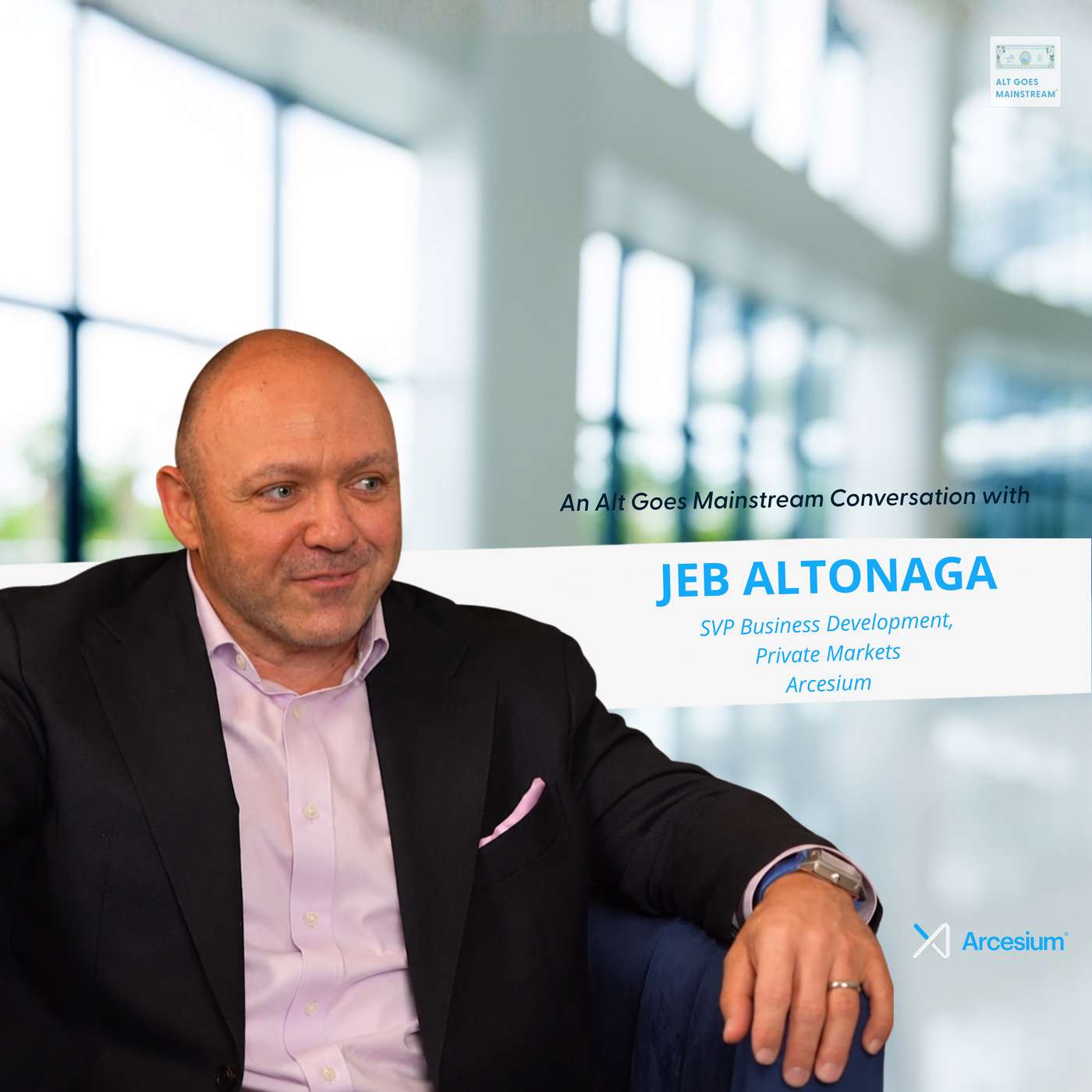
Arcesium’s Jeb Altonaga discusses “operational mastery” in private markets by fixing the data normalization problem—turning unstructured deal data into structured, standardized data—and the missing “middle layer” that prevents front/middle/back offices and counterparties from communicating via APIs. He also connects this to transparency, secondary markets, and whether private credit could become more tradable.
Jeb Altonaga is head of business development and private markets at Arcesium. He previously worked across hedge funds (including Citadel), LP/family office roles (Blue Pool, Asia; owned by a Brooklyn Nets owner), and banks, including building an investment bank and working on capital markets/LP relationships.
AI can normalize loan files in minutes (vs manual hours/days). Industry standardization is hindered by fragmented counterparties and incentives. LPs (large institutional allocators and large family offices) are the main push for normalization. A robust security/instrument master is the “nucleus” that eliminates reconciliation breaks. Secondary markets and evergreens increase demand for transparency and tighter bid-ask spreads.
Citadel’s “situation awareness” tech integration; mortgage-pool collateral analysts manually normalizing data (now AI-automated); a Hong Kong hedge fund (Senrigan Capital) losing assets when investors weren’t locked in; secondary/continuation vehicles growing toward ~$240B+ volume.
Written by AI. May contain mistakes.
Discussion on the challenges of data normalization in private markets and its implications.
Jeb Altonaga shares insights from his diverse career in finance and what led him to Arcesium.
“Jeb, welcome to the Elko's Mainstream Podcast.”
Exploration of how AI is transforming the processing of unstructured data in private markets.
“I was in the capital markets division of our boutique investment bank, working with GPs on the LP relationships that I was fostering through that career path and obviously in the family office just being of kind.”
Discussion on the complexities and challenges of achieving data standardization in private markets.
“You got to get everybody to go along with you.”
Jeb discusses the crucial role that Limited Partners (LPs) play in driving data normalization efforts.
“All that's been, because everything is kind of built for purpose by that point.”
Final thoughts on how AI can change data analysis and the challenges that remain.
“Well, it's interesting you mentioned the LP making that push.”
Explore how AI impacts data analysis and adoption in investment strategies.
“So there's all these influences and factors that are coming together.”
Discuss how different generations adapt to technology and its implications for business.
“I mean, I started my career at Goldman on the principal strategic investments team, which was a balance sheet investing team, investing the security division.”
Unpack the evolution of market structures and the needs of private market investors.
“And the way I think about that, and you're right, Bloomberg's interface hasn't really changed.”
Examine the role of evergreen funds and the demand for real-time data in private markets.
“I think we're pretty much there, but outside of a standard protocol.”
Analyze the development of the secondary market and its impact on investment strategies.
“Or if somebody else is in distress, like that firm that Citadel bought their public book, situational awareness, they were trying to sell their private book first.”
Explore how technology impacts transparency and efficiency in private markets.
“push, but it's not as at size yet that's driving.”
Discuss the relationship-driven nature of private equity compared to private credit.
“I don't think you're going to need transparency as much because of the way the deals get done, let's say on the private equity, the equity component, the buyout or the growth, because the deal is done.”
Learn how AI is transforming data management in financial services.
“I don't care what anybody, I'm over 50%.”
Understand how different firms utilize Arcesium's AI capabilities for efficiency.
“We made a recent acquisition called Limina.”
Examine the critical role of human expertise in a technology-driven environment.
“and maybe they're not using everything that we put out, they're using a snowflake.”
Discuss the convergence of private and public credit markets and its implications.
“And if we continue to roll out the tape on that, those firms will probably be in a position to capture more of the flows.”
Explore how market structure and convergence impact private credit investments.
“And I think if I'm smaller, I want it to be more opaque.”
Discusses the importance of stability and understanding in private credit investments.
“What I think is two days has been like three weeks.”
Analyzes the challenges and future potential for liquidity in private market trading.
“There was a hedge fund in Hong Kong called Senrigan Capital run by a gentleman named Nick.”
Examines how technology can improve operational efficiency in private credit.
“So my liquidity discount won't be so big because the bid-ask spread isn't as wide.”
Discusses the importance of centralized data management for improving efficiency.
“How long do you think it'll take before we get there?”
Highlights the ongoing need for evolution and learning in private markets.
“But I think it's such an important point, though, because the middle, figuring out the middle, the GUI is important.”

Get the gist, explore an idea or ask about something said.
 Claude
On Alt Goes Mainstream: The Latest on Alternative Investments, WealthTech, & Private Markets, what are the key points of this episode?
Searching your listeningAutomatic transcript. May contain errors.
0:00Welcome back to the Alco's Mainstream Podcast. Today, we are in the studio with Jeb Altonaga, head of business development and private markets at Arcesium, where they're really trying to solve the data normalization problem, which is something Jeb talked about a lot, how to figure out how to take unstructured data, turn it into structured data, understand and figure out how to create the market infrastructure from pre to post investment across public markets, private markets, and specifically private credit where Jeb spends a lot of time focusing. His background spans everything from being at a hedge fund, he's at Citadel, to an LP, Blue Pool, large family office, working in banks, starting an investment bank, to now being at Arcesium.
0:42So he sees things from such interesting, unique vantage points. And we had such a fascinating discussion about how to think about data normalization, where and when transparency makes sense, what secondary markets might do to transparency, what a tradable market might look like, what the market structure evolution will look like in private markets, particularly in private credit, and what's next and what Jeb would wave as his magic wand to make private markets even more efficient and effective. So thanks so much, Jeb. Great conversation. Looking forward.
1:24This episode of Alt Goes Mainstream is brought to you by Ultimis, the full service fund administrator and transfer agent powering asset managers in private and public markets. As Alt Go Mainstream, we need real expertise to handle complex fund structures, connect with key distribution partners, and handle sophisticated compliance, reporting, and transparency demands. That's Altimus, high-tech, high-touch solutions for over 450 clients and 2 ,500 funds with over 775 billion in assets under administration. Backed by an expert team of over 1 ,200 employees, they place client service at the core of their business, helping you navigate complexity during your fund structuring or launch, and then supporting you through every stage of growth.
2:05Whether you're already in the market or thinking about entering private wealth, you can trust their team's deep expertise in retail alternatives to help you reach your goals. Learn more at ultimisfundsolutions.com or email info at ultimisfundsolutions.com. Jeb, welcome to the Elko's Mainstream Podcast. Michael, glad to be here. Thanks for taking the time with me. Pleasure. This is going to be a fascinating conversation because you have such an interesting vantage point on private markets, the evolution of private markets, market structure, data, technology. You've been at investment firms. You've been in the hedge fund world.
2:45You've been banks. You've been at family offices. You've built an investment bank. You're now at a technology company that's helping develop. What did I miss? And what did you learn from all of those different experiences? I don't think you missed anything. And I used to think that was a disadvantage, obviously, when I was younger and moving through all these different, call it lanes, as opposed to someone that went to a target school, thought about their education, was purposeful on, I'm going to go into banking and go into PE, or I'm going to be an analyst or research, right? And they went down that lane.
3:19They did a two-year program or a three-year program. They went to MBA school. They came out, or they went to law school, came out, did what they were going to do. And I was just like, I felt a little bit like an imposter and recluse because I was traveling down all these different lanes. But as I got older, and now that I am older, I found the benefit of having that breath. And I still joke about the cliche term when people say, oh, you're not a master of anything. You can just do everything. And so that has stuck with me now, given that I've gone down all these different lanes, I feel like I can see things a lot differently around the corner than someone that stayed in one lane.
3:57And so it's come together now nicely, which I didn't have that vision 20 years ago, popping through all these different career paths. What did you see differently coming around the corner as it relates to private markets that made you do something like join Arcesium? That was an interesting call. I was not looking. I was in the capital markets division of our boutique investment bank, working with GPs on the LP relationships that I was fostering through that career path and obviously in the family office just being of kind. And when they called, it reminded me when they gave me the background of D.E.
4:34Shaw, the spin out 10 years ago, So obviously looking at public markets, but really now a concentration on the private side. And it led me back to countrywide and loan tape cracking where you would go out and we'd buy mortgage pools. And there was a team we called the pit. They were collateral analysts and they'd have to manually transform unstructured data over hours, days into a normalized file to get into the regular investment process of into our staging area where we would be able to look at the risk, into the middle office, into the security master, all of this kind of stuff. That is now done with AI in five minutes.
5:16So the evolution of unstructured, non-conforming, every deal is different private market component is now starting to morph into what you would see in a public listed equities where you have a RIC code and it's not Reuters, whatever. and Refinitiv sends data now or Bloomberg or FactSet or whatever. We're not there yet because there are still our nuances and every contract is different. But the speed that we get there in a private market is fascinating. So this opportunity arose. And given what I learned from 13 years in the hedge fund into what was maybe a transformation at a activist hedge fund, which to me, I joke, it's like being private equity on a beer budget.
6:02Like you have to buy a little stock. You can't just buy the whole company. You got to get everybody to go along with you. But everybody you sit across the table with when you're in an activist campaign, generally, you want to sell a business, you want to take it private, et cetera. You're negotiating with private equity. So I saw what the other side of the table gets to do not being in a public market atmosphere. It was like, that's fascinating. Started going down that route, which led me to this. And so it's been an amazing journey. And the private market's much more fascinating. Maybe not as fast paced, but a lot more thought operational, maybe more of a personal statement and a hedge fund or on the sell side, et cetera, if you're a banker, you're not really building anything.
6:41I always felt like I was moving money from A to B. There's no holes left that I can turn around and say I dug those ditches. But in the private markets, it's much more operational. You can see what you've built. You can see that transformation and then it leaves the other side. So as it relates to digging holes and figuring out what needs to be built next in private markets, what in your mind, you see this from such an interesting vantage point at Arcesium from a data perspective and solving the problems around unstructured, destructured data. What holes do you want to dig in a positive way? Sometimes digging holes are negative.
7:19True. But what do you want to build that you feel has not yet been built? I think we've barbelled the tech very well. I talked about normalizing unstructured data in a normalized basis. I think that's coming through very well now. You're seeing a lot of AI be able to take loan files, normalize them, pull covenants out. It's getting better and better at the minute. It's like watching my children grow, but on two times speed. And so it's fascinating to see how that's developing. On the backside, when everything's built, that last mile is very technologically savvy. We have a lot of systems that can report, look at investor accounting, get IRRs done, look at waterfalls.
8:07All that's been, because everything is kind of built for purpose by that point. The middle, that barbelled area that sits in there, that's like no man's land. When a custody or a servicer is talking to the fund administrator or the tech stack provider, whether it's Arcesium or Broadridge or any of these names, there's so many different counterparties that are involved and nobody has the same protocols. Nobody's stepping to the plate with a standardization. And so we've become at Arcesium an API first. Like that's what we want to do because that normalizes data, gets everything to be able to talk to each other efficiently.
8:43And there's no real push for any standardization. There's no body, et cetera. And so everybody is building for themselves. And that's where we're missing. Do you think the industry or the players in the industry on both the GP side and the LP side want normalization of data? I want to say yes, but there's also a hesitation because of the vastness of strategies within a private market. If we just look at a few without even drilling into like the second derivative of it, you've got PE buyout. You've got PE growth equity. You've got venture growth early equity. You've got private credit, direct lending or corporate lending.
9:27You've got structured in asset based finance, whether that's mortgages, commercial, buy your burrito now, pay for it later. All these different sleeves of it and Mez, Unitron, et cetera, et cetera. The list goes on. real assets, infrastructure, data center, like you name it, private market spans it. And so trying to normalize across all of this, and if we go to any firm in general, there are crossed so many different asset classes that I think it's very tough outside of the GP that says, yeah, I'd love to have very structured, normalized data. And the LP that says, I would love it because I want to aggregate, see what my risks are across all the different GPs that I'm in know if I have overexposure to karma, as an example, with everybody giving them warehouse lines and this and that.
10:18And so I do think those two bodies would love it. But then you need to convince your loan servicer, your custodian, your fund admin, your, you know, you name it. And to be able to get everybody into the same room and give them financial incentive, it's very hard. That's a monumental task. Who does this push come from? Does it come from the LP? It has to. They're the money center. They're the ones holding the cards per se. Yes, there are some GPs that write their own ticket. There is a Blackstone, a KKR, a Citadel, a Millennium, etc. They are marquee names. They can choose which LPs they want to let in the gate, which they don't.
10:59And people will re-up so they don't lose their place in line. But if you look at it and there was a stat, and I may misquote it, we'll have to look it up, That said, there are as many GP private equity firms as there are McDonald's in the US. Alisa Wood from KKR. Yeah. And so if you look at that, that just tells you, OK, what does that look like? Yes, there's a few names I've mentioned. So maybe there's 10 that that tail that can drive it. But you've got what then 13 ,900 other firms. One aren't going to have the budget to maybe get on that protocol. Two aren't going to be big enough. There's going to be consult.
11:33Well, it's interesting you mentioned the LP making that push. You were at Blue Pool, the family office based in Asia, Josiah, for those who may not be as familiar, he owns the Brooklyn Nets, amongst other things. I still call it the New Jersey Nets, but I apologize to the Nets fans. You were in a large institutional family office. Yes. So it's interesting to hear that the push has to come from the LP for data normalization, data standardization. How do LPs then think about that? Because they also have different setups. You were in a family office construct. You've worked with LPs of different stripes and the different seats you've sat in.
12:16Different LPs have different setups, different budgets. Some are highly institutionalized. Some are in the family office world. like, you know, one family office, you know, one family office. Some are not very institutionalized. So where does this push come from and how does it happen? I think it's the exact mirror of what I mentioned with the McDonald's example. To your point, you're not going to be able to institutionalize that, even though I would say the larger LPs will drive this, the SWIBs, the Florida States, the Mooses as a family office, the Perot Capitals, the ones that have significant assets and are saying we need for the rights of our constituents, whether it's teachers in Texas or it's whoever.
13:02Those are the ones that are going to drive it. You're right. If I'm a$100 million,$500 million family office, even to a blue pool, which at the time I was there went from pre-IPO of BABA to about$6 billion post-IPO of BABA, it was still private equity was just getting built. What kind of systems did we want in place? How are we going to deliver performance metrics and capture that? And then we had a public markets business and a seeding business into multiple hedge funds. And so how does that look? That's a totally different system because there was no AI back then, right? It was unstructured data versus feeds coming from Bloomberg and normalization of that and having a seat at the table and the GP and the manager to be able to get top line revenue to reduce your fee load in the commingled fund.
13:48Then they had internal trading systems. They were running their own books and business and you still had restrictions because Alibaba was very active in M &A and making acquisitions domestically and externally. So there's all these influences and factors that are coming together. And so I don't think even though I say the LPs are driving that normalization, it's easy to adopt that across a money center or LP perspective because of the variability. again in where do you sit in that? How much does AI change the equation, making it easier for people to, at the very least, maybe not standardize the data in a sense, because it still may be unstructured data from all sorts of places, but at the very least, be able to analyze the data that they have?
14:42Great point. I think it's going to be a game changer when adoption is greater and the penetration is there. Right now, I still see whether it's legacy, call it, I guess maybe because I'm older, I can say this, right? If you're older and you're not as familiar with technology, you're not as adaptable to change. change, maybe you're going to want to stay within your lane and what you're familiar with. So as time moves on and you get the younger generation that only knows this, and I think about this, I'll use my family as an example. Okay. I'm about 10 years older than my wife. My wife grew up with the internet and a cell phone, et cetera.
15:29And then you have my children. My daughter's 13. My son's going to be 10 in a couple months. I grew up analog, converted into text so I have the best of both worlds I'm glad nobody has videos of me as a teenager but right now I'm very efficient because I know how to build it because I had to do it analog but I'm using what tools are available now to do it at ten times the speed my wife she likes to argue with me on text because she's comfortable with that modem and she says I can't manipulate the conversation or be louder etc and so she can have a fair fight when we're arguing about something.
16:02So she's very familiar with and comfortable with tech more so than I would be. My daughter knows nothing else but tech. She doesn't know what it's like to not have an iPad, et cetera. And so, you know, I think my adaptability when something's new is probably a little bit harder. My wife adopts it more. My kid, bang, she's right. And the first time she was 18 months, she FaceTimed me because she could barely talk, but she knew which buttons to press, She knew how to open the iPad. And I was just like, did somebody call me and you're talking? She was like, no, daddy. I knew how to, in her baby voice, like get to the right point.
16:38And so I see that as an evolution to where as we mature and the younger generation starts taking over, coming up into the senior ranks, I think AI will be more adaptable. And that evolution into speed will come through as we dinosaur start to retire. Interesting point. I mean, I started my career at Goldman on the principal strategic investments team, which was a balance sheet investing team, investing the security division. The head of Blue Pool sat in that team. Oliver Weisberg. Yes. Yeah. So but what was interesting was this was I was there 2012. So the younger younger investors or people in the trading for quote unquote growing up social.
17:19So I had Facebook, Twitter, all of those kind of things. So the user experience of what people needed to have on the trading floor, especially as now those younger people are maybe running trading desks, needed to be different than what it needed to be in the 90s when people might have read tape by in a very analog way. Having said that, something like Bloomberg never changed their user interface. So it's interesting. and I'm sure it's gotten better and everything. But it's interesting to think about what the example you just gave about your family and the different ages and how they think about things and how they communicate and what that means for private markets, market structure evolution, and what people need and the way in which they are going to interact with systems, data, and desktop real estate.
18:13Is there no desktop real estate for private markets the way that there is for Bloomberg? Bloomberg might be trying to create that now that they've hired Canoe. And so is BlackRock and a couple of them. And BlackRock with E-Front and Prequin and all of that. But it's interesting to think about what you just said in the context of private markets, market infrastructure, and what the next generation of leaders in private markets are going to need. So I'd love for you to unpack that a little bit. Yeah, no, that's a great point. And the way I think about that, and you're right, Bloomberg's interface hasn't really changed.
18:45It's still orange and black, right? It always has been, et cetera. And I think even when I had a Bloomberg license and it sat there, I used it mostly for chat, but we did deals through it and everything. But it was mainly through chat. And yeah, we had analytics and we'd pull stuff. But you think about where does Bloomberg actually really thrive? It's in their data business. And that comes through. That's not the interface. That's coming through files. That's coming through APIs. That's going into, call it a Charles River or an EZ, OMS, PMS. It's the live ticking data that goes onto the real estate that's on your desktop.
19:18And many people I know that are on the front office, deal teams, traders, portfolio managers, you name it, whatever the title is around getting deals done, they tend to live in their Excel files, et cetera. And so they have the Bloomberg API pool that's coming right into that spreadsheet. They're not necessarily looking at the terminal itself. So does Bloomberg, and they probably figured this out. I've never worked there or interviewed people from there, but I would think they understand that. So why would we spend our time changing our screen? Do we need to make it? My understanding is there's a lot more AI agents and functionality that's coming through and whatnot in there that's available to synthesize, modernize data, et cetera.
19:58But there's still a pool into Excel. And so wherever that real estate lives, it's always going to be available to the person of what they want to use it for. and it's just adapting to how do I synthetically get that data into the screen I wanna look at, be able to manipulate it the way that I wanna manipulate it, whether that I'm sending it out to a data science team or I'm using AI and my agents to manipulate that or however, and then what's that output that I'm gonna consume and how does that get into my factory floor, security master, my middle office, my back office is recording it, my IR team has data at their fingertips so that they can get in front of the LPs and be like, this is your IRR, this is your waterfalls, this is how we're looking.
20:37And that then comes back to the front and says, we need to have this discussion with this LP because we're looking at X, Y, and Z. And so I think regardless using the Bloomberg, the eFront, whatever, the GUI that's sitting there isn't as important as how the speed of delivery and the ability to manipulate that speed and transform that data. What has to happen for speed of delivery to get better? I think we're pretty much there, but outside of a standard protocol. So this goes to the beginning of our question. When I get into some of these firms and we have conversations, CTOs of big logos that have 80, hundreds of billions of dollars of AUM, sometimes they're still like, oh, should we SFTP and drop this file to you?
21:26And you're just like, we can, but shouldn't you API it? Is there other protocols we can use that are a little bit more efficient and secure? Why do they not want to API it? They just haven't built it. Why have they not built it? Probably there hasn't been an incentive to build it. Does that change if the, one, the market structure changes, and two, if the incentives change? So think about things like evergreen funds. And you spend a lot of time on private credit. So think about things like benchmarking, real-time reporting. What happens when there are redemptions? What's actually going on in private credit relative to what people might be thinking or hearing?
22:10You have to then. Are these the incentives that are going to push people in the right direction of, or I shouldn't say right, I mean, I don't know if it's right or wrong, but the direction of there's going to be more real-time data and more transparency? Yeah, I wouldn't say right or wrong. You're right. You're correct in the way that you're informing or thinking about that protocol. call. Right now, a private equity deal getting done takes months, sometimes years. A private credit deal takes time. It's not like you looked at what did Scott Bessent say today? What did Trump tweet? Do I have to change my investment thesis?
22:45And am I shorting treasuries because we think the rates are going to go higher and so my bond prices are... And you're not making that instant decision, which there's pipes and plumbing which deliver that public market feel. So in a private component, whether you're trading or buying a loan or you're participating in a deal, there's a lot of lead time. There's no standardization of data. There's no real impetus to say I need to make decisions right now. And I think that's part of the delay. So it's fine. We don't have to invest in the infrastructure to be API first so I can SFTP you. To your point, as the evergreen structure has evolved and come into private markets, despite my fears of asset liability mismanagement, and that's not what the M stands for generally, but within that, you are having structures that are not needing to expire in seven or 10 years as a closed-end fund drawdown.
23:45These funds are being deployed immediately. You're not having to call capital. It's coming in. And so there's an evergreen structure that's in place. There are incentives. There are wants from the people that are the inventors of, say, private credit like Mark Rohn, et cetera. Apollo's pushing this Aries, Blue Owl, et cetera, to where they want to have transparency. Maybe that's led by their LPs. It's led by them wanting to have BDCs. They're wanting to tap the wealth channel a lot more. What does that mean for them? Obviously, because capital hasn't turned over. So there's other, I think, drivers of why the evergreen in the retail high net worth channel has been very active more recently.
24:27but you still need to think about data from a public market perspective and how do you bring that into private and with the front and the back being as robust the middle being that missing piece that we chatted about you are seeing signs of that push and so the protocol is starting to be there and if Apollo saying we need to have a trading desk that can trade a private loan out because maybe they have a mark of x somebody's willing to pay y that's a gain they're going to do that. Or if somebody else is in distress, like that firm that Citadel bought their public book, situational awareness, they were trying to sell their private book first.
25:06If protocols were in place and you could get in there, make those determinations, that might've been the better play. Really interesting point because evergreens are part of this story, but it's also the development of the secondary market. So if the development of the secondary market keeps happening, which it has in private equity and private credit. I think the secondary market has grown to about$240 billion or so of total volume. That's expected to grow. Some have said by 2030, it could be$500 billion of total volume. One secondary investor said even a trillion. Whether it's one or the other of those numbers, what that means is there has to be more transparency around those marks and more real-time element to those marks because you need to be able to adjudicate them and then take action on them.
25:55Yes. So how does the secondary market impact what you just said and a push to make things more standardized, normalized, and happen in more efficient ways? I think that's a big driver, to be honest. I've been seeing for the last four or five years, given the lack of exits, the secondary market, the continuation vehicle market, GP led, LP led, et cetera, really come on to the market. And I believe in the GPs that are in very highly involved in secondaries driven by the LPs. This is a perspective. And then I think it goes from that bottoms up or top up if you're wherever you put the LP on whichever side.
26:39Think about if I'm an LP and I'm making a commitment to a manager in a commingled vehicle. I'm not co-investing yet. I'm not in a side pocket. I'm committing to the structure and the expertise of that manager because they're going to go out and get deals. And I've committed 100, 200 million, 50 million, whatever that number is, to a blank canvas. Wouldn't you rather walk into a studio and pick your art out that's already painted? And so the secondary market from an LP perspective, they come in, they can see exactly what they're buying. They're not relying so much on this manager's intuition and the ability to find deals from a bottom up.
27:20They're able to pick a quality portfolio that's already established based on where they think the valuation is, undervalued, overvalued, not take something with widespread. spreads. So somebody who's selling, if they're more distressed, needs to take a lower bid. There's more value in that versus, yes, if it gets more normalized, and I do think this is where it's pushing, there is more transactional volume that can take place. There is a better risk reward scenario. There is a tighter bid ask. So it is better for the people selling to be able to get a better bid than the assets right now very wide because there is lack of transparency.
27:59And I think that's going to make the secondary market much more viable. And so I do think that's part of the push, but it's not as at size yet that's driving. It's still the tail wagging the dog, which doesn't necessarily always pan out. You bring up some interesting points. And I think it's hard to see a world where technology doesn't create more transparency and efficiency. but there are two interesting philosophical points that come from this one is part of why secondary markets were attractive to certain investors on the buy side not necessarily the sell side was the the mispricing or the information arbitrage that one party has over another and sometimes there are sellers who need to sell systematically they need to rebalance their portfolio.
28:49And I think secondaries, it's worth saying that secondaries is becoming more of a portfolio management tool for LPs, institutional and non-institutional. But there was a world where secondaries had some sort of the information asymmetry meant that certain people would benefit from that relative to others. The other aspect of this too is that private markets have tended to be less transparent than public markets. That was also part of the reason or rationale for investors allocating to private markets and in some cases for the edge that certain private markets managers would have. If there's more transparency, one, do GPs want there to be more transparency or do they have no choice?
29:38Are they forced to? And how does this whole element of transparency impact returns going forward? All great points. I'll break it down into two sides of the private markets business, I think. I don't think you're going to need transparency as much because of the way the deals get done, let's say on the private equity, the equity component, the buyout or the growth, because the deal is done. You're an owner. You're sitting on the board. You can be as transparent as you want that. Does it really matter? No. that you're in there, it's relationship. Private credit makes a lot more sense because of the volume, the turnover.
30:16I think it's still very much a relationship-driven business. If you look at some of the private equity sponsors, they will say, and what percentage of that is really LBO or private equity buyout driven? It's not necessarily me as a corporate like IBM walking into KKR Credit or Apollo or Aries and saying, I need a loan. they're still going to the bank. And that's where you see forward flow as well. The bank says, I don't want this on my balance sheet. I want a fee as a banker and private credit has the cash. They're going to fund it. I no longer have to securitize some of this. So I'm missing out on, there's a lot of other fees that don't need to get.
30:52And so the transition from what the interest rate is to the end investor is probably a lot more A to B pointed. So within that, yes, you are looking at private credit can absolutely be more transparent. There's more transaction, There's more volume. The turnover is there for the secondary component, et cetera. So I do believe transparency will move more rapidly and faster in that component. I still think it will be very fragmented and less transparent in the private equity side, even the infrastructure side, et cetera, because of the way deals are done. And there's not really a need to be transparent there because if I'm Tom Abravo and I'm buying a tech company, I've bought it.
31:34I own it. what does it matter? Deal's done. I'm majority. I don't care what anybody, I'm over 50%. I make all the decisions. So if it's transparent, if I say, oh, I own this, it's getting reported. Do you think that's just where the market structure will head though? Because you made another point earlier on, which I think we should unpack, which is important, which is the middle. It's all of the different service providers in the middle and stitching together everything that they do. If they have to evolve their business for one asset class or another, eventually all the asset classes are going to kind of come along.
32:05They're going to try. They're going to have to push. It'll just be how fast do you throttle that? If you're on the highway and I feel here on the East Coast, I'm from California. So if anybody's been on a freeway in California, especially Southern California, you know how fast we drive on the left lane. Here I was shocked when I got on the highway where I live in New Jersey. And I'm like, why is the speed limit 40 miles an hour? Right. And I'm driving 85. And so I think it'll be really like, where are you in the lanes? Are you on the far left? Are you speeding versus are you on the right. We're all on the highway.
32:32We're all going to the same place. It's the same concrete or asphalt underneath us. And so, yes, the protocols will become very similar. I think it'll just be how fast is that dial throttled up? If I'm more on the equity side and I'm doing buyouts or I'm doing growth or I'm even buying it from a secondary's perspective, I'm still going to be in there doing my due diligence. There's still going to be time lag. There's still going to be hush about not wanting, if I go to Tama Bravo, other TMT-focused providers to be in there. So I don't need that transparency. I can't have people front-running me or the competition getting in there.
33:08What do you feel like technology does well today as it relates to stitching together a lot of the private markets data and market infrastructure? AI has been a game changer in that. The agentic use of agents to be able to go out and normalize data, whether you're a snowflake, a Databricks, or our Aquata product, which is basically, think of it like a Salesforce, which you can use for basically anything. And it gets, you know, built for purpose. You have a data lake. And people can build and customize on top of that. On top of that. Versus, say, like a backstop, which is built for purpose within asset management.
33:46And so our product is very built for purpose with all the models already in there, say 150 plus models ready. So the data lake is built for purpose within the financial services industry. Whereas if I go to Snowflake, I can be GM. I can be a tire manufacturer. I can build it for purpose. So I think that component has really been a game changer because that data normalization, that ingestion, that churning to get the raw materials into form to be put together, whether I'm an assembly line building cars or I'm getting rubber to build a tire. once it's been transformed, the speed at which it can get into the lanes and the process for the front middle back office, which we talked earlier to IR, et cetera, and thinking about it from a golden source perspective, having one layer of data that is the same, regardless of where I sit in what my job function is, it's just the GUI or the UX that I'm looking at, whether it's Excel or it's a data feed that I'm coming into, or I am opening up a program and I'm looking at how do I execute a trade, how I think about my risk, what's my IRRs, what's all these different thoughts.
34:52It is that main component of golden source of data that I want there to be no need for reconciliation between the accountants, the middle office, the ops people, or the traders or the portfolio managers. And is your platform set up in a way where AI agents can come in and do the work on top of that data lake or that golden source of data? Thanks for asking that. I didn't want to have a Arcesium commercial, but we actually recently released something called Arcesium Intelligence. I can't use AI. I have to say Arcesium Intelligence every time because that's what it is. But yes, the agents are there.
35:32There's 150 built agents in there, which sit on top and are integrated into that platform front to back. We made a recent acquisition called Limina. They're a Swedish OMS PMS system. We brought them in. So now we can be front to back. It's mostly public markets. Doesn't do much, but I don't think you need an OMS on the private side until we're in secondary and we're trading. Charles River does a great job there. But within that, you're looking at a golden source of data. There's a single set of circumstances. It all gets pulled into these various modules and components that we have. a quad as a data lake that sits on top of that also has its own agents that are working to normalize structure report calculate etc and everything works in unison and i think firms are starting to think about this i had this experience at citadel with citadel technology they had the same approach single set of data different uis guis on if i was a portfolio manager if i was an execution trader if i was risk if i was reporting if i was in but there was never a need to say, does the back office have a break from the front office?
36:41Never a question because the data lake was one data lake. And I think that's where you start. That's the foundation, right? If I'm building a house, my foundation needs to be solid. How much do firms need to have their internal organization operations processes and ability to agentify their own businesses? So say there are two different firms who both use Arcesium. One is better at leveraging AI and agentifying their business than another. How different will those experiences on the Arcesium platform be? Or are you getting, you and your peers in technology getting to a point where you're standardizing so much of not just the data, but the processes where two different firms with two different technology organizations and capabilities are both able to do their job.
37:31in a relatively similar and effective way? I think they will be able to do their jobs similarly, fairly effective. Experiences will be very different. Why? If someone is very savvy and has built their processes, and maybe they're not using everything that we put out, they're using a snowflake. They've got what their protocols are today, and we can fit in. And this is where we come in very nicely because we're modular versus someone that is still very analog and trying to figure it out. It's like using a even their software packages that I use that I probably only use 10 percent of the power because I'm just not familiar with all of that.
38:14They're not going to get the full horsepower that Arceusium has to offer because of their approach and maybe not being as savvy technology wise. They're still going to get a wonderful experience. are still going to get the data to flow through. They're still going to have accuracy. They're going to have less wrecks, less breaks, et cetera, but they're probably not going to be as good as the firm that's thought about this. Let's think of situation awareness and Citadel. Citadel has now punted in since at least the time I went to them in 2008. I think they did something with E-Trade. They did something with LTCM before that.
38:50They just did situation awareness. They have the same technology as a lot of the other firms. Why is Citadel able to jump in there get something done over a weekend as quickly as they did, probably because of the mindset of the tech first component versus, I'm just giving out names, Bally, Millennium, some other large firm that has lots of AUM. Call it a Perot Capital. They have billions of dollars of AUM. They have investment teams. Why aren't they punting in and buying something like Citadel did and making that return in the first week that Citadel made and then completely clearing that risk off their books within two or three weeks.
39:28So in an era where technology continues to get better and AI maybe democratizes certain aspects of the ability to process information, what then is the edge for investment firms? The people. So I'll point this back using yourself sitting in special sits or principal strategies at Goldman. was your capabilities as a person that got hired into that role at Goldman equally as competitive if maybe you went to a Jeffries? Not picking on Jeffries. I think they're very different. Well, I was an analyst. I didn't do much of anything. No, but you know what I mean? But there are firms that can train in the culture that gets driven is going to be the differentiator.
40:20And this is where we get to the human factor that AI is not going to be a solver, right? And I do worry, and I don't want to derail us. I do worry because I was able to peel back the onion and be very analog. I know how to build the Lego set versus, let's say my son buys it and Legos are put together for him. He doesn't know how to build it. If it breaks, can he fix it? I worry about that in 10, 15 years with AI and people just not building the analog side. But to the point, there's still a culture and there's still an excellence. And the people that are hired are the best of the best at like a Goldman, et cetera, versus, I'm not saying they're mediocre, but they're probably not the top one or 1 % of the 1 % that are going to some other firms.
41:01And that's going to be the differentiator forever. Well, it's an interesting question. We talked about this a little bit as it relates to private markets. There are certain firms that are pushing forward the market structure. Yes. And if we continue to roll out the tape on that, those firms will probably be in a position to capture more of the flows. And maybe that's more true in private credit than it is in private equity. But if you think about, let's take private credit as an example, the market structure for private credit is evolving to the point where certain firms believe that maybe there'll be a tradable marketplace.
41:34Some want a marketplace, others don't. I guess I would love to unpack why. Well, I mean, if you're David versus Goliath, if you're Goliath, you want to be able to buy risk at a discount to what it might be to underwrite it? What's that cost to originate versus purchase something at a discount? What does it mean as if I can go in size versus if I'm a smaller private credit, maybe more niche for$5 billion firm? This is an$80 billion firm. What does that mean? And I think if I'm smaller, I want it to be more opaque. I want to be able to have the ability to use my relationship skills more than my ability to influence the market in size to trade it or be able to say, I can come in quicker, faster, more nimble because I've got 80 billion behind me in all these processes.
42:24I think that's the differentiator. Does the whole world of private credit change, one, as the market structure changes, and two, as public and private converge? So you see Millennium has a long lock vehicle that they've gotten into private credit. I think it's their vehicle has a five-year lockup period, which looks a little bit more like a lot of private credit funds are seven-year fund lives, maybe even 10-year fund lives. These worlds are converging a bit. How does that impact how private credit unfolds in terms of, one, the way people invest, but, two, what the market structure looks like?
43:03I don't think it changes what the market structure looks like. I think it changes how people invest, but I think it makes it more stable. As we look back through six or 12 months ago, I forget when Jamie Dimon talked about cockroaches and there being more. I think it's been 12 months now. As I age, right, time just goes by faster. It's mind boggling to me. What I think is two days has been like three weeks. And within that structure, you're going to see the ability of these larger firms, I think, to be able to take advantage of those dislocations. and I think it just regulates it to become more stable.
43:42What does a 5 % gate mean if I never read the fine print within the PPM and I'm retail and I'm like, oh, you're going to give me a 14 % interest rate return? They're thinking about it in terms of CDs or bonds or whatever. And they think, oh yeah, I might be able to get out of it or it's an ETF with bonds and I'm going to be able to trade out of it. They don't really think about the fine points and they don't have the acumen necessarily. But if you're like, this is going to be a five-year paper because it's locked for that point you're in here, it just brings more stability, less volatility to that.
44:10You can have all the transparency, et cetera. I do think the BDCs had a transparency problem because I don't think it was ever the quality of the underlying paper that was the issue. It was just somebody yelled fire and everybody wanted to run out of the building. And there was just not enough exits for people to get out. And then the snowball effect came. Even in public markets, you saw this, And I'll use this as an example now as a defunct firm. There was a hedge fund in Hong Kong called Senrigan Capital run by a gentleman named Nick. Nick got seeded with$250 million by Blackstone from their BAM unit.
44:43I forget what they're called now, BXCI or something like that. I'm still a GSO BAM person. He raised a billion dollars. He had a five-year time horizon and an 18-month lock. And he was an event-driven strategy. When the five years came, he had hit his target returns. 18 months in, he was way down. Volatility was up. And everybody that wasn't locked in like Blackstone that had seeded them and had a long-term contract ran for the hill. So they went from$250 ,000 ,000 to$250 ,000 ,000. It lasted 10 years because the track came and they were able to show that their investment thesis played out, which brought them back up to billions or a couple at that point.
45:33I think you need to get back to the fundamentals of asset and liabilities need to match. So if I have long-term components in paper that has a duration or a target investment timeline of five years, seven years, three years, you need to match that with the liability. If I'm making an investment, I know I can't get out of this for that time. Secondary markets can change that. If Apollo, Aries, and whatnot can build trading desks that can handle and pick up volumes without such a wide bid-ask spread. and as a firm, I can say, okay, I have this paper, but I'm giving liquidity. I know I can trade my paper out to match a redemption schedule and I'm not going to get my head cut off for it.
46:17So my liquidity discount won't be so big because the bid-ask spread isn't as wide. That's a game changer, but we're not there yet. Are we not there yet from a technology perspective? I wouldn't say we're not there from a technology perspective because we at Arcesium are very active with discussions with some of these names and the fund admins and the custodians and stuff that are going to process that. And we are building that layer and we're white labeling that layer to be in there to be able to facilitate that. We can today facilitate that, but we need the custodian and we need the fund admin.
46:53We need the servicer to all be on the same plan. But as we sit in a sell side institution, white labeled, as we sit in the GP as a client of ours, all of that comes together. We are definitely from a technology perspective, able to facilitate that today. So if we had this conversation a year ago, I think you probably would have said something different. 100%. But there's still work to be done on the technology side. If you could wave your magic wand and have anything be built to fill a hole or you're digging the ditch, you're digging the hole now, what would you want to be filled right now? And say this, if I could wave my magic wand, this gets solved today in private markets.
47:43Boom. Again, going back to where we said front and back is great. And I think setup, the middle is where there's gaps. I see the middle being solution through what we call a security master or an instrument master or whatever. If you don't believe loans are securities, whatever, however you want to put that moniker on that. Most firms, surprisingly, as I told you, you pop the bonnet or the hood, whatever you want to call it, and you look under there and you see people looking up at you, which you thought was maybe automated. And you're like, oh, why is there a hundred people turning the rubber bands?
48:16If people institute the right foundation, which to me, I think an instrument security master is it. And we're starting to see these penetrate some of these larger private credit firms as they're like going, they're realizing, yeah, we concentrated on front office. We've got our OMS. We've got our deal procedures really well dialed in. We've got our accounting investment and accounting book of record really dialed in. We're really good on both of these, which feeds IR. They can get reports out. They've got to still massage and put stuff together in Excel. The middle is where things are taking time, but they're finding, and I'm seeing in firms, big firms that you would recognize the logo goes, they're instituting a robust security master that an Arcesium or some other firms are putting out there.
49:00And it's a game changer because now ingress and egress to the accounting system, the front office, everything is starting with the security master. So the deal team goes, we have a stub idea. It starts creating in security master as a stub. And then as they get more information, as they start negotiating the agreement terms, AI is then just sweeping that in. It's ingressing into Security Master. The data in there is getting more robust. The terms are starting to formulate. And then when it goes to IC and IC approves it and the dock is signed, all the information gets sucked. And now the Security Master is the heart.
49:38It's the nucleus. It's sitting in there living, breathing. The loan dock gets attached. All the terms are in there. That gets egressed out. So now the OMS, PMS, wherever the deal cloud is being originally originated, the accountants, IR, everybody has that. And it's all golden source. There's no breaks. There's nothing that hasn't connected. The bridge hasn't fallen. It's now built. It's all streamlined. And I think that's the differentiator that's starting to migrate right now. How long do you think it'll take before we get there? My team and I just have to go out and sell more. So you need to get back to the office and start selling.
50:17I think it's moving. Budgets need to be there. CTOs need to have those conversations with the COOs. The COOs need to sit in management team meetings and say, this is what we need to get to a full functioning, tradable, executionable marketplace. This is a key piece of technology in the stack that needs to come in. And I'm seeing as one of my good friends who's a CTO at Macquarie Asset Management and the CTOs of the major logos, 30, 40 of them get together quarterly. They have conversations. They're going into different rooms. They're in Boston. They're in New York. They're in Chicago. They're just migrating quarterly and having a full one-day session.
50:59They're talking about this. So the conversations are being had from the biggest firms. It'll trickle down as that CTO moves or gets a call from another firm, moves to another. I think it'll just penetrate. And so I think we're a couple years away from that being maybe standard course, maybe a little bit longer. And you're right in the middle of all of this. I'd love to be. I hope so. Making sure that that happened. But I think it's such an important point, though, because the middle, figuring out the middle, the GUI is important. But the middle and all the stakeholders who are involved in the middle, there's so much data in and data out that this has to be an industry-wide effort.
51:37It does. It does. And I think that's a good place to be in. You know, as places like Arcesium sell into sell side, into fund admins, into obviously GPs, as some LPs, like let's take state of Wisconsin SWIB, they originate their own loans as you get more LPs that are also sitting peri passu or doing a lot of co-invest, sitting with the GPs and have their own capabilities, just like a GP, they're an LP GP. This is just going to penetrate and I think just perpetuate. I think that's such a great way to wrap up this conversation. You've been in the middle of so many different aspects of public and private markets.
52:12You're in the middle of that at Arcesium. And I think it's so important to think through how much progress we've made, which you illuminated on, but also there's still work to be done in the middle. And if that gets solved, then the market structure looks so much different. Yeah, I don't know if it'll be solved. I think there's always work to do. It's like me at 52. I'm still learning right going to get my executive MBA at 48 like I never if you never stop learning. We're never going to stop evolving. And as long as I think everyone's thinking about the evolution and continuing we're never done.
52:40We're never finished. It'll the progress will always be there. Private markets is never finished, but it's going to continue to progress. So this was such a great conversation. Thanks so much, Jeff. Thanks, Michael. I appreciate it. Likewise. guys. Thanks for listening to this episode of Alt Goes Mainstream. I hope you enjoyed it. You can read more about alts at my substack, altgoesmainstream.substack.com. Thanks a lot and have a great day.
Welcome back to the Alt Goes Mainstream podcast.
Today’s podcast dives into the world of data and decision-making in private markets.
We were in the studio with private markets polymath Jeb Altonaga. Jeb is SVP, Head of Business Development in Private Markets at Arcesium, where they have built a financial management data platform aimed at solving the data normalization problem across public and private markets.
Jeb’s multihyphenate background puts him in a position to see the data challenges for GPs and LPs alike from all different angles as Arcesium works to take unstructured data and turn it into structured data and insights to help asset managers run their businesses more efficiently and serve LPs better.
Jeb’s background spans Citadel, where he was Head of Relationship Management & Operations in Asia-Pacific, to being an LP as the COO at Blue Pool, a large family office based in Asia, to running capital formation and as COO at Australian activist investment firm Sandon Capital. He joined Arcesium in August 2025 to spearhead the execution of business strategy and the product roadmap for Arcesium’s software solutions in private markets.
We had such a fascinating discussion given the various vantage points that Jeb has had in private markets. We covered:
Bio
Jeb Altonaga leads business development for Arcesium’s Private Markets segment, drawing on over 25 years in alternative investments, capital formation and funds management. He founded Clearglass Capital Partners, a private capital advisory firm, and previously served as COO at Sandon Capital in Sydney and Partner & COO at Blue Pool Capital (& Pinyin) in Hong Kong and began his buy-side career at Citadel Investment Group in Chicago. Jeb holds an MBA from NYU Stern and has served on the board of Hedge Funds Care Asia.
Thanks, Jeb, for sharing your wisdom, expertise, and passion about public and private markets.
Show Notes
00:00 Welcome to Alt Goes Mainstream
01:25 A Message from Ultimus Fund Solutions
02:22 Jeb’s Career Path and Lessons
04:05 Why Jeb Joined Arcesium
04:40 From Loan Tapes to AI
06:33 Building in Private Markets
07:26 The Missing Middle Layer
08:55 Do GPs and LPs Want Standards
10:38 LPs Must Drive Change
11:33 Family Office Perspective
14:23 AI Adoption for Different Generations
18:11 Private Markets Need a Desktop
21:02 APIs versus SFTP plumbing
23:25 Evergreens and Secondaries Push Transparency
28:49 Secondaries as Portfolio Tool
29:11 Transparency vs Information Edge
29:48 Private Equity Transparency Limits
30:10 Why Private Credit Opens Up
31:48 Market Structure Highway Analogy
33:08 Tech Stitching Private Data
34:14 Golden Source Data Layer
35:19 Arcesium Intelligence Agents
35:39 Front to Back Platform Buildout
36:50 Why Firms Differ on Same Stack
39:27 Tech First Culture as Edge
41:04 Private Credit Marketplace Debate
43:41 Liquidity Mismatch and Gates
46:24 Secondary Trading Tech Readiness
47:37 Security Master Fix and Wrap
A Word from Our Sponsor, Ultimus
This episode of Alt Goes Mainstream is brought to you by Ultimus, the full-service fund administrator and transfer agent powering asset managers in private and public markets. As alts go mainstream, you need real expertise to handle complex fund structures, connect with key distribution partners, and handle sophisticated compliance, reporting, and transparency demands.
That’s Ultimus: high-tech, high-touch solutions for over 450 clients and 2,500 funds with $775B in assets under administration. Backed by an expert team of over 1,200 employees, they place client service at the core of their business, helping you navigate complexity during your fund structuring or launch and then supporting you through every stage of growth. Whether you’re already in the market or thinking about entering private wealth, you can trust their team’s deep expertise in retail alternatives to help you reach your goals.
Learn more at ultimusfundsolutions.com or email [email protected].
We thank Ultimus for their support of alts going mainstream.
Editing and post-production work for this episode was provided by The Podcast Consultant.