Ask ChatGPT

 Alt Goes Mainstream: The Latest on Alternative Investments, WealthTech, & Private Markets
12 Nov 2026 · 1h 4m · 33 chapters
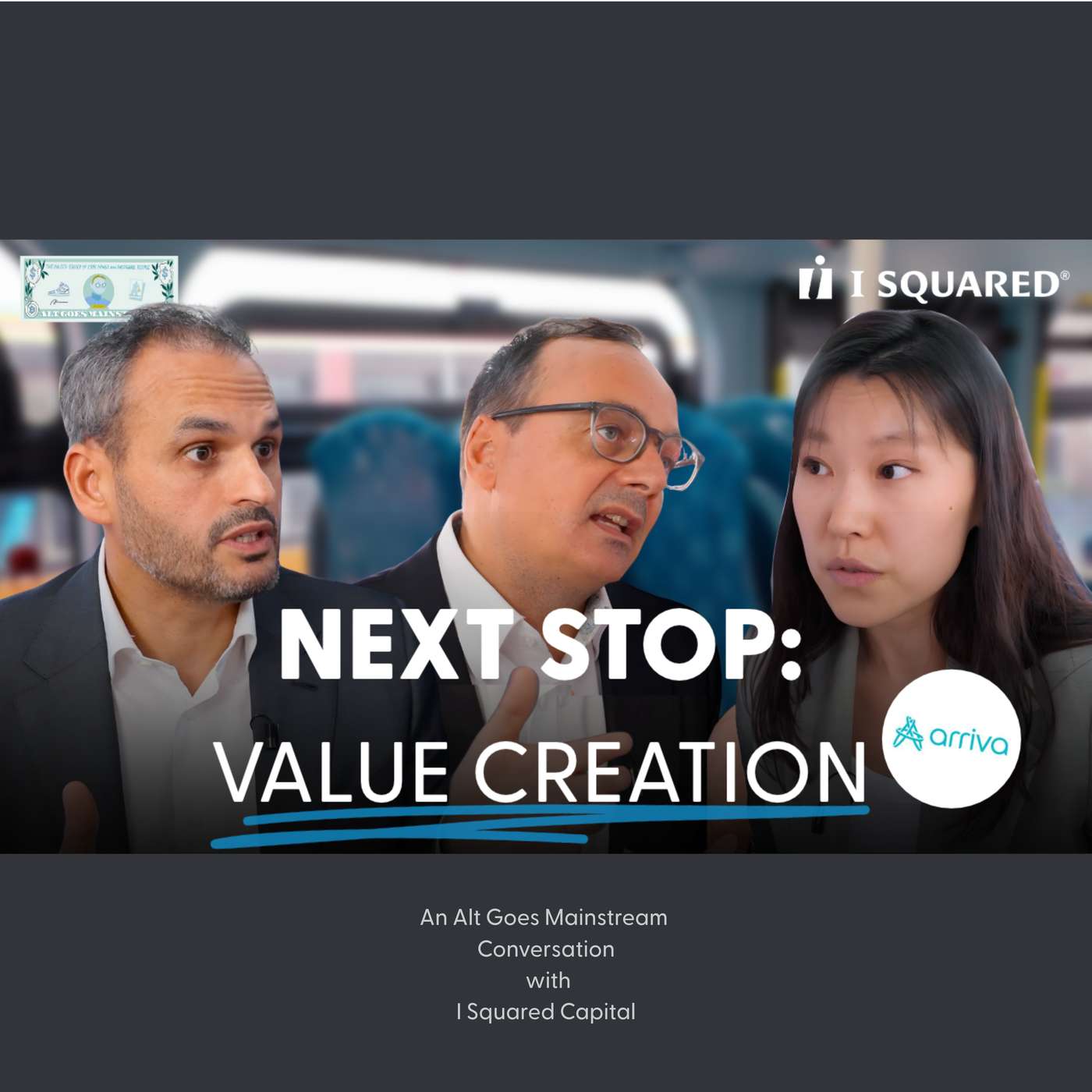
iSquared’s infrastructure investing in Arriva (London buses and European public transport), focusing on how taking Arriva private enabled a hands-on value creation plan: cost/revenue optimization, electrification of fleets, capital structure fixes, and concession bidding. The episode also covers why infrastructure is becoming “mainstream,” the role of private capital as governments face budget stress, and the power/“behind-the-meter” ecosystem needed for electrification.
Written by AI. May contain mistakes.
Explore the role of infrastructure in everyday life and investment opportunities.
“If you think about it, so everyone needs power, water, transport, internet.”
Introduction to Mo El Gazzar and his background in infrastructure investing.
“Mo, welcome to the Altco's Mainstream Podcast.”
Understand how the infrastructure asset class has evolved over the years.
“infrastructure investing for many years.”
Discuss the challenges faced by governments and the need for private capital.
“If you think about Western governments, they're stretched.”
Insights into the decision-making process for acquiring Arriva and its potential.
“The journey for us started in the Nordics actually.”
Learn about the increasing trend of corporate carve-outs in infrastructure.
“Is that going to be an increasing trend where I hear you talk about this?”
Explore strategies behind effective value creation plans in acquisitions.
“And the other area for us as well that we find very exciting is public to privates.”
Discuss the trade-offs between immediate dividends and long-term growth investments.
“in the context of how you thought about rolling out that value creation plan.”
Understand the impact of geographic expansion on business value and exit strategies.
“And once we had that in mind, we managed to capture that growth.”
Examine the ecosystem needed for electrifying transportation and infrastructure.
“correctly and appropriately bid at the right cost of capital.”
Analyze the challenges of power supply in the context of growing demand.
“We sold the international operations to local cost of capital that was more attractive to them to buy in their own home turf, and they could size the risk.”
Learn how businesses can source their own power and overcome supply chain challenges.
“The transportation sector is going to continue to electrify.”
Explore the risks associated with infrastructure investments and how to navigate them.
“you're going to see that across the board.”
Understand the implications of regulatory and geopolitical risks in investment.
“If you look at all our sub-assets, so whether it's transportation, logistics, digital on the data centers, or the B2B businesses on the fiber side, those are businesses that require power.”
Learn strategies for balancing short and long-term investment risks in infrastructure.
“Then layer on top of it the geopolitical risk that we're seeing around us today.”
Understand the benefits of operating within the mid-market infrastructure space.
“Being in the mid-market and able to maneuver in assets that you can bring the value creation.”
Learn about strategies for exits and optimizing business performance.
“I think that's a great segue to a little motif with a bus that we're on and a road.”
Explore the opportunities for retail investors in infrastructure assets.
“And I'm not relying on one avenue because sometimes a lot of people buy certain businesses in the world of alternatives say, oh, my exit route's an IPO.”
Discover the background of the speaker and their approach to value creation.
“Maxime, welcome to the Alco's Mainstream Podcast.”
Learn how risk management contributes to value creation in investments.
“minute you buy an asset, you can almost tear apart your equity story.”
Understand the strategic implications of electrifying fleet assets.
“So the beauty of electrification is that there is not a huge amount of people who can do it, and there is not a huge amount of people which can arbitrate it rightly, and I'll explain why.”
Explore the complexities of the market and strategies for value development.
“to be able to accelerate on topics such as electrification where everybody else is struggling to get access to capital.”
Learn how consolidating small assets can create liquidity and de-risk investments.
“where can we consolidate the market, where can we fundamentally develop some synergies, and where can we also add liquidity and de-risk and asset.”
Understand the critical importance of talent in asset management value creation.
“Is there a certain aspect of value creation that maybe people may not appreciate as much but is actually really, really important in terms of driving value?”
Discover how to assess the right management teams for driving value.
“will go into thinking relentlessly do i have the best team in the best location for the right asset and the reality that more often than not you need to get a new team the incumbent team is going to be difficult.”
Explore the challenge of balancing growth strategies with risk management.
“down on a number of specific initiatives, including by the way, retroacting talent, including doing a lot of construction work and also coming with product expertise because we do it for a living.”
Examine how debt capital markets support infrastructure growth and financing.
“I started in consulting, actually, so providing advisory services to regulatory utilities, which is basically the most traditional type of infrastructure.”
Learn how Arriva finances its infrastructure and the importance of cash flow.
“So maybe we can finance against the buses and trains.”
Explore how private credit impacts financing decisions in the infrastructure sector.
“I would say that relationship with lenders is critical.”
Discover the conservative approach to leverage and its impact on operations.
“Yeah, you hear crazy stories about private credit has become the biggest asset owner in the data center space.”
Understand how different companies within the platform can create synergies.
“So we want that leverage to be resilient even in the severe downside case scenarios.”
Learn about the unexpected insights gained from cross-pollination at conferences.
“It really needs scale to pull that kind of meeting off.”
See how value creation is demonstrated in real-time at an Arriva depot.
“Some people went to the Conrad Energy Trading System room.”

Get the gist, explore an idea or ask about something said.
 Claude
On Alt Goes Mainstream: The Latest on Alternative Investments, WealthTech, & Private Markets, what are the key points of this episode?
Searching your listeningAutomatic transcript. May contain errors.
0:01Kristen Guo: You've probably ridden one of the London Red Buses. Well, here we are in Arriva's Palmer's Green Bus Depot. Arriva is one of the London Red Bus companies. It's owned by iSquared. And we were here today to talk with three members of the team from iSquared, Mo, Maxime, and Kristen, to talk about how iSquared's investment in Arriva has helped them grow their platform and their business, what it meant to take the business private and leverage an infrastructure platform in the mid-market with the scale of the business. of I squared$65 billion platform,$15 billion fund, how they're able to leverage debt capital markets to help the business, how they're able to leverage a value creation team and an asset management team to help great operators like Arriva serve London and all sorts of people around Europe, 1.5 million trips a day across 11 countries in Europe, 16 billion euros of contracts, massively scaled platform.
0:55Kristen Guo: They're helping people get where they need to go. They're helping drive the bus. And what a great conversation with all three of them. Thanks so much. If you think about it, so everyone needs power, water, transport, internet. Even other infrastructure businesses.
1:10Mohamed El Gazzar: We've got all of them.
1:11Kristen Guo: There are people sitting on this bus who may now, because of all going mainstream, have a chance to invest in infrastructure. It'd be an owner of business that they're actually using. How do you think about that aspect of infrastructure investing? Bus too bad it's not driving through the streets of London. That'd be tough to film. Can we create an amazing value creation story with it?
1:32Mohamed El Gazzar: Yes. Could we also create a monster? Absolutely.
1:36Kristen Guo: This episode of Alt Goes Mainstream is brought to you by Ultimis, the full service fund administrator and transfer agent powering asset managers in private and public markets. As Alt Go Mainstream, you need real expertise to handle complex fund structures, connect with key distribution partners, and handle sophisticated compliance, reporting, and transparency demands. That's Ultimis. high tech, high touch solutions for over 450 clients and 2 ,500 funds with over 775 billion in assets under administration. Backed by an expert team of over 1 ,200 employees, they place client service at the core of their business, helping you navigate complexity during your fund structuring or launch, and then supporting you through every stage of growth.
2:17Kristen Guo: Whether you're already in the market or thinking about entering private wealth, you can trust their team's deep expertise in retail alternatives to help you reach your goals. Learn more at ultimisfundsolutions.com or email info at ultimisfundsolutions.com.
2:35Kristen Guo: Mo, welcome to the Altco's Mainstream Podcast. Thank you. Thank you for having me. Well, no, thanks for having me. We are on an Arriva bus in the Palmer's Green Depot, which is one of your portfolio companies, your assets. You own Arriva. I've never done a podcast on a bus, actually. So excited to be here with you. Very excited to have you with us here. I think it's be a ton of fun because we're really going to bring to life what infrastructure investing is really about. What better way to do it than be sitting on a bus? Too bad it's not driving through the streets of London. That'd be tough to film.
3:05Kristen Guo: But very emblematic of the type of investing you do and also how hands-on you are. So we'll get into that and talk about Arriva and why you decided to invest in the business and grow the business and the platform. But first, I want to start with your background. You've been doing infrastructure investing for many years. You and Sadek have worked together for going on, what, 27 years? Yeah. So I would love to hear a bit about your background, how you ended up at I-squared. Yeah.
3:32Maxime Jacqz: So I'm Moil Ghazar. I was part of the founding team with Sadek and Gotham in 2012, 2013. I started working with Sadek in the year 2000, so about 26 years ago. Yeah, just even 99 to 27 years and met gotham our other managing partner 22 23 years ago and harsh who runs our asia practice almost 25 years ago so it's been an amazing journey together after uni i joined moho stanley where i was there for about 12 13 years and immediately after that it was Sadek and Gautam, as our co-founders, decided to start I-Squared, and Harsh and I jumped in, and we were there from the beginning. I've been sitting in Europe all this time, so my focus is really on our European investing and our building our European franchise over the years.
4:26Maxime Jacqz: What's changed about European infrastructure over the years? So I think there's a lot of change that happened. So one, the asset class has become, in my mind, as mainstream as private equity or real estate. So if you go back to 2010, 2011, and you'd walk into NLP's office, a lot of the questions were around, where does this fit? Does this fit in real assets? Does this fit in private equity? How can I allocate the capital to invest in infrastructure? That's gone today. Today, it's a full mainstream asset class with its dedicated teams around the world from the larger sovereign investors, pension funds, smaller pension funds, everyone is looking at this asset class.
5:12Maxime Jacqz: And it's done extremely well. So throughout the last 15 years, the asset class has performed very well. It did what it's supposed to do. It's inflation linked. It returned very good money for investors. And people appreciated the asset class and have tracked it over the years. We've been fortunate. We work hard, But obviously, luck plays a big role in these things. And we've been fortunate to be there from the beginning. And today, as you have seen with I2's growth, we are north of$65 billion of AUM. And that's testament to the faith that the investors have put in us over the years and the team.
5:49Maxime Jacqz: The team have worked extremely hard around the world, whether it's in the U.S., in Europe or in Asia, to build this amazing franchise. and we're also blessed to have portfolio companies like Arriva and others that have helped us grow and demonstrate to our investors and the world that this is an asset class that will continue to grow. There's a lot more to do and if you read Sadek's book, there's a lot of aging infrastructure out there and there's new infrastructure in certain parts of the world but when you look at Western Europe and North America, we've got a lot of work to do. So there's a lot of investments that have to go in, a lot of capex that have to be put to work.
6:26Maxime Jacqz: And we really want to be part of that and continue to be part of that.
6:30Kristen Guo: And you need private capital to fill that need, especially as governments may not be able to spend as much or be looking to partner with private investors.
6:40Maxime Jacqz: If you think about Western governments, they're stretched. There's been a lot of stress in the system with the global financial crisis, COVID, the European crisis, these various crises have put stress on the balance sheets of a lot of the Western countries, whether it's North America or Europe, and that has led to the need for private capital to step in and to help deploy the capital adequately. That's sometimes, as you said, through partnerships, but equally, sometimes these are concessions where private capital is to have a specific concession with the public body to build out a role of specific infrastructure.
7:22Kristen Guo: Unpack that a little bit more because I think that relates to what we're going to talk about here today at Arriva.
7:27Maxime Jacqz: In some cases, you'd have a concession to operate a business like Arriva, whereby you're having a relationship with the municipalities, the local authorities. Buses are needed. That's an essential need. It's public transportation. you would bid on a concession to a specific municipality in a specific town or specific city and that will be for a time frame whether it's seven years or ten years once you win the concession based on specific criteria or you win the tender you'll go out procure the buses and run the route so we've been excited about that space for a long time we didn't just wake up and decide oh let's go invest in Arriva and for us it's always that bottoms-up approach to investing in any asset class we look at, or sectorally or in subsectorally, because that's very important to us.
8:17Kristen Guo: I want to tie together a few things you said from the last two answers, because I think it's important and interesting for people as investors to think about. So one is you said that in many respects, infrastructure is like private equity in some senses. When you talk about concessions, long-term contracts, annual contracts with municipalities, good partners, customers. There's some similarities to SaaS or software in that sense, right? I know software's had a bit of a struggle recently, but just conceptually, you have long-term contracts with good counterparties when you're investing in a business, these assets that you have.
8:54Kristen Guo: So there are a lot of similarities between the two asset classes, and then you add in the value creation piece, and you're actually building and operating these businesses. So I'd love to get, as we sit in one of the Ariba buses get into Ariba's business. So you bought the business in 24 from Deutsche Bahn, bought it for about a billion six euros, including debt. You've added another two billion euros or so to the platform to help finance, build the business. What did you see in Ariba that made you say, this is a business to buy and why now?
9:29Maxime Jacqz: I'll answer this question by going a little bit back in history and the story for us started in 2018-2019. We started identifying that public transportation is a sub-asset class within transport and logistics that's very interesting. Municipalities, local authorities want to continue to electrify the fleets. As I mentioned, there is stress in the system when it comes to the fiscal positions of local authorities and governments and therefore that partnership with the private sector will continue to grow. The journey for us started in the Nordics actually. We tracked a business called Nobina. It was in the press back in 20, end of 2018 throughout 2019.
10:09Maxime Jacqz: We're very interested in it. We tried to transact at the time but unfortunately we couldn't get there on price. We're very disciplined when it comes to our entry price and what we liked is we saw a business that has all these attributes. The concessions, the electrification story, the ability for us to make a difference as we buy these businesses and deploy our value creation levers that we pull from an asset management perspective but we just were not comfortable with the entry price however we don't stop there if a deal doesn't work but we like a sub-sector we continue to track that sub-sector so we started looking at first group which is a listed company here in the uk and it was going to be a public to private spend a lot of time on this business analyzing it getting continue to get excited about the business plan, but where we did not get comfortable and decided not to go is the rail exposure of this particular business was quite large.
11:06Maxime Jacqz: And for us, the reasoning for pulling out or not going ahead with the deal was there was just too much rail exposure for us and there was a lot of political noise around regulation and how various governments, particularly here in the UK, have a view on the future of rail. And you've probably seen from the various different discussions you've had with Sadiq and some of my colleagues, regulation is something where very, very...
11:33Kristen Guo: How do you underwrite regulation?
11:35Maxime Jacqz: That's the thing. You have to be very careful. You have to ask yourself many questions around the role the regulator is playing. Does this regulation make sense or not? Are we over-earning as a private investor? And from our perspective, we felt in the case of First Group, there was just too much regulatory risk. So we decided it's not for us. We like the rail sector, but there's too much risk and noise around that. So we decided not to go ahead with this. And then that led us to ultimately Arriva.
12:04Kristen Guo: On Arriva, what did you see in Arriva that made it stand out? And you mentioned something like rail. Rail, there's obviously challenges, but there's probably a lot of moats, right? What are some of the moats that you saw in a business like Arriva? Because there's other bus operators. Go ahead. A few others in London. Now, when I look at the buses, I actually look to see who's the owner of the red bus now that we're sitting here in an Arriva bus. But there's other operators. You've expanded the platform in the UK and then abroad as well. 14 depots in London alone, I think. But what did you see as the moats for the business with Arriva?
12:36I think for me, Arriva was owned by Deutsche Bahn, a state-owned entity that moved away from
12:45Maxime Jacqz: investing outside Germany to investing inside Germany so inward investing so a state-owned entity was not able to continue to grow in the UK in Holland and Italy Czech Republic key geographies were a reverse present so for me a star of business for capital that's an amazing opportunity to look at and then when you think about buying a business through a corporate carpet there's a lot a low-hanging fruit where we could bring our value creation toolkit to work because it was a neglected asset sitting in a state-owned entity. Then the opportunity on the other side was huge in the sense of municipalities wants to continue to electrify their fleets.
13:31Maxime Jacqz: There are plenty of routes and concessions coming and tenders. So it was, I'm not saying a badly run asset, but it was challenged in the way it was run. So an opportunity for the new buyer to come in, unshackle the capex and allow the business to really grow and reach its potential.
13:49Kristen Guo: I want to get into how you did that. But before, I think this is an interesting and important point. When I hear you talk about how you decided to buy a revamp, who you decided to buy it from, you mentioned the word corporate carve out. Is that going to be an increasing trend where I hear you talk about this? it seems similar to what's happening in private equity in some senses, where a big corporate has a slightly orphaned asset that a private equity firm says, hey, I can go and actually take this business, remove it, use the value creation plan to actually build this into a real business, since it's now, there's more focus on the business, et cetera.
14:24Kristen Guo: Given the dynamics of what's happening in infrastructure with governments being saddled with debt, the ability to create value and having a platform to help create value, is this a trend and theme that you think is going and continue this kind of corporate carvalidization of infrastructure assets?
14:41Maxime Jacqz: First of all, you have to be a value-add fund in the sense of you have to have the deep venture of asset management and your mindset needs to be about, as an investor, to go in, have those levers ready to pull and have the experience. Some of these corporate cars are very complicated because it takes time to stabilize a business once it's out of a corporate entity. But absolutely, we will continue on our side to do corporate carvalids, whether it's from state-owned entities, private sector, certain divisions that sit in corporates that are non-core, where you could take it out and really help grow the business.
15:14Maxime Jacqz: And the other area for us as well that we find very exciting is public to privates. There are plenty of companies that shouldn't be public companies. Nothing against the public markets, but they're not growing. The equity market has moved on, and they're saddled by being in the public market where you can unleash that growth on the private side. And once it's grown again, you could put it again, public, but with a different capital structure, with a different focus, with a different operating model that suits the new public listing, if you were to go. So for me, absolutely. We, at least on our side, are going to be doing more corporate carve-outs from governments and corporates, private sector, and P2Ps.
15:56Kristen Guo: So you mentioned value creation plan. One of the things you did, and I'd love for you to talk about this in the context of how you thought about rolling out that value creation plan. But you bought the business for around a billion six euros, including debt. But you put two billion euros in the platform. What was the thought behind that? And where did it have the most impact? I think in year one, kind of the first seven months you owned it, over 127 million euros of profit.
16:23Maxime Jacqz: So I think for us, the first decision we had to make is we're not in there to make a dividend straight away. Of course, we want to stabilize the business to be able to demonstrate that this business now has the right cap structure to be able to pay dividend. But the primary focus was to have the business capture that opportunity to deploy the$2 billion of CapEx. And that you could only do by not focused on taking dividends out of the business, by having CapEx facilities that automatically can be used to grow and facilitate this. So that was our focus. And once we had that in mind, we managed to capture that growth.
17:00Maxime Jacqz: That's not necessarily for every buyer, because some buyers would like to buy an asset and focus on yield from day one and are not interested to put that much capital back into the business, whether it's through further leverage or dividend sacrifice.
17:15Kristen Guo: And that point brings up an interesting thought, which is how do you think about the equity story relative to the more stable yield or debt story?
17:25Maxime Jacqz: so to me i'm buying a business that needs to go through that journey to get the right equity story with a stable dividend going forward and i think areva is getting there so if i were to look at areva's journey today as i think about the next phase of areva areva today has or in the process of putting a very good capital structure it's going to be able to have a steady dividend to go with that, we'll be able to continue to demonstrate to a new buyer in the future that we've got a fantastic team that's bidding and a concession team that can size the concessions correctly and appropriately bid at the right cost of capital.
18:08Maxime Jacqz: And that's a going concern. That's a business that you could sell to anyone in the future with the right equity story. So you've taken a carve out and created a story out of it and right size it in the sense of some some, Arriva today is in 11 geographies, maybe we'll have less geographies as the equity story unfolds. We've done that in many other businesses.
18:28Kristen Guo: How much does geographic expansion have to factor in as you think about value creation and ultimately exit?
18:36Maxime Jacqz: So I'll answer that in a different way, because we came across that in many businesses. So you start with the European business, and then you say, let me have a U.S. presence, or let me have an Asian presence. It sometimes works, but it also sometimes is a hindrance when you come and sell. Because local cost of capital, in the sense of we owned a business that was a solar business, that was a Spanish origin business with operations in Japan, in the U.S., and in Latin America. We sold the international operations to local cost of capital that was more attractive to them to buy in their own home turf, and they could size the risk.
19:12Maxime Jacqz: And then we focused the business as a large Spanish and Portuguese solar business that was sold ultimately with a specific focus. We've done again that in the transportation sector on the leasing side with a business called Tip Trailers, where we were present in Europe, a pan-European business, with an operation in Canada. We sold the Canadian business to a better suited buyer in North America. And then we now have a pan-European business that we just recently sold. And the focus was on buying a European champion. So sometimes it's important to understand the sector and the subsector you're in and the audience that are looking into that.
19:53Kristen Guo: Well, I think that's a great segue to another dimension of really thinking about and focusing on a specific market. So you talked a bit earlier about electrifying the fleet. So not all, but a good portion of Arriva's buses, including the one we're sitting on, is an electric vehicle. to do that there's a whole host of downstream elements that you need to have we're sitting in a depot i imagine there probably needs to be electric vehicle charging stations there needs to be power there needs to be electricity all sorts of things how do you think about the broader ecosystem of just what's required to properly build and run an infrastructure platform and And then think about how you can create value as a firm and kind of think about the entire value chain to create value for all of your platforms or portfolio companies.
20:43Maxime Jacqz: So we have a huge advantage in the sense of we understand the power market very well. And if you see what's going on today, there's been a surge in the demand side of the equation when it comes to power. We need more power. That's just continuing to grow. As a colleague of mine says, it's yes or yes. Data centers need more power. The transportation sector is going to continue to electrify. The housing sector will continue to electrify. We just need a lot more power. And the supply is a little bit challenged. We've seen supply challenges in Europe with the war in the Ukraine and the drop in the supply of gas, particularly to two of the largest economies in Europe, which had trickle effect in Germany and in Italy.
21:23Maxime Jacqz: So to me, the dynamics around the supply and demand side of where we sit in power, that's something we do day to day. So as you mentioned, when I think about electrifying the fleet, I have to think about the charging stations. I have to think about where am I getting my electricity from? How am I sourcing my electricity? And I think what you're going to see going forward is every business is not just going to be able to say, oh, I'm going to apply to the system operator and the grid is going to provide me power. No, I'll have to think of what's behind the meter. I have to think about how am I going to source my own power?
21:56Maxime Jacqz: How am I going to have solar with battery? How am I going to have companies that can help me with that? Now, the good thing is we have one of the world's largest companies, Agreco, which is another business that we've grown substantially over the years. And that business focuses on that behind-the-meter solutions and what we can do. And I want to give you a small example. We have a cold storage business, very different than Arriva. Those are giant refrigerators where you're storing food for supermarkets. And we had a customer of ours in Holland that asked us to expand the facility so they can take more capacity and put their food produce there.
22:33Maxime Jacqz: That needs power. And we went to the system operator where we applied for the power and said, look, we have challenges. We can't provide the power. So we were not going to be able to achieve our growth plan because there are shortages of power today. We went to Greco, and they came with their solution behind the meter. And they enabled us to start that business and build the facility. you're going to see that across the board. So today, as an infrastructure owner with deep knowledge of the dynamics of supply and demand on power, I have a huge advantage when I'm the owner of Arriva to be able to assess the growth on the electrification of the fleet and what is needed in that chain that you mentioned as to how you need to get this electricity and the molecules to the buses.
23:17Kristen Guo: On that point, given the different dimensions through which you see the entire value chain from all the different portfolio companies or infrastructure platforms that you have, do you have views that may differ from some others in infrastructure investing? If you just looked at a certain business or sub-asset class on its own, maybe really interesting investment. But then when you think about things like, oh, we need to supply power or we need electricity or whatever it is, are there things where you maybe have a slightly more non-obvious view than others in the infrastructure asset class because you see some of the other downstream effects?
23:55Kristen Guo: And therefore, like in isolation, a certain asset class might be interesting, sub-asset class might be interesting. But given challenges and other sub-asset classes that might also play a role, maybe it's not as interesting.
24:06Maxime Jacqz: What I would say is I think we appreciate the challenges of every single business that needs power today. If you look at all our sub-assets, so whether it's transportation, logistics, digital on the data centers, or the B2B businesses on the fiber side, those are businesses that require power. And we appreciate that risk, I think, a lot more than others in the sense of it is not an automatic right that you today, if you're going to be in a business, and you're just going to get power from grid. That's just not going to happen. You can be in certain subsectors, but in a lot of the times you have to think about these behind-the-meter solutions in order for you as an investor to capture that growth.
24:51Maxime Jacqz: But just relying on grid, that'll be quite challenging because there are challenges in the grids we see today. What are you most worried about in infrastructure investing going forward? To me, one of the things that worry me the most is regulation. We avoid investing in businesses that are heavy in regulation. But look, regulation is around. You can't avoid it completely because those are behaviors that you can't predict. There are pressures on budgets today. We're seeing it in France. We're seeing it in the UK. We're seeing it in Germany. We're seeing it everywhere in Western Europe. and that shapes public opinions, ultimately shapes what policymakers do and don't do.
25:33Maxime Jacqz: And I have to navigate all this as an investor. Sometimes it's not very clear. I'll give you an example. If you're investing in a toll road, I'd rather take traffic risk than take availability payment risk. Availability payment is where you have a toll road and as long as the toll road is there, you just keep getting paid by the government or the municipality. Where you take traffic risk is that you have the road, but you're getting paid from the consumer. So as long as the cars are going, that's okay. So what I'm trying to say is that there are certain behaviors when it comes to regulation that's just out of my control.
26:11Maxime Jacqz: Then layer on top of it the geopolitical risk that we're seeing around us today. Those are the types of risks that, unfortunately, I'll just have to be always aware of as I'm underwriting any of the businesses we look at. and as we are doing the gas management side, because things are changing so fast. Who would have thought that seven, eight months ago, that the disruption that we're seeing today to the oil and gas market would lead to what we're facing? And we see that in a lot of businesses.
26:40Kristen Guo: How do you balance the short-term and long-term aspects of that? Because you may not know what could happen five, ten years from now, but you want to hold these assets for quite some time in many cases because of the characteristics and the long-term contracts, like I mentioned with ARIVA, seven to 10-year contracts, but maybe there's a different administration that comes in. Maybe there's different local councillors or municipalities and the way they think about things. So how do you balance both the short-term risks and the longer-term risks, as well as longer-term time horizons that you may hold these assets?
27:12Maxime Jacqz: I'll touch upon two things that we do very well and we're very proud of. Hyperdiversification. One of the things you'll hear with I-squared is hyperdiversification. We're not interested in taking macro bets. I'm not equipped as an investor to say I'm going all in a specific sector. It's going to be the best sector and I'm going to put all my eggs in that. And it's not just about diversification. It's hyper diversification. Every one of I2's funds, like if you take our third fund, there's a$15 billion fund, 30 investments. So things can go wrong. But we can withstand the pain because a lot of others will go well and you don't have such a large check written.
27:52Maxime Jacqz: if something does go wrong that's out of your control, that hyper-diversification will help you. The other point I want to make is mid-market. Being in the mid-market and able to maneuver in assets that you can bring the value creation. Some of the larger assets that you buy, the very large infrastructure assets, if you own one of the world's largest airports, you're not going to be able to maneuver that much. Certain amounts of maneuver that you could do if you own Heathrow Airport. But if you own an asset that's in the mid-market where you could influence, dial up the capex, dial down the capex, control the costs, don't focus on this geography, focus on another one.
28:31Maxime Jacqz: But if you own one of the world's largest infrastructure assets, there's a lot less maneuverability that you can do, and that we benefit from being in the mid-market.
28:39Kristen Guo: I think that's a great segue to a little motif with a bus that we're on and a road. But I've always, when I talk with our entrepreneurs about thinking about exits, I think of it like you're driving down the highway. there's exit ramps that you can go off. And those are choices, right? You can choose to go off an exit ramp, maybe a little less risk a little earlier on if you're cruising down the highway. How do you think about, particularly as it relates to the mid-market, a business like Arriva, and how do you think about those exit ramps? When are you going to get off this bus?
29:07Maxime Jacqz: So for us, it's the journey of what we're trying to achieve. So corporate carve-out, lots to do around cost optimization and revenue optimization. We've done a lot, a lot to do. Electrification journey, the 2 billion euros that you talked about, still a lot to do, fixing the capital structure, did some and continuing to do, and get the business on the right track from, does it produce the right dividend yield, et cetera, and have that team and a very good concessions team.
29:37Kristen Guo: 16.9 billion euros in contracts signed and booked, right?
29:42Maxime Jacqz: Correct. So that's testament to the great team at Arriva that have really worked very hard to size these concessions, the tenders, because that's what creates the longevity in this business. You're not relying on one contract, you're everywhere. You're in certain geographies in European rail, you're doing trams, you're doing buses, and you continue to have that diversified book. Once you've done that and you've achieved your underwriting, that we've mapped out ourselves at day one, the choices are very big. And also managing the equity check at exit. If I'm talking about an incredibly large equity check, I'll have a difficulty.
30:16Maxime Jacqz: But if I have a decent size equity check and manageable, I'll be able to think of buyers, whether it's sovereigns, whether it's direct investors, whether it's other infrastructure funds, whether it's strategics that are looking to buy. So I've opened up a variety of different routes that I could sell the business to. And I'm not relying on one avenue because sometimes a lot of people buy certain businesses in the world of alternatives say, oh, my exit route's an IPO. But if the market's closed, what do you do? We've been there before. So for me, having those variety of exit routes focuses on your underwrite and what you're trying to achieve.
30:50Maxime Jacqz: And sometimes it doesn't go according to plan. So you have to pivot and change your underwrite to always focus on how do I give myself the maximum amount of exit routes off that highway you mentioned.
31:02Kristen Guo: You need a good bus driver too. Exactly. You need a good management team and a good investor to do all that. So I think that's a great tie-in to where I want to wrap and kind of tie things together. we're sitting here on this bus 4.5 million journeys per year for Arriva there are people sitting on this bus who may now because of all it's going mainstream have a chance to invest in infrastructure what would you say to investors and now more investors who have access to infrastructure they may not think about it but if they're sitting on the bus they may actually at some point being it'd be an owner of business that they're actually using to transport themselves, walk through an airport, leverage the water or energy or electricity supply.
31:44Kristen Guo: How do you think about that aspect of infrastructure investing?
31:47Maxime Jacqz: I'm fascinated by the democratization of our asset class. It's giving everyone the ability to invest in a fascinating asset. I grew up in this asset class. It's everywhere around us, as you said. You walk to an airport, you're driving down a toll road, you are turning on your power, you're sitting on your bus. The food, like I talked to you about the cold storage. The food you eat at a restaurant sits in cold storage facilities. That's all part of our asset class. And investors will have the ability and continue to have the ability to benefit from that. And I think that will continue to grow. It's going to continue to grow because governments need those partnerships.
32:25Maxime Jacqz: Municipalities need those partnerships. Local authorities need those partnerships. Everyone needs those partnerships. And infrastructure asset class is there to continue to grow and address the underinvestment that's been going on for decades. And if I'm a retail investor or someone who's new to the asset class, that's a fascinating place to be because I have such a huge growth potential in front of me. I'm not bound by, well, it's just this amount of capex and that's it. It just continues to grow.
32:55Kristen Guo: And they can be sitting on the bus that they might be. An investor. An investor. Exactly. So what a great way to wrap this up. Here we are at Arriva on the bus. Thanks so much, Mel. Thank you. Thank you. Pleasure. Maxime, welcome to the Alco's Mainstream Podcast.
33:08Mohamed El Gazzar: Thank you. Thank you, Michael.
33:10Kristen Guo: Pleasure to be here. We're on an Arriva bus, one of your assets. I think this is a perfect setting to talk about value creation. You've come in, built a value creation plan for Arriva, and here we are sitting in one of 14 depots, 16.9 billion euros in customer contracts, booked and signed. Massive platform. You invested a few billion euros, two billion euros into the platform since you bought it, 24. We'll get into all that, but first I want to start with your background. How did you end up at I-squared? You've been in infrastructure for a while, so tell us how you've gotten here.
33:41Mohamed El Gazzar: The journey to the bus has been quite long. So I started my career back in 2004. Initially, I was doing some M &A for the Deutsche Bank, ABN Amro, and then I moved in-house to their infrastructure fund, where I stayed for 11 years, initially on the investment side and then asset management side, and joined I-squared nine years ago, initially with the promise of setting up really their asset management practice here in this part of the world as many funds started typically with an investment team and then started to realize at some point that now i have some assets i need to manage them i squared exactly the other way around which is we want to start with asset management we want to start with engineers want to start with people who can buy asset build asset expand asset before anything else which was a bit of a unique approach to things something that worked very well and that allowed really me and the team to be able to build up something from scratch very early on and to make sure we could double down on our ability to create value.
34:36Mohamed El Gazzar: So if you look at the team that we have within asset management, you have a lot of engineers, people which are building background, construction background. You have a lot of technical experts, product experts, and people which are dealing with the kind of challenges that we have here in Arriva on a daily basis. So electrification, maintenance, repair, preventive maintenance, telematics, etc. is something that we have been embracing from very early on.
35:00Kristen Guo: So two interesting things in there, one related to your background, but then one related to the background of those on the platform. So what did investing help you with as it came to building the asset management platform? Did you think about things differently because you'd been on the investment side?
35:17Mohamed El Gazzar: Yeah, sure. I think what is for sure in the investment world is that the minute you buy an asset, you can almost tear apart your equity story. Things never go to plan for one reason or the other, but it's super important to have this in mind and being able to be prepared. The other thing is there is various ways to create value. You can create value through financial engineering, you can create value from hoping for a re-rating, you can create value in many different ways, but by far the superior approaches to creating value are ones which are focusing on die-side protection, reducing risk is arguably a very efficient way to create value and we are extremely focused on risk reduction.
35:53Mohamed El Gazzar: We measure risk, we have our proprietary risk wheel and something that we are extremely focused on. The other thing is about making sure that we have a full asymmetry between our investment thesis. Putting it differently, we hate the concept of having an asset which has unlimited downside and zero upside. A perfect example would be a regulated asset. So if tomorrow you are buying into a regulated asset in the space of let's say UK water for instance, you'll be in that setup whereby there is fundamentally unlimited downside. If the regulator tells you tomorrow you have to cut your returns, your equity is gone given the amount of debt you have and there is zero upside.
36:33Mohamed El Gazzar: It's never going to be a time where they're going to wake up and say you know what I'm allowing you to double your returns. It's not going to happen. So what we want to find is exactly the opposite. And Arriva is a good example. So huge amount of ability to go through cycles. If tomorrow we decide to double down on the electrification of fleet, we currently have a billion plus EMR toward this effort, we can do it. If tomorrow there is an opportunity to further consolidate the market and grow, we can do it. So we like this kind of asymmetry. And I think that's one of the lessons learned from the investment world, which is trying to look at alternative ways to create value in a way which is a lot more comfortable.
37:07Kristen Guo: So you talk about If you electrified the fleet, you could really grow the business. Why?
37:13Mohamed El Gazzar: So the beauty of electrification is that there is not a huge amount of people who can do it, and there is not a huge amount of people which can arbitrate it rightly, and I'll explain why. Arbitrage is about the cost of electrifying. It's about getting your access to the grid, which is the biggest bottleneck. We know how to do it. We have companies like Aurora. They are an idea in the UK. hey, this is our bread and butter. They bring the last mile connection to a depot like this one. So we know exactly the cost of electrifying, we know exactly the challenges towards accessing the grid, etc. Then it's about putting the local infrastructure, the various hardware and software to be able to optimize your fleet charging.
37:52Mohamed El Gazzar: Then it's about procuring the vehicles. We are sitting here in a BYD bus, and we have massive procurement advantages of being able to have an ISQA global franchise, which, frankly speaking, doesn't go to China to buy a few buses. When we speak to the CATL of this world, we speak about procuring gigawatts across multiple sites, multiple portfolio companies. Then it's about being able to understand the residual value of an asset. So when you buy a bus and a battery, typically you need to be able to have the right formula when it comes to what's going to be the commercial technical life, but also the end value of an asset.
38:26Mohamed El Gazzar: And if you don't know about it, you are going to be by default, maybe a bit cautious about it. And numbers have actually shown that the more data points we have, the more comfort we have with the fact that we can maintain a battery for a longer period of time, especially if we charge them and discharge them well. So you never want to go what we do. So when you have an iPhone, what you do with that, you go zero, 100%, 0 % 100%. It is the worst possible formula when it comes to keeping your iPhone alive. What we do here is that you're never going to go full, you're never going to go on low etc etc.
38:59Mohamed El Gazzar: So plenty of things to ultimately lead to an optimized value for the battery at the end of its life. If you can understand all those kind of principles you can do a lot better than the rest of the competition. Electrification is also about accessing capital. Plenty of operators potential have the ability to electrify their fleet but they don't have the capital behind it. The beauty of a mid-market model that we have is that we start small. So So our last fund is a 15 billion fund. We do 30 positions per vintage. So every single position is small, which is giving us a tremendous option to be able to double down on it.
39:36Mohamed El Gazzar: If we like it and if there is value to be made, we can double down. If you have 10 positions per fund, you cannot double down on a single position. It's going to be a 20 % exposure to your fund. So in Arriva, we bought a relatively small day one ticket with a massive amount of capital available behind it to be able to accelerate on topics such as electrification where everybody else is struggling to get access to capital.
39:57Kristen Guo: I think what you shared there brings together a bunch of different aspects to this. So one is you have a large-scale platform, both on the capital side, $15 billion for mid-market. You also have 50-plus operators and executives on the asset management side. So you have a large team to be able to help these mid-market companies. But then you also have invested across the entire value chain. And there's investing in Arriva, to your point, there's a bus depot that needs electrification. There's downstream requirements for that when it comes to things like power, et cetera. How do you think about tying all the different pieces of the platform together as one, you're thinking about investing in a certain opportunity, but two, as you think about building out the value creation plan?
40:40Mohamed El Gazzar: Yeah. So I think those situations really can vary a lot. But we are, frankly speaking, focusing on what is small and complex. as typically our unique angle towards creating value where others maybe will fail to do it. Putting it differently, can we add value into buying and owning an airport? I know Mo was referring to that before. Very hard for us to do so. Why? Because first, it's too simple, too big, too hard to move, limited potential for growth. If you think about it, it's a glorified shopping mall and a car park with a tiny bit of volatility towards your PLS revenues. But more importantly, there is limited potential for growth.
41:20Mohamed El Gazzar: As you think of it, you're not going to be able to double down on your runway. We've been discussing it for the past 30 years in ETHRO, and it's not even close to being done. And ultimately, the entry point you have to pay to get access to those trophy assets is just way too high. If you buy an asset 25 times, frankly speaking, you are mathematically implying that the asset will grow maybe for 10 % perpetually. Obviously, nothing grows in life 10 % perpetually. Or you're going to have a massive amount of growth spike. or someone will be even more ambitious than you when it comes to your exit to be able to bail you out from this position, which we don't want to rely on an exit.
41:53Mohamed El Gazzar: So as we look at building and buying this platform, we tend to focus on what is complex, what is too small, where can we consolidate the market, where can we fundamentally develop some synergies, and where can we also add liquidity and de-risk and asset. Adding liquidity is because maybe we have a bunch of small assets which individually are not very attractive to the market, We're going to buy a number of small assets in Italy, make them part of Arriva, being able to sell them as a whole, and there will be some interesting rewriting potential. It could be about derisking an asset by adding scale, bringing it to it.
42:29Mohamed El Gazzar: So there is a lot of that thinking that goes into our business development puzzle. We also want to do buy versus build arbitrage. So there are situations where we're just buying our own asset would not make sense. We'd rather build it. We do it across data centers. We do it across cold storage. Here in the context of this depot, sometimes we have a chance of being able to buy some already electrified depot or just build our own and we'd rather build our own. So we tend to look at platform development with those lenses.
42:58Kristen Guo: Are there areas or sub-asset classes of infrastructure where scale meets mid-market intersects where you're able to really leverage that platform of scale to have outsized value creation in the mid-market?
43:15Mohamed El Gazzar: Yeah, no, for sure. A good example would be the cold storage space, which we've been exploring for a while. It was a very binary situation in the world where you have the large players in the US, the lineage, the America's world, trading at relatively high multiples, well-consolated, limited opportunity for growth, but nonetheless a very stable market with plenty of scale and synergies, and the European model, which was extremely fragmented. Lots of small mom-and-pop type operations, which is coming with a massive downside, which is liquidity. I mean, it's very difficult to find a path to liquidity.
43:49Mohamed El Gazzar: And in that sense, there was a tremendous opportunity for us to start to consolidate that market. So it was about buying those kind of small mom and pop type shops at a discount to what we see otherwise. It's about building our own asset through pure greenfield or sometimes brinefield development. And that allows us to do really a few things to bring it to scale and improve liquidity on the risk I was referring to before. It allows us to develop also synergies, commercial synergies, construction synergies, health and safety, best practices, etc. And even without having to rely on some kind of re-rating, really super helpful.
44:24Mohamed El Gazzar: Now at some point, you are getting into a situation whereby you're starting to be so big that you're almost an obvious buyer, and a smaller part of the market will have you pay for it, which is you have created so much value, I'm making up numbers, but that is you're currently trading at what could be a 14 to 16 times multiple, you've been doing your first acquisition at eight times. Now I see the AmeriCold trading multiple, I want 15 times as well. So there is be a point in time where there is some limit into your growth story because of adjusted expectation from the market, but also sometimes laziness too.
45:02Mohamed El Gazzar: You've been thinking, well, last year I did 20 transactions of a very small side. In the next year, maybe I want to play golf a bit more and only do five transactions of a larger size. And then you become lazy and you have to overpay. So we need to be careful and mindful of this kind of scale games and making sure that also we don't miss the opportunity to maintain a scale which is going to be suitable enough for the next buyer.
45:23Kristen Guo: On that point as well, what do you think is the most important or underappreciated feature of the value creation platform? Is there a certain aspect of value creation that maybe people may not appreciate as much but is actually really, really important in terms of driving value?
45:40Mohamed El Gazzar: I think people, and when I say people, I will put myself in that category, they tend to overestimate the toolkit of value creation of an asset management team. They say, well, we have an amazing ability to create value by optimizing revenue and yield, optimizing cost, optimizing procurement, debt capital market, digitalization, EHD, etc. The reality that there is a single factor which is doing everything, which is talent. Without talent, you have nothing. Ultimately, we are not micromanagers. we have no willingness to also micromanage because the next buyer is not going to buy us they're going to buy the team so they have to be able to look at the team as being standalone and being able to create value going forward so i think a huge amount of at least my brand power will go into thinking relentlessly do i have the best team in the best location for the right asset and the reality that more often than not you need to get a new team the incumbent team is going to be difficult.
46:38Mohamed El Gazzar: And it's mainly for two reasons. Reason number one, maybe they are a very good team. They did very well, but they did very well for themselves. And maybe financially it's going to be very difficult to align their interests going forward. And that may be a recipe to potentially start with a new team. Or they haven't done so well financially, but maybe it's for a reason. Maybe it's another top team that you wanted to have for your setup. So there is a fair amount situation where we need to move away from the incumbent team and add more vision, stamina, and fundamentally relentless focus towards delivering this business plan and going above that.
47:13Kristen Guo: So you talk about management teams and what it takes to be a successful management team. Who within the investment business, whether it's the investors or the value creation team, is best placed to evaluate whether or not the existing management team or new management team is the right people to drive the bus, I guess.
47:32Mohamed El Gazzar: Yeah. No, I mean, fundamentally, the question that we don't ask ourselves on day one, but way before that. So, you know, we don't go to the investment committee without having a very valid answer when it comes to who's going to be the one driving this, what's going to be the management team. Sometimes we already have a fully lined up team in place. Sometimes we've done a full assessment. Sometimes we have a desktop review and plenty of options, but we're never going to go into any kind of investment thesis without having this clarified from day one and well before that. And then it's a joint effort.
48:07Mohamed El Gazzar: One of the special ways of I-squared progressing with value creation is we do it in a duo type setup, where the investment team and the asset management team are working fundamentally hand in hand across what we call a dedicated asset team, a DAT. And that duo, which is a dual leadership acting as a shareholder in the boardroom, is fundamentally accountable and responsible for delivering value from start to exit, including on any changes vis -à-vis the management team. It allows us to do two things. Number one, accountability. What I don't want to have is a setup whereby on day one, the investment team will give me an asset and say, we may have overpaid for that.
48:46Mohamed El Gazzar: Good luck. No, that's not what happens. You are fundamentally accountable for your underwrite. So if you've done a deal and it applies to everybody, it applies to Mo, to Sadek, to Gotam, to my investment team colleagues, they will be on that deal through at the end. The limit to this is obviously we do a lot and we have a long-term holding period and we do a lot of value creation work. It's super important for us to have another team to really come and doubling down on a number of specific initiatives, including by the way, retroacting talent, including doing a lot of construction work and also coming with product expertise because we do it for a living.
49:21Kristen Guo: I think that brings up another really interesting question, which is you talked a bit about this at the beginning in terms of the colleagues you have on the asset management side being engineers or experts in their field or former operators. What's that balance between a former operator, but also somebody who understands and appreciates the investment side of infrastructure?
49:42Mohamed El Gazzar: Yeah, it's interesting. And I think ultimately you need to have really both in your team. You can't have a team which is only bankers working on themselves, patch it. You need to have someone who's done it. Someone who knows really what's going to be the consequence of progressing this kind of plan. On the next spreadsheet, you can say, I'm going to have 2 million of synergies and cost cutting next year. In reality, no, it's not going to happen. Your 2 million, first, it's going to cost a million to deliver it because you'll have to settle things, pay somebody off, etc. Two, it's going to take some time.
50:14Mohamed El Gazzar: You may have also some cost to implement it with consultants and otherwise. And ultimately, you need to be able to live through it to be able to model it properly. So we need to have this kind of hands-on operators. We've been living and breathing the asset. This being said, it's difficult to have only those in your team because they may be disconnected from the reality of the investment world. They may not speak the same language. they may have different approaches when it comes to capital. So having both is super important. We even have consultants. This is how open we can be in life. But jokes aside, it's very much about having this combination of financial expertise and operational expertise which really make it much more powerful.
50:56Kristen Guo: What's the hardest part of value creation?
50:58Mohamed El Gazzar: So the hardest part of it is to be able to find a balance between the growth story but also the de-risking story, keeping in mind your ultimate objective which is exit. We are not here to necessarily double down on everything and create growth on all fronts when there is not a credible exit strategy at the end. You know, in the case of Arriva, we are sitting in this bus whereby we can literally double down on capital that we put at work. We could go across a number of other geographies. we could diversify across a number of other services in Europe. Can we create an amazing value creation story with it?
51:41Mohamed El Gazzar: Yes. Could we also create a monster? Absolutely. And we don't want that. We also want to make sure that not only we deliver something which is tangible, but also we deliver a plan for the next buyer. I don't want to be in a situation where the next buyer is going to come and say, you've done it all. So I'm sorry, but as far as I'm seeing, there is no growth going forward or it's too big. So it's also finding this balance between what's realistic, what's the best use of my capital, what could be an alternative use of my capital, because every single dollar that we are asking to our investment committee is a dollar which is not going to be spent into a data center in Asia or a water treatment plant in the U.S.
52:16Mohamed El Gazzar: So I also need to have that in mind and make sure that I use the right balance when it comes to my capital deployment in a way which is delivering the best return and protecting my exit as well.
52:26Kristen Guo: So you've got to find the right bus stop then. The analogy just keep going on. Maxime, this was such a fascinating conversation. You tied so many aspects of the platform together in terms of how you think about building the right team internally, have on the bus to then help the buses drive in the right direction. So thanks so much. Appreciate it.
52:44Mohamed El Gazzar: Thank you so much. Thanks, Michael. Cheers.
52:46Kristen Guo: Kristen, welcome to the Alco's Mainstream Podcast.
52:48Mohamed El Gazzar: Great to meet you, Michael.
52:49Kristen Guo: Pleasure to be here. We're on an Arriva bus, one of your assets, I squared. You probably played a role in financing some of the Arriva assets, which we'll get into. A lot to talk about as it relates to the asset management platform you have, the role that debt capital markets plays in financing a lot of these assets as well. I think you've done over 10 billion euros of transactions in the past year. So you've probably helped a lot of these companies grow, including this one. So before we get to that, though, we'd love to hear your background and how you got here.
53:18Mohamed El Gazzar: I started my career in 2014. I started in consulting, actually, so providing advisory services to regulatory utilities, which is basically the most traditional type of infrastructure. And then four years later, joined I-squared, became the, I think, 16th employee in our London office. We were quite small back then and was the second employee in the asset management function. So it was like it was Maxime, his own shop. And then I was added. I think when I joined, we had four assets in Europe. And these days we have 18 assets. So quite a tremendous amount of growth.
53:53Kristen Guo: What's been the most important and impactful thing in terms of helping these assets grow?
54:01Mohamed El Gazzar: I think cap markets, call me biased, I would say finding the right cap markets is very important. Because you already heard from Maxine that our growth story is about do that cap packs, do that organic growth, do it in M &A, invest in regions and markets we have conviction on. But to unlock that growth, we need efficient cost structure. And that capital structure should also be appropriate from a risk management standpoint, because you don't want your managing team to worry about covenant compliance every day. They don't need to worry about interest costs going through the roof because central banks are hiking.
54:40Mohamed El Gazzar: You shouldn't worry about a lender consent getting stuck just because one lender is not responding to the email because they're on holiday. And you need to stack up your debt maturities in a way that you are never forced to refinance in the back market.
54:54Kristen Guo: How do you think about both finding the right type of debt capital market solutions for each portfolio company, but also thinking about how you can leverage the power of the I-squared platform, 65 billion or so of assets,$15 billion fund. So there's a lot of size and scale there that you can probably go to lenders and say, hey, we have this big portfolio, we have a lot of assets, but then each asset may need its own unique, specific elements to how you think about financing the transactions.
55:26Mohamed El Gazzar: Let me start with sort of how we finance each individual projects, because infrastructure financing is very interesting because there are different structures that could work. Take the example of Arriva. So because we debated a lot with the Arriva management team about this topic, Take your house as an example. You have a mortgage on it. Your banks are financing you against the value of the house. So if you fail on your payments, the banks can seize your house, sell it and take their money back. So they take comfort in the fact that there's a value in your house. Then the parallel to Arriva is that Arriva owns these buses and trains.
56:03Mohamed El Gazzar: So maybe we can finance against the buses and trains. There's value in that fixed asset. But fundamentally we believe that Arriva is not just about its assets. It's about operating those assets. It's about serving our passengers, providing employment opportunities for the drivers, and also generating a profit while we're doing that. A good operator could generate a better profit out of the same fleet. So fundamentally, we believe that we should finance on the back of Arriva's contracts, cash flows, and profits. And that's why we also think that the lenders should take comfort in the fact that Arriva's cash flows is highly contracted.
56:41Mohamed El Gazzar: You heard it from Maxine, from Mo. We have three quarters of our revenue are contracted with governments, transport authorities, and we have close to 16 billion of order book.
56:52Kristen Guo: And on long-term, relatively long-term contracts, seven to 10 years. But that's generally a characteristic across many infrastructure assets, right? Whether it's in renewables, PPAs, airports, I'm sure cold storage facilities have their own form of long-term contracts as well. So I guess, how do you think about that and build relationships with lenders, make sure that you're finding the right solutions for each of your platform operators?
57:19Mohamed El Gazzar: I would say that relationship with lenders is critical. You have to build your credibility over time. I-squared is very proud in the fact that we always stand behind our assets. Of course, some assets go through difficulties. We will put more asset management people, like jumping in, all hands on deck, try to make things work. We will find different management teams in the market to find a solution to do the turnaround. And I think they also see that through 10 years of working with I-squared across different assets, how resilient we have been and how prudent we have been with our leverage as well.
57:53Mohamed El Gazzar: And so that relationship gets built over time. So these days, if I have to communicate to one of our lenders, This asset is underperforming, but don't worry, they are working on it. They really take our words for it. So that lender relationship is critical. How has the growth of private credit impacted how you think about where debt can play a role in financing the growth of some of these companies?
58:16Kristen Guo: And also who is financing some of these companies?
58:19Mohamed El Gazzar: Yeah, you hear crazy stories about private credit has become the biggest asset owner in the data center space. The amount of exposure to data centers is crazy. Frankly speaking, I don't see I-squared on our side. We don't see too much involvement from private credit on our lending side. And the reason for that is we're very boring with our leverage profile. We always only take senior debt. There's rarely any hold call and junior debt. So basically, the return profile doesn't really clear that hurdle for a lot of credit funds.
58:54Kristen Guo: Why are you so conservative with your leverage?
58:58Mohamed El Gazzar: I think what I would say that our philosophy to leverage is that the debt should be a facilitator, but it should not drive the fundamental business decisions. I mentioned that we don't want our management team to be worried about governance compliance. Arriva's CEO should not sign a long-term contract that's dilutive to the business just because it brings in a nice day-one EBDA to make the lenders happy. We want the management team to really focus on operations and don't need to worry about the debt. Sometimes when you load your business with too much debt and that leverage is not appropriate through the cycle because there are downside moments.
59:32Mohamed El Gazzar: So we want that leverage to be resilient even in the severe downside case scenarios. That's why we've been quite conservative.
59:39Kristen Guo: How do you think about synergies across the asset management portion of the platform? You have all these different types of companies. They may have some synergies between them, though. How do you think about that as it relates to the build-out of the asset management platform and then how the companies that you're partnering with work together?
59:55Mohamed El Gazzar: If you think about it, everyone needs power, water, transport, internet.
1:00:01Kristen Guo: Even other infrastructure businesses.
1:00:03Mohamed El Gazzar: We've got all of them. You've got to think that someone's going to have something you need there. The simplest example is between a power producer and a power consumer. As you know well from speaking to Mo and Maxime, We have a lot of power producer companies in our portfolio. We have flexible generation, conventional power, solar, wind, all kinds of renewables. We have mobile power as well, energy services, you name it. And we also have a lot of power users in our portfolio. Data centers is one. All data centers in the world are struggling to find power, cheap and reliable power. The other big use case for power is code storage.
1:00:40Mohamed El Gazzar: So you heard the story from Mo, our KubeCode, the code storage platform. They run these industrial scale refrigerators basically and they feed on electricity. So when they didn't have a grid connection, we were able to call on Agrico, which is our mobile power generation business, to come in and provide that behind the meter solution.
1:01:01Kristen Guo: Another aspect of this is there's probably a lot of cross-pollination of ideas between the different operators you have. You put on an asset management conference to bring everybody together. What is that like and what does that do to the broader portfolio?
1:01:14Mohamed El Gazzar: I think not everyone can do that. It really needs scale to pull that kind of meeting off. If you think about it, we have over 100 profit companies now in the world, and we're all infrastructure. So the cross-pollination exists within similar businesses, which I talked about, but also exists within the entire supply chain. You asked a very good question about Arriva's energy transition journey, the fact that we need to introduce these EV charging sites onto the depots. How is Arriva doing it? Arriva is the transport expert. They're not a power expert. So how to unlock this initiative? Guess what?
1:01:51Mohamed El Gazzar: We have a UK-based last mile distribution business that exactly connects the last mile grid to EV chargers. So the kind of advice this company, Aurora Utilities, can provide to Arriva is the top advice you can ever get on this topic.
1:02:08Kristen Guo: What's been the most unexpected insight you've learned from cross-pollination across the platform?
1:02:16Mohamed El Gazzar: With annual conferences, we try to not confine people to the conference rooms because we have the benefit of the fact that infrastructure assets are physical. So we go out and see them. This year, the conference was in London. So we took people out to go on trips to see these individual sites. People are here to see the Arriva Depot at the Enlightened Data Center. Some people went to a tip trailer site. Some people went to the Conrad Energy Trading System room. I think the amount of knowledge you learn by talking to someone on the site, running that site, is way more than what you can read from a board deck in general.
1:02:54Kristen Guo: I think that's such a great way to wrap this conversation up. You mentioned you have to take people out to the site. Here we are Yeah. And an Arriva bus. You've financed this business. You've helped it grow part of the value creation plan. And here we are in a depot, one of 14 in the UK, 1.5 million passengers transported a day, I believe.
1:03:14Maxime Jacqz: Yeah.
1:03:14Kristen Guo: In Europe. So it's this value creation in action. So Kristen, thanks so much. Thanks for listening to this episode of Alt Goes Mainstream. I hope you enjoyed it. You can read more about alts at my sub stack, altgoesmainstream.substack.com. Thanks a lot and have a great day. Mainstream!
Welcome back to the Alt Goes Mainstream podcast.
Many of you have probably seen the red buses traversing the streets of London. Some of you have probably taken a London red bus to get to your next stop in the city.
One of those red bus companies, Arriva, is owned by $60B AUM infrastructure investor I Squared.
We went to North London to Arriva’s Palmers Green bus depot to take an inside look at the business of Arriva.
Arriva London is one of the largest bus operators in London. They’ve been carrying passengers around the UK’s capital since 1980 and they currently provide around 18% of the capital’s bus services, transporting 300 million passengers a year and covering 50 million miles across the 100 routes they operate under contract to Transport for London.
Arriva London is part of the broader Arriva Group, which operates in 11 countries across Europe. The Group operates almost 12,000 buses and 650 trains, completing 1.5 billion passenger journeys a year.
We had the chance to sit down with the team at I Squared behind Arriva and I Squared’s infrastructure investing platform that delivers essential, everyday services to people across the globe.
We talked with I Squared Senior Partner Mohamed El Gazzar, Fund Partner Maxime Jacqz, and Principal Kristen Guo about how they have built Arriva into a pan-European transportation platform.
Chapter 1 - Mohamed El Gazzar: Patience, price discipline in their infrastructure investments, and professionalizing the Arriva platform.
Notable quotes from Mohamed:
“We’re very disciplined when it comes to our entry price. The deal doesn’t work, but we like a sub-sector. We continue to track that sub-sector.”
“Data centers need more power. The transportation sector is going to continue to electrify. The housing sector will continue to electrify. As a colleague of mine says, it’s yes or yes.”
“A lot of people buy certain businesses and say, ‘Oh, my exit route’s an IPO.’ But if the market’s closed, what do you do? We’ve been there before.”
00:00 Inside London Bus Depot
01:03 Infrastructure Investing Goes Mainstream
01:37 Sponsor Message Ultimus
02:35 Meet Mohamed El Gazzar
04:42 Europe Infrastructure Evolution
07:58 How Concessions Work
09:52 Why Buy Arriva
15:00 Carve Outs and P2P Deals
17:23 Value Creation and CapEx Plan
21:34 Electrifying Fleets and Power
26:51 Risks Regulation and Geopolitics
29:27 Diversification Mid-Market Exits
33:46 Democratizing Infrastructure Access
35:55 Closing and Sign Off
Chapter 2 - Maxime Jacqz: Value creation with Arriva
Notable quotes from Maxime:
“We hate the concept of having an asset which has unlimited downside and zero upside.”
“There is a single factor which is doing everything, which is talent. Without talent, you have nothing. The next buyer is not going to buy us. They’re going to buy the team.”
“Can we create an amazing value creation story with it? Yes. Could we also create a monster? Absolutely. And we don’t want that.”
00:00 Welcome Aboard Arriva
00:30 Maxime’s Path to I Squared
02:16 Investment Lessons on Risk
04:10 Electrifying the Bus Fleet
07:42 Platform Strategy and Synergies
10:24 Mid-Market Consolidation Playbook
12:58 Talent as the Value Driver
14:51 Picking and Backing Leaders
17:04 Operators vs Bankers Balance
18:45 Growth vs Exit Discipline
Chapter 3 - Kristen Guo: How capital markets can be a growth engine for infrastructure companies
Notable quotes from Kristen Guo:
“We’re very boring with our leverage profile. We always only take senior debt.”
“The debt should be a facilitator, but it should not drive the fundamental business decisions.”
“The amount of knowledge you learn by talking to someone on site, running that site, is way more than what you can read from a board deck.”
00:00 Welcome Aboard Arriva
00:30 Kristen’s Career Path
01:12 Capital Markets Fuel Growth
02:50 Financing Arriva Cash Flows
04:43 Building Lender Trust
05:48 Private Credit and Leverage
07:32 Platform Synergies in Action
09:08 Asset Management Conference
10:24 Site Visits and Real Learning
Bios
Mohamed El Gazzar is a Senior Partner of I Squared Capital, responsible for the infrastructure strategy in Europe. Mohamed is part of ISQ’s Executive Committee, Investment Committee, and Operating Committee, where he leads the Human Resources subcommittee. He sits on numerous boards and DATs, including but not limited to Conrad Energy, Lighten, Cube Cold Europe and Aggreko. Since joining I Squared Capital, Mohamed has led the acquisition and development of portfolio companies encompassing power and utilities, energy, transport and logistics, digital infrastructure, environmental infrastructure and social infrastructure. Some of the power and utilities investments that Mohamed has led include Energia Group in Northern Ireland and the Republic of Ireland; T-Solar, a solar PV portfolio with operations predominantly in Spain which was sold in 2020; and Conrad Energy, a UK independent power producer providing highly flexible generation; Aggreko, a leading global provider of mobile modular power, temperature control and energy services. In the transport and logistics space he led the 2018 acquisition of TIP Group, the largest pan-European trailer and truck lessor with presence across 17 countries in Europe and Canada; Cube Cold Europe, a pan-European cold storage platform focusing on acquiring and developing small- to medium-sized cold storage facilities across strategic areas such as ports and logistics hubs; and Arriva, a bus and rail operator. In 2019, Mohamed was involved in the acquisition of Domidep, I Squared Capital’s first investment in the social infrastructure space and one of the largest elderly residential care providers in France. In the digital infrastructure space, Mohamed led the acquisition of EXA, a leading pure-play operator of critical telecom infrastructure networks, which was completed in 2021. More recently, Mohamed led the acquisition of Applus, a global leader in the testing, inspection, and certification (TIC)sector. Before joining I Squared Capital, Mohamed spent 12 years at Morgan Stanley, most recently as an Executive Director of Morgan Stanley Infrastructure (MSI), a global platform for infrastructure investments at Morgan Stanley Investment Management. Mohamed holds an LL.B. with Honors from Warwick University in the United Kingdom.
Maxime Jacqz is a Fund Partner based in the London office, leading ISQ’s European asset management function. Maxime focuses on portfolio company management and asset optimization, as well as due diligence and transaction execution. He serves on the boards and DATs of I Squared Capital portfolio companies including, but not limited to, EXA, Enva, Aggreko, Applus, Cube Green Energy, Cube Cold and nLighten. Max...