Ask ChatGPT
 Alt Goes Mainstream: The Latest on Alternative Investments, WealthTech, & Private Markets
29 Sep 2026 · 53m · 18 chapters
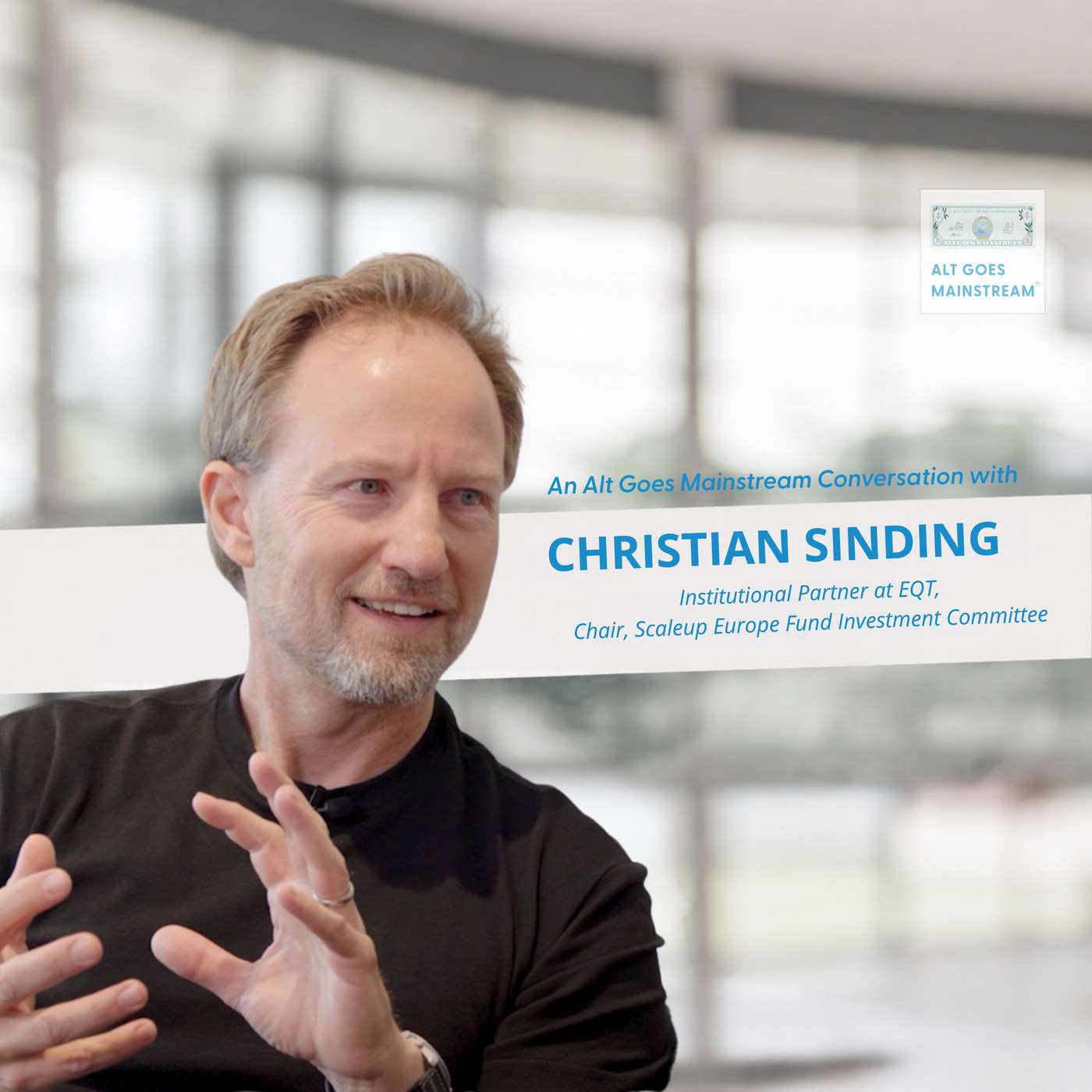
Christian Sinding (former EQT CEO) explains EQT’s “inspire change” culture, its governance tools (Full Potential Plans and the Troika model), and why Europe can produce “trillion euro” companies. He then details EQT’s Scale Up Europe Fund, a EU-backed growth fund meant to fund Europe’s fastest-scaling tech and help them go global.
Christian Sinding, former CEO of EQT; now institutional partner and chair of the EQT Council. He previously lived and studied in the US (UVA) and worked in investment banking/private equity. Also appearing: Neo, a humanoid robot from 1X Technologies, described as 168 cm tall, 30 kg, with a 2–4 hour battery life.
Europe has many deep-tech research outputs but too few public $10B+ companies (14 in Europe vs 241 in the US over 50 years). Scale-up success requires speed, capital, industrial/offtake networks, and governance alignment. EQT aims to “reignite IPOs” and outperform peers post-IPO.
Tognum (industrial tech; 25% of revenues invested in R&D in year one). Gulderma (Nestlé carve-out; Troika governance; strong post-IPO performance). Lovable (Swedish founder; aims to be first trillion-euro company; >€10B value; >$500M ARR). ISAI (satellite surveillance; first Scale Up Europe investment). 1X Technologies and Everok (sovereign AI/hyperscaler theme).
Written by AI. May contain mistakes.
Explore the unique challenges and opportunities of company creation in Europe.
“This is actually a unique moment in time.”
Discusses Christian's upbringing and the impact of Nordic culture on tech innovation.
“Christian, welcome to the Altco's Mainstream Podcast.”
Understanding EQT's unique culture and long-term investment philosophy.
“You have built an international firm rooted in Europe, locals with locals, but also global.”
Exploring EQT's approach to inspiring rather than forcing change in companies.
“hopefully we have taken a company that was maybe a silver medalist or a bronze medalist and turned it into a gold medalist and maybe even something which is beyond that into even higher value.”
Understanding how the Troika model facilitates effective governance and decision-making.
“One place where my mind when you talk about that slightly different concept, but similar framework is part of what you do is you have the Troika model.”
Analyzing the factors that contribute to continued company success after IPO.
“because the real decisions are taken out of the board and executed by management, but the Troika makes sure that the right questions are asked.”
Learn about EQT's strategic approach to taking companies public and maintaining performance.
“What are the ingredients that make that possible?”
Explore how EQT adapts its strategies to changing market conditions and growth opportunities.
“So when I listen to you share perspectives on full potential plan, what it takes to build a company that can go public, I can't help but actually think about EQT itself.”
Discover EQT's focus on venture and growth capital in emerging industries like space and AI.
“As you thought about expanding the business of EQT, why add something like venture and growth?”
Unpack the reasons behind Europe becoming a prime investment region amid geopolitical changes.
“you know, software has been the most popular sector for the last 10 to 15 years, because it's been relatively easy to understand and easy to create value in.”
Explore why Europe is becoming an attractive region for investment.
“So what does Europe have in your mind to make this a really attractive region to invest in and can build massive companies, the trillion euro companies?”
Understanding the need for a European stock exchange for growth companies.
“What would it look like to have a different type of stock exchange and what has to happen for that to be realized?”
Identify what reforms Europe needs to support a trillion-euro company.
“It's one of the fastest growing companies in the world.”
Learn about the Scale Up Europe Fund and its impact on growth companies.
“That's a great segue to if you think about something you said a year ago a little over a year ago here at the U.S.”
Discuss how European founders perceive and interact with investors.
“But you don't just want to be another growth fund.”
Discussion on the geopolitical aspects of investing, the role of different capital sources, and the ambition behind the Scale-Up Europe fund.
“Is there a geopolitical element to this that's worth unpacking a bit?”
Delving into the 'why not' mindset that encourages innovation and growth in European companies.
“I love that conversation and the way of thinking.”
An interactive demonstration with Neo, highlighting its functions and potential in everyday tasks.
“I can help around the home, answer questions, and perform various tasks.”

Get the gist, explore an idea or ask about something said.
 Claude
On Alt Goes Mainstream: The Latest on Alternative Investments, WealthTech, & Private Markets, what are the key points of this episode?
Searching your listeningAutomatic transcript. May contain errors.
0:00Neo's like Peter Crouch. He's got the little robot there. Fist bump. Nice. This is actually a unique moment in time. If you look at the last 50 years, in Europe, there's only 14 companies that have been created that are public that are worth more than$10 billion. In the US, it's 241. It's the yes, but type of person, where you kind of see the opportunity, but for some reason you can't go after it. And then it's the, that's going to be hard, but why not? Let's go for it. One company we're invested in is called Lovable, which is a wonderful brand, by the way, isn't it? The founder's vision there, he's Swedish, his vision is to become the first trillion euro company.
0:41Welcome back to the Alt Goes Mainstream podcast. We were live from Oslo, Norway, for a very special conversation with Christian Sinding, the former CEO of one of the industry's leading alternative asset managers, EQT. He's now focused on another ambitious project, the Scale Up Europe Fund, a fund that EQT is managing and has support from the EU to invest in Europe's most ambitious and promising technology companies. With One X Technologies Neo-Humanoid Robot joining us for part of the conversation, Christian and I had a fascinating discussion about the evolution of EQT and alternative asset management, what Europe needs to fund the future, what it will take to create the trillion euro company, the what, why, and how behind EQT's Scale-Up Europe fund, Why EQT's Scale Up Europe Fund invested in ISA and Lovable.
1:25Why EQT invested in 1x Technologies. And Christian's Why Not Attitude. Thanks, Christian, for such an interesting and fascinating conversation. We hope you enjoy.
1:34Christian Sinding: We're going mainstream. This episode of Alt Goes Mainstream is brought to you by Ultimis, the full-service fund administrator and transfer agent powering asset managers in private and public markets. As Alt Go Mainstream, we need real expertise to handle complex fund structures connect with key distribution partners, and handle sophisticated compliance, reporting, and transparency demands. That's Altimus. High-tech, high-touch solutions for over 450 clients and 2 ,500 funds with over$775 billion in assets under administration. Backed by an expert team of over 1 ,200 employees, they place client service at the core of their business, helping you navigate complexity during your fund structuring or launch, and then supporting you through every stage of growth.
2:18Whether you're already in the market or thinking about entering private wealth, you can trust their team's deep expertise in retail alternatives to help you reach your goals. Learn more at ultimisfundsolutions.com or email info at ultimisfundsolutions.com. Christian, welcome to the Altco's Mainstream Podcast. Thank you, Michael. Pleasure to be here. We are in your hometown of Oslo, which has a meaning in a number of different ways that I think are relevant to both your background, EQT, a company that we'll see a bit of today, 1X Technologies. So, would love to start there. What about your upbringing, Nordic heritage, background living in Oslo has kind of given you a perspective on European company building technology?
3:12Great question. And it's fun to be here in Oslo, especially with a tech company that we'll talk a little bit about later. I think Scandinavia has a pretty unique place in the world. We're relatively small countries and we are therefore, have always been actually, looking out into the world. So even from the Viking times, there was always a need to go out in the world to trade and to meet other people and to learn from others. And over time, that's created a society that's quite egalitarian, very open, relatively non-hierarchical, and is a place where you can really bring your ideas forward in a positive way.
3:51So that's why in Europe you see a lot of innovation coming from this region. We like to say that we have small mouth and big ears. Since we're not a superpower in any way, we have to understand how to interact with other people and how to create interest at other levels. So I think I bring that with me and that I was lucky to live in the U.S. when I grew up and also went to college, went to UVA, the comm school, started my career there in investment banking and private equity. And of course, what the U.S. has obviously is superpower, but outside of that is an incredible sort of founder's mentality to create something new.
4:27I think for me and actually also for EQT, we kind of try to bring those two things together. And that's shown over time to be a great model for developing companies, actually. I think that's a great foundation for a lot of what we'll discuss today because you have the Scale Up Europe Fund. Yeah. You have built an international firm rooted in Europe, locals with locals, but also global. You have big presence in the US, you have big presence in Asia with BPEA that you bought a few years ago as well. So I think there's a lot to unpack as it relates to kind of what the best of both worlds bring together, particularly as it relates to how do you build the trillion euro company.
5:10So first though, I think we have to rewind the tape a little bit and go back to EQT. We're formerly CEO. You've since moved into institutional partner and chair the EQT council. But what about the culture of EQT? Really want to get to the bottom of it. I think that that will inform so much of the scale up Europe fund, how you build companies here. So what about EQT's culture and DNA makes it so different? Yeah, it's an important question. We were founded back in 1994, coming from the Wallenberg group of companies. And the Wallenbergs have been investors and developers of companies since 1856, actually, and are super, super long term.
5:51And the idea behind EQT in 94, when private equity was actually very financial, it was all about leveraged buyouts and high yield bonds and all that kind of stuff. The idea was actually to take this super long-term ownership philosophy, adding value to global businesses, and bring that into the private equity world, simply to be the best owner of companies. So when I joined back in 1998 as employee number 11, coming from the U.S., I brought some financial skills and some skills around that industry, which was already pretty large in the US. But EQT and the foundations of EQT were all about finding really good companies and figuring out how do we accelerate them?
6:36How do we build them? How do we make them more international, more successful? Really a growth mindset. And I think that actually has helped lift private equity. And if you look at what's in the press right now around private equity, it's really back to basics. How do you create value? It is by developing the businesses in the best possible way. So EQT, what we try to do is when we work with our companies, where we work through the boards, we try to have really good governance. We're very active owners, but what we want to do is to help the companies excel in their own right. So we don't send our people in to tell people what to do.
7:13We try to recruit the absolute best board that's suited for that business. Specialists from whatever industry, whether it's healthcare or technology or services, that board challenges, mentors, the management team. And the management team is then, of course, responsible for executing on the strategy and building the companies. And if the management team isn't able to do that, then we will, of course, change the management team, change the CEO, drive that change together with the board. But when our ownership period is over, hopefully we have taken a company that was maybe a silver medalist or a bronze medalist and turned it into a gold medalist and maybe even something which is beyond that into even higher value.
7:58That comes a little bit back to the growth mindset, but it also comes back to one big difference between EQT and many other private equity firms is that we don't think of ourselves as controlling and telling people what to do and, let's say, forcing change. change, we want to inspire change. And I think that's a mentality difference, which is maybe hard to see from the outside, but that's why a lot of our companies outperform over time. If you could unpack that a little bit more, what does that look like in practice in terms of inspiring change, but not necessarily forcing it? Yep. So the easiest example is our full potential plans.
8:40So when we buy a company, you do due diligence, you do lots of analysis, you have a plan that's probably there from before. EQT makes a plan and then you buy the company. And oftentimes private equity just then starts to work. Okay, we'll follow the plan that the private equity firm made and then hopefully that will go well. And you have lots of tools and resources around executing. But we actually, as soon as we sign the deal to buy the company, we actually take a step back and say, okay, now we're partnering with the board, with the management, and all the resources that EQT has from globalization of companies, digitalization, sustainability, whatever the themes may be that are important for the business.
9:21And then we say, if we had all the resources in the world for the next five years, what would we do with this company? And then we bring that into a vision, and then we pull that vision back to today. What actions do we need to take today to reach as far as we can on that full potential. And that's what I mean by the mentality. And a lot of times that means quite a lot of change. It means augmenting the management team, it might mean M &A, it might mean a lot of R &D. So one of our most successful investments ever, it actually was in Germany some years ago in an industrial tech company. And in the first year we invested, I think, 25 % of revenues in R &D so that we could really bring forth a whole new product range and do that very quickly.
10:06And that ended up being a super, super successful deal called Tognum. So this full potential plan is something that changes the mindset. And it also creates an important alignment between us as the owners, the private equity firm and our investors, the board and the management. And then we very often bring the employees in as owners as well in some form. So you get a super alignment between all the different governance elements of the company. So if you have a great vision, you make that vision into a very credible plan with the resources you need, and then you have full alignment. Those three things come together to really deliver.
10:42One place where my mind when you talk about that slightly different concept, but similar framework is part of what you do is you have the Troika model. Yeah. And you also have an industry council, I think 600 industry experts across different industries, specialities that you can bring into companies. How does the Troika model work in practice and how does it help you create value? Yeah. Great question. A recent company that we acquired a few years ago from Nestle and then took public, and we just finished our sell-down from the public markets, is a company called Gullderma, which we bought out of Nestle in a very competitive auction.
11:24And we applied basically the full model to that. And governance was a key part of it because when you're buying a unit out of a large corporate, of course, the governance systems, the decision-making, the IT systems, everything is set up in a totally different way. When an independent company you get a different amount of freedom. So the Troika there was actually a CEO who came from the outside, who had run Shire before. And then the chair had been an executive across many different industries including also Pharma. And then the EQT partner was Swiss, Swiss company and a healthcare expert. So the three of them in the Troika basically have weekly meetings to talk about every dimension of developing the business, whether it's people, strategy, execution, financing, M &A.
12:13You could go even a little bit deeper, working capital, problems, challenges, lawsuits if there are, patent challenges, or whatever the themes may be. And it really becomes a tool for the CEO where the CEO can get input from the chair and the owner. And then when you then come to the board meeting, a lot of the basic questions have been ironed out. So you come to the board meeting, you can actually then take real decisions quickly. In many other private equity firms, the board meetings are for reporting. But we get the reporting directly from the companies. It's all automated, all digitized. So all of our board members, the deal team, everybody, everybody has the same information.
12:54So reporting is basically history, right? When you get to the board meeting, you want to talk about the future. You'll want to talk about, okay, how do we actually accelerate revenues? How do we, in this case, that we needed to develop a whole new set of prescription drugs for skin health as a skin health company? How do we accelerate that process? How do we bring more products into that product suite? Do we do M &A? Do we do it all ourselves? Do we partner with other firms, et cetera? The Troika actually is like oil in the machinery, which helps drive this change in a faster way without actually disturbing the governance because the real decisions are taken out of the board and executed by management, but the Troika makes sure that the right questions are asked.
13:35It's a good one. How do you create that foundation for success even after you're the owner? So what I mean by that is you put a paper out a little over a year ago about looking back at the, I think it was the 26 companies, 26 companies you take in public, and three years after they've been public, think the performance was 21 % above the IPO price. Average EBITDA growth was 33 % greater than its peers. What are the ingredients that make that possible? Because it's not just when you're the owner. These companies still become successful after they continue on to the next phase of their journey in public markets.
14:18The Goldarmer example is actually the perfect one because we outperformed every other company in that industry during the time after we took it public. And I think the secret sauce there is pretty simple. We only want to take public companies which we truly believe are going to perform. So again, pulling that back into this full potential plan, when we go public, we build a new full potential plan. We ask the same question. So, of course, the governance is different in the public markets. By then, of course, all the reporting, all the elements of being a public company have to be in place. But we kind of put ourselves in the shoes of the investors in the company again and say, what price should we list this at so that we believe that the performance of the company and the stock price match and so that the journey for all shareholders will be positive.
15:14It's kind of a simple model, but of course very difficult to do. Nobody can predict the future, but we try to do our best to choose the right companies, the right management team, the right pricing, the right stock exchange, the right equity story, and really continue to back the companies. And actually, even after we've sold out, the companies continue to perform better than their industry peers. And that's something we're really proud of. And if you think about private equity, we're now a huge industry, right? So we've become a business of developing businesses. So if EQT can create a reputation where when you buy a company from EQT, whether in the public markets, in the IPO, or in the private markets, and those companies perform, everything else equal, people will then appreciate buying from EQT.
16:02And we're buying and selling probably 30, 40 companies a year. actually in 2024 and 2025, we were the most active private equity firm in the world in the capital markets. Isn't that amazing? Why? And what about the current market structure of 24, 25 made you say, you know what, we want to make sure we are exiting businesses and this is the right time to exit? There are many dimensions to it, but if you look at the last cycle of 10 years plus, it was very easy in private equity. Interest rates were falling, multiples were going up, there was a lot of activity in the private markets, private equity firms were growing.
16:37So there was a lot of secondary buyouts and pretty, probably a little bit too easy. We realized as that cycle was starting to come to an end after the pandemic and with interest rate rising, et cetera, that many people had ignored the public markets for a while. And it's hard to take companies public because of these things that we just talked about, right? You have to have the right management, the right systems, the right equity story, the right timing, the right pricing, all those questions. And it takes time to exit. It takes probably three years to fully exit a public company. And during that time, stock prices moved with geopolitical questions and all that kind of stuff.
17:12So the private equity world had kind of ignored the public markets for a while and said, hey, you know, the public markets aren't that important. We actually took a specific decision to reignite IPOs at EQT. The guy actually who led that effort is here in Oslo. His name is Magnus. and he's head of our capital markets for equities. And we've created a playbook then for how do you prepare to become a public company? And it starts years before we go public. So we decided to do that. We executed well. Galdemar was one of those. So we took a number of companies public around the world and we have a pretty sophisticated program to sell down as well.
17:51So therefore, we were the most active 24 and 25 in combination of IPOs and sell downs of any private equity firm in the world. And that I think is also another sign of proof that investors are willing to buy shares from companies that EQT has owned. So when I listen to you share perspectives on full potential plan, what it takes to build a company that can go public, I can't help but actually think about EQT itself. You were most recently the CEO. What was the full potential plan for EQT? as you thought about building the business of UKT? Well, we've had many rounds of that, of course, over the years.
18:35But I remember back in 2013 when Thomas was the CEO, my predecessor, we had a plan of having$20 billion in AUM in 2020. And in 2020, we were at 40, I think, and maybe even 50 because we were already public at the time. So we were probably two and a half times our own full potential plan. So that was amazing. And then when we went public, we created a plan that was fairly ambitious, actually. And it was a combination of organic growth and some smaller acquisitions. And I think what we were able to do is, since we were well prepared when we went public, we were actually able to grow faster organically.
19:18So we started some new funds, including growth in a number of areas. We expanded our infrastructure business line quite a lot. and we expanded our real estate business. We did some really interesting combinations with other firms, one in real estate, which was medium size, has gone quite well. The big one you mentioned already, BPA, was an amazing combination with Jean Salata, who's now chair of EQT. And I'd say we were, with the resources and the platform we had, we were able to both grow faster in organic terms, in acquisition terms, while at the same time performing for our clients. And that's another theme in private equity where we like to say that we're performance chasers rather than AUM chasers.
20:03Of course, AUM is something that you measure in terms of size, but our clients don't really care about AUM. What they care about is our returns. So that's still very much at the core of EQT, keeping that performance really sharp. And Pear, who's now CEO, is a big performance chaser, which I like. How do you balance those two things? Because the industry market structure is changing. The business of asset management is changing. So how do you think about balancing being a public company and performing for your shareholders while also performing for your investors? That's the easiest question. Why do you buy Apple products?
20:39They're great products. There you go. Yeah. Would you buy Apple products if they weren't? No. No. And what would happen to the stock price? Go down. There you go. So it's the same with us. If we don't deliver for our clients, at the end of the day, that's not going to be good for EQT and then it won't be good for the shareholders. So we always put our clients first. How do you think about the evolution of EQT's business? Because as you get bigger, and I want to specifically talk about venture and growth, the business that you started in 2016, because that will get to a lot of why the scale up fund and all the aspects around growth investing in Europe.
21:15As you thought about expanding the business of EQT, why add something like venture and growth? I think it's a very important strategic resource for EQT. The reason is that what venture capital is doing and also what growth is doing is we're looking into the future and saying, what are going to be the most important industries of the future? Which founders, which industries, which companies are going to be the ones that are going to be impacting the world? and of course understanding that in our later state strategies whether it's infrastructure or private equity or real estate is actually pretty important because you're kind of forced to think much longer term about changing societies.
21:59So if you look at the current themes today, space for example is a big one. All right and we started investing in space and ventures years ago so we have the exploration company which is a kind of European SpaceX or space shuttle. We now this year bought a company in Germany that's in private equity, which is a launch services company. So everything you need to launch a rocket other than the rocket itself is what they kind of provide. And in the Scale-Up Europe Fund, the first investment we've done is ISAI, which is the world-leading satellite surveillance company. And now valued at 10 billion euros, an amazing business, an amazing founder.
22:38and in infrastructure, we own satellite base stations. So if you look across EQT, the fact that we started looking at space very early in EQT Ventures means that we can draw that competence and that theme into all of our strategies. So that's really the benefit of it. Of course, it's a bit challenging because it means that you're multidimensional on how you invest. It's very different to back a founder for a new idea and not all ideas win. But then as you get to growth, when it starts to scale, then you're starting to see which business models are winning. How do we back them? And then, of course, in private equity and other strategies, then they're more scaled.
23:17And we can use that kind of mentality from these newer, younger companies and those strategies. Then you can turn it around. If you ask the companies that we work with in the early stage, we're very active owners also there. We bring a lot of resources with our industrial network, with the Wallenberg network in offtake programs or mentoring programs or just good governance for actually taking companies public. We have a lot of competence that we can then pull back into the early stage. So that's something we're continuously doing. How do we get the most out of this platform? I think that's a really interesting dimension through which to look at both venture and growth and private equity.
23:55So there's now a shift to investing in, quote unquote, hard industries. So things like defense, AI, robotics, that combines both hard hardware, software, in many cases, there's a capital requirement needed for a lot of these companies over time. Everok is another good example in your portfolio, right? You did that out of EQT Ventures. We're trying to build a European hyperscaler effectively. That was sovereign AI client. Right? And I think they'd said a year or two after you invested in the venture side, they need$2 to$3 billion worth of capital. Where is that going to come from? That's probably going to come from growth.
24:33Maybe it's going to come from private equity, but you need a scaled platform and firm to be able to do that. How do you think this era of both venture and private equity, if there is a focus on more quote unquote hard industries, the requirements of what an investment platform can bring will be different. Yeah, the world is changing faster than people think. And for a long time, the private markets have been investing in companies with a small asset base, high cash flows, stable revenues, you know, software has been the most popular sector for the last 10 to 15 years, because it's been relatively easy to understand and easy to create value in.
25:16It's a lot harder when you come to hardware. So we've actually created a playbook called the scale-up brick, which is a playbook for founders, both in the startup phase, but also in the growth phase on what are the components that you need to be able to succeed. You need, obviously, customers, you need the technology itself, you need a lot of capital, you need offtake programs with bigger industrial companies from the sector or governments or whatever you're selling to, and many other elements. And so we've created this playbook so we can help companies actually accelerate within that field. And we're applying that to 1x that we saw here in the beginning of the show, and we'll talk more about later maybe, and Everok and others.
26:02I think what you see in private equity as well is that we're going to go back to doing more industrial tech investing. So around robotics, automation, space, defense, tech. And that's actually quite exciting. and private equity in the kind of good old days was actually investing a lot in those fields. This also means that capital structures will change because the cash flows are changing. You need to have equity capital and debt capital that's flexible enough to drive growth and invest in the future. So it's actually a multidimensional and it comes a little bit back to the competencies that we've tried to build the DQT so we can actually really take advantage of this.
26:38So I think that brings up a really interesting question around who are companies going to partner with going forward? So this is certainly a trend we see on the LP side where LPs want to do more with less GPs. What about just as you described that a company is going to need different types of capital, different stages of the journey. Are companies going to do more with less on the capital partner side with GPs that they work with? I think you'll find companies that are partnering with private equity firms all the way from ventures through growth into the private equity world or even into the infrastructure world on the real estate side.
27:15And of course, there's a big private credit element as well. That's not something EQT focuses on. We think that's a more of a more commoditized financing type of business. Everything that we do has to do with owning and developing companies. So it's a different, again, back to a different mentality, a different way to work. All of them are important because we use a lot of debt in our structures, but really to facilitate growth and development of companies. So it all comes back to that same question, actually. I think the point of development of companies, really important to unpack as it relates to Europe.
27:48So Europe is a really interesting place to invest right now for a number of reasons. There's also geopolitical elements to this that you mentioned a bit. I want to unpack a little bit more. why Europe and why now? So what does Europe have in your mind to make this a really attractive region to invest in and can build massive companies, the trillion euro companies? Yes, there you go. We'll talk about it. Yes, yes. So I'd love for you to unpack where Europe is today and what it looks like. Yeah, this is actually a unique moment in time. If you start with the geopolitical pressures, Of course, you have the US, China, the two big behemoths in the world, and you kind of have Europe right in between.
28:34And over these past five years or so, I think Europe's woken up to the fact that we need to drive more innovation in our whole continent here. We need to help companies develop faster and better. We need to develop more companies. And this is not something that's just in the business world. It's actually something that's been realized in the political world as well. So starting with the Mario Draghi report, which came out about two years ago, which was really a manifesto about what are the changes that we need in the European society as a whole to help create more companies, more jobs, more value, more innovation for everyone.
29:12That, I think, got a lot of following, both in the political world and in the business world. And then you have some of the pressures that the Trump administration has put on Europe, actually in terms of trade, in terms of tariffs, in terms of building our own defense, whatever the themes may be. All these external pressures and internal pressures have now created a unique environment for investors, actually, in Europe. So right now, if you look at Europe, there are more research papers written in Europe than any other continent in the world every year. So we're super innovative in deep tech, in software, in fintech, in defense, in space, all different kinds of sectors.
29:53But actually starting with patents, slightly fewer patents, slightly fewer new companies, slightly fewer growth companies, and then ultimately fewer big public companies. The reason that this is all changing now is people have realized that, hey, we're not getting the full potential out of E.K.T. Well, there you go. Out of Europe and a little Freudian slip there. If you look at the last 50 years, in Europe, there's only 14 companies that have been created that are public, newly created that are public, that are worth more than$10 billion. In the U.S. at the same time, E.K.T. is one of them. Four of them are Swedish.
30:30back to this innovative nature of this region of Europe. In the US, it's 241, and the scales are so much bigger. And we have the same size, relatively similar size economies, relatively similar size of population. So the potential for Europe is actually massive, and now the conditions are there. So the politicians are now driving lots of reforms. It makes it easier to start companies, to incentivize people, to move talent around, and also bringing capital to private companies. and ultimately, hopefully, also creating even bigger stock exchanges so we can list these trillion euro companies. Unpack that a little bit more.
31:08What would it look like to have a different type of stock exchange and what has to happen for that to be realized? I think there are companies now that are accelerating super, super fast. and over the last 20 years or so, the mentality has been, well, if I have a super fast growing company, I should list it in the US because that's the biggest stock market and the most liquid stock market in the world. That mentality is now changing to say, hey, you know what? We have the capital in Europe. We actually have the companies in Europe. We have the talent in Europe. Why don't we list these businesses here in Europe?
31:47It is possible on a local exchange. Some of them are quite big. NASDAQ is there in a number of places, including Stockholm where EQT is listed. But we have a dream actually to create a European stock exchange where you could have a NASDAQ for Europe or whatever the brand may be, where we can create a lot more liquidity and where investors all over the world can access those shares even more easily. And you have a couple of companies that are worth almost half a trillion now, Arm and NASML, UK and Netherlands respectively. So we're kind of on our way. and there's a lot of discussions on how do we break down the barriers between all these different countries to make it easier to list.
32:25There's one dimension which is kind of maybe hard to explain. That's a mentality dimension. I think in the past, again, they're looking backwards. I think Europe has been satisfied to have a local winner or a regional winner or maybe a European winner. And then we're like, oh, this has been so successful. We're very happy. We're doing well. and then you're kind of, yeah, satisfied. That's changing now. Now when you talk to founders, which we are in the Scale-Up Europe Fund that we'll talk about in a minute, surely, the founders are saying, we want to win globally. We want to be based in Europe.
33:05We want to scale in Europe, but we want to be absolute global winners in our industry. And those are the kinds of companies that we're looking to back. And that type of mentality, that type of language hasn't really been there for a while. It's really cool. And I just have a funny little factoid. Sometimes when you look at Europe, the press always likes to talk about the negatives. For example, the automotive industry. But the automotive industry is less than 1 % of the market cap of European stock exchanges. So it's absolutely irrelevant. What's relevant are the future businesses, and they're the ones we're building.
33:36What has to change about the mentality or what is different about founders' mentality today in Europe that makes them have that global and like we're going to be the first place winner ambition? It's the deglobalization trend, which I actually don't think is real, but maybe there's a mentality around it. these geopolitical pressures. We have wars not far from the borders of Europe, actually, and we have the trade tensions. And we have, I think, a need for, after the pandemic, also to make sure that you have resources close to you physically, back to the physical world. Because if you're dependent on medicines from India or China, and there's a new pandemic, and you can't export and import and move people around, that problem.
34:25So there are a lot of different forces that are bringing people saying, hey, you know what? We can do this from where we live and where we exist. And the mentality has come, I think, from some of these pressures and I think some of the potential since we have all this amazing research that I talked about. One company we're invested in is called Lovable, which is a wonderful brand, by the way, isn't it? And the founder's vision there, he's Swedish, his vision is to become the first trillion euro company. Today, they're already worth, you know, 13.3. Yeah, more than 10. Thanks a lot. You saw it.
34:56Yeah, more than 10 billion euros. And it's three years old. It's one of the fastest growing companies in the world. They have more than$500 million of ARR already. So it's already been one of the biggest software companies in the world in terms of ARR. And the idea is actually to be a partner for founders, a partner for corporates, and for lovable to produce any type of software that any executive needs in any industry in the world. So it's a massive vision. They're performing on it, and if they deliver, it will be a trillion euro company. What do you think Europe still needs to build in order to be able for a company like Lovable to realize that vision?
35:32We actually need to drive through these reforms of the politicians we're talking about, the Draghi Report. So there's something called EU Inc., which is a play on the Delaware company. And yesterday, if you were to start a business in Europe, you'd have to have 26 different countries or 27 different countries or companies in 27 different countries, and they all have different rules and regulations. It's just a pain. With EU Inc., you can have one company. You can start it overnight. It's digital. It's 1 ,000 euros. So it's super, super easy. So as a founder, you can start an EU company, deliver in all the European countries, and of course, the world as well.
36:07That's happening as we speak. We need capital markets reforms. We need to make it easier to move capital around, to move shareholdings around, options around, all these kinds of things, aligning tax structures, making it again easier for companies to grow and scale across a big region. And then we also need some capital markets reforms. If you look at the US, I think around 31 % of savings is actually invested in the stock market. In Europe, it's 13%. So they have 20 % of all capital owned by all individuals in the region which are today not being put to productive use I guess you could say at least not directly in Europe and that also will bring a lot more capital to the stock exchanges or to private companies and then again lift those companies up you don't need to go to the US if the capital is here.
36:56That's a great segue to if you think about something you said a year ago a little over a year ago here at the U.S. Bank, that's a management conference, you're on a panel with Sir Christopher Hahn, DCI and you said something I think that was really important for people to understand about the current state of private markets is that market structure is changing. Private companies are staying private longer. If that's the case, then there needs to be capital to support that. And I think that's a great segue to the scale up Europe fund because there needs to be a lot of capital to support all of these companies that may stay private longer.
37:30If you've got to build a trillion euro company, there was one trillion plus company in the US that just went public, but it realized all that value in private markets, SpaceX. There There may be a few more on the way. There are. Anthropic, opening high, maybe a few others. So how does the Scale Up Europe Fund factor into all this and what is it? Yeah. So the Scale Up Europe Fund is a unique public-private partnership, actually, which I think is amazing. It was started by the European Commission, which is basically the management team of the European Union, if we're talking business terms. and they partnered with a number of large institutions like the Nova Foundation from Denmark or a Nova company from Denmark and other institutions and families around Europe and they created a competition to manage a fund called Scalp Europe Fund to invest in the absolute best growth companies in Europe and help them scale to become global winners.
38:27and EQT won that competition. I think we brought all the resources that we've been talking about in this conversation and more. We also have offices all around Europe in addition to what I talked about. So we also have the physical resources to help companies, also find the best companies. And we brought all that together. We won that mandate just a few months ago. I'm the chairman of the investment committee, which is really exciting, working with a great team, amazing team of now a little over 30 people. We're going to grow to more than 50. The idea is to not just bring capital to these companies, but also a lot of competence.
39:01The elements we talked about with industrial partnerships, offtake programs, mentoring programs, helping companies grow out into the world, helping them go public, et cetera. And so we're partnering with the best founders. We've already done several investments. The first one has been announced called ISAI that I mentioned earlier. And there's more in the pipeline. And actually, the pipeline is even better than we thought. So we have more than 1 ,000 companies in our target list. We have active dialogues with 200. And we're going to do 30, 40 investments in these companies. We're really trying to find the best ones we can.
39:32There's plenty of growth capital out there in the world. Obviously, the U.S. has more of it than Europe. And it's a trend we've all been seeing in the venture and growth world that the European early stage VCs may be doing the deals at early rounds. But then U.S. growth investors coming in and investing in European companies at growth stage. the scale-up fund is meant to fix that in a sense where there's now large-scale European capital providers at growth stage for some of these companies. But you don't just want to be another growth fund. What is different about the scale-up fund than just another growth fund?
40:10Well, first of all, it's going to be the biggest growth fund in Europe, one of the biggest in the world. We have a target of$5 billion. Hopefully, it'll be a little bit larger than that in the first round. The next wave, what we've talked with our sponsors about is moving towards 20 billion and then hopefully beyond. And this is euros, so well over$20 billion in that case. And so it's going to have scale. I think more importantly, it's going to be able to lead growth rounds. If you look at the last 10 years, 80 % of all growth rounds have been led by American investors, some by Asians, and then a tiny little portion by Europeans.
40:45And that's not just because of capital, There's some capital here, but that capital hasn't had the scale. And again, back to mentality, hasn't really had the mentality of moving quickly enough. So speed is another element. So if you talk to a European founder, and I talk to a lot of them now, what they ask us, and now they see it in action, what they ask us is, how will you compete and why will you win? And the reason we will win is that we have all these elements that we can bring to the table, including capital, but we also can act super fast. And those two elements the Americans have had for longer.
41:24And it comes back to this mentality question as well. So we have the right mentality, we have all the right resources, and we have the speed to execute. So I think that's absolutely unique. And we're seeing it already now that we are, you know, in every round, we're now talking with founders about we are one of the co-leads, one of the ones that are helping the founders and working with them to build the best companies. You were the co-lead in IceEye, General Atlantic. You're the co-lead in Lovable with Menlo. That's right. How do you think founders think about having a European investor? Do these European founders want a European investor?
42:00Is there a geopolitical element to this that's worth unpacking a bit? Or is it you're one of the investors and you'll have U.S. growth investors, you'll have other international growth investors? Of course, every company is different and every founder is different and every culture of a company is different. But if we didn't have all those capabilities I talked about and we didn't have the speed and we only had capital, we'd be in zero co-leads. We might be able to invest in the company if we're lucky, but you have to be the best. Otherwise the founders don't want to work with you. So this is not about subsidies.
42:38It's not about geopolitics in and of itself. I think the founders really appreciate that they can have capital from different sources, that there's a capital provider in Europe like us. They're Americans and they're also Asian and other sources of capital from around the world. We're bringing one to the table, which has all the features that founders are looking for. And that's how it's designed, really. What does success look like? What's the ambition for the scale-up fund? Well, success is to help create the first trillion euro company. I think that's the easiest example. But that's maybe just an example.
43:18I think much more important is that we're systemically able to invest with the best founders and the best companies, bring value to them, bring capital to them, bring networks and all these other capabilities that they're looking for. and then of course create superior returns for the investors. I mean, at the end of that, that's what we talked about earlier, right? Why does EQT exist? Well, we exist to create returns for savers and pensioners and institutions all around the world. So that's super important. And they, of course, hang together. If you're investing in the best companies and help them develop in a great way, then that should create really good returns over time.
43:54That's of course gonna be the ultimate, called a financial test, whether this is successful. And then scale, you know, we really want to scale this into being the biggest fund of this type in the world. And to do that, all those capabilities and returns, et cetera, need to come together. And we know we're also going to need to raise capital for it continuously. You mentioned scale. And while the fund's intent is to invest in the best companies and generate the best possible returns, there's also a catalytic element to it. What do you think that something like the Scale-Up Europe fund can catalyze in terms of other capital flows or capital formation into European companies?
44:35Yes. Well, hopefully it'll inspire also other growth funds. We hope that we can use the momentum of this fund to actually impact some of the regulatory changes that I talked about. We hope that, and we're in dialogues with large corporates, to not just bring offtake programs, et cetera, to the companies, but also capital from them, whether that's working capital or CapEx or development capital, whatever the companies might need to develop new technologies. Crowding in more the other forms of capital, whether it's debt capital or hybrid capital, whatever it may be. So really being this accelerator of change in Europe and hopefully starting this, getting a really fantastic flywheel going.
45:19And I think you've seen that in Sweden. Sweden has created actually more unicorns per capita than any other country in the world, which is pretty amazing. Four of the top 14 companies that I mentioned are from Sweden. And of course, Silicon Valley has this amazing flywheel. Those are maybe the two most successful in the world, Silicon Valley and Sweden. And we're Swedish. I'm Norwegian, but you can do Swedish. So we, of course, want to take all those capabilities and bring that in all of Europe. You mentioned Silicon Valley, and we'll get to this in a minute, too. because 1X Technologies, one of your companies, they started here, they have roots here, but they're also in Silicon Valley.
45:55There's an element of Silicon Valley that I think New York has in the finance context as well, which is the network density. One, it has it too. How do you create the network density in Europe that Silicon Valley has? And how important is that? Or is it okay if it's a bit distributed? Because you have a local with locals model. And there's the difference in cultures, but the size and scale of Europe is also one of its strengths. You know, if you look at Google, it did some amazing research a few years ago on how to create the best performing teams in the world in any situation. And the clear answer was diversity of thought.
46:29So, of course, when you bring people from different cultures and different backgrounds together, and now with technology, it's so much easier than it was 20, 30 years ago. It gives itself. So I think it's almost like a hub and spoke type of structure. I think the power of Europe now can really rise. I think that that gets to something else I want to touch on. You mentioned the word why a few minutes ago, but in a podcast you did with Moonfair's Stefan Pauls, you talked about why not. Yes. Why not mentality. I love that conversation and the way of thinking. What do you mean by why not? And what should European companies why not be?
47:14There are kind of two types of people in the world. It's the yes, but type of person, where you kind of see the opportunity, but it's just for some reason you can't go after it. And then it's the, that's going to be hard, but why not? Let's go for it. And that's the kind of mentality we're looking for, you know, that founder mentality, growth mentality, whatever you want to call it in the modern language. And we're really looking for that type of person and that type of founder and those types of people. And I think we're seeing that now in Europe, not just in the business world and in the founder world, but also with the politicians.
47:50So I think it's kind of an inspirational way to think. And something that I try to do too, that when something is difficult, then, you know, let's go after it. What's your why not today? Today is, it's really about the scale-up Europe fund. And the challenge and the opportunity is, as you heard, there's a lot of change that's happening in Europe now, but it actually does need to happen. The Scale-Up Europe Fund is super concrete. It exists. We were already well on our way to fundraising to the target. We want to make sure all these other initiatives also come about, even if it is challenging. So I think that's the why not is, yes, why not?
48:31Why can't we create the European Stock Exchange that will have trillion euro companies on it? I think we will. What do you think the why not should be for the private markets industry more broadly? Not falling into the trap of becoming an asset manager. And if I turned it into the why not question, continuing to bring resources to companies to make them the best. It's a lot harder than just to allocate capital, but it's so much more rewarding. I think that's such a great segue to one of your portfolio companies, 1X Technologies. we were telling you about this earlier that like in the beginning it might be a little tough to imagine having a robot in your home or being in a waymo and then you're used to it so i think that's a perfect time to bring in our friend neo it is because why not let's see let's do it what happened yep yep i hear him coming oh here's neo hi neo i'm neo a humanoid robot created by 1x technologies I'm 168 centimeters tall, weigh 30 kilograms, and my battery lasts between two to four hours, depending on the charge level.
49:36I can help around the home, answer questions, and perform various tasks. Anything specific you'd like to know? Can you show us your hands?
49:48Ah, there we go. Yeah, that's pretty amazing. Apparently as dexterous as ours. Yeah. Really? Yeah, 25 degrees of freedom and quite tactile. So you can even pick up a pin now or an egg. Really? A raw egg even. Yeah. So they're going to be in the home. They're going to be in the home. So that they can do tasks. So, hey, Neo, what kind of tasks do you perform in the home? I can do a variety of things. Navigate around spaces, patrol routes, answer questions, check my battery and volume, show gestures, do some fun routines like dances, and respond to commands like changing my posture. I'm here to assist, so let me know what you'd like to try.
50:30Hey, Neo, can you disco?
50:36Here we go, the robot.
50:48Neo, stop. Got it, stopped. Let me know if you'd like me to start again or do something else. Our final question to you is what kind of tasks can you help a human with? I can assist humans in several ways. I can navigate around a space, patrol preset routes, show expressive gestures, play routines like dances, change my posture, check and record my battery and volume levels, answer questions, and provide information or assistance based on what I see. My role is to help make everyday tasks easier and more convenient. What about more specific tasks? Can you do the laundry or help us with dishwashing or rake leaves or what can you do?
51:27Right now, my strengths are in mobility, interaction and information. I don't handle hands-on chores like laundry, dishwashing or yard work. I'm designed to assist rather than replace all household tasks. If there's a task I can help with, just ask. Okay. And a broader question. our route to artificial general intelligence. How will you contribute to that? I'm here to help however I can, providing information, performing tasks with a daily basis, and being a supportive presence. I don't contribute in the sense of a person, but I aim to make things easier and more efficient for you. Fist bump.
52:11Nice. There we go. There we go. That was fun. What a great conversation. Thanks a lot. Thanks. Appreciate it. Thank you, Nia. Should we get a picture with Nia? Yeah, let's do that.
52:23Thanks for listening to this episode of Alt Goes Mainstream. I hope you enjoyed it. You can read more about alts at my substack, altgoesmainstream.substack.com. Thanks a lot and have a great day.
52:35Christian Sinding: We're going mainstream.
Welcome back to the Alt Goes Mainstream podcast.
Today’s podcast takes us to Oslo, Norway, for a very special conversation with Christian Sinding, the former CEO of one of the industry’s leading alternative asset managers, EQT.
Christian’s hometown of Oslo provided an ideal setting to showcase both the Nordic heritage that represents EQT’s DNA and the global ambitions of the firm (and one of its portfolio companies, 1X) that is looking to fund Europe’s first €1T company.
Christian has been one of the leaders in the alternative asset management industry. He was most recently the CEO of EQT, where he steered the firm on an impressive growth path as a public company and helped scale the firm to almost €300B AUM.
He’s now focused on another ambitious project: the Scaleup Europe Fund, a fund that EQT is managing and has support from the European Commission to invest in Europe’s most promising technology companies.
With 1X Tech’s NEO humanoid robot joining us for part of the discussion, Christian and I had a fascinating conversation about the past, present, and future of alternative asset management and Europe’s technology ecosystem. Christian and I discussed:
Come for the conversation with Christian, stay until the end to meet NEO.
Bio
Christian Sinding is an Institutional Partner at EQT with nearly 30 years of experience at the firm. He served as CEO and Managing Partner from 2019 to May 2025, during which EQT quadrupled in size, becoming the fourth-largest company listed on the Swedish stock exchange.
As CEO, Christian oversaw EQT’s public listing on Nasdaq Stockholm in 2019 and guided the firm’s development as a publicly listed organization, with a strong focus on governance, transparency and long-term, responsible ownership.
Prior to becoming CEO, Christian served as Head of EQT Equity from 2011, where he played a central role in building EQT’s core investment franchise and expanding the firm’s international footprint. Under his leadership, EQT scaled from a market value of approximately €6 billion at listing to around €40 billion in 2025, further strengthening its position as a global leader in private markets.
Christian chairs the EQT Council and the Global Investment Forum, serves as Chair of the Investment Committee for the Scaleup Europe fund, and serves on the Investment Committees for EQT Equity and EQT Future. He is also a board member of the EQT Foundation, supporting EQT’s long-term societal engagement.
Christian brings deep experience in leadership, governance, public markets and long-term value creation, with a focus on resilience and partnering with founders and management teams to build durable, globally competitive businesses.
Thanks, Christian, for sharing your passion, expertise, and wisdom about private markets and building companies and for such a fascinating conversation.
Show Notes
00:00 Meet NEO, the 1X Robot
00:06 Europe’s $10B Gap
00:18 The “Why Not” Mindset
00:29 Lovable and The Trillion Euro Ambition
01:37 A Message From Our Sponsor, Ultimus Fund Solutions
02:35 Welcome Christian Sinding
02:40 Nordic Edge on Innovation
05:38 EQT Origins and DNA
08:01 Inspiring Change Not Control
08:36 Full Potential Planning
10:46 Troika Model Explained
13:42 Winning After the IPO
16:14 Capital Markets Playbook
20:56 Why Venture and Growth
28:44 Europe’s Innovation Gap
28:56 Politics Push Reform
29:37 Why Europe Can Win
30:47 Building Bigger Markets
31:18 A European Nasdaq Dream
32:28 From Local To Global
33:36 Founder Ambition Shifts
34:40 Lovable Trillion Dollar Vision
35:32 EU Inc And Capital Reforms
36:56 Private Longer Needs Capital
37:52 Scaleup Europe Fund Explained
39:53 What Makes It Different
43:02 Defining Success And Flywheel
46:47 The “Why Not” Mentality
48:58 Some Time With NEO, The 1X Robot
A Word from Our Sponsor, Ultimus
This episode of Alt Goes Mainstream is brought to you by Ultimus, the full-service fund administrator and transfer agent powering asset managers in private and public markets. As alts go mainstream, you need real expertise to handle complex fund structures, connect with key distribution partners, and handle sophisticated compliance, reporting, and transparency demands.
That’s Ultimus: high-tech, high-touch solutions for over 450 clients and 2,500 funds with $775B in assets under administration. Backed by an expert team of over 1,200 employees, they place client service at the core of their business, helping you navigate complexity during your fund structuring or launch and then supporting you through every stage of growth. Whether you’re already in the market or thinking about entering private wealth, you can trust their team’s deep expertise in retail alternatives to help you reach your goals.
Learn more at ultimusfundsolutions.com or email [email protected].
We thank Ultimus for their support of alts going mainstream.
Editing and post-production work for this episode was provided by The Podcast Consultant.