Ask ChatGPT
 Alt Goes Mainstream: The Latest on Alternative Investments, WealthTech, & Private Markets
29 Oct 2026 · 1h 31m · 37 chapters
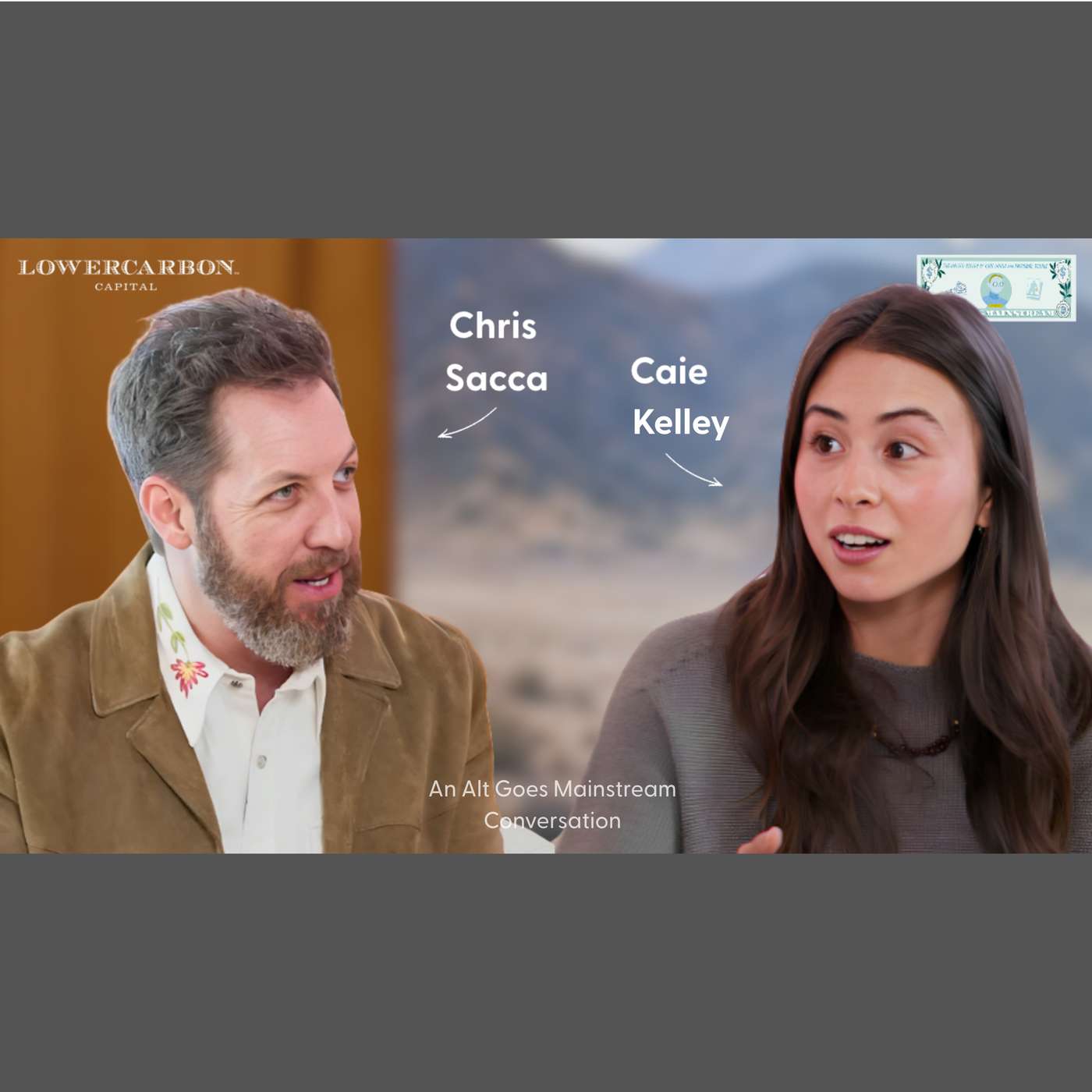
Lowercarbon Capital’s Chris Sacca and Caie (Kai) Kelley discuss investing in “energy” and industrial power/advanced manufacturing rather than “climate tech,” how they underwrite early-stage hardware, and why they believe doing well and doing good overlap. They argue the key bottleneck is electrons/power and supply chains, and they emphasize unapologetic capitalism, technical diligence, and scaling from “just add water” stages to large revenue businesses.
Written by AI. May contain mistakes.
Discussion on the unique investment strategies of Lower Carbon and their portfolio focus.
“But they're also going to do it in a way where they're unapologetic capitalists.”
Introduction of Chris Sacca and Kai Kelley, discussing their non-climate backgrounds and transition to energy investments.
“There's a lot going on in the space you're investing in, energy, power, AI, climate.”
Chris shares his transition from tech to energy, focusing on the demand for electrons.
“How did you both get into this space and why?”
Kai discusses her finance and tech background, emphasizing the importance of impactful investments.
“We had a really funny interaction with a really big asset manager recently who I've done business with in the past and I just said in passing, I'm like, it's kind of weird.”
Discussion on the investment philosophy of Lower Carbon, focusing on substantial business growth without compromising values.
“But they were moving into the Andurals, the Palantirs, the SpaceX's.”
Exploration of the unique challenges in underwriting hardware investments compared to software ventures.
“That's how you end up investing in fucking mushroom leather.”
Learn how decarbonization creates unique investment opportunities.
“And carbon is inherently expensive, like digging up and burning old dinosaur bones.”
Explore the growth and investment strategy of Antora's large battery.
“And so I just, I wanted to jump in and say that because that's where our fund has grown.”
Dive into how market size affects demand and investment in energy technology.
“We actually know a lot about how wave energy works.”
Examine the balance of risk and reward when investing in energy technologies.
“You need this very specific manufacturing process.”
Understand the potential for growth in the energy market driven by technological advances.
“But Kai, in your view, especially I think from a growth prism, that's an interesting question to ask is like, you have to see what the size and scale of the opportunity is.”
Learn how companies like SpaceX create secondary markets by building infrastructure.
“You understand the throughput such that you can fulfill the demand in that scale.”
Explore the unexpected progress in fusion energy and investment strategies.
“Their first market, and Chris already talked about it, this is a thermal heat battery storage company.”
Discover how Giga tackled supply chain bottlenecks in energy infrastructure.
“The folks who trust us as managers are feeling really psyched about that.”
Compare the current state of nuclear energy with the emerging fusion market.
“and overall our shortages that we're seeing when we're building out the electrical grid in general.”
Examine the opportunities in businesses that address extreme weather events.
“And then there's something I want to strand I want to pull on based on what you just said as well that'll tie those two things.”
Learn how climate change affects ranchers and farmers and their operations.
“And this will be useful for the Colorado River.”
Explore the importance of narrative in conveying climate solutions to the public.
“hear about these types of companies, opportunities, who should be involved and why and how?”
Understand the investment landscape in clean energy and the importance of storytelling.
“where I see them also getting deployed and ready for growth capital much quicker.”
Discover how perceptions around power and energy investments are evolving among investors.
“I don't know if you see a lot of those in New York, but there's a lot of MAGA flags in the yard, solar panels on the house, and like an F-150 lightning in the driveway.”
Learn how perceptions of clean tech investing are evolving beyond traditional ESG mandates.
“And that was a light bulb moment for me of these guys did not have a clean tech ESG mandate whatsoever.”
Understand the emerging technologies and companies transforming energy usage and storage.
“Even the acronym ESG, we're like, look, we might be the E, but fuck the S and the G at this point.”
Discover how Emerald AI is capturing wasted power in the grid and improving energy efficiency.
“I'm a founder and it could never be fast enough to meet my standards.”
Explore how SolarSquare is revolutionizing solar panel installation in India and its implications for energy decentralization.
“So I'll start with you, Chris Emerald, AI.”
Learn why decentralized solar systems are vital for energy security and grid resilience.
“And now she's rolling out batteries to go with it.”
Discover how Fuse Energy is changing the utility landscape through innovative consumer engagement.
“And Fuse does that, but on the utility and the energy side.”
Understand Kluver's role in financing solar installations and its future potential in energy management.
“And that's somebody who actually did take a utility and make it a higher net promoter score.”
Explore the recent shift in attitudes towards investing in hard tech and its implications for the energy sector.
“Well, that ties something you both said earlier together is there's derivative businesses.”
Learn how vertical integration is transforming energy companies' operations and market strategies.
“But now when all these companies stand up and say, and so that's why we built this factory, this is how many square feet we have and we convert it into factory space.”
Discuss the trend of multi-strategy platforms in investment and their relevance in the current market.
“You have way more control over your customer relationships.”
Discussion on the evolution and necessity of the carbon removal market.
“I mean, he is a smart guy and what he's achieved at Thrive is incredible.”
Exploring the personal motivations behind investing in impactful businesses.
“So I want to end by tying all that together.”
A conversation about the future vision for Lower Carbon and its investments.
“And to see that becoming an even firmer and more predictable and more inevitable way of making bigger and bigger amounts of money is just crazy.”
Learn about Antora's innovative approach to generating heat and electricity using carbon blocks.
“She's going to tell us a little bit about Antora.”
Discover how a startup is transforming wire harness manufacturing through automation and software.
“Most people don't know what a wire harness is, but essentially what they are are needed for every single thing that turns on.”
Explore how Panthelos is deploying nodes in the ocean to generate energy from waves.
“This is the node and this is, here's a shipping container for scale.”
Understand the potential of ocean energy and its implications for power consumption and sustainability.
“I think I am an abundance mentality person, so I'll say that we are going to need more power and energy generation on land.”

Get the gist, explore an idea or ask about something said.
 Claude
On Alt Goes Mainstream: The Latest on Alternative Investments, WealthTech, & Private Markets, what are the key points of this episode?
Searching your listeningAutomatic transcript. May contain errors.
0:00Welcome back to the Elko's mainstream podcast. I am here live from Lower Carbon's outpost. Lower Carbon is an investor in some of the most interesting technologies that are at the frontier, whether it's an energy, power, AI, all of it's coming together. We had such a fascinating conversation with Chris Sacca, one of the best performing venture investors ever at Lower Case. He's doing it again now at Lower Carbon. He's partnered with Caie Kelley and Clay Dumas. You can see from some of the portfolio companies that are here. They're here this week for Climate Week. We talked about why climate may not be the best description for what they do.
0:35And also how, think about underwriting these types of companies. They also understand the importance of investing in things that are really changing our world for the better. But they're also going to do it in a way where they're unapologetic capitalists. You won't want to miss this. You never know what the next frontier will be. And Chris, Kai, and the team at Lower Carbon are on it. Emerald. Solar Square. Hughes Energy. Kluver. If this company does really well, the world is actually going to be a better and more interesting place. We have the most energy dense portfolio of anyone in venture.
1:11This isn't like hippie shit. I don't really think of ourselves as climate investors. We don't know how big the market for energy could become. Mars is for quitters. There's a big opportunity here. If you're going to Mars, you're giving up on what we've got here. It's the only time I've ever seen where doing well and doing good, like the then is a complete overlap. We've seen the answer key to the test. Bring the cost of electricity down to two cents per kilowatt hour, five to 10x decrease in the cost of electricity. So it's okay to be an unapologetic capitalist. Hell yeah. Passion times profit times purpose.
1:48Welcome to the Alco's Mainstream Podcast. This episode of Alt Goes Mainstream is brought to you by Ultimis, the full service fund administrator and transfer agent powering asset managers in private and public markets. As Alt Go Mainstream, we need real expertise to handle complex fund structures, connect with key distribution partners, and handle sophisticated compliance, reporting, and transparency demands. That's Altimus. High tech, high touch solutions for over 450 clients and 2 ,500 funds with over 775 billion in assets under administration. Backed by an expert team of over 1 ,200 employees, they place client service at the core of their business, helping you navigate complexity during your fund structuring or launch, and then supporting you through every stage of growth.
2:33Whether you're already in the market or thinking about entering private wealth, you can trust their team's deep expertise in retail alternatives to help you reach your goals. Learn more at ultimisfundsolutions.com or email info at ultimisfundsolutions.com.
2:50Chris, Kai, welcome to the Altco's Mainstream Podcast. Well, welcome to our outpost, man. It's good to have you here. No, it's awesome. I think this is climate week. There's a lot going on in the space you're investing in, energy, power, AI, climate. We'll get to that too. I think where I'd love to start, actually, it's a great jumping off point, because you both don't come from climate world and have done other things. And now you invest into this category, which we can unpack what that is, what that isn't. So we'd love to start there. How did you both get into this space and why? Well, I'll tell you, it's kind of wild.
3:28My career has come full circle. So more than 20 years ago, which is kind of a weird phrase to say, but I do have a great beard. I was co-leading Google's efforts to site and build data centers. And so I was doing power acquisition. there. Back then, 100 or 150 megawatt data centers sounded like the biggest possible thing you could imagine on the planet. Dwarfed right now. I mean, those are like inference sites for AI at this point. And we were the second or third largest server manufacturer in the world. And so my job at Google, a lot of it was really hardware and physical infrastructure intensive.
4:02Obviously, with lowercase, there was a new wave of consumer web, Ajax and Web 2.0 had unlocked this ability for individual entrepreneurs to just start stuff and see if users liked it. And so I was involved in that wave because that was just the most innovative space. But now that the world has pivoted back to energy, I mean, that was in the founding thesis of lower carbon 10 years ago. We really noticed there was going to be this burgeoning demand for electrons. So we've been long electrons ever since then. It is funny to be in New York for climate week because I don't really think of ourselves as climate investors.
4:34I mean, this whole week was started as a protest. The roots of this week were the UN is in town and what Clinton Global Initiative is in town. It's people out there with drums and poster board and puka shells who really started this whole week. So we are hopefully just this new pragmatism that's here and saying, look, it's not climate tech as much. It's energy. And we have the most energy dense portfolio of any one adventure. Advanced manufacturing, critical inputs, building materials and industrial chemicals. That's what we actually do. and I'll just tell you really quick. We had a really funny interaction with a really big asset manager recently who I've done business with in the past and I just said in passing, I'm like, it's kind of weird.
5:16You guys aren't investors in our stuff. Like we're fine. We've had no shortage of money, but it's weird you're not invested with us. They're like, oh, we don't touch climate tech. And I was like, oh, no worries, no worries. But do you guys want exposure to our energy fund? And they're like, hell yes. And I was like, what about our advanced manufacturing critical input stuff? And they're like, absolutely. And I was like, God damn, this whole space has such a branding problem. So we'll get back to that because I think how you worded your LP letter, I think actually is so emblematic of what the opportunity is.
5:48I want to pause on that for a second, though, because I think what you said about both your background, as well as the types of things you're investing in is a perfect segue to Kai, your background. and fusing your two backgrounds together explains why you're both up here on stage. But you were in finance, private equity world. You worked at Sound, which was one of the early investors in some of the biggest AI companies. Would love to hear your background, how you got here and also your skillset and how that applies to investing in this category from software to now hardware. I think it dovetails a lot with what Chris was saying.
6:26I'll back up a little bit. I went to school. I was raised by a single mom. I went to school on financial aid. I only mentioned that because I worked two jobs during college. And then after school, I knew I wouldn't go into PhD research impact or climate because all of those things, I think at that time I associated with, you don't make a lot of money and it's not where you're going to make the most impact. And so I went to JP Morgan. I worked in investment banking. I wanted to work in the tech investment banking group because that's where the biggest deals were doing. That's where the most interesting entrepreneurs were building.
6:58And And it was just definitely the place to be in terms of living and breathing in New York City. I kind of went down the same normal path that a lot of people do. I was working at J.P. Morgan. I was in the most transaction-heavy group. And then I wanted to go into private equity because that's where the smart people were going if you were in investment banking. And so I recruited. I joined Premiera. I was sitting in the Premiera seat. And I still had that similar belief. But I also started reading a lot of philosophy at that time and had read about a Dutch philosopher who said that a lot of people spend their lives moving the world sideways.
7:31And I think there's a lot of value that private equity brings in general. But I also noticed at that time, a lot of my smartest friends from undergrad, they had maybe gone to the Googles or the JP Morgans or the Goldman's of the world. But they were moving into the Andurals, the Palantirs, the SpaceX's. They were all moving to Los Angeles. And I sort of wanted to generally follow that talent and all of those really smart people. And I also wanted to do something where you could say with the straight face, if this company does really well, the world is actually going to be a better and more interesting place.
8:03And I didn't always feel that way in tech investment banking and on some of those general transactions. So I moved to Sound, like you mentioned, and I worked there for a couple of years. And one of the very big transactions we did was we had a$250 million fund in which we divided into three companies only, OpenAI, Anthropic, and Perplexity. At that moment in time, if you believed anything that they were saying, and this was before chat opened for the general public and anyone started testing it on their own and started to realize that promise in the general consumer ecosystem, you knew that there were soon going to be unbelievable bottlenecks all the way down the supply chain.
8:42If consumers were going to use any of those applications software, there was going to be a crazy demand for power, for energy, for building in the U.S., for U.S. sovereignty, otherwise. And so I knew also then that I needed to go to a place that was going to be best positioned for taking advantage of those waves. So at that point in time, I think I Googled something along the lines of what is the deepest energy and advanced manufacturing portfolio in the world. I wanted to find the fund that had the most energy companies. And it wasn't out of any like lower carbon, I love climate dynamic. It was just I want to go to a place that's closest to the best talent, which was, again, in SpaceX in Los Angeles.
9:21And that was lower carbon. And I wanted to go to the place with more than 120 companies in this specific space where I felt like once people got over the initial hype and excitement of what ChatGBT was, they were going to then start to think about what else it meant to build and supply and resource for those types of new trends and talents. And so that's what took me to lower carbon. But I think when I hear Chris's speech, I often think there's a lot of similarities there. We came at it different generations and different timeframes with the same general thought process around where bottlenecks were going to be and why we needed to build for them.
9:59Yeah, I think that's it. Kye is exemplary. That's why she's the first GP we've named from within our team. And that was an obvious thing from the moment she joined. But she's exemplary of we don't hire people who identify as climate people. There's a couple of things. Number one is as investors, they find really nice, warm and fuzzy science projects and then try and convince them that it will be businesses. And that's a great way to light all your money on fire. That's how you end up investing in fucking mushroom leather. At that point, you have no risk. You've de-risked your chance of ever returning any money.
10:32We look for businesses that are massive businesses with incredible growth potential that at the end of our process will have a big impact on climate and make us feel proud to be involved in. And so that's why we get the best talent to come work for us. But you can't have a CAI if you aren't looking at the very best businesses without compromise. So who is investing in the types of businesses that you invest in there? Yeah. Well, so we're investing in them earlier than most people. We have the technical chops to assess how viable this new energy generation is or this transmission or this energy storage.
11:08There aren't many venture investors who have that technical know-how. We have the operations know-how to understand, okay, we've modeled this. Right now it costs 2x the existing offering in the space, but can we bring that down by 20x? Can we bring this down to a fraction of the cost as we scale it, as we make it, as we build our own gigafactory for it? So what's fun is we do see some tourists come through in these later rounds right now. And look, we can't do it all ourselves, so we welcome them. And so when we see our deals, quote unquote, validated by some of the household name firms, we'll take it.
11:43And also, by the way, some of those firms are great at Fortune 100 introductions or helping staff up the C-suite after the company is really humming along. But nobody else is really doing this at the early stage of the scale. I think this gets to some really interesting aspects of what it takes to build companies in this space, both from the financing needed, when and how, the entry point and what risk you're taking. Also, then how do you underwrite and the type of skill set? So I think that's a great segue to you, Kai. You came from the private equity world. You know how to underwrite certain types of businesses in certain ways.
12:20You came from the venture world, but also worked at Google and did data center building investing. So there's this interesting mix of backgrounds to actually underwrite these businesses. And we talked about this a little bit before as well, that there's a different skill set that it takes to underwrite and understand these hardware businesses than software businesses. How do you bring your private equity hat and think about investing in and underwriting some of these businesses? So let me just start that in time order and phase order, because I'll just say a few years ago, I didn't really realize we needed a Kai and it wasn't a muscle we ever had within the org.
12:57And so why didn't you realize that? Well, because most of what we had done in the web was like gut based investing. And so when you're building Twitter, there is no proxy for valuing Twitter. So you're sitting there saying it's 140 character micro blogging service. How are we going to get people to give a shit about it? How are we even going to prompt them? We would stay up all night. Like what should be in the text box to encourage people to post something here? And so we were making revenue, but each round you're buying for a company like that is like CAC. It's just to acquire more customers.
13:29And so someday out in the model, it goes cashflow positive. But for the most part, you're just daisy chaining rounds, maybe a little greater fool theory. And so even for Uber, at Uber, you have some proxies, but there isn't a great one because you're like, look, we're not just replacing every taxi medallion. If we do this right and the LTV is great, maybe people never lease a car again. But on the other hand, if we're discounting all the rides, is the LTV actually that high? And so you're raising a Series E, F, G, just again, chasing all that. I feel like what we do right now is unfair, particularly even at the startup phase, because I almost everything we make is a substitute good for something that's already there in the market.
14:10And we're decarbonizing it. And carbon is inherently expensive, like digging up and burning old dinosaur bones. Turns out it's expensive. Moving that shit around is expensive. We usually have to fight wars to secure that stuff. We're in a double blockaded straight right now because we can't extract this stuff fast enough. and it tends to blow up every now and then. So every time we're able to decarbonize a process, that's literally the alpha. That's the profit opportunity there. And so when we build this stuff though, and when we make these initial investments, we literally already know who the customer is and we get to go interview them.
14:43And so if they're a buyer of an industrial chemical, we're like, hey, how do you buy it? In what quantities? What's your lead time? What certification do you need on it? What do you need to see from the factory that produces to you so you can push your stamp through your ISO process. And we just know that going in. And then we can go back to the team and be like, all right, what's our roadmap to being able to deliver better than this price and these volumes on these lead times? And so it's cheating. Like we already, we've seen the answer key to the test. And so it's like that in literally everything we do, whether it's delivering power, storing power, so much of what we do, like when we look at a company like Antora that runs literally the largest battery in the world and not even ex-China, like in the world, which is cool because everything is always like, except for the huge shit in China.
15:30This is the largest battery in the world and it's modular. So when we've been with that company since they were pre-seed. So we're the first folks in, we've been with them all the way since. And we've watched this thing scale. We've been advisors to them from the beginning on how to take that first one and make it so it scales. Now it's a business that has no ceiling on it. And the demand is more than we could meet in the next few years. I forget what numbers we're allowed to say, but it's a huge fucking business. I think we now have 10 or 11 companies are doing over$100 million in revenue. So these are real, real businesses.
15:59But when I look at something like Antora, what's interesting is by the time you get to the series B for that company, now we have so much data that we never had for consumer web stuff. We just have reams and reams of what does the supply chain look like? What does the pricing environment look like? What's the competitive environment look like? And all kinds of other little proprietary signals we have. And so at that point, I'm the kind of guy who's like, Antora's feeling hot. Maybe we should keep investing. But I didn't really have the analytical skill set to do that. And so that's Kai. And that's what she's built for us.
16:37That's why she runs our growth fund and the re-underwriting process. And so I just, I wanted to jump in and say that because that's where our fund has grown. We're over$3 billion in AUM and then a bunch of my own money. I'm the biggest LP in the fund. But so that's where we've evolved from. Hey, look, in the first phase, it's taking on some technical and science risk, which we feel really good about. It's taking on a little bit of product risk, but we know the product market fit. That's the part that's not fair. You're not guessing about it. We know exactly what the product market fit is. But then there's this point where like, okay, now it's a series B.
17:10it's a Series C, is there still another opportunity for a 10 or 15x from here? And without KAYI, that's not something we can do. So then how do you think about underwriting these types of businesses? And is it very different from underwriting a software business? The short answer is it is very different. But in many ways, like Chris is saying, it's sort of a cheated system. So if you think of a business like Panthalassa, for example, which raised a big Series B, and we were talking about it before. This is a 100-meter-long node that will self-propel into the middle of the ocean, turn vertical, use ocean wave energy to generate electricity and energy, which it then uses for compute, but it could use for any other application as well.
17:54That founder estimates that in the next four years, he will bring the cost of electricity down to$0.02 per kilowatt hour. If you compare that to consumer electricity, Most of us pay around 10 to 15 cents in some areas in California, it's probably 18 to 20 cents. So this is somewhere like a 5 to 10x decrease in the cost of electricity. Of course, you can imagine that if you can bring electricity costs down that far, you are going to have significant demand. You have a known market for energy. I would argue, actually, we don't know how big the market for energy could become if you had a fundamentally different technology that's offering a fundamentally different cost for providing it to market.
18:36But we'll leave that for now. No, no, no. Like when price comes down, it grows the market. That was Bill Gurley's big thesis about Uber is that if you know you can push a button and count on a car, then the overall market is bigger than cabs and bigger than black cars. Turns out he's right. That's why he's Bill Gurley. Panthalos is a fascinating one, right? Because if you think about it, one, it's using ocean power to power these data centers effectively. They're in the ocean instead of in space like Star Cloud, right, which people seem to be very excited about or on land. But then, and as you know, and we'll talk about this too, because you've invested in all the preceding things that create AI, energy, power, electricity, water.
19:11You need all of that too. But this doesn't need any of that. How do you wrap your head around an opportunity like that? So one is this market element, but you're asking also about how do you underwrite the risk that is associated with going to the middle of the ocean and creating energy there. And there it becomes quite granular. You know that the way that they make these nodes are a lot like a factory line and a production line. They roll steel, which is a known technology. The compute nodes themselves are known. We know how chips work. We know how compute works. We actually know a lot about how wave energy works.
19:43There's certainly technical challenges around how do you make a self-propelled node and how do you put it in the middle of the ocean. But like Chris is mentioning, we know a lot about these supply chains. We can understand the single source, make sure there's no single point of failure. We can make sure that we understand the run times, understand the maintenance. And so there's a lot of the risk-averse debt underwriting type of mentality that then goes into taking each individual part of how that company is producing a node and underwriting that particular risk with the understanding that we have significant demand on the other side when these companies go out into the ocean or wherever they're building.
20:21The other interesting thing too is Panthalassa raised a large round. They had to produce their nodes in a factory. Well, I think they will have a factory at some point, but they had to produce their nodes in some sort of factory that cost money. There's a lot of unknowns there. What then is the right entry point from a risk reward perspective to invest in a lot of these types of companies? Because if you're investing before a lot of the stuff gets built, you don't know, but it might cost a lot of money. So you need to raise a bunch of money. And what's the right balance of risk reward? Gordon, you obviously do early end growth.
20:52There's other types of investors. How do you think about that aspect? I love looking for inefficient markets where there's an imbalance of information and where we have anomalous understanding of something that somebody else, whether it's because they haven't done the work and the research, they haven't visited the lab, or they've got some preconception of the space or some overhang from getting their ass kicked in an investment earlier on, some really bad negative confirmation bias. I just think we bring the freshest eyes to the stuff we invest in. We do the crispiest math and the crispiest technical analysis.
21:25And then the result is, I just have the very highest confidence in the kind of stuff we do. And we're seeing that. We have such a low loss ratio, et cetera. That it is weird because I do think we're able to get this stuff through to a stage. You mentioned debt. Debt is not something that comes up in the consumer web much, but we're able to get these companies to such a bankable state so much faster than anything I've ever seen. where we get them to where they pencil out for a risk-averse spreadsheet. And so here in New York, there are people in the mid-levels of these buildings who are underwriting things to kind of cover their own asses at this point.
22:00They're like, I won't get fired if I miss a couple points of yield, but I will get canned if I invest in something too risky. And so it's been amazing to see them attracted to our project-financed opportunities. Does this space need those types of investors? And if so, when and how? It actually needs them earlier and it needs them to really, we need to shift the scorecard for how those people are rated based on performance within their companies. And so I'll give you an example. We have a company called Arbor. So Arbor makes a gas turbine. And so there is a five to seven year backlog for gas turbines.
22:37And it's mostly because the traditional custom turbine needs to be made out of this one particular element that is heat resistant because otherwise a turbine would totally melt. And so you need this element. You need this very specific manufacturing process. It's a nightmare. But as we're trying to meet the energy demands right now, we need these turbines. This company Arbor, first of all, it's a gas turbine that works in a special way. It's super critical. And so it burns at this very hot temperature. And the turbine they make is actually 3D printed. We have one somewhere here on the floor. It's the size of like a coffee cup lid.
23:10And so that's a one megawatt turbine. The 25 megawatt is about this big. They 3D print these things. The super critical process burns super hot, generates all the power you need. And the two outputs are pure CO2, which can be sequestered or used productized, and clean water. This is actually a water generating technology. It's amazing to think, I don't know if anyone listening actually paid attention in biology class, it's wild. That is super critical process. It gives off water. And so I love these guys. They're one of the most inspiring companies you'll see. But when you look at their product roadmap from how many megawatts now to how many gigawatts later, it's slower than it should be.
23:49And so when I ask why and they're like, well, because the bank wants us to go from one megawatt to show a 10 megawatt project. And then the hyperscaler wants us to build a 25 megawatt project. And then they'll unlock the milestones for us to build the multiple gigawatts. And if you ask, so what's different between one and 10? nothing, literally just bigger parts. So what about going from 10 to 25? Do we have to, is this a Moore's law thing? Do we have to break through some physical barrier? And they're like, no, it's literally the same fucking thing with just the larger disc and bigger pipes going into it.
24:25And so for me, the big disconnect is between here and gigawatts are these meaningless fucking incremental steps that don't actually need to be achieved to de-risk anything. But somebody, somewhere has to say, well, I can't commit us to a power purchase agreement until we've seen a pilot of this scale. And that, like as an efficiency guy, that drives me fucking crazy. So it is my opportunity. So we go buy more of these companies. But at the same time, I deeply believe we need to be delivering the cleanest solutions to the planet like this. And so it drives me crazy that we have a technology that could immediately be rolled out across the United States that could help propel our competitive advantage in AI that could help provide increased air conditioning to the burgeoning middle class, which by the way, AI takes up three to 5 % of the power grid right now.
25:13Air conditioning is way bigger. And so, and growing also geometrically as the planet gets shittier and hotter. And so that was part of the original founding thesis of this company. So how do you both think about the size and scale of the opportunity? Because I think that Now that gets to answering your question of why aren't investors trying to address this problem? Now they have different risk reward spectrums, as you discussed as well. But Kai, in your view, especially I think from a growth prism, that's an interesting question to ask is like, you have to see what the size and scale of the opportunity is.
25:49And I know it's different across each category. But how do you just for people who are not as familiar with this, the spaces you invest in, how should they be thinking about how big this opportunity is? I think one thing to say wholesale is a lot what we're saying around the markets overall, which is to say that an energy market is sometimes people will joke that Uber's consumers are every customer on Earth. And that's true to a certain extent. But I think energy is a much more obvious, huge market TAM. It's the one TAM slide that actually matters. Normally, you know, you go through a deck and you just skip the TAM slide because it's a bunch of bullshit.
26:24Everyone's approaching a$3 trillion market. Well, one thing that I found interesting really quick before you continue. In one of the presentations from one of your companies two days ago, they said the ocean is 30 Saudi Arabia's worth of power. Yes. How do you start to come to the ocean? There's one small slice of the ocean down in the global south off of Chile that's 100 gigawatts of power. And by the way, no boats go through there because it's pretty shady to sail through there. But those are the waves we like. And so the power is there. The electrons are there to harness. I think you asked earlier a question about how do you underwrite or how do you know when is the right time to start investing in some of these businesses?
27:02And the early stage part of our business, we do take risk on some understanding of the science and tech. And so you'll see that our team is super technical in terms of understanding how the physics and the chemistry of all of that work. Now, if you think of the overall climate or energy hardware and advanced manufacturing lifecycle, we're in a stage where it's a really interesting opportunity for growth investments in general. A lot of the businesses we're talking about now have taken down the core scientific risk. And so we have what we call a just add water stage where you're saying, if we give you $1 of capital, you know how to deploy that capital to generate at least$10 of returns in this one to 10 ratio.
27:42And that's because you understand your supply chain. You understand your demand market. You understand the labor constraints related to that. You have the manufacturing plant and build. And so at that instance, you're ready for ingesting growth capital. You genuinely understand your product well enough. You understand the techno economics of it. You understand the throughput such that you can fulfill the demand in that scale. And then we start to see real growth vectors from there. I think the second really important thing about how we think about these opportunities, and I'll use SpaceX as an example because I think it's easier for people to conceptualize.
28:19SpaceX started, of course, with a goal of going to space to go to the moon, or not actually to go to Mars, but now to the moon. So whatever, we'll be fine. But the... We say Mars is for quitters, by the way. Like, there's a big opportunity here. If you're going to Mars, you're giving up on what we've got here. Yeah, yeah. Yeah, but SpaceX inadvertently, because they built out a lot in order to try to achieve that goal, they needed to build out a lot of core infrastructure to reach that big target market. And inadvertently, you would say space is a huge market. But today, most of that company's revenue actually comes from Starlink.
28:54They inadvertently created a second market, which is an overall phenomenon we talk about in hardware, where your ability to access a market opens the keys to a secondary, even larger market. And you are only able to access that market because you've built out the infrastructure, the know-how, the network, the moat that allows you to then grow into that market. A simple example in our portfolio is Antora. Their first market, and Chris already talked about it, this is a thermal heat battery storage company. So they heat a carbon block really hot using solar energy. And then that carbon block dispatches energy over the next couple of days very slowly.
29:34That initial market of industrial heat is already a$200 billion market. But once you create heat, you can pretty easily translate heat to electricity. And so their secondary market is an even bigger market in the power markets. But you today could not access the electricity market if you were a new startup or a new company without the core understanding that came from accessing their first huge market. And so you see these companies actually grow faster as they scale. This is that idea of geometric growth. And so sometimes I think what's really interesting about these spaces is because you're building in the real world, you're building real infrastructure.
30:11You have the ability to access an initial already gigantic, no one's crying for you type of market size. But it's also what lays the foundation for a much even bigger story down the line. Yeah. And by the way, I see this happen in a couple of ways. We see dual use come up. And so we have the world's only dedicated fusion fund. And that's a great example of where the entire market had just these preconceptions about fusions not working and it's never going to work. And we had this moment, you know, our partner Clay and our co-founder at Lower Carbon started visiting these labs. And he'd come back and be like, you guys, like, it's actually working.
30:46I've seen the data. I watched the shot. And it's improving exponentially. And what are we missing here? You know, and we just kept gut checking. And we're like, it'll never work. And we're like, except when we talk to the scientists, it is working. And so we launched the first fusion fund in the world. We gave our LPs individual choice. We didn't want to cram it down. And we're like, okay, this sounds wild. Some of you are going to have preconceptions. Some of you are going to trust us as managers. The folks who trust us as managers are feeling really psyched about that. Because since we have demonstrated net energy gain, and so there's more energy coming out of fusion reactions than there are going in now.
31:20And so that's happening in multiple, again, I lose track of what I'm allowed to say. without pre-announcing, but it's happening across multiple companies and multiple approaches to fusion. We also now have the world's preeminence fusion researcher works for us, Dr. Scott Su, the kind of godfather of the space. But I bring this up because along the way, one of our companies, Exmer, has developed the world's most powerful laser. And so it's for inertial confinement. It's a really cool approach to fusion. It's the highest net energy producing approach to date. But along the way, one of the things that DOT, the Defense or Department of War, I guess now, reached out and said, hey, turns out we're running out of munitions in Iran really quickly trying to shoot down all these UAVs.
32:01Your laser would be absolutely perfect for ridding the sky of and allowing us to protect critical infrastructure and other places. And so this is now a dual-use company. And it's one of the ways that being on the equity stack already, we're able to fund the build out of the fusion plant by these defense contracts. And they've announced Walnut Great Thion as a prime to do this. And so I see the dual use emerging where some folks in our fusion portfolio are also building the fusion supply chain. So they're building their own reactor while also selling superconducting tape. But then I also see the verticalization happening.
32:35So when I think about a company like Giga, where you've led, it started with one product and then they start to see those bottlenecks and they start to verticalize. Do you want to talk about that at all? Yeah. So Giga is a really interesting company in our portfolio. It's founded by four founders who dropped out of Texas A &M. We sometimes tell this story because it's a full circle to Chris's original history. One of the co-founders saw a video on Twitter of a guy using flared methane emissions and mining it for Bitcoin, not entirely dissimilar to the origin story of Crusoe. And he saw the video on Twitter.
33:06He thought that was a little bit crazy. He drove to Canada to understand the core technology. And then they went back to their oil field. One of the co-founders fathers owned an oil rig in East Texas, and they learned to start to make these Bitcoin mining sites. As they did that, though, like Chris mentioned, they realized that there was an unbelievable bottleneck in actually the electrical transformers, the substations, the other parts, the component parts for it. It wasn't the other technology that was the bottleneck. And so one of their co-founders also then realized that the technology as it's done in the U.S.
33:43today is hand done and custom, which is why you can see these headlines. Transformers have similar six to seven year bottleneck timelines. And so they went to China and they started to understand actually the way in which you manufacture transformers at scale. How do you actually build electrical equipment in a way that rolls off of a factory line instead of needing to be hand done with a specific electrical engineer, take six to nine months? There's plenty of mistakes that happened as a result of that. And so Giga is one of those really interesting examples of a company that started to understand their own supply chain bottlenecks, went to the places that understood those the best and brought that technology and understanding back to the US.
34:25Giga makes US-made transformers today in Long Beach and in Houston, and they can do it in a fundamentally different way that answers to some of the US-based constraints around labor and know-how and overall our shortages that we're seeing when we're building out the electrical grid in general. We had a survey yesterday on an event, which was what does the U.S. need to build the most of, and the vast majority of participants said transmission. So I want to combine that with what you shared about nuclear. So 21, you're on Ted Seide's podcast, Capital Allocators. You talked about nuclear. That was a long time ago.
35:02Wow, 21. But five years ago. So nuclear in 21, if people were paying attention, they would have maybe either seen what you saw or said, okay, this is actually a really interesting space. But a lot of people didn't wrap their head around that at that point. You talk about Transformers today. In both of your minds, what is the nuclear in 21 today? Yeah. Well, first of all, that's what we get paid to do. And so that's why I feel really comfortable putting a bunch of my own money into this fund. Like I said, I'm the biggest investor. And so that's literally we get paid and we recruit the best we know to see around that corner.
35:39And so it's fun to see the rest of the world catching up on energy, transmission, storage, grid resilience. It's amazing to see that. Fission, by the way, I'm not bearish on fission. It's just we have a rule that we will never get into a permission-based business. So I want all the risk we take to be between us and the customer. And so that we know, okay, these are all things that are ostensibly within our control. And so it's up to us to execute according to the plan. It's up to us to get this thing cheap enough or build enough of them. And so what I hate is when we've done that part and we're sitting around waiting for a bureaucrat to approve something.
36:16That is just the death of capital and souls. For an entrepreneur, just waiting for some permission is, you see it happening in some of the data center space right now. Like some of these big ambitious plants ready to go. They're massively job producing. The water thing was bullshit. The woman who wrote that in Empire of AI about water consumption of data centers later corrected it. She was off by 10 ,000x. But, of course, that's not a really viral story. And so the water consumption stuff isn't a thing. But we need these data centers. I understand concern of local communities. But, damn, to be an entrepreneur and sit around and try and manage a city council process is wild.
36:52I'll tell you really quick. I built a data center once in Oregon in the Dalles. And I built it on the site of an old aluminum smelter. And so the aluminum business had all moved to China, but the site had transformers on it already. It had transmission to the site, clean power off the Bonneville Dam. And so I was really excited to do this. And I had the community behind me. And the guy who was leading them, I was negotiating with him. And at one point, we were going through some agreements. And I had mentioned some legal term. I don't know. It was like race episode or something like that. And he's like, huh?
37:25And I was like, well, you're the judge, right? I mean, it was Judge So-and-so. And he's like, yeah. And I was like, well, you, sorry, you're like a lawyer, right? He's like, ah, fuck no, I'm a cherry farmer. And he's like, you just get elected judge in this town. And it just reminded me, I was like, everything we'd done at that point was like a lesson in civics, right? And back then data centers were cool and they created jobs and people liked them. But for us, as we look through this stack, we want to build businesses that don't depend on anyone else but ourselves. And so that's why we've avoided Fission for the most part.
37:56but fusion has actually been regulated to the same extent that an MRI machine has because there isn't that inherent danger. And it's funny, in Virginia, we had a situation where the community protested a natural gas plant that was going to be installed there, drove them out of town. That same site is now where we're building one of our first fusion reactors at scale that will put electrons on the grid. And they rolled out a band for the ribbon cutting. The community was psyched to have that thing going in there. And so I've absolutely loved to see not just investors start to catch on, but communities start to catch on to the promise of fusion.
38:34Kai, I want to hear your perspective on what is the fusion opportunity of 21 today. And then there's something I want to strand I want to pull on based on what you just said as well that'll tie those two things. Yeah. And I just want to say there are spaces and I know you're going to say it because I'm excited about it because this is one of the things she leads for us. but that's the arbitrage for us is we see it. And then we hope that other investors, like Pantolasa, that Pantolasa was batshit for years. Right. And if we had explained, if we'd put it up in front of an investor room, like the other day, everyone would be like, what the fuck are you guys doing at that shop?
39:07Like we thought you guys were serious investors. You know, suddenly many rounds in Peter Thiel comes along, personally backs it. Founders fund is there and everyone's like, oh shit, I need to get some Panthalassa stock. Now the secondary bids come in. It's hilarious to us. And so that's what we do. Crusoe sounded dumb. So these guys are putting like weird boxes out in the middle of stranded asset oil fields and flaring gas. How has that ever become a big business, et cetera? Now everyone's trying to buy Crusoe stock. And so that's the business. 30 plus billion dollars. Yeah. But now it's fun to get bids for Commonwealth Fusion.
39:39And it's fun to get bids for Exxamur. And so I love the new liquidity. The secondary market is a great indicator of how our portfolio is performing. And I've loved that reassurance, like, oh shit, okay, we're early. And so I only say that as like that usually, it's usually like five year delta between when we do the deal and get really material ownership in these things. And when we start to see the outside bids, that's our opportunity. That's the alpha we trade on. So do you really want to tip your hand right now? No, I'm just go ahead. Your second best idea. I think one big category we haven't talked about, and this is why he's mentioning it, is resilience.
40:13For us, we know the world is getting more extreme for a huge variety of reasons, but the weather is also getting more extreme. I think we're all hopefully flying out first thing in the morning because there will be another winter storm, even though we are in September. And at the beginning of the week, there was also major delays related to weather getting into the city for New York Climate Week. And that is true everywhere in the United States and in Europe. There's heat waves, there's fires in other places. And so that market is a very different market than, and I think people have trouble wrapping their heads around because it's incredibly different than enterprise SaaS.
40:46It's a recurring market. You're betting on the idea that instead of having a customer you retain for a long period of time, you actually have an event that's occurring over and over again. And so the way that you acquire customers or you build businesses in that space is very different. But we see a huge opportunity in helping people in places that are going to be affected by those changing circumstances. Sometimes that sounds a little impact focused, but I think there's a huge opportunity in terms of those type of businesses. A simple example is Rainmaker on the cloud seeding side. This is a business founded by Augustus Dorico, who is known to some as the mayor of El Segundo in Los Angeles.
41:26It's a legend. Is he the only mullet in your portfolio? He actually isn't. He's not the only mullet, but he's got the strongest one for sure, man. Yeah. And that's a business that is helping to bring water to drought-stricken places. And their main goal is to make water abundant and cheaper and more easily accessible to everyone. And cloud seeding, their business has been around for a long time. It's not a new technology, but what has always been challenging is that you weren't able to attribute your specific intervention to the creation of net new rain in a particular area. And so the core technology that Augustus is bringing is, can you prove that your specific act created rain for an area?
42:08And this will be useful for the Colorado River. This will be useful for Utah. This will be useful. I don't ski at all. I'm not coordinated, but it will be useful for those among us who like to ski in other different types of places. And so I think we see a growing opportunity for those type of businesses that are actively taking advantage of what I would otherwise consider a more unstable world. This happened across fire. This happened across flood. This happened across just storms as this administration is slash support for FEMA and for recovery from storms. And we're only getting more extreme weather.
42:44The private sector has to backfill that space. And so we are just very wide eyed about what's happening there. And by the way, this is kind of the most apolitical stuff we do. When you really think about it, this isn't like hippie shit. I live in the American West where water is everything. And when we have drought years, that impacts the lives of people irrespective of how they vote. And so you see ranches dry up. I mean, it impacts everyone in America because beef prices are a nightmare because you can't feed cattle anymore. And in a lot of places, we haven't had a second cut on the hay. A second cut is if you have a long enough growing season, you're able to get one more harvest of hay.
43:17And so it's been a while since we've had a second cut. And as a result, you have these constituencies who look past all politics and all voting and are just like, I'm just trying to run the ranch that's been in my family for four generations. I think people underestimate ranchers and farmers. They really do consider themselves stewards of the land. And so when Augustus goes out and meets with these folks, this is not a climate conversation. It is a, can you help support my farm? Right now, what are the two most important voting issues? it's the economy and cost of living. And so when you do that, it has those downstream effects.
43:52We've seen the Colorado River wildly depleted to the point where some of the dams on it aren't producing any power anymore. Augustus is confident that he can double the volume of the Colorado River within six years. There's math to that. It's real. And that's why we've seen Western states like Utah and New Mexico contract with him to restore some of these ecosystems that have otherwise been disrupted by human activity. What's so fascinating when I listened to both of you share some of these stories and then tying that to what you said, Chris, earlier about it's not just the investors that need to understand the gravity of this, but it's also the community and that they understand it.
44:29So much of this is about shaping the narrative in the right way. You both are writers. You love writing. And that's such an important piece of this too. So I'd love to unpack how you think about creating the narrative that people should hear about these types of companies, opportunities, who should be involved and why and how? Because I think that's such an important piece to all of this too. Yeah. Well, look, let's think of this space as a political candidate. And so if it runs as climate, what does climate mean? Climate means everything costs more. That's how it's been framed for a long time.
45:08Your energy prices are going up because we can't use carbon and the hippies are making us pay more for it. You have to drive an electric car. You can't take the long shower you want. You have to put a different shower head on. And how dare you for eating meat? And so this is not a winning political platform. When you shame Americans for eating meat, not only does it just feel like it's against the American way, but burgers are fucking delicious. And so you've just gone against human instinct completely. So what is the winning message? The winning message is, hey, our portfolio is putting electrons on the grid, bringing down the cost of power, and in a lot of cases generating clean water along the way.
45:43And you're worried about job security and the age of AI and the uncertainty that comes with it. We are actively repatriating jobs to this country, trade jobs, good, high paying, steady jobs. We're literally building factories in this country. And the irony is, by the way, we will see legislators in Congress vote against climate-y type stuff. And then they will gladly show up to the ribbon cutting of our factory that we're building in their district. And they're welcome. We don't mind it. We get past all that shit. I drive a truck. Again, And it's fun. It's too big and awesome, but it's loud and I love it, actually.
46:15So what we try and do is approach this with this ultimate pragmatism. And then the third stool of that political platform might be, hey, and by the way, are you worried about sending your sons and daughters off to fight in forever wars in the Middle East to secure this stuff? We decouple ourselves from all that geopolitical risk by generating that energy right here and by generating and having that supply chain here. And so it's patriotic. It secures a lower cost of living and shores up the economy. And that's part of the narrative that's been missing. And again, that's also why the fund generates alpha, is that we see that.
46:49And so we are fine letting Fox News and Newsmax and all these guys do all the culture war shit and scream about paper straws. Paper straws do suck. And they also don't address the problem at scale. So bless everybody trying to do, like, more recyclable packaging. I don't want any green on green violence, but that's like all futility at this point, if you really want to address this crisis at scale. So we're going to let the culture wars play out over that. And then we'll just build the massively scalable, easily bankable businesses underneath it. What's still missing from the storytelling and narrative shaping in this space?
47:25Optimism that I think we get to feel every day because we see these solutions and we understand what's coming down the pipeline. And I think there's still a lot of work to be done in terms of translating that to the general populace. I think sometimes people will say in this work, in this administration right now, do you feel pessimistic about the world? And I think the answer is often very much no, because we have the enormous privilege of seeing these SpaceX and other very talented ex-Tesla, ex-Elon Universe founders building unbelievable breakthrough solutions here, where I see them also getting deployed and ready for growth capital much quicker.
48:02The type of narrative work I do is slightly different than Chris. I spend a lot of time trying to work on making these companies legible to financial capital, which is a different type of storytelling because your audience is quite different. And we talked about this a lot, a little bit, but venture debt, financial investors, project equity, They're looking for their own version of a story, which is how do I not take a zero if I give you X dollars amount of capital and how do I guarantee X amount of yield and return? It is still a story. It's just a different version of that. It's told in a slightly different way.
48:38What do you want that cohort of investors to understand that you feel maybe they may not totally be understanding that today? I spent a few years giving interviews and on stages trying to convince people that Twitter was a business. And I would still get asked by the interviewer, will Twitter ever make money? And I'm like, geez, in year two, we did$35 million in top line. And after a couple of years of convincing people, I'm like, why am I wasting my time doing this? And I went out and raised a billion dollars and I just bought a bunch of Twitter. My original check was a$25 ,000 seed check from a credit card.
49:12But by the time of the IPO, I owned 16 % of the company. And so I had this motto of like, why am I convincing you? Why am I not just taking advantage of the opportunity? So sometimes I hedge whether we even want to talk about this part of the stack. And in the same way that CAI has unlocked this growth opportunity for us, and really just a next level analysis of whether these are underwritable opportunities. I sit here and I spend a lot of my time talking to the world's biggest banks and project financiers, trying to help them understand how large and obvious and safe these projects are. Now, I do it because we're on the equity stack, and it's really nice to be able to shift to non-diluted financing.
49:52The return profile for those investments is different than us trying to go after tens of X multiples on our funds. But at the same time, it's real money. And it's real money that as an asset class is outpacing everything else there. You've had folks like Blue Owl on the podcast. And so I don't know where I want to be in the open AI capital stack itself. With the open weights models coming around and the pricing pressure, I have no doubt about the capability of those models. But where that pricing is, is a whole exercise, what consumers will bear, what enterprises will see in terms of ROI. But I do know that even if you slash those valuations and their resources in half, we have many, many years worth of demand that our companies will still never be able to fulfill.
50:35So I think we are in the most bankable part. And even if the AI went away, we need the air conditioning. We need the electrification of the economy. It's just people are choosing electric cars because they're cheaper. They're cheaper to operate. They're easier to operate. My favorite, by the way, is living in Montana and Wyoming where I drive by a ranch house and I see a MAGA flag. Literally, they're everywhere. I don't know if you see a lot of those in New York, but there's a lot of MAGA flags in the yard, solar panels on the house, and like an F-150 lightning in the driveway. And I'm like, that family is not driving that truck to Virtue Signal.
51:05They're just driving it because fuck the power company. The net promoter score for your local utility is usually closer to zero than it is to 100. And so look, I think there is a massive opportunity here that I sometimes hesitate to sell because if I had the right two or three people in-house, we just always have such an abundance of capital thrown at us. I would probably be taking advantage of this more myself. There is that gap where they want to see these small demonstration projects. they want these things de-risked beyond all belief. And in doing so, it slows it down. And particularly for these modularized ones, like Antora builds a box.
51:42And so if they ship 200 boxes, now they've got orders for thousands and thousands of boxes. Like we knew that a long time ago. And so it would have been great to be able to skip a couple of phases of that company. And in that case, we just funded that fate. We were like, fuck it, let's just go big. And we'll be the ones who fund it with equity. I think there's an easy, easy project finance way to skip some of that, where it's not really a first of a kind. You're like, it's just a bigger of a kind. Let's just go to the actual commercial size plant and skip one phase of that. Well, you mentioned a firm like Blue Owl that your investors in Crusoe just raised at 30 plus billion dollar valuation.
52:15I think their revenue is at least$2 billion or so. But as last reported, Blue Owl financed from a real assets or their real estate business. Mark Zara has been on the podcast, runs that business. They financed the project, Project Stargate that Crusoe is a part of in Abilene, Texas, right? To us, that makes perfect sense. And that's like, by the way, money's smart and it'll eventually find its way. It'll seep into all these things. And that's why the guys they named some of the different wings of the art museum after are the smart guys who have got to those spaces before everybody else. They exploited that inefficiency.
52:46So some of your guests operate like that. And so I'm a blue owl believer. Like, I think they have identified that this is bankable for multiple uses. And so it's not even an open AI bet as much as like, okay, open AI I do think is gonna unbullish on that business, but at the same time, if it doesn't, we still need compute for so many goddamn things going forward that I think it is bankable as a real estate play. Well, that makes a really interesting question, right? So everybody's so focused on AI, particularly the capital formation that's happening in private markets and those who wanna access open AI, Anthropic, et cetera, and for good reason.
53:19But there's all of these other parts of the value chain. are people missing those aspects of things when it comes to energy power, et cetera, that are related to, maybe not totally correlated with because they can be used for other things? Are people understanding that aspect of all of this properly? Because energy power has to go into powering the data center. And then there's compute and use of AI and consumer adoption as that increases, all of these things are going to tie together, right? Well, I would say our investors are not missing that. And so they're seeing it. And part of what we do is we aren't just investing their capital, but we're also educating them because so many of our investors are legitimately strategic and can be accelerative to some of the portfolio.
54:05And so we don't do like a formal co-invest program, but at the same time, we know which of our LPs like to do directs alongside us, which can be legitimately helpful to these companies. And actually, whether it's through unlocking other layers of finance, whether it's through introductions, whether it's through securing anchor customers. Some are just helpful with recruiting and staffing out those teams too. And so we do an informal, hey, look, this is one that you guys should be looking at as well. And so we'll do some of this round, but we're getting to a point where we know what your mandate is.
54:35Kai does an incredible job of understanding the mandates, risk profiles, and kind of the internal criteria of basically everybody in the space. People who invest kind of it our same round all the way up through public markets investors and understanding what's a good fit for them. To answer that, even five years ago, probably you were spending a lot of time trying to convince people that power was an interesting space. I don't think we feel that dynamic anymore. I do think we will, to your point, need to continue to evolve the way in which we tell the story to help people understand it from a debt perspective or a private equity perspective.
55:10But there's a lot of infrastructure capital for power and energy and advanced manufacturing. And I think sometimes I do talk about this a lot. I think that being a growth investor today is such an exciting opportunity because there are so many interesting power names that we seeded four or five years ago, hitting that big inflection point. But most of the time today, I think we're getting calls saying, I'm trying to understand what behind the meter means. And I would love to throw some capital at that, less so trying to educate them that that's a big opportunity. Back when we saw D.E. Shaw, the actual, the quant legend.
55:45And I have a good friend who was a honcho there and is a big LP in our work. One day, just catching up with him casually, he was asking questions about our clean energy stuff. And the questions started to go deeper than an LP usually asks us. And I was like, what's going on? And he's like, well, we're one of the largest operators of wind and solar in the world at this point. And that was a light bulb moment for me of these guys did not have a clean tech ESG mandate whatsoever. There's some of the smartest people who've ever walked the planet. They see arbitrage opportunities and get there before everybody else.
56:16That's literally why they've outperformed so consistently for so long. And so if they see this as a spreadsheet exercise, then it's crossed a chasm where it's no longer about, hey, we want the world to know that we're generating electrons on the roof or covering the parking lot with panels, and we'll put that in the brochure. This is just business as business. And we do start to see increasing numbers of people wrapping their heads around this stuff, again, no matter what the political agenda is. And I think part of it is we've just had to free ourselves from this. Even the acronym ESG, we're like, look, we might be the E, but fuck the S and the G at this point.
56:51That's not what we're focused on at all. And I think that's dragged down a lot of this stuff. But as a younger generation of investors have come to this with, it is their normal that a home will have panels and have batteries. And now the next phase is understanding a company like Base that's basically building a network of all those batteries to go ahead and be its own utility. Or as they just wrap their heads around, okay, we have these other sources of industrial heat. And now it's just common knowledge that most solar power gets curtailed. Literally, there's more than we can use. So it just gets sent in the ground.
57:22If instead you use that to heat up Antora's big ass glowing orange carbon blocks, then you literally have 24-7 solar power. Those batteries can last for days. So we start to see a generation of investors catching on to this. So it is going in the right direction. I'm a founder and it could never be fast enough to meet my standards. So you hear some urgency for me of like every meeting I'm taking with a bank is time I'm not building a product. And every time I'm trying to convince somebody that this makes sense for them and dragging them along. It does make me feel good to bring more people into the space.
57:55But on the other hand, I wish I were in that fucking factory rolling out more units. You both have kind of led me to, we'll do a little word association. This will be fun. But you mentioned storytelling. And I think your website actually does a great job of this. And I don't know if this was intentional, but you have tiles for each company, maybe like solar panels. I don't know. But you have one sentence that describes each of these companies. I think that would be so helpful for people to understand, especially those who are not in this everyday like you are. So I'm going to say a company. You mentioned a bunch of the companies that are in the portfolio already, but I'm going to say a company, and I'm going to have you share in like a sentence or two what the gravity of that, what that company is doing, who they are.
58:38So I'll start with you, Chris Emerald, AI. They're discovering power that's currently wasted within the grid right now. and so generating power by basically recapturing wasted power. And so they make it so a data center can dynamically manage its consumption so it can fit onto the grid. The grids have to build for what peak demand is going to be, but peak demand is rarely actually drawn down from the grid. And so there's more capacity that can be used, and yet there are these moments where, in the same way during the Super Bowl, everyone flushes the toilet at the same time, and that's like the fingers crossed day for the sewer system.
59:14And so we have those moments on the internet as well. And so Emerald Varun is one of the most inspiring founders ever, who's got time in government, time working for a Fortune 100 utility and energy provider. And so he's understood there is so much opportunity right now that if you dynamically manage the power consumption of a data center, you really can make these work within the existing infrastructure and have like a multiplier effect on how these data centers perform. And that's been amazing because there's all these, like you said, bottlenecks to whether it's the equipment layer, whether it's the transmission layer.
59:45We're trying to do so much behind the meter now. And some states are requiring you have to bring your own power to the data center. So Varun has just unlocked in like a multiple of power with the technology that have Emerald. Kai, solar square. It's solar panels on every roof in India. And it is today, I will say very succinctly, the largest installer of solar panels in the country. And that country is the one of arguably the largest market in the world for residential solar. How many are they installing a week? So that's a this is a market that used to take like a year to install 300 ,000 panels.
1:00:23And now they're doing 100 ,000 panels a week. And so, yeah, within India, within the cities they operate, there's never a panel more than a kilometer away. And it really does have network effects. It's kind of wild. It feels familiar to me as a consumer web guy, where when your neighbor looks across the street and is like, what is that? And now she's rolling out batteries to go with it. It is just a massive, massive business in the most popular country on earth. And I think that that's such an important graphic because, Kai, why is decentralized solar so important? It's a really good question.
1:00:53And I think in general, you're seeing this constraint already pop up in the United States, which is if you build a huge amount of power in a specific area, it is hard to get it to every individual consumer without building out a huge amount of transmission and building out the grid. We are going to need to do more of that in every single part of the world. But in a place like India, where there's such a huge population, decentralization allows for the generation of electricity exactly where you use it. It's the same core insight as base and other companies in our portfolio. And over time, that is a much more secure supply of energy.
1:01:29It's much harder to take down a thousand homes, each generating their own sense of electricity than it is to for one specific node of electricity power generation to be compromised. And so you also get a more secure grid over time and you don't need to wait for build out of grid or transmission or any of the policy or permitting stuff we talk about as not wanting to be associated with as we. Yeah, I mean, I mean, look, no one runs on older, shittier software than the utilities. Maybe there's some federal government agencies that are still working in Pascal and Fortran, but literally they are the most vulnerable to hacking.
1:02:07If you ask me about risks of AI, if we really get to the mirror bacteria and bioweapon shit, it's over. But between now and then, I'm confident that your utility is gonna get broken. And I'm confident that you're gonna turn the faucet and the water's not gonna show up for a bit. So anything we can do to build that resilience. And then you see what happens with choke points. I mean, some rebels with non-state-of-the-art weapons can blow up a Saudi pipeline and it's game over, right? And so can you imagine the desperation the Saudis feel right now. It's such a powerful country, and now they are just helpless in this situation.
1:02:41And so I love anything we can ever do to decentralize. So you mentioned utilities, Fuse Energy. Yeah, so Fuse is actually great. These guys came out of Revolut. You know them better, actually. And so do you want to talk about it? Yeah, sure. So Alan was employee number four at Revolut. And when we went to do the reference calls, most people told us that there would be no Revlute if there was no Allen. And so he was responsible for most of that company's early growth. And he was there for a lot of the early build out. And him and his co-founder, Charles, are building what is easiest to understand as a neo-utility, a new utility that you take every part of what it means to be a consumer and producer of electricity, all the way from the start, solar panels, batteries, generation of power, all the way to the grid in the consumption of energy for an individual residential consumer.
1:03:34They tackle every single part of that supply chain with a core insight that's very similar to the origins of Revolut, which was the idea that a banking institution is a heavily regulated incumbent, moves incredibly slowly, and it's death by a thousand cuts that make it really inefficient, but also take margin away from the way that business is able to make a large amount of money. And Fuse does that, but on the utility and the energy side. And that is a business where we invested at the seed, large seed, and then reinvested twice since prior to their next formal institutional rounds because, and this is publicly announced, more than$600 million of run rate grown in the last two and a half years.
1:04:16So unbelievably growth. I don't know we can say for sure it's the fastest growing company in the UK and in Europe, but I think it is at least one or two. Yeah, and that's amazing. And that's somebody who actually did take a utility and make it a higher net promoter score. The number one channel for their new business is their existing customers. It's wild to love your power company. And yet, Fuse figured that out. And it's also part of that verticalization. It would have been okay to come in and try and build. You know, you've seen the cricket mobiles of the world that don't own their own towers.
1:04:45And so, we're going to build a consumer layer there and see if we can sell this better than the incumbents. And yet, these guys went and just built a stack. Why do the consumers love this utility so much more? More visibility, better software. They can actually see. They have transparency in their pricing. These guys do such a good job of running it that you don't get shock bills. And so what are your pain points with your utility? There is a face on it. It has a heartbeat. And so I think as a result, you just have a different type of non-abusive relationship with the utility. So, Kai, we're going to stay in Europe.
1:05:16Kluver? Kluver is actually very similar to SolarSquare. And what they help to do is they do financing for small, medium installers of solar panels and eventually a lot of other different parts of the home electrification stack. We're co-investors in that business. You brought it to us, actually, so we'll give you some public credit here. And Kluver, by the time that they went out to raise their seat, as you know, had already secured a billion dollar forwards flow from some major European institutions because they're able to credibly underwrite the risk of a small homeowner who is looking to install a solar panel and the risk of an installer in general trying to add those solar panels to the grid.
1:05:56And so today we will call them a solar panel installer business. Over time, I think we will very quickly see that they expand to other parts of the vertical stack and start to be an energy management provider themselves. Well, that ties something you both said earlier together is there's derivative businesses. That's a more natural progression for a business like Kluver, but there's other businesses that get created out of some of these, the businesses that they first start in one place and then they expand into other areas. Yeah, I mean, one of the big shifts is, and I'll say, irrespective of the people who tried to talk us out of investing in what they had labeled climate, there was a whole other group of mentors and GPs who were like, don't touch hard tech.
1:06:37Like that is just a tough, tough place. But I think that was probably an earned reputation back when everything was outsourced to be built in China. And so all of trying to manage different factories and different component bases, and then make sure your IP doesn't get stolen because you've just sent it over to a factory over there. So what we've seen is this generation of talent that's coming out of hard tech, that's built cars, that's built rockets. And we're attracting a lot of people from big energy, from big aero and automotive, from big ag, who are coming into this space. They have a lot of success building big things.
1:07:13and so they're not just unafraid of hard tech it's what excites them it's what they get fired up to build and so now when you get a company like giga who is just like we can do this shit and so they can build these transformers and then as they look at more of the bottleneck they're like you know the switch gear there's now there's way too long a wait for the switch gear and schneider puts you in line and so why don't we just build the switch gear it's not that hard And so what we do is it would be crazy if I said to you 10 years ago and company XYZ is going to build their own factory as an investor, you'd be like, end of discussion, we're out of here.
1:07:49But now when all these companies stand up and say, and so that's why we built this factory, this is how many square feet we have and we convert it into factory space. Now we turn out these units ourselves and employ people ourselves. That was not a model before people started rolling out of these hard tech companies in LA. And LA really is the epicenter for this stuff. But that did not happen before then. And so that's the big shift is that verticalization and actually commanding your own supply chain and building your own stuff has literally been one of the biggest value unlocks. And that allows for whether it's diversified sources of revenue or as you said, like, but it's mostly just kind of bringing more things into the stack.
1:08:26And when you do that, you have way more control over your deliverables. You have way more control over your customer relationships. and it's much easier for us to underwrite what the revenue and sales and scale will be because we own the factory. When I hear this, one place my mind goes is thinking about the business evolution of asset management. And you see this happen in private equity where they've scaled. Blackstone actually has more AUM in real estate than they do in private equity. But people think of them as a private equity firm. But they do all these things, infrastructure, credit, private equity, et cetera.
1:09:00venture. You're also seeing this platformization. A bunch of the venture firms have become larger multi-strategy or multi-category platforms. Is this a space where you think the investors going forward will just become larger platforms as businesses? Because to your points earlier, it takes a skill set that's a little bit different to understand this and to know a lot of the conversation centralized around understanding the risk you're taking, when and how? I think part of it is just when you do what we do and you see what we see. And as you get to know our companies better and then get to deeply understand what they're frustrated by and what they're seeing.
1:09:39And that reveals a lot of our deal flow comes from like, wait, why are we stuck waiting for that part? And so let's go see who makes it and whether somebody else wants to make it and whether we can make it cheaper and better. We will help found something. We have literally hired lawyers so that somebody can form a company. So we have something to invest in. We're like, Why don't we get you a lawyer so that we have somebody to talk to so we can own a piece of this new thing? You know, Josh Kushner is no dummy. I mean, he is a smart guy and what he's achieved at Thrive is incredible. But the whole move into rolling up accounting firms is just that's literally a result of seeing the pain that some of these other businesses are experiencing.
1:10:13He's been early to open AI and to see AI coming around the corner and seeing an opportunity there that did not fit their original mandate. But when you do what we do, sometimes you just can't fucking help yourself. You're like, there's a huge business there. And I won't sleep well at night if I don't go tackle it. And so that's one of the things I see. I didn't have any aspiration to have a fusion fund. But once we saw it was working, we're like, fuck, we got to push in chips here. We have a carbon removal fund. It was the same thing. Carbon removal. There was estimation that the first carbon removal plant ever launched in the world.
1:10:45More carbon was spent on flying to the ribbon cutting than it would ever take out of the atmosphere. And so they were science projects, basically. But we started to see car removal deliveries scale exponentially in terms of the capability. And then we started to see the Collison Brothers and Stripe and Frontier start to amass a demand curve for that car removal. We realized there was a middle layer of measurement reporting verification that needed to be built. So we helped build that with our portfolio companies. And then that became a functioning market. And that's a great little fund that was not in the original strategy.
1:11:16It didn't even feel like a bankable space at first. But once it was, it was like we should push into that. And so growth was not really on my radar, right? But once we started to see that opportunity was there, and once we realized with someone like Kai, how confidently we could unlock that. When we hired our first few people at Lower Carbon, I remember Clay telling them, I don't imagine more than five, six people ever working here. At Lower Case, we were never more than five people when we had 6 billion AUM at our peak. I'd never even met our outsourced CFO. And so we were small, intentionally lean, no committees.
1:11:46We could move really quickly. But this is a different type of business where we do need that bench of technical expertise. We do need that advanced financial understanding and analysis. We have incredible people who open markets for our companies, who have experience negotiating with utilities and governments to secure those deals. And so it has made sense to build this team. I remember when Clay came to us and said, we need to hire a software engineer. I was like, this feels like some big company shit, man. And it turned out it was one of the most brilliant moves ever. Kyle, who works for us, is an incredible integrator of all these tools that are out there.
1:12:18So our internal AI is just off the charts. Yeah. And so I would just say, I couldn't chart for you what the future is for lower carbon in the platform. But if we see something as just an obvious opportunity and nobody else notices it, I just can't help myself. I wish I weren't so fucking busy, but I just can't help myself when I see an opportunity. And if we see other smart people, I'll tell you one other thing. We ask everyone in the company seven questions every week. It's just a little form you fill out and the answers get sent to everybody. And some of it's like, what'd you learn this week?
1:12:51What are you doing outside of work? It's fun to hear what people are up to. But one of the questions is who blew your mind this week? And so that ends up being the strongest possible signal for talent acquisition we've ever had. And so if a name comes up there more than once, we're like, push in. And so, and even if we don't have a job description for that person, we're like, let's go take a look. So for both of you this week, who was the person or most recently who blew your mind? I think it's a cop-out answer because I'm not going to choose a specific founder, but we've had the privilege of having, I think, more than 30 of our founders here this week spending time with them.
1:13:30And I think that is always the most grounding thing. I wish New York had more factories because that is the true most grounding thing to walk with the founder through the factory floor that he or she has built. But in general, the time with all of them and how committed they are to doing the thing, which I think you actually don't always see if we take it all the way back. You don't always see that if you're building an enterprise-ass business for a slightly more optimized workflow solution. But if you are building a new fusion reactor or you are making wire harnesses that help every single thing turn on, you have to be pretty committed to doing that in terms of bringing that idea to life.
1:14:10And so spending time with people who believe in that work and are so committed to it is always, it does blow my mind. Yeah, I mean, I'll say so, Jordan at Senra. Jordan came out of the Elon universe, doesn't need to be doing this. But in the Elon universe saw that wire harnesses, which are, if you haven't seen a wire harness, there's literally miles of them in your car. They're just this massive cluster of wires that cannot actually be automated in their fabrication right now. It is a skilled trade of weaving and connecting and following a set of instructions. And so traditional training for this is 18 months.
1:14:43He started this company where he's figured out how to train people in about one month to do this. They're good paying jobs for some of the folks who do it where their other job was barista. And now they come in, they have a job that pays like a trade. And I think one of the things that always blows my mind about him is the sheer humanity and how he thinks about this job and the empowerment of the people he's hiring while building a big profitable business. And so that's something that I love. Mitch, who runs ARC Boats. So again, other guys who came out of the Tesla universe and these guys build fully electric boats.
1:15:15I actually have two. We bought one and we're still in love with it. We've got another one. It's the very best wake boat you can buy at any price. I know a guy who is an oil and gas trader who walked away from his deposit on a ski boat to go buy an ARC boat. You hand design the wave literally on an iPad. It makes no noise. So you can talk to the person wake surfing. There's no exhaust. So it's also kind of your pontoon boat situation. But what's fun is they've started to graduate up the curve. And then they did a center console fishing boat. And now they're doing tugs. And that is a massive, massive market in harbors that are trying to reduce not just their carbon footprint, but their exhaust and their pollution.
1:15:51And so that guy, when he talks about that company, there is an excitement in his voice like he won the lottery every single time still. We're years into this company. He still talks about it like, I can't believe he's, he like is almost giddy and jittery when he talks about it. Cause like, I, I almost can't believe I get to do this for a living. We talked to Michael from Zeno, who's building basically two wheelers and batteries and battery swapping in Kenya. And so Michael's a guy who hails from Bozeman where I live and still comes home to work on his parents' ranch a couple of times a year when they need extra hands, but he's lived and worked all over the world, had a lot of experience in Kenya, but also came out of the Tesla universe.
1:16:30And so that that deep skill set of building of actually shipping stuff. And so he's having wild success with two wheelers, which are the primary form of transportation in Africa. And so every single one of these, I just get so fired up. And I mentioned at the end of the day, when we had all our entrepreneurs stand up, like, I sometimes do that for myself, honestly, because it reminds me that what seemed like a crazy idea to start this firm, and so many people trying to talk us out of it. And when so many of these companies we back are absolutely fucking insane when we do that, they don't necessarily compute for normal people to see them stand up and be understood and applauded by a whole new crowd that doesn't require a leap of faith.
1:17:13That like warms my heart. So I want to end by tying all that together. So you, you said fires you up. Passion times profit times purpose. I think you've talked a lot about each of these different things, but I want to hear from each of you what you feel your purpose is. Because I think that drives you to do what you're doing. So Kai. I wish I had a succinct answer to this, but I think I'll go back to that point I was saying about spending your life making the world move sideways versus moving forward. And I think the very simple thing I sometimes say is we invest in real world businesses for real good.
1:17:50And if it takes you more than two sentences to tell me why it's real good, then you're probably not a good fit for lower carbon. What I think is really interesting at the end of saying that to a founder is almost everyone will come back to the end and say, by the way, I don't think we had a chance to talk about it, but I want to tell you why this is a really good business, that this is a business that needs to exist in the world. I think it is an unbelievable privilege to work with people who believe in that and who want to make a difference. I know we talk a lot and we're not doing it out of any goodness of our heart, but there's still something very humanizing about somebody who wants to make the world a more interesting and better place.
1:18:29In this ecosystem today, we have so many venture capitalists in general building towards a future that I wouldn't necessarily say we're so excited to live in. Why? I don't know if we actually only want to have robots and AI and... And gambling. And gambling. Yeah, I mean... And defense. We're basically building the online version of vapes, and we see it all the time. And it's just extractive. It's banging the hell out of these communities that could least afford it. I mean, I grew up in the Rust Belt, so I've seen what happens when jobs get shipped overseas. The GM plant was the largest employer in my community.
1:19:07It went away. We not only had one of the largest trailer parks in America, but meth and fentanyl came in. No one had any agency or control over their own destiny. I've ridden my bike across the country. I've bicycled across literally the gut of the country and seeing what's happened to communities, particularly in the middle of the country and in the South, that have just been eviscerated by free trade and jobs going overseas. And so I think for me, I take that personally. I worry about it. I know these families. I was just in Buffalo last week. I go and spend a lot of time with my high school buddies, and I know the plight of that region.
1:19:43And add to that a layer of geopolitical panic, add to that some existential crises panic. And so I think for me, and I do this out of choice, right? Lowercase went, well, I didn't have to do this. Like most human beings, we just want to feel helpful. And the way to address your overall worry about something is to feel like you're actually part of the solution. And so whether it is a pride to be able to tell your parents at Thanksgiving the cool shit you're working on and be excited to answer their questions rather than figuring out the speak that the comms team gave you to, you know, I did an interview yesterday and there was a comms person there representing the guy who was interviewing.
1:20:20And she's like, who does your comms? And I was like, what? She's like, I need to call your comms person. I was like, why? And she's like, you said like four things that will get you canceled in that interview. And I was like, no, no, actually, that's what we talk about is that we just really approach this with a smash mouth pragmatism. But at the end of the day, what's there in that authenticity is I'm fucking proud of what we do. I'm proud of literal job creation. I'm proud of factories being built here. I'm proud of making this country more resilient to the increasing threats that we see. Like that makes me feel good.
1:20:54And then it also enables me to not worry about flying somewhere on vacation and being shamed by my carbon footprint. It makes me feel really good tucking into a good Montana steak and like, you know, cooked medium rare. My daughter runs a grill in our house and she's a master. And so, like, it makes me feel good and at the same time proud of the overall impact and the systemic impact we're having. And along the way, our LPs include universities. They include pension funds. they include people who wrote a small check to lowercase and made millions of dollars as a result and I feel really proud to make money for them and when LPs tell me what it unlocked I know of two non-profits that have been built specifically because of money people have made investing with us and like that makes me feel fucking good and it makes me feel cool when my daughters walk in and out of my zooms and uh and you know know what I'm working on and I'm proud to tell them too And so to be able to do that and make a ton of money, like it's the only time I've ever seen where doing well and doing good, like the vent is a complete overlap.
1:21:55And to see that becoming an even firmer and more predictable and more inevitable way of making bigger and bigger amounts of money is just crazy. I can't believe it's actually happening. So it's okay to be an unapologetic capitalist. Hell yeah. I mean, look, John Arnold, like I say, markets work most of the time. We started this thing during the first Trump administration. We were never counting on government for a thing. Like we could not count on any regulation. We could count on deregulation. We could count on subsidies for coal trying to drive down pricing. Coal at any subsidy will never be profitable.
1:22:25And so we just couldn't count on any of that ever. And so as a result, we knew we had to just give the market something better, faster, cheaper, easier to use, longer lasting, safer, more delicious. Whatever it was, we had to deliver that product and it had to be up to a consumer to choose it out of pure greed and self-interest. not because people have made them feel bad about their life choices. And that might have seemed like a weird proposition when we went out and raised our first$800 million. But now the market has caught on and it makes a lot of sense. I think that's such a great way to wrap this up because we started by talking about how you both didn't come from the climate space.
1:23:02We talked about why climate is maybe not the best way to describe this space or what you're doing. And it creates connotations that certain investors may think differently about the space or how to invest in it, how to generate returns from it. And there's a lot of dualities to this, which is fine. And I think that's what makes this space so fascinating. It's across political administration. It's how do you think about energy, defense, security, economic security, national security. All of that's wrapped up together. And I think you both did such a fascinating and fantastic job of illustrating all of those things while staying true to who you are and making the world better, but also doing really well.
1:23:43So what a great conversation. Thanks so much. Right on, man. Thanks for having us. Thanks for stopping by, actually. Absolutely. All right. We are here at the Lower Carbon Outpost, a little home away from home during Climate Week, where Lower Carbon's housing founders. They are having meetings all around. We just did a podcast and we want to talk about some of the companies that Lower Carbon is investing in. I'm here with Kai E. Kelly, general partner at Lower Carbon. She's going to tell us a little bit about Antora. Size and scale that Antora could become. It's a great question. So their initial market in heat was already a$200 billion industry in the U.S.
1:24:21alone. The same technology that can be used to generate heat can also then be used to generate electricity. I actually don't have the top of my head the scale of an electricity market, but we can assume that it's quite a big market for power. Why are you most excited about Antor? Couple of things. So this is a very modular carbon block. This is going to get a little complicated, but if we look at the specific part of the battery, it's just a specific cell. There's nothing crazy going on here. This is a series of carbon blocks. It takes the solar power in. It heats it red hot. So these blocks get really, really, really hot.
1:24:59And then it will slowly turn the cells over time, which allows for the slow dispatch of the heat over the next couple of days. So it's really simple architecture that can then be made in a factory line and then produce that scale significantly quicker than a full construction plant. Or, for example, a nuclear power reactor will take years and it's a bunch of individual parts being constructed. This is simple blocks then that get dispatched over time. That's fascinating. This seems like such an interesting company. They're tackling a massive problem. Yes. They have scaled, commercialized. They've built a massive business at this point.
1:25:35Yes. I love it. This looks like some wires. Yes. Super complicated system of wires. Most people don't know what a wire harness is, but essentially what they are are needed for every single thing that turns on. So if you have a car, you have a plane, you have a drone, these are often miles long, complicated wires. The founder of this company is a guy named Jordan who realized from his time at SpaceX that the number one cause of failure for rocket launches was wire harnesses. But most of them were made by mom and pop industry people whose average age was 55 years old. And so it's a tribal knowledge industry where it's very difficult to make these accurately and at scale.
1:26:15And what Senra is doing is essentially breaking down those parts using software, putting automation in different parts of the component supply chain, and then creating wire harnesses that can go into every electrical system in the world. And creating jobs too, right? Yes. Because they're enabling people to train as trade workers. Yes. Instead of doing something else. Yeah, exactly. Something Jordan said early in our work together is that the number one source of talent for wire harness manufacturing are people who have very high attention to detail, which are people who work at escape rooms and people who are baristas.
1:26:50And so those are their two best sources of talent who then translate into building these. I got to say, this does look pretty complicated to figure out how to untangle this thing. This is my nightmare. This makes Ikea furniture look easy. We can't take this to you, but this is the Solugen factory in Houston. An overlay here. This is a mill. We can talk about that later. But Solugen is an industrial chemicals producer. And what they do is they use biology to create chemicals at the same price point as inputs for regular industrial chemicals. That's used. One of their biggest contracts are with the Department of War and the Department of Defense.
1:27:24But in general, this is a business that produces industrial chemicals at a drop in replacement price for any chemical manufacturer in the world. and this is their first factory out in Houston. All right, last one. So what is this? This is the node and this is, here's a shipping container for scale. So this is a pretty 100 meter long node. It's sitting on a barge at the moment. It's about to go out in the middle of the ocean, which you can see here. It's gonna be tugged for a little bit out into the middle of the ocean and then it will self-propel it farther deeper into the ocean. Essentially what this does, that you can see this is a node that turns vertical in the middle of the ocean.
1:28:02It bobs up and down and it creates energy from waves. So it exists in the most volatile parts of the ocean in the world. What part of the ocean will Pantolosa's node sit in? So this is where you'll see on the top of the water, you'll see basically the top of this bulb. And the rest of this is underwater and it's generating electricity. You can see that the ocean is a very cold place. And so it will self-cool over time. There's compute nodes here and then it generates compute and energy in the same location. Why is it so important? I think it's going to be in the southern cone, correct? Yes. Why is it so important that Pantolos is able to have its nodes in the ocean?
1:28:44Think about relative to where other data centers might be built, whether it's land, space, etc. Ocean requires no permitting, no interconnect, no permission in order to generate. But it's also there is no other source besides the sun. There is no other source of energy that is as dense as the open ocean. We've just never learned to harness it effectively until we had Panthalassa. I think the stat that Gartha shared with us is that the southern hemisphere near the Antarctic, where he plans to deploy is equivalent to, you will actually remember this better, 100 Saudi Arabias? 30 Saudi Arabias. We won't say 100.
1:29:24Yeah, 30 Saudi Arabia's worth of power. Amazing.
1:29:31So are these actually in the ocean right now being deployed? Yes, exactly. So they've been built. Yes, this is a real picture. This is not an AI-generated image. This is a real picture of a node. This is their Ocean 2 node in Washington. It's going to actually go out, but they're on their third generation now that's shipping and deploying already at scale. You think these are going to replace data centers on land? I think I am an abundance mentality person, so I'll say that we are going to need more power and energy generation on land. But I think this is the cleanest solution to call it a gigawatt of energy in the shortest period of time.
1:30:09How much is a gigawatt of energy? six gigawatts can power about four to five million homes so call it a million a million homes wow full just power the home yes also power like people's internet yes ai usage etc yes air conditioning your ipads at night your iphone to watch tiktok this can do a lot hopefully they don't spend too much time on their iphone watching tiktok late at night but but if it's going to happen. I guess Panthelos is probably going to do it. Yeah, that's the best solution. I love it. Well, this is fascinating. Thanks so much. Kai, general partner at Lower Carbon. They're doing so much interesting stuff.
1:30:47So many fascinating companies at the intersection of a number of key trends, energy, power, electricity, AI. You're doing it all. Love it. Thank you so much. Thanks for listening to this episode of Alt Goes Mainstream. I hope you enjoyed it. You can read more about alts at my substack altgoesmainstream.substack.com thanks a lot and have a great day
Welcome back to the Alt Goes Mainstream podcast.
One of the best-performing venture investors in history is back in the saddle. And this time, he’s bringing the stampede to invest in some of the most consequential companies of our time.
For Chris Sacca, the seeds of investing in energy were sown 23 years ago when he was building data centers for Google.
His investing career went into full bloom with Lowercase Capital, the venture firm he founded in 2010 with $8.4M in capital. Thanks to early investments in Uber, Twitter, Stripe, Instagram, Blue Bottle Coffee, Docker, Optimizely, and others, Lowercase’s first fund returned over 204x DPI and around 250x MOIC.
For his second act, he is going bigger to solve massive problems that require real solutions across energy, power, water, AI, transmission, and nuclear fusion.
He and his wife, Crystal, co-founded Lowercarbon Capital (and are the firm’s largest LPs) to invest in companies that own every part of the electrical stack, from sunlight to socket.
Chris and Crystal have built out a stellar team to match the opportunity in front of them by bringing together the requisite ingredients to be an expert and differentiated investor in energy, advanced manufacturing, nuclear fusion, and transmission. General Partner Clay Dumas was previously Chief of Staff in the White House Office of Digital Strategy. The firm’s most recent General Partner to join the ranks is Caie Kelley, who leads the firm’s Growth investing efforts. Caie brings to bear a background in private equity at Permira and investing in climate startups at Ashton Kutcher and Guy Oseary’s Sound Ventures and output so considerable that the Lowercarbon team calls her “CaieGPT,” despite that output being human-generated.
Irrespective of political regime, geopolitical chokepoints, and supply chain reconfiguration, the world was in dire need of better, faster, safer, cheaper, and cleaner energy alternatives.
Chris, Clay, Caie and team at Lowercarbon set out to invest in new energy and manufacturing companies that could become the foundation of the new energy economy when Lowercarbon launched in 2021. In that time, national security, energy security, geopolitical tensions, reorienting of supply chains, and a hotter earth have all undergone seismic shifts. Lowercarbon has invested across the energy stack to back companies addressing these challenges and building the foundation of the new economy.
There’s a lot to play for here on Earth, as Chris noted in the podcast, saying, “Mars is for quitters. If we are going to Mars, we are giving up on what we have here.”
And what we have here is what this fascinating conversation with Chris and Caie focused on. We covered:
Bios
Caie Kelley, General Partner
Caie is a General Partner at Lowercarbon Capital, where she focuses primarily on growth stage opportunities and provides a quantitative lens to the team’s deep tech and science-backed work. Prior to Lowercarbon, she was at SOUNDWaves, the climate-focused venture arm of Sound Ventures, where she built out the team’s sustainability strategy, helped raise the fund’s first external capital, and backed founders at multiple stages of growth across batteries, alternative materials, circularity, and climate software.
Prior to Sound, Caie was at Permira, an $80b private equity fund based in New York, where she focused on technology and industrial services growth-stage businesses. Caie started her career in the technology investment banking group at JP Morgan in both San Francisco and New York, where she advised IPO-ready companies on how to graduate to the “real world” (public markets).
Caie holds a bachelor’s degree in economics from Harvard College, where she graduated Summa Cum Laude and Phi Beta Kappa, and where she wrote a very, very long thesis on Southeast Asia and first became painfully aware of the disparate effects of climate change on developing parts of the world. Caie grew up in the Bay Area with two biologists as parents but is now a Southern California loyalist — she currently lives in Los Angeles where she spends her free time consuming reality television and staying up to date with pop culture discourse, and going on flat walks in the sun with friends.
Chris Sacca, Founder & Managing Partner
Chris is the co-founder of Lowercarbon Capital, backing the world’s most ambitious and scalable decarbonization solutions across energy, industrial materials, transportation, carbon removal, and advanced manufacturing. The portfolio spans countless companies, each proving to the world that hard-tech climate solutions are just good business.
Alongside his wife, Crystal, Chris also co-founded Lowercase Capital, best known for its very early investments in Uber, Twitter, Instagram, Twilio, Docker, Optimizely, Blue Bottle Coffee, and Stripe, making it one of the most successful venture funds in history.
The performance of the Lowercase funds vaulted Chris to the number-two spot on the Forbes Midas List and landed him a place on Vanity Fair’s New Establishment list before he shifted in 2017 from broad-based venture capital to focus on climate innovation, philanthropy, and creative pursuits.
Before becoming an investor, Chris served as Head of Special Initiatives at Google, where he founded and co-led the Access division. His projects included Google’s multi-billion-dollar initiatives for the 700MHz and TV white-spaces spectrum, culminating in Google’s $4.7 billion bid in the FCC spectrum auction. Chris oversaw billions of dollars of global energy projects and co-led the siting and acquisition of groundbreaking data centers in Oregon, Georgia, and the Netherlands. Chris helped expand the company’s global fiber-optic and undersea cable footprint, drove many of Google’s business development and M&A transactions, and was a founding team member of the company’s New Business Development division. In recognition of his accomplishments, Chris was among the first Google employees ever to receive the Google Founders’ Award, the company’s highest internal honor.
Earlier in his career, Chris practiced law at Fenwick & West, representing startups, venture firms, and multinational corporations in financings, M&A, and licensing deals, and later held executive roles, including General Counsel and Head of Corporate Development, at one of the world’s largest streaming and digital media companies, Speedera Networks, later acquired by Akamai.
For almost 20 years, Chris has been a fixture on television, radio, podcasts, in ...