Ask ChatGPT
 Alt Goes Mainstream: The Latest on Alternative Investments, WealthTech, & Private Markets
22 Sep 2026 · 37m · 15 chapters
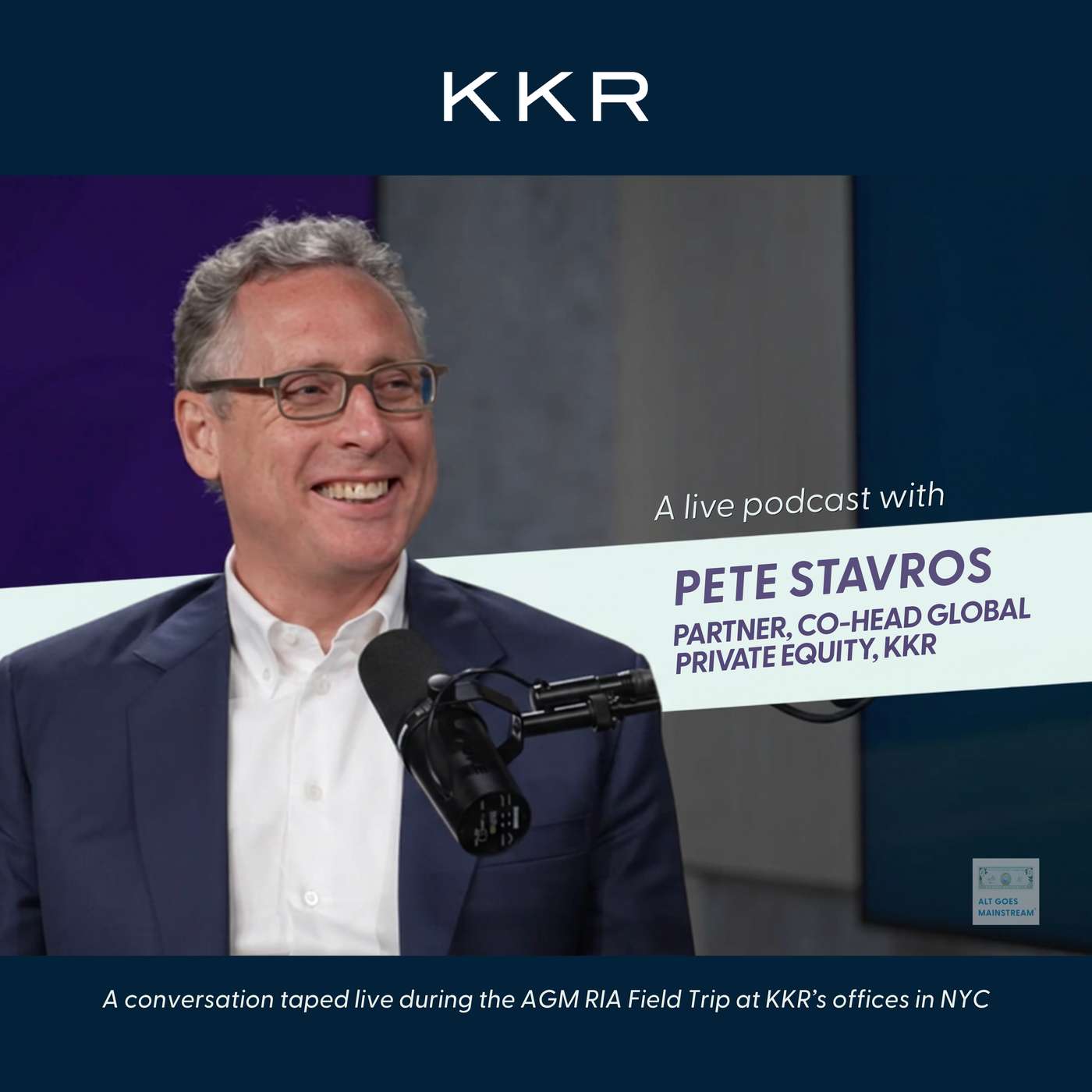
Pete Stavros (KKR) discusses KKR’s 50-year culture of collaboration and “making everybody an owner,” arguing private equity’s next decade should shift from financial engineering to total cultural transformation in portfolio companies. He explains KKR’s investment edge: extensive investor support teams (capital markets, macroeconomists, operating experts, ex-CEOs) and a process that evolves over time. He also details KKR’s broad-based employee ownership (BBO) approach, including financial literacy and post-exit wealth support, and how KKR scales this via Ownership Works.
Pete Stavros, KKR partner and co-head of private equity. Host/other speaker: not named in the transcript (All Goes Mainstream host), plus references to Henry and George (KKR founders) and external voices like Gallup, T. Rowe Price, and CFO/CEOs interviewed.
Culture can’t be copied quickly; it’s sustained through recruiting, evaluation, compensation, and promotion. Employee ownership plus leadership-driven cultural change improves retention and engagement. “Just stock” incentives fail; ownership requires education, information, and decision input.
Gardner Denver (10-year transformation; quit rate down 90%, engagement up from 19th to 91st percentile; value creation via “value-added value engineering” yielding ~$60M savings). Capital Safety (2011; worker safety/turnover issues; early ownership mistakes led to later improvements). Cool IT (recent sale; ~14x money; workers’ income in stock up to ~800%). Ownership Works coalition (50 firms; labor leaders, banks, McKinsey, foundations). AI experiments across KKR’s 225-company portfolio (130 active experiments). Software not dead; durable analytics software example: Cotivity.
Written by AI. May contain mistakes.
Discussion on Pete Stavros' background and his path to KKR.
“Welcome to this live Alt Goes Mainstream podcast, the RA Field Trip.”
Exploration of KKR's collaborative culture and its impact on the firm.
“KKR has had its 50th anniversary a few weeks ago.”
Insights into how KKR supports its investors through resources and collaboration.
“It's really, it's got to account for everything that you do every day.”
Discussion on innovative approaches to value creation at KKR.
“on the culture impacting how we invest, we bring the best of all of this to bear on every single opportunity, which I really don't think anyone in the world does.”
Understanding the importance of cultural transformation in private equity.
“And I'll just quickly touch on the last thing you said, which is around the kind of culture of the businesses we invest in and what we do with them.”
Learn how cultural shifts can impact business performance and investment success.
“And the engagement scores as measured by Gallup went from the 19th percentile to the 91st, that's a total cultural transformation.”
Discover the origins and challenges of implementing broad-based employee ownership.
“How did the decision to create the broad-based employee ownership BBO plan come about?”
Explore how employee ownership changes lives and shapes workplace culture.
“And I can't tell you how many ways we screwed this up.”
Understand the importance of financial literacy in managing wealth after ownership events.
“the audience, how do you think about closing that loop once they have a wealth creation event?”
Learn about the initiative to share employee ownership practices within the industry.
“This is like an ongoing journey, and it's really complicated.”
Learn about the potential influence of employee ownership in private equity and its broader implications.
“I then had a peer firm call with the same question of how much should workers invest?”
Discover how private equity firms adapt employee ownership programs in different countries.
“God, if everyone did this, who knows what this could become.”
Explore the evolving landscape of private equity, including software and investment strategies.
“People find it entertaining and interesting.”
Examine how AI is being integrated into private equity and its potential benefits for portfolio companies.
“And what's going to happen to private equity if it is?”
Reflect on the importance of culture in private equity and ownership dynamics.
“particularly when there's enough ops improvement to protect the downside.”

Get the gist, explore an idea or ask about something said.
 Claude
On Alt Goes Mainstream: The Latest on Alternative Investments, WealthTech, & Private Markets, what are the key points of this episode?
Searching your listeningAutomatic transcript. May contain errors.
0:00Welcome back to the All Goes Mainstream podcast. We were live from KKR's studio in New York City. We sat down with KKR partner and co-head of private equity, Pete Stavros. This was a special podcast recorded live during AGM's first RIA field trip.
0:14Pete Stavros: I think the next decade is moving from balance sheet arbitrage, income statement arbitrage, and tinkering to total cultural transformation. What a great conversation. Hope you enjoy.
0:54We're going mainstream.
1:08Thank you.
1:26Pete Stavros: We're going mainstream. Welcome to this live Alt Goes Mainstream podcast, the RA Field Trip. We're here in KKR's studio. Thanks for having me. Pleasure to have you. I think there's so much to discuss around KKR's evolution as a firm. It's 50th anniversary. Your career and trajectory in private equity. What's going on today. How you've thought about making everybody an owner. I think that's core to the value of the firm, and it's also core to how you think about private equity. So a lot to get into. First, I want to start with your background. I think that's just a good way to set the table. How did you end up at KKR?
2:07Pete Stavros: Oh, gosh. I was working at another private equity firm in Chicago, and we partnered with KKR on a deal. This is like in 2004, and the firm was really small at the time. They had expanded into Europe, not really yet Asia. And it was mostly two offices and it was largely just a private equity business, New York and California. So worked with some partners on a transaction, got to know them and then got a call. And I think they said, we're looking for between zero and two people. The firm was so small at the time. And then that kicked off like six months of interviewing and then eventually an offer and convinced my wife to.
2:49Pete Stavros: moved to New York. Well, here we are. KKR has had its 50th anniversary a few weeks ago. What, when you joined the firm, would you say is still the same today? For sure, the culture. So when Henry and George started KKR in 1976, it was really with an eye towards creating a different type of firm that was more collaborative than a traditional Wall Street investment firm. And I think there's lots of cultures and models that can work. Other firms have, I would say, very tight P &Ls, where if you run a business or you run an industry vertical, how you do determines not only your career trajectory, but your compensation, like in that year.
3:34Pete Stavros: Your deal does great, you're going to do great. And Henry and George always hated that, and they thought that sub-optimized what the collective could produce. And so when they started KK Art was all about collaboration. We want everyone to share in everything that we do. We think we'll deliver the best outcomes if we can get people working across functions, across industry verticals, even across regions of the world. And that has never changed. So here we are 50 years later, and it's all about culture. And culture is, it's hard to create and hard to sustain. So when we talk about culture being our advantage, someone might say, well, if it's an advantage, why don't we just copy it?
4:15Pete Stavros: But this is 50 years of determining who we recruit, how we evaluate them, how we compensate them, who gets promoted, who gets elevated, and what gets celebrated in the firm. It's really, it's got to account for everything that you do every day. How do you sustain a culture? It's got to be, like I said, everyone coming in the firm to recruit to everyone who's getting promoted to partner. It's got to be a part of literally everything you do. There's this case study at Harvard Business School on Ritz-Carlton. Ritz-Carlton has these career days and people come in to learn about Ritz-Carlton and you get beat over the head on service.
4:57Pete Stavros: So if you're not someone who gets a charge out of helping other people, you opt out. It's a little bit like that interviewing at KKR. You come to interview and you'll interview with 20 people and all 20 people are going to hammer the idea of collaboration. This is not a star culture. We win and lose together. Not everybody wants that. And so you'll get a lot of people who just say, I'm going to go to firm XYZ. I want to bet on myself. And if I win, I want to do great. And that can work. It's just not the way we operate. So again, it's got to be a part of like every aspect of how we manage the firm.
5:29I think what's interesting about that is the culture, the values, the mission, it all reflects itself in the investment culture of how you think about investing, underwriting deals, how you work with companies and founders. How do you think that the culture, mission and values and the DNA of KKR actually reflect itself and the investment culture and the investment process?
5:54Pete Stavros: One of the things that separates KKR is the extent of the resources that we surround our investors with. So for every investor, we have six people who help them make better decisions and be more effective in their jobs, be more efficient. So, for example, we've got 70 or 80 people who are capital markets experts who, when a company is going public, doing a secondary offering, doing a debt financing, repricing their debt, the capital markets people take all that work off of the investor's plate, and they're just better at it because that's all they do for a living. We have a team of 50 macroeconomists who work with us on portfolio construction.
6:32Pete Stavros: They do microeconomic analysis of individual companies we're looking at. We have a team of 100 operating experts who work with our deal teams on individual companies. We've got another 100 ex-CEOs, kind of advisor types who chair businesses for us, and on and on and on. That's really unique. What's even more unique is the ability to get all those people to work together. So you could replicate all the resources, but without the culture, that deal team is not going to pull on all the different capabilities inside the firm. So to your point on the culture impacting how we invest, we bring the best of all of this to bear on every single opportunity, which I really don't think anyone in the world does.
7:15Pete Stavros: You might point to other big firms and say, well, they have an operating group or they have some macroeconomists. They don't operate the way that we do. I think there's two things in there that come to mind when you talk about that. One is the fact that you have this entire platform to help companies as they grow and scale. That helps your private equity business. I think you wrote a paper in 2024, one of your colleagues, Josh, did about you make your own luck. And that gets into kind of some of the capstone business and how you help companies post deal, which I think we'll talk about in a bit because today's private equity is different from five years ago's private equity or 10 years ago's private equity.
7:52The other piece is the, I think persistence and performance is really about persistence and process. And I think you mentioned this on a GS Exchange podcast, the performance has been roughly 20 % annualized over a long period of time. To have that kind of consistency in performance, I think comes down to persistence in process. How do you think about that persistence in process and maybe tie that to what you do on the post-deal value creation side?
8:21Pete Stavros: So I would say I agree with the persistence in process point, but it's also about constantly evolving because we're in a very competitive market. So if we have our standard set of operating procedures of like we buy a company and these are the value creation levers we pull on, well, others are going to figure that out. So I would say the sophistication with which we are constantly evolving our approach, I think would surprise people. I'll just give you one example. We bought a company, a public company called Gardner Denver. We took it private. And I think there's this assumption that a company in the public market sometimes, well, it must be well run.
8:57Pete Stavros: It's under the bright spotlight of the public markets. And that's often not the case. I think the governance model is very different from the private markets where there's not quite as much alignment between the board and the owners and the management relative to how we operate. So this company, there were some obvious value creation levers, how they were purchasing raw materials, labor productivity, inventory management. And then there were newer things we were experimenting with. One of them is now, I think, more broadly known, and people call it value-added value engineering. But the idea was this company made a lot of air compressors, and they were largely standard products.
9:36Pete Stavros: And with a standardized product, if you can make small changes in the cost of that product across millions of units, you can save a lot of money. So we rented out a vacant warehouse and we took our highest selling compressor and we dissected it from the base. Like you would walk lengthwise across this warehouse and you'd start with the base of the compressor and then we'd lay out all of the parts of the compressor ending with the rotary blade. And then we bought the competitive compressors in the market and dissected them in exactly the same way. So then when you walked across the warehouse horizontally, you could compare parts across the compressors.
10:17Pete Stavros: And we brought in a cross-functional team where we had our manufacturing experts, our procurement experts, our energy efficiency experts, our sales leaders. And we would say, okay, let's start with the base. You can't help but notice our base is three times as heavy as the competitor's base. Why do we have a base? Because this impacts not only material costs, but transportation costs. Do our customers even want this? So the salespeople go make customer calls and the salespeople say, in fact, I hate this because when I need to move your compressor, I can't move it as easily as I can one of the competitors.
10:49Pete Stavros: So, okay, we're going to fix that. And then all the way down, you get to the rotary blades, we're comparing material composition of our blade versus others, energy efficiency implications, etc. That led to a list of dozens of changes we could make to our compressor that added up to$60 million of savings. Now, it took us years to get after it all because this is not so easy to change the material composition of your rotary blade, for example, but that's the extent to which we are involved in these companies and we're always coming up with new ways of making companies better. And I'll just quickly touch on the last thing you said, which is around the kind of culture of the businesses we invest in and what we do with them.
11:31Pete Stavros: That's the new frontier. So when you said private equity is changing, I think the next decade is moving from kind of balance sheet arbitrage, income statement arbitrage and tinkering to total cultural transformation. And I think that's where the industry needs to head. What do you mean by total cultural transformation? What I mean by that is in America and I'll give you the American statistics and then I'll just make the case that the problems are global. Most Americans don't like their job. So 70 percent of Americans are not engaged at work. An average American company changes out its whole workforce every three to four years.
12:11Pete Stavros: And we look at plenty that change it out every 18 months. You look at a big retailer, they are rehiring their entire front line working in stores every 12 months. So if Walmart has a million employees, they're hiring a million people a year. Workers have no wealth. Wealthy people own all the stock in America. The top 10 % of Americans own$45 trillion of stock assets, and the bottom 50 % own$400 billion. Two-thirds of Americans are not financially literate. on and on and on. There's just this massive list of problems with the workforce. Well, that's bad for companies, right? This is all bad for workers, but these companies are having to rehire, retrain, onboard, offboard, try and teach people about the business.
13:00Pete Stavros: They're losing all of this knowledge as people keep flooding in and out of their doors. And so total cultural transformation, and I'll just quickly say, we are so trained to think these are American problems. Do you think there are more billionaires per capita in America or Sweden? Far more in Sweden. But Sweden is supposed to be a gentle form of capitalism. You hear the data of minority of Americans are engaged on the job. I think it's 30 % according to Gallup. In Japan it's like 10%. And that, there's all these paradoxes in the world where people say, well in Japan the quit rate's almost like zero.
13:38Pete Stavros: Nobody quits. That's masking some other challenges that are very similar to what we face. If you look at financial literacy, lack of wealth, it's the same everywhere. These are unfortunately really pervasive in the capitalistic world. So when I say total transformation of the culture, what I'm talking about is how do we undo all this? How do we reverse it? And that Gardner Denver example, this took us 10 years, but the quit rate at Gardner Denver dropped 90 percent. And the engagement scores as measured by Gallup went from the 19th percentile to the 91st, that's a total cultural transformation.
14:10Pete Stavros: That's a different business. And when we took it public, the reason it traded for like eight EBITDA turns more than it ever had and beyond all the peer set is because the culture. You talked to T. Rowe Price, who ended up buying 25 % of the company, and they said, we own the stock for one reason, it's because of the culture. How do you, when you're looking at a business, underwrite culture and underwrite whether or not you can make a cultural transformation in that company? So it's implicitly underwritten in what we think we can do with it. So when we're saying we can do X, Y, and Z around labor productivity, raw material productivity, quality, customer satisfaction, there's an implicit assumption that we're going to change the culture.
14:52Pete Stavros: And our confidence in our ability to do it is improving, but it's not a certainty that we can make it happen because it's really dependent on how good the leadership is. As evolved as we are, we're not in the factory every day. And so we're relying on the leaders we hire to drive these transformations. And that realization set off a whole series of work streams on what makes great leaders great. Why do some leaders transform their cultures and others don't, despite us providing the same tools? We'll probably talk about ownership, but we have a huge content library of how to make workers owners, how to administer the plans, how to communicate the plans, how to teach financial literacy, how to share more information with the frontline in a way that they'll grasp it.
15:40Pete Stavros: And you give two CEOs the same tools and you get different outcomes because they have different leadership capabilities. So to answer your question, like we underwrite it, but we hedge it because we know that's not a guarantee. It's like any investment. We give the tools, we make the investment. It doesn't guarantee the culture's going to shift. But it does seem like making employees owners has been effective. And to your point, it may be more effective in certain companies rather than others. But uniformly, if you make employees owners, that changes the way that they think about the business, changes retention, productivity, et cetera.
16:19Pete Stavros: If the leadership team does the hard work to make it about more than just stock. So if it's just stock, it's a compensation discussion, which is important, but it's not a cultural conversation. So does that CEO and leadership team take ownership as the foundation and then do the work to teach financial literacy, teach people about the business? Do they give them more say over their daily work? If someone's made an owner, their expectations of the company actually go up. So I'm an owner. There's information I should get. there are decisions I should have input on. So where it doesn't work is when it's just about the stock.
17:00Pete Stavros: When it's about the stock being used as one tool to change the culture, that's when it works. How did the decision to create the broad-based employee ownership BBO plan come about? The first time we tried it was 2011. So we were working on a deal called Capital safety. This was a company that makes fault protection equipment. So if you've seen a worker up on a bridge or a building, the harnesses that they wear and then the lanyard that attaches them to the structure, that was the equipment that the company makes. And what happened was this was the first manufacturing investment we'd made in some time.
17:39Pete Stavros: So KKR in the 80s did a lot of manufacturing investing. And then as growth year industries became more exciting, we pivoted to healthcare care and media and technology and manufacturing had not become as big of an effort for us. So as a result of that, I think we were caught a little by surprise at how disconnected and unhappy those so-called blue-collar workers were. And so much so that when we signed the deal, between signing and closing, there's this period of time where you're waiting for antitrust approvals, etc. We were getting faxes into our office. This is 2011, so faxes were strange for sure by then, but they were from frontline workers saying the workplace is unsafe, people are getting hurt, the turnover, the rate of turnover where people are quitting, it's out of control, supervisors don't listen to us, etc.
18:36Pete Stavros: And it was surprising because the business was very high performing and you could tell the people cared about one another. This was not like a cold culture. It was a function of high growth where they were struggling to keep up with demand. They were taking a ton of market share and all this other stuff was falling by the wayside. So we dive in headfirst, work with the leadership team. We had to bring in some new leaders and we tried ownership. So as a means to get people more engaged and to stop quitting, we tried giving people a stake in the outcome. And I can't tell you how many ways we screwed this up.
19:12Pete Stavros: I could spend an hour just on that. The communication was terrible. We actually initially tried it at one plant only, which was so stupid because everyone obviously talked, and on and on and on. We didn't teach financial literacy. We made so many mistakes. But even as poorly as we did it, we were able to see this could really matter. And when we sold the company to 3M workers, the reaction from the workforce, I think you could probably still find one of these videos online that workers and we have posted. I mean, it was transformational for people. And so even as poorly as we did it, we knew we were on to something.
19:50Pete Stavros: And now we've done this with 85 companies, about 200 ,000 frontline workers were on these programs. We've had many exits and many great outcomes. We just sold a company this month. this month or last month called Cool IT. You guys may have heard of it. They make HVAC cooling systems for data centers. It was a knockout deal. We made 14 times our money and workers who had been there 10 years made 800 % of their income in stock. And even more recent years, workers, I think people who had only been there a couple of years made like 300%. I'd never seen such an immediate impact where people were talking about all the ways it was going to change their life.
20:31Pete Stavros: I mean, the dollars were so big, and this was in Calgary, which has a very large amount of immigration. And so there were all these folks from all over the world who hadn't had a chance to move their families yet, hadn't bought a home, and it was like, let me tell you how my life's going to change. It was very cool. So where my mind goes, and we have a number of wealth managers, people who run these firms in the audience, how do you think about closing that loop once they have a wealth creation event? then what comes next for the employees? You talk about financial literacy. Is there an ability to close the loop with wealth management services as well?
21:08Pete Stavros: Yes. I think we've done an okay job of that. Here's been our journey with financial literacy. Back to that capital safety example, we did nothing. There was nothing done with financial literacy. And if you look at some of these old videos of the celebration event and you hear people say buying a new car, going to, you know, on the dream vacation, a lot of those people were probably in debt and had not been prepared for a large influx of money. And that was a huge miss. It didn't dawn on me until a couple of companies later, we had a very successful investment and we were paying dividends on the stock and a frontline worker came up to me in tears because he was going to lose his home.
21:53Pete Stavros: And I was like, how's that possible? The business is on fire. You're working more hours than ever. There's all this overtime. We've paid multiple dividends on the shares. You personally must have made, I don't know,$15 ,000 just in dividends. And he's like, well, I bought a truck and I took a loan out to buy the truck. And then my brother loved it and he wanted a truck, but he couldn't, he didn't qualify for a loan. So I put his loan on me and when you add up two car loans and my mortgage, I'm underwater. And I was like, oh my God, we had never anticipated how actually giving people more money could make them worse off if they weren't prepared for it.
22:34Pete Stavros: So that was when we started financial literacy training. So during the course of an investment, we're teaching folks about saving, planning, budgeting, the importance of getting out of credit card debt, the true cost of credit card debt, and so on. We've had other learnings along the way. For example, the pressure that can be created on a worker by receiving his or her income every other week can be a strain. So we found some service providers who, for a fee that we will absorb, not the worker, they can access their wages every day. So if they miss budget or make a planning mistake, they're not running to a payday lender, which is what we wanted to avoid.
23:15Pete Stavros: What we did was we inserted into that service of when people were accessing their wages every day. We'd pay for the cost. We just needed to know why they were doing it. And we learned that it was less about a budgeting error and more about an emergency. So a boiler would break or they'd have a health issue or their car would break down. And that's when they would run to a payday lender if they didn't have access to their wages every day. So then we started another program having an employee emergency assistance fund. at our companies. So we'll put, I don't know, a couple million dollars in a nonprofit fund effectively that can give grants to workers.
23:51And then we learned people were coming to companies
23:55Pete Stavros: and working for decades, and then we would run into them because we'd buy the company, and then we'd try to get them to do financial literacy training, and they'd say, it's too late for me. I've been at this, I'm 60 years old, I'm not interested. So then we started experimenting with going upstream into high schools, local high schools to teach financial literacy. So it's been this long journey. And then at the exit event, we now show up. We prepay for financial coaching for 12 months post the event. We prepay for everyone's tax filings because we don't want someone who'd never had wealth to make a big mistake on their taxes.
24:29Pete Stavros: This is like an ongoing journey, and it's really complicated. And financial resilience is a stack. It's not just one issue. I mean, watching those videos is incredible. You see these people, they're so happy in a way that almost is, it's almost indescribable unless you probably see it and you feel it having seen the journey with these companies. It's not just you who's doing this now. You pioneered this program, but it's now something that other firms in the industry are adopting as well. How have you thought about helping other firms, maybe your competitors as well, adopting this? But I think it speaks to a broader point of like, one is ownership matters.
25:08people owning equity. It's really important for them. There are a number of reasons that you mentioned earlier. And then two is it helps these companies. So you create more resilient companies. How have you thought about bringing this to the industry beyond KKR?
25:22Pete Stavros: Yeah, that's a great question. And we talked a lot about it. We've done this now with 85 companies. We've learned from so many mistakes you've made. And we've also learned from things that really went well. And 85 companies in, we think we're pretty good at this, so why would you ever teach other firms to do it? And there were two reasons why we started this nonprofit called Ownership Works, and there's now 50 private equity firms that are part of the nonprofit. Together, what's exciting about Ownership Works is around the proverbial table, you have labor leaders and labor advocates and labor pension funds sitting with Goldman Sachs and other banks, sitting with McKinsey, KKR, other private equity firms, Rockefeller Foundation, Ford Foundation.
26:06Pete Stavros: It's a pretty unusual coalition. And we're all saying the same thing, which is if this could become more common and a bigger effort in corporate America, it could really matter. So why would we do this? There's two reasons. And I'm just going to do a quick digression with a story, which is one of our CEOs, I'd always been opposed to workers investing out of pocket. This always was supposed to be a free benefit. And one of the CEOs I worked closely with said, trust me, Pete, people don't value what they don't pay for. So I know my people. It doesn't need to be a lot of money, but they need to invest.
26:44Pete Stavros: And that had always been not something I wanted to do for if you go back to the ESOP transactions, when workers gave up defined benefit pension for stock and then the stock didn't work out. there was a history of thinking it would not be a good idea for workers to take risk, particularly given the low financial literacy in the country. So I resisted. I resisted. Finally, I gave in. So we open up a solicitation period, and people can make investments in the company, and a worker shows up with a brown bag of, I think it was$10 ,000 or$12 ,000 in cash. So the HR leader goes to this person and says, I'm not trying to be nosy, but why did you bring in cash?
27:23Pete Stavros: And that's a lot of money. Are you sure? And he says, I'm definitely sure. I'm not missing this opportunity. And in terms of why I brought in cash, that's because I don't have a bank account. And she's like, so did you have this like under your mattress? Where was the cash? Again, not sure everybody knows, we're just trying to understand. And the guy's like, no, it's a loan. She's like, a loan? But you said you don't have a bank account. And he said, no, yeah, it's a street loan. It was basically like a loan shark loan that he was taking out at God knows what interest rate to invest in a private equity deal.
27:55Pete Stavros: So we shut down the solicitation, returned everyone's money, and never did that again. I then had a peer firm call with the same question of how much should workers invest? It's like 5 ,000, 1 ,000, 500. What if should they take loans? So people were going to make mistakes that we either already made or almost made, which could be damaging to the whole employee ownership idea. That was part of the reason of why would you work with other people if you guys think you're so good at this. The other thing was more aspirational, which is think of how... Now I'm really going to go on a digression and a tangent, but think of the impact private equity could have on the country.
28:38Pete Stavros: Think of how many people we employ. KKR alone employs a million people across our companies. And so if we could get all the private equity doing this, that might be 15 million people. And if 15 million people are on these ownership programs, well, then all the public companies are going to have to do it or they're not going to be competitive. And the benefit that private equity has for all of its challenges is it's got the most effective governance model and the most effective way to cascade change. And that's because it all goes up to very few people. So at these investment firms, if the top of the house says, you know what, we're doing ownership, that might be 500 ,000 people like that.
29:17Pete Stavros: as opposed to I spent a lot of time with the Harley-Davidson folks working with them on an ownership program and we got it done but it took us I don't know 12 months and multiple board meetings and steering committee meetings and worrying about what the shareholders are going to say and that impacted at Harley like 4 ,000 people which was great but with the same amount of time if we convince private hockey firm XYZ you might get 50 times that number in the same amount of work. So those were the two reasons we, to answer your question, why would you work with other firms is there was real downside to the effort for all of us.
29:55Pete Stavros: And there was this aspirational view of, God, if everyone did this, who knows what this could become. On that point, you also invest internationally in a big way. How do you think about taking this program and doing it internationally as well? Is it similar, different, harder, because you have to deal with different countries, cultures, et cetera? Or is this very much, you'll do it in the U.S., and then you'll figure out how to export it outside of the U.S. private equity ecosystem? Yeah, so we started it in the U.S., and we let our partners experiment with it as opposed to, we could have just said, you're all doing it.
30:32Pete Stavros: But then you can't hold people accountable the minute you start telling them what to do. So we gave our U.S. partners years to experiment with it, and slowly they all tried it, saw the benefit, importantly, as you note, saw the impact on people as exits started to happen. And now we're at a stage where in the U.S. with every deal, this is what we do. And then in the last handful of years, maybe five years, maybe a little bit longer, we've experimented outside the U.S. So we've now done this across Western Europe. We've done this in Canada, in Vietnam, in Japan, in New Zealand. We've done it kind of everywhere, but we're still giving the partners outside the U.S.
31:18Pete Stavros: time. We've done it in India to experiment. And I think we'll get to a place where we figure out the local cultural complexities, because every country is obviously very different. The U.S. has more of an ownership culture than many other countries. There's more people who watch CNBC here, it's almost like a part of entertain. You got mad money. People find it entertaining and interesting. We've got Robin Hood, so there's a lot of people interested in the market. You don't have that everywhere. So it'll be different. And the cultural, we were talking earlier about Japan as an example. In the US, a company is trying to get its quit rate down above all else.
31:57Pete Stavros: The quit rate is just out of control, as we talked about earlier. In Japan, the quit rate is very low. For most of our companies, it's 2-3%. but the engagement scores are worse than in the United States. So there it's about engagement more than about how do we get people to stop quitting. It'll be different. It'll be different everywhere. I want to segue a bit in a quick discussion about your views on private equity today. There's a lot going on, whether it's what's going on with exits. You have software, you have AI. What are your thoughts on the current state of private equity today? Let's see.
32:35Pete Stavros: The current state of private equity, maybe we could just talk about some of the headline issues like, is software dead? And what's going to happen to private equity if it is? I think people love big proclamations. I think it attracts press attention the more dramatic you can be. For sure, software is not dead. There will be parts of it that are challenged. And if the old model was in a basic workflow tool to just take pricing up 10 % a year because you're convinced there's too much of a software coding barrier to entry for someone to switch, that's going to be hard. Thankfully, software for us is one of seven verticals.
33:14Pete Stavros: And lucky for us, we'd never played in that high multiple buy a company and just jack pricing game. It was frustrating for a long time. I used to get calls from George Roberts saying, Hey, did you notice Vista and Toma and all these other firms sold another private equity deal for X times their money? And they didn't hold it that long. And they bought it at 20 times EBITDA and sold it for 30. For a long time, that was frustrating, but it just wasn't consistent with our approach. And so we missed all that. The software deals that we did were lower multiple. And I would say more like business analytical, business analytics tools, like one deal called Cotivity is a provider of analytic tools to insurers.
33:56Pete Stavros: So it leverages all of this historical data we have to give them advice on fraud, over billings, things like that. So a native AI tool could never replicate it because they don't have the data. So there's, thankfully we've been in software that is maybe a little less sexy, but is more durable. So is software dead is one of the big headlines. And parts of it will be challenged. I think a mistake would be for people to say, well, now I'm just like never doing software because there'll be interesting things to do. How do you think AI will impact a lot of the companies that you invest in? Because you're investing in a lot of businesses that people may not necessarily see out there every day, but they are things we use in our daily life.
34:37Pete Stavros: Back to the benefit of private equity for a second, how one firm is responsible for so many companies. It gives us a huge advantage in learning. So we have the largest private equity portfolio in the world. We have 225 companies. That's an opportunity to run AI experiments at scale. So think of our AI effort in the portfolio as a matrix of along the top, all the AI vendors, which range from ones you would know like Deloitte, McKinsey, et cetera, to little boutiques you would have never heard of. And then along the other axis, all the possible applications you can imagine. We have like 130 experiments running right now trying to find the right vendor application match.
35:20Pete Stavros: And when we find it, we then look for opportunities to roll it across the portfolio. We should learn faster than anyone on AI in terms of how to apply it because we have the biggest portfolio. We're running the greatest number of experiments. That's how we're using it in our portfolio. In terms of new deals, I think there'll be opportunities to take the other side of the risk equation as long as, of course, it's bounded and we see enough operational improvement that even if we're a little wrong, we're still going to be fine. I would take accounting firms. Accounting was a hot private equity idea.
35:53Pete Stavros: People were paying 20 times EBITDA for accounting firms. Now you can buy one for 10 and people are like, accounting's dead. I'd bet a lot of money accounting is not dead. I talked to a CFO of a big company about what it would take for them to switch auditors. I mean, this is a regulated part of finance. The CEO is signing his or her name to the statements. If you have an accounting problem, you've got a big issue. Another thing about accounting, remember all the days when offshoring was starting and all the accountants were going to do all their work overseas? A lot of that has moved to India and other places.
36:27Pete Stavros: And people were saying accounting's dead. It's going to be a price war. Never happened. All the offshoring happened, and the accounting firms captured the benefits. So I would be pretty skeptical of industries like that where people say, it's dead. So I think there's opportunity to make some interesting investments, particularly when there's enough ops improvement to protect the downside. I think that's such a great way to tie this all together, because we started by talking about culture. We started the day with Henry talking about the founding of the firm and being we, not I. And I think this just ties so much of it together around how you as a firm operate, how you think about working with your companies, their employees, and what that means, and that it's really about ownership and equity.
37:06So thank you, Pete. Thank you. Appreciate it. Thanks for listening to this episode of Alt Goes Mainstream. I hope you enjoyed it. You can read more about alts at my substack, altgoesmainstream.substack.com. Thanks a lot, and have a great day.
37:20Pete Stavros: We're going mainstream.
Welcome back to the Alt Goes Mainstream podcast.
Today’s podcast unpacks the importance of ownership and equity, and how the world’s largest private equity firm (source: PEI 300) has helped create a culture of ownership within its portfolio companies and more broadly across the industry.
With the backdrop of KKR’s studio in New York and the firm fresh off the heels of celebrating its 50th Anniversary, we sat down with KKR’s Co-Head of Global Private Equity Pete Stavros for a live conversation during AGM’s RIA Field Trip to discuss how culture can be a competitive advantage and how it defines much of what KKR does both internally and with its portfolio companies.
Pete has not only been a leading private equity investor at one of the industry’s largest firms, but he’s also been a pioneer in one of the industry’s most important initiatives: enabling employees of private equity-backed companies to share in ownership of the companies where they work.
The firm’s Broad-Based Employee Ownership has delivered on its promise in many ways, with KKR’s recent 14x (and $4.75B) exit on CoolIT providing all 650 CoolIT employees with cash payouts that ranged from approximately one year to more than eight years of annual pay, which, as Pete noted in our conversation, was “life-changing for many employees.”
Pete and I had a fascinating conversation about the culture of ownership at KKR, the evolution of the firm’s private equity platform, why it’s so important to make employees owners, and how it’s created a ripple effect in the industry. We covered:
Bio
Pete Stavros (NewYork) joined KKR in 2005 and is Co-Head of Global Private Equity. This includes oversight of assets across Europe, Asia and the Americas and traditional large and mid-cap private equity, core and growth equity. Prior to this role, Pete served as Co-Head of the Americas Private Equity platform. He is a member of several investment committees at KKR. As an investor, Pete has helped lead a number of successful investments across sectors and sizes, including HCA Healthcare, Nielsen, Gardner Denver / Ingersoll Rand, Capsugel, Capital Safety, Hyperion, Flow Control Group, Charter Next Generation, Minnesota Rubber and Plastics, Geostabilization International, Crosby Group and CHI Overhead Doors. Prior to becoming Co-Head of Americas Private Equity, Pete led the Industrials industry team where he pioneered an innovative employee engagement and ownership model. This approach has been successfully implemented at more than 90 KKR companies and has positively impacted more than 200,000 workers. Pete is the Founder and Chairman of Ownership Works, a non-profit focused on building a worker ownership movement globally and enhancing the financial resiliency of the workforce. The goal of Ownership Works is to create more than $20 billion of wealth for working families over the next decade. Pete is also the Founder and Chairman of Expanding ESOPs, an organization focused on dramatically expanding the number of Employee Stock Ownership Plans (ESOPs) in corporate America. Prior to joining KKR, Pete was an investor with GTCR Golder Rauner, where he was an investor in the healthcare sector. He holds a B.S. in Chemistry, magna cum laude, from Duke University and an M.B.A. with high distinction, Baker Scholar, from Harvard Business School.
Thanks, Pete, for sharing your wisdom, expertise, and passion on private equity and making everyone an owner.
Show Notes
00:00 Live From AGM Field Trip at KKR Studio In NYC
00:29 A Message From Ultimus Fund Solutions
02:00 Meet Pete Stavros
02:09 The Story of Joining KKR
02:33 From Interviews To NYC
03:08 All About Collaboration
03:02 A No Star Culture
04:03 How Culture Is Sustained
04:43 Ritz-Carlton Analogy
05:23 No Star Culture
05:29 Culture Shapes Investing
05:54 Platform Resources Edge
06:24 Capital Markets Bench
06:41 Macro And Ops Experts
06:52 Making Resources Work
07:52 Consistency And Process
08:40 Evolving Value Creation
08:46 Gardner Denver / Ingersoll Rand Case
09:25 Value Engineering Method
10:09 Warehouse Teardown
10:54 Customer Feedback Loop
11:25 Sixty Million In Savings
11:50 Culture As The Next Frontier
12:16 Defining Transformation
12:27 Workforce Crisis Stats
13:08 Problems Are Global
14:28 Underwriting Culture Risk
15:12 Leadership Makes It Work
16:00 Ownership Done Right
17:06 BBEO Origins
19:10 Early Mistakes Learned
19:30 Scaling To 85 Companies
19:59 CoolIT Exit Results
20:48 Closing The Wealth Loop
21:12 Financial Literacy Journey
21:45 Truck Loan Lesson
23:39 Building Resilience Stack
24:15 Exit Support Package
24:37 Industry Adoption
25:40 Ownership Works Launch
27:04 Street Loan Cautionary Tale
28:00 Why Share The Playbook
30:02 Taking Ownership Global
30:56 International Rollout
31:31 Local Culture Differences
32:15 State Of Private Equity
32:40 Is Software Dead
33:09 KKR Software Approach
34:26 AI At Portfolio Scale
34:55 One Hundred Thirty Tests
35:35 Buying The Fear Trade
35:49 Accounting Is Not Dead
37:08 Closing Thoughts
A Word from Our Sponsor, Ultimus
This episode of Alt Goes Mainstream is brought to you by Ultimus, the full-service fund administrator and transfer agent powering asset managers in private and public markets. As alts go mainstream, you need real expertise to handle complex fund structures, connect with key distribution partners, and handle sophisticated compliance, reporting, and transparency demands.
That’s Ultimus: high-tech, high-touch solutions for over 450 clients and 2,500 funds with $775B in assets under administration. Backed by an expert team of over 1,200 employees, they place client service at the core of their business, helping you navigate complexity during your fund structuring or launch and then supporting you through every stage of growth. Whether you’re already in the market or thinking about entering private wealth, you can trust their team’s deep expertise in retail alternatives to help you reach your goals.
Learn more at ultimusfundsolutions.com or email info@ultimusfundsolutions....