Ask ChatGPT


 Alt Goes Mainstream: The Latest on Alternative Investments, WealthTech, & Private Markets
6 Oct 2026 · 43m · 26 chapters
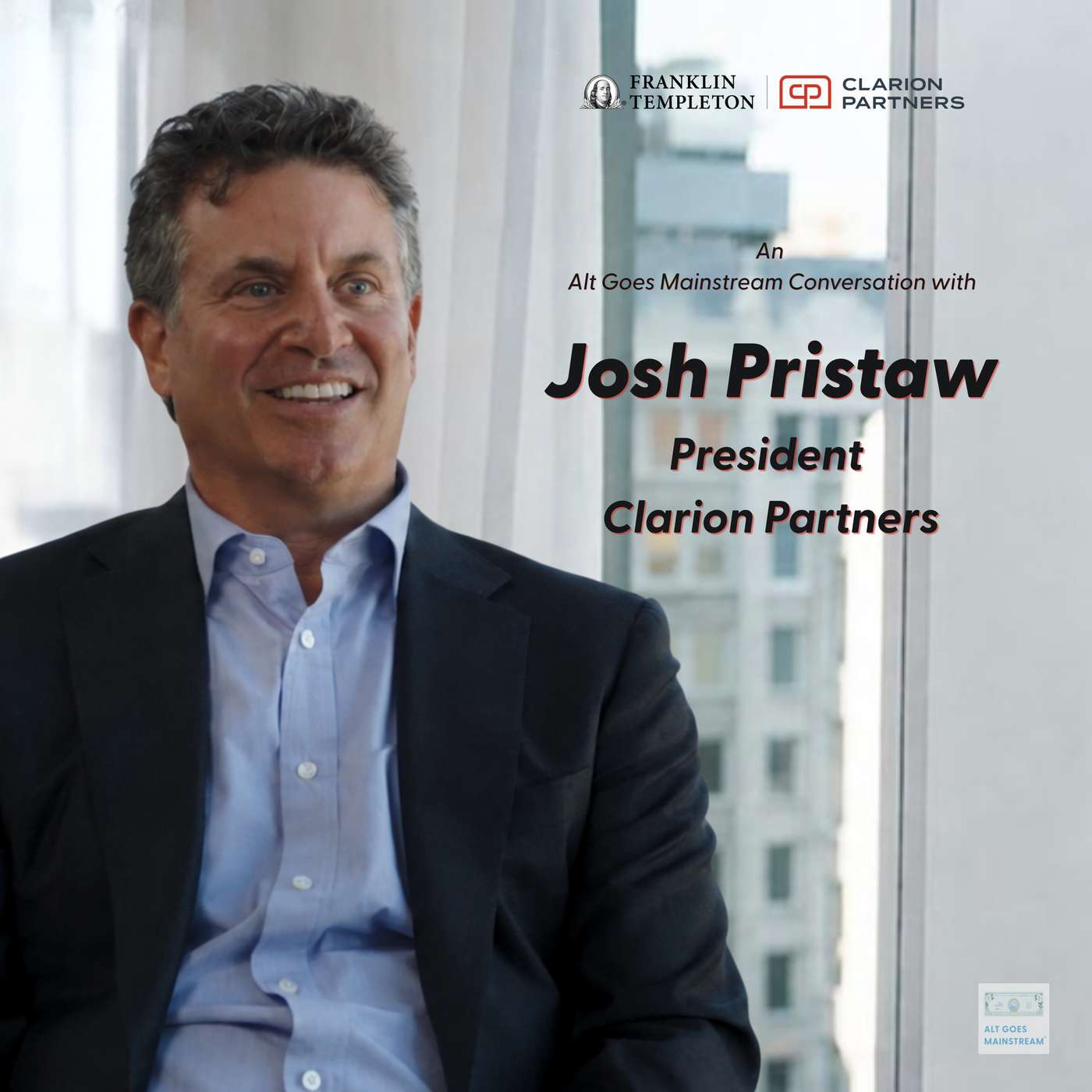
Josh Pristaw, president of Clarion Partners (a $72B real estate investment firm within Franklin Templeton’s alternatives), explains how Clarion invests using long-term demographic/structural megatrends plus heavy data science, with an emphasis on diversification and evergreen/open-ended fund liquidity management. He argues that “80 is the new 70,” and uses demographic-driven underwriting to target sectors like healthcare/senior housing, industrial logistics, essential retail, and housing.
Josh Pristaw began in shopping center investing (late 1990s/early 2000s), later ran Brazil-focused real estate businesses, then worked at Pretium Partners managing large-scale single-family rental operations (100,000 homes; 3,000 employees), and now leads Clarion.
Clarion models ~15 asset classes down to postal codes; it sells as much as it buys (especially since 2022) via active portfolio management; data centers may be less suitable for evergreen core/core-plus due to liquidity/valuation uncertainty and development-to-sell dynamics.
senior housing demand from “10,000 people turning 80 daily”; industrial demand tied to e-commerce sales and future warehouse specs (power, level floors, robotics); self-storage demand driven by “housing velocity” from senior home sales.
Written by AI. May contain mistakes.
Discussion of Josh's career trajectory and experiences in real estate.
“But as Josh talked about, Clarion does it by diversification.”
Josh shares insights on investment strategies and the evolution of the real estate industry.
“We're in Franklin Templeton and Clarion's office here in New York.”
Exploration of demographic trends and their impact on real estate investments.
“You've worked internationally in Brazil, which we'll get to.”
Discussion on how to make informed real estate investment decisions.
“And depending on those asset classes, you can have pretty profound differences.”
Learn how diversification impacts the ability to sell real estate assets.
“$5 or$10 billion data center, as an example.”
Explore the different buyer profiles in real estate and their impact on sales.
“And who is often, given the size and scale of your platform, who is often the buyer?”
Understand the dynamics of investing in Brazil and the lessons learned.
“Why did you decide to start a real estate investment firm focused on Brazil?”
Discover the advantages of investing in the U.S. after experiences in Brazil.
“But I would say there was a famous Brazilian economist who said in Brazil, even the past is unpredictable.”
Learn about the operational complexities of managing a large real estate portfolio.
“What did you learn that you've now taken to your time at Credium?”
Explore how data science enhances real estate investment decisions.
“How do those two things come together as it relates to how you leverage data science to make better real estate investments?”
Examine the balance between quantitative analysis and personal relationships in real estate.
“And so when you fuse those two things together, I like to say we're not guessing.”
Identify key trends driving investment in industrial, healthcare, and housing sectors.
“How much of that is really quantitatively driven?”
Learn how e-commerce influences the demand for industrial real estate.
“But across each of those four sectors that you focus on, what are some of the things that people may not realize that's driving a lot of these trends and why you like each of these sectors?”
Discover strategies for developing and maintaining future-proof real estate properties.
“or are companies going to be more efficient in how they use those properties?”
Understand the importance of water and power availability in real estate investments.
“are going to want five or 10 years from now.”
Explore how macro trends influence underwriting practices in real estate.
“And if there's no water, people won't move there.”
Explore the intricacies of perceived versus actual risks in data center investments.
“How much is something like that a greater actual risk than perceived risk?”
Learn how macro trends influence underwriting decisions and location strategies.
“I've lived on the East Coast my entire life.”
Discuss the challenges and considerations of investing in data centers.
“Yeah, I think it's about knowing who you are and what's the value proposition you're providing to your clients.”
Examine the liquidity challenges and future value uncertainties of data centers.
“In our business, we don't have any asset that's more than$500 million in our open-end funds.”
Understand the demand-supply dynamics affecting data center investments.
“What happens five years from now when somebody wants their money back and you have to go sell an asset to meet a redemption?”
Discover best practices for managing open-ended funds and ensuring liquidity.
“centers that that might meet how much supply is being built.”
Identify the key challenges in managing evergreen funds and aligning strategies.
“It's not something you just sort of do part-time.”
Learn about the importance of active management and capital structure in funds.
“There's a very long gestation period on those dollars.”
Understand how data and quantitative analysis can drive real estate investment success.
“I imagine you have a secular view on a space.”
Learn about the importance of tackling complex problems in real estate investments.
“It's the really hard things that sometimes fail that I think you take the most from.”

Get the gist, explore an idea or ask about something said.
 Claude
On Alt Goes Mainstream: The Latest on Alternative Investments, WealthTech, & Private Markets, what are the key points of this episode?
Searching your listeningAutomatic transcript. May contain errors.
0:00Welcome back to the Alco's Mainstream podcast. I'm Michael Sijmore, founder of Alco's Mainstream, co-founder and partner of Broad Hidden Ventures. We have a fascinating conversation on tap today. It was with Josh Pristaw, president of Clarion Partners, a$72 billion real estate investment firm that's part of Franklin Templeton's family of alternatives managers. Josh has such a fascinating background in the real estate space, starting investing in shopping centers, to building an investment firm that focused on both the U.S. as well as Brazil, to working at Predium Partners, to now being president of Clarion, which is one of the largest investors and managers of industrial real estate, along with Blackstone and Prologis.
0:37We had such an interesting conversation about how to cut through complexity in a space that requires tons of scale and capital. But as Josh talked about, Clarion does it by diversification. They have one of the largest open-ended real estate investment platforms. 95 % of their capital is in open-ended funds. Josh does believe in AI and data center trend, but he has some interesting perspectives and nuances that relates to why data centers might not fit into how they think about investing. He also talked a ton about some of the mega trends and themes that drive their investment thesis. So great conversation.
1:13Thanks so much, Josh. Hope you enjoy. This episode of Altco's Mainstream is brought to you by Ultimis, the full service fund administrator and transfer agent powering asset managers in private and public markets. As Altco Mainstream, you need real expertise to handle complex fund structures, connect with key distribution partners, and handle sophisticated compliance, reporting, and transparency demands. That's Altimus. High-tech, high-touch solutions for over 450 clients and 2 ,500 funds with over$775 billion in assets under administration. Backed by an expert team of over 1 ,200 employees, they place client service at the core of their business, helping you navigate complexity during your fund structuring or launch, and then supporting you through every stage of growth.
1:55Whether you're already in the market or thinking about entering private wealth, you can trust their team's deep expertise in retail alternatives to help you reach your goals. Learn more at ultimisfundsolutions.com or email info at ultimisfundsolutions.com.
2:12Pleasure to be here. We're in Franklin Templeton and Clarion's office here in New York. Really exciting conversation on tap. I think you have such a fascinating background. Not only have you been in real estate, your entire career, but you've worked in some pretty interesting places, which we'll get into. Claire Ann is one of the largest investors in real estate in the industry. Really interesting purview on what's going on. And you have some very specific views on megatrends and maybe some that are somewhat surprising to some people, which we'll get into as well. So really excited for the conversation.
2:44First, I want to start with your background. You started in 1997. Long time ago. But also a lot of experience. So I want to start there with just what your career trajectory has been like and how the real estate industry has evolved over that time as well.
3:02Josh Pristaw: Well, maybe start with what's always been fascinating to me is to be focused on things that have sort of long-term, we'll call it durable secular trends or demographic trends, but something that was operationally challenging or operationally intensive. So something where it was going to be good for a while, but not everybody could just do it. And so I would say I started that in the shopping center space in the late 90s and early 2000s, running around buying sort of failed shopping centers, redeveloping them, and bringing in modern new retailers that were growing, companies like Walmart, Target, Costco, Home Depot.
3:36Josh Pristaw: And from there, I went to Brazil, which I know you want to talk about later, and U.S. housing, which were two areas that I thought had really long-term positive trends, but were pretty operationally intensive. And then more recently here at Clarion, focusing on almost exclusively on things that we have believe have really long-term secular structural trends. But the industry in general, I would say, has changed pretty dramatically. Just the sheer scale of it, and I would say the professionalism. So if you were to wind back the clock,$100 million transaction in 1997 was a really big deal. And if you look at the scale of alternatives managers today, where it's trillions of dollars, the scale and then the access to information is dramatically different.
4:14So I want to touch on something that you mentioned in there, which is some of these long-term durable structural trends. You've worked in different categories of real estate, shopping centers. You've worked internationally in Brazil, which we'll get to. Clarion here, industrials, health care, essential retail. What are some of those features of some of these long-term trends that you saw? Even going back to early days when you were in shopping centers, what were some of those trends that have stayed constant throughout the different types of mega trend real estate investing that you've done?
4:51Josh Pristaw: Well, the first thing I'd say is demographics is sort of inevitable. And that's a really powerful thing. So if you look at consumer habits or spending habits, you can pretty much tell based on history what people do at different ages of their lives. And barring things like a pandemic or war, which we seem to have both of recently, you have a pretty good sense of how many people are going to be at different parts of their life looking out 5, 10, 15, 20 years. And so that enables you to look at things like one of our highest conviction ideas right now is around health care real estate, where you have 10 ,000 people turning 80 every day.
5:25Josh Pristaw: And historically, when people turn 80, their ability to stay safely alone in their homes decreases, unfortunately. and about 10 % of those people elect to go into senior housing. So as an example, we can look forward at what we think the number of 80-year-olds are going to be in different parts of the country and have a pretty strong view of what the demand is going to be for senior housing. And to meet that demand, you would have to build five times as much new supply as is currently in the pipeline and sustain that for the next 15 years. So that megatrend looks a lot to us like what we saw with e-commerce in 2010.
6:01Josh Pristaw: Or you just can't keep up? On the point about real estate, because that fact in and of itself is mind-blowing to me. 10 ,000 people every day turning 80 in the United States. What do you have to think about as it relates to the future in order to get that right? And I ask that question in some senses as like, are you underestimating certain aspects of things due to the speed at which technology adoption or AI? Say people live longer or live healthier lives because of what AI can do to healthcare. How do you think about those types of impacts to some of these megatrends as you think about underwriting real estate investment?
6:38Josh Pristaw: Yeah, well, it's a great question. And it's one that's sort of occupied my mind, not just recently on healthcare, but it actually impacts the same trends impact different real estate asset classes. And that's what makes this so fun. So I think we're already experiencing that because I like to say 80 is the new 70. So this industry, a lot of people thought that that adoption into senior housing would happen at age 70. But people, not because of AI, are just healthier, they're wealthier, they're living longer, and they're staying active longer. We think we've sort of planned for that and are accommodating that in our sort of revised plans.
7:12Josh Pristaw: But I think the other thing that, just based on my background in housing, is to me quite interesting, is we have a phenomenon we call aging in place. So that ability to stay in your home longer means that if you look at the home ownership rate for people over 75, that's about 80%. There's something like 25 to 27 million homes that are owned by seniors. And compared to the previous generation, that's about 10 percentage points higher. So when people ask, like, where are all the homes? Where is this affordability crisis that we're experiencing right now? A lot of that is the previous generation would have sold that home to an entry level young family.
7:49Josh Pristaw: And so like grandma and grandpa own these homes and they haven't been recycled back into the system. Time will solve that problem and I think will be a big part of what helps solve the affordability crisis in the house market. Is that senior housing comes online and meets the – you have the supply to meet that demand? I think it's almost – And then that fills some of the gap? I don't think it's dependent on the supply. I think it's a needs-based thing where people will not be able to live in their homes on their own. They will need to sell those homes. and those homes will get recycled into the system.
8:20Josh Pristaw: But that has other profound impacts on other asset classes. For example, we have an 18-person research and data science team here. One of the really attractive things for me at Clarion was coming to a firm that had the scale to really unpack and invest in these things. And so what we've done is we've basically modeled 15 different asset classes, national, market, sub-market, all the way down to the postal code in some cases, to understand what drives rent growth for each of these sectors. And then we can forecast those variables and have a view going forward. For self-storage, for Exenters, interesting.
8:53Josh Pristaw: The number one thing that drives demand for rent growth is housing velocity, somebody selling a home. So going back to this idea, if you have 27 million homes owned by people that are 75 and older that are inevitably going to sell those homes in the next 5 to 10 years, that's going to create stimulus demand for self-storage in those areas. That's a really interesting example. And I think it applies both to real estate and to other asset classes. So where my mind goes when you talk about that is how much, because you're investing in so many of these mega trends, you see a lot of demographic changes.
9:33You have to project out some of these demographic changes forward. How much can investing in or having exposure to the type of real estate themes and trends you're investing in, how much can it help inform allocators on other trends or investment theses that they can and should have? Outside of real estate? Either in real estate or outside of real estate.
9:57Josh Pristaw: Look, I think in real estate, it's extraordinarily powerful to have your own data and access to, I would say, sort of broad market data make these decisions. And if you think about dispersion in things like the way we think about operating evergreen funds, there's essentially four quadrants in real estate. There's sector selection. So the difference between did you pick office assets or industrial 10 years ago? Your performance and outcome is dramatically different. Market selection. So do I want to be in Southern California or do I want to be in Nashville? And depending on those asset classes, you can have pretty profound differences.
10:30Josh Pristaw: Then there's asset selection. The first two are top down. The second two are bottoms up. And then the last one is execution. So somebody needs to go renovate the unit, lease the space, make sure that your elderly mother or father is getting the care that they need in that senior housing facility, or they'll move out. So you need to do all four of those well. And I think these trends really impact how you make those decisions. What matters more when it comes to driving returns, the macro trends or the bottom up? Oh, it's interesting. I would say you have to be good at all of them. If you look in the rear view mirror over the last 10 years, I think the sector selection was massively important.
11:06Josh Pristaw: So I think you need to make the early calls like right away on which sectors you want to be in. And then I think it goes to what is, if you don't get that right, the rest of it's kind of irrelevant. And I think it goes to what's your style of investing. So as we talked about, we're mostly core, core plus at Clarion, mostly evergreen funds. We're investing in things that we fundamentally expect to own long term, where cash flow is going to grow, and we think they're going to be worth more in the future. That leads you to a different conclusion than if you're just going to buy something, fix it, and flip out of it.
11:40Josh Pristaw: I would say the asset selection is probably much more important than getting the sector and the market right. And there's no unanimity of opinion here at Clarion. You probably get a different answer from other people. I think it's really hard to overcome the top down if you don't get those right. And it's a little bit, we talked earlier, my experience in Brazil, which was great for a long period of time. But at some point, that sort of, did you want to be in Brazil? It didn't matter. We built some of the best buildings ever built in that country that had a lot of demand from the tenants. But if you don't get the country, if you don't get the big picture right, it's really hard to come out on top.
12:16How do you think about timing that bet, right? Whether it's in a certain region like Brazil, or maybe it's the Southeast, the US, which seems to be really popular right now, or some of these sectors. How do you make sure you time that right and you have enough runway to actually make sure that you have the time on your side, especially if you're owning these assets? Sure.
12:38Josh Pristaw: I think the short answer I'd give you is I prefer not to have to time it. You want to have conviction that the trends are really long-term. And I think the beauty of the sort of privilege of the types of vehicles that we manage is that we can look through the noise to the signal of things we think are going to be good long-term. Now, you have to balance that with the fact that if you get it wrong early, investors can redeem and choose to go elsewhere. And the other thing I would say is we're constantly reevaluating all these assumptions. And so one of the things I'm the most proud of, having looked back at the performance of Clarion in the last, really, in the last four years or so since interest rates spiked in 2022, or even looking through more of a risk on period during COVID, is in almost every year, we've sold as much as we bought.
13:19Josh Pristaw: And that's pretty uncommon. If you think about the growth of the alternatives business, is that people tend to accumulate assets when things are good, and then they sort of get stuck. And so I think we've been really disciplined about being an active portfolio manager and selling things that we've extracted the value we thought we could get, or maybe we have a different view on that market. Given the size and scale at which you're operating now, I think there's a nuance here because you're a scaled platform. I think along with Blackstone and ProLodge, just one of the biggest investors in industrial real estate in the industry.
13:52$72 billion platform. But a lot of the assets are actually not small in size, but diversified relative to buying a $5 or$10 billion data center, as an example. By design. And I want to get to that. But before we do, how does that level of diversification enable you to sell assets? You talk about selling as much as you're buying. Has that enabled you to sell assets? And who is often, given the size and scale of your platform, who is often the buyer?
14:27Josh Pristaw: Well, I think that's the beauty of having what I would say is digestible assets that are diversified within our platform is that there's tons of different profiles of buyers that can buy it. And maybe going back to one of my lessons or experiences in Brazil, where I feel like I underestimated the importance of liquidity and having a really broad base of people that could buy these assets. And so if you look at Clarion, most of our assets are either industrial or multifamily housing. And those are the two biggest, most liquid transaction markets where it could be anywhere from other core funds to local high net worth to sovereign wealth funds to non-traded REITs, literally almost everybody in the real estate world participates in some way in that type of a market.
15:15Josh Pristaw: So they're highly liquid. I want to talk about Brazil a little bit, because I think it's so fascinating that you had an experience internationally in a market that's quite interesting. And it was at the early days of its demographic trends in the right direction. Why did you decide to start a real estate investment firm focused on Brazil? So first of all, it was about equally split between the US and Brazil. I ran the Brazil business. I went a week a month for 17 years, including a three-month stint when my first son was born. And it was a fantastic experience. I would say the overarching theme, going back to where I started the conversation today, was we were looking for long-term structural demographic trends where we thought we could build a business for a decade or two around that theme, coupling that with operational or development expertise in real estate.
16:05Josh Pristaw: And at the time, the US economy was struggling after the GFC. And when you looked at a place like Brazil or many of the emerging markets, they had a very young population and they needed every kind of asset class. They didn't have enough homes, didn't have high quality offices, there were no distribution centers, the hotels were a mess. And so we serially built teams and businesses by asset class at the firm I was at, GTIS, to take advantage of that opportunity and built some amazing projects. What was the hardest part about investing in a place like Brazil? You know, I would say it was a university education in complexity.
16:41Josh Pristaw: You take for granted sometimes how efficient the markets are here, how liquid they are, how clear the rules are. And to a certain extent, that was a little bit the advantage there is that it wasn't something everybody could do. We had over 40 people at the peak in that business, and all but one of them locally were Brazilian. So we built a local execution capability to do that. But I would say there was a famous Brazilian economist who said in Brazil, even the past is unpredictable. And we found that from time to time. But it was a fantastic place to build a business, like wonderful culture, people.
17:15Josh Pristaw: And for me, as a professional, I learned so much because the degree of problem solving you had to have for something that was completely unexpected that you could never anticipate. and just coolly, calmly dealing with those kind of situations, I think it really set me up for the future. What's made it easier investing in a place like the U.S. after having had that long run of experience in Brazil? You know, I'm very fond of analogies. So there's sort of the sports analogy that the game slows down at some period of time. I think the number of variables that change, the tax code, the labor laws, entitlements, like approval processes were changing quite frequently.
17:54Josh Pristaw: So I think that the sort of stability that those things don't move nearly as much in a place like the US, and then I would say the sheer volume of liquidity are the two biggest, I would say, things that I took away from that. And then so from GTIS, you're at Predium, another massively scaled firm, I think around$62 billion or so, but largely focused on single family. What was your experience like there? What did you learn that you've now taken to your time at Credium? Yeah. I mean, incredibly innovative, dynamic company. And I would say if Brazil was the university education in dealing with complexity, owning and operating 100 ,000 single family rental homes across the country with 3 ,000 employees was a PhD.
18:38Josh Pristaw: It was really, I would say, dealing with operational challenges and running a business as opposed to simply making investments was the next level of my professional development. And I think the direction of where I think a lot of the alternatives investment sort of industry is going. But the other one that was very, very eye-opening was use of data and analytics. Because when you are trying to manage 100 ,000 disparate things, we had to build, and I say we, but I don't take attribution for this. There's like a fantastic management team, a fantastic group of people that work there, had to figure out how to value individual homes.
19:18Josh Pristaw: How do you renovate them? How do you manage them? And there were so much data science and analytics. And the way to look at that and then apply that to other industries and other real estate businesses is a huge opportunity here at Clarion. And I would say the commitment of the firm to invest dollars to figure that out and the partnership with Franklin Templeton, when you look more broadly at the resources that they have, was a significant part of why I find this job so fascinating. Tying a few things together, you talk about the importance of data science and you talk about the importance of underwriting and understanding demographic trends.
19:52How do those two things come together as it relates to how you leverage data science to make better real estate investments?
19:59Josh Pristaw: Well, they're entirely connected. I mentioned earlier when we were talking that we forecasted essentially 15 different asset classes. And so what are we doing with that? We're doing something called a recursive factor addition, RFA, which is a fancy data science word for. We run thousands of models using computing power you couldn't do probably five or 10 years ago to identify, again, what are the things that drove demand for our different products? And then we make assumptions about for each of those asset classes based on demographics, how many people are going to be there at that part of their life and they're going to want that.
20:33Josh Pristaw: And so when you fuse those two things together, I like to say we're not guessing. Of course, there's no certainties in life and certainly less in investing, but we're not guessing that we think there's going to be demand for a senior housing facility. We're not guessing that we think there's going to be demand for a rental residential property or a warehouse because we've done a lot of research around those things that suggests that demand will be there. Maybe it's 90 days later or six months later, but it'll be there. How quantitative has real estate become relative to the relationship side of real estate?
21:06Josh Pristaw: I think it's becoming incredibly quantitative. And I think it depends. I think fund management, so the world of Clarion or Franklin Templeton is extraordinarily quantitative. And I think you simply can't compete if you're not already quantitative and leaning into these things pretty significantly. I think that being said, at the end of the day, our customers are people. So you can't ignore personal relationships and a resident has to have a good experience. They have to feel like they're treated well. If you're leasing space in a warehouse to a tenant, they have to want to do business with you again.
21:41Josh Pristaw: So it's really a combination of those two things. But I don't think you can be competitive in the fund management business without being quantitative. Is the area that you focus on, Clarion, industrial, healthcare, healthcare facilities, essential retail - Housing. And housing. How much of that is really quantitatively driven? Because that is very much predicated on some of these large trends that we should talk about. I think different parts of it are predicated on different parts of being quantitative. So we, as a firm, we're organized by asset class. So maybe important to highlight, we don't have a bunch of generalists.
22:21Josh Pristaw: So we have the industrial team. If you work on industrial, you're an industrial. The housing team, we have a vertically integrated operating platform that has 750 employees around the country in different markets. And in those businesses, when you're vertically integrated, it's quite quantitative. So we're doing things like in the housing business, how much ad spend do we want on certain properties? What is the top of funnel demand from the resident, like for which unit types? And we have different screening criteria. All this is about driving sort of bottom line cash flow. So that's extraordinarily quantitative.
22:55What are some of the things that people like myself, so certainly the stat of 10 ,000 people turning 80 every day is one of them. But across each of those four sectors that you focus on, what are some of the things that people may not realize that's driving a lot of these trends and why you like each of these sectors?
23:16Josh Pristaw: Oh, sure. So some of my favorites. So as you mentioned before, we're the third largest owner of industrial in the U.S., about$42 billion of assets. And so our research suggests that what really drives demand for industrial logistics, because we don't own factories, we own warehouses for distribution, is e-commerce sales. So the most impactful thing that can drive a demand for one square foot of space is a dollar of e-commerce sales. And so what I think people don't appreciate is over the next 10 years, annual e-commerce sales are expected to be$1 trillion more per year 10 years from now than today.
23:54Josh Pristaw: And so that's a huge number. And that's going to drive a lot of demand for space. So if we roll out the string on that, there's going to be more demand for product. So therefore, more demand for space. So does that mean there's going to be more industrial logistics properties? or are companies going to be more efficient in how they use those properties? So, and this goes to a question we were talking about on another day, was that what do we learn from being one of the largest owners and operators? Well, we understand where our tenants are going with their businesses. So, depending on the tenant, their demands are changing.
24:29Josh Pristaw: So, things like, will they need more power in the future? The answer is yes. You're going to have more robotics, depending on the use. And so, you'll be able to move more goods through there. And one of the trends we've seen in our warehouses over the last 20 years is while we generally only do single-story warehouses in the U.S., the height keeps going up because people are getting more efficient. And as you have more robotics and things that are picking things from higher up, it's not just the square footage. It's the volume of the space. So we're acutely focused on that. How does something like robotics impact the logistics industry?
25:03Josh Pristaw: Well, I think it really drives the demand for assets that have power. So I think you could see a scenario where 10 years from now, you have two assets that outwardly look very similar to each other but have huge dispersion in their relative values because one has access to power and others don't. And I'll give you other examples of it's about this sort of real estate geeky response, but the capacity and the levelness of the floor. So as a reasonably healthy middle-aged guy, like the floor doesn't have – for me, I can walk around. It doesn't have to be super flat and doesn't have to be pristine.
25:35Josh Pristaw: If you're rolling robots around there, it's got to be very flat. And as you add more things, it has to support more weight. We, as a large owner, we have what we call the Clarion spec, like the specification. So if somebody brings us an opportunity to develop a property, we often change it and say, we're going to invest more in some of these things because we're a long-term owner. We're not just going to build it and trade out of it. We want to future-proof it for what we think the Amazons and the Walmarts of the world are going to want five or 10 years from now. So how much of an edge is that aspect of the real estate investing business in terms of understanding how to build and maintain and future-proof the properties that you own?
26:18Josh Pristaw: I think it's a huge advantage. And so I would say it's not just – I mean there's plenty of people that know how to build, but build what? And so I think that part of it of really having a view of – and that goes to having dedicated specialists. So if we were a series of generalists who just allocate capital to other people, it's a lot harder to know, for example, like what you think Amazon might want five years from now. But we talk to companies like that all the time because if you go down the list of these different big users of space, we're one of their largest partners. So we have those fluid dialogues where we understand what they want to do.
26:53How do you think about things that are connected to the supply chain of real estate, but maybe not real estate itself? So as an example, power, water. You may not invest in those specific assets directly, but you need that in order to build and run the data center or the industrial. Not just that.
27:16Josh Pristaw: It impacts future growth, right? So one of the things I've looked at in the past with the research team, not at Clarion, but at other places, was when you look at the potential for drought out west. And every summer, I feel like you read about the Colorado River and you read about Phoenix. So we did a pretty serious deep dive to look at what actually drives the availability of water, not just to the site, but all these things are predicated on populations continuing to grow. And if there's no water, people won't move there. And so you have to be prepared to really look at. That goes back to the thing we were talking about before, the four quadrants, the market selection.
27:50Josh Pristaw: So you actually have to understand, is there power? Is there water? Is there fiber? And not just enough for your property today, but for that economy to continue to grow. How much is something like that a greater actual risk than perceived risk? Ooh. I think it's pretty episodic. So I think you'll see situations where, I mean, you're seeing it now with certain data centers that have been delivered that the power capacity hasn't caught up and they're running generators, diesel generators to meet the power to provide to the servers. And so the question is how long do they have to do that and how expensive is that compared to pulling power from the grid?
28:32Josh Pristaw: So I think it's sort of episodic, but you're definitely starting to see it. How much do some of the things that you're referencing impact how you think about underwriting going forward? Would you underwrite properties in different places than you might have otherwise as a result of some of these broader macro trends? Yes, but I would say that if the bigger macro trend is, when you overlay that with the data science, AI, and investment insight, I think when you really understand what drives you what drives growth and sort of cash flow growth in certain sectors, that will lead you sometimes to places you otherwise sort of eliminates implicit bias, right?
29:15Josh Pristaw: I grew up in Vermont. I've lived on the East Coast my entire life. You might have a certain view of things that leads you to Tulsa, Oklahoma for self-storage, for example, because if you really understand what drives it and you can identify zip codes where those factors exist, you can be sort of somewhat location agnostic. And so I think it's the application of those megatrends with the overlay of the data science where we're finding ourselves in places you might not otherwise think were the best. So finding yourselves in places that you might think differently. One would think, given the size and scale, that you'd be a participant in the data center investing space.
29:55Yeah. That is not necessarily something you do in as big of a way as some of your peers. Why?
30:04Josh Pristaw: Yeah, I think it's about knowing who you are and what's the value proposition you're providing to your clients. And so I'd start by saying that we totally believe in AI. I don't think data centers are a bad investment. But if you think about what a core open end core plus funds, what are they designed to do? So they're income oriented, low volatility, and we want liquidity for people. And so how do we do that? Well, we do it with diversification. We quite simply, we invest in things that over the long term, history has shown those types of assets are worth more in the future than they are today.
30:38Josh Pristaw: And the challenge we have with data centers in that space is that, first of all, most of the capital that's gone into investing in data centers so far has been development. The opportunistic part of creating the asset predicated on selling it to someone like Clarion in an open-ended fund that's going to earn a 8 % to 10 % return. So I would say the issue I have, a few issues with that, is one, I believe in AI adoption. I believe in all this thing. But if you're going to make that bet, why make it at an 8 % to 10 % return in an open-end fund as opposed to make it in a private equity or in your own NVIDIA stock?
31:13Josh Pristaw: I think the risk return on that is sort of a little bit asymmetric. But just going back to how we manage our business, if you look at the overall core Odyssey fund index, which is the institutional index, it's about$280 billion. We have the fourth largest fund. The non-traded REIT world, if you add that up, is about$140 billion. In our business, we don't have any asset that's more than$500 million in our open-end funds. And so that's by design. But if you think about how do you fit a$5 billion or$10 billion asset in one of these funds where the biggest ones are$10 billion or$15 billion or even$20 billion, I think it's really, really challenging.
31:50Josh Pristaw: And there are so few trades of these things that if investors said, give me my money back, go sell assets, it's not clear what those would trade for. I'll wrap that thought by saying we have a pretty good sense based on what the long-term demand is for multifamily, for industrial. I have not met a person who tries to articulate what the value of the data center is worth 10 or 15 years from now when the tenant leases up. Why is that? I think because people don't know what the needs, what the technology will be, will these things be in space? Will there be fundamentally different equipment that's needed?
32:26Josh Pristaw: One of the things that works really well in open-end funds, which I didn't touch on things, is also things that have low capex. because if you want to deliver income to people, that income gets gobbled up and consumed by CapEx. And so I think the question will be, it's undeniable that there's great demand from outstanding tenants, Microsoft, Google, Meta. But what happens 10 or 15 years from now? And even before then, let's say there's a 10-year lease. What happens five years from now when somebody wants their money back and you have to go sell an asset to meet a redemption? If you only have five years of term left on that lease and people don't know what that building is worth at the end of it, it's pretty illiquid.
33:07Josh Pristaw: So it's a question of liquidity for us in managing diversification. So I think that's a really important point because one, the Wealth Channel's product of choice is largely Evergreen. Two is there's a lot of investment activity in data centers. What happens to all these data centers that are in open-ended Evergreen vehicles? So it's a great question. And I'd go back and say, I don't think there's a systemic problem with data centers. I think that if you look at the development sides, I would say the vast majority of the capital so far has been in developing these things and then hopefully selling them.
33:45Josh Pristaw: I think what will happen is the volume of capital there completely outweighs what is available to buy it. So there's one thing I want to make sure I understand about how you're thinking about the imbalance between volume of capital raised for data centers and dollar value of assets and non-traded REITs. Those two things may be different, but there's another element of the whole data center investing space, which is there's so much demand for these data centers that that might meet how much supply is being built. How do those things relate to them? Maybe they're totally different. I want to make sure I understand that.
34:28Josh Pristaw: It's a great question. I think they're quite related, but they're distinct, which is sort of the point I'm trying to make. So I appreciate you asking the clarifying question. So again, according to Jones-Lang LaSalle, there's a trillion dollars of, I would say, new supply. There is a seemingly almost endless amount of demand, right? So I believe those spaces will be leased. The issue is there's just not enough capital to then, that is willing to invest at a core rate of return to acquire them because all of those business plans are predicated on build it, lease it, and sell it. None of them are, or almost none of them are predicated on holding them for 10 years.
35:07Josh Pristaw: And so what I think will happen, it's not like a crisis or anything. I think you'll just have a lot of capital that gets tied up in those well-leased data centers that become, there'll be more sellers than buyers, and it will be difficult to get liquidity in that. And that's, as we talked about before, I'm particularly sensitive to that just given my experience in emerging markets. And I think the practical expression of that when you think about as that ends up in evergreen open-end funds is if you have the overlay of that with the type of cycle you're seeing right now, for example, with private credit where people want to rotate some dollars out and are putting in redemption requests.
35:41Josh Pristaw: if you can't sell these$5 billion assets, and once you put them in these funds, it's going to put a tremendous amount of pressure on the portion of your fund that is liquid that you can sell. And so I think that may be the ultimate thing that happens here is that the data centers don't actually trade as much as people think. But if there's a demand for liquidity from wealth investors in some of these products, that those funds are going to have to sell multifamily, industrial, self-storage, the types of things that are more liquid. And hopefully, we're there to get a good buy when that happens.
36:12I think you bring up an interesting point, which is the management of particularly an evergreen or open-ended fund as it relates to real estate. That's something that Clarion has done for quite some time. I think 95 plus percent of the 72 billion or so is in evergreen or open-ended format. That's for institutional and wealth channel LPs. What are some of the lessons you've learned from managing open-ended vehicles for quite some time?
36:40Josh Pristaw: First of all, it's not a hobby, right? It's not something you just sort of do part-time. It's what we do. We invest really heavily in the teams that manage liquidity. They manage the capital structure. They manage the financial flexibility to be able to sell assets when we need to and to be able to even just to rotate into other things. We're going to generate a better return. So each of the teams are, I would say, very well staffed, almost like their own investment manager, subject to the risk parameters in the investment committee that we otherwise have. And I think you have to staff it that way because otherwise you get stuck with a portfolio that you didn't plan for the unexpected, which is another lesson from Brazil.
37:18Josh Pristaw: So I think you really need to do that. And I think you'll see big dispersion in performance over time from managers that really know how to manage evergreen vehicles. And if you think about it, again, a pleasure and a privilege of Clarion being part of Franklin Templeton and a trillion seven of assets that have – they're all open-ended largely. Some of them with daily liquidity in the mutual fund space. So that's just the DNA of who we are. What is the hardest thing about managing an evergreen or open-ended fund? Well, I think it's, well, I'll give you a few. One is, I think, matching the funds flows with the investment strategy.
37:58Josh Pristaw: And that's another one going back to the data center piece for a second is when you think about an institutional fund, people come in quarterly. And you have, I would say, much more. There's a very long gestation period on those dollars. You have a very good visibility. And people tell you long in advance when they're coming in and when they're coming out. And so you can match that. If you think about wealth products where people might come in every single day, having the visibility to know that you're going to have a billion dollars, that's a lot of days of individual trades. So I think aligning liquidity with the investment strategy is a really, really hard thing.
38:32Josh Pristaw: And then the other one I would say is I think you need to be set up for very clear and relentless communication with your clients. What's the most, maybe this actually already answers this question, but what's the most underappreciated skill in managing an evergreen or background to manage an evergreen? Well, I think it's two pieces that are related. One would be active portfolio management. So there's no such thing as set it and forget it. We're always evaluating what's working, what's not working, and where would you rather invest those dollars? And then the other one is managing a capital structure to be able to do that.
39:06Josh Pristaw: Because I like the expression computer real estate. It's great that on a spreadsheet, it says if you sell this and you reinvest it there, you'll earn an extra 10 basis points per year. But if your debt covenants don't allow you to release it, or you need consent from somebody, or that trips some covenant or a concentration issue, then you can't do it. So it's all theoretical. So you really need to manage the whole capital structure. How do you think about that aspect of managing an evergreen fund, figuring out where the best relative risk return is, as well as the opportunity cost related to that with what you talked about earlier about having this long-term view and trend, balancing those things.
39:43I imagine you have a secular view on a space. Yep. But those two things sometimes may come in conflict, no?
39:50Josh Pristaw: Well, it depends on the strategy of the fund. And I would say we have certain products where they're diversified and we run what we call model portfolios where we will look at, and again, you want diversification. So if you just look for the sort of absolute highest return, you might pick one sector and you'd say, that's great. We think that's going to be the highest, but that's maybe that's a higher risk strategy. So we like to offer different products for different investors that think about things differently. So we have people that like the diversified approach where we will toggle up and down exposure to different sectors based on how we think about them over time.
40:26Josh Pristaw: And there's a big focus now on rotating into what we call alternative sectors, healthcare, things like industrial outdoor storage, self-storage. And then we offer sector-specific products where someone might say, you know, I do my asset allocation. I do my diversification. I want the best partner to invest in industrial. And we think that we're that partner. What do you think is the most underappreciated aspect of real estate investing? I think how quantitative it needs to be to be successful. I think it is not the most forward tech-enabled business, but there are parts of it that have extraordinary tech adoption.
41:02Josh Pristaw: And I think to be successful, you need to be very data-enabled and very quantitative. And I think people still think about the legacy of it. And the people that are sort of – that are the managers that are sleeping in the switch there are going to get their lunch eaten. So for younger people in the real estate space, do they need a different skill set or should they focus on different things to become really good at? given what you just said? That's a great question. I think people should early on expose themselves to like a broad range of different experiences and not just do the same thing over and over and over again.
41:37Josh Pristaw: And I think that is, when I look back on my career, the sort of journey that looks kind of random when you think from like public school in Vermont to investing in shopping centers across the Midwest to Brazil to single family rental to here, which is really excited about this role, I touched a lot of different things and solved a lot of problems. And so I think it's a little bit of a cliche adage, but it's not the easy things that work out. It's the really hard things that sometimes fail that I think you take the most from. And that would be my guidance to people. I think that's such a great way to wrap this up.
42:09It's been all about solving problems. You've had complex problems in places like Brazil. You've had large-scale problems at places like Pretium and here at Clarion, given the size and scale of what you're dealing with and the types of assets you're dealing with. And there's always something that could be a geopolitical force or a macro force that are challenging to deal with, but underpin all by data-driven quantitative investing. This was such a fascinating conversation. Thanks so much, Josh.
42:35Josh Pristaw: Thanks for having me. It was great. I enjoyed it. Pleasure.
42:57Thanks for listening to this episode of Alt Goes Mainstream. I hope you enjoyed it. You can read more about alts at my sub stack, altgoesmainstream.substack.com. Thanks a lot and have a great day.
Welcome back to the Alt Goes Mainstream podcast.
Today’s podcast dives into the world of real estate with one of the industry’s largest managers and investors in industrial real estate.
We sat down in Franklin Templeton’s New York City office with real estate veteran Josh Pristaw, Managing Director, President of Clarion Partners, a $73.3B AUM real estate investment firm within Franklin Templeton’s alternatives platform.
Josh discussed data and durable demographics, which are drivers of the deeply researched investment process that his team at Clarion employs to invest in industrial real estate.
Josh’s background, which spans developing shopping centers to investing in real estate in Brazil to running one of the industry’s leading single-family rental investing platforms at Pretium, has helped him lead Clarion, one of the industry’s largest industrial real estate investment platforms.
Josh and I had a fascinating conversation, connecting data and demographics to actionable insights in real estate investing. We covered:
Bio
Josh Pristaw, equity owner and Managing Director, is President of Clarion Partners. He is a member of the Firm’s Executive Board, Investment Committee, and the Board of Directors for Clarion Partners Holdings, LLC. He joins Clarion from Pretium, where he served as Senior Managing Director and Head of Pretium’s real estate platform. Prior to Pretium, Josh co-founded GTIS Partners.
He has more than two decades of real estate experience across property sectors and functions, including acquisitions, asset management, portfolio development, and capital markets. He joined Clarion Partners in 2025 and has been working in the industry since 1997. Josh graduated from Dartmouth College, B.A. (1997).
Thanks, Josh, for sharing your wisdom, expertise, and passion about real estate investing and your data-driven approach to the asset class.
Show Notes
00:00 Introduction
01:14 Message from Ultimus Fund Solutions, Our Sponsor
02:44 Josh Career Origins
03:55 Real Estate Scale Shifts
04:51 Understand Demographics and Mega Trends
05:35 Senior Housing Supply Gap
07:12 Housing Turnover and Storage
08:24 Data Models Across Sectors
09:21 Data Driven Allocation Lens
09:57 Four Drivers of Returns
12:16 Timing Bets and Liquidity
15:17 Lessons Learned From Building In Brazil
18:06 Invitation Homes Data Ops
19:44 Clarion Data Science Edge
21:06 Quant Meets Relationships
22:11 Asset Class Specialists
23:16 Industrial Demand Megatrends
23:32 Ecommerce Trillion Wave
24:16 Efficiency And Taller Warehouses
4:58 Robotics Power Premium
26:54 Infrastructure Constraints
29:44 Why Not Data Centers
34:27 Supply Glut More Sellers
33:10 Liquidity Supply Imbalance
36:12 Evergreen Fund Playbook
39:26 Portfolio Rotation Discipline
41:16 Career Advice and Wrap Up
A Word from Our Sponsor, Ultimus
This episode of Alt Goes Mainstream is brought to you by Ultimus, the full-service fund administrator and transfer agent powering asset managers in private and public markets. As alts go mainstream, you need real expertise to handle complex fund structures, connect with key distribution partners, and handle sophisticated compliance, reporting, and transparency demands.
That’s Ultimus: high-tech, high-touch solutions for over 450 clients and 2,500 funds with $775B in assets under administration. Backed by an expert team of over 1,200 employees, they place client service at the core of their business, helping you navigate complexity during your fund structuring or launch and then supporting you through every stage of growth. Whether you’re already in the market or thinking about entering private wealth, you can trust their team’s deep expertise in retail alternatives to help you reach your goals.
Learn more at ultimusfundsolutions.com or email [email protected].
We thank Ultimus for their support of alts going mainstream.
Editing and post-production work for this episode was provided by The Podcast Consultant.