Ask ChatGPT

 Alt Goes Mainstream: The Latest on Alternative Investments, WealthTech, & Private Markets
19 Aug 2026 · 32m · 14 chapters
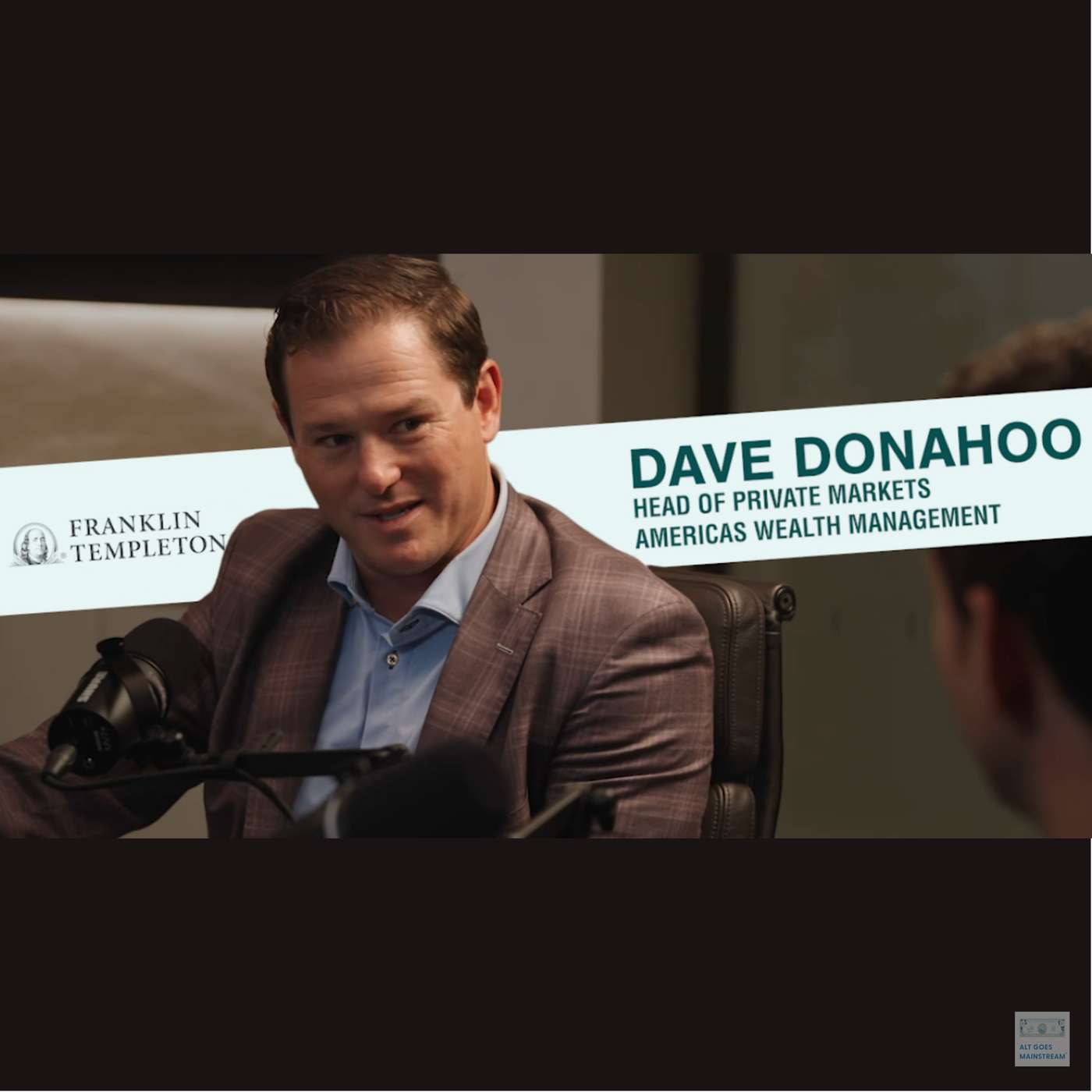
Franklin Templeton’s Dave Donahoo discusses building private-market and wealth solutions for RIAs by “starting with the end client,” using investor-first product design, brand/communication strategy, and careful structuring of perpetual vehicles.
Dave Donahoo is Franklin Templeton’s Head of Private Markets, America’s Wealth Management. He started at T. Rowe Price (individual investor channel in Sept 2008–early 2009), later worked in wealth/national accounts, then joined Blackstone during its private-markets growth (perpetual products). He now helps build Franklin Templeton’s private markets business for the RIA channel.
Client service and EQ matter; product structures must preserve investment integrity; “no one manager can do everything well” so use narrow-scope specialists; perpetual products require 6–12 months of covenant/structure testing; brand transformation takes intentional education.
Secondary private equity structure selection (avoiding interval funds due to incentive-fee/pricing and daily capital needs); infrastructure evergreen via non-traded structures with managers Lexington Partners (secondary infra), Benefit Street (infrastructure debt), Digital Bridge (data centers), Copenhagen Infrastructure Partners (renewables), and Actis (growth economies); DC/401k examples include private real estate via custom target dates and advisor-managed accounts, plus fund-strategist model portfolios.
Written by AI. May contain mistakes.
Dave Donahoo discusses his background and experience in private markets.
“Dave, welcome to the Alco's Mainstream Podcast.”
Dave shares insights and lessons learned from his time at Blackstone and Franklin Templeton.
“I think that's a big thing I take away from that early experience.”
Discussion on the benefits and obstacles traditional asset managers face in private markets.
“So I think that's a great segue to traditional asset manager going very deep in private markets.”
Exploring how Franklin Templeton aims to establish a reputation in private markets.
“meaningful private markets capabilities?”
Learn about the importance of investment integrity when considering vehicle structures.
“We study for a long time before we decide to build a perpetual, and it must not be for commercial reasons.”
Explore how different structures serve various asset classes and the rationale behind these choices.
“But is there a decidedly best structure for an evergreen?”
Understand the considerations made when structuring infrastructure investments.
“The second part that we thought a lot about was in an interval structure, you have to take capital daily.”
Discover the importance of preserving distinct investment cultures across firms.
“Infrastructure is a longer-duration asset.”
Learn about the significance of effectively using data within investment strategies.
“We want people that work really hard but work the right way and work in a collaborative way.”
Examine how macro data influences investment strategies across markets.
“sits on any of their investment committees, nor should we.”
Insights into the evolving landscape of product innovation in investment management.
“context of what you're able to see across public and private?”
Understand how historical insights shape solutions in private markets.
“Maybe some of what has been seen on the wire house channel side, maybe that creeps its way into the independent channel side.”
Explore how RIA channels are evolving and what they seek in investment products.
“Because if we talk to 10 people, you'll get 10 different opinions.”
Discussing the significance of client service and communication in investment management.
“What do you think the RIA channel wants as it comes to product and the different types of products or solutions that they could have?”

Get the gist, explore an idea or ask about something said.
 Claude
On Alt Goes Mainstream: The Latest on Alternative Investments, WealthTech, & Private Markets, what are the key points of this episode?
Searching your listeningAutomatic transcript. May contain errors.
0:01Welcome back to the Altco's Mainstream podcast. We were live from Franklin Templeton's office in New York City. We sat down with Franklin's head of private markets, America's wealth management, Dave Donahoo. And around the world, we've worked with superannuation plans and defined contribution plans in a variety of different geographies. So we know that market, we know that market really well. There's some unique ways that market is going to have to approach private markets. This was a special podcast recorded live during Altco's Mainstream's inaugural RIA field trip. Please enjoy.
0:33And now a word from our sponsor, Altimus Fund Solutions. This episode of Altgo's Mainstream is brought to you by Altimus, the full service fund administrator and transfer agent powering asset managers in private and public markets. As Altgo Mainstream, we need real expertise to handle complex fund structures, connect with key distribution partners, and handle sophisticated compliance, reporting, and transparency demands. That's Altimus, high-tech, high-touch solutions for over 450 clients and 2 ,500 funds with over 775 billion in assets under administration. Backed by an expert team of over 1 ,200 employees, they place client service at the core of their business, helping you navigate complexity during your fund structuring or launch, and then supporting you through every stage of growth.
1:18Whether you're already in the market or thinking about entering private wealth, you can trust their team's deep expertise in retail alternatives to help you reach your goals. Learn more at ultimisfundsolutions.com or email info at ultimisfundsolutions.com.
1:36Dave, welcome to the Alco's Mainstream Podcast. We are here at Franklin Templeton's New York headquarters, part of the AGMRI field trip. Thanks for joining the podcast. Well, thanks for having me. It's exciting. Back-to-back weeks, we've gotten to spend some time with you and with a live audience here. This is really great. So I'm excited to be on. I think no pressure with the live audience. You have a great group. And I think where I want to start is with your background. Your background started at T. Rowe, but you started in 2008 with the Individual Investor Channel. You've obviously since done a number of things at T.
2:10Rowe. You then went to Blackstone. Now you're here at Franklin. But I think it's interesting that you started your career in 2008 with the Individual Investor. What do you think that the private market space and then also the wealth space can learn from the things that you saw in 2008 working with individual investors at that point in time? Yeah, it's a good question. I'll be a bit more granular about when I started. I started September 15th, 2008, which was the day that Lehman Brothers fought for bankruptcy. So my first day, I was told I'd be in a six-month training program, that I would get my series of licenses, that I would learn what a stock, what a bond was, what a mutual fund was.
2:49And then sometime January, February, March of 2009, I'd end up on the phones answering inbound inquiries from investors that worked directly with the firm to buy mutual funds at the time. The website was like a new thing that a lot of people weren't comfortable doing their financial services and banking on. And so we had a phone bank and we talked to advisors or sorry, and clients, mom and dad buying their mutual funds and answer questions about them. So that training program didn't last six months. It lasted maybe six days and the markets went crazy and the inbound phone queues were 100, 200, 300, 400 people deep.
3:28And you had to find a way to go talk to humans to clear the work lines and the queues. And looking back, it's probably the greatest thing that ever happened in my career. I remember vividly a conversation I had probably December 2008, January 2009 with a mother who'd been a school teacher for 30 years. She was based out of Kansas. She had a$300 ,000 retirement account with T. Rowe Price that was allocated across various different mutual funds. And I think$300 ,000 was worth like$225 ,000 at the time she called. And obviously she had a lot of apprehension, a lot of concern, a lot of what's going on because this isn't her area of expertise.
4:07And at some point she said to me on the phone, if the account value keeps going down, is there a point where I owe you money? And that's like a really interesting question for a 22-year-old to answer. If I look back at that time on the phones, I think starting in chaos was really important because it forced me to learn on the fly. It's forced me to dive in and figure things out. And the most important thing I still take away from it that carries in my job today is the EQ aspect of that. Meeting a client where they are, understanding what their expertise is, what the expertise you can bring to them is, but talking to them in a language that they'll understand that it is comforting and assuring.
4:45It's still factual. You have to be honest. You have to share hard truths. But being able to meet them from an EQ perspective became a really, really important thing. And if I think about where we are as a private market business, a couple of things I carry forward from that. One, you have to start with the end client and work backwards. And we're in a room full of people that are really important clients to us as a firm, but you're not our end client. Our end client is your end client. And we realize they're your most trusted asset and commodity. And so for you to trust us to take care of them is a real privilege.
5:16But everything we do from product design to the way we carry ourselves and conduct our business starts with that end line in mind and pulls itself backwards. I think that's a big thing I take away from that early experience. We'll file something in there, what you just sent away for a bit, because I want to continue on your background. Because I think it's instructive to where you are today. So then you went to Blackstone. Now you're at Franklin. What did you learn from working in the wealth business at Blackstone? They were one of the earlier pioneers of doing this. So what did you learn from your time there?
5:46And what have you taken as you build Franklin's RA business? Yeah, really good question. Building to that, the rest of the time at Tira was spent away from individual investors. So internal sales, external sales, working with the RA community, national accounts, some leadership roles, and then, yes, joining Blackstone to get involved in the private market side at a really exciting time to be a part of that firm where perpetual products were becoming quite popular. They'd been a fast mover in that space, and we were really experiencing tremendous growth and success. For me, anything you do in your career, you take away lessons in leadership from those you had the privilege of working for and were mentors.
6:21And I've had a lot of great mentors and leaders in my career through both organizations, including Franklin Templeton today. But I looked at T. Rowe, and I thought big public market firm at the time that really understands wealth. And if you pull back the onion further, the focus on wealth was really on the national account side and the fee-based side, the RA side. There was never a loaded share glass. There was never a very big broker-dealer business. So I really learned the importance of engaging home office leadership and national account folks during my time there. You go to the private market firm you mentioned that I was fortunate to spend a few years at, and certainly brand is something that resonated with me, how important that can matter in the wealth space, being on the vanguard of getting into a channel and dedicating resources and education really stood out.
7:05And then the way the whole ecosystem kind of evolved around one set of speaking and talking points to create an amplifying effect, everyone talking about the business the same way. If you pull those two things together, the dream come true for me was ending up here. When I had the chance three and a half years ago to join Franklin Templeton at the infancy of our Franklin Templeton private market business and be involved in the leadership team and the build-out, I thought to myself, this is an 80-year-old firm. that knows wealth inside and out. This is a firm, as my colleague and partner mentioned to you in the past, who has basically touched every advisor in the United States over the course of our history and our tenure in the business, but understands wealth inside and out.
7:44Part one. Part two is committing, and we'll get more into this, the resources to build a really scaled private market business in wealth. If you can bring a historically traditional manager into best-in-class private market solutions and combine that knowledge of wealth with domain expertise on the private market side, I thought this was a really unique place to start the next component of my career and be a part of building something really, really special. And I've had a lot of fun. So I think that's a great segue to traditional asset manager going very deep in private markets. What do you think some of the advantages are of being a traditional asset manager that is now going into private markets?
8:24Yeah, pros and cons to everything. So we should be sober about kind of what are the challenges of that. And there are a few. And I think we navigate those challenges well. But the advantages to me are really clear. We didn't need to learn the language of wealth because we woke up one day and realized God wasn't making any more pension plans and we wanted to focus on the wealth community. We have lived and breathed wealth for nearly five plus decades as a firm, especially in the U.S., working with the RA and the advisor market. And so we have a organizational architecture that is set up to service the advisor and service the RA.
8:56And I think that's a huge head start relative to, say, a dedicated private market firm who's operated solely institutional and is coming to the wealth space. So a really big advantage for us was having the architecture and the knowledge of wealth. I'd say the other part of it is there's synergies that come out of having a scaled private market business attached to a scaled public market business. If I look around this room and I ask the folks who have been kind enough to join us today, how many of you want more phone calls from asset managers? I don't think a single hand would go up. Especially on the higher end of the RA market, they are constantly inundated by folks like us reaching out and aspiring to do business with them.
9:33And that's in some ways a privilege of the business and the success they've built. In some ways, that's a huge burden. And so we hear from clients time and time again, we want to do more with fewer partners. And if we can have breadth of product capabilities across public markets where we're top 10, private markets where we're top 10, direct indexing and tax alpha solutions where we're a scaled player as well, we can be more relevant to our clients. And to us, that's a really important part of the equation as well. I want to put a pin in what you just said about the full platform, maybe even combining public and private together.
10:09We'll talk about that. We touched on that earlier in the day as a group, too, in terms of how do people think about building portfolios, product construction, et cetera. But before we get to that, what do you think are the biggest challenges with being a traditional asset manager or, by heritage, at the very least? You have a large, as you mentioned, scaled private markets business, too, certainly by AUM. but what are some of the challenges of navigating being a traditional asset manager and adding in meaningful private markets capabilities? Sure. I'll lift back the curtain a little bit and I'll give you one answer externally facing, one answer internally facing.
10:41Externally facing brand. Franklin Templeton is a storied brand. We've been around for 80 years, but I think brands are known for things. And historically, Franklin Templeton was known as a public market manager. And so there's this brand awareness that we work through and we've done so in a really regimented way to educate our clients on the transformation we've undergone over the last five years. And so from brand, what we talk about is we talk about Franklin Templeton as being one Franklin Templeton. Inside of Franklin Templeton, 1.7 plus trillion, we talk about Franklin Templeton private markets as being an approximately$300 billion business.
11:15And then inside the brand, and we'll get to this in a little bit, we have specialist investment managers that have a very narrow scope and a deep expertise in that scope, firms like Lexington Partners or Clarion Partners and benefit tree partners. But certainly it takes a little bit of time to educate the world on brand and what you're doing with your brand when you go through a transformation like we have. And I look back four years ago to where we were and where we are today. I'm excited more people recognize what we're doing, but more and more will day by day. And internally, communication.
11:44We are a 10 ,000-person company, and Jenny Johnson and our leadership down have said we have three big priorities on the public market side, ETF vehicles, direct indexing, and then private markets. And not every single human being at this firm grew up in the private market business. That's okay. There's a lot of synergies that come from the architecture we've built as a firm and the functions they play to help make our private market business better. But you have to be overly intentional internally about communicating about what you're doing, why you're doing it, how you're doing it, and how we can all do it together.
12:16I think brand is such an interesting thing to unpack as it relates to the business of asset management, particularly as the Wealth Channel becomes a larger part of private markets. What feeling do you want your brand to have with the Wealth Channel? Yeah, specific to the private market business. I would love the Wealth Channel to look at Franklin Templeton private markets and first off have a reaction of, wow, five years ago we didn't recognize this firm was doing it, but we're really excited to know this firm is doing it today, part one. Second part is I want to be known for something. And I think a couple of things we want to be known for are a philosophical belief we hold across the firm that no one manager can do everything well.
12:57So within Franklin Templeton Private Markets, I just alluded to this, we believe very clearly that the best way to build a business where your goal has to be long-term performance and differentiated product is with managers that have a narrow scope. They do a small amount of things, a deep expertise. They've done it really well for a long period of time, and then we need to leave them alone from an investment perspective. So Lexington, for instance, I want Lexington to be known as one of the fathers of the secondary private equity industry, because they are. They've done it for 33 years. And I want our clients to know Lexington is a part of the Franklin Templeton private markets family.
13:31They wake up and go to sleep every day, only focused on secondary and co-investment private equity. They've done it for 33 years. They've done it really well. So I want it to be known as a platform that's built around investors first and performance. The second part of it, and I think we'll probably get into this a bit more, is there is this rush into perpetual products. And we're a part of that as well. We have the Franklin Templeton Private Market Perpetual Series. But again, it comes back to knowing wealth. I want us to be known as the brand that built these products the right way, with the end client in mind, with the right structure.
14:04We study for a long time before we decide to build a perpetual, and it must not be for commercial reasons. It must be because we can deliver investment integrity. Unpack what you mean by right. Yeah. I think a vehicle structure must be the right fit for the asset class you're deploying in it. And so, for instance, we spend six to 12 months, two to four quarters, studying every investment capability we consider putting in a perpetual structure. We're going to study about 10 different things. Leverage and the lack of leverage that you can use in certain perpetual structures. how will that or will that not affect the way we allocate capital.
14:44Trade allocation policy with our drawdown or institutional vehicles. Pricing, the frequency in which we'll let capital in and out of these vehicles. All these things are really studied. And if any of them violate a covenant that our investment team looks at us and says, in a perpetual structure, we'd have to manage money a little different than how we have for 20 years in the case of benefit-treat partners and private credit, 30 in the case of Lexington and private equity, 40 in the case of Clarion and private real estate. If we have to change who we are as an investor, we're out. We're not building the perpetual structure.
15:14Short term, maybe I'm leaving some opportunity on the table. We're running this business for the long term. And if long term is about performance, then you have to be really regimented about building these products the right way. Once you get to the point that you can build them, then it becomes around vehicle alpha, vehicle differentiation, how you can structure it in an investor friendly way. But you have to start with the investor. I want to get to vehicle alpha. And I know you're serving different cohorts of clients within the Wealth Channel, and we'll get to that as well. But is there a decidedly best structure for an evergreen?
15:48And maybe that there's nuance to that, too, maybe different structures for different investors. For sure. Because there has to be different structures for different strategies. How do you think about that aspect of structural alpha or structure alpha? I'll answer the question with a question. Give me an asset class, and I'll give you an answer and it's going to vary. So pick an asset class and let's walk through it. Let's do secondaries first. Secondary private equity. When you look at structure there, there's probably three prevailing structures you could have used. You could use an interval fund, a non-traded registered investment company, or you could use some sort of other private structure, a 3C7, maybe an opco, something of that nature.
16:27Let's pick interval fund. Interval fund, without a doubt, is the easiest to use for the end client. But remember, I said it starts with investment integrity. Based on regulation, if you take private equity to an interval fund structure, you eliminate the incentive fee. Most managers who choose to do that increase their management fee to offset the eliminated incentive fee. I didn't want to look a single investor in this room in the eye and say we did that and priced the business different than we priced for our institutional clients. Because I think the questions would then become, how do you allocate capital to us versus your institutions?
16:58Do you favor them versus us, et cetera, et cetera? So we felt we would violate a pricing covenant if we did that. The second part that we thought a lot about was in an interval structure, you have to take capital daily. In the secondary asset class, where LP partnership deals buying into a stake sold by a big institution typically close at quarter end, where we think that's a huge mode of differentiation for our business at Lexington Partners, for me to take capital on a daily basis, again, might be easier for the client, easier from a commercial perspective, would dilute, in our opinion, our investment integrity.
17:31So we moved away from the interval fund structure. By the way, we use the interval fund in real estate equity for a different reason, but it's all about the investment integrity and what you can do at a high level. The 3C7 and the OPCO structures, we felt like they had some benefits, but they matched the benefits of a non-traded RIC. And so when you weighed the pros and cons of each, both wouldn't force us to violate investment integrity, but we found the non-traded RIC to be a little bit more investor-friendly, and that's why we went that route. Investor-friendly for more investors. Investor-friendly for more investors and the fact that your qualifications could come down from QP to QC.
18:05And then also, based on the way we'd be regimented into some covenants of the 40 Act and transparency and valuation, et cetera, we felt like that was a cleaner thing to show clients. Let's do infrastructure. Let's do infrastructure. So infrastructure, we are approaching through a very similar structure, a non-traded structure, to Lexington. So it will take capital monthly. It will let money out quarterly. I think a lot of the same similarities hold. Infrastructure is a longer-duration asset. I don't know that I love that in a vehicle that takes capital daily. I think that violates investor integrity in that we have to either, A, dilute our underwriting standards to just waive deals in, or B, sit on excess cash at times where you don't necessarily want us to sit on excess cash.
18:50And I think you know this, Michael, but what we've done in infrastructure, which I'm really excited about, is actually a partnership model. So we have some capabilities for infrastructure in-house. Lexington Partners deploys into the secondary part of infrastructure. That's very important. If you're going to build a holistic evergreen solution, think about limiting your duration on the front end. Think about diversification on the front end, too. Benefit Street Partners has a pretty unique infrastructure debt capability, But as standalones, we didn't think those two things alone would create holistic exposure.
19:20So we found three managers that we think are very like-minded, who, again, sticking with our platform. First thing I told you is we don't think one manager can do everything well. So we want managers with narrow scope and a deep expertise in that scope. So we found three managers that we think do a subset of the work in infrastructure really, really, really well. Digital Bridge focused on data centers and digital infrastructure. CIP, Copenhagen Infrastructure Partners, focus on, broadly speaking, renewables. Actis, which is part of General Atlantic, going across asset type but specializing in growth economies.
19:52Very interesting from an Infor perspective. So we found three managers that we think create synergies with each other, and we created a structure where there is contractually obligated deal flow with no fee layering that gives clients, we believe, exposure more holistic than they could get anywhere else. How do you think about the balance of investment structure and investment culture? And you have your platform and your brand, Franklin. Each of those firms have their platform and their firm and their investment culture. Do you want those investment cultures to all be very different? Is part of the hypothesis or view that those firms, each of their investment cultures is the right investment culture for them, and therefore you want to preserve that as opposed to have one brand, one firm that has one specific investment culture in theory?
20:43Yeah, short answer, yes. Culture, there are some foundational things that any firm Franklin chooses to acquire, and we'll talk more about this I think later today, or any firm we choose to work with, there are core foundational things that must apply. Like don't be a jerk is an obvious one. We want people that work really hard but work the right way and work in a collaborative way. We want people that think about the client first. We want people that think long-term, not short-term. So those cultural pillars, they have to apply regardless for us to see another organization as like-minded and one we want to work with.
21:15But from an investment perspective, yes, I do want each organization to have their own distinct investment culture, and we don't want to disrupt an investment culture that has made an organization, in our opinion, great for a long period of time. Lexington, Benefit Street, Clarion Partners, they all have their own nuanced and unique investment cultures. The foundation is they all believe long-term in building the business that we're all building together. And they all actually start to work together and cross-pollinate ideas and their synergies when they talk to each other more. We do CIO roundtables quarterly and informally they're talking daily.
21:47But they all have their unique investment culture and no one in my team sits on any of their investment committees, nor should we. That culture must be maintained. At that point, where my mind goes is a lot of the monoline brands, or I guess in the sense of a single brand, but cross-strategy, they often talk about how much data they have and can glean from all these different asset classes, portfolio company exposures, investment exposures across whether it's private equity, real estate infrastructure, secondaries, credit, et cetera. How do you benefit from that aspect of the platform as each of these firms are more independent than a single brand underneath one hood?
22:33Yeah, so I think everyone says they have a ton of data, and I'll say it. We have a ton of data. What you do with data is what really matters, and so having data is great. Knowing how to efficiently analyze and act on data is more important. I think in the industry, we're all going through this at our own firms. there's a digitization and AI transformation that's happening that makes firms that really adopt AI better positioned to analyze their data in a way to create better outcomes. And one of the other focuses of our leadership is we're very, very heavily invested into AI across our entire business, investors and distribution alike.
23:06I would tell you one of the benefits of having inside Franklin Templeton markets specialized investment managers is each of them have disparate data they built in their years of experience. So let me give you an example. Lexington, 33 years in secondary private equity, probably have as robust of a database as anybody as it relates to what GPs out there mark which way, what portfolio companies are owned by what GPs. So when they're presented with an opportunity to purchase a pool of assets from a selling institution, they can go to their database and really quickly analyze this portfolio they're seeing for the first time from that institution because chances are they've seen it before.
23:45But Benefitri Partners has a ton of information about sponsors and non-sponsors on the loan side. So think about a world in which Lexington is underwriting a pool of assets. Some of them are credit-oriented in nature because occasionally that shows up. It's not a huge part of their business. And being able to tap a data set of Benefitri Partners to help them there. Or think about the real estate side of our business. Clarion focuses a lot on real estate equity. Within Benefitri Partners, private credit business, they focus a lot on real estate lending. The synergies from these disparate pools of data that are honed for certain expertises being pulled together really creates a powerful synergy, and we're doing a ton of that cross-collaboration.
24:23The other place where my mind goes where I think one of the benefits of being a traditional asset manager and having that heritage is you have market strategists, you have a chief investment strategist, you have plenty of macro data. What are the benefits of having a traditional asset management business in that context of what you're able to see across public and private? I think you teed me up for an easy answer here. It's a big benefit for us. So if you look on our historically public market side of the business, practice management is really important to advisors and RAs. The folks in the room know that.
24:56And out of ClearBridge, which is one of our public market equity managers, we've run for a decade plus what we call the anatomy of the recession. It's a data-driven approach to study macro data on a monthly basis in green light, yellow light, red light, talk about the factors that are influencing the markets. That has a very large advisor and RA following. That data sets a top-down that doesn't just inform our clients and brand us with clients as a thought leader, but that data sets a top-down that's digested internally as well. Our macro strategist team and the investment institute here at Franklin Templeton that is not a part of distribution but really is meant to be a thick tag.
25:33That's data that if you asked Lexington or Benefitri Partners or Clarion Partners, wasn't available to them prior to coming into the Franklin Templeton private market family. So there is already this engine that's existed for a long time studying the macro, and that data is feeding and I think making all of our investment teams better and helping our clients. I think the other aspect of this conversation, it kind of lays the foundation for a conversation about product innovation. Yes. So there's tons happening, product innovation, whether it's model portfolios, there's hybrid public-private products.
26:09And some of those are partnerships between alternative asset managers, traditional asset managers. You, in theory, could do that yourself if you so choose. there's a huge push into the 401k space. There's innovative products that some of the private banks and maybe even we could talk about the RA channel as a centralization of the CIO function becomes something that continues to happen. Maybe some of what has been seen on the wire house channel side, maybe that creeps its way into the independent channel side. Maybe not. We have a bunch of independent advisors in the room who may have their own view on this too.
26:42But how do you think about the product innovation in this space, whether it's models or hybrid products? And how do you think your platform can kind of put the piece of the puzzle together? I think we're set up really to do it all if we choose to do so. And you've spent time talking to George Stephan, my partner and friend, who's our global COO. And inside his vertical sits our product R &D business. And they're studying all of these things. What I would say is, again, North Star has to be differentiated. It has to be tied to investment performance. But let me just tick a few of the things you mentioned off.
27:14Defined contribution. Being a historically public markets manager, huge advantage. We've had a multi-decade relationship with the US-based DCIO community, defined contribution and 401k community. And around the world, we've worked with superannuation plans and defined contribution plans in a variety of different geographies. So we know that market. We know that market really well. There's some unique ways that market is going to have to approach private markets. And I think we're working really creatively with a lot of key players in that space to build solutions there. We have solutions today in real estate.
27:46So we deliver private real estate today into 401k plans primarily through custom target dates and through advisor-managed accounts with one of the largest record keepers in the U.S. Model portfolios. Like what do you mean when you say model portfolios? Because if we talk to 10 people, you'll get 10 different opinions. But if we think about what I would call fund strategist portfolios, what public market managers have done for about 15 years delivering a portfolio of mutual funds and ETFs across the risk spectrum, conservative to moderate to growth, to advisors who want to outsource investment decisions and focus on client retention, practice management, new household acquisition, there's a lot of lessons we've learned as a firm building that business over the last 15 plus years that we're carrying forward as we build private market models.
28:33some of which will be just private markets, some of which will combine private markets and public markets, some of which based on the client preferences and we want to meet clients where they are will be closed architecture, some of which will be multi-manager. And by the way, on the multi-manager side, we have$100 billion business called Franklin Templeton Investment Solutions, where a huge part of what they do is third-party diligence as a fiduciary removed from my side of the fence on outside managers. So we have a role that decks and managers we already partner with that we can create component parts that make a really synergistic outcome with the parts of our business that deserve to be in that lineup as well.
29:12What do you think the RIA channel wants as it comes to product and the different types of products or solutions that they could have? I hope to learn over the next three hours or so. I would say traveling the country for the last three years with our team, which I'm incredibly proud of the group we've assembled and the work they're doing with the RA community. The RA community is a growth market for us, Michael. You know that. We care deeply about the world of RIA because they're fiduciaries, because they're entrepreneurial minded. They want to think about scaling their business efficiently, and they want to think about long-term relationships.
29:45You've met one RA. You've met one RIA. But if I generalize, I think what they want is what I hope every end buyer wants from a private market manager. They want a product. that's been built with the investment performance front and center of the product. Not for commercial reasons, but for reasons that say, we've done this this way for decades, and this is the right vehicle wrapper, the right structure, and the right solution to bring to you as an RA that we think we can deliver outcomes for a long period of time. So part one, investment performance. Part two, they want differentiation. So they want you to be thoughtful about focusing on your area of expertise and you to be able to articulate how you're different than all the other things they're seeing because they are bombarded by managers like us.
30:27Maybe the third, final, and most important point I would make goes back to the first question you asked me about what I learned talking to individual investors. I think maybe more important than both of the things I just mentioned is they want somebody on the other end of the phone that if things don't work well, they can call. And that person is going to look them in the eye and explain to them what's happening, why it's happening, and what they're doing to fix it. And so I think client service and just sober selling and being really intellectually honest on the front end of the sale. Here's the product I built.
30:59Here's the environments it works well in. Here's the environments it might not work well in. Set the right expectations. But then as life goes on, things will go wrong. Anybody who sits here and says everything will always be perfect always is lying. So when things don't go exactly the way you articulate it, I think more than anything, they want somebody who they can call or maybe more importantly, someone who's going to call them first and say, here's what's happening, here's why it's happening, and here's what I'm doing about it. I think that matters most. I think that's such a great way to tie everything together.
31:27You did it yourself. You didn't even need me to do that, but you tied it with a bow from talking about working with individual investors to start your career to making sure that the right client service model for the RIA channel, which has to be tailored to each specific RIA, personalized, and all the ways in which you're doing that. So, Dave, what a fascinating conversation. Thanks for coming on the show here at Franklin Templeton. Thanks for having me, Michael. Appreciate it. Thanks for listening to this episode of Alt Goes Mainstream. I hope you enjoyed it. You can read more about alts at my sub stack, altgoesmainstream.substack.com.
32:04Thanks a lot and have a great day.
32:06Dave Donahoo: We're going mainstream.
Welcome back to the Alt Goes Mainstream podcast.
We were live from AGM’s RIA Field Trip at Franklin Templeton’s New York office in Madison Square Park with Franklin Templeton’s Head of Private Markets - Americas Wealth Management Dave Donahoo to discuss the nuances of serving the wealth channel.
Dave brings the perspective of someone who has seen the wealth channel handle multiple market cycles and an understanding of both traditional and alternative asset management, while always keeping the outcome for the end investor in mind.
Dave started his career in the depths of the 2008 financial crisis at T. Rowe Price, where he worked with individual investors. He rose up the ranks of T. Rowe Price and then joined Blackstone as a Principal in the firm’s Private Wealth Solutions business before moving to Franklin Templeton as Head of Private Markets - Americas Wealth Management.
Unpacking nuances in private markets, Dave discussed why he believes a “family of specialists” with a “narrow scope” is critical for a private markets investment platform and how a traditional asset manager can approach building brand in private markets. We had a fascinating discussion, covering:
Thanks, Dave, for sharing a fascinating window into the wealth channel and for your passion, expertise, and dedication to providing private markets solutions to the wealth channel.
Show Notes
00:04 Live from Franklin Templeton RIA Field Trip
00:07 Meet Dave Donahoo
02:31 Lehman Day One Story
03:15 Thrown Into the Phone Queues
03:37 Teacher Call and Investor Fear
04:53 Start With the End Client
05:26 From T Rowe to Blackstone
05:53 Blackstone Wealth Playbook
07:18 Why Franklin Was the Fit
08:09 Traditional Manager Advantages
09:09 Platform Synergies in Wealth
10:16 Challenges of Going Private
10:36 Brand Transformation Story
11:44 Internal Alignment and Change
12:16 What the Brand Should Signal
12:50 Specialist Managers Philosophy
13:44 Building Perpetuals the Right Way
14:13 Defining the Right Structure
15:44 Evergreen Structure Depends
16:09 Secondaries Structure Choice
18:10 Infrastructure Partnership Model
20:02 Preserving Investment Cultures
21:50 Data and AI Cross Collaboration
24:17 Macro Insights Across Platforms
25:47 Product Innovation Roadmap
27:06 Private Markets in 401k Plans
27:53 What Model Portfolios Mean
29:06 What RIAs Want Most
30:21 Client Service and Honesty
A Word from Our Sponsor, Ultimus
This episode of Alt Goes Mainstream is brought to you by Ultimus, the full-service fund administrator and transfer agent powering asset managers in private and public markets. As alts go mainstream, you need real expertise to handle complex fund structures, connect with key distribution partners, and handle sophisticated compliance, reporting, and transparency demands.
That’s Ultimus: high-tech, high-touch solutions for over 450 clients and 2,500 funds with $775B in assets under administration. Backed by an expert team of over 1,200 employees, they place client service at the core of their business, helping you navigate complexity during your fund structuring or launch and then supporting you through every stage of growth. Whether you’re already in the market or thinking about entering private wealth, you can trust their team’s deep expertise in retail alternatives to help you reach your goals.
Learn more at ultimusfundsolutions.com or email [email protected].
We thank Ultimus for their support of alts going mainstream.
Editing and post-production work for this episode was provided by The Podcast Consultant.