Ask ChatGPT


 Alt Goes Mainstream: The Latest on Alternative Investments, WealthTech, & Private Markets
10 Sep 2026 · 1h 10m · 28 chapters
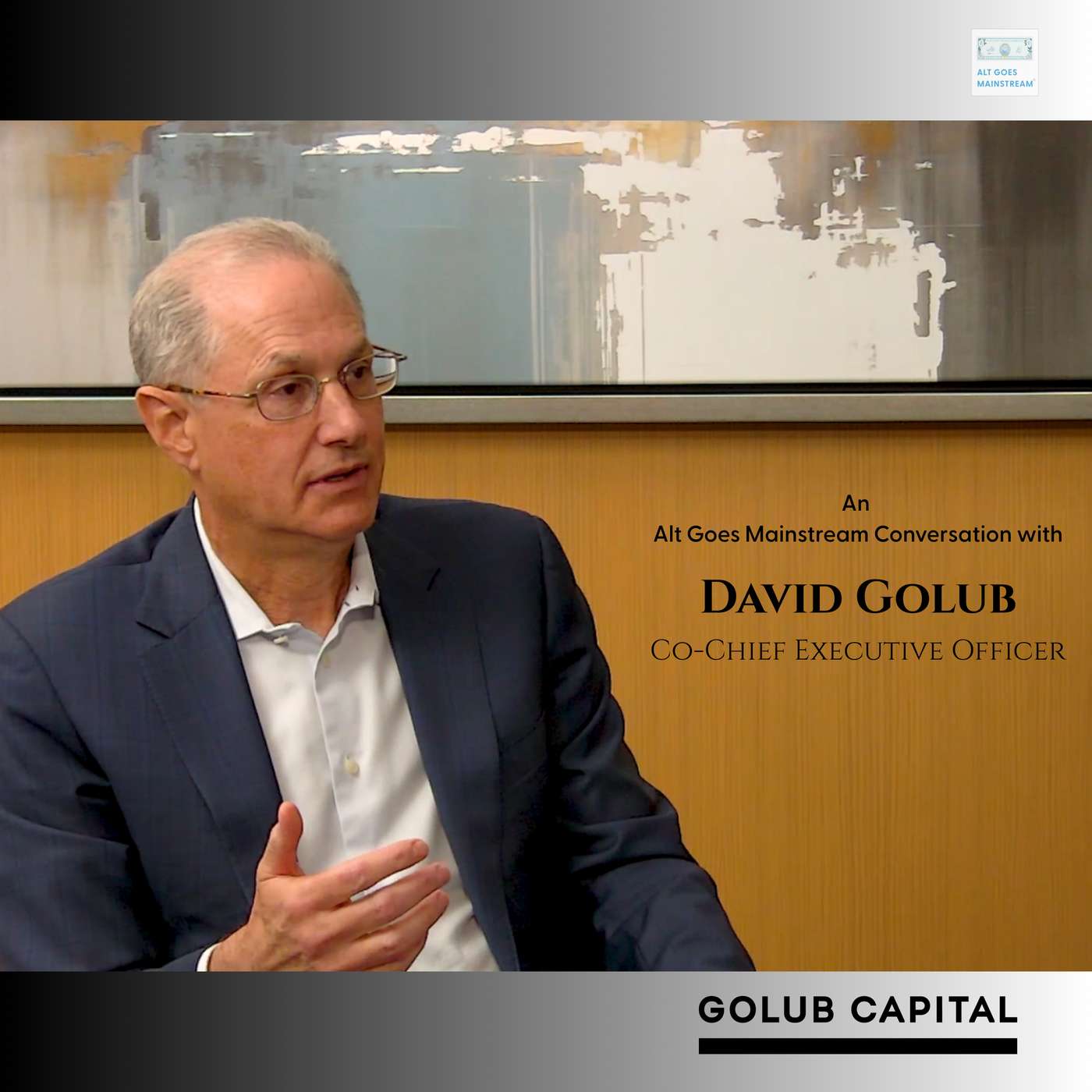
Golub Capital co-CEO David Golub explains how private credit pioneer Golub built a $95B specialist platform, pioneered unitranche “one-stop” sponsor-backed financing, and manages credit risk via underwriting focused on entity value and a distressed strategic-sale “second way out.” He also discusses sponsor relationships, asset-manager competitive advantages, and current private credit risks/dispersion.
David Golub is co-CEO of Golub Capital (with brother Lawrence). He began his career in private equity in 1987 at a Lehman legacy firm (SLAMX), later worked at Lazard Frère affiliate with Lester Pollock, then shifted toward private credit as specialization and financing needs evolved.
Traditional mezzanine + bank structures “stunk” due to intercreditor conflicts and lack of clean incremental capital. Unitranche adoption accelerated during the financial crisis. Golub’s underwriting looks at what could go wrong for company profitability and whether a strategic buyer would still pay in a distressed state. Competitive advantage is primarily relationships: ~90% of new deal volume comes from ~200 repeat sponsor firms.
“Golub Gold Loans” branding; underwriting lens examples include avoiding one-product/customer-concentrated businesses; current-cycle “Darwinian moment” where weaker firms lose capital and terms improve for survivors; junior debt expected to drive more stress than senior.
Written by AI. May contain mistakes.
Discussion on building an alternative asset manager and David's background.
“So just such a fascinating conversation in so many ways.”
David shares his transition from private equity to private credit.
“David, welcome to the Elko's Mainstream Podcast.”
David discusses the challenges he faced in private equity and the evolution of the market.
“How did your background evolve from starting in private equity, now today, helping to run Golub with your brother and now the new leadership that you have in place?”
Insights into the creation of unit tranche financing and its necessity in the market.
“It was right around that time that I started talking to my brother.”
Exploration of issues with traditional financing structures and their impact on private equity.
“And the way that existed at the time was a kluge.”
Discussion on how underwriting approaches differ with unit tranche loans.
“And we had no doubts there was a big market here.”
Learn about unique credit underwriting practices and risk assessment strategies.
“the key ingredient that banks would look for was capacity to syndicate.”
Discover how relationships and competitive advantages shape asset management success.
“You focus on what you believe you're good at.”
Explore how long-term relationships can influence financial decisions and partnerships.
“We absolutely have to accept that renting dead presidents, there's nothing proprietary about making a loan.”
Examine the balance between growth and performance in asset management firms.
“cutting or strategy or all of the above.”
Learn how Andy Grove's maxim about complacency impacts business decisions.
“So I had the incredible privilege of getting to know Andy when I was at the Michael J.”
Explore the delicate balance between growth and performance in private credit.
“And it's led us not to go public because we think that creates a lot of pressures to grow that may not be healthy.”
Understand how scale can provide a competitive advantage in private equity.
“We've got to do a good job for our investors.”
Examine how the landscape of private equity is changing and what it means for partnerships.
“If you need to deploy, how do you avoid that?”
Learn about the real and perceived risks currently facing the private credit market.
“And I think in many cases, it's those winners that are producing the best results and raising the most money.”
Discover how recent market trends and challenges are affecting private credit firms.
“I talk about it as having a big N, meaning there's a lot of repetitions in the sample size.”
Learn about the cyclical nature of private credit and the factors affecting its current state.
“So that's if you kind of order the postcards, that's the order.”
Understand how institutional allocators are approaching private credit in today's market.
“It seems like institutional allocators seem to be comfortable allocating private credit.”
Explore the factors influencing company performance and credit stress in various sectors.
“It relates to the development, in some cases, of AI-related threats.”
Delve into the importance of dispersion among asset managers and their competitive advantages.
“I think there's going to be some correlation between the folks who have trouble in the coming period and the folks who have high proportions of junior debt.”
Learn how investors can assess the competitive strengths of asset managers.
“I wrote about this a while ago in Alco's mainstream.”
Discover how credit investors navigate the fine line between optimism and pessimism.
“The one I often get and I like to receive is, what keeps you up at night?”
Examine the strategic discussions around expanding the scope of a wealth management business.
“I think in really successful credit managers, this balance between institutionalized pessimistic lens and capacity to see the positives that needs to be ingrained and embedded at a whole bunch of levels.”
Learn how firms like Golub Capital have strategically expanded their wealth business.
“Obviously, many firms, they start with wealth capital in one way, shape, or form.”
Explore the challenges and changes in the private credit space over the years.
“So in the early 2000s, we're trying to raise money for this new debt strategy.”
Discover the importance of investor diversification and long-term strategies in business.
“One of the ways we can modulate, we can mitigate the impact of those changes is by having diversification of our investors.”
Understand how Golub Capital plans to leverage strengths to explore new growth opportunities.
“so that we can promote from within and we can build this distinctive culture that doesn't get diluted by constant recruiting of senior people from outside.”
Examine how psychological insights shape relationship building in business contexts.
“I think we've done enough work so that institutionally we do.”

Get the gist, explore an idea or ask about something said.
 Claude
On Alt Goes Mainstream: The Latest on Alternative Investments, WealthTech, & Private Markets, what are the key points of this episode?
Searching your listeningAutomatic transcript. May contain errors.
0:00Welcome back to the Altco's Mainstream podcast. I'm Michael Sijmore, founder of Altco's Mainstream. I'm here at Golub Capital in their New York office to talk with David Golub, co-CEO of a firm that has grown to$95 billion, scaled specialists, largely focused on the private credit ecosystem. They built one of the largest, most successful platforms by really focusing on one thing. Our conversation was fascinating on so many levels. We talked about how to build an alternative asset manager, how David and his brother Lawrence started in private equity and how those roots informed how they've thought about private credit, pioneering unit tranche financing, how they work with sponsors, why they have such good relationships with those sponsors, what they look for in those relationships with sponsors.
0:42That was tied to something else that David and I talked about, about the psychology of relationships, the psychology of partnerships, which was informed by not only his mom becoming a PhD and then being a psychologist, but also his dad being a psychiatrist, his wife being a psychiatrist. So just such a fascinating conversation in so many ways. I think so instructive for LPs as well, because David and I talked about how LPs can think about underwriting GPs based on the business of asset management. How do they think about their own competitive advantages, which David also talked about in such an illuminating way about Golub itself and the competitive advantages that Golub has in the credit space.
1:21So thanks so much, David. such a fascinating conversation. This episode of Altco's Mainstream is brought to you by Ultimis, the full service fund administrator and transfer agent powering asset managers in private and public markets. As Altco Mainstream, we need real expertise to handle complex fund structures, connect with key distribution partners, and handle sophisticated compliance, reporting, and transparency demands. That's Ultimis. High tech, high touch solutions for over 450 clients and 2 ,500 funds with over 775 billion in assets under administration. Backed by an expert team of over 1 ,200 employees, they place client service at the core of their business, helping you navigate complexity during your fund structuring or launch, and then supporting you through every stage of growth.
2:04Whether you're already in the market or thinking about entering private wealth, you can trust their team's deep expertise in retail alternatives to help you reach your goals. Learn more at ultimisfundsolutions.com or email info at ultimisfundsolutions.com.
2:21David, welcome to the Elko's Mainstream Podcast. Thank you. Pleasure to be here. Pleasure to be here. We're in Golub's offices. Fascinating story about a firm that has evolved and I think is in many respects emblematic of the business of alternative asset management, Private credit, broadly, that's what you do. That's all you do. Really excited to get into this conversation. So first, would love to start with your background because you started in private equity. I did. And now you do private credit. How did your background evolve from starting in private equity, now today, helping to run Golub with your brother and now the new leadership that you have in place?
3:03You know, there's this myth I find that people think careers are planned and architected. And, you know, at age 23, here are the 17 things I'm going to do between now and retirement. So the answer to your question is by accident. So I started my business career. It was 1987. I came out of business school and went into private equity at a legacy Lehman firm. It was then called Shearson Lehman American Express or SLAMX. I always loved that acronym SLAMX. And we did a bunch of different kinds of private equity that ranged from buying middle market companies to going after RJR Nabisco to making bridge loans to some hostile raiders.
3:45I left Lehman and went to an affiliate of Lazard Frere and worked for Lester Pollock for a long time, again, doing a wide variety of different kinds of private equity. And it was fun. I didn't dislike private equity. As I became more senior, I found that I was actually less good at it. So I was a very good associate. I could do all kinds of analyses. I was a pretty good vice president figuring out what needed to be done. At the time, when you were a partner of a private equity firm, these firms were quite small. There wasn't the degree of specialization you see today. So you needed to find your deal.
4:23You needed to kind of hum around looking for an interesting deal to do. and then you needed to negotiate and then you needed to arrange the financing for it. And I found that to be challenging. And I also found that by the late 1990s, just when I was doing that, that the world had changed. When I went into private equity, there were a dozen firms. By the late 1990s, there were thousands of firms. So I was looking at that time and asking myself, is there something I'm better suited for? Is there some place where I could be special? Because I didn't feel special as a private equity partner. It was right around that time that I started talking to my brother.
5:12And he actually had a different arc, but it took him to a similar place. Now, he started what is now Golub Capital in 1994. It was then called Golub Associates. And it was started as a small private equity firm. By small, I mean the focus of the firm was on doing small transactions. He was looking at the world through a different lens in the late 1990s. There were all these people doing telecom deals and internet deals. And he just looked at them and didn't really understand their appeal. So it's challenging to get things done. He was finding that this emphasis on small transactions meant even when you did well, that dollars were small too.
6:00And we both came to this central insight at the same time. The arcs were different, but we came to this central insight at the same time, Michael. The central insight was that there was an industry now, a private equity industry that required its own way to finance purchases of companies. And the way that existed at the time was a kluge. Didn't make any sense. What got you comfortable that the industry was big enough? Like what were some of the foundational building blocks that you said, okay, this is now an industry that can have sponsor-backed financing and maybe we can partner with enough firms for this to make sense?
6:41So it's not like there wasn't a sponsor finance business in the late 1990s. There was. The main way that buyouts were financed was through a combination of a loan from a bank and a loan from a mezzanine shop. The banks by that time were pretty regulated. It was not the Wild West of the 1980s anymore. and a typical bank looked to make loans to private equity-backed companies at three and a half times EBITDA. If it was a really strong credit, they would give three and a half times EBITDA. If it was a, eh, okay, just barely gets over the line, it was three and a half times EBITDA. And if you were a private equity sponsor, if you're a partner of private equity from doing a deal, you said to yourself, that's not enough leverage.
7:32I need more leverage than that. So you then went out and raised a second form of leverage in the form of some kind of junior debt or mezzanine capital. There were a few firms that specialized in providing mezzanine debt, but mostly these were insurance companies. And mostly these insurance companies offered a solution where they would give you a slug of junior debt at a fixed rate in connection with also getting some penny warrants. So they would be aiming to get a teen's return through a combination of the return on their debt instrument, which typically had an 11%, 12 % interest rate and some penny warrants that they'd get an equity upside from.
8:15So that sounds okay, right? If you're a private equity firm, maybe it's a little more work to have this two-part capital structure. But here's the truth. It stunk. It stunk. Why? First, you had two parties. You have to get two parties both to agree to be financiers of your deal. Then you have to get them to agree on the intercreditor arrangements. And that sounds simple. It's not. No. Who gets what say about what new financing gets put in place? What happens if the company enters into a big lease? What happens if CapEx is above? So, there'd be a big fight every single deal between the senior debt holder and the junior debt holder about inter-creditor rights, and you as the sponsor would always lose.
9:03Like one or the other party would gain rights, and they would come out of your hide. And it always happened on the three days before closing. The second problem was after the deal closed. After the deal closed, in most cases, if you've got a good company that you own, you want more capital. You want more capital to do an acquisition or you want more capital because some growth strategy is working and you want to push. Well, if you went to the bank and you asked the bank for more capital, the guy from the bank would very politely say, gee, please don't make me go back to committee. If you make me go back to committee, they're going to think something's wrong.
9:42Your loan's going to end up on watch list. Bad things will happen. So then you go to the mezzanine loan provider and you say, okay, you know, I got this problem. Bank doesn't want to give me more money. How about you? I know it's expensive, but will you give me more money? And the mezz guy will say to you, oh, gee, I want to be honest with you. I get evaluated. I, Mr. Mezz Capital, I get evaluated based on the IRR of my fund. So the way you can make things work for me is if you quickly pay down that mezzanine debt piece that I gave you and let me keep the penny warts. And then I'm going to get a good IRR and that'll make all my stakeholders happy.
10:26You walk away from both of these conversations as the private equity sponsor, you say yourself, Taryn, I don't have a clean source of incremental capital. If I really want more capital, I'm going to have to refinance the whole right-hand side of the balance sheet. That's where the insight came. And we had no doubts there was a big market here. The insight came from looking at this and saying, this is a clue. It works, but it's not really fit for purpose. It's not really designed the way you would want it to be designed. That's a great segue to something that you as a firm pioneered, which is unitron financing.
11:01Exactly right. You created a one-stop shop solution. What was that spark or what were those conversations like with sponsors in the early days that made you say, you know what, this is what we have to do? And obviously you got that from your private equity experiences as well. But what was that like in the early days? Take us back to that. It's fun to think about this because it was so different from what I suspect you and others think it probably was like. The insight came to us because we did private equity deals. It wasn't like a leap. It was candidly, it was pretty obvious that this Cluj, there's a better answer than that.
11:37So we went out, and this is the early 2000s, and we started talking to private equity firms. And these were largely people that my brother and I and Andy Stoyerman and Greg Cashman that we knew. And we go and we talk to them and say, have we got a great idea? Instead of doing this multi-layer birthday cake capital structure with all the issues associated with it, why don't you take a unitronch loan from us? Simple, easy, one facility. Andy had the idea of branding it. So we started calling these Golub Gold Loans. So the gold stood for Golub One Stop Loans. And people responded. People thought, that's a really interesting idea.
12:17That's a good idea. And then the very next sentence would be, I think I'll try that next time. It was extremely difficult to get people to try it. Why? To actually, you know, this is true, lots of product innovations. Product innovations are often better, but in the absence of some kind of catalyst, it's hard to get trial. In business school, you learn about the adoption curve where something starts out really slowly and then takes off. And usually it takes off because of some catalyst. For us, the catalyst was the financial crisis. It's very interesting. So in the 2000s, prior to the financial crisis, we got some people to try it.
12:56The people who tried it liked it. They became repeat customers. But it was challenging to get trial. When the financial crisis hit and suddenly sponsors who wanted to do deals could not get a bank loan, could not get a mezzanine loan, well, compared to not being able to get anything, our one-stop loan looked pretty good. But how do we break down the components of a unit tranche loan? How do you underwrite the risk in a unit tranche loan? And how do you think about the different layers of the cake that you're just providing in one package? So I'm going to broaden your question. I'm going to answer a slightly different question, which is how do we think about underwriting?
13:38And how is that maybe a little different from how others did? So traditionally in bank land, banks think about assets and they think about the liquidation value of assets. When there was a shift from traditional bank lending to syndication, and there was some syndication in the late 1990s, early 2000s, where banks arranged loans that they then distributed to lots and parties. the key ingredient that banks would look for was capacity to syndicate. Do I have confidence that I can get buyers, enough buyers to want to buy this loan that I'm not going to get hung with holding a lot of it? We always approach it with a third and I think very different perspective.
14:29We raised funds. We planned on holding all of the loans that we were originating. So we didn't think about syndication. We also didn't really think about liquidation. We thought about the entity value of the companies that we were making loans to. And we thought about what could go wrong? What in the environment could happen that would make that company's profitability go down? And then we asked a second question, which was assuming that happens, Would there still be a strategic buyer out there who'd want to own this company in its little bit beaten up state at a value high enough so that we wouldn't lose money?
15:18So our approach to underwriting, and this goes all the way back to the early 2000s, reflects this distressed value perspective, this second way out through a sale of the company in its distressed state. That's not a traditional bank way of looking at credit. And I think it's been one of the secrets of our success. It's been our ability to identify companies that are unlikely to get into trouble and that if they get into trouble are still going to be strategically valuable to another firm. That's been a big part of how we've contained credit losses. What's the skill set for underwriting in that framework?
16:00And maybe obviously different than banks, obviously, the way they do that, certainly in the syndicated loan market. But even relative to other investors in the credit space, is there a different approach in your mind in terms of how you think about underwriting credit and credit risk? Yes. I mean, I think what I just described is maybe not unique, but unusual. And I think it reflects in many ways the private equity, what we've started out talking about, the private equity origins, intellectual origins of the firm. We're thinking really carefully about, is this a good business? What's the definition of a good business?
16:36A definition of a good business is one where it's got tailwinds, it's got the capacity to continue to grow, and it's got risks that are containable, that are mitigatable. So when you're looking at businesses through this kind of lens, you start being very careful if it's a one product company. You say to yourself, hmm, somebody else comes out with a better mousetrap. Is there really going to be a strategic competitor of this firm that's going to want to own this company that's making the old no longer so good mousetrap? Probably not. Second example, if the customer set is too concentrated, we've always been very allergic to that because our view, again, is similar.
17:25Well, what happens if you screw up with that customer and you lose that customer? Is there still going to be a strategic guy who's going to want to buy your company after you've lost your giant customer? Probably not. So this lens is, I think, different, distinctive. It's worked very well for us over a long period of time. It's now really inculcated in our culture. I think that's a great segue to another dimension of looking at what you just shared. in terms of how you look at businesses, which is you've built Golub into a$95 billion scale specialist. You're a credit manager. You focus on what you believe you're good at.
18:06You don't focus on things that you don't believe you're good at. You have a number of customers. I think it's around 200 sponsor relationships, give or take really high quality relationships where a lot of them are repeat customers. So based on what you just shared about how you'd look at a business, how do you think about how you'd look at the business of Golub or the business of asset management through that prism and where your competitive advantages are? So I love the question because we talk often about competitive advantages when we're talking about businesses generally. We'll look at an industrial services company and we'll talk about its market share and we'll talk about its patents and we'll talk about the degree to which it has repeat customers.
18:50But when you talk about asset management companies, very often you hear people just change their vocabulary entirely. They have a really good team. That guy's really smart. Or they have a proprietary model. I think that's right. I don't believe in any of those things. I think asset management businesses are very much like every other kind of company. If you don't have a very clear set of competitive advantages, you're very unlikely as an asset manager to be able to produce consistent premium returns. So we've exactly to your point, grown Gallup Capital over now 30 plus years with the specific intention of identifying, honing, nurturing, growing a set of competitive advantages that will help us compete.
19:38And one of them, maybe the most important of them is the one you just mentioned, which is relationships. And we're big believers that relationships matter. Now, There was, for me, a seminal course I took in college with the Nobel Prize winner in game theory named Tom Shelley. I'm going to really nerd out on you for a minute here. I apologize for the dance. So in game theory, they talk about how there's a really big difference in incentives between a game that you're going to play once and a game where you and I are going to keep playing over and over and over again. So one's called a one-shot game and the other is called a repeating game.
20:15and short version one-shot games tend to lead to knife fights. So you try to screw me, I try to screw you. There's a lot of double crossing, I promise, and I then don't live up to my promise. Repeating games lead to collaboration and cooperation. Reputation matters. If you screw me, I screw you right back the next time. We both end up worse off. So instead of doing that, I cooperate with you and we figure out how to work together in ways that are good for both of us. It's exactly what our business is built on. So how does that work in the context of credit, where if someone comes in with a lower interest rate to a sponsor for one of their companies, what makes them decide to choose the relationship over something that some, not all, and maybe this is a misconception that what I'm getting at with an example is that the capital can be a commodity.
21:23So push back on that, please. Yeah. We absolutely have to accept that renting dead presidents, there's nothing proprietary about making a loan. So let's talk about what constitutes a win-win relationship. And I'll give you some context, some reality of our business, just to kind of illustrate these points as I'm going along. So we have about 200 private equity firms that we've done multiple deals with. Every year for the last decade, 90 % of our new deal volume has been with those repeat customers. So we've got a group of private equity firm clients who like working with us, who keep coming back and saying, hey, would you lend us money for this new deal?
22:09Would you lend us money for that new deal? And 90 % of the new business we write is with that core group. There are thousands of middle market private equity firms in the United States. There are probably 10 ,000 if we include Europe and include larger companies. So to be focused on 200 is pretty narrow. So what's the value proposition? Why did they like to work with us and why do we like to work with them? Well, I'll answer the second one first. It's easier. We decide which firms we want to work with based on an assessment that we make. Do they pick good companies to buy? Are they good at adding value to those companies?
22:52Do they have an ethos of working really hard to fix things when they make a mistake. That's not just about writing new checks, although it includes writing new checks. It's about parachuting new management in. It's about bringing in resources from the home office that's good at procurement or technology or cost cutting or strategy or all of the above. And the final point is, do they think of us as partners? Do they understand that they're going to want us to finance future deals and that in connection with that, it's in their interest to see us be successful? What do we provide? Well, today, if you're a successful private equity firm, you probably don't have just one fund.
23:39You probably have a flagship and a middle market and maybe a technology and maybe a Europe and maybe some other specialty funds. You probably have a capital markets team that's responsible for arranging the financing for all of your portcos. That capital markets team probably isn't that big. So that capital markets team wants to have a reasonable number. They don't want to be relying on any one party. They may love us, but they're not going to want to only have Gallup Capital. They're going to want to have a small number of close relationships where those debt partners can solve a lot of different needs that they have.
24:23Small companies, big companies, specialty distribution, technology, healthcare, Europe, Canada, Australia. So across geography, across industry, across size. And they're going to want firms that are decisive. They do what they say they're going to do. They want firms that if the going gets a little rough, they're going to be partnership oriented. They're not going to panic. They're going to be solution oriented. They're going to want firms with people they know. Everybody prefers to work with people they know. So it feeds into the reputational issues we were just talking about. So we've designed Gallup Capital to check literally all of those boxes.
25:08There are very few other firms that are out there that are fit for purpose the way we've designed Gallup Capital to be fit for purpose. Does that mean what we're proposing on one of your transactions, Michael, that we can charge 100 basis points more? Guess what? No. No. But if you're thinking about the long term and multiple financings with a certain firm, you're probably going to think longer term about how you price that transaction. So we're going to be competitive. We're going to create our premium for investors by picking good deals, by having lower credit losses. and we're going to get some advantage from you, the private equity client, because of what we do for you, we're going to be a first call.
26:02We're going to be a last call. Sometimes you're going to have a deal where you don't have time to take it to 16 people. We're going to be one of the very small number of people you take it to. Sometimes you're going to have a proprietary deal. You're going to want to take it to only one party and trust that party to be fair. We want to be that party. So that's the symbiosis. How do you think about the evolution of asset management as a business and many of the firms that you might work with continuing to grow in size and scale or adding different funds or strategies? How has that impacted how you think about your business as well?
26:38And then going forward in the private equity world and where we are today, how do you think about the go forward for how you continue to serve the private equity industry, have the relationships you have, maybe add new relationships where it makes sense? Well, you alluded to this earlier, right? We think very hard. Again, we're nerds, so it shouldn't be that surprising. We think very hard about how we want to develop our business in a way that makes it a better business. So let me give you some examples of that. And in the hedge fund industry, growth can be the enemy of performance. If I'm a hedge fund manager and I have to invest down to my 432nd best idea, I may not have as strong performance as if I'm only investing my top 200 best ideas.
27:29So we think very hard and have thought for many years very hard about, well, how big should we be? How much new capital should we take on? One of the good quirks about our business serving private equity firms is that being bigger over the years has enabled us to do more for them. It's enabled us to do larger loans. It's enabled us to do more geography. So we've been able to make growth into an advantage, into a source of competitive advantage, where in many asset management businesses, it's a disadvantage. And one of the attributes we've had to fight is Andy Grove, Andy Grove's aphorism. So I had the incredible privilege of getting to know Andy when I was at the Michael J.
28:22Fox Foundation, and he was doing a lot of work with the foundation in the early 2000s. Andy, for those of you who don't know him, and you clearly do, he was the legendary CEO of Intel during Intel's heyday. So Andy had a book that he wrote called Only the Paranoid Survive. And the famous quote from that book, which sits on my wall opposite my desk, is success breeds complacency, complacency breeds failure, only the paranoid survive. And the theory behind the quote, the theory that Andy was getting at is when we're successful, we tend to get some hubris. We tend to get a little arrogant and it tends to lead us to either think that we just deserve that success or to think that we can take our success and bring it someplace else where maybe we don't have the advantages that we have in our home court.
29:17We think about those issues a lot. And it's led us not to go public because we think that creates a lot of pressures to grow that may not be healthy. It's led us not to diversify into a variety of other asset classes where we have been unable to identify what our sources of competitive advantage would be. It's led us to really hone in on being a specialist and being proud of being a specialist. do you think you can continue to be a specialist and a scale specialist? You mentioned the hedge fund industry where my mind goes with that example is capacity. There's only a certain amount of capacity to continue to deliver for your investors.
29:57At what point is that true in current model for what you just discussed of staying in our home court? This is what we do. How much bigger can you be in current form? I don't know. I mean, it's a really interesting question. And my honest answer is, I don't know. What we've done in order to address the fact that we don't know the answer to that question is we consistently think about what's the near-term investment opportunity set. And we adjust our fundraising so that our fundraising and the opportunity set go together. And there've been many times, again, this is not a popular thing to say if we were a public asset manager.
30:40There've been many times over the last 20 years where we've said, let's slow down fundraising. Let's stop fundraising for that sub-strategy that we have. Let's modulate fundraising in this other area. Because it's my view very much along the lines of what you were just saying, it's my view that our job one is performance. Our job one is not growth. Our job one is performance. We've got to do a good job for our investors. Our job two is we've got to do a good job for our sponsor clients. We've got to be good partners for them. It's an interesting question that relates to what you just said in terms of the nuance of where both private equity is going as an industry and where private credit is going as an industry.
31:23So I agree with what you're saying in terms of, one, delivering on returns is most important before thinking about the business. But there's a world where scale... I do disagree with that. I wouldn't say it's before thinking about the business. My view is if we do a good job serving our investors, if we do a good job serving our sponsor clients, if we do a good job serving the folks who lend us money, who want us to keep credit losses low and have a lot of consistency, if we do a good job for our team by giving them opportunities to grow and develop their own talents, if we do those four things well, everything else would be great.
32:04The business would be great. we don't have to focus on what's best for the business. We have to focus on what's best for our four key stakeholders. That totally makes sense. Where I was going with the question was, is there a world where scale actually gives you an advantage? It doesn't compromise the four things that you said, but you may have to continue to scale and grow because that actually helps you win deals or enables you to continue working with sponsors if this is the world of private equity that we're living in today, where deals are getting larger, funds are getting, there's probably a cap on how big a private equity fund can be.
32:44But you've got the$25 billion private equity. Look, let me frame your question in a different way. If we were still$3 billion in assets under management, like I think we were in 2008, would we have a competitive disadvantage today? You bet. You bet. Our scale today at$95 billion and growing is one of our competitive advantages. Our capacity to go to a private equity firm and say, hey, you got that$10 million EBITDA company that needs a$35 million,$50 million, whatever it is loan. We look at that for you. Oh, you got this$200 million EBITDA company. It needs a billion and a half dollars. We can look at that for you.
33:28So the breadth of what we are capable of doing is today very much a source of competitive advantage. Having said that, it's one of my parents' aphorisms to be, be careful what you ask for. You've also got to be careful with that scale, not to make the scale into this heavy weight that's on your back. If you need to deploy, how do you avoid that? That's not how porcupines make love. Carefully, you've got to manage the vehicles that you take on. If you take on too many vehicles that have immediate deployment, it's bad. You've got to manage the total amount of capital that you take on. And you've got to have very close granular feel of what's coming, what the market conditions that are in front of you might look like.
34:18The studies. How do you think about the private equity industry? You said something earlier about there's a certain number of firms we like to work with. One place where my mind goes is, and maybe there are more than the 200 that you work with, but you're effectively underwriting their ability to underwrite well. There's been a lot of talk in the industry broadly about a shrinking number of firms and for a number of reasons, not just because of returns, but also because of the evolution of the business itself, private equity, certain firms need to scale. Some firms will have more trouble raising money for scale reasons, not just return or performance reasons.
34:57But let's pause it for a second because I think you're onto something that's really important that reflects back on a prior part of our conversation. Let's use the lens we were talking about earlier, the lens of competitive advantage and apply that to private equity. Private equity, historically, we tend to think about it as this very, very fragmented business. I don't know if it's true or not, the line that there are more private equity firms than McDonald's. I mean, whether it's true or not, that's a lot of private equity firms. So if you're a couple people, what's your edge? Now compare it to the winners today.
35:36The winners today have a procurement group and a technology group. And here's how you run a really good services business group. And here's how you do compensation really well. And here's, oh, you're in the distribution business. Well, here's how you organize your warehouse. They're really good in the weeds on how to improve the companies that they're buying. And they have, in many cases, centralized teams that parachute in and are adept at impacting those portfolio companies. Now, look, I'm not trying to say every private equity transaction is successful. We all know they're not. I'm not saying that every good private equity firm has a perfect tracker.
36:22They don't. But the point I'm driving at is there is a subset today of private equity firms that have really upped the game of what is possible for competitive advantage in private equity. And I think they're setting a new standard. And I think in many cases, it's those winners that are producing the best results and raising the most money. How do you then think about that continued evolution of their businesses as how many firms you feel you would be comfortable partnering with? So we have no artificial limit on the number of private equity firms we're comfortable partnering with. It's not like it was design that said, oh, well, let's identify.
37:11It's just happened. I would tell you that one of the things that makes me really optimistic about our business is that as I think about that private equity winner of the future, which has a number of different funds, which has a number of different internal groups of the sort that I was just describing, including a capital markets team. I think that winner private equity firm of the future is going to want to work with a small number of private credit players who look like out-capital. And I think that positions us very well for this future state as the private equity industry consolidates. is a slightly different dimension of looking through the same question we just asked.
37:58But how much can LPs learn about private equity funds by having a relationship or partnership with a private credit firm like Golub? You're asking is if you're an institution, if you're an institutional LP or a Wealth Channel LP, but you have a relationship with Golub, How much can that allocation or look through into the underlying portfolio companies and private equity firm that you work with on the transactions help them understand how they should be thinking about their private equity relationships? It's an interesting question. I haven't really given a lot of thought to that. I would say this.
38:35I think in a sense, it's a good housekeeping seal of approval for an investor to see that Gallup Capital is a debt provider for their deals, especially if it's a repeat debt provider for their deals because we do our homework. And one of the key elements of our homework is assessing is that private equity firm good at what they do? Again, doesn't mean we don't make mistakes. Guess what? We make mistakes. But investing is a game of big numbers. I talk about it as having a big N, meaning there's a lot of repetitions in the sample size. And when you look at samples that include a big N, judgments matter.
39:16So that's a great segue to the concept of risk in private credit today. What do you feel are actual risks in private credit? And what are perceived risks? Yeah, it's interesting right now. We're in an environment, Michael, where many cases, people don't have the story. They've lost the story. What sense? When I was growing up, my mom went back to university, got her PhD in psychology, and she was a clinical psychologist. And this is a little embarrassing. As part of her work, she would sometimes kind of do various kinds of tests on her kids, on our friends. And one of the tests is called, I still remember, it was called a Wexler.
39:58and you'd get this set of postcards and you had to put them in order so that you could explain what happened. And I think you can do that right now for what's happening in private credit. But if you read Bloomberg or other, you kind of, they don't get the story. So what's happening right now is this, it's pretty straightforward. We have had four years where base rates have declined, spreads have declined, and we've hit a normal, not that unusual credit cycle. And those three headwinds have in turn had some impacts. The first impact is returns in the industry have come down some. If you look at the publicly traded BDCs as an example, in 23 and 24, average ROE was high single digits.
40:51This is all gap. I'm not talking stock prices, I'm talking real returns. If you look at 25, instead of being high single digits, it was like four and a half. So down significantly. In the first half of this year, down a bit more. So first issue is returns have come down. Second issue is we've seen more dispersion. Not everybody's been impacted the same way. The best players have seen a bit of reduction in performance, but they're still doing okay. And then there's some other folks at the other end of the spectrum who have seen their returns come down very sharply and are now actually making losses.
41:30Third thing that's happened in connection with this decrease in performance and increase in dispersion is we've gotten press noise. Our industry is not used to press noise. We're used to being the nerdy kids in the cafeteria. The press goes to the jocks in the private equity section. But we've suddenly gotten a lot of attention. And the attention in the poor performance has caused BDC stock prices to go down. It's caused the semi-liquid non-traded BDCs to see elevated redemptions. And all that's created more noise. So that's if you kind of order the postcards, that's the order. And as soon as you put things in that order, where things are going from here is actually not that hard to predict.
42:16Like we've seen this movie before. It's not exactly the same, but the pattern's the same. We're headed toward what I call a Darwinian moment. We're headed toward a period where some firms who are performing reasonably well for their investors who have diversified sources of capital, they're going to be fine. They're going to adapt. They're going to take market share. They're going to put themselves in a position to grow. Some firms who are not performing well and who don't have diversified sources of capital, they're going to suffer. And they're, in some cases, going to melt. The consequence of those firms losing access to capital will change the supply demand balance in the business.
43:03And the business will become more lender friendly. We're going to see better terms and conditions. We're going to see better spreads. We're going to see less competition. We're going to see better terms and conditions. That's how this goes. This is not the first time this has happened. But you need the capital to be able to deploy into that environment. Correct. That's the division between winners and losers. So this is the story of our industry. Arguably, every industry has a degree of cyclicality. Ours doesn't swing like semiconductors, but there's a cyclicality to it. We're going through one of those cycles now.
43:40Do you think what you've shared corroborates why institutional allocators seem to be comfortable allocating to private credit today? And now that's obviously, I'm sure different firms have different views, but in the news, It seems like institutional allocators seem to be comfortable allocating private credit. Some institutional. I mean, I think institutions come in a lot of shapes and sizes. I had a mentor once who used to talk about how some institutions are systematic avoiders of opportunity. They have their own bureaucracies and people don't want to be associated with controversy. So I think there are plenty of institutions today that are avoiding private credit.
44:22But I think you're onto something else, which is there are some institutions that have a capacity to take a long view. And they have leadership that's seen this pattern, this movie before. And they're looking at the very same dynamics and saying, hey, I like this for these reasons. is when you think about your portfolio, is the underlying portfolio company health in a good place? EBITDA, earning strong, growth is strong, their balance sheets are strong. Like, is that all under the surface? Because obviously you see a lot of noise at the high levels, but underneath the surface. This is just so frustrating, okay?
45:07There are two narratives that are out there. There's the sky is falling and there's the everything's green. Guess what? Neither is true. Though he's somewhere in the middle. Neither is true. There's an elevated level of credit stress across the private equity ecosystem. It's across a wide variety of industries. It's not just software companies. It's across a wide variety of industries. It relates to tastes changing post-COVID. It relates to higher interest rates. It relates to, in some cases, too much leverage and not enough growth. It relates to the development, in some cases, of AI-related threats.
45:47It's not one of these things. It's all of these things. If we go one layer deeper on what you're seeing from companies in the portfolio, are you finding larger companies are healthier or smaller companies are healthier? And then how does that inform how you might think about things going forward? And maybe that's industry dependent. Maybe it's sector dependent. We're seeing the same patterns across both larger and smaller companies. It is absolutely not the case that larger companies are doing uniformly better than smaller companies, nor in my experience has that ever really been the case. Again, it's another one of the narratives that's out there that I'm not a buyer of.
46:28They're much easier to talk about good companies and bad companies than to talk about big versus little or even talk about different sectors. There are good and bad companies within specific sectors. Where I think the puck is going from here is that you're going to see a continuation of some trends that have become apparent to people who are looking carefully in the last couple of quarters. You're going to see amplification of the degree of dispersion between good managers and not so good managers. You're going to see some managers who've identified their problems early. And it's reflected in the valuations of their portfolio companies.
47:12It's reflected in the absence of growth in their lower performance rating categories, the absence of growth in their non-accrual rates, things of that sort. And you're going to, on the other hand, see some portfolios out there and some managers out there who display the exact opposite characteristics. You're going to see some where there's really clear degradation at the portfolio level. You're going to see increasing levels of stress in their portfolios. You're going to see a worsening valuations. You're going to see more non-accruals. I think there's going to be some correlation between the folks who have trouble in the coming period and the folks who have high proportions of junior debt.
47:58I think junior debt's going to be a bigger issue going forward than senior debt. But I think a very large chunk of it's going to be manager dependent. So to connect two things that we discussed over the course of the conversation, one, as you mentioned, dispersion a few times. Two is how people should underwrite the asset managers themselves and the business of asset management. What are those competitive advantages that we talked about earlier on in the conversation? For investors who may be a little bit earlier to private markets, how should they think about underwriting a manager and thinking about an understanding, being cognizant of that there may be dispersion and therefore, here's the things you need to look at to make sure you're on the right side of that dispersion, not the wrong side?
48:45So it's a great question. And I wish the answer was, hey, all you have to do is look at the Morningstar report and look for the five. There's no equivalent of that in our markets. I think what that means, practically speaking, is you've got to do the work. And it's not enough to say, oh, such and such is a great brand. And so they're great at everything they do. Not sure there are that many firms, if any, that are great at everything they do because of their name plates. I think you can, if you do the work, reasonably quickly establish who the experts in that asset class think are the best. And one of the interesting things about private credit is the same names come up over and over again.
49:35And they come up over and over again over literally 20 years. So on the one hand, it's not easy. On the other hand, I don't think it's rocket science. Which is not or hasn't been too dissimilar, certainly from venture, a little less so maybe in private equity, but persistence and performance. But persistence and performance, I wrote about this a while ago in Alco's mainstream. Persistence and performance comes from persistence and process. I think it comes from competitive advantages. Process can be one element of that. Yeah. So I think what you're getting at, and this is where I wanted to go with this whole part of the conversation, was this is one layer deeper.
50:14To your point, there's a lot of managers who are large-scale, have good brands, have done well. So people, a lot of firms look similar on the surface. How do you get to that next layer deeper as an allocator to make sure you're really figuring out like who the firm that you want to work with is and why and what makes their competitive advantages so different and unique? And how can, we've almost like flipped it in a sense in this conversation. Obviously, I'm talking with an asset manager on the GP side. But it's like, how can LPs ask more about like, what are your competitive advantages? How do you think about building your own firm?
50:52So not just the, hey, like, how do you think about investing in or underwriting a company? So I think you're getting at something really important and I would love to see this happen. So I think it would be great and appropriate and productive for them if investors were more focused on asking exactly the question you just asked. It's not show me your performance track record. They should ask for that. It's tell me why you've been able to outperform. So I see you've outperformed. Like that's test one. Okay. Don't bother looking at investment managers who don't have a track record of outperforming.
51:38We can all agree that that seems pretty sensible. But then the next question, which I think is critical, gets to where you're going. Explain the why. Tell me the why. And if the manager doesn't have a really clear, crisp, understandable answer to that question, that's talent. What's your favorite or most interesting question you've ever received from an LP? We get great questions from LPs. The one I often get and I like to receive is, what keeps you up at night? I mean, I love getting it on the one hand, but it's a hard question because I'm a credit guy. If I started taking you through the list of things that keep me up at night, We would still be here tomorrow.
52:24And I like to talk about that. I like to talk about how there's a power to pessimism. There's all these business books written about the power of optimism. And I don't take anything away from that. There is power to optimism. But there isn't a lot that's been said or written or talked about, about the power of pessimism. How do you as a business owner, though, balance? You have to be an optimist to be a business builder and business owner. How do you? Because I find this so fascinating. about credit investors is like, you have to be a pessimist, but you also have to have elements of your DNA and the way you approach things where you are an optimist.
52:59How do you balance those two things? I think this is one of the magics of working with my brother, because we trade off these two different roles. You're right that you need, I think, to build a business successfully, you need to be an optimist. And I think I'm right that often to be a good credit investor, You need to think like a pessimist. So we trade rules. And it depends on the day, sometimes the hour of the day, the topic of the conversation. Who's the optimist and who's the pessimist? But I think being able to bring both of those roles to life has been one of the secrets of our success.
53:38Where my mind goes with that, if I put an LP hat on it, LPs should, especially with credit investors, be thinking about and trying to evaluate and understand. Not that they don't already. There's plenty of fantastic allocators. but how the dynamic of the investors or the managing partners is between optimism and pessimism and who plays what role, how do they play that role in unpacking that or trying to figure out, like, can't get inside an investment committee necessarily, but trying to get to the heart of like, okay, how is this person a pessimist? Where and where are they a pessimist? When?
54:09How do they think about it? So I think you're onto something. I'd even take it one step further. I think it's not just about the managing partner or the managing partners. I think in really successful credit managers, this balance between institutionalized pessimistic lens and capacity to see the positives that needs to be ingrained and embedded at a whole bunch of levels. Through the organization. It's about culture. That's about process. That's about division of roles and responsibilities. I don't think it's there's just one answer to your question. I think what you're describing is challenging.
54:49And it's why when you're trying to evaluate different managers, you can see it. You can find it there or missing. When you interview people to join Gollum or your team interviews people, how do you uncover whether or not they're a good pessimist? I'm not sure you can. But what you can do is you can assess people's analytical thinking. We spend a lot of time thinking about how to assess analytical thinking capacity. So I'll give you an example of a reasonably standard interview question that I'll use. I'll ask somebody, what do you think of such and such? And they'll express an opinion. And I'll say, OK, I want you to take the other side.
55:35Give me the five best reasons for the other side of the argument. And the capacity to be able to move back and forth analytically, not emotionally, but analytically, I think is a really good marker for us for success at Gallup Capital. What were some of those things where you've gone back and forth and evaluated both sides internally as you thought about building a wealth business? Obviously, many firms, they start with wealth capital in one way, shape, or form. That's different from today's wealth channel capital. And the wealth channel is not monolithic. So I think that's an important point as part of this.
56:18But you've deliberately grown your firm. You talked about that throughout the conversation and have been very deliberate in why you haven't gone and done certain things. But one thing you have done is expanded the breadth and scope of your wealth business. What were some of those internal conversations of we should do this? We shouldn't do this. Why? How? How does it fit what we do? How does it fit our brand? So I want to go back at answering your question. I want to go back 25 years because you'll find this entertaining, but it's also telling. So in the early 2000s, we're trying to raise money for this new debt strategy.
56:56Now, imagine a time when no one knows what private credit, and it's not a phrase that's used. You go to an institution and there is no allocation to this asset class. They look at you funny and they say, well, can you show me your track record? And you say, no. So suffice to say, in the early days, institutional fundraising is out the window. It's impossible. There's no way we're going to get capital from institutions in scale. So what did we do? We went to folks we knew. This is called the wealth business at the time. Folks we knew, wealthy families, wealthy individuals, some wealth managers who we had relationships with.
57:37And that was the nature of the wealth business, the wealth channel at that time. And flash forward to today, it's a little different. You have platforms. You have very large wealth management firms. You have centralized groups within those firms that vet products. So yes, you're correct. We have decided very intentionally to build internally a team that's focused on the wealth channel. Our thinking behind this is that we want diversification of our investors. I talked earlier about how important diversity is if we're looking at a company's customers or a company's products. Well, the same is true about our business.
58:28If we are only serving insurance companies and there's a regulatory change that's out of our control that makes it impossible for insurance companies to continue to invest with us, that's not good for our business. So we are subject to forces that are beyond our control. One of the ways we can modulate, we can mitigate the impact of those changes is by having diversification of our investors. We can serve wealth and insurance and pension funds and sovereign wealth funds and endowments and foundations and health systems. And that's how we've built our business. So if you look at our investor partners group today, yes, we have a private wealth team and we're very proud of what we built there and the reputation and the individuals who are part of that team.
59:21And we'll build more. That's a set of complementary strategies designed to put us in a position where we have the kinds of investors who will want to be with us for decades. That last point, given that it started in some respects as two family members, do you think you think differently about building a firm because it started not entirely, but there's two family members, brothers that started the firm and that's how you also think about those LP relationships? I do. I'm not sure it's a brother thing, but there is something distinctive about how we think, based on my experience talking to peers and colleagues in other places, there's something distinctive about it.
1:00:13We have never wanted to be public. And I think we see that there are behaviors and incentives that become patterns in publicly managed alternative asset companies. We have affirmatively decided we You don't want to go that path in an effort to avoid some of those negative patterns. The second aspect is we're very long-term in our thinking. We don't think in terms of quarters or in terms of even years. We think with a perspective of building something with enduring resilient value over decades. what's different about that in terms of how you've built the business and in terms of how you think about thinking in terms of decades is there something you've done maybe differently from others as you've built the business or like as other asset management founders think about or just starting their journey thinking about building their business is there something from what you just said that people can pull on or reference and say you know what maybe i should build my business that way.
1:01:33So if you look at our business and where we look different from many peers, it's degree of specialization and focus. It's degree of investment in technology. It's degree of investment in middle office, back office, so that we can provide a service proposition that's unmatched. It's degree of focus on training and development of our people so that we can promote from within and we can build this distinctive culture that doesn't get diluted by constant recruiting of senior people from outside. But I think those are all really distinctive and they're intentional. Does that mean we have the only recipe for success?
1:02:23Absolutely not. Absolutely not. Does that mean if you do all of these things, you'll be successful? I can't promise you that. What I can tell you is that this model has worked really well for us. What's when you think about continuing to build in the deliberate way you have, what's next? I'm going to give you a good, boring answer to that. The single the biggest component of our go-forward strategy is more of the same. We have some fancier words that we use internally to describe that. We talk about it as nurturing and growing the core. But what that effectively means is we've got a really good set of businesses today around sponsor finance.
1:03:10We think the private equity ecosystem is very likely to continue to grow, and we think we've got an opportunity to continue to grow with it. We're also looking at adjacencies where we can leverage the competitive advantages that we have into competitive advantages in those adjacencies. So I'll give you a concrete example of this. We have launched a GP-led secondaries or continuation vehicle funding business. Why? Well, over the last 20 years, we've done 400 private equity co-invest. We're good at this. We have the track record to prove we're good at this. The capital markets folks who we call on every day on the debt side, they're the same people in most cases who are arranging the continuation vehicles for those private equity firms.
1:04:03What do they want? They want folks who are going to be providing the equity needs for their CVs that they already know. They're going to want folks who are experts in a variety of different industries and can get up to speed quickly. They're going to want people who, when they say yes, actually come through and close. They're going to want people who can provide small amounts as well as much larger amounts of capital. Check, check, check. So So suddenly the GP-led secondaries business sounds a lot like our sponsor debt business. And it doesn't just sound a lot like it. It is a lot like it. And a lot of the competitive advantages that we've built on the debt side are directly relevant so long as you believe that continuation vehicles are going to grow to be a significant force.
1:04:55I do. I think we've done enough work so that institutionally we do. And so this is an adjacency that we think we can grow into something that's quite sizable. When I hear you talk about expanding into other strategies that make sense for you, it comes back down to the DNA. You evaluate your DNA and say, is this what we're good at? And then is this what's required to be good at this? Can we do it? I want to end on a slightly different topic, but I think is fascinating given the arc of this whole conversation. So a lot of the conversation actually revolved around psychology in many ways. And you mentioned that your mom went back to school, got her PhD, was a clinical psychologist.
1:05:40What do you think? That's much worse. My father was a psychiatrist. My wife is a psychiatrist. This is a great topic to unpack more because where we started the conversation was that the relationships that you have as a firm is so important to the firm's competitive advantage. And underwriting a relationship is about underwriting people. If I put a very finance framework to something that is much more human, how is the experience? I didn't know that your dad and your wife. But how the experience of being in and around psychology, how has that helped inform how you think about building relationships, evaluating relationships and people, which is so important to the work that you do?
1:06:27It's a hard question to answer because I don't have any other frame to look at the world through. This is literally my world. I grew up the son of a psychiatrist and a psychologist. I'm married to a psychiatrist. I believe in what they do. And what they fundamentally do is they help people be good problem solvers. And my hope, belief and hope, is that through my experiences, I've developed into a good problem solver. And what is a good problem solver? Good problem solver doesn't mean conflict is eliminated. It means you're good at asking questions. You're good at figuring out what's important.
1:07:13I can figure out what's important to you. I can convey to you what's important to me. And together we can work collaboratively. This goes back to my game theory conversation. We can work collaboratively to come up with answers that that work for both of us. And if we can do that, that in turn is relationship building. That in turn makes us both better at doing the same thing the next time. Are there certain things that you do when you approach building those relationships or frameworks that you've taken from all that you've learned that help you do that better? Maybe, but I'll be honest. I think a big chunk of it is about being authentic.
1:07:57And I think some people who try really hard to develop tools or tricks or techniques to do what you're describing, they come across as inauthentic. So I don't have a magic recipe for being disarming and getting people to reveal things that they shouldn't. I think that's actually in some ways the opposite of what the goal ought to be. I often say in a business context that I'm a terrible poker player. I am a terrible poker player. But the reason I talk about that is I talk about that as a prelude to let me tell you what's important to me and let me understand better what's important to you so that we can figure this out.
1:08:40It's interesting because I think many people would hear that and they would think, oh, negotiations may be more challenging, but maybe there's a way of negotiating that you have that is like you're being vulnerable, sharing, not in a way that hurts you. I don't mean vulnerable in a negative context, but that builds a relationship rather than makes it adversarial. I think you're onto something. And I think, again, this gets back to repeating game versus single shot game. In the repeating game context, part of what makes us both successful is understanding what makes us both win. I think that's such a great way to wrap this conversation up because it highlights how you thought about building business, how you thought about building partnerships, how the people aspect and the game theory aspect, psychology aspect, all of that are related into building a business and thinking so deeply about it too.
1:09:41The concept of thinking about asset management as a business is so important as we are where we are in this industry. This has been such a fascinating conversation. I really enjoyed it too, Michael. Thank you. Thanks for listening to this episode of Alt Goes Mainstream. I hope you enjoyed it. You can read more about alts at my substack, altgoesmainstream.substack.com. Thanks a lot and have a great day.
Welcome back to the Alt Goes Mainstream podcast.
We went to Golub Capital’s New York office to sit down with Co-CEO David Golub.
David Golub and his brother Lawrence both started their careers in private equity. It was their experiences in private equity in the 1990s that turned them into private credit pioneers.
Lawrence and David have built Golub Capital into a $95B private credit behemoth, largely due to their pioneering decision to create the “one-stop” unitranche loan solution for sponsor-backed companies after spotting a gap in the sponsor finance market.
Fast forward over 30 years, and Golub Capital is one of the leaders in private credit.
David discussed how Golub has spent the balance of its life as a scaled specialist credit manager “honing the competitive advantages” that make the firm so unique. Golub has built a cadre of 200 high-quality sponsor relationships with many of the industry’s top private equity firms, which call on them when they are seeking sponsor financing for their companies.
David and I had a fascinating conversation that covered everything from the early days of private credit to the story of pioneering unitranche loans to what LPs should look for in GPs to the psychology of relationships and partnerships. We discussed:
Bio
David Golub is Co-Chief Executive Officer of Golub Capital, a market-leading, award-winning direct lender and experienced private credit manager. As of April 1, 2026, Golub Capital had over $90 billion of capital under management, a gross measure of invested capital including leverage. Golub Capital partners with institutional investors and family offices, offering tailored solutions for investors’ credit asset strategies. The Firm specializes in delivering reliable, creative and compelling financing solutions to companies backed by private equity sponsors. Golub Capital has been a top 3 U.S. Middle Market Bookrunner each year from 2008 through Q1 2026 for senior secured loans of up to $500 million for leveraged buyouts. Golub Capital has been consistently recognized with industry awards, including Lender of the Year, Americas (Private Debt Investor, 2014, 2015, 2016, 2018, 2021, 2022, 2023, 2024) Lender of the Decade, Americas (Private Debt Investor, 2023), Senior Lender of the Decade, Americas (Private Debt Investor, 2023), Senior Lender of the Year, Americas (Private Debt Investor, 2015, 2016, 2017, 2019, 2020, 2023, 2025) and BDC Manager of the Year, Americas (Private Debt Investor, 2015, 2016, 2017, 2023).
Mr. Golub is active in charitable and civic organizations. Mr. Golub is a member of the Founder’s Council of the Michael J. Fox Foundation for Parkinson’s Research, where he was the first board Chairman and a long-time director. Mr. Golub is Co-Founder and Chair of the Golub Capital Nonprofit Board Fellows Network, which operates at 20 leading business schools; its mission is to make nonprofit boards more effective by training hundreds of MBA students each year to become highly skilled nonprofit directors. Mr. Golub is a member of the Association of Marshall Scholars’ Director’s Circle and previously was a member of the Stanford Graduate School of Business Advisory Council. He has served on the boards of the Loan Syndications and Trading Association, the Hudson Guild and the World Policy Institute. Mr. Golub is on the board of directors of Burton Snowboards and has served on the boards of numerous public and private companies.
Prior to joining Golub Capital in 2003, Mr. Golub was a Managing Director of Centre Partners, a leading middle market private equity firm, and of Corporate Partners, a Lazard-sponsored $1.5 billion private equity fund formed to acquire significant minority stakes in established companies.
Mr. Golub earned his AB degree magna cum laude in Government from Harvard College. He received an MPhil in International Relations from Oxford University, where he was a Marshall Scholar, and an MBA from Stanford Graduate School of Business, where he was an Arjay Miller Scholar.
Thanks, David, for sharing your wisdom, expertise, and passion about private credit, the business of asset management, and the psychology of relationships.
Show Notes
00:00 Introduction
01:23 A Message from Ultimus Fund Solutions, Our Sponsor
02:26 David’s Career Shift to Credit
06:07 Sponsor Finance Market Gap
10:56 Unitranche Origins
12:47 Crisis As Catalyst
14:25 Distressed Value Lens
16:21 What Makes A Good Business
19:39 Relationships And Game Theory
21:26 Capital Isn’t Proprietary
25:39 Being First Call
26:21 Managing Growth Carefully
27:29 Fundraising Versus Opportunity
28:08 Only The Paranoid Survive
29:17 Staying A Specialist
29:45 Capacity And Performance
32:47 Scale As Advantage
36:23 Raising Capital Follows Winners
37:12 Future PE Picks Few Lenders
37:52 Credit Partner as A Signal
38:37 Doing Homework on Sponsors
39:02 Big “n” Investing Mindset
39:16 Risk Real vs Perceived
41:30 Press Noise and Redemptions
42:22 Darwinian Moment Ahead
42:54 Why Terms Improve Next
44:42 Portfolio Stress Reality Check
47:51 Junior Debt Trouble Spot
48:10 Underwriting the Manager
51:06 Ask the Why
52:00 What Keeps You Up at Night
54:13 Culture of Constructive Doubt
54:57 Testing Analytical Thinking
55:53 Building the Wealth Channel
56:45 Early Days Wealth Fundraising
58:11 Diversifying the Investor Base
01:00:45 Decades Mindset and Focus
01:01:35 Specialization and Infrastructure
01:02:39 More of the Same
01:03:21 Adjacencies Like GP Secondaries
01:03:42 Continuation Vehicles Rationale
01:05:22 Psychology and Relationships
01:06:48 Problem Solving Builds Trust
01:07:51 Authenticity Over Tactics
01:09:23 Closing Reflections
A Word from Our Sponsor, Ultimus
This episode of Alt Goes Mainstream is brought to you by Ultimus, the full-service fund administrator and transfer agent powering asset managers in private and public markets. As alts go mainstream, you need real expertise to handle complex fund structures, connect with key distribution partners, and handle sophisticated compliance, reporting, and transparency demands.
That’s Ultimus: high-tech, high-touch solutions for over 450 clients and 2,500 funds with $775B in assets under administration. Backed by an expert team of over 1,200 employees, they place client service at the core of their busin...