Ask ChatGPT

 Alt Goes Mainstream: The Latest on Alternative Investments, WealthTech, & Private Markets
12 Aug 2026 · 57m · 23 chapters
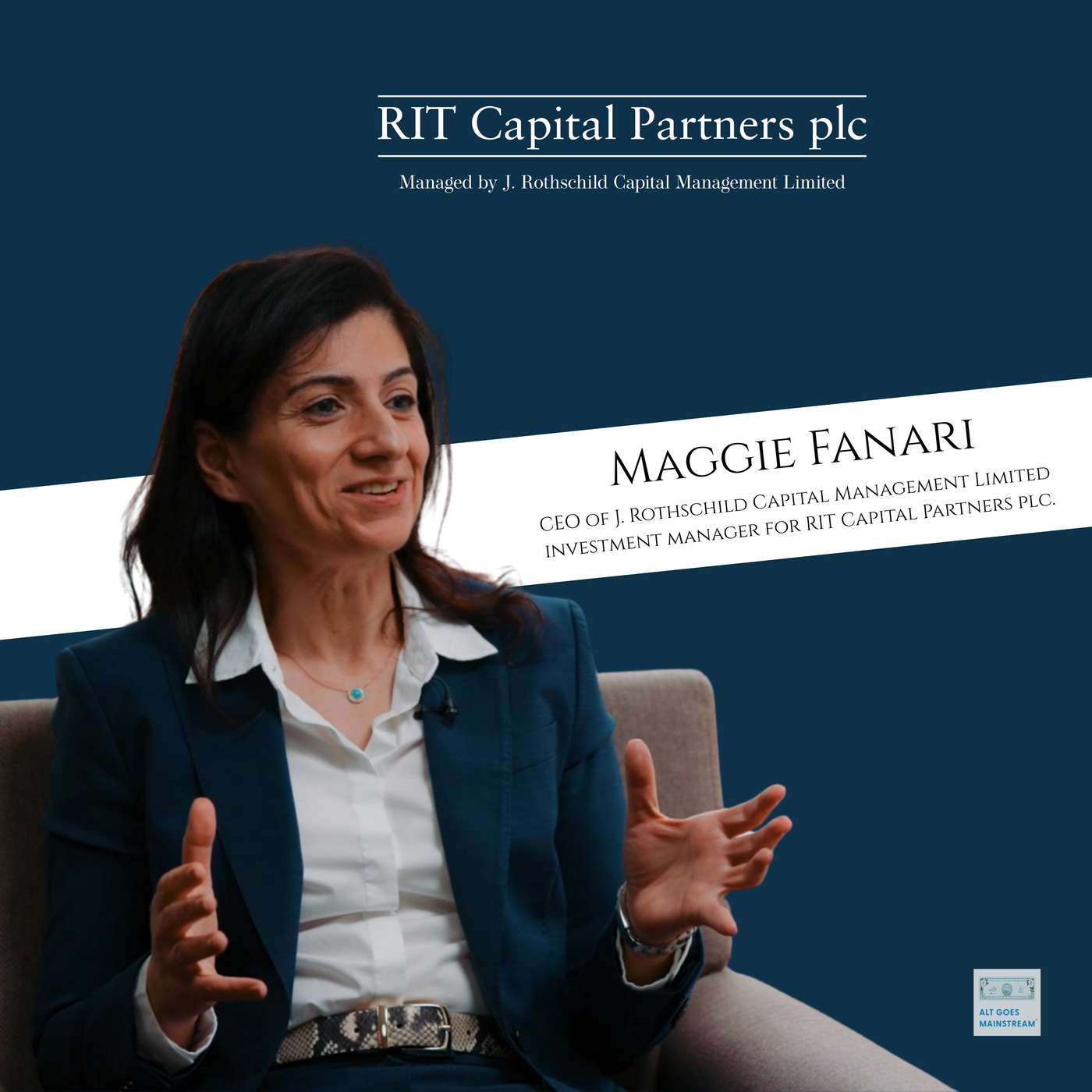
RIT Capital Partners’ CEO Maggie Fanari explains why “permanent capital” (RIT’s family-office heritage institutionalized) is a privilege for building a multi-asset portfolio across public and private markets, capturing upside while limiting downside, and partnering early with top private managers. She discusses co-investing, manager selection, listed investment trusts trading vs NAV, and where value creation is shifting (especially AI, fintech, AI infrastructure, and public-market opportunities tied to sovereignty/re-industrialization).
Maggie Fanari, CEO of Jay Rothschild Capital Management (manager of RIT Capital Partners). Background: ~20 years at Ontario Teachers’ Pension Plan (institutional allocator across asset classes); ran high-conviction equities strategies spanning public/private; joined RIT board in 2019; became CEO in 2024.
RIT compounds shareholder wealth ~10.6% over 35 years; captures ~70% of market upside and limits monthly decline to ~40%. Permanent capital avoids forced selling and enables long-term underwriting and mispricing opportunities. Best managers want RIT’s heritage/structure; co-invest access improves deal selection and realizations.
Anthropic, Databricks, Scale AI (acquired by Facebook), Stripe, Ramp, Epic Systems (moat via data/switching costs), Friday’s SpaceX IPO (SpaceX moved from private to public), Frontier Labs, Green Oaks, Thrive, Iconic, and Oscar Health (Josh Kushner).
Written by AI. May contain mistakes.
Learn about RIT's unique heritage and investment strategy.
“The best managers and the best companies in the world really want to partner with us, given our heritage.”
Maggie Fanari shares her journey from Ontario Teachers Pension Plan to RIT.
“We're in the boardroom for RIT Capital Partners.”
Maggie discusses the evolution and changes in asset allocation strategies.
“Would love to talk about that because I think that can set some of the grounding for, one, how private markets has evolved, and two, how you think about the world of both public and private.”
Exploration of RIT's dual focus on public and private markets for growth.
“stocks that were driving equity market returns.”
Maggie explains the importance of investing alongside emerging managers.
“So maybe they don't need to do as much in other places if they have exposure to this because you're giving them that exposure more broadly.”
Insight into the nuances and strategies of successful co-investing.
“But why invest in firms like the Green Oaks, like the Thrives, et cetera's?”
Learn about strategic investments in AI and the importance of diversification.
“And then there's also the ability of that portfolio construction going back to us knowing the type of exposures and the types of companies we want to gain access to.”
Discuss the implications of SpaceX's public offering on private market valuations.
“So a good example of that, the most recent example would be Friday's IPO of SpaceX.”
Analyze the balance between public and private investments for value capture.
“a lot of that's happening in the private markets.”
Discover how moats and market positions influence investment decisions.
“But I think in today's environment, your moat matters because some companies today are faced with the risk of disruption as we're seeing.”
Examine how permanent capital structures provide long-term investment advantages.
“And that gets to an interesting way in which to look at, one, some of these businesses and their moats, and two, combining that with the heritage and history of RIT.”
Understand how increasing fund sizes affect growth stage investing and capital allocation.
“So I want to go down a little bit of a rabbit hole as it relates to particularly growth.”
Discussion on current trends and perspectives in growth stage investing.
“And you can see that, as we all see, the opportunity is still early.”
Insights on the risks associated with increased capital in growth investing.
“would have been quite strong given the outcomes that have been created in the last year or two in recent months.”
Exploring the role of permanent capital in portfolio construction and investment timing.
“But I think what you typically see late cycle is everyone taking their allocation from 30 to 50 % as an example.”
Discussion on holding investments through their transition from private to public markets.
“But at the same time, we're anticipating realizations or liquidity events to occur, like we saw on Friday with SpaceX moving from a private company to a public company.”
How the rise of individual investors is influencing public market dynamics.
“And I think similar to your comment, if you're able to identify and invest in category leaders over the long term, that's a little bit of what we saw with Amazon and companies like Google and so on, right?”
Examining the benefits and misconceptions surrounding listed investment trusts.
“which is ultimately key, is the fact that you get the governance of a public company, you get the liquidity for investments that are also illiquid.”
Analyzing how investor sentiment towards private markets has evolved over time.
“And I know you've seen it in a few different contexts because you were on the board and now you've run the firm for a little over two years.”
Learn the qualities to look for in venture capital managers and how relationships matter.
“What do you think you will look at going forward in managers?”
Understand how macroeconomic factors influence investment strategies in both public and private markets.
“And we've also been operating in the industry now for over 35 years.”
Explore the importance of having a long-term investment perspective while being tactically agile.
“So you mentioned a few things that are true today that maybe were not true.”
Learn how permanent capital allows for both long-term strategies and tactical agility.
“So we can kind of have the best of both worlds from that perspective.”

Get the gist, explore an idea or ask about something said.
 Claude
On Alt Goes Mainstream: The Latest on Alternative Investments, WealthTech, & Private Markets, what are the key points of this episode?
Searching your listeningAutomatic transcript. May contain errors.
0:00The best managers and the best companies in the world really want to partner with us, given our heritage. And that allows us to create a portfolio that most investors can't create elsewhere.
0:26Welcome back to the Elkos Mainstream Podcast. I'm Michael Sigmore, founder of Altco's Mainstream, co-founder of Broadhaven Ventures. We are here today in London in Jay Rothschild Capital Management's office, the manager of RIT Capital Partners. We interviewed Maggie Finari, CEO of Jay Rothschild Capital Management, which is the manager of RIT Capital Partners. Fascinating conversation of her background as an institutional allocator at OTPP, then joining the board of RIT, now being the CEO of RIT, and really just discussing a lot of the interplays of public and private markets, the history and heritage of RIT and Lord Jacob Rothschild's firm, taking a family office mindset, taking that perspective, allocating to both public and private markets, and then opening that up to investors, both institutional and in the wealth channel, given that there's a listed investment trust.
1:21So dug into a lot of really interesting discussions, topics around private markets, manager selection, listed investment trusts, what's going on in late stage private markets, some very big IPOs, which RIT has had the chance to be a part of, given that they invested in those companies in private markets. So just a fascinating conversation. So much of what's going on today in the here and the now that's really important, interesting, and instructive to take stock of and understand, and who better than Maggie to help us do that. So thanks so much. What a great conversation with Maggie. This episode of Alco's Mainstream is brought to you by Ultimis.
1:54the full service fund administrator and transfer agent, powering asset managers in private and public markets. As Alts go mainstream, we need real expertise to handle complex fund structures, connect with key distribution partners, and handle sophisticated compliance, reporting, and transparency demands. That's Altimus. High-tech, high-touch solutions for over 450 clients and 2 ,500 funds with over$775 billion in assets under administration. Backed by an expert team of over 1 ,200 employees, they place client service at the core of their business, helping you navigate complexity during your fund structuring or launch, and then supporting you through every stage of growth.
2:32Whether you're already in the market or thinking about entering private wealth, you can trust their team's deep expertise in retail alternatives to help you reach your goals. Learn more at ultimisfundsolutions.com or email info at ultimisfundsolutions.com.
2:48Maggie, welcome to the Outco's Mainstream Podcast. Great. Thank you. Delighted to be here, Michael. Well, thank you for having me. We're in the boardroom for RIT Capital Partners. You have multiple offices here. We have a beautiful sunny day in London, rarity, but probably a good sign for talking about the optimism of private markets and everything that's going on. So I'm excited for this conversation. RIT is such a fascinating and unique firm with an interesting heritage. You have a fascinating background. And I think really combine institutional allocator perspective with now a different type of firm at RIT, but taking that institutional mindset to it.
3:27So excited to get into the conversation. Given your background, I would love to start there. You have a fascinating background. You got to know RIT through the process of working where you did last. So we'd love to hear just how you ended up here and what that evolution has been like. Sure. Thank you, Michael. I actually got to know RIT before I joined the board in 2019. So about 15 years prior, really with the view being that the firm had a very similar overlap to a pension plan. And prior to my role at RIT, I was with the Ontario Teachers Pension Plan, which is a Canadian pension plan for almost 20 years of investing across asset classes.
4:08And RIT, similar to teachers, were very focused on protecting on the downside and asymmetric upside. So we had a lot of overlapping deal flow. And then when I moved to London, RIT asked me to join the board in 2019. So I was on the board for about four years. And then there was an opportunity to come in as the CEO in 2024. So the Canadian pensions, the Maple Leaf teachers being one of them, such a fascinating evolution as a business or an allocator. Would love to talk about that because I think that can set some of the grounding for, one, how private markets has evolved, and two, how you think about the world of both public and private.
4:51You were on a team and ran a team of what was called high conviction equities. That could be public, that could be private. What did you learn from your time at Teachers that you've taken to RIT as you manage the business at RIT? Yeah, I ran a few different asset class strategies while I was there. And what I really learned and I've taken to RIT as well is top-down portfolio construction and bottom-up asset selection matter equally. If you don't build a portfolio looking top down in terms of how it can be resilient under different macroeconomic factors, it doesn't matter if you've got the right investments underneath, how you size it, the type of exposures you have, how you want to risk mitigate.
5:35That portfolio construction top down is just as important as the bottom up asset selection. And that's really what I've done at RIT is really broaden that portfolio construction framework in a more institutional way to the firm over my time here. What do you think as an allocator is maybe more challenging in today's environment? So dynamic, you have the rise of the retail investor, which is also changing public markets. You have a bunch of megatrends. You have changing and shifting geopolitical landscape. has it gotten harder to do asset allocation than it was maybe 15, 20 years ago when you were at Teachers?
6:14I think what I would say is probably the market dynamic is moving a bit more similar to the environment of 15 to 20 years ago, where diversification really mattered. I would say if we looked at over that COVID period or a couple of years ago, it was just really a handful of stocks that were driving equity market returns. And that was a lot harder. But in an environment where you have macroeconomic risk, geopolitical risk, and effectively, as what we're seeing is the world order has really changed. We're in a completely new paradigm. So as a result, you're seeing this global opportunity set really open up, both in Europe, in areas like commodities that we had in the early 2000s.
6:56So what you're seeing is a little bit of that backdrop for 15 to 20 years ago, coming into today's investing environment. I think what you have to do is you You just have to accept that the world has changed and then look to redefine your portfolio from that perspective in a recognition that we're just going to have more volatility going forward. But that's creating new opportunities as well. And what you want to do is you want to be really early in your ability to capture that opportunity set. I think that's a great segue to talking about RIT as a firm and how you think about investing because you straddle both public and private markets.
7:30It enables you to go anywhere in a sense. There are asset classes you obviously don't spend as much time on, but I think that that kind of gets to some of the history and heritage of the firm. So it was started by Lord Jacob Rothschild, and its heritage is very much in a family office format, but now you've taken that institutionalization to it, both in terms of the way in which you think about asset allocation, and also there's a listed vehicle element to it. So we'd love to talk about the history and heritage of the firm and how that informs how you think about both top-down asset allocation and portfolio construction as well as bottom-up security analysis.
8:08I'll probably start with what is it that we're trying to do, which is what you would do for your own portfolio. You want to capture as much growth as you can. You want to limit any market downside as well. And then you want to be able to compound your growth for the long term. So if I put some numbers behind that, we've been able to compound the wealth of our shareholders at 10.6 % over the last 35 years since we were listed in 1988. We've captured 70 % of the market upside and limited the market decline to about 40 % in terms of monthly capture. As a result, we've given as much upside as we can, and we've also been able to compound wealth in a less volatile way than if investors had just invested over an index over that period of time set differently.
8:53How do you think investors think about and look at an investment platform like RIT? Because to your point, it's combining growth and upside with limiting downside risk that in a sense is a part of the total portfolio. So maybe they don't need to do as much in other places if they have exposure to this because you're giving them that exposure more broadly. Is that how investors think about it? That's right. I think in today's terms, investors think it's defensively positioned for growth. It can be very much a core part of your portfolio, and then they can look to build other exposures alongside it.
9:30But what they're really looking for is we've been able to compound over our history in that 10%, 12 % range. You also get a dividend of roughly 2%, and that's what shareholders are hoping for. But the question really becomes, how do we construct that portfolio and what makes it unique? And that's really where our brand and our heritage comes into play. The best managers and the best companies in the world really want to partner with us, given our heritage. And that allows us to create a portfolio that most investors can't create elsewhere. And that's really why shareholders want to own RIT. I think that's a great point, because if you think about, we'll talk about this in the context of the private side, because if you look at a lot of your private side allocation, both on funds and directs, And at one point, you had larger exposure to funds.
10:16I think it was 22%, 9 % direct is what was shown publicly, although that may have changed more recently given some of the either exposure returns you've had. But it's managers who some in the world of private markets would know, but maybe not everybody does. Green Oaks, Thrive, Iconic. firms like that, which are, they may not have been the brands of 30, 40 years, but they were at one point the next wave of emerging managers. Now they've, I think it's very fair to say they've emerged given the size of scale of AUM and the types of companies they've invested in. But why invest in firms like the Green Oaks, like the Thrives, et cetera's?
10:55And what about those managers appealed to you as you thought about allocating to them? We're quite fortunate to have been able to, again, going back to what do we like to be? We like to be early, and we like to be early in identifying these managers. So many of them we've been partnered with for at least 10 to 15 years. We are either in their first fund or their second. And our view is they're going to be able to create a tremendous amount of alpha, which they've clearly demonstrated. If we're there early, we can develop what's really important to us is that partnership-driven approach, our ability to partner with these funds very early and build that relationship such that when they grow to the size they are today, they also remember that we were there very early and we just have a very good relationship with each other.
11:38And that also gives us the ability to co-invest alongside them in their best deal flows such that we can invest in names like we're hearing about today, Anthropic and Databricks directly. And then indirectly, we'll also get exposure through their funds to some of these really amazing category leaders that we're all reading about today. I think that brings up such an important aspect of this, which is co-invest. So being able to partner with smaller managers at one point in their journey, you get a seat at the table, you get access to co-invest. How much do you believe that co-invest is a critical component of an investor's private markets exposure so that they can really back the winners that they and their fund managers believe are the companies that are going to be the leading companies going forward?
12:24So from our perspective, because we believe we're able to identify the best managers, our general view is we're going to be able to invest in the best deal flow alongside them. And that's a very strong partnership. If I put some numbers behind it as an example, last year our private's portfolio was up 18%. And our directs portfolio off the back of a year of very strong realizations. It was up about 47 % in terms of returns. And I also think it's important. Returns are great, but in a world where you're hearing people aren't really experiencing DPI or realizations, again, this goes back to being able to invest with the best managers who see, pick, and win the best deals very early.
13:06We're able to invest with them. A lot of our realizations last year came from two areas, one being fintech and the other in AI infrastructure. And companies like Scale AI is an example. Yep. Yep. That got acquired by Facebook. Yep. And that was, I believe, a Green Oaks portfolio company. Yes, it is. What do you think it takes to be a great co-investor? Because there's, I'll frame this question by one, maybe some of the misconceptions in some senses that people may have is there's at times a question that an LP might ask as to why is this fund manager offering this as co-invest? Is it because they don't have as much conviction in investing out of their main fund and wouldn't want to invest?
13:48Or is it they need excess capacity or want to scale up? And there's probably answers on both sides of the coin. And then there's a question if you're an LP or an allocator, do you just do every co-invest? Do you select co-invest on what you think makes sense? And then you have to do that underwriting. And sometimes that can be a good thing. Sometimes that can be a bad thing. What are some of the dynamics of co-invest that you think are nuances that allocators should understand and that have enabled you to be really good at picking the right co-invest alongside your managers? Well, I think our managers would love to put their best deal flow in their funds to generate those returns.
14:23But oftentimes they will have the opportunity for their partners to partner. And in our case, they know that we do want to partner alongside them and we have the ability to be able to invest directly. There are some firms that can't do that, and they only get their exposure through the fund's portfolio. So we're counting on, and based on the returns of our fund partners, that they are seeing picking and winning the best deals. And if we can participate in that deal flow, that's great. But you also have to have an excellent team with you, has very strong pattern recognition around what deals they fundamentally believe truly are going to be those category leaders, which we have.
14:59We've been investing in private markets for over 35 years. And then there's also the ability of that portfolio construction going back to us knowing the type of exposures and the types of companies we want to gain access to. So if we want to invest in AI as an example, we can invest in companies like Anthropic, but what we also want is to be able to offer our shareholders that diversification across the AI theme. So we just don't want to own one category leader like Anthropic. That's great. That's a frontier model. Wonderful. How about the AI infrastructure? So obviously we want that exposure to companies like Databricks, which we also own.
15:39And then we also want exposure to the companies that are benefiting from the AI built out in the application space, like Stripe or Ramp as an example. And we'll look at both how much exposure we have through our funds. And then if we want to add to that exposure directly, and at times we'll get that co-invest deal flow, but we might also go to our partners and say, we'd love to own more Databricks as an example, and there's an opportunity that comes our way. So we're also hunting while participating alongside our fund partners. And then on occasion, we will also source deals directly ourselves.
16:11So a good example of that, the most recent example would be Friday's IPO of SpaceX. That is an investment in a company that I got to know and made an investment with with Ontario Teachers. When I came to RIT, I didn't feel that we had enough SpaceX exposure, and it was our first investment on the private side. So you really need a strong team with a good network in addition to a strong business model or USP, but our USP is really our fund partners in our network. Let's talk about SpaceX for a second because I think there's so many interesting aspects to what that company has done as it relates to private markets and the evolution of private markets from a market structure perspective.
16:53So now that it's public, it went public at$1.75 trillion roughly, much of the value is captured in private markets. Doesn't mean that there won't be value to capture in public markets as well. But given that you do both privates and publics, how do you think about that interplay between where value will be captured going forward? Will most of that happen in private markets? And SpaceX had a healthy secondary market. You probably could have sold in the secondary market in a relatively, quote unquote, liquid secondary market in the private markets if you wanted to. But how do you think about that balance between where companies will capture the most value and then how you get exposure to both public and private?
17:36So it's something that we've been thinking about a lot because, again, the market structure's changed. SpaceX stayed as a private company for almost 25 years. And now it's come out to the public markets. and it has a new business line in Kipu with a tremendous growth runway and potential. So you could see that multiple on SpaceX compress very, very quickly. But you've had a lot of value created in the private markets. And then you could look at companies like Anthropic, where a lot of value has been created, but it is also looking to go public a lot earlier than the more traditional concept of companies are staying private for longer.
18:14Really off of the back is, as you noted, really healthy secondary markets. But again, in the case of an Anthropic or an OpenAI or a Databricks, you're still seeing a huge amount of that value accretion take place in the privates market. So I think if you have the ability to invest in private assets and get exposure to those companies, you definitely want to be able to do that. And also too, when it comes to innovation, a lot of that's happening in the private markets. If we think about Frontier Labs, there are very few publicly traded companies that you can get access to with that kind of growth profile.
18:50So where do you think, from a relative value perspective, investors can get more value today? Because you can invest in both. And as you mentioned, like an anthropic and open AI, they are healthily priced and they've rapidly grown valuations, maybe completely justifiably. We've talked about this a bit. It doesn't feel like the anthropic revenue multiple is crazy. Especially if you look forward. And if you look forward, you look at their growth rate and you look forward. How do you think about where on a relative value basis things are today? And does that inform your view as to you should invest public markets, private markets to capture certain relative value returns in certain themes?
19:36We've made a conscious decision that when it comes to private markets and innovation, that we're going to do that through the private's portfolio with a recognition that there's a lot of value creation that's being taken place. It's where the innovation is, and there's scarcity value in the public markets. But if you have the access, which we do, then you can invest in these really exciting companies. And then when they go public, they'll continue to compound growth. So you actually benefit in a portfolio like ours, in a multi-asset class portfolio, you benefit on both sides of that trade. But in the public markets, where we see additional opportunity is in other areas of the market.
20:14So call it biotech. If we look today, as I noted earlier, the world order has changed. So we think as a result, governments are going to have to focus on their own sovereignty. So when we think about their own sovereignty, it means that they're going to have to re-industrialize their supply chain base, their energy security, more recently probably more focused on maritime security. And there are some great companies in the public markets that haven't seen that level of new growth, if you will, because that's the new opportunity set that's being created. And you can come in at some very attractive multiples for those specific themes.
20:49And what we want to again make sure is that as a firm, the portfolio is well diversified across a number of themes to really generate those healthy returns for shareholders. This is going to be a question really based about scale. Do you feel like there are certain types of companies, and maybe this is related to some of the examples that you just gave, where these companies may have been in public markets for quite some time, and they have a certain level of scale, but they will be better placed to capture value going forward and how much scale matters in terms of their ability to capture value going forward and therefore maybe that's a public company because they've been public for 10, 15 years.
21:29They've been public. You've seen scale. These companies have great moats. They have a long history. They have a predictable revenue stream. So yes, scale does matter. But I think in today's environment, your moat matters because some companies today are faced with the risk of disruption as we're seeing. So what you need are really good businesses that have very defensible moats such that when you think about the terminal value, you can actually model it. And a lot of the volatility that we're seeing in public markets today is really due to the fact that investors aren't sure what the terminal value is of some companies.
22:04But that is the opportunity in public markets, is figuring out who's going to benefit from using AI in their businesses and who may not. And that's an exciting time for public markets as well. How do you underwrite Moat? So from there, what we look at is data. So how propriety is that data set to a company. So if we think of Epic Systems, which we spoke about earlier, an amazing healthcare IT services company established in the 1970s by an amazing founder. And this is a business that has a fairly significant market share of the electronic health records. 50 plus percent in the US. 50 plus percent in the US.
22:44That business could also easily be public. But going back to your question on Moat, they have a data set that's been refined over decades that's very unique to those hospitals, the switching costs would be exceptionally high. And they're also using software and data and AI in their business, which can only make them better over time. So we look at that. If someone was to come in with a great model without the data sets, they're not going to be able to win or take market share away from Epic. So you've got to go in and do that detailed underwriting. And also too, whether a company is private or public, an exceptional management team truly makes a difference.
23:21Well, you mentioned Epic's a great example of this, Judy, has been founder CEO since the 70s, right, and still running the business. And that gets to an interesting way in which to look at, one, some of these businesses and their moats, and two, combining that with the heritage and history of RIT. is as a permanent capital investor with a family office heritage, do you take a longer-term view on looking at companies? And to your point, companies moats compound over time. Data becomes a moat that compounds over time. How much of the history and heritage of RIT do you think is expressed in the investment thesis of the types of companies you look at and decide to work with and think about as you underwrite things like their long-term durable moats?
24:06Yeah, the fact that it's a permanent capital structure is a privilege because it does give you the opportunity to think very long term. And it also gives you the benefit that when you see volatility in the market, you actually have the opportunity to go in and take advantage of securities that have been mispriced during that volatility. But our ability to go in and capture that opportunity set without having to worry about So redemptions, as an example in some other models, is a real edge. And then it also, it's very much driven with a family-oriented mindset, the same as similar to an endowment or a pension plan, but also with our partners.
24:47And when we go out and speak to companies, the fact that we have permanent capital means that we're not going to come back to them in a year or two and say, we're really sorry, we need to sell because of something in our structure. Our structure is an advantage, and that's why our LPs love to work with us. And we're quite fortunate, as I noted, we believe we've invested in the best partners in the world. So when they go out and raise their next new fund, their funds are massively oversubscribed. So raising funds is not a problem for them, but selecting their partners and who they're going to let into their next fund and how much allocation they're going to give them, that's really what they're thinking about.
25:21By virtue of the fact that we have permanent capital, that does set us apart from the rest. So I want to unpack what you said in there at the end, which is these funds, they come to market again for their new fund tend to be oversubscribed. So I want to go down a little bit of a rabbit hole as it relates to particularly growth. So one of the questions that was coming to my mind earlier as you were talking about the likes of the Green Oaks, Thrives, etc., particularly in growth stage investing, fund sizes have gotten larger. Now, perhaps the opportunity set has gotten larger as well. But given that you've often backed many of these managers before they became as mainstream as they are today, let's say, they're no longer emerging managers.
26:03That would be unfair to call firms like that emerging managers at this point. But how do you think about the increase in fund size and what that means to, one, potential returns and to some of the capital allocation decisions that they may make? And maybe that's changed. The market's changed. I mean, Anthropic Green Oaks just led the last round of, co-led the last round of Anthropic, right? $65 billion round. But I imagine the team believes that there's multiples of return to be had if they invested at$900 billion. So how do you think about increasing fund sizes, particularly as it relates to growth stage investing?
26:43And what does that mean from your perspective as an LP? It's a factor. I mean, that is always part of our underwriting case. But our managers have continued because they do see pick and win the best deals. Their returns continue to be tier one. And they also think about this quite deeply in terms of what they're looking to do and the returns that they're looking to generate. Our managers are very focused on delivering great returns for their LPs. As a result, over time, they've really been quite measured in terms of how much capital they raise. Now, the market structure has changed more recently as we've been seeing with these very large rounds.
27:21But that's really because AI is a new structural long-term theme and the build-out of AI also requires a lot of capital, specifically in the areas of compute. So you can kind of look to justify that. And also too, that you've got companies trading at very large valuations versus what we would have seen in the past on the private side, like trillion dollar companies or close to it. But the growth has been incredible. So if we go back to Anthropic, they just started in 2022, 10 million in revenues, and their run rate today is somewhere in that$45 billion range. So if you think about that, multiple compression happens very quickly.
28:03And you can see that, as we all see, the opportunity is still early. You can continue to see that compounding of growth and ultimately multiple compression. But what you want to see is the growth continuing to come in quite strongly. Just to put it in context for people, you invested in another great business, Databricks, right? They did$5.4 billion of ARR in 25. Anthropic, to your point, in Q1 relative to April, went from$30 to$45 billion of run rate. So they did three Databricks worth of run rate in a few months. So just to put in context with the scale and the growth, and I think that leads to the next question, which is, do you think fund sizes can get bigger because the opportunity set is larger?
28:47So I definitely think that they can because the opportunity set is larger. The market is growing. It's just the pace at which that happens is important. But at the end of the day, what you really want to see from your GPs is they have that conviction. they have that discipline and they have that focus. How do you feel about the current state of growth stage investing and some of the vintages going forward? So if you'd invested in the past few vintages as you had in growth, returns, I imagine, would have been quite strong given the outcomes that have been created in the last year or two in recent months.
29:27Going forward, how do you feel about growth stage investing? And this is really a question for the wealth channel broadly, because oftentimes, and this is generally the case, I'm not saying this will be the case, but I think it's, you look at past cycles, people generate returns, particularly in venture and growth, and those who are in those vintages tended to do tremendously well. But then everybody sees the success of that past performance, tends to pile into the next vintage. There's more capital in those vintages. They don't necessarily do well. Maybe this time is different, but how do you think about it?
30:00Somebody who's an institutional allocator, I think sharing that perspective and mindset, having seen multiple cycles, is helpful to maybe newer investors who are coming in. And it feels like there's a lot of interest in something like venture and growth right now because people have seen what has done well. So what would your perspective be at this point in time today on an area like venture and growth? Like venture and growth. So I'm very optimistic about that area. But going back to your question. If you have FOMO, which is what I think you're asking, we don't look to chase the trend. What we want it is to be early.
30:34Part of chasing investments or chasing a theme once everyone gets really excited about it is then people tend to increase their allocation to that theme quite materially late cycle. While for us, private investments is part of our portfolio construction. It's anywhere from 25 to a third of our portfolio. And we stay pretty disciplined on that, both through that combination of we want to see great returns and we also want to see realizations come through. But I think what you typically see late cycle is everyone taking their allocation from 30 to 50 % as an example. And that's where things get tricky in terms of chasing venture and growth very late in the day.
31:20But it said differently, it's more about how you invest and whether you say, just follow your process disciplined. We have core partners within our portfolio. Our fund's portfolio is an example. 65 % of our exposure is in five core partners. So it's really important to stay disciplined and not look to chase a theme that's already developed. Our job then is to think about what's next. Well, what's interesting there too, and this goes back to the permanent capital structure, is you already have that exposure. Some of these companies or funds that are still private and have that exposure, people get exposure to that rather than, to your point, deciding to significantly increase exposure to a certain asset class or strategy or fund at a point in time when it might be late cycle.
32:10So I think that's an interesting aspect to the permanent capital feature. You mentioned something else that you're roughly 25 % to a third allocated to privates. I think on the website, it's somewhere maybe a slightly larger band. I think you're at 31.7 % or so, at least the last publicly available numbers, as it relates to your exposure to private markets. Do you feel like, given where we are today, you're underexposed or overexposed? I think where we are today, we're right in that band of where we'd like the overall portfolio to be with the remainder in public markets and uncorrelated strategies.
32:48So fundamentally, I'm pretty comfortable with the portfolio and our allocation to privates with a recognition that we believe that we're going to have very strong returns that come from this portfolio. But at the same time, we're anticipating realizations or liquidity events to occur, like we saw on Friday with SpaceX moving from a private company to a public company. But again, we think that we've got good exposure because we really like the portfolio we have. The combination of the partners, the vintages of our funds, the diversification, and also on the direct side, the types of companies that we own, the diversification there as well.
33:26Well, it's interesting too. Another place where my mind goes is you think about a company like SpaceX, which has compounded so greatly in private markets, but maybe still has room to run in public markets. KOTU had put out a chart recently, which actually showed that it might be counterintuitive, but companies 100 billion plus in enterprise value actually have a greater chance, I think it was like 31 % chance of doing a 10x relative to companies that are 1 to 10 billion, 10 to 100 billion. So it actually is, it may be a little bit of a counterintuitive point, but like owning the companies at scale maybe actually is what creates, whether in public or private, and I think that gets to another area where I want to go is how do you think about this interplay of you hold something in private markets and then you continue to hold in public markets?
34:21Because if you have a long-term view, maybe there is a 10x opportunity in public markets. So we think about our portfolio as a one team, one nav, if you will, just overall as a firm. So we're happy to continue owning, and we have in the past, owning companies that have gone from our private portfolio to our public portfolio. We'll re-underwrite that just as a separate investment thesis to see if it meets our requirements on the public side and the returns are really attractive for our shareholders. But we think that's a real benefit because at the end of the day, we've known that company for so many years on the private side.
34:57So when we go to the public side, it's not really a new investment. And if we have conviction, we'll continue to own it in the portfolio. And I think similar to your comment, if you're able to identify and invest in category leaders over the long term, that's a little bit of what we saw with Amazon and companies like Google and so on, right? You had a handful of these companies capture, what is it, somewhere and like 80, 90 % of the gains within the technology sector. And I do think also too, what we're seeing lately with very strong category leaders coming through, that that's probably a similar trend that will come into play here.
35:36So lots of opportunity. How much do you think the rise of the individual investor will impact these scaled players who have more brand recognition continuing to kind of be the winning scaled players going forward? In terms of their ability to raise additional capital from - Just the retail investor, the individual investor participating more often and in a greater quantum in public markets, maybe they go to the names that they know and recognize and the firms that have the scale generally have the brand. So is that impacting how public markets price action might be manifesting itself? To a degree.
36:20But I think what you're also seeing is a lot of companies come in who require a lot of liquidity. So the market structure is changing. As we saw on the public side, Google most recently raised an$80 billion round, if you will, and equity issuance. And then you've seen the same with these IPOs starting with SpaceX, but you'll have more IPOs come through that will also require a larger amount of capital. So I think what you're really seeing is just an expansion and growth within the public markets. And you also have seen the rise of the retail investor who have become much more educated, much more informed over time.
36:59So I think that growth, that supply and demand is being equally met. You're always going to have instances in the market where you see volatility or a meme stock or a security that's mispriced. But that creates opportunities for other people in the market. How do you think about the listed investment trust world? I think that's a great transition to talking about mispriced assets. Listed investment trusts sometimes trade below NAV, sometimes they trade at a premium to NAV. What are some of the misconceptions that people have about listed investment trusts that as someone who is running one knows intimately?
37:38I'm not sure necessarily about the misconceptions, but sometimes you do get a sector that trades at discounts and then it'll also trade at premiums. That's often linked to...there's a very strong correlation to interest rates as well. If interest rates are high, you have more capital that flows out of the sector and into gilts and then vice versa. But I think what people appreciate about investment trusts, as long as they deliver on performance, which is ultimately key, is the fact that you get the governance of a public company, you get the liquidity for investments that are also illiquid. And then more specifically in our case, you're getting institutional access.
38:18You're getting similar deal flow to great institutions around the world, like pension plans and endowments. And we're able to deliver that both in public markets and in private markets. So from that perspective, it's a very attractive vehicle to compound wealth. And we treat it as a portfolio. It has a family heritage behind it. So we're very much investing the portfolio as though it's also our capital, right? And it's one team, one nav, as you said. So it is. How you invest and perform, it matters to everybody at the firm. That brings us to an interesting question, which is, do you think many investors who are investing in listed investment trusts, Do they look at the opportunity to capture the difference in the price as it's related to whether it's trading below or above NAV, and they think of that in the shorter term?
39:14Or should many allocators to listed investment trusts really think in the longer term? And that's where you actually tend to get the most benefit as an investor is by being a holder of it. So because we're looking at compound wealth over time, and we also have illiquid assets in our portfolio, you're really looking for that alignment of long-term investors. When discounts do open up to net asset values, that creates a real opportunity, that additional margin of safety, where if you're expecting the portfolio to do what it's done in the past that 10, 12 % or that 10.6 % more specifically, the addition of a dividend on top, and then some level of discount narrowing over time, that's just a very attractive opportunity set.
40:02So as a result, you are getting an additional return, becomes an asymmetric return, which is great. Where do most investors in RIT, where do they put this and bucket it in terms of their overall asset allocation? So we have different investors, so I can't always look into their portfolios. But when I do meet with shareholders, especially many of them who have actually owned us since the time that we were listed, many of them use RIT as a core offering within their portfolio, and then they'll look to place other investments in and alongside it. Have you seen a lot of investors change their view on private markets over time as you've worked with them?
40:43And I know you've seen it in a few different contexts because you were on the board and now you've run the firm for a little over two years. Has the way that they viewed both public and private markets changed? Because your public markets exposure to private markets at some private markets, that's not all. But have you seen them change the way that they think about their asset allocation in that regard? What I would say is sentiment definitely shifts through a cycle. So if we go back to 2022, sentiment more broadly across the industry was not as robust as the years for private assets in 2020 and 2021.
41:17So you had a bit of that period of recovery. And for those like ourselves who are able to prove and be in that right quadrant of good returns coming out and good realizations, specifically out of that 2021 vintage, which we've been able to do, that sentiment starts to shift. And then if you're able to provide access to great companies that we've discussed about the names in our portfolio, then people become very excited about private assets. I think for us, what's really important is that we just maintain that consistency in our process through the discipline in which we make investments. We stay really focused and not get distracted and just really have conviction in our strategy and what we are looking to do to deliver those long-term returns for shareholders.
42:02What do you think you will look at going forward in managers? You've invested in a number of really high quality managers. You've said you're relatively concentrated in your exposure to a set of managers. So you have high conviction with those managers you work with and then add to that with CoInvest. Going forward, what are the types of managers that will stand out to you and what do you look for as it relates to what their edge is? We're always on the lookout for new managers. We spend a lot of time building relationships with people in the industry, whether it's on the public side or the private side.
42:38But if I look to the private side, what's really important for us is that that depth of network really comes through in that manager and that they're also able to convince founders to let them invest in their companies. And that's also complemented by the fact that they're also able to have a really good relationship with the founder because oftentimes they're investing earlier stage. And as a result, those founders are looking for support in how they build out their business and also how they win in the sector that they're operating in, whether it's a new one or an existing sector that they're looking to disrupt.
43:14So a good example of that in the pattern recognition we have would be liking someone like Josh Kushner. So he started off as a founder, he built Oscar Health. Alongside that, he also had an incredible track record as an angel investor and his own brand. So you're really looking for individuals like that combined with that hustle. Do you think that today's world of venture requires a different skill set as a manager? No, I don't think it requires a different skill set. Seeing picking and winning the right deals is absolutely important. The how you do that is our perception of the edge of that manager.
43:53But no, I don't think it changes as long as managers stay really true to why they set up their firm in the first place. And if you think about that, just to take three examples, Green Oaks, Thrive, Rivet, they've all done that in slightly different ways. And they're all founders because they all founded their firm. An asset management firm is a business too. But they've all, if you think about their edge, they've all done that in different, when Neil has a different edge and background than Josh, who's a founder, Mickey, who was a founder. And then Mickey obviously specializes with Ribbit and FinTech.
44:23So they're different. They're slightly different. So I guess you'd say that different firms can have different edges, and it's up to you as an allocator to figure out what that edge is. Yeah, that's right. And that they can apply it with consistency. And as we've seen with all those great names and including with Ribbit, I mean, Mickey went out and set up a fintech GP when not many people really understood what fintech was. And you are looking for people that are visionaries in that way. And I would say the commonality between all three is they are visionaries in terms of how they think about the opportunity set that they are going to go after.
44:59But very, very much, yes, in agreement with you. How much does AI impact how managers will either find, pick, win, or help in your mind? I think it'll be incredibly important because what we've seen of late is for the managers that were able to identify some of the category leaders that we've spoke about, that's created a tremendous amount of value in the venture and growth ecosystem today. And you've seen a lot of capital flow in a concentrated way into these great names. And those are the returns that have been made for these funds. So I think what you're seeing is it'll be even more important for GPs to be able to identify early these category leaders, because what we're going to see, I suspect, is fewer of them, but much larger companies, but we're going to see fewer of these category leaders come through.
45:56And I believe our managers have absolutely been able to do that. And what I like going back to your question is, in the last cycle, they were able to identify the winners. And what we're clearly seeing is in this next phase, they're able to do the same thing. Where that takes my mind is, you have to be in the right managers, because dispersion was true before, particularly in venture, even as opposed to other asset classes, growth, buyout, et cetera. But that dispersion, if outcomes are going to be larger, that dispersion is going to be even more protracted. Yeah, exactly. Do you think that'll shrink the overall ecosystem of the number of venture?
46:34We could probably say the same for private equity too, but will it shrink the number of managers in your mind and people will end up with a flight to quality? Or is it still so hard to get access to all the top managers that they'll always be capacity constrained and it'll still be a matter of people will try to get access and they'll get access to whatever the best is that they can get access to? I don't have the numbers on me, but I think if we look at the private equity example, I think there was somewhere in the neighborhood of 16 ,000 or 17 ,000 private equity firms, with the view being that the number of firms had increased exponentially over the last few years.
47:10So like any sector, I think you'll see some elements of consolidation come through. I think in the venture and growth space, that differentiation in what you do is incredibly important, but you're also seeing quite a very large opportunity set come through today. So it's really for each manager to prove how much value that they're going to be able to create for their LPs. So the GPs need to continue to find ways to differentiate and stand out to get in the best companies. The LPs also need to continue to find ways to have those avenues of access and stand out so that they continue to be the partners to those GPs.
47:50How do you as an LP, with you mentioned a number of really high quality managers, how do you continue to be a great partner to either existing GPs or new GPs so that you get access? Because there's only a finite amount of LP capital that will get access to those managers. Yeah. So going back to it's our history, it's our brand. Many GPs were quite fortunate, really want to work with us. And we've also been operating in the industry now for over 35 years. So we have a real track record behind us. We have the permanence of our capital. And we're always looking to see if it's a new GP, how we can unlock our network to also help them in building out their business.
48:33And we've done that for a long time. And we're also very consistent. And I think having that consistency with your partner. But we're always looking to see how we can help just in the same way that they're always looking to see how we can help as well. but it does become a really good partnership over time. What do you think is a view that you have on the world of venture and growth that maybe other allocators don't share or is less obvious? I don't have a specific answer to that. I think for us and for me in particular, the benefit of being able to invest across asset classes and really think about the macro environment, the geopolitical environment, going back to just if you have that full lens, it really gives you the opportunity to see what early themes might be developing and then our ability to get ahead of that.
49:29Some people might hope that everything kind of goes back to the way it was before. We fundamentally don't believe that. And that's why we think there's just this new compelling opportunity set that we've been discussing going forward. How much do some of the earlier stage investments drive your views on some of the mega trends that you've invested in and maybe express all the way through late stage venture growth into public markets? That's a key synergy of being able to manage one portfolio that's quite as diversified both globally and across asset classes. And that also enables us to take very specific views, which is really what people want to see and hear.
50:10So last year, as we were looking at some of the themes that were coming through on the AI side, like Anthropik, when we were looking at the diligence there and Databricks, we could clearly see that level of growth coming through. And it started to inform our views that there was probably volatility that was coming into the enterprise software services market on the public side. So as a result, we looked to sell last year our Microsoft exposure, our Salesforce exposure and GoDaddy exposure. It's not to say that we might not invest in those companies down the line, but because of what we were seeing on the private side, it helped to inform our views on the public side as well.
50:47And our investment team, they all sit together on the same floor. They're constantly exchanging views. And it really becomes, again, going back to the firm's philosophy around one team, one nav, and also living the values of our firm, going back to our heritage. We're extremely entrepreneurial. We're very focused on performance. We always want to operate with the highest level of integrity, both with our partners and ultimately with our shareholders as well. and then collaboration. And collaboration is very key. And that also creates something very special about the culture of our firm and the ability for us to get real alpha insights across the team and generate the additional return for our shareholders.
51:28What are you most worried about as it relates to some of the risks to both your public and private portfolio? So we spend a lot of time on risk analysis, scenario analysis. What we really want to do, going back to that top-down portfolio construction, is look to ensure that we really understand what exposures we have in the portfolio and whether those are the exposures that we want or the risks that we're happy to take. Because as we look to diversify our portfolio, we want our portfolio to be able to perform in different macro geopolitical events. So at the start of this year, we were a bit more defensively positioned.
52:10So we had a lower quoted equities exposure than we would normally have, somewhere in the 40s. And we're typically in that 50 % plus range, really with a view saying we thought the market was going to be more volatile going into this year. We couldn't have predicted a war or geopolitical event, but we really fundamentally believe in this more multipolar world. And there were indications to us that in the first half of this year, you could see some level of volatility. So what we want to ensure is that we're not designing the portfolio for only one event, but we want to be resilient across different events and have the portfolio push through that.
52:47And that is the benefit of having a diversified portfolio. So as the world becomes more volatile, the more relevant we become in delivering returns for shareholders. So you mentioned a few things that are true today that maybe were not true. over the past 15 years of investing, whether it's multipolar world, it's a different interest rate regime. How do you think going forward, investors are going to have to invest? And is there a different skill set required to be good at investing, whether public or private, going forward today? I think going forward today, the idea of geopolitics, where we haven't spent a lot of time thinking about geopolitics more recently really comes into play.
53:37And also too, what we've seen in the last five years is a lot of volatility. If we go to COVID, the Ukraine war, if we go to the wall of tariffs that we had last year, and then earlier this year, the US-Iran war. And we haven't seen bouts of that kind of volatility come through in some time over over a five-year period. I think what we should expect to see is just generally more of them. So what you want to do is you want to have access to the right information and the right partners to help you make informed decisions. And that'll become increasingly more important over time. Do allocators and do you ask GPs about how they think about geopolitics and macro more than maybe investors and allocators have done in the past?
54:27So for us as a firm, going back to a bit of the heritage of the firm, that's always been a key part of our DNA. But we're definitely just given these more recent events over the last few years, spending a lot more time on it. Other people might take the view I've chatted with other allocators. I'm saying it's right or wrong, but they say none of that really matters. We're just bottom up and it's all idiosyncratic. I think fundamentally you do need to incorporate those factors if you're looking to do what we do in terms of our mandate. I think that's such a fascinating element to all of this is like there's so many macro forces that are changing markets so quickly that kind of have to think about the different dimensions of what that might mean.
55:11One question there, how does the structure that you have, is that different in terms of how you can then think about some of these macro impacts? Because to your point, if you're investing certain vintages and you're a fully private markets investor, you're investing in a closed-end fund, you're basing your investments on those vintages. Does it change for you given your permanent capital structure? You're still investing in closed-end funds, I'm sure, but is there any sort of difference in terms of how you can think about this or how you can vintage diversify so that you maybe avoid or smooth out some of those challenges?
55:43So we look to be diversified and we really focus on the sizing. What we don't want, going back to my earlier comments, is we don't want any one factor or specific investment taking over or swamping the returns of the overall portfolio such that everything else you have in the portfolio doesn't matter anymore. So we're really quite focused on that. But we just have the opportunity to think very long-term, very structural in our views, and then given the permanence of our capital, but we also have the agility to be very tactical in the near term if we want to take advantage of certain market opportunities that come up.
56:21So we can kind of have the best of both worlds from that perspective. I think that's such a great way to encapsulate our conversation, the best of both worlds in terms of having this permanence of capital, but the agility to be able to be tactical or express a certain theme, see a view that you want to express while also thinking about the history and DNA of the firm. So what a great conversation, Maggie. Thanks so much. Thank you, Michael.
56:49Thanks for listening to this episode of Alt Goes Mainstream. I hope you enjoyed it. You can read more about alts at my sub stack, altgoesmainstream.substack.com. Thanks a lot and have a great day. We're going mainstream.
Welcome back to the Alt Goes Mainstream podcast.
Today’s podcast takes us to the heart of London, where we sat down with Maggie Fanari, the CEO of J Rothschild Capital Management Limited, manager of RIT Capital Partners plc.
RIT blends a rich heritage with a modern approach to both asset allocation and private markets.
Lord Jacob Rothschild founded Rothschild Investment Trust in 1971. RIT listed on the London Stock Exchange with total assets of £280M. Today, the firm stands tall as one of the UK’s largest investment trusts with over £4.7B of total assets.
The firm’s permanent capital and family office heritage have enabled the firm to think long-term, according to Maggie. “Permanent capital is a privilege,” she said.
Maggie has brought an institutional allocator’s background to RIT. She joined as CEO of RIT from Ontario Teachers’ Pension Plan in 2024, where she was Senior Managing Director, Global Group Head of High Conviction Equities at OTPP, which has a global mandate to invest in public and private companies.
Maggie and I had a fascinating discussion about how the firm invests across public and private markets, balancing both top-down portfolio construction and bottom-up asset selection. We covered:
Bio
Maggie Fanari is the CEO of J. Rothschild Capital Management Limited (JRCM) , investment manager for RIT Capital Partners plc. She is Chair of JRCM’s Investment Committee.
Maggie was previously Senior Managing Director, Global Group Head of High Conviction Equities at Ontario Teachers’ Pension Plan, which has a global mandate to invest in public and private companies.
At Ontario Teachers’, she served as a member of many of the pension plan’s investment committees. She was involved in the execution of investments across a variety of asset classes (private and public), including supporting the development and execution of the venture and growth business.
Before joining Ontario Teachers’, Maggie worked at KPMG and Scotia Capital. Maggie is a chartered accountant and a CFA charter holder. She also holds a BBA from the Schulich School of Business at York University and ICD.D certification from the Institute of Corporate Directors.
Maggie served as a non-executive director on the Board of RIT Capital Partners plc from April 2019 to February 2024.
Thanks, Maggie, for sharing your wisdom, expertise, and passion across public and private markets and your thoughtful perspectives from your experiences as an institutional investor.
This podcast was recorded on 15 June 2026, and therefore all RIT data is provided as at 31/05/2026.
Show Notes
00:42 Meet Maggie Fanari
03:44 Teachers’ Pension Roots
04:51 Top Down Meets Bottom Up
05:50 Allocating In New Paradigm
06:15 Diversification Returns
07:02 Volatility Creates Opportunity
07:22 What Makes RIT Unique
08:08 Compounding With Downside
09:41 Brand Opens Doors
10:05 Backing Emerging Managers
11:57 Co-Invest Importance
12:36 Returns And Realizations
13:22 Great Co-Investor Playbook
15:02 Building AI Theme Exposure
16:06 Sourcing Deals Like SpaceX
16:37 Public Private Value Split
20:09 Public Themes And Sovereignty
20:58 Moats And Terminal Value
24:06 Permanent Capital Edge
25:07 Oversubscribed Fund Access
26:46 Underwriting And Discipline
27:17 Why AI Needs Capital
27:49 Anthropic Growth Math
28:15 Databricks Scale Comparison
28:41 Can Funds Get Bigger
30:22 FOMO And Chasing
30:47 Portfolio Allocation Guardrails
31:47 Permanent Capital Advantage
32:13 Right Sized Private Exposure
32:51 Liquidity And Realizations
33:28 Owning Winners At Scale
34:11 Private To Public Hold
34:41 Re Underwriting Post IPO
35:38 Retail Investor Impact
36:20 Public Market Liquidity Needs
37:57 Why Investment Trusts Work
38:56 Discounts As Margin Safety
40:08 How Shareholders Allocate
41:03 Sentiment Shifts In Cycles
42:02 What Makes Great Managers
43:14 Manager Edge Examples
45:02 AI And Finding Leaders
46:56 Consolidation And Differentiation
47:51 Being A Great LP Partner
48:50 Macro Lens As Edge
49:42 Private Signals Inform Public
50:48 Culture One Team One NAV
51:28 Risk And Scenario Analysis
52:59 Multipolar World Investing
54:14 Geopolitics In Diligence
55:10 Permanent Capital Best Of Both
A Word from Our Sponsor, Ultimus
This episode of Alt Goes Mainstream is brought to you by Ultimus, the full-service fund administrator and transfer agent powering asset managers in private and public markets. As alts go mainstream, you need real expertise to handle complex fund structures, connect with key distribution partners, and handle sophisticated compliance, reporting, and transparency demands.
That’s Ultimus: high-tech, high-touch solutions for over 450 clients and 2,500 funds with $775B in assets under administration. Backed by an expert team of over 1,200 employees, they place client service at the core of their business, helping you navigate complexity during your fund structuring or launch and then supporting you through every stage of growth. Whether you’re already in the market or thinking about entering private wealth, you can trust their team’s deep expertise in retail alternatives to help you reach your goals.
Learn more at ultimusfundsolutions.com or email [email protected].
We thank Ultimus for their support of alts going mainstream.
Editing and post-production work for this episode was provided by The Podcast Consultant.