Ask ChatGPT
 Alt Goes Mainstream: The Latest on Alternative Investments, WealthTech, & Private Markets
29 Jul 2026 · 25m · 13 chapters
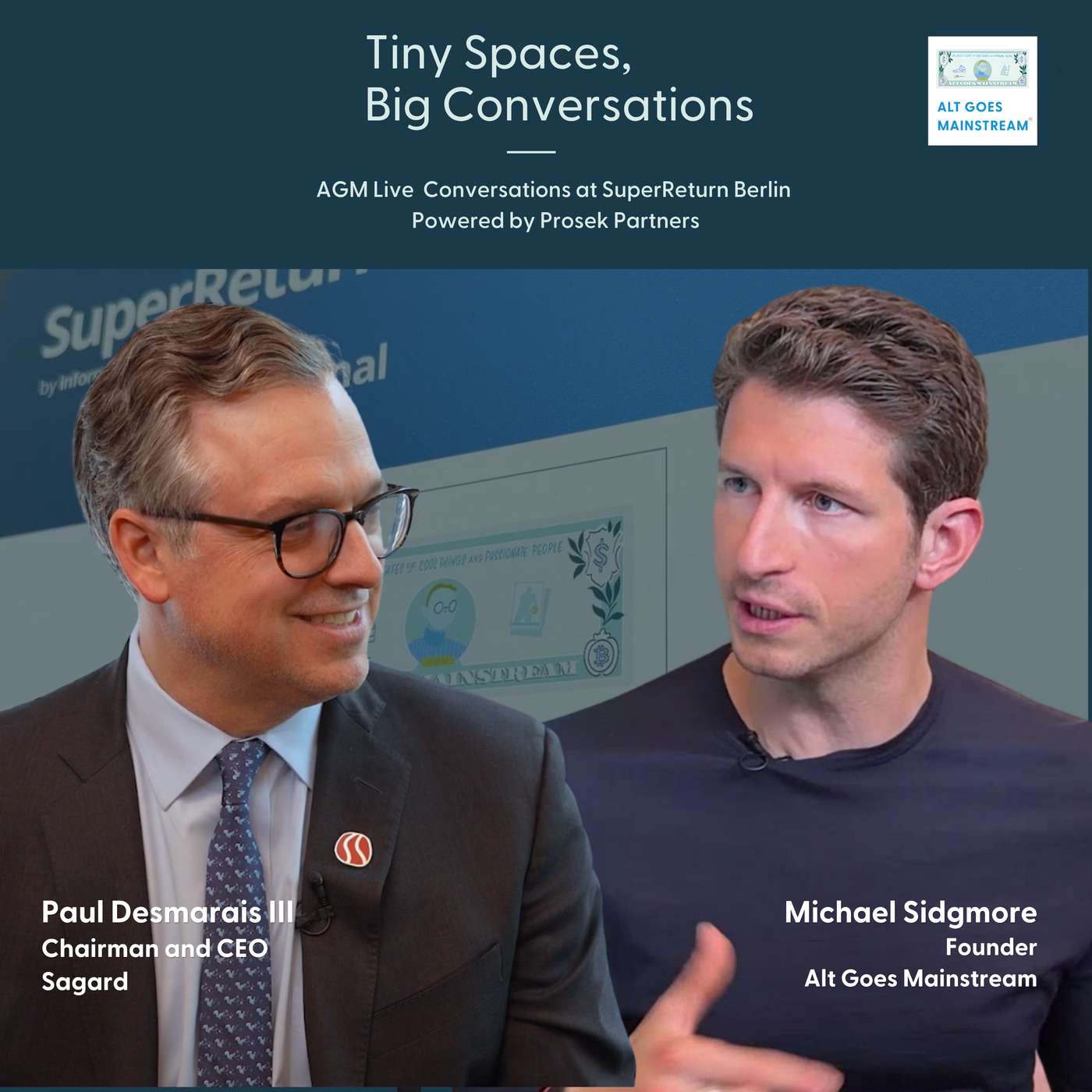
Paul Desmarais III (Sagar) explains how Sagar built a $46B alternative asset manager since 2016, aiming to “go mainstream” by offering alternatives and innovation to entrepreneurs and family offices, using a customer-first, generational, decentralized “pod shop” model with unified culture and (mostly) one brand.
Paul Desmarais III is third-generation in Canada’s Power Corporation financial-services ecosystem (owns Empower Retirement and is an owner of Rockefeller Capital Management). He co-founded Sagar in 2016 with $400M, scaled to $46B, and says he’s a “builder” (entrepreneurial G1). He’s built 35 companies from zero.
risk-taking and reinvention are required for long-term family wealth; Sagar invests with a 40-year mindset; alignment comes from family/shareholder capital (6.7B of 46B) and team co-investing ($300M+); emerging managers become future capacity-constrained funds.
venture studio Diagram; fintech fund Portage; structured equity via Portage Capital Solutions; secondaries firm Bex; AI fund; acquisition of Unigestion (mid-market private equity); telemedicine Dialogue; Wealthsimple; Nesto; Cohо; Coho; Weld Simple.
Written by AI. May contain mistakes.
Discussion on Paul Desmarais III's background and journey as an entrepreneur.
“I think there's a lot of pieces of the puzzle that put themselves together to form cigars.”
Exploration of the role of risk-taking in successful family businesses across generations.
“And the more you start shying away from risk, the more actually failure in the long term is guaranteed.”
Insights into the formation of Cigard and the gaps Paul identified in the asset management industry.
“When I think about Cigard, it's by entrepreneurs for entrepreneurs.”
Discussion on the importance of a customer-first approach at Cigard and the alignment with family interests.
“ripple through how you've built the Cigard platform?”
Paul discusses the long-term vision for Cigard and the role of innovation in their strategies.
“does that change your perspective or your time horizon with how you think about building an asset management business as well as the type of strategies you'd add to the platform?”
Exploration of how Cigard fosters collaboration and synergies across multiple investment strategies.
“You have venture on the platform, importage and diagram.”
Learn how leadership styles and values create a collaborative culture.
“So that level of alignment and that level of sharing outcomes is something that I think leads to collaboration.”
Discover the process of selecting and nurturing partnerships in business.
“So on that point, how do you evaluate the right fit for one of the new managers or strategies?”
Understand how long-term vision is ingrained in company culture.
“How do you enable people to think with the long-term vision that you have?”
Explore the future of alternative asset management and specialization.
“How do you think about the long-term vision of Cigar, particularly as it relates to the evolution of alternative asset management as a business and the place that the industry is in today?”
Learn about the importance of decentralized decision-making in business.
“Do you think you can balance both continued scale and you've said small is beautiful.”
Understand the role of branding in client trust and experience.
“But ultimately, that decentralization of decision-making is what allows us to stay nimble.”
Explore the legacy Cigar aims to create through its support for entrepreneurs.
“When you think about the long term, what do you want the legacy of Cigar to be?”

Get the gist, explore an idea or ask about something said.
 Claude
On Alt Goes Mainstream: The Latest on Alternative Investments, WealthTech, & Private Markets, what are the key points of this episode?
Searching your listeningAutomatic transcript. May contain errors.
0:00We're going mainstream. Hi, I'm Michael Sijmore, founder of Alco's Mainstream and co-founder of Broadhaven Ventures. We are live from Super Return, Berlin. I am here with Paul Desmarais, co-founder and CEO of Sagar, which is also a town in Quebec and an asset manager that has built and scaled in such a short period of time into a$46 billion platform across a number of strategies. I think it's fascinating what you've built, fascinating, honestly, as well in the context of the industry, the industry's evolution. So really excited to have this conversation. Where I want to start, though, is I think both from a background perspective in terms of the things you've done leading up to Cigard, as well as the heritage and history of both Cigard and other affiliated businesses that you've had been involved with.
0:51I think there's a lot of pieces of the puzzle that put themselves together to form cigars. So we'd love to start there. Thank you. And it's great to be here. You're right. I wear two hats and it's two sides of me that are really interesting, but also have created what we are today. First, I'm the third generation of a family business in Canada that has built one of the largest financial services holdings in Canada. But for those in the U.S., we own Empower Retirement and we are an owner of Rockefeller Capital Management. I'm also a first-generation entrepreneur. When people say, hey, Paul, are you a G3?
1:26I always say, no, no, no, no, I'm G1 because I'm a builder. I see myself as an entrepreneur. I love building things. I co-founded Cigar in 2016 with$400 million, have now scaled it to$46 billion, and in that process have done a lot of very entrepreneurial things. We've built 35 companies from zero. That, I think, is in our DNA as a family. Every generation has kind of reinvented what we do. My grandfather built a large industrial group. My father created a financial group. And today, my entrepreneurial project is Cigar. What was the spark that made you say, I want to go build this? I think it's in our DNA where even when we were young, we were always extremely commercial.
2:08I'd go and I'd raise money for charities at a really young age, going door to door, knocking for money. And in retrospect, I realized that all those things were extraordinarily formative. Wow, you did something right as a family in terms of creating entrepreneurs, which we'll get to that in a second. But one thing, just hearing you talk about that, there's another side of seeing family businesses. What do you think has been the hardest part of seeing other generations and also being affiliated with one as you then had to go and build your own business? So families around the world go from success and drive to risk management.
2:47And the more you start shying away from risk, the more actually failure in the long term is guaranteed. To grow wealth as a family successfully, taking into consideration spending, children, demographics, you need to grow that wealth at more than 10 % per year. The reality is it's very hard to do that without taking risk, without making sure that every generation reinvents themselves as entrepreneurs. and it's something, especially in certain cultures, that risk avoidance is accentuated. So here in Europe, you look at large families, their ability to reinvent themselves generation after generation is quite limited because that risk-taking culture and that fear of failure is very prevalent.
3:33In North America, we're extremely lucky where failure is a badge of honor. And honestly, in our family, we've been allowed to take risk. And when we failed, we've not been punished for it. We've been asked to learn the lessons that came from that. And that's a huge privilege when you're an entrepreneur is knowing that you can learn from mistakes and keep on building. As an entrepreneur, what drives you? I often tell people my goal in life is to have a transformational impact on a thousand entrepreneurs. Why is that? is because I fundamentally believe that cities and the prosperity of communities come from business, come from people creating things, creating better ways of doing things, solving problems, creating employment, wealth.
4:17And so I think that if I could play my role in enabling a thousand entrepreneurs to have transformational impacts on our community, I think I'll live in a better city and a better country and a better world. I think that's such a great segue. When I think about Cigard, it's by entrepreneurs for entrepreneurs. Yes. You have built a business and a platform of entrepreneurs and you're empowered entrepreneurs to then empower entrepreneurs through the investment platforms that they've built. So walk us through the formation of Cigar 2016. What did you see that the asset management world, what did it need that it didn't have and you felt missing?
4:55I think we first started with our own group. Within the power corporation ecosystem, we have$4 trillion of assets under administration, a trillion dollars of assets under management. In 2016, there was very little exposure to alternatives. And so I saw a real need that at first really served some of our internal purposes around access to alternatives, but also access to innovation. One of the advantages of joining a family group from a place like Goldman is you come with lots of new ideas and new networks, and you bring that to your family. And it became clear to me that on things like technology and innovation, the family was not moving fast enough.
5:36The family was not exposing itself to enough new ideas. And so I thought we can create a vehicle to not only bring them access to alternative investments, but also bring them access to innovative ideas, especially in financial services. and that's why we started with a credit business and a venture business around financial services, which are not the most natural pairings of two first strategies, but for the purposes of where we were coming from, which is insurance and wealth management, they're actually very well suited for that environment. And it's really only from there, as we started serving more and more other clients, we realized, hey, you know, there's a big world out there and let's specialize in certain ways so we could serve a niche.
6:20One thing that's fascinating in there is you kind of thought about building this for your family in a sense of what you would want and you're the customer in a sense and then there are many other customers that are like you. How has that mindset continued to ripple through how you've built the Cigard platform? You said we are the customer and that is exactly correct. One of the things that's really important about our ecosystem is over 46 billion, 6.7 comes from our family and shareholder ecosystem. So that level of alignment is very different than a lot of the industry. And so we are literally the customer because over 10 % of all of our assets comes from companies that are related to our family group or my other shareholders.
7:08And And so that is really important. And so first and foremost, we're trying to find strategies where we are differentiated and we have a right to win. And so ultimately, because when our insurance company is picking managers, they also have a choice to choose everyone. They're never forced to invest in cigar. We happen to be one of the better performing managers that they've chosen, but ultimately they could choose from the whole world. And so we need to take a customer first approach and we have our family group companies involved, but also as individuals, our team has now invested over$300 million in our strategies.
7:44And so that is also something that is important. So we definitely think about customer first. Do you think that especially as we get to a world where alternative asset managers are expanding and evolving their businesses, they're moving fast because they have to from a business imperative perspective? And I think we all would agree that that's important, particularly if you have investors as you need to grow. You're doing that as well. But how much do you think the alignment that you have from your own capital and the shareholder capital, as well as just your learned history of watching multiple generations of financial services be built, does that change your perspective or your time horizon with how you think about building an asset management business as well as the type of strategies you'd add to the platform?
8:31Yes. And so the timeline is something that we always think generationally. I'm young. I'm in my mid-40s. I'm going to be doing this hopefully for another 40 years. Maybe not 40, but at least 30. And so as a result, when I talk to an entrepreneur who I admire and who I love to have as part of my ecosystem, I can approach that conversation with patience. I'm in no rush. These are human businesses. Human relationships take time to build. and you see it in our partnerships. I mean, we have partnerships with families in Europe that we've been in partnership for 40 years. And so ultimately, these things, whether we get a deal done in a year, two years, three years, in a 40-year time horizon really doesn't matter.
9:16And so we can be very, very patient. In terms of the types of assets that we invest in and the types of strategies that we've built, innovation is naturally a big part of our DNA. We are builders. We are growth-oriented. We are not looking to make a quick buck. We are in the business of building businesses for the long term. We're really focused. We often say we want to find regional champions and turn them into national champions and in some cases global champions. That takes time and that growth mindset is really important and that's really core to our DNA. And that innovation focus is really important because if you look at the persistence of companies in the S &P 500 over long periods of time, the most common outcome over a long period of time is zero, is a total loss.
10:04And so you know that you need to continuously reinvent yourself. And ultimately, by having a strong innovation arm at Cigar, we know that we will be at the forefront of all these different technology trends, giving us an advantage when we partner with entrepreneurs in being ahead of the curve when it comes to technology trends. So you mentioned a bunch of interesting things in there, marrying kind of this long-term view and also building an asset management business. Yes. With infusing that with innovation. You have venture on the platform, importage and diagram. You recently launched an AI fund, but you also have credit.
10:39You have real estate. You have mid-market private equity. You have secondaries. You have a wealth business. You recently acquired Unigestion, mid-market private equity. How do you think about what's next for a cigar and adding to the platform in a way with this innovation mindset? but also keeping in mind your core DNA as a business. So we think about our business as different pillars. Financial services is a pillar. We started by building a venture studio, as you mentioned, Diagram. And then we added Portage, an early stage fintech fund. We then added Portage Capital Solutions that does structured equity solutions for entrepreneurs.
11:18We've added a secondary business around fintech. Each one of those businesses leverage a competitive advantage we have in terms of the scale of our team, the breadth of our portfolio, our credibility in the sector. And so as we think of adding more strategies, we're often thinking about what are the adjacencies that will benefit from our existing ecosystem, but will also add to that competitive moat. And so for each one of our pillars, whether it be financial services or healthcare and technology investing in Europe, or our fund-to-funds business where our goal is to be the leading lower middle market investor globally, what are the strategies that we're going to add that benefit from our advantages but also add to those advantages?
12:04So another example would be we have one of the leading emerging manager programs in Europe, actually globally. Why is that relevant? because the best emerging managers of today will be the capacity-constrained middle market funds of tomorrow. And everybody remembers the first check they got. And if we can be the first check with those people, we will be guaranteed to have the best access to co-investments, the best access to secondaries, and ultimately capacity for primaries. That's exactly the type of moat that we're constantly trying to build. As I'm listening to this in my head, There's all sorts of connectivity between the different parts of your platform that you could leverage the emerging manager business to help deal flow on the secondary side, on the venture side, on the wealth side of wealth business.
12:53There's so many different aspects to how you can enable your platform to create synergies amongst the different firms that you have. How do you do that at a scale? Great question. And so we do it with a lot of thought. and I'll give you a few examples. In our Toronto office and in our New York office, we are moving to new office spaces. All the investment teams are on one floor. I review seating and I specifically place who I think are the most likely to have connecting or adjacent businesses next to each other on the office floor. So it's at that level of detail is how do I position every person on a floor plan so that we maximize communication and we maximize the odds of collaboration across strategy.
13:39And that openness and that thoughtfulness, I think, will lead to collaboration. Other ways that are more, you know, brute force ways are financial incentives. While each one of our teams have a majority of their incentives linked to their direct strategy, we offer all the partners a chance to be shareholders of the firm. And we also have carry that is shared across the firm as well. So that level of alignment and that level of sharing outcomes is something that I think leads to collaboration. And then the third is a very soft approach, which is we are a firm that was founded by individuals that come from collaborative cultures.
14:16So a lot of our leadership come from Goldman Sachs or McKinsey, and those are very collaborative cultures. And so we also lead from the top. And so the way I live collaboration is I try and make sure that I respond to anybody on the platform within 24 hours. Often it's faster, but that's my way of living collaboration. That constant availability as a leader is something that I really care about. And I would say that that pertains to all my leadership team as well. What's interesting about that, too, is you can really compound the moat when you do that. It's probably one of those things that's a little amorphous to see and feel unless you're in it.
14:53But when you're in it, you actually can tell that that culture creates a moat and you continue to grow and then you get bigger and you have that. And you repeat those cultural tenets continuously. We have five values, entrepreneurship, innovation, collaboration, authenticity and rigor. I repeat those continuously. Our senior leadership repeat them continuously. That's also what drives culture. We do, you know, funny things like we give people awards for living those values the best at the Christmas parties. We really are constantly repeating and repetition and leadership is really important. So on that point, how do you evaluate the right fit for one of the new managers or strategies?
15:38Because you've done it in build, buy and partner. Yes. So how do you go about figuring out whether someone, team, firm, culture are a right fit for the Cigar platform? This is a human business, and it takes time to get to know humans. So on average, our transactions take a year. What does that mean? That means if someone's doing a process, it's probably not suited for us. We need to have these bilateral conversations and really get to know each other. What that often means is a lot of time. In the case of performance equity management, we actually organized a fishing trip where we took a bunch of their partners and a bunch of our partners.
16:17We went fishing in Alaska and each partners spent a day with each other on a fishing boat. And that, you know, a lot of a lot comes out when you're in a boat for a day and especially when you're two by two. And so ultimately we do a lot of things like that. We spend time with each other. We'll have a lot of dinners. We'll do some activities together over a long period of time. And then we'll develop a joint vision of what we're trying to build together prior to doing the transaction. And often in that development of a joint vision, that's when you realize the misalignments. How do you enable people to think with the long-term vision that you have?
16:58Well, firstly, we have a DNA of builders. A lot of our senior leadership team are builders. They tend to be extremely passionate about what they're doing. and they're very passionate about our project. A lot of the people left much larger roles to come at first and do what seemed like a pretty crazy project. When Adam Vigna and Samuel Robinson and Francois Lafarturne decided to join me, there was nothing. Adam Vigna was head of private credit at CPPIB. That is pretty remarkable for him to leave. Samuel Robinson, who is chief administrative officer of the investment bank at Goldman, he had an opportunity to be in a much larger role.
17:37He chose to be the number two person of a two-man team. That takes people that are into a project. And I think they all align with this idea of impact on entrepreneurs. And they all have the same kind of desire to win. And they all come from a similar culture. And so the ability to think long-term is very much ingrained in the way they come from. And even places like Goldman, right? They always had a saying, be long-term greedy. And so as a result, that permeates our culture. I was only there for a year and I got that stamped in too. Yes. Yes, I know what it means and it does. You really do get that sense.
18:14You talk about long-term vision. How do you think about the long-term vision of Cigar, particularly as it relates to the evolution of alternative asset management as a business and the place that the industry is in today? So I often look at the evolution of the mutual fund industry. as a parallel to what the alternative management industry is going to go through. And so if you think about it, the beta has been created. Now there's going to be a world where people are going to be seeking alpha. And that means specialization. It means focus. And so Cigar is never going to be the firm that is doing mega deals across industries.
19:00We are going to choose our industries. We're going to build specialized strategies around that. And then we're going to focus on deals where we can really create value, which will tend to be smaller deals. Because often, small companies don't have the full set of resources to reach their full potential and can really benefit from a partner like us who has this global reach, who has this global network that we could bring to those entrepreneurs. And so I think the industry is going to specialize. I think it's going to segment. And I think that that will be a huge opportunity for Cigar to build a very complementary firm to some of the leading players that were built so far.
19:38Do you think you can balance both continued scale and you've said small is beautiful. So this balance of scale and small. And that's where I think our unique business model at Cigar is differentiated. We are highly decentralized when it comes to decision making. My vision is that when you interface with a cigar partner, you are interfacing with the decision maker. That is really important for middle market entrepreneurs. Middle market entrepreneurs are fighting lots of fires, lots of challenges. They don't want to talk to someone who then needs to talk to two other people to get something done.
20:15They want to talk to someone who's going to make a decision. And so our model of decentralized and delegated authority and accountability is really, really important. Now, how do we keep that all together? It's our values. It's our incentive systems. It's our firm structure. It's the buy-in that people have in terms of what we're doing. That keeps it all together. But ultimately, that decentralization of decision-making is what allows us to stay nimble. And the empowerment of those leaders to identify new opportunities and execute on those opportunities is really important. I don't want to pigeonhole the business and the description, but I can't help but think of like the hedge fund world went through this evolution of pod shops.
20:57Yes. And I don't think private markets outside of hedge funds will have true pod shops in the same sense that hedge funds do. But do you think that like when I listen to what you're talking about, the difference is that it's decentralized decision making. Yes. But you're kind of a pod shop in a sense. Is that a good conceptualization? It's actually a great analogy. We're kind of a pod shop, except each of the pods has dedicated capital, and there's nobody sitting at the middle making the capital allocation decisions. Each pod raises its own dedicated pools that are focused on that strategy and then does that.
21:29We do have certain mandates where we actually allocate across our different pods, and we build certain products. So like some of our products in the wealth channel are actually allocations across our pods. But in general, a majority of our capital is dedicated pod by pod. But the pod shop is not a bad analogy. How do you then think about the centralization of the brand? So it's a great question. And it's something we spend a lot of time on. And by the way, it's not black and white. In fact, I'd say cigar is a preference to go to one brand, one logo, cigar. are, but the reality is that we still operate in a multi-brand environment.
22:07We have Portage, which is our dedicated financial services brand. We have Diagram, which is our venture studio. We have Bex, which is our secondaries firm. And so in a context where we have a preference for one, we do allow for some diversity. That's because sometimes you build such a brand value in certain areas that you kind of want to keep that brand value. But what's really important is we want our clients, whether the clients be our investors or the entrepreneurs to back, to have a consistent experience with our brand. The brand is also important in how the industry is evolving. If you think of retailization, the wealth channel adopting alternative products, having one brand is extremely important because it requires a lot of advisor education and that advisor education is a lot easier to execute if you have one brand versus like seven.
23:00It also requires a lot of trust. And trust is a lot easier to build if there's one brand that gives a consistent experience relative to many. And so what's interesting is that we have a decentralized decision authority, a unified culture under, in theory, one brand, but in practice, a few. When you think about the long term, what do you want the legacy of Cigar to be? Well, I mentioned this earlier. We are very focused on the legacy of impact on entrepreneurs. And so there's nothing that makes me more proud of the businesses that we've built from scratch. If I think of Dialogue, the largest telemedicine company in Canada, this came from an idea in my office.
23:45Nesto, we just announced a round at a multi, like at a billion and a half dollars last week, a$300 million round, which in Canada, like unicorns are not that frequent. We've created multiple in our ecosystem in the last 10 years. Weld Simple, Nesto, Dialog, Coho. Those are four of our first eight seed bets have become unicorns. And so we're really proud of what we created. The amount of jobs we've ended up creating. 3 ,000 jobs in Montreal exist because of the companies that we built from scratch. And so that makes me extremely proud. But ultimately, it's about the entrepreneur. It's about Malik at Nesto.
24:22It's Mike Katchen at Wealthsimple. It's Sharif at Dialogue. It's Dan at Coho. Like we are backing these individuals and we are their biggest champions and we're helping them build transformational companies. And we're hoping to have our impact through them. That's such a great way to wrap this up because you're building transformational companies through them, but cigar itself is a transformational company in the industry a business of businesses yes by entrepreneurs and for entrepreneurs so then i think all of that showed your passion and your energy and and and not just the dna it comes through so this was such a great conversation i love thanks so much paul thank you appreciate it thank you thank you
25:08We're going mainstream.
Welcome back to the Alt Goes Mainstream podcast.
We sat down with Paul Desmarais III, the Co-Founder, Chairman, and CEO of Sagard, the fast-growing $46B global multi-strategy alternative asset manager.
We were live from Berlin, which becomes the “capital of private capital” in June as private equity industry leaders make the annual pilgrimage to the city for one of the marquee private equity conferences, SuperReturn Berlin.
With Prosek Partners and former Bloomberg TV journalist Deirdre Bolton as my producer, along with her team, we took over a Tiny Space cabin to hold big conversations with some of the industry’s leading alternative asset managers.
Sagard combines a rich history and heritage of building asset management businesses with a modern approach to building a global alternative asset manager.
Paul’s deep understanding of the industry comes from being part of a family of multiple generations of asset management pioneers in Canada who have built some of the industry’s largest financial services businesses.
Paul is the “next first generation” of asset management pioneers to come out of the Desmarais family. He started Sagard with $400M in seed capital in 2016 and, in ten short years, has grown the platform into a global multi-strategy alternative asset manager with over $46B.
Sagard’s mission to empower founders by being a business that builds businesses shines through in the approach Paul and the team have taken in building Sagard. The firm has incubated, built, and acquired asset management talent and firms to scale across strategy and geography into the global platform that it is today.
Paul and I had a fascinating conversation about the business of asset management and why Sagard exists to serve entrepreneurs around the world. We covered:
Bio
Paul Desmarais III is the Chairman and CEO of Sagard, an alternative asset management firm active in venture capital, private equity, credit, and real estate.
Paul has led Sagard since 2016, along with a handful of close partners bound by a common vision: partnering with entrepreneurs to catalyze transformation in our investments and communities. Sagard has experienced outstanding growth, with assets under management increasing to over $46B.
Under Paul, Sagard has built a global network of expertise that helps companies lead, embrace, and stay ahead of disruptive trends, expanding activity in North America, Europe, and the Middle East. Paul engages actively in growing Sagard companies. Within the Sagard ecosystem, Paul is the Executive Chairman and Co-Founder of Portage (fintech & financial services investing) and the Chairman and Co-Founder of Diagram (venture builder). Within the investment portfolios, he is the Chairman of Wealthsimple, Novisto, and Sagard Wealth, and a director of Nesto and Midas. Paul also sits on the board of Empower, the number two 401(k) business in the U.S.
Show Notes
00:00 Live From SuperReturn
00:10 Meet Paul Desmarais III
01:06 Family Business Roots
01:23 G1 Entrepreneur Mindset
01:35 Launching Sagard 2016
01:51 Generational Reinvention
02:02 Early Spark To Build
03:40 Learning From Mistakes
04:33 By Entrepreneurs For Entrepreneurs
04:45 Sagard Origin Story
04:58 Power Corp Alternatives Gap
05:43 Starting With Credit
06:10 Serving Beyond The Family
06:46 Alignment With Family Capital
07:19 Customer First Performance
07:44 Team Money Invested
07:53 Generational Time Horizon
08:47 Patience Builds Partnerships
09:22 Innovation In The DNA
09:39 Regional To Global Champions
09:53 Why Reinvention Matters
10:26 Platform Strategy Mix
11:02 Pillars Of The Firm
11:25 Fintech Ecosystem Flywheel
11:35 Building The Competitive Moat
12:07 Emerging Managers Advantage
12:41 Synergies At Scale
13:08 Designing Collaboration
13:47 Incentives And Shared Carry
15:07 Values Drive Culture
23:25 Legacy And Entrepreneur Impact
24:39 Closing Thanks