 Ask ChatGPT
 BIG IDEAS BY NEW ECONOMIES
26 Sep 2026 · 1h 3m · 26 chapters
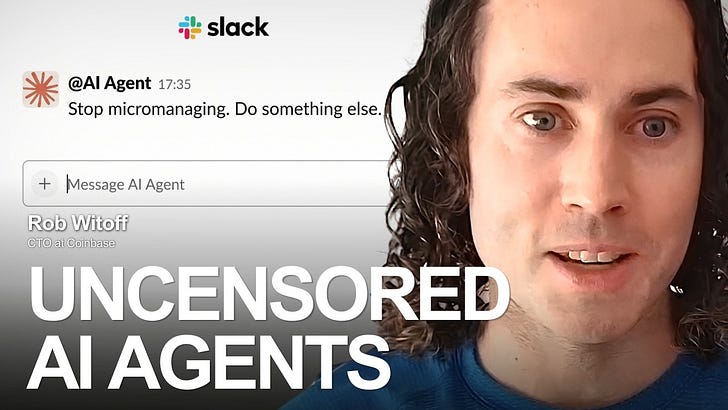
Coinbase’s CTO (Rob Wittoff) explains how Coinbase is integrating AI agents to 100x software productivity and how crypto is shifting from speculation to real payments/rails, stablecoins, and agentic commerce. He also covers internal “software factory” orchestration, model-update evaluation, trust/security, and how Coinbase is flattening org layers and using agent-driven “spicy” feedback weekly.
Rob Wittoff, CTO at Coinbase. Background: helped scale Coinbase from a scrappy 2012 startup to the largest American crypto exchange with 4,000+ employees; previously worked across engineering, security/infrastructure, data, recruiting/operations.
98–99% of Coinbase code is now agent-written; engineers supervise 3–5 agents (sometimes 10) daily; soon they’ll supervise loops/systems with ~100 agents. Coinbase uses a custom “CB agent” platform with security/compliance agents. New model releases are rapidly adopted after internal benchmarks; every 2nd/3rd generation brings “unlock” automation. Weekly agent feedback replaces slow performance-review cycles.
tax-season prototype built by a non-engineer using internal rapid prototyping tools; X402 transactions exceeding 100M; AI Advisor for agentic trading; custom compliance/security models using Coinbase’s historical decisioning data; account segmentation/sub-accounts for safer agent permissions.
Written by AI. May contain mistakes.
Discover Rob Wittoff's journey and insights into cryptocurrency's evolution.
“He helped scale Coinbase from a scrappy 2012 startup into America's largest crypto exchange with over 4 ,000 global employees.”
Explore how the use cases of cryptocurrency are shifting from speculation to practical applications.
“I've been excited to catch up with you here for a while.”
Understand the regulatory landscape and Coinbase's efforts to scale its systems.
“And we've been working towards what the big global scale moment would look like.”
Learn about Coinbase's engineering practices and how they foster innovation.
“And for where things are scaling, one of the new really interesting interfaces that we have here is for a long time, We've always built for web and mobile, and now we're building for agents internally, too.”
Find out how Coinbase engineers develop taste and judgment in their work.
“And so over the last few weeks where I've gotten to start, this is maybe my sixth or seventh core of duty as CTO here.”
Learn how Coinbase encourages all employees to prototype and innovate freely.
“That's where we're able to get this real step function increase in what we think of as our software factory internally that makes us a really high output, but also high trust, modern software company.”
Learn how Coinbase encourages rapid prototyping to enhance product development.
“If you got an idea, we want you to go prototype it, go and build it.”
Discover how the roles of software engineers are changing with AI advancements.
“By giving people those tools, a picture is worth a thousand words.”
Explore how Coinbase's CB Agent platform integrates various internal tools.
“And who are the domain leaders that are articulating that to some model or some brains?”
Understand the disruptive effects of AI model updates on product development.
“So we can figure out for our specific workflows, where do the models work really well and where are they not up for the task or where do they have some fundamentally new capability?”
Learn how Coinbase builds custom models to enhance compliance and security.
“And these are the like 99 % improvements that we're seeing all across the company now.”
Gain insights into the factors driving volatility in the crypto market.
“What do you think the market still does not understand about this volatility?”
Learn how Coinbase is transforming into a comprehensive financial super app.
“in risk-on and risk-off assets and how they're managing their finances and where they're spending their free time and entertainment time.”
Hear the hosts encourage listeners to subscribe for more content.
“The guests on the show are getting bigger and bigger and we need your help to grow this channel.”
Explore the journey towards seamless crypto payments and AI integration.
“And we can talk more about how that works, where it's been truly up and to the right, over 100 million transactions.”
Discover how Coinbase views the emerging opportunity in prediction markets.
“We are unquestionably in the middle of one.”
Learn how Coinbase is engaging with prediction markets to enhance economic transparency.
“How is Coinbase thinking about this prediction market's opportunity?”
Discover the critical use cases and growth potential of stable coins in digital transactions.
“What's the most efficient way for an agent to make a transaction?”
Understand the challenges and strategies in keeping pace with rapid technological advancements.
“We're obviously having a lot of these conversations.”
Explore how Coinbase is streamlining operations for faster decision-making and execution.
“And it's really good for coordinating because you can set expectations at each level.”
Learn how Coinbase uses AI tools to provide real-time feedback for continuous improvement.
“We would be looking at each of those independently.”
Learn about creating a personal brain to manage interactions and feedback.
“And it's got all of my preferences and interactions, and it sees all of my private contacts.”
Discuss the recent and upcoming inflection points in AI technology.
“And so we're going to scale this out quite a bit internally.”
Explore how AI agents will enhance human capabilities and workflows.
“Is this going to happen in the next 12 months, do we think?”
Understand the importance of health tracking and personal growth.
“We can actually have time off and our agents can do the work for us.”
Wrap up the discussion with insights on future developments and personal reflections.
“And what I've found is my sleep is a really good predictor of how well I show up and how well I'm able to interact with people here.”

Get the gist, explore an idea or ask about something said.
 Claude
On BIG IDEAS BY NEW ECONOMIES, what are the key points of this episode?
Searching your listeningAutomatic transcript. May contain errors.
0:00A year ago, we were primarily writing code by hand, the old-fashioned way. Today, roughly 98-99 % of our code is all written by agents. Most of our engineers are supervising 3 to 5, sometimes 10 agents throughout the day. They're producing 100x the code they were a year ago. When you see that, it breaks assumptions across the whole staff. And so right now, an average engineer might have 3 to 5 agents working for them. In six months, what is unquestionably true, what I'm very confident of, we are going to have...
0:33Rob Witoff: This is Rob Wittoff, CTO at Coinbase. He helped scale Coinbase from a scrappy 2012 startup into America's largest crypto exchange with over 4 ,000 global employees. And today, he's revealing how modern companies should integrate AI agents in order to 100x their productivity and growth. The cost to go from zero to one is lower to build it now than it is to ask for permission to build that. And so we want everyone to have the ability to rapidly prototype and experiment with things they want to see. Large companies historically have had a lot of layers. You get objective feedback on how you're working with people.
1:11And over the course of years, you slowly get a little better and internalize feedback. And that's completely the old way to work now. What we found agents are exceptional now for people that are really high growth and want to grow and be the best versions of themselves they can be and are not afraid to get the hard feedback. GBT 5.6 and Claude's 4.8 plus got really exceptional in giving people the hard feedback you wouldn't otherwise hear. People may not want to say, Rob, stop giving me feedback. Rob, get out of my way. You know who's not afraid to say that is my agent. And companies that really want to grow, really want to win, I think are getting almost more productivity gains from that kind of feedback than we are from models in product development.
1:58I think it's that transformative right now. One of the most important things that's happened in my career, maybe my life in the last year or two, it's that.
2:09Rob Witoff: Welcome to New Economies.
2:23Rob, welcome to New Economy.
2:25Rob Witoff: So good to see you. Oli, thanks for having me. I've been excited to catch up with you here for a while. Likewise, this is kind of a full circle moment. Your first official interview since you joined Coinbase as CTO. And, you know, I love to begin with Coinbase started 13 years ago. Everyone has been a little bit skeptical around what is happening in crypto. Coinbase is now the largest American crypto exchange. What do people still not realize about crypto and its biggest opportunity? We've been here for 13 years at Coinbase and Bitcoin's been around or cryptocurrency has been around for 17 years now.
3:06The staying power is here. And one of the big shifts that we're navigating that we're all really excited about now is for years, the killer use case of crypto was speculation. And we've been working towards what the big global scale moment would look like. That's here now. People are using crypto rails because they're more efficient rails. They're using protocols because they're the best platform for stable coins and large transfers and trading and new asset types and new trading instruments to be built on top of. And so we've started to see real large scale exponential growth all across the business.
3:48And I think we've been working towards this for so long. And now that we're seeing these new, more efficient crypto rails underpin other parts of the economy, stable coins being one of the big growth areas, agentic commerce being another really killer use case. This is what we've worked towards for a long time. And now we get to think about what the next chapter of scaling and really playing a bigger role in the world stage looks like.
4:10Rob Witoff: What does the next chapter look like on that global stage? Yeah, so there's been a lot of work happening with regulatory clarity. Number one, you've probably seen the Genius Act and the Clarity Act. I think as the CTO, where I've spent a lot of time is internally on how are we scaling our systems? How are we making sure our quality bar is extremely high? People want to use our products because we're the most trusted brand. That's something we think about a lot. How do we double down on trust? And for where things are scaling, one of the new really interesting interfaces that we have here is for a long time, We've always built for web and mobile, and now we're building for agents internally, too.
4:53We've had new protocols like the X402 protocol we could talk about. One of the fastest growing new protocols on the internet, which is helping agents make transfers both small and large across services on the internet. So making sure that's high quality, high trust, reliable, and can scale for humans and agents are some of the areas we're spending a lot of time on now.
5:18Rob Witoff: You know, maybe even 12 months ago, I never thought we would be allowing agents to do stable coins for us, transacts on our behalf, buying e-commerce products. But that is now full reality, right? We'll come back to that. You just joined CTO. You're a couple of weeks in, a month in. What is it like rejoining a company? Which, by the way, for the audience, I think you first started in 2014, right? Maybe just help the audience take us through how that transition went and why you started. and rejoin the company. Yeah, so I've had an amazing journey here where I got to meet Brian when he was starting the company.
5:55It's just a one-person company. And when I first came out to meet Brian, there was somebody sleeping in the office. He was working out of a loft apartment. So that was back in 2012. And I've gotten to see that scale to about the 4 ,000 people we are here today. And over that period of time, I've gotten to work in just about every corner of the business, starting as an engineer. working in security and infrastructure and data and how we're recruiting and prioritizing and operating and everything internally. And I think across that, what I've really cared about is how do we build a great organization?
6:31How do we get great people in here and build things that our customers really want to use? And having been a part of a team for so long, you get to see why decisions are made the way they were. And one of the really interesting things about a company that scales over time is you'll often make small decisions that have big ramifications on how the company works five or 10 years later. But having seen the whole journey of that, you have a really deep first principles understanding of why things are the way they are, why the culture is the way it is, and how all those things interplay with each other.
7:07And I think that's allowed me to think really principally about what does great look like here? How do we build a good team? How do we scale our systems? How do we challenge assumptions so that we can run a really efficient and high productivity org? And so over the last few weeks where I've gotten to start, this is maybe my sixth or seventh core of duty as CTO here. I'm able to lean harder into across the company. Where are the big opportunities? How do I get people together? And how do I really get the company to the next level at all levels from how engineering works today? How we're rethinking the company with AI as that reshapes assumptions on what great looks like, the kinds of people we're hiring for, architecturally for as our customers' needs evolve, as we lean harder into trading and payments and stable coins, what are the systems we built that are not designed for that, that we need to fundamentally rethink.
8:05And having all that context, I think, gives me the confidence to lean really hard into what the next chapter looks like.
8:11Rob Witoff: So out of the 4 ,000 team members globally, how many kind of sit under, you know, technical engineers, product under your remit? Yeah, so for engineering, I think around a third, maybe a little more of the company is engineering right now. And we're actually growing that, which is pretty interesting right now in all parts of the business. And two categories we think a lot about here or as we lean harder into automation and intelligence, one thing we believe strongly in is we need to have the best tastemakers and people with really deep domain expertise that know how to direct our agents internally, where we should be focusing up our efforts.
8:57But in order to do that really well, we need a lot of great high agency engineers that can drive rethinking, rebuilding our internal systems in partnering with those experts so we can codify that into fully automated workflows or loops or things that make the company move really quickly. And so in doing that, we're actually growing the amount of engineers in the company quite a bit because we're trying to inject automation into every part of the business from support to compliance to security and so on. Because what we found is where there are often these legacy manual workflows, they're not just multi-step and slow and expensive.
9:39There's also more room for human error in those two. And so where we have these well-defined workflows, similar to the self-driving car analogy, in a lot of cases in the business, we're now able to show that bringing intelligence and agents in, we can actually move faster, but also with a much higher quality bar. And we do that by pairing these high agency engineers with these domain experts that really deeply understand what are the problems we're trying to solve and support and compliance and going from bugs inside of our infrastructure to automatically patching code and shipping new changes internally.
10:16That's where we're able to get this real step function increase in what we think of as our software factory internally that makes us a really high output, but also high trust, modern software company.
10:29Rob Witoff: You know, it's so interesting just listening to this. I've had a whole bunch of founders on the show recently. We were just saying the co-founder of LinkedIn, Reid Hoffman, a couple of days ago this year, Webflow, there's a head of AI at Replit. And the consensus is actually kind of the same. Where we are heading is all about taste and it's all about judgment. when you're looking after these 1300 engineers give or take how are you coaching them about what does great taste actually look like and then also what does great judgment look like yeah it's a great great question so taste and judgment in the modern era for engineering i think is akin to thinking entrepreneurially and being able to really think holistically about what are we building and why?
11:13And I think a part of that starts with, we want everyone here using our products. It's not enough to be looking at the data and sitting afar and thinking we know what our customers want. We want our people being customers, being daily users of our products internally. One of my favorite features we launched recently was you can now direct deposit it directly into the Coinbase app. And it's a small feature. It's not widely used externally, but it makes it really easy for everyone here to be a regular user of our products and get a feel for what works, what are the rough edges, where do they get trapped in some workflow in our app, and to develop their own taste for what create looks like and what they want to see.
12:00We also, of course, augment that with we want people really understanding our customers. We do a lot of customer sessions internally to make sure people are fully understanding that workflow. We've done other things like trading Olympics internally, where we're helping encourage people to use new products. We've been investing a lot in derivatives and futures inside of Coinbase. We're making it really easy for people to deeply empathize and develop that taste internally. I think one of the other big categories on judgment is a lot of this comes from two things. One is just experience having the reps and the cycles to build systems, see them scale, work with teams over time.
12:42One of the more interesting ones I think about for engineering is I think some of the best ways you develop judgment in engineering is gathering battle scars over time where you have to make mistakes to learn some of the really big things. And one of the challenges that larger teams always have is we don't have a lot of error tolerance for our staff to make mistakes that could hit our customers externally. And so a lot of what we do then is making intentional space for people to move fast, experiment, break things, get instant feedback without impacting our customers. And that looks like really good internal development environments, staging environments, and defense in depth so that engineers have that extra autonomy to develop that judgment once they're inside of the company too.
13:34Rob Witoff: That's so interesting. So if you're a software engineer at Coinbase, if you have an idea, can I come to you and say, hey, Rob, I've got this idea. Can I get a bunch of people to work with me and we can try it out? Let's just get inside. What does the engineering team actually look like? Yeah, yeah. So this is such a good question. How do you go from zero to one? How do you experiment and play? Super important that this is seamless internally. So we don't want you coming to me, coming to your lead. If you got an idea, we want you to go prototype it, go and build it. And one of the magical things about where we are in the world today is the cost to go from zero to one is roughly lower to build it now than it is to ask for permission to build that.
14:19And so we want everyone to have, and this is engineers and non-engineers too, 100 % of the company has the ability to rapidly prototype and experiment with things they want to see. And I'll give you a good example of this. We had an incident sometime last year where during the tax season, there was some tax form that I don't think we were producing in a way that it was easy for customers to use. And we did the legacy thing where people get together and start talking about how should we fix this? What should this look like? And one of our high agency internal non-engineers, rather than joining the conversation, used one of our rapid prototyping tools internally to mock up a fully working prototype of what he thought it should look like.
15:08That immediately became the thing we built. And so while other people were trying to debate, what should this look like? How does this work? By giving people those tools, a picture is worth a thousand words. A prototype is worth a million words. and that's how we're encouraging people to rapidly prototype, build something quickly and we're able to get more attention and more momentum on things once people can see and touch and feel what it could look like.
15:36Rob Witoff: When I was speaking to the head of AI at Replit my biggest takeaway was all of these software engineers what their role looked like even 12, 24 months ago looks very different today. And my takeaway from the chat with Mikhail was all of these software engineers that are going to become AI agents, managers. How does Coinbase think about setting up your software engineers for success when really their role has completely changed in the last, what, 24 months? So the most important thing we think about here is the rate of change in that trend. And every three months from prompts to agents to your harnesses and loops and graphs, Every three months, there's a new thing.
16:21And every time a new frontier model comes out, it reshapes what is possible. And we're collectively learning as an industry in order of magnitude faster pace than engineering ever has before. So the one thing we know to be true is the rate of change is going to at least continue, if not accelerate from here. And so our ability to predict what two, three, four years looks like from now, we can do it. We have our strategy. We have our things we're working towards, but we're probably wrong. And that's the thing you have to really lean into is rapidly embracing the rate of change and hiring people that have that neuroplasticity and are excited by adapting to that as we go.
17:07And a couple of specific examples of what that looks like. A year ago, we were primarily writing code by hand, the old-fashioned way. Today, there's roughly 98%, 99 % of our code is all written by Asians. And we're looking at the small exception or artisanally crafting, I like to think of it as, a really small percent of the edge cases. We wouldn't have predicted, or I didn't predict last year, that would have changed so quickly. Today, most of our engineers are supervising maybe three to five, sometimes 10 agents throughout the day, which is a really different muscle to exercise. And where that's heading is going from supervising just agents to now supervising loops and full systems.
17:57And a lot of that is being distilled to what problems should we be solving in the first place? And so now we're thinking about how do we really lean into what is our product strategy? What is our architecture strategy? And who are the domain leaders that are articulating that to some model or some brains? We're building a lot of this into our Coinbase brain internally. And then that brain is orchestrating our agents and loops internally that makes that a really scalable, extremely high quality and fidelity system.
18:29Rob Witoff: How are you setting up your agents? You know, you're self-managing these 1 ,200-ish people, right? But when you have time to actually do your job right and building these products, what type of agents are you using and how are you orchestrating that? Yeah, so we've got a variety of tools internally. So the way we've broken this down is, number one, we want to be giving people the best available tooling. And so we've got access to just about every model, open weight models, frontier labs, those are all available. We've got a lot of harnesses available internally. So we want people to explore and experiment.
19:09But for how we're scaling that, that sort of scattershot approach only gets you so far. And so what scaling that looks like is inside of Coinbase, we built what we call our Coinbase agent platform, or we call it CB agent for short internally. And so CB agent is where all the pieces come together into our software factory. And so beyond just supervising an individual agent, you want your agent participating with other agents with some clear goal that's producing our product at the end of the day as one of the reasons we're all here to make the product great and featureful. And so that all comes together through our CB agent harness where I have my agents I've created.
19:52There's security agents, compliance agents, they get to work together to make sure when we want to ship something new or there's customer feedback coming in or we set our goals for where we want to head to, they can work together within our CB agent platform, which makes our fully integrated software factory really smooth and high fidelity across a lot of different teams and have to work together inside of Coinbase.
20:17Rob Witoff: I kind of refer these model updates to what used to be the iPhone once every six or 12 months. Now it's literally like every few months, right? You're saying sometimes even a few weeks. How disruptive are these AI model updates to your product roadmap? Disruptive is a good word. They are disruptive in the true nature of the word where they are not just causing some frenetic energy internally. They are typically disrupting the way we work too. And so let me walk you through what some of the process looks like. When a new model launches externally, we try to do two things. One, we try to make that available to our staff as soon as we can internally.
21:04But two, we're running our own internal evaluation benchmarks against that. So we can figure out for our specific workflows, where do the models work really well and where are they not up for the task or where do they have some fundamentally new capability? And the most exciting part of this for me is when a new model comes out, this doesn't happen with all model generations, but at least every second or third model generation. There's some fundamentally new unlock where it can automate a thing you weren't able to safely do in the past. And a lot of this started earlier this year when I think it was the Opus 4.5 model came out.
21:50I think that was on February 5th of this year. And that was just an exponential unlock in software development for us. Some of the more recent ones we've had are in general purpose reasoning where they're now very good at helping you with strategy. And as these come out, I try to look for these aha moments that I'll find personally, and then share those with our peers and leaders and engineers to make sure everybody is experiencing the same type of aha moment for a new model, which lets them rethink how their internal stack and the automations they built are working. One of the great things about that is, you know, what's really good at modifying all the tooling and automations you built to use the new model is the new model.
22:31And so we go through this cycle where the company sort of incrementally ratchets up our capabilities. Each time a new model comes out, the challenges are just making sure we're sharing the aha moments so we know what those are. And we have our own custom structured frameworks for understanding what they specifically mean for a company like Coinbase.
22:52Rob Witoff: And these are just model updates, right? We're not even talking about new models. We were saying earlier, we had Reid Hoffman on the show, right? He made a really interesting point around typically right now, there are maybe four or five AI models. Maybe in the coming years, they're going to be 10 to 15. As we think about that, would you guys ever launch potentially your own? Is that something you thought about? Yeah, something we think about and we are working on in pieces. I don't think we're going to launch our own frontier model, but what we do have is we've got 13 years of really high fidelity data on what it means to build great cryptocurrency products working with our users and all the other data sets we've collected.
23:41And so some good examples are three really interesting examples that are a little unique to Coinbase are in compliance. We have really rigorous compliance obligations that we take really seriously. And it's important to protect our customers and to protect us too. And we've spent a lot of time using historic decisioning we've made internally to build custom internal compliance models that are helping us now increase the precision of decisions we're making and also make it much lower latency for if an account has to be reviewed because there's some compliance obligation there. We can now do that with higher quality in sometimes minutes where it might have taken weeks or months in the past.
24:25And these are the like 99 % improvements that we're seeing all across the company now. One of the next ones that's really near and dear to my heart is on how we're securing the company. This is just one of the most important value propositions we have, being the most trusted brand. How are we securing our system, securing our code? And one of the things I like about Coinbase is we're often a target for a lot of attackers, hackers that want to test out of vulnerability, they'll come to Coinbase first. So we've got really good logs. We see a lot of things on the internet. We've got a lot of history for where things can go wrong.
25:08We also look at whenever there's a vulnerability we see outside in the wild, we look at that and see how does that apply to us inside of Coinbase. So we've got a tremendous data set here. And for every change and every line of code we ship, we've always had really good scanning and auditing and reviews. We've got the structured set of gates between code writing and going out to production. And so one of the ways we're customizing our models now is using that historical data to optimize, in some cases, open weight models where we can slightly retrain those now. And we're thinking about how we accelerate that over time to have the best security models internally.
25:50So we always have the most secure, the most hardened systems. We've been working with Frontier Labs on that too, to make sure we can test some of their cyber capabilities on some of the most hardened and important to hardened code bases, both in Coinbase, cryptocurrency and cryptography too. So I think custom models there are certainly something we'll keep investing in. The last one is around agentic trading. And we recently launched a product called AI Advisor, where we help people build models that can encode the trading strategies they want to build and implement those on our platform. And again, we've got really good custom data sets there that help us customize models to give a great experience for people building on our platform.
26:39So those are just a few of the examples. And I think there will be a lot of room building on open weight models where we're pretty bullish long term to tailor those to specific use cases to make them extremely performant.
26:53Rob Witoff: You know, we mentioned trust earlier, and I'll be honest, anyone who's running a crypto company, sometimes I do feel a bit sorry, because it is so volatile. What do you think the market still does not understand about this volatility? Why actually is it so volatile? So this has been a part of crypto from the very beginning where there's always these three or four year cycles where market goes up, market goes down. and we have a saying here, Brian likes to share this, that it's never as good as it seems, it's never as bad as it seems. And I think one of our superpowers has always been zooming out and looking at that long-term trend and continuing to build when the going gets rough or when other people get dejected elsewhere in the industry.
27:40I think one of our real superpowers is we keep powering through and that's why we've continued to scale and build good products and win in the long term. I think one of the shifts there, though, is human beings have, I think, a roughly fixed appetite for investing in risk-on and risk-off assets and how they're managing their finances and where they're spending their free time and entertainment time. And I think historically that's rotated from crypto to other things. And so it's not that people's appetites for new assets or new projects is going up and down. I think it's just rotating from place to place to place over time.
28:27And so one of the places we've been scaling the company recently is growing into what we call our everything exchange internally, where we want to provide all the things that our customers want from prediction markets to payments to futures, derivatives. And so now that we're building out a more full-featured product suite, we're seeing this stabilizing factor between the cycles because people can get more of what they want on platform. And that's something that we're pretty committed to growing because we're seeing really good customer feedback from that.
29:03Rob Witoff: You know, when you look at these super apps all around the world, I've always thought of Coinbase as a super app for financial services and the biggest opportunity, right? Where in that journey are you really truly being this financial super app? And where are still the opportunities to be unlocked? I think the opportunities are everywhere for us to unlock. We're only about six months into having publicly launched our everything exchange from derivatives, futures. We started supporting equities not too long ago. But I think the real big unlock for us is we've always had this long-term thinking of how can we use it.
29:50So our mission here is to increase economic freedom in the world. And we really believe in that. We're not here to do the short-term thing. We're here to have what we believe is a really positive impact on people's individual liberties across the world. and for a lot of the things we're building to really achieve that we have to make them run on better rails make them more accessible make them more open to the extent we can do that safely and in the right ways and so these are things like tokenizing equities and putting more of this on chain so it's more more accessible and helping people with self-custody so they have the ability to control their keys and control their crypto and things that are built on top of it and i think this chapter we're moving into now is again less of the speculative wouldn't it be nice if but really meeting people where they are and building things that give people real financial control give people real economic freedom and so i think these next big unlocks are how do we not just support equities but support them on modern crypto native rails you can do a lot more
30:59Rob Witoff: interesting things with them if you're enjoying today's episode hit subscribe by the bottom real screen. The guests on the show are getting bigger and bigger and we need your help to grow this channel. So if you're enjoying today's guests or any previous episodes, hit subscribe and I promise you it'll be worth it. Now back to today's episode. You know, we said earlier, 12 months ago, if we asked any agent to transact on our behalf, I don't think many of us would feel comfortable doing it right but now with you know commerce trading booking flights booking hotels it's now really become a reality you're probably the best person to ask about this where in the journey are we are being fully agentic with crypto payments are we just getting going we just scratching the surface i think we've hardly scratched the surface i mean i'll give you two perspectives on that so So some of the steepest exponential growth curves we have here are on X402 transactions.
32:05And we can talk more about how that works, where it's been truly up and to the right, over 100 million transactions. And we don't see any time of that slowing down too. Personally, what's more interesting is when you're transacting in commerce on the internet, there's a lot of different sites. There's a lot of things you have to work through. And there's a lot of routine things you're doing. If you're stocking up the house with the same thing every week or every month, if you're traversing the internet and you want to read an article on one site, you don't want to have to sign up for a subscription for everything.
32:45You don't want to have to click through all the paywalls. You would be really happy to pay a couple cents to access a page here. you would be really happy to tell an agent to keep your house stocked up on X, Y, or Z and have a short conversation with it instead of having to navigate through different sites. And so I think there's a lot of obvious opportunities where it's not just a nice to have, it's a far superior user experience for people. One of the challenges though, which were as familiar as anyone in crypto, is the user experience hasn't historically been very good. It's been hard for people to use.
33:24And so where we're really excited is seeing harnesses improve, seeing the interface become much more seamless. And a big area has been, of course, increasing the quality of model interactions. One word, for example, we hear a lot less today is hallucination. last year model hallucinations were a huge problem and so frontier labs have worked a lot on increasing the quality of model interactions building in guardrails so that models are not making mistakes or doing things that are not aligned with instructions you keep them we're not all the way there yet but at the direction of with the direction of travel we have now, you can see there will be really high quality experiences where you can tell your agent to focus on some goal.
34:14I want to book a trip to Thailand. I want to take my family to Spain. And they can coordinate all of the steps that need to happen, do all of the research, look at all of your historical preferences, propose the full itinerary for you. And you can give it a yes at the end and it's all taken care of for you, that can save you orders of magnitude amounts of time compared to what that looks like today.
34:40Rob Witoff: There's also security, right? I mean, I think this kind of yes option is the thing that's going to make most consumers confident, right? It's not just going to go and spend a thousand dollars or $10 ,000, right? Without my permission. Yeah. And there's a lot of fundamental things we're working on here that I think are important for this to work. We're working on things, for example, like better segmentation within your account. So when an agent has access to your wallet, you don't want to have access to your whole entire wallet. So we've got sub portfolios and sub accounts where you can give it access to a small amount, but making that process really seamless.
35:20And then also managing risk and guardrails and model alignment with your intent are all things we're optimizing now that I think will very quickly make the concern of misaligned models a thing of the past. But that's one of the limiting factors we're working through now.
35:38Rob Witoff: I completely see this working for the consumers where if it's more the personal things, right? Buy me this wardrobe or, you know, find me this itinerary's gone holiday. But when it comes to more financial services where people are a lot more risk averse they're cautious obviously with their personal capital it's obviously a very different experience right or is it a different experience right how do you see the experience working for more financial service related agents that are scouting new opportunities for consumers so i think there's a continuum here that holds true across really any use case.
36:19And one of the first important areas to nail is getting your agents read-only access to all of your data so they can't take any action at all. But if you could still get really crisp insight into how is your portfolio allocated? As prices change, how does your allocation change over time? How does that match your risk tolerance? As assumptions are changing, are you still managing your portfolio the way you'd want to? I think there's still extremely safe, read-only, high-value places where we want agents to start. Where that gets into the more nuanced territory is when your agents can start to take right actions for you and when they can make a decision or execute a trade on your behalf.
37:10That's where we need a few things. Number one, we need the right hard constraints. So you don't want to be able to move funds that are not allocated for it. Number two, we build a lot of this internally. Escalation to human has to be a core workflow here. So models often work through a lot of assumptions, and that's to give you a good user experience. So they're not asking you 20 questions to respond to a simple prompt. But if you're making a lot of assumptions like that for a financial application, it's not always appropriate. And so we want agents to be bringing humans in at the right point inside of a workflow so that we're never making an assumption that you, the human, wouldn't make.
37:56Now, that has to compound over time too. And this is where the data becomes really interesting. If you're providing the same feedback multiple times, and as you spend more time with the agent, we wanted to learn from you. So we think about this like a self-improving loop where you have a loop where you might kick off a trade or some financial rebalance or want to surface new opportunities for new assets that are launching. You're going to interact with that. The model learns from you and that gets more tailored over time with the brain we build around yourself, your interactions, the context you provide that a model has access to to make sure it's escalating to you at the right time, but not over-including you for things that become just high friction over time.
38:42Rob Witoff: You know, as you say, we're just getting going with this. If we look in 12 months time, where is this going to be? This is going to surprise a lot of people where we have a tendency to underappreciate how quickly and how far exponential growth curves can change. We are unquestionably in the middle of one. One of the trends we see internally is AI has impacted different roles within Coinbase in different ways. Some roles are impacted a little bit. Other roles are truly impacted 100x. And we see this across engineering where some of our most prolific engineers working on projects that are highly suitable for automation, like a big migration across many bases.
39:31They're producing 100x the code they were a year ago today. And when you see these 100x to, I think we'll see 1 ,000x in not too long from now, when you see that, it breaks assumptions across the whole stack. And so right now, an average engineer might have three to five agents working for them. In six months, you might have loops with 100 agents working for you across the company. That breaks for us internally our software development stack, our tools we use to ship code out, how we're monitoring things, how we're reviewing and improving things. And there's just one limiting factor after another.
40:10But I think what is unquestionably true, what I'm very confident of, we are going to have an order of magnitude more agents running for everyone. And the mental energy we spend managing the agents, not just executing them, is going to become an appreciable part of how we're all spending our mental capacity.
40:30Rob Witoff: And this is why it's so exciting, right? The next opportunity is us becoming agent managers. and then once we're running five or ten are we going to have agent managers of agent managers right? It's like a flywheel effect and then you know what comes next? This is where there's this constant stepping back to reassess what's the current limiting factor and working on to the next one and this is why it's so important the people you're hiring and the people that are getting ahead are really flexible to constantly step back and say okay, I've been working this way for a month or two. I've noticed I'm starting to do roughly the same thing.
41:11I think a new or the latest model family can probably do this thing that I didn't trust the last family with. How do I bring them together and step back and do the next thing? And this is just a constant scaling process right now that for people that are interested in that continuous improvement, I think it's one of the most exciting times of all of our careers.
41:35Rob Witoff: And also just the opportunity for every consumer to get educated on what other financial products are out there, right? One thing I've been super surprised about, to be honest, is these prediction markets. Obviously, there are now more players in this space and the market is heating up. If you asked me 12, 24 months ago, I was like, these things are just another, essentially, some people would say it's a gambling side, right? But actually when you look into it, it's such an interesting use case. How is Coinbase thinking about this prediction market's opportunity? So I know you guys have just entered the space.
42:11Yeah, it's an extremely interesting market where it allows you to create almost, and as someone in news media, you think a lot about this, it's becoming a more efficient way to share the news and share what's happening in the world and share the real ground truth, which is something I think the world has a real appetite for. So I think once you get past the superficial use case of what's the weather going to be tomorrow and more what's geopolitically going to happen here, what's going to happen with technology in the next year, what's the new model family going to achieve on your latest evals or benchmarks, it becomes a more efficient way for you.
42:55to navigate and understand the world. So that's something we're really excited about. And that's really aligned with our mission to advance economic freedom for the whole world, to give more people more transparency into that. I do think for what prediction markets look like though, we see that as one of many different order types or market types that we wanna give our customers exposure to. And so if that's what our customers want and it's something we think is providing real value, We want to give people the best experience to do that in one place. So whether it's crypto or equities or prediction markets, we want to have the full suite.
43:33And we want to make sure those are built on modern and accessible rails so we can expose them the best way, not just the legacy way that it's worked for a long time.
43:44Rob Witoff: super cool okay so we've had agent managers we've got prediction markets and the third which has also caught me by surprise unsurprisingly is stable coins is this the next big opportunity unquestionably yes so number one if your agents are out there performing some tasks for you they need to coordinate with other agents they need to access data different data sets all from the news, pull different models down, have other services manipulate images or content or write code for you, or even purchasing more inference for you. What's the most efficient way for an agent to make a transaction? It's using some kind of digital trustless rail that's extremely efficient and can support low cost payments.
44:36That is the killer use case or one of the killer use cases for stable coins. The other thing we see is for non-custodial wallets, for payments, for transactions. It's a more efficient, lower cost, faster settling. It's a fundamentally better protocol. And so in so many of these cases, people are not using it because they think it will be great. They're using it because it solves a real problem for them today. And that's why we're seeing such exponential growth here. I think at the same time, stable coins are still hard to use. You still have to figure out where do you acquire them? Where do you store them?
45:14If you're going to top up a wallet for your agent, how does that work? Do you have a wallet built into your default harness? Probably not today. And so when you see these exponential growth curves, and then you look at what does the user experience look like, and you see all the friction that's out there right now and all of the gaps in the market, that's where you see this perfect storm of continued growth. So I think we're at the very beginning of what that's going to look like. And there's a long way for this to run.
45:43Rob Witoff: I think it's going to be really interesting to see are these stablecoins going to remain private or are we going to see country-owned stablecoins? Obviously, there are pros and cons to both. Yeah, there's huge questions to be answered here. The industry is moving at a mile a minute. We're obviously having a lot of these conversations. working with our partners on this, but it's another really fast to navigate environment. And what's underpinning this again is we're solving real problems. We're building something people want. And I think that's the best position to be in. I think a lot of what I think about is how do you win or how do you provide the best services in a market that's moving really fast?
46:31And there's a lot of competing trade-offs there. I think you win by building the most efficient machine to create the machines. You win by having the highest velocity, highest quality software development factory. And so we've spent so much time making this streamlined internally. And so we're able to build great products really quickly. And you see this exponential growth. What I don't think the world's fully appreciated is how quickly large companies, great products are going to be evolving with these user trends. And where in the past, you might be expecting a flagship new release or getting a new iPhone or a new computer once every year or two.
47:15Now we're starting to get big upgrades every 24 hours, every day in some cases. And so the velocity at which the world writ large is going to be running and is starting to run is not something I think anyone really internalizes the impact of that, but it's going to be one of the wild things we watch in the next couple of years.
47:36Rob Witoff: You know, there's rebirth of or even creating the new financial infrastructure, the new financial ecosystem. As we're having this chat, I was thinking, so I'm 28 now, right? Even when I was 14, 15, I remember going with my mom and dad to the ATM with my little debit card, withdrawing$20,$30 or something. back then there was nothing like this. Now we have everything available. It really is truly wild how things are growing. And if we think GBT only launched November the 30th of something, 2021, what does the next even 12 months look like? We can't think five years ahead. We can only think in like six or 12 months, right?
48:18Rob Witoff: How do you guys think about the velocity of change and just preparing for the next huge wave of growth available to everyone? This is a really hard problem because this becomes a human coordination problem at scale too. One of, let's see, a few of the things we've done that have had really outsized gains are, number one, we've historically needed, so large companies historically have had a lot of layers. You get a person reports to a manager, a director, a senior director, and all the way up. And it's really good for coordinating because you can set expectations at each level. But it's really slow for executing because you've got to deal with all this human coordination.
49:05And so we made a concerted effort over the last year to flatten our company so that there's fewer layers between decisions being made and the person executing on them. And one of my heuristics for this is when we're working on a big engineering problem or we're embarking on a new big architectural upgrade, I want to have the engineer in the room that's executing it when we're discussing it and making a decision so we can completely flatten that and eliminate the games of telephone that have historically made it really hard to coordinate and execute at scale. So that's one really interesting one.
49:42Another one is in how we're getting really objective feedback on our execution. And this is one of the most important things that's happened in my career, maybe my life in the last year or two. It's that, especially as a remote company like Coinbase, almost all of our interactions are over Slack or they're like this on a call where you can record or transcribe. and historically you get objective feedback and how you're working with people you do a big performance review process once every six months you get some feedback people are maybe afraid to say what they're really thinking and over the course of years you slowly get a little better and internalize feedback and that's completely the old way to work now that that's not at all how i think a great modern organization runs so for people that are really high growth and want to grow and be the best versions of themselves they can be and are not afraid to get the hard feedback.
50:45What we found agents are exceptional at, especially the most recent version models, the GBT-56 and Claude's 4.8 plus families of models got really exceptional in giving people the hard feedback you wouldn't otherwise hear. And so this looks like we interact over the course of the day of the week, every Friday at 9am, everybody at Coinbase gets a message, which is a full assessment on everything you shared over Slack. And if you transcribe meetings, things like that, what are you doing? Well, what are your gaps? Are you not communicating? Well, are you too frenetic? Are you not setting a clear strategy?
51:28Are you not communicating well with your peers? Is there some friction you're not picking up that somebody else is maybe seeing. And then my favorite section here is we always have a spicy feedback section, which sometimes is a little extreme, but it's a good prompt. And it's what is the really hard feedback you need to hear. And so what I found personally using this, we've got many thousands of people that are using this every week now, is that things that would have otherwise taken me six months to figure out. I'm now iterating on a weekly basis. And one of the things that I get dinged on often here is I often get too far into the weeds.
52:07I'll be too hands-on somewhere. And people might not want to say, Rob, stop giving me feedback. Rob, get out of my way. But you know who's not afraid to say that is my agent. It's really good at saying you're way too in the weeds here. You got to stop doing this. There's something over here that really needs your attention, go do that. And so we were able to get this kind of roughly real-time, direct, spicy feedback to people at the company. Companies that really want to grow, really want to win, I think are getting almost more productivity gains from that kind of feedback than we are from models in product development.
52:46I think it's that transformative right now.
52:48Rob Witoff: So fascinating. This spicy take agent, what is the last piece of feedback it gave you that you're not doing well at? The last piece was, there's a part of engineering that I own where the strategy is not clear enough. And so people are working, not in as well aligned as they should be. And so my feedback is, I got to go in and fix that. and I've got time set up next week now and I will go in and fix exactly that. And just keeping you focused and spotting those things where everybody has blind spots is one of the more exciting times to be able to work and get feedback like that. And the tool you're using, is this a built-in house tool or you use a third party?
53:39This is an entirely custom tool and we built it entirely custom for two reasons. Number one, the cost to build products is so low right now. There are really low barriers to go and do that. Number two, for these to be really great, you got to tailor them to your culture, your values, and enrich them with as much of your personal data as you can. And so this has been an iterative process for us over the last year. But we've tuned this to the point where I think everyone here is getting the best feedback of their careers.
54:15Rob Witoff: This is so fascinating. I asked this question on all our episodes. If I was to come and join you as a chief of staff for a week, what would we be doing and how does your day look like? If you were to be my chief of staff for the week, so I try to break up my time into engineering, running our shared services internally, and how we're advancing AI for the company. We would be looking at each of those independently. What are the key metrics we want to drive there? And really digging into those to make sure we understand what's happening across the business. and then I spent a lot of time on deep dives across all three to figure out where are the limiting factors on each so you'd be helping me with that and then getting together with the people so we can get in the room with the engineers with the leads debug what's going on and help fix the limiting factors we can move on to the next one and I try to lean in pretty hard there because people are often afraid to reach out for help they want to work through it but sometimes the fastest course of action is to just get the right people together, pick one path and stick with that path.
55:27Instead of letting people do the painful thing over the course of weeks and months to slowly evolve, sometimes making a decision is much better than continuing to linger or making a suboptimal decision.
55:42Rob Witoff: And with these 1 ,200, 1 ,300 software engineers working under you, alongside you do you do like a update once a week uh all hands-on how's that kind of like structures as a whole org we get together once a month and i get together with these different groups every week though and we'll dive into what some of the key factors are one of the pieces that actually two of the pieces we're piloting now which are pretty cool is as i built out my personal knowledge base over the last year. And it's got all of my preferences and interactions, and it sees all of my private contacts. I built out my personal brain internally.
56:26And so I've been ramping up people that have access to talk to my personal brain, which has all of my preferences in it. And so I've got about a dozen people with this access right now. And they can talk to that anytime they want. And we've tuned this to the point where I'll usually review what the brain has shared with them every couple of days, make sure it's not saying something wild. But it's usually able to give real-time, highly targeted feedback the same way that I would in seconds where I wouldn't be able to do that at scale. And so we're going to scale this out quite a bit internally.
57:07The second thing is building on that Coinbase coach we have internally. I'm now sharing my perspective on how people are doing. I'll share that with about 50 people in my org next week. So they'll be getting direct feedback from me at scale in a way that you would normally never do this. You wouldn't have the capacity for that. But because I can pull together all of my interactions and have these latest generation models draft this with me, I'm able to drive, I think, a much more aligned, much more cohesive org than we have in the past.
57:42Rob Witoff: It's so interesting. I mean, all of this is just changing so quickly, right? You know, the conversations we've been having with guests on the show, I think as an overall agreement, we think since Jan of this year, this has really been the inflection point for everyone. Yeah, I would add this has been the latest inflection point, And we're just waiting for the next inflection point for this to continue to go. It is true. When is that going to happen? Is this going to happen in the next 12 months, do we think? So the big inflection point this year was February 5th, where one of the latest generation of models was released.
58:19I think it was Claude 4.5 and GPT-5.4, maybe it was. I think the latest set of models, GPT-5.6, felt like a really big inflection point for and how we're using intelligence in our strategy and how we interact with people internally. I think the next big inflection point is probably in the coming weeks when the next set of models come out, where models are starting to get really good at orchestrating across domains and projects and applications. And as full computer use becomes something that models are really tailored for, rather than having to connect an agent through MCP and onboard specific apps to make sure the API is available, your agent has access to a whole computer.
59:11And so as long as a human can do a thing, your agent can do a thing too. And we'll take this through the same maturation arc we talked about for financial accounts, where initially it'll just be read-only. You're not going to trust it with full access. You're going to have dedicated agent accounts internally. So just like Like your humans have an email and a Slack handle. Agents now have the same thing. And then selectively, you'll give them more and more control over time until eventually they've got full peer access to another person inside. And they're performing a full role, which I think puts humans in this increasingly high leverage position where now you're orchestrating more of them, you're managing more.
59:54and your ability to ship products at massive scale with massive quality and trust continues to scale with it. So we have these kind of compounding exponential factors on top of each other, which is going to make the next couple of years feel really sci-fi.
1:00:11Rob Witoff: And I think even in the next few months, next few years, as we will have these agent managers, we can actually go on holiday. We can actually have time off and our agents can do the work for us. When your agents are doing the work for us, How do you spend your time outside of all this kind of AI chaos? What would you like to do in your spare time? I'll give you two or three answers. So I've got a young child at home. So we had our first kid about 18 months ago. So that's one of my favorite things is to play with our little baby at home. I think next to that, what I've been so passionate about for so long is that kind of personal growth, really objective reflection on how are you doing?
1:00:52How can you be improving? and so the killer app that i i've i've always been hacking on in the background is how are you tracking your health and your wearable sensors and how does that tie into your exercise your sleep and so what i've been able to do recently is i pull all of that into a model that gives me weekly feedback on how i'm doing tips on where i should be exercising more changing my schedule or changing my diet and nutrition. And I am just an eternal geek for ingesting more data in there and optimizing more of my life.
1:01:32Rob Witoff: We're the same. I mean, I'm trying to get more than four hours sleep at night, but when you're busy building, you know, it's a little hard, but I try and get my 10, 15 ,000 steps in a day. So you've got to make some trade-offs, but, um, you know, sleep, sleep is everything. One of the things my agent tracks is how my sleep and my heart rate as a proxy for stress levels impact the quality of the advice I'm able to give people and the quality of work that I do. So I have an agent that runs on top of our CB coach that augments that with my smart ring data that pulls all that together and gives me some extra feedback on top of that.
1:02:11And what I've found is my sleep is a really good predictor of how well I show up and how well I'm able to interact with people here.
1:02:19Rob Witoff: Yeah. And then the spicy take agent you have, which gives you feedback, hopefully is always going to say Rob is on great form these days. That's right. Rob, this has been amazing. Thank you so much. Congrats again on joining Coinbase and come back in 12 months and see where things are at. Thanks, really fun to chat. I'm sure things will be wildly different, but it's the ride of our lives right now. I agree. Cheers.
Subscribe to stay ahead of technology trends. Never miss future editions.
Rob Witoff, CTO of Coinbase, joins us in his first interview since returning to the crypto company. He explains why 98–99% of Coinbase’s code is now written by agents, how his engineers went from writing code by hand to supervising 3–10 agents each in a single year, and why a Friday-morning “spicy feedback” agent may be giving Coinbase bigger productivity gains than AI in product development.
In our in-depth conversation, we discuss:
* Why Coinbase engineers are producing 100x the code they did a year ago, and why agent managers of agent managers are coming next
* Why it’s now cheaper to build a prototype than to ask for permission, and why a picture is worth a thousand words but a prototype is worth a million
* The weekly AI feedback agent every Coinbase employee receives, and the “spicy” section that tells Rob to get out of the weeds
* Why crypto is so volatile, and why "it's never as good or as bad as it seems
* Will Coinbase become the financial super app?
Watch or listen now across YouTube, Apple Podcasts, Spotify, and X
Download the transcript 👇
Timestamps
(0:00) Meet Rob Witoff(2:30) Crypto's Understated Opportunity(4:09) Coinbase's Next Opportunity(5:30) Inside Coinbase's CTO Role(8:10) Managing a Third of the Company Under Engineering(10:28) Taste & Judgment in the Modern Era of Engineering(13:33) Inside Coinbase's Engineering Team: Zero to One(15:35) How to Set Up Engineers for Success(18:28) How Rob Sets Up His Agents(20:17) How Disruptive Are Model Updates(22:51) Would Coinbase Ever Launch Its Own AI Model?(26:12) Agentic Trading(26:52) Why Are Markets So Volatile?(29:02) What Is the Super App Opportunity?(31:20) Why Now Is the Moment for Agentic Financial Services(34:38) The Fundamentals of Security(35:38) The Agentic Consumer Experience(41:34) Prediction Markets(43:52) Stablecoins(45:45) Will Stablecoins Be Country-Owned?(47:35) The New Financial Infrastructure(49:52) How Coinbase Structures Internal Feedback(54:16) Ollie Joins as Rob's Chief of Staff(57:41) Has 2026 Been the Inflection Point for AI?
Lessons from this episode with Rob
1. Why 98–99% of Coinbase’s code is now written by agents, and why engineers are becoming supervisors of loops and systems
A year ago, Coinbase engineers were writing code by hand. Today almost all of it is written by agents, and Rob says he didn’t predict it would change this fast.
* Most engineers now supervise three to five agents, and sometimes 10, throughout the day. Rob calls that a very different muscle to exercise.
* The next step is supervising whole loops and systems, which shifts the job to deciding what problems should be solved in the first place.
* Coinbase is building a “Coinbase brain” that holds its product and architecture strategy and directs its agents and loops.
2. The weekly AI feedback agent that tells Rob to get out of the weeds
Every Friday at 9am, everyone at Coinbase gets a full assessment of how they’re working, built from their Slack messages and transcribed meetings. It covers what they’re doing well and where their gaps are.
* Rob’s favorite part is the “spicy feedback” section, which asks: what is the really hard feedback you need to hear?
* People might not want to say “Rob, get out of my way,” but his agent isn’t afraid to say it.
* Lessons that used to take him six months to learn, he now iterates on every week.
3. Why it’s now cheaper to build a prototype than to ask for permission
Rob doesn’t want people coming to him or their lead with an idea. He wants them to go and build it, and that applies to 100% of the company, including non-engineers.
* During one tax season, people were debating how to fix a confusing tax form. A non-engineer built a fully working prototype, and it immediately became the thing they built.
* A picture is worth a thousand words, but a prototype is worth a million.
* Once people can see, touch and feel something, it gets far more attention and momentum.
4. How Coinbase builds taste and judgment in engineers
Rob says taste in modern engineering means thinking like an entrepreneur about what you’re building and why. That starts with being a daily user of your own product.
* Employees can now direct deposit their pay into the Coinbase app, a small feature that makes it easy for everyone to use the product and find its rough edges.
* Judgment comes from battle scars: you have to make mistakes to learn the big lessons.
* Large companies can’t let staff make mistakes that hit customers, so Coinbase builds safe environments where engineers can break things without customers being affected.
5. Why Coinbase flattened its layers so the engineer doing the work is in the room
Large companies have traditionally had many layers, from manager to director to senior director and up. Rob says that is good for coordinating but slow for executing.
* Over the last year, Coinbase deliberately removed layers between decision-makers and the people doing the work.
* His rule of thumb is that for any big architectural decision, the engineer who will execute it is in the room when it’s discussed.
* This removes the games of telephone that have historically made it hard to execute at scale.
6. How to trust an AI agent with your money: read-only first, hard limits second, human sign-off third
Rob describes a path that applies to almost any use of agents. Agents start with read-only access and earn more control over time.
* Even read-only access can show you how your portfolio is allocated and whether it still matches your risk tolerance.
* Once agents can trade on your behalf, they need hard limits on which funds they can move.
* Escalating to a human has to be a core part of the workflow, so the agent never makes an assumption you wouldn’t make.
Where to find and connect with us
Follow Ollie on X: https://x.com/ollieforsyth
Follow Rob on X: https://x.com/rwitoff
Visit Coinbase: https://coinbase.com/
Our partner for today's episode is Harmonic, your go-to startup database: https://harmonic.ai
Previous episodes include
See all previous episodes here 👉
If you enjoyed this episode, help sustain our work by clicking ❤️ and 🔄 at the top of this post.