Ask ChatGPT
 BIG IDEAS BY NEW ECONOMIES
1 Nov 2026 · 39m · 16 chapters
How media institutions and brands should partner with creators in 2026: creators going independent, IP ownership, video-first distribution, and how paid ads/placements can be “a feature not a bug” if transparency and trust are preserved.
Written by AI. May contain mistakes.
Learn about the evolution of media and the shift towards video content.
“I was at the Journal of First Volunteers, but I saw media really changing and I started spending a lot of time doing video.”
Explore Joanna's journey from traditional journalism to becoming an independent creator.
“So you're all at least part of a live podcast, which is always really fun.”
Discussion on the importance and strategy of negotiating media partnerships.
“I mean, I was, I will say I was a big baby about it.”
Insights into new deals and IP ownership in the evolving media landscape.
“We are seeing so many others now partner in really interesting ways.”
Examining the changing dynamics between journalists and media institutions.
“And so I think the way that we work together probably does shift a little bit because they have to be the trust keeper with their audience.”
Learn about recent NPR deals and their implications for talent relationships.
Explore the transition of Guy Raz's show and the new partnership dynamics.
“And these two NPR-related deals, and there's a hidden backstory of why they might have happened at similar timings, but they show just how, you know, there's a shift in how you can work with institutions.”
Understand the importance of trust in storytelling and audience relationships.
“I want to stop and let both of you guys react and chat about that a little bit.”
Learn how creators can maintain trust while managing ad partnerships.
“I don't even know who sells the ads in this company, right?”
Discuss the ethics of ads in podcasts and how hosts navigate conflicts.
“And I said, look, you've got greater clients.”
Examine how authenticity in ads can enhance audience engagement.
“but i do think that like authentic engagement with okay these are brands that i actually use in our life.”
Understand the dynamics of paid partnerships and audience perceptions.
“So there's different things that he's involved in, but he's still very trusted across everything.”
The discussion revolves around transparent partnerships between media and brands, emphasizing authenticity in sponsorships.
“I've got to say something that keeps it still pretty honest.”
Panelists share key rules for communications teams and independent reporters building their networks.
“We have one minute left before we go to Q &A.”
The panel discusses the role of AI in podcasting, focusing on authenticity and human connection.
“Really quick, I'm going to get up with the mic, so if anybody has a question, raise your hand.”
The hosts speculate on the future of the internet, discussing the potential of video content and the enduring value of genuine human perspectives.
“even across the avenue to sports and finance.”

Get the gist, explore an idea or ask about something said.
 Claude
On BIG IDEAS BY NEW ECONOMIES, what are the key points of this episode?
Searching your listeningAutomatic transcript. May contain errors.
0:00I was at the Journal of First Volunteers, but I saw media really changing and I started spending a lot of time doing video. And I really started to really see the audience growing there. And I was spending far more time working on those YouTube videos, probably 80%, 90 % of my time doing that versus writing the column. That really just gave me the motivation to start saying, okay, I think I would want to do this on my own. And so I was really trying to think about how is it going to de-risk this? Risk is a really hard thing to take, especially when you're in your 40s and you have a family and going out on your own is just terrifying.
0:32It is so much work, but it is such rewarding work. My number one rule is have a good. A couple of weeks ago, I did meet a creator who I was just trying to get to know them. They didn't know anything about our company, but then they like pushed over a sales deck. I was like, that's not how it's going to work. I will say as a communicator, when we're partnering, you know, it's a mix of both earned and sometimes it's paid. One really important kind of point or distinction is that even in those paid moments, you may be paying for that partnership or that placement, but you actually like cannot pay for the opinion.
1:01So I do think that relationship building and that genuine kind of interest and authenticity mutually is really important. It's incumbent upon all the existing institutions to be really creative about how they partner with talent. If you do it right, ads are a feature, not a bug. And so a lot of these institutions that we've all worked for are all grappling with how to think about their relationship with talent and redefining that in 2026 and beyond. Today, if you want to build a really successful media property, you need to make sure that. Welcome to the New Media Summit.
1:48We're going to have some fun with this conversation. I'm Joe Malone. Today, a lot is going on in the media. People trust people more than institutions now. Reporters are building their own companies. We have at least one who's doing that right here, which is great. Brands are building their own voices. Creators are hiring on sales teams. The rules about who pitches, who pays, who owns the audience are all breaking and being reforged in real time. And today, we're going to talk about those new rules. What we all need to do, I'm going to talk really quickly about the panelists. I introduced them, but remember, this is all being recorded for a podcast, live podcast at Ollie's company.
2:23Thank you, Ollie. So you're all at least part of a live podcast, which is always really fun. It's great to go live, except this is live to tape, and they'll be released, I don't know, sometime in the next few weeks. So who's here with me? Joanna Stern, founder of New Things. Joanna, welcome. Hi, everyone. Sona Ileth-Moon is the chief communications officer at Yahoo. She is our host, so let's give a big round of applause for her. Thank you, everybody, and this beautiful Santa Sussan today for being here. And then Lily and Shoes, the VP of Podcast. VP of Podcast Business at Fox Media. Fox, not Fox.
2:55At Fox. They sounded like Fox, but it was Fox in my brain. Fox with a V. Okay. We are going to go, and I'm going to stop talking. I'm going to let Joanne talk a little bit. You were in the journal for 12 years. Why'd you walk out? Why'd you leave? Well, a few reasons. But I think the real thing was that for the beginning, I was at the Journal of First Followers, but the beginning of when I started there, my focus was really on the column. And I was hired to do a column and do video, take over the shoes of Wolf Wolfsburg that can never be filled. As I always say, I could not fill his shoes, so I changed the shoes, literally, because he would never wear my shoes.
3:38Then as it started progressing, I saw media really changing. And I started spending a lot of time doing video and a lot of time doing video on YouTube. I was doing the videos that I was doing on the Wall Street Journal website, but we were also publishing on YouTube. And I really started to really see the audience growing there and really seeing that parasocial relationship growing there. And I was spending far more time working on those YouTube videos, probably 80 percent, 90 percent of my time doing that versus writing the column. and that really just gave me the motivation to start saying okay I think I I would want to do this on my own and I want to just fully focus on doing it's the Joanna show versus doing the Joanna show at the Wall Street Journal so there you are at the journal you're like I'm gonna leave I'm gonna do this what were were there things that you did in the last year or two to get yourself prepped and ready so that you went and did it and maybe things that there's so much I should have done to prepare to be honest um things the journal did not know I was doing.
4:33I mean, I was, I will say I was a big baby about it. I think risk is a really hard thing to take, especially when you're in your forties and you have a family and you have been doing the same thing for a long time. If you have a work family that you know and trust and like going out on your own is just terrifying. I think it probably is true at any age, but really terrifying as you get older. And so I was really trying to think about how is it going to de-risk this? And I don't want and talk a little bit about the MTC partnership later on. We can jump into that, but that was one big way. I thought, okay, what if I'm making something for myself, but I'm also still partnering with a media company, and what could that deal look like in case no one wants to sponsor me or no one decides to subscribe for my newsletter?
5:19Luckily, that did not happen. But there were a lot of those things, and I was having a lot of conversations about, okay, companies right now, I think a lot of journalists in the space right now are seeing that companies want to treat their journalists like creators and they're while they're working at the companies they're trying to improve those models for me it really came down to do i want to own my content and the answer ended up being yes i want to own this product i want to own where i'm publishing and i want to own the whole part of it and so um yeah i ultimately made that decision so tell me a little bit about the nbc partnership which you mentioned and uh you negotiated that while you were still at the journal?
5:58I did. I did. And they didn't know, did they? I don't think so. No, I'm that clever. You know, journalists are really good at keeping secrets. Really good. It's just kind of a little bit of the job. In fact, actually, I talked to a lot of media companies. I went out and sort of thought, okay, what if I can partner here with a media company that is looking to do, because lots of traditional companies right now are talking about how they want to embrace creator-led journalism. They want to embrace creators. And I have lots of conversations, lots of everything from digital partners to newspapers, TV, broadcast channels.
6:33And ultimately, NBC was just a great fit because we were doing video first. I really wanted the business to be video first and business is video first now. And they really wanted to also have a stronger voice attack in a business. And so things kind of converge. And to me, again, it was really important that I own my content. And so a large part of what we do is licensing. You will see the videos that we publish on YouTube also possibly appear on NBCnews.com. We also, there's a lot of other parts of the deal, too, where I appear as a, you know, sort of, quote, unquote, contributor type of role.
7:06You might see me on the Today Show. You might see me on NBC News Now as commenting on tech news. So there's a lot of layers to it. But I really do believe this is the future. and we are now seeing so many other journalists and I think reader journalists, journalists, first and foremost a journalist. We are seeing so many others now partner in really interesting ways. So I want to bring Lillian into the conversation. Did you talk to Lillian over at Vox when you were going around and doing your rounds? I did. And then what did you say to her? Even I didn't talk to you. I had a lot of thoughts. No, I think Joanna's absolutely right in the sense that it's incumbent upon all the existing institutions to be really creative about how they partner with talent.
7:50And I think that's something that we've been really focused on in figuring out, you know, I think we're going to talk a little bit later today about all the different movements from people from the Times to people buying back their IP to people creating their new IP to own. And I think today, if you want to build a really successful media property, you need to make sure that everyone's incentives are aligned and get really creative about the deal structures and how to make that happen. And it's very fun to be on the forefront of that because every deal that we're making, whether it's with a journalist or Ina Garten, who's also another version of someone coming from traditional media into owning her own IP and coming into the digital media space.
8:36We're formulating a lot of bespoke arrangements and trying to be really creative to see for Joanna's caring about owning IP. For other people, they care about making a living wage day one and what we weigh those things and make trade-offs to figure out the shape of those deals. So what was your pitch to her directly? Did you say like, this is what we're going to do for you? Well, funny. I mean, you can talk about this, Liam, but they really specialize in podcasts. and I look what is a podcast does anyone have that answer these days is it a video it's you know it's an existential question I think we all ask ourselves before we go to bed every night but you know I was building first and foremost a video show where we're not publishing every week it's not audio first it's really video first and so box wasn't quite there yeah it was a really interesting point in time because I feel like when we spoke which I guess was how many months ago like six months ago that was a really big turning point I mean the tide of video it's it feels like this repeating dream where video goes away and now it's the biggest thing again and it really is the biggest source of discovery so this existential question of what is a podcast is we're almost evolving the vernacular since we spoke of like we used to be a podcast network now we're really a network of shows and talent-driven shows and when I spoke to Joanna I was talking to her about here's someone who's exactly in the right fit an expert we have a lot of content and business and tech but I also never want to enter into a partnership unless I know that we can uniquely serve the needs of what they have and six months ago we weren't at the place where we were selling video exclusive content, a lot of our podcasts are now very, they're all multi-platform, certainly all the new shows that we're launching, but a lot of them, especially back then, had an audio backing and there's different considerations that we don't have to get into today.
10:37It's kind of boring, but on the advertising side of why marketers might care about that and the different attributions. So a lot of the work our team has been doing is, okay, the audience has clearly made that move. everybody is discovering new things on video, whether it's on social or on YouTube. How do we also educate the advertisers and marketers and make them understand that that's where they need to invest? So that's been a lot of the work in the last six to 12 months. And we're getting better. We are getting better since we last showed up. Yeah, video everywhere for podcasts. It seems to me like a natural.
11:15Sona, you're running comps for Yahoo globally. You have relationships with top reporters and journalists all over the world. When someone goes independent, what do you do? What do you say? Do you reach right out to them? Does your relationship change? What does that mean, or do you just look at it as just somebody else can help me get the story out? Yeah, first things first, I'll reach out and congratulate them on the move. I mean, I'm excited for them as an individual. How exciting. Second is I will like and subscribe, and I try to become a paid subscriber. Yeah, hey. Support, support. Yeah. Usually when it comes with merch, I'll do the annual subscription.
11:51But anyway, but then, you know, I try to think about it from their point of view because they are not just a storyteller. They are also now the publisher. They are now also the editor. And now they are the brand. And so I think the way that we work together probably does shift a little bit because they have to be the trust keeper with their audience. And so, you know, we'll definitely reach out. Maybe we'll collaborate. We'll start to read their new content or watch their new content. And when the time is right, we'll engage. Yeah, we'll talk more into the comms side as we get through here. But I want to talk a little bit about how when partnerships between media and independence happen.
12:27You have your NBC partnership, which is very interesting. But I was struck by, and things change so quickly because I was preparing this the last week or two, struck by the NPR deal that was announced with Kevin Rewis and Casey Newton. they went independent, but NPR selling ads and distribution and radio in 2027, not owning the IP. Joanna, walk me through your interpretation of this deal. Is this a deal that you would have taken? Does it make sense? And that relationship with the media company is so different from working for them and basically being their brand. Well, look, they're two of my very good friends.
12:59So I think that's a great deal and they made a great decision. I'm super excited to listen to their show. I think it is exactly the things you want to strike in a deal, right? First of all, they own their IP. They are partnering with a network that has wide reach, especially in the audio world. So then you get great marketing, great crossover, I'm assuming that they might have on other NPR shows. So they were leaving a giant show back by the New York Times. They had massive listeners. Usually you can hope that some of those listeners come. Like this was my biggest sphere leading the journals like how do i know i'll get these people to come with me thankfully the youtube algorithm has been very nice to me and people have now discovered me through that but that is a huge risk and jump you take so they de-risk a little bit by that by partnering with npr there for just wide distribution and marketing and so i think those two components and then the third one being that this they're doing the sales for them look npr knows how to sell audio ads right they know how to sell audio i i don't know in detail how that those ads are going to look but i assume they're they've already got a lot of people lining up to want to sponsor that show and lillian you're now on the other side of an npr deal something that just happened yesterday uh how i built this so i was going to ask you would vox do that deal with them to bring them in with kevin and casey but let's instead talk about the deal you just did with how i built this and what that was like and what you can tell us about how that works.
14:28Well, first, I want to give kudos to NPR because coming from public media, I think a lot of these institutions that we've all worked for are all grappling, as I talked about before, with how to think about their relationship with talent and redefining that in 2026 and beyond. And these two NPR-related deals, and there's a hidden backstory of why they might have happened at similar timings, but they show just how, you know, there's a shift in how you can work with institutions. So for Guy Raz, he started How I Built This, for those who don't know, with NPR over 10 years ago. It was an NPR show, but in this recent move, he actually bought back the IP and is now working with us.
15:18And we are his new sales and business and distribution partner. So we're really excited to work with him in a similar way that Kevin Casey might be working with NPR. You asked if that's a deal we would do. That is a deal we are constantly doing. That is the basis of our business where we are looking for people who have a great show. Maybe they need production support. Maybe they just need a sales and distribution partner. As Joanna knows, it's really hard to do everything by yourself. And we would love for people to just focus on the creative. And we want to be a platform to take care of everything else.
15:55So that was the pitch to Guy. That was the pitch that we're always making. And so in this new phase of the partnership, we're really excited to figure things out with Guy. We're going to launch How I Built This in Video, which has never happened before. We're going to be bringing back the How I Built This Summit, which is a two-day conference. That's a really special convening for founders, big founders and early founders alike. And so there's been a lot of like big picture brainstorming of how do we take this show and actually build it into a huge franchise, which is the ultimate goal for a lot of these creators.
16:30I want to stop and let both of you guys react and chat about that a little bit. I have one more question on somebody else coming over to Fox, but I'm just curious. You take Sona on this, on these deals, the way it's worked out, how that changes for the way you think about working with people, or it's like, it doesn't matter where they end up, I'm just going to work with whoever's there. I mean, I think it really matters who is telling the story, do they have the trust of their audience, and whether they own the IP or they're on their own or they're backed by a traditional publisher or media company, I don't think that matters as much.
16:58Right now, people are looking to other people as experts, as their guides. And so for us, it doesn't matter what the deal structure is. I don't think the average person even knows or cares. But from a cons perspective, it's the one-on-one relationship that I think matters the most. Is there a company that a podcaster or a journalist or somebody else could work with where you'd be worried about the trust issue? Because it seems to me trust is one of the few things we have. And are there red flags that show up when you find out about it? Like, maybe you're not going to work with that person. Maybe they just got sold to OpenAI and won't work with them.
17:36Not that that's the case, but we did just hear from them. I don't have any individual examples there, but I do know that in this day and age, it's harder to build trust, and it's easier to erode trust than ever. So I would say if a storyteller has the trust of their audience and they're able to maintain them, that's usually a pretty good signal for us as communicators. Yeah, I mean, trust is so important. I want to talk a little bit about that, and I'll get to the other podcast I want to talk to you about, Lillian. But, Joanna, when you leave the journal, you're going to do your own thing, you're running your own business, how do you maintain that trust level?
18:11And obviously you're doing things for the viewers and for the people who are watching and reading, but how do you convince them that you're not selling out and you're not, because you're out there trying, you know, maybe doing outs and selling outs and doing those things. How do you maintain that trust? So this is also one of the biggest reasons I think I stayed at the journal so long, because the journal instilled in me such a deep level of rigor and ethics and standards that was amazing. I mean, I came to the journal not knowing certain things about how I should conduct journalism. And I left, you know, it just truly was the best journalism school I ever could have gone to.
18:44And so I really feared this idea of, OK, I'm going to read ads. This is crazy. I don't even know who sells the ads in this company, right? There's such a wall at many of these legacy or traditional institutions. And so this was one of my biggest fears about going. And the biggest thing I said to myself was, I'm going to be transparent. I'm going to tell my audience exactly what is an ad. We have a very distinct, we have a money mic. So every time I do an ad on YouTube, I have a physical golden mic. And so, you know, anyone like to sponsor the golden mic? You were able to. And so this was like one of our first things that we introduced in our launch video, which was, look, I'm going to be reading ads now.
19:28That's going to be really different. But you're always going to see this mic. You're always going to know it's an ad. Also, we have a standards policy. We have an ethics policy that we post on the site, which we have stuck to. But I won't say it is a completely different world. I am juggling, as you said before, so right. I juggle being the editor-in-chief. I juggle being the CEO and head of sales and all of these things. And hopefully soon we'll bring on someone else to handle some of this so I can go back to focusing on the work. But I think the transparency is just number one. If you're enjoying today's episodes, hit subscribe at the bottom of your screen.
20:06The guests on the show are getting bigger and bigger and we need your help to grow this channel. So if you're enjoying today's guests or any previous episodes, hit subscribe and I promise it'll be worth it. Now back to today's episode. How different, really quickly, just because I've done this at different places as well, how different is the conflict of interest and ethics statement that you have here today versus what you had at the journal? I would say very different just because, look, I am reading the ads. I am talking and actively involved in sales conversations. Smooth Media is here. They represent me in sales.
20:43Hi, Josh. Josh, and Josh, I have to say, we have conversations weekly about should we engage with that company? And he keeps me more honest. Honestly, I mean, talk about spending months before leaving the journal. Josh and I had many meals, many, many conversations about how I was going to keep my journalistic ethics. And I said, look, you've got greater clients. They take money from the big frontier labs. I'm not going to do that. I am not going to do that. I cover them. I'm not taking money from big consumer tech companies that I would cover. And so he keeps me really honest because we'll get offers or things that come in.
21:19And I'm just like, yeah, no, I know I'm turning down possibly a million dollar deal right there by not even engaging. But we've got to stay the course because the audience and the growth of the audience is the most important thing. Is there a conflict of interest or ethics across bots for the podcast that you guys do and let everybody do their own thing? It is really bespoke by host and show. I think a lot of our hosts are also journalists like Joanna and have a very clear line. And there was a big conversation with a lot of our new shows before people even started thinking about doing host reads and ad reads.
21:54There are a lot of other, you know, creators in our network that like Marques Brownlee, who hosts Waveform and all of the Verge hosts, Neelag, who would never, you know, there's very clear endemic ads that they wouldn't feel comfortable reading. not to bring up my queen again but Ina Garten who has never has never done an ad before um has never voiced any kind of active spot like approval of of a brand and so that was a very careful conversation and she just texted me the other day and was like oh my gosh and I kind of love doing ads and Dylan was saying this earlier if you do it right ads are a feature not a bug and so So Ina, her show is Happy Hour with Ina.
22:43It's her drinking with Kate McKinnon or something for an hour. But her actual cooking segment often is the ad. So her launch sponsor was Whole Foods, and she's actually cooking during the ad segment. So people are obsessed with the ads themselves. And that's been fun to just navigate that journey with. Yeah, just to jump in on that, because I've also embraced that in a way that I never thought I would. right our launch partner was a company called mercury banking or thank my son works there i know that oh you know that well he's a programmer at mercury oh well hire him and there's my there's my host and this isn't sponsored but like mercury has been vital to building the business for us right they have a great banking platform and i really feel every ad is authentic and we see in the youtube comments lots of people saying i actually watched the ad it was as funny as the piece or it was as engaging as the piece and i think that's the right match right those are the right matches that i embrace because i'm like i was never going to cover mercury no offense to your son no it's all right it's a bank okay it's a bank well it's definitely not a bank no no no i know i don't know i work at the slamer all the time and i know how to it's not a bank it's not but i do think that like authentic engagement with okay these are brands that i actually use in our life.
24:03Like every time we add a new host into our network, we'll give them a survey of like, what car do you drive? What's your credit card of choice? Think about gathering as many brands that they authentically use every single day. And that's our starting point of, okay, who are we going to pitch first? Because the ad product's better. It's more comfortable for the host. And it's just like everybody wins. Sona, what do you think about host tweets? I mean, They are at Yahoo now, but it was Instagram and Lyft and other places. How do you think about them and the value that they give to the viewer and the audience?
24:38I mean, we need ads, right? Like ads for consumer tech platforms, ads for programming. So I think they're just part of the ecosystem. I will say as a communicator, when we're partnering, you know, it's a mix of both earned and sometimes it's paid. Maybe we're co-hosting an event together. one really important kind of point or distinction is that even in those paid moments you may be paying for that partnership or that placement but you actually like cannot pay for the opinion that's something we're finding with creators and they do have their guardrail so like you know like you just said i'm not going to work with the uh frontier or frontier labs and so that is actually something we're seeing we are often kind of getting to those paid partnerships or collabs after we've met someone or built that relationship.
25:22And I will say a couple of weeks ago, I did meet a creator who I was just trying to get to know them. They didn't know anything about our company, but then they like pushed over a sales deck. And I was like, that's not how it's going to work. So I do think that relationship building and that genuine kind of interest and authenticity mutually is really important. Talk to me about launching. You have a launch coming up or a recent launch and you want to get out and get the word out. Are you talking to reporters? Are you talking to creators? Are you posting it yourself? How do you make those decisions today?
25:51Yeah, I think we're doing all of those things. And I will use one example. And this is my little plug. We launched the Office Scout earlier this year. It's our AI-powered answer engine, scout.com, if you haven't checked it out. It's actually really good for the open web because we send traffic back to both publishers and creators because we want the web to thrive, not just survive. But, you know, for that launch, we worked with a couple of traditional media outlets. For example, we worked with SaaS Company to tell our culture story. We worked with The Verge to tell our technology innovation story.
26:24We worked with OXios to talk about the media publisher piece. But then we also worked with LinkedIn creators like Maegan Adar, TNTech, Instagram creators to kind of expand that story. We told our story on LinkedIn directly. We love LinkedIn. We've been investing a ton there, as you can see with our conference room confessional in Brinton back there. And then down the road, we had a partnership with Emily Sundberg of Feed Me at South by Southwest to continue the conversation. So I think it's a mix of all the things. Some earn, some own, some paid. And I think, you know, in this kind of day and age, that is the way.
27:01So for everybody, if a creator gets paid, is it still influence? Does it still matter? And does the audience care? In what sense? Like if they're getting paid to talk about something. And maybe they disclose it, maybe they don't. Like look at Marques Brownlee, you brought up. He's the chief product officer at Ridge. So there's different things that he's involved in, but he's still very trusted across everything. And you are out there getting people to buy ads, and you're probably at some point talking about their companies. Does the audience tend to worry about that, or do we overthink it? I actually now that I sit in the seat I think we overthink it I think you know I would have said back in my old life six months ago way back then that we're not overthink that we're not thinking about it enough but I really do trust the audience and I really do think that's why that transparency is so important I think especially when you're when you are telling them exactly how that sponsorship happens, right?
28:02Again, like the market, it's very clear. This is an advertisement. This is a sponsor. I'm also, as you said, I'm not lying about my use of this product. I mean, there are many times where we get a sponsor and I'm like, I don't really like the product didn't work that well. And now I got to figure out a way to not say that, right? I've got to say something that keeps it still pretty honest. And so I think that's, you just have to be authentic and you have to be transparent yeah i feel like we our audiences are pretty smart i mean we are all also consumers of this content and i think a lot of the disclosures that happen with creators who take that care will make people understand okay that's the relationship between this brand and this ad uh this brand and the show and then other hosts and shows choose to stuff their shows with as many ads as possible, which is also fun because I think I'm smart enough to know if you're reading like 14 different ad reads, you're probably not personally endorsing every single one of them.
29:00So I think it's giving credit to how smart our audiences actually are that you can, there's an easy sniff test to figure out what the relationship is. So what do you think? I mean, we're doing it. So I'm really good about it. Yeah. Well, I mean, you know, just to piggyback off, Sonia, you know, last night we partnered on a dinner together, right? Yahoo was a partner on the dinner. And it was everyone who attended the dinner. It was absolutely very clear to everyone that we were partnering on this dinner. And the point of the dinner was to bring together top people in the industry, media, tech, which we both represented very nicely.
29:36I think it was a wonderful dinner. No offense to all of you who were not invited. Next time, you can sign up. And we were really transparent. This is a partnership, but we're having a conversation. Our goal was, my goal was to have a great conversation about the web the open web that jimes so nicely with what they've been doing with scout and i don't think anywhere there was like oh i i didn't know yahoo was involved with this yeah no we our name was like literally in bold on the money mic and i liked it yeah i do have to i feel like y 'all i just have to give a shout out has been very creative about how they've been working with shows creators and you know yahoo scout is also a sponsor of one of our shows this is like a coincidence but scott galloway prof g you know they in formulating that deal it wasn't just an ad read it's how do we use scout to inform the research of the show and how do we bring it up in an organic way because the product is good it comes out very naturally and so that's the icel type of partnership a dinner that curates the right set of cross-section of people a partnership where you can actually use it to inform the research of the show.
30:45And then it doesn't, it feels very like integrated and natural. Okay. We have one minute left before we go to Q &A. And I have a quick question for each of you. I'm going to turn it around. I'm going to start off, Sona, with you. What's a rule for comms teams that are working with these new independent reporters? What's one rule that you should think about if you're going to go out and talk to them versus maybe the way you traditionally worked with journalists? Gosh, I think it's pretty consistent how we're working with both. You know, give them valuable information. access, respect, that's kind of it.
31:16And then Lillian and Joanna, I'll start with you Lillian. What's one rule for creators and reporters who are going up on their own and want to build their name? One thing they should know when they go up and do that. I think you should know how much work it's gonna take. And when you strike a deal, make sure that you have skin in the game and have upside. And Joanna, what's your one rule? You took the one about being hard work. It is so much work, but it is such rewarding work. I absolutely love what I'm doing right now more than anything I've done in my life. I think my number one rule is have a good support network, a personal board, which is what I was told I actually had.
31:54I didn't realize that's what I was putting together, but just really smart people on all different sides of the business. So if that's sales, like have someone you know that understands sales. They don't have to work for you. They just have the friend or the uncle or whatever. you know someone who knows marketing all these different parts because actually someone in the last session asked you know they were a traditional journalist and how they should come over with you it's a great question I know how to do journalism really well I know how to walk into the room and tell and report the story and put that story together it's what I love doing it's what I've been doing for the last 20 years I do not know how to sell I do not know how to market I do not how to you know triple x my growth those are the things I need to learn how to lean on other people for.
32:36We have time for two questions. Really quick, I'm going to get up with the mic, so if anybody has a question, raise your hand. Somebody must have a question for this wonderful panel right there. And I know who it is, so it's Paul. Go ahead. Hi, thanks very much. What role does AI play in future podcasting when we're in the era of synthetic avatars, synthetic overdub? How does that impact you? What sort of deals are you doing? What sort of data are you being approached to to sell to companies that you know that build these synthetic products it's very live question that we're thinking about and i don't have the perfect answer but i i'll answer in like a kind of broader existential way and then more more tactically i think at least for our shows our portfolio of shows i think someone said this earlier it is all driven by human connection and trust in the host.
33:31And a lot of our shows, you know, there are a lot of shows out there that are really information. You know, you're just checking the bots, trying to get your daily dose of what's happening in the news. But for the bulk of a lot of the most successful podcasts, it's the community of people that all are obsessed with Tara Swisher and Scott Galloway or, you know, Marquez or all the best of our hosts. And that's not going to go away when an artificial replica happens. And I think even with the TVPN example that we had earlier, all the replicas, the human replicas are not even able to do it. I mean, maybe an AI replica will do a little bit better, but I think it speaks to the importance of authenticity and what people are really seeking out in long form content.
34:20In general, there's a lot of conversations that we're having in terms of data and what types of data these various companies are trying to get from us, but it is a conversation that we're having with a lot of our hosts and figuring out what we're comfortable sharing versus not. So to be continued, it's an interesting one. Sonan, do you want anything to add on AI? Then we'll take one more question, so think about it. Go ahead. Just that I think people are craving experts even across the avenue to sports and finance. We see that some of the most popular programming is one of some of those really unique point of view.
34:57I'm going to mention Ariel Helwani, who does combat MMA. Reporting is a unique POV. I'd love to see AI try to replicate that. Similarly, we have Deidre Bosa, who just joined us to report on AI and technology through Yonk Finance. So I think those really unique points of view are not going to be easily replicated via AI. I also want to say that the video, I think the influx of video has also created another another touch point in relationship and gives me at least some solace that there's, we'll see what a fake Scott Galloway looks like in a year, but at least right now, we've seen many, many attempts, there's still some distance.
35:44The dick jokes are, you know, I was like, I don't know the answer. Okay, I'm not going to end on that. One more quick question, unless you want to say something about AI. You wrote a whole book on it, so read the book. Hi, I'm Allie Mack. I was wondering what you all think, speaking about your dinner last night, about what the internet looks like in five years. That was a great question because we spoke a lot about it last night. And I think actually off of the AI question, it's a really good one. We have this big debate at the table about newsletters. And if newsletters are going to kind of just, we've hit peak newsletter because AI will just summarize everything in our inbox and all of our AI and our muses and our dots and our instincts are all going to be summarizing what's in our newsletter.
36:30What is the real touch point? And it goes to what we were just saying, which is that video podcasts become even more important because you are actually getting this really intimate conversation or look and view of what is being reported on or what is being talked about. So I think it's probably going to look a lot more like that, more video, more podcasts. I still love to read and to write. And so I really do hope that form survives and that not everything I write is just summarized by AI. But not to plug for Scout, but, you know, that hopefully more and more of these platforms are pushing to the primary sources and that we are teaching, as I wrote in the book, teaching our children how to go to primary sources, how to click links.
37:15Please everyone, teach your kids how to click links. And I wind up. Sona, what about you? Real quickly, five years on the internet, what does it look like? Again, I think genuine human POVs and authenticity will rule. So I'm hopeful newsletters will last, videos will last. I still have print magazines, love the app, I feel like we're seeing kids and people go back to malls. So, you know, I don't want to be super final about any of it. And I do think that there will be more niche storytelling that will rise to the top. Maybe general reporting or general information will get summarized, but more niche and focused expert POVs will rule.
37:59Lillian? I think a lot of what's happening here will continue to persist in the Internet age five years from now. that is online beginning offline experiences. I think one thing we didn't really talk about that much today is how important live is for all of this. And I think it's really what makes, you know, whether it's a dinner or a live show or, you know, we've been investing so much in that because it's not only the relationship that audiences have with Joanna, it's also the relationship that they have with each other. and I think the live convening is a really special way of seeing how great the internet is, but in a tactile way.
38:44Awesome. We actually have a lot more to talk about, all that stuff. There's only so much you can do in 30 minutes. Thank you guys so much. Big round of applause to Joanna, Thelma, Lillian, Yahoo. Thank you.
Subscribe to stay ahead of technology trends. Never miss future editions.
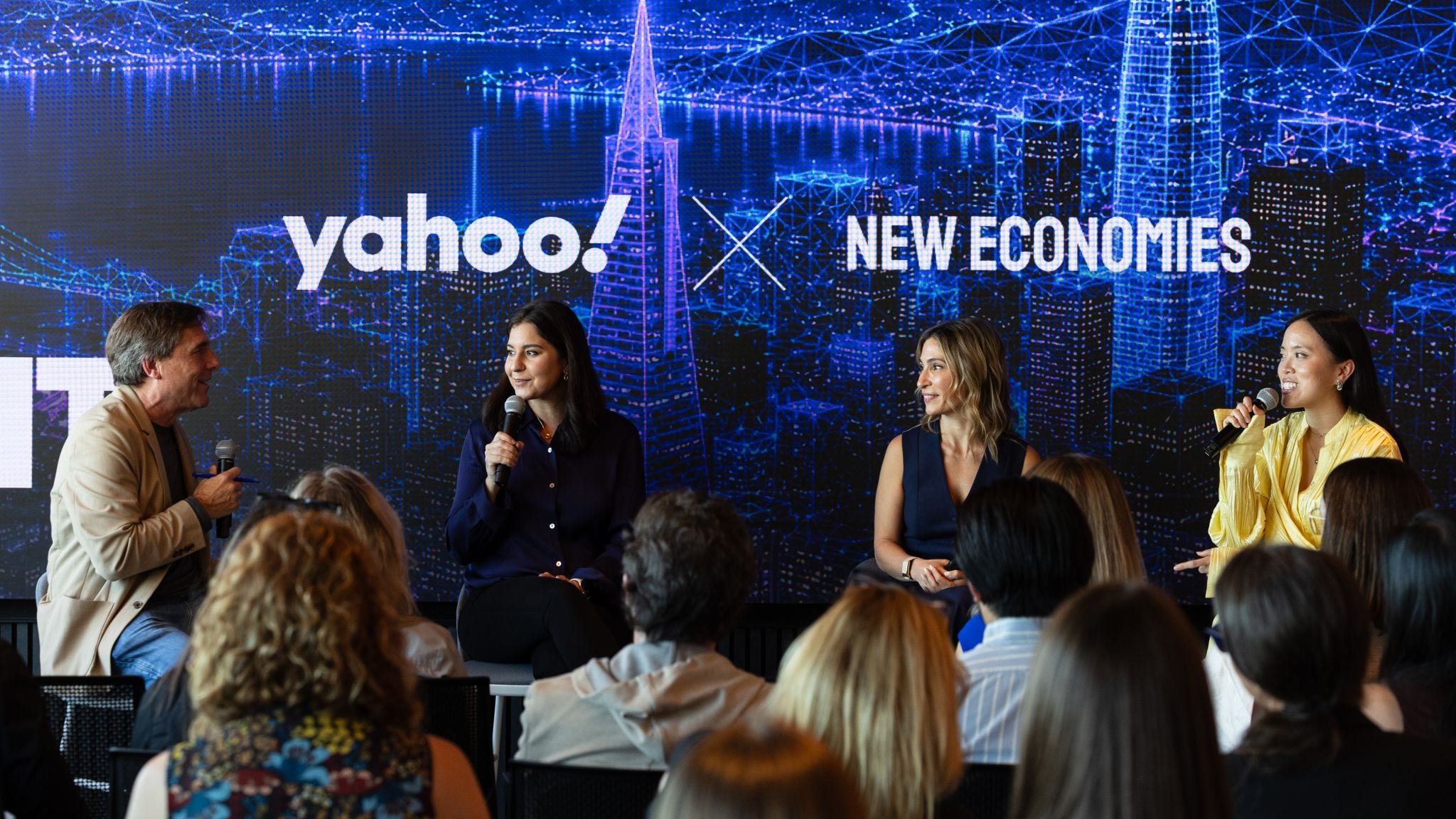
During San Francisco’s Tech Week 2026 a few weeks ago, we co-hosted our first NEW MEDIA Summit with Yahoo, bringing together media’s biggest names for candid conversations on where the industry goes next.This panel, moderated by Jim Louderback brought together Joanna Stern, founder of New Things, Sona Iliffe-Moon, Chief Communications Officer at Yahoo, and Lillian Xu, VP of Podcast Business at Vox Media. They discussed why Joanna left The Wall Street Journal after 12 years, how her NBC News partnership works, what the NPR and How I Built This deals mean for creators, how to keep audience trust while running ads, and what the internet will look like in five years.
Subscribe to stay ahead of technology trends. Never miss future editions.
In our in-depth episode, we discuss:
* Why Joanna Stern left The Wall Street Journal after 12 years, when 80% to 90% of her time was already going into YouTube, and how she de-risked going independent by negotiating her NBC partnership while still at the Journal
* Why owning your IP matters most, and what the Kevin Roose and Casey Newton NPR deal and Guy Raz buying back How I Built This say about how institutions now partner with talent
* How Vox Media is turning How I Built This into a franchise with video for the first time and the return of its two-day summit, and why Lillian Xu says every creator deal needs skin in the game and upside
* How Joanna keeps trust while reading ads: a physical “money mic,” a published ethics policy, and turning down a possible million-dollar deal rather than take money from the frontier labs she covers
* Why Sona Iliffe-Moon says brands can pay for a placement but never for an opinion, and why the panel thinks expert human voices, video and live events will win as AI summaries become part of our daily lives.
Watch or listen now across YouTube, Apple Podcasts, Spotify, and X
Download the transcript 👇
Timestamps
(0:00) Welcome to the New Media Summit(3:05) Meet Joanna Stern: Why she left The Wall Street Journal(7:28) How media companies are partnering with creators(11:09) What changes when a journalist goes independent(12:33) Do the NPR deals make sense?(17:58) How to keep your audience's trust(19:21) How creators partner with brands(27:00) Does the audience care about paid ads?(30:50) Quick-fire round
Lessons from these titans of media
Joanna Stern: New Things
Build a personal board. Joanna knows how to report and tell a story, but she’s the first to admit she doesn’t know how to sell, market or triple her growth. Her advice is to surround yourself with smart people from every side of the business, whether that’s a friend who understands sales or someone who knows marketing. They don’t need to work for you, but they need to be there when you need them.
Lillian Xu: VP, Podcast Business at Vox Media
Go in with your eyes open. Going independent is far more work than most people expect, so know what you’re taking on before you start. And when you strike a deal with a network or partner, make sure you have skin in the game and real upside, so everyone’s incentives are aligned.
Sona Iliffe-Moon: Chief Communications Officer at Yahoo
Lead with the relationship, not the sales deck. Brands can pay for a partnership or a placement, but they can never pay for an opinion, and the best paid work comes after a genuine relationship has been built. For comms teams, the rule with independent creators is the same as with any journalist: give them valuable information, access and respect.
Jim Louderback: Inside The Creator Economy
The rules of media are being rewritten in real time. Reporters are building their own companies, brands are finding their own voices and creators are hiring their own sales teams, so who pays whom is up for grabs. In that shift, trust is one of the few things that holds its value, and anyone building in this new world should guard it closely.
Subscribe to Jim’s newsletter, Inside The Creator Economy.
Where to connect with us
Follow Ollie on LinkedIn: https://www.linkedin.com/in/ollieforsyth
Follow Jim on LinkedIn: https://www.linkedin.com/in/jlouderbFollow Sona on LinkedIn: https://www.linkedin.com/in/sonamoonFollow Joanna on LinkedIn: https://www.linkedin.com/in/joannasternFollow Lillian on LinkedIn: https://www.linkedin.com/in/lillianlxu
Previous episodes include
Our partners:
Harmonic: Your go-to startup database. Visit Harmonic to learn more.
Prelint: Keeps every decision reviewed, recorded, and traceable. Head over to Prelint to learn more.
VCX: The public ticker for private tech. Head over to GetVCX.com to learn more.